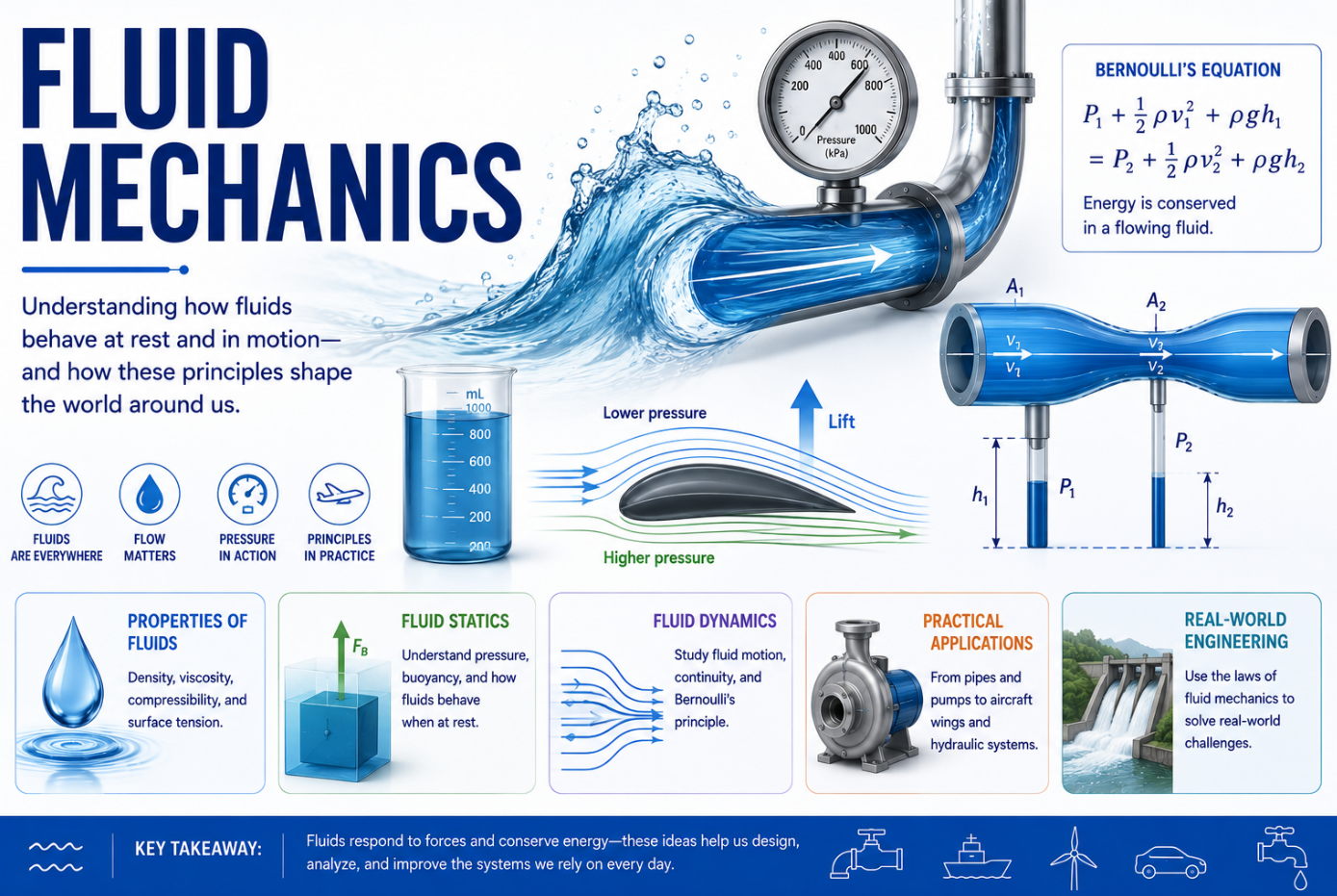
Fluids are everywhere. They flow through rivers and oceans, circulate through our bodies, move through pipes and engines, and even shape the weather around us. Understanding how liquids and gases behave is one of the most important areas of physics, helping scientists and engineers design everything from submarines and airplanes to water systems and medical devices.
This course begins by introducing the fundamental properties of fluids and the concept of density. Students will explore how density is measured, how it influences the behaviour of materials, and why some objects float while others sink. Through practical examples and investigations, they will discover how density helps explain many everyday phenomena.
Students will then examine pressure in fluids, learning how forces are distributed through liquids and gases. They will investigate how pressure changes with depth, how atmospheric pressure affects our environment, and how hydraulic systems use Pascal's Principle to multiply force. These concepts provide an important foundation for understanding many engineering and technological applications.
The course continues with an exploration of buoyancy and Archimedes' Principle. Students will investigate the upward force exerted by fluids and learn how floating and sinking can be explained through the relationship between density, weight, and displaced fluid. They will examine real-world applications involving ships, submarines, hot-air balloons, and aquatic organisms.
Next, students will study fluid flow and Bernoulli's Principle. They will explore how fluids move through pipes and channels, how flow speed and pressure are related, and how these ideas help explain aerodynamic lift and other important engineering principles. Students will discover how fluid flow influences transportation, aviation, and modern technology.
Throughout the course, students will connect fluid mechanics concepts to real-world systems including water distribution networks, weather patterns, ocean currents, biological systems, and engineering design. By combining scientific theory with practical applications, students will develop a deeper understanding of how fluids influence the world around us and how fluid mechanics contributes to solving modern challenges.
Main Topics
Unit 1: Density and the Properties of Fluids
Explore the fundamental characteristics of liquids and gases while learning how density influences the behaviour of materials, fluids, and floating objects.
Unit 2: Pressure in Fluids
Investigate how pressure acts within liquids and gases and discover how pressure is used in hydraulic systems, engineering, and natural environments.
Unit 3: Buoyancy and Archimedes' Principle
Learn how buoyant forces act on objects and explore the principles that explain floating, sinking, and the operation of ships and submarines.
Unit 4: Fluid Flow and Bernoulli's Principle
Examine how fluids move and how pressure, speed, and energy interact in flowing fluids, leading to applications in aerodynamics and engineering.
Unit 5: Fluid Mechanics in the Real World
Apply fluid mechanics concepts to weather systems, ocean currents, biological systems, engineering projects, and technological innovations.
Perfect For
- Middle school and early high school students studying physical science or physics
- Students preparing for advanced courses in physics, engineering, or environmental science
- Homeschool learners seeking a structured introduction to fluid mechanics
- Learners interested in understanding how fluids influence everyday life
- Students who enjoy applying mathematics and science to real-world problems
- Future engineers, scientists, pilots, architects, and technology professionals
By the End of This Course
Students will be able to:
- Distinguish between the properties of liquids and gases.
- Calculate and interpret density in a variety of situations.
- Explain why objects float, sink, or remain suspended.
- Calculate pressure and analyze pressure changes in fluids.
- Apply Pascal's Principle to hydraulic systems.
- Explain buoyancy using Archimedes' Principle.
- Analyze fluid flow using continuity and Bernoulli's Principle.
- Explain how lift is generated in aerodynamic systems.
- Apply fluid mechanics concepts to weather, oceans, biology, and engineering.
- Solve quantitative and conceptual problems involving fluids.
This course provides a strong foundation in fluid mechanics, helping students understand how liquids and gases behave and how these behaviours influence the natural world and modern technology. Through investigation, problem solving, and real-world applications, students will develop scientific reasoning skills that prepare them for future studies in physics, engineering, environmental science, and technology.
- Викладач: Young Mr.