Buoyancy and Archimedes' Principle
1. Buoyant Force
Learning outcomes
- I can define buoyant force and describe its direction.
- I can explain why fluids exert an upward force on objects.
- I can identify factors that affect buoyant force.
- I can compare buoyant forces acting on different objects.
- I can relate buoyant force to pressure differences in fluids.
Why can a huge ship float while a small metal coin sinks? Why does your body feel lighter when you are standing in a swimming pool? Why does a helium balloon rise through the air?
All of these situations involve buoyant force.
Buoyant force is produced because fluids exert pressure on objects. Since fluid pressure usually increases with depth, the bottom of a submerged object experiences greater pressure than the top. This pressure difference produces a net upward force.


What Is Buoyant Force?
Buoyant force is the upward force exerted by a fluid on an object that is partly or completely immersed in the fluid.
Buoyant force is sometimes called upthrust.
Its direction is:
upward
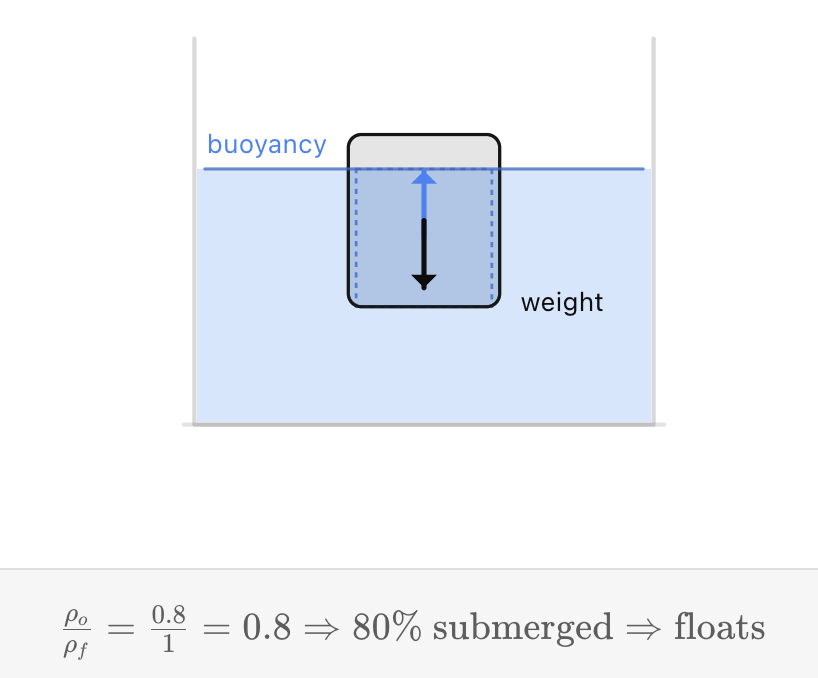
This is opposite to the direction of the object's weight, which acts downward.
For an object in water:
       ↑
  Buoyant force
       │
    [object]
       │
     Weight
       ↓
The motion of the object depends partly on the relationship between these two forces.
Fluids Produce Buoyant Force
Remember that a fluid is any substance that can flow.
This includes:
- liquids
- gases
Therefore, buoyant force occurs in both liquids and gases.
Water produces buoyant force on:
- swimmers
- boats
- submarines
- fish
- floating objects
Air produces buoyant force on:
- balloons
- airships
- objects in the atmosphere


Buoyancy is therefore not only a property of water.
All fluids can produce buoyant forces.
Where Does Buoyant Force Come From?
To understand buoyant force, we need to connect it to our previous topic: fluid pressure.
Recall that liquid pressure increases with depth:
greater depth → greater pressure
Imagine a rectangular block completely underwater.
Water pushes against every surface of the block.


The water pushes:
- downward on the top
- upward on the bottom
- sideways on the sides
The sideways forces largely balance each other.
But the bottom of the object is deeper than the top.
Therefore:
Pressure at bottom > Pressure at top
This means the upward force on the bottom is greater than the downward force on the top.
The result is a net upward force.
That net upward force is the buoyant force.
Connecting Pressure to Force
Remember:
Pressure = Force ÷ Area
Therefore:
Force = Pressure × Area
Suppose the top and bottom of an underwater block have the same area.
Because the bottom is deeper:
Pbottom > Ptop
Therefore:
Fbottom > Ftop
So:
larger upward force − smaller downward force = buoyant force
This gives us an important connection:
Buoyant force exists because fluid pressure changes with depth.
A Numerical Example
Imagine a rectangular object underwater.
The water produces:
Upward force on bottom = 80 N
and:
Downward force on top = 50 N
The sideways forces balance.
The net upward force caused by the pressure difference is:
Buoyant force = 80 N − 50 N
Buoyant force = 30 N upward
So the fluid produces a buoyant force of 30 N.
What Determines the Size of the Buoyant Force?
The buoyant force depends mainly on:
1. Volume of Fluid Displaced
An object that displaces more fluid experiences a greater buoyant force.
More fluid displaced → greater buoyant force
2. Density of the Fluid
A denser fluid produces a greater buoyant force for the same displaced volume.
Greater fluid density → greater buoyant force
3. Gravitational Field Strength
Stronger gravity increases the weight of the displaced fluid.
Greater gravitational field strength → greater buoyant force
These ideas can be summarized by Archimedes' Principle, which we will explore in more detail in the next topic.
Displacement
When an object enters water, it pushes some of the water out of the space it occupies.
This is called displacement.


A completely submerged object displaces a volume of water equal to its own volume.
For example:
An object with a volume of 500 cm³ that is completely underwater displaces:
500 cm³ of water
A partially submerged object displaces only the volume of the part below the water.
Exploring Buoyancy
The relationship between object density, fluid density and displaced fluid determines whether an object floats, sinks or remains suspended.