Fluid Flow and Bernoulli's Principle
1. Fluid Flow
Learning outcomes
- I can describe how fluids move through pipes and channels.
- I can distinguish between laminar and turbulent flow.
- I can identify factors that affect flow rate.
- I can explain how fluid speed changes in different situations.
- I can apply fluid flow concepts to real-world examples.
Fluids are constantly moving around us. Water travels through household pipes, blood moves through blood vessels, air flows through ventilation systems, rivers move toward the sea, and fuel travels through engines.
The study of moving fluids is called fluid dynamics.
Understanding fluid flow allows scientists and engineers to predict how quickly fluids move, how much fluid can pass through a system, and how the shape and size of a pipe or channel affect the flow.


What Is Fluid Flow?
Fluid flow is the movement of a liquid or gas from one location to another.
Remember that both liquids and gases are fluids because they can flow and change shape.
Examples include:
- water flowing through a pipe
- air moving through a ventilation duct
- blood moving through an artery
- water flowing along a river
- oil moving through a pipeline
- air moving around a vehicle
A fluid often flows because there is a difference in pressure, although gravity and other forces can also cause flow.
In general, fluid tends to move:
from higher pressure → toward lower pressure
Flow Through Pipes
Imagine water inside a horizontal pipe.
If the pressure at one end is greater than the pressure at the other end, the pressure difference can push the water through the pipe.


A larger pressure difference can generally produce a greater flow rate, provided other conditions remain the same.
This principle is important in:
- household plumbing
- water distribution systems
- hydraulic systems
- pipelines
- pumps
- blood circulation
Flow Through Open Channels
Fluids do not always travel through enclosed pipes.
A channel has a surface that is open to the atmosphere.
Examples include:
- rivers
- streams
- canals
- drainage ditches
- gutters


Gravity plays an especially important role in open-channel flow.
Water generally moves from:
higher elevation → lower elevation
The slope, shape, depth and roughness of the channel can all affect the flow.
Flow Rate
The flow rate describes how much fluid passes a particular location during a certain amount of time.
A simple equation is:
Flow rate = Volume ÷ Time
or:
Q = V/t
where:
- Q = volume flow rate
- V = volume of fluid
- t = time
Common units include:
- L/s
- L/min
- m³/s
Large rivers are often described using cubic metres per second (m³/s).
Worked Example 1: Calculating Flow Rate
A pipe delivers:
120 L of water in 30 s
Calculate the flow rate.
Use:
Q = V/t
Substitute:
Q = 120 ÷ 30
Q = 4 L/s
Answer
The flow rate is:
4 L/s
This means that every second, approximately 4 litres of water pass the measurement point.
Worked Example 2: Finding Volume
Water flows through a hose at:
6 L/min
How much water is delivered in 8 minutes?
Start with:
Q = V/t
Rearrange:
V = Qt
Substitute:
V = 6 × 8
V = 48 L
Answer
The hose delivers:
48 L of water
Flow Rate and Fluid Speed Are Different
It is important to distinguish between flow rate and fluid speed.
Fluid speed tells us how quickly individual parts of the fluid are moving.
It might be measured in:
m/s
Flow rate tells us how much fluid passes a point each second.
It might be measured in:
m³/s
A wide river may have relatively slow-moving water but still carry an enormous volume of water every second.
A narrow pipe may contain faster-moving water but transport a much smaller total volume.
Connecting Flow Rate, Area and Speed
For steady flow, volume flow rate can also be written as:
Q = Av
where:
- Q = volume flow rate (m³/s)
- A = cross-sectional area (m²)
- v = average fluid speed (m/s)
This relationship makes sense.
A wider pipe can carry more fluid at the same speed.
Similarly, faster-moving fluid carries more volume through the same pipe each second.
Worked Example 3: Flow Rate from Area and Speed
Water moves through a pipe with a cross-sectional area of:
0.020 m²
at an average speed of:
3.0 m/s
Calculate the flow rate.
Use:
Q = Av
Substitute:
Q = 0.020 × 3.0
Q = 0.060 m³/s
Answer
The flow rate is:
0.060 m³/s
What Happens When a Pipe Becomes Narrower?
Consider water flowing steadily through a pipe that changes diameter.


For a liquid that is approximately incompressible, the same amount of water entering the pipe each second must continue through the narrower section.
Therefore:
wide section → lower speed
narrow section → higher speed
This relationship is described by the continuity equation.
The Continuity Equation
For steady flow of an approximately incompressible fluid:
A₁v₁ = A₂v₂
where:
- A₁ = area of the first section
- v₁ = fluid speed in the first section
- A₂ = area of the second section
- v₂ = fluid speed in the second section
In simple terms:
If the pipe gets narrower, the fluid must move faster to maintain the same flow rate.
Worked Example 4: A Narrowing Pipe
Water moves through a pipe.
At the wide section:
A₁ = 0.04 m²
v₁ = 2 m/s
The pipe narrows to:
A₂ = 0.02 m²
Calculate the new speed.
Use:
A₁v₁ = A₂v₂
Substitute:
0.04 × 2 = 0.02 × v₂
0.08 = 0.02v₂
Therefore:
v₂ = 4 m/s
Answer
The water speed increases from:
2 m/s → 4 m/s
because the cross-sectional area was reduced by half.
A Garden Hose Example
You can observe this idea with a garden hose.
If you partly cover the opening with your thumb, the opening becomes smaller.
The water leaving through the smaller opening can move faster, assuming the supply can maintain sufficient flow.


This allows the water to form a faster jet.
Hose nozzles use this idea to control the shape and speed of the outgoing water.
Real hose systems are somewhat more complicated because narrowing the outlet can also change the overall flow rate and pressure losses.
Laminar Flow
Fluids do not always move in the same way.
One important type of flow is laminar flow.
In laminar flow, fluid moves in relatively smooth layers.
The layers move alongside each other with limited mixing.


Laminar flow is generally:
- smooth
- orderly
- predictable
- associated with relatively little mixing
We can imagine the fluid moving along smooth paths called streamlines.
Laminar Flow in a Pipe
In a pipe with laminar flow, fluid near the walls generally moves more slowly because of interactions with the pipe surface.
Fluid near the centre can move faster.
This produces a characteristic velocity pattern.


At the pipe wall, fluid speed is approximately zero relative to the wall.
Moving toward the centre, the speed increases.
The fastest flow occurs near the centre.
Turbulent Flow
The second major type is turbulent flow.
In turbulent flow, the fluid moves irregularly.
It contains:
- swirling
- mixing
- eddies
- rapidly changing motion


Turbulent flow is generally more chaotic than laminar flow.
Examples can include:
- fast-flowing rivers
- water around rocks
- rapidly moving air
- high-speed flow through large pipes
- water behind boats
Comparing Laminar and Turbulent Flow
| Laminar Flow | Turbulent Flow |
|---|---|
| Smooth | Irregular |
| Ordered layers | Strong mixing |
| Predictable streamlines | Swirls and eddies |
| Less mixing | More mixing |
| Often occurs at lower speeds | Often occurs at higher speeds |
The transition between these types of flow depends on several factors, not simply speed.
Reynolds Number
Scientists and engineers often use a quantity called the Reynolds number to help predict whether flow will be laminar or turbulent.
The Reynolds number depends on factors including:
- fluid speed
- fluid density
- viscosity
- characteristic size of the pipe or object
You do not need to calculate Reynolds number here, but its basic message is important:
Whether flow becomes turbulent depends on the properties of both the moving fluid and the system through which it moves.


Viscosity and Flow
Viscosity describes a fluid's resistance to flowing or deforming.
A fluid with high viscosity flows less easily.
Examples include:
- honey
- syrup
- thick oil
Fluids with lower viscosity include:
- water
- many gases


Compare water and honey flowing through identical narrow tubes.
The water usually moves much more easily.
The honey experiences greater internal resistance to flow.
Therefore:
higher viscosity → greater resistance to flow
when other conditions are similar.
Temperature Can Affect Viscosity
The viscosity of many liquids changes with temperature.
For many liquids:
higher temperature → lower viscosity
For example, warm cooking oil usually flows more easily than cold cooking oil.
This is important in systems involving:
- engine oils
- industrial fluids
- pipelines
- food processing
The exact relationship depends on the particular fluid.
Pipe Diameter and Flow
Pipe diameter can have a major effect on fluid flow.
A narrow pipe provides less cross-sectional area and, in real systems, can create much greater resistance to flow.


For a fixed pressure difference:
larger pipe → generally greater flow rate
smaller pipe → generally lower flow rate
This is one reason major water supply pipes are much wider than the pipes leading to an individual tap.
Pipe Length
Longer pipes generally produce greater resistance to flow.
As fluid travels through a pipe, interactions with the pipe wall contribute to energy losses.
Therefore, for otherwise similar conditions:
longer pipe → greater resistance → lower flow rate
if the pressure difference remains the same.
This is important when designing:
- water networks
- pipelines
- heating systems
- irrigation systems
Surface Roughness
The inside surface of a pipe also affects flow.
A smooth pipe generally produces less resistance than a rough pipe under comparable conditions.
Rough surfaces can increase disturbances and energy losses, particularly in turbulent flow.


Older pipes may develop:
- corrosion
- mineral deposits
- biological buildup
These can reduce the effective diameter and increase resistance.
As a result, the flow rate may decrease.
Pressure Difference
Pressure difference is another major factor.
A greater pressure difference can push fluid more strongly through a pipe.
Therefore, all else being similar:
greater pressure difference → greater flow rate
Pumps are often used to create or maintain this pressure difference.


Pumps are essential in:
- municipal water systems
- heating and cooling systems
- industrial processes
- irrigation
- fuel systems
Factors Affecting Flow Rate
Important factors include:
Pressure difference
Greater pressure difference generally increases flow.
Pipe diameter
Larger diameter generally allows greater flow.
Pipe length
Longer pipes generally increase resistance.
Viscosity
More viscous fluids generally flow less easily.
Surface roughness
Rougher surfaces can increase resistance.
Temperature
Temperature can change fluid viscosity and therefore affect flow.
Obstacles and bends
Valves, bends, fittings and obstructions can increase resistance and energy loss.
Rivers and Fluid Flow
River flow is more complicated than flow through a simple pipe.


River speed can be affected by:
- channel width
- channel depth
- slope
- rocks and obstacles
- surface roughness
- amount of water
- bends
- vegetation
Water near the riverbed and banks tends to experience more friction than water farther from these surfaces.
This creates differences in speed across the channel.
Narrow River Sections
If a river carries approximately the same volume of water per second through a narrower section, its average speed may increase.
The same continuity idea applies:
Q = Av
If:
Q stays approximately constant
and:
A decreases
then:
v must increase
However, real rivers are complicated because their depth, shape, turbulence and flow rate can also change.
Blood Flow
Blood flowing through the circulatory system is another important application of fluid dynamics.


The heart creates pressure differences that drive blood through vessels.
Blood flow is affected by:
- vessel diameter
- blood viscosity
- pressure difference
- vessel length
- elasticity of vessel walls
Changes in vessel diameter can strongly affect resistance to blood flow.
This is one reason blood vessels can help regulate blood distribution by narrowing or widening.
Ventilation Systems
Airflow through ventilation ducts follows many of the same principles as liquid flow through pipes.


Engineers must consider:
- duct diameter
- air speed
- pressure differences
- bends
- filters
- fans
- surface resistance
Poorly designed ductwork can create:
- excessive turbulence
- noise
- energy losses
- uneven airflow
Fluid-flow principles therefore help engineers design efficient heating, ventilation and air-conditioning systems.
Oil and Gas Pipelines
Long pipelines can transport fluids over hundreds or thousands of kilometres.


Engineers must determine:
- required pipe diameter
- fluid viscosity
- required pressure
- pumping power
- energy losses
- safe operating flow rates
Choosing a wider pipe may reduce resistance but requires more material and costs more to build.
Choosing a narrow pipe may cost less initially but require more pumping energy.
This is a classic engineering trade-off.
Laminar vs Turbulent Flow in Engineering
Neither type of flow is always "better."
Laminar flow can be useful when:
- smooth predictable motion is important
- mixing should be minimized
- energy losses should be reduced
Turbulent flow can be useful when:
- mixing is desirable
- heat transfer needs to be increased
- substances need to mix quickly
For example, turbulence can improve mixing in chemical processes.
So engineers sometimes try to reduce turbulence, while in other situations they deliberately create it.
Worked Example 5: Comparing Pipe Sections
Water flows steadily through a pipe.
Section A has:
Area = 0.030 m²
Speed = 2 m/s
Calculate the flow rate:
Q = Av
Q = 0.030 × 2
Q = 0.060 m³/s
The pipe then narrows to:
Area = 0.010 m²
Assuming the same steady flow rate:
0.060 = 0.010 × v
Therefore:
v = 6 m/s
Answer
The fluid speed increases from:
2 m/s → 6 m/s
as the cross-sectional area decreases.
Reading a Flow Rate Graph
Suppose we measure the volume of water that has passed through a pipe over time.
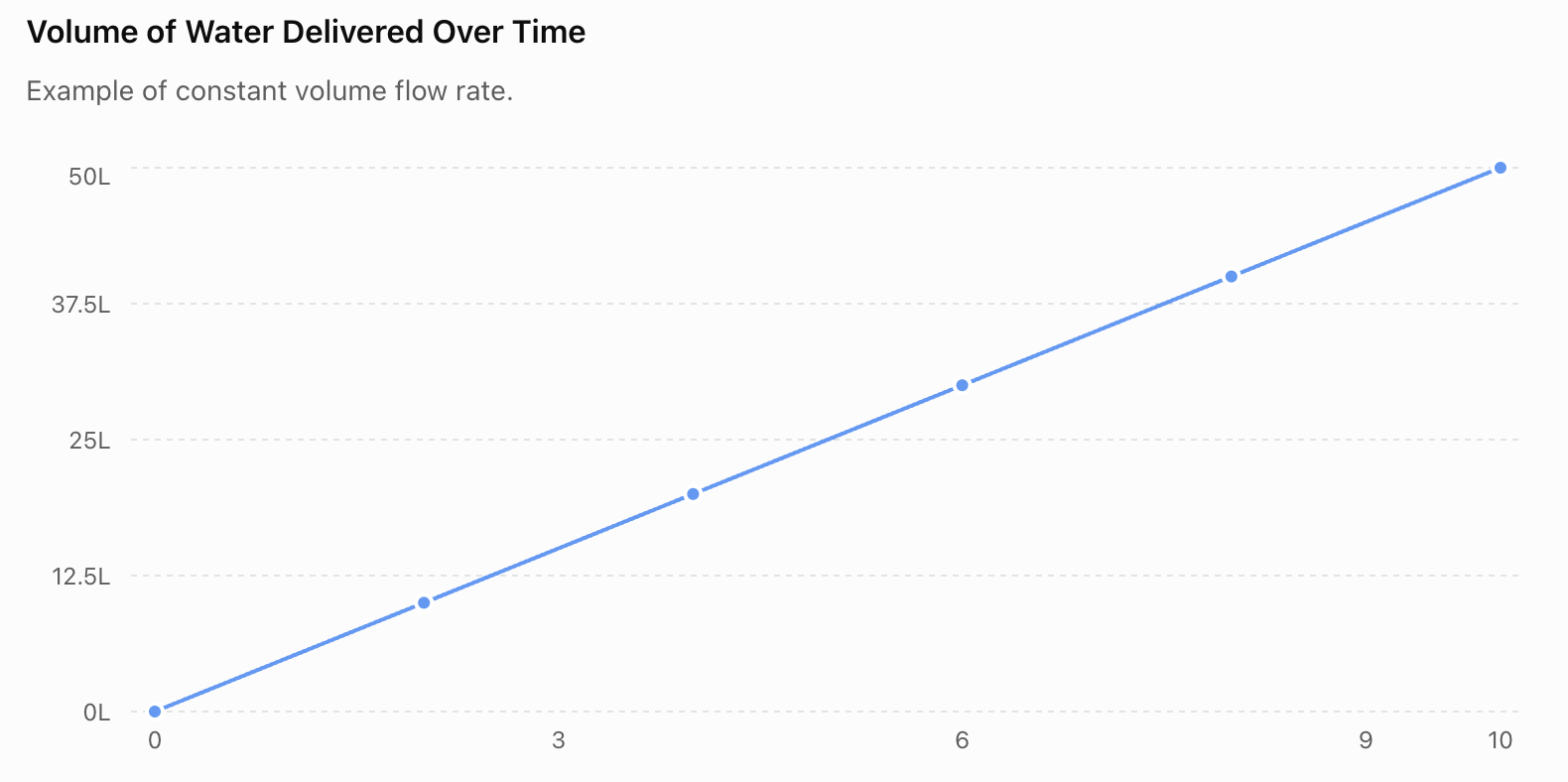
The graph shows:
50 L in 10 s
Therefore:
Q = 50 ÷ 10
Q = 5 L/s
The straight line indicates that the flow rate is constant.
The gradient of a volume-time graph represents the flow rate.
A steeper line means a greater flow rate.
Fluid Flow and Energy
Moving fluids carry energy.
However, some of this useful mechanical energy can be transferred because of:
- friction
- turbulence
- pipe bends
- valves
- rough surfaces
Engineers often describe these effects as flow losses or pressure losses.
Reducing unnecessary losses can make a system more energy efficient.
For example:
less resistance → less pumping energy required
This can significantly reduce operating costs in large systems.
Designing an Efficient Pipe System
Suppose an engineer needs to transport water through a building.
A good design should consider:
- required flow rate
- available pressure
- pipe diameter
- pipe length
- number of bends
- valves
- fluid properties
- energy use
- material cost
A very small pipe might be inexpensive but produce excessive resistance.
A very large pipe might reduce resistance but cost much more.
The engineer must choose a practical compromise.
Common Mistakes
Mistake 1: Confusing flow rate and fluid speed
They are related but different.
Speed tells us how fast the fluid moves.
Flow rate tells us how much fluid passes a point per unit time.
Mistake 2: Thinking fluids only flow because of gravity
Gravity can cause fluid flow, especially in rivers and drainage systems.
However, pressure differences can also drive flow.
Mistake 3: Saying narrow pipes always have greater flow rates
Not necessarily.
For a given steady incompressible flow, the fluid moves faster through the narrower section of the same flow path.
But a completely separate narrow pipe supplied by the same pressure difference often has a lower overall flow rate because it provides greater resistance.
These are different situations.
Mistake 4: Thinking laminar flow means the fluid is not moving
Laminar fluid is moving.
Its motion is simply smooth and orderly.
Mistake 5: Thinking turbulent flow means the fluid moves only forward
Turbulent fluid still has an overall direction of flow, but it also contains irregular fluctuations, mixing and eddies.
Mistake 6: Thinking turbulent flow is always undesirable
Turbulence can increase energy losses, but it can also improve:
- mixing
- heat transfer
- chemical reactions
Whether turbulence is useful depends on the application.
Mistake 7: Ignoring viscosity
Fluids do not all flow equally easily.
Honey and water behave very differently because their viscosities are different.
Mistake 8: Assuming fluid speed is the same everywhere across a pipe
Interactions with the pipe wall slow the fluid near the surface.
The velocity can therefore vary across the pipe.
Check Your Understanding
1. Recall
Define fluid flow and give two examples.
2. Flow Rate
A pipe delivers 300 L of water in 60 seconds.
Calculate the flow rate in L/s.
3. Calculate
A hose delivers water at 8 L/min.
How much water will it deliver in 15 minutes?
4. Compare
Describe two differences between:
laminar flow
and
turbulent flow.
5. Explain
Why does honey generally flow more slowly through a narrow tube than water under similar conditions?
6. Fluid Speed
Water moves through a pipe with:
A₁ = 0.06 m²
v₁ = 2 m/s
The pipe narrows to:
A₂ = 0.03 m²
Calculate v₂.
7. Apply
Explain why an old pipe containing mineral deposits might provide a lower flow rate than a clean pipe supplied under similar conditions.
8. Rivers
A river enters a narrower channel while approximately the same volume of water continues to pass each second.
Predict what happens to the average water speed and explain your reasoning.
9. Engineering
An engineer must choose between:
- a narrow, inexpensive pipe
- a wider, more expensive pipe
for a long-distance water system.
Explain one advantage and one disadvantage of each choice.
10. Challenge
A student says:
"A narrow pipe always has a greater flow rate because the water moves faster."
Explain why this statement is incorrect.
Your answer should clearly distinguish between fluid speed and volume flow rate.
Key Terms
- Fluid flow – movement of a liquid or gas
- Fluid dynamics – study of fluids in motion
- Flow rate – volume of fluid passing a point per unit time
- Volume flow rate – another term for volume transported per unit time
- Fluid speed – rate at which the fluid moves
- Cross-sectional area – area of a pipe or channel perpendicular to the direction of flow
- Laminar flow – smooth, orderly fluid motion
- Turbulent flow – irregular fluid motion involving mixing and eddies
- Streamline – path representing the direction of smooth fluid flow
- Viscosity – resistance of a fluid to flowing or deforming
- Pressure difference – difference in pressure that can drive fluid flow
- Continuity equation – relationship expressing conservation of fluid flow in a steady system
- Reynolds number – quantity used to help predict whether flow is laminar or turbulent
- Eddy – local swirling motion within a fluid
Key Takeaways
- Fluids can move through pipes, channels, vessels, ducts and natural waterways.
- Pressure differences and gravity are important causes of fluid flow.
- Volume flow rate can be calculated using Q = V/t.
- For flow through an area, Q = Av.
- For steady flow of an approximately incompressible fluid, A₁v₁ = A₂v₂.
- When the same steady flow passes through a narrower section, the fluid generally moves faster.
- Flow rate and fluid speed are not the same thing.
- Laminar flow is relatively smooth and orderly.
- Turbulent flow contains irregular motion, mixing and eddies.
- Flow is affected by pressure difference, pipe diameter, pipe length, viscosity, surface roughness, temperature, bends and obstacles.
- Fluid-flow principles are important in plumbing, rivers, blood circulation, ventilation, pipelines, irrigation and industrial systems.
- Engineers must balance flow rate, resistance, energy use, cost and safety when designing fluid systems.