Pressure in Fluids
1. What Is Pressure?
Learning outcomes
- I can define pressure as force acting per unit area.
- I can use the pressure equation to solve problems.
- I can explain how changing force or area affects pressure.
- I can identify examples of pressure in everyday life.
- I can compare situations involving high and low pressure.
Pressure is an important idea in physics because a force does not always have the same effect. The effect of a force depends partly on how large an area the force acts over.
A person standing on snow in ordinary shoes may sink deeply into it, while the same person wearing snowshoes may stay near the surface. Their weight has not changed—the difference is the area over which the force acts.


What Is Pressure?
Pressure is the force acting per unit area of a surface.
This means that pressure describes how concentrated a force is.
A large force acting over a small area produces high pressure.
The same force spread over a large area produces lower pressure.
Pressure is represented by the symbol P.
The SI unit of pressure is the pascal (Pa).
1 pascal = 1 newton per square metre
So:
1 Pa = 1 N/m²
The Pressure Equation
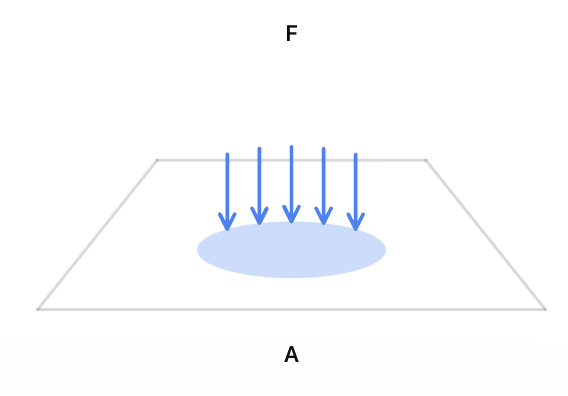
Pressure depends on two quantities:
- Force (F) measured in newtons (N)
- Area (A) measured in square metres (m²)
The relationship between these quantities can be explored below.
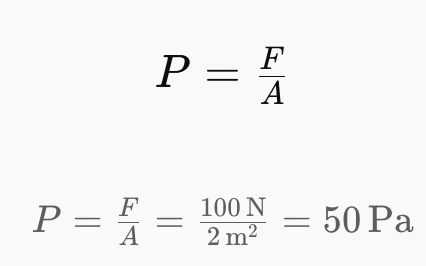
For calculations, this relationship is written as:
P = F ÷ A
where:
P = pressure (Pa)
F = force (N)
A = area (m²)
Example 1: Calculating Pressure
A box pushes down on the floor with a force of 600 N. The bottom of the box has an area of 2 m².
P = F ÷ A
P = 600 ÷ 2
P = 300 Pa
The box exerts a pressure of 300 Pa on the floor.
Rearranging the Pressure Equation
The equation can also be rearranged to calculate force or area.
To calculate force:
F = P × A
To calculate area:
A = F ÷ P
A useful equation triangle is:
        F
      ─────
       P A
Cover the quantity you want to calculate.
Example 2: Finding Force
A pressure of 500 Pa acts over an area of 4 m².
F = P × A
F = 500 × 4
F = 2000 N
The force is 2000 N.
Example 3: Finding Area
A force of 900 N produces a pressure of 300 Pa.
A = F ÷ P
A = 900 ÷ 300
A = 3 m²
The area is 3 m².
How Force Affects Pressure
If the area stays the same, increasing the force increases the pressure.
For example:
| Force | Area | Pressure |
|---|---|---|
| 100 N | 2 m² | 50 Pa |
| 200 N | 2 m² | 100 Pa |
| 400 N | 2 m² | 200 Pa |
When the force doubles, the pressure also doubles.
Therefore:
More force → greater pressure
Less force → lower pressure
This is a direct relationship when area remains constant.


How Area Affects Pressure
Area has the opposite effect.
If the force stays the same, spreading it over a larger area decreases the pressure.
For example:
| Force | Area | Pressure |
|---|---|---|
| 400 N | 1 m² | 400 Pa |
| 400 N | 2 m² | 200 Pa |
| 400 N | 4 m² | 100 Pa |
When the area doubles, the pressure is halved.
Therefore:
Smaller area → greater pressure
Larger area → lower pressure
This is an inverse relationship when force remains constant.
High Pressure: Small Contact Area
Sometimes we deliberately want to create high pressure.
A sharp knife has a very thin cutting edge. Because the force is concentrated over a tiny area, the pressure can become very large.
This allows the knife to cut through materials much more easily.


The same principle explains why we use:
- sharp needles
- nails with pointed ends
- axes
- scissors
- sharp knives
- pins
- ice-skate blades
These objects concentrate force onto a small area, producing high pressure.
Sharp vs Blunt Knife
Imagine pressing down with a force of 50 N.
If a blunt edge contacts an area of 0.01 m²:
P = 50 ÷ 0.01 = 5000 Pa
If a much sharper edge contacts an area of 0.001 m²:
P = 50 ÷ 0.001 = 50 000 Pa
The force is identical, but the sharper edge produces 10 times more pressure.
Low Pressure: Large Contact Area
In other situations, high pressure would cause problems.
Instead, we spread the force over a larger area.
Snowshoes are a good example.


A person's weight produces a downward force.
With ordinary boots, this force acts over a relatively small area.
With snowshoes, the same force is spread across a much larger area.
Therefore:
larger area → lower pressure → less sinking
Skis work in a similar way.
Pressure and Vehicle Tyres
Vehicles can also use large contact areas to reduce pressure on the ground.
Heavy agricultural machines could sink into soft soil because their enormous weight creates a large force.
Wide tyres spread that force over a greater area.


Some vehicles go even further and use tracks instead of tyres.
Tank and bulldozer tracks provide a large contact area with the ground.
This reduces ground pressure and helps heavy vehicles travel across softer surfaces.
High Heels and Flat Shoes
High-heeled shoes provide a useful everyday example.
Imagine two people of equal weight.
One wears flat shoes.
The other wears high heels.
Their weights may be identical, but the heel of a high-heeled shoe has a very small contact area.


The smaller area produces much greater pressure.
This explains why high heels can:
- sink into soft ground
- leave marks in wooden floors
- damage some surfaces
It also demonstrates an important principle:
A greater pressure does not necessarily mean a greater force.
The pressure can increase simply because the area decreases.
Lying Down vs Standing
Consider a person standing on the floor.
Their weight acts through the relatively small area of their feet.
Now imagine the same person lying flat on the floor.
Their weight has not changed, but the contact area is much larger.
Therefore, the pressure on the floor decreases.


This illustrates why it is important to consider both force and area when comparing pressure.
Pressure in Engineering
Engineers often need to control pressure.
For example, the foundations of a large building spread its weight across a large area of ground.
If the foundation were too small, the enormous weight of the building could create excessive pressure on the soil.


Engineers therefore design foundations that distribute forces safely.
Similar principles are used when designing:
- bridges
- roads
- dams
- cranes
- vehicles
- aircraft landing gear
- industrial machinery
Pressure and Animal Adaptations
Animals also show adaptations related to pressure.
Animals that live on soft surfaces often have relatively large feet.
For example, camels have broad feet that help spread their weight over the sand.


Animals living in snowy environments may also have wide paws or feet.
The larger contact area reduces pressure, helping them avoid sinking deeply into snow or sand.
Comparing High and Low Pressure
To compare pressure correctly, you need to consider both force and area.
| Situation | Force | Area | Pressure |
|---|---|---|---|
| Sharp needle | Moderate | Very small | Very high |
| Snowshoe | Same body weight | Large | Low |
| High heel | Same body weight | Very small | High |
| Flat shoe | Same body weight | Larger | Lower |
| Tractor with wide tyres | Large | Large | Reduced |
| Knife edge | Moderate | Very small | High |
A large force does not automatically mean high pressure.
Likewise, a small force does not necessarily mean low pressure.
You must consider how much area the force acts over.
A Useful Problem-Solving Method
When solving pressure problems:
Step 1: Identify the force.
Step 2: Identify the contact area.
Step 3: Check the units.
Force should normally be in newtons (N).
Area should normally be in square metres (m²).
Step 4: Choose the correct equation.
Step 5: Substitute the values.
Step 6: Calculate the answer.
Step 7: Include the correct unit.
Watch Out for Area Units
One common mistake in pressure calculations is forgetting to convert area into square metres.
For example:
1 m = 100 cm
but:
1 m² = 10 000 cm²
Therefore:
100 cm² = 0.01 m²
This difference is important because pressure calculations often involve relatively small contact areas.
Worked Example
A block exerts a downward force of 240 N. Its base measures 0.4 m × 0.2 m.
First calculate the area:
A = length × width
A = 0.4 × 0.2
A = 0.08 m²
Now calculate pressure:
P = F ÷ A
P = 240 ÷ 0.08
P = 3000 Pa
The block exerts a pressure of 3000 Pa.
Key Terms
- Pressure – force acting per unit area
- Force – a push or pull measured in newtons
- Area – the size of a surface
- Contact area – the area over which two surfaces touch
- Pascal (Pa) – SI unit of pressure
- High pressure – a relatively large force acting over a small area
- Low pressure – a force spread over a relatively large area
- Direct relationship – when one quantity increases as another increases
- Inverse relationship – when one quantity increases as another decreases
Key Takeaways
- Pressure is force acting per unit area.
- Pressure is measured in pascals (Pa).
- 1 Pa = 1 N/m².
- Increasing force while keeping area constant increases pressure.
- Increasing area while keeping force constant decreases pressure.
- Sharp objects create high pressure by concentrating force over a small area.
- Snowshoes, wide tyres, tracks, and foundations reduce pressure by spreading force over a large area.
- High pressure does not always mean a large force—the size of the contact area is equally important.
- Pressure is important in everyday life, engineering, transportation, construction, and biology.