1. Review of Trigonometric Functions

Learning outcomes
  • I can evaluate all six trigonometric functions for any angle.
  • I can interpret trigonometric values using the unit circle.
  • I can analyse the domains and ranges of trigonometric functions.
  • I can determine exact values using reference angles.
  • I can connect graphical, algebraic, and geometric representations.

Review of Trigonometric Functions

Trigonometry describes relationships between angles, coordinates, and ratios. Earlier trigonometry often focuses on the three functions: 

sinθ, cosθ, tanθ

However, there are actually six trigonometric functions:

sin, cos, tan, csc, sec, cot

Using the unit circle allows us to extend these functions beyond acute angles in right triangles and evaluate them for angles in all four quadrants.

https://images.openai.com/static-rsc-4/AYlLTcJcNCDdz5iH0OFoHp0cr8t2H7GwdBrYPHVMrd2Ytx4Lp8gTRvn_0HelgJ8aAqCWFAPKBoq2WuAaxnuD4B6s_g3Kvu0tsoEXxV1pcJCIWMElOTU-CafdDe3Ym1Eopn9Ty3R0S8vaHwXZdVKkoQMxaXEVm2rLPJfGGeVrMpwXw5KJBxCmPlRCuUylnnOh?purpose=fullsize
 
https://images.openai.com/static-rsc-4/ZMrsgwm4IXeJUqtGsePbwas1LBaTU2Bc59JwUoCtcuv-5f4K0x1EyWpX1E0GOZgyRmzQ1HNlvjXAlvjSZQ7v13N-khEpLOCLI4ce0fUdLobo_ebKXUkNlsnp-wkAscib0V2czQ3r5L7uhmSeeCOhg7Iw6XJRTYsXkDSYb84tm_TyyTgL8R8hizuXUO_ICslx?purpose=fullsize
 
https://images.openai.com/static-rsc-4/crHTQwMdoxJOCMe_KAn9TAhusT1zKt6xW8peRNoatDaGagZAFcxFmIHGKXcnLz-a83D5iMYeuPWN38shTbc2avWzVFsxFz7BB5SjS0sfDNLOYbZNW3s3131VBLxo8RiRCSTpasQOEcvzAVDMbhbvx-exNjn02Jewhp6pQ29M27gX6gehuXWrOn6ENfbHb-0I?purpose=fullsize
5

The Six Trigonometric Functions

For a right triangle, remember:

\( sin \theta = \frac{opposite}{hypotenuse} \)

\( cos \theta = \frac{adjacent}{hypotenuse} \)

\( tan \theta = \frac{opposite}{adjacent} \)

A common memory aid is:

SOH – CAH – TOA

  • Sine = Opposite / Hypotenuse
  • Cosine = Adjacent / Hypotenuse
  • Tangent = Opposite / Adjacent

The Reciprocal Functions

The other three trigonometric functions are the reciprocals of sine, cosine, and tangent.

Cosecant

\( csc \theta = \frac{1}{sin \theta } \)

Secant

\( sec \theta = \frac{1}{cos \theta } \)

Cotangent

\( cot \theta = \frac{1}{tan \theta } \)

Since:

\( tan \theta = \frac{sin \theta }{cos \theta } \)

we can also write:

\( cot \theta = \frac{cos \theta }{sin \theta } \)


The Unit Circle

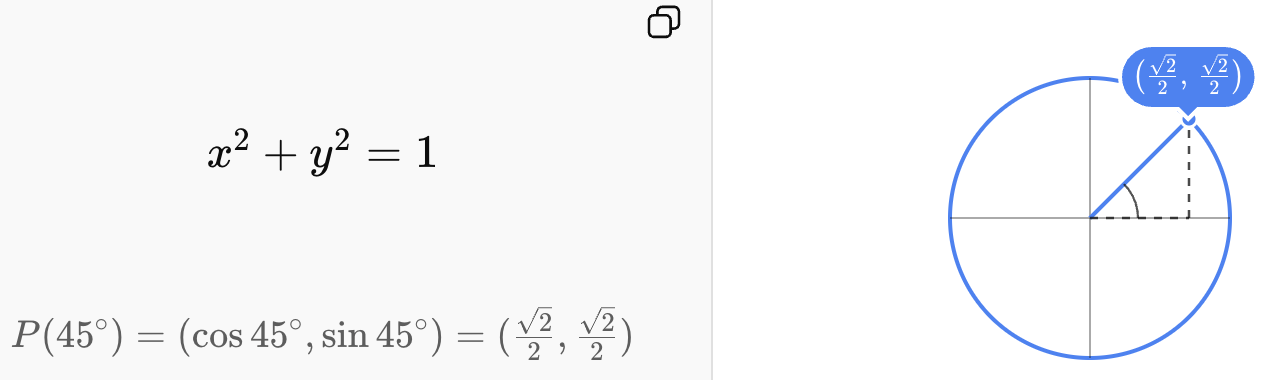
The unit circle is a circle centred at the origin with radius 1.

It provides one of the most powerful ways to understand trigonometric functions.

For an angle

θ\theta

in standard position, the point where its terminal side intersects the unit circle has coordinates:

(cosθ, sinθ)

Therefore:

  • x-coordinate = cosθ
  • -coordinate = sinθ

This connection allows us to evaluate trigonometric functions for angles much larger than 90o, as well as negative angles.


The Six Functions on the Unit Circle

If a point on the unit circle is: (x, y) then:

sinθ = y

cosθ = x

and:

\( tan \theta = \frac{y}{x} \)

The reciprocal functions become:

\( csc \theta = \frac{1}{y} \)

\( sec \theta = \frac{1}{x} \)

\( cot \theta = \frac{x}{y} \)

So all six trigonometric functions can be determined from the coordinates of a point on the unit circle.


Example Using Coordinates

Suppose a point on the unit circle is:

\( ( \frac{3}{5}, \frac{4}{5}) \)

(35,45)\left(\frac35,\frac45\right)

Then:

\( cos \theta = \frac{3}{5} \)

and:

\( sin \theta = \frac{4}{5} \)

Therefore:

\( tan \theta = \frac{sin \theta }{cos \theta } = \frac{ \frac{4}{5} }{ \frac{3}{5} } = \frac{4}{3} \)

The reciprocal functions are:

csc⁡θ=54\csc\theta=\frac54sec⁡θ=53\sec\theta=\frac53cot⁡θ=34\cot\theta=\frac34

So:

sin⁡θ=45,cos⁡θ=35,tan⁡θ=43\boxed{ \sin\theta=\frac45,\quad \cos\theta=\frac35,\quad \tan\theta=\frac43 }csc⁡θ=54,sec⁡θ=53,cot⁡θ=34\boxed{ \csc\theta=\frac54,\quad \sec\theta=\frac53,\quad \cot\theta=\frac34 }

Important Angles

Several angles appear repeatedly in trigonometry.

The most important are:

0∘,30∘,45∘,60∘,90∘0^\circ,\quad30^\circ,\quad45^\circ,\quad60^\circ,\quad90^\circ

Their radian equivalents are:

0,π6,π4,π3,π20,\quad\frac{\pi}{6},\quad\frac{\pi}{4},\quad\frac{\pi}{3},\quad\frac{\pi}{2}

Students should become familiar with their exact sine and cosine values.

Angle Radians sin⁡θ\sin\theta cos⁡θ\cos\theta tan⁡θ\tan\theta
0∘0^\circ 00 00 11 00
30∘30^\circ π/6\pi/6 1/21/2 3/2\sqrt3/2 3/3\sqrt3/3
45∘45^\circ π/4\pi/4 2/2\sqrt2/2 2/2\sqrt2/2 11
60∘60^\circ π/3\pi/3 3/2\sqrt3/2 1/21/2 3\sqrt3
90∘90^\circ π/2\pi/2 11 00 undefined
https://images.openai.com/static-rsc-4/GGcEpM3vL5YZyzs2gxJqJh53NddKuH6GFaKuPAT7D-gmFGoEd4zzM_CuMNzh0K6F3SNkbJLnCvoQ9qLb9I7-oMP_a45T13q2jqY7IBl1aT5neGglcgBYqL4vuGjkxHLk268_AAghBhAwoIW43Nq-1ChmC43woNfT-xhS7h9K11IZ8s_AkhjcUrN6rmFx8Iqh?purpose=fullsize
https://images.openai.com/static-rsc-4/lsNJAaMP95CT9yBAKAu8T5itMew__faYzNNSUHsdC8Dws99XEcdgd73BkbDFj9UyJD5jq0nNzwHYEXjEa_DB2Zdjt4BHrT4aJdsxiH5MreLDWJ5M08O9IwLVMiv4at-bgtm5WSJdAdFix1cXNZHrEIyzZhEfH1iVwyk6GTHOg2OMhF33RJxoa8iCHqxVbcd4?purpose=fullsize
https://images.openai.com/static-rsc-4/et6gLFI2CvI3F_Ouw0zqbW0oVsI5sPnkQMP-7JTu4TOenDnnmNJEI2SLfp-Zp-YDHkzmdLCuIji_hE_kbCR73IyExcalTLoJ00ftX7bHk36u6dycwmjAaUozbQ4qnNKjRWDraKyzn3EWKCr3lAEA-pTaswv6F8kKEn6DInKmSsKklGRG1I9jPE00XLB1Kwgq?purpose=fullsize
4

Exact Values

An exact value is written without rounding to a decimal.

For example:

sin⁡60∘=32\sin60^\circ=\frac{\sqrt3}{2}

is exact.

A calculator might give:

sin⁡60∘≈0.866\sin60^\circ\approx0.866

This is an approximation.

When a question asks for an exact value, answers should normally remain as fractions and radicals.


Special Triangles

The exact values on the unit circle come from two important right triangles.

45°–45°–90° Triangle

Its side ratio is:

1:1:21:1:\sqrt2

Therefore:

sin⁡45∘=12=22\sin45^\circ=\frac{1}{\sqrt2} =\frac{\sqrt2}{2}

and:

cos⁡45∘=22\cos45^\circ=\frac{\sqrt2}{2}

30°–60°–90° Triangle

Its side ratio is:

1:3:21:\sqrt3:2

Therefore:

sin⁡30∘=12\sin30^\circ=\frac12cos⁡30∘=32\cos30^\circ=\frac{\sqrt3}{2}sin⁡60∘=32\sin60^\circ=\frac{\sqrt3}{2}cos⁡60∘=12\cos60^\circ=\frac12
https://images.openai.com/static-rsc-4/s3tdEQDweqAj8Kvslhpc5xAHue5QMibnapU0z6mxCuqySWa1N50iRRZBz_OYUBTWzxHhkHwG4XRgrt0uO1AIFG68cL5-t0cp6yT8gcUxFuqBrvi3ny30OP9D1GcQLmCIjIxUU-X5ogTNlRLbPkq4lT5FeGd1HTu3Jdm1GKWIU-cAsuoCB3rNma_qTJ1341ys?purpose=fullsize
https://images.openai.com/static-rsc-4/OuEtUYQd0D9M_YNJjJa3u0ju55T1oE2RxX-bKhWXhg0HNOTTGhOnSLJgeWkIrBxvCEMfGI7lCJ0gf_WPH_T2MBwNbBpofoXLcpFlr1JrBMXmjibs25uTCO2FWy9aE7RUC3q3LK3Z1BMm7Vh7QxR4fiMlh9232RMoyDT1alGpQATORA6CrtUcKSZPUuB8rCM2?purpose=fullsize
https://images.openai.com/static-rsc-4/9c1q0V2Ucw-loWguvPgnrRsfUdU-FYfyvcj9qliXfqFLeUXMEb78m69Bsr8QxoRjScK9ZlVmHeVPWgtAieKddGZA_pj6v7J7kKEhUcKOiOCfRT6TEhmAPpFQ-vB3RK5HKcVF2zPFC60aFt_uSMZNhrwHEWKYtx0_16DFtiZVfczrFILwUty_GOxXtO8RZ2rw?purpose=fullsize
4

The Four Quadrants

The coordinate plane is divided into four quadrants.

The signs of sine, cosine, and tangent depend on the quadrant containing the terminal side of the angle.

Quadrant I

sin⁡+,cos⁡+,tan⁡+\sin+,\quad\cos+,\quad\tan+

Quadrant II

sin⁡+,cos⁡−,tan⁡−\sin+,\quad\cos-,\quad\tan-

Quadrant III

sin⁡−,cos⁡−,tan⁡+\sin-,\quad\cos-,\quad\tan+

Quadrant IV

sin⁡−,cos⁡+,tan⁡−\sin-,\quad\cos+,\quad\tan-
https://images.openai.com/static-rsc-4/L5VnTUUWvrSWnm2jK3oa86eSTNeO91lr5pDjsjbLg-6xOxwn1oni1lGAuMlyD4hulh3irexQddCefudokR00vcJk1Z7YlIo2tMCbcAvyXzN2ommMKTjJpQkRxXJYhXWS6hqbCIzt-tkj-wOVUaUkFnrIj9UubV1PvG4xh9A4MguOILQcRwKm-9Ywk8dLiffF?purpose=fullsize
https://images.openai.com/static-rsc-4/_Ncs1zFB0FpmuaqpjPy_0Mjvc_ntmjfUyPXmWrlGJwHwA1enDOopCSiV-J6aVRksUGuOkHRjZP0a6h5270RIqrUfLyEpJ_BQueiq5Y5eUXPcfzyD21O7VMRMKBuGj4IOJS9qhFj6Bd1M17-q5SoQRmNWlWPomznknQUL67kiyQb3cZ3r-2oZBqyEurLsJGCl?purpose=fullsize
https://images.openai.com/static-rsc-4/c9dZlBKEdTe6MAObMi9xtqBfUmVmpZZgVAtieCOZvCIAXcsfgeB3FgjLpQ2OMW8e3iBE8X4YeES0geQRmf3KHI-E4Gypzhg4yYC8sl52_sc5q_aFzd3DJekriq9YCuKnMXfdGBn0anChV99Zd1wiXs8IaswnkUO3cqrt8RzDySPUNbbAijIVIc446uX-CF96?purpose=fullsize
5

A common memory aid is ASTC:

  • Quadrant I – All positive
  • Quadrant II – Sine positive
  • Quadrant III – Tangent positive
  • Quadrant IV – Cosine positive

The reciprocal functions have the same signs as their corresponding functions:

  • cosecant has the same sign as sine
  • secant has the same sign as cosine
  • cotangent has the same sign as tangent

Reference Angles

A reference angle is the positive acute angle formed between the terminal side of an angle and the

xx

-axis.

Reference angles allow us to use familiar exact values for angles in any quadrant.

For example:

150∘150^\circ

is in Quadrant II.

Its reference angle is:

180∘−150∘=30∘180^\circ-150^\circ=30^\circ

We therefore use the values associated with

30∘30^\circ

.


Example: Evaluate

sin⁡150∘\sin150^\circ

Reference angle:

30∘30^\circ

We know:

sin⁡30∘=12\sin30^\circ=\frac12

Sine is positive in Quadrant II.

Therefore:

sin⁡150∘=12\boxed{\sin150^\circ=\frac12}

Example: Evaluate

cos⁡150∘\cos150^\circ

Again, the reference angle is:

30∘30^\circ

We know:

cos⁡30∘=32\cos30^\circ=\frac{\sqrt3}{2}

But cosine is negative in Quadrant II.

Therefore:

cos⁡150∘=−32\boxed{\cos150^\circ=-\frac{\sqrt3}{2}}

Example: Evaluate

tan⁡225∘\tan225^\circ

The angle

225∘225^\circ

lies in Quadrant III.

Its reference angle is:

225∘−180∘=45∘225^\circ-180^\circ=45^\circ

We know:

tan⁡45∘=1\tan45^\circ=1

Tangent is positive in Quadrant III.

Therefore:

tan⁡225∘=1\boxed{\tan225^\circ=1}

Finding Reference Angles

For angles between

0∘0^\circ

and

360∘360^\circ

:

Quadrant I

θR=θ\theta_R=\theta

Quadrant II

θR=180∘−θ\theta_R=180^\circ-\theta

Quadrant III

θR=θ−180∘\theta_R=\theta-180^\circ

Quadrant IV

θR=360∘−θ\theta_R=360^\circ-\theta

where

θR\theta_R

is the reference angle.


Evaluating All Six Functions

Suppose:

θ=120∘\theta=120^\circ

Step 1 – Find the reference angle

180∘−120∘=60∘180^\circ-120^\circ=60^\circ

Step 2 – Identify the quadrant

120∘120^\circ

is in Quadrant II.

Therefore:

  • sine is positive
  • cosine is negative
  • tangent is negative

Step 3 – Find the first three functions

sin⁡120∘=32\sin120^\circ=\frac{\sqrt3}{2}cos⁡120∘=−12\cos120^\circ=-\frac12tan⁡120∘=−3\tan120^\circ=-\sqrt3

Step 4 – Use reciprocals

csc⁡120∘=23=233\csc120^\circ=\frac{2}{\sqrt3} =\frac{2\sqrt3}{3}sec⁡120∘=−2\sec120^\circ=-2cot⁡120∘=−13=−33\cot120^\circ=-\frac{1}{\sqrt3} =-\frac{\sqrt3}{3}

Therefore all six functions can be determined from the reference angle and quadrant.


Domains and Ranges

A function's domain tells us which input values are allowed.

Its range tells us which output values are possible.

The six trigonometric functions have different domains and ranges.


Sine

Because sine represents the

yy

-coordinate on the unit circle:

−1≤sin⁡θ≤1-1\leq\sin\theta\leq1

Domain

All real numbers\boxed{\text{All real numbers}}

Range

[−1,1]\boxed{[-1,1]}
https://images.openai.com/static-rsc-4/XQTU74ysT06-5jUhrgBHatqKseX9e2NEjDiPc0sO7oO0a-jpICwxEJjhTqXHy6F14uhySHRmSPjDG5lnK20mA0ep_JPZU3u-4AZCUBUpKf3dD8wzuecv-70gBHuMkUdLUDv9JxME53JfWNtsvLrOkM1rCPdIcwsFQLN9yOPxFbFriL_WJM1K-3SLNU21EvTA?purpose=fullsize
https://images.openai.com/static-rsc-4/x03Cemdd_LHLnpyDG3V_PVT0wxok7Y-1-dyu3uyxkDWtE_b-PBbs2sL9K4r57bdp2iM-GDv0MXqVo_xHqAz5QMS9Fue4n42bzUbq266kXxcPEV_pYs0AEiiHJlTnozKPJ43gwdBJwG55YMUcj8ZZRdt35mY2jileP5PU9dKa3FXOEPLeetsfN0hVZYYcVsPI?purpose=fullsize
https://images.openai.com/static-rsc-4/OQU1TqjNseZDn8Eck14REnOcplsKkgul1luKPgIibU-UnGpf2e9biUitbiTNv7xgKJ6XHLz2B5vFH47Q5BFF9kEesQt1bSwQD3zlU-CwmuxP0W-mbbnDNDn-01bY-inFYjUgyLYcHuaA9GowhEdmnOYgTqA9NC6b4mtM3PrGxeQxLCeIBlswpK-eE05n8KwW?purpose=fullsize
4

Cosine

Cosine represents the

xx

-coordinate on the unit circle.

Therefore:

−1≤cos⁡θ≤1-1\leq\cos\theta\leq1

Domain

All real numbers\boxed{\text{All real numbers}}

Range

[−1,1]\boxed{[-1,1]}
https://images.openai.com/static-rsc-4/dZGTgKfCzg2L4ZjjKfba4_gm3MbM8iHqUMuq9ysH_MJHE3IeNeLQmFfxU3pL1z7SFmA1UMECJYuMwijeeW6dXN1aOFsjsr8IrrSSWWZT_3S0P_C5S2OxTlma_Jo5fMJ9EVaE6ammF0g3JGOVTdFbqqqeWqzq77chRu9UQUVPMDfBqq4A95nbLoszL2ksK-ni?purpose=fullsize
https://images.openai.com/static-rsc-4/d-VctNM6IKVnU9DcEIMh3FjOy1-4X4DUqEbD0JVtzwf5gcQblF2jwCUycL3jZ8JAMAUhLcP5RfwImAffDy4t5se77rd3KI32AA_lvgCghj80IU_gKHGD01xtN9fyS6Re0YCSUnsiczUtrRfqbMtqHB-ytze5hZTJuacYcoeXCFTXeTGT0qWzrb53wLMXS1t6?purpose=fullsize
https://images.openai.com/static-rsc-4/7ikkrK387L-5imCQI__9OaYt-rdcJEx9jutO1-pffGv7IxKRYSBFB78WZyLeIdlNVrZ_U-pp3vkSE2kr7VqudlgF2kuMcNihEZ8946QKFnwyAe0-6vjjFxdpCfe_If2_bO8iSGiIJpV-gLRzuubrXIBTIKGVGwC88mSgFEnpNg2MaNHeNHW_mADHnD7r-ZNS?purpose=fullsize
5

Tangent

Tangent can be written as:

tan⁡θ=sin⁡θcos⁡θ\tan\theta=\frac{\sin\theta}{\cos\theta}

Division by zero is undefined.

Therefore tangent is undefined whenever:

cos⁡θ=0\cos\theta=0

This occurs at:

90∘,270∘,450∘,…90^\circ,\quad270^\circ,\quad450^\circ,\ldots

or generally:

θ=90∘+180∘k\theta=90^\circ+180^\circ k

where

kk

is any integer.

Domain

All real numbers except:

θ=π2+kπ\boxed{\theta=\frac{\pi}{2}+k\pi}

Range

(−∞,∞)\boxed{(-\infty,\infty)}
https://images.openai.com/static-rsc-4/V3511v9qclzq0r_c0d91liXcg0nGQOogIBd8g3G5avDR1FKz1t6naebTdh18K0n41MMoeBppaM-diL5HoAyEqgg_a0UsebXrK_uUpRsHat0c90_dizAocrAIrXzNHeXV7AwSoEVjVRcCkMWZpDI47cFQQwEcJcfySad88IHrr1nNhnJfkacXXlqN_ZZsM3Xi?purpose=fullsize
https://images.openai.com/static-rsc-4/qQJ1iv2DZDmRWyyMlchD8-w9rcJP_lp0VdnFuclnvfqtcQFWc7gN3yKNAzNfsSmQi1WLWu4u8KWKOwh1faI9vwVfbSWW2VoEtTvOwf_pxnmwzsE0lcvrDgNNJX5Z2DcDk09LI1NgpJz_C8z_rWfCx3NGlNpTRvJcm9IiCTsYPmZgivj05mJ3YlQ8on9TyG6L?purpose=fullsize
https://images.openai.com/static-rsc-4/m8jDlNniT4_YxcSCSEZFSR06vdnaGbcXwKDEjX2Q8eYeYsGRgNj1g-3bHaDVXi-ek5b2EBG3TTzqeh5xT41Dne6RDj7NTmaf-PxRAXgSm6q2vueYiGHbvPWydSAXO_1CFJNIIG2App4m5Cy6-sB-p3mDjr2u6CsXK8aDBoa-VDYy2_suzZUvjGaO6Y1-PYaz?purpose=fullsize
5

Cosecant

Since:

csc⁡θ=1sin⁡θ\csc\theta=\frac{1}{\sin\theta}

cosecant is undefined whenever:

sin⁡θ=0\sin\theta=0

Therefore:

Domain

All real numbers except:

θ=kπ\boxed{\theta=k\pi}

Range

Since sine lies between

−1-1

and

11

, cosecant cannot have values strictly between

−1-1

and

11

:

(−∞,−1]∪[1,∞)\boxed{(-\infty,-1]\cup[1,\infty)}

Secant

Since:

sec⁡θ=1cos⁡θ\sec\theta=\frac{1}{\cos\theta}

secant is undefined whenever:

cos⁡θ=0\cos\theta=0

Domain

All real numbers except:

θ=π2+kπ\boxed{\theta=\frac{\pi}{2}+k\pi}

Range

(−∞,−1]∪[1,∞)\boxed{(-\infty,-1]\cup[1,\infty)}

Cotangent

Since:

cot⁡θ=cos⁡θsin⁡θ\cot\theta=\frac{\cos\theta}{\sin\theta}

cotangent is undefined whenever:

sin⁡θ=0\sin\theta=0

Domain

All real numbers except:

θ=kπ\boxed{\theta=k\pi}

Range

(−∞,∞)\boxed{(-\infty,\infty)}

Comparing Domains and Ranges

Function Domain Restrictions Range
sin⁡θ\sin\theta None [−1,1][-1,1]
cos⁡θ\cos\theta None [−1,1][-1,1]
tan⁡θ\tan\theta θ≠π2+kπ\theta\neq\frac{\pi}{2}+k\pi All real numbers
csc⁡θ\csc\theta θ≠kπ\theta\neq k\pi y≤−1y\leq-1ory≥1y\geq1
sec⁡θ\sec\theta θ≠π2+kπ\theta\neq\frac{\pi}{2}+k\pi y≤−1y\leq-1ory≥1y\geq1
cot⁡θ\cot\theta θ≠kπ\theta\neq k\pi All real numbers

Here:

k∈Zk\in\mathbb{Z}

means

kk

can be any integer.


Connecting Geometry and Algebra

Trigonometric functions can be understood in several different ways.

Geometrically

Using right triangles:

sin⁡θ=oppositehypotenuse\sin\theta=\frac{\text{opposite}}{\text{hypotenuse}}

Using the Unit Circle

Using coordinates:

(cos⁡θ,sin⁡θ)(\cos\theta,\sin\theta)

Algebraically

Using identities such as:

tan⁡θ=sin⁡θcos⁡θ\tan\theta=\frac{\sin\theta}{\cos\theta}

and:

sin⁡2θ+cos⁡2θ=1\sin^2\theta+\cos^2\theta=1

Graphically

Using graphs such as:

y=sin⁡xy=\sin x

and:

y=cos⁡xy=\cos x

These are not separate ideas. They are different representations of the same mathematical relationships.


Connecting the Unit Circle to the Sine Graph

Imagine a point moving counterclockwise around the unit circle.

Its vertical coordinate is:

sin⁡θ\sin\theta

As the point travels around the circle, its vertical position changes:

0→1→0→−1→00\rightarrow1\rightarrow0\rightarrow-1\rightarrow0

These values produce the familiar sine wave.

https://images.openai.com/static-rsc-4/avrSua6eIyd4C_4M-SH7OOucwvSwEFJwJ610jMu6_3umymz6sU5NqWjgLqFyN5nzP3h_4nsAud_NSkBrX4t6pxCcJFH6EpL_TimHzgckHOKGkrmfp8gTWZ2ZUMIVFrIekGVS1GH9eUux34uHohaxm-0aV21npfAe1MW0kPcAYApwEp4TCU1k9LrAjTb3yjbV?purpose=fullsize
https://images.openai.com/static-rsc-4/ZzyFAp7DodIGffJcW1iT08pe3DveErkYa2yu5QQ2YyoLPP18RYDZRBlRk5Z7vLLYjR_NEKvlWq7-RFhJccz6uWjjflcVdHAjISo3H1CeSHLNMsbXEA1PZmQ96gPgAq4whOqOGmcHHTx-Ug6YUy6duoAYTh49pHyDVvnXR7VX01t7hGZOKfFQXpDpyzWMEO3S?purpose=fullsize
https://images.openai.com/static-rsc-4/Rrnw6sND5LUk2GTZs0eAYhuQMhFYo2q42adidXtZxx5poGt1Hn_DgDksyesONan0TwHRqvY_2huJz_ku9CSjNHc-VpdB5PNNvTtfuNIRQEqNeAkPMRa4tiNKEuVGbO3TDisZM_DvlUnhCeuUJ_1nmqwTbErWhL6IuQRNl3HWSYMJS6BjDQKKDcoYegMw1W3M?purpose=fullsize
6

The sine graph is therefore closely connected to circular motion.


Connecting the Unit Circle to the Cosine Graph

Cosine represents the horizontal coordinate of the moving point.

As the point travels around the unit circle:

1→0→−1→0→11\rightarrow0\rightarrow-1\rightarrow0\rightarrow1

These values create the cosine graph.

This explains why sine and cosine have the same general shape but are shifted relative to one another.


Periodic Behaviour

Trigonometric functions repeat their values.

This is called periodicity.

Sine and cosine repeat every:

360∘360^\circ

or:

2π2\pi

Therefore:

sin⁡(θ+360∘)=sin⁡θ\sin(\theta+360^\circ)=\sin\theta

and:

cos⁡(θ+360∘)=cos⁡θ\cos(\theta+360^\circ)=\cos\theta

Tangent and cotangent repeat every:

180∘180^\circ

or:

π\pi

Therefore:

tan⁡(θ+180∘)=tan⁡θ\tan(\theta+180^\circ)=\tan\theta

Example: Angles Greater Than 360°

Evaluate:

cos⁡420∘\cos420^\circ

Subtract one complete rotation:

420∘−360∘=60∘420^\circ-360^\circ=60^\circ

Therefore:

cos⁡420∘=cos⁡60∘\cos420^\circ=\cos60^\circcos⁡420∘=12\boxed{\cos420^\circ=\frac12}

This demonstrates how periodicity allows us to simplify large angles.


Negative Angles

Negative angles are measured clockwise from the positive

xx

-axis.

For example:

−45∘-45^\circ

ends in Quadrant IV.

Therefore:

sin⁡(−45∘)=−22\sin(-45^\circ)=-\frac{\sqrt2}{2}

while:

cos⁡(−45∘)=22\cos(-45^\circ)=\frac{\sqrt2}{2}

This gives the useful relationships:

sin⁡(−θ)=−sin⁡θ\boxed{\sin(-\theta)=-\sin\theta}

and:

cos⁡(−θ)=cos⁡θ\boxed{\cos(-\theta)=\cos\theta}

Sine is an odd function, while cosine is an even function.


A Complete Example

Evaluate exactly:

sec⁡315∘\sec315^\circ

Step 1 – Identify the quadrant

315∘315^\circ

lies in Quadrant IV.

Step 2 – Find the reference angle

360∘−315∘=45∘360^\circ-315^\circ=45^\circ

Step 3 – Determine cosine

Cosine is positive in Quadrant IV:

cos⁡315∘=22\cos315^\circ=\frac{\sqrt2}{2}

Step 4 – Take the reciprocal

sec⁡315∘=122\sec315^\circ= \frac{1}{\frac{\sqrt2}{2}}=22=\frac{2}{\sqrt2}=2=\sqrt2

Therefore:

sec⁡315∘=2\boxed{\sec315^\circ=\sqrt2}

Another Complete Example

Evaluate exactly:

csc⁡240∘\csc240^\circ

Reference angle:

240∘−180∘=60∘240^\circ-180^\circ=60^\circ

The angle lies in Quadrant III, where sine is negative.

Therefore:

sin⁡240∘=−32\sin240^\circ=-\frac{\sqrt3}{2}

Take the reciprocal:

csc⁡240∘=−23\csc240^\circ=-\frac{2}{\sqrt3}

Rationalize:

csc⁡240∘=−233\boxed{\csc240^\circ=-\frac{2\sqrt3}{3}}

A Strategy for Exact Trigonometric Values

When asked to find an exact value:

Step 1: Determine the quadrant.

Step 2: Find the reference angle.

Step 3: Recall the exact value for

30∘30^\circ

,

45∘45^\circ

, or

60∘60^\circ

.

Step 4: Determine whether the answer should be positive or negative.

Step 5: Use a reciprocal if the question asks for

csc⁡\csc

,

sec⁡\sec

, or

cot⁡\cot

.

Step 6: Simplify the answer exactly rather than converting to a decimal.


Common Misconceptions

SOH-CAH-TOA is not limited to the whole study of trigonometry.

It is extremely useful for right triangles, but the unit circle extends trigonometric functions to much broader sets of angles.

Tangent is not always defined.

Since:

tan⁡θ=sin⁡θcos⁡θ\tan\theta=\frac{\sin\theta}{\cos\theta}

it is undefined whenever:

cos⁡θ=0\cos\theta=0

Sine and cosine cannot be larger than 1 or smaller than -1.

Their values are coordinates on a circle of radius 1.

Reference angles are always positive acute angles.

They describe the angle between the terminal side and the

xx

-axis.

Exact values should not automatically be converted to decimals.

For example:

32\frac{\sqrt3}{2}

is usually preferred to:

0.8660.866

when an exact value is requested.


Did You Know?

Trigonometric graphs appear throughout science because many natural processes are periodic.

Sine and cosine functions can model:

  • sound waves
  • light waves
  • alternating electrical current
  • ocean tides
  • vibrations
  • rotating objects
  • seasonal cycles
  • pendulum motion
https://images.openai.com/static-rsc-4/pzyzzfG42-wHpkyh2foqBwxIbL8e6AIDavLv-q-lSquLcLstCFyMP8G5mMNtTlkepb7zln8Q81bOsNtimBV-j_YBlG6HrteuAc5YG2gwpgoauGmjGGRrBRVRsA1_8f27s2e56ZdteFu4ZehK_VSGgPqQdB9J9cxN2JxXvdKEH02wHNMzdZapoxfj8qVS-pLj?purpose=fullsize
https://images.openai.com/static-rsc-4/R6_qIfQDncvcA6rOyl44EAoCZT6NVlknV1DBO9kf0pHz3r6cNrJ6OeGA6Ez770uahRcE-6Byv3HkH4vvU8BTNAALvOuSnX0HrRZRAskaiMOSZe840O5UPCSzStOINkW-pYC1nxBqWQBxT6HYplIk7TAEcaXREuhGqOxecLtjqQtVoF0dzT9yRZFK9gOFDxIq?purpose=fullsize
https://images.openai.com/static-rsc-4/FPadtTtgbyNMEKG7PUx7PFhM0r1dI0uLE8CJ_JM35MhGr0OrCH96oD2GxV3QZSnc3NSRUJ8SH8y97VMJwT1Z7gLtrgiif-3KtjPuUZsAZQ2vHdpoTcbgOo1WQOtEsKjW0IZrLBhyv1su12DAAYIhnfiPMHgF8_P83vxdo7_CaY50EMT3MzYE22L5LzkkXw9h?purpose=fullsize
6

The unit circle, triangle ratios, and sine-wave graphs may look like different topics at first, but they are all representations of the same underlying trigonometric relationships.


Key Terms

Trigonometric function – A function relating angles to ratios or coordinates.

Unit circle – A circle of radius 1 centred at the origin.

Sine – The

yy

-coordinate of a point on the unit circle.

Cosine – The

xx

-coordinate of a point on the unit circle.

Tangent – The ratio

sin⁡θ/cos⁡θ\sin\theta/\cos\theta

.

Cosecant – The reciprocal of sine.

Secant – The reciprocal of cosine.

Cotangent – The reciprocal of tangent.

Reference angle – The positive acute angle between an angle's terminal side and the

xx

-axis.

Exact value – A value expressed exactly using fractions, integers, or radicals rather than a rounded decimal.

Domain – The possible inputs of a function.

Range – The possible outputs of a function.

Period – The interval after which a function repeats its values.


Key Takeaways

  • There are six trigonometric functions:
sin⁡,cos⁡,tan⁡,csc⁡,sec⁡,cot⁡\boxed{\sin,\cos,\tan,\csc,\sec,\cot}
  • On the unit circle:
(cos⁡θ,sin⁡θ)\boxed{(\cos\theta,\sin\theta)}
  • The reciprocal relationships are:
csc⁡θ=1sin⁡θ\csc\theta=\frac1{\sin\theta}sec⁡θ=1cos⁡θ\sec\theta=\frac1{\cos\theta}cot⁡θ=1tan⁡θ\cot\theta=\frac1{\tan\theta}
  • Exact values for30∘30^\circ,45∘45^\circ, and60∘60^\circcan be determined using special triangles.
  • Reference angles allow exact values to be found in all four quadrants.
  • The signs of trig functions depend on the quadrant.
  • Sine and cosine have range:
[−1,1][-1,1]
  • Tangent and cotangent have all real numbers as their range but have restrictions in their domains.
  • Secant and cosecant have range:
(−∞,−1]∪[1,∞)(-\infty,-1]\cup[1,\infty)
  • Sine, cosine, secant, and cosecant repeat every2π2\pi.
  • Tangent and cotangent repeat everyπ\pi.
  • Trigonometric ideas can be represented geometrically, algebraically, graphically, and through the unit circle.
  • Understanding the connections between these representations provides the foundation for more advanced work with trigonometric identities, equations, functions, and calculus.