Advanced Trigonometric Functions
| Website: | Young Education |
| Kurs: | Advanced Trigonomitry |
| Buch: | Advanced Trigonometric Functions |
| Gedruckt von: | ゲストユーザ |
| Datum: | Freitag, 25. September 2026, 02:37 |
1. Review of Trigonometric Functions
Learning outcomes
- I can evaluate all six trigonometric functions for any angle.
- I can interpret trigonometric values using the unit circle.
- I can analyse the domains and ranges of trigonometric functions.
- I can determine exact values using reference angles.
- I can connect graphical, algebraic, and geometric representations.
Review of Trigonometric Functions
Trigonometry describes relationships between angles, coordinates, and ratios. Earlier trigonometry often focuses on the three functions:
sinθ, cosθ, tanθ
However, there are actually six trigonometric functions:
sin, cos, tan, csc, sec, cot
Using the unit circle allows us to extend these functions beyond acute angles in right triangles and evaluate them for angles in all four quadrants.


The Six Trigonometric Functions
For a right triangle, remember:
\( sin \theta = \frac{opposite}{hypotenuse} \)
\( cos \theta = \frac{adjacent}{hypotenuse} \)
\( tan \theta = \frac{opposite}{adjacent} \)
A common memory aid is:
SOH – CAH – TOA
- Sine = Opposite / Hypotenuse
- Cosine = Adjacent / Hypotenuse
- Tangent = Opposite / Adjacent
The Reciprocal Functions
The other three trigonometric functions are the reciprocals of sine, cosine, and tangent.
Cosecant
\( csc \theta = \frac{1}{sin \theta } \)
Secant
\( sec \theta = \frac{1}{cos \theta } \)
Cotangent
\( cot \theta = \frac{1}{tan \theta } \)
Since:
\( tan \theta = \frac{sin \theta }{cos \theta } \)
we can also write:
\( cot \theta = \frac{cos \theta }{sin \theta } \)
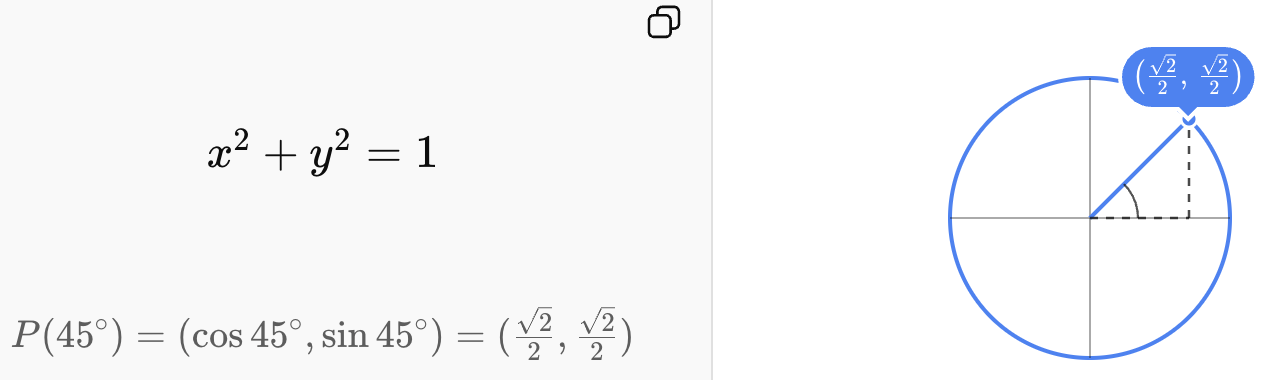
The Unit Circle
The unit circle is a circle centred at the origin with radius 1.
It provides one of the most powerful ways to understand trigonometric functions.
For an angle
in standard position, the point where its terminal side intersects the unit circle has coordinates:
(cosθ, sinθ)
Therefore:
- x-coordinate = cosθ
- -coordinate = sinθ


2. Advanced Function Transformations
Learning outcomes
- I can determine amplitude, period, phase shift, and vertical displacement.
- I can write equations from transformed graphs.
- I can sketch transformed trigonometric functions.
- I can analyse the effects of multiple transformations.
- I can interpret transformed functions in context.
3. Composite Trigonometric Functions
Learning outcomes
- I can evaluate composite trigonometric functions.
- I can analyse combinations of trigonometric functions.
- I can simplify composite expressions.
- I can interpret composite functions graphically.
- I can solve problems involving multiple trigonometric functions.
4. Inverse Trigonometric Functions
Learning outcomes
- I can determine principal values of inverse trigonometric functions.
- I can evaluate inverse trigonometric expressions.
- I can solve equations involving inverse functions.
- I can interpret inverse functions graphically.
- I can apply inverse functions in modelling problems.
5. Trigonometric Modelling
Learning outcomes
- I can model periodic phenomena using trigonometric functions.
- I can determine model parameters from data.
- I can interpret amplitude, period, and phase shift.
- I can evaluate the suitability of trigonometric models.
- I can solve real-world modelling problems.