Triangles
1. Classifying Triangles
Learning outcomes
- I can classify triangles by sides.
- I can classify triangles by angles.
- I can identify properties of different triangle types.
- I can compare different classifications.
- I can solve problems involving triangle properties.
Classifying Triangles
A triangle is a polygon with three sides, three vertices, and three interior angles.
Although all triangles have these basic features, triangles can have very different shapes. Mathematicians classify triangles in two main ways:
- by the lengths of their sides
- by the sizes of their angles
An important idea is that a triangle can belong to one category from each system at the same time.
For example, a triangle could be both isosceles and right-angled.


Classifying Triangles by Their Sides
Triangles can be classified by comparing the lengths of their three sides.
There are three main classifications:
- equilateral
- isosceles
- scalene
Equilateral Triangles
An equilateral triangle has three equal sides.
Because all three sides are equal, all three interior angles are also equal.
Since the angles inside every triangle add to: 180o
each angle in an equilateral triangle must be: 180o ÷ 3 = 60o
Therefore, an equilateral triangle always has:
- 3 equal sides
- 3 equal angles
- each angle equal to 60o
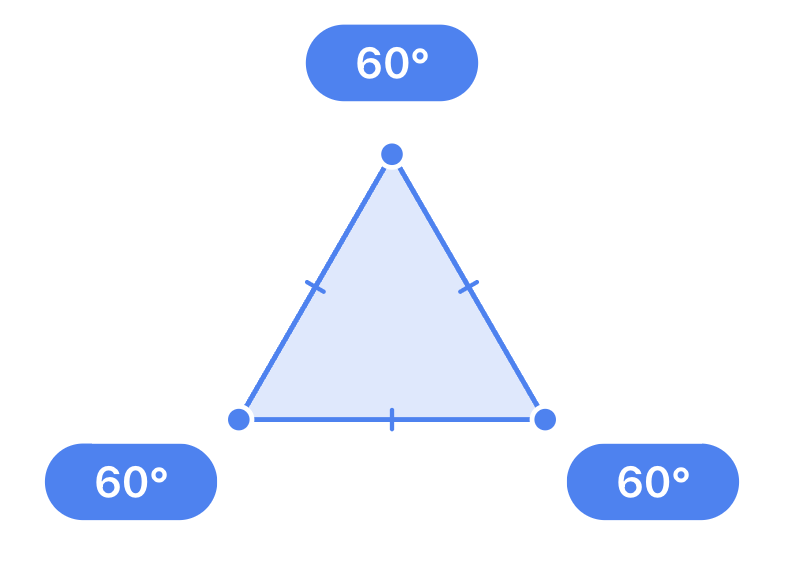
Equal sides are often shown on diagrams using matching tick marks.
If all three sides have the same tick mark, they have equal lengths.
Isosceles Triangles
An isosceles triangle has at least two equal sides.
The angles opposite those equal sides are also equal.
These equal angles are often called the base angles.


For example, suppose an isosceles triangle has two equal angles of: 70o
The third angle is: 180o - 70o - 70o = 40o
Scalene Triangles
A scalene triangle has three sides of different lengths.
Its three angles are also different.
Therefore, a scalene triangle has:
- no equal sides
- no equal angles


For example, a triangle with sides: 5 cm, 7 cm, 9 cm
is scalene because all three side lengths are different.
Comparing Side Classifications
| Triangle | Equal Sides | Equal Angles |
|---|---|---|
| Equilateral | 3 | 3 |
| Isosceles | At least 2 | At least 2 |
| Scalene | 0 | 0 |
Side markings on diagrams can help us identify the classification even when no measurements are provided.
Classifying Triangles by Their Angles
Triangles can also be classified according to their angles.
The three main classifications are:
- acute
- right
- obtuse
The key angle to examine is usually the largest angle.


Acute Triangles
An acute triangle has three angles that are all less than: 90o
For example: 50o 60o 70o
All three angles are less than 90o
Therefore, the triangle is: Acute
An equilateral triangle is always acute because all three of its angles are 60o
Right Triangles
A right triangle contains exactly one angle equal to: 90o
A right angle is usually shown using a small square symbol.
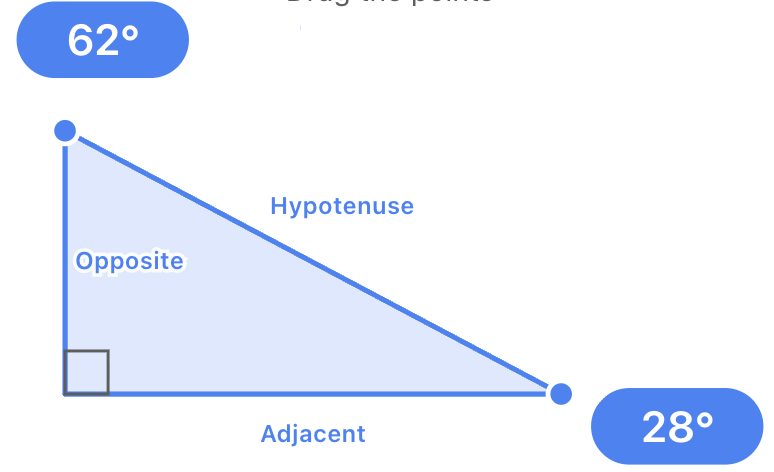
The side opposite the right angle is called the hypotenuse.
The hypotenuse is always the longest side of a right triangle.
The other two sides are often called the legs.
Right triangles are extremely important in mathematics because they are used in:
- the Pythagorean theorem
- trigonometry
- measurement
- construction
- navigation
- engineering
Obtuse Triangles
An obtuse triangle contains one angle greater than: 90o
but less than: 180o
For example: 110o 40o 30o
Because: 110o > 90o
the triangle is: Obtuse


A triangle cannot have two obtuse angles because their total would already exceed 180o
Comparing Angle Classifications
| Triangle | Largest Angle |
|---|---|
| Acute | Less than
90o |
| Right | Exactly
90o |
| Obtuse | Greater than
90o |
A useful memory rule is:
Acute → all angles < 90°
Right → one angle = 90°
Obtuse → one angle > 90°
The Triangle Angle Sum
One of the most important properties of every triangle is:
This property allows us to calculate missing angles.
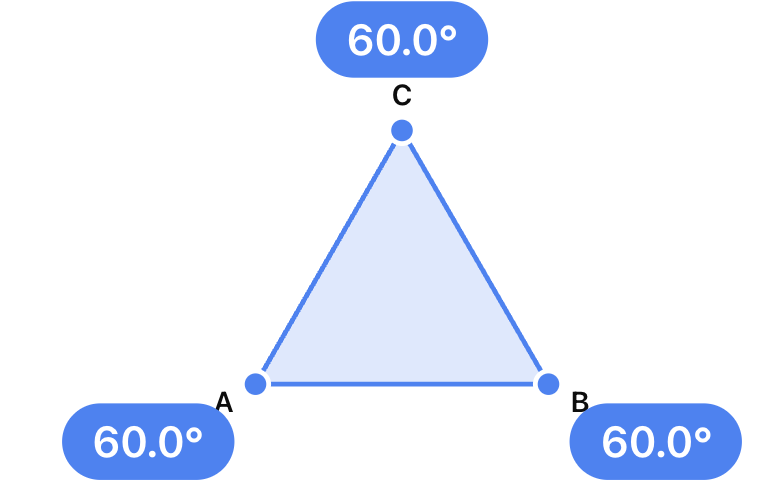
If the three angles are A, B, and C: A + B + C = 180o
Finding a Missing Angle
Suppose a triangle contains angles of: 45o 65o x
Since the angles total 180o
45 + 65 + x = 180
110 + x = 180
x = 70o
The three angles are therefore: 45o 65o 70o
All are less than 90o
Therefore, the triangle is acute.
A Triangle Can Have Two Classifications
Side classification and angle classification describe different properties.
Therefore, we can often give a triangle two names.
For example, consider a triangle with sides: 5 cm, 5 cm, 7 cm
and angles: 45o 45o 90o
Two sides are equal.
Therefore:
Isosceles
One angle is 90o
Therefore:
Right
The complete classification is:
Isosceles right triangle
Possible Combinations
Several combinations are possible.
Acute Scalene
All sides are different and all angles are less than 90o
Acute Isosceles
Two sides are equal and all angles are less than 90o
Right Scalene
All sides are different and one angle is 90o
Right Isosceles
Two sides are equal and one angle is 90o
Obtuse Scalene
All sides are different and one angle is greater than 90o
Obtuse Isosceles
Two sides are equal and one angle is greater than 90o
Equilateral
An equilateral triangle is always acute, because: 60o 60o 60o
So an equilateral triangle cannot be right or obtuse.


Using Side Lengths to Classify Triangles
Suppose a triangle has sides: 8 cm, 8 cm, 5 cm
Two sides are equal.
Therefore: Isosceles
Now consider: 4 cm, 6 cm, 9 cm
All three sides are different.
Therefore: Scalene
Using Angles to Classify Triangles
Suppose the angles are: 35o 55o 90o
Because one angle equals 90o
Right Triangle
Now consider: 25o 45o 110o
Because one angle is greater than 90o
Obtuse Triangle
Worked Example 1
An isosceles triangle has a vertex angle of: 40o
Find the other two angles.
Because the triangle is isosceles, the other two angles are equal.
First find the remaining angle total:
180o - 40o = 140o
Divide equally:
140o ÷ 2 = 70o
Therefore: 70o 70o
The triangle's angles are: 40o 70o 70o
All angles are less than 90o
So the complete classification is:
Acute isosceles triangle
Worked Example 2
A triangle has angles:
Two angles are equal, so the sides opposite them are also equal.
Therefore, the triangle is isosceles.
It also contains a
angle.
Therefore:
Worked Example 3
A triangle contains angles:
Calculate
:
Because one angle is greater than
, the triangle is obtuse.
Since all three angles are different, all three opposite sides must also be different.
Therefore:
The Longest Side and Largest Angle
There is an important relationship between the sides and angles of a triangle:
The longest side is opposite the largest angle.
Similarly:
The shortest side is opposite the smallest angle.


For example, if the angles are:
the side opposite
will be the longest.
The side opposite
will be the shortest.
Can Any Three Lengths Make a Triangle?
No.
For three lengths to form a triangle, they must satisfy the triangle inequality.
The sum of the lengths of any two sides must be greater than the length of the third side.
Consider:
Check:
Yes.
These lengths can form a triangle.
Now consider:
Check:
This is false.
Therefore:
Solving Triangle Problems
When solving a triangle-classification problem, use this strategy:
Step 1 – Examine the sides
Ask:
- Are all three equal?
- Are two equal?
- Are all different?
Classify as:
equilateral, isosceles, or scalene
Step 2 – Examine the angles
Ask:
- Are all below?
- Is one exactly?
- Is one greater than?
Classify as:
acute, right, or obtuse
Step 3 – Use the angle sum if necessary
Remember:
Step 4 – Give both classifications when possible
For example:
Common Misconceptions
A triangle does not have to have only one classification.
A triangle can be both isosceles and right, because one term describes its sides and the other describes its angles.
A right triangle cannot contain two right angles.
Two
angles would already total
, leaving no angle for the third vertex.
An obtuse triangle cannot contain two obtuse angles.
Two angles greater than
would total more than
.
An equilateral triangle cannot be right or obtuse.
Its angles are always:
Did You Know?
An equilateral triangle is also a special type of isosceles triangle under the mathematical definition that an isosceles triangle has at least two equal sides.
However, in many school classification exercises, the categories are treated separately:
- equilateral = three equal sides
- isosceles = two equal sides
- scalene = no equal sides
Always follow the definitions being used in your course or question.
Key Terms
Triangle – A polygon with three sides and three angles.
Equilateral triangle – A triangle with three equal sides and three
angles.
Isosceles triangle – A triangle with at least two equal sides.
Scalene triangle – A triangle with no equal sides.
Acute triangle – A triangle with three angles less than
.
Right triangle – A triangle containing one
angle.
Obtuse triangle – A triangle containing one angle greater than
.
Hypotenuse – The longest side of a right triangle, opposite the right angle.
Triangle inequality – The rule that the sum of any two side lengths must be greater than the third side.
Key Takeaways
- Triangles can be classified by their sides and angles.
- An equilateral triangle has three equal sides and threeangles.
- An isosceles triangle has at least two equal sides and corresponding equal angles.
- A scalene triangle has no equal sides.
- An acute triangle has three angles less than.
- A right triangle has one angle equal to.
- An obtuse triangle has one angle greater than.
- The interior angles of every triangle add to.
- A triangle can have both a side classification and an angle classification.
- The longest side is opposite the largest angle.
- The shortest side is opposite the smallest angle.
- The triangle inequality can be used to determine whether three lengths can actually form a triangle.
- Triangle properties can be used to calculate missing angles, compare sides, and solve geometric problems.