Triangles
| Сайт: | Young Education |
| Курс: | Geometry and Proof |
| Книга: | Triangles |
| Надруковано: | Guest user |
| Дата: | понеділок 9 листопада 2026 16:37 PM |
1. Classifying Triangles
Learning outcomes
- I can classify triangles by sides.
- I can classify triangles by angles.
- I can identify properties of different triangle types.
- I can compare different classifications.
- I can solve problems involving triangle properties.
Classifying Triangles
A triangle is a polygon with three sides, three vertices, and three interior angles.
Although all triangles have these basic features, triangles can have very different shapes. Mathematicians classify triangles in two main ways:
- by the lengths of their sides
- by the sizes of their angles
An important idea is that a triangle can belong to one category from each system at the same time.
For example, a triangle could be both isosceles and right-angled.


Classifying Triangles by Their Sides
Triangles can be classified by comparing the lengths of their three sides.
There are three main classifications:
- equilateral
- isosceles
- scalene
Equilateral Triangles
An equilateral triangle has three equal sides.
Because all three sides are equal, all three interior angles are also equal.
Since the angles inside every triangle add to: 180o
each angle in an equilateral triangle must be: 180o ÷ 3 = 60o
Therefore, an equilateral triangle always has:
- 3 equal sides
- 3 equal angles
- each angle equal to 60o
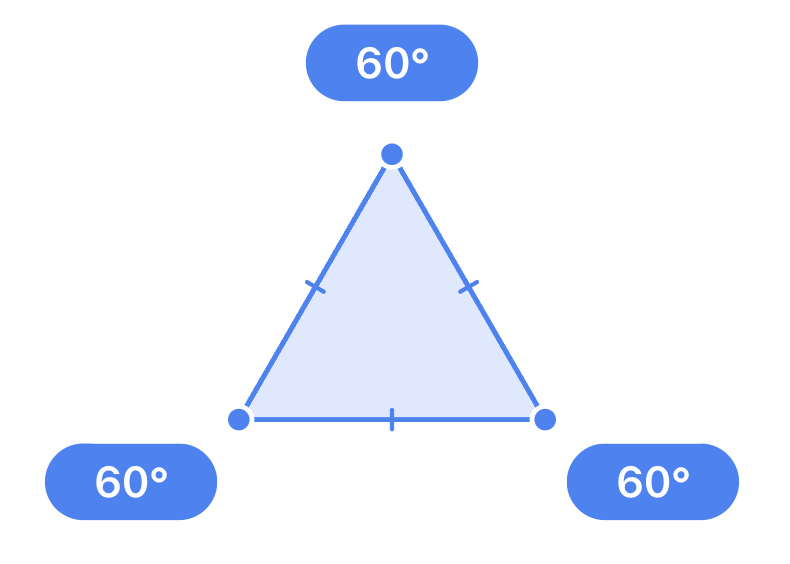
Equal sides are often shown on diagrams using matching tick marks.
If all three sides have the same tick mark, they have equal lengths.
Isosceles Triangles
An isosceles triangle has at least two equal sides.
The angles opposite those equal sides are also equal.
These equal angles are often called the base angles.


For example, suppose an isosceles triangle has two equal angles of: 70o
The third angle is: 180o - 70o - 70o = 40o
Scalene Triangles
A scalene triangle has three sides of different lengths.
Its three angles are also different.
Therefore, a scalene triangle has:
- no equal sides
- no equal angles


For example, a triangle with sides: 5 cm, 7 cm, 9 cm
is scalene because all three side lengths are different.
Comparing Side Classifications
| Triangle | Equal Sides | Equal Angles |
|---|---|---|
| Equilateral | 3 | 3 |
| Isosceles | At least 2 | At least 2 |
| Scalene | 0 | 0 |
Side markings on diagrams can help us identify the classification even when no measurements are provided.
Classifying Triangles by Their Angles
Triangles can also be classified according to their angles.
The three main classifications are:
- acute
- right
- obtuse
The key angle to examine is usually the largest angle.


Acute Triangles
An acute triangle has three angles that are all less than: 90o
For example: 50o 60o 70o
All three angles are less than 90o
Therefore, the triangle is: Acute
An equilateral triangle is always acute because all three of its angles are 60o
Right Triangles
A right triangle contains exactly one angle equal to: 90o
A right angle is usually shown using a small square symbol.
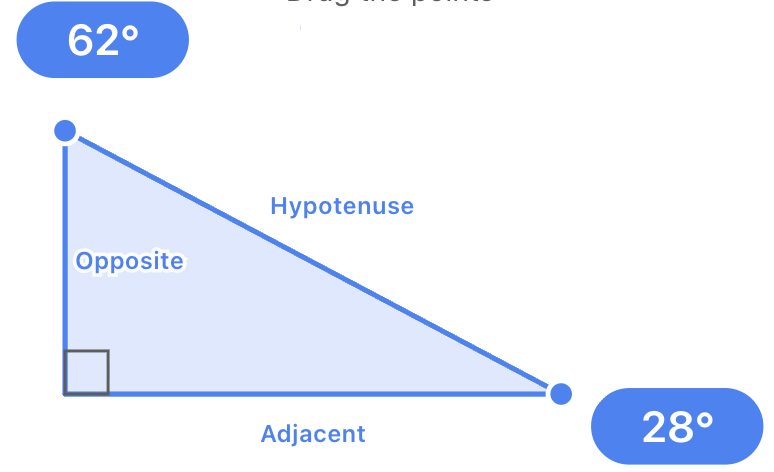
The side opposite the right angle is called the hypotenuse.
The hypotenuse is always the longest side of a right triangle.
The other two sides are often called the legs.
Right triangles are extremely important in mathematics because they are used in:
- the Pythagorean theorem
- trigonometry
- measurement
- construction
- navigation
- engineering
Obtuse Triangles
An obtuse triangle contains one angle greater than: 90o
but less than: 180o
For example: 110o 40o 30o
Because: 110o > 90o
the triangle is: Obtuse


A triangle cannot have two obtuse angles because their total would already exceed 180o
Comparing Angle Classifications
| Triangle | Largest Angle |
|---|---|
| Acute | Less than
90o |
| Right | Exactly
90o |
| Obtuse | Greater than
90o |
A useful memory rule is:
Acute → all angles < 90°
Right → one angle = 90°
Obtuse → one angle > 90°
The Triangle Angle Sum
One of the most important properties of every triangle is:
This property allows us to calculate missing angles.
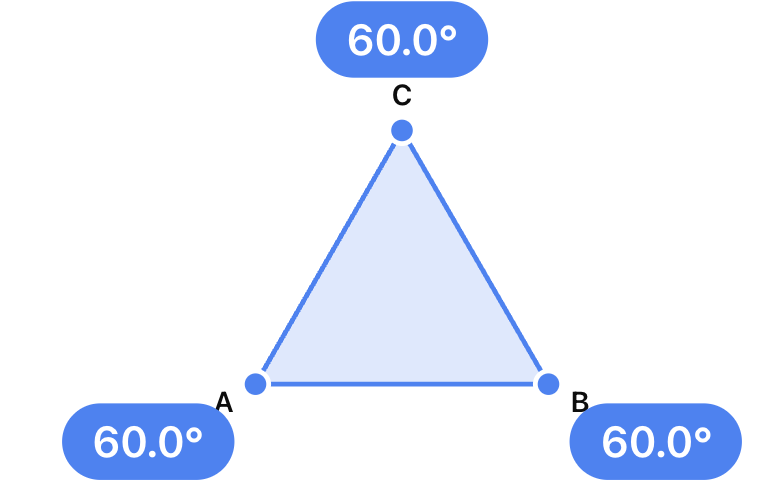
If the three angles are A, B, and C: A + B + C = 180o
Finding a Missing Angle
Suppose a triangle contains angles of: 45o 65o x
Since the angles total 180o
45 + 65 + x = 180
110 + x = 180
x = 70o
The three angles are therefore: 45o 65o 70o
All are less than 90o
Therefore, the triangle is acute.
A Triangle Can Have Two Classifications
Side classification and angle classification describe different properties.
Therefore, we can often give a triangle two names.
For example, consider a triangle with sides: 5 cm, 5 cm, 7 cm
and angles: 45o 45o 90o
Two sides are equal.
Therefore:
Isosceles
One angle is 90o
Therefore:
Right
The complete classification is:
Isosceles right triangle
Possible Combinations
Several combinations are possible.
Acute Scalene
All sides are different and all angles are less than 90o
Acute Isosceles
Two sides are equal and all angles are less than 90o
Right Scalene
All sides are different and one angle is 90o
Right Isosceles
Two sides are equal and one angle is 90o
Obtuse Scalene
All sides are different and one angle is greater than 90o
Obtuse Isosceles
Two sides are equal and one angle is greater than 90o
Equilateral
An equilateral triangle is always acute, because: 60o 60o 60o
So an equilateral triangle cannot be right or obtuse.


Using Side Lengths to Classify Triangles
Suppose a triangle has sides: 8 cm, 8 cm, 5 cm
Two sides are equal.
Therefore: Isosceles
Now consider: 4 cm, 6 cm, 9 cm
All three sides are different.
Therefore: Scalene
Using Angles to Classify Triangles
Suppose the angles are: 35o 55o 90o
Because one angle equals 90o
Right Triangle
Now consider: 25o 45o 110o
Because one angle is greater than 90o
Obtuse Triangle
Worked Example 1
An isosceles triangle has a vertex angle of: 40o
Find the other two angles.
Because the triangle is isosceles, the other two angles are equal.
First find the remaining angle total:
180o - 40o = 140o
Divide equally:
140o ÷ 2 = 70o
Therefore: 70o 70o
The triangle's angles are: 40o 70o 70o
All angles are less than 90o
So the complete classification is:
Acute isosceles triangle
Worked Example 2
A triangle has angles:
Two angles are equal, so the sides opposite them are also equal.
Therefore, the triangle is isosceles.
It also contains a
angle.
Therefore:
Worked Example 3
A triangle contains angles:
Calculate
:
Because one angle is greater than
, the triangle is obtuse.
Since all three angles are different, all three opposite sides must also be different.
Therefore:
The Longest Side and Largest Angle
There is an important relationship between the sides and angles of a triangle:
The longest side is opposite the largest angle.
Similarly:
The shortest side is opposite the smallest angle.


For example, if the angles are:
the side opposite
will be the longest.
The side opposite
will be the shortest.
Can Any Three Lengths Make a Triangle?
No.
For three lengths to form a triangle, they must satisfy the triangle inequality.
The sum of the lengths of any two sides must be greater than the length of the third side.
Consider:
Check:
Yes.
These lengths can form a triangle.
Now consider:
Check:
This is false.
Therefore:
Solving Triangle Problems
When solving a triangle-classification problem, use this strategy:
Step 1 – Examine the sides
Ask:
- Are all three equal?
- Are two equal?
- Are all different?
Classify as:
equilateral, isosceles, or scalene
Step 2 – Examine the angles
Ask:
- Are all below?
- Is one exactly?
- Is one greater than?
Classify as:
acute, right, or obtuse
Step 3 – Use the angle sum if necessary
Remember:
Step 4 – Give both classifications when possible
For example:
Common Misconceptions
A triangle does not have to have only one classification.
A triangle can be both isosceles and right, because one term describes its sides and the other describes its angles.
A right triangle cannot contain two right angles.
Two
angles would already total
, leaving no angle for the third vertex.
An obtuse triangle cannot contain two obtuse angles.
Two angles greater than
would total more than
.
An equilateral triangle cannot be right or obtuse.
Its angles are always:
Did You Know?
An equilateral triangle is also a special type of isosceles triangle under the mathematical definition that an isosceles triangle has at least two equal sides.
However, in many school classification exercises, the categories are treated separately:
- equilateral = three equal sides
- isosceles = two equal sides
- scalene = no equal sides
Always follow the definitions being used in your course or question.
Key Terms
Triangle – A polygon with three sides and three angles.
Equilateral triangle – A triangle with three equal sides and three
angles.
Isosceles triangle – A triangle with at least two equal sides.
Scalene triangle – A triangle with no equal sides.
Acute triangle – A triangle with three angles less than
.
Right triangle – A triangle containing one
angle.
Obtuse triangle – A triangle containing one angle greater than
.
Hypotenuse – The longest side of a right triangle, opposite the right angle.
Triangle inequality – The rule that the sum of any two side lengths must be greater than the third side.
Key Takeaways
- Triangles can be classified by their sides and angles.
- An equilateral triangle has three equal sides and threeangles.
- An isosceles triangle has at least two equal sides and corresponding equal angles.
- A scalene triangle has no equal sides.
- An acute triangle has three angles less than.
- A right triangle has one angle equal to.
- An obtuse triangle has one angle greater than.
- The interior angles of every triangle add to.
- A triangle can have both a side classification and an angle classification.
- The longest side is opposite the largest angle.
- The shortest side is opposite the smallest angle.
- The triangle inequality can be used to determine whether three lengths can actually form a triangle.
- Triangle properties can be used to calculate missing angles, compare sides, and solve geometric problems.
2. Congruent Triangles
Learning outcomes
- I can identify congruent figures.
- I can apply the SSS, SAS, ASA, AAS, and HL congruence tests.
- I can determine whether triangles are congruent.
- I can justify congruence using appropriate criteria.
- I can solve geometric problems using congruent triangles.
Congruent Triangles
Introduction to Congruent Triangles
In geometry, two figures are congruent when they have exactly the same shape and size.
Congruent figures may be positioned differently. One figure might be rotated, reflected, or translated, but if it can fit exactly over another without stretching or resizing, the figures are congruent.
Triangles are particularly important because their congruence can be established using specific combinations of side lengths and angles.
Rather than measuring every side and angle, mathematicians use five important congruence tests:
-
SSS: Side–Side–Side
-
SAS: Side–Angle–Side
-
ASA: Angle–Side–Angle
-
AAS: Angle–Angle–Side
-
HL: Hypotenuse–Leg, for right triangles
These tests allow us to determine whether two triangles are congruent, justify geometric relationships, and solve problems involving unknown lengths and angles.


Understanding Congruent Figures
Two figures are congruent if all their corresponding sides and angles are equal.
For triangles, this means:
-
All three pairs of corresponding sides have equal lengths.
-
All three pairs of corresponding angles have equal measures.
Example
Suppose triangle ABC has:
AB = 5 cm
BC = 7 cm
AC = 9 cm
Triangle DEF has:
DE = 5 cm
EF = 7 cm
DF = 9 cm
If the vertices correspond as A ↔ D, B ↔ E, and C ↔ F, the triangles are congruent.
We write:
△ABC ≅ △DEF
The symbol ≅ means "is congruent to."
Congruence Versus Similarity
Congruent figures have the same shape and the same size.
Similar figures have the same shape but may have different sizes.
For example, triangles with side lengths:
3 cm, 4 cm, 5 cm
and:
6 cm, 8 cm, 10 cm
are similar but not congruent.
Their corresponding sides have the same ratio, but their lengths are different.
|
Property |
Congruent triangles |
Similar triangles |
|---|---|---|
|
Same shape |
Yes |
Yes |
|
Same size |
Yes |
Not necessarily |
|
Corresponding angles equal |
Yes |
Yes |
|
Corresponding sides equal |
Yes |
Not necessarily |
|
Scale factor |
1 |
Any positive value |
Transformations and Congruence
Congruent figures can be mapped onto each other using rigid transformations.
A rigid transformation preserves distances and angle measures.
Translation
A translation slides a figure without rotating or changing its size.
Rotation
A rotation turns a figure around a fixed point.
Reflection
A reflection flips a figure across a line.
These transformations preserve congruence.
A dilation with a scale factor other than 1 does not preserve congruence because it changes the figure's size.
Corresponding Sides and Angles
Before proving that triangles are congruent, we must identify which vertices, sides, and angles correspond.
Suppose:
△ABC ≅ △DEF
The order of the letters tells us the correspondence.
|
Triangle ABC |
Triangle DEF |
|---|---|
|
Vertex A |
Vertex D |
|
Vertex B |
Vertex E |
|
Vertex C |
Vertex F |
|
Side AB |
Side DE |
|
Side BC |
Side EF |
|
Side AC |
Side DF |
|
Angle A |
Angle D |
|
Angle B |
Angle E |
|
Angle C |
Angle F |
Therefore:
AB = DE
BC = EF
AC = DF
∠A = ∠D
∠B = ∠E
∠C = ∠F
Why Letter Order Matters
The statements:
△ABC ≅ △DEF
and:
△ABC ≅ △DFE
describe different vertex correspondences.
A congruence statement must match corresponding vertices in the correct order.
Corresponding Parts of Congruent Triangles
An important geometric principle is:
Corresponding Parts of Congruent Triangles are Congruent (CPCTC).
This means that once two triangles have been proven congruent, their corresponding sides and angles must be equal.
For example, if:
△ABC ≅ △DEF
then:
AB = DE
BC = EF
AC = DF
and:
∠A = ∠D
∠B = ∠E
∠C = ∠F
This principle allows us to calculate unknown measurements after proving congruence.
The SSS Congruence Test
SSS stands for Side–Side–Side.
Two triangles are congruent if all three sides of one triangle are equal to the three corresponding sides of another triangle.
Conditions for SSS
We must know that:
-
One pair of corresponding sides is equal.
-
A second pair of corresponding sides is equal.
-
A third pair of corresponding sides is equal.
No angle measurements are required.
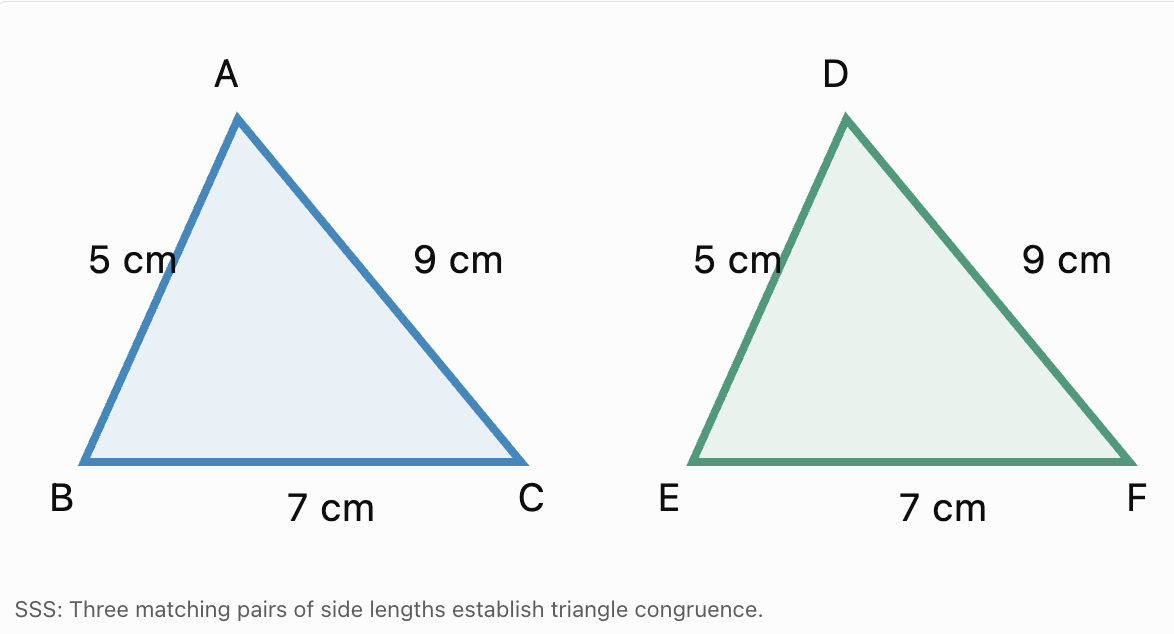
Worked Example: SSS
Triangle ABC has:
AB = 5 cm
BC = 7 cm
AC = 9 cm
Triangle DEF has:
DE = 5 cm
EF = 7 cm
DF = 9 cm
Step 1: Compare Corresponding Sides
AB = DE = 5 cm
BC = EF = 7 cm
AC = DF = 9 cm
Step 2: Apply the Congruence Test
All three pairs of corresponding sides are equal.
Therefore:
△ABC ≅ △DEF by SSS.
Why SSS Works
Three fixed side lengths determine a triangle's shape and size, provided they satisfy the triangle inequality.
Although the triangle can be rotated or reflected, the distances between its vertices remain unchanged.
The SAS Congruence Test
SAS stands for Side–Angle–Side.
Two triangles are congruent if:
-
Two corresponding sides are equal.
-
The included angle between those sides is equal.
The word included is extremely important.
The included angle is the angle formed by the two known sides.
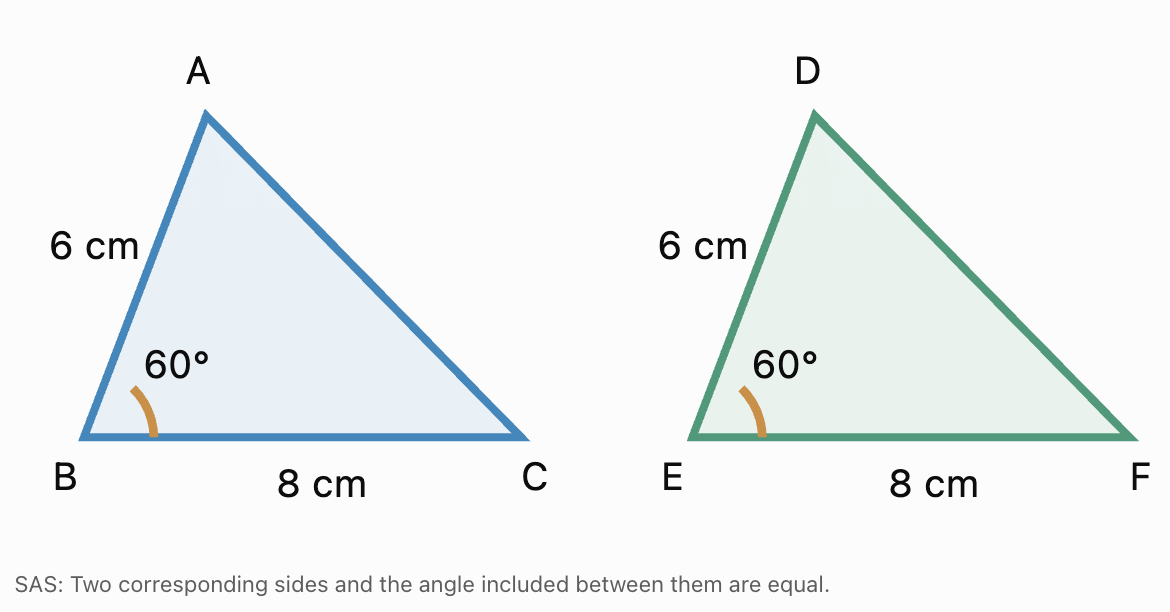
Worked Example: SAS
Triangle ABC has:
AB = 6 cm
BC = 8 cm
∠ABC = 60°
Triangle DEF has:
DE = 6 cm
EF = 8 cm
∠DEF = 60°
Step 1: Compare the Sides
AB = DE
BC = EF
Step 2: Compare the Included Angles
∠ABC = ∠DEF = 60°
Both angles lie between the two known sides.
Step 3: Apply SAS
△ABC ≅ △DEF by SAS.
Why the Included Angle Matters
Two side lengths and an angle not between them do not always determine a unique triangle.
The position of the angle is essential.
The ASA Congruence Test
ASA stands for Angle–Side–Angle.
Two triangles are congruent if:
-
Two corresponding angles are equal.
-
The included side between those angles is equal.
Worked Example
Triangle ABC has:
∠A = 45°
∠B = 70°
AB = 8 cm
Triangle DEF has:
∠D = 45°
∠E = 70°
DE = 8 cm
Step 1: Compare Angles
∠A = ∠D = 45°
∠B = ∠E = 70°
Step 2: Compare Included Sides
AB = DE = 8 cm
The known side lies between the two known angles.
Step 3: Apply ASA
△ABC ≅ △DEF by ASA.
Finding the Third Angle
The angles in a triangle sum to 180°.
Therefore:
∠C = 180° − 45° − 70°
∠C = 65°
Similarly:
∠F = 65°
The third pair of angles is also equal.
The AAS Congruence Test
AAS stands for Angle–Angle–Side.
Two triangles are congruent if:
-
Two corresponding angles are equal.
-
One pair of corresponding non-included sides is equal.
The known side does not lie between the two known angles.
Worked Example
Triangle ABC has:
∠A = 40°
∠B = 75°
AC = 10 cm
Triangle DEF has:
∠D = 40°
∠E = 75°
DF = 10 cm
Step 1: Compare Angles
∠A = ∠D = 40°
∠B = ∠E = 75°
Step 2: Compare Sides
AC = DF = 10 cm
Step 3: Identify the Side Position
AC and DF are not the sides included between the two specified angles.
Step 4: Apply AAS
△ABC ≅ △DEF by AAS.
Why AAS Works
Knowing two angles determines the third angle because:
A + B + C = 180°
Therefore, AAS can be converted into ASA by calculating the missing angle.
This explains why AAS is a valid congruence test.
Comparing ASA and AAS
|
ASA |
AAS |
|---|---|
|
Two angles and a side |
Two angles and a side |
|
Known side is between the known angles |
Known side is not between the known angles |
|
Included side |
Non-included side |
|
Proves congruence |
Proves congruence |
Both are valid tests.


The HL Congruence Test
HL stands for Hypotenuse–Leg.
This test applies specifically to right triangles.
Two right triangles are congruent if:
-
Their hypotenuses are equal.
-
One pair of corresponding legs is equal.
Understanding Right Triangles
A right triangle contains one angle measuring 90°.
The hypotenuse is the side opposite the right angle.
It is always the longest side of a right triangle.
The other two sides are called legs.
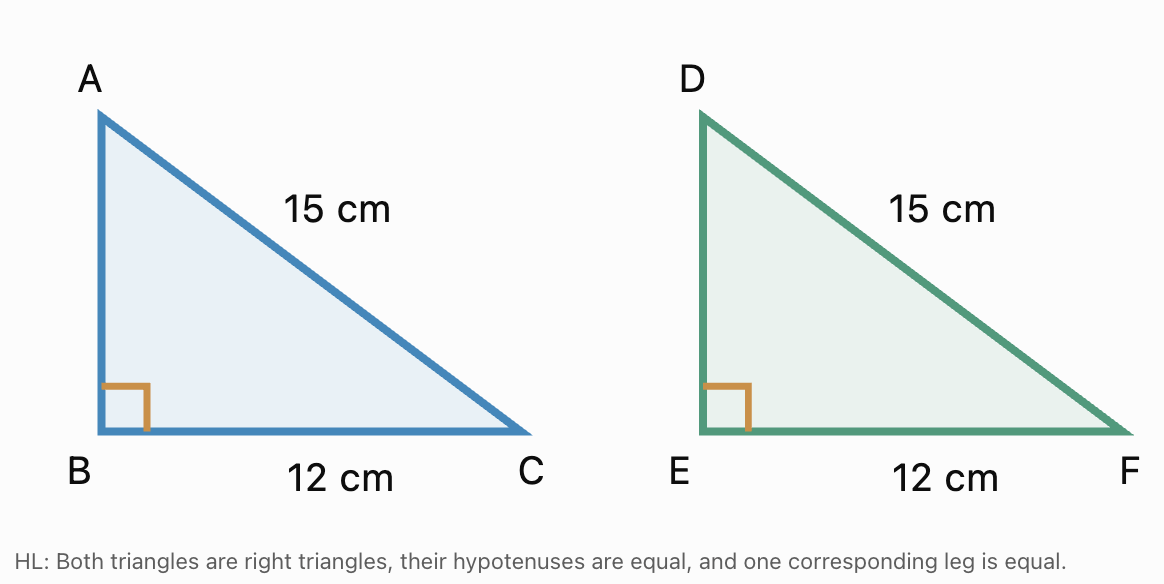
Worked Example: HL
Triangle ABC is right-angled at B.
Triangle DEF is right-angled at E.
Given:
AC = DF = 15 cm
BC = EF = 12 cm
Step 1: Identify the Right Angles
∠B = ∠E = 90°
Step 2: Identify the Hypotenuses
AC and DF are opposite the right angles.
AC = DF = 15 cm
Step 3: Identify the Legs
BC = EF = 12 cm
Step 4: Apply HL
△ABC ≅ △DEF by HL.
Finding the Missing Leg
Using the Pythagorean theorem:
AB² + BC² = AC²
AB² + 12² = 15²
AB² + 144 = 225
AB² = 81
AB = 9 cm
Therefore:
DE = 9 cm
because corresponding sides of congruent triangles are equal.
Important Limitation
HL applies only to right triangles.
For non-right triangles, equal hypotenuse-like sides and another side do not establish congruence because the concept of a hypotenuse applies only to right triangles.
Comparing the Five Congruence Tests
|
Test |
Information required |
Special condition |
|---|---|---|
|
SSS |
Three corresponding sides |
All three side pairs equal |
|
SAS |
Two sides and one angle |
Angle must be included |
|
ASA |
Two angles and one side |
Side must be included |
|
AAS |
Two angles and one side |
Side is non-included |
|
HL |
Hypotenuse and one leg |
Both triangles must be right triangles |
Choosing the Correct Test
Ask:
-
What measurements or relationships are given?
-
Are three corresponding sides equal?
-
Are two sides and their included angle equal?
-
Are two angles and a corresponding side equal?
-
Are both triangles right triangles?
-
Is the known side a hypotenuse or a leg?
-
Is the available information sufficient to prove congruence?
The correct test depends on both the measurements and their positions in the triangles.
Conditions That Do Not Always Prove Congruence
Not every combination of equal measurements is sufficient.
Two common invalid tests are:
-
AAA: Angle–Angle–Angle.
-
SSA: Side–Side–Angle, in general.
Why AAA Does Not Prove Congruence
Suppose two triangles have angles:
40°, 60°, and 80°.
Both triangles have the same shape.
However, one triangle could be much larger than the other.
Equal angles establish similarity, not necessarily congruence.
Example
Triangle ABC has sides:
3 cm, 4 cm, 5 cm
Triangle DEF has sides:
6 cm, 8 cm, 10 cm
The corresponding angles are equal, but the triangles are not congruent.
AAA establishes similarity, not congruence.
Why SSA Does Not Always Prove Congruence
SSA provides:
-
Two side lengths.
-
An angle that is not included between those sides.
In some cases, this information can produce two different triangles.
This is called the ambiguous case.
Example
Suppose a triangle has:
-
An angle of 30°.
-
The side opposite that angle measuring 5 cm.
-
Another side measuring 8 cm.
Using the sine rule:
sin(B)/8 = sin(30°)/5
sin(B) = 8(0.5)/5
sin(B) = 0.8
This gives two possible angles:
B ≈ 53.13°
or:
B ≈ 126.87°
Both can produce valid triangles with different shapes.
Therefore, SSA does not generally guarantee congruence.
Exception
In right triangles, the HL test provides sufficient information because the right angle and hypotenuse relationship remove the ambiguity.
Using Congruence to Solve Unknown Side Lengths
Once two triangles are proven congruent, corresponding sides are equal.
Worked Example
Suppose:
△ABC ≅ △DEF
and:
AB = 3x + 2
DE = 17
Find x.
Step 1: Use Corresponding Sides
Since AB corresponds to DE:
3x + 2 = 17
Step 2: Solve
3x = 15
x = 5
Step 3: Verify
AB = 3(5) + 2 = 17
Therefore, AB = DE.
Solving Problems with Two Algebraic Expressions
Worked Example
Suppose:
△PQR ≅ △XYZ
and:
PQ = 4x − 3
XY = 2x + 9
Find x.
Step 1: Set Corresponding Sides Equal
4x − 3 = 2x + 9
Step 2: Solve
2x = 12
x = 6
Step 3: Calculate the Side Length
PQ = 4(6) − 3
PQ = 21
XY = 2(6) + 9
XY = 21
Both sides are equal, as expected.
Using Congruence to Solve Unknown Angles
Corresponding angles in congruent triangles are equal.
Worked Example
Suppose:
△ABC ≅ △DEF
and:
∠A = 4x + 10°
∠D = 70°
Find x.
Step 1: Use Corresponding Angles
4x + 10 = 70
Step 2: Solve
4x = 60
x = 15
Step 3: Verify
∠A = 4(15) + 10
∠A = 70°
Therefore, the corresponding angles are equal.
Combining Congruence with Angle Sums
Worked Example
Suppose:
△ABC ≅ △DEF
and triangle ABC has:
∠A = 45°
∠B = 65°
Find ∠F.
Step 1: Find the Third Angle
∠C = 180° − 45° − 65°
∠C = 70°
Step 2: Identify the Correspondence
Since:
△ABC ≅ △DEF
vertex C corresponds to vertex F.
Therefore:
∠F = 70°
This combines the triangle angle-sum rule with congruence.
Proving Congruence in Geometric Diagrams
Some problems involve triangles that share a side or contain vertical angles.
These situations require recognising geometric relationships that are not explicitly stated as measurements.
Shared Sides
If two triangles share a side, that side is equal to itself.
For example:
AC = AC
This is called the reflexive property.
Vertical Angles
When two lines intersect, vertically opposite angles are equal.
For example:
∠AOB = ∠COD
if the angles are vertically opposite.
Parallel Lines
Parallel lines can create equal:
-
Corresponding angles.
-
Alternate interior angles.
These angle relationships can help establish ASA or AAS congruence.
Worked Example: Shared Side
Suppose triangles ABC and ADC share side AC.
Given:
AB = AD
BC = DC
Prove the triangles are congruent.
Step 1: Identify Equal Sides
AB = AD — given.
BC = DC — given.
AC = AC — shared side.
Step 2: Apply SSS
All three pairs of corresponding sides are equal.
Therefore:
△ABC ≅ △ADC by SSS.
Step 3: Apply CPCTC
We can conclude:
∠BAC = ∠CAD
and:
∠BCA = ∠ACD
These angle relationships follow from congruence.
Worked Example: Vertical Angles and SAS
Two straight lines intersect at point O.
Suppose:
AO = CO
BO = DO
Prove:
△AOB ≅ △COD
Step 1: Identify Equal Sides
AO = CO — given.
BO = DO — given.
Step 2: Identify Equal Angles
∠AOB = ∠COD
because vertically opposite angles are equal.
Step 3: Apply SAS
The equal angles are included between the equal side pairs.
Therefore:
△AOB ≅ △COD by SAS.
Writing Formal Congruence Proofs
A geometric proof explains why a conclusion must be true.
A clear proof identifies:
-
The information given.
-
Relevant geometric relationships.
-
The congruence test.
-
The conclusion.
Example: Two-Column Proof
Given:
AB = DE
BC = EF
∠ABC = ∠DEF
Prove:
△ABC ≅ △DEF
|
Statement |
Reason |
|---|---|
|
AB = DE |
Given |
|
BC = EF |
Given |
|
∠ABC = ∠DEF |
Given |
|
△ABC ≅ △DEF |
SAS congruence |
Example: Paragraph Proof
AB = DE and BC = EF are given. The included angles ∠ABC and ∠DEF are also equal. Therefore, the two triangles have two pairs of equal corresponding sides and equal included angles. Hence, △ABC ≅ △DEF by SAS.
Both proof formats are acceptable when the reasoning is complete and mathematically correct.
A Proof Involving Parallel Lines
Suppose AB is parallel to CD, and diagonals AC and BD intersect at O.
Given:
AO = CO
Prove:
△AOB ≅ △COD
Step 1: Identify Equal Angles
Since AB is parallel to CD:
∠BAO = ∠DCO
These are alternate interior angles formed by transversal AC.
Step 2: Identify Another Pair of Equal Angles
∠AOB = ∠COD
These are vertically opposite angles.
Step 3: Identify Equal Sides
AO = CO — given.
Step 4: Apply ASA
The equal sides lie between the two equal angle pairs.
Therefore:
△AOB ≅ △COD by ASA.
Step 5: Draw Further Conclusions
By CPCTC:
AB = CD
and:
BO = DO
This demonstrates how triangle congruence can establish additional geometric properties.
Applications of Congruent Triangles
Congruent triangles appear in many real-world situations because triangular structures are rigid and maintain their shape when their side lengths are fixed.
Architecture and Construction
Triangular supports are used in:
-
Roof trusses.
-
Bridges.
-
Towers.
-
Structural frames.
Congruent triangular components help engineers maintain consistent dimensions.

Manufacturing
Congruent shapes are important in:
-
Precision-cutting processes.
-
Machine components.
-
Construction panels.
-
Repeated structural elements.
Components must often match exactly to fit together correctly.
Design and Art
Congruent triangles appear in:
-
Tessellations.
-
Geometric patterns.
-
Decorative tiles.
-
Symmetrical artwork.


Surveying and Measurement
Surveyors use triangles to determine distances and positions.
Known side lengths and angles can help establish geometric relationships without measuring every distance directly.
Congruence provides a way to verify that two triangular arrangements have identical dimensions.
Worked Application: Symmetrical Roof Structure
A roof structure contains two triangular supports, ABC and DEF.
The supports have corresponding side lengths:
AB = DE = 3 m
BC = EF = 4 m
AC = DF = 5 m
Step 1: Identify the Congruence Test
All three corresponding side lengths are equal.
Therefore:
△ABC ≅ △DEF by SSS.
Step 2: Interpret
The triangular supports have the same shape and size.
Their corresponding angles are also equal.
Step 3: Practical Significance
Congruent supports help ensure consistent geometry and alignment in the structure.
However, congruence alone does not prove that a structure can safely support a particular load. Material properties, joints, and forces must also be considered.
Worked Application: Measuring an Unknown Distance
Two congruent triangular frames are constructed.
In the first triangle:
AB = 2x + 4 cm
In the second triangle, the corresponding side is:
DE = 30 cm
Find x.
Step 1: Use Congruence
AB = DE
2x + 4 = 30
Step 2: Solve
2x = 26
x = 13
Step 3: Verify
AB = 2(13) + 4
AB = 30 cm
The corresponding sides are equal.
A Systematic Method for Congruence Problems
When solving a problem involving congruent triangles, use the following procedure.
Identify the Triangles
Determine which two triangles are being compared.
Match Corresponding Vertices
Identify which vertices, sides, and angles correspond.
Record the Given Information
List the equal side lengths and angle measures.
Identify Additional Relationships
Look for:
-
Shared sides.
-
Vertical angles.
-
Parallel-line angle relationships.
-
Right angles.
-
Equal radii.
-
Bisected segments or angles.
Select the Congruence Test
Choose SSS, SAS, ASA, AAS, or HL.
Justify the Congruence
Explain why the selected test applies.
Apply CPCTC
Use corresponding equal sides or angles to solve additional parts of the problem.
Verify
Check that the correspondence, calculations, and conclusion are consistent.
Common Mistakes
Confusing congruence with similarity
Congruent figures have equal corresponding side lengths, not merely proportional sides.
Using AAA as a congruence test
Equal angles establish similarity but not necessarily congruence.
Using SSA as a general congruence test
SSA can produce more than one possible triangle.
Misidentifying the included angle in SAS
The angle must lie between the two known sides.
Confusing ASA with AAS
ASA uses the included side; AAS uses a non-included side.
Applying HL to triangles that are not right triangles
HL requires both triangles to contain a right angle.
Confusing the hypotenuse with a leg
The hypotenuse is opposite the right angle.
Writing vertices in the wrong order
Congruence statements must preserve corresponding vertex order.
Assuming two triangles are congruent because they look alike
Visual appearance is not sufficient mathematical proof.
Using CPCTC before proving congruence
Corresponding parts can be concluded equal only after congruence has been established.
Failing to state the congruence criterion
A complete proof should identify the relevant test.
Ignoring shared sides or vertical angles
These relationships often provide missing information needed for a proof.
Making unsupported conclusions
Every statement in a geometric proof must follow from given information or an established theorem.
Key Terms
-
Congruent Figures: Figures with exactly the same shape and size.
-
Congruent Triangles: Triangles whose corresponding sides and angles are equal.
-
Congruence Symbol (≅): A symbol meaning "is congruent to."
-
Corresponding Vertices: Vertices that occupy matching positions in congruent figures.
-
Corresponding Sides: Sides that match in position and length.
-
Corresponding Angles: Angles that match in position and measure.
-
Rigid Transformation: A transformation that preserves distances and angle measures.
-
Translation: A transformation that slides a figure.
-
Rotation: A transformation that turns a figure around a fixed point.
-
Reflection: A transformation that flips a figure across a line.
-
Similarity: A relationship between figures having the same shape but not necessarily the same size.
-
SSS Congruence: A test using three equal pairs of corresponding sides.
-
SAS Congruence: A test using two equal side pairs and their equal included angles.
-
ASA Congruence: A test using two equal angle pairs and their equal included sides.
-
AAS Congruence: A test using two equal angle pairs and an equal non-included side pair.
-
HL Congruence: A right-triangle test using equal hypotenuses and one equal pair of legs.
-
Included Angle: The angle formed by two specified sides.
-
Included Side: The side between two specified angles.
-
Hypotenuse: The side opposite the right angle in a right triangle.
-
Leg: Either of the two sides forming the right angle in a right triangle.
-
Right Triangle: A triangle containing one 90° angle.
-
Triangle Inequality: The requirement that the sum of any two side lengths of a triangle exceeds the third side.
-
AAA: Three equal angle pairs, which establish similarity but not necessarily congruence.
-
SSA: Two side pairs and a non-included angle pair, which do not generally establish congruence.
-
Ambiguous Case: A situation in which given triangle measurements can produce more than one possible triangle.
-
CPCTC: Corresponding Parts of Congruent Triangles are Congruent.
-
Reflexive Property: The principle that a quantity is equal to itself.
-
Vertical Angles: Opposite angles formed by intersecting lines.
-
Alternate Interior Angles: Angles on opposite sides of a transversal and inside two lines.
-
Geometric Proof: A logical argument establishing a mathematical conclusion.
-
Two-Column Proof: A proof organised into statements and reasons.
-
Triangle Angle-Sum Theorem: The theorem stating that the interior angles of a triangle sum to 180°.
-
Pythagorean Theorem: The relationship a² + b² = c² in a right triangle.
-
Geometric Justification: A mathematical explanation supporting a geometric conclusion.
Key Takeaways
-
Congruent triangles have exactly the same shape and size.
-
Corresponding sides of congruent triangles have equal lengths.
-
Corresponding angles of congruent triangles have equal measures.
-
Congruent figures may be translated, rotated, or reflected without losing congruence.
-
Congruence differs from similarity because congruent figures must also have equal sizes.
-
SSS proves congruence using three pairs of equal corresponding sides.
-
SAS proves congruence using two pairs of equal sides and their included angles.
-
ASA proves congruence using two pairs of equal angles and their included sides.
-
AAS proves congruence using two pairs of equal angles and a non-included side.
-
HL proves congruence for right triangles using the hypotenuse and one leg.
-
AAA does not establish congruence because triangles can have equal angles but different sizes.
-
SSA does not generally establish congruence because it may produce two different triangles.
-
Corresponding vertices must be written in the correct order in congruence statements.
-
Shared sides, vertical angles, and parallel-line relationships can help establish congruence.
-
Once triangles are proven congruent, CPCTC allows us to conclude that their corresponding parts are equal.
-
Congruence can be used to calculate unknown side lengths and angle measures.
-
Formal proofs should contain clear statements supported by valid geometric reasons.
-
Triangle congruence is useful in construction, manufacturing, architecture, surveying, and geometric design.
-
The most important skill is selecting the correct congruence test and explaining why the available information satisfies its conditions.
Check Your Understanding
Recall and Understanding
-
Define congruent triangles and explain how they differ from similar triangles.
-
List the five triangle congruence tests and explain what each requires.
-
Explain why the included angle is important in SAS.
-
Explain why AAA does not prove triangle congruence.
-
Describe why HL can only be applied to right triangles.
Application
-
Triangle ABC has side lengths 5 cm, 8 cm, and 10 cm. Triangle DEF has corresponding side lengths 5 cm, 8 cm, and 10 cm. State whether the triangles are congruent and justify your answer.
-
Two triangles have two corresponding sides of 6 cm and 9 cm, with included angles of 50°. Identify the congruence test.
-
Two triangles have corresponding angles of 40° and 70°, and an equal side between those angles. Identify the congruence test and calculate the third angle.
-
If △ABC ≅ △DEF, AB = 3x + 4, and DE = 25, find x.
-
Two right triangles have hypotenuses of 13 cm and corresponding legs of 5 cm. Explain why they are congruent and calculate the other leg.
Analysis and Challenge
-
Two triangles share side AC. Given AB = AD and BC = DC, prove that △ABC ≅ △ADC.
-
Two lines intersect at O. Given AO = CO and BO = DO, prove that △AOB ≅ △COD.
-
Explain why SSA can produce two different triangles, using an example or labelled sketch.
-
A pair of congruent triangles has corresponding angles expressed as 3x + 10° and 5x − 20°. Determine x and the common angle.
-
A bridge design contains two triangular supports. Each has two corresponding sides measuring 4 m and 6 m, with the included angle measuring 75°. Prove that the supports are congruent and explain why this information is useful in construction.
Final Summary
Congruent triangles have identical shapes and sizes, with equal corresponding sides and angles.
Triangle congruence can be established using five important tests: SSS, SAS, ASA, AAS, and HL.
Each test requires a particular combination of side and angle information.
Not every combination is sufficient. AAA establishes similarity, while SSA does not generally guarantee congruence.
Once triangles have been proven congruent, the principle of CPCTC allows additional side lengths and angle measures to be determined.
Congruence proofs often involve shared sides, vertical angles, parallel lines, and other geometric relationships.
These ideas are important in geometric problem solving and have practical applications in architecture, construction, engineering, and design.
The central principle is that proving triangle congruence requires identifying corresponding parts, selecting a valid congruence criterion, and providing clear mathematical justification for the conclusion.
3. Similar Triangles
Learning outcomes
- I can identify similar figures.
- I can apply similarity criteria.
- I can calculate missing side lengths using similarity.
- I can solve proportional reasoning problems.
- I can apply similarity to real-world situations.
Similar Triangles
Introduction to Similar Triangles
In geometry, two figures are similar when they have the same shape but are not necessarily the same size.
Similar figures have equal corresponding angles and proportional corresponding side lengths.
For example, two triangles may have exactly the same angles, but one triangle may be twice as large as the other. The triangles are still similar because their shapes are identical.
Similarity is an important mathematical concept because it allows us to calculate unknown lengths, compare geometric figures, and solve problems involving objects that cannot be measured directly.
Similar triangles are particularly useful in:
-
Architecture and construction.
-
Maps and scale drawings.
-
Photography and image enlargement.
-
Surveying and measuring heights.
-
Engineering and design.
-
Shadows and indirect measurement.
-
Mathematical modelling.
Understanding similarity involves recognising corresponding parts, applying similarity criteria, calculating scale factors, and using proportional reasoning.


Understanding Similar Figures
Two figures are similar if their corresponding angles are equal and their corresponding sides are proportional.
Corresponding Angles
Corresponding angles occupy matching positions in similar figures.
If triangle ABC is similar to triangle DEF, then:
∠A = ∠D
∠B = ∠E
∠C = ∠F
Corresponding Sides
Corresponding sides are sides that occupy matching positions in the two figures.
For similar triangles:
AB/DE = BC/EF = AC/DF
The ratios of corresponding side lengths are equal.
Similarity Notation
The symbol ∼ means "is similar to."
We write:
△ABC ∼ △DEF
The order of the letters is important because it identifies the corresponding vertices.
For example:
A ↔ D
B ↔ E
C ↔ F
This correspondence determines which sides should be compared.
Congruence Versus Similarity
Congruent figures have the same shape and the same size.
Similar figures have the same shape but may have different sizes.
|
Property |
Congruent figures |
Similar figures |
|---|---|---|
|
Same shape |
Yes |
Yes |
|
Same size |
Yes |
Not necessarily |
|
Corresponding angles equal |
Yes |
Yes |
|
Corresponding sides equal |
Yes |
Not necessarily |
|
Corresponding sides proportional |
Yes |
Yes |
|
Scale factor |
1 |
Any positive number |
All congruent figures are similar.
However, not all similar figures are congruent.
Example
Triangle ABC has sides:
3 cm, 4 cm, 5 cm
Triangle DEF has sides:
6 cm, 8 cm, 10 cm
The side ratios are:
6/3 = 2
8/4 = 2
10/5 = 2
All corresponding sides have been multiplied by 2.
Therefore, the triangles are similar but not congruent.
Scale Factors
A scale factor describes how much a figure has been enlarged or reduced.
For corresponding sides:
Scale factor = new length / original length
If the scale factor is:
-
Greater than 1, the figure is enlarged.
-
Between 0 and 1, the figure is reduced.
-
Equal to 1, the figure remains the same size.
Example: Enlargement
A triangle has a side measuring 5 cm.
A similar triangle has the corresponding side measuring 15 cm.
Scale factor = 15/5
Scale factor = 3
The second triangle is three times as large in its linear dimensions.
Example: Reduction
A triangle has a side measuring 20 cm.
A smaller similar triangle has the corresponding side measuring 8 cm.
Scale factor = 8/20
Scale factor = 0.4
The second triangle is a reduction of the first.
Exploring the Scale Factor
The following comparison illustrates how changing the scale factor changes the side lengths of a triangle while preserving its angles.
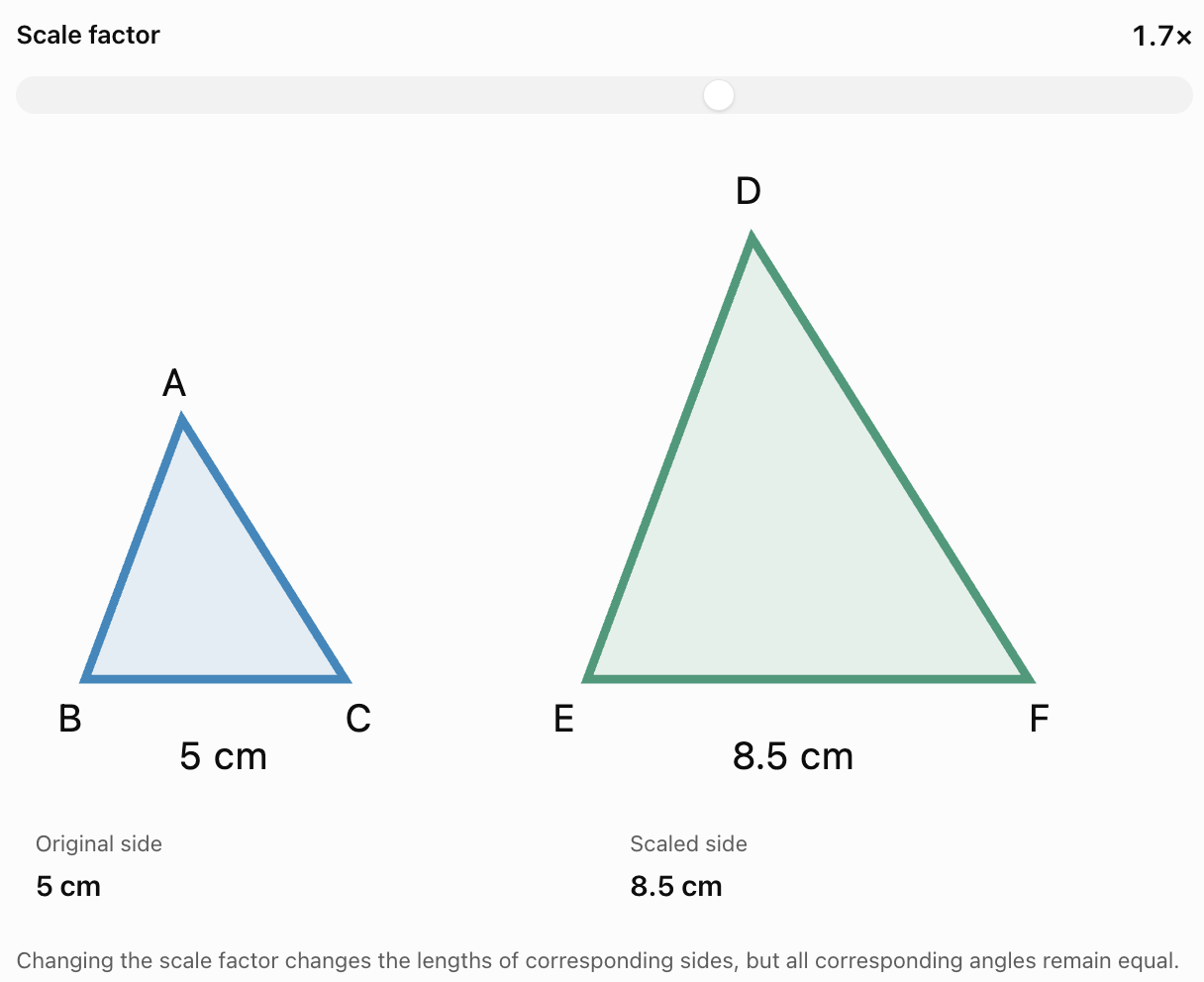
Important Observation
A scale factor affects all corresponding side lengths equally.
It does not change the angles.
For example, if a triangle has angles:
40°, 60°, and 80°
then every similar triangle has those same three angles, regardless of its size.
Criteria for Similar Triangles
Two triangles can be proven similar using three main criteria:
-
AA: Angle–Angle similarity.
-
SSS: Side–Side–Side similarity.
-
SAS: Side–Angle–Side similarity.
These criteria allow us to establish similarity without measuring every side and angle.
AA Similarity
AA stands for Angle–Angle.
Two triangles are similar if two angles of one triangle are equal to two corresponding angles of another triangle.
Why Two Angles Are Enough
The interior angles of every triangle add to 180°.
If two angles are equal, the third angles must also be equal.
For example:
Triangle ABC has:
∠A = 40°
∠B = 65°
Therefore:
∠C = 180° − 40° − 65°
∠C = 75°
Triangle DEF has:
∠D = 40°
∠E = 65°
Therefore:
∠F = 75°
All three pairs of corresponding angles are equal.
Thus:
△ABC ∼ △DEF by AA similarity.
Worked Example
Triangle PQR has angles:
35°, 65°, and 80°.
Triangle XYZ has angles:
35°, 65°, and 80°.
Are the triangles similar?
Step 1: Compare Angles
Both triangles contain corresponding angles of 35° and 65°.
Step 2: Apply AA
Two corresponding angles are equal.
Conclusion
The triangles are similar by AA.
No side lengths are needed to establish similarity.
SSS Similarity
SSS stands for Side–Side–Side.
Two triangles are similar if all three pairs of corresponding sides are proportional.
Unlike SSS congruence, the side lengths do not need to be equal.
They must have the same ratio.
Worked Example
Triangle ABC has sides:
4 cm, 6 cm, 8 cm
Triangle DEF has sides:
10 cm, 15 cm, 20 cm
Determine whether the triangles are similar.
Step 1: Compare Corresponding Sides
10/4 = 2.5
15/6 = 2.5
20/8 = 2.5
Step 2: Identify the Common Ratio
All three ratios are equal.
The scale factor is:
k = 2.5
Step 3: Apply SSS Similarity
△ABC ∼ △DEF by SSS similarity, with the sides matched in the order listed.
Important Difference
For SSS congruence, all three corresponding side lengths must be equal.
For SSS similarity, the corresponding side lengths must be proportional.
SAS Similarity
SAS stands for Side–Angle–Side.
Two triangles are similar if:
-
Two pairs of corresponding sides are proportional.
-
The included angles between those sides are equal.
Worked Example
Triangle ABC has:
AB = 6 cm
AC = 9 cm
∠A = 50°
Triangle DEF has:
DE = 10 cm
DF = 15 cm
∠D = 50°
Determine whether the triangles are similar.
Step 1: Compare Corresponding Side Ratios
DE/AB = 10/6 = 5/3
DF/AC = 15/9 = 5/3
The ratios are equal.
Step 2: Compare Included Angles
∠A = ∠D = 50°
Step 3: Apply SAS Similarity
The two side pairs are proportional, and the included angles are equal.
Therefore:
△ABC ∼ △DEF by SAS similarity.
Why the Included Angle Matters
If the equal angle is not between the proportional side pairs, the information may be insufficient to prove similarity.
The position of the angle is important.
Comparing Similarity Criteria
|
Criterion |
Information required |
|---|---|
|
AA |
Two pairs of equal corresponding angles |
|
SSS |
Three pairs of proportional corresponding sides |
|
SAS |
Two pairs of proportional corresponding sides and equal included angles |
Important Observation
AAA also establishes triangle similarity, but it is unnecessary to check all three angles because AA is sufficient.
There is no general SSA similarity criterion.


Finding Missing Side Lengths
One of the most important applications of similarity is calculating unknown lengths.
If two triangles are similar, their corresponding sides are proportional.
Suppose:
△ABC ∼ △DEF
Then:
AB/DE = BC/EF = AC/DF
We can use these proportions to find missing side lengths.
Worked Example: Basic Proportions
Two similar triangles have corresponding sides:
Small triangle: 4 cm and 7 cm.
Large triangle: 12 cm and x cm.
Find x.
Step 1: Identify the Scale Factor
Scale factor = 12/4
k = 3
Step 2: Apply the Scale Factor
x = 7 × 3
Final Answer
x = 21 cm
Verification
12/4 = 3
21/7 = 3
The corresponding side ratios are equal.
Worked Example: Cross-Multiplication
Suppose two similar triangles have:
AB = 5 cm
DE = 15 cm
BC = 8 cm
EF = x cm
Find x.
Step 1: Write a Proportion
AB/DE = BC/EF
5/15 = 8/x
Step 2: Cross-Multiply
5x = 15 × 8
5x = 120
Step 3: Solve
x = 24 cm
Step 4: Verify
5/15 = 1/3
8/24 = 1/3
The proportions are equal.
Worked Example: Finding a Side in the Smaller Triangle
Two similar triangles have:
Small corresponding side = x
Large corresponding side = 18 cm
Another small side = 5 cm
Corresponding large side = 15 cm
Find x.
Step 1: Write a Proportion
x/18 = 5/15
Step 2: Simplify
x/18 = 1/3
Step 3: Solve
x = 18/3
x = 6 cm
Reasonableness Check
The larger triangle has a scale factor of 3 relative to the smaller triangle.
Therefore, the missing small side must be one-third of 18 cm.
The answer is reasonable.
Solving Algebraic Problems Using Similarity
Sometimes side lengths are given as algebraic expressions.
Similarity allows us to construct equations and solve for unknown variables.
Worked Example
Two similar triangles have corresponding sides:
Small triangle: 3x + 2 and 10 cm.
Large triangle: 20 cm and 25 cm.
The first pair is 3x + 2 and 20, and the second pair is 10 and 25.
Find x.
Step 1: Write a Proportion
(3x + 2)/20 = 10/25
Step 2: Cross-Multiply
25(3x + 2) = 200
Step 3: Expand
75x + 50 = 200
Step 4: Solve
75x = 150
x = 2
Step 5: Verify
3x + 2 = 3(2) + 2 = 8
8/20 = 0.4
10/25 = 0.4
The proportions match.
Final Answer
x = 2
Worked Example: Two Unknown Sides
Two similar triangles have side lengths:
Small triangle: 6 cm, 8 cm, and 10 cm.
Large triangle: 9 cm, x cm, and y cm.
The corresponding sides are listed in the same order.
Step 1: Calculate the Scale Factor
k = 9/6
k = 1.5
Step 2: Find x
x = 8 × 1.5
x = 12 cm
Step 3: Find y
y = 10 × 1.5
y = 15 cm
Final Answer
The larger triangle has side lengths:
9 cm, 12 cm, and 15 cm
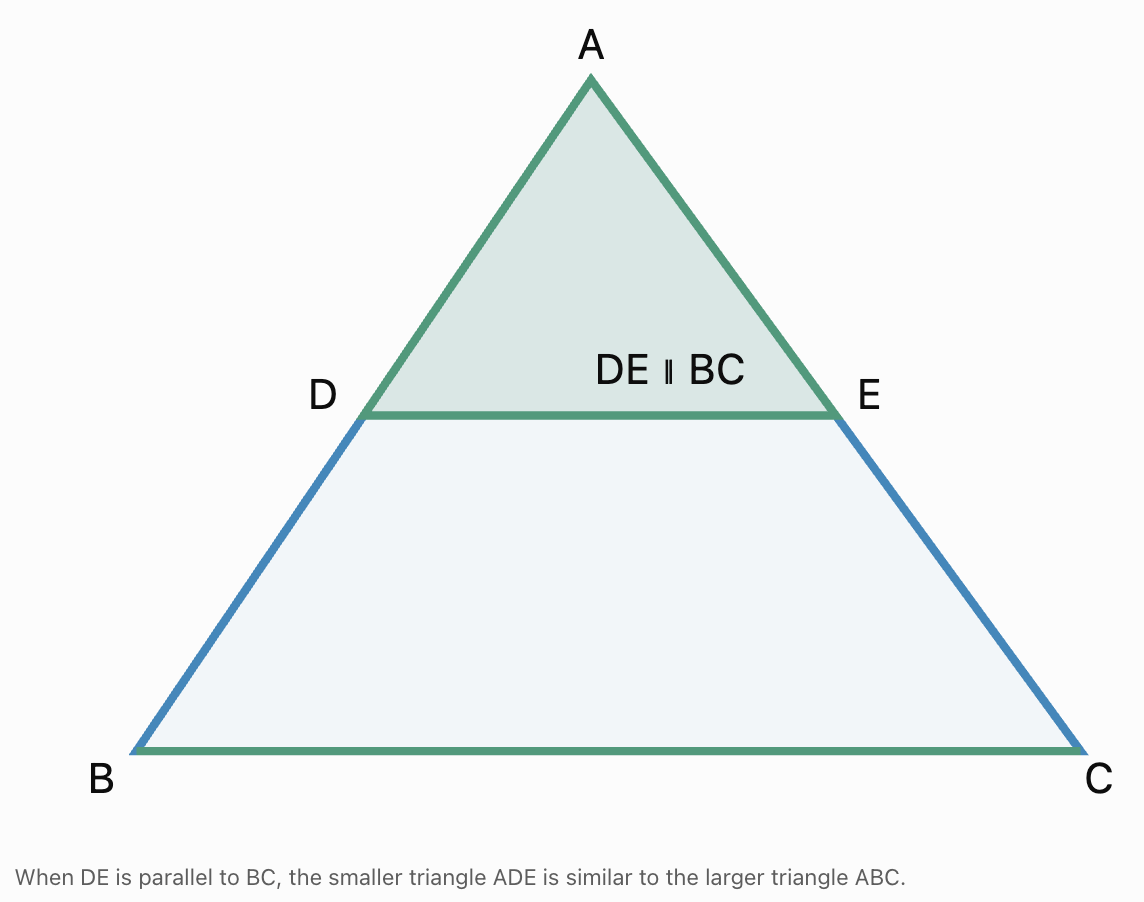
Similar Triangles Formed by Parallel Lines
Parallel lines frequently create similar triangles.
Consider triangle ABC with points D on AB and E on AC.
If:
DE ∥ BC
then:
∠ADE = ∠ABC
and:
∠AED = ∠ACB
These are corresponding angles formed by parallel lines.
Therefore:
△ADE ∼ △ABC by AA similarity.
Proportional Relationships
Since:
△ADE ∼ △ABC
we have:
AD/AB = AE/AC = DE/BC
This relationship is extremely useful when a line parallel to one side divides the other two sides of a triangle.
Worked Example: Parallel-Line Similarity
In triangle ABC:
DE ∥ BC
AD = 4 cm
AB = 10 cm
AE = 6 cm
Find AC.
Step 1: Establish Similarity
△ADE ∼ △ABC by AA.
Step 2: Write the Proportion
AD/AB = AE/AC
4/10 = 6/AC
Step 3: Cross-Multiply
4AC = 60
Step 4: Solve
AC = 15 cm
Step 5: Verify
4/10 = 0.4
6/15 = 0.4
The ratios match.
Interpretation
The smaller triangle has a scale factor of 0.4 relative to the larger triangle.
Similar Triangles and the Pythagorean Theorem
Similarity and the Pythagorean theorem can be combined to solve right-triangle problems.
Worked Example
A right triangle has legs of 6 cm and 8 cm.
A similar right triangle has a corresponding leg of 15 cm instead of 6 cm.
Find the other two side lengths.
Step 1: Find the Original Hypotenuse
Using the Pythagorean theorem:
c² = 6² + 8²
c² = 36 + 64
c² = 100
c = 10 cm
Step 2: Calculate the Scale Factor
k = 15/6
k = 2.5
Step 3: Find the Other Leg
8 × 2.5 = 20 cm
Step 4: Find the Hypotenuse
10 × 2.5 = 25 cm
Final Answer
The larger triangle has sides:
15 cm, 20 cm, and 25 cm
Verification
15² + 20² = 225 + 400 = 625
25² = 625
The Pythagorean theorem is satisfied.
Similarity and Perimeter
When two figures are similar, their perimeters have the same ratio as their corresponding side lengths.
If the scale factor is k:
New perimeter = k × original perimeter
Worked Example
A triangle has side lengths:
5 cm, 7 cm, and 8 cm.
A similar triangle has a scale factor of 3.
Find the perimeter of the larger triangle.
Step 1: Calculate the Original Perimeter
P = 5 + 7 + 8
P = 20 cm
Step 2: Apply the Scale Factor
New perimeter = 3 × 20
Final Answer
60 cm
Important Principle
A scale factor of 3 makes the perimeter three times as large.
It does not make the perimeter nine times as large.
Similarity and Area
Area changes differently from side length.
If the scale factor is k:
New area = k² × original area
This happens because area involves two dimensions.
Worked Example
A triangle has an area of 24 cm².
A similar triangle has a scale factor of 2.5.
Find the area of the larger triangle.
Step 1: Square the Scale Factor
k² = 2.5²
k² = 6.25
Step 2: Calculate the New Area
New area = 24 × 6.25
Final Answer
150 cm²
Comparing Length, Perimeter, and Area
|
Scale factor |
Side-length factor |
Perimeter factor |
Area factor |
|---|---|---|---|
|
2 |
2 |
2 |
4 |
|
3 |
3 |
3 |
9 |
|
0.5 |
0.5 |
0.5 |
0.25 |
|
1.5 |
1.5 |
1.5 |
2.25 |
|
4 |
4 |
4 |
16 |
Why Area Changes by the Square
The area of a triangle is:
A = 1/2 × base × height
If both base and height are multiplied by k:
New area = 1/2 × (k × base) × (k × height)
New area = k² × (1/2 × base × height)
Therefore:
New area = k² × original area
This relationship applies to all similar two-dimensional figures.
Real-World Application: Measuring Heights Using Shadows
Similar triangles can be used to measure the heights of tall objects without climbing them.
When sunlight strikes objects at the same angle, their heights and shadow lengths can form similar right triangles.
Worked Example
A student who is 1.6 m tall casts a shadow measuring 2 m.
At the same time, a tree casts a shadow measuring 12 m.
Find the height of the tree.

Step 1: Establish Similarity
Both objects are vertical to level ground.
The sunlight creates the same angle with the ground.
Therefore, the height-and-shadow triangles are similar by AA.
Step 2: Write a Proportion
Tree height / tree shadow = student height / student shadow
h/12 = 1.6/2
Step 3: Cross-Multiply
2h = 12 × 1.6
2h = 19.2
Step 4: Solve
h = 9.6 m
Interpretation
The tree is approximately 9.6 m tall.
Reasonableness Check
The tree's shadow is six times longer than the student's shadow.
Therefore, its height should also be six times greater.
1.6 × 6 = 9.6 m
The answer is reasonable.
Real-World Application: Maps and Scale Drawings
Maps use similarity to represent large distances using smaller measurements.
Worked Example
A map uses the scale:
1 cm : 5 km
Two towns are 7.5 cm apart on the map.
Find their actual distance.
Step 1: Identify the Scale
1 cm represents 5 km.
Step 2: Apply Proportional Reasoning
Actual distance = 7.5 × 5
Final Answer
37.5 km
Interpretation
The towns are approximately 37.5 km apart according to the map scale.
This is a straight-line or map-measured distance, not necessarily the distance travelled along roads.

Real-World Application: Scale Models
Architects and engineers often use scale models to represent larger structures.
Worked Example
A building model is constructed at a scale of:
1 : 200
The model building is 18 cm tall.
Find the actual height of the building.
Step 1: Interpret the Scale
Every 1 cm on the model represents 200 cm in reality.
Step 2: Multiply
Actual height = 18 × 200
Actual height = 3600 cm
Step 3: Convert Units
3600 cm = 36 m
Final Answer
36 m
Interpretation
The actual building is 36 m tall.
Important Observation
When using scale ratios, all measurements must initially be expressed in compatible units.
Real-World Application: Photography
Images can be enlarged or reduced while maintaining their proportions.
If an image is enlarged uniformly, the original and enlarged shapes are similar.
Worked Example
A photograph measures:
12 cm wide
8 cm high
It is enlarged to a width of 30 cm.
Find the new height.
Step 1: Calculate the Scale Factor
k = 30/12
k = 2.5
Step 2: Calculate the New Height
New height = 8 × 2.5
Final Answer
20 cm
Interpretation
The enlarged photograph should measure:
30 cm × 20 cm
This preserves the original proportions without distortion.


Real-World Application: Indirect Measurement
Similarity can be used to determine distances that are difficult or unsafe to measure directly.
For example, a surveyor may construct two similar triangles to estimate the width of a river.
Worked Example
A surveying arrangement creates two similar triangles.
The smaller triangle has:
-
A horizontal side of 4 m.
-
A corresponding perpendicular side of 6 m.
The larger triangle has a corresponding horizontal side of 30 m.
Find the larger perpendicular side.
Step 1: Write a Proportion
6/4 = x/30
Step 2: Cross-Multiply
4x = 180
Step 3: Solve
x = 45 m
Interpretation
The unknown perpendicular distance is 45 m.
The validity of this result depends on the surveyor having established that the two triangles are similar.
Real-World Application: Engineering and Design
Engineers use similar triangles to calculate dimensions in scaled structures and mechanical systems.
Worked Example
A triangular support has:
Base = 2.4 m
Height = 1.8 m
A larger similar support must have a base of 4 m.
Find its height.
Step 1: Calculate the Scale Factor
k = 4/2.4
k = 5/3
Step 2: Calculate the New Height
New height = 1.8 × 5/3
Final Answer
3 m
Interpretation
The larger support must have a height of 3 m to preserve the original triangular shape.
Multi-Step Problems with Similar Triangles
Some problems require more than one mathematical technique.
They may involve:
-
Angle calculations.
-
Proportional relationships.
-
Algebraic equations.
-
Perimeter calculations.
-
Area ratios.
-
Pythagorean theorem.
Worked Example: Finding a Missing Side and Area
Two triangles are similar.
The smaller triangle has:
Base = 8 cm
Height = 6 cm
The larger triangle has a corresponding base of 20 cm.
Find:
-
The larger triangle's height.
-
The smaller triangle's area.
-
The larger triangle's area.
Step 1: Calculate the Scale Factor
k = 20/8
k = 2.5
Step 2: Find the Larger Height
Height = 6 × 2.5
Height = 15 cm
Step 3: Find the Smaller Area
A = 1/2 × 8 × 6
A = 24 cm²
Step 4: Find the Larger Area
Using the area scale factor:
Larger area = 24 × 2.5²
Larger area = 24 × 6.25
Larger area = 150 cm²
Step 5: Verify Directly
A = 1/2 × 20 × 15
A = 150 cm²
Both methods agree.
Worked Example: Combining Angles and Proportions
Triangle ABC is similar to triangle DEF.
Given:
∠A = 50°
∠B = 65°
AB = 8 cm
DE = 12 cm
BC = 10 cm
Find:
-
∠F.
-
EF.
Step 1: Find the Third Angle
∠C = 180° − 50° − 65°
∠C = 65°
Since C corresponds to F:
∠F = 65°
Step 2: Find the Scale Factor
k = DE/AB
k = 12/8
k = 1.5
Step 3: Find EF
EF = BC × 1.5
EF = 10 × 1.5
EF = 15 cm
Final Answers
∠F = 65°
EF = 15 cm
Writing Similarity Proofs
A similarity proof explains why two triangles must have the same shape.
The proof should identify the information given and apply a valid similarity criterion.
Example: AA Similarity Proof
Given:
∠A = ∠D
∠B = ∠E
Prove:
△ABC ∼ △DEF
|
Statement |
Reason |
|---|---|
|
∠A = ∠D |
Given |
|
∠B = ∠E |
Given |
|
△ABC ∼ △DEF |
AA similarity |
Paragraph Proof
The corresponding angles ∠A and ∠D are equal, and the corresponding angles ∠B and ∠E are equal. Therefore, the triangles have two pairs of equal corresponding angles. Hence, △ABC ∼ △DEF by AA similarity.
Why Mathematical Justification Matters
A diagram may appear to contain similar triangles, but visual appearance alone is not sufficient.
A mathematical proof must establish the required relationships.
For example, two triangles may look similar even when their side ratios differ slightly.
Accurate reasoning is more reliable than visual estimation.
A Systematic Method for Similarity Problems
Identify the Triangles
Determine which figures are being compared.
Match Corresponding Parts
Identify corresponding vertices, sides, and angles.
Establish Similarity
Use AA, SSS, or SAS similarity.
Determine the Scale Factor
Compare a known pair of corresponding sides.
Write a Correct Proportion
Keep the order of corresponding sides consistent.
Solve the Equation
Use multiplication, division, or cross-multiplication.
Check Units
Ensure that measurements use compatible units.
Verify the Result
Check that the corresponding side ratios match.
Interpret the Answer
Explain what the result means in the original geometric or practical situation.
Common Mistakes
Confusing similarity with congruence
Similar figures do not need to have equal side lengths.
Matching incorrect corresponding sides
Side ratios must compare matching sides.
Writing proportions inconsistently
All ratios must use the same triangle order.
Assuming equal angles imply congruence
Equal angles establish similarity, not necessarily congruence.
Using an invalid similarity criterion
AA, SSS, and SAS are the standard triangle similarity criteria.
Forgetting the included angle in SAS
The equal angle must lie between the proportional sides.
Calculating the scale factor backwards
Always identify which figure is the original and which is the scaled figure.
Using different measurement units without converting
For example, centimetres and metres must be converted appropriately.
Applying the scale factor incorrectly
Side lengths change by k, while areas change by k².
Assuming perimeter and area change by the same factor
They scale differently.
Failing to establish similarity before using proportions
A proportion based on similarity is justified only when the figures are known to be similar.
Ignoring the real-world context
Practical answers should include units and reasonable interpretations.
Key Terms
-
Similar Figures: Figures with the same shape and proportional corresponding side lengths.
-
Similar Triangles: Triangles with equal corresponding angles and proportional corresponding sides.
-
Similarity Symbol (∼): A symbol meaning "is similar to."
-
Corresponding Vertices: Vertices occupying matching positions in similar figures.
-
Corresponding Sides: Sides that match in position and are proportional.
-
Corresponding Angles: Angles occupying matching positions and having equal measures.
-
Proportion: An equation stating that two ratios are equal.
-
Ratio: A comparison of two quantities using division.
-
Scale Factor: The ratio of a corresponding new length to an original length.
-
Enlargement: A transformation that increases a figure's dimensions proportionally.
-
Reduction: A transformation that decreases a figure's dimensions proportionally.
-
Dilation: A transformation that changes a figure's size while preserving its shape.
-
Congruence: A relationship between figures having exactly the same shape and size.
-
AA Similarity: A criterion based on two pairs of equal corresponding angles.
-
SSS Similarity: A criterion based on three pairs of proportional corresponding sides.
-
SAS Similarity: A criterion based on two proportional side pairs and an equal included angle.
-
Included Angle: The angle formed by two specified sides.
-
Triangle Angle-Sum Theorem: The rule that the interior angles of a triangle sum to 180°.
-
Parallel Lines: Lines in a plane that never intersect.
-
Alternate Interior Angles: Angles on opposite sides of a transversal between parallel lines.
-
Corresponding Angles: Angles occupying matching positions when a transversal crosses two lines.
-
Cross-Multiplication: A method for solving proportions.
-
Perimeter: The total distance around a figure.
-
Area: The amount of two-dimensional space enclosed by a figure.
-
Area Scale Factor: The square of the linear scale factor.
-
Pythagorean Theorem: The relationship a² + b² = c² in a right triangle.
-
Indirect Measurement: Finding an unknown distance using mathematical relationships instead of direct measurement.
-
Scale Drawing: A drawing representing an object using proportional dimensions.
-
Scale Model: A physical model with dimensions proportional to the original object.
-
Geometric Proof: A logical argument establishing a mathematical relationship.
-
Proportional Reasoning: Using ratios and proportions to solve problems.
-
Mathematical Verification: Checking whether a calculated result satisfies the original conditions.
Key Takeaways
-
Similar triangles have the same shape but are not necessarily the same size.
-
Corresponding angles in similar triangles are equal.
-
Corresponding sides in similar triangles are proportional.
-
The order of vertices in similarity notation identifies the correct correspondence.
-
Congruent triangles are always similar, but similar triangles are not always congruent.
-
AA similarity requires two pairs of equal corresponding angles.
-
SSS similarity requires three pairs of proportional corresponding sides.
-
SAS similarity requires two proportional side pairs and an equal included angle.
-
Scale factors describe how corresponding lengths change between similar figures.
-
A scale factor greater than 1 represents enlargement.
-
A scale factor between 0 and 1 represents reduction.
-
Corresponding side lengths change by the scale factor k.
-
Perimeters of similar figures also change by k.
-
Areas of similar figures change by k².
-
Similarity allows missing side lengths to be calculated using proportions.
-
Cross-multiplication is a useful method for solving proportional equations.
-
Parallel lines can create similar triangles through equal corresponding or alternate interior angles.
-
Similarity can be combined with the Pythagorean theorem, angle-sum relationships, and algebra.
-
Similar triangles are useful for measuring heights, distances, and dimensions indirectly.
-
Maps, photographs, scale drawings, and architectural models rely on proportional relationships.
-
Mathematical proofs should establish similarity before using corresponding side ratios.
-
Real-world solutions should include appropriate units and reasonableness checks.
-
The central skill in similarity problems is identifying corresponding parts, establishing a valid similarity relationship, and using consistent proportions to calculate unknown quantities.
Check Your Understanding
Recall and Understanding
-
Define similar triangles and explain how they differ from congruent triangles.
-
State the three main triangle similarity criteria.
-
Explain why two equal pairs of corresponding angles are sufficient to prove triangle similarity.
-
Define scale factor and explain the difference between enlargement and reduction.
-
Explain why the areas of similar triangles change by the square of the scale factor.
Application
-
Two triangles have corresponding sides of 3 cm, 5 cm, and 7 cm, and 6 cm, 10 cm, and 14 cm. Determine whether they are similar and justify your answer.
-
A triangle has sides of 4 cm, 6 cm, and 9 cm. A similar triangle has a corresponding shortest side of 12 cm. Find its other two side lengths.
-
Two similar triangles have corresponding sides of 5 cm and 15 cm. If another side of the smaller triangle is 8 cm, find the corresponding side of the larger triangle.
-
Two triangles have corresponding angles of 45° and 70°. Explain why they are similar and calculate the third angle.
-
A triangle has an area of 18 cm². A similar triangle has a scale factor of 3. Find the larger triangle's area.
Analysis and Challenge
-
In triangle ABC, DE is parallel to BC. Given AD = 6 cm, AB = 15 cm, and AE = 8 cm, calculate AC.
-
Two similar triangles have corresponding sides measuring 2x + 3 cm and 18 cm, and another corresponding pair measuring 5 cm and 10 cm. Find x.
-
A student who is 1.5 m tall casts a shadow of 1.8 m. At the same time, a building casts a shadow of 21.6 m. Calculate the building's height and explain why similarity applies.
-
A scale model of a tower is constructed at a scale of 1 : 250. The model is 32 cm tall. Find the actual tower height in metres.
-
Two similar triangular supports have corresponding bases of 6 m and 10 m. The smaller support has a height of 4.5 m and an area of 13.5 m². Determine the larger support's height and area, showing all calculations.
Final Summary
Similar triangles have the same shape, equal corresponding angles, and proportional corresponding side lengths.
Similarity can be established using AA, SSS, or SAS criteria.
Once similarity has been proven, scale factors and proportions can be used to calculate unknown side lengths and solve geometric problems.
Similar triangles also provide important relationships between corresponding perimeters and areas.
Parallel lines, angle relationships, and the Pythagorean theorem can be combined with similarity to solve more advanced problems.
In practical situations, similarity allows heights, distances, and dimensions to be calculated using indirect measurement and scale models.
The central principle is that similar triangles preserve their shape through equal corresponding angles and proportional side lengths, allowing unknown measurements to be determined through mathematical reasoning.
4. Right Triangle Geometry
Learning outcomes
- I can apply the Pythagorean Theorem.
- I can solve problems involving right triangles.
- I can determine unknown side lengths.
- I can recognize Pythagorean triples.
- I can solve practical problems involving right triangles.
Right Triangle Geometry
Introduction to Right Triangles
Right triangles are among the most important shapes in geometry. They appear in architecture, engineering, construction, navigation, physics, and many everyday situations involving distances and measurements.
A right triangle is a triangle containing one angle of exactly 90°. This special angle creates a mathematical relationship between the triangle's three sides.
That relationship is described by the Pythagorean Theorem, which allows us to calculate an unknown side length when the other two sides are known.
Right triangle geometry can be used to:
-
Calculate diagonal distances.
-
Determine the height of buildings and other structures.
-
Find the length of ladders and ramps.
-
Calculate distances on coordinate grids.
-
Determine whether a triangle contains a right angle.
-
Solve practical measurement problems.
The Pythagorean Theorem is especially useful because it connects geometry with algebra, square roots, and measurement.


Understanding the Parts of a Right Triangle
A right triangle contains three sides and three angles.
The most important features are the legs, the hypotenuse, and the right angle.
The Right Angle
The right angle measures exactly 90°.
It is usually indicated by a small square in the corner of the triangle.
The Legs
The two sides that meet to form the right angle are called the legs.
They are commonly labelled:
a and b
The Hypotenuse
The hypotenuse is the side opposite the right angle.
It is always the longest side of a right triangle.
It is commonly labelled:
c
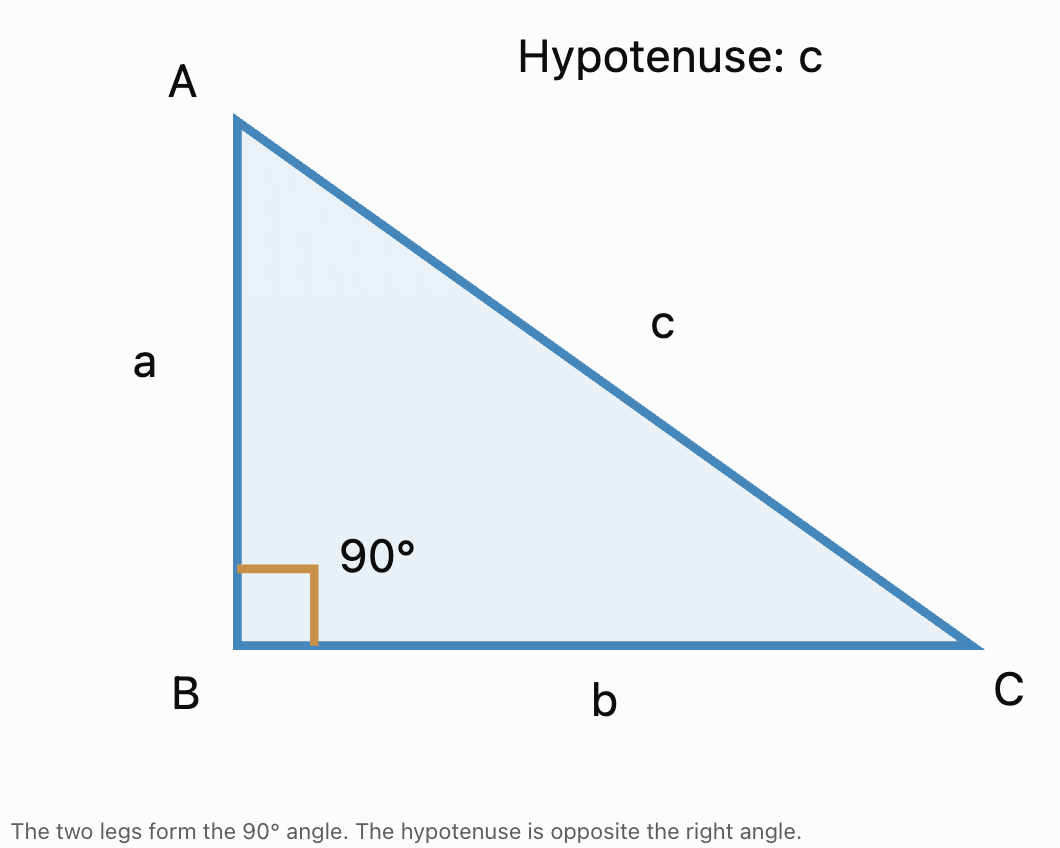
Important Properties
-
A right triangle has exactly one right angle.
-
The other two angles are acute, meaning each is less than 90°.
-
The two acute angles add to 90°.
-
The hypotenuse is longer than either leg.
-
The Pythagorean Theorem applies to every right triangle.
The Pythagorean Theorem
The Pythagorean Theorem describes the relationship between the three sides of a right triangle.
a² + b² = c²
where:
-
a is the length of one leg.
-
b is the length of the other leg.
-
c is the length of the hypotenuse.
The theorem states that the sum of the squares of the two shorter sides equals the square of the longest side.
Understanding Squared Lengths
If a side measures 3 cm, then:
3² = 3 × 3 = 9
If another side measures 4 cm:
4² = 4 × 4 = 16
Adding:
9 + 16 = 25
Since:
5² = 25
a triangle with side lengths 3 cm, 4 cm, and 5 cm satisfies the Pythagorean Theorem.
Therefore, it is a right triangle.
Visualising the Pythagorean Theorem
The theorem can be understood geometrically by constructing a square on each side of a right triangle.
The area of the square on the hypotenuse equals the combined areas of the squares on the two legs.
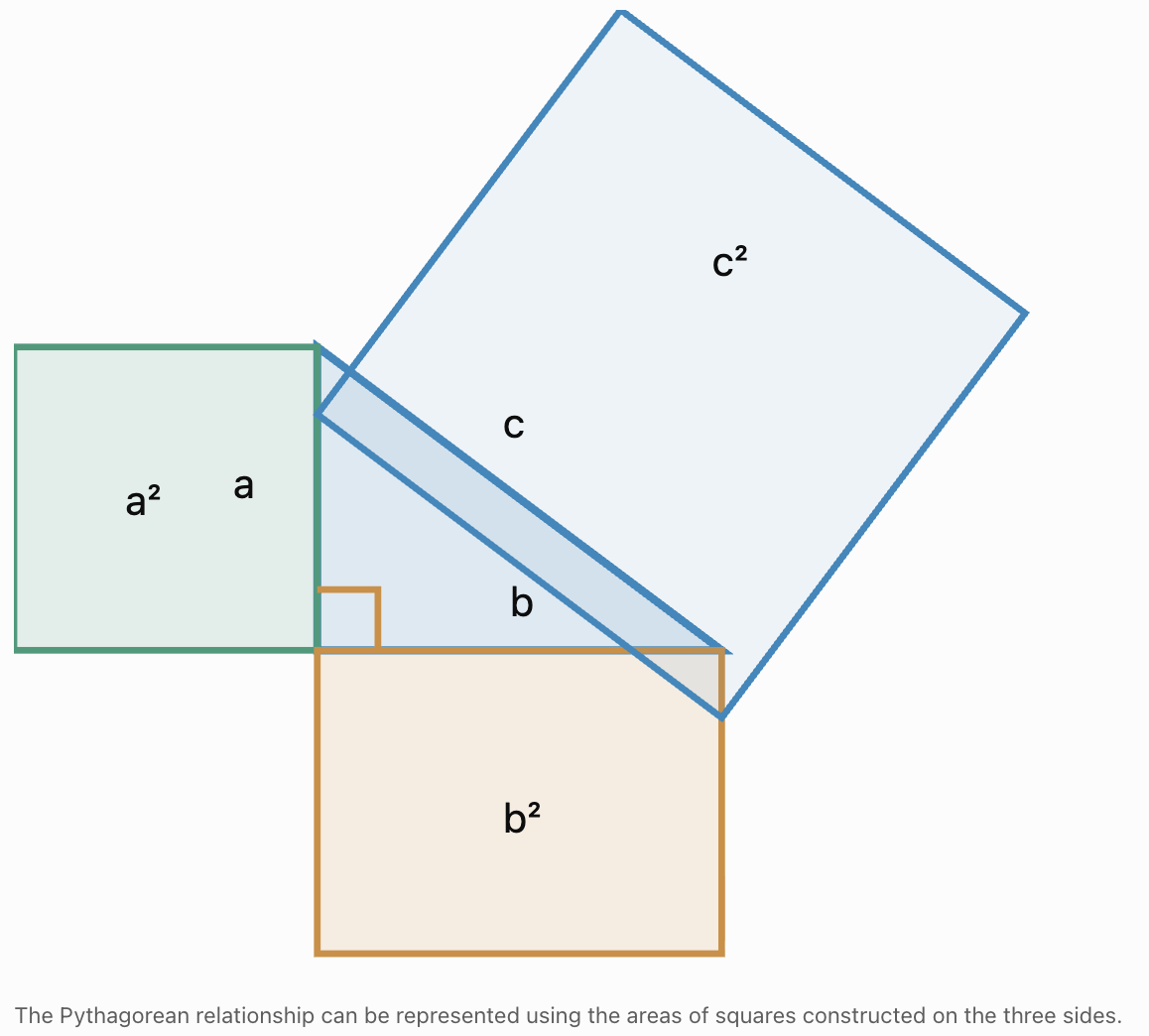
Example
For a triangle with legs of 3 cm and 4 cm:
Area of first square = 3² = 9 cm²
Area of second square = 4² = 16 cm²
Combined area = 25 cm²
The square on the hypotenuse must therefore have an area of 25 cm².
Its side length is:
√25 = 5 cm
Thus, the hypotenuse is 5 cm.
Calculating the Hypotenuse
When the lengths of both legs are known, the hypotenuse can be calculated using:
c = √(a² + b²)
Worked Example: Finding the Hypotenuse
A right triangle has legs measuring:
a = 6 cm
b = 8 cm
Find the hypotenuse.
Step 1: Write the Formula
a² + b² = c²
Step 2: Substitute
6² + 8² = c²
Step 3: Square the Values
36 + 64 = c²
Step 4: Add
100 = c²
Step 5: Take the Square Root
c = √100
c = 10 cm
Verification
6² + 8² = 10²
36 + 64 = 100
100 = 100
The answer is correct.
Reasonableness Check
The hypotenuse must be longer than either leg.
Since 10 cm is greater than both 6 cm and 8 cm, the answer is reasonable.
Worked Example: A Non-Integer Hypotenuse
A right triangle has legs measuring:
a = 5 cm
b = 7 cm
Find the hypotenuse.
Step 1: Apply the Formula
c² = 5² + 7²
Step 2: Calculate
c² = 25 + 49
c² = 74
Step 3: Take the Square Root
c = √74 cm
Step 4: Approximate
c ≈ 8.60 cm
Important Observation
Not every right triangle has whole-number side lengths.
Some hypotenuse lengths are irrational numbers.
In these cases, the exact answer may be written using a square root.
For example:
√74 cm
The decimal value is an approximation.
Calculating a Missing Leg
Sometimes the hypotenuse and one leg are known.
The Pythagorean Theorem can be rearranged to find the other leg.
Starting with:
a² + b² = c²
Subtract b²:
a² = c² − b²
Therefore:
a = √(c² − b²)
Similarly:
b = √(c² − a²)
Worked Example: Finding a Missing Leg
A right triangle has:
Hypotenuse = 13 cm
One leg = 5 cm
Find the other leg.
Step 1: Write the Formula
a² + b² = c²
Step 2: Substitute
5² + b² = 13²
Step 3: Square the Known Values
25 + b² = 169
Step 4: Rearrange
b² = 169 − 25
b² = 144
Step 5: Take the Square Root
b = √144
b = 12 cm
Verification
5² + 12² = 13²
25 + 144 = 169
169 = 169
The solution is correct.
Worked Example: Missing Leg with a Decimal Answer
A right triangle has:
Hypotenuse = 12 m
One leg = 7 m
Find the missing leg.
Step 1: Apply the Formula
b² = 12² − 7²
Step 2: Calculate
b² = 144 − 49
b² = 95
Step 3: Take the Square Root
b = √95
Step 4: Approximate
b ≈ 9.75 m
Reasonableness Check
The missing leg must be shorter than the hypotenuse.
Since 9.75 m is less than 12 m, the answer is reasonable.
Recognising Pythagorean Triples
A Pythagorean triple is a set of three positive whole numbers that satisfy the Pythagorean Theorem.
For example:
3² + 4² = 5²
9 + 16 = 25
Therefore:
3, 4, 5
is a Pythagorean triple.
Common Pythagorean Triples
|
Leg a |
Leg b |
Hypotenuse c |
|---|---|---|
|
3 |
4 |
5 |
|
5 |
12 |
13 |
|
6 |
8 |
10 |
|
7 |
24 |
25 |
|
8 |
15 |
17 |
|
9 |
12 |
15 |
|
9 |
40 |
41 |
|
12 |
16 |
20 |
|
20 |
21 |
29 |
Some triples are multiples of smaller triples.
For example:
3, 4, 5
Multiply each number by 2:
6, 8, 10
Multiply each number by 3:
9, 12, 15
These are also Pythagorean triples.
Primitive Pythagorean Triples
A primitive Pythagorean triple has no common factor greater than 1.
Examples include:
-
3, 4, 5
-
5, 12, 13
-
7, 24, 25
-
8, 15, 17
The triple 6, 8, 10 is not primitive because all three numbers are divisible by 2.
Why Pythagorean Triples Are Useful
Recognising common triples can make calculations faster.
For example, if a right triangle has legs of 9 cm and 12 cm, we can recognise that it is three times the 3–4–5 triangle.
Therefore:
Hypotenuse = 15 cm
No calculator is required.
Generating Pythagorean Triples
Some Pythagorean triples can be generated using two positive integers m and n, where m > n.
The formulas are:
a = m² − n²
b = 2mn
c = m² + n²
Worked Example
Let:
m = 3
n = 2
Then:
a = 3² − 2²
a = 9 − 4 = 5
b = 2(3)(2)
b = 12
c = 3² + 2²
c = 9 + 4 = 13
Therefore:
5, 12, 13
is a Pythagorean triple.
Verification
5² + 12² = 13²
25 + 144 = 169
169 = 169
The relationship is satisfied.
Determining Whether a Triangle Is Right-Angled
The converse of the Pythagorean Theorem states:
If the side lengths of a triangle satisfy:
a² + b² = c²
where c is the longest side, then the triangle is right-angled.
This allows us to test whether a triangle contains a 90° angle.
Worked Example
A triangle has side lengths:
9 cm, 12 cm, and 15 cm
Determine whether it is a right triangle.
Step 1: Identify the Longest Side
c = 15 cm
Step 2: Square the Shorter Sides
9² = 81
12² = 144
Step 3: Add
81 + 144 = 225
Step 4: Square the Longest Side
15² = 225
Step 5: Compare
225 = 225
Therefore:
The triangle is right-angled.
Worked Example: A Triangle That Is Not Right-Angled
A triangle has side lengths:
6 cm, 8 cm, and 11 cm
Determine whether it is right-angled.
Step 1: Identify the Longest Side
c = 11 cm
Step 2: Calculate
6² + 8² = 36 + 64
6² + 8² = 100
Step 3: Compare
11² = 121
Since:
100 ≠ 121
the triangle does not satisfy the Pythagorean Theorem.
Conclusion
The triangle is not right-angled.
Classifying Triangles Using Side Lengths
The Pythagorean relationship can also help classify triangles as acute, right, or obtuse.
Let c be the longest side.
|
Relationship |
Triangle type |
|---|---|
|
a² + b² = c² |
Right triangle |
|
a² + b² > c² |
Acute triangle |
|
a² + b² < c² |
Obtuse triangle |
These comparisons assume that the three lengths form a valid triangle.
Example: Acute Triangle
Side lengths:
6 cm, 7 cm, and 8 cm
6² + 7² = 36 + 49 = 85
8² = 64
Since:
85 > 64
the triangle is acute.
Example: Obtuse Triangle
Side lengths:
5 cm, 6 cm, and 9 cm
5² + 6² = 25 + 36 = 61
9² = 81
Since:
61 < 81
the triangle is obtuse.
Right Triangles on Coordinate Grids
The Pythagorean Theorem can be used to calculate the distance between two points on a coordinate plane.
Suppose the points are:
A(x₁, y₁)
B(x₂, y₂)
The horizontal distance is:
Δx = x₂ − x₁
The vertical distance is:
Δy = y₂ − y₁
These distances form the legs of a right triangle.
The straight-line distance between the points is the hypotenuse.
Therefore:
d = √[(x₂ − x₁)² + (y₂ − y₁)²]
This is called the distance formula.
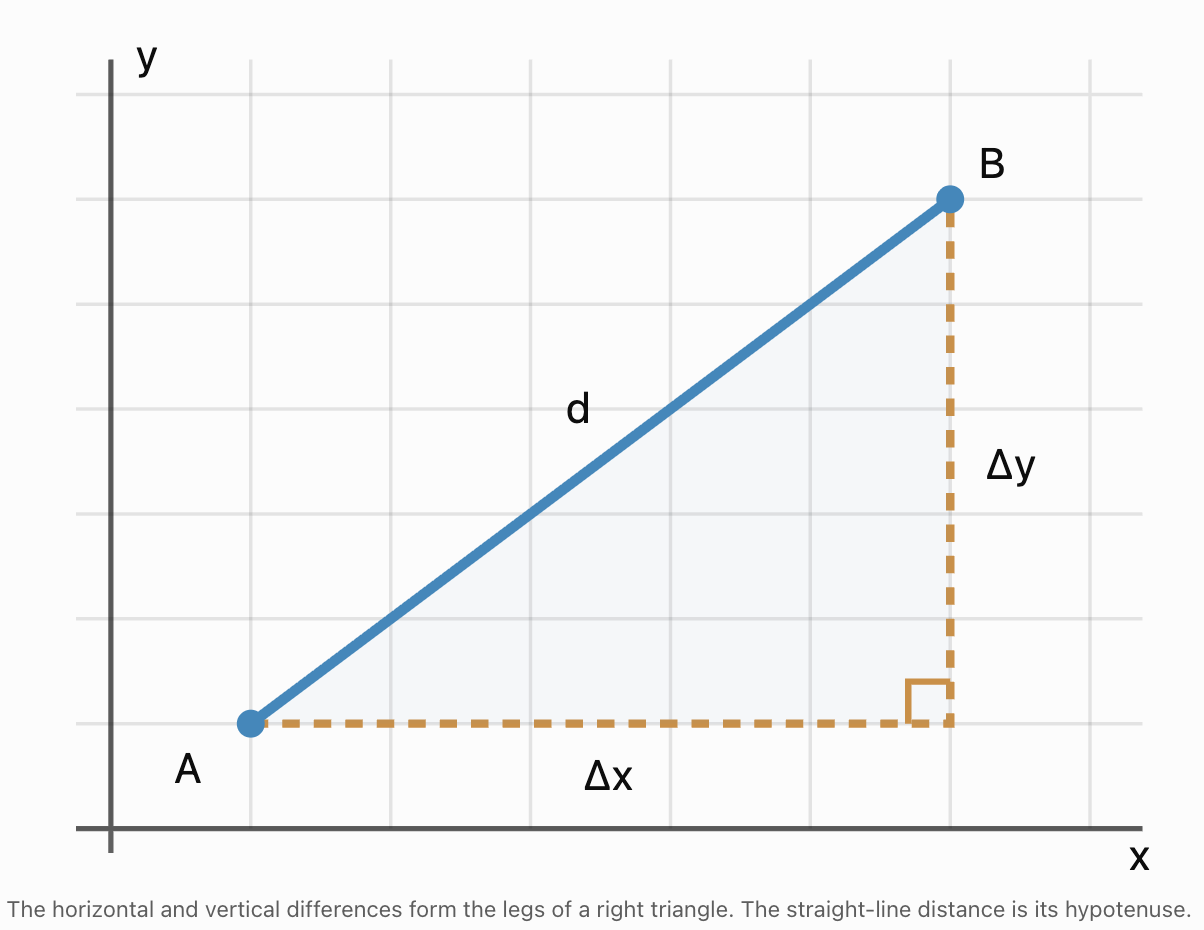
Worked Example: Distance Between Two Points
Find the distance between:
A(2, 3)
B(8, 11)
Step 1: Find the Horizontal Difference
Δx = 8 − 2
Δx = 6
Step 2: Find the Vertical Difference
Δy = 11 − 3
Δy = 8
Step 3: Apply the Pythagorean Theorem
d² = 6² + 8²
d² = 36 + 64
d² = 100
Step 4: Calculate the Distance
d = 10 units
Interpretation
The straight-line distance between the two points is 10 coordinate units.
Worked Example: Negative Coordinates
Find the distance between:
P(−3, 4)
Q(5, −2)
Step 1: Find the Differences
Δx = 5 − (−3) = 8
Δy = −2 − 4 = −6
Step 2: Square the Differences
8² = 64
(−6)² = 36
Step 3: Add
d² = 64 + 36
d² = 100
Step 4: Calculate
d = 10 units
Important Observation
Negative coordinate differences do not produce negative distances because the differences are squared.
Practical Application: Ladders
A ladder leaning against a vertical wall forms a right triangle with the wall and the ground, assuming the wall is vertical and the ground is level.
The ladder is the hypotenuse.
Worked Example
A ladder is 10 m long.
Its base is positioned 6 m from the wall.
How high up the wall does the ladder reach?
Step 1: Identify the Sides
Hypotenuse = 10 m
Horizontal leg = 6 m
Vertical leg = h
Step 2: Apply the Formula
h² + 6² = 10²
Step 3: Calculate
h² + 36 = 100
h² = 64
Step 4: Solve
h = 8 m
Interpretation
The ladder reaches 8 m up the wall.
Reasonableness Check
The vertical height must be shorter than the ladder.
Since 8 m is less than 10 m, the result is reasonable.
Safety Connection
In real situations, ladder placement must also follow appropriate safety guidance. The Pythagorean Theorem determines geometric distances but does not by itself establish whether the ladder is positioned safely.
Practical Application: Ramps
Ramps form right triangles when they connect two different heights across a horizontal distance.
The ramp is the hypotenuse.
Worked Example
A ramp rises 1.2 m vertically over a horizontal distance of 5 m.
Find the ramp length.
Step 1: Identify the Legs
a = 1.2 m
b = 5 m
Step 2: Apply the Formula
c² = 1.2² + 5²
Step 3: Calculate
c² = 1.44 + 25
c² = 26.44
Step 4: Take the Square Root
c ≈ 5.14 m
Interpretation
The ramp must be approximately 5.14 m long along its sloping surface.
Important Observation
The sloping length is greater than the horizontal distance because the ramp also rises vertically.

Practical Application: Television and Screen Sizes
Screen sizes are often described by their diagonal measurement.
The width and height form the legs of a right triangle.
The diagonal is the hypotenuse.
Worked Example
A rectangular screen is:
48 cm wide
36 cm high
Find its diagonal.
Step 1: Apply the Formula
d² = 48² + 36²
Step 2: Calculate
d² = 2304 + 1296
d² = 3600
Step 3: Take the Square Root
d = 60 cm
Interpretation
The screen has a diagonal measurement of 60 cm.
This illustrates why screen dimensions can be described using a single diagonal length.
Practical Application: Construction
Builders use right triangles to check whether corners are square.
A common method uses the 3–4–5 Pythagorean triple.
Worked Example
A builder measures:
3 m along one side of a rectangular foundation.
4 m along the adjacent side.
If the corner is exactly 90°, the diagonal between the endpoints should be:
c² = 3² + 4²
c² = 9 + 16
c² = 25
c = 5 m
Interpretation
If the diagonal measures 5 m, the two measured sides form a right angle, assuming the measurements are accurate.
This technique is useful when setting out rectangular foundations and other structures.


Practical Application: Navigation
The Pythagorean Theorem can calculate straight-line displacement when two movements are perpendicular.
Worked Example
A person walks:
300 m east
400 m north
Find the straight-line distance from the starting point.
Step 1: Identify the Legs
Eastward movement = 300 m
Northward movement = 400 m
Step 2: Apply the Formula
d² = 300² + 400²
Step 3: Calculate
d² = 90000 + 160000
d² = 250000
Step 4: Take the Square Root
d = 500 m
Interpretation
The person finishes 500 m from the starting point.
Distance Versus Displacement
The total distance walked is:
300 + 400 = 700 m
The magnitude of displacement is:
500 m
These values differ because distance measures the length of the path travelled, while displacement describes the straight-line change in position.
Practical Application: Engineering Cables
Support cables often form the hypotenuse of right triangles.
Worked Example
A vertical pole is 12 m tall.
A cable is attached to its top and anchored 5 m from its base.
Find the minimum straight-line cable length.
Step 1: Apply the Formula
c² = 12² + 5²
Step 2: Calculate
c² = 144 + 25
c² = 169
Step 3: Solve
c = 13 m
Interpretation
The straight-line distance from the top of the pole to the anchor point is 13 m.
Additional cable may be required for attachment and tensioning.
Multi-Step Right Triangle Problems
Some geometric problems contain more than one right triangle.
In these cases, we may need to apply the Pythagorean Theorem several times.
Worked Example: Two Connected Right Triangles
A rectangular field measures:
30 m long
40 m wide
A person walks diagonally across the field and then travels 12 m vertically upward along a separate perpendicular route.
Find the straight-line distance from the original starting point to the final point, assuming the 12 m movement is perpendicular to the plane of the field.
Step 1: Find the Field Diagonal
d² = 30² + 40²
d² = 900 + 1600
d² = 2500
d = 50 m
Step 2: Form a Second Right Triangle
The field diagonal is one leg.
The vertical movement is the other leg.
Therefore:
D² = 50² + 12²
Step 3: Calculate
D² = 2500 + 144
D² = 2644
Step 4: Solve
D = √2644 ≈ 51.42 m
Interpretation
The straight-line distance between the starting and final positions is approximately 51.42 m.
Important Observation
The first application of the theorem finds a diagonal in a horizontal plane.
The second application finds a three-dimensional distance.
Right Triangle Geometry in Three Dimensions
The Pythagorean Theorem can also be used to find the space diagonal of a rectangular prism.
For a rectangular prism with:
Length = l
Width = w
Height = h
the space diagonal is:
d = √(l² + w² + h²)
This formula comes from applying the Pythagorean Theorem twice.
Worked Example
A rectangular storage box measures:
Length = 6 cm
Width = 8 cm
Height = 24 cm
Find the distance between opposite corners of the box.
Step 1: Apply the Three-Dimensional Formula
d² = 6² + 8² + 24²
Step 2: Calculate
d² = 36 + 64 + 576
d² = 676
Step 3: Take the Square Root
d = 26 cm
Interpretation
The straight-line distance between opposite corners is 26 cm.
Algebraic Problems Involving Right Triangles
Sometimes side lengths are expressed algebraically.
The Pythagorean Theorem can be used to construct and solve equations.
Worked Example
A right triangle has legs:
x cm
(x + 7) cm
and a hypotenuse of 13 cm.
Find x.
Step 1: Write the Equation
x² + (x + 7)² = 13²
Step 2: Expand
x² + x² + 14x + 49 = 169
Step 3: Simplify
2x² + 14x + 49 = 169
2x² + 14x − 120 = 0
Step 4: Divide by 2
x² + 7x − 60 = 0
Step 5: Factorise
(x + 12)(x − 5) = 0
Therefore:
x = −12 or x = 5
Step 6: Reject the Invalid Solution
A side length cannot be negative.
Therefore:
x = 5 cm
Step 7: Find the Other Leg
x + 7 = 12 cm
Step 8: Verify
5² + 12² = 13²
25 + 144 = 169
169 = 169
The solution is correct.
Combining Right Triangles with Similarity
Right triangles can also be similar.
For example, the triangles with sides:
3, 4, 5
and:
6, 8, 10
are both right triangles.
Their corresponding sides have the same ratio:
6/3 = 2
8/4 = 2
10/5 = 2
Therefore, they are similar by SSS similarity.
This means the second triangle is an enlargement of the first by a scale factor of 2.
Important Connection
The Pythagorean Theorem remains valid when a right triangle is enlarged or reduced proportionally.
If:
a² + b² = c²
then multiplying all side lengths by k gives:
(ka)² + (kb)² = (kc)²
k²a² + k²b² = k²c²
Dividing by k² returns the original relationship.
This shows why all similar right triangles preserve the Pythagorean relationship.
Choosing the Correct Method
When solving a right triangle problem, use the following process.
Identify the Right Angle
Determine whether the triangle contains a 90° angle.
Identify the Hypotenuse
Locate the side opposite the right angle.
Label the Sides
Use a and b for the legs and c for the hypotenuse.
Determine the Unknown
Decide whether you need to find:
-
The hypotenuse.
-
One of the legs.
-
A diagonal distance.
-
A coordinate distance.
-
Whether the triangle is right-angled.
Select the Formula
For the hypotenuse:
c = √(a² + b²)
For a missing leg:
a = √(c² − b²)
For coordinate distance:
d = √[(x₂ − x₁)² + (y₂ − y₁)²]
Substitute Carefully
Use the correct side lengths and units.
Solve
Square, add or subtract, and take the square root.
Verify
Substitute the calculated value into the original equation.
Interpret
Explain what the result means in the original problem.
Common Mistakes
Using the Pythagorean Theorem on a triangle that is not right-angled
The theorem applies only to right triangles.
Misidentifying the hypotenuse
The hypotenuse is opposite the 90° angle and is always the longest side.
Adding the side lengths instead of their squares
The theorem involves squared lengths.
Forgetting to take the square root
Solving for c² is not the same as solving for c.
Adding instead of subtracting when finding a leg
To find a missing leg, subtract the square of the known leg from the square of the hypotenuse.
Subtracting in the wrong order
The square of the hypotenuse must be the larger quantity.
Accepting negative side lengths
Physical lengths must be positive.
Rounding too early
Keep exact values until the final step whenever possible.
Confusing distance with displacement
The length of a travelled path may be different from the straight-line displacement.
Using inconsistent units
Convert measurements into compatible units before calculating.
Assuming all right triangles have integer side lengths
Many right triangles have irrational side lengths.
Forgetting to check whether the answer is reasonable
The hypotenuse must always be longer than either leg.
Confusing a Pythagorean triple with any three whole numbers
The numbers must satisfy the Pythagorean relationship.
Failing to identify the longest side when testing a triangle
The longest side must be used as c.
Key Terms
-
Right Triangle: A triangle containing one angle of exactly 90°.
-
Right Angle: An angle measuring 90°.
-
Leg: One of the two sides forming the right angle.
-
Hypotenuse: The side opposite the right angle and the longest side of a right triangle.
-
Pythagorean Theorem: The relationship a² + b² = c² in a right triangle.
-
Converse of the Pythagorean Theorem: The principle that a triangle is right-angled if its side lengths satisfy the Pythagorean relationship.
-
Pythagorean Triple: Three positive whole numbers satisfying a² + b² = c².
-
Primitive Pythagorean Triple: A Pythagorean triple with no common factor greater than 1.
-
Square: The result of multiplying a number by itself.
-
Square Root: A number that produces a given value when squared.
-
Irrational Number: A number that cannot be expressed as a ratio of two integers.
-
Exact Value: A value written without rounding.
-
Approximate Value: A numerical estimate of an exact quantity.
-
Diagonal: A straight line connecting non-adjacent vertices of a polygon or opposite corners of a solid.
-
Distance Formula: A formula for calculating the straight-line distance between two coordinate points.
-
Coordinate Plane: A two-dimensional system using horizontal and vertical axes.
-
Horizontal Distance: Distance measured parallel to the horizontal axis.
-
Vertical Distance: Distance measured parallel to the vertical axis.
-
Displacement: The straight-line change in position from an initial point to a final point, including direction.
-
Distance: The total length of a path or the separation between points, depending on context.
-
Acute Triangle: A triangle in which all three angles are less than 90°.
-
Obtuse Triangle: A triangle containing one angle greater than 90°.
-
Perpendicular Lines: Lines that intersect at a right angle.
-
Rectangular Prism: A three-dimensional solid with rectangular faces.
-
Space Diagonal: A line connecting opposite vertices of a three-dimensional solid.
-
Similar Triangles: Triangles with equal corresponding angles and proportional corresponding sides.
-
Scale Factor: The ratio of corresponding lengths in similar figures.
-
Verification: Checking a calculated result against the original equation.
-
Reasonableness Check: Evaluating whether a mathematical result makes sense.
-
Geometric Model: A mathematical representation of a physical shape or situation.
Key Takeaways
-
The Pythagorean Theorem describes the relationship between the three sides of a right triangle.
-
The two sides forming the right angle are called legs.
-
The hypotenuse is opposite the right angle and is always the longest side.
-
The Pythagorean Theorem states that a² + b² = c².
-
The hypotenuse can be found using c = √(a² + b²).
-
A missing leg can be found by subtracting the square of the known leg from the square of the hypotenuse.
-
The theorem applies only to right triangles.
-
The converse of the theorem can be used to determine whether a triangle is right-angled.
-
Pythagorean triples are sets of positive whole numbers satisfying the theorem.
-
Common triples include 3–4–5, 5–12–13, and 8–15–17.
-
Multiples of Pythagorean triples are also Pythagorean triples.
-
Not all right triangles have whole-number side lengths.
-
Some side lengths must be expressed using square roots.
-
The distance formula is derived from the Pythagorean Theorem.
-
Right triangle geometry can be used to calculate distances on coordinate grids.
-
The theorem can be applied more than once to solve three-dimensional problems.
-
Similar right triangles preserve the Pythagorean relationship.
-
Right triangle geometry is useful for ladders, ramps, cables, screens, construction, and navigation.
-
Mathematical solutions should include appropriate units and verification.
-
The central skill is recognising right triangles, identifying the hypotenuse correctly, and applying the Pythagorean Theorem to calculate unknown distances and side lengths.
Check Your Understanding
Recall and Understanding
-
Define a right triangle and identify its three sides.
-
State the Pythagorean Theorem and explain what each variable represents.
-
Explain why the hypotenuse must always be the longest side.
-
Define a Pythagorean triple and give three examples.
-
Explain how the converse of the Pythagorean Theorem can be used to identify right triangles.
Application
-
A right triangle has legs measuring 9 cm and 12 cm. Calculate the hypotenuse.
-
A right triangle has a hypotenuse of 17 cm and one leg of 8 cm. Find the missing leg.
-
Determine whether a triangle with side lengths 7 cm, 24 cm, and 25 cm is right-angled.
-
Find the distance between points A(1, 2) and B(7, 10).
-
A rectangular field measures 60 m by 80 m. Calculate the diagonal distance across the field.
Analysis and Challenge
-
A 13 m ladder leans against a vertical wall. Its base is 5 m from the wall. How high does the ladder reach?
-
A ramp rises 0.9 m over a horizontal distance of 4.8 m. Calculate its sloping length.
-
A person walks 500 m east and then 1200 m north. Calculate the total distance walked and the magnitude of the displacement.
-
A right triangle has legs measuring x cm and (x + 7) cm, with a hypotenuse of 13 cm. Determine x and verify your solution.
-
A rectangular storage container measures 9 m long, 12 m wide, and 20 m high. Calculate the straight-line distance between opposite corners of the container.
Final Summary
Right triangle geometry provides an important connection between shape, measurement, and algebra.
The Pythagorean Theorem allows unknown side lengths to be calculated using the relationship between the legs and hypotenuse.
It can also be used to determine whether a triangle is right-angled, recognise Pythagorean triples, and calculate distances on coordinate grids.
More advanced applications involve similar triangles, algebraic equations, three-dimensional distances, and practical measurement problems.
The theorem is widely used in architecture, construction, navigation, engineering, and everyday situations involving perpendicular distances.
The central principle is that the square of the hypotenuse of a right triangle equals the sum of the squares of its two legs, providing a reliable method for calculating unknown lengths and solving geometric problems.
5. Triangle Proofs
Learning outcomes
- I can prove properties of triangles.
- I can justify congruence and similarity.
- I can prove angle relationships.
- I can complete formal geometric proofs.
- I can explain my reasoning clearly.
Triangle Proofs
Introduction to Triangle Proofs
Geometry is not only about calculating lengths and angles. It is also about explaining why mathematical relationships must be true.
A geometric proof is a logical argument that uses known facts, definitions, properties, and theorems to establish a conclusion.
Triangles are especially important in geometric proofs because their properties can be used to demonstrate relationships involving:
-
Equal angles and side lengths.
-
Congruent triangles.
-
Similar triangles.
-
Parallel and perpendicular lines.
-
Angle bisectors and medians.
-
Isosceles and equilateral triangles.
-
Unknown geometric measurements.
A complete triangle proof should do more than state an answer. It should explain how each conclusion follows logically from the information given.


Understanding Mathematical Proof
A mathematical proof is a sequence of logical statements that establishes the truth of a mathematical claim.
Each statement must be supported by a valid reason.
These reasons may include:
-
Information provided in the question.
-
Mathematical definitions.
-
Previously established theorems.
-
Properties of equality.
-
Geometric relationships.
Example
Suppose we are given:
AB = AC
We can conclude that triangle ABC is isosceles.
This follows from the definition of an isosceles triangle: a triangle with at least two equal sides.
We can then conclude:
∠ABC = ∠BCA
because the base angles of an isosceles triangle are equal.
The reasoning follows a logical sequence:
AB = AC
↓
△ABC is isosceles.
↓
∠ABC = ∠BCA
Each conclusion is supported by a mathematical fact.
Given Information and Required Conclusions
Most geometry proof questions contain two parts.
Given: Information known to be true.
Prove: The conclusion that must be established.
Example
Given:
AB = AC
D is the midpoint of BC.
Prove:
△ABD ≅ △ACD
To complete the proof, we must identify enough corresponding equal sides or angles to apply a valid congruence criterion.
Step 1: Use the Given Side Equality
AB = AC
Step 2: Use the Definition of Midpoint
Since D is the midpoint of BC:
BD = DC
Step 3: Identify the Shared Side
AD = AD
This follows from the reflexive property.
Step 4: Apply SSS Congruence
The three corresponding side pairs are equal.
Therefore:
△ABD ≅ △ACD by SSS.
This is a complete proof because every necessary equality has been justified.
Important Properties Used in Triangle Proofs
Before writing more advanced proofs, it is important to understand several fundamental geometric relationships.
Triangle Angle-Sum Theorem
The interior angles of every triangle add to 180°.
∠A + ∠B + ∠C = 180°
Worked Example
In triangle ABC:
∠A = 50°
∠B = 65°
Find ∠C.
Step 1: Apply the Angle-Sum Theorem
50° + 65° + ∠C = 180°
Step 2: Simplify
115° + ∠C = 180°
Step 3: Solve
∠C = 65°
Using the Theorem in Proofs
If two triangles have two pairs of equal corresponding angles, their third angles must also be equal.
For example, suppose:
∠A = ∠D
∠B = ∠E
Then:
∠C = 180° − ∠A − ∠B
∠F = 180° − ∠D − ∠E
Since the corresponding angles are equal:
∠C = ∠F
This relationship is frequently used in similarity proofs.
Exterior Angle Theorem
An exterior angle of a triangle is formed when one side is extended beyond a vertex.
The exterior angle equals the sum of the two non-adjacent interior angles.
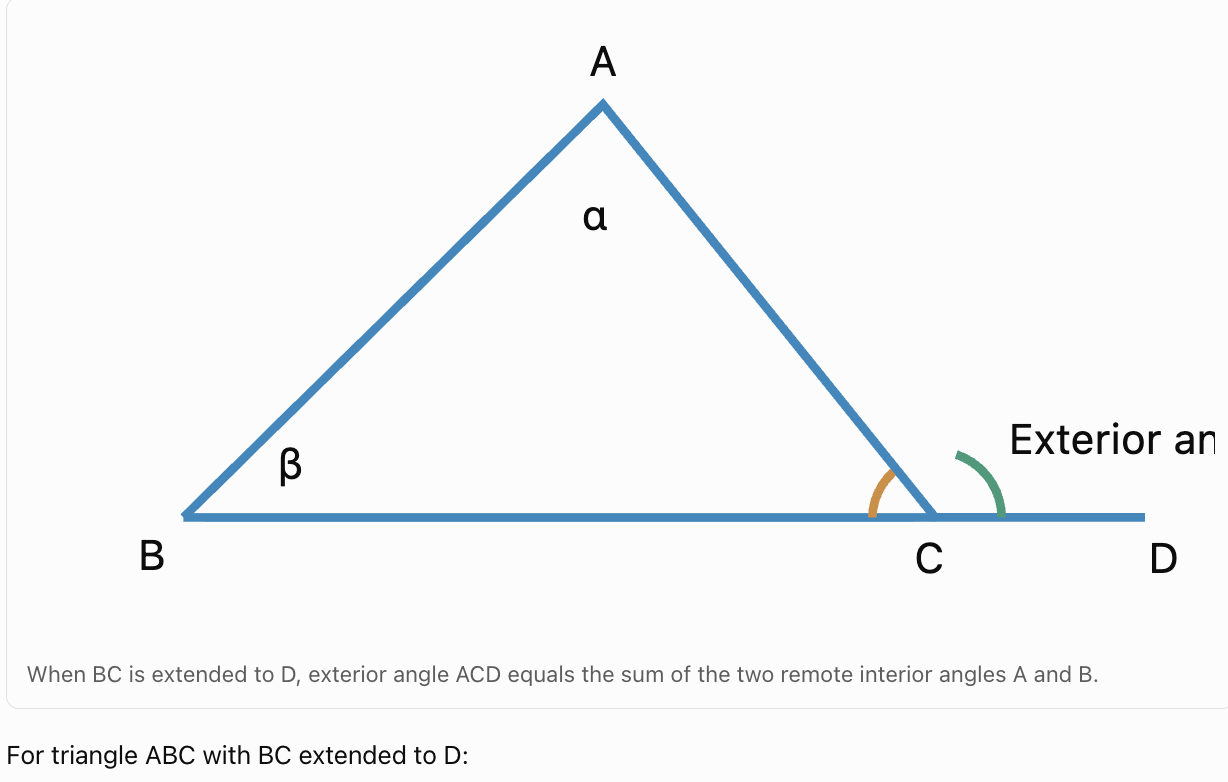
For triangle ABC with BC extended to D:
∠ACD = ∠BAC + ∠ABC
Worked Example
Suppose:
∠A = 45°
∠B = 70°
Then:
Exterior angle = 45° + 70°
Exterior angle = 115°
Why the Exterior Angle Theorem Works
The triangle angle-sum theorem gives:
∠A + ∠B + ∠C = 180°
The interior angle at C and its adjacent exterior angle form a straight line:
∠C + exterior angle = 180°
Therefore:
Exterior angle = 180° − ∠C
Since:
∠A + ∠B = 180° − ∠C
we conclude:
Exterior angle = ∠A + ∠B
This is an example of proving one theorem using another.
Angle Relationships in Geometric Proofs
Several angle relationships are especially useful when proving properties of triangles.
Vertically Opposite Angles
When two straight lines intersect, vertically opposite angles are equal.
For example:
∠AOB = ∠COD
when the two angles are vertically opposite.
Angles on a Straight Line
Adjacent angles forming a straight line add to 180°.
Corresponding Angles
When parallel lines are crossed by a transversal, corresponding angles are equal.
Alternate Interior Angles
When parallel lines are crossed by a transversal, alternate interior angles are equal.
Angle Bisectors
An angle bisector divides an angle into two equal angles.
If AD bisects ∠BAC:
∠BAD = ∠DAC
Perpendicular Lines
Perpendicular lines intersect at 90°.
If AD is perpendicular to BC:
∠ADB = ∠ADC = 90°
These relationships often provide the equal angles needed for congruence or similarity proofs.


Proving Triangle Congruence
Two triangles are congruent when they have exactly the same shape and size.
Congruent triangles have:
-
Equal corresponding side lengths.
-
Equal corresponding angles.
The congruence symbol is:
≅
For example:
△ABC ≅ △DEF
This statement indicates the correspondence:
A ↔ D
B ↔ E
C ↔ F
Triangle Congruence Criteria
|
Criterion |
Requirements |
|---|---|
|
SSS |
Three pairs of equal corresponding sides |
|
SAS |
Two pairs of equal corresponding sides and equal included angles |
|
ASA |
Two pairs of equal corresponding angles and equal included sides |
|
AAS |
Two pairs of equal corresponding angles and one equal non-included side |
|
HL |
Equal hypotenuses and one equal corresponding leg in right triangles |
A proof must identify which criterion applies and justify the required equalities.
Proving Congruence Using SSS
Worked Proof
Given:
AB = DE
BC = EF
AC = DF
Prove:
△ABC ≅ △DEF
Step 1: Identify Corresponding Sides
AB corresponds to DE.
BC corresponds to EF.
AC corresponds to DF.
Step 2: Verify the Equalities
AB = DE — given.
BC = EF — given.
AC = DF — given.
Step 3: Apply SSS
All three corresponding side pairs are equal.
Therefore:
△ABC ≅ △DEF by SSS.
Two-Column Proof
|
Statement |
Reason |
|---|---|
|
AB = DE |
Given |
|
BC = EF |
Given |
|
AC = DF |
Given |
|
△ABC ≅ △DEF |
SSS congruence |
Proving Congruence Using SAS
Worked Proof
Two straight lines AC and BD intersect at O.
Given:
AO = CO
BO = DO
Prove:
△AOB ≅ △COD
Step 1: Identify Equal Sides
AO = CO — given.
BO = DO — given.
Step 2: Identify Equal Angles
∠AOB = ∠COD
These angles are vertically opposite.
Step 3: Apply SAS
The equal angles lie between the two pairs of equal sides.
Therefore:
△AOB ≅ △COD by SAS.
Two-Column Proof
|
Statement |
Reason |
|---|---|
|
AO = CO |
Given |
|
BO = DO |
Given |
|
∠AOB = ∠COD |
Vertically opposite angles |
|
△AOB ≅ △COD |
SAS congruence |
Important Observation
The angle used in SAS must be the included angle.
Two equal sides and a non-included angle do not generally establish congruence.
Proving Congruence Using ASA
Worked Proof
Given:
∠A = ∠D
∠B = ∠E
AB = DE
Prove:
△ABC ≅ △DEF
Step 1: Compare the Angles
∠A = ∠D — given.
∠B = ∠E — given.
Step 2: Compare the Included Sides
AB = DE — given.
The equal sides lie between the two known angles.
Step 3: Apply ASA
△ABC ≅ △DEF by ASA.
Proving Congruence Using AAS
Worked Proof
Given:
∠A = ∠D
∠B = ∠E
AC = DF
Prove:
△ABC ≅ △DEF
Step 1: Identify Equal Angles
∠A = ∠D
∠B = ∠E
Step 2: Identify Equal Sides
AC = DF
These are non-included sides relative to the two known angles.
Step 3: Apply AAS
△ABC ≅ △DEF by AAS.
Proving Congruence Using HL
The HL criterion applies only to right triangles.
Worked Proof
Triangles ABC and DEF are right-angled at B and E.
Given:
AC = DF
AB = DE
Prove:
△ABC ≅ △DEF
Step 1: Identify the Right Angles
∠B = ∠E = 90°
Step 2: Identify the Hypotenuses
AC and DF are the hypotenuses.
AC = DF — given.
Step 3: Identify Equal Legs
AB = DE — given.
Step 4: Apply HL
△ABC ≅ △DEF by HL.
Corresponding Parts of Congruent Triangles
Once two triangles have been proven congruent, their corresponding sides and angles must be equal.
This principle is called:
Corresponding Parts of Congruent Triangles are Congruent (CPCTC).
For example, if:
△ABC ≅ △DEF
then:
AB = DE
BC = EF
AC = DF
∠A = ∠D
∠B = ∠E
∠C = ∠F
Important Proof Rule
CPCTC is used after proving that the triangles are congruent.
It cannot be used as an unsupported assumption to establish the congruence itself.
Worked Proof: An Isosceles Triangle
Given:
AB = AC
D is the midpoint of BC.
Prove:
∠BAD = ∠DAC
Step 1: Identify Equal Sides
AB = AC — given.
Step 2: Use the Midpoint
BD = DC — definition of midpoint.
Step 3: Identify the Shared Side
AD = AD — reflexive property.
Step 4: Prove Triangle Congruence
△ABD ≅ △ACD by SSS.
Step 5: Apply CPCTC
∠BAD = ∠DAC
Therefore:
AD bisects ∠BAC.
Two-Column Proof
|
Statement |
Reason |
|---|---|
|
AB = AC |
Given |
|
BD = DC |
Definition of midpoint |
|
AD = AD |
Reflexive property |
|
△ABD ≅ △ACD |
SSS congruence |
|
∠BAD = ∠DAC |
CPCTC |
|
AD bisects ∠BAC |
Definition of angle bisector |
This proof demonstrates how triangle congruence can establish an additional geometric property.
Proving Properties of Isosceles Triangles
An isosceles triangle has at least two equal sides.
The angles opposite those equal sides are also equal.
Isosceles Triangle Theorem
If:
AB = AC
then:
∠ABC = ∠BCA
These are called the base angles.
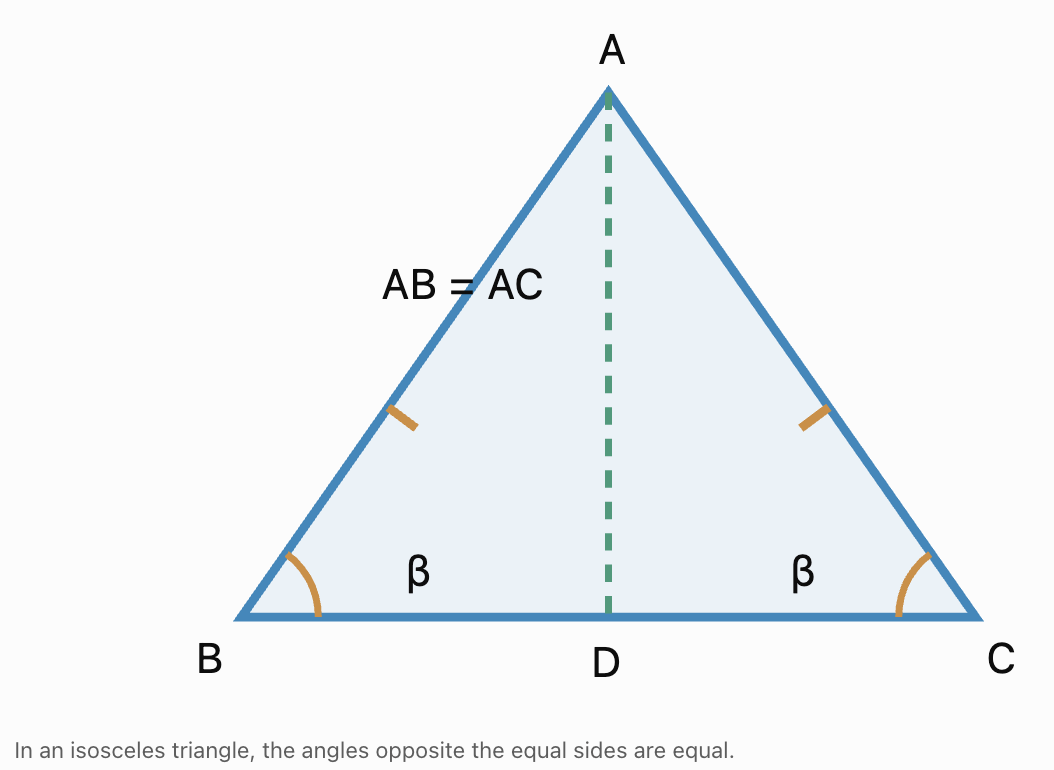
Proof of the Isosceles Triangle Theorem
Given:
AB = AC
Prove:
∠ABC = ∠BCA
Step 1: Construct an Angle Bisector
Draw AD so that it bisects ∠BAC and meets BC at D.
Therefore:
∠BAD = ∠DAC
Step 2: Identify Equal Sides
AB = AC — given.
AD = AD — reflexive property.
Step 3: Apply SAS
The equal angles lie between the corresponding equal sides.
Therefore:
△BAD ≅ △CAD by SAS.
Step 4: Apply CPCTC
∠ABD = ∠ACD
Since D lies on BC:
∠ABD = ∠ABC
∠ACD = ∠BCA
Therefore:
∠ABC = ∠BCA
The base angles of an isosceles triangle are equal.
Converse of the Isosceles Triangle Theorem
The converse states:
If two angles of a triangle are equal, then the sides opposite those angles are equal.
For example:
If ∠B = ∠C, then:
AB = AC
This theorem can be used to prove that a triangle is isosceles.
Worked Example
In triangle ABC:
∠B = 55°
∠C = 55°
Prove that AB = AC.
Since:
∠B = ∠C
the sides opposite those angles are equal.
Therefore:
AB = AC
Triangle ABC is isosceles.
Proving Properties of Equilateral Triangles
An equilateral triangle has three equal sides.
If:
AB = BC = AC
then all three interior angles are equal.
Since the angles add to 180°:
3θ = 180°
θ = 60°
Therefore:
∠A = ∠B = ∠C = 60°
Proof
Given:
AB = BC = AC
Prove:
∠A = ∠B = ∠C = 60°
Step 1: Apply the Isosceles Triangle Theorem
Since AB = AC:
∠B = ∠C
Since AB = BC:
∠A = ∠C
Therefore:
∠A = ∠B = ∠C
Step 2: Apply the Angle-Sum Theorem
∠A + ∠B + ∠C = 180°
3∠A = 180°
∠A = 60°
Therefore:
All three angles measure 60°.
Converse
If all three angles of a triangle measure 60°, the triangle is equilateral.
This follows from the converse of the isosceles triangle theorem.
Proving Triangle Similarity
Two triangles are similar when they have the same shape, although their sizes may differ.
Similar triangles have:
-
Equal corresponding angles.
-
Proportional corresponding side lengths.
The similarity symbol is:
∼
For example:
△ABC ∼ △DEF
Triangle Similarity Criteria
|
Criterion |
Requirements |
|---|---|
|
AA |
Two pairs of equal corresponding angles |
|
SSS |
Three pairs of proportional corresponding sides |
|
SAS |
Two pairs of proportional corresponding sides and equal included angles |
Similarity proofs are useful for establishing proportional relationships and finding unknown lengths.
Proving Similarity Using AA
Worked Proof
Given:
AB ∥ DE
Lines AE and BD intersect at C, with A, C, E collinear and B, C, D collinear.
Prove:
△ABC ∼ △EDC
Step 1: Identify Equal Angles
∠BAC = ∠DEC
These are alternate interior angles formed by transversal AE.
Step 2: Identify Another Pair
∠ABC = ∠EDC
These are alternate interior angles formed by transversal BD.
Step 3: Apply AA
Two pairs of corresponding angles are equal.
Therefore:
△ABC ∼ △EDC by AA similarity.
Consequence
Corresponding sides are proportional:
AB/ED = BC/DC = AC/EC
These proportions can be used to calculate unknown lengths.
Proving Similarity Using SSS
Worked Proof
Triangle ABC has sides:
AB = 4 cm
BC = 6 cm
AC = 8 cm
Triangle DEF has sides:
DE = 10 cm
EF = 15 cm
DF = 20 cm
Prove that the triangles are similar.
Step 1: Compare Corresponding Sides
AB/DE = 4/10 = 0.4
BC/EF = 6/15 = 0.4
AC/DF = 8/20 = 0.4
Step 2: Identify Equal Ratios
All three corresponding side ratios are equal.
Step 3: Apply SSS Similarity
△ABC ∼ △DEF by SSS similarity.
Proving Similarity Using SAS
Worked Proof
Given:
AB = 6 cm
AC = 9 cm
DE = 10 cm
DF = 15 cm
∠BAC = ∠EDF
Prove:
△ABC ∼ △DEF
Step 1: Compare Side Ratios
AB/DE = 6/10 = 3/5
AC/DF = 9/15 = 3/5
Step 2: Compare Included Angles
∠BAC = ∠EDF — given.
Step 3: Apply SAS Similarity
The corresponding side pairs are proportional, and the included angles are equal.
Therefore:
△ABC ∼ △DEF by SAS similarity.
Proving Similarity Using Parallel Lines
Parallel lines often create similar triangles.
Consider triangle ABC with D on AB and E on AC.
Given:
DE ∥ BC
Prove:
△ADE ∼ △ABC
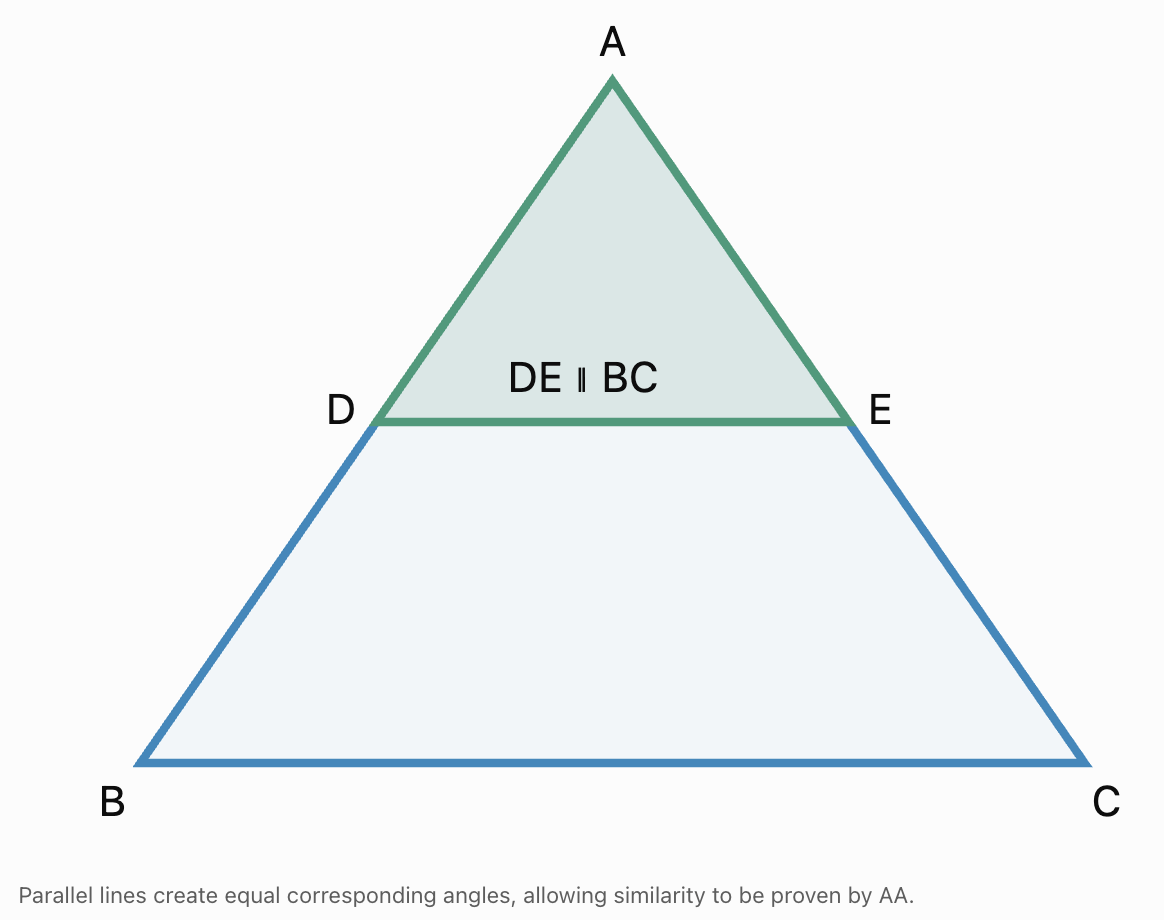
Step 1: Identify a Common Angle
∠DAE = ∠BAC
These are the same angle at vertex A.
Step 2: Use Parallel Lines
Since DE ∥ BC:
∠ADE = ∠ABC
These are corresponding angles.
Step 3: Apply AA Similarity
Two corresponding angles are equal.
Therefore:
△ADE ∼ △ABC by AA.
Step 4: Establish Proportional Sides
AD/AB = AE/AC = DE/BC
This relationship is the basis of many proportional reasoning problems.
Worked Example: Using a Similarity Proof to Find a Length
Given:
DE ∥ BC
AD = 4 cm
AB = 10 cm
AE = 6 cm
Find AC.
Step 1: Establish Similarity
△ADE ∼ △ABC by AA.
Step 2: Write a Proportion
AD/AB = AE/AC
4/10 = 6/AC
Step 3: Cross-Multiply
4AC = 60
Step 4: Solve
AC = 15 cm
Step 5: Verify
4/10 = 0.4
6/15 = 0.4
The proportions are equal.
Formal Geometric Proofs
A formal proof presents mathematical reasoning in a clear, organised sequence.
There are several common proof formats.
Two-Column Proofs
A two-column proof separates statements from reasons.
|
Statement |
Reason |
|---|---|
|
AB = AC |
Given |
|
BD = DC |
D is the midpoint of BC |
|
AD = AD |
Reflexive property |
|
△ABD ≅ △ACD |
SSS congruence |
|
∠BAD = ∠DAC |
CPCTC |
This format is especially useful for learning to justify every step.
Paragraph Proofs
A paragraph proof communicates the same reasoning using complete sentences.
Example:
AB = AC is given. Since D is the midpoint of BC, BD = DC. The triangles also share side AD, so AD = AD by the reflexive property. Therefore, △ABD ≅ △ACD by SSS congruence. Corresponding angles are equal, so ∠BAD = ∠DAC by CPCTC.
Flow Proofs
A flow proof uses a sequence of statements connected by arrows.
For example:
AB = AC
BD = DC
AD = AD
↓
△ABD ≅ △ACD by SSS
↓
∠BAD = ∠DAC by CPCTC
All three proof formats are valid when the reasoning is logically complete.
How to Plan a Geometric Proof
When beginning a proof, it is useful to work both forwards and backwards.
Forward Reasoning
Start with the given information.
Ask:
-
What can I conclude immediately?
-
Are any sides equal?
-
Are any angles equal?
-
Are there shared sides?
-
Are there parallel or perpendicular lines?
Backward Reasoning
Look at the conclusion.
Ask:
-
What would be sufficient to prove this?
-
Would congruent triangles establish the result?
-
Would similar triangles establish the result?
-
Which criterion could be used?
-
What additional facts are needed?
Connecting the Reasoning
Once a possible strategy is identified, organise the steps so that each conclusion follows from previously established facts.
Backward reasoning is useful for planning, but the final proof should present the logical justification clearly.
Proving Angle Relationships Using Congruent Triangles
Congruence can be used to establish relationships that are not immediately obvious.
Worked Proof: A Perpendicular Median in an Isosceles Triangle
Given:
AB = AC
D is the midpoint of BC.
Prove:
AD ⟂ BC
Step 1: Identify Equal Sides
AB = AC — given.
BD = DC — midpoint.
AD = AD — shared side.
Step 2: Prove Congruence
△ABD ≅ △ACD by SSS.
Step 3: Apply CPCTC
∠ADB = ∠ADC
Step 4: Use the Straight-Line Relationship
Since B, D, and C lie on a straight line:
∠ADB + ∠ADC = 180°
The two angles are equal.
Therefore:
2∠ADB = 180°
∠ADB = 90°
Similarly:
∠ADC = 90°
Conclusion
AD ⟂ BC
Interpretation
In an isosceles triangle, the segment joining the apex to the midpoint of the base is perpendicular to the base.
The same segment also bisects the apex angle.
This is an important property of isosceles triangles.
Proving Angle Relationships Using Similarity
Similarity can establish equal angles and proportional side lengths.
Worked Proof
Given:
△ABC ∼ △DEF
Prove:
∠C = ∠F
Step 1: Use the Definition of Similarity
Similar triangles have equal corresponding angles.
Step 2: Identify Corresponding Vertices
A corresponds to D.
B corresponds to E.
C corresponds to F.
Step 3: Conclude
∠C = ∠F
This is a direct consequence of similarity.
Multi-Step Proof: An Isosceles Triangle with a Parallel Line
Consider triangle ABC where:
AB = AC
D lies on AB.
E lies on AC.
DE ∥ BC
Prove that:
AD = AE
Step 1: Establish Similarity
Since DE ∥ BC:
∠ADE = ∠ABC
∠AED = ∠ACB
Therefore:
△ADE ∼ △ABC by AA.
Step 2: Use Corresponding Sides
AD/AB = AE/AC
Step 3: Use the Given Equality
AB = AC
Therefore, the two denominators are equal.
Step 4: Conclude
Since the ratios are equal and the denominators are equal:
AD = AE
Interpretation
A line parallel to the base of an isosceles triangle creates a smaller isosceles triangle.
This proof combines similarity with the properties of isosceles triangles.
Proving the Midpoint Theorem
The midpoint theorem states:
The segment joining the midpoints of two sides of a triangle is parallel to the third side and half its length.
Suppose:
D is the midpoint of AB.
E is the midpoint of AC.
We want to prove:
DE ∥ BC
and:
DE = BC/2
Proof Using Similarity
First, because D and E are midpoints:
AD = DB
AE = EC
Therefore:
AB = 2AD
AC = 2AE
So:
AD/AB = 1/2
AE/AC = 1/2
Thus:
AD/AB = AE/AC
The included angle at A is common to both triangles.
Therefore:
△ADE ∼ △ABC by SAS similarity.
Corresponding angles are equal:
∠ADE = ∠ABC
Since these are corresponding angles formed by transversal AB:
DE ∥ BC
Corresponding sides are proportional:
DE/BC = AD/AB = 1/2
Therefore:
DE = BC/2
Both parts of the midpoint theorem have been proven.
Practical Importance
The midpoint theorem is useful in:
-
Triangle constructions.
-
Coordinate geometry.
-
Structural design.
-
Geometric proofs.
-
Calculating unknown lengths.
Using Algebra in Triangle Proofs
Some proofs involve algebraic expressions rather than numerical measurements.
Worked Example
Triangle ABC is isosceles with:
AB = AC
Given:
AB = 3x + 5
AC = 5x − 7
Find x.
Step 1: Use the Isosceles Property
AB = AC
3x + 5 = 5x − 7
Step 2: Rearrange
12 = 2x
Step 3: Solve
x = 6
Step 4: Verify
AB = 3(6) + 5 = 23
AC = 5(6) − 7 = 23
The sides are equal.
Conclusion
The given triangle is consistent with the isosceles condition.
Worked Example: Angle Expressions
Triangle ABC is isosceles with:
AB = AC
Given:
∠B = 4x + 10°
∠C = 6x − 20°
Find x.
Step 1: Apply the Isosceles Triangle Theorem
∠B = ∠C
4x + 10 = 6x − 20
Step 2: Solve
30 = 2x
x = 15
Step 3: Calculate the Angles
∠B = 4(15) + 10 = 70°
∠C = 6(15) − 20 = 70°
Step 4: Find the Third Angle
∠A = 180° − 70° − 70°
∠A = 40°
Verification
40° + 70° + 70° = 180°
The result is consistent.
Real-World Applications of Triangle Proofs
Triangle proofs are useful because they allow geometric properties to be established without measuring every dimension.
Architecture and Construction
Triangular structures are commonly used in roof supports and bridges.
Congruence can establish that repeated components have identical geometric dimensions.
Similarity can be used to calculate dimensions in scale drawings and models.

Surveying
Surveyors use triangles to calculate distances that may be difficult to measure directly.
Similarity relationships can help determine unknown distances from known measurements.
Manufacturing
Congruence helps verify that manufactured components match intended geometric dimensions.
Computer Graphics
Geometric transformations and similarity relationships are used in image scaling, modelling, and graphical design.
Engineering Design
Triangle properties can help establish alignment, symmetry, and proportional relationships.
However, proving geometric congruence or similarity does not by itself establish structural safety. Forces, materials, and other engineering factors must also be considered.


Common Mistakes in Triangle Proofs
Assuming triangles are congruent because they look identical
A diagram is not sufficient evidence unless the necessary relationships are established.
Using AAA to prove congruence
AAA establishes similarity, not necessarily congruence.
Using SSA as a general congruence test
SSA does not generally guarantee triangle congruence.
Confusing SAS congruence with SAS similarity
SAS congruence requires equal corresponding sides, while SAS similarity requires proportional sides.
Using CPCTC before proving congruence
CPCTC is a consequence of congruence, not an independent congruence criterion.
Writing vertices in the wrong order
The order of vertices must correctly represent corresponding parts.
Failing to justify shared sides
A shared side is equal to itself by the reflexive property.
Assuming angles are equal without a valid reason
Equal angles must follow from given information or an established geometric theorem.
Confusing corresponding and alternate interior angles
These angle relationships must be identified correctly.
Using parallel-line angle relationships without establishing parallelism
The relevant lines must be known to be parallel.
Skipping important proof steps
A proof must contain enough reasoning to establish the conclusion.
Using the conclusion as a premise
This is circular reasoning.
Confusing a theorem with its converse
A statement and its converse require separate justification.
Failing to distinguish congruence from similarity
Congruent triangles have equal corresponding side lengths; similar triangles have proportional corresponding side lengths.
Providing calculations without explanations
A complete proof should explain why each mathematical relationship is valid.
Key Terms
-
Geometric Proof: A logical argument establishing a geometric statement.
-
Given Information: Facts known to be true at the beginning of a proof.
-
Conclusion: The statement that must be established.
-
Theorem: A mathematical statement proven using logical reasoning.
-
Definition: A precise explanation of a mathematical term.
-
Axiom or Postulate: A mathematical statement accepted without proof within a particular system.
-
Logical Reasoning: Using established facts and rules to reach valid conclusions.
-
Deductive Reasoning: Drawing conclusions that necessarily follow from given premises.
-
Congruent Triangles: Triangles with equal corresponding sides and angles.
-
Similar Triangles: Triangles with equal corresponding angles and proportional corresponding sides.
-
SSS Congruence: A criterion using three equal pairs of corresponding sides.
-
SAS Congruence: A criterion using two equal side pairs and their equal included angles.
-
ASA Congruence: A criterion using two equal angle pairs and their equal included side.
-
AAS Congruence: A criterion using two equal angle pairs and a non-included equal side.
-
HL Congruence: A criterion for right triangles using equal hypotenuses and one equal leg.
-
AA Similarity: A criterion using two pairs of equal corresponding angles.
-
SSS Similarity: A criterion using three pairs of proportional corresponding sides.
-
SAS Similarity: A criterion using two proportional side pairs and an equal included angle.
-
CPCTC: Corresponding Parts of Congruent Triangles are Congruent.
-
Corresponding Sides: Sides occupying matching positions in two triangles.
-
Corresponding Angles: Angles occupying matching positions in two triangles.
-
Reflexive Property: The property that a quantity is equal to itself.
-
Vertical Angles: Opposite angles formed by intersecting lines.
-
Alternate Interior Angles: Angles on opposite sides of a transversal between two lines.
-
Corresponding Angles Theorem: A theorem stating that corresponding angles are equal when parallel lines are crossed by a transversal.
-
Angle Bisector: A line or ray dividing an angle into two equal angles.
-
Midpoint: A point dividing a segment into two equal parts.
-
Median: A segment joining a triangle's vertex to the midpoint of the opposite side.
-
Altitude: A perpendicular segment from a vertex to the line containing the opposite side.
-
Isosceles Triangle: A triangle with at least two equal sides.
-
Equilateral Triangle: A triangle with three equal sides.
-
Base Angles: The angles opposite the equal sides of an isosceles triangle.
-
Exterior Angle: An angle formed by extending a side of a polygon.
-
Triangle Angle-Sum Theorem: The theorem stating that the interior angles of a triangle add to 180°.
-
Exterior Angle Theorem: The theorem stating that an exterior angle equals the sum of the two remote interior angles.
-
Midpoint Theorem: The theorem stating that the segment joining two side midpoints of a triangle is parallel to the third side and half its length.
-
Converse: A statement formed by reversing the hypothesis and conclusion of another statement.
-
Two-Column Proof: A proof organised into statements and reasons.
-
Paragraph Proof: A proof written using complete sentences.
-
Flow Proof: A proof organised using connected logical steps.
-
Circular Reasoning: Attempting to prove a statement by assuming that it is already true.
-
Mathematical Justification: A valid explanation supporting a mathematical statement.
Key Takeaways
-
A geometric proof establishes a conclusion through a sequence of logically justified statements.
-
Every statement in a proof should follow from given information, definitions, or established theorems.
-
Triangle proofs often involve congruence, similarity, angle relationships, and properties of special triangles.
-
SSS, SAS, ASA, AAS, and HL can be used to prove triangle congruence.
-
AA, SSS, and SAS can be used to prove triangle similarity.
-
Congruent triangles have equal corresponding sides and angles.
-
Similar triangles have equal corresponding angles and proportional corresponding sides.
-
CPCTC can be applied after proving triangle congruence.
-
Shared sides are equal by the reflexive property.
-
Vertically opposite angles are equal.
-
Parallel lines create equal corresponding and alternate interior angles.
-
The interior angles of every triangle add to 180°.
-
An exterior angle of a triangle equals the sum of the two remote interior angles.
-
Isosceles triangles have equal base angles.
-
Equilateral triangles have three equal sides and three 60° angles.
-
Congruence can be used to prove that a segment is an angle bisector, median, or altitude.
-
Similarity can be used to establish proportional relationships and calculate unknown lengths.
-
The midpoint theorem can be proven using triangle similarity.
-
Formal proofs may be written as two-column proofs, paragraph proofs, or flow proofs.
-
Forward reasoning begins with known information.
-
Backward reasoning identifies what is needed to establish the desired conclusion.
-
Mathematical diagrams help visualise relationships but do not replace logical justification.
-
The central skill in triangle proofs is selecting appropriate geometric relationships and connecting them through clear, valid mathematical reasoning.
Check Your Understanding
Recall and Understanding
-
Define a geometric proof and explain why each statement must have a valid reason.
-
List the five triangle congruence criteria and explain when each can be used.
-
State the three triangle similarity criteria.
-
Explain the meaning of CPCTC and describe when it may be used.
-
Explain the difference between a theorem and its converse.
Application
-
Given AB = AC and D is the midpoint of BC, prove that △ABD ≅ △ACD.
-
Two lines AC and BD intersect at O. Given AO = CO and BO = DO, prove that △AOB ≅ △COD.
-
In triangle ABC, AB = AC and ∠B = 55°. Calculate ∠A and justify each step.
-
Given DE ∥ BC in triangle ABC, prove that △ADE ∼ △ABC.
-
Triangle ABC has sides 4 cm, 6 cm, and 8 cm. Triangle DEF has corresponding sides 10 cm, 15 cm, and 20 cm. Prove that the triangles are similar.
Analysis and Challenge
-
In isosceles triangle ABC, AB = AC and D is the midpoint of BC. Prove that AD is perpendicular to BC.
-
Prove that the base angles of an isosceles triangle are equal.
-
Prove that every equilateral triangle has three angles measuring 60°.
-
D and E are the midpoints of AB and AC in triangle ABC. Prove that DE is parallel to BC and that DE = BC/2.
-
Triangle ABC is isosceles with AB = AC. Points D and E lie on AB and AC respectively, and DE ∥ BC. Prove that AD = AE using triangle similarity.
Final Summary
Triangle proofs provide a systematic way to establish geometric relationships using mathematical reasoning.
Congruence proofs demonstrate that two triangles have identical shapes and sizes, while similarity proofs establish that triangles have equal corresponding angles and proportional side lengths.
Angle relationships, shared sides, parallel lines, and the properties of isosceles and equilateral triangles provide essential information for constructing proofs.
Formal proofs organise this information into a logical sequence of statements supported by mathematical reasons.
By combining congruence, similarity, and established geometric theorems, we can prove properties involving angles, side lengths, midpoints, medians, altitudes, and parallel lines.
The central principle is that a geometric conclusion is not established simply because it appears true in a diagram. It must follow logically from known information and valid mathematical relationships.