Foundations of Geometry
1. Points, Lines, and Planes
Learning outcomes
- I can identify the basic undefined terms of geometry.
- I can describe relationships between points, lines, and planes.
- I can use correct geometric notation.
- I can identify line segments, rays, and angles.
- I can solve simple problems involving geometric figures.
The foundations of geometry
Geometry is the study of shapes, sizes, positions and spatial relationships.
Most geometric definitions are built from three basic ideas:
- Point
- Line
- Plane
These are called the undefined terms of geometry. They are not formally defined using simpler geometric terms because they form the foundation from which other terms are defined.
Although they are undefined, we can describe their important properties and represent them with diagrams.
Points, lines, and planes
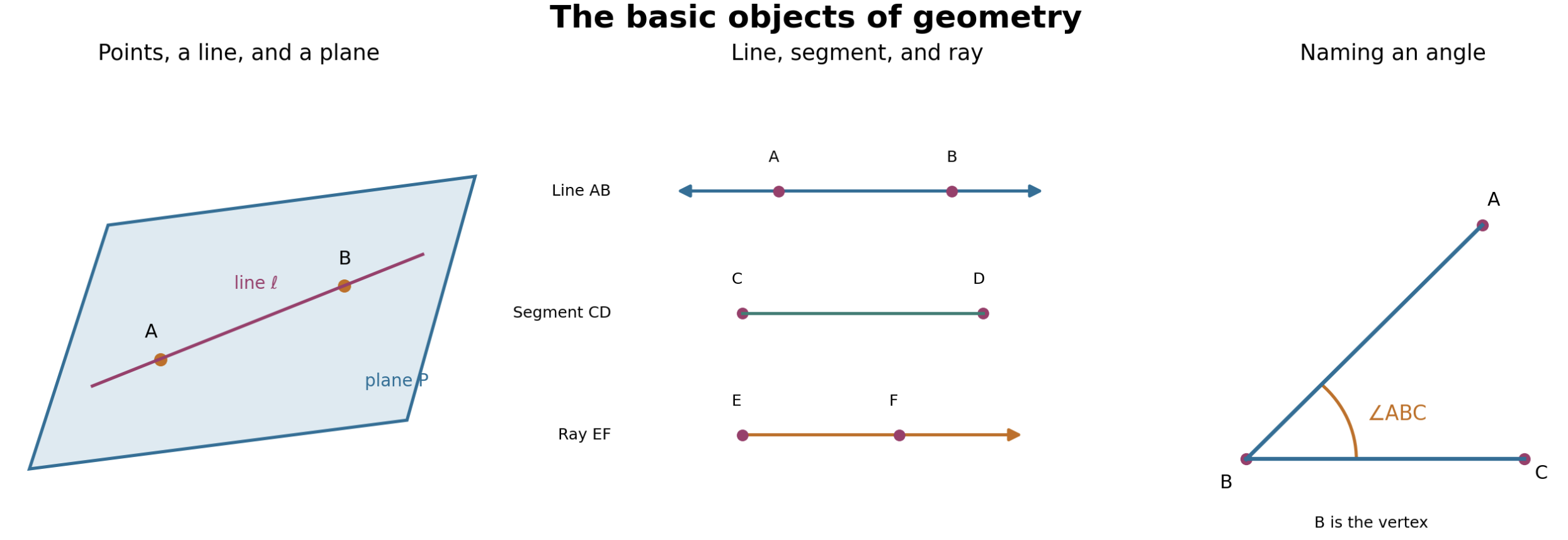
The drawings represent geometric objects. The dots and lines on the page have thickness, but ideal geometric points and lines do not.
Points
A point indicates an exact location.
A point:
- Has no length.
- Has no width.
- Has no height.
- Is represented by a small dot.
- Is named using a capital letter.
For example:
Point A
The dot used in a diagram is only a representation. The ideal geometric point has no physical size.
In coordinate geometry, a point can be identified by an ordered pair:
A(3, 2)
This means Point A is located three units along the horizontal axis and two units along the vertical axis.


Locations on a map and stars in a diagram can be approximated as points, even though the real objects have size.
Lines
A line is a straight path that extends forever in two opposite directions.
A line:
- Has length but no thickness.
- Contains infinitely many points.
- Has no endpoints.
- Extends indefinitely in both directions.
- Is represented with arrowheads at both ends.
A line can be named using any two points on it.
The line through A and B is written:
It can also be named:
These names refer to the same line because a line extends in both directions.
A lowercase letter may also name a line:
line ℓ
Collinear points
Points that lie on the same line are called collinear points.
If Points A, B and C lie on the same line, then A, B and C are collinear.
If Point D does not lie on that line, then A, B, C and D are not all collinear.
Any two distinct points determine exactly one line.
This means that only one straight line can be drawn through two different points.
Planes
A plane is a flat surface that extends forever in all directions within two dimensions.
A plane:
- Has length and width.
- Has no thickness.
- Contains infinitely many points and lines.
- Extends indefinitely.
- Is usually drawn as a slanted parallelogram.
A plane can be named using a capital script letter or a single capital letter, such as:
plane P
It can also be named using three noncollinear points:
plane ABC
Three noncollinear points determine exactly one plane.


A tabletop, wall or sheet of glass can model part of a plane. A true geometric plane has no edge and extends infinitely.
Coplanar points and lines
Points or lines that lie in the same plane are called coplanar.
For example:
- Three vertices of a flat tabletop are coplanar.
- Lines drawn on the same sheet of paper are coplanar.
- Lines on different faces of a box may not be coplanar.
Four points do not necessarily lie in one plane. For example, the four vertices of a triangular pyramid are not all coplanar.
Relationships between points, lines, and planes
The basic relationships include:
- A line contains infinitely many points.
- A plane contains infinitely many points and lines.
- Two distinct points determine one line.
- Three noncollinear points determine one plane.
- If two points lie in a plane, the line through them also lies in the plane.
- Two intersecting lines determine one plane.
- Two parallel lines determine one plane.
- Two planes can intersect in a line.
These relationships help establish the structure of geometric figures.
Intersections
An intersection is the set of points shared by two or more geometric objects.
Two lines
Two different lines in the same plane can:
- Intersect at one point.
- Be parallel and never intersect.
- Be the same line and share infinitely many points.
A line and a plane
A line can:
- Intersect a plane at one point.
- Lie entirely in the plane.
- Be parallel to the plane and never intersect it.
Two planes
Two different planes can:
- Intersect in a line.
- Be parallel and never intersect.


The corner of a room models the intersection of planes. The line where two walls meet represents their line of intersection.
Line segments
A line segment is part of a line with two endpoints.
The segment with endpoints A and B is written:
or:
Unlike a line, a segment has a measurable length.
The length of segment AB is written:
AB
For example:
represents the geometric segment.
AB = 7 cm states its length.
Do not use an arrow over the letters when naming a segment.
The segment addition principle
If Point B lies between Points A and C, then:
AB + BC = AC
Worked example
Point B lies between A and C.
AB = 5 cm
BC = 8 cm
Find AC.
Use segment addition:
AC = AB + BC
AC = 5 + 8
AC = 13 cm
Worked example with an unknown length
Point M lies between Points L and N.
LM = 2x + 1
MN = x + 4
LN = 17
Use:
LM + MN = LN
Substitute:
(2x + 1) + (x + 4) = 17
3x + 5 = 17
3x = 12
x = 4
Now find each length:
LM = 2(4) + 1 = 9
MN = 4 + 4 = 8
Check:
9 + 8 = 17
Therefore:
LM = 9 units and MN = 8 units
Midpoints
A midpoint divides a segment into two congruent segments.
If M is the midpoint of
, then:
AM = MB
Worked example
M is the midpoint of
.
AM = 3x − 2
MB = x + 6
Since M is the midpoint:
3x − 2 = x + 6
2x = 8
x = 4
AM = 3(4) − 2 = 10
MB = 4 + 6 = 10
Therefore:
AB = 10 + 10
AB = 20 units
Rays
A ray is part of a line that has one endpoint and extends forever in one direction.
The ray that begins at A and passes through B is written:
The first letter identifies the endpoint.
In general:
and
are different rays because they have different endpoints and extend in different directions.
A ray resembles:
- A beam of light.
- A direction from a starting location.
- One side of an angle.


A physical light beam has width and may spread, but it can be approximated using a geometric ray.
Opposite rays
Two rays are opposite rays when they:
- Share the same endpoint.
- Lie on the same line.
- Extend in opposite directions.
If B lies between A and C, then:
and
are opposite rays.
Together, opposite rays form a straight line and a straight angle of 180°.
Comparing lines, segments, and rays
| Figure | Endpoints | Extends indefinitely |
|---|---|---|
| Line | None | In both directions |
| Segment | Two | No |
| Ray | One | In one direction |
The arrowheads in a diagram communicate whether the figure continues.
A plain drawn path without arrowheads represents a segment when endpoints are marked.
Angles
An angle is formed by two rays with a common endpoint.
The common endpoint is called the vertex.
The two rays are called the sides of the angle.
In the diagram, rays BA and BC form angle ABC:
Point B is the vertex.
When an angle is named using three letters, the vertex must be the middle letter.
The same angle can also be called:
If only one angle is located at B, it may be called:
Measuring angles
Angles are commonly measured in degrees.
| Angle type | Measure |
|---|---|
| Acute angle | Greater than 0° and less than 90° |
| Right angle | Exactly 90° |
| Obtuse angle | Greater than 90° and less than 180° |
| Straight angle | Exactly 180° |
| Reflex angle | Greater than 180° and less than 360° |
| Full rotation | Exactly 360° |


Clock hands, open doors, roof supports and road intersections provide familiar examples of angles.
The angle addition principle
If ray BD lies inside angle ABC, then:
m∠ABD + m∠DBC = m∠ABC
The symbol m∠ABC means “the measure of angle ABC.”
Worked example
Ray BD divides ∠ABC into two smaller angles.
m∠ABD = 35°
m∠DBC = 48°
Find m∠ABC.
Use angle addition:
m∠ABC = 35° + 48°
m∠ABC = 83°
The complete angle is acute because its measure is less than 90°.
Worked example with an unknown angle
Ray QS lies inside ∠PQR.
m∠PQS = 2x + 5
m∠SQR = x + 10
m∠PQR = 75°
Use angle addition:
(2x + 5) + (x + 10) = 75
3x + 15 = 75
3x = 60
x = 20
Calculate the two angles:
m∠PQS = 2(20) + 5 = 45°
m∠SQR = 20 + 10 = 30°
Check:
45° + 30° = 75°
Parallel lines
Two coplanar lines are parallel if they never intersect.
Parallel lines are written:
ℓ ∥ m
Arrow markings placed on the lines may indicate that they are parallel.
Examples that approximate parallel lines include:
- Opposite edges of a rectangular page.
- Railway tracks on a straight section.
- Horizontal shelves.
- Lane markings on a straight road.


Railway tracks appear to meet in the distance because of perspective, but parallel geometric lines do not intersect.
Perpendicular lines
Two lines are perpendicular if they intersect to form right angles.
Perpendicular lines are written:
ℓ ⟂ m
A small square placed at an intersection indicates a 90° angle.
Examples include:
- Adjacent edges of a rectangular page.
- A vertical wall meeting a level floor.
- Horizontal and vertical coordinate axes.
- The crossbars of some window frames.
Skew lines
Skew lines are lines that:
- Do not intersect.
- Are not parallel.
- Are not in the same plane.
Skew lines occur only in three-dimensional geometry.
Different edges of a box may be skew if they run in different directions and do not lie on a common face.
Naming a plane correctly
A plane may be named using three noncollinear points.
Suppose A, B and C lie in the same plane and do not lie on one line.
The plane can be named:
- Plane ABC.
- Plane ACB.
- Plane BAC.
- Plane BCA.
- Plane CAB.
- Plane CBA.
All these names identify the same plane.
Three collinear points cannot uniquely name a plane because infinitely many planes can contain the same line.
Coordinates and geometric figures
Points on a coordinate plane can be used to determine lengths.
If A(x₁, y₁) and B(x₂, y₂), the distance between them is:
AB = √[(x₂ − x₁)² + (y₂ − y₁)²]
Worked example
A(1, 2) and B(5, 5)
AB = √[(5 − 1)² + (5 − 2)²]
AB = √(4² + 3²)
AB = √25
AB = 5 units
The horizontal and vertical changes form a right triangle with side lengths 4 and 3.
Finding a midpoint from coordinates
The midpoint of A(x₁, y₁) and B(x₂, y₂) is:
M = [(x₁ + x₂)/2, (y₁ + y₂)/2]
Worked example
Find the midpoint of A(2, 3) and B(8, 7).
M = [(2 + 8)/2, (3 + 7)/2]
M = (5, 5)
The midpoint is:
M(5, 5)
Real-world applications
Points, lines and planes are used in:
- Architecture.
- Engineering drawings.
- Maps and navigation.
- Computer graphics.
- Construction.
- Product design.
- Surveying.
- Art and perspective drawing.


Architectural drawings use points to locate features, lines to show edges and planes to represent surfaces.
Interpreting diagrams carefully
A geometric diagram may not be drawn to scale.
Do not assume that:
- A point is a midpoint because it looks centred.
- Two lines are perpendicular because they appear to form a right angle.
- Two segments are congruent because they look equal.
- Lines are parallel because they appear not to meet.
Relationships must be:
- Stated in the problem.
- Marked using accepted symbols.
- Established through calculation or reasoning.
Common misconceptions
- “A point is a small circle.” The dot is a representation; a point has no size.
- “A line has two endpoints.” A segment has two endpoints; a line extends forever.
- “Ray AB and ray BA are the same.” Their endpoints and directions differ.
- “Any three points determine one plane.” The points must be noncollinear.
- “Lines that do not intersect are always parallel.” In three dimensions, they may be skew.
- “The vertex can appear anywhere in an angle’s name.” It must be the middle letter in a three-letter name.
- “A diagram is always drawn to scale.” Use labels and markings as evidence.
- “Length AB and segment AB mean exactly the same thing.” One is a measurement; the other is a geometric object.
Did you know?
A straight line cannot be drawn physically with perfect accuracy. Every pencil or computer line has some thickness and finite length.
Geometric lines are ideal objects. The marks we draw are models that allow us to reason about them.
Key terms
- Point: An exact location with no dimensions.
- Line: A straight path extending forever in two directions.
- Plane: A flat surface extending forever in two dimensions.
- Undefined term: A foundational idea described through its properties rather than formally defined.
- Collinear: Lying on the same line.
- Coplanar: Lying in the same plane.
- Line segment: Part of a line between two endpoints.
- Ray: Part of a line with one endpoint extending forever in one direction.
- Endpoint: A point marking the end of a segment or the beginning of a ray.
- Angle: A figure formed by two rays sharing an endpoint.
- Vertex: The common endpoint of the sides of an angle.
- Parallel lines: Coplanar lines that never intersect.
- Perpendicular lines: Lines intersecting at right angles.
- Skew lines: Noncoplanar lines that do not intersect.
- Midpoint: A point dividing a segment into two congruent segments.
Key takeaways
- Point, line and plane are the three basic undefined terms of geometry.
- A point represents a location, a line extends in two directions and a plane extends in two dimensions.
- Two distinct points determine one line.
- Three noncollinear points determine one plane.
- A segment has two endpoints; a ray has one; a line has none.
- Geometric notation communicates whether a figure is a line, segment or ray.
- The vertex is written in the middle when naming an angle with three letters.
- Segment and angle addition can be used to find unknown measures.
- Diagrams must be interpreted using labels and markings rather than appearance alone.