Foundations of Geometry
| Site: | Young Education |
| Course: | Geometry and Proof |
| Book: | Foundations of Geometry |
| Printed by: | Guest user |
| Date: | Monday, 9 November 2026, 4:39 PM |
1. Points, Lines, and Planes
Learning outcomes
- I can identify the basic undefined terms of geometry.
- I can describe relationships between points, lines, and planes.
- I can use correct geometric notation.
- I can identify line segments, rays, and angles.
- I can solve simple problems involving geometric figures.
The foundations of geometry
Geometry is the study of shapes, sizes, positions and spatial relationships.
Most geometric definitions are built from three basic ideas:
- Point
- Line
- Plane
These are called the undefined terms of geometry. They are not formally defined using simpler geometric terms because they form the foundation from which other terms are defined.
Although they are undefined, we can describe their important properties and represent them with diagrams.
Points, lines, and planes
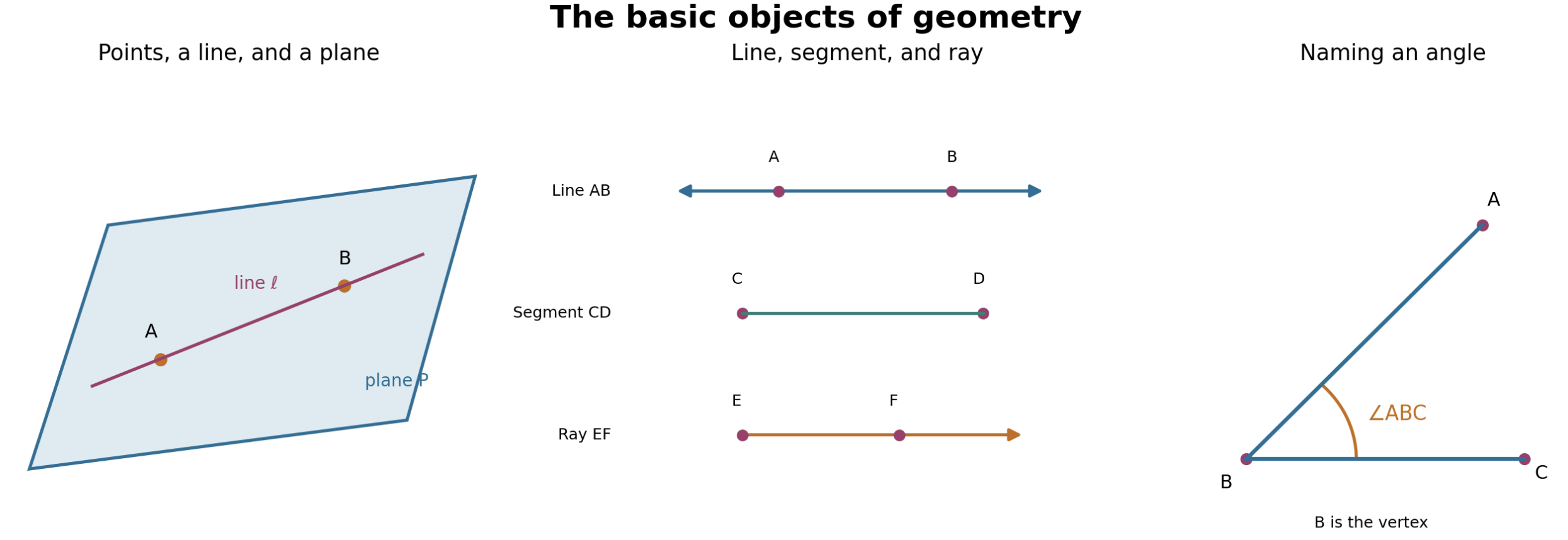
The drawings represent geometric objects. The dots and lines on the page have thickness, but ideal geometric points and lines do not.
Points
A point indicates an exact location.
A point:
- Has no length.
- Has no width.
- Has no height.
- Is represented by a small dot.
- Is named using a capital letter.
For example:
Point A
The dot used in a diagram is only a representation. The ideal geometric point has no physical size.
In coordinate geometry, a point can be identified by an ordered pair:
A(3, 2)
This means Point A is located three units along the horizontal axis and two units along the vertical axis.


Locations on a map and stars in a diagram can be approximated as points, even though the real objects have size.
Lines
A line is a straight path that extends forever in two opposite directions.
A line:
- Has length but no thickness.
- Contains infinitely many points.
- Has no endpoints.
- Extends indefinitely in both directions.
- Is represented with arrowheads at both ends.
A line can be named using any two points on it.
The line through A and B is written:
It can also be named:
These names refer to the same line because a line extends in both directions.
A lowercase letter may also name a line:
line ℓ
Collinear points
Points that lie on the same line are called collinear points.
If Points A, B and C lie on the same line, then A, B and C are collinear.
If Point D does not lie on that line, then A, B, C and D are not all collinear.
Any two distinct points determine exactly one line.
This means that only one straight line can be drawn through two different points.
Planes
A plane is a flat surface that extends forever in all directions within two dimensions.
A plane:
- Has length and width.
- Has no thickness.
- Contains infinitely many points and lines.
- Extends indefinitely.
- Is usually drawn as a slanted parallelogram.
A plane can be named using a capital script letter or a single capital letter, such as:
plane P
It can also be named using three noncollinear points:
plane ABC
Three noncollinear points determine exactly one plane.


A tabletop, wall or sheet of glass can model part of a plane. A true geometric plane has no edge and extends infinitely.
Coplanar points and lines
Points or lines that lie in the same plane are called coplanar.
For example:
- Three vertices of a flat tabletop are coplanar.
- Lines drawn on the same sheet of paper are coplanar.
- Lines on different faces of a box may not be coplanar.
Four points do not necessarily lie in one plane. For example, the four vertices of a triangular pyramid are not all coplanar.
Relationships between points, lines, and planes
The basic relationships include:
- A line contains infinitely many points.
- A plane contains infinitely many points and lines.
- Two distinct points determine one line.
- Three noncollinear points determine one plane.
- If two points lie in a plane, the line through them also lies in the plane.
- Two intersecting lines determine one plane.
- Two parallel lines determine one plane.
- Two planes can intersect in a line.
These relationships help establish the structure of geometric figures.
Intersections
An intersection is the set of points shared by two or more geometric objects.
Two lines
Two different lines in the same plane can:
- Intersect at one point.
- Be parallel and never intersect.
- Be the same line and share infinitely many points.
A line and a plane
A line can:
- Intersect a plane at one point.
- Lie entirely in the plane.
- Be parallel to the plane and never intersect it.
Two planes
Two different planes can:
- Intersect in a line.
- Be parallel and never intersect.


The corner of a room models the intersection of planes. The line where two walls meet represents their line of intersection.
Line segments
A line segment is part of a line with two endpoints.
The segment with endpoints A and B is written:
or:
Unlike a line, a segment has a measurable length.
The length of segment AB is written:
AB
For example:
represents the geometric segment.
AB = 7 cm states its length.
Do not use an arrow over the letters when naming a segment.
The segment addition principle
If Point B lies between Points A and C, then:
AB + BC = AC
Worked example
Point B lies between A and C.
AB = 5 cm
BC = 8 cm
Find AC.
Use segment addition:
AC = AB + BC
AC = 5 + 8
AC = 13 cm
Worked example with an unknown length
Point M lies between Points L and N.
LM = 2x + 1
MN = x + 4
LN = 17
Use:
LM + MN = LN
Substitute:
(2x + 1) + (x + 4) = 17
3x + 5 = 17
3x = 12
x = 4
Now find each length:
LM = 2(4) + 1 = 9
MN = 4 + 4 = 8
Check:
9 + 8 = 17
Therefore:
LM = 9 units and MN = 8 units
Midpoints
A midpoint divides a segment into two congruent segments.
If M is the midpoint of
, then:
AM = MB
Worked example
M is the midpoint of
.
AM = 3x − 2
MB = x + 6
Since M is the midpoint:
3x − 2 = x + 6
2x = 8
x = 4
AM = 3(4) − 2 = 10
MB = 4 + 6 = 10
Therefore:
AB = 10 + 10
AB = 20 units
Rays
A ray is part of a line that has one endpoint and extends forever in one direction.
The ray that begins at A and passes through B is written:
The first letter identifies the endpoint.
In general:
and
are different rays because they have different endpoints and extend in different directions.
A ray resembles:
- A beam of light.
- A direction from a starting location.
- One side of an angle.


A physical light beam has width and may spread, but it can be approximated using a geometric ray.
Opposite rays
Two rays are opposite rays when they:
- Share the same endpoint.
- Lie on the same line.
- Extend in opposite directions.
If B lies between A and C, then:
and
are opposite rays.
Together, opposite rays form a straight line and a straight angle of 180°.
Comparing lines, segments, and rays
| Figure | Endpoints | Extends indefinitely |
|---|---|---|
| Line | None | In both directions |
| Segment | Two | No |
| Ray | One | In one direction |
The arrowheads in a diagram communicate whether the figure continues.
A plain drawn path without arrowheads represents a segment when endpoints are marked.
Angles
An angle is formed by two rays with a common endpoint.
The common endpoint is called the vertex.
The two rays are called the sides of the angle.
In the diagram, rays BA and BC form angle ABC:
Point B is the vertex.
When an angle is named using three letters, the vertex must be the middle letter.
The same angle can also be called:
If only one angle is located at B, it may be called:
Measuring angles
Angles are commonly measured in degrees.
| Angle type | Measure |
|---|---|
| Acute angle | Greater than 0° and less than 90° |
| Right angle | Exactly 90° |
| Obtuse angle | Greater than 90° and less than 180° |
| Straight angle | Exactly 180° |
| Reflex angle | Greater than 180° and less than 360° |
| Full rotation | Exactly 360° |


Clock hands, open doors, roof supports and road intersections provide familiar examples of angles.
The angle addition principle
If ray BD lies inside angle ABC, then:
m∠ABD + m∠DBC = m∠ABC
The symbol m∠ABC means “the measure of angle ABC.”
Worked example
Ray BD divides ∠ABC into two smaller angles.
m∠ABD = 35°
m∠DBC = 48°
Find m∠ABC.
Use angle addition:
m∠ABC = 35° + 48°
m∠ABC = 83°
The complete angle is acute because its measure is less than 90°.
Worked example with an unknown angle
Ray QS lies inside ∠PQR.
m∠PQS = 2x + 5
m∠SQR = x + 10
m∠PQR = 75°
Use angle addition:
(2x + 5) + (x + 10) = 75
3x + 15 = 75
3x = 60
x = 20
Calculate the two angles:
m∠PQS = 2(20) + 5 = 45°
m∠SQR = 20 + 10 = 30°
Check:
45° + 30° = 75°
Parallel lines
Two coplanar lines are parallel if they never intersect.
Parallel lines are written:
ℓ ∥ m
Arrow markings placed on the lines may indicate that they are parallel.
Examples that approximate parallel lines include:
- Opposite edges of a rectangular page.
- Railway tracks on a straight section.
- Horizontal shelves.
- Lane markings on a straight road.


Railway tracks appear to meet in the distance because of perspective, but parallel geometric lines do not intersect.
Perpendicular lines
Two lines are perpendicular if they intersect to form right angles.
Perpendicular lines are written:
ℓ ⟂ m
A small square placed at an intersection indicates a 90° angle.
Examples include:
- Adjacent edges of a rectangular page.
- A vertical wall meeting a level floor.
- Horizontal and vertical coordinate axes.
- The crossbars of some window frames.
Skew lines
Skew lines are lines that:
- Do not intersect.
- Are not parallel.
- Are not in the same plane.
Skew lines occur only in three-dimensional geometry.
Different edges of a box may be skew if they run in different directions and do not lie on a common face.
Naming a plane correctly
A plane may be named using three noncollinear points.
Suppose A, B and C lie in the same plane and do not lie on one line.
The plane can be named:
- Plane ABC.
- Plane ACB.
- Plane BAC.
- Plane BCA.
- Plane CAB.
- Plane CBA.
All these names identify the same plane.
Three collinear points cannot uniquely name a plane because infinitely many planes can contain the same line.
Coordinates and geometric figures
Points on a coordinate plane can be used to determine lengths.
If A(x₁, y₁) and B(x₂, y₂), the distance between them is:
AB = √[(x₂ − x₁)² + (y₂ − y₁)²]
Worked example
A(1, 2) and B(5, 5)
AB = √[(5 − 1)² + (5 − 2)²]
AB = √(4² + 3²)
AB = √25
AB = 5 units
The horizontal and vertical changes form a right triangle with side lengths 4 and 3.
Finding a midpoint from coordinates
The midpoint of A(x₁, y₁) and B(x₂, y₂) is:
M = [(x₁ + x₂)/2, (y₁ + y₂)/2]
Worked example
Find the midpoint of A(2, 3) and B(8, 7).
M = [(2 + 8)/2, (3 + 7)/2]
M = (5, 5)
The midpoint is:
M(5, 5)
Real-world applications
Points, lines and planes are used in:
- Architecture.
- Engineering drawings.
- Maps and navigation.
- Computer graphics.
- Construction.
- Product design.
- Surveying.
- Art and perspective drawing.


Architectural drawings use points to locate features, lines to show edges and planes to represent surfaces.
Interpreting diagrams carefully
A geometric diagram may not be drawn to scale.
Do not assume that:
- A point is a midpoint because it looks centred.
- Two lines are perpendicular because they appear to form a right angle.
- Two segments are congruent because they look equal.
- Lines are parallel because they appear not to meet.
Relationships must be:
- Stated in the problem.
- Marked using accepted symbols.
- Established through calculation or reasoning.
Common misconceptions
- “A point is a small circle.” The dot is a representation; a point has no size.
- “A line has two endpoints.” A segment has two endpoints; a line extends forever.
- “Ray AB and ray BA are the same.” Their endpoints and directions differ.
- “Any three points determine one plane.” The points must be noncollinear.
- “Lines that do not intersect are always parallel.” In three dimensions, they may be skew.
- “The vertex can appear anywhere in an angle’s name.” It must be the middle letter in a three-letter name.
- “A diagram is always drawn to scale.” Use labels and markings as evidence.
- “Length AB and segment AB mean exactly the same thing.” One is a measurement; the other is a geometric object.
Did you know?
A straight line cannot be drawn physically with perfect accuracy. Every pencil or computer line has some thickness and finite length.
Geometric lines are ideal objects. The marks we draw are models that allow us to reason about them.
Key terms
- Point: An exact location with no dimensions.
- Line: A straight path extending forever in two directions.
- Plane: A flat surface extending forever in two dimensions.
- Undefined term: A foundational idea described through its properties rather than formally defined.
- Collinear: Lying on the same line.
- Coplanar: Lying in the same plane.
- Line segment: Part of a line between two endpoints.
- Ray: Part of a line with one endpoint extending forever in one direction.
- Endpoint: A point marking the end of a segment or the beginning of a ray.
- Angle: A figure formed by two rays sharing an endpoint.
- Vertex: The common endpoint of the sides of an angle.
- Parallel lines: Coplanar lines that never intersect.
- Perpendicular lines: Lines intersecting at right angles.
- Skew lines: Noncoplanar lines that do not intersect.
- Midpoint: A point dividing a segment into two congruent segments.
Key takeaways
- Point, line and plane are the three basic undefined terms of geometry.
- A point represents a location, a line extends in two directions and a plane extends in two dimensions.
- Two distinct points determine one line.
- Three noncollinear points determine one plane.
- A segment has two endpoints; a ray has one; a line has none.
- Geometric notation communicates whether a figure is a line, segment or ray.
- The vertex is written in the middle when naming an angle with three letters.
- Segment and angle addition can be used to find unknown measures.
- Diagrams must be interpreted using labels and markings rather than appearance alone.
2. Measuring Angles
Learning outcomes
- I can measure and classify angles.
- I can identify complementary and supplementary angles.
- I can solve problems involving vertical angles.
- I can solve problems involving angles formed by intersecting lines.
- I can apply angle relationships to solve unknown angles.
Measuring Angles
An angle is formed when two rays or line segments meet at a common point called the vertex.
Angles describe the amount of turn between two directions and are measured in degrees, written using the symbol °.
For example:
45°
means an angle measuring 45 degrees.
Understanding angles allows us to solve problems involving shapes, intersecting lines, construction, navigation, engineering, and design.


Parts of an Angle
An angle has three important parts:
- vertex — the point where the two rays meet
- arms — the rays or line segments forming the angle
- angle measure — the amount of rotation between the arms
For an angle named ∠ABC:
B is the vertex.
The middle letter always identifies the vertex.
Measuring Angles
A protractor is commonly used to measure angles.
Most classroom protractors measure from:
0° to 180°
To measure an angle:
- Place the centre mark of the protractor on the vertex.
- Align the 0° line with one arm of the angle.
- Find where the other arm crosses the scale.
- Read the correct scale.
- Record the measurement using the degree symbol.
For example:
angle = 63°


Choosing the Correct Protractor Scale
Many protractors have two sets of numbers.
One scale begins:
0°, 10°, 20°, 30°...
from the left.
The other begins:
0°, 10°, 20°, 30°...
from the right.
Always start reading from the 0° aligned with the first arm of the angle.
A useful check is to estimate the angle first.
If the angle clearly looks acute but your protractor gives:
130°
you have probably read the wrong scale.
Classifying Angles
Angles can be classified according to their size.
| Angle Type | Measurement |
|---|---|
| Acute | greater than 0° and less than 90° |
| Right | exactly 90° |
| Obtuse | greater than 90° and less than 180° |
| Straight | exactly 180° |
| Reflex | greater than 180° and less than 360° |
| Full turn | exactly 360° |
Acute Angles
An acute angle measures:
0° < angle < 90°
Examples:
25°
48°
89°
All are smaller than a right angle.
Right Angles
A right angle measures exactly:
90°
A small square is often drawn at the vertex to indicate a right angle.
Right angles appear frequently in:
- rectangles
- squares
- buildings
- doors
- floor tiles
- coordinate grids
Obtuse Angles
An obtuse angle measures:
90° < angle < 180°
Examples:
105°
135°
172°
An obtuse angle is larger than a right angle but smaller than a straight angle.
Straight Angles
A straight angle measures:
180°
It forms a straight line.
This fact is extremely useful:
angles on a straight line add to 180°
Reflex Angles
A reflex angle is greater than 180° but less than 360°.
For example:
230°
If the smaller angle between two rays is 130°, the corresponding reflex angle is:
360° − 130° = 230°
A Full Turn
One complete rotation is:
360°
Therefore:
- quarter turn = 90°
- half turn = 180°
- three-quarter turn = 270°
- full turn = 360°


Complementary Angles
Two angles are complementary when their measures add to:
90°
Therefore:
a + b = 90°
Example:
30° + 60° = 90°
So 30° and 60° are complementary.
Finding a Missing Complementary Angle
Suppose one angle is:
37°
and the two angles are complementary.
Let the missing angle be x.
x + 37° = 90°
Therefore:
x = 90° − 37°
x = 53°
Check:
37° + 53° = 90°
Correct.
Supplementary Angles
Two angles are supplementary when their measures add to:
180°
Therefore:
a + b = 180°
Example:
120° + 60° = 180°
So 120° and 60° are supplementary.
Finding a Missing Supplementary Angle
One angle measures:
128°
Find its supplementary angle.
Let the unknown angle be x.
x + 128° = 180°
Therefore:
x = 180° − 128°
x = 52°
Check:
128° + 52° = 180°
Correct.
Complementary Versus Supplementary
These terms are easy to confuse.
Remember:
Complementary → 90°
Supplementary → 180°
| Relationship | Total |
|---|---|
| Complementary | 90° |
| Supplementary | 180° |
A useful memory trick:
C comes before S
and:
90 comes before 180
So:
Complementary → 90°
Supplementary → 180°
Angles on a Straight Line
Angles forming a straight line add to:
180°
Suppose two adjacent angles are:
x° and 72°
Then:
x + 72 = 180
Therefore:
x = 108°
This is the same mathematical relationship as supplementary angles.
Multiple Angles on a Straight Line
Sometimes more than two angles appear along a straight line.
Suppose three angles are:
35°, x°, and 80°
Because they form a straight line:
35 + x + 80 = 180
Combine known angles:
115 + x = 180
Therefore:
x = 65°
Angles Around a Point
Angles around a single point add to:
360°
This is because a complete turn is 360°.
Suppose three angles around a point are:
110°, 95°, and x°
Then:
110 + 95 + x = 360
205 + x = 360
Therefore:
x = 155°


Intersecting Lines
When two straight lines cross, they form four angles.
Several important relationships appear automatically.
The angles directly opposite each other are called vertical angles.
Adjacent angles form straight lines and are supplementary.
Vertical Angles
Vertical angles are opposite angles formed when two lines intersect.
Vertical angles are always equal.
Therefore:
opposite angle = opposite angle
If one angle is:
65°
the angle directly opposite it is also:
65°
This does not require measurement.
It follows from the geometry of intersecting lines.
Example: Vertical Angles
Two lines intersect.
One angle is 118°.
The angle directly opposite it is:
118°
The two remaining angles are supplementary to 118°.
Therefore:
180° − 118° = 62°
So the four angles are:
118°, 62°, 118°, 62°
Why Vertical Angles Are Equal
Suppose two lines intersect and create angles A, B, C, and D.
Angles A and B form a straight line:
A + B = 180°
Angles B and C also form a straight line:
B + C = 180°
Therefore:
A + B = B + C
Subtract B from both sides:
A = C
So the opposite angles are equal.
This proves the vertical-angle rule.
Adjacent Angles
Adjacent angles share:
- a common vertex
- a common arm
For example, if two adjacent angles form a straight line, they add to:
180°
However, adjacent angles do not always add to 180°.
They do so only when their outer arms form a straight line.
Linear Pairs
Two adjacent angles whose non-common sides form a straight line are called a linear pair.
A linear pair always adds to:
180°
For example:
x + 47 = 180
Therefore:
x = 133°
Intersecting Lines: A Powerful Pattern
When two lines intersect, you really only need to know one angle.
Suppose one angle is:
40°
Then:
- opposite angle = 40°
- adjacent angle = 180° − 40° = 140°
- other opposite angle = 140°
So the four angles are:
40°, 140°, 40°, 140°


Using Algebra with Vertical Angles
Angle relationships can also produce algebra equations.
Suppose two vertical angles are:
3x + 10
and:
5x − 30
Vertical angles are equal.
Therefore:
3x + 10 = 5x − 30
Add 30:
3x + 40 = 5x
Subtract 3x:
40 = 2x
Therefore:
x = 20
Now calculate the angle:
3(20) + 10 = 70°
Check:
5(20) − 30 = 70°
Both angles are equal.
Using Algebra with Supplementary Angles
Suppose two angles form a straight line.
Their measures are:
2x + 15
and:
3x + 20
Since they form a straight line:
(2x + 15) + (3x + 20) = 180
Combine like terms:
5x + 35 = 180
Subtract 35:
5x = 145
Divide by 5:
x = 29
Now calculate the angles.
First angle:
2(29) + 15 = 73°
Second angle:
3(29) + 20 = 107°
Check:
73° + 107° = 180°
Correct.
Choosing the Correct Angle Rule
When solving an unknown angle, first look at the diagram.
Ask:
Do the angles form a right angle?
Use:
total = 90°
Do the angles form a straight line?
Use:
total = 180°
Are the angles opposite each other at intersecting lines?
Use:
vertical angles are equal
Do the angles go completely around a point?
Use:
total = 360°
Choosing the correct relationship is often the most important part of the problem.
Worked Example: Complementary Angles
Two angles form a right angle.
One measures 26°.
Find x.
x + 26 = 90
x = 90 − 26
x = 64°
Worked Example: Supplementary Angles
Two angles form a straight line.
One measures 143°.
Find x.
x + 143 = 180
x = 37°
Worked Example: Vertical Angles
Two lines intersect.
One angle is 76°.
Find the opposite angle.
Vertical angles are equal.
Therefore:
x = 76°
Worked Example: Intersecting Lines
Two lines intersect.
One angle is 76°.
Find the adjacent angle.
Adjacent angles along a straight line are supplementary.
x + 76 = 180
x = 104°
So the four angles are:
76°, 104°, 76°, 104°
Worked Example: Angles Around a Point
Four angles around a point are:
90°, 110°, 75°, and x°
Angles around a point total 360°.
90 + 110 + 75 + x = 360
275 + x = 360
x = 85°
Worked Example: Multi-Step Problem
Two lines intersect.
One angle is:
2x + 20
The opposite angle is:
4x − 40
Since vertical angles are equal:
2x + 20 = 4x − 40
Add 40:
2x + 60 = 4x
Therefore:
60 = 2x
x = 30
Calculate the angle:
2(30) + 20 = 80°
The opposite angle is also:
80°
The adjacent angles are:
180° − 80° = 100°
Therefore all four angles are:
80°, 100°, 80°, 100°
Real-World Applications of Angles
Angles are important in many areas.
Construction
Builders use angles when constructing:
- roofs
- stairs
- walls
- supports
Engineering
Engineers use angles when designing:
- bridges
- machines
- roads
- structures
Navigation
Directions and bearings depend on angles.
Sports
Angles affect:
- shots
- passes
- trajectories
- rebounds
Art and Design
Angles help create:
- perspective
- patterns
- geometric designs


Estimating Angles
Before measuring an angle, estimate its size.
Compare it with familiar reference angles:
45° → half a right angle
90° → right angle
180° → straight line
360° → full turn
For example, if an angle is slightly larger than a right angle, a reasonable estimate might be:
100°–120°
An answer of 35° would clearly be unreasonable.
Estimation is therefore useful for checking measurements.
Solving Unknown Angles
A reliable strategy is:
STEP 1 — Identify the relationship
Complementary?
Supplementary?
Vertical?
Straight line?
Around a point?
STEP 2 — Write an equation
Example:
x + 68 = 180
STEP 3 — Solve
x = 112°
STEP 4 — Check
112° + 68° = 180°
STEP 5 — Ask whether the answer makes sense
If the diagram shows an obtuse angle, your answer should normally be greater than 90°.
Common Mistakes
Reading the Wrong Protractor Scale
Always begin with the scale that starts at 0° on the aligned arm.
Confusing Acute and Obtuse Angles
Acute:
less than 90°
Obtuse:
greater than 90° but less than 180°
Complementary Angles Add to 180°
Incorrect.
Complementary angles add to:
90°
Supplementary Angles Add to 90°
Incorrect.
Supplementary angles add to:
180°
All Opposite Angles Are Equal
Not necessarily.
The rule applies to vertical angles created by two intersecting lines.
Vertical Means Up and Down
In the term vertical angles, "vertical" does not mean that the angles must point vertically.
Vertical angles are simply opposite angles formed by intersecting lines.
Adjacent Angles Are Always Supplementary
Incorrect.
They are supplementary only when their outer arms form a straight line.
Angles Around a Point Add to 180°
Incorrect.
Angles around a point add to:
360°
Trusting the Diagram Instead of the Mathematics
Geometry diagrams are not always drawn perfectly to scale.
Use the given information and angle relationships rather than simply judging the picture.
Check Your Understanding
- What is an angle?
- What is the vertex of an angle?
- What unit is used to measure angles?
- What instrument is commonly used to measure angles?
- Classify an angle measuring 42°.
- Classify an angle measuring 90°.
- Classify an angle measuring 125°.
- Classify an angle measuring 180°.
- Classify an angle measuring 240°.
- What is the total angle in one complete turn?
- What do complementary angles add to?
- Find the complement of 34°.
- Find the complement of 67°.
- What do supplementary angles add to?
- Find the supplement of 115°.
- Find the supplement of 47°.
- Two angles form a straight line. One is 68°. Find the other.
- Three angles on a straight line are 35°, 92°, and x°. Find x.
- What do angles around a point add to?
- Three angles around a point are 120°, 85°, and x°. Find x.
- What are vertical angles?
- Two lines intersect. One angle is 52°. Find the opposite angle.
- One angle formed by two intersecting lines is 52°. Find each adjacent angle.
- Two lines intersect and one angle is 135°. Determine all four angles.
- Explain why vertical angles are equal.
- Two vertical angles are 3x + 5 and 5x − 35. Find x.
- Two supplementary angles are 2x + 10 and 3x + 20. Find x.
- Explain how you decide which scale to read on a protractor.
- Why is estimating an angle useful before measuring it?
- Explain how complementary, supplementary, and vertical-angle relationships can be used to find unknown angles.
Key Terms
Angle — Amount of rotation or turn between two rays or line segments meeting at a vertex.
Degree (°) — Standard unit used to measure angles.
Vertex — Common endpoint where the arms of an angle meet.
Protractor — Instrument used to measure and draw angles.
Acute angle — Angle greater than 0° and less than 90°.
Right angle — Angle measuring exactly 90°.
Obtuse angle — Angle greater than 90° and less than 180°.
Straight angle — Angle measuring exactly 180°.
Reflex angle — Angle greater than 180° and less than 360°.
Complementary angles — Two angles whose measures add to 90°.
Supplementary angles — Two angles whose measures add to 180°.
Vertical angles — Opposite angles formed by two intersecting lines; they have equal measures.
Adjacent angles — Angles sharing a common vertex and a common arm.
Linear pair — Two adjacent angles whose non-common arms form a straight line; their measures add to 180°.
Intersecting lines — Lines that cross at a common point.
Key Takeaways
- Angles are measured in degrees (°).
- A protractor can be used to measure angles.
- Estimate an angle before measuring to help identify mistakes.
- Angle classifications include:
acute → less than 90°
right → 90°
obtuse → between 90° and 180°
straight → 180°
reflex → between 180° and 360°
- Complementary angles add to:
90°
- Supplementary angles add to:
180°
- Angles on a straight line add to:
180°
- Angles around a point add to:
360°
- Vertical angles formed by intersecting lines are:
equal
- If one angle formed by intersecting lines is known, all four angles can be determined.
- Algebra can be combined with angle relationships to solve more complex problems.
A useful problem-solving guide is:
LOOK AT THE ANGLE RELATIONSHIP
↓
Right angle? → 90°
Straight line? → 180°
Vertical angles? → EQUAL
Around a point? → 360°
↓
WRITE AN EQUATION
↓
SOLVE FOR THE UNKNOWN
↓
CHECK THE ANGLE RELATIONSHIP
↓
ASK: DOES THE ANSWER MAKE SENSE?
3. Parallel Lines and Transversals
Learning outcomes
- I can identify corresponding, alternate, and co-interior angles.
- I can determine whether lines are parallel using angle relationships.
- I can calculate missing angles formed by transversals.
- I can justify angle relationships using geometric reasoning.
- I can solve multi-step angle problems.
Parallel Lines and Transversals
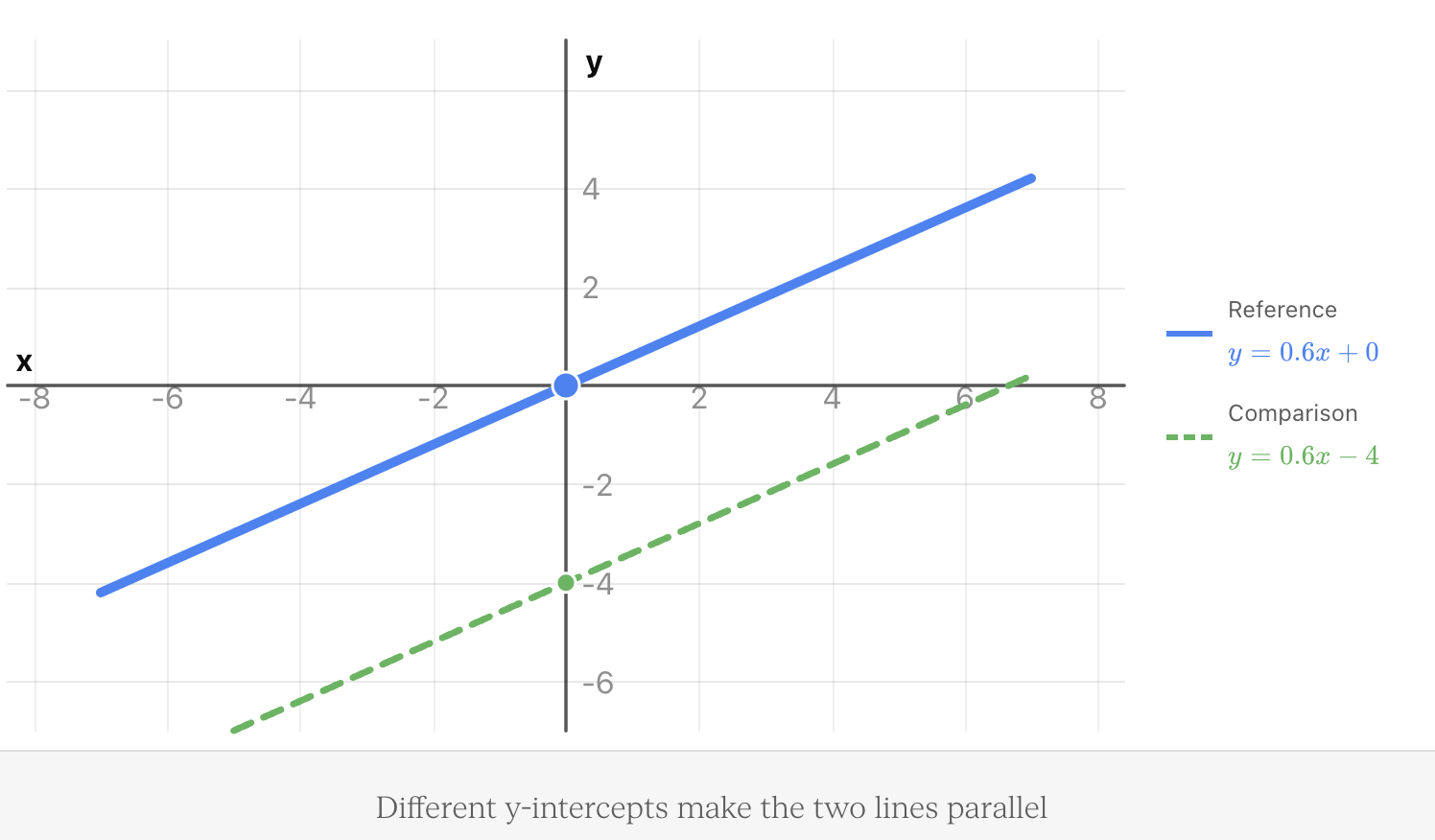
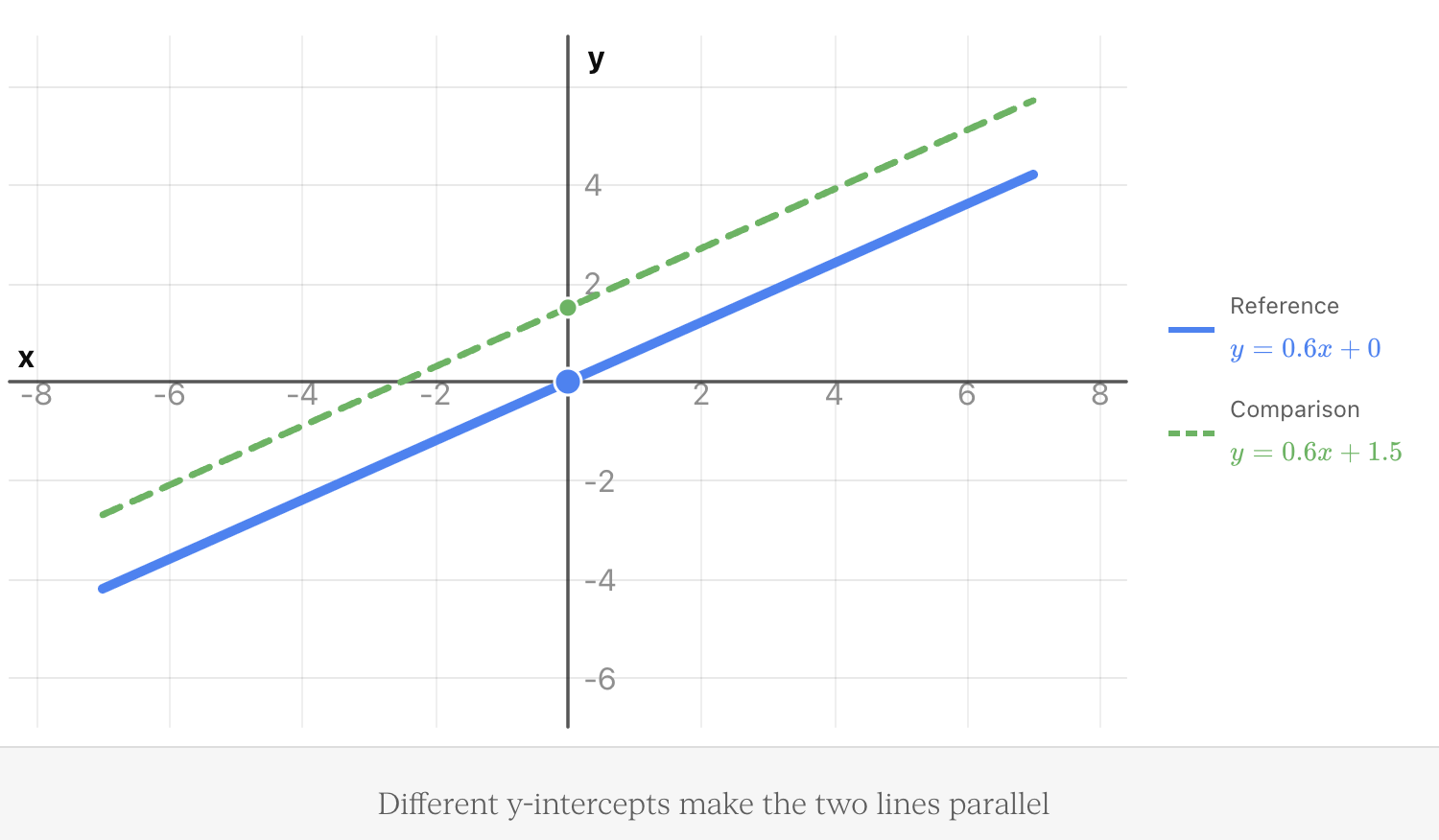
Parallel lines are lines in the same plane that never meet, no matter how far they are extended. When another line crosses two or more lines, the crossing line is called a transversal.
Understanding the angles created by a transversal allows us to calculate unknown angles and can even help us determine whether two lines are parallel.


Parallel Lines
Parallel lines:
- remain the same distance apart
- never intersect
- point in the same direction
Parallel lines are usually marked with matching arrow symbols on a diagram.
For example:
AB ∥ CD
The symbol ∥ means "is parallel to."
Parallel lines are common in everyday structures, including:
- railway tracks
- opposite edges of rectangular objects
- ruled notebook paper
- road markings
- beams and supports in buildings
The important feature is that the distance between the two lines remains constant.
What Is a Transversal?
A transversal is a line that crosses two or more other lines at different points.
When a transversal crosses two parallel lines, eight angles are formed.
These angles are not all different sizes. Their positions create predictable relationships that allow us to find unknown angles without measuring them.
There are three particularly important relationships:
- corresponding angles
- alternate angles
- co-interior angles
Corresponding Angles
Corresponding angles occupy the same relative position at each intersection.
A useful way to remember them is:
Corresponding = matching corners
When the lines are parallel:
Corresponding angles are equal.
Example
Suppose one corresponding angle is 68°.
The angle in the same position at the other intersection is also:
68°
So:
68° = 68°
This relationship works only when the two lines being crossed are parallel.
Alternate Angles
Alternate angles lie on opposite sides of the transversal and between the parallel lines.
A useful visual description is that they often form a Z-shape in the diagram.
When the lines are parallel:
Alternate angles are equal.
Example
If one alternate angle is 115°, its alternate angle is also:
115°
This relationship is especially useful because the two angles may look quite far apart on a diagram even though they are equal.


Co-Interior Angles
Co-interior angles are located between the two parallel lines and on the same side of the transversal.
They are sometimes called same-side interior angles.
Unlike corresponding and alternate angles, co-interior angles are not usually equal.
Instead:
Co-interior angles add to 180°.
Example
One co-interior angle is 124°. Find the other angle, x.
x + 124° = 180°
x = 180° − 124°
x = 56°
Therefore, the two co-interior angles are:
124° + 56° = 180°
Three Relationships to Remember
| Angle relationship | Rule | Helpful visual |
|---|---|---|
| Corresponding | Equal | F-shape |
| Alternate | Equal | Z-shape |
| Co-interior | Add to 180° | C/U-shape |
The letter shapes can be useful memory aids, but it is more important to understand the positions of the angles. Diagrams may be rotated, stretched, or drawn in unfamiliar orientations.
Other Angle Rules You Will Need
Problems involving parallel lines often require more than one angle rule.
Vertically Opposite Angles
When two lines intersect, angles directly opposite each other are equal.
If one angle is 72°, the vertically opposite angle is also:
72°
Angles on a Straight Line
Angles forming a straight line add to:
180°
If one angle is 133°:
x + 133° = 180°
x = 47°
Angles Around a Point
Angles around a point add to:
360°
These basic rules can be combined with parallel-line relationships to solve more complicated problems.
Calculating Missing Angles
Consider two parallel lines crossed by a transversal.
One angle is 63°. Find an angle that is corresponding to it.
Corresponding angles are equal.
Therefore:
x = 63°
Now suppose another angle forms a straight line with x.
x + y = 180°
63° + y = 180°
y = 117°
So:
y = 117°
Notice that two different geometric rules were required.
Multi-Step Example
Suppose two parallel lines are crossed by a transversal. One angle is 128°. Angle x is alternate to the 128° angle, and angle y forms a straight line with x.
Find x
Alternate angles are equal.
x = 128°
Find y
Angles on a straight line add to 180°.
y + 128° = 180°
y = 52°
Therefore:
x = 128°
y = 52°
This is a multi-step angle problem because one answer is used to determine another.
Determining Whether Lines Are Parallel
Angle relationships can also be used in reverse.
Instead of being told that two lines are parallel, you may be given information about their angles and asked whether the lines must be parallel.
For example, if two corresponding angles are both 75°, then the lines are parallel.
Similarly, lines are parallel if:
- corresponding angles are equal
- alternate angles are equal
- co-interior angles add to 180°
Example
Two lines are crossed by a transversal. A pair of alternate angles measure 47° and 47°.
Because the alternate angles are equal:
the two lines are parallel.
Justifying Your Answers
In geometry, calculating the correct number is only part of the solution. You should also be able to explain why your answer is correct.
Instead of writing only:
x = 72°
write:
x = 72° because alternate angles between parallel lines are equal.
Useful justifications include:
- corresponding angles are equal
- alternate angles are equal
- co-interior angles sum to 180°
- vertically opposite angles are equal
- angles on a straight line sum to 180°
- angles around a point sum to 360°
Worked Multi-Step Problem
Two parallel lines are crossed by a transversal. One angle is 38°. Angle a is vertically opposite this angle. Angle b corresponds to a. Angle c forms a straight line with b.
Find a, b, and c.
Step 1: Find a
Vertically opposite angles are equal.
a = 38°
Step 2: Find b
Corresponding angles are equal.
b = 38°
Step 3: Find c
Angles on a straight line add to 180°.
c + 38° = 180°
c = 142°
Therefore:
a = 38°, b = 38°, c = 142°
This demonstrates an important problem-solving strategy: find one angle at a time and write the reason for every step.


A Useful Problem-Solving Strategy
When solving a complicated diagram, first look for an angle whose value is already given. Then identify the relationship connecting that angle to the unknown.
Ask yourself:
Are the angles opposite each other?
Use vertically opposite angles.
Are they on a straight line?
Use 180°.
Are they in matching positions across parallel lines?
Use corresponding angles.
Are they inside the parallel lines on opposite sides of the transversal?
Use alternate angles.
Are they inside the parallel lines on the same side?
Use co-interior angles.
For multi-step problems, you may need to calculate an intermediate angle before you can find the final answer.
Common Mistakes
Assuming every pair of angles is equal
Only certain angle relationships produce equal angles. Co-interior angles, for example, add to 180° rather than being equal.
Using parallel-line rules when the lines are not parallel
Corresponding and alternate angles are guaranteed to be equal only when the lines are parallel.
Confusing alternate and co-interior angles
Alternate angles are on opposite sides of the transversal. Co-interior angles are on the same side.
Relying entirely on the appearance of the diagram
Geometry diagrams are not always drawn to scale. An angle that looks like 90° may not actually be 90°.
Giving an answer without a reason
When asked to justify your answer, name the angle relationship or geometric rule you used.
Key Terms
Parallel lines — lines in the same plane that never intersect and remain the same distance apart.
Transversal — a line that crosses two or more other lines.
Corresponding angles — angles in matching positions at two intersections. They are equal when the lines are parallel.
Alternate angles — angles on opposite sides of a transversal, between two parallel lines. They are equal.
Co-interior angles — angles between two parallel lines on the same side of a transversal. They add to 180°.
Vertically opposite angles — opposite angles formed when two lines intersect. They are equal.
Supplementary angles — two angles whose measures add to 180°.
Geometric reasoning — using established geometric relationships and rules to justify a conclusion.
Key Takeaways
- A transversal crosses two or more lines.
- When parallel lines are crossed by a transversal, predictable angle relationships are created.
- Corresponding angles are equal.
- Alternate angles are equal.
- Co-interior angles add to 180°.
- Vertically opposite angles are equal.
- Angles on a straight line add to 180°.
- Angle relationships can be used in reverse to prove that lines are parallel.
- Multi-step problems often require several angle rules.
- A complete geometric solution should include both the angle value and the reason.
Check Your Understanding
- Two parallel lines are crossed by a transversal. One angle is 64°. What is its corresponding angle?
- An alternate angle to an angle measuring 117° is labelled x. Find x.
- Two co-interior angles are 105° and y. Find y.
- An angle of 48° and angle x form a straight line. Find x.
- Two corresponding angles formed by a transversal are both 82°. What can you conclude about the two lines?
- Explain why corresponding angles cannot automatically be assumed to be equal if the two lines have not been shown to be parallel.
- One angle is 136°. Its vertically opposite angle is x. An angle corresponding to x is y. Find x and y if the lines are parallel.
- A pair of co-interior angles are (2x + 20)° and (4x + 10)°. Find x and then calculate both angles.
4. Geometric Constructions
Learning outcomes
- I can construct line segments and angles accurately.
- I can construct perpendicular and angle bisectors.
- I can construct parallel lines.
- I can use a compass and straightedge correctly.
- I can explain the purpose of geometric constructions.


5. Introduction to Proof
Learning outcomes
- I can distinguish between inductive and deductive reasoning.
- I can identify statements and reasons in geometric proofs.
- I can write simple geometric proofs.
- I can justify conclusions using known theorems.
- I can communicate mathematical reasoning clearly.


