Forms of Quadratic Equations
1. Standard Form
Learning outcomes
- I can identify the coefficients in standard form.
- I can explain the role of each coefficient.
- I can determine how coefficient a affects the graph.
- I can recognise quadratic equations written in standard form.
- I can convert simple equations into standard form.
Introduction
A quadratic function is a function whose greatest exponent is 2. The graph of a quadratic function is a U-shaped or upside-down U-shaped curve called a parabola.
Quadratic functions can be written in several different forms. Each form makes particular features easier to identify. In this lesson, we will examine standard form, which clearly displays the three coefficients a, b, and c.
Standard form is useful for identifying the direction in which a parabola opens, its y-intercept, and the location of its axis of symmetry.
Standard Form
The standard form of a quadratic function is:
y = ax² + bx + c
It can also be written using function notation:
f(x) = ax² + bx + c
The letters a, b, and c represent real-number coefficients.
For the function to be quadratic:
a ≠ 0
If a were equal to zero, the x² term would disappear and the function would no longer be quadratic.
Identifying the Coefficients
In the standard form:
y = ax² + bx + c
- a is the coefficient of x².
- b is the coefficient of x.
- c is the constant term.
Consider the function:
y = 3x² − 5x + 7
The coefficients are:
- a = 3
- b = −5
- c = 7
The signs belong to the coefficients. Therefore, b is −5, not 5.
Example 1
Identify a, b, and c:
y = 2x² + 6x − 9
- a = 2
- b = 6
- c = −9
Example 2
Identify a, b, and c:
f(x) = −4x² + 3x + 8
- a = −4
- b = 3
- c = 8
Example 3
Identify a, b, and c:
y = x² − 7x + 2
The coefficient of x² is understood to be 1:
- a = 1
- b = −7
- c = 2
Example 4
Identify a, b, and c:
y = −x² + 10
The coefficient of x² is −1, and the missing x term has a coefficient of zero:
- a = −1
- b = 0
- c = 10
Example 5
Identify a, b, and c:
y = 5x² − 3x
There is no constant term, so c = 0:
- a = 5
- b = −3
- c = 0
The Role of Coefficient a
In the function:
y = ax² + bx + c
the coefficient a has a major effect on the shape and direction of the parabola.
Coefficient a determines:
- Whether the parabola opens upward or downward.
- Whether the parabola is relatively narrow or wide.
- Whether the function has a minimum or maximum value.
The Sign of a
If a > 0, the parabola opens upward.
Examples include:
- y = x²
- y = 2x² + 3x − 1
- y = 0.5x² − 4
An upward-opening parabola has a minimum value at its vertex.
If a < 0, the parabola opens downward.
Examples include:
- y = −x²
- y = −3x² + 2x + 5
- y = −0.25x² + 8
A downward-opening parabola has a maximum value at its vertex.
The Size of a
The absolute value of a, written |a|, affects the width of the parabola.
If |a| > 1:
- The parabola is narrower.
- The graph rises or falls more steeply.
Examples:
- y = 2x²
- y = −5x²
If 0 < |a| < 1:
- The parabola is wider.
- The graph rises or falls more gradually.
Examples:
- y = 0.5x²
- y = −0.25x²
If |a| = 1, the parabola has the same basic width as y = x².
It is more accurate to say that a changes the graph’s vertical stretch or compression. This produces the visual effect of a narrower or wider parabola.
The Role of Coefficient b
The coefficient b is attached to the x term:
y = ax² + bx + c
Coefficient b helps determine the horizontal position of the parabola. In particular, it affects:
- The location of the vertex.
- The position of the axis of symmetry.
- The position of the x-intercepts.
The axis of symmetry can be calculated using:
x = −b/(2a)
For example, consider:
y = x² − 6x + 5
In this function:
- a = 1
- b = −6
- c = 5
The axis of symmetry is:
x = −(−6)/(2 × 1)
x = 6/2
x = 3
Therefore, the parabola is symmetrical around the vertical line x = 3.
Unlike c, coefficient b does not produce a simple vertical shift by itself. Its effect depends partly on the value of a.
The Role of Coefficient c
The coefficient c is the constant term:
y = ax² + bx + c
It gives the y-intercept of the graph.
The y-intercept occurs when x = 0. Substituting x = 0 gives:
y = a(0)² + b(0) + c
y = c
Therefore, the graph crosses the y-axis at:
(0, c)
For example:
y = 2x² − 5x + 7
The value of c is 7, so the y-intercept is:
(0, 7)
If c = 0, the graph passes through the origin:
(0, 0)
How the Coefficients Affect the Graph
The following graph set shows how changing a, b, or c affects a quadratic function.
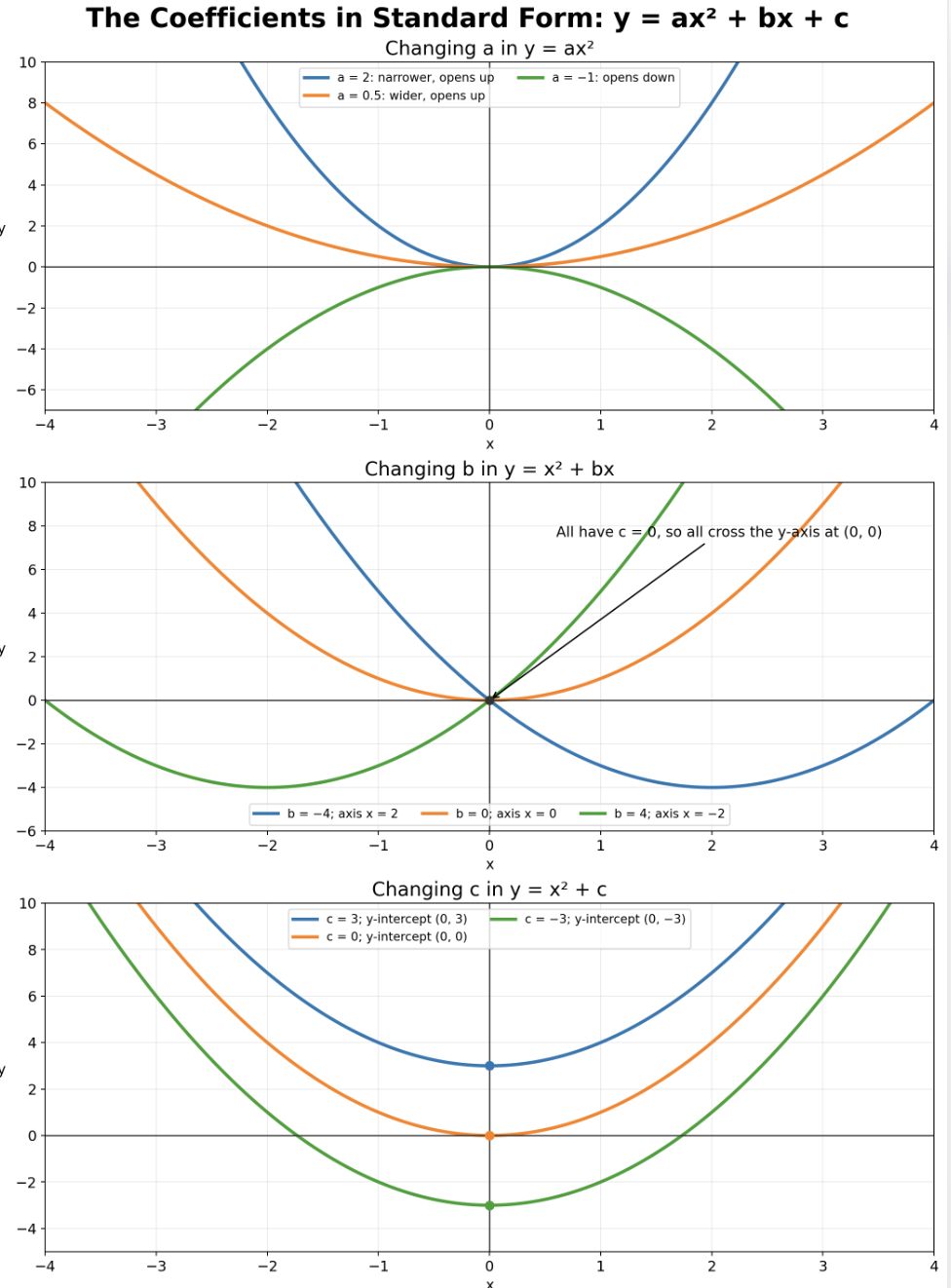
The first graph shows that:
- Positive values of a produce upward-opening parabolas.
- Negative values of a produce downward-opening parabolas.
- Larger values of |a| produce narrower parabolas.
- Values of |a| between 0 and 1 produce wider parabolas.
The second graph shows that changing b changes the location of the axis of symmetry and vertex.
The third graph shows that c determines the y-intercept. When c changes while a and b remain fixed, the graph moves vertically.
Summary of the Coefficients
| Coefficient | Position in the function | Main effect |
|---|---|---|
| a | Coefficient of x² | Determines opening direction and width |
| b | Coefficient of x | Helps determine the vertex and axis of symmetry |
| c | Constant term | Determines the y-intercept |
Recognising Standard Form
A quadratic function is in standard form when:
- The terms are arranged in descending powers of x.
- The x² term comes first.
- The x term comes second.
- The constant term comes last.
- Like terms have been combined.
The correct order is:
y = ax² + bx + c
Already in Standard Form
These functions are in standard form:
- y = 3x² + 4x − 7
- y = −2x² + 8x + 1
- f(x) = x² − 9x
- y = 6x² + 5
Missing terms are permitted because their coefficients are zero.
For example:
y = 6x² + 5
can be written as:
y = 6x² + 0x + 5
Therefore:
- a = 6
- b = 0
- c = 5
Not Written in Standard Form
These quadratic expressions are not currently in standard form:
- y = 4 + 3x − 2x²
- y = (x + 2)(x − 5)
- y = (x − 3)² + 4
- y = 2x² + 3x + x² − 5x + 7
They can be converted into standard form by rearranging, expanding, or combining like terms.
Converting Equations into Standard Form
Method 1: Rearrange the Terms
Write the terms in descending powers of x:
- x² term
- x term
- Constant term
Worked Example
Rewrite in standard form:
y = 7 + 3x − 2x²
Rearrange the terms:
y = −2x² + 3x + 7
Therefore:
- a = −2
- b = 3
- c = 7
Method 2: Combine Like Terms
Worked Example
Rewrite in standard form:
y = 2x² + 5x + 3 + x² − 2x + 4
Combine the x² terms:
2x² + x² = 3x²
Combine the x terms:
5x − 2x = 3x
Combine the constants:
3 + 4 = 7
Therefore:
y = 3x² + 3x + 7
The coefficients are:
- a = 3
- b = 3
- c = 7
Method 3: Expand Brackets
Use the distributive property to remove brackets.
Worked Example
Rewrite in standard form:
y = (x + 2)(x − 3)
Expand:
y = x(x − 3) + 2(x − 3)
y = x² − 3x + 2x − 6
Combine like terms:
y = x² − x − 6
Therefore:
- a = 1
- b = −1
- c = −6
Method 4: Expand a Squared Binomial
Worked Example
Rewrite in standard form:
y = (x − 4)² + 3
Expand the squared binomial:
(x − 4)² = (x − 4)(x − 4)
y = x² − 4x − 4x + 16 + 3
Combine like terms:
y = x² − 8x + 19
Therefore:
- a = 1
- b = −8
- c = 19
Method 5: Move All Terms to One Side
A quadratic equation is often written in the form:
ax² + bx + c = 0
Worked Example
Rewrite in standard form:
2x² + 3 = 5x
Subtract 5x from both sides:
2x² − 5x + 3 = 0
Therefore:
- a = 2
- b = −5
- c = 3
Quadratic Function or Quadratic Equation?
A quadratic function is commonly written as:
y = ax² + bx + c
or:
f(x) = ax² + bx + c
A quadratic equation is commonly written as:
ax² + bx + c = 0
Both use the same standard-form expression. The difference is how it is being used.
A function describes the relationship between x and y. A quadratic equation usually asks us to find values of x that make the expression equal to zero.
Checking Whether an Expression Is Quadratic
To be quadratic, the greatest exponent of the variable must be exactly 2.
Quadratic
- y = 4x² − 3x + 8
- y = −x² + 7
- 2x² + 5x = 3
Not Quadratic
- y = 4x + 8 is linear.
- y = x³ − 2x is cubic.
- y = 5 is constant.
- y = 2ˣ is exponential.
- y = 1/x² is rational.
Remember that a cannot equal zero. If a = 0, the x² term disappears.
Worked Example: Identify and Interpret the Coefficients
Consider:
y = −3x² + 12x − 5
The coefficients are:
- a = −3
- b = 12
- c = −5
From these coefficients, we can determine that:
- The parabola opens downward because a is negative.
- The parabola is narrower than y = x² because |a| = 3.
- The graph has a maximum value.
- The y-intercept is (0, −5).
- The axis of symmetry can be found using x = −b/(2a).
Calculate the axis of symmetry:
x = −12/[2(−3)]
x = −12/−6
x = 2
Therefore, the axis of symmetry is x = 2.
Worked Example: Missing Coefficients
Consider:
y = −5x² + 9
Rewrite it to display all three terms:
y = −5x² + 0x + 9
Therefore:
- a = −5
- b = 0
- c = 9
The graph:
- Opens downward.
- Is narrower than y = x².
- Has its axis of symmetry at x = 0.
- Crosses the y-axis at (0, 9).
Real-World Connections
Quadratic functions can model situations in which a quantity rises and then falls, or falls and then rises.
Examples include:
- The path of a thrown ball.
- The path of water from a fountain.
- The shape of a satellite dish.
- The shape of some bridges and arches.
- The relationship between area and side length.
- The height of a projectile over time.
- Revenue and profit models in business.
- Braking-distance models.


Example: Projectile Motion
The height of a ball might be modelled by:
h(t) = −5t² + 20t + 1
In this function:
- h(t) is the height of the ball.
- t is the time.
- a = −5, so the graph opens downward.
- The ball reaches a maximum height.
- c = 1, so the ball begins at a height of 1 metre.
The coefficients help us interpret the physical situation before completing any detailed calculations.
Common Misconceptions
Ignoring Negative Signs
In:
y = −4x² − 3x + 8
the coefficients are:
- a = −4
- b = −3
- c = 8
The negative signs belong to the coefficients.
Assuming a Missing Term Has No Coefficient
In:
y = 2x² + 7
the x term is missing because b = 0.
Assuming a Is Always 1
In:
y = x² + 5x − 2
a = 1 because x² means 1x².
In:
y = −x² + 5x − 2
a = −1 because −x² means −1x².
Confusing Standard Form with Other Forms
The expression:
y = (x − 2)(x + 5)
is quadratic, but it is written in factored form. It must be expanded to be written in standard form.
Thinking b Is the y-Intercept
The constant c gives the y-intercept. Coefficient b helps determine the horizontal position of the vertex and axis of symmetry.
Thinking a Changes Only the Direction
The sign of a determines the opening direction, while |a| affects the width of the parabola.
Did You Know?
The word parabola comes from ancient Greek mathematics. Parabolic shapes have an important reflective property: signals or light rays travelling parallel to a parabola’s axis are reflected towards a single point called the focus.
This is why parabolic shapes are used in:
- Satellite dishes.
- Radio telescopes.
- Reflecting telescopes.
- Car headlights.
- Solar cookers.
- Directional microphones.
Key Terms
- Axis of symmetry: The vertical line that divides a parabola into two matching halves.
- Coefficient: A number multiplying a variable or power of a variable.
- Constant term: A term without a variable; c in the standard form.
- Function notation: A way of writing a function using symbols such as f(x).
- Leading coefficient: The coefficient of the term with the greatest exponent; a in a quadratic function.
- Maximum value: The greatest output of a downward-opening parabola.
- Minimum value: The smallest output of an upward-opening parabola.
- Parabola: The curved graph of a quadratic function.
- Quadratic equation: An equation in which the greatest exponent of the variable is 2.
- Quadratic function: A function that can be written as f(x) = ax² + bx + c, where a ≠ 0.
- Standard form: The form y = ax² + bx + c or ax² + bx + c = 0.
- Vertex: The turning point of a parabola.
- Vertical compression: A transformation that makes a parabola appear wider.
- Vertical stretch: A transformation that makes a parabola appear narrower.
- x-intercept: A point where a graph crosses or touches the x-axis.
- y-intercept: The point where a graph crosses the y-axis; it is (0, c) in standard form.
Key Takeaways
- The standard form of a quadratic function is y = ax² + bx + c.
- The coefficient a cannot equal zero.
- Coefficient a determines the direction and width of the parabola.
- If a > 0, the parabola opens upward.
- If a < 0, the parabola opens downward.
- Larger values of |a| produce narrower parabolas.
- Values of |a| between 0 and 1 produce wider parabolas.
- Coefficient b helps determine the vertex and axis of symmetry.
- Coefficient c gives the y-intercept.
- A missing term has a coefficient of zero.
- Terms must be arranged in descending powers of x to be in standard form.
- Brackets must be expanded and like terms combined when converting to standard form.
- A quadratic equation can be written as ax² + bx + c = 0.