Forms of Quadratic Equations
| Сайт: | Young Education |
| Курс: | Quadratic Functions |
| Книга: | Forms of Quadratic Equations |
| Надруковано: | Guest user |
| Дата: | понеділок 9 листопада 2026 16:37 PM |
1. Standard Form
Learning outcomes
- I can identify the coefficients in standard form.
- I can explain the role of each coefficient.
- I can determine how coefficient a affects the graph.
- I can recognise quadratic equations written in standard form.
- I can convert simple equations into standard form.
Introduction
A quadratic function is a function whose greatest exponent is 2. The graph of a quadratic function is a U-shaped or upside-down U-shaped curve called a parabola.
Quadratic functions can be written in several different forms. Each form makes particular features easier to identify. In this lesson, we will examine standard form, which clearly displays the three coefficients a, b, and c.
Standard form is useful for identifying the direction in which a parabola opens, its y-intercept, and the location of its axis of symmetry.
Standard Form
The standard form of a quadratic function is:
y = ax² + bx + c
It can also be written using function notation:
f(x) = ax² + bx + c
The letters a, b, and c represent real-number coefficients.
For the function to be quadratic:
a ≠ 0
If a were equal to zero, the x² term would disappear and the function would no longer be quadratic.
Identifying the Coefficients
In the standard form:
y = ax² + bx + c
- a is the coefficient of x².
- b is the coefficient of x.
- c is the constant term.
Consider the function:
y = 3x² − 5x + 7
The coefficients are:
- a = 3
- b = −5
- c = 7
The signs belong to the coefficients. Therefore, b is −5, not 5.
Example 1
Identify a, b, and c:
y = 2x² + 6x − 9
- a = 2
- b = 6
- c = −9
Example 2
Identify a, b, and c:
f(x) = −4x² + 3x + 8
- a = −4
- b = 3
- c = 8
Example 3
Identify a, b, and c:
y = x² − 7x + 2
The coefficient of x² is understood to be 1:
- a = 1
- b = −7
- c = 2
Example 4
Identify a, b, and c:
y = −x² + 10
The coefficient of x² is −1, and the missing x term has a coefficient of zero:
- a = −1
- b = 0
- c = 10
Example 5
Identify a, b, and c:
y = 5x² − 3x
There is no constant term, so c = 0:
- a = 5
- b = −3
- c = 0
The Role of Coefficient a
In the function:
y = ax² + bx + c
the coefficient a has a major effect on the shape and direction of the parabola.
Coefficient a determines:
- Whether the parabola opens upward or downward.
- Whether the parabola is relatively narrow or wide.
- Whether the function has a minimum or maximum value.
The Sign of a
If a > 0, the parabola opens upward.
Examples include:
- y = x²
- y = 2x² + 3x − 1
- y = 0.5x² − 4
An upward-opening parabola has a minimum value at its vertex.
If a < 0, the parabola opens downward.
Examples include:
- y = −x²
- y = −3x² + 2x + 5
- y = −0.25x² + 8
A downward-opening parabola has a maximum value at its vertex.
The Size of a
The absolute value of a, written |a|, affects the width of the parabola.
If |a| > 1:
- The parabola is narrower.
- The graph rises or falls more steeply.
Examples:
- y = 2x²
- y = −5x²
If 0 < |a| < 1:
- The parabola is wider.
- The graph rises or falls more gradually.
Examples:
- y = 0.5x²
- y = −0.25x²
If |a| = 1, the parabola has the same basic width as y = x².
It is more accurate to say that a changes the graph’s vertical stretch or compression. This produces the visual effect of a narrower or wider parabola.
The Role of Coefficient b
The coefficient b is attached to the x term:
y = ax² + bx + c
Coefficient b helps determine the horizontal position of the parabola. In particular, it affects:
- The location of the vertex.
- The position of the axis of symmetry.
- The position of the x-intercepts.
The axis of symmetry can be calculated using:
x = −b/(2a)
For example, consider:
y = x² − 6x + 5
In this function:
- a = 1
- b = −6
- c = 5
The axis of symmetry is:
x = −(−6)/(2 × 1)
x = 6/2
x = 3
Therefore, the parabola is symmetrical around the vertical line x = 3.
Unlike c, coefficient b does not produce a simple vertical shift by itself. Its effect depends partly on the value of a.
The Role of Coefficient c
The coefficient c is the constant term:
y = ax² + bx + c
It gives the y-intercept of the graph.
The y-intercept occurs when x = 0. Substituting x = 0 gives:
y = a(0)² + b(0) + c
y = c
Therefore, the graph crosses the y-axis at:
(0, c)
For example:
y = 2x² − 5x + 7
The value of c is 7, so the y-intercept is:
(0, 7)
If c = 0, the graph passes through the origin:
(0, 0)
How the Coefficients Affect the Graph
The following graph set shows how changing a, b, or c affects a quadratic function.
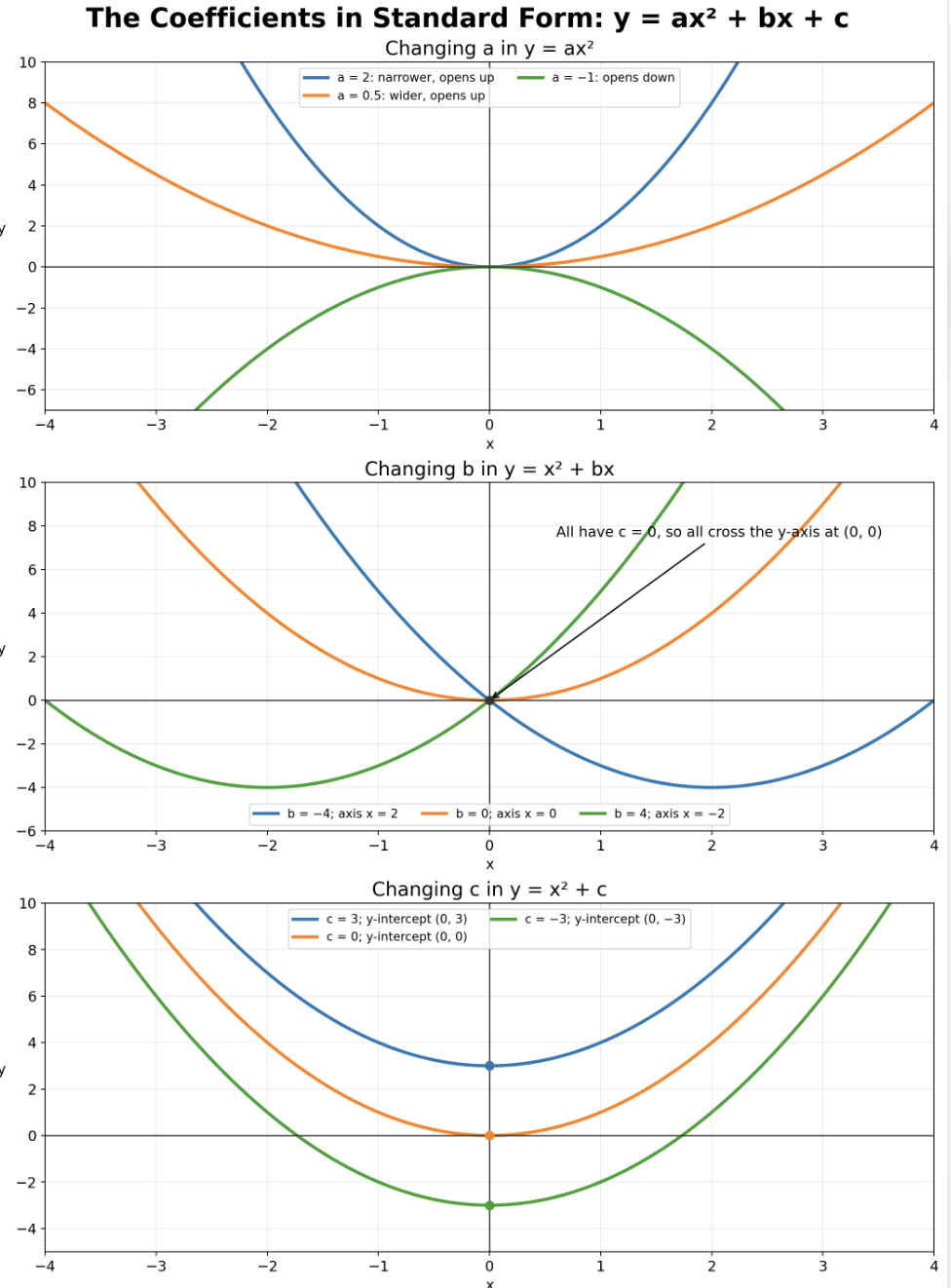
The first graph shows that:
- Positive values of a produce upward-opening parabolas.
- Negative values of a produce downward-opening parabolas.
- Larger values of |a| produce narrower parabolas.
- Values of |a| between 0 and 1 produce wider parabolas.
The second graph shows that changing b changes the location of the axis of symmetry and vertex.
The third graph shows that c determines the y-intercept. When c changes while a and b remain fixed, the graph moves vertically.
Summary of the Coefficients
| Coefficient | Position in the function | Main effect |
|---|---|---|
| a | Coefficient of x² | Determines opening direction and width |
| b | Coefficient of x | Helps determine the vertex and axis of symmetry |
| c | Constant term | Determines the y-intercept |
Recognising Standard Form
A quadratic function is in standard form when:
- The terms are arranged in descending powers of x.
- The x² term comes first.
- The x term comes second.
- The constant term comes last.
- Like terms have been combined.
The correct order is:
y = ax² + bx + c
Already in Standard Form
These functions are in standard form:
- y = 3x² + 4x − 7
- y = −2x² + 8x + 1
- f(x) = x² − 9x
- y = 6x² + 5
Missing terms are permitted because their coefficients are zero.
For example:
y = 6x² + 5
can be written as:
y = 6x² + 0x + 5
Therefore:
- a = 6
- b = 0
- c = 5
Not Written in Standard Form
These quadratic expressions are not currently in standard form:
- y = 4 + 3x − 2x²
- y = (x + 2)(x − 5)
- y = (x − 3)² + 4
- y = 2x² + 3x + x² − 5x + 7
They can be converted into standard form by rearranging, expanding, or combining like terms.
Converting Equations into Standard Form
Method 1: Rearrange the Terms
Write the terms in descending powers of x:
- x² term
- x term
- Constant term
Worked Example
Rewrite in standard form:
y = 7 + 3x − 2x²
Rearrange the terms:
y = −2x² + 3x + 7
Therefore:
- a = −2
- b = 3
- c = 7
Method 2: Combine Like Terms
Worked Example
Rewrite in standard form:
y = 2x² + 5x + 3 + x² − 2x + 4
Combine the x² terms:
2x² + x² = 3x²
Combine the x terms:
5x − 2x = 3x
Combine the constants:
3 + 4 = 7
Therefore:
y = 3x² + 3x + 7
The coefficients are:
- a = 3
- b = 3
- c = 7
Method 3: Expand Brackets
Use the distributive property to remove brackets.
Worked Example
Rewrite in standard form:
y = (x + 2)(x − 3)
Expand:
y = x(x − 3) + 2(x − 3)
y = x² − 3x + 2x − 6
Combine like terms:
y = x² − x − 6
Therefore:
- a = 1
- b = −1
- c = −6
Method 4: Expand a Squared Binomial
Worked Example
Rewrite in standard form:
y = (x − 4)² + 3
Expand the squared binomial:
(x − 4)² = (x − 4)(x − 4)
y = x² − 4x − 4x + 16 + 3
Combine like terms:
y = x² − 8x + 19
Therefore:
- a = 1
- b = −8
- c = 19
Method 5: Move All Terms to One Side
A quadratic equation is often written in the form:
ax² + bx + c = 0
Worked Example
Rewrite in standard form:
2x² + 3 = 5x
Subtract 5x from both sides:
2x² − 5x + 3 = 0
Therefore:
- a = 2
- b = −5
- c = 3
Quadratic Function or Quadratic Equation?
A quadratic function is commonly written as:
y = ax² + bx + c
or:
f(x) = ax² + bx + c
A quadratic equation is commonly written as:
ax² + bx + c = 0
Both use the same standard-form expression. The difference is how it is being used.
A function describes the relationship between x and y. A quadratic equation usually asks us to find values of x that make the expression equal to zero.
Checking Whether an Expression Is Quadratic
To be quadratic, the greatest exponent of the variable must be exactly 2.
Quadratic
- y = 4x² − 3x + 8
- y = −x² + 7
- 2x² + 5x = 3
Not Quadratic
- y = 4x + 8 is linear.
- y = x³ − 2x is cubic.
- y = 5 is constant.
- y = 2ˣ is exponential.
- y = 1/x² is rational.
Remember that a cannot equal zero. If a = 0, the x² term disappears.
Worked Example: Identify and Interpret the Coefficients
Consider:
y = −3x² + 12x − 5
The coefficients are:
- a = −3
- b = 12
- c = −5
From these coefficients, we can determine that:
- The parabola opens downward because a is negative.
- The parabola is narrower than y = x² because |a| = 3.
- The graph has a maximum value.
- The y-intercept is (0, −5).
- The axis of symmetry can be found using x = −b/(2a).
Calculate the axis of symmetry:
x = −12/[2(−3)]
x = −12/−6
x = 2
Therefore, the axis of symmetry is x = 2.
Worked Example: Missing Coefficients
Consider:
y = −5x² + 9
Rewrite it to display all three terms:
y = −5x² + 0x + 9
Therefore:
- a = −5
- b = 0
- c = 9
The graph:
- Opens downward.
- Is narrower than y = x².
- Has its axis of symmetry at x = 0.
- Crosses the y-axis at (0, 9).
Real-World Connections
Quadratic functions can model situations in which a quantity rises and then falls, or falls and then rises.
Examples include:
- The path of a thrown ball.
- The path of water from a fountain.
- The shape of a satellite dish.
- The shape of some bridges and arches.
- The relationship between area and side length.
- The height of a projectile over time.
- Revenue and profit models in business.
- Braking-distance models.


Example: Projectile Motion
The height of a ball might be modelled by:
h(t) = −5t² + 20t + 1
In this function:
- h(t) is the height of the ball.
- t is the time.
- a = −5, so the graph opens downward.
- The ball reaches a maximum height.
- c = 1, so the ball begins at a height of 1 metre.
The coefficients help us interpret the physical situation before completing any detailed calculations.
Common Misconceptions
Ignoring Negative Signs
In:
y = −4x² − 3x + 8
the coefficients are:
- a = −4
- b = −3
- c = 8
The negative signs belong to the coefficients.
Assuming a Missing Term Has No Coefficient
In:
y = 2x² + 7
the x term is missing because b = 0.
Assuming a Is Always 1
In:
y = x² + 5x − 2
a = 1 because x² means 1x².
In:
y = −x² + 5x − 2
a = −1 because −x² means −1x².
Confusing Standard Form with Other Forms
The expression:
y = (x − 2)(x + 5)
is quadratic, but it is written in factored form. It must be expanded to be written in standard form.
Thinking b Is the y-Intercept
The constant c gives the y-intercept. Coefficient b helps determine the horizontal position of the vertex and axis of symmetry.
Thinking a Changes Only the Direction
The sign of a determines the opening direction, while |a| affects the width of the parabola.
Did You Know?
The word parabola comes from ancient Greek mathematics. Parabolic shapes have an important reflective property: signals or light rays travelling parallel to a parabola’s axis are reflected towards a single point called the focus.
This is why parabolic shapes are used in:
- Satellite dishes.
- Radio telescopes.
- Reflecting telescopes.
- Car headlights.
- Solar cookers.
- Directional microphones.
Key Terms
- Axis of symmetry: The vertical line that divides a parabola into two matching halves.
- Coefficient: A number multiplying a variable or power of a variable.
- Constant term: A term without a variable; c in the standard form.
- Function notation: A way of writing a function using symbols such as f(x).
- Leading coefficient: The coefficient of the term with the greatest exponent; a in a quadratic function.
- Maximum value: The greatest output of a downward-opening parabola.
- Minimum value: The smallest output of an upward-opening parabola.
- Parabola: The curved graph of a quadratic function.
- Quadratic equation: An equation in which the greatest exponent of the variable is 2.
- Quadratic function: A function that can be written as f(x) = ax² + bx + c, where a ≠ 0.
- Standard form: The form y = ax² + bx + c or ax² + bx + c = 0.
- Vertex: The turning point of a parabola.
- Vertical compression: A transformation that makes a parabola appear wider.
- Vertical stretch: A transformation that makes a parabola appear narrower.
- x-intercept: A point where a graph crosses or touches the x-axis.
- y-intercept: The point where a graph crosses the y-axis; it is (0, c) in standard form.
Key Takeaways
- The standard form of a quadratic function is y = ax² + bx + c.
- The coefficient a cannot equal zero.
- Coefficient a determines the direction and width of the parabola.
- If a > 0, the parabola opens upward.
- If a < 0, the parabola opens downward.
- Larger values of |a| produce narrower parabolas.
- Values of |a| between 0 and 1 produce wider parabolas.
- Coefficient b helps determine the vertex and axis of symmetry.
- Coefficient c gives the y-intercept.
- A missing term has a coefficient of zero.
- Terms must be arranged in descending powers of x to be in standard form.
- Brackets must be expanded and like terms combined when converting to standard form.
- A quadratic equation can be written as ax² + bx + c = 0.
2. Vertex Form
Learning outcomes
- I can identify the vertex from vertex form.
- I can determine the axis of symmetry.
- I can describe graph transformations using vertex form.
- I can sketch graphs directly from vertex form.
- I can compare vertex form with standard form.
Vertex Form
What Is Vertex Form?
A quadratic function can be written in several forms. One of the most useful is vertex form:
y = a(x − h)² + k
Vertex form is especially useful because the vertex and axis of symmetry can be identified directly from the equation.
In:
y = a(x − h)² + k
- a controls the direction and vertical stretch or compression of the parabola
- h gives the x-coordinate of the vertex
- k gives the y-coordinate of the vertex
Therefore, the vertex is:
(h, k)
The Parent Quadratic Function
The simplest quadratic function is:
y = x²
Its graph is a parabola.
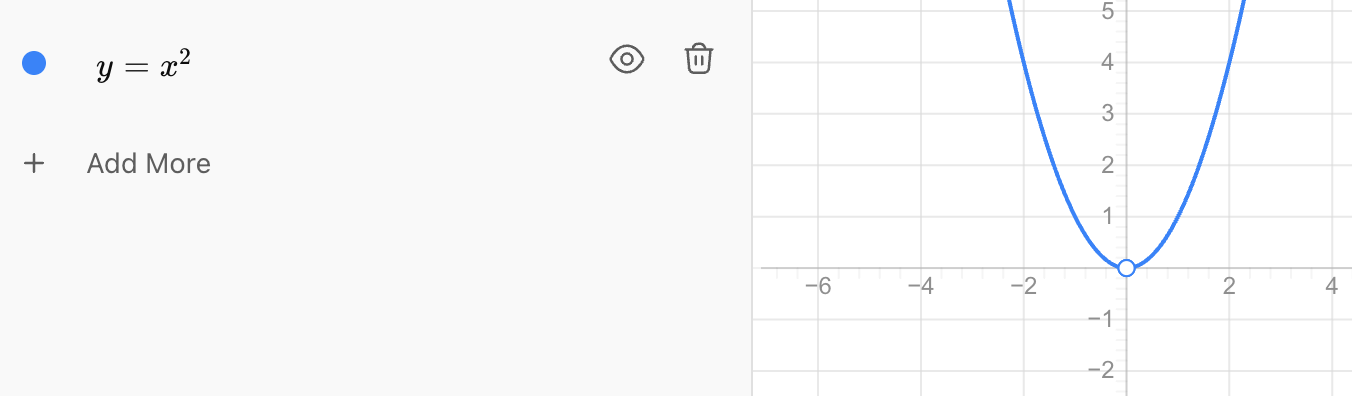
For y = x²:
- vertex = (0, 0)
- axis of symmetry = x = 0
- parabola opens upward
- a = 1
Vertex form describes transformations of this basic parabola.
Identifying the Vertex
Consider:
y = (x − 3)² + 2
Compare it with:
y = a(x − h)² + k
We can identify:
a = 1
h = 3
k = 2
Therefore:
vertex = (3, 2)
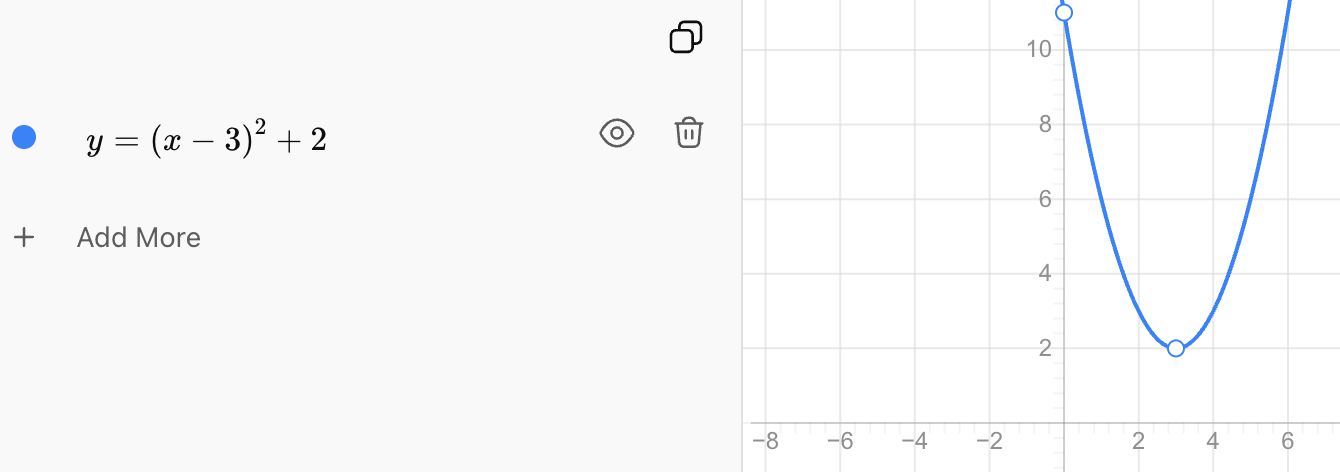
The parabola has moved:
- 3 units right
- 2 units up
compared with y = x².
Watch the Sign of h
The sign inside the brackets can be confusing.
Remember:
y = a(x − h)² + k
The x-coordinate of the vertex is h, not simply the number you see after x.
For example:
y = (x − 5)² + 3
Vertex:
(5, 3)
But:
y = (x + 5)² + 3
can be written as:
y = (x − (−5))² + 3
so the vertex is:
(−5, 3)
The horizontal shift appears to have the opposite sign from the sign inside the brackets.
More Examples of Identifying the Vertex
| Equation | h | k | Vertex |
|---|---|---|---|
| y = (x − 4)² + 7 | 4 | 7 | (4, 7) |
| y = (x + 2)² + 5 | −2 | 5 | (−2, 5) |
| y = 3(x − 1)² − 6 | 1 | −6 | (1, −6) |
| y = −2(x + 4)² − 3 | −4 | −3 | (−4, −3) |
| y = ½(x − 8)² | 8 | 0 | (8, 0) |
The value of a does not change the location of the vertex.
Axis of Symmetry
Every parabola has an axis of symmetry.
This is a vertical line passing through the vertex that divides the parabola into two mirror-image halves.
For:
y = a(x − h)² + k
the axis of symmetry is:
x = h
So if the vertex is:
(3, 2)
the axis of symmetry is:
x = 3
Example: Finding the Axis of Symmetry
Consider:
y = 2(x + 4)² − 1
The vertex is:
(−4, −1)
Therefore, the axis of symmetry is:
x = −4
Notice that the axis of symmetry depends only on the x-coordinate of the vertex.
Transformations from y = x²
Vertex form makes transformations easy to identify.
Starting with:
y = x²
the function:
y = a(x − h)² + k
can involve:
- horizontal translation
- vertical translation
- reflection
- vertical stretch
- vertical compression


Horizontal Translation
The value h controls horizontal movement.
If h > 0
The graph moves right.
Example:
y = (x − 4)²
moves 4 units right.
If h < 0
The graph moves left.
Example:
y = (x + 4)²
moves 4 units left.
Remember that:
x + 4 = x − (−4)
so h = −4.
Vertical Translation
The value k controls vertical movement.
If k > 0
The graph moves up.
Example:
y = x² + 5
moves 5 units upward.
If k < 0
The graph moves down.
Example:
y = x² − 5
moves 5 units downward.
Unlike the horizontal translation, the vertical translation uses the sign exactly as it appears.
The Role of a
The value of a affects the shape and direction of the parabola.
In:
y = a(x − h)² + k
the value of a determines:
- whether the parabola opens upward or downward
- whether it is vertically stretched or compressed
Positive and Negative Values of a
If:
a > 0
the parabola opens upward.
If:
a < 0
the parabola opens downward.
Compare:
y = x²
and:
y = −x²
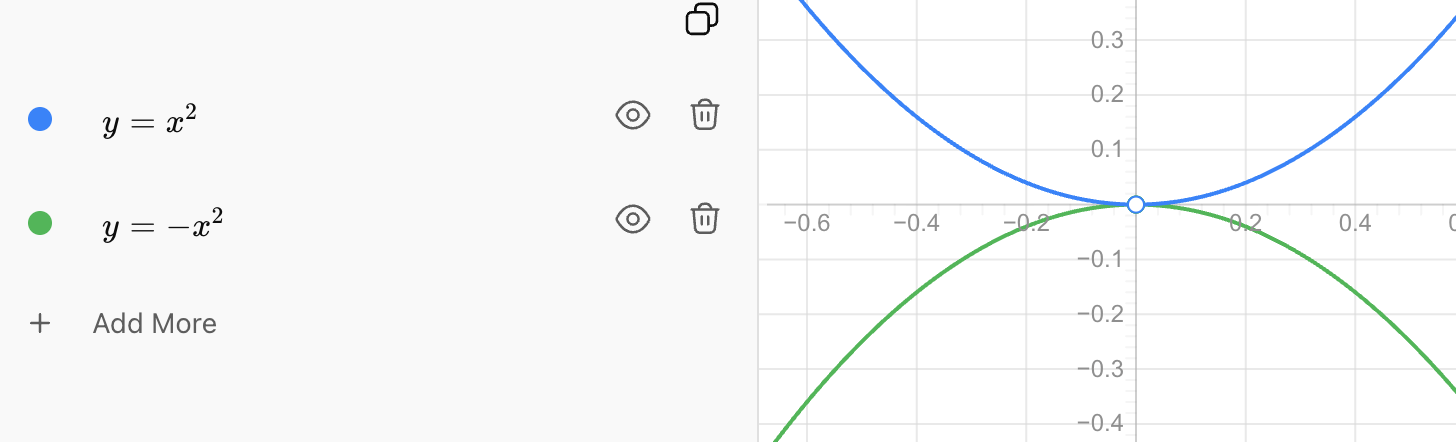
The negative sign reflects the parabola across the x-axis.
Vertical Stretch
If:
|a| > 1
the parabola is vertically stretched compared with y = x².
It appears narrower.
For example:
y = 3x²
has a vertical stretch factor of 3.
Compare:
y = x²
y = 3x²
For the same x-value, the y-value of 3x² is three times as far from the vertex level.
Vertical Compression
If:
0 < |a| < 1
the parabola is vertically compressed.
It appears wider.
For example:
y = ½x²
is vertically compressed by a factor of ½.
So:
- |a| > 1 → narrower
- |a| = 1 → basic width
- 0 < |a| < 1 → wider
Putting the Transformations Together
Consider:
y = −2(x − 3)² + 4
From the equation:
a = −2
h = 3
k = 4
Therefore:
- vertex = (3, 4)
- axis of symmetry = x = 3
- shift right 3
- shift up 4
- reflection across the x-axis
- vertical stretch by factor 2
- parabola opens downward
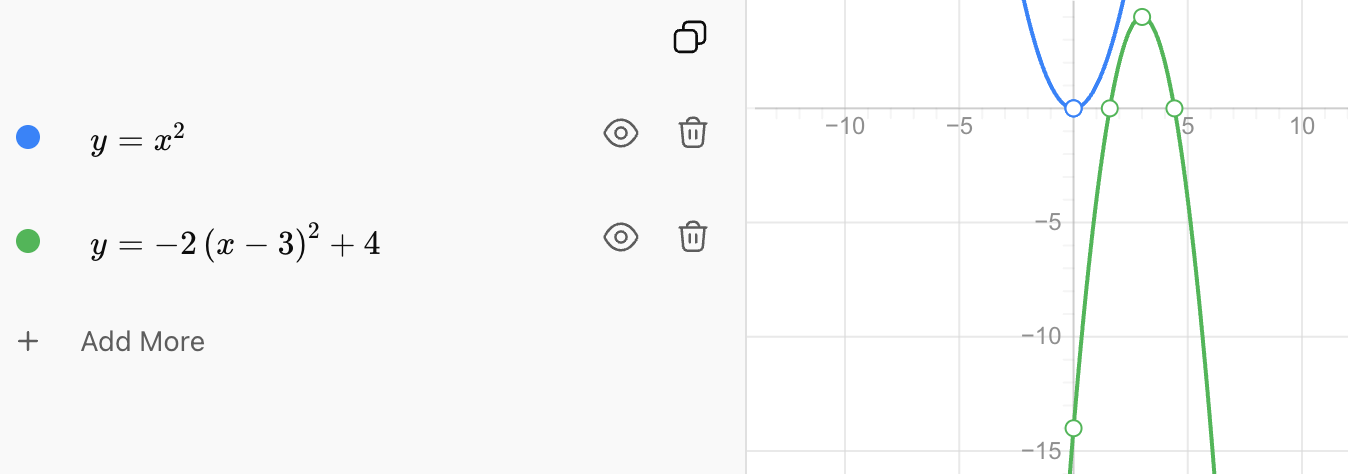
This demonstrates why vertex form is so useful: a great deal of information about the graph can be read directly from the equation.
Sketching from Vertex Form
Suppose we want to sketch:
y = (x − 2)² − 3
Identify the vertex
h = 2
k = −3
Vertex:
(2, −3)
Draw the axis of symmetry
x = 2
Determine the direction
a = 1
Therefore, the parabola opens upward.
Find nearby points
Choose values on either side of x = 2.
For x = 1:
y = (1 − 2)² − 3
y = 1 − 3
y = −2
So one point is:
(1, −2)
By symmetry:
(3, −2)
is also on the graph.
Using the Step Pattern
For the basic parabola:
y = x²
starting from the vertex, a useful pattern is:
- across 1 → up 1
- across another 1 → up 3 more
- across another 1 → up 5 more
This produces the familiar:
1, 3, 5 pattern
The corresponding heights from the vertex are:
- 1² = 1
- 2² = 4
- 3² = 9
For:
y = a(x − h)² + k
these vertical changes are multiplied by a.
Example Using the Step Pattern
Consider:
y = 2(x − 1)² + 3
Vertex:
(1, 3)
Since a = 2, multiply the basic vertical changes by 2.
From the vertex:
- across 1 → up 2
- across another 1 → up 6 more
- across another 1 → up 10 more
The parabola is narrower than y = x².
Sketching a Downward Parabola
Consider:
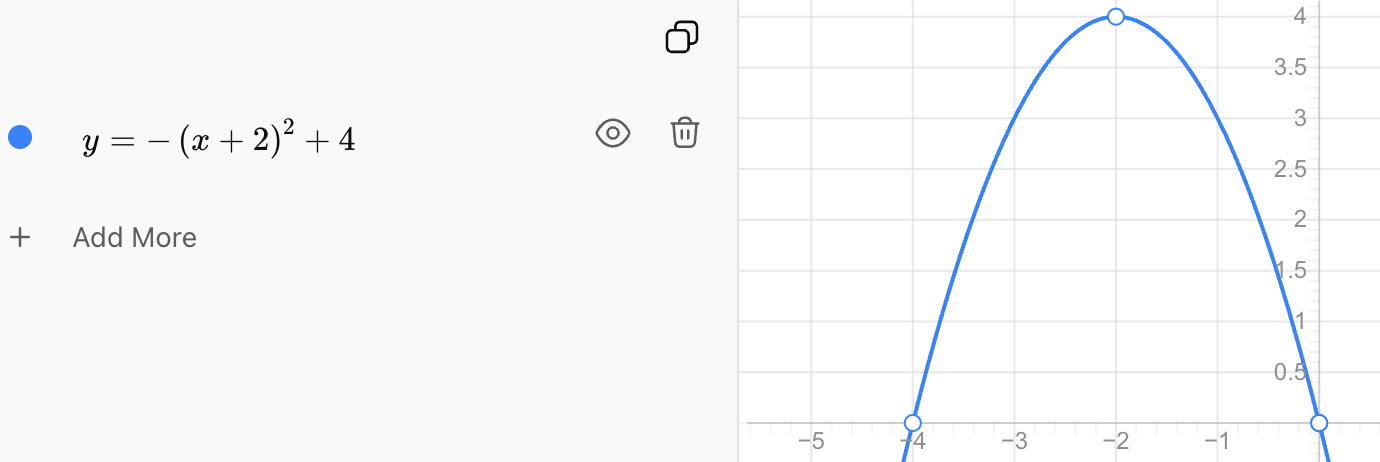
y = −(x + 2)² + 4
Vertex:
(−2, 4)
Axis of symmetry:
x = −2
Because:
a = −1
the parabola opens downward.


3. Factored Form
Learning outcomes
- I can identify quadratic equations written in factored form.
- I can determine the x-intercepts from factored form.
- I can identify the axis of symmetry using the roots.
- I can sketch graphs from factored form.
- I can compare factored form with other forms.
Factored Form
What Is Factored Form?
A quadratic function can be written in factored form:
y = a(x − r₁)(x − r₂)
where:
- a affects the direction and vertical stretch or compression of the parabola
- r₁ is one root or x-intercept
- r₂ is the other root or x-intercept
Factored form is especially useful because the x-intercepts can usually be identified immediately.
For example:
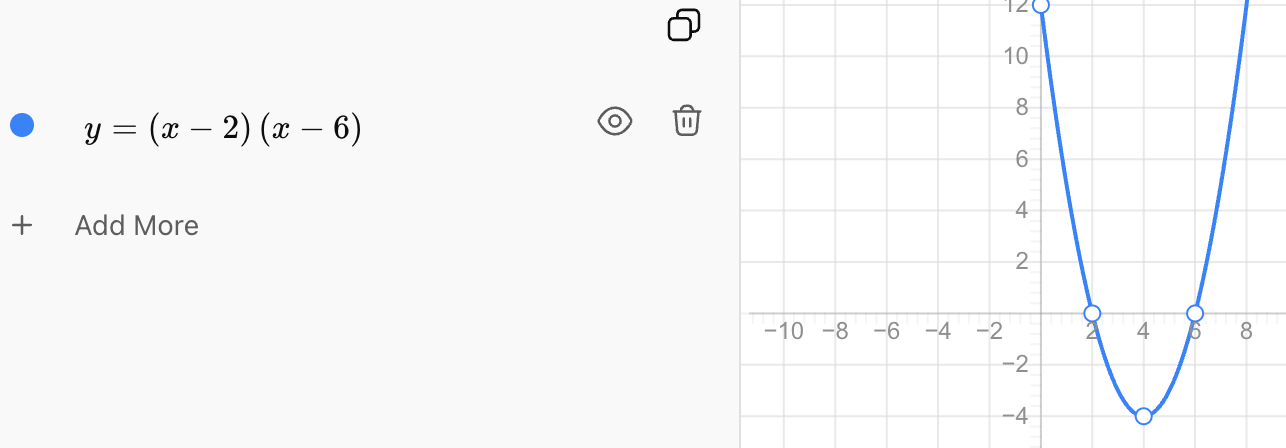
y = (x − 2)(x − 6)
has x-intercepts:
x = 2 and x = 6
or, as coordinate points:
(2, 0) and (6, 0)
Roots, Zeros and x-Intercepts
The terms roots, zeros, and x-intercepts are closely related.
A root or zero is an x-value that makes:
y = 0
An x-intercept is the corresponding point where the graph crosses or touches the x-axis.
For example:
y = (x − 3)(x + 5)
The roots are:
x = 3
and:
x = −5
The x-intercepts are:
(3, 0) and (−5, 0)
Finding the x-Intercepts
To find an x-intercept, set:
y = 0
Consider:
y = (x − 2)(x − 7)
Set y = 0:
0 = (x − 2)(x − 7)
For the product to equal zero, at least one factor must equal zero.
So:
x − 2 = 0
x = 2
or:
x − 7 = 0
x = 7
Therefore, the x-intercepts are:
(2, 0) and (7, 0)
The Zero Product Property
This method relies on the Zero Product Property.
If:
AB = 0
then:
A = 0 or B = 0
For a quadratic:
(x − r₁)(x − r₂) = 0
we can therefore write:
x − r₁ = 0
or:
x − r₂ = 0
giving:
x = r₁ or x = r₂
This is why factored form makes the roots so easy to identify.
Watch the Signs
As with vertex form, the signs can cause mistakes.
For:
(x − 4)
the root is:
x = 4
But for:
(x + 4)
the root is:
x = −4
because:
x + 4 = 0
x = −4
The sign of the root is therefore the opposite of the sign shown inside the factor.
Examples of Finding Roots
| Factored Form | Roots | x-Intercepts |
|---|---|---|
| y = (x − 2)(x − 5) | 2, 5 | (2, 0), (5, 0) |
| y = (x + 3)(x − 4) | −3, 4 | (−3, 0), (4, 0) |
| y = 2(x − 1)(x − 6) | 1, 6 | (1, 0), (6, 0) |
| y = −3(x + 5)(x + 2) | −5, −2 | (−5, 0), (−2, 0) |
| y = ½x(x − 8) | 0, 8 | (0, 0), (8, 0) |
Notice that a does not change the roots.
Axis of Symmetry from the Roots
A parabola is symmetrical.
If its roots are:
r₁ and r₂
the axis of symmetry lies exactly halfway between them.
Therefore:
x = (r₁ + r₂)/2
This is simply the average of the two roots.
Example: Finding the Axis of Symmetry
Consider:
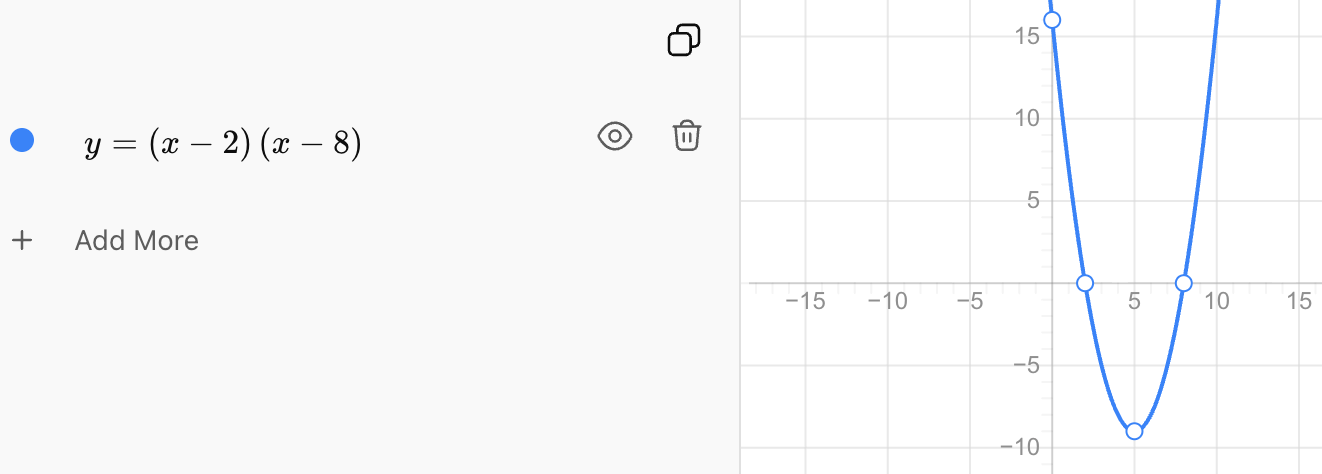
y = (x − 2)(x − 8)
The roots are:
r₁ = 2
r₂ = 8
Find their midpoint:
x = (2 + 8)/2
x = 10/2
x = 5
Therefore, the axis of symmetry is:
x = 5
Why the Axis Is Halfway Between the Roots
The two sides of a parabola are mirror images.
If the graph crosses the x-axis at:
(2, 0)
and:
(8, 0)
the axis of symmetry must be exactly halfway between those points.
The distance from 2 to 5 is 3.
The distance from 5 to 8 is also 3.
So:
x = 5
is the line of symmetry.
Finding the Vertex from Factored Form
Factored form does not show the vertex directly, but we can find it easily.
Consider:
y = (x − 2)(x − 8)
We already know the axis of symmetry:
x = 5
The vertex lies on this line.
Substitute x = 5:
y = (5 − 2)(5 − 8)
y = (3)(−3)
y = −9
Therefore:
vertex = (5, −9)
A Reliable Vertex Method
When given factored form:
y = a(x − r₁)(x − r₂)
Find the roots
r₁ and r₂
Find the axis of symmetry
x = (r₁ + r₂)/2
Substitute this x-value into the function
The resulting y-value gives the vertex.
This gives:
vertex = (x, y)
The Role of a
The value a has the same basic role in all forms of a quadratic.
If:
a > 0
the parabola opens upward.
If:
a < 0
the parabola opens downward.
Also:
- |a| > 1 → vertically stretched, appearing narrower
- |a| = 1 → basic width
- 0 < |a| < 1 → vertically compressed, appearing wider
Example with a Negative Value of a
Consider:
y = −2(x − 1)(x − 5)
Roots:
x = 1 and x = 5
Axis of symmetry:
x = (1 + 5)/2
x = 3
Find the vertex:
y = −2(3 − 1)(3 − 5)
y = −2(2)(−2)
y = 8
Therefore:
vertex = (3, 8)
Since:
a = −2
the parabola opens downward.
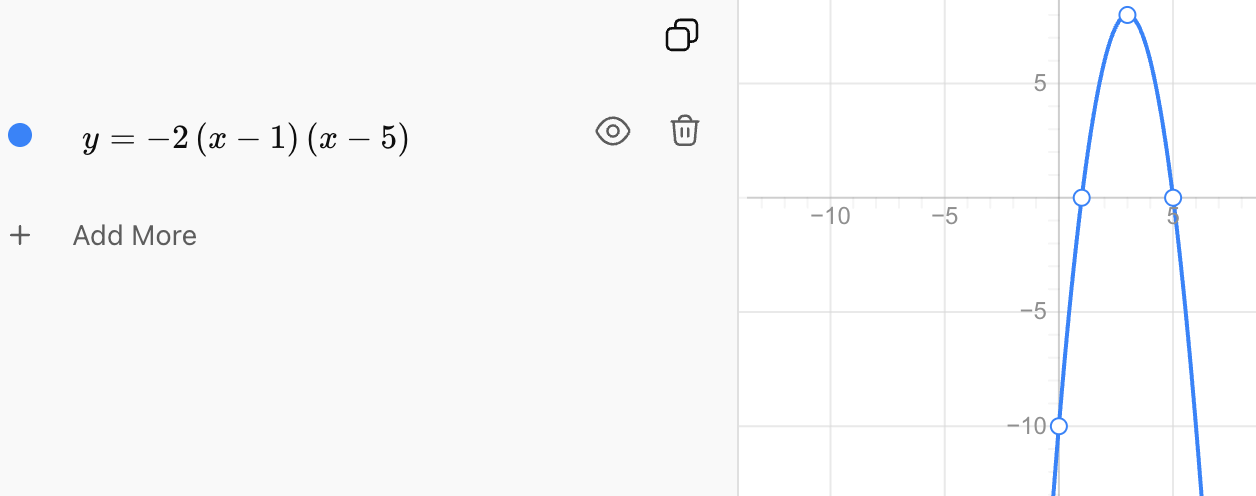
The vertex is therefore a maximum.
Finding the y-Intercept
Factored form also allows us to find the y-intercept.
At the y-intercept:
x = 0
Consider:
y = (x − 2)(x − 6)
Substitute x = 0:
y = (0 − 2)(0 − 6)
y = (−2)(−6)
y = 12
Therefore, the y-intercept is:
(0, 12)
The y-Intercept in General
For:
y = a(x − r₁)(x − r₂)
set x = 0:
y = a(−r₁)(−r₂)
Therefore:
y = ar₁r₂
So the y-intercept is:
(0, ar₁r₂)
This is useful when sketching.
Sketching from Factored Form
Factored form gives us several important features needed for a sketch.
Consider:
y = (x + 1)(x − 5)
Find the roots
x = −1
x = 5
So the x-intercepts are:
(−1, 0) and (5, 0)
Find the axis of symmetry
x = (−1 + 5)/2
x = 2
Find the vertex
Substitute x = 2:
y = (2 + 1)(2 − 5)
y = (3)(−3)
y = −9
Vertex:
(2, −9)
Determine direction
a = 1
Therefore, the parabola opens upward.
Find the y-intercept
Set x = 0:
y = (1)(−5)
y = −5
So:
y-intercept = (0, −5)
We now have enough information to sketch the graph accurately.
A Quick Sketching Strategy
When sketching from factored form, find these features:
- x-intercepts
- axis of symmetry
- vertex
- direction of opening
- y-intercept
Then draw a smooth symmetrical parabola through the important points.
Repeated Roots
Sometimes both factors are identical.
For example:
y = (x − 3)²
This can also be written:
y = (x − 3)(x − 3)
Both roots are:
x = 3
This is called a repeated root or double root.
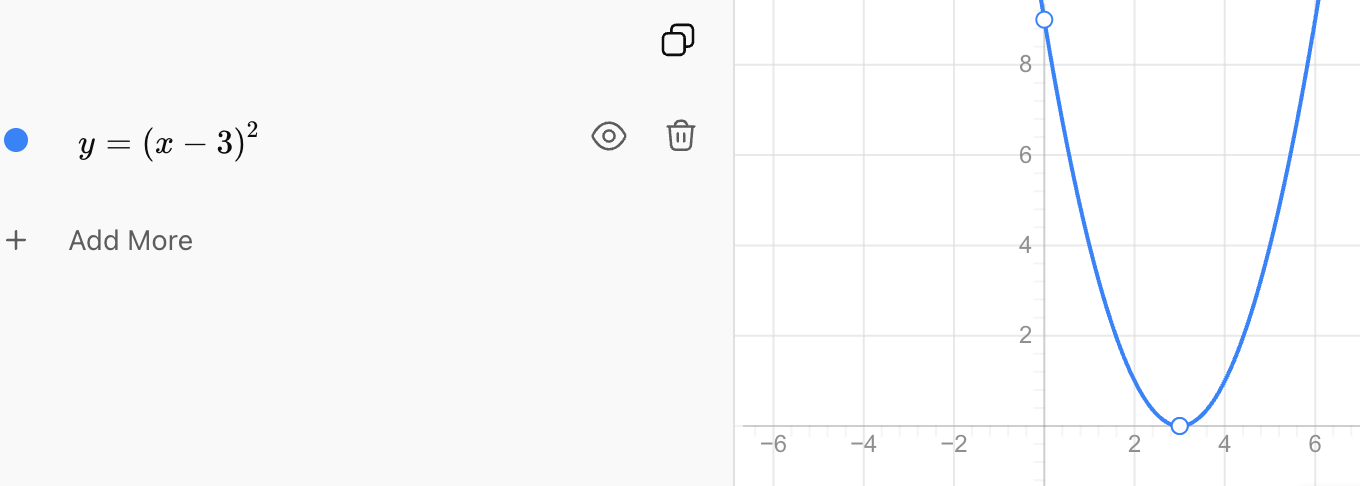
The parabola touches the x-axis at:
(3, 0)
but does not cross it.
The x-intercept is also the vertex.
Crossing vs Touching the x-Axis
If a quadratic has two different real roots, the graph usually crosses the x-axis twice.
For example:
y = (x − 2)(x − 6)
crosses at:
x = 2 and x = 6
If the quadratic has a repeated root, the graph touches the x-axis once.
For example:
y = (x − 4)²
touches at:
x = 4
This difference is important when interpreting quadratic graphs.
Factored Form and Standard Form
Standard form is:
y = ax² + bx + c
Factored form is:
y = a(x − r₁)(x − r₂)
The same quadratic can often be written in either form.
For example:
y = (x − 2)(x − 5)
Expand:
y = x² − 5x − 2x + 10
Therefore:
y = x² − 7x + 10
So:
y = (x − 2)(x − 5)
and:
y = x² − 7x + 10
represent the same parabola.
What Each Form Reveals
From:
y = (x − 2)(x − 5)
we can immediately identify:
roots = 2 and 5
From:
y = x² − 7x + 10
we can immediately identify:
y-intercept = 10
Different forms make different features easier to see.
Factored Form and Vertex Form
Vertex form is:
y = a(x − h)² + k
Factored form is:
y = a(x − r₁)(x − r₂)
Vertex form makes it easy to identify:
- vertex
- axis of symmetry
- maximum or minimum
- transformations
Factored form makes it easy to identify:
- roots
- x-intercepts
- axis of symmetry from the roots
Comparing the Three Main Forms
| Form | General Equation | Information Seen Most Easily |
|---|---|---|
| Standard | y = ax² + bx + c | y-intercept |
| Vertex | y = a(x − h)² + k | vertex and axis of symmetry |
| Factored | y = a(x − r₁)(x − r₂) | roots and x-intercepts |
The coefficient a can be identified directly in all three forms.
One Quadratic in Three Forms
Consider the quadratic:
y = x² − 6x + 5
Standard Form
y = x² − 6x + 5
The y-intercept is immediately visible:
(0, 5)
Factored Form
Factor:
y = (x − 1)(x − 5)
The roots are immediately visible:
x = 1 and x = 5
Vertex Form
The same function can be written:
y = (x − 3)² − 4
The vertex is immediately visible:
(3, −4)
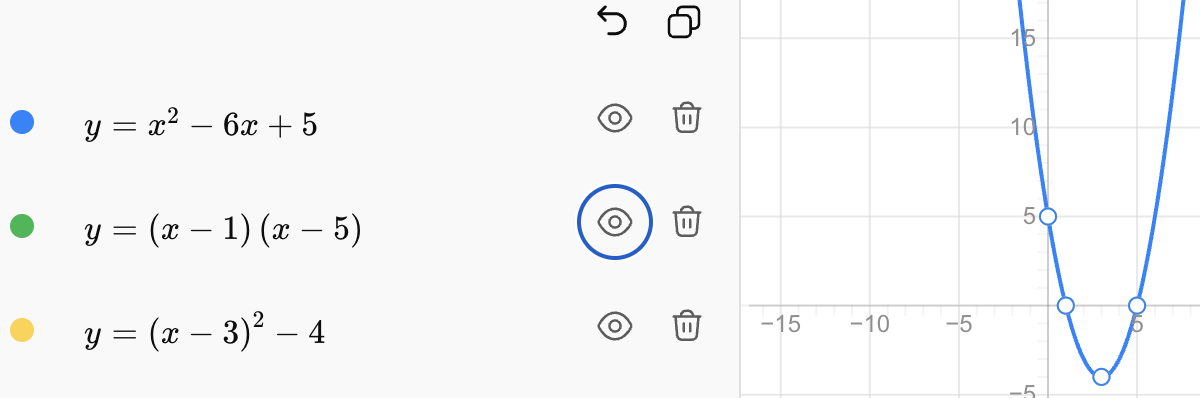
All three equations represent exactly the same parabola:
y = x² − 6x + 5
y = (x − 1)(x − 5)
y = (x − 3)² − 4
4. Converting Between Forms
Learning outcomes
- I can convert standard form to factored form when possible.
- I can convert between standard and vertex form.
- I can identify the advantages of each form.
- I can verify equivalent equations.
- I can choose the most useful form for a problem.
Converting Between Forms
Three Useful Forms of a Quadratic
A quadratic function can often be written in three different forms:
Standard form
y = ax² + bx + c
Vertex form
y = a(x − h)² + k
Factored form
y = a(x − r₁)(x − r₂)
These forms can describe the same parabola, but each makes different information easier to identify.
| Form | Most Useful Information |
|---|---|
| Standard | y-intercept and coefficients |
| Vertex | vertex, axis of symmetry, maximum/minimum |
| Factored | roots and x-intercepts |
Being able to convert between the forms allows us to choose the representation that is most useful for a particular problem.
Equivalent Quadratic Equations
Consider these equations:
y = x² − 6x + 5
y = (x − 1)(x − 5)
y = (x − 3)² − 4
Although they look different, they represent exactly the same quadratic function.
They therefore have:
- the same parabola
- the same vertex
- the same intercepts
- the same axis of symmetry
- the same value of y for every value of x
The only difference is the form in which the equation is written.
Standard Form
Standard form is:
y = ax² + bx + c
where a ≠ 0.
For example:
y = 2x² − 8x + 6
Standard form immediately shows:
a = 2
b = −8
c = 6
Since c = 6, the y-intercept is:
(0, 6)
The coefficient a also tells us that the parabola opens upward and is vertically stretched by a factor of 2.
Factored Form
Factored form is:
y = a(x − r₁)(x − r₂)
For example:
y = 2(x − 1)(x − 3)
The roots are immediately visible:
x = 1
and:
x = 3
Therefore, the x-intercepts are:
(1, 0) and (3, 0)
Vertex Form
Vertex form is:
y = a(x − h)² + k
For example:
y = 2(x − 2)² − 2
The vertex is immediately visible:
(2, −2)
and the axis of symmetry is:
x = 2
All three examples above represent the same function:
y = 2x² − 8x + 6
y = 2(x − 1)(x − 3)
y = 2(x − 2)² − 2
Standard Form to Factored Form
To convert standard form to factored form, we factor the quadratic expression.
Consider:
y = x² + 7x + 12
We need two numbers that:
- multiply to 12
- add to 7
Those numbers are:
3 and 4
Therefore:
y = (x + 3)(x + 4)
This is factored form.
The roots can now be identified immediately:
x = −3 and x = −4
Factoring When a = 1
For a quadratic:
x² + bx + c
look for two numbers that:
multiply to c
and:
add to b
Example:
y = x² − 8x + 15
We need two numbers that multiply to 15 and add to −8.
They are:
−3 and −5
Therefore:
y = (x − 3)(x − 5)
Another Factoring Example
Convert:
y = x² + 2x − 15
We need two numbers that:
multiply to −15
and add to 2.
The numbers are:
5 and −3
Therefore:
y = (x + 5)(x − 3)
The roots are:
x = −5 and x = 3
Factoring Out a Common Factor
Sometimes we should first factor out a common factor.
Consider:
y = 2x² − 10x + 12
Every term contains 2.
Factor it out:
y = 2(x² − 5x + 6)
Now factor the trinomial:
x² − 5x + 6
We need two numbers that multiply to 6 and add to −5.
They are:
−2 and −3
Therefore:
y = 2(x − 2)(x − 3)
Factoring When a Is Not 1
Consider:
y = 2x² + 7x + 3
We want to write it as:
y =
Since:
2x² = 2x × x
and:
3 = 3 × 1
try:
(2x + 1)(x + 3)
Check by expanding:
2x(x) = 2x²
2x(3) = 6x
1(x) = x
1(3) = 3
Combine:
2x² + 7x + 3
Therefore:
y = (2x + 1)(x + 3)
Not Every Quadratic Factors Easily
Consider:
y = x² + x + 1
There are no integers that multiply to 1 and add to 1.
Therefore, it cannot be factored into simple linear factors using integers.
Some quadratics:
- factor easily
- require irrational numbers
- require complex numbers
- have no real linear factors
So when we say convert to factored form when possible, we usually mean factor over the number system being used in the course.
Factored Form to Standard Form
To convert factored form to standard form, expand the factors.
Consider:
y = (x − 2)(x + 5)
Multiply:
y = x(x + 5) − 2(x + 5)
y = x² + 5x − 2x − 10
Combine like terms:
y = x² + 3x − 10
Expanding with a Leading Coefficient
Consider:
y = 3(x − 2)(x + 4)
First multiply the factors:
(x − 2)(x + 4)
= x² + 4x − 2x − 8
= x² + 2x − 8
Now multiply by 3:
y = 3x² + 6x − 24
This is standard form.
Standard Form to Vertex Form
To convert standard form to vertex form, we can use a process called completing the square.
Consider:
y = x² − 6x + 5
We want the form:
y = a(x − h)² + k
Start with:
y = x² − 6x + 5
Focus on:
x² − 6x
Take half of −6:
−3
Square it:
9
Add and subtract 9:
y = x² − 6x + 9 − 9 + 5
The first three terms form a perfect square:
x² − 6x + 9 = (x − 3)²
Therefore:
y = (x − 3)² − 9 + 5
So:
y = (x − 3)² − 4
The vertex is now immediately visible:
(3, −4)
Why Completing the Square Works
The expression:
x² + bx
can be turned into a perfect square by adding:
(b/2)²
For example:
x² + 8x
Half of 8 is:
4
Square 4:
16
Therefore:
x² + 8x + 16 = (x + 4)²
This idea is the basis of completing the square.
Another Standard-to-Vertex Example
Convert:
y = x² + 4x − 1
Take half of 4:
2
Square it:
4
Add and subtract 4:
y = x² + 4x + 4 − 4 − 1
Factor the perfect square:
y = (x + 2)² − 5
Therefore:
y = (x + 2)² − 5
Vertex:
(−2, −5)
When a Is Not 1
Consider:
y = 2x² − 8x + 3
First factor 2 from the x-terms:
y = 2(x² − 4x) + 3
Complete the square inside the brackets.
Half of −4 is:
−2
Square it:
4
So:
y = 2(x² − 4x + 4 − 4) + 3
Factor:
y = 2[(x − 2)² − 4] + 3
Distribute:
y = 2(x − 2)² − 8 + 3
Therefore:
y = 2(x − 2)² − 5
Vertex:
(2, −5)
A Faster Way to Find the Vertex
If the goal is simply to find the vertex rather than practise completing the square, start with:
y = ax² + bx + c
The x-coordinate of the vertex is:
x = −b/(2a)
Then substitute this value into the original equation to find y.
Example Using the Vertex Formula
Consider:
y = 2x² − 8x + 3
Here:
a = 2
b = −8
Find the x-coordinate:
x = −(−8)/(2 × 2)
x = 8/4
x = 2
Now substitute x = 2:
y = 2(2²) − 8(2) + 3
y = 8 − 16 + 3
y = −5
Therefore, the vertex is:
(2, −5)
So vertex form is:
y = 2(x − 2)² − 5
Vertex Form to Standard Form
To convert vertex form to standard form, expand the squared expression.
Consider:
y = (x − 4)² + 3
Expand:
(x − 4)² = x² − 8x + 16
Therefore:
y = x² − 8x + 16 + 3
y = x² − 8x + 19
Another Vertex-to-Standard Example
Convert:
y = −2(x + 3)² + 5
Expand:
(x + 3)² = x² + 6x + 9
Substitute:
y = −2(x² + 6x + 9) + 5
Distribute:
y = −2x² − 12x − 18 + 5
Therefore:
y = −2x² − 12x − 13
Factored Form to Vertex Form
There are several possible methods.
A useful method is:
- identify the roots
- find their midpoint
- use the midpoint as the x-coordinate of the vertex
- substitute to find the y-coordinate
- write vertex form
Consider:
y = (x − 2)(x − 8)
Roots:
2 and 8
Axis of symmetry:
x = (2 + 8)/2
x = 5
Find y when x = 5:
y = (5 − 2)(5 − 8)
y = 3(−3)
y = −9
Vertex:
(5, −9)
Since a = 1:
y = (x − 5)² − 9
Another Factored-to-Vertex Example
Consider:
y = −2(x − 1)(x − 5)
Roots:
1 and 5
Axis:
x = (1 + 5)/2
x = 3
Find y:
y = −2(3 − 1)(3 − 5)
y = −2(2)(−2)
y = 8
Vertex:
(3, 8)
Since a = −2:
y = −2(x − 3)² + 8
Vertex Form to Factored Form
To convert vertex form to factored form, we need to find the roots.
Consider:
y = (x − 3)² − 9
Set y = 0:
0 = (x − 3)² − 9
Add 9:
9 = (x − 3)²
Take square roots:
x − 3 = ±3
Therefore:
x = 6
or:
x = 0
The roots are 0 and 6.
Therefore, factored form is:
y = x(x − 6)
Another Vertex-to-Factored Example
Consider:
y = 2(x − 4)² − 18
Set y = 0:
0 = 2(x − 4)² − 18
18 = 2(x − 4)²
9 = (x − 4)²
x − 4 = ±3
Therefore:
x = 7
or:
x = 1
Since a = 2:
y = 2(x − 1)(x − 7)
When Real Factored Form Is Not Possible
Consider:
y = (x − 2)² + 4
Set y = 0:
0 = (x − 2)² + 4
−4 = (x − 2)²
A real number squared cannot equal −4.
Therefore, the quadratic has:
no real roots
and therefore cannot be written as a product of two real linear factors.
Its graph never reaches the x-axis.
Verifying Equivalent Equations
After converting between forms, it is useful to verify that the equations are equivalent.
There are several ways to do this.
Expand the equation
For example:
(x − 2)(x − 5)
expands to:
x² − 7x + 10
So the two forms are equivalent.
Substitute values
Choose an x-value and calculate y using both equations.
For example:
y = x² − 6x + 5
and:
y = (x − 1)(x − 5)
At x = 2:
Standard form:
y = 4 − 12 + 5
y = −3
Factored form:
y = (2 − 1)(2 − 5)
y = (1)(−3)
y = −3
Both produce the same result.
A Stronger Verification
Testing one x-value is a useful check, but it does not prove that two equations are equivalent.
To prove equivalence algebraically, transform one expression into the other.
For example:
(x − 1)(x − 5)
= x² − 5x − x + 5
= x² − 6x + 5
This confirms that the equations are identical for every x-value.
Comparing All Three Forms
Consider:
Standard
y = x² − 8x + 12
Factor:
Factored
y = (x − 2)(x − 6)
Complete the square:
Vertex
y = (x − 4)² − 4
These all represent the same parabola.
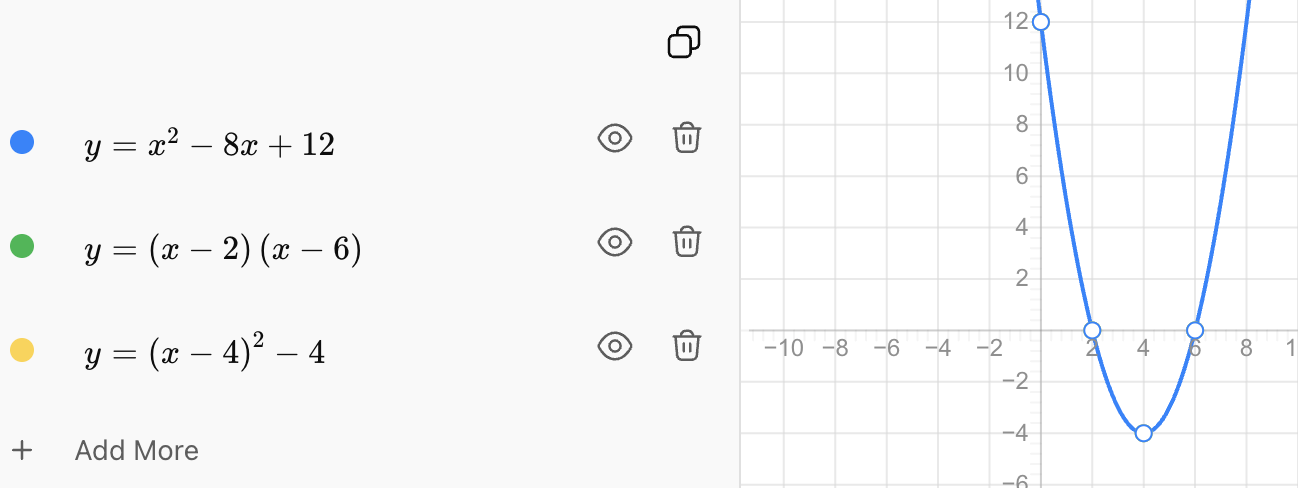
Because the equations are equivalent, the three graphs overlap exactly.
What Each Form Reveals
From:
y = x² − 8x + 12
we immediately see:
y-intercept = (0, 12)
From:
y = (x − 2)(x − 6)
we immediately see:
x-intercepts = (2, 0) and (6, 0)
From:
y = (x − 4)² − 4
we immediately see:
vertex = (4, −4)
and:
axis of symmetry = x = 4
The form changes, but the graph does not.
Advantages of Standard Form
y = ax² + bx + c
Standard form is useful when:
- identifying the y-intercept
- performing algebraic operations
- comparing coefficients
- using the quadratic formula
- finding the vertex using x = −b/(2a)
The y-intercept is simply:
(0, c)
Advantages of Vertex Form
y = a(x − h)² + k
Vertex form is useful when:
- identifying the vertex
- finding maximum or minimum values
- finding the axis of symmetry
- describing transformations
- sketching from transformations
- solving optimization problems
The vertex is:
(h, k)
Advantages of Factored Form
y = a(x − r₁)(x − r₂)
Factored form is useful when:
- identifying roots
- finding x-intercepts
- solving quadratic equations
- finding the axis of symmetry from the roots
- analyzing where a quadratic is positive or negative
The roots are:
r₁ and r₂
Choosing the Best Form
Suppose a question asks:
"When does the object hit the ground?"
This means:
height = 0
The roots are important.
Factored form is probably most useful.
Suppose a question asks:
"What is the maximum height?"
The vertex is important.
Vertex form is probably most useful.
Suppose a question asks:
"Where does the graph cross the y-axis?"
The y-intercept is important.
Standard form is probably most useful.
Example: Projectile Motion
Suppose the height of an object is:
h = −5t² + 30t
This is standard form.
Factor:
h = −5t(t − 6)
Now we can immediately identify when the object is at ground level:
t = 0
and:
t = 6
To find the maximum height, vertex form would be more useful.
Complete the square:
h = −5(t² − 6t)
h = −5[(t − 3)² − 9]
h = −5(t − 3)² + 45
Now we immediately see:
vertex = (3, 45)
Therefore:
maximum height = 45
at:
t = 3
The same quadratic in three forms reveals different information.
Moving Between Forms
A useful conversion map is:
Standard → Factored
Factor the quadratic.
Factored → Standard
Expand and combine like terms.
Standard → Vertex
Complete the square.
Vertex → Standard
Expand and simplify.
Factored → Vertex
Find the roots → find their midpoint → calculate the vertex → write vertex form.
Vertex → Factored
Set y = 0 → solve for the roots → write the factors.
Worked Example: All Three Forms
Start with:
y = 2x² − 12x + 10
Standard Form
Already given:
y = 2x² − 12x + 10
Convert to Factored Form
Factor out 2:
y = 2(x² − 6x + 5)
Factor:
y = 2(x − 1)(x − 5)
Roots:
1 and 5
Convert to Vertex Form
The axis lies halfway between the roots:
x = (1 + 5)/2
x = 3
Find y:
y = 2(3 − 1)(3 − 5)
y = 2(2)(−2)
y = −8
Vertex:
(3, −8)
Therefore:
y = 2(x − 3)² − 8
So the three equivalent forms are:
Standard: y = 2x² − 12x + 10
Factored: y = 2(x − 1)(x − 5)
Vertex: y = 2(x − 3)² − 8
Checking the Conversion
Expand the vertex form:
y = 2(x − 3)² − 8
y = 2(x² − 6x + 9) − 8
y = 2x² − 12x + 18 − 8
y = 2x² − 12x + 10
This matches the original standard form.
Now expand the factored form:
y = 2(x − 1)(x − 5)
y = 2(x² − 6x + 5)
y = 2x² − 12x + 10
All three are equivalent.
A Conversion Strategy
When faced with a quadratic problem, do not automatically convert the equation.
First ask:
What information do I need?
If you need the y-intercept, standard form may already be best.
If you need the roots, convert to factored form if possible.
If you need the vertex, vertex form may be best.
Choosing the right representation can greatly reduce the amount of work required.
Common Mistakes
Mistake: Changing forms changes the graph.
Equivalent forms represent exactly the same function and therefore the same graph.
Mistake: Factoring x² − 7x + 10 as (x + 2)(x + 5).
The correct factors are (x − 2)(x − 5).
Mistake: Forgetting the leading coefficient.
For example, 2x² − 10x + 12 becomes 2(x − 2)(x − 3), not simply (x − 2)(x − 3).
Mistake: Changing only part of an equation while completing the square.
Any quantity added must also be accounted for so that the function remains equivalent.
Mistake: Assuming every quadratic has a real factored form.
Some quadratics have no real roots.
Mistake: Using one substituted value as proof of equivalence.
It is a useful check, but algebraic expansion provides stronger verification.
Mistake: Converting equations unnecessarily.
Use the form that already reveals the information required.
Key Terms
Standard form — quadratic form y = ax² + bx + c.
Vertex form — quadratic form y = a(x − h)² + k.
Factored form — quadratic form y = a(x − r₁)(x − r₂).
Equivalent equations — equations representing the same function for every value of x.
Factor — expression multiplied by another expression to produce a product.
Root — x-value that makes the function equal to zero.
x-intercept — point where the graph meets the x-axis.
y-intercept — point where the graph meets the y-axis.
Vertex — maximum or minimum point of a parabola.
Axis of symmetry — vertical line passing through the vertex.
Completing the square — algebraic process used to create a perfect-square expression and convert a quadratic into vertex form.
Perfect-square trinomial — trinomial such as x² + 6x + 9 that can be written as the square of a binomial.
Key Takeaways
- Quadratic functions can be written in standard, vertex and factored forms.
- Equivalent forms describe exactly the same parabola.
- Standard form is y = ax² + bx + c.
- Vertex form is y = a(x − h)² + k.
- Factored form is y = a(x − r₁)(x − r₂).
- Standard form makes the y-intercept easy to identify.
- Vertex form makes the vertex and axis of symmetry easy to identify.
- Factored form makes the roots and x-intercepts easy to identify.
- Standard form can be converted to factored form by factoring when appropriate.
- Factored form can be converted to standard form by expanding.
- Standard form can be converted to vertex form by completing the square.
- Vertex form can be converted to standard form by expanding.
- The midpoint of the roots can help convert factored form to vertex form.
- Solving for the roots can help convert vertex form to factored form.
- Not every quadratic has real linear factors.
- Expanding expressions is a reliable way to verify that two forms are equivalent.
- The most useful quadratic form depends on the information required by the problem.
Check Your Understanding
- Convert y = x² + 7x + 12 to factored form.
- Convert y = x² − 9x + 20 to factored form.
- Convert y = 2x² − 10x + 12 to factored form.
- Expand y = (x − 3)(x + 5) into standard form.
- Expand y = 2(x − 1)(x − 6) into standard form.
- Convert y = x² − 6x + 2 into vertex form.
- Convert y = x² + 8x + 10 into vertex form.
- Convert y = 2x² − 8x + 1 into vertex form.
- Convert y = (x − 4)² − 9 into standard form.
- Convert y = −2(x + 3)² + 5 into standard form.
- Convert y = (x − 2)(x − 8) into vertex form.
- Convert y = (x − 3)² − 16 into factored form.
- Explain how you could verify that y = x² − 6x + 5 and y = (x − 1)(x − 5) are equivalent.
- Which form would you choose to find the x-intercepts of a quadratic? Explain.
- Which form would you choose to identify a maximum or minimum quickly? Explain.
- Write y = x² − 10x + 16 in standard, factored and vertex forms, and identify one advantage of each representation.
5. Comparing Different Forms
Learning outcomes
- I can determine which form reveals the vertex most easily.
- I can determine which form reveals the roots most easily.
- I can identify graph features from each form.
- I can compare equivalent quadratic equations.
- I can explain why different forms are useful.