Structure of Matter
1. The Building Blocks of Matter
Learning outcomes
- I can describe how matter is organized from atoms to subatomic particles.
- I can identify protons, neutrons, and electrons.
- I can compare the properties of subatomic particles.
- I can explain how atoms are held together.
- I can distinguish between atomic and nuclear scales.
Matter Is Made of Smaller Building Blocks
Everything around us is made of matter. Matter includes anything that has mass and occupies space, from the air we breathe to planets, stars, living organisms, and the materials inside electronic devices.
Matter can be understood as a hierarchy of increasingly smaller structures:
Matter → substances → atoms → subatomic particles
Atoms were once thought to be the smallest possible pieces of matter. We now know that atoms contain even smaller particles called subatomic particles.
The three subatomic particles most important for understanding atomic structure are:
- Protons
- Neutrons
- Electrons
Later in nuclear and particle physics, we will discover that even protons and neutrons are not fundamental particles—they are made from smaller particles called quarks.


The Structure of an Atom
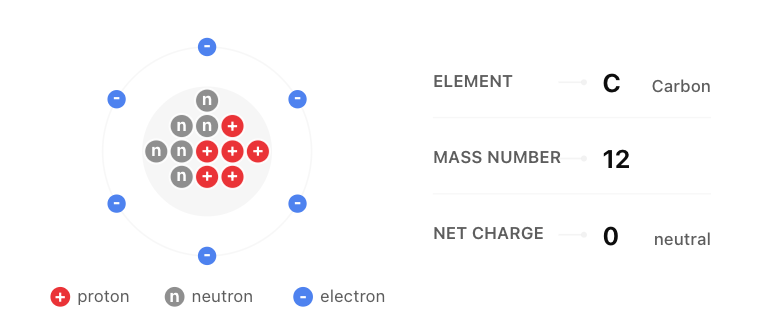
An atom consists of two main regions:
1. The nucleus
The nucleus is the extremely small, dense centre of the atom. It contains:
- positively charged protons
- electrically neutral neutrons
Together, protons and neutrons are sometimes called nucleons because they are particles found in the nucleus.
2. The electron cloud
The nucleus is surrounded by negatively charged electrons. Electrons occupy regions of space around the nucleus associated with different energy levels.
A simplified model can therefore be represented as:
Atom = nucleus + electrons
and:
Nucleus = protons + neutrons
Comparing the Subatomic Particles
Protons, neutrons, and electrons have very different properties.
| Particle | Symbol | Charge | Relative Mass | Location |
|---|---|---|---|---|
| Proton | p⁺ | +1 | 1 | Nucleus |
| Neutron | n⁰ | 0 | 1 | Nucleus |
| Electron | e⁻ | −1 | about 1/1836 | Outside nucleus |
A proton and neutron have approximately the same mass, while an electron is much lighter.
Because almost all of an atom's mass comes from its protons and neutrons, most of the mass of an atom is concentrated in its nucleus.
Did You Know?
If a proton had a mass of about 1 kg, an electron on the same scale would have a mass of only about 0.00054 kg, or roughly 0.54 g.
Protons
A proton is a positively charged particle located inside the nucleus.
The number of protons is especially important because it determines the identity of an element.
For example:
- An atom with 1 proton is hydrogen.
- An atom with 6 protons is carbon.
- An atom with 8 protons is oxygen.
- An atom with 92 protons is uranium.
Changing the number of protons therefore changes the element itself.
The number of protons in an atom is called its atomic number or proton number.
Neutrons
A neutron has approximately the same mass as a proton but has no overall electric charge.
Neutrons are found in the nucleus alongside protons.
Atoms of the same element can contain different numbers of neutrons. These different versions of an element are called isotopes.
For example, carbon-12 and carbon-14 both contain 6 protons, but they contain different numbers of neutrons.
Neutrons are especially important in nuclear physics because the balance between protons and neutrons affects the stability of the nucleus.


Electrons
An electron is a negatively charged subatomic particle found outside the nucleus.
Electrons are much lighter than protons and neutrons.
In a neutral atom:
number of electrons = number of protons
The positive and negative charges therefore balance.
For example, a neutral atom containing 8 protons will also contain 8 electrons.
Electrons are particularly important in chemical reactions and bonding, while changes involving the nucleus are the main focus of nuclear physics.
What Holds an Atom Together?
You might expect the negatively charged electrons to simply fly away from the positively charged nucleus. However, they are attracted to the nucleus by the electromagnetic force.
Opposite electric charges attract:
positive nucleus ↔ negative electrons
This electromagnetic attraction helps bind electrons to the atom.
However, a different problem exists inside the nucleus.
All protons are positively charged, so they repel one another electrically.
Why doesn't the nucleus simply break apart?
The Strong Nuclear Force
Inside the nucleus, protons and neutrons experience the strong nuclear interaction.
At the very short distances found inside a nucleus, this interaction is strong enough to overcome the electrical repulsion between nearby protons and bind the nucleus together.
This gives us two important interactions within the atom:
| Interaction | Main Role |
|---|---|
| Electromagnetic | Helps bind electrons to the positively charged nucleus |
| Strong nuclear | Helps bind protons and neutrons within the nucleus |
The competition between these effects becomes extremely important when studying nuclear stability, radioactivity, fission, and fusion.
Atomic Scale vs Nuclear Scale
Atoms are extremely small, but their nuclei are even smaller.
A typical atom has a radius of approximately:
10⁻¹⁰ m
A typical nucleus has a radius of approximately:
10⁻¹⁵ to 10⁻¹⁴ m
This means that the nucleus is roughly tens of thousands of times smaller in radius than the atom, depending on the atom being considered.


The difference between these scales is enormous.
Imagine an atom enlarged until it was roughly the size of a large stadium. On the same scale, its nucleus would be only a tiny object near the centre.
This illustrates an important idea:
Most of an atom's volume is associated with the region occupied by its electrons rather than the nucleus.
At the same time:
Almost all of the atom's mass is concentrated in the tiny nucleus.
Looking Deeper: Are Protons and Neutrons Fundamental?
Protons, neutrons, and electrons are often called the three main subatomic particles when first studying atoms. However, modern particle physics reveals another level of structure.
Electrons are currently considered fundamental particles.
Protons and neutrons are not.
They are made from smaller particles called quarks.
A proton contains:
2 up quarks + 1 down quark
A neutron contains:
1 up quark + 2 down quarks
Quarks are bound together by the strong interaction, involving particles called gluons.
So our hierarchy can be extended:
Matter → atoms → nuclei and electrons → protons and neutrons → quarks


This is one of the central ideas of particle physics: as scientists investigate matter at smaller and smaller scales, structures that once appeared fundamental can reveal an even deeper level of organization.
Atomic Physics, Nuclear Physics, and Particle Physics
These different scales help separate several areas of physics.
Atomic physics mainly investigates atoms and their electrons.
Nuclear physics investigates atomic nuclei, including protons, neutrons, nuclear stability, radioactivity, fission, and fusion.
Particle physics investigates the fundamental particles and interactions underlying matter, including quarks, electrons, neutrinos, and other particles.
The deeper we investigate matter, the smaller the scale becomes:
Atom → nucleus → nucleons → quarks
Key Terms
Matter – Anything that has mass and occupies space.
Atom – The basic unit of an element.
Subatomic particle – A particle smaller than an atom.
Proton – A positively charged particle found in the nucleus.
Neutron – An electrically neutral particle found in the nucleus.
Electron – A negatively charged fundamental particle found outside the nucleus.
Nucleus – The small, dense central region of an atom containing protons and neutrons.
Nucleon – A proton or neutron.
Strong nuclear interaction – The interaction responsible for binding nucleons within atomic nuclei.
Quark – A fundamental particle that combines to form particles such as protons and neutrons.
Key Takeaways
- Matter is made from atoms, and atoms contain smaller subatomic particles.
- The nucleus contains protons and neutrons, while electrons occupy the surrounding atomic region.
- Protons have positive charge, neutrons have no net charge, and electrons have negative charge.
- Protons and neutrons are much more massive than electrons.
- Electromagnetic attraction binds electrons to the positively charged atom.
- The strong nuclear interaction helps bind protons and neutrons inside the nucleus.
- An atom is typically around 10⁻¹⁰ m in radius, while nuclei are roughly 10⁻¹⁵–10⁻¹⁴ m in radius.
- Almost all atomic mass is concentrated in the nucleus.
- Protons and neutrons are themselves made from quarks, taking us from nuclear physics into particle physics.