Structure of Matter
| Сайт: | Young Education |
| Курс: | Nuclear and Particle Physics |
| Книга: | Structure of Matter |
| Надруковано: | Gast |
| Дата: | пʼятниця 25 вересня 2026 02:38 AM |
1. The Building Blocks of Matter
Learning outcomes
- I can describe how matter is organized from atoms to subatomic particles.
- I can identify protons, neutrons, and electrons.
- I can compare the properties of subatomic particles.
- I can explain how atoms are held together.
- I can distinguish between atomic and nuclear scales.
Matter Is Made of Smaller Building Blocks
Everything around us is made of matter. Matter includes anything that has mass and occupies space, from the air we breathe to planets, stars, living organisms, and the materials inside electronic devices.
Matter can be understood as a hierarchy of increasingly smaller structures:
Matter → substances → atoms → subatomic particles
Atoms were once thought to be the smallest possible pieces of matter. We now know that atoms contain even smaller particles called subatomic particles.
The three subatomic particles most important for understanding atomic structure are:
- Protons
- Neutrons
- Electrons
Later in nuclear and particle physics, we will discover that even protons and neutrons are not fundamental particles—they are made from smaller particles called quarks.


The Structure of an Atom
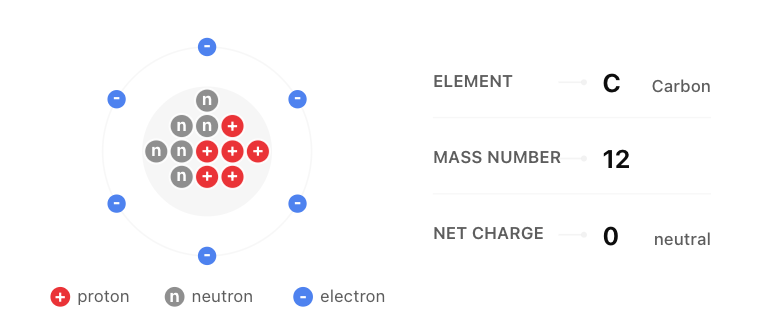
An atom consists of two main regions:
1. The nucleus
The nucleus is the extremely small, dense centre of the atom. It contains:
- positively charged protons
- electrically neutral neutrons
Together, protons and neutrons are sometimes called nucleons because they are particles found in the nucleus.
2. The electron cloud
The nucleus is surrounded by negatively charged electrons. Electrons occupy regions of space around the nucleus associated with different energy levels.
A simplified model can therefore be represented as:
Atom = nucleus + electrons
and:
Nucleus = protons + neutrons
Comparing the Subatomic Particles
Protons, neutrons, and electrons have very different properties.
| Particle | Symbol | Charge | Relative Mass | Location |
|---|---|---|---|---|
| Proton | p⁺ | +1 | 1 | Nucleus |
| Neutron | n⁰ | 0 | 1 | Nucleus |
| Electron | e⁻ | −1 | about 1/1836 | Outside nucleus |
A proton and neutron have approximately the same mass, while an electron is much lighter.
Because almost all of an atom's mass comes from its protons and neutrons, most of the mass of an atom is concentrated in its nucleus.
Did You Know?
If a proton had a mass of about 1 kg, an electron on the same scale would have a mass of only about 0.00054 kg, or roughly 0.54 g.
Protons
A proton is a positively charged particle located inside the nucleus.
The number of protons is especially important because it determines the identity of an element.
For example:
- An atom with 1 proton is hydrogen.
- An atom with 6 protons is carbon.
- An atom with 8 protons is oxygen.
- An atom with 92 protons is uranium.
Changing the number of protons therefore changes the element itself.
The number of protons in an atom is called its atomic number or proton number.
Neutrons
A neutron has approximately the same mass as a proton but has no overall electric charge.
Neutrons are found in the nucleus alongside protons.
Atoms of the same element can contain different numbers of neutrons. These different versions of an element are called isotopes.
For example, carbon-12 and carbon-14 both contain 6 protons, but they contain different numbers of neutrons.
Neutrons are especially important in nuclear physics because the balance between protons and neutrons affects the stability of the nucleus.


Electrons
An electron is a negatively charged subatomic particle found outside the nucleus.
Electrons are much lighter than protons and neutrons.
In a neutral atom:
number of electrons = number of protons
The positive and negative charges therefore balance.
For example, a neutral atom containing 8 protons will also contain 8 electrons.
Electrons are particularly important in chemical reactions and bonding, while changes involving the nucleus are the main focus of nuclear physics.
What Holds an Atom Together?
You might expect the negatively charged electrons to simply fly away from the positively charged nucleus. However, they are attracted to the nucleus by the electromagnetic force.
Opposite electric charges attract:
positive nucleus ↔ negative electrons
This electromagnetic attraction helps bind electrons to the atom.
However, a different problem exists inside the nucleus.
All protons are positively charged, so they repel one another electrically.
Why doesn't the nucleus simply break apart?
The Strong Nuclear Force
Inside the nucleus, protons and neutrons experience the strong nuclear interaction.
At the very short distances found inside a nucleus, this interaction is strong enough to overcome the electrical repulsion between nearby protons and bind the nucleus together.
This gives us two important interactions within the atom:
| Interaction | Main Role |
|---|---|
| Electromagnetic | Helps bind electrons to the positively charged nucleus |
| Strong nuclear | Helps bind protons and neutrons within the nucleus |
The competition between these effects becomes extremely important when studying nuclear stability, radioactivity, fission, and fusion.
Atomic Scale vs Nuclear Scale
Atoms are extremely small, but their nuclei are even smaller.
A typical atom has a radius of approximately:
10⁻¹⁰ m
A typical nucleus has a radius of approximately:
10⁻¹⁵ to 10⁻¹⁴ m
This means that the nucleus is roughly tens of thousands of times smaller in radius than the atom, depending on the atom being considered.


The difference between these scales is enormous.
Imagine an atom enlarged until it was roughly the size of a large stadium. On the same scale, its nucleus would be only a tiny object near the centre.
This illustrates an important idea:
Most of an atom's volume is associated with the region occupied by its electrons rather than the nucleus.
At the same time:
Almost all of the atom's mass is concentrated in the tiny nucleus.
Looking Deeper: Are Protons and Neutrons Fundamental?
Protons, neutrons, and electrons are often called the three main subatomic particles when first studying atoms. However, modern particle physics reveals another level of structure.
Electrons are currently considered fundamental particles.
Protons and neutrons are not.
They are made from smaller particles called quarks.
A proton contains:
2 up quarks + 1 down quark
A neutron contains:
1 up quark + 2 down quarks
Quarks are bound together by the strong interaction, involving particles called gluons.
So our hierarchy can be extended:
Matter → atoms → nuclei and electrons → protons and neutrons → quarks


This is one of the central ideas of particle physics: as scientists investigate matter at smaller and smaller scales, structures that once appeared fundamental can reveal an even deeper level of organization.
Atomic Physics, Nuclear Physics, and Particle Physics
These different scales help separate several areas of physics.
Atomic physics mainly investigates atoms and their electrons.
Nuclear physics investigates atomic nuclei, including protons, neutrons, nuclear stability, radioactivity, fission, and fusion.
Particle physics investigates the fundamental particles and interactions underlying matter, including quarks, electrons, neutrinos, and other particles.
The deeper we investigate matter, the smaller the scale becomes:
Atom → nucleus → nucleons → quarks
Key Terms
Matter – Anything that has mass and occupies space.
Atom – The basic unit of an element.
Subatomic particle – A particle smaller than an atom.
Proton – A positively charged particle found in the nucleus.
Neutron – An electrically neutral particle found in the nucleus.
Electron – A negatively charged fundamental particle found outside the nucleus.
Nucleus – The small, dense central region of an atom containing protons and neutrons.
Nucleon – A proton or neutron.
Strong nuclear interaction – The interaction responsible for binding nucleons within atomic nuclei.
Quark – A fundamental particle that combines to form particles such as protons and neutrons.
Key Takeaways
- Matter is made from atoms, and atoms contain smaller subatomic particles.
- The nucleus contains protons and neutrons, while electrons occupy the surrounding atomic region.
- Protons have positive charge, neutrons have no net charge, and electrons have negative charge.
- Protons and neutrons are much more massive than electrons.
- Electromagnetic attraction binds electrons to the positively charged atom.
- The strong nuclear interaction helps bind protons and neutrons inside the nucleus.
- An atom is typically around 10⁻¹⁰ m in radius, while nuclei are roughly 10⁻¹⁵–10⁻¹⁴ m in radius.
- Almost all atomic mass is concentrated in the nucleus.
- Protons and neutrons are themselves made from quarks, taking us from nuclear physics into particle physics.
2. Fundamental Forces
Learning outcomes
- I can identify the four fundamental forces of nature.
- I can compare the relative strengths and ranges of the fundamental forces.
- I can explain which forces act within the nucleus.
- I can describe everyday examples of each force.
- I can explain why gravity is negligible at the nuclear scale.


3. Quarks
Learning outcomes
- I can describe quarks as fundamental particles.
- I can identify the six types (flavours) of quarks.
- I can explain how quarks combine to form hadrons.
- I can determine the quark composition of protons and neutrons.
- I can distinguish between quarks and leptons.
Looking Deeper Inside Matter
When scientists first discovered atoms, atoms were thought to be the smallest possible pieces of matter. Later, experiments showed that atoms contain protons, neutrons, and electrons.
Scientists then discovered something even more surprising:
Protons and neutrons are not fundamental particles.
They contain smaller particles called quarks.
A quark is a fundamental particle, meaning that according to current experimental evidence, it does not have a smaller internal structure.
This gives us another level in the organization of matter:
Matter → atoms → protons and neutrons → quarks
Electrons are different. Electrons are also fundamental particles, but they belong to another family called leptons.


The Six Flavours of Quarks
There are six types of quarks. Physicists call the different types flavours.
They are:
- Up
- Down
- Charm
- Strange
- Top
- Bottom
These six quarks are commonly organized into three generations.
| Generation | Quark | Symbol | Electric Charge |
|---|---|---|---|
| First | Up | u | +⅔ |
| First | Down | d | −⅓ |
| Second | Charm | c | +⅔ |
| Second | Strange | s | −⅓ |
| Third | Top | t | +⅔ |
| Third | Bottom | b | −⅓ |
Notice an unusual feature: quarks have fractional electric charges.
Up, charm, and top quarks have charge:
+⅔e
Down, strange, and bottom quarks have charge:
−⅓e
Here, e represents the magnitude of the elementary charge.
Quark Generations
The six quarks occur in three generations:
Generation 1:
Up and down
Generation 2:
Charm and strange
Generation 3:
Top and bottom
Ordinary stable matter is made almost entirely from first-generation particles.
That means the protons and neutrons in the atoms around us are built primarily from up and down quarks.
The heavier quarks can be produced in high-energy processes such as particle accelerator collisions and cosmic-ray interactions, but they are unstable and rapidly transform into lighter particles.


Quarks Combine to Form Hadrons
Quarks are unusual because we do not normally observe individual quarks by themselves.
Instead, quarks combine to produce composite particles called hadrons.
A hadron is a particle made from quarks held together by the strong interaction.
Two major families of hadrons are:
Baryons – traditionally described as three-quark combinations.
Mesons – quark-antiquark combinations.
Protons and neutrons are examples of baryons.
More precisely, modern particle physics also recognizes exotic hadrons such as tetraquarks and pentaquarks, but baryons and mesons provide the essential starting point for understanding hadronic matter.
Protons
A proton contains two up quarks and one down quark.
Proton = uud
We can use the charges of the quarks to check the proton's charge.
Up quark = +⅔
Up quark = +⅔
Down quark = −⅓
Therefore:
+⅔ + ⅔ − ⅓ = +1
So the proton has an overall electric charge of:
+1


Neutrons
A neutron contains one up quark and two down quarks.
Neutron = udd
Again, we can calculate the total charge.
Up quark = +⅔
Down quark = −⅓
Down quark = −⅓
Therefore:
+⅔ − ⅓ − ⅓ = 0
The neutron therefore has no overall electric charge.


Comparing Protons and Neutrons
The difference between a proton and neutron is therefore surprisingly small at the level of their valence quarks.
| Particle | Valence Quark Composition | Charge |
|---|---|---|
| Proton | uud | +1 |
| Neutron | udd | 0 |
Changing just one valence quark changes the particle.
This becomes particularly important when studying beta decay, where the weak interaction allows one type of quark to transform into another.
For example, during beta-minus decay, a down quark in a neutron changes into an up quark.
At the nucleon level:
neutron → proton + electron + antineutrino
At the valence-quark level:
udd → uud
What Holds Quarks Together?
Quarks interact through the strong interaction, the strongest of the four fundamental interactions.
The particles that mediate the strong interaction are called gluons.
Quarks possess a property called colour charge. Despite the name, colour charge has nothing to do with visible colour. The terms red, green, and blue are simply labels physicists use to describe this property.
Gluons interact with colour charge and help bind quarks together.
Quarks + strong interaction → hadrons


Quark Confinement
One of the most unusual properties of quarks is that they are not normally found alone.
This phenomenon is called quark confinement.
If enough energy is supplied while attempting to separate quarks, that energy can produce new quark-antiquark pairs rather than simply releasing an isolated quark.
As a result, experiments detect combinations of quarks rather than free individual quarks.
This is very different from electrons, which can exist as free particles.
Antiquarks
Every quark has a corresponding antiparticle called an antiquark.
Antiquarks have properties opposite to the corresponding quark, including opposite electric charge.
For example:
Up quark:
u = +⅔
Up antiquark:
ū = −⅔
Down quark:
d = −⅓
Down antiquark:
d̄ = +⅓
Antiquarks are especially important in forming another type of hadron: the meson.
Baryons and Mesons
Hadrons can be classified according to their quark structure.
Baryons
Ordinary baryons contain three valence quarks.
Examples include:
Proton = uud
Neutron = udd
Mesons
Mesons contain a quark and an antiquark.
For example, a positively charged pion can be represented as:
π⁺ = u d̄
The charges are:
+⅔ + ⅓ = +1
Therefore the pion has charge +1.
A Simple Particle Hierarchy
The organization of matter can now be expanded:
Matter
↓
Atoms
↓
Nucleus + electrons
↓
Protons + neutrons
↓
Quarks
Protons and neutrons are hadrons.
Electrons are leptons.
Quarks and leptons are both considered fundamental particles.
Quarks vs Leptons
Quarks and leptons are two major families of fundamental matter particles in the Standard Model.
| Property | Quarks | Leptons |
|---|---|---|
| Fundamental? | Yes | Yes |
| Six types? | Yes | Yes |
| Experience strong interaction? | Yes | No |
| Can normally exist freely? | No | Yes, for charged leptons and neutrinos |
| Can form hadrons? | Yes | No |
| Example | Up quark | Electron |
The most important difference is:
Quarks experience the strong interaction.
Leptons do not.
The Six Leptons
For comparison, there are also six leptons:
- Electron
- Electron neutrino
- Muon
- Muon neutrino
- Tau
- Tau neutrino
These are also organized into three generations.
| Generation | Quarks | Leptons |
|---|---|---|
| 1 | up, down | electron, electron neutrino |
| 2 | charm, strange | muon, muon neutrino |
| 3 | top, bottom | tau, tau neutrino |
This organization forms an important part of the Standard Model of particle physics.


Did You Know?
A proton is often drawn as if it simply contains three small balls representing two up quarks and one down quark.
The real situation is much more complex.
Inside a proton is a highly dynamic system involving:
- three valence quarks
- gluons
- temporary quark-antiquark pairs
Much of the proton's mass does not come directly from simply adding the masses of its three valence quarks. A large fraction arises from the energy associated with the strong interaction and the motion of particles inside the proton.
So the familiar uud description identifies the proton's valence-quark composition, but the proton's internal structure is considerably richer.
Key Terms
Quark – A fundamental particle that experiences the strong interaction.
Flavour – The type of quark, such as up, down, strange, charm, top, or bottom.
Hadron – A composite particle made from quarks and bound by the strong interaction.
Baryon – A type of hadron whose ordinary examples, such as protons and neutrons, contain three valence quarks.
Meson – A hadron consisting of a quark-antiquark pair.
Gluon – A force-carrying particle associated with the strong interaction.
Lepton – A fundamental particle that does not experience the strong interaction.
Antiquark – The antiparticle corresponding to a quark.
Quark confinement – The phenomenon that prevents quarks from normally being observed individually.
Valence quark – A quark contributing to the defining quantum properties of a hadron.
Key Takeaways
- Quarks are fundamental particles.
- There are six quark flavours: up, down, charm, strange, top, and bottom.
- Quarks have fractional electric charges of +⅔ or −⅓.
- Quarks combine to form composite particles called hadrons.
- A proton has valence-quark composition uud.
- A neutron has valence-quark composition udd.
- The charges of the individual quarks combine to produce the overall charge of a proton or neutron.
- Quarks are held together through the strong interaction, mediated by gluons.
- Quarks are not normally observed individually because of quark confinement.
- Quarks experience the strong interaction, while leptons do not.
- Quarks and leptons form the two major families of fundamental matter particles in the Standard Model.
4. Leptons
Learning outcomes
- I can identify the members of the lepton family.
- I can describe the properties of electrons and neutrinos.
- I can compare leptons with quarks.
- I can explain the role of neutrinos in nuclear processes.
- I can classify particles as leptons or non-leptons.
What Are Leptons?
The Standard Model of particle physics organizes fundamental matter particles into two major families:
Quarks and leptons
A lepton is a fundamental particle that does not experience the strong interaction.
Unlike protons and neutrons, leptons are not known to be made from smaller particles.
The best-known lepton is the electron, which is found in every ordinary atom.
Another important group of leptons consists of the extremely light particles called neutrinos.


The Six Leptons
There are six leptons, arranged into three generations.
| Generation | Charged Lepton | Neutrino |
|---|---|---|
| First | Electron (e⁻) | Electron neutrino (νₑ) |
| Second | Muon (μ⁻) | Muon neutrino (νμ) |
| Third | Tau (τ⁻) | Tau neutrino (ντ) |
Each generation contains:
one negatively charged lepton + one electrically neutral neutrino
The first generation contains the particles most closely associated with ordinary matter.
The Three Generations
First Generation
Electron (e⁻)
Electron neutrino (νₑ)
These are stable or effectively stable particles and are extremely important in ordinary matter and nuclear processes.
Second Generation
Muon (μ⁻)
Muon neutrino (νμ)
The muon is similar to an electron but much more massive. It is unstable and eventually decays into lighter particles.
Third Generation
Tau (τ⁻)
Tau neutrino (ντ)
The tau is even more massive than the muon and is also unstable.
In general, the heavier generations of matter particles are produced in high-energy environments such as particle accelerators and cosmic-ray interactions.
The Electron
The electron is probably the most familiar fundamental particle.
It has:
- electric charge of −1e
- very small mass compared with a proton or neutron
- no known internal structure
- spin of ½
Electrons occupy the regions surrounding atomic nuclei and are responsible for much of the behaviour we associate with atoms and chemistry.


Why Are Electrons Important?
Electrons are involved in:
- chemical bonding
- electricity
- atomic energy levels
- electromagnetic radiation
- ion formation
- electrical conductivity
- many forms of radioactive decay
When atoms gain or lose electrons, they become ions.
When atoms share or transfer electrons, they can form chemical bonds.
However, the electron itself is not made from quarks. It is a fundamental lepton.
Muons and Tau Particles
The muon and tau have the same electric charge as the electron:
−1e
However, they have much greater masses.
Approximate masses are:
| Particle | Approximate Mass |
|---|---|
| Electron | 0.511 MeV/c² |
| Muon | 106 MeV/c² |
| Tau | 1777 MeV/c² |
The muon is therefore more than 200 times as massive as an electron, while the tau is more than 3,000 times as massive.
Unlike electrons, muons and tau particles are unstable.
They eventually decay into lighter particles.
Neutrinos
A neutrino is an electrically neutral fundamental particle belonging to the lepton family.
There are three types:
- Electron neutrino
- Muon neutrino
- Tau neutrino
Neutrinos have several unusual properties:
- They have no electric charge.
- They have extremely small masses.
- They do not experience the strong interaction.
- They do not interact electromagnetically.
- They interact through the weak interaction and gravity.
- They can travel through enormous amounts of matter without interacting.


Neutrinos Can Pass Through Matter
Because neutrinos interact so weakly with matter, huge numbers of them can pass through your body without producing any noticeable effect.
Neutrinos produced by the Sun continuously travel through:
- Earth's atmosphere
- buildings
- people
- oceans
- the planet itself
Most pass straight through without interacting with anything.
This makes neutrinos extremely difficult to detect.
Scientists therefore build enormous detectors containing large quantities of water, ice, or other materials to increase the probability that a neutrino will interact.
Neutrinos in Nuclear Processes
Neutrinos are especially important in nuclear physics.
They appear in several processes involving the weak interaction, including beta decay and nuclear reactions inside stars.
One important example is beta-minus decay.
A neutron changes into a proton:
n → p + e⁻ + ν̄ₑ
The products are:
- a proton
- an electron
- an electron antineutrino
The antineutrino carries away some of the energy and momentum released during the decay.
Beta-Plus Decay
Neutrinos also appear during beta-plus decay.
A proton can transform into a neutron:
p → n + e⁺ + νₑ
The products include:
- a neutron
- a positron
- an electron neutrino
The positron is the antiparticle of the electron.
These reactions show the close connection between leptons and the weak interaction.
Neutrinos and the Sun
The Sun produces enormous numbers of neutrinos.
Deep inside the Sun, hydrogen nuclei undergo nuclear fusion, eventually producing helium.
Some stages of the proton-proton chain involve the weak interaction and produce neutrinos.
These neutrinos escape from the Sun very easily because they interact so weakly with matter.


This makes neutrinos valuable to astronomers.
Photons produced in the Sun's core can take a very long time to work their way outward because they repeatedly interact with matter.
Neutrinos, however, can escape from the core very quickly.
Detecting solar neutrinos therefore gives scientists information about nuclear reactions happening inside the Sun.
Neutrino Oscillation
For many years, experiments detected fewer solar neutrinos than scientists expected.
Eventually, physicists discovered that neutrinos can change from one flavour into another as they travel.
For example:
electron neutrino → muon neutrino → tau neutrino
This phenomenon is called neutrino oscillation.
The discovery was extremely important because neutrino oscillation shows that neutrinos must have non-zero mass.
This required an extension to the simplest original version of the Standard Model, in which neutrinos had been treated as massless.
Leptons vs Quarks
Quarks and leptons are both fundamental matter particles, but they behave differently.
| Property | Quarks | Leptons |
|---|---|---|
| Fundamental particles | Yes | Yes |
| Six types | Yes | Yes |
| Three generations | Yes | Yes |
| Experience strong interaction | Yes | No |
| Experience weak interaction | Yes | Yes |
| Charged members | Yes | Yes |
| Can form hadrons | Yes | No |
| Normally found individually | No | Some can be |
| Examples | up, down | electron, neutrino |
The most important distinction is:
Quarks experience the strong interaction.
Leptons do not.
Quarks Form Hadrons — Leptons Do Not
Quarks combine through the strong interaction to form particles called hadrons.
Examples include:
Proton = uud
Neutron = udd
Electrons and other leptons do not form hadrons.
Therefore:
Proton → hadron, not a lepton
Neutron → hadron, not a lepton
Electron → lepton
Neutrino → lepton
Classifying Particles
Consider the following particles:
| Particle | Classification |
|---|---|
| Electron | Lepton |
| Electron neutrino | Lepton |
| Muon | Lepton |
| Tau | Lepton |
| Muon neutrino | Lepton |
| Tau neutrino | Lepton |
| Up quark | Quark, not a lepton |
| Down quark | Quark, not a lepton |
| Proton | Hadron, not a lepton |
| Neutron | Hadron, not a lepton |
| Photon | Boson, not a lepton |
| Gluon | Boson, not a lepton |
A useful question to ask is:
Does this particle belong to one of the six members of the lepton family?
If yes, it is a lepton.
Matter Particles in the Standard Model
We can now expand our picture of fundamental matter.
Fundamental matter particles
→ Quarks
- up
- down
- charm
- strange
- top
- bottom
→ Leptons
- electron
- electron neutrino
- muon
- muon neutrino
- tau
- tau neutrino
Quarks and leptons together form the fermionic matter particles of the Standard Model.


Antileptons
Like quarks, leptons have corresponding antiparticles.
For example:
Electron → positron (e⁺)
Electron neutrino → electron antineutrino (ν̄ₑ)
The positron has the same mass as an electron but the opposite electric charge.
Electron:
charge = −1
Positron:
charge = +1
Antiparticles become particularly important when studying beta decay, antimatter, particle collisions, and conservation laws.
Did You Know?
Neutrinos are among the most abundant matter particles in the Universe, yet they are extremely difficult to detect.
This happens because neutrinos rarely interact with other matter.
Physicists have therefore constructed enormous neutrino observatories, sometimes deep underground or within Antarctic ice, to shield detectors from other particles and increase the chance of observing rare neutrino interactions.


Key Terms
Lepton – A fundamental matter particle that does not experience the strong interaction.
Electron – A negatively charged first-generation lepton found in ordinary atoms.
Muon – A heavier, unstable charged lepton.
Tau – The heaviest charged lepton.
Neutrino – A very light, electrically neutral lepton that interacts through the weak interaction and gravity.
Antineutrino – The antiparticle corresponding to a neutrino.
Positron – The positively charged antiparticle of the electron.
Neutrino oscillation – The process through which neutrinos change between different flavours.
Weak interaction – A fundamental interaction involved in processes such as beta decay.
Key Takeaways
- Leptons are fundamental particles.
- There are six leptons arranged into three generations.
- The charged leptons are the electron, muon, and tau.
- Each charged lepton has a corresponding neutrino.
- Electrons have charge −1 and are important components of ordinary atoms.
- Neutrinos have no electric charge and extremely small masses.
- Neutrinos interact primarily through the weak interaction and gravity.
- Neutrinos and antineutrinos are produced in important nuclear processes such as beta decay.
- Nuclear fusion in stars also produces neutrinos.
- Quarks experience the strong interaction, while leptons do not.
- Protons and neutrons are hadrons, not leptons.
- Quarks and leptons together make up the fundamental matter particles of the Standard Model.
5. The Standard Model
Learning outcomes
- I can describe the purpose of the Standard Model.
- I can classify particles into quarks, leptons, bosons, and hadrons.
- I can identify the force-carrying particles.
- I can explain the role of the Higgs boson.
- I can recognize the limitations of the Standard Model.
What Is the Standard Model?
The Standard Model of particle physics is the scientific theory used to describe the known fundamental particles of matter and three of the four fundamental interactions.
It provides physicists with a framework for answering two major questions:
What is matter made of?
and
How do fundamental particles interact?
The Standard Model includes:
- quarks
- leptons
- force-carrying bosons
- the Higgs boson
It successfully describes the strong, electromagnetic, and weak interactions.
However, it does not provide a quantum description of gravity.

The Main Groups of Particles
A useful starting point is to divide the particles we encounter into two broad categories:
Fundamental particles
and
Composite particles
Fundamental particles have no known smaller internal structure.
Composite particles are made from combinations of fundamental particles.
Within the Standard Model, the fundamental particles include:
Quarks + leptons + gauge bosons + Higgs boson
Particles such as protons and neutrons are not fundamental. They are composite particles called hadrons.
Fermions: The Matter Particles
Quarks and leptons belong to a larger group called fermions.
Fermions are the fundamental particles that make up matter.
There are:
6 quarks + 6 leptons = 12 fundamental matter particles
These are organized into three generations.
| Generation | Quarks | Leptons |
|---|---|---|
| 1 | up, down | electron, electron neutrino |
| 2 | charm, strange | muon, muon neutrino |
| 3 | top, bottom | tau, tau neutrino |
Most ordinary matter is made from first-generation particles.
That means the matter around us depends primarily on:
- up quarks
- down quarks
- electrons
Electron neutrinos also participate in many nuclear processes.
Quarks
There are six flavours of quarks:
- Up (u)
- Down (d)
- Charm (c)
- Strange (s)
- Top (t)
- Bottom (b)
Quarks experience:
- the strong interaction
- the electromagnetic interaction if electrically charged
- the weak interaction
- gravity, although gravity is not included in the Standard Model
Quarks have fractional electric charges.
Up-type quarks:
u, c, t = +⅔
Down-type quarks:
d, s, b = −⅓

Leptons
There are also six leptons:
- Electron
- Electron neutrino
- Muon
- Muon neutrino
- Tau
- Tau neutrino
Unlike quarks, leptons do not experience the strong interaction.
The electron, muon, and tau have electric charge −1.
The neutrinos have no electric charge.
The electron is especially important because it is a major component of ordinary atoms.
Bosons
Another major category is the bosons.
Some bosons act as force-carrying particles, allowing fundamental particles to interact.
The Standard Model includes the following gauge bosons:
| Interaction | Force-Carrying Particle |
|---|---|
| Electromagnetic | Photon (γ) |
| Strong | Gluon (g) |
| Weak | W⁺, W⁻ and Z⁰ bosons |
There are eight types of gluons, although Standard Model diagrams usually represent them with a single gluon entry.
The Higgs boson is also a boson, but it has a different role.
The Photon
The photon is associated with the electromagnetic interaction.
It has:
- no electric charge
- zero rest mass
- spin 1
Photons are responsible for electromagnetic interactions between charged particles.
Light itself consists of photons.
Therefore, photons appear in phenomena involving:
- visible light
- radio waves
- X-rays
- gamma rays
- electricity
- magnetism
All electromagnetic radiation consists of photons.


Gluons
Gluons are the force carriers of the strong interaction.
They act between particles carrying colour charge, particularly quarks.
Gluons bind quarks together inside hadrons such as protons and neutrons.
For example:
Proton = uud
Neutron = udd
Without the strong interaction mediated by gluons, these quark combinations would not form protons and neutrons.
W and Z Bosons
The W⁺, W⁻, and Z⁰ bosons carry the weak interaction.
The weak interaction is responsible for several types of particle transformation and radioactive decay.
For example, beta-minus decay can be represented at the nucleon level as:
n → p + e⁻ + ν̄ₑ
At the quark level, a down quark transforms into an up quark through a process involving a W⁻ boson.
The W and Z bosons are very massive, which contributes to the extremely short range of the weak interaction.
Where Are the Hadrons?
A common source of confusion is that hadrons are not fundamental particles in the Standard Model.
A hadron is a composite particle made from quarks.
Two important categories are:
Baryons
Ordinary baryons contain three valence quarks.
Examples:
Proton = uud
Neutron = udd
Mesons
Mesons contain a quark and an antiquark.
For example:
π⁺ = u d̄
So when classifying particles:
Quark → fundamental fermion
Electron → fundamental fermion and lepton
Photon → boson
Proton → hadron and baryon
Neutron → hadron and baryon
Particle Classification
| Particle | Classification |
|---|---|
| Up quark | Quark / fermion |
| Down quark | Quark / fermion |
| Electron | Lepton / fermion |
| Neutrino | Lepton / fermion |
| Proton | Hadron / baryon |
| Neutron | Hadron / baryon |
| Pion | Hadron / meson |
| Photon | Gauge boson |
| Gluon | Gauge boson |
| W boson | Gauge boson |
| Z boson | Gauge boson |
| Higgs boson | Scalar boson |
This classification is useful because it distinguishes fundamental particles from particles made from other particles.
The Higgs Field
One of the most important parts of the Standard Model is the Higgs field.
Unlike an ordinary object located in one particular place, the Higgs field exists throughout space.
Certain fundamental particles interact with this field.
The strength of this interaction contributes to the particle's rest mass.
Particles that interact more strongly with the Higgs field generally acquire greater mass through the Higgs mechanism.
The Higgs Boson
The Higgs boson is an excitation of the Higgs field.
A useful comparison is to think about waves on the surface of water.
The water exists throughout the region.
A wave is an excitation of that water.
Similarly:
Higgs field → exists throughout space
Higgs boson → excitation of the Higgs field


The Higgs boson was experimentally discovered in 2012 at the Large Hadron Collider at CERN.
Its discovery provided strong evidence for the Higgs mechanism predicted by the Standard Model.
Does the Higgs Explain All Mass?
A common misconception is:
"The Higgs boson gives everything its mass."
This is too simple.
The Higgs mechanism explains the masses of fundamental particles such as electrons, quarks, and the W and Z bosons.
However, most of the mass of ordinary matter comes from protons and neutrons.
Much of the mass of protons and neutrons arises from the energy of the strong interaction and the motion of quarks and gluons inside them.
So the Higgs mechanism is essential, but it is not the whole story behind the mass of everyday objects.
A Map of the Standard Model
The Standard Model can be summarized as:
FERMIONS
Matter particles
→ Quarks
- up
- down
- charm
- strange
- top
- bottom
→ Leptons
- electron
- electron neutrino
- muon
- muon neutrino
- tau
- tau neutrino
BOSONS
→ Gauge bosons
- photon
- gluons
- W⁺
- W⁻
- Z⁰
→ Scalar boson
- Higgs boson
Composite particles such as protons, neutrons, and mesons are built from the quarks described by the model.


What Does the Standard Model Explain?
The Standard Model has been extraordinarily successful.
It helps explain:
- the structure of matter at the particle level
- electromagnetic interactions
- the strong interaction
- the weak interaction
- radioactive beta decay
- interactions between quarks
- interactions involving neutrinos
- particle production and decay
- many results from particle accelerator experiments
Many predictions of the Standard Model have been confirmed experimentally with extremely high precision.
But the model is not complete.
Limitation 1: Gravity
The most obvious limitation is that the Standard Model does not include a quantum theory of gravity.
The other three fundamental interactions are incorporated into the Standard Model.
Gravity is described extremely successfully on large scales by Einstein's general theory of relativity.
However, physicists have not yet developed and experimentally confirmed a complete theory that successfully combines gravity with quantum physics.
A hypothetical quantum particle called the graviton is sometimes proposed, but no graviton has been detected.
Limitation 2: Dark Matter
Astronomical observations provide strong evidence for dark matter.
Dark matter appears to produce gravitational effects on:
- galaxies
- galaxy clusters
- gravitational lensing
- the large-scale structure of the Universe
However, none of the known Standard Model particles provides a complete explanation for the dark matter inferred from these observations.


This suggests that there may be particles or physics beyond the Standard Model.
Limitation 3: Dark Energy
Observations indicate that the expansion of the Universe is accelerating.
The name dark energy is given to whatever is responsible for this large-scale phenomenon.
The Standard Model of particle physics does not provide a satisfactory explanation for the observed nature and magnitude of dark energy.
Limitation 4: Neutrino Mass
In the simplest original formulation of the Standard Model, neutrinos were treated as massless.
However, the discovery of neutrino oscillations demonstrated that neutrinos have non-zero masses.
The Standard Model can be extended to accommodate neutrino masses, but their origin remains an important area of research.
Limitation 5: Matter and Antimatter
The Standard Model includes antimatter and allows some differences between the behaviour of matter and antimatter.
However, these known effects do not appear sufficient to explain why the observable Universe contains far more matter than antimatter.
Understanding this matter-antimatter asymmetry remains one of the major unanswered questions in physics.
Did You Know?
The Standard Model is both incredibly successful and obviously incomplete.
It describes experimental results involving fundamental particles with remarkable accuracy, yet some of the biggest questions in physics remain unanswered:
What is dark matter?
What is dark energy?
Why is there more matter than antimatter?
How does gravity fit with quantum physics?
Why do the fundamental particles have the particular masses and properties that we observe?
Answering these questions could require physics that goes beyond the Standard Model.
Key Terms
Standard Model – The theory describing known fundamental particles and the strong, electromagnetic, and weak interactions.
Fermion – A particle with half-integer spin; fundamental fermions include quarks and leptons.
Quark – A fundamental matter particle that experiences the strong interaction.
Lepton – A fundamental matter particle that does not experience the strong interaction.
Boson – A particle with integer spin; several bosons act as force carriers.
Gauge boson – A boson associated with a fundamental interaction.
Hadron – A composite particle made from quarks.
Baryon – A hadron whose ordinary examples contain three valence quarks.
Meson – A hadron containing a quark and antiquark.
Higgs field – A field that exists throughout space and participates in the mechanism through which certain fundamental particles acquire mass.
Higgs boson – The particle associated with excitations of the Higgs field.
Key Takeaways
- The Standard Model describes the known fundamental particles and three fundamental interactions.
- Fundamental matter particles are divided into quarks and leptons.
- Quarks and leptons are fermions.
- Quarks combine to produce composite particles called hadrons.
- Protons and neutrons are hadrons, not fundamental particles.
- The photon carries the electromagnetic interaction.
- Gluons carry the strong interaction.
- W and Z bosons carry the weak interaction.
- The Higgs field plays an important role in giving fundamental particles their rest masses.
- The Higgs boson is an excitation of the Higgs field.
- The Standard Model does not provide a quantum description of gravity.
- It does not fully explain phenomena including dark matter, dark energy, neutrino masses, and the matter-antimatter asymmetry.
- The search for physics beyond the Standard Model is one of the major areas of modern physics.