Introduction to Systems of Equations
1. What is a System of Equations?
Learning outcomes
- I can define a system of equations.
- I can explain what it means for two equations to form a system.
- I can identify the variables in a system.
- I can recognize systems with one or more variables.
- I can distinguish between a single equation and a system of equations.
Introduction
An equation is a mathematical statement showing that two expressions are equal. A system of equations contains two or more equations that are considered together.
The equations in a system usually contain the same variables and describe different conditions involving the same quantities. A solution to the system must make every equation in the system true at the same time.
Systems of equations are useful when one equation does not provide enough information to determine all the unknown values. They are used to model costs, distances, mixtures, populations, speeds, and many other real-world situations.
What Is an Equation?
An equation is a mathematical statement showing that two expressions have the same value.
For example:
2x + 3 = 11
This equation contains one variable, x.
To solve the equation, find the value of x that makes the equation true:
2x + 3 = 11
2x = 8
x = 4
We can check the solution by substituting x = 4:
2(4) + 3 = 11
8 + 3 = 11
11 = 11
Therefore, x = 4 is the solution.
What Is a System of Equations?
A system of equations is a set of two or more equations that are considered and solved together.
For example:
Equation 1: x + y = 7
Equation 2: x − y = 1
Together, these equations form a system.
The solution must make both equations true at the same time.
For this system, the solution is:
x = 4 and y = 3
Check Equation 1:
4 + 3 = 7
7 = 7
Check Equation 2:
4 − 3 = 1
1 = 1
Because x = 4 and y = 3 make both equations true, the ordered pair (4, 3) is the solution to the system.
What Makes Equations a System?
Two or more equations form a system when they are treated together and their variables represent the same quantities.
Consider the equations:
y = 2x + 1
y = −x + 4
Both equations contain the variables x and y. They can be treated as a system because we want to find values of x and y that satisfy both equations simultaneously.
In a real-world situation, the equations must use the variables consistently. If x represents the number of adult tickets in the first equation, it must also represent the number of adult tickets in the second equation.
The equations in a system:
- Are considered together.
- Usually contain some or all of the same variables.
- Describe different conditions involving those variables.
- Must all be satisfied by a solution.
- May be written vertically, separated by commas, or joined with the word “and.”
Representing a System
A system can be written by listing its equations together.
For example:
Equation 1: 2x + y = 8
Equation 2: x − y = 1
It may also be written using a brace to show that the equations belong together:
⎧ 2x + y = 8
⎩ x − y = 1
The brace does not change either equation. It simply shows that the equations form one system.
The system can also be written in one line:
2x + y = 8 and x − y = 1
All three forms represent the same system.
Identifying Variables in a System
A variable is a letter or symbol representing an unknown or changing quantity.
Consider the system:
3x + 2y = 18
x − y = 1
The variables are:
- x
- y
The numbers multiplying the variables are called coefficients:
- The coefficient of x in the first equation is 3.
- The coefficient of y in the first equation is 2.
- The coefficient of x in the second equation is 1.
- The coefficient of y in the second equation is −1.
The numbers without variables are called constants. In this system, 18 and 1 are constants.
The Meaning of a Solution
A solution to a system is a value or set of values that makes every equation in the system true.
For a two-variable system, the solution is often written as an ordered pair:
(x, y)
For example, consider:
x + y = 5
2x − y = 1
Test the ordered pair (2, 3).
For the first equation:
2 + 3 = 5
5 = 5
For the second equation:
2(2) − 3 = 1
4 − 3 = 1
1 = 1
The ordered pair (2, 3) satisfies both equations. Therefore, it is a solution to the system.
A value that satisfies only one equation is not a solution to the complete system.
A Graphical View of a System
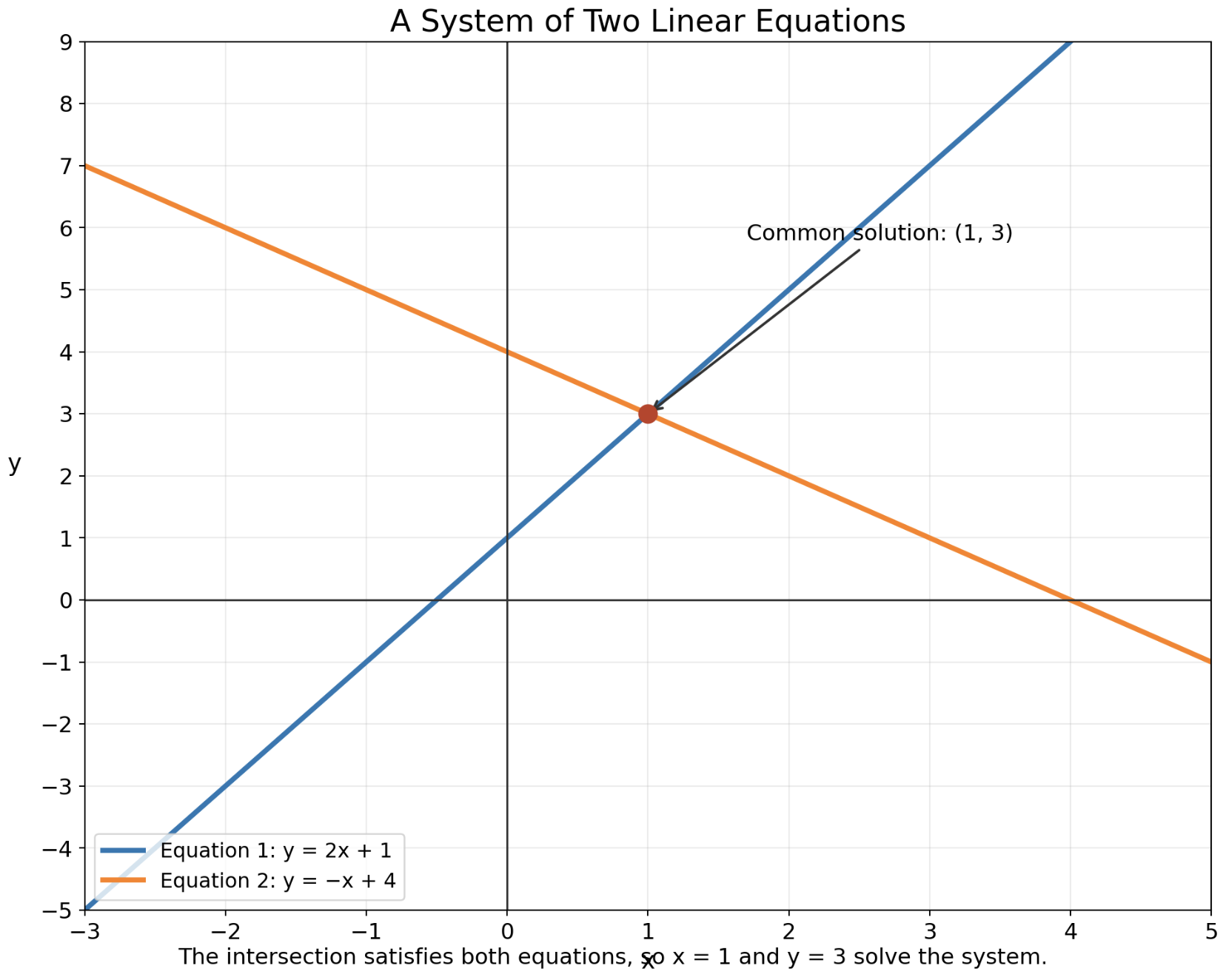
Each equation in a two-variable linear system represents a line. The solution is the point that lies on both lines.
Consider the system:
Equation 1: y = 2x + 1
Equation 2: y = −x + 4
The lines intersect at (1, 3). This point is the solution because x = 1 and y = 3 satisfy both equations.
Check Equation 1:
3 = 2(1) + 1
3 = 3
Check Equation 2:
3 = −1 + 4
3 = 3
The point (1, 3) belongs to both lines, so it satisfies both equations.
Systems with One Variable
A system can contain only one variable.
For example:
Equation 1: x + 3 = 7
Equation 2: 2x = 8
Both equations contain the variable x.
The solution to the first equation is x = 4.
The solution to the second equation is also x = 4.
Therefore, x = 4 is the solution to the system because it satisfies both equations.
A one-variable system can also have no solution. For example:
Equation 1: x = 4
Equation 2: x = 7
There is no value of x that can equal both 4 and 7. Therefore, the system has no solution.
Systems with Two Variables
Many systems contain two variables, usually x and y.
For example:
Equation 1: x + y = 10
Equation 2: x − y = 2
The variables are x and y.
The solution is:
x = 6 and y = 4
Check Equation 1:
6 + 4 = 10
Check Equation 2:
6 − 4 = 2
Both equations are true, so the solution is (6, 4).
Systems with Three or More Variables
A system can contain three or more variables.
For example:
Equation 1: x + y + z = 12
Equation 2: 2x − y + z = 9
Equation 3: x + 2y − z = 4
The variables are:
- x
- y
- z
A solution would contain a value for each variable, often written as an ordered triple:
(x, y, z)
The values must make all three equations true.
Systems with more variables are used in complex situations involving several unknown quantities. The number of equations does not always have to equal the number of variables, although this affects how much information is available.
Single Equation or System?
A single equation contains one mathematical condition.
Example:
2x + y = 10
This is one equation, even though it contains two variables.
A system contains at least two equations that are considered together.
Example:
Equation 1: 2x + y = 10
Equation 2: x − y = 2
This is a system because it contains two equations.
| Feature | Single equation | System of equations |
|---|---|---|
| Number of equations | One | Two or more |
| Number of conditions | One | Multiple |
| Variables | One or more | One or more |
| Solution | Satisfies one equation | Satisfies every equation |
| Graphical meaning | One graph | Two or more graphs considered together |
The number of variables does not determine whether something is a system. The number of equations does.
For example:
x + y + z = 10
This is still a single equation, even though it contains three variables.
However:
x + y = 10
x − y = 4
This is a system because it contains two equations.
Common Solutions
A common solution is a solution shared by all the equations in a system.
Consider:
Equation 1: y = x + 2
Equation 2: y = 2x − 1
For x = 3:
Equation 1 gives:
y = 3 + 2 = 5
Equation 2 gives:
y = 2(3) − 1 = 5
Both equations produce y = 5. Therefore, (3, 5) is their common solution.
On a graph, the point (3, 5) would lie on both lines.
Possible Numbers of Solutions
A system of two linear equations can have different numbers of solutions.
One Solution
If the two lines intersect once, the system has one solution. The intersection point satisfies both equations.
No Solution
If the lines are parallel, they never intersect. There is no ordered pair that satisfies both equations.
Infinitely Many Solutions
If the two equations represent the same line, every point on the line satisfies both equations. The system has infinitely many solutions.
These possibilities show that being a system does not guarantee that it has exactly one solution.
Recognising a System
Consider each example.
Example 1
3x + 5 = 17
This is a single equation with one variable.
Example 2
x + y = 8
This is a single equation with two variables.
Example 3
x + y = 8
2x − y = 4
This is a system of two equations with two variables.
Example 4
a + b + c = 20
2a − b + c = 7
a + 3b − c = 12
This is a system of three equations with three variables.
Example 5
m = 10
2m = 20
m + 5 = 15
This is a system of three equations with one variable.
Worked Example: Testing a Possible Solution
Determine whether (3, 2) is a solution to the following system:
Equation 1: x + y = 5
Equation 2: 2x + y = 8
Substitute x = 3 and y = 2 into Equation 1:
3 + 2 = 5
5 = 5
Equation 1 is true.
Substitute x = 3 and y = 2 into Equation 2:
2(3) + 2 = 8
6 + 2 = 8
8 = 8
Equation 2 is also true.
Therefore, (3, 2) is a solution because it satisfies both equations.
Worked Example: Not a Solution
Determine whether (2, 4) is a solution to the same system:
Equation 1: x + y = 5
Equation 2: 2x + y = 8
Substitute into Equation 1:
2 + 4 = 5
6 = 5
This statement is false.
Substitute into Equation 2:
2(2) + 4 = 8
8 = 8
This statement is true.
The ordered pair satisfies the second equation but not the first equation. Therefore, (2, 4) is not a solution to the system.
Real-World Example: Ticket Sales
A school sells adult and student tickets for a performance.
Let:
- a represent the number of adult tickets sold.
- s represent the number of student tickets sold.
Suppose 100 tickets were sold altogether:
a + s = 100
Suppose adult tickets cost $10, student tickets cost $6, and total ticket revenue was $760:
10a + 6s = 760
Together, the equations form the system:
Equation 1: a + s = 100
Equation 2: 10a + 6s = 760
The first equation describes the total number of tickets. The second equation describes the total revenue.
The same variables must have the same meanings in both equations:
- a always represents adult tickets.
- s always represents student tickets.
A solution must satisfy both the ticket-total condition and the revenue condition.
Other Real-World Uses
Systems of equations can be used to model:
- Comparing mobile phone plans.
- Calculating the prices of different products.
- Finding where two moving objects meet.
- Combining substances in a mixture.
- Comparing wages from different jobs.
- Determining the dimensions of geometric figures.
- Analysing supply and demand.
- Finding electrical currents in circuits.
- Calculating quantities in chemical reactions.
- Comparing rates of population change.
Each equation represents one condition. The system combines the conditions into one mathematical model.
Common Misconceptions
Two Variables Mean Two Equations
A single equation can contain several variables. The expression x + y = 10 is one equation, not a system.
Any Value That Satisfies One Equation Solves the System
A solution must satisfy every equation in the system.
The Equations Must Look Similar
Equations can form a system even when they are written in different forms.
For example:
y = 2x + 1
3x + y = 11
These equations can still form a system because they share the variables x and y.
Every System Has One Solution
A system may have one solution, no solution, or infinitely many solutions.
A System Must Have Two Variables
Systems can have one, two, three, or more variables.
Did You Know?
Systems of equations have been used for thousands of years. Ancient mathematicians solved problems involving several unknown quantities long before modern algebraic symbols were developed. They often described the equations using words or arranged numbers in tables.
Today, computers can solve systems containing thousands or even millions of variables. These large systems are used in engineering, economics, weather forecasting, medical imaging, and scientific modelling.
Key Terms
- Coefficient: A number multiplying a variable, such as 3 in the term 3x.
- Common solution: A value or set of values that satisfies every equation in a system.
- Constant: A number without a variable.
- Equation: A mathematical statement showing that two expressions are equal.
- Independent equation: An equation in a system that provides a distinct condition or piece of information.
- Intersection: A point where two or more graphs meet.
- Linear equation: An equation whose graph is a straight line.
- Ordered pair: Two values written as (x, y), representing a point on a coordinate plane.
- Ordered triple: Three values written as (x, y, z).
- Simultaneously: At the same time. A system’s solution must satisfy all equations simultaneously.
- Single equation: One mathematical statement containing an equals sign.
- Solution: A value or set of values that makes an equation true.
- Substitution: Replacing a variable with a value or expression.
- System of equations: A set of two or more equations considered and solved together.
- Unknown: A quantity whose value has not yet been determined.
- Variable: A letter or symbol representing an unknown or changing quantity.
Key Takeaways
- A system of equations contains two or more equations considered together.
- The equations usually share one or more variables.
- Variables must represent the same quantities throughout a real-world system.
- A solution must make every equation in the system true simultaneously.
- A single equation remains a single equation even if it contains several variables.
- A system may contain one, two, three, or more variables.
- In a two-variable linear system, each equation represents a line.
- The intersection of the lines represents their common solution.
- A system may have one solution, no solution, or infinitely many solutions.
- Systems of equations allow several conditions from the same situation to be modelled together.