1. Positive and Negative Numbers

Learning outcomes
  • I can identify positive and negative numbers.
  • I can locate integers on a number line.
  • I can explain the meaning of zero.
  • I can describe real-life situations involving integers.
  • I can compare positive and negative values.

https://images.openai.com/static-rsc-4/2sTx31zKV6ALWIIUdRBov_3Rikl6OqejtGs6dYaKAk0fU8HP47knJW2R-RDt7HTLhh8_G9kzDGBzuA_gwaFZR0J0-3D2Vbw11f1JAqW7RFgUeMpvSOv-r5Wi-CUTcjBhgt5tFHlsHQvTDt0JxfwDLbjmtnlIwG2NqJeOQN_LatCn4Dn2p3eNUCMojoRNQteY?purpose=fullsize
 
https://images.openai.com/static-rsc-4/32l_wj6mrB0ZQ7lwy4ncwRJJ7dh4DzNXOlUOISGQaYHYyidXrHvUU_bH80Tsa6Q9A4J8JrA30ZgLQYsKkJ4zTdd1tK31Az8EA7mIBmO2t5hlHpqJRNl4GK0CaZ7thtN_LuhH78SkX7Yt2VPnIdk0AFHx4pCxtrq9IcPGRGEgQPx7q8cNoE91KRl3fIolK1NP?purpose=fullsize
 
https://images.openai.com/static-rsc-4/FdsK3HkWy7n4n2ciRJbwt2_Vom52C7eM2kPibZIBlgGuAPUQ6oPZTmQ4KUYRMUkW_bfhvOxj31bUjjy_TByI86nRVFsJMO96Epf9rHsTfev8ZWRmN5tyEDc22GdnlZ7Oh6Y91ca4CyCGSshFIiNpNVOAg7TL-0pCL5_LRYIDUbDzwr0KFSGVh__JyP4zikKj?purpose=fullsize
 
6

What Are Positive and Negative Numbers?

Numbers can represent quantities that are above or below a reference point.

Numbers greater than zero are called positive numbers.

Examples:

1, 4, 12, 50

Numbers less than zero are called negative numbers.

Examples:

−1, −4, −12, −50

The number:

0

is neither positive nor negative.

Together, positive numbers, negative numbers, and zero allow us to describe quantities on both sides of a reference point.


Positive Numbers

A positive number is any number greater than zero.

Examples:

3

15

27

100

Positive numbers can be written with a plus sign:

+3

+15

However, the plus sign is usually omitted.

Therefore:

+8 = 8

https://images.openai.com/static-rsc-4/Vdrgo0tqD0gwiX4FXpbrK5pq5X7_2nEToVsQ2j7Di7Ekstz4YPH7MdBDeD0eZXKXnDMzdpL2sZ0kNFiqCWa_F3guhBKreVHM9lpmaVmLJ2oHF63gaOEKpXZVahR8mu3s1lYRrYdwxbd2R_V9F0VFdOW2kWknztuGhbNMvFhXuf6FAKBr_nJKyL6O7k49Knwc?purpose=fullsize
 
https://images.openai.com/static-rsc-4/O_UpRjjXP7bY7AvhNzUEbQ76KCNp2-lchtjd3ZjOooqGlx2TsF3ZV7w7KoK5E9R_h9PtT6qAHs4ZICW7t8tBmYd-a74BcKM4QMHrNegbpRYwQLa8le6zJg47VCjecBLB-y1-4ZsPCNyvRGxMY0cfGC16GxHhViVeWAxSc0PwMuGkPjP8p41OxuG_RZL2qw44?purpose=fullsize
 
https://images.openai.com/static-rsc-4/2UMuwjEPK3u7kbLyKVv23YpswU4Ldp5dsUQTx7fQ9vwLD8o-2EN2uO1tEfGugS8ffaORRXAVYJyRUxEuxO8M5obvVk8EC6pUU5f1z40H7txaGLadiSelm5ciJinyPaTlDHq8dMAFS9SCMLLBJ0LP-7w-MwXEW5SqWGXOe6ZadI-rDiD4BLWUhEemT6gGHnya?purpose=fullsize
 
4

On a horizontal number line, positive numbers appear to the:

right of zero


Negative Numbers

A negative number is any number less than zero.

Negative numbers are written using a minus sign:

−2

−7

−15

−100

The negative sign is important because:

5

and:

−5

represent different values.

On a horizontal number line, negative numbers appear to the:

left of zero


What Are Integers?

Integers are whole numbers, their negative counterparts, and zero.

Examples:

..., −5, −4, −3, −2, −1, 0, 1, 2, 3, 4, 5, ...

Integers do not include numbers such as:

2.5

−3.7

1/2

because these are not whole numbers.

https://images.openai.com/static-rsc-4/bG2Gr7NhXM_xWjj77W27DWt-afmImvi1xQypdi1FZtjVfa7CbXhQ15QXoWVu25P37-a0pimUWfaG0MF6MFS0kV_mkXo4NryA4ZT1DOrasA3eC9B_JIYMaxY_5FLS8m8_zBHxWYPFDtuPZCFSYB94i04J21vzVoamuetN_PhLkNO-Mn_nKbmHVzwJMZtxToSu?purpose=fullsize
 
https://images.openai.com/static-rsc-4/07FkUDdJarLn5z1OufH76R4_l1uKV8mIm-2n8QXxXZVVLJuuFlSZbhCeooeaOWWVHagPs4tnW5wK-_SQUJicT-DWimMhIsFfdoiZmDxYYqO4wa76A_ltYJSdg5iHL45pcreyqRqUw-4yyOcB22svArGko3J_6UkS3wiTjsFAQcoQFlfNUKF0MrXs0dLiUiP9?purpose=fullsize
 
https://images.openai.com/static-rsc-4/D-DlNVH0aP4Bks2jLQfGklqhC6gtI2XcFWi0fLzVNXxPnUPe_khU1tajOUR67sUnNBQSdevVYeWaTyBmG2QElgZr8RMo9lN2sWFIXc2S8KFcHCG2Zk2LGbYauYqPCgznTIU2HQ8kPOw0ycwY1Njjaf4bIHw0y4iCQHUMVg88Z7Ny6N6yNl8cadDmgO5XFOP8?purpose=fullsize
 
5

The Integer Number Line

A number line shows numbers according to their value.

For example:

−5 −4 −3 −2 −1 0 1 2 3 4 5

As we move to the right, numbers become greater.

As we move to the left, numbers become smaller.

Therefore:

4 > 2

but also:

−2 > −4

because −2 appears farther to the right.


Understanding Zero

Zero is an important reference point.

0

is:

  • not positive
  • not negative
  • an integer
  • the boundary between positive and negative numbers
https://images.openai.com/static-rsc-4/JjqZq2Ia3uFqynC7WxMFT6ytgs4iK12o58vo1Vpfay4-Ob_8JTR8LI4WsGWE0QJpXVCb_lTrRhelgb0K3l-x8s8mNkkv0q7x1zkJjVIuoPy1Xgjo7_cZovZZ2gU33ShgC5MQGvg63ZXKgxz_meaVJQo7DRdvwiZq3urlOKERDVRNMIRwxPkEtsTiGkbj_u0U?purpose=fullsize
 
https://images.openai.com/static-rsc-4/NNKxpmLo6HMzVHQXBuresDpHqsJGNm71gnmUVKW0yzXrGy_5ThPr2Q9BQYyNlq1UsnYi8eK0n8n29IBzPjiASaSvpjtblqptCyQVlgiz6Vk72wDiOnFchAK3PBfyZdR4fDF8CX_flE5f9DsrX4MiHLspHBGLAbVJ_WRmxvBII_wfceVPZ4XZlKn3pyY_Ow1l?purpose=fullsize
 
https://images.openai.com/static-rsc-4/Y6l8TK2mOO6_OW0wBAfQ3Fk5C01MKK_MiLejKRnKvKZIKKqT1_AmbB77Zl8Y-P60lMvQKWqSmHPzTGeLH335WzOCUJwAktHj5O9LDPPkeUZ6S_5dapJOUmVOqYCG4CamCNpXpW3JxtUrOENSo_zeh6VduWkLhezwuMJHKJlM9vH7wQSeU6Ac6p8_jZPCyGFW?purpose=fullsize
 
5

On a number line:

negative numbers < 0 < positive numbers

For example:

−3 < 0 < 5


Zero as a Reference Point

In real-world situations, zero often represents a reference level rather than simply "nothing."

For example:

0°C

is a particular temperature.

Temperatures above 0°C can be represented using positive numbers.

Temperatures below 0°C are represented using negative numbers.

Similarly, sea level can be used as a zero reference for elevation.


Opposite Numbers

Two numbers that are the same distance from zero but on opposite sides of zero are called opposites.

Examples:

5 and −5

12 and −12

100 and −100

https://images.openai.com/static-rsc-4/2hxKjErXIHgG8nBzTLmM682LHgytV7A3zUt_x8IdEhmODxnks7MguDkMKBQAKDUbVrXDuDvZyIrjdT6HQtqAbil_AH51As-QjjZiWfNLhM3ykKJ6i-Y8GrLGMw_gR7xlLADElLUuHLLUNlsErhEeriD-UwWTjvpD49kSppF6JctKbHvuDHeGZeigNl7ubAet?purpose=fullsize
 
https://images.openai.com/static-rsc-4/IAmvH5cFRlM0k7BtwL7MGTCUUULj_L_yjQ8xSfqf_1MM_NAh8ROG998GYIxP_dJ3Q7sFVjPzKkInV_4va9ZgHGN_Pss5RtQ9bdfCjxtgJRocJFDarPINdjG78N-FmWYX9bWxLPYkmHPVUl2CtvHWi_sXAsZqCmc7yK7mG4f34NMqrS9uTsSG1Tntb57CG1cl?purpose=fullsize
 
https://images.openai.com/static-rsc-4/a23itGtVmagaHlzqCHw4VbIcOu06qwnsMLQRkQ-JpRxNe3R3T_2Yruek5Mu49c_YmfMMuzPyywr3gAo6dKd-OiDQ7ODpC6uDI-NYXddzv0ESt2qDKidccLffMciqE_qtfwav3sSRA2UfMDKUPpQOMfzoMLw1QARIv4uFdbx4ZDYSJtreCXZmxOjcxfiIAg81?purpose=fullsize
 
5

The opposite of:

7

is:

−7

The opposite of:

−4

is:

4

The opposite of:

0

is:

0


Equal Distance from Zero

Consider:

−6 and 6

Both numbers are:

6 units

away from zero.

However, they lie in opposite directions.

This is why they are opposites.

Similarly:

−3 and 3

are both 3 units from zero.


Absolute Value

The absolute value of a number describes its distance from zero.

Absolute value is written using vertical bars.

For example:

|5| = 5

and:

|−5| = 5

https://images.openai.com/static-rsc-4/HpA70yd1SrH7cGlEZTyQutHfraWCZNRHHnuNQ0wypJZndRw0o1cYWcv1uwdRrOtSyjR2VCopO4UdxbhD7VM24ofaR9exZgQnt-Ow9Aj3q84f-D5CHOOe4zhZsJHfCJUqLuMNTEe8dJNcZQaNc1pmbH0v7QraXsRO4SvNmS2rwMiuA11b6UQJTLd2-5sfSbcw?purpose=fullsize
 
https://images.openai.com/static-rsc-4/_WbJBqkW5-LXRKeEkEt_vzf_pVIgYgGK6TIuMfYYIQcVP7B8Y5Vhs5o9tvjGXFs0Qex69E6jSvwd1fTheizSq8TLt2IcdZkYsIPK1hdj7_pD_oNr-apg28CS5W7Y25sEFcUdd3vPFlDNOf2OUAb7w0idYsrlPgbz5tokpfmnmR2KJYz8BGS1iAdNaNbcqFJI?purpose=fullsize
 
https://images.openai.com/static-rsc-4/0cDjkfQGMdJhWCbawcGOp0bjMfNhQQ9RLASiV_1r1kdMOtgMz77mnQu-ZDv6apUEdM3nBQFSgbhBSSG6ls1x_w4l8S8iNFeS4R2Fr2SgHxfkt7X98E1SPG89Ts9egz0Dvo8r5Tb4i7pOfgNE0ymMELDQNsp_z8ddSFcKlKosmrgZrDHBNhJVB3YpZFIOkDsF?purpose=fullsize
 
6

Absolute value is never negative because distance is not negative.

For example:

|−12| = 12


Locating Integers on a Number Line

To locate an integer:

Step 1: Find zero.

Step 2: Determine whether the number is positive or negative.

Step 3: For a positive number, move right.

Step 4: For a negative number, move left.

For example, to locate:

−4

start at zero and move:

4 units left


Locating Positive Integers

To locate:

+6

start at:

0

and move:

6 units to the right

The point represents:

6


Locating Negative Integers

To locate:

−6

start at:

0

and move:

6 units to the left

https://images.openai.com/static-rsc-4/E5XmWC1ctSHrMiP8fJIlD0wbVA2p35zx-S1ullWPLlkGFzuUNfIGI28wLFopUuSzpmeoJa7Ph7p03u_0zgkY1IwPS8Wz-n8u484MdDCTuxCARfBye6CpNOw7LRdUPos5lvD8mXYRyJME_-wILy5iMWmutqeOrJAAVTV7QFaRLy_YIZOk_OuHP4oeH8epzJld?purpose=fullsize
 
https://images.openai.com/static-rsc-4/bA7YsGHSFzmm8RbaXLrDmg0vn1R5VEDurEXgGk-IeRJQP3zUdW843Dj1dkyu-9EykVUCgnj0cJSHCbhYCzK2hrezfk0cG_tGFcpiiiU3LUg4_Dxf8mk0tiGMUBwH2mhAh20NO7dIyFMEGsbKnP8m4COfcvrveuNHA0mgcJ6Qa8Z1SqF_n-VJjtmV4XCdkPsA?purpose=fullsize
 
https://images.openai.com/static-rsc-4/bG2Gr7NhXM_xWjj77W27DWt-afmImvi1xQypdi1FZtjVfa7CbXhQ15QXoWVu25P37-a0pimUWfaG0MF6MFS0kV_mkXo4NryA4ZT1DOrasA3eC9B_JIYMaxY_5FLS8m8_zBHxWYPFDtuPZCFSYB94i04J21vzVoamuetN_PhLkNO-Mn_nKbmHVzwJMZtxToSu?purpose=fullsize
 

Although:

6 and −6

have the same distance from zero, they have different positions and different values.


Comparing Positive Numbers

Positive numbers can be compared in the familiar way.

For example:

8 > 3

because 8 is farther to the right on the number line.

Similarly:

15 > 12

and:

2 < 9


Comparing Positive and Negative Numbers

Every positive number is greater than every negative number.

For example:

3 > −5

1 > −100

25 > −2

Even a very small positive integer is greater than a very large negative integer.

For example:

1 > −1,000

because 1 lies to the right of −1,000.


Comparing Negative Numbers

Negative numbers can initially seem more difficult to compare.

Consider:

−2 and −7

On the number line:

−2

is farther to the right.

Therefore:

−2 > −7

https://images.openai.com/static-rsc-4/2aQS2LgxTOlCmupqrSuochhrZdrkzwWrsr_6iFWoz4yecH_JXtnVGjmYnm28z763HteMqzOBT9jAtjEFWa098pOW-Clb5lu55SVZFRMAJgRzxXKwJCAXF7V2qVcfUnro3Rb9lHZHuKMtl9zlS9BoJwFTftWAIuXBFJ5zHuLVQSW_9NdRTiSxz_XhOxPk4geG?purpose=fullsize
 
https://images.openai.com/static-rsc-4/g_mmsVwMWDQxdjSV1smhi1LJO3-0aR2DW80V_zP306O1_sfmxBNFVWANU6LGurlZhO6BQdhH66UuA2thoBdjxg_x-G8NIfSo9KW0LhSz8av9E8428OAZ6J4h0WsvBPGl_iEY7EHX0ulGVreA5Yo9XqOZIv5EFHoA7FRs0xCcjyJjrL3C0lhw6q31KYEn1mCn?purpose=fullsize
 
https://images.openai.com/static-rsc-4/iq2PPNPKs9cWh7vgkWj_i139Bm5FeTDzzuTcUrKoqNb95mBMp1w661FpuwXL4lAVHfE6hXx7V7Gui-Xpur7Cu5hlfw7kjQp7p03UJlSyJF6yKFSDYruvAo1zg-FOHX4Y2YAqsqrJqUf3rr6v06TPC-ehIihecRZyyMv3WS0av_Kkda6DSEjBfSbmR__FbZkt?purpose=fullsize
 
5

The negative number closer to zero is greater.


Why −2 Is Greater Than −7

Imagine temperature.

A temperature of:

−2°C

is warmer than:

−7°C

Therefore:

−2 > −7

This matches the number line.

−2 lies farther right than −7.


Another Negative Comparison

Compare:

−15 and −6

Since:

−6

is closer to zero:

−6 > −15

Or:

−15 < −6

Be careful not to compare only the digits 15 and 6.

The negative signs change the values.


Comparison Symbols

Use:

> for greater than

< for less than

= for equal to

Examples:

5 > −3

−8 < 2

−3 < −1

0 > −4

0 < 7


A Reliable Comparison Rule

When comparing integers, imagine the number line.

The number farther to the right is greater.

The number farther to the left is smaller.

https://images.openai.com/static-rsc-4/l1UsHX5RHz1UeLORAy3eNTg9y2w7xHg38mSC0cis74uYwXs1FdQG9SiVjzx81J6B_0wO1-hb_NAFCNTDozWVtbaHM59R2C0KJhcLuyVtf5x94JsSt3n6SwCIBsr097GWlypjSO1TpOKBAGqZscQ9PgEXWo-RL_gRDcACSZLgqwrZ6MdjkzrdDAJtUvp4Hi4S?purpose=fullsize
 
https://images.openai.com/static-rsc-4/2sTx31zKV6ALWIIUdRBov_3Rikl6OqejtGs6dYaKAk0fU8HP47knJW2R-RDt7HTLhh8_G9kzDGBzuA_gwaFZR0J0-3D2Vbw11f1JAqW7RFgUeMpvSOv-r5Wi-CUTcjBhgt5tFHlsHQvTDt0JxfwDLbjmtnlIwG2NqJeOQN_LatCn4Dn2p3eNUCMojoRNQteY?purpose=fullsize
 
https://images.openai.com/static-rsc-4/2aQS2LgxTOlCmupqrSuochhrZdrkzwWrsr_6iFWoz4yecH_JXtnVGjmYnm28z763HteMqzOBT9jAtjEFWa098pOW-Clb5lu55SVZFRMAJgRzxXKwJCAXF7V2qVcfUnro3Rb9lHZHuKMtl9zlS9BoJwFTftWAIuXBFJ5zHuLVQSW_9NdRTiSxz_XhOxPk4geG?purpose=fullsize
 
6

This single rule works for:

  • two positive numbers
  • two negative numbers
  • positive and negative numbers
  • comparisons involving zero

Worked Example 1

Compare:

−4 and 3

−4 is negative.

3 is positive.

Every positive number is greater than every negative number.

Therefore:

−4 < 3


Worked Example 2

Compare:

−8 and −3

−3 is farther to the right on the number line.

Therefore:

−3 > −8

Or:

−8 < −3


Worked Example 3

Compare:

0 and −12

Zero lies to the right of −12.

Therefore:

0 > −12


Worked Example 4

Order from least to greatest:

4, −3, 0, −7, 2

Imagine the number line.

From left to right:

−7, −3, 0, 2, 4

Therefore:

−7 < −3 < 0 < 2 < 4


Worked Example 5

Order from greatest to least:

−8, 5, −2, 0, 3

From right to left:

5, 3, 0, −2, −8

Therefore:

5 > 3 > 0 > −2 > −8


Integers and Temperature

Temperature is one of the most common real-life applications of negative numbers.

Consider:

5°C

This temperature is:

5 degrees above 0°C

Consider:

−5°C

This temperature is:

5 degrees below 0°C

https://images.openai.com/static-rsc-4/NiinAoTG6oWFpep-gYCQd53PYmt3iriuBQXLhJjoMFnptjWLsWq9geZ01TlCZBQSBghjtWoIVGgfgZC3esiSYBAW4rJOmgBNqqMA6kXB9ugHvI0fnxF44BjGLoIHET2Il_fFCciZH0zaLbZDWdy0BajbuMiKdv2_AKx_23CZAvXdjN1R6tWLTqnZya-p9wc_?purpose=fullsize
 
https://images.openai.com/static-rsc-4/FNzTCrqLrFxWrORPRIUMs0xjEIb8buqwWbSQvjwb97QGpU3fVD7YY-mJl4zalMhicq-K8QVkKbw7e9mak_CLJAPiTbL8hqG1Ia1p2_D_a6C1Wwyk5iBqfu4SWCl4u3LkOyp-RaWaluyqXFPndtL0IJqhR-nNdASOBhDLjH9KZLakciDmRbzj9eIBT4DH69TZ?purpose=fullsize
 
https://images.openai.com/static-rsc-4/4uuqlLyiQT9oTLuB3lqL_qL-5IkHTP1zdiA-q3YkBNEk11fzoipE8H_py92ZmU4v-a0JE9MUlVsWPnQWurEVOxfUpT6xY8DUU3yA1iYSgU3s-sGggRiIcamTl283LSTsAFZj7YdBzagi3O5Q_1iRWfhNqqhBjrgVKj2BU9S6r3OyM7otwqMpBBobuMYzTMlI?purpose=fullsize
 
5

Therefore:

5°C > −5°C


Comparing Temperatures

Suppose four temperatures are recorded:

−8°C

3°C

−2°C

0°C

From coldest to warmest:

−8°C < −2°C < 0°C < 3°C

The coldest temperature is:

−8°C

The warmest is:

3°C


Integers and Elevation

Elevation can be measured relative to sea level.

Sea level can be represented as:

0 m

A mountain location might be:

+850 m

A location below sea level might be:

−40 m

https://images.openai.com/static-rsc-4/Uil1RQNldS7CLYO0XB_R7Yqb-lYa4glqz8Ff-v8YUy5a2bdIPC7QcsqqTs2K5LC2WqLSOSp_3cGQNKUOw-0d93okCowLD5c-s9zWuK6uZD5RWRpluPAnWfWNX0cHZCCmAvdDndWdqWpmDD2di_mzzRRrB5LJxc9RaqM9nCszdPwTSOxYqko58qGgv7gAZghs?purpose=fullsize
 
https://images.openai.com/static-rsc-4/junjONR4_OhaasKxjJYkvHJ-U5uDixWq9KBDzfngRFVUCQuPz1sEShdZ8zuWnnTRoOdDFijhXJ1htEavhidQW-81ox3Z9WoFUn44nRrNzev8_f-5sUaSwuARQ54sE6ZQIUfO2uT5rZBTfZhDcYMoUgFXUP2Z78iHiF3g1wKEGj8m2R22585orrLcyNotpQmO?purpose=fullsize
 
https://images.openai.com/static-rsc-4/H8cxL9k5v9_ppg_KyxypEVcOQASENl3J9pDGQW9YVVbgQbkR2FLiu2jaYzmkUye35gr7jR9VHnHs0_-lUoEbQAmJWBvgnebv1xe9QYAjqIjtZPpy649AuHGN9b_WCC4x9ROPSUibFMNrxeFoH-BHQGy34RNCNBmaHnG8DCgJD7xNfnSG6t-8N23vSoEJt4ZB?purpose=fullsize
 
6

Positive and negative numbers tell us which side of the reference level a location lies.


Elevation Example

Suppose:

Location A = 250 m

Location B = −30 m

Location C = 0 m

From lowest to highest:

−30 m < 0 m < 250 m

Location B is below sea level.

Location C is at sea level.

Location A is above sea level.


Integers and Money

Positive and negative numbers can also represent money.

For example:

+$50

could represent receiving $50.

−$50

could represent spending $50 or owing $50.

A bank account change of:

+$200

means the balance increases by $200.

A change of:

−$75

means the balance decreases by $75.

https://images.openai.com/static-rsc-4/EwU_SHSRJgdexsTH2DP86Ssd5j_jKD4DD3I-FcsaINM8A_8ne1Z3qPgOu_0zPCT584daBqzQrjXJ_aC44UE0ABx-7TojpcZz8QUtjEX6G95U9w_NfnFXn0xAoM2jriq2DrhJ50dE9qIGAfHMVui693eZJSpnYJud8B1R0BG_Je6KMIPL-kTAuTMZ9pYzqGvw?purpose=fullsize
 
https://images.openai.com/static-rsc-4/0nx-f_mGuZl-rXcHMNpNEEuTS2keiVqfSfdYoT6o1iGch6SJt1Af0NKEfX9t-HZVatwKMkN4ckw77T6t8aRekQgLstJS1zRLVusEpvjzvVqM40OhDyWtSkIxIV2PE80vIdX1xGqywSl3kk6cxzaW049PSmch8c0U25p2W4DZ7myrCiXMjn8pO-Mjmyzacj9h?purpose=fullsize
 
https://images.openai.com/static-rsc-4/9BL-I-X9b5KMqzqYrUi2BJh8WoD9mlM8hRb86-OQARZUC25PjyPRXs47LGxi_PYjXz7bghFrfX3TMLYuJjV46E4UpM7RXnXUl_CjDoRlYKlr8ONn4ff5LZ_1cHe3Muyvv4yk_i6gV5ng6riiHbXF7lzEi9r_pDGkh6SUBq-RvYUgssyqCnPTBVjcfOjZxQFI?purpose=fullsize
 
6

Money and Zero

In a simple debt model:

positive value

can represent money available.

zero

can represent no money available and no debt.

negative value

can represent debt.

For example:

$25

means you have $25.

$0

means neither a positive balance nor debt.

−$25

can represent owing $25.


Integers in Buildings

Building floors can be represented using integers.

Suppose:

Ground level = 0

Floors above ground:

1, 2, 3, 4, ...

Underground levels:

−1, −2, −3, ...

https://images.openai.com/static-rsc-4/Rgwk2q8Msxi-8LHQLK9PPewPI8pOy5ZPtjc8_yDj2lK_-LH2cVv6aj8NjbqAeDCccBLhOyGaMSqBPu3vonM_wvGCgq3vL_pOEqWXf6V13-TSO5JXHPItDuCRNL4psxl846vDea_ssN23kmqE3nfhHFxRlXlCDx1cUSBrNCNoPF7BLERUYhDCU2xLdHgw-w6S?purpose=fullsize
 
https://images.openai.com/static-rsc-4/CtiLSq_MQKY0uh3s3a7GFSO3pQVj1q-3cgyrV4hxvyBjoDLUdNBDahVEXJQ_vjcBBc8phB6NqzrgWIK7ASXA5PEOEl5TWhxd8c29TXAVBtrWI_76tMtd0VirHzpZJQWT5l6nfuA5GJf_SSBrvRNH3tQythJmbgUqZQIeqMczVMONCVoqwg94anSFZ3b7n2Rl?purpose=fullsize
 
https://images.openai.com/static-rsc-4/pIoatQbkdVrHsb-nxCVt-F9VJSKBbf-IRtJE48rSXCIaaUx2Mz468-nKB0kwWD7jKhmJy3YAx8Kp-plNTfuaWEOR2CTfM6mBKSvdQWfG0m4Mmn07I0J-keI-PjUDXhLrN6sUT7Oh_8KlEymjpn8CNsW_tToiW4VlaIdDTVzpTozAAPCoeUnLxIbj29b0SI4A?purpose=fullsize
 
5

An elevator travelling from:

−2

to:

4

moves upward across zero.


Integers and Depth

Sea level can again be used as:

0

A diver:

12 m below sea level

could be represented as:

−12 m

A drone:

30 m above sea level

could be represented as:

+30 m

The signs communicate direction relative to the reference point.


Integers and Sports

Positive and negative values can represent changes in position or score differences.

For example, in golf a score relative to par might be:

−2

meaning two strokes below par.

A score of:

+3

means three strokes above par.

https://images.openai.com/static-rsc-4/4EfwUQG9eTsEVEvhYodRwVbqovJnVe_Zo9xuwYMcGn8sjjcc8hsfTR_jehXfQ9Evq78eCd68pUQCXcYkei2FcWP8Xcp-yDgcxSmFjOO43oBkYSnwwuRGDXbYrUrawZPJEGA1gTAbd7gIG_SGrvnmq2GieQ9EnEL7E9LPsvT_BpvvPwmJaQoU4NDgrGH96P-W?purpose=fullsize
 
https://images.openai.com/static-rsc-4/0yN_NLIKKYElrqy8v8DybO2NV5QDTrPhgNI7rNtpbA49GFrH-9aT0F0-m_gboqubZ---Ovkq75EQzzArJlV2bltYQLtAzfJ4VQpID6C9Rr3QXVGYlnWZtMsJ1cgwwH_REISbhXCxeSHJFW7xXDZaVrjC_tEt8uCpoyVReUfRssRcTEOLryFPJQOvdinqGaq0?purpose=fullsize
 
https://images.openai.com/static-rsc-4/32l_wj6mrB0ZQ7lwy4ncwRJJ7dh4DzNXOlUOISGQaYHYyidXrHvUU_bH80Tsa6Q9A4J8JrA30ZgLQYsKkJ4zTdd1tK31Az8EA7mIBmO2t5hlHpqJRNl4GK0CaZ7thtN_LuhH78SkX7Yt2VPnIdk0AFHx4pCxtrq9IcPGRGEgQPx7q8cNoE91KRl3fIolK1NP?purpose=fullsize
 

The meaning of positive and negative values depends on the context.


Integers and Change

Integers can represent increases and decreases.

For example:

+6

might represent an increase of 6.

−6

might represent a decrease of 6.

Examples include:

  • temperature changes
  • stock changes
  • elevation changes
  • population changes
  • financial gains and losses
  • movement forward and backward

Direction and Integers

Integers can also represent opposite directions.

For example, we might define:

east = positive

and:

west = negative

Then:

+5 km

means 5 km east.

−5 km

means 5 km west.

https://images.openai.com/static-rsc-4/sEO8VKkSmJSNEQrmwnBdYA2K0kTG-moCJ9pN21UUGNF_0mHEMWpbBTIOl4Wj1WTDHtJaKQxmL4zWDj81pSctmGGnSfp7Dc_AThfodBrBsY6gEVPwO3rRAg194pbrK0Gm3JF_mGwGggd6Yrc-TQSj5Xjag4k90_jFzHnlzazfcBU3sQ3vaffdra2TuzCa9Ewh?purpose=fullsize
 
https://images.openai.com/static-rsc-4/gEdxR20w6fG7OQPYXTH0LbtzR4M3LRwutceHeRIHtO8B3BDN58IDkP5e1oB-sRWvOCRynWg46ZvB-94eyxfg6_Fje8rSGfLQCHv5mz8JYjL3D5sXoMyMvH3BSx516zsfpDvXhiYQVdckF5L7i0brwlOzbkLY3GWkwbU1_r_nYBFs-cEFCZioiZiQG5O6WpnW?purpose=fullsize
 
https://images.openai.com/static-rsc-4/2sTx31zKV6ALWIIUdRBov_3Rikl6OqejtGs6dYaKAk0fU8HP47knJW2R-RDt7HTLhh8_G9kzDGBzuA_gwaFZR0J0-3D2Vbw11f1JAqW7RFgUeMpvSOv-r5Wi-CUTcjBhgt5tFHlsHQvTDt0JxfwDLbjmtnlIwG2NqJeOQN_LatCn4Dn2p3eNUCMojoRNQteY?purpose=fullsize
 
5

The choice of positive direction must be defined before interpreting the values.


Zero Does Not Always Mean Nothing

Zero can have different meanings depending on context.

On a thermometer:

0°C

is a temperature.

For elevation:

0 m

can mean sea level.

For a bank balance:

$0

means no positive or negative balance.

For movement:

0 m

can represent the starting position.

For a number line:

0

is the reference point separating positive and negative numbers.


Opposites in Real Life

Many real-world quantities naturally come in opposite pairs.

Examples include:

  • above / below
  • gain / loss
  • deposit / withdrawal
  • forward / backward
  • rise / fall
  • profit / loss
  • above sea level / below sea level

Positive and negative numbers provide a convenient way to represent these opposites.


Worked Example 6: Temperature

Morning temperature:

−4°C

Afternoon temperature:

6°C

Which is warmer?

Since:

6 > −4

the afternoon is warmer.


Worked Example 7: Elevation

A diver is at:

−18 m

A boat is at:

0 m

A helicopter is at:

+120 m

Order from lowest to highest:

−18 m < 0 m < 120 m


Worked Example 8: Bank Balance

Three balances are:

$45

−$20

$0

Order from least to greatest:

−$20 < $0 < $45

The negative balance is the smallest value.


Worked Example 9: Comparing Negative Temperatures

Compare:

−12°C and −5°C

−5 is closer to zero.

Therefore:

−5 > −12

So:

−5°C

is warmer.


Worked Example 10: Number Line Position

Which number is farther from zero?

−9 or 6

Distances from zero:

|−9| = 9

|6| = 6

Therefore:

−9

is farther from zero.

However:

6 > −9

Distance from zero and numerical value are different ideas.


Ordering Integers

To order integers, imagine their positions on a number line.

Consider:

−6, 4, −1, 7, 0, −3

Least to greatest:

−6, −3, −1, 0, 4, 7

Greatest to least:

7, 4, 0, −1, −3, −6

https://images.openai.com/static-rsc-4/176V-Ny2Z_dLWbxPP5m25POPqZCU-HOA8RE9fJdKSizEqpiYo8tuBwNZuD5fQhHoZQuNkfgNWug3n_8Kwu4yUx-koacbCCRCKMoYuPoAgaw7mUiS92FWv1vSRI5Lf04c33ZWpzUbunLaoYVkZL6grLgUpvNurfhp21RDaJojL_-5EcfpG4lKIjm_6CYYV_PT?purpose=fullsize
 
https://images.openai.com/static-rsc-4/2sTx31zKV6ALWIIUdRBov_3Rikl6OqejtGs6dYaKAk0fU8HP47knJW2R-RDt7HTLhh8_G9kzDGBzuA_gwaFZR0J0-3D2Vbw11f1JAqW7RFgUeMpvSOv-r5Wi-CUTcjBhgt5tFHlsHQvTDt0JxfwDLbjmtnlIwG2NqJeOQN_LatCn4Dn2p3eNUCMojoRNQteY?purpose=fullsize
 
https://images.openai.com/static-rsc-4/zBqt12yIfNjmQN_pzN6_WBsPreTZf4hCVPByWNCADtSlhHOjnJnJVZMRS8oZ-qHLqyUakZF7RuGGdbhb7CoMpllOZjCe4I6ti2gNe4aRhmqu58EUxmrh9fSq_jmRKFV24wKFEklPJu-mU4YcX_kpmlhQejNUw-0f7lkS-3AykFzNqaEcMGlWAT_LugaL-Dvt?purpose=fullsize
 
5

Comparing Absolute Value and Numerical Value

Consider:

−10 and 4

Numerically:

−10 < 4

But their absolute values are:

|−10| = 10

|4| = 4

So −10 has the greater absolute value, even though −10 is the smaller number.

This distinction is important.


Real-Life Problem 1: Weather

Temperatures in four cities are:

City A: 4°C

City B: −7°C

City C: −2°C

City D: 6°C

From coldest to warmest:

−7°C < −2°C < 4°C < 6°C


Real-Life Problem 2: Elevator

An elevator is at:

floor −3

Another elevator is at:

floor 5

Relative to ground level:

  • −3 is three floors below ground
  • 5 is five floors above ground

Therefore:

5 > −3

https://images.openai.com/static-rsc-4/PX2O0txznf3twIsukbhSv_HcoPt358tSPBvrdp2uMrc0wFnTicECZ1_Z3W-oPZKNcGQGpgLSFlRVGSV437mbiUbqYYBSRz_aZytpRsyUWBVHQNABQ34TlkyQPaFKoPKBMtiGrlNphGJdp83L2cCFksaTeo5kLDhGm9cmqu6td9wdpUeKdz_wL0PPKis23Tgg?purpose=fullsize
 
https://images.openai.com/static-rsc-4/Q8vXu6-QnvvR0o6ICQcSHHp_FrzNgyFETTuLYAboVMtno71MRchCeA_KDteIp87P6vzUY4q0l420wG4XB5jzHRxp6oEO_d1Phxd6FSXXS39AuEAyiHbl5q_kO_iuJK8nk8wdSQpyWVzeFXn1HbgCgJm2fmZDOyt-fjgIC33bVGJN51wYaYmVyzKutx3Ql1Jx?purpose=fullsize
 
https://images.openai.com/static-rsc-4/CtiLSq_MQKY0uh3s3a7GFSO3pQVj1q-3cgyrV4hxvyBjoDLUdNBDahVEXJQ_vjcBBc8phB6NqzrgWIK7ASXA5PEOEl5TWhxd8c29TXAVBtrWI_76tMtd0VirHzpZJQWT5l6nfuA5GJf_SSBrvRNH3tQythJmbgUqZQIeqMczVMONCVoqwg94anSFZ3b7n2Rl?purpose=fullsize
 
4

Real-Life Problem 3: Diving

Three divers are at:

−5 m

−12 m

−8 m

Which diver is deepest?

On a number line:

−12 < −8 < −5

Therefore:

−12 m

is the deepest position.

The smallest numerical value represents the greatest depth below the reference level.


Real-Life Problem 4: Financial Changes

A business records daily changes:

Monday: +$120

Tuesday: −$75

Wednesday: +$40

Thursday: −$150

The greatest positive change is:

+$120

The greatest loss is represented by:

−$150

Numerically:

−150 < −75 < 40 < 120


A Reliable Integer Comparison Strategy

When comparing integers:

Step 1: Imagine or draw a number line.

Step 2: Locate both numbers.

Step 3: Identify which number is farther right.

Step 4: The number farther right is greater.

For two negative numbers, remember:

The number closer to zero is greater.


Common Mistakes

Mistake 1: Thinking all numbers with larger digits are greater

Incorrect:

−8 > −3

Correct:

−8 < −3

because −8 lies farther left.


Mistake 2: Thinking zero is positive

Zero is:

neither positive nor negative


Mistake 3: Ignoring the negative sign

5

and:

−5

are not the same number.

They are opposites.


Mistake 4: Thinking −10 is greater than −2 because 10 > 2

On the number line:

−10

lies farther left.

Therefore:

−10 < −2


Mistake 5: Confusing absolute value with numerical value

Although:

|−20| = 20

the number:

−20

is still less than:

5


Error Analysis

A student says:

−9 > −4

because:

9 > 4

This reasoning ignores the negative signs.

On the number line:

−9

is farther left than:

−4

Therefore:

−9 < −4

https://images.openai.com/static-rsc-4/g_mmsVwMWDQxdjSV1smhi1LJO3-0aR2DW80V_zP306O1_sfmxBNFVWANU6LGurlZhO6BQdhH66UuA2thoBdjxg_x-G8NIfSo9KW0LhSz8av9E8428OAZ6J4h0WsvBPGl_iEY7EHX0ulGVreA5Yo9XqOZIv5EFHoA7FRs0xCcjyJjrL3C0lhw6q31KYEn1mCn?purpose=fullsize
 
https://images.openai.com/static-rsc-4/kPRCIyAhUWliNesgTdF3F-XvdvjWKbIgU7enjfFOmXUE9X4W3Yww9Bm-uZMOSgI18yIWIeuV_elkQBwClwedPFqeOoiFCXTzsi0RDKYnU_eNFtIVsxy7q3EVXZgrBML6mKljJ9_xwtCRB4w24DSqu9UskQc_xhcwxkM6G2Hd7xk6EwDUjZ-jSNlw24XvEIKH?purpose=fullsize
 
https://images.openai.com/static-rsc-4/iq2PPNPKs9cWh7vgkWj_i139Bm5FeTDzzuTcUrKoqNb95mBMp1w661FpuwXL4lAVHfE6hXx7V7Gui-Xpur7Cu5hlfw7kjQp7p03UJlSyJF6yKFSDYruvAo1zg-FOHX4Y2YAqsqrJqUf3rr6v06TPC-ehIihecRZyyMv3WS0av_Kkda6DSEjBfSbmR__FbZkt?purpose=fullsize
 

Another Error Analysis

A student says:

0 is a positive number because it is not negative.

This is incorrect.

Numbers greater than zero are positive.

Numbers less than zero are negative.

Zero is exactly between these groups.

Therefore:

0 is neither positive nor negative.


A Useful Mental Model

Think of a number line as a road.

Moving right means values increase.

Moving left means values decrease.

For example:

−5 → −4 → −3 → −2 → −1 → 0 → 1 → 2 → 3

Every step to the right increases the value by:

1

Every step to the left decreases the value by:

1


Did You Know?

Negative numbers were not always widely accepted in mathematics.

For many early mathematical problems, people worked mainly with positive quantities because these were easy to connect to physical objects.

You can have:

5 apples

but the idea of having:

−5 apples

is less direct.

https://images.openai.com/static-rsc-4/Xy5xCazXlPsScmGXeAjCI_g47_lLUjhHMfuHLn7QI4Hd6MSfS2VW0DxCEV48o5Vw-bwHI8NGISwcSGo2tQEzm2h4ndtyDldQNHFsNi4h4_M4L3a06QHClGAkkw45auDyRk_EC0lF4F-coBA_fl5mpB4NrTlMjc51VouT8jYI6QmgUQOxd8gT9_aRsV_0t5K3?purpose=fullsize
 
https://images.openai.com/static-rsc-4/rt9Zm2QQlcSZvKRlJMKqr7ZAUZ23kVCJ08ymyYd6rOdIjtXJd62C21exU2LZAOr4rtOO98fafJ_dhkttMKUAeyKZGoWvyC2-X2NswqVS841BIrQ9kX-Vhz3N-hdw8zEz3SEo04bTi9gUWBoPm0BnabprtjyPpLuLjQPr8OFRT5mgxgwBQnm5zSe0WNmyuH76?purpose=fullsize
 
https://images.openai.com/static-rsc-4/_fMtlZAsycUSIgXpJ6BQpee_pOutOqZXg-8efYI5Y7kC2qHfxOx1gwYJgAfxeB9NhDABPzaMI-C_AkoWA8wJJYdWEbwqpy5gwOEuJHY4krBNTafPkMS3G2WBBAJmbr2OXj05_aC6IpRESTFlXD4BrJHeUWfy0JyG4Y8mWYM0MUqO4U36hQ1YI9poM0grX_hE?purpose=fullsize
 
5

As mathematics developed, negative numbers became essential for representing quantities such as:

  • debt
  • temperatures below a reference point
  • positions below sea level
  • movement in opposite directions
  • decreases and losses

Today, integers are fundamental throughout mathematics, science, finance, engineering, and computing.


Key Terms

  • Positive number: Number greater than zero.
  • Negative number: Number less than zero.
  • Integer: Whole number, its negative counterpart, or zero.
  • Zero: Integer that is neither positive nor negative.
  • Number line: Visual representation showing numbers according to value.
  • Opposite: Number the same distance from zero but on the opposite side.
  • Absolute value: Distance of a number from zero.
  • Greater than: Larger in numerical value; represented by >.
  • Less than: Smaller in numerical value; represented by <.
  • Reference point: Starting or comparison point from which positive and negative values are measured.
  • Elevation: Height relative to a reference level such as sea level.
  • Depth: Distance below a reference surface or level.
  • Gain: Positive change in a quantity.
  • Loss: Negative change in a quantity.

Key Relationships

Positive numbers:

x > 0

Negative numbers:

x < 0

Zero:

x = 0

On a number line:

left = smaller

right = greater

For any positive integer:

positive > 0

For any negative integer:

negative < 0

Every positive integer is greater than every negative integer.

Opposites:

5 and −5

12 and −12

Absolute value:

|5| = 5

|−5| = 5


Key Takeaways

  • Positive numbers are greater than zero.
  • Negative numbers are less than zero.
  • Zero is neither positive nor negative.
  • Integers include positive whole numbers, negative whole numbers, and zero.
  • Positive integers usually appear to the right of zero on a horizontal number line.
  • Negative integers appear to the left of zero.
  • Numbers increase as you move right along a number line.
  • Numbers decrease as you move left.
  • Every positive number is greater than every negative number.
  • When comparing two negative numbers, the number closer to zero is greater.
  • Opposite numbers are the same distance from zero but lie on opposite sides.
  • The opposite of zero is zero.
  • Absolute value describes distance from zero.
  • A number can have a large absolute value while still being a small numerical value.
  • Zero often acts as a reference point rather than simply meaning "nothing."
  • Positive and negative numbers can represent temperature, elevation, depth, money, building floors, direction, gains, and losses.
  • The meaning of positive and negative values depends on the reference point and context.
  • Number lines provide a reliable way to locate, compare, and order integers.
  • Positive and negative numbers provide a mathematical way to describe quantities that extend in opposite directions from a reference point.


Adding and subtracting integers

When we add ( + ) or subtract ( - ) numbers, we should think of where we start and finish on a number line. Think of the first number as the starting place. Think of “+” as moving right ( → ), and “–“ as moving left ( ← ). Then think of the second number as the distance. For example:

           3 + 4      start at 3, move right 4               9 – 7     start at 9, move left 7
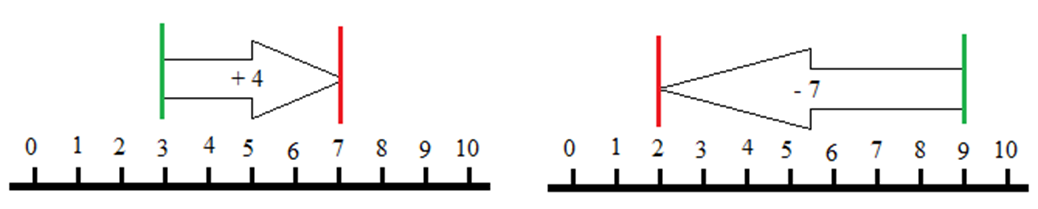

                          3 + 4 = 7                                                   9 – 7 = 2

Since integers include negative numbers, we can extend the number line and apply the same rules:

        -4 + 6   start at -4, move right 6                      3 – 8   start at 3, move left 8

                      -4 + 6 = 2                                            3 – 8 = -5

You will often see a combination of signs and can consider (A and B are natural numbers):


A – (+B ) | A – (→ B) | A ← B | A – B

4 – (+3) = 4 – 3 = 1


A + ( + B) | A + ( → B) | A → B |  A + B 

4 + (+3) = 4 + 3 = 7


A + (-B)  | A + ( ← B) | A ← B | A – B

4 + (-3) = 4 – 3 = 1


A – ( - B) | A – ( ← B) | A → B | A + B 

4 – (-3) = 4 + 3 = 7

Integers


Exercise set 1: Calculate (express answers as mixed numbers where necessary)


4•(-15) = -60


(-8)(-7) = 56


-12•8 = -96


84÷(-8) =


-56÷7 = -8


(-89)÷(-5) =


-51t•13 = -663t


14g•(-28g) = -392g2


(-15p)(-22v) = 330pv


78÷(-11) =


(-92)÷(-25) =


-62÷27 =


Order of Operations Including Fractions, Integers, and Real Numbers
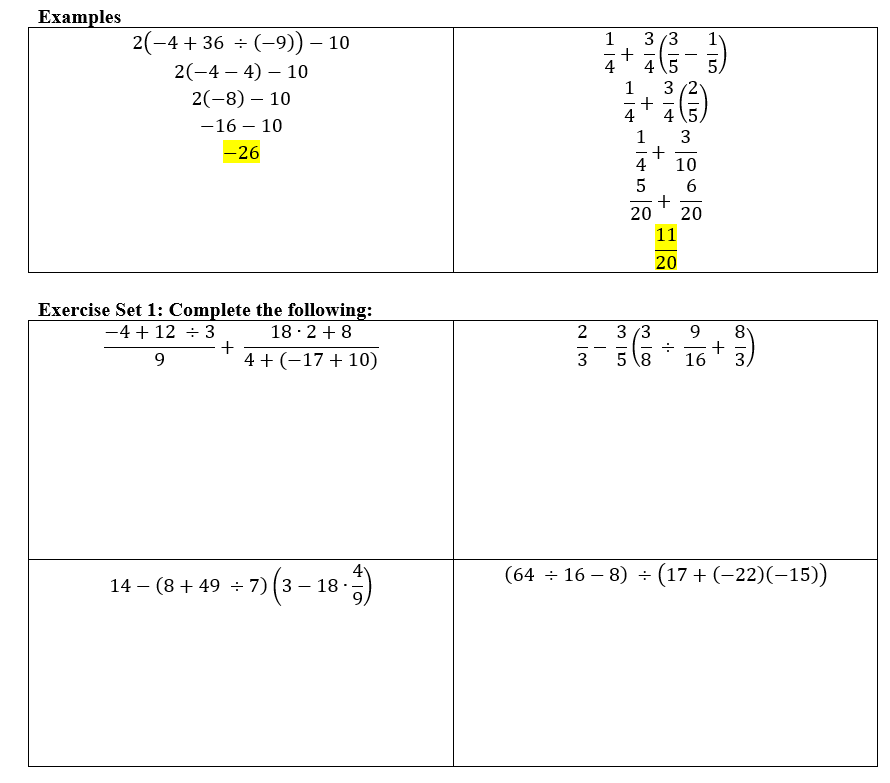


Exercise set 3:

1.     Alwyn sells twelve hamburgers in the morning for a sale price of ¥35 each. In the evening he sells nine hamburgers at the regular price of ¥45 each. The cost of making each burger is ¥15. If Alwyn gets to keep 30% of the profit, how much money does he earn that day from hamburgers?


2.     Eve draws eight caricatures per day. She charges customers ¥120 each, but her materials only cost her ¥75 for every fourteen that she draws. However, she must pay a weekly concession fee of ¥325. If she works six days per week, how much money would she earn if she works for fifteen weeks?


3.    Dolly ate  of a pizza. Jordan gave  of the pizza to Edward, before eating  of what was left. How much is left now, and who ate the most?


1.     A certain small factory employs 98 workers. Of these, 10 receive a wage of $150 per day and the rest receive $85.50 per day. To the management, a week is equal to 6 working days. How much does the factory pay out for each week?


2.     If the same factory has supplies expenses of $1135.78 a day in addition to the wages above and makes $60,128.72 in a week, what is the factory’s total profit or loss in one week?


3.     A certain Math Club makes 35 bars of laundry soap a week and sells these at $20 each. Before the soap can all be sold, the pupils found out that 6 bars were destroyed by mice. How much will be the total sale at the end of a four-week month? Write an expression and show your work and answer.


4.     Travis goes to the book fair where paperback books are $1.50 and hardback books are $3. Travis buys five paperback and two hardback books. How much change will Travis receive from a $20 bill?


5.     Kim sales necklaces to earn extra money. She charges $10 per necklace for material and $2.75 per hour to make unique gifts. How much would two necklaces cost together if one takes her an hour to make and the other three hours to make?


1.     A certain class raised ¥3500. Jennifer invested the class money. When it was time to use the money, the class had 114% of the original amount. Moon said they should put 20% away for another day. After the class agreed, Charlie spent  of the money that was left on decorations for the class. Ivy spent  of it on snacks for the class. Jack and Jack argued on what to do with the rest. Jack Gao spent 50% of what was left on party games, while Jack Cai spent 90% of his half on math puzzle books for the class, and gave the rest to the teacher to buy more white board markers. If white board markers cost ¥3 for 5, how many markers did Mr. Young buy?


2.    Thompson said  of his class should each bring 63 walnuts, and  the class should each bring as many sunflower seeds as there will be walnuts at the party. Mr. Young said he is on a diet, and will only eat 7% of the sunflower seeds and half as many walnuts. He insisted that if the snacks were to be divided up evenly among the 11 people at the party, then Zoe should get her share plus the remainder of his.

a)       How many walnuts and sunflower seeds does Zoe get?

b)      What is the ratio of Zoe’s walnuts to Neo’s walnuts?

c)       Melise eats as many walnuts as she does sunflower seeds until one of them runs out. How many of the other are left?