Integers and Number Relationships

Site: Young Education
Course: Numbers and Place Value
Book: Integers and Number Relationships
Printed by: Visiteur anonyme
Date: Friday, 25 September 2026, 2:37 AM

1. Positive and Negative Numbers

Learning outcomes
  • I can identify positive and negative numbers.
  • I can locate integers on a number line.
  • I can explain the meaning of zero.
  • I can describe real-life situations involving integers.
  • I can compare positive and negative values.

https://images.openai.com/static-rsc-4/2sTx31zKV6ALWIIUdRBov_3Rikl6OqejtGs6dYaKAk0fU8HP47knJW2R-RDt7HTLhh8_G9kzDGBzuA_gwaFZR0J0-3D2Vbw11f1JAqW7RFgUeMpvSOv-r5Wi-CUTcjBhgt5tFHlsHQvTDt0JxfwDLbjmtnlIwG2NqJeOQN_LatCn4Dn2p3eNUCMojoRNQteY?purpose=fullsize
 
https://images.openai.com/static-rsc-4/32l_wj6mrB0ZQ7lwy4ncwRJJ7dh4DzNXOlUOISGQaYHYyidXrHvUU_bH80Tsa6Q9A4J8JrA30ZgLQYsKkJ4zTdd1tK31Az8EA7mIBmO2t5hlHpqJRNl4GK0CaZ7thtN_LuhH78SkX7Yt2VPnIdk0AFHx4pCxtrq9IcPGRGEgQPx7q8cNoE91KRl3fIolK1NP?purpose=fullsize
 
https://images.openai.com/static-rsc-4/FdsK3HkWy7n4n2ciRJbwt2_Vom52C7eM2kPibZIBlgGuAPUQ6oPZTmQ4KUYRMUkW_bfhvOxj31bUjjy_TByI86nRVFsJMO96Epf9rHsTfev8ZWRmN5tyEDc22GdnlZ7Oh6Y91ca4CyCGSshFIiNpNVOAg7TL-0pCL5_LRYIDUbDzwr0KFSGVh__JyP4zikKj?purpose=fullsize
 
6

What Are Positive and Negative Numbers?

Numbers can represent quantities that are above or below a reference point.

Numbers greater than zero are called positive numbers.

Examples:

1, 4, 12, 50

Numbers less than zero are called negative numbers.

Examples:

−1, −4, −12, −50

The number:

0

is neither positive nor negative.

Together, positive numbers, negative numbers, and zero allow us to describe quantities on both sides of a reference point.


Positive Numbers

A positive number is any number greater than zero.

Examples:

3

15

27

100

Positive numbers can be written with a plus sign:

+3

+15

However, the plus sign is usually omitted.

Therefore:

+8 = 8

https://images.openai.com/static-rsc-4/Vdrgo0tqD0gwiX4FXpbrK5pq5X7_2nEToVsQ2j7Di7Ekstz4YPH7MdBDeD0eZXKXnDMzdpL2sZ0kNFiqCWa_F3guhBKreVHM9lpmaVmLJ2oHF63gaOEKpXZVahR8mu3s1lYRrYdwxbd2R_V9F0VFdOW2kWknztuGhbNMvFhXuf6FAKBr_nJKyL6O7k49Knwc?purpose=fullsize
 
https://images.openai.com/static-rsc-4/O_UpRjjXP7bY7AvhNzUEbQ76KCNp2-lchtjd3ZjOooqGlx2TsF3ZV7w7KoK5E9R_h9PtT6qAHs4ZICW7t8tBmYd-a74BcKM4QMHrNegbpRYwQLa8le6zJg47VCjecBLB-y1-4ZsPCNyvRGxMY0cfGC16GxHhViVeWAxSc0PwMuGkPjP8p41OxuG_RZL2qw44?purpose=fullsize
 
https://images.openai.com/static-rsc-4/2UMuwjEPK3u7kbLyKVv23YpswU4Ldp5dsUQTx7fQ9vwLD8o-2EN2uO1tEfGugS8ffaORRXAVYJyRUxEuxO8M5obvVk8EC6pUU5f1z40H7txaGLadiSelm5ciJinyPaTlDHq8dMAFS9SCMLLBJ0LP-7w-MwXEW5SqWGXOe6ZadI-rDiD4BLWUhEemT6gGHnya?purpose=fullsize
 
4

On a horizontal number line, positive numbers appear to the:

right of zero


Negative Numbers

A negative number is any number less than zero.

Negative numbers are written using a minus sign:

−2

−7

−15

−100

The negative sign is important because:

5

and:

−5

represent different values.

On a horizontal number line, negative numbers appear to the:

left of zero


What Are Integers?

Integers are whole numbers, their negative counterparts, and zero.

Examples:

..., −5, −4, −3, −2, −1, 0, 1, 2, 3, 4, 5, ...

Integers do not include numbers such as:

2.5

−3.7

1/2

because these are not whole numbers.

https://images.openai.com/static-rsc-4/bG2Gr7NhXM_xWjj77W27DWt-afmImvi1xQypdi1FZtjVfa7CbXhQ15QXoWVu25P37-a0pimUWfaG0MF6MFS0kV_mkXo4NryA4ZT1DOrasA3eC9B_JIYMaxY_5FLS8m8_zBHxWYPFDtuPZCFSYB94i04J21vzVoamuetN_PhLkNO-Mn_nKbmHVzwJMZtxToSu?purpose=fullsize
 
https://images.openai.com/static-rsc-4/07FkUDdJarLn5z1OufH76R4_l1uKV8mIm-2n8QXxXZVVLJuuFlSZbhCeooeaOWWVHagPs4tnW5wK-_SQUJicT-DWimMhIsFfdoiZmDxYYqO4wa76A_ltYJSdg5iHL45pcreyqRqUw-4yyOcB22svArGko3J_6UkS3wiTjsFAQcoQFlfNUKF0MrXs0dLiUiP9?purpose=fullsize
 
https://images.openai.com/static-rsc-4/D-DlNVH0aP4Bks2jLQfGklqhC6gtI2XcFWi0fLzVNXxPnUPe_khU1tajOUR67sUnNBQSdevVYeWaTyBmG2QElgZr8RMo9lN2sWFIXc2S8KFcHCG2Zk2LGbYauYqPCgznTIU2HQ8kPOw0ycwY1Njjaf4bIHw0y4iCQHUMVg88Z7Ny6N6yNl8cadDmgO5XFOP8?purpose=fullsize
 
5

The Integer Number Line

A number line shows numbers according to their value.

For example:

−5 −4 −3 −2 −1 0 1 2 3 4 5

As we move to the right, numbers become greater.

As we move to the left, numbers become smaller.

Therefore:

4 > 2

but also:

−2 > −4

because −2 appears farther to the right.


Understanding Zero

Zero is an important reference point.

0

is:

  • not positive
  • not negative
  • an integer
  • the boundary between positive and negative numbers
https://images.openai.com/static-rsc-4/JjqZq2Ia3uFqynC7WxMFT6ytgs4iK12o58vo1Vpfay4-Ob_8JTR8LI4WsGWE0QJpXVCb_lTrRhelgb0K3l-x8s8mNkkv0q7x1zkJjVIuoPy1Xgjo7_cZovZZ2gU33ShgC5MQGvg63ZXKgxz_meaVJQo7DRdvwiZq3urlOKERDVRNMIRwxPkEtsTiGkbj_u0U?purpose=fullsize
 
https://images.openai.com/static-rsc-4/NNKxpmLo6HMzVHQXBuresDpHqsJGNm71gnmUVKW0yzXrGy_5ThPr2Q9BQYyNlq1UsnYi8eK0n8n29IBzPjiASaSvpjtblqptCyQVlgiz6Vk72wDiOnFchAK3PBfyZdR4fDF8CX_flE5f9DsrX4MiHLspHBGLAbVJ_WRmxvBII_wfceVPZ4XZlKn3pyY_Ow1l?purpose=fullsize
 
https://images.openai.com/static-rsc-4/Y6l8TK2mOO6_OW0wBAfQ3Fk5C01MKK_MiLejKRnKvKZIKKqT1_AmbB77Zl8Y-P60lMvQKWqSmHPzTGeLH335WzOCUJwAktHj5O9LDPPkeUZ6S_5dapJOUmVOqYCG4CamCNpXpW3JxtUrOENSo_zeh6VduWkLhezwuMJHKJlM9vH7wQSeU6Ac6p8_jZPCyGFW?purpose=fullsize
 
5

On a number line:

negative numbers < 0 < positive numbers

For example:

−3 < 0 < 5


Zero as a Reference Point

In real-world situations, zero often represents a reference level rather than simply "nothing."

For example:

0°C

is a particular temperature.

Temperatures above 0°C can be represented using positive numbers.

Temperatures below 0°C are represented using negative numbers.

Similarly, sea level can be used as a zero reference for elevation.


Opposite Numbers

Two numbers that are the same distance from zero but on opposite sides of zero are called opposites.

Examples:

5 and −5

12 and −12

100 and −100

https://images.openai.com/static-rsc-4/2hxKjErXIHgG8nBzTLmM682LHgytV7A3zUt_x8IdEhmODxnks7MguDkMKBQAKDUbVrXDuDvZyIrjdT6HQtqAbil_AH51As-QjjZiWfNLhM3ykKJ6i-Y8GrLGMw_gR7xlLADElLUuHLLUNlsErhEeriD-UwWTjvpD49kSppF6JctKbHvuDHeGZeigNl7ubAet?purpose=fullsize
 
https://images.openai.com/static-rsc-4/IAmvH5cFRlM0k7BtwL7MGTCUUULj_L_yjQ8xSfqf_1MM_NAh8ROG998GYIxP_dJ3Q7sFVjPzKkInV_4va9ZgHGN_Pss5RtQ9bdfCjxtgJRocJFDarPINdjG78N-FmWYX9bWxLPYkmHPVUl2CtvHWi_sXAsZqCmc7yK7mG4f34NMqrS9uTsSG1Tntb57CG1cl?purpose=fullsize
 
https://images.openai.com/static-rsc-4/a23itGtVmagaHlzqCHw4VbIcOu06qwnsMLQRkQ-JpRxNe3R3T_2Yruek5Mu49c_YmfMMuzPyywr3gAo6dKd-OiDQ7ODpC6uDI-NYXddzv0ESt2qDKidccLffMciqE_qtfwav3sSRA2UfMDKUPpQOMfzoMLw1QARIv4uFdbx4ZDYSJtreCXZmxOjcxfiIAg81?purpose=fullsize
 
5

The opposite of:

7

is:

−7

The opposite of:

−4

is:

4

The opposite of:

0

is:

0


Equal Distance from Zero

Consider:

−6 and 6

Both numbers are:

6 units

away from zero.

However, they lie in opposite directions.

This is why they are opposites.

Similarly:

−3 and 3

are both 3 units from zero.


Absolute Value

The absolute value of a number describes its distance from zero.

Absolute value is written using vertical bars.

For example:

|5| = 5

and:

|−5| = 5

https://images.openai.com/static-rsc-4/HpA70yd1SrH7cGlEZTyQutHfraWCZNRHHnuNQ0wypJZndRw0o1cYWcv1uwdRrOtSyjR2VCopO4UdxbhD7VM24ofaR9exZgQnt-Ow9Aj3q84f-D5CHOOe4zhZsJHfCJUqLuMNTEe8dJNcZQaNc1pmbH0v7QraXsRO4SvNmS2rwMiuA11b6UQJTLd2-5sfSbcw?purpose=fullsize
 
https://images.openai.com/static-rsc-4/_WbJBqkW5-LXRKeEkEt_vzf_pVIgYgGK6TIuMfYYIQcVP7B8Y5Vhs5o9tvjGXFs0Qex69E6jSvwd1fTheizSq8TLt2IcdZkYsIPK1hdj7_pD_oNr-apg28CS5W7Y25sEFcUdd3vPFlDNOf2OUAb7w0idYsrlPgbz5tokpfmnmR2KJYz8BGS1iAdNaNbcqFJI?purpose=fullsize
 
https://images.openai.com/static-rsc-4/0cDjkfQGMdJhWCbawcGOp0bjMfNhQQ9RLASiV_1r1kdMOtgMz77mnQu-ZDv6apUEdM3nBQFSgbhBSSG6ls1x_w4l8S8iNFeS4R2Fr2SgHxfkt7X98E1SPG89Ts9egz0Dvo8r5Tb4i7pOfgNE0ymMELDQNsp_z8ddSFcKlKosmrgZrDHBNhJVB3YpZFIOkDsF?purpose=fullsize
 
6

Absolute value is never negative because distance is not negative.

For example:

|−12| = 12


Locating Integers on a Number Line

To locate an integer:

Step 1: Find zero.

Step 2: Determine whether the number is positive or negative.

Step 3: For a positive number, move right.

Step 4: For a negative number, move left.

For example, to locate:

−4

start at zero and move:

4 units left


Locating Positive Integers

To locate:

+6

start at:

0

and move:

6 units to the right

The point represents:

6


Locating Negative Integers

To locate:

−6

start at:

0

and move:

6 units to the left

https://images.openai.com/static-rsc-4/E5XmWC1ctSHrMiP8fJIlD0wbVA2p35zx-S1ullWPLlkGFzuUNfIGI28wLFopUuSzpmeoJa7Ph7p03u_0zgkY1IwPS8Wz-n8u484MdDCTuxCARfBye6CpNOw7LRdUPos5lvD8mXYRyJME_-wILy5iMWmutqeOrJAAVTV7QFaRLy_YIZOk_OuHP4oeH8epzJld?purpose=fullsize
 
https://images.openai.com/static-rsc-4/bA7YsGHSFzmm8RbaXLrDmg0vn1R5VEDurEXgGk-IeRJQP3zUdW843Dj1dkyu-9EykVUCgnj0cJSHCbhYCzK2hrezfk0cG_tGFcpiiiU3LUg4_Dxf8mk0tiGMUBwH2mhAh20NO7dIyFMEGsbKnP8m4COfcvrveuNHA0mgcJ6Qa8Z1SqF_n-VJjtmV4XCdkPsA?purpose=fullsize
 
https://images.openai.com/static-rsc-4/bG2Gr7NhXM_xWjj77W27DWt-afmImvi1xQypdi1FZtjVfa7CbXhQ15QXoWVu25P37-a0pimUWfaG0MF6MFS0kV_mkXo4NryA4ZT1DOrasA3eC9B_JIYMaxY_5FLS8m8_zBHxWYPFDtuPZCFSYB94i04J21vzVoamuetN_PhLkNO-Mn_nKbmHVzwJMZtxToSu?purpose=fullsize
 

Although:

6 and −6

have the same distance from zero, they have different positions and different values.


Comparing Positive Numbers

Positive numbers can be compared in the familiar way.

For example:

8 > 3

because 8 is farther to the right on the number line.

Similarly:

15 > 12

and:

2 < 9


Comparing Positive and Negative Numbers

Every positive number is greater than every negative number.

For example:

3 > −5

1 > −100

25 > −2

Even a very small positive integer is greater than a very large negative integer.

For example:

1 > −1,000

because 1 lies to the right of −1,000.


Comparing Negative Numbers

Negative numbers can initially seem more difficult to compare.

Consider:

−2 and −7

On the number line:

−2

is farther to the right.

Therefore:

−2 > −7

https://images.openai.com/static-rsc-4/2aQS2LgxTOlCmupqrSuochhrZdrkzwWrsr_6iFWoz4yecH_JXtnVGjmYnm28z763HteMqzOBT9jAtjEFWa098pOW-Clb5lu55SVZFRMAJgRzxXKwJCAXF7V2qVcfUnro3Rb9lHZHuKMtl9zlS9BoJwFTftWAIuXBFJ5zHuLVQSW_9NdRTiSxz_XhOxPk4geG?purpose=fullsize
 
https://images.openai.com/static-rsc-4/g_mmsVwMWDQxdjSV1smhi1LJO3-0aR2DW80V_zP306O1_sfmxBNFVWANU6LGurlZhO6BQdhH66UuA2thoBdjxg_x-G8NIfSo9KW0LhSz8av9E8428OAZ6J4h0WsvBPGl_iEY7EHX0ulGVreA5Yo9XqOZIv5EFHoA7FRs0xCcjyJjrL3C0lhw6q31KYEn1mCn?purpose=fullsize
 
https://images.openai.com/static-rsc-4/iq2PPNPKs9cWh7vgkWj_i139Bm5FeTDzzuTcUrKoqNb95mBMp1w661FpuwXL4lAVHfE6hXx7V7Gui-Xpur7Cu5hlfw7kjQp7p03UJlSyJF6yKFSDYruvAo1zg-FOHX4Y2YAqsqrJqUf3rr6v06TPC-ehIihecRZyyMv3WS0av_Kkda6DSEjBfSbmR__FbZkt?purpose=fullsize
 
5

The negative number closer to zero is greater.


Why −2 Is Greater Than −7

Imagine temperature.

A temperature of:

−2°C

is warmer than:

−7°C

Therefore:

−2 > −7

This matches the number line.

−2 lies farther right than −7.


Another Negative Comparison

Compare:

−15 and −6

Since:

−6

is closer to zero:

−6 > −15

Or:

−15 < −6

Be careful not to compare only the digits 15 and 6.

The negative signs change the values.


Comparison Symbols

Use:

> for greater than

< for less than

= for equal to

Examples:

5 > −3

−8 < 2

−3 < −1

0 > −4

0 < 7


A Reliable Comparison Rule

When comparing integers, imagine the number line.

The number farther to the right is greater.

The number farther to the left is smaller.

https://images.openai.com/static-rsc-4/l1UsHX5RHz1UeLORAy3eNTg9y2w7xHg38mSC0cis74uYwXs1FdQG9SiVjzx81J6B_0wO1-hb_NAFCNTDozWVtbaHM59R2C0KJhcLuyVtf5x94JsSt3n6SwCIBsr097GWlypjSO1TpOKBAGqZscQ9PgEXWo-RL_gRDcACSZLgqwrZ6MdjkzrdDAJtUvp4Hi4S?purpose=fullsize
 
https://images.openai.com/static-rsc-4/2sTx31zKV6ALWIIUdRBov_3Rikl6OqejtGs6dYaKAk0fU8HP47knJW2R-RDt7HTLhh8_G9kzDGBzuA_gwaFZR0J0-3D2Vbw11f1JAqW7RFgUeMpvSOv-r5Wi-CUTcjBhgt5tFHlsHQvTDt0JxfwDLbjmtnlIwG2NqJeOQN_LatCn4Dn2p3eNUCMojoRNQteY?purpose=fullsize
 
https://images.openai.com/static-rsc-4/2aQS2LgxTOlCmupqrSuochhrZdrkzwWrsr_6iFWoz4yecH_JXtnVGjmYnm28z763HteMqzOBT9jAtjEFWa098pOW-Clb5lu55SVZFRMAJgRzxXKwJCAXF7V2qVcfUnro3Rb9lHZHuKMtl9zlS9BoJwFTftWAIuXBFJ5zHuLVQSW_9NdRTiSxz_XhOxPk4geG?purpose=fullsize
 
6

This single rule works for:

  • two positive numbers
  • two negative numbers
  • positive and negative numbers
  • comparisons involving zero

Worked Example 1

Compare:

−4 and 3

−4 is negative.

3 is positive.

Every positive number is greater than every negative number.

Therefore:

−4 < 3


Worked Example 2

Compare:

−8 and −3

−3 is farther to the right on the number line.

Therefore:

−3 > −8

Or:

−8 < −3


Worked Example 3

Compare:

0 and −12

Zero lies to the right of −12.

Therefore:

0 > −12


Worked Example 4

Order from least to greatest:

4, −3, 0, −7, 2

Imagine the number line.

From left to right:

−7, −3, 0, 2, 4

Therefore:

−7 < −3 < 0 < 2 < 4


Worked Example 5

Order from greatest to least:

−8, 5, −2, 0, 3

From right to left:

5, 3, 0, −2, −8

Therefore:

5 > 3 > 0 > −2 > −8


Integers and Temperature

Temperature is one of the most common real-life applications of negative numbers.

Consider:

5°C

This temperature is:

5 degrees above 0°C

Consider:

−5°C

This temperature is:

5 degrees below 0°C

https://images.openai.com/static-rsc-4/NiinAoTG6oWFpep-gYCQd53PYmt3iriuBQXLhJjoMFnptjWLsWq9geZ01TlCZBQSBghjtWoIVGgfgZC3esiSYBAW4rJOmgBNqqMA6kXB9ugHvI0fnxF44BjGLoIHET2Il_fFCciZH0zaLbZDWdy0BajbuMiKdv2_AKx_23CZAvXdjN1R6tWLTqnZya-p9wc_?purpose=fullsize
 
https://images.openai.com/static-rsc-4/FNzTCrqLrFxWrORPRIUMs0xjEIb8buqwWbSQvjwb97QGpU3fVD7YY-mJl4zalMhicq-K8QVkKbw7e9mak_CLJAPiTbL8hqG1Ia1p2_D_a6C1Wwyk5iBqfu4SWCl4u3LkOyp-RaWaluyqXFPndtL0IJqhR-nNdASOBhDLjH9KZLakciDmRbzj9eIBT4DH69TZ?purpose=fullsize
 
https://images.openai.com/static-rsc-4/4uuqlLyiQT9oTLuB3lqL_qL-5IkHTP1zdiA-q3YkBNEk11fzoipE8H_py92ZmU4v-a0JE9MUlVsWPnQWurEVOxfUpT6xY8DUU3yA1iYSgU3s-sGggRiIcamTl283LSTsAFZj7YdBzagi3O5Q_1iRWfhNqqhBjrgVKj2BU9S6r3OyM7otwqMpBBobuMYzTMlI?purpose=fullsize
 
5

Therefore:

5°C > −5°C


Comparing Temperatures

Suppose four temperatures are recorded:

−8°C

3°C

−2°C

0°C

From coldest to warmest:

−8°C < −2°C < 0°C < 3°C

The coldest temperature is:

−8°C

The warmest is:

3°C


Integers and Elevation

Elevation can be measured relative to sea level.

Sea level can be represented as:

0 m

A mountain location might be:

+850 m

A location below sea level might be:

−40 m

https://images.openai.com/static-rsc-4/Uil1RQNldS7CLYO0XB_R7Yqb-lYa4glqz8Ff-v8YUy5a2bdIPC7QcsqqTs2K5LC2WqLSOSp_3cGQNKUOw-0d93okCowLD5c-s9zWuK6uZD5RWRpluPAnWfWNX0cHZCCmAvdDndWdqWpmDD2di_mzzRRrB5LJxc9RaqM9nCszdPwTSOxYqko58qGgv7gAZghs?purpose=fullsize
 
https://images.openai.com/static-rsc-4/junjONR4_OhaasKxjJYkvHJ-U5uDixWq9KBDzfngRFVUCQuPz1sEShdZ8zuWnnTRoOdDFijhXJ1htEavhidQW-81ox3Z9WoFUn44nRrNzev8_f-5sUaSwuARQ54sE6ZQIUfO2uT5rZBTfZhDcYMoUgFXUP2Z78iHiF3g1wKEGj8m2R22585orrLcyNotpQmO?purpose=fullsize
 
https://images.openai.com/static-rsc-4/H8cxL9k5v9_ppg_KyxypEVcOQASENl3J9pDGQW9YVVbgQbkR2FLiu2jaYzmkUye35gr7jR9VHnHs0_-lUoEbQAmJWBvgnebv1xe9QYAjqIjtZPpy649AuHGN9b_WCC4x9ROPSUibFMNrxeFoH-BHQGy34RNCNBmaHnG8DCgJD7xNfnSG6t-8N23vSoEJt4ZB?purpose=fullsize
 
6

Positive and negative numbers tell us which side of the reference level a location lies.


Elevation Example

Suppose:

Location A = 250 m

Location B = −30 m

Location C = 0 m

From lowest to highest:

−30 m < 0 m < 250 m

Location B is below sea level.

Location C is at sea level.

Location A is above sea level.


Integers and Money

Positive and negative numbers can also represent money.

For example:

+$50

could represent receiving $50.

−$50

could represent spending $50 or owing $50.

A bank account change of:

+$200

means the balance increases by $200.

A change of:

−$75

means the balance decreases by $75.

https://images.openai.com/static-rsc-4/EwU_SHSRJgdexsTH2DP86Ssd5j_jKD4DD3I-FcsaINM8A_8ne1Z3qPgOu_0zPCT584daBqzQrjXJ_aC44UE0ABx-7TojpcZz8QUtjEX6G95U9w_NfnFXn0xAoM2jriq2DrhJ50dE9qIGAfHMVui693eZJSpnYJud8B1R0BG_Je6KMIPL-kTAuTMZ9pYzqGvw?purpose=fullsize
 
https://images.openai.com/static-rsc-4/0nx-f_mGuZl-rXcHMNpNEEuTS2keiVqfSfdYoT6o1iGch6SJt1Af0NKEfX9t-HZVatwKMkN4ckw77T6t8aRekQgLstJS1zRLVusEpvjzvVqM40OhDyWtSkIxIV2PE80vIdX1xGqywSl3kk6cxzaW049PSmch8c0U25p2W4DZ7myrCiXMjn8pO-Mjmyzacj9h?purpose=fullsize
 
https://images.openai.com/static-rsc-4/9BL-I-X9b5KMqzqYrUi2BJh8WoD9mlM8hRb86-OQARZUC25PjyPRXs47LGxi_PYjXz7bghFrfX3TMLYuJjV46E4UpM7RXnXUl_CjDoRlYKlr8ONn4ff5LZ_1cHe3Muyvv4yk_i6gV5ng6riiHbXF7lzEi9r_pDGkh6SUBq-RvYUgssyqCnPTBVjcfOjZxQFI?purpose=fullsize
 
6

Money and Zero

In a simple debt model:

positive value

can represent money available.

zero

can represent no money available and no debt.

negative value

can represent debt.

For example:

$25

means you have $25.

$0

means neither a positive balance nor debt.

−$25

can represent owing $25.


Integers in Buildings

Building floors can be represented using integers.

Suppose:

Ground level = 0

Floors above ground:

1, 2, 3, 4, ...

Underground levels:

−1, −2, −3, ...

https://images.openai.com/static-rsc-4/Rgwk2q8Msxi-8LHQLK9PPewPI8pOy5ZPtjc8_yDj2lK_-LH2cVv6aj8NjbqAeDCccBLhOyGaMSqBPu3vonM_wvGCgq3vL_pOEqWXf6V13-TSO5JXHPItDuCRNL4psxl846vDea_ssN23kmqE3nfhHFxRlXlCDx1cUSBrNCNoPF7BLERUYhDCU2xLdHgw-w6S?purpose=fullsize
 
https://images.openai.com/static-rsc-4/CtiLSq_MQKY0uh3s3a7GFSO3pQVj1q-3cgyrV4hxvyBjoDLUdNBDahVEXJQ_vjcBBc8phB6NqzrgWIK7ASXA5PEOEl5TWhxd8c29TXAVBtrWI_76tMtd0VirHzpZJQWT5l6nfuA5GJf_SSBrvRNH3tQythJmbgUqZQIeqMczVMONCVoqwg94anSFZ3b7n2Rl?purpose=fullsize
 
https://images.openai.com/static-rsc-4/pIoatQbkdVrHsb-nxCVt-F9VJSKBbf-IRtJE48rSXCIaaUx2Mz468-nKB0kwWD7jKhmJy3YAx8Kp-plNTfuaWEOR2CTfM6mBKSvdQWfG0m4Mmn07I0J-keI-PjUDXhLrN6sUT7Oh_8KlEymjpn8CNsW_tToiW4VlaIdDTVzpTozAAPCoeUnLxIbj29b0SI4A?purpose=fullsize
 
5

An elevator travelling from:

−2

to:

4

moves upward across zero.


Integers and Depth

Sea level can again be used as:

0

A diver:

12 m below sea level

could be represented as:

−12 m

A drone:

30 m above sea level

could be represented as:

+30 m

The signs communicate direction relative to the reference point.


Integers and Sports

Positive and negative values can represent changes in position or score differences.

For example, in golf a score relative to par might be:

−2

meaning two strokes below par.

A score of:

+3

means three strokes above par.

https://images.openai.com/static-rsc-4/4EfwUQG9eTsEVEvhYodRwVbqovJnVe_Zo9xuwYMcGn8sjjcc8hsfTR_jehXfQ9Evq78eCd68pUQCXcYkei2FcWP8Xcp-yDgcxSmFjOO43oBkYSnwwuRGDXbYrUrawZPJEGA1gTAbd7gIG_SGrvnmq2GieQ9EnEL7E9LPsvT_BpvvPwmJaQoU4NDgrGH96P-W?purpose=fullsize
 
https://images.openai.com/static-rsc-4/0yN_NLIKKYElrqy8v8DybO2NV5QDTrPhgNI7rNtpbA49GFrH-9aT0F0-m_gboqubZ---Ovkq75EQzzArJlV2bltYQLtAzfJ4VQpID6C9Rr3QXVGYlnWZtMsJ1cgwwH_REISbhXCxeSHJFW7xXDZaVrjC_tEt8uCpoyVReUfRssRcTEOLryFPJQOvdinqGaq0?purpose=fullsize
 
https://images.openai.com/static-rsc-4/32l_wj6mrB0ZQ7lwy4ncwRJJ7dh4DzNXOlUOISGQaYHYyidXrHvUU_bH80Tsa6Q9A4J8JrA30ZgLQYsKkJ4zTdd1tK31Az8EA7mIBmO2t5hlHpqJRNl4GK0CaZ7thtN_LuhH78SkX7Yt2VPnIdk0AFHx4pCxtrq9IcPGRGEgQPx7q8cNoE91KRl3fIolK1NP?purpose=fullsize
 

The meaning of positive and negative values depends on the context.


Integers and Change

Integers can represent increases and decreases.

For example:

+6

might represent an increase of 6.

−6

might represent a decrease of 6.

Examples include:

  • temperature changes
  • stock changes
  • elevation changes
  • population changes
  • financial gains and losses
  • movement forward and backward

Direction and Integers

Integers can also represent opposite directions.

For example, we might define:

east = positive

and:

west = negative

Then:

+5 km

means 5 km east.

−5 km

means 5 km west.

https://images.openai.com/static-rsc-4/sEO8VKkSmJSNEQrmwnBdYA2K0kTG-moCJ9pN21UUGNF_0mHEMWpbBTIOl4Wj1WTDHtJaKQxmL4zWDj81pSctmGGnSfp7Dc_AThfodBrBsY6gEVPwO3rRAg194pbrK0Gm3JF_mGwGggd6Yrc-TQSj5Xjag4k90_jFzHnlzazfcBU3sQ3vaffdra2TuzCa9Ewh?purpose=fullsize
 
https://images.openai.com/static-rsc-4/gEdxR20w6fG7OQPYXTH0LbtzR4M3LRwutceHeRIHtO8B3BDN58IDkP5e1oB-sRWvOCRynWg46ZvB-94eyxfg6_Fje8rSGfLQCHv5mz8JYjL3D5sXoMyMvH3BSx516zsfpDvXhiYQVdckF5L7i0brwlOzbkLY3GWkwbU1_r_nYBFs-cEFCZioiZiQG5O6WpnW?purpose=fullsize
 
https://images.openai.com/static-rsc-4/2sTx31zKV6ALWIIUdRBov_3Rikl6OqejtGs6dYaKAk0fU8HP47knJW2R-RDt7HTLhh8_G9kzDGBzuA_gwaFZR0J0-3D2Vbw11f1JAqW7RFgUeMpvSOv-r5Wi-CUTcjBhgt5tFHlsHQvTDt0JxfwDLbjmtnlIwG2NqJeOQN_LatCn4Dn2p3eNUCMojoRNQteY?purpose=fullsize
 
5

The choice of positive direction must be defined before interpreting the values.


Zero Does Not Always Mean Nothing

Zero can have different meanings depending on context.

On a thermometer:

0°C

is a temperature.

For elevation:

0 m

can mean sea level.

For a bank balance:

$0

means no positive or negative balance.

For movement:

0 m

can represent the starting position.

For a number line:

0

is the reference point separating positive and negative numbers.


Opposites in Real Life

Many real-world quantities naturally come in opposite pairs.

Examples include:

  • above / below
  • gain / loss
  • deposit / withdrawal
  • forward / backward
  • rise / fall
  • profit / loss
  • above sea level / below sea level

Positive and negative numbers provide a convenient way to represent these opposites.


Worked Example 6: Temperature

Morning temperature:

−4°C

Afternoon temperature:

6°C

Which is warmer?

Since:

6 > −4

the afternoon is warmer.


Worked Example 7: Elevation

A diver is at:

−18 m

A boat is at:

0 m

A helicopter is at:

+120 m

Order from lowest to highest:

−18 m < 0 m < 120 m


Worked Example 8: Bank Balance

Three balances are:

$45

−$20

$0

Order from least to greatest:

−$20 < $0 < $45

The negative balance is the smallest value.


Worked Example 9: Comparing Negative Temperatures

Compare:

−12°C and −5°C

−5 is closer to zero.

Therefore:

−5 > −12

So:

−5°C

is warmer.


Worked Example 10: Number Line Position

Which number is farther from zero?

−9 or 6

Distances from zero:

|−9| = 9

|6| = 6

Therefore:

−9

is farther from zero.

However:

6 > −9

Distance from zero and numerical value are different ideas.


Ordering Integers

To order integers, imagine their positions on a number line.

Consider:

−6, 4, −1, 7, 0, −3

Least to greatest:

−6, −3, −1, 0, 4, 7

Greatest to least:

7, 4, 0, −1, −3, −6

https://images.openai.com/static-rsc-4/176V-Ny2Z_dLWbxPP5m25POPqZCU-HOA8RE9fJdKSizEqpiYo8tuBwNZuD5fQhHoZQuNkfgNWug3n_8Kwu4yUx-koacbCCRCKMoYuPoAgaw7mUiS92FWv1vSRI5Lf04c33ZWpzUbunLaoYVkZL6grLgUpvNurfhp21RDaJojL_-5EcfpG4lKIjm_6CYYV_PT?purpose=fullsize
 
https://images.openai.com/static-rsc-4/2sTx31zKV6ALWIIUdRBov_3Rikl6OqejtGs6dYaKAk0fU8HP47knJW2R-RDt7HTLhh8_G9kzDGBzuA_gwaFZR0J0-3D2Vbw11f1JAqW7RFgUeMpvSOv-r5Wi-CUTcjBhgt5tFHlsHQvTDt0JxfwDLbjmtnlIwG2NqJeOQN_LatCn4Dn2p3eNUCMojoRNQteY?purpose=fullsize
 
https://images.openai.com/static-rsc-4/zBqt12yIfNjmQN_pzN6_WBsPreTZf4hCVPByWNCADtSlhHOjnJnJVZMRS8oZ-qHLqyUakZF7RuGGdbhb7CoMpllOZjCe4I6ti2gNe4aRhmqu58EUxmrh9fSq_jmRKFV24wKFEklPJu-mU4YcX_kpmlhQejNUw-0f7lkS-3AykFzNqaEcMGlWAT_LugaL-Dvt?purpose=fullsize
 
5

Comparing Absolute Value and Numerical Value

Consider:

−10 and 4

Numerically:

−10 < 4

But their absolute values are:

|−10| = 10

|4| = 4

So −10 has the greater absolute value, even though −10 is the smaller number.

This distinction is important.


Real-Life Problem 1: Weather

Temperatures in four cities are:

City A: 4°C

City B: −7°C

City C: −2°C

City D: 6°C

From coldest to warmest:

−7°C < −2°C < 4°C < 6°C


Real-Life Problem 2: Elevator

An elevator is at:

floor −3

Another elevator is at:

floor 5

Relative to ground level:

  • −3 is three floors below ground
  • 5 is five floors above ground

Therefore:

5 > −3

https://images.openai.com/static-rsc-4/PX2O0txznf3twIsukbhSv_HcoPt358tSPBvrdp2uMrc0wFnTicECZ1_Z3W-oPZKNcGQGpgLSFlRVGSV437mbiUbqYYBSRz_aZytpRsyUWBVHQNABQ34TlkyQPaFKoPKBMtiGrlNphGJdp83L2cCFksaTeo5kLDhGm9cmqu6td9wdpUeKdz_wL0PPKis23Tgg?purpose=fullsize
 
https://images.openai.com/static-rsc-4/Q8vXu6-QnvvR0o6ICQcSHHp_FrzNgyFETTuLYAboVMtno71MRchCeA_KDteIp87P6vzUY4q0l420wG4XB5jzHRxp6oEO_d1Phxd6FSXXS39AuEAyiHbl5q_kO_iuJK8nk8wdSQpyWVzeFXn1HbgCgJm2fmZDOyt-fjgIC33bVGJN51wYaYmVyzKutx3Ql1Jx?purpose=fullsize
 
https://images.openai.com/static-rsc-4/CtiLSq_MQKY0uh3s3a7GFSO3pQVj1q-3cgyrV4hxvyBjoDLUdNBDahVEXJQ_vjcBBc8phB6NqzrgWIK7ASXA5PEOEl5TWhxd8c29TXAVBtrWI_76tMtd0VirHzpZJQWT5l6nfuA5GJf_SSBrvRNH3tQythJmbgUqZQIeqMczVMONCVoqwg94anSFZ3b7n2Rl?purpose=fullsize
 
4

Real-Life Problem 3: Diving

Three divers are at:

−5 m

−12 m

−8 m

Which diver is deepest?

On a number line:

−12 < −8 < −5

Therefore:

−12 m

is the deepest position.

The smallest numerical value represents the greatest depth below the reference level.


Real-Life Problem 4: Financial Changes

A business records daily changes:

Monday: +$120

Tuesday: −$75

Wednesday: +$40

Thursday: −$150

The greatest positive change is:

+$120

The greatest loss is represented by:

−$150

Numerically:

−150 < −75 < 40 < 120


A Reliable Integer Comparison Strategy

When comparing integers:

Step 1: Imagine or draw a number line.

Step 2: Locate both numbers.

Step 3: Identify which number is farther right.

Step 4: The number farther right is greater.

For two negative numbers, remember:

The number closer to zero is greater.


Common Mistakes

Mistake 1: Thinking all numbers with larger digits are greater

Incorrect:

−8 > −3

Correct:

−8 < −3

because −8 lies farther left.


Mistake 2: Thinking zero is positive

Zero is:

neither positive nor negative


Mistake 3: Ignoring the negative sign

5

and:

−5

are not the same number.

They are opposites.


Mistake 4: Thinking −10 is greater than −2 because 10 > 2

On the number line:

−10

lies farther left.

Therefore:

−10 < −2


Mistake 5: Confusing absolute value with numerical value

Although:

|−20| = 20

the number:

−20

is still less than:

5


Error Analysis

A student says:

−9 > −4

because:

9 > 4

This reasoning ignores the negative signs.

On the number line:

−9

is farther left than:

−4

Therefore:

−9 < −4

https://images.openai.com/static-rsc-4/g_mmsVwMWDQxdjSV1smhi1LJO3-0aR2DW80V_zP306O1_sfmxBNFVWANU6LGurlZhO6BQdhH66UuA2thoBdjxg_x-G8NIfSo9KW0LhSz8av9E8428OAZ6J4h0WsvBPGl_iEY7EHX0ulGVreA5Yo9XqOZIv5EFHoA7FRs0xCcjyJjrL3C0lhw6q31KYEn1mCn?purpose=fullsize
 
https://images.openai.com/static-rsc-4/kPRCIyAhUWliNesgTdF3F-XvdvjWKbIgU7enjfFOmXUE9X4W3Yww9Bm-uZMOSgI18yIWIeuV_elkQBwClwedPFqeOoiFCXTzsi0RDKYnU_eNFtIVsxy7q3EVXZgrBML6mKljJ9_xwtCRB4w24DSqu9UskQc_xhcwxkM6G2Hd7xk6EwDUjZ-jSNlw24XvEIKH?purpose=fullsize
 
https://images.openai.com/static-rsc-4/iq2PPNPKs9cWh7vgkWj_i139Bm5FeTDzzuTcUrKoqNb95mBMp1w661FpuwXL4lAVHfE6hXx7V7Gui-Xpur7Cu5hlfw7kjQp7p03UJlSyJF6yKFSDYruvAo1zg-FOHX4Y2YAqsqrJqUf3rr6v06TPC-ehIihecRZyyMv3WS0av_Kkda6DSEjBfSbmR__FbZkt?purpose=fullsize
 

Another Error Analysis

A student says:

0 is a positive number because it is not negative.

This is incorrect.

Numbers greater than zero are positive.

Numbers less than zero are negative.

Zero is exactly between these groups.

Therefore:

0 is neither positive nor negative.


A Useful Mental Model

Think of a number line as a road.

Moving right means values increase.

Moving left means values decrease.

For example:

−5 → −4 → −3 → −2 → −1 → 0 → 1 → 2 → 3

Every step to the right increases the value by:

1

Every step to the left decreases the value by:

1


Did You Know?

Negative numbers were not always widely accepted in mathematics.

For many early mathematical problems, people worked mainly with positive quantities because these were easy to connect to physical objects.

You can have:

5 apples

but the idea of having:

−5 apples

is less direct.

https://images.openai.com/static-rsc-4/Xy5xCazXlPsScmGXeAjCI_g47_lLUjhHMfuHLn7QI4Hd6MSfS2VW0DxCEV48o5Vw-bwHI8NGISwcSGo2tQEzm2h4ndtyDldQNHFsNi4h4_M4L3a06QHClGAkkw45auDyRk_EC0lF4F-coBA_fl5mpB4NrTlMjc51VouT8jYI6QmgUQOxd8gT9_aRsV_0t5K3?purpose=fullsize
 
https://images.openai.com/static-rsc-4/rt9Zm2QQlcSZvKRlJMKqr7ZAUZ23kVCJ08ymyYd6rOdIjtXJd62C21exU2LZAOr4rtOO98fafJ_dhkttMKUAeyKZGoWvyC2-X2NswqVS841BIrQ9kX-Vhz3N-hdw8zEz3SEo04bTi9gUWBoPm0BnabprtjyPpLuLjQPr8OFRT5mgxgwBQnm5zSe0WNmyuH76?purpose=fullsize
 
https://images.openai.com/static-rsc-4/_fMtlZAsycUSIgXpJ6BQpee_pOutOqZXg-8efYI5Y7kC2qHfxOx1gwYJgAfxeB9NhDABPzaMI-C_AkoWA8wJJYdWEbwqpy5gwOEuJHY4krBNTafPkMS3G2WBBAJmbr2OXj05_aC6IpRESTFlXD4BrJHeUWfy0JyG4Y8mWYM0MUqO4U36hQ1YI9poM0grX_hE?purpose=fullsize
 
5

As mathematics developed, negative numbers became essential for representing quantities such as:

  • debt
  • temperatures below a reference point
  • positions below sea level
  • movement in opposite directions
  • decreases and losses

Today, integers are fundamental throughout mathematics, science, finance, engineering, and computing.


Key Terms

  • Positive number: Number greater than zero.
  • Negative number: Number less than zero.
  • Integer: Whole number, its negative counterpart, or zero.
  • Zero: Integer that is neither positive nor negative.
  • Number line: Visual representation showing numbers according to value.
  • Opposite: Number the same distance from zero but on the opposite side.
  • Absolute value: Distance of a number from zero.
  • Greater than: Larger in numerical value; represented by >.
  • Less than: Smaller in numerical value; represented by <.
  • Reference point: Starting or comparison point from which positive and negative values are measured.
  • Elevation: Height relative to a reference level such as sea level.
  • Depth: Distance below a reference surface or level.
  • Gain: Positive change in a quantity.
  • Loss: Negative change in a quantity.

Key Relationships

Positive numbers:

x > 0

Negative numbers:

x < 0

Zero:

x = 0

On a number line:

left = smaller

right = greater

For any positive integer:

positive > 0

For any negative integer:

negative < 0

Every positive integer is greater than every negative integer.

Opposites:

5 and −5

12 and −12

Absolute value:

|5| = 5

|−5| = 5


Key Takeaways

  • Positive numbers are greater than zero.
  • Negative numbers are less than zero.
  • Zero is neither positive nor negative.
  • Integers include positive whole numbers, negative whole numbers, and zero.
  • Positive integers usually appear to the right of zero on a horizontal number line.
  • Negative integers appear to the left of zero.
  • Numbers increase as you move right along a number line.
  • Numbers decrease as you move left.
  • Every positive number is greater than every negative number.
  • When comparing two negative numbers, the number closer to zero is greater.
  • Opposite numbers are the same distance from zero but lie on opposite sides.
  • The opposite of zero is zero.
  • Absolute value describes distance from zero.
  • A number can have a large absolute value while still being a small numerical value.
  • Zero often acts as a reference point rather than simply meaning "nothing."
  • Positive and negative numbers can represent temperature, elevation, depth, money, building floors, direction, gains, and losses.
  • The meaning of positive and negative values depends on the reference point and context.
  • Number lines provide a reliable way to locate, compare, and order integers.
  • Positive and negative numbers provide a mathematical way to describe quantities that extend in opposite directions from a reference point.


Adding and subtracting integers

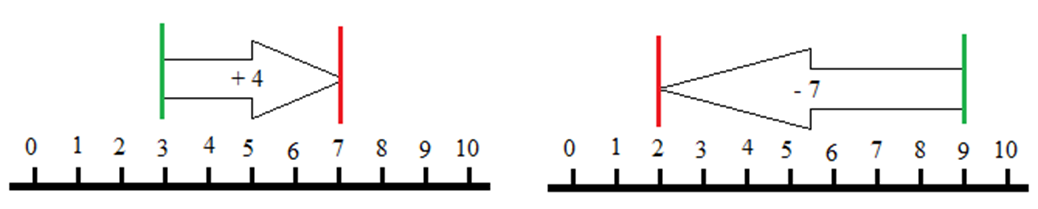
When we add ( + ) or subtract ( - ) numbers, we should think of where we start and finish on a number line. Think of the first number as the starting place. Think of “+” as moving right ( → ), and “–“ as moving left ( ← ). Then think of the second number as the distance. For example:

           3 + 4      start at 3, move right 4               9 – 7     start at 9, move left 7


                          3 + 4 = 7                                                   9 – 7 = 2

Since integers include negative numbers, we can extend the number line and apply the same rules:

        -4 + 6   start at -4, move right 6                      3 – 8   start at 3, move left 8

                      -4 + 6 = 2                                            3 – 8 = -5

You will often see a combination of signs and can consider (A and B are natural numbers):


A – (+B ) | A – (→ B) | A ← B | A – B

4 – (+3) = 4 – 3 = 1


A + ( + B) | A + ( → B) | A → B |  A + B 

4 + (+3) = 4 + 3 = 7


A + (-B)  | A + ( ← B) | A ← B | A – B

4 + (-3) = 4 – 3 = 1


A – ( - B) | A – ( ← B) | A → B | A + B 

4 – (-3) = 4 + 3 = 7

Integers


Exercise set 1: Calculate (express answers as mixed numbers where necessary)


4•(-15) = -60


(-8)(-7) = 56


-12•8 = -96


84÷(-8) =


-56÷7 = -8


(-89)÷(-5) =


-51t•13 = -663t


14g•(-28g) = -392g2


(-15p)(-22v) = 330pv


78÷(-11) =


(-92)÷(-25) =


-62÷27 =


Order of Operations Including Fractions, Integers, and Real Numbers


Exercise set 3:

1.     Alwyn sells twelve hamburgers in the morning for a sale price of ¥35 each. In the evening he sells nine hamburgers at the regular price of ¥45 each. The cost of making each burger is ¥15. If Alwyn gets to keep 30% of the profit, how much money does he earn that day from hamburgers?


2.     Eve draws eight caricatures per day. She charges customers ¥120 each, but her materials only cost her ¥75 for every fourteen that she draws. However, she must pay a weekly concession fee of ¥325. If she works six days per week, how much money would she earn if she works for fifteen weeks?


3.    Dolly ate  of a pizza. Jordan gave  of the pizza to Edward, before eating  of what was left. How much is left now, and who ate the most?


1.     A certain small factory employs 98 workers. Of these, 10 receive a wage of $150 per day and the rest receive $85.50 per day. To the management, a week is equal to 6 working days. How much does the factory pay out for each week?


2.     If the same factory has supplies expenses of $1135.78 a day in addition to the wages above and makes $60,128.72 in a week, what is the factory’s total profit or loss in one week?


3.     A certain Math Club makes 35 bars of laundry soap a week and sells these at $20 each. Before the soap can all be sold, the pupils found out that 6 bars were destroyed by mice. How much will be the total sale at the end of a four-week month? Write an expression and show your work and answer.


4.     Travis goes to the book fair where paperback books are $1.50 and hardback books are $3. Travis buys five paperback and two hardback books. How much change will Travis receive from a $20 bill?


5.     Kim sales necklaces to earn extra money. She charges $10 per necklace for material and $2.75 per hour to make unique gifts. How much would two necklaces cost together if one takes her an hour to make and the other three hours to make?


1.     A certain class raised ¥3500. Jennifer invested the class money. When it was time to use the money, the class had 114% of the original amount. Moon said they should put 20% away for another day. After the class agreed, Charlie spent  of the money that was left on decorations for the class. Ivy spent  of it on snacks for the class. Jack and Jack argued on what to do with the rest. Jack Gao spent 50% of what was left on party games, while Jack Cai spent 90% of his half on math puzzle books for the class, and gave the rest to the teacher to buy more white board markers. If white board markers cost ¥3 for 5, how many markers did Mr. Young buy?


2.    Thompson said  of his class should each bring 63 walnuts, and  the class should each bring as many sunflower seeds as there will be walnuts at the party. Mr. Young said he is on a diet, and will only eat 7% of the sunflower seeds and half as many walnuts. He insisted that if the snacks were to be divided up evenly among the 11 people at the party, then Zoe should get her share plus the remainder of his.

a)       How many walnuts and sunflower seeds does Zoe get?

b)      What is the ratio of Zoe’s walnuts to Neo’s walnuts?

c)       Melise eats as many walnuts as she does sunflower seeds until one of them runs out. How many of the other are left?


2. Comparing and Ordering Integers

Learning outcomes
  • I can compare integers using a number line.
  • I can order integers from least to greatest.
  • I can order integers from greatest to least.
  • I can explain why negative numbers are less than positive numbers.
  • I can solve problems involving integer comparisons.

https://images.openai.com/static-rsc-4/4AgpJ7PpSw4mJjGqS7Y347VdmW0xUHmEk7Mt5aGVcOROTky65hRefAlSjqs1XEXnYM9S4bu1S2_O6REymKFKrwQdJe7735ZXU1KV9z43839Rh3i_jhkz3N_0FBMSnQbJu7WNjYw-fRw1IiPNYwL2kQs805SK2G6209gIw0XFe-LJgXt5oCcOfB44IzV5f0JY?purpose=fullsize
 
https://images.openai.com/static-rsc-4/WWZBwoHFB6Bq2foj0dGr-Gaujo9Sc7dAQrsm6yez4Qf3vH0w48CG5oGIFsHhpQpez73S51u26BjEFG9bP0k9wn2OhgVgAZaC4215S2N5IZWgH12HSwhPkUMfYYxyQpqjdawxVzoa316bMaxdVqo_29ABMZyRDxYZTQBdlKE_d64_QOgR0jPu2pKm0ihUh3RH?purpose=fullsize
 
https://images.openai.com/static-rsc-4/2aQS2LgxTOlCmupqrSuochhrZdrkzwWrsr_6iFWoz4yecH_JXtnVGjmYnm28z763HteMqzOBT9jAtjEFWa098pOW-Clb5lu55SVZFRMAJgRzxXKwJCAXF7V2qVcfUnro3Rb9lHZHuKMtl9zlS9BoJwFTftWAIuXBFJ5zHuLVQSW_9NdRTiSxz_XhOxPk4geG?purpose=fullsize
 
5

What Does It Mean to Compare Integers?

To compare integers means to determine which integer has the greater or smaller value.

For example:

7 > 3

because 7 is greater than 3.

But integers can also be negative:

−2 > −6

This can seem less obvious at first.

A number line provides one of the best ways to understand integer comparisons.


Review: What Are Integers?

Integers include:

  • positive whole numbers
  • negative whole numbers
  • zero

For example:

..., −5, −4, −3, −2, −1, 0, 1, 2, 3, 4, 5, ...

Numbers such as:

2.5, −3.7, 1/2

are not integers.


The Integer Number Line

A number line places integers according to their value.

For example:

−6 −5 −4 −3 −2 −1 0 1 2 3 4 5 6

The most important rule is:

Numbers increase as you move to the right.

Numbers decrease as you move to the left.

https://images.openai.com/static-rsc-4/l1UsHX5RHz1UeLORAy3eNTg9y2w7xHg38mSC0cis74uYwXs1FdQG9SiVjzx81J6B_0wO1-hb_NAFCNTDozWVtbaHM59R2C0KJhcLuyVtf5x94JsSt3n6SwCIBsr097GWlypjSO1TpOKBAGqZscQ9PgEXWo-RL_gRDcACSZLgqwrZ6MdjkzrdDAJtUvp4Hi4S?purpose=fullsize
 
https://images.openai.com/static-rsc-4/bG2Gr7NhXM_xWjj77W27DWt-afmImvi1xQypdi1FZtjVfa7CbXhQ15QXoWVu25P37-a0pimUWfaG0MF6MFS0kV_mkXo4NryA4ZT1DOrasA3eC9B_JIYMaxY_5FLS8m8_zBHxWYPFDtuPZCFSYB94i04J21vzVoamuetN_PhLkNO-Mn_nKbmHVzwJMZtxToSu?purpose=fullsize
 
https://images.openai.com/static-rsc-4/2aQS2LgxTOlCmupqrSuochhrZdrkzwWrsr_6iFWoz4yecH_JXtnVGjmYnm28z763HteMqzOBT9jAtjEFWa098pOW-Clb5lu55SVZFRMAJgRzxXKwJCAXF7V2qVcfUnro3Rb9lHZHuKMtl9zlS9BoJwFTftWAIuXBFJ5zHuLVQSW_9NdRTiSxz_XhOxPk4geG?purpose=fullsize
 
5

Therefore:

The integer farther to the right is greater.


Comparison Symbols

Three symbols are commonly used.

> means greater than

Example:

5 > 2

< means less than

Example:

−4 < 3

= means equal to

Example:

−7 = −7

The open side of the comparison symbol faces the greater value.


Comparing Positive Integers

Positive integers can be compared in the usual way.

Compare:

4 and 9

On the number line, 9 lies farther to the right.

Therefore:

9 > 4

or:

4 < 9


Comparing a Positive and a Negative Integer

Compare:

5 and −3

5 is to the right of zero.

−3 is to the left of zero.

Therefore:

5 > −3

https://images.openai.com/static-rsc-4/aQpLy2uWsz9QhIv3ZnEMxh5O0X-jThZvz6eQqpU3hMCOAVJllfAfu6GRzsnFY98Nw49NtV4p-bjFi_EkeMOycKS8XeXABfDJ2waiNLUliwQBzdonOSsmeT9b-bbgtVFMIIl7rsPbFAw04pcb8mw3a2CpZsb-N6JswHBy74FfSDG4-H0JEPqlmBNPCamzW_M9?purpose=fullsize
 
https://images.openai.com/static-rsc-4/2aQS2LgxTOlCmupqrSuochhrZdrkzwWrsr_6iFWoz4yecH_JXtnVGjmYnm28z763HteMqzOBT9jAtjEFWa098pOW-Clb5lu55SVZFRMAJgRzxXKwJCAXF7V2qVcfUnro3Rb9lHZHuKMtl9zlS9BoJwFTftWAIuXBFJ5zHuLVQSW_9NdRTiSxz_XhOxPk4geG?purpose=fullsize
 
https://images.openai.com/static-rsc-4/4AgpJ7PpSw4mJjGqS7Y347VdmW0xUHmEk7Mt5aGVcOROTky65hRefAlSjqs1XEXnYM9S4bu1S2_O6REymKFKrwQdJe7735ZXU1KV9z43839Rh3i_jhkz3N_0FBMSnQbJu7WNjYw-fRw1IiPNYwL2kQs805SK2G6209gIw0XFe-LJgXt5oCcOfB44IzV5f0JY?purpose=fullsize
 
4

This leads to an important rule:

Every positive integer is greater than every negative integer.


Why Are Negative Numbers Less Than Positive Numbers?

Positive integers lie to the right of zero.

Negative integers lie to the left of zero.

Since values increase as we move right:

negative integer < 0 < positive integer

For example:

−4 < 0 < 6

Therefore:

−4 < 6


Even a Small Positive Number Is Greater

Compare:

1 and −100

The digits in 100 are much larger than the digit in 1.

However, this does not determine the comparison.

−100 is far to the left of zero.

1 is to the right of zero.

Therefore:

1 > −100

The signs matter.


Comparing Negative Integers

Comparing two negative integers requires careful thinking.

Compare:

−3 and −8

On the number line:

−8 is farther left.

−3 is farther right.

Therefore:

−3 > −8

https://images.openai.com/static-rsc-4/CWNfHvI_4UroHvb3y9FrySYt_Rju7elRMAQ0UnViYnylhd53FoI5dw2HP1RwWThK5L780jEIkQVYg3OkZzpthwCzD2M-cFiXzJEQUKLdDypJs1xvRzs_g4a2MLr7woXP6syf32Vl8HgGMKoEKCrUZ6GdMSiFNaAVDOs52e-3DkcK5cqzdiwkRGWGo9onLtlA?purpose=fullsize
 
https://images.openai.com/static-rsc-4/2aQS2LgxTOlCmupqrSuochhrZdrkzwWrsr_6iFWoz4yecH_JXtnVGjmYnm28z763HteMqzOBT9jAtjEFWa098pOW-Clb5lu55SVZFRMAJgRzxXKwJCAXF7V2qVcfUnro3Rb9lHZHuKMtl9zlS9BoJwFTftWAIuXBFJ5zHuLVQSW_9NdRTiSxz_XhOxPk4geG?purpose=fullsize
 
https://images.openai.com/static-rsc-4/WPfbvwK649Q58ZCtLCzU-R61EL4WV7BkZQTSN_QSUNwvUhS5fblx3tktx_DKb883ewE6EDE05gskZGDYGwPc1g-uKK7pjvQnB7XqFaQbuGGCHV6ZujpoMqRU_D_B_a74jkI4iOcr-l9TnbqlLcHxHe2xUludInddofbiFv_WTcgRIBeyUukJ5yOO3sP0JVSQ?purpose=fullsize
 
4

For negative integers:

The number closer to zero is greater.


Why Is −3 Greater Than −8?

Think about temperature.

−3°C

is warmer than:

−8°C

Therefore:

−3 > −8

Or think about money.

A balance of:

−$3

represents a smaller debt than:

−$8

So −3 represents the greater numerical value.


Another Negative Comparison

Compare:

−15 and −6

−6 is closer to zero.

Therefore:

−6 > −15

We can also write:

−15 < −6

Do not simply compare 15 and 6 while ignoring the negative signs.


Comparing with Zero

Zero is greater than every negative integer.

For example:

0 > −5

0 > −100

0 > −1

Zero is less than every positive integer.

For example:

0 < 2

0 < 18

0 < 1,000

https://images.openai.com/static-rsc-4/NNKxpmLo6HMzVHQXBuresDpHqsJGNm71gnmUVKW0yzXrGy_5ThPr2Q9BQYyNlq1UsnYi8eK0n8n29IBzPjiASaSvpjtblqptCyQVlgiz6Vk72wDiOnFchAK3PBfyZdR4fDF8CX_flE5f9DsrX4MiHLspHBGLAbVJ_WRmxvBII_wfceVPZ4XZlKn3pyY_Ow1l?purpose=fullsize
 
https://images.openai.com/static-rsc-4/ngWMqvrDLy_X1_MaBrDwx2gpDY2BwIR2ZOd5_prr90XQeebR5yv98WJxDAVNQQdR0j22l_a8-vf3R6N5Mdf0Uve8LpQKzx9dfSEtI2x9knIf79AuysriMk_eP3TH43VOifx7rzIfLNvh2HZaL5mkIlfVYwPG_mUqzwBUYMno5NTEmjqDocVV9WKlMHo3UjPy?purpose=fullsize
 
https://images.openai.com/static-rsc-4/WPfbvwK649Q58ZCtLCzU-R61EL4WV7BkZQTSN_QSUNwvUhS5fblx3tktx_DKb883ewE6EDE05gskZGDYGwPc1g-uKK7pjvQnB7XqFaQbuGGCHV6ZujpoMqRU_D_B_a74jkI4iOcr-l9TnbqlLcHxHe2xUludInddofbiFv_WTcgRIBeyUukJ5yOO3sP0JVSQ?purpose=fullsize
 
5

Therefore:

negative integers < 0 < positive integers


A Reliable Comparison Strategy

When comparing two integers:

Step 1: Imagine or draw a number line.

Step 2: Locate both integers.

Step 3: Determine which integer is farther to the right.

Step 4: The integer farther right is greater.

This method works for every pair of integers.


Worked Example 1

Compare:

−7 and 4

−7 is left of zero.

4 is right of zero.

Therefore:

−7 < 4


Worked Example 2

Compare:

−9 and −2

−2 is farther right.

Therefore:

−2 > −9

or:

−9 < −2


Worked Example 3

Compare:

0 and −14

Zero is farther right.

Therefore:

0 > −14


Worked Example 4

Compare:

12 and 0

12 is farther right.

Therefore:

12 > 0


Worked Example 5

Compare:

−25 and −30

−25 is closer to zero and farther right.

Therefore:

−25 > −30


Ordering Integers

To order integers means to arrange them according to their numerical value.

Integers can be ordered:

least to greatest

or:

greatest to least

A number line makes both processes easier.

https://images.openai.com/static-rsc-4/176V-Ny2Z_dLWbxPP5m25POPqZCU-HOA8RE9fJdKSizEqpiYo8tuBwNZuD5fQhHoZQuNkfgNWug3n_8Kwu4yUx-koacbCCRCKMoYuPoAgaw7mUiS92FWv1vSRI5Lf04c33ZWpzUbunLaoYVkZL6grLgUpvNurfhp21RDaJojL_-5EcfpG4lKIjm_6CYYV_PT?purpose=fullsize
 
https://images.openai.com/static-rsc-4/WWZBwoHFB6Bq2foj0dGr-Gaujo9Sc7dAQrsm6yez4Qf3vH0w48CG5oGIFsHhpQpez73S51u26BjEFG9bP0k9wn2OhgVgAZaC4215S2N5IZWgH12HSwhPkUMfYYxyQpqjdawxVzoa316bMaxdVqo_29ABMZyRDxYZTQBdlKE_d64_QOgR0jPu2pKm0ihUh3RH?purpose=fullsize
 
https://images.openai.com/static-rsc-4/zBqt12yIfNjmQN_pzN6_WBsPreTZf4hCVPByWNCADtSlhHOjnJnJVZMRS8oZ-qHLqyUakZF7RuGGdbhb7CoMpllOZjCe4I6ti2gNe4aRhmqu58EUxmrh9fSq_jmRKFV24wKFEklPJu-mU4YcX_kpmlhQejNUw-0f7lkS-3AykFzNqaEcMGlWAT_LugaL-Dvt?purpose=fullsize
 
5

Least to Greatest

Least to greatest means:

smallest → largest

On a number line, this means reading:

left → right

For example:

−5, −2, 0, 3, 7

is ordered from least to greatest.

We can write:

−5 < −2 < 0 < 3 < 7


Greatest to Least

Greatest to least means:

largest → smallest

On a number line, read:

right → left

For example:

7, 3, 0, −2, −5

We can write:

7 > 3 > 0 > −2 > −5


Ordering a Mixed Set of Integers

Order from least to greatest:

4, −6, 2, −1, 0

First identify the negative integers:

−6, −1

Then zero:

0

Then positive integers:

2, 4

Therefore:

−6 < −1 < 0 < 2 < 4


Ordering Several Negative Integers

Order from least to greatest:

−3, −12, −5, −1

Think about their positions on the number line.

The number farthest left is:

−12

Then:

−5

Then:

−3

Then:

−1

Therefore:

−12 < −5 < −3 < −1

https://images.openai.com/static-rsc-4/WWZBwoHFB6Bq2foj0dGr-Gaujo9Sc7dAQrsm6yez4Qf3vH0w48CG5oGIFsHhpQpez73S51u26BjEFG9bP0k9wn2OhgVgAZaC4215S2N5IZWgH12HSwhPkUMfYYxyQpqjdawxVzoa316bMaxdVqo_29ABMZyRDxYZTQBdlKE_d64_QOgR0jPu2pKm0ihUh3RH?purpose=fullsize
 
https://images.openai.com/static-rsc-4/9nJ0fYQH37QwCendAPZDYZgRQIN3dGcP0uA5Eq2hsHQ9qg4MN13XjQ2B8A5rbJtBmBKvv6xXuPCx3-dYVW-O6M8qZnTvLpawRYeBzwvSd1S3_Ysg8Kso9f3hIdGmzWCj52BzKIJUw1fSfaOU-RKJtCJ3ZQPl1DP-L5qtnzKepD7giyeAfUDo9gc8J93mYb9H?purpose=fullsize
 
https://images.openai.com/static-rsc-4/zBqt12yIfNjmQN_pzN6_WBsPreTZf4hCVPByWNCADtSlhHOjnJnJVZMRS8oZ-qHLqyUakZF7RuGGdbhb7CoMpllOZjCe4I6ti2gNe4aRhmqu58EUxmrh9fSq_jmRKFV24wKFEklPJu-mU4YcX_kpmlhQejNUw-0f7lkS-3AykFzNqaEcMGlWAT_LugaL-Dvt?purpose=fullsize
 

Ordering from Greatest to Least

Order:

−8, 5, 0, −2, 7, −11

from greatest to least.

Positive integers first:

7, 5

Then:

0

Then negative integers from closest to zero to farthest:

−2, −8, −11

Therefore:

7 > 5 > 0 > −2 > −8 > −11


A Shortcut for Ordering Mixed Integers

For a set containing positive integers, zero, and negative integers:

For least to greatest:

  1. most negative values
  2. negative values closer to zero
  3. zero
  4. small positive values
  5. larger positive values

For greatest to least, reverse the order.


Absolute Value and Integer Comparisons

The absolute value of an integer is its distance from zero.

For example:

|−8| = 8

|5| = 5

https://images.openai.com/static-rsc-4/HpA70yd1SrH7cGlEZTyQutHfraWCZNRHHnuNQ0wypJZndRw0o1cYWcv1uwdRrOtSyjR2VCopO4UdxbhD7VM24ofaR9exZgQnt-Ow9Aj3q84f-D5CHOOe4zhZsJHfCJUqLuMNTEe8dJNcZQaNc1pmbH0v7QraXsRO4SvNmS2rwMiuA11b6UQJTLd2-5sfSbcw?purpose=fullsize
 
https://images.openai.com/static-rsc-4/jDKfkpNzbTBXQrqL4kthebbIf32s-XHOoS38ahoUaja7PQl400k_C4kXEzcNEtAZk-9Jsj0dqG4i-X8FIbW8WGNUkdQIzW6MJX4CjTbk5OQ8QNE_aJJVORUg7qmcQlfTlLClTOOgdb-7XS8iqdq3SRvhUNYqSCYvxOTnxKSQNimlkTzZ7W05YjEeLIPM1cTx?purpose=fullsize
 
https://images.openai.com/static-rsc-4/kPRCIyAhUWliNesgTdF3F-XvdvjWKbIgU7enjfFOmXUE9X4W3Yww9Bm-uZMOSgI18yIWIeuV_elkQBwClwedPFqeOoiFCXTzsi0RDKYnU_eNFtIVsxy7q3EVXZgrBML6mKljJ9_xwtCRB4w24DSqu9UskQc_xhcwxkM6G2Hd7xk6EwDUjZ-jSNlw24XvEIKH?purpose=fullsize
 
4

Be careful:

A greater absolute value does not always mean a greater integer.

For example:

|−8| > |5|

but:

−8 < 5


Opposites and Comparisons

Opposite integers are the same distance from zero but on opposite sides.

Examples:

−4 and 4

−10 and 10

For any positive integer:

n > −n

For example:

8 > −8

because 8 lies to the right of −8.


Number-Line Distance Is Different from Value

Consider:

−12 and 5

−12 is farther from zero:

|−12| = 12

while:

|5| = 5

But:

−12 < 5

So we must distinguish between:

distance from zero

and:

numerical value


Integers in Temperature

Temperature provides a useful real-world example.

Suppose the temperatures are:

−8°C, 4°C, −2°C, 0°C, 6°C

From coldest to warmest:

−8°C < −2°C < 0°C < 4°C < 6°C

https://images.openai.com/static-rsc-4/NiinAoTG6oWFpep-gYCQd53PYmt3iriuBQXLhJjoMFnptjWLsWq9geZ01TlCZBQSBghjtWoIVGgfgZC3esiSYBAW4rJOmgBNqqMA6kXB9ugHvI0fnxF44BjGLoIHET2Il_fFCciZH0zaLbZDWdy0BajbuMiKdv2_AKx_23CZAvXdjN1R6tWLTqnZya-p9wc_?purpose=fullsize
 
https://images.openai.com/static-rsc-4/hdWPSWSBKg7fBOBMo9SaSS6s45ISPR0-c5W9RLOhVmlvyM1gRVg1qlrj608oilwJanhyTkd8CTXuKU-788uNN1mZAf1pD7H2YuEx96bgNuhvx3tkrWDz4wYiRh7-8WuDnK4QhrFEwL4zBOFaKSm7TRgrLuikFIUZwo0Gg8wjFJVC8vCxlQCgzIhWAjLPf4JQ?purpose=fullsize
 
https://images.openai.com/static-rsc-4/5bfAGFR0aLyt_ntn-pOliRAzaGRnk8WUSZpIh5wwB65URMaKLSOa_VVoBrg4qnBrTT8bVn978IAzZ_Dzu2lPZJ0Ytj071VPNb2LDrvr7NbK1339NdMgm9k5L3ks1xzghMAg811lfRo3gzaO8jNZUIXyuaeLzV0ESzLncfMCITjCTUcEe0dEMZ95jQX3LZxJL?purpose=fullsize
 
6

The coldest temperature has the smallest numerical value.


Temperature Problem

Four cities record:

City A: −12°C

City B: −3°C

City C: 5°C

City D: −7°C

Order from coldest to warmest:

−12°C < −7°C < −3°C < 5°C

Therefore:

  • City A is coldest.
  • City C is warmest.

Integers and Elevation

Elevation can be measured relative to sea level.

Suppose:

Location A: +350 m

Location B: −40 m

Location C: +75 m

Location D: −120 m

https://images.openai.com/static-rsc-4/junjONR4_OhaasKxjJYkvHJ-U5uDixWq9KBDzfngRFVUCQuPz1sEShdZ8zuWnnTRoOdDFijhXJ1htEavhidQW-81ox3Z9WoFUn44nRrNzev8_f-5sUaSwuARQ54sE6ZQIUfO2uT5rZBTfZhDcYMoUgFXUP2Z78iHiF3g1wKEGj8m2R22585orrLcyNotpQmO?purpose=fullsize
 
https://images.openai.com/static-rsc-4/Uil1RQNldS7CLYO0XB_R7Yqb-lYa4glqz8Ff-v8YUy5a2bdIPC7QcsqqTs2K5LC2WqLSOSp_3cGQNKUOw-0d93okCowLD5c-s9zWuK6uZD5RWRpluPAnWfWNX0cHZCCmAvdDndWdqWpmDD2di_mzzRRrB5LJxc9RaqM9nCszdPwTSOxYqko58qGgv7gAZghs?purpose=fullsize
 
https://images.openai.com/static-rsc-4/H8cxL9k5v9_ppg_KyxypEVcOQASENl3J9pDGQW9YVVbgQbkR2FLiu2jaYzmkUye35gr7jR9VHnHs0_-lUoEbQAmJWBvgnebv1xe9QYAjqIjtZPpy649AuHGN9b_WCC4x9ROPSUibFMNrxeFoH-BHQGy34RNCNBmaHnG8DCgJD7xNfnSG6t-8N23vSoEJt4ZB?purpose=fullsize
 
4

From lowest to highest:

−120 m < −40 m < 75 m < 350 m


Integers and Depth

Suppose three divers are located at:

−6 m

−15 m

−9 m

Which diver is deepest?

Order:

−15 < −9 < −6

Therefore:

−15 m

represents the deepest position.

The deepest location has the smallest numerical value.


Integers and Money

Integers can represent financial balances or changes.

For example:

+$80

can represent a gain of $80.

−$25

can represent a loss of $25.

$0

can represent no gain or loss.

https://images.openai.com/static-rsc-4/EwU_SHSRJgdexsTH2DP86Ssd5j_jKD4DD3I-FcsaINM8A_8ne1Z3qPgOu_0zPCT584daBqzQrjXJ_aC44UE0ABx-7TojpcZz8QUtjEX6G95U9w_NfnFXn0xAoM2jriq2DrhJ50dE9qIGAfHMVui693eZJSpnYJud8B1R0BG_Je6KMIPL-kTAuTMZ9pYzqGvw?purpose=fullsize
 
https://images.openai.com/static-rsc-4/bLVamVBAfBHsZKFkzL7LPU_-RbgESx32U5hb7yVeezoF6CV4SdlTLwGJrjct_VUnvVjuErOOZui83GeZHPVMQ8EUS4HwlUhHuCr9xWDYbtPOoedvvTcn-kIXbBgQeTFq6wh348tAG39OY9BCOYO0ryPQiG5UCOu-4LG4iIDTheYNJNeLECpDaOdnMEcyQPkG?purpose=fullsize
 
https://images.openai.com/static-rsc-4/FQjxJEVkuPCiUN6sd0wi4ggD8KRgLm2Cy-WSBq5HkmKhiSa1qF69c5Ax7O9w2fkFsANeXlI74Z5PBCy2xzjE8sOvU6eunFXpiwVhkYAitO6Ez2j-SgdjZQP_-hAvNHOD-Q_JTfn9k2MskYVwz_xrx6xS-w-9W5lsoFMBn7ve85Db4mkq9iIBWYKxDRc3auPv?purpose=fullsize
 
5

Comparing Debts

Suppose:

Person A has a balance of:

−$20

Person B has a balance of:

−$75

Numerically:

−20 > −75

Person A's balance is greater because it is closer to zero.


Integer Changes

Suppose a business records:

+$200

−$150

+$75

−$300

$0

Order from least to greatest:

−$300 < −$150 < $0 < +$75 < +$200

The largest loss is represented by the smallest integer.


Integers and Building Floors

Suppose an elevator can stop at:

−3, −2, −1, 0, 1, 2, 3, 4

where:

0 = ground level

Negative floors are underground.

Positive floors are above ground.

https://images.openai.com/static-rsc-4/PX2O0txznf3twIsukbhSv_HcoPt358tSPBvrdp2uMrc0wFnTicECZ1_Z3W-oPZKNcGQGpgLSFlRVGSV437mbiUbqYYBSRz_aZytpRsyUWBVHQNABQ34TlkyQPaFKoPKBMtiGrlNphGJdp83L2cCFksaTeo5kLDhGm9cmqu6td9wdpUeKdz_wL0PPKis23Tgg?purpose=fullsize
 
https://images.openai.com/static-rsc-4/Jd_LQFQw1eDCqoCUmmr41kzDLV-WHQxK_UgNWh8Sadu-ldGSUddcpm9VpKMe88V_-FAt7JsfxW2bAV-DHpZbMCHl_FbuQHweGYwG3qImdo4aCTSLa_ng_-9CE0fc16CDoXveW1zGvidR8oH5_EA0_G9EFWIwxE36xFrHzkmSaeqYBAO1QEQIw3SlWP4XGpTc?purpose=fullsize
 
https://images.openai.com/static-rsc-4/pIoatQbkdVrHsb-nxCVt-F9VJSKBbf-IRtJE48rSXCIaaUx2Mz468-nKB0kwWD7jKhmJy3YAx8Kp-plNTfuaWEOR2CTfM6mBKSvdQWfG0m4Mmn07I0J-keI-PjUDXhLrN6sUT7Oh_8KlEymjpn8CNsW_tToiW4VlaIdDTVzpTozAAPCoeUnLxIbj29b0SI4A?purpose=fullsize
 
5

Floor:

−3

is lower than:

−1

because:

−3 < −1


Integers and Direction

Suppose we define:

east = positive

west = negative

Then:

+8 km

means 8 km east of the starting point.

−5 km

means 5 km west.

Compare:

−5 < 8

The positions can be represented directly on a number line.


Integers and Sports

Some sports use positive and negative values.

In golf, a score relative to par might be:

Player A: −4

Player B: +2

Player C: −1

Player D: 0

Numerically, from least to greatest:

−4 < −1 < 0 < 2

https://images.openai.com/static-rsc-4/4EfwUQG9eTsEVEvhYodRwVbqovJnVe_Zo9xuwYMcGn8sjjcc8hsfTR_jehXfQ9Evq78eCd68pUQCXcYkei2FcWP8Xcp-yDgcxSmFjOO43oBkYSnwwuRGDXbYrUrawZPJEGA1gTAbd7gIG_SGrvnmq2GieQ9EnEL7E9LPsvT_BpvvPwmJaQoU4NDgrGH96P-W?purpose=fullsize
 
https://images.openai.com/static-rsc-4/TxvOXMfBRepRwYzXvUSYBID_WzSW_aZun88ZJO-HudlEpCAJ4suhwBKv1ZGPHIf4ac3TSyVmFZ5AV9Z7pZNwliLp2Y2iK1qsD8tarjC54Ha3G_u-7loHP4Ioe_lxIYNB5gS2mGXKh_iCCJ1L435OgAB5orKlY73drKTs3nCwFYYuNlHnIgMxkVaEmu028RjH?purpose=fullsize
 
https://images.openai.com/static-rsc-4/cUXylFQXrnyfs8ylPmyMdC-3ZknYNoRQG5I3SeAxXY0Twat2ttWcFbR8OX06MJuQhBa2Wm3f7ozs4DS_FmltE3VyrC1cO5ezg5rT3qDJHgjrewirptLAEjqtpKqnVmmjI3ny5APuEZS9iCBaXV2EmeOqLhQ3UlVvRInJlc-gNQBYRNOJYKXOR8OMd8Cv5VMm?purpose=fullsize
 
4

Remember that in some real-world contexts, the numerically greatest value is not necessarily the "best" result. Interpretation depends on the situation.


Worked Example 6: Ordering Temperatures

Order from least to greatest:

3°C, −5°C, 0°C, −1°C, 7°C

Answer:

−5°C < −1°C < 0°C < 3°C < 7°C


Worked Example 7: Ordering Elevations

Order from highest to lowest:

−20 m, 150 m, 0 m, 85 m, −60 m

Answer:

150 m > 85 m > 0 m > −20 m > −60 m


Worked Example 8: Comparing Balances

Account A:

−$45

Account B:

$12

Since every positive number is greater than every negative number:

12 > −45

Therefore, Account B has the greater balance.


Worked Example 9: Comparing Two Negative Values

Compare:

−47 and −52

−47 is closer to zero.

Therefore:

−47 > −52


Worked Example 10: Mixed Integers

Order from least to greatest:

12, −4, −15, 8, 0, −1, 5

Answer:

−15 < −4 < −1 < 0 < 5 < 8 < 12


Finding Missing Integers

Integer comparisons can also be used to determine possible missing values.

Suppose:

−5 < x < 2

and x must be an integer.

Possible values include:

−4, −3, −2, −1, 0, 1

https://images.openai.com/static-rsc-4/YyxiFSH8E3LHskjNm6lfo7vYoHTGZEabwuM2g1Kvb_LEq6tpgecwjux5lxuA4YO62Yoim3l-xLAe7jeW50y-naGLDzNtPskBUITR97a0dCTKfVefB-9L15m04wyEUNJjSrvqcKowpNV_vOhEq26AuKcikZggmWrJPHcZwIeTxoQ2PAF1gq8B52rl488Z9g9F?purpose=fullsize
 
https://images.openai.com/static-rsc-4/hQChn4twVLi_Ujzkakc3uycDhrCVQSuGpd_yNRD86H8BAoQs2a27HySzF_xIW_8iAwOVyLSCu1bVQkoeranYBIRcu_YmDnNOYW527NoRxd_AC5pUVbZhfnFizETozo__iaimJXXykYLQD6TUoskALZcRlPAzDIxMcMNc6ogzgzKfzyrxbK8axpWo6jWeL0PE?purpose=fullsize
 
https://images.openai.com/static-rsc-4/YKAXN0bkBAYe7saU-W8RlEduuNkJjzmDbfMxnLi7aGxEOqX76Z793qMO5UlWqrt25hxC9mIeCQtJlt771EQ3-rpFlSRy7bv19BzjaBA11NyMM7gqgE2dwgtTbZ7vrvkiu4VeNOnZo1gyNuvA-D_tk8cYJqYyQ3A6_BaCYFLw-ymqcjRutq4V2EA-Z1TNZAbM?purpose=fullsize
 

This means x must lie between −5 and 2 on the number line.


Another Missing-Integer Problem

Suppose:

−8 < x < −3

Possible integer values are:

−7, −6, −5, −4

Notice that:

−2

does not satisfy the condition because:

−2 > −3


Reasoning with Integer Comparisons

Consider the statement:

A < B

This means A lies to the left of B on a number line.

If:

A = −7

and:

B = −2

then:

−7 < −2

because −7 lies farther left.

Number-line reasoning helps us explain rather than simply memorize comparison rules.


Real-World Problem 1: Weather

Morning temperature:

−6°C

Afternoon temperature:

2°C

Night temperature:

−4°C

Order from coldest to warmest:

−6°C < −4°C < 2°C


Real-World Problem 2: Ocean Depth

Three objects are located at:

Object A: −35 m

Object B: −12 m

Object C: −48 m

From deepest to shallowest:

−48 m, −35 m, −12 m

https://images.openai.com/static-rsc-4/-7o2VYnH689xA9NNnadAFQf0b59Qmk1g1H29ligdutcSJk4gKWaJ1DQ8GFkRPsHRfHLXR6JOVpynyynw43RyM-djkErDAkxPKo4KciZDyw2HyUszCvmjrRymDaMAMNNVU3Q_njNoBuO02Ud-nQBFHS_TxckTVpuV1Bu0BLPCrf-jnhCckgiI4e6XCrGdg3kE?purpose=fullsize
 
https://images.openai.com/static-rsc-4/umyLeURTO8_9e_SiWNznl5VqcYJ0HLCJnHXrrI2ObghwjQeIF3kIDy6HnOBimXUhBOItsEUYrm3wz4diNJG7DBHjLcUICDWsi7BZphyQiv_nm5zT5bjXibwEjJ5ooPRbt-9pm07rEbFJ5ZbuTDZq5VHKRst93iBg3XYO7UeSbpbne36daBsgM_bsabi7yYsj?purpose=fullsize
 
https://images.openai.com/static-rsc-4/NfvcG8h8-ONqdss1ZI2uB4vThyzjd1aafeR0tHNVBColexeylYGRP6h9HtIdOtbRrx8VWQ5jpd-I0VcbiIoJfvk9dB9YKErZOt5I4v6Pxuivy0TIVJMHvZjadD3XYJ4wtwHoay7a1-pUCx9-wxUoEhKujbYLMNEMZ2Xd6mWncvNbqnWWeC372jrkh0rsgEcn?purpose=fullsize
 
5

Object C is deepest because −48 is the smallest integer.


Real-World Problem 3: Building Floors

Three people are on floors:

A: −2

B: 5

C: −4

Order from lowest to highest:

−4 < −2 < 5

Person C is on the lowest floor.


Real-World Problem 4: Financial Changes

A company records:

Monday: +$120

Tuesday: −$80

Wednesday: −$150

Thursday: +$45

Order the changes from least to greatest:

−$150 < −$80 < +$45 < +$120


Real-World Problem 5: Temperature Records

Five temperatures are:

−2°C, −11°C, 4°C, −6°C, 1°C

The minimum temperature is:

−11°C

The maximum temperature is:

4°C

The values in order are:

−11 < −6 < −2 < 1 < 4


Comparing Integers Without Drawing a Number Line

Once the number-line idea is understood, comparisons can often be made mentally.

Ask:

Are the signs different?

If yes, the positive integer is greater.

Are both positive?

The larger magnitude is greater.

Are both negative?

The integer closer to zero is greater.

Is one number zero?

Zero is greater than any negative integer and less than any positive integer.


Common Mistakes

Mistake 1: Ignoring negative signs

Incorrect:

−10 > −3

because 10 > 3.

Correct:

−10 < −3


Mistake 2: Thinking the negative number with larger digits is greater

Incorrect:

−50 > −8

Correct:

−50 < −8

because −50 lies farther left.


Mistake 3: Thinking zero is negative

Zero is neither positive nor negative.


Mistake 4: Ordering negative integers like positive integers

Incorrect least-to-greatest order:

−2, −5, −9

Correct:

−9, −5, −2


Mistake 5: Confusing value with absolute value

Although:

|−20| > |5|

we still have:

−20 < 5


Error Analysis

A student orders:

−3, −8, −12

from least to greatest.

This is incorrect.

Imagine the number line:

−12 is farthest left.

Then:

−8

Then:

−3

Correct order:

−12 < −8 < −3

https://images.openai.com/static-rsc-4/lj-JGjedkh4HE_jCZWVrVjh0e4_W2fz2YFG0RUTtCHpaMYUmv4zCaP-6OlGPy4h00XEZ1mq61C1BdnlWtFVW8Z7IKzNgV4Y1px1Pazvtt1sOcc-uoJiIbnL_wqtBgK6-VSgTEIP5LdOOi09gkxWJW_buvotr6GcB8r0CTitXE5VpsmnzgnPJudLEq28tyEaC?purpose=fullsize
 
https://images.openai.com/static-rsc-4/g_mmsVwMWDQxdjSV1smhi1LJO3-0aR2DW80V_zP306O1_sfmxBNFVWANU6LGurlZhO6BQdhH66UuA2thoBdjxg_x-G8NIfSo9KW0LhSz8av9E8428OAZ6J4h0WsvBPGl_iEY7EHX0ulGVreA5Yo9XqOZIv5EFHoA7FRs0xCcjyJjrL3C0lhw6q31KYEn1mCn?purpose=fullsize
 
https://images.openai.com/static-rsc-4/zBqt12yIfNjmQN_pzN6_WBsPreTZf4hCVPByWNCADtSlhHOjnJnJVZMRS8oZ-qHLqyUakZF7RuGGdbhb7CoMpllOZjCe4I6ti2gNe4aRhmqu58EUxmrh9fSq_jmRKFV24wKFEklPJu-mU4YcX_kpmlhQejNUw-0f7lkS-3AykFzNqaEcMGlWAT_LugaL-Dvt?purpose=fullsize
 
6

Another Error Analysis

A student says:

−100 > 2

because 100 is greater than 2.

This ignores the signs.

−100 is negative.

2 is positive.

Every positive integer is greater than every negative integer.

Therefore:

−100 < 2


Explaining Your Reasoning

A strong mathematical explanation should say why a comparison is true.

Instead of only writing:

−4 > −9

you could write:

−4 is greater than −9 because −4 lies farther to the right on the number line.

Or:

−4 is closer to zero than −9, so −4 is the greater negative integer.


A Reliable Ordering Strategy

When ordering integers:

Step 1: Identify all negative integers.

Step 2: Identify zero, if present.

Step 3: Identify all positive integers.

Step 4: Imagine their positions on a number line.

Step 5: For least to greatest, read from left to right.

Step 6: For greatest to least, read from right to left.

Step 7: Check negative integers carefully.


Did You Know?

A number line has no beginning or end.

https://images.openai.com/static-rsc-4/NNKxpmLo6HMzVHQXBuresDpHqsJGNm71gnmUVKW0yzXrGy_5ThPr2Q9BQYyNlq1UsnYi8eK0n8n29IBzPjiASaSvpjtblqptCyQVlgiz6Vk72wDiOnFchAK3PBfyZdR4fDF8CX_flE5f9DsrX4MiHLspHBGLAbVJ_WRmxvBII_wfceVPZ4XZlKn3pyY_Ow1l?purpose=fullsize
 
https://images.openai.com/static-rsc-4/FdsK3HkWy7n4n2ciRJbwt2_Vom52C7eM2kPibZIBlgGuAPUQ6oPZTmQ4KUYRMUkW_bfhvOxj31bUjjy_TByI86nRVFsJMO96Epf9rHsTfev8ZWRmN5tyEDc22GdnlZ7Oh6Y91ca4CyCGSshFIiNpNVOAg7TL-0pCL5_LRYIDUbDzwr0KFSGVh__JyP4zikKj?purpose=fullsize
 
https://images.openai.com/static-rsc-4/gEdxR20w6fG7OQPYXTH0LbtzR4M3LRwutceHeRIHtO8B3BDN58IDkP5e1oB-sRWvOCRynWg46ZvB-94eyxfg6_Fje8rSGfLQCHv5mz8JYjL3D5sXoMyMvH3BSx516zsfpDvXhiYQVdckF5L7i0brwlOzbkLY3GWkwbU1_r_nYBFs-cEFCZioiZiQG5O6WpnW?purpose=fullsize
 
5

The integers continue forever in both directions:

..., −1002, −1001, −1000, ...

and:

..., 1000, 1001, 1002, ...

No matter how large a positive integer you choose, a greater integer exists.

No matter how negative an integer is, a smaller integer exists.

This is why the arrows on a number line extend in both directions.


Key Terms

  • Integer: Positive whole number, negative whole number, or zero.
  • Positive integer: Integer greater than zero.
  • Negative integer: Integer less than zero.
  • Zero: Integer that is neither positive nor negative.
  • Compare: Determine which value is greater, smaller, or equal.
  • Order: Arrange numbers according to value.
  • Least: Smallest numerical value.
  • Greatest: Largest numerical value.
  • Number line: Visual representation of numbers according to position and value.
  • Greater than: Larger in numerical value; represented by >.
  • Less than: Smaller in numerical value; represented by <.
  • Absolute value: Distance of an integer from zero.
  • Opposite integers: Integers the same distance from zero on opposite sides.
  • Minimum: Smallest value in a set.
  • Maximum: Greatest value in a set.

Key Relationships

On a number line:

left = smaller

right = greater

For negative and positive integers:

negative < 0 < positive

For example:

−8 < 0 < 5

For two negative integers:

the number closer to zero is greater

For example:

−3 > −10

Opposite integers:

−a < a

when a is positive.

For example:

−7 < 7


Key Takeaways

  • Integers can be compared using their positions on a number line.
  • Numbers increase as you move to the right.
  • Numbers decrease as you move to the left.
  • The integer farther to the right is always greater.
  • Every positive integer is greater than every negative integer.
  • Zero is greater than every negative integer.
  • Zero is less than every positive integer.
  • When comparing two negative integers, the number closer to zero is greater.
  • A large absolute value does not necessarily mean a large numerical value.
  • Least to greatest means arranging integers from smallest to largest.
  • On a number line, least to greatest corresponds to left to right.
  • Greatest to least means arranging integers from largest to smallest.
  • On a number line, greatest to least corresponds to right to left.
  • Negative integers must be ordered carefully because integers farther from zero in the negative direction are smaller.
  • Number-line reasoning is more reliable than comparing digits alone.
  • Integer comparisons can be used with temperatures, elevations, depths, financial balances, building floors, directions, and changes.
  • Real-world context can affect how an integer should be interpreted.
  • Minimum means the smallest numerical value, while maximum means the greatest.
  • Strong mathematical explanations use number-line position or distance from zero to justify comparisons.
  • Comparing and ordering integers provides the foundation for later work with integer addition, subtraction, inequalities, coordinate geometry, algebra, and many real-world mathematical models.


3. Factors, Multiples, and Divisibility

Learning outcomes
  • I can identify factors of a number.
  • I can identify multiples of a number.
  • I can use divisibility rules.
  • I can determine whether one number is a factor of another.
  • I can solve problems involving factors and multiples.

https://images.openai.com/static-rsc-4/JMiuGirBbemHTA4fgVOWTLlsFCX-S8k75lbZCFEN6CVlZ-vVH55cuwJ2wvdONVWVdjbEUbaCIXrk5JsULonlqKwBeFLPxftwRg1KiddznDK-P8tHbG_NiGHmlakcyAFEVTWVZ3sH7GHfxpb9yB87KNtSPbwsHxPM1E8TgW8ndpeQXRKk84n2WJTRzIO4EFqJ?purpose=fullsize
 
https://images.openai.com/static-rsc-4/1nnc5cFViWdcms9JyXo76yOLRU65hNixqtKmvEFfFaZI-uhD1U2viP24qhspMDBPF8reDO021E6e5W3u0sNs2TLyBCw5_leyO_83bSmtpLiLQFHhHtXVUvx5RpSJHwXGlgGDauY9fYB91HhmKvi-Hu9bCeubhie8BMu5phV2rrIBU8x5qOjz8fLY6Ur2WRG7?purpose=fullsize
 
https://images.openai.com/static-rsc-4/LcAFLd5DBPc6HGIpwU3u5P2CYxr83wYmfs_pwU1O9A2Ld653rMbf86_ONPfJDK8NMlKw30uw_eH3XUvgyUsytR3p7BxUjZeSyY1B3f77SYeXM_Y_JkvuX-5-xhf3q9T8BGCrDQb-77oJYEouS205cZozXLz8AXcXPJvemGeGInsw2VcuZ2hvbfxJk3j7AU6C?purpose=fullsize
 
6

What Are Factors and Multiples?

Factors and multiples describe relationships between whole numbers.

Consider:

4 × 6 = 24

From this multiplication fact, we know:

  • 4 is a factor of 24.
  • 6 is a factor of 24.
  • 24 is a multiple of 4.
  • 24 is a multiple of 6.

Factors and multiples are closely connected through multiplication and division.


What Is a Factor?

A factor of a whole number divides that number exactly, leaving no remainder.

For example:

3 is a factor of 12

because:

12 ÷ 3 = 4

with no remainder.

Similarly:

4 is a factor of 12

because:

12 ÷ 4 = 3


Factor Pairs

Factors often come in pairs.

For 12:

1 × 12 = 12

2 × 6 = 12

3 × 4 = 12

Therefore, the factors of 12 are:

1, 2, 3, 4, 6, 12

https://images.openai.com/static-rsc-4/JG-8JS-cgSh7c1v8OtPZSn26J2226AkjFow6xp1w93WyGCy3EvNLaLqEHkRsFBDCpeqr3GULs1JwAQPqWt5IJ_P0grJuHBwriDhyNqLxlvbNrkDgiddxRncL7yBLyK5TKZL2Zoqv0T55L8kOWuD-r8OIPgyoaz3bZ4xAadWK5_5hnze-AjUNeUaqqBhb_MLB?purpose=fullsize
 
https://images.openai.com/static-rsc-4/PnC4YfrlDzwndqrTFiDV0foMzYCpST033yFCUoiqv92bNifxc4s1ZLa2lWtfvdz3SBBFdaXDrVXIBQ6OxLFTk0eMRPb6MKMRQPiZFnwU4lLky7OlL9B0PAD8N3GCIFY-LcacYuOec5f0hPj0JG6SMiyrN4JLoExzfpY3lDSd-NR-XXVa8XXuK4d-OpN8VmpA?purpose=fullsize
 
https://images.openai.com/static-rsc-4/848kUaZsqe75ithD_iQy7HXs6pv1puOUqfkhX82XVw_Li7xSMZ0lUXzGUnyb7K5Nl4Ro3DWL2BJjqWkJY4OMwtir0Sm5GC6Wcgs-MTKVHSDv4miOKCrSbYpyBLI_CGVPNjTiEoXsGhQxCbtbyuFlH4OhKlXD7t9cQe3zvPRU61ZA_GVKO1R_zxMY5FIJFdDz?purpose=fullsize
 
5

Each multiplication equation gives us a factor pair.


Finding Factors Systematically

Suppose we want all the factors of:

24

Start with 1 and test possible divisors.

1 × 24 = 24

2 × 12 = 24

3 × 8 = 24

4 × 6 = 24

Therefore:

Factors of 24 = 1, 2, 3, 4, 6, 8, 12, 24

A systematic approach helps make sure no factors are missed.


Factors Using Division

We can also test factors using division.

Is 5 a factor of 35?

Calculate:

35 ÷ 5 = 7

There is no remainder.

Therefore:

5 is a factor of 35.


When a Number Is Not a Factor

Is 4 a factor of 18?

Calculate:

18 ÷ 4 = 4 remainder 2

Since the division does not produce a whole-number quotient:

4 is not a factor of 18.

https://images.openai.com/static-rsc-4/KpE6nnQJinxADm7f4gzCjFXUIYb2t0cLozDRQVOl1BOcvuToh1chqN50AjQut4K-Vw-_TikCOv4vkQSo_e85uTAADjHfiy9_krAcojuQX0eV586n4axaNiNvnLr6U1SwHofBhxPYkcVPlwbfAtvRppzjqzCvrZKAGX07vwdflGGK7SAL70cWF1kLgQsvAAEH?purpose=fullsize
 
https://images.openai.com/static-rsc-4/pT1AO4vIG7Fwbwd1FDfyZaTAvHHVRUS5OGghjQBFcWvJnOkF8DTdPiUFjoVTwx_glVskQwDkMNqcg3rlkDhd5ZppYOeXmoHW6YcawwpSNfI4o7nlyVRUpRczvXPJoV4_qh0-jHxa14B9dsvsTEGAFejQ_Wh9HA1gVTzkIdsBmXsvplIBVSGHkJZxaLn-BEJU?purpose=fullsize
 
https://images.openai.com/static-rsc-4/Ob-2NgroMvEp8g6HVjvrtHRT9MB7lIwrhpXQqdwFZwsRFm50gdi8gy707nkmT4mRpOlrJCbWXw8blhjkHGeaEox8VvN4kHd7f6JUBO9HXa-PIWpRWWwKQ-KaJS3WVEz0aLu7ksWt3Ys6zDe0jtJMm0CJwIxdKxGsOqj62gp602Y0ryuktsyv13fHmkXiB9iH?purpose=fullsize
 
5

Every Number Has Certain Factors

Every positive whole number has at least:

1 and itself

as factors.

For example:

Factors of 17:

1, 17

Factors of 20 include:

1 and 20

Factors of 100 include:

1 and 100

The number 1 is a factor of every positive whole number.


What Is a Multiple?

A multiple is produced when a number is multiplied by a whole number.

Multiples of 5 include:

5, 10, 15, 20, 25, 30, 35, ...

because:

5 × 1 = 5

5 × 2 = 10

5 × 3 = 15

5 × 4 = 20

and so on.


Multiples Continue Forever

A number has a limited number of positive factors, but it has infinitely many positive multiples.

For example, multiples of 7 include:

7, 14, 21, 28, 35, 42, 49, 56, ...

https://images.openai.com/static-rsc-4/ppmcbyNM2NtT6lOyHR488z9F3BC7YrRB-cOLhkzejdRI2NLLSQmzOqsbZOuIHdvaXesD-SBSfLrogKuJvl7M8PAPWCSOnwCGKfrrABJCvoVjTR8-ESA2_icLHSThFPSZBU_FPix_amD-mGmHZUDaPmJo_cmsgX7LC7DullMwmRNKQq1VTM1JLZC19oePDiLK?purpose=fullsize
 
https://images.openai.com/static-rsc-4/qBBfKB-CY8sHeoyMOxfPVOdccEa2nmK5O7APBA05zlvbH333iS9KEs_H_OCAk8nMVzaia-tPQxcmfyODGlB0U3pDjBL6khrDMsXL2X3hv8LoVG_EHawNLHDRV537VYdV9sj6gfea_7FFwRZivRHtkix-jJlS6BBOAH_uDgRetFF-gD1xLwidq-ZdwKaCXK6b?purpose=fullsize
 
https://images.openai.com/static-rsc-4/Q7_Os5WK2SyoVEhzBMgOJEz5_FSrIzvaZqegW9dm9GKuJOH4aiPsRfWKN5L2yHeLoQi5RPYS9rJdi1P9iyy6ozdhtzPYSgZrNtrwU4bTYCPSH9sdA7rNA3CdqwCeoiaOOJRUjsiGbYPMWJN1yJz3jqislJf84jnAcUFWkBvRzBaaDzw7PsbffX7u57ihBe6N?purpose=fullsize
 
4

There is always another multiple because we can continue multiplying by larger whole numbers.


Multiples on a Number Line

Multiples can be visualized using equal jumps on a number line.

For multiples of 4:

4, 8, 12, 16, 20, 24, ...

Each jump has a size of:

4

This connects multiples with repeated addition.


Factors and Multiples Are Related

Consider:

6 × 8 = 48

This tells us:

6 is a factor of 48

8 is a factor of 48

and:

48 is a multiple of 6

48 is a multiple of 8

The relationship works in both directions.


Factor or Multiple?

Consider the numbers:

5 and 30

Since:

5 × 6 = 30

we can say:

5 is a factor of 30

and:

30 is a multiple of 5

https://images.openai.com/static-rsc-4/9-0qUlhBnfnTsRObSB2is_mLZyFaNKefcrpmsFSu9KI5UuPljT2oVTDw0qbqZyW1FHRJYSKQE7tcB9byVsydmrgq1PlQ-rj0V93WT59Wdma6czsFAl7FcFiUdPXz6hvGyhiHYwAGJSW127YUF-AO5KmaglcIjY1Ah8kiNPCSdNoNqAIoodu0G7AdtI72q1ou?purpose=fullsize
 
https://images.openai.com/static-rsc-4/KulahWJxdbiFTExAaKBsahakaZi1-gAI5z8soK9LhTBtrmT1jlF_mUuNth12u5Cnm4waDXXcrou5GidCT-LXauEn6F6yoYCYqT6bJJVaFjcBarr6ijJA-Wn9ye7qXCU-kWM753rM1oHIOHKhdcf-tf5QOa9hxoGSJdwcUU_KUit70NnarhO9kQNi6KXID05B?purpose=fullsize
 
https://images.openai.com/static-rsc-4/xeC0inJ8v87_nsFFIW2hHOrcQQg1nw4JD3RjijmCuUO5i2hXSvkqHLLrmfjS0RW53Uu_lTsB9-TURMF8ruDh1ghvV2yrA4p0RAQZtn2JHUhgD5ZBOLTfXuJM99rJzsvynnUo-lnqJ3tr0CBDtvIeG1I1qX-HhVyQGRpATObPLU8UvtLT2k1qqXiru2v2ASF5?purpose=fullsize
 
5

The words describe different sides of the same relationship.


Factor Example

Is:

9

a factor of:

72?

Calculate:

72 ÷ 9 = 8

Since the quotient is a whole number:

Yes, 9 is a factor of 72.


Multiple Example

Is:

72

a multiple of:

9?

Since:

9 × 8 = 72

the answer is:

Yes, 72 is a multiple of 9.


What Does Divisible Mean?

A number is divisible by another number if the division produces a whole-number quotient with no remainder.

For example:

24 is divisible by 6

because:

24 ÷ 6 = 4

But:

25 is not divisible by 6

because the division leaves a remainder.


Divisibility and Factors

If:

a number is divisible by another number

then that second number is a factor.

For example:

42 is divisible by 7

so:

7 is a factor of 42

https://images.openai.com/static-rsc-4/VkGWVMbSsjKyXLs2WPDCEtTenQOoGiIu9n_fqi9wnHD1Wqb_16nVV9slhOMBLoTQdvlkWC10deuy1psF7qI-SyUhNtUBaTjM6r6IyhqeJ9-yNpSQftM1YIo7WiWgi9-c-xwjGXksOwR5kQv6ZqL2K82kgMM2CdOJ-1z-jN5UO1jB06e5w9_d_n6Tlz-oUuMc?purpose=fullsize
 
https://images.openai.com/static-rsc-4/hFDCk_tdShr8sxcJHRd-tnTYsmmndfhEELGlatmf7nUR9GjoQYLvXFU73M869WAOGzZA_phAkWSBbXZAxe5jP4FwxLapNmlRyCmOguxCGYvxJQSHML-5QIYxhQmTccAwsZptOSV-KOJHxIqie7lbQEQnZB_E-WoIxoLHVbYj_nRCyqwHl4lqnd2B4Mr-vT1c?purpose=fullsize
 
https://images.openai.com/static-rsc-4/JMiuGirBbemHTA4fgVOWTLlsFCX-S8k75lbZCFEN6CVlZ-vVH55cuwJ2wvdONVWVdjbEUbaCIXrk5JsULonlqKwBeFLPxftwRg1KiddznDK-P8tHbG_NiGHmlakcyAFEVTWVZ3sH7GHfxpb9yB87KNtSPbwsHxPM1E8TgW8ndpeQXRKk84n2WJTRzIO4EFqJ?purpose=fullsize
 
5

Divisibility Rules

Divisibility rules are shortcuts that help determine whether one number divides another exactly.

Instead of performing long division every time, we can examine the digits of the number.

Useful divisibility rules include rules for:

2, 3, 4, 5, 6, 8, 9, and 10


Divisibility Rule for 2

A number is divisible by 2 if its last digit is:

0, 2, 4, 6, or 8

These are even digits.

Examples:

38

ends in 8, so:

38 is divisible by 2

124

ends in 4, so:

124 is divisible by 2

https://images.openai.com/static-rsc-4/o89IEG15SHXPiD83_HMsnb_i7zX9KkQXCU5cu8WVHhpXWLky17lV_gQ3oC3inR4nd6wT_7Wl9lc0x5zsbxP8yXVlP-08wbwbLJ35ZlzEtt6oi62ydvyMpNZbK94pGNTPleAdxlYvxy8DdDcA1U2rqR7mJ8EYFmlPp8d4w2ktEvO8aaM1eSq1o6bB_Ftl5caw?purpose=fullsize
 
https://images.openai.com/static-rsc-4/T8fyWiFidsUmt8jfN3uEDt99H-2yoLfEZvquJSkonPiO4X-32E8px80vR-K0K0MS5eqiy11KX5MS4pzPPjCOtxFcRFQRHKieSgo8qxpslTnafm22j03K9ifLNnDpec11_cWYOTrgtK1KpUatgsI4Xmh6UEOOgV3zEWgvtI-vLe5qc5rSF9qPpH0nZT_fvRHz?purpose=fullsize
 
https://images.openai.com/static-rsc-4/oXSTyilMaWawtno_fHt5N55rcVFSi2sJVquC8pQ14jr8Pna22r0iCx0llFXmD-dgWMyQAx2Qc7_8M651Cpo-pldiRileZsPGlJGaewLWME4TtBelMZTfVRiAIFbX4Ezj_z_SgrDz8JoCkT0mpOwJTw0vxlSE3D5CluZnsuG6u7ab2Rcu3q4hl5iTHPma5HEM?purpose=fullsize
 
6

Divisibility Rule for 3

A number is divisible by 3 if the sum of its digits is divisible by 3.

Consider:

123

Add the digits:

1 + 2 + 3 = 6

Since 6 is divisible by 3:

123 is divisible by 3


Another Rule of 3 Example

Is:

742

divisible by 3?

Add:

7 + 4 + 2 = 13

13 is not divisible by 3.

Therefore:

742 is not divisible by 3


Divisibility Rule for 4

A number is divisible by 4 if the number formed by its final two digits is divisible by 4.

Consider:

316

Look at:

16

Since:

16 ÷ 4 = 4

we know:

316 is divisible by 4


Another Rule of 4 Example

Consider:

742

Look at the final two digits:

42

42 is not divisible by 4.

Therefore:

742 is not divisible by 4


Divisibility Rule for 5

A number is divisible by 5 if its last digit is:

0 or 5

Examples:

35

120

1,005

are all divisible by 5.

But:

127

is not divisible by 5.

https://images.openai.com/static-rsc-4/9ByZPSvgaCsLofVeNveVkJ4Z1Kcf-VTgfFbcQ7ICfLCDOsEzPwbJQgk_PhhGSu36qO31mUA-3S45Fxo-uhYPMm_NPldoGpPOIK--zs0Wk3KhV28uT-or3j64weFXQb9ly4zUkQ4XjxpO9Q-DtOe7f34t3xetyNx6FMyoiYKyAJiIIfiFXpYWl5Nslubetzph?purpose=fullsize
 
https://images.openai.com/static-rsc-4/zHVxemrkOgfBnDbZAvDvrY_TSnP2cMfYdIDxInavpAZWyCv5aZ4iS2DzKnvMSixidyp8btR7KRYOo675f3cKU1Lwf7z8_4uKrMRnRVgMUDqzfUhTIzCTscwULC5lk0e_zKYjYlDjSZp0tRxh-2hqgOo7TpAdL0_y7D0w549gNaWCoyEayv1fYJpGIBO9zeSM?purpose=fullsize
 
https://images.openai.com/static-rsc-4/Pg66N165eCps4sFoN7QGWkJcTldmOkqqsQODxAHFnMJBQkhP9h7unnj8Dk3wAn4LeYIaS2HtIY-x5hEqkLi40fzb_zMxPf-g1ctlNRvUiTOFo-hOC086-rV3E7-lE6GFw6ULe1wb55qz4feeBSdPMjMaWoJUHevXutTExb9IrirbOOZZDKnU5J8uGhimYQHR?purpose=fullsize
 
5

Divisibility Rule for 6

A number is divisible by 6 if it is divisible by:

2 and 3

Both conditions must be true.

Consider:

126

It is even, so it is divisible by 2.

Digit sum:

1 + 2 + 6 = 9

9 is divisible by 3.

Therefore:

126 is divisible by 6


Rule of 6: A Common Mistake

Consider:

27

The digit sum is:

2 + 7 = 9

So 27 is divisible by 3.

However, 27 is not even.

Therefore:

27 is not divisible by 6

Both the 2 rule and the 3 rule must work.


Divisibility Rule for 8

A number is divisible by 8 if the number formed by its last three digits is divisible by 8.

Consider:

2,136

Look at:

136

Since:

136 ÷ 8 = 17

we know:

2,136 is divisible by 8


Divisibility Rule for 9

A number is divisible by 9 if the sum of its digits is divisible by 9.

Consider:

729

Digit sum:

7 + 2 + 9 = 18

18 is divisible by 9.

Therefore:

729 is divisible by 9

https://images.openai.com/static-rsc-4/d9hNHET9sTDyQGh-Ho5V2kh3ig3MV0CR3wiNN_TMapflM_VQGJw-ETLigP6U7kBjQfvMbN_N2TYybI9Wkl9MgLro6I537OvOma_v9Ucf_Sf6o6M-vZk6BIrSZdLr8OqP0431XmoeQ6F9CBQGST7xq4dKIop4qMkkYXfqfOV4SOIC0p6HrYnSLeG1h1S4iCxP?purpose=fullsize
 
https://images.openai.com/static-rsc-4/9OXD8AQN6c8z4CNoDCeKC2ngFYXNgoubx2vx9PrRe5bw-9VOgIwVrYB2GuAin37bfpBfowGnZ0htBfRdYtQ1pPaDWCntm8kXWX5HEpXXUChTxJ7eOD-esxRwSmvaT43vqOSYN0pOXzQpKxLdKS4mDpdSQMUcwe0-xuqn6toeELUQtO54q-qbwcIcsxp5_6aV?purpose=fullsize
 
https://images.openai.com/static-rsc-4/sNsd6f4Ool7LwS8Ev_1ABYvi-sqQr7nkA84YXKNU7OurOcQA6Co0gxoFRsgFoO6EYkv1zGYYeOz4hDk1b3cl4t6Gaz_6JJ-dDAmfZy38K3NKDWSzncf8Dqc4wxx6JPS-1BUv3Cb8Bu9SHJsOQjjbr9N_va9W0PK4lAgtTfYatvQ2sK4osAe0HZ_HbN2gQ_tI?purpose=fullsize
 
5

Divisibility Rule for 10

A number is divisible by 10 if its final digit is:

0

Examples:

40

120

2,350

are divisible by 10.

Numbers such as:

45

126

are not divisible by 10.


Useful Divisibility Rules

  • 2: Last digit is 0, 2, 4, 6, or 8.
  • 3: Sum of digits is divisible by 3.
  • 4: Last two digits form a number divisible by 4.
  • 5: Last digit is 0 or 5.
  • 6: Number is divisible by both 2 and 3.
  • 8: Last three digits form a number divisible by 8.
  • 9: Sum of digits is divisible by 9.
  • 10: Last digit is 0.

These rules make factor testing much faster.


Using More Than One Divisibility Rule

Consider:

360

Is it divisible by 2?

Yes. It ends in 0.

By 3?

3 + 6 + 0 = 9

Yes.

By 4?

Last two digits:

60

Yes.

By 5?

Yes. It ends in 0.

By 6?

Yes. It is divisible by both 2 and 3.

By 8?

360 ÷ 8 = 45

Yes.

By 9?

Digit sum is 9.

Yes.

By 10?

Yes.

https://images.openai.com/static-rsc-4/fPIJ2Qx1Nsv5VtvT6az2A8ucgEgr0uaiGlUhjeEYRGMYQfZfLjERkz4rOgHQu3omHgUFhRFPPuUFSE4hA9IdTXOjMjwKvVAbV4PylPzLxlOKrf4yTxZS6XGQwdNb3zuKIZp873QO62r8uCrV5roVWs0IJIziDbCD-rKN-YHIEI93WY245rAdub4AWjKQkG3X?purpose=fullsize
 
https://images.openai.com/static-rsc-4/RKtch47anhoqqnx9V3aPr2Vmz7l5JxozNULQaLgzsrnuhcVMtMoZlxl1erWREmdCl2uh505GeiSMImp-lq47ftimjarVjNN9dA03jsdJZZBGhVLF-bMpV1JugjSc0FyY8OA8HZ6Z5XsYRJs0cCfvI9IZ4ToxG16WGCTKGNk5fX7WDOVnXPoAZmzVY1EmT9U1?purpose=fullsize
 
https://images.openai.com/static-rsc-4/cWXGPEz7076Fi9zn9s4n16g1rGRXG8qAr72JIdVQ5KPTJRv6zGsubXlUvlput5DReZmA9bhtyt0_soAaqr8sk625mAuwd8n_rPpeb3S-crSCQkIb_QqwExMcnDBlsebbxmkuyD9GjfFs9Wf5SH7MmiqyCeI68Ka0npbBSF7timIlDVNVms7AxizMq95z5FOH?purpose=fullsize
 
4

This tells us many possible factors of 360 without having to test each one using long division.


Factor Trees

Factors can also be represented using a factor tree.

Consider:

24

We could begin:

24 = 4 × 6

Then:

4 = 2 × 2

and:

6 = 2 × 3

So:

24 = 2 × 2 × 2 × 3

or:

24 = 2³ × 3

https://images.openai.com/static-rsc-4/_1V7gEyDMV5PF96g0jfviZI2Kvo04fOGyqDlgZDMkV4_K_SDmxpW-6lmlm3ik6TmGrIowCOHHy1op7GSxBcHl_c9j1Yl9MM1h9IyHnxPH5UDYdstW6jOC2NwdXdhKtR62xZEy4KYWIgaa4__2IafbUjQV__JLirw19EOn2_XXsfpWAlwJftWq_mOnrMEMGYW?purpose=fullsize
 
https://images.openai.com/static-rsc-4/tUekebMb9kVfr7447Z8FVjdsDZfGHcwoUfOWFT9HtMDoS4yXlBxj6reH44Ab3fXRw-nZ96089qFNdhHJZzZLlr4Or8Po1PkYJrgIVmRdfC7JH277-aqO3bPEM4wzLg-ALPgLFHzcF4UtKvxjpGmzrDTSGMczBbkOj1arvA5seXVJ7DHAU60aqh0WVz0gGDPJ?purpose=fullsize
 
https://images.openai.com/static-rsc-4/mpg3kg5dEYuxwG9zj6sB58nwY-EY31b6tfAJPCAd2dH9hnr6KrWVqSDzBMqB_zZr_lAYFWvPG9EtGWIjxirf613ykEOmLJvrkZEB9L6qjKRXMW4-AaVw579AnlubQrgbKdNFbIQHTdLLPQbPqh5z0BZmPViZFN85phyvjKZucj06ZMAfVj9MzLmFscfPvJPC?purpose=fullsize
 
4

This is called prime factorization.


Prime Numbers

A prime number has exactly two positive factors:

1 and itself

Examples:

2, 3, 5, 7, 11, 13, 17, 19

For example, the only factors of 7 are:

1 and 7

Therefore:

7 is prime


Composite Numbers

A composite number has more than two positive factors.

For example:

Factors of 12:

1, 2, 3, 4, 6, 12

Therefore:

12 is composite

https://images.openai.com/static-rsc-4/OF2N-agmegfYkxXLrRUPFfTzvx5eojN_0C0gVROQkw2SEjOLvLY567ySVVKhz1EljE-KKVeZe72ttcJuwwcxKFw-8j8d2CM96iL8UcIZwwg_o_Q6Qhg_CXjK0kIyr4QAJpz1wbZYGlzwA2bttY-9ebnkNOjZd7RJAYOQNORymy0J6pKKYQsCUzQfP1xiC4Cf?purpose=fullsize
 
https://images.openai.com/static-rsc-4/GpgMgNdVnmm802BV1M0DmHUSoqJZ-aYAi3pYeoUdQWh_s8SE7mHrDwrdBJGMyGhgS9q-sfpKHyYe3hluzky9s5LUhxrNb8K47FRTahEaaIK6-fIA7TJZSMLOu4FNQ51XTpdGBZtk3inDH1M7H5eE_FiWr9zYKnzWSaJhnPqQkusUKEOkZs38QCXLNuiIxBJv?purpose=fullsize
 
https://images.openai.com/static-rsc-4/QCo3qg8k0oOw2g8vFZeaBNk6QIGo2XGPnAN9TBcf4GP6o4WFZ5KclpAcHVq-v3usv-I16eEtgxUcdY3sq3ykaTkLvfqdUNfkz5K-3ak5fE5JohMBjQ9Cp6O8JpmMmUFcrF1Zs4LbVGA9jXeN7xLpGKPOhE9UrDZVXQllochH0RUluAGn9eNrA6HFWP55SRZi?purpose=fullsize
 
5

The number:

1

is neither prime nor composite because it has only one positive factor.


Worked Example 1: Find All Factors

Find the factors of:

18

Factor pairs:

1 × 18

2 × 9

3 × 6

Therefore:

Factors of 18 = 1, 2, 3, 6, 9, 18


Worked Example 2: Find Multiples

Write the first six positive multiples of 8.

Calculate:

8 × 1 = 8

8 × 2 = 16

8 × 3 = 24

8 × 4 = 32

8 × 5 = 40

8 × 6 = 48

Answer:

8, 16, 24, 32, 40, 48


Worked Example 3: Test a Factor

Is 7 a factor of 91?

Calculate:

91 ÷ 7 = 13

There is no remainder.

Therefore:

Yes, 7 is a factor of 91.


Worked Example 4: Use a Divisibility Rule

Is:

438

divisible by 3?

Add the digits:

4 + 3 + 8 = 15

15 is divisible by 3.

Therefore:

438 is divisible by 3.


Worked Example 5: Divisibility by 6

Is:

234

divisible by 6?

First test 2:

234 is even.

So yes.

Test 3:

2 + 3 + 4 = 9

9 is divisible by 3.

Therefore:

234 is divisible by 6.


Common Factors

Two or more numbers can share factors.

Consider:

12 and 18

Factors of 12:

1, 2, 3, 4, 6, 12

Factors of 18:

1, 2, 3, 6, 9, 18

Common factors:

1, 2, 3, 6

https://images.openai.com/static-rsc-4/q-vX29y53E99SkSllqjgl58vjvV9kYHAQt3WQu8UIU30rFnkwA49dLViG60JJ7aEzlUBwvLDCOH91IjwilfLnyxKc4T6SSfc-vU7yil5qW3rSuoGqfHFSOdMVevBY1OCMC-iU-6nLjzfWHZYsvlvGZVuR2aWYPB4IKOTuqZSE5lbh5eEsiHEqd8K5Zx8i1Un?purpose=fullsize
 
https://images.openai.com/static-rsc-4/iGjMzFc2hXhILuWWuzBD56R1brRcHq6AomVjHPfHhw32wl_NOYaff7rp0n5aIWKy9b3LdXmuPWk9YuGp0Ca0aPb_EjSYMC0y49mn2TiyzpIXEm8kZC5zpW3fAdkcSvMVOEJRLm_RltX23-gHSf638jmEZKIhX0lNKh464Yd5EsvpHWBDacWsV1RL328uFcuO?purpose=fullsize
 
https://images.openai.com/static-rsc-4/I27YpvEWZtC_xUL10JRO-ga0hNU0cm_9qlU02Audy5VQMMejyqVY3S9j-yf16DHnsFN2MgtLoJ_8KzNT7MB0g7yiGmBQEEjLrMPdUBA7MclWn7piyhMDPBBFKm1KzB-pzlSw-qyVcnI_qHbC35OfzK2OHZGbE4YLD2dTAHt5JzT8wBXZEYj5mjogtLpi3lRJ?purpose=fullsize
 
4

The largest common factor is:

6

This is called the greatest common factor (GCF).


Greatest Common Factor

The greatest common factor is the largest factor shared by two or more numbers.

For example:

Factors of 20:

1, 2, 4, 5, 10, 20

Factors of 30:

1, 2, 3, 5, 6, 10, 15, 30

Common factors:

1, 2, 5, 10

Therefore:

GCF(20, 30) = 10


Common Multiples

Two numbers can also share multiples.

Consider:

Multiples of 4:

4, 8, 12, 16, 20, 24, 28, ...

Multiples of 6:

6, 12, 18, 24, 30, 36, ...

Common multiples include:

12, 24, 36, ...

The smallest positive common multiple is:

12

This is called the least common multiple (LCM).


Least Common Multiple

The least common multiple is the smallest positive multiple shared by two or more numbers.

For example:

Multiples of 5:

5, 10, 15, 20, 25, 30, ...

Multiples of 6:

6, 12, 18, 24, 30, ...

The first common multiple is:

30

Therefore:

LCM(5, 6) = 30

https://images.openai.com/static-rsc-4/a8IehHGCEMiSYxDEIsm3DNYwxHJWE_ApdmZ4yETxFKsx6ztjUBiLJsE7BB8flHHCzQWbMqeE-nWi03kfz96xuL4L-7oqsoxbyOoE7Z-6Oaqkx4NVDoVOtaOKJiU0CeqqQq8n4kgVmICFS8FsBaJX3uuRNV-CFrhWM0_Xx772ciZrMSf1IWVwNpA6Ik-HxGgW?purpose=fullsize
 
https://images.openai.com/static-rsc-4/lcfoz38wS7av9JQ0wEhXXueTBvGpA0tkddDGyybTnyDqQIq60XPQ8TvXaXX-JZ8umzySjqKh3wht3B9U-XdSH5mKF8PWFznL5JKyp024DMOTiOKZN73hMtYtNjogFV_qSuybYa4WqkQnVlN11uOEfGeWWnd6ZThhYCtnDi0IhPkoEIXG7dJfGp5cltvyEk8y?purpose=fullsize
 
https://images.openai.com/static-rsc-4/U-jL9TPan4Vf34t2X7hBfOzn2kpdHe2e-37d-2KCSf-VsZgVgOgqzPf3oX9f-O_ZXqT019pBmjX5ONwAIRmg5qCWT1Rv-TBAeCTdViDXuc6yG5YyULOpZBERBsByz-A0bMVxupwj2UCWqM2c1hlFwdada2jp51JXAYm3Qi79kYyz97xAZhCi6WVCwyPC--Ex?purpose=fullsize
 
4

Factors in Equal Grouping Problems

Suppose:

24 students

must be placed into equal groups with no students left over.

Possible group sizes are factors of 24:

1, 2, 3, 4, 6, 8, 12, 24

For example:

24 ÷ 6 = 4

so groups of 6 are possible.

But groups of 5 are not possible because:

24 ÷ 5

leaves a remainder.


Real-World Problem 1: Arranging Objects

A teacher has:

36 chairs

and wants to arrange them into equal rows.

Possible row sizes must be factors of 36.

Factor pairs:

1 × 36

2 × 18

3 × 12

4 × 9

6 × 6

https://images.openai.com/static-rsc-4/0PASOvtsnwqm0UYOjYrmfDXhFbtRBliCrowCIpGUXTCe9z72qpQMiNWSId1alPbmiNDTlJ551VsMuO2Yiqc4C2fV_A9XpAyvn_BdRU37qs06nddta84gb5K2-m20JmxgRpkOe3zkcHGnsUzGAcHzwRNlZBWQoThBewZ1LeJRaBnhs6yf_aFERexGsjAs0jYZ?purpose=fullsize
 
https://images.openai.com/static-rsc-4/vEQlMIe2emedZP9QhhNy30zSPwkmIRHXn0PblQK8sHKTXacSj73brTo07ygFs66krWXNtCGQ8Aw-nMZelOxO1EiIfCWr2Ad3NlB0DtVPNaFkOwBfg2Qs76GCH86QfHUpoN3SMwldaGzhIVFnBXG6W71OZxqwQzdPg60tJoY9shC2adnwR2XCZ30UTHqx8eGt?purpose=fullsize
 
https://images.openai.com/static-rsc-4/bjncypFHSqCepNDeW2dfA_sbc1m9ImPasiI-_FdW0G9V5QbG47VCv8sQcHYFT4tDEYH0Z9GfQobpEyfUAHSYEVL_Q3XWpwR1MNAYxc9YVUwLG93FqOWbfjeEz-iA7xW8oVdikGqLFaoucVVplgqY8LjYi_JsfWpKpWRO3FrtHi86o_ZYlo0Y-h9Qm0OqR0HL?purpose=fullsize
 

Therefore, possible numbers of chairs per row include:

1, 2, 3, 4, 6, 9, 12, 18, 36


Real-World Problem 2: Packaging

A company has:

48 bottles

and wants to place the same number in each box with none left over.

Could each box contain:

6 bottles?

Calculate:

48 ÷ 6 = 8

Yes.

Therefore:

6 is a factor of 48

and 48 bottles can be packed into:

8 boxes of 6


Real-World Problem 3: Repeating Events

One bus arrives every:

10 minutes

Another arrives every:

15 minutes

If they arrive together now, when will they next arrive together?

Multiples of 10:

10, 20, 30, 40, ...

Multiples of 15:

15, 30, 45, ...

The least common multiple is:

30

Therefore:

They will next arrive together in 30 minutes.

https://images.openai.com/static-rsc-4/KaI9AJCDdRJUmso8kFVEz7iwYaRrVPjiCDZmx46_p85xrAaPc6hT7YTL4dKiiUTDf3LUaGZSKwlKZk1N-I86hnnFEcOortwKVQYpGHWDsVUnfR1vPnN0t-5-ZaIZlstFlgSeKXQUo738eCXFC6-lEmMpjrIy9IGniqKcycKKH3PW_F6nGNwsFrVmBB_XmV-7?purpose=fullsize
 
https://images.openai.com/static-rsc-4/Z3H1dJMNengBrhUrNYmP3Ha_c0gA4yxMJQrXiiobKTOvQmJ27IfE12pD1MfjttnF345yNcsjwscFTj3BdZeJXxgktlZZRLjSNOdNnu3D_s2wkteoO9YGQ9TDXwXwb2_m2bgbDQ2abWEbSsfhrRAoSomDDgRN3iFGGdWePSqXcQlOIYCwHoLNRt48mF23ubby?purpose=fullsize
 
https://images.openai.com/static-rsc-4/7iIMp5Nf5oUtVt_Z62fTRhAdm8yGAFBg8PoaEKqZIdz6LHe-NWiE9_bEywvMy9YnUCLiWrN0d7FFEwSmMdWlCxRGaaCSE9f-cElmTqSsATuNyqORTus0MSATrvZCMPzM8kulRMhOQbaXlcZt98mkuqmADfsIudXhIkx_dGs0XrY0GwLugLfhOmurqgpjlt9k?purpose=fullsize
 
4

Real-World Problem 4: Making Equal Packs

A teacher has:

24 pencils

and:

36 erasers

and wants to make the greatest possible number of identical packs without leftovers.

We need the GCF.

Factors shared by 24 and 36 include:

1, 2, 3, 4, 6, 12

The greatest is:

12

Therefore:

12 identical packs

can be made.

Each pack contains:

24 ÷ 12 = 2 pencils

and:

36 ÷ 12 = 3 erasers


Real-World Problem 5: Flashing Lights

A red light flashes every:

4 seconds

A blue light flashes every:

6 seconds

They flash together now.

When will they next flash together?

Multiples of 4:

4, 8, 12, 16, ...

Multiples of 6:

6, 12, 18, ...

LCM:

12

Therefore:

They will flash together again after 12 seconds.


Recognizing Factor Problems

A problem may involve factors when it asks about:

  • equal groups
  • equal rows
  • arranging objects
  • sharing without leftovers
  • possible dimensions
  • dividing quantities exactly
  • largest identical groups

Questions involving the greatest possible number of equal groups often involve the GCF.


Recognizing Multiple Problems

A problem may involve multiples when it asks about:

  • repeating patterns
  • schedules
  • cycles
  • events occurring together
  • skip counting
  • future times when patterns match

Questions asking when two repeating events will next occur together often involve the LCM.

https://images.openai.com/static-rsc-4/KulahWJxdbiFTExAaKBsahakaZi1-gAI5z8soK9LhTBtrmT1jlF_mUuNth12u5Cnm4waDXXcrou5GidCT-LXauEn6F6yoYCYqT6bJJVaFjcBarr6ijJA-Wn9ye7qXCU-kWM753rM1oHIOHKhdcf-tf5QOa9hxoGSJdwcUU_KUit70NnarhO9kQNi6KXID05B?purpose=fullsize
 
https://images.openai.com/static-rsc-4/l32ibrdPxzj1BYKVXqrr6drP6VzS3zROgSZYxAgQIXbsttij5sBMKGYhgp3rT_WNSoBMSEcmnr5rzNF7BmiQuNmFC2GYVR_KKjFxffrUPHZTTMBeyeSmkCoLNG6c2qs4L03vboYLv9lN48FKFDJZGPtpIkBuTEN08KmjVqSjEOxieV1Fe3ZueF9hHVz0s3dq?purpose=fullsize
 
https://images.openai.com/static-rsc-4/VXt21h1Yc-geWfoWZ-lRTTwA1UkQ9aMEqYTJLcxwAf4Y1rHio3-vzhDBBbOy-fQZVveoNLHO2hsAJUzHS6crPzZTzUli8t-vR4eyGimrh3O0ntcPsCF-nzuLV412NNYxVq3ztdrDrNL6ZWYUWsPi78W03lecCWjE9U9zFBDtruDcouBkt3Kmz2ILJ6-0-s7K?purpose=fullsize
 
5

Factor or Multiple? Example

Consider:

8 and 56

Since:

8 × 7 = 56

we know:

8 is a factor of 56

and:

56 is a multiple of 8

We can also say:

56 is divisible by 8

All three statements describe the same mathematical relationship.


Using Divisibility Rules to Find Factors

Suppose we want to know whether 3 is a factor of:

2,451

Instead of dividing, add the digits:

2 + 4 + 5 + 1 = 12

12 is divisible by 3.

Therefore:

2,451 is divisible by 3

and:

3 is a factor of 2,451

Divisibility rules are particularly useful with large numbers.


Challenge Example

Determine whether:

7,236

is divisible by:

2, 3, 4, 5, 6, 9, and 10

By 2:

Last digit is 6.

Yes

By 3:

7 + 2 + 3 + 6 = 18

Yes

By 4:

Last two digits are 36.

Yes

By 5:

Does not end in 0 or 5.

No

By 6:

Divisible by both 2 and 3.

Yes

By 9:

Digit sum is 18.

Yes

By 10:

Does not end in 0.

No


A Reliable Strategy for Finding Factors

Step 1: Begin with 1.

Step 2: Test whether it divides the number exactly.

Step 3: Record both numbers in the factor pair.

Step 4: Continue testing larger numbers.

Step 5: Stop once the factor pairs begin repeating.

Step 6: List the factors in order.

For:

30

factor pairs are:

1 × 30

2 × 15

3 × 10

5 × 6

So:

Factors = 1, 2, 3, 5, 6, 10, 15, 30


A Reliable Strategy for Finding Multiples

To find multiples:

Step 1: Choose the number.

Step 2: Multiply it by 1, 2, 3, 4, and so on.

For 9:

9 × 1 = 9

9 × 2 = 18

9 × 3 = 27

9 × 4 = 36

9 × 5 = 45

Therefore:

9, 18, 27, 36, 45, ...


Common Mistakes

Mistake 1: Confusing factors and multiples

For:

4 and 20

4 is a factor of 20.

20 is a multiple of 4.


Mistake 2: Forgetting 1 and the number itself

The factors of 10 are:

1, 2, 5, 10

not just:

2 and 5


Mistake 3: Stopping a multiples list

Multiples continue forever.

There is no largest multiple of a positive whole number.


Mistake 4: Thinking 1 is prime

1 has only one positive factor.

A prime number must have exactly two.

Therefore:

1 is neither prime nor composite.


Mistake 5: Using only one test for divisibility by 6

A number must be divisible by:

both 2 and 3

to be divisible by 6.


Mistake 6: Confusing GCF and LCM

GCF involves:

shared factors

LCM involves:

shared multiples


Error Analysis

A student says:

6 is a multiple of 24 because 6 × 4 = 24.

The multiplication fact is correct, but the relationship has been reversed.

Since:

6 × 4 = 24

we know:

6 is a factor of 24

and:

24 is a multiple of 6

https://images.openai.com/static-rsc-4/KulahWJxdbiFTExAaKBsahakaZi1-gAI5z8soK9LhTBtrmT1jlF_mUuNth12u5Cnm4waDXXcrou5GidCT-LXauEn6F6yoYCYqT6bJJVaFjcBarr6ijJA-Wn9ye7qXCU-kWM753rM1oHIOHKhdcf-tf5QOa9hxoGSJdwcUU_KUit70NnarhO9kQNi6KXID05B?purpose=fullsize
 
https://images.openai.com/static-rsc-4/XdYTrmqEWWm_wx1fcAWkLJKkIaKgWFbaKbKvnxgZQ9TW8e7Zackt8hNmhwDYaFhiV2qYSCgbamEquM8AP_nnDyhpItOPPyrCTnMq8-tXxaOB-9S7wF36bbXnk3QpdDvhgthnrv5-8HeZ0BE7jsLlAXSu8cEsbwy2E5QQL36va5pF9c93Wkb9bQUejth8UVlb?purpose=fullsize
 
https://images.openai.com/static-rsc-4/xeC0inJ8v87_nsFFIW2hHOrcQQg1nw4JD3RjijmCuUO5i2hXSvkqHLLrmfjS0RW53Uu_lTsB9-TURMF8ruDh1ghvV2yrA4p0RAQZtn2JHUhgD5ZBOLTfXuJM99rJzsvynnUo-lnqJ3tr0CBDtvIeG1I1qX-HhVyQGRpATObPLU8UvtLT2k1qqXiru2v2ASF5?purpose=fullsize
 
4

Another Error Analysis

A student says:

123 is not divisible by 3 because it does not end in 3, 6, or 9.

This uses the wrong rule.

For divisibility by 3, add the digits:

1 + 2 + 3 = 6

Since 6 is divisible by 3:

123 is divisible by 3

In fact:

123 ÷ 3 = 41


Did You Know?

Divisibility rules work because of the structure of our base-ten number system.

For example, consider:

372

We can write it as:

300 + 70 + 2

For divisibility by 3:

300, 60, and 0

are all divisible by 3, so the remainder depends on the digit sum:

3 + 7 + 2 = 12

Since 12 is divisible by 3:

372 is divisible by 3

https://images.openai.com/static-rsc-4/Vc8UjIdeRUr59hKGYCB1kxErbHggrmWUX0dZT7O0PLTP9xCZlK0S7xcaWpcyf5x2byo9wSZAjtlsDQ8YcSTPC1p1aqYhDCYINQBTVtj5YqNXljfVJdWFL_iLeTNNImHhgKF-zITtF0XdWTec5mg0Lv37gQI1HQWN8DFqTnsdOjz9lIoVxaiQmsFpWEKBBYT5?purpose=fullsize
 
https://images.openai.com/static-rsc-4/Cpw-85p2QAPmVWr6hQJFXg7LlGEjwkhupE3QGey4x0zxYACFeZYgO-IEBgiQ7LX5lnbV1NMjwluvokp0HJrphQBKRp8OPLiewaxFrGPkSCQ0CfoquVJbqYvTJ3tbLm5GkLK7jZgXUMhRSmK6z4x-A-GCl7kCseIS_BJBhSRc_rImTUX2GIkDQZ3geOH4oSbO?purpose=fullsize
 
https://images.openai.com/static-rsc-4/t23vwMCi3KpiOYjZwQ5xPDyQWBp3AayGTc9OcTlDK0a-JTvWZ8YvyRGhIXHood0PFcQxZGGWZSsGQpefOgcslGOdGBGluo9l9ku8tZ8q8vz6VhfJZdfbh09WgPFhaZ0EuD9XHZwYsz7Cvf71g5y_qo1bWHj8k0Z-kyGfvEIKUtoazLdljn_AXXcj9RFvNMd_?purpose=fullsize
 
4

Divisibility rules are not simply tricks; they come from mathematical patterns in place value.


Key Terms

  • Factor: Whole number that divides another whole number exactly.
  • Factor pair: Two factors whose product equals a given number.
  • Multiple: Result of multiplying a number by a whole number.
  • Divisible: Able to be divided exactly without a remainder.
  • Divisibility rule: Shortcut for determining whether a number is divisible by another number.
  • Remainder: Amount left after division when division is not exact.
  • Prime number: Whole number greater than 1 with exactly two positive factors.
  • Composite number: Whole number greater than 1 with more than two positive factors.
  • Prime factorization: Writing a number as a product of prime factors.
  • Factor tree: Diagram used to break a number into factors.
  • Common factor: Factor shared by two or more numbers.
  • Greatest common factor (GCF): Largest factor shared by two or more numbers.
  • Common multiple: Multiple shared by two or more numbers.
  • Least common multiple (LCM): Smallest positive multiple shared by two or more numbers.

Key Relationships

If:

a × b = c

then:

a and b are factors of c

and:

c is a multiple of a and b

For example:

7 × 8 = 56

Therefore:

7 and 8 are factors of 56

and:

56 is a multiple of 7 and 8

Also:

56 ÷ 7 = 8

56 ÷ 8 = 7

so 56 is divisible by both 7 and 8.


Key Divisibility Rules

Divisible by 2: Last digit is 0, 2, 4, 6, or 8.

Divisible by 3: Sum of digits is divisible by 3.

Divisible by 4: Last two digits form a number divisible by 4.

Divisible by 5: Last digit is 0 or 5.

Divisible by 6: Divisible by both 2 and 3.

Divisible by 8: Last three digits form a number divisible by 8.

Divisible by 9: Sum of digits is divisible by 9.

Divisible by 10: Last digit is 0.


Key Takeaways

  • A factor divides another whole number exactly without a remainder.
  • Factors can be found using multiplication pairs or division.
  • Every positive whole number has 1 and itself as factors.
  • A multiple is produced by multiplying a number by a whole number.
  • Positive multiples continue indefinitely.
  • Factors and multiples describe opposite sides of the same multiplication relationship.
  • If 5 is a factor of 30, then 30 is a multiple of 5.
  • A number is divisible by another number when the quotient is a whole number with no remainder.
  • Divisibility rules allow us to test numbers efficiently without performing full division.
  • Divisibility by 2 depends on the final digit.
  • Divisibility by 3 and 9 depends on the sum of the digits.
  • Divisibility by 4 depends on the final two digits.
  • Divisibility by 5 depends on whether the number ends in 0 or 5.
  • Divisibility by 6 requires divisibility by both 2 and 3.
  • Divisibility by 8 can be tested using the final three digits.
  • Divisibility by 10 requires a final digit of 0.
  • Prime numbers have exactly two positive factors.
  • Composite numbers have more than two positive factors.
  • The number 1 is neither prime nor composite.
  • Common factors can be used to find the greatest common factor.
  • Common multiples can be used to find the least common multiple.
  • Factor problems often involve equal groups, arrangements, and sharing without leftovers.
  • Multiple problems often involve repeating events, cycles, and schedules.
  • Factors, multiples, and divisibility form an important foundation for fractions, ratios, prime factorization, algebra, and number theory.

4. Prime Factorization

Learning outcomes
  • I can identify prime and composite numbers.
  • I can find the prime factorization of a number.
  • I can use factor trees to organize factorization.
  • I can express numbers as products of prime factors.
  • I can explain why prime factorization is useful.

https://images.openai.com/static-rsc-4/n8OLuvgQhxE0NRgm_Oi3CsMOBgDbTV-r_07_MQ3ni0SuNy3KlPTSIWkHQDRFWiLNGD_44rzKpbQ11QRplFONiZzgeZnUVOm0itCiTbEm0kv7-FU3hKIcl5ClzLPXOLPVhOFxd8wAP7EcnqFLRAjBgTbRml9q0ZGv3aAQEmVp2MBFWBKauE8pu2Y2Bk-iLwRz?purpose=fullsize
 
https://images.openai.com/static-rsc-4/Uj2VVyIeRPh4yyeLDxRllSv38knctx34PdCZtuyyFX77iRPfGPxJrFP_VzEeE59eeoizxlN2JufRXjeVC5KEg65W63cbULP6OO97sXtaiVnQYsbqEzfTYoWrlC0bLfdKjJsUhTMXtLWQkzWn5Vi9OdGxFdd5PHHws70R8RT2xiTK3VItzhmCL_Ph7tnpe6Gq?purpose=fullsize
 
https://images.openai.com/static-rsc-4/Q5IEoAY_mkG2keY-7nT6ysZjkGpWz1SMN6JjTdBuxdbcCEs5q4iGmchWV28lzyRZUkMiOSFRfIuc0p0bvY97qBTRYzD99mbOpBcoo4z3CTAdw8exM-ZCXMDkZwqB7SjgVjtaOFhgTWCFHCqSDGIVwqbOCuMq6umectM-1vDsMZAqqcvcdAYBFKMyREciOEIa?purpose=fullsize
 
6

What Is Prime Factorization?

Every whole number greater than 1 is either:

  • a prime number, or
  • a composite number.

Composite numbers can be broken into smaller factors. If we continue breaking those factors apart until every factor is prime, we have found the number's prime factorization.

For example:

12 = 2 × 2 × 3

Since 2 and 3 are both prime numbers, this is the prime factorization of 12.

Prime factorization reveals the basic multiplicative structure of a number.


Review: What Is a Factor?

A factor is a whole number that divides another whole number exactly.

For example:

Factors of 12:

1, 2, 3, 4, 6, 12

because each divides 12 without leaving a remainder.

Factor pairs of 12 are:

1 × 12

2 × 6

3 × 4

https://images.openai.com/static-rsc-4/JG-8JS-cgSh7c1v8OtPZSn26J2226AkjFow6xp1w93WyGCy3EvNLaLqEHkRsFBDCpeqr3GULs1JwAQPqWt5IJ_P0grJuHBwriDhyNqLxlvbNrkDgiddxRncL7yBLyK5TKZL2Zoqv0T55L8kOWuD-r8OIPgyoaz3bZ4xAadWK5_5hnze-AjUNeUaqqBhb_MLB?purpose=fullsize
 
https://images.openai.com/static-rsc-4/giykFhanwoHkVviE7LP3STR0Xz4xEYISJ8nI1z-kbO3iVdQIDUiyR8GWB6Slv6p3D-s-wrO_j-k2xz-iEQtk80cFffc_4yEpRy03cBZ7XTjdcBhPXZ9EtHrT-IUm4ibsW0n5j5pNsgDwv-7j79pxk0WMyQqzKXIz3NRVfNrqlPwe-pRd3Rp0Jc_86n8lkGDj?purpose=fullsize
 
https://images.openai.com/static-rsc-4/PnC4YfrlDzwndqrTFiDV0foMzYCpST033yFCUoiqv92bNifxc4s1ZLa2lWtfvdz3SBBFdaXDrVXIBQ6OxLFTk0eMRPb6MKMRQPiZFnwU4lLky7OlL9B0PAD8N3GCIFY-LcacYuOec5f0hPj0JG6SMiyrN4JLoExzfpY3lDSd-NR-XXVa8XXuK4d-OpN8VmpA?purpose=fullsize
 
5

Factors are important because prime factorization involves repeatedly breaking a number into factors.


What Is a Prime Number?

A prime number is a whole number greater than 1 that has exactly two positive factors:

1 and itself

For example, the factors of 7 are:

1 and 7

Therefore:

7 is prime.


Examples of Prime Numbers

The first several prime numbers are:

2, 3, 5, 7, 11, 13, 17, 19, 23, 29, 31, 37, 41, 43, 47

Notice that the numbers become less regular as they increase.

There is no simple repeating pattern that generates all prime numbers.

https://images.openai.com/static-rsc-4/puwJES0DYRr70v3k6Yqh3MB3p5J3PsWmUBraHa2BawTFi5KO5HTBx91nxzEM3Kzs03ooNAz-M0rNi_F50uVGvChNUyO9VNOQ1Vz5WeltckG1-0pQ0Puav1RIq5-vsJsZ4laElUlw0mqgnlKwzD7BPX8db2l_XUQ8Nrm36r18g73z4n5TucaOuJaxP3V58VKN?purpose=fullsize
 
https://images.openai.com/static-rsc-4/uFqO3R6qIFGjwUKMmdpMf8mIkA3Vevvsbw7Fh04sL61pUm9qTAXtgV2PEi0ZbBrl4yBfYi20LOGmcEaPsWppW5oziYQOJLPSHNNSuywWj6SGT8kcp9-LCmd0_8luJRu1EvW93JG39dB8ACThWsdnJhCeYTYMLcZTJfNawMPEcBNMqye-AhXFcbadCjHexiIJ?purpose=fullsize
 
https://images.openai.com/static-rsc-4/GBZqIi9IpLLlOSrRN5aQ-onJQsyKdfVh2H77J7B3W4t59H8N6HPPWzdyW2cWQjw15suIiiDxa9835VkShG1RriwwfSbmISQbuwVoL8lJUBc55d9YgamXz1dlIcg5F3iOglds88USgzHvJMz8EtFVYc5xNhoeJZtM8LvJ3b3I3OaqfKSL0uaHJr_mXL21ITkH?purpose=fullsize
 
4

Is 2 Prime?

Yes.

The factors of 2 are:

1 and 2

Therefore, 2 has exactly two positive factors.

2 is prime.

It is also the only even prime number.

Every other even number greater than 2 is divisible by 2 and therefore has more than two factors.


Is 1 Prime?

No.

The number 1 has only one positive factor:

1

A prime number must have exactly two positive factors.

Therefore:

1 is not prime.

It is also not composite.


What Is a Composite Number?

A composite number is a whole number greater than 1 that has more than two positive factors.

For example, the factors of 12 are:

1, 2, 3, 4, 6, 12

Since 12 has more than two factors:

12 is composite.

https://images.openai.com/static-rsc-4/XU1WQq8eM_-rHjTlN6bFEL2Z9S7dWwkVpLT2kHQpw6Nzp078RqYHG2hdR9xoEo68xmu2vka68vpCjuTaXzROd-xbXOg3daEU0iuhrZKZeKWg8ddVHE5K7K31a_lZCuKkjvcygdz4I7EUpnJDDri5AqrrI-U7icwMxhHypF9E06VtCEZrZbILLYxiBzB8Hppn?purpose=fullsize
 
https://images.openai.com/static-rsc-4/c7qiJh8f0XCDbHC33OxtYDXYy6xhj9R5bsmP9Mr-O80KuygNp5Q30bat_ztDNqgzsDxwGcfVMnEs8IV-DaJr1IrX6mByu2Bgy3mTTLhVuhSyAAHd70iISzuTHmY-rjvv3_7hUHmtqrqvIKpcJVwT6Aoh06Fj-YsvJIKot0Xlftjk5D9zryTaybev7QYjJhQF?purpose=fullsize
 
https://images.openai.com/static-rsc-4/YNZu6xj-sarlu9XPuihZszsT7GRS9tNboHytNGNu0eieTlNmUQ3V6qfwc7zoGZ-rdWf9taOMN0zfMpC1Nov_oXCFFU1IugYY_IS8PGZZGbR-CcTVjrV1QkksiVNuvVK8O0ktTYvg2TkJvjrFQ2oksH1pq1oj6azDV_F4DZaG1PFPrVSDcQwPkplT4D5BuHfB?purpose=fullsize
 
5

Prime, Composite, or Neither?

Every positive whole number can be classified.

1: Neither prime nor composite

2: Prime

3: Prime

4: Composite

5: Prime

6: Composite

7: Prime

8: Composite

9: Composite

10: Composite


How Can We Test Whether a Number Is Prime?

To determine whether a number is prime, test whether smaller prime numbers divide it exactly.

Useful primes to test include:

2, 3, 5, 7, 11, ...

Divisibility rules can make this easier.

For example, consider:

51

Digit sum:

5 + 1 = 6

Since 6 is divisible by 3:

51 is divisible by 3

In fact:

51 = 3 × 17

Therefore:

51 is composite.


Example: Is 29 Prime?

Test possible small prime factors.

29 is not even, so it is not divisible by 2.

Digit sum:

2 + 9 = 11

so it is not divisible by 3.

It does not end in 0 or 5, so it is not divisible by 5.

No smaller prime divides 29 exactly.

Therefore:

29 is prime.


Prime Numbers as Building Blocks

Prime numbers are sometimes called the building blocks of whole numbers.

Why?

Because every composite number can be written as a product of prime numbers.

For example:

18 = 2 × 3 × 3

20 = 2 × 2 × 5

30 = 2 × 3 × 5

42 = 2 × 3 × 7

https://images.openai.com/static-rsc-4/fz3Jpw0rgfEUx0E461oHdL926Q13vQNa3oVjhsf2Jp1xTpCA9UQZ2K88jybr6cXn12F327_0-SJubHynBlU3X9bePj_iYdciTr_y_qNd7YZ78yhSKIvBrMmigZWWN0Cj68FyOvhKsuiSPMnUfoCCJqZc4n3ENrPAj5g8f5xXd2ffGMRVX2F4p0Z8MiERDjF6?purpose=fullsize
 
https://images.openai.com/static-rsc-4/xRaLU17p1UFB8GTcg2dffKeOZX11t2JrXsfps3JqjSUVhNJFkcK5MtwldScgdsmGTQdlQ13H3AWPKCQjPFl1jApOLhFLmh8Iw_C0CP3j3du4GkZVwDjwuVmsaBfE9LPZuTocU6OUBiFLazBQH39RpIZqpn6WPNVyN5lagkRWxma6s9CWqrlVPvXZBP3d90LE?purpose=fullsize
 
https://images.openai.com/static-rsc-4/9FRDxz2VVQswvj07PAQBN9GlbhgNOYP3VhomGiBgbxTAh7Rz_gSmuBnmbAVvsp119i660MVWlI0o-J_eZJ9x8Gwp9v_P656KeNr6YyIcJuBTPy_1Jr_OxgJ_wI33He0UybSF7VAgvHAfC9RlWNgb6_EhCk9Yr6DfvWdXUoe6k0w4YDDL2FkXzSOwZzo2oViA?purpose=fullsize
 
5

What Is Prime Factorization?

The prime factorization of a number is an expression showing that number as a product of prime numbers.

For example:

24 = 2 × 2 × 2 × 3

Every factor on the right is prime.

Therefore:

2 × 2 × 2 × 3

is the prime factorization of 24.


Factor Trees

A factor tree is a diagram used to organize prime factorization.

Start with the number you want to factor.

Break it into any pair of factors.

Then continue breaking composite factors apart until every branch ends with a prime number.

For example, 24 could begin as:

24 = 4 × 6

Then:

4 = 2 × 2

and:

6 = 2 × 3

So the prime factors are:

2, 2, 2, 3

Therefore:

24 = 2 × 2 × 2 × 3

https://images.openai.com/static-rsc-4/_1V7gEyDMV5PF96g0jfviZI2Kvo04fOGyqDlgZDMkV4_K_SDmxpW-6lmlm3ik6TmGrIowCOHHy1op7GSxBcHl_c9j1Yl9MM1h9IyHnxPH5UDYdstW6jOC2NwdXdhKtR62xZEy4KYWIgaa4__2IafbUjQV__JLirw19EOn2_XXsfpWAlwJftWq_mOnrMEMGYW?purpose=fullsize
 
https://images.openai.com/static-rsc-4/tUekebMb9kVfr7447Z8FVjdsDZfGHcwoUfOWFT9HtMDoS4yXlBxj6reH44Ab3fXRw-nZ96089qFNdhHJZzZLlr4Or8Po1PkYJrgIVmRdfC7JH277-aqO3bPEM4wzLg-ALPgLFHzcF4UtKvxjpGmzrDTSGMczBbkOj1arvA5seXVJ7DHAU60aqh0WVz0gGDPJ?purpose=fullsize
 
https://images.openai.com/static-rsc-4/9KHRKpQWKdv2s-hmdzi8LiYJ79sJ_Z51s6iHghctcAFkA9zwYLqZaK0ns0KDtPY_OrTnorWd8BNORokJ6I07nBKjxFG4fJFV-Vimh-duP1X1-dvmcGHQWRAxyz4uW9qtbEg-tk7zr7v4k7lMLYhSczrCP6vwLlqHGRA1hxtKSG2d9_xR4tPxlFGwBm6Zb70C?purpose=fullsize
 
5

Exploring a Factor Tree

A factor tree can begin with different factor pairs and still reach the same prime factors.

For example, explore how 60 can be broken down completely into primes:

 
×××604221535
60 factors into 2 × 2 × 3 × 5.
nnn
 
Give feedback

The important idea is that the final prime factors do not depend on which valid factor pair you choose first.


Factor Tree Example: 36

Start:

36

One possible factor pair is:

36 = 6 × 6

Then:

6 = 2 × 3

and:

6 = 2 × 3

Therefore:

36 = 2 × 3 × 2 × 3

Rearrange:

36 = 2 × 2 × 3 × 3


Different Factor Trees Give the Same Result

We could also start 36 using:

36 = 4 × 9

Then:

4 = 2 × 2

and:

9 = 3 × 3

Therefore:

36 = 2 × 2 × 3 × 3

The same prime factors appear.

https://images.openai.com/static-rsc-4/d-sfHsxu-ZG_4oBRs_cO7kyHAgsf7P8u1Hyb7eevJYNSxr4c3QMX3fozRun3nuohvGxQxblaerKyUbhSfPXx8PzhnDMq97lwXDuteSGptw5el0FMpkV0_Tmkpn_vk6awL3zHtlq9tOgc4-1cjWeWrwBx3uDYSRVdgCd9_dME3jEtSLL-ep21YA1XPd2kDYXv?purpose=fullsize
 
https://images.openai.com/static-rsc-4/MdYGv8PohXuj0ESkZuuBKCsZiOhHYzf4qqhuxgvS_TIfjdmiizLjpbHSnAcg39ljWl8xa_KI7u4QmfArbfPk3UNkhhIEoUJ_c8KQRcnDlulEdjuFS5ASicTvG2YQSfKSYqJ0ilyzI4p_lZivXLnhpJ0YnVkuBj1gNA9pp-T8MppL1uKDggMZp9CrpudTU0le?purpose=fullsize
 
https://images.openai.com/static-rsc-4/CsJFmM-6IpL0FBuVrLCwozKrteSFH1VJ9gpXG28zF8Mr2-wn1EXPCWx6IOMV0Cbbi2eSQ-oBW0DGTL-OJzpZKF9l0cP6Xsoy3orbV0T--cDsRPRSCxfIkdlk24nmXvgLTzISzQwQ1atZ_bGy4LZcISQUig3GHQaNG9WxCJ2t2DZBkcXvZQCoR2DPu8orvGJn?purpose=fullsize
 
6

This is an important property of prime factorization.


How to Build a Factor Tree

Step 1: Write the number at the top.

Step 2: Choose any factor pair.

Step 3: Draw branches to the two factors.

Step 4: Circle or identify factors that are prime.

Step 5: Continue splitting composite factors.

Step 6: Stop when every branch ends in a prime number.

Step 7: Write all the prime factors as a multiplication expression.


Worked Example 1: Prime Factorization of 18

Start with:

18

Choose:

18 = 2 × 9

2 is prime.

9 is composite:

9 = 3 × 3

Both 3s are prime.

Therefore:

18 = 2 × 3 × 3


Worked Example 2: Prime Factorization of 28

Start:

28 = 4 × 7

7 is prime.

Break 4 apart:

4 = 2 × 2

Therefore:

28 = 2 × 2 × 7

Check:

2 × 2 × 7 = 28

Correct.


Worked Example 3: Prime Factorization of 40

Start:

40 = 5 × 8

5 is prime.

Break 8:

8 = 2 × 4

Then:

4 = 2 × 2

Therefore:

40 = 2 × 2 × 2 × 5

https://images.openai.com/static-rsc-4/K05BK2_-DMekJRfewPoJ7o8nWk1T2ooPgXLRh3DP9cSLp1ieSnlEwNugEsdOGTTHs4vMaWr2BOABTqKCO08g2ueg3d3ay2tUdJVqWXWPXAGp_gUNYbQj4qQpZK_rNIolQtbbWmFOXmuCseS2PPdjjU0POBFx2iNmPUXWclMhOTe5w86BYfXDWBlRld8cGgnt?purpose=fullsize
 
https://images.openai.com/static-rsc-4/kJzaX8UgqoUoeAAgjW_rbKZujGQrDMgimvBYvC79YC8tTkDnuBk2Mjt7qvgcT9Sdy19ObR_ZcPqpZFENk4-bg1aY6so_8wDSZw9hVCcEuWaX6PJD8hqCOX8iGaWdst-hvRdD8vEQn9Tufv3OeDUBrbApx0cZZfvcI49Lqfuqqv8ajvxSv9m0OeI6IpVXPyGW?purpose=fullsize
 
https://images.openai.com/static-rsc-4/ijEWFiraoU3lbuz4vd9CWqvcCEBcDQ2ANVH1Iw-KFvp9XHB2AIzDm4wiBDnm0D4IFcZpsgqV6ROGkRodkIeA4YQit3cgFcM7U8kx6NRdqOSYM5lkR5xDtnioyCLnxDXIxYGFfy6HQE6JEffjoYYhsT3xAfoJSu3AjpMj1RrDRSKHuH4ZZOI9D24bR75pMoU6?purpose=fullsize
 
5

Worked Example 4: Prime Factorization of 45

Start:

45 = 5 × 9

5 is prime.

Break 9:

9 = 3 × 3

Therefore:

45 = 3 × 3 × 5

Check:

3 × 3 × 5 = 45


Worked Example 5: Prime Factorization of 72

Start:

72 = 8 × 9

Break 8:

8 = 2 × 4

4 = 2 × 2

Break 9:

9 = 3 × 3

Therefore:

72 = 2 × 2 × 2 × 3 × 3


Writing Prime Factorizations in Order

Prime factors are usually written from smallest to largest.

Instead of:

3 × 2 × 5 × 2

write:

2 × 2 × 3 × 5

For example:

60 = 2 × 2 × 3 × 5

This makes the factorization easier to read and compare.


Using Exponents

Repeated prime factors can be written using exponents.

For example:

2 × 2 × 2 = 2³

and:

3 × 3 = 3²

Therefore:

72 = 2 × 2 × 2 × 3 × 3

can be written as:

72 = 2³ × 3²

https://images.openai.com/static-rsc-4/7wn2ZkKopG8zrpCDfA7U4OTX5Z1DOZqrYhMB8dxMq6kKBW35GjRww34vOv6SpUxj8a-FTy3YkZzK4Y5SCh7wxFDFczbHAZmyVga_XvaK-P9GJuS_aLvRukjvOF5h7LHR39P4kzXFAmQ5PFXGFTJtDDKDAQlZp7Pw7PEpwRgKSmYwePNA-0eWViSjx6z3KMLq?purpose=fullsize
 
https://images.openai.com/static-rsc-4/ZdL2RvVzP1NiQhwMeqIZ4bmXZbGWBijXUG4gqCLN7JTukMeTfqfYn9ZjJPMS8-xo2dPK_89_DTUiricU7Zhfxelo2qJbzlHyXGF7aLK_quKIQ7QhhxK27Pcl2c4lz1C_aSHmgQljBk3Hr9TvCEeMC36n7wDfl2HCezsK35NPZCJBcAJU8IjGcOHfj5gwTCEf?purpose=fullsize
 
https://images.openai.com/static-rsc-4/CGeW-dLXU6ll9ENPUyi_hyq-OLHrebHWgXirYFA7t0oa9RTc2ZVoZUAAQTLI9PYni2Ux6QE6zSH7eao6VTSPm0hZ-WAqQOh9Wqm1dH3tEuDirUSXUKG7WyS4Iaa8BEzEC2Axhw8yKTfS0WHjDGCcGSNVMoEGcs_E9_9adhn9blCNh4w5eTj7MOiqvpfDMFV-?purpose=fullsize
 

Understanding Exponential Form

Consider:

2⁴ × 3

This means:

2 × 2 × 2 × 2 × 3

Calculate:

2 × 2 × 2 × 2 = 16

Then:

16 × 3 = 48

Therefore:

48 = 2⁴ × 3

The exponent tells us how many times the prime factor is repeated.


Prime Factorization of 100

One factor tree could begin:

100 = 10 × 10

Then:

10 = 2 × 5

for each branch.

Therefore:

100 = 2 × 5 × 2 × 5

Rearrange:

100 = 2 × 2 × 5 × 5

Using exponents:

100 = 2² × 5²


Prime Factorization of 120

Start:

120 = 12 × 10

Factor 12:

12 = 3 × 4

4 = 2 × 2

Factor 10:

10 = 2 × 5

Therefore:

120 = 2 × 2 × 2 × 3 × 5

Using exponents:

120 = 2³ × 3 × 5

https://images.openai.com/static-rsc-4/gptazknwqimg3_S_szHqJ3XjDZD9hiTZU2UQFWCJcDWDT3SwORoybkwHrk4TLSwl0vcME_3MQB8MmE8FYLqHAL-pNBNOj0ha4ML6TgFAQonfphjpMZBXvClH3-NAR5yJKjk8ng_QAQF3MwtXl2WvEVFKSq9S7BSgpQLn_rGRJQhqxHAxi9Ind_0B9YZr6Fnn?purpose=fullsize
 
https://images.openai.com/static-rsc-4/7uOTbrLTfGM9C9r9tcaTX54xk08SdHg4LZyBRXCSC8MHagsDurbHzN5ds1FSAxx7O-2FpLJJk0FoGlQvZP0cnh3R-brCXpdnE7aXSCcNxtHEsLC8fhu4Tqf1SeN38rCkjIXqeSLBE7PVamXcnmzciD9grqObhj-2AwN0a_svu3_lUjgADw3fQPRgR8A-asNg?purpose=fullsize
 
https://images.openai.com/static-rsc-4/ydKnV9p_iiange8zQXkfjG_rOmmhUzqQv0yWE4ssJIZNLESg-MQ7XhBkvEEoOPZCvlsBvKL9bojNAxkqOiRLjuXOptCmCg62KOSVJ84C6jLI34zm2YxV3-Y5zY5TiTZ08_hgVJqs9MQiNxYTd1wYjK3lkHnsIJqKlOySU9J6-bI4m4hqIhqqln6e34IJOCJF?purpose=fullsize
 
5

Another Method: Repeated Division

Factor trees are not the only method for finding prime factorization.

We can repeatedly divide by the smallest possible prime.

Consider:

84

Divide by 2:

84 ÷ 2 = 42

Again:

42 ÷ 2 = 21

Now divide by 3:

21 ÷ 3 = 7

Finally:

7 ÷ 7 = 1

So the prime factors are:

2 × 2 × 3 × 7

Therefore:

84 = 2² × 3 × 7


Choosing Prime Divisors

When using repeated division, useful primes to test include:

2, 3, 5, 7, 11, ...

Divisibility rules help identify which prime to try.

For example:

150

is even, so divide by 2:

150 ÷ 2 = 75

75 ends in 5, so divide by 5:

75 ÷ 5 = 15

Again:

15 ÷ 5 = 3

3 is prime.

Therefore:

150 = 2 × 3 × 5 × 5

or:

150 = 2 × 3 × 5²


Checking a Prime Factorization

Always multiply the prime factors back together.

Suppose:

90 = 2 × 3² × 5

Check:

3² = 9

Then:

2 × 9 × 5 = 90

Therefore, the factorization is correct.

https://images.openai.com/static-rsc-4/cdOWCUw9dUhfASpYEYzbkmY6rFNapuVF7Z0GLS5l6a5tzE32ZFOE59KFGgh87BcriAWMXqs3blWhooW-0bekcNWPzSlNv6LZZXn61--9OjzyWOVMtiU6MpuWdJxc13Vj1i4_8qP2DiTmlQdMSBLIKBJNH9NJd_5HL1lxLMDzB0slpAu8qESiiXgr1aYhR_gy?purpose=fullsize
 
https://images.openai.com/static-rsc-4/bFifQh15_eP2zFicBKl9lmyH-39QRgzqmcL0BT4p7IW4BavgB3eeoUU41ZR5sQeQVEjCK4ek2aMKMpsEf1DW5YAvlqNTeAVi5FDUqI5l0i2neY11N5P_c_t1GWFghMSszPq62QcsBFKJZwBGvHASxNLJhrjuP3VSKBA0ITK_sijPAQF_cr6UTRx5pzO8kgsy?purpose=fullsize
 
https://images.openai.com/static-rsc-4/zGhmElnjTVVqO-C41mYeQWApbuo8V1ptHJ6B5-75cqlcuAPeuzAiZC-adND_jd6tploaVbSb9qu-Dj7DgGW-k_wdQxiG0yEG5WEBB0CtKx0DnOdv-R0riLbHfX3rLgAQ004prer0lQjBTfR_SvfxDo5qHRKvxKUcRuZBJTBzc5ftXO9UDRjo_0DxgJ-uP-Qg?purpose=fullsize
 

The Unique Prime Factorization Idea

Consider:

60

We could begin:

60 = 6 × 10

or:

60 = 4 × 15

or:

60 = 3 × 20

Different factor trees are possible.

But when every branch is broken into prime factors, each method gives:

60 = 2 × 2 × 3 × 5

The order might differ, but the prime factors are the same.


Fundamental Theorem of Arithmetic

A major mathematical idea says:

Every whole number greater than 1 can be expressed as a product of prime numbers in essentially one unique way.

"Essentially" means that the order does not matter.

For example:

2 × 3 × 5

and:

5 × 2 × 3

represent the same prime factorization.

This result is called the Fundamental Theorem of Arithmetic.


Why Is Prime Factorization Useful?

Prime factorization helps reveal relationships between numbers.

It can be used to:

  • identify factors
  • find common factors
  • find the greatest common factor
  • find common multiples
  • find the least common multiple
  • simplify fractions
  • work with roots
  • solve number problems
  • study patterns in mathematics
https://images.openai.com/static-rsc-4/Js70oUiO2Ekmault1Sa6HMyVQ35GLqw3lOVm-w28-Q2OqzSofEPmRCz45PTjRzeGWPPy_SGByfxR263rMSnaA8giGp98iXLZCsJ1SCoJS8zFuwmDqfaCQXMroxNQGJSlILTLUW9S-jHrxQKXU-wB51A24iA3x_1Ai47jePfL-2xTcj6tXCB2GPdpqe18A_gd?purpose=fullsize
 
https://images.openai.com/static-rsc-4/jaZJmF0yToJqaUzFrTm5ahyTnKcSw9jCTNzajPzEv6epsYDrou6L_sqQET6Qnn_KEfnk0Ja6Dazvclg3kMZ6LYNeN12WkjauUAufhHHKp9qFxJ3BEM4SympOInO4jtMbBj7m7nV9WE96FAoPt5PjdjXFFzY9_gWQQeuC1bUY7irU2X_osdvj_VraZO9SMeiH?purpose=fullsize
 
https://images.openai.com/static-rsc-4/ADIr1DYxBgU-CN0QK7CmgdotAkgfo2LSkN5FRjY4GzDZ4Z1_vbv49B2XjxXiVFwnCrCLgsXiwbAa-BsOCc9Gbhtt0eOr9Na5QpxPQj7G2FJjq5H7P7tXTstWjsEPh8Vat3NCCwKHejCH-MfbY_hZ-gs_0NxT8AOLAPSZBFrd89YclmDVX_Gl5l-x89TLIuFf?purpose=fullsize
 
6

Using Prime Factorization to Find the GCF

Consider:

24 and 36

Prime factorization of 24:

24 = 2³ × 3

Prime factorization of 36:

36 = 2² × 3²

The prime factors they share are:

2² × 3

Therefore:

GCF = 12


Why the GCF Method Works

Write:

24 = 2 × 2 × 2 × 3

and:

36 = 2 × 2 × 3 × 3

Both numbers contain:

2 × 2 × 3

Therefore:

2 × 2 × 3 = 12

is a common factor.

It is the largest combination of prime factors shared by both numbers.


Using Prime Factorization to Find the LCM

Consider:

12 and 18

Prime factorizations:

12 = 2² × 3

18 = 2 × 3²

For the LCM, include enough prime factors to contain both factorizations:

2² × 3²

Calculate:

4 × 9 = 36

Therefore:

LCM(12, 18) = 36


Prime Factorization and Fractions

Prime factorization can help simplify fractions.

Consider:

18/24

Prime factorizations:

18 = 2 × 3 × 3

24 = 2 × 2 × 2 × 3

Common prime factors include:

2 × 3 = 6

Divide numerator and denominator by 6:

18/24 = 3/4

https://images.openai.com/static-rsc-4/kAudyjpiuia1bXaeXCEmhEdVEqBpt6rGeKesvlLsBaijzKYjkcWnBoG03buAQvSWy3vng2xennOCGJE8fqvE9VY7ukgk47dKULUtptnJNTDQ_DUE0VFhyW29-b4yNhpgY5ESCPCzrJRvePF5w8SWXIEniy1KiM4eEO22eQqsDPLrCPfx3h1OzvTgZD4Ix8Om?purpose=fullsize
 
https://images.openai.com/static-rsc-4/vTZtWSZi-1NH_tEyLlpQ6vdOS0ZfKyFrWC-TZBgC00fPeJ7BL5aL6ulk6dDtiYB_Zp1sXvPckCVHFkwEiwl-dlWkskrgqJd0hAzdoHPZxtrAfIxC9TlU932Y4xohoz9lI9hMcGNLE7CtBCI7Y2Zx9YNYFcBnbttbADxzSWfdZRqfaReRJjEns_Zy8QTY3Z7f?purpose=fullsize
 
https://images.openai.com/static-rsc-4/9uCEhFuymEBFfwemGeSnm1NM19GF5fmuClfTeHw5ZJOxej0u-T7esx_Y24OkHlna_wKPtORkTZEgAL5Rd8yLn57TVWxOHqKI5nEL_pWYbRLPy1fTEwraZZ8RU2URxncTJhGdNY8HHbT_jLY1ByfwVPP3M5HkE-WfkYnn6_WjdJD5GbJMmfANRNJh188ACdRQ?purpose=fullsize
 
5

Prime Factorization and Square Roots

Prime factorization can also help simplify square roots.

Consider:

√36

Prime factorization:

36 = 2² × 3²

Therefore:

√36 = √(2² × 3²)

= 2 × 3

= 6

Prime factors reveal the perfect-square structure of the number.


Recognizing Perfect Squares

Prime factorization can help identify perfect squares.

Consider:

144 = 2⁴ × 3²

Every exponent is even.

Therefore, 144 is a perfect square.

In fact:

144 = 12²

This idea becomes useful in algebra and work with radicals.


Real-World Problem 1: Equal Groups

A teacher has:

48 pencils

and:

60 pens

and wants to create the greatest possible number of identical sets with no items left over.

Prime factorizations:

48 = 2⁴ × 3

60 = 2² × 3 × 5

Common prime factors:

2² × 3 = 12

Therefore:

12 identical sets

can be created.

Each set contains:

48 ÷ 12 = 4 pencils

and:

60 ÷ 12 = 5 pens


Real-World Problem 2: Repeating Events

One machine completes a cycle every:

12 minutes

Another completes a cycle every:

18 minutes

Prime factorizations:

12 = 2² × 3

18 = 2 × 3²

LCM:

2² × 3² = 36

Therefore:

The machines will complete a cycle together every 36 minutes.

https://images.openai.com/static-rsc-4/IrfNHN2Hg-LndSon0xt1SYa8wLeLrK01cMTWylrQrkvLUK-3vxZV0WN4jasxHdKtOqddPMXhNpXMW8TimFm4wUtZ-cpBCKpA8s4GhjisTpj3voB63tkNqSq3cvShSXlvQw7MmFlhUxSKNt5aqyI6oukmFwqldgkSoNGBZSSIxCvcR5A-e_DtVD177CnpYQ7j?purpose=fullsize
 
https://images.openai.com/static-rsc-4/Z3H1dJMNengBrhUrNYmP3Ha_c0gA4yxMJQrXiiobKTOvQmJ27IfE12pD1MfjttnF345yNcsjwscFTj3BdZeJXxgktlZZRLjSNOdNnu3D_s2wkteoO9YGQ9TDXwXwb2_m2bgbDQ2abWEbSsfhrRAoSomDDgRN3iFGGdWePSqXcQlOIYCwHoLNRt48mF23ubby?purpose=fullsize
 
https://images.openai.com/static-rsc-4/rDyNYJ8iCUOJ-GNyXDwJpmojzlMvTDkfU2Mvodze9f4Bha8zDtY71_QQVGHwmrWj_ACuJ75se8_s8jUeN3VQS-tpxP5djnH9mgK-zx07dhuxExviUTJb8CK7nUhEhiD5hklzw-aTINeBDGYlmpPAP5XN6l_9SSOs75ZvLuAOyeuAdK69l-miHXCHCoIvUTrh?purpose=fullsize
 
5

Real-World Problem 3: Arranging Tiles

Suppose:

72 tiles

must be divided into equal groups.

Prime factorization:

72 = 2³ × 3²

This tells us that every factor of 72 can be built from combinations of:

2 × 2 × 2 × 3 × 3

This information can be used to determine possible equal arrangements.


Worked Example 6

Find the prime factorization of:

54

Start:

54 = 6 × 9

Then:

6 = 2 × 3

and:

9 = 3 × 3

Therefore:

54 = 2 × 3 × 3 × 3

Using exponents:

54 = 2 × 3³


Worked Example 7

Find the prime factorization of:

96

Repeatedly divide by 2:

96 ÷ 2 = 48

48 ÷ 2 = 24

24 ÷ 2 = 12

12 ÷ 2 = 6

6 ÷ 2 = 3

3 is prime.

Therefore:

96 = 2 × 2 × 2 × 2 × 2 × 3

or:

96 = 2⁵ × 3


Worked Example 8

Find the prime factorization of:

225

Since it ends in 5:

225 = 5 × 45

Then:

45 = 5 × 9

and:

9 = 3 × 3

Therefore:

225 = 3 × 3 × 5 × 5

or:

225 = 3² × 5²


Worked Example 9

Is 91 prime or composite?

Test small prime factors.

Not divisible by 2.

Digit sum:

9 + 1 = 10

so not divisible by 3.

Does not end in 0 or 5.

Try 7:

91 ÷ 7 = 13

Therefore:

91 = 7 × 13

So:

91 is composite.


Worked Example 10

Find the prime factorization of:

210

We can write:

210 = 21 × 10

Then:

21 = 3 × 7

and:

10 = 2 × 5

Therefore:

210 = 2 × 3 × 5 × 7

All four factors are prime.


Common Mistakes

Mistake 1: Stopping before every factor is prime

For example:

24 = 4 × 6

is a factorization, but not a prime factorization.

Both 4 and 6 are composite.

Continue:

24 = 2 × 2 × 2 × 3


Mistake 2: Including 1 in the prime factorization

Incorrect:

12 = 1 × 2 × 2 × 3

Although mathematically the product is 12, 1 is not prime.

Prime factorization uses only prime factors.


Mistake 3: Thinking 1 is prime

1 has only one positive factor.

Therefore:

1 is neither prime nor composite.


Mistake 4: Thinking every odd number is prime

For example:

9 = 3 × 3

15 = 3 × 5

21 = 3 × 7

These are odd but composite.


Mistake 5: Thinking every even number is composite

Almost true, but:

2

is even and prime.


Mistake 6: Forgetting repeated factors

Incorrect:

24 = 2 × 3

Correct:

24 = 2 × 2 × 2 × 3

Each occurrence of a prime factor must be included.


Error Analysis

A student writes:

36 = 6 × 6

and says this is the prime factorization.

The multiplication is correct, but 6 is not prime.

Continue factoring:

6 = 2 × 3

for both factors.

Therefore:

36 = 2 × 3 × 2 × 3

Rearrange:

36 = 2² × 3²

https://images.openai.com/static-rsc-4/kCgEjFA7WQYh0Y2wWpmI97baiwb8nKx0CitKgnRLOfvWfiAfABPwbbxgmjLHdYKAKLZoL5x5e7I_EapEs3j4ljSMc_eR8SQlDL1-sxNCpNC-6-qTtQC_Wb9qwWf-Nob8v3Xuj04l471R5_BsxvipVVbFQ0ilXf6Hunz5V1gh6UmKbTXzmAj5jmY69ifvAE4T?purpose=fullsize
 
https://images.openai.com/static-rsc-4/91TkFk6HeGdtKG6HAnmovcjeQhQFDzLX3ocy1vUmUPahZFb1QTsFqao6waQtR7CvTAosWDD12vMN4xaiReukx8AFxRkT02bLLlzNrqb2OsoelDjSMYnC4EIsFqso4-rFNLSbysm50iFOJxI6wWpsc-CnuC9iNmVZmsB6pXybj9PCwy3b8u19paTvFtFNqjXe?purpose=fullsize
 
https://images.openai.com/static-rsc-4/JheTboNiloGT1cw97-pGKq5WcVIFGE3y0bGKP-i1bOL9Mod0F26fJTLFhY5OHQb2OeoPDCEJ-SRjVYFKbLanWTF6IHjX5cxOAsre6TCfi8YulQBG9rpJmilNSNfmdAgqB4Flyi4S_38EVWbmLphKwXoltNveaN7ExphLDmk33ZCtRrBOv8uOzp4U2k_RMLSL?purpose=fullsize
 

Another Error Analysis

A student writes:

48 = 2³ × 3

Check:

2³ × 3 = 8 × 3 = 24

This does not equal 48.

The correct prime factorization is:

48 = 2⁴ × 3

because:

2⁴ × 3 = 16 × 3 = 48

Multiplying the prime factors back together is an effective way to check your work.


A Reliable Prime Factorization Strategy

Step 1: Decide whether the number is already prime.

Step 2: If it is composite, choose a factor pair.

Step 3: Break every composite factor into smaller factors.

Step 4: Continue until every factor is prime.

Step 5: List the prime factors from smallest to largest.

Step 6: Use exponents for repeated prime factors if appropriate.

Step 7: Multiply the factors to check your answer.


Choosing an Efficient Factor Pair

Any correct factor pair works, but some choices make the process faster.

For example, to factor:

72

we could choose:

72 = 8 × 9

This is convenient because:

8 = 2 × 2 × 2

and:

9 = 3 × 3

So:

72 = 2³ × 3²

Recognizing familiar factors can make factor trees much faster.


Using Divisibility Rules

Divisibility rules can help choose factors efficiently.

If a number is even:

try 2.

If its digit sum is divisible by 3:

try 3.

If it ends in 0 or 5:

try 5.

For example:

330

is even:

330 = 2 × 165

165 ends in 5:

165 = 5 × 33

Then:

33 = 3 × 11

Therefore:

330 = 2 × 3 × 5 × 11


Did You Know?

Prime numbers continue forever.

There is no largest prime number.

Mathematicians have known this for more than 2,000 years.

https://images.openai.com/static-rsc-4/vxPwa5C_I1wzWd0CHRcd8FDpdjEHS3hJfFh2YfAyip-C4cFkK6wQOCBjaZoLI6wKb2EJ004aNdZF-3vgdp2JSi7PvEr8ffXhwf4NmneheHScZ3WqY3PRaB-AEYTWg_9yxni9XASfXE0LDSAdAJTnr6dLjO1aUqzFfvMkmeJ7xZ9wo-GyTpaRZb834uo8XGK0?purpose=fullsize
 
https://images.openai.com/static-rsc-4/6M-oIhssuEKV_Dbimiq3Ghb0CujbCVUIrdEVwgHpSPTxSQPpxEUhPtmuex7iRdX3pojDFEZJnnlbHbawoXRVqoIp3oJo1WN0F9TJUVkFypMyyJD7FEZdj27YhkId8rg0lrSPwDJyhnIMVKxo7ZF3PoW-IYR2aTLGj90cvAr-y1Yd--Zqg678aa5glV1ECKRB?purpose=fullsize
 
https://images.openai.com/static-rsc-4/fnA4LhDz5QfiyzDqjCyZz2f0jy9wqUxoWQYgjcW1_ouHc7q9umq9VxBFLuh1Q0N2363BQH8BlBX9adzvbGTv8AvUYB8U5VNpnRzh_PNkrReraJJcjyZBhU-pteUiWRS1PQse7Y-pWaGMwajNEZ17YRgdToJnbF7onl_7mxl8nB0_VYxGGuZZgX_Dybg2gaY_?purpose=fullsize
 
5

Prime numbers also play an important role in modern computing.

Some encryption systems use mathematical problems involving very large prime numbers and their products. Multiplying large primes is straightforward for computers, while reversing certain large-number problems can be much more difficult.

This makes prime numbers useful far beyond classroom mathematics.


Key Terms

  • Factor: Whole number that divides another whole number exactly.
  • Prime number: Whole number greater than 1 with exactly two positive factors.
  • Composite number: Whole number greater than 1 with more than two positive factors.
  • Prime factor: Factor that is also a prime number.
  • Prime factorization: Expression of a whole number as a product of prime numbers.
  • Factor pair: Two factors whose product equals a given number.
  • Factor tree: Diagram showing repeated factorization until only prime factors remain.
  • Exponent: Number showing how many times a factor is multiplied by itself.
  • Product: Result of multiplication.
  • Divisibility: Whether one number divides another exactly.
  • Greatest common factor (GCF): Greatest factor shared by two or more numbers.
  • Least common multiple (LCM): Smallest positive multiple shared by two or more numbers.
  • Fundamental Theorem of Arithmetic: Principle that every integer greater than 1 has a unique prime factorization apart from the order of its factors.

Key Relationships

Prime number:

exactly two positive factors

Composite number:

more than two positive factors

Prime factorization example:

24 = 2 × 2 × 2 × 3

Exponential form:

24 = 2³ × 3

Another example:

180 = 2² × 3² × 5

To check:

4 × 9 × 5 = 180


Key Takeaways

  • Prime numbers have exactly two positive factors: 1 and themselves.
  • Composite numbers have more than two positive factors.
  • The number 1 is neither prime nor composite.
  • The number 2 is the only even prime number.
  • Not every odd number is prime.
  • Prime numbers are the basic multiplicative building blocks of whole numbers.
  • Prime factorization expresses a number as a product containing only prime factors.
  • Factor trees provide a visual way to organize prime factorization.
  • A factor tree is complete only when every final branch is prime.
  • Different factor trees for the same number produce the same collection of prime factors.
  • Prime factors are usually written from smallest to largest.
  • Repeated prime factors can be written efficiently using exponents.
  • Divisibility rules can help identify useful factors quickly.
  • Repeated division provides another method for finding prime factorization.
  • Multiplying the prime factors back together is an effective way to check an answer.
  • Every whole number greater than 1 has a unique prime factorization apart from the order of its factors.
  • Prime factorization can be used to find common factors and the GCF.
  • Prime factorization can be used to find common multiples and the LCM.
  • Prime factorization can help simplify fractions.
  • Prime factorization can help identify and simplify perfect squares and roots.
  • Prime factorization is useful in number theory, algebra, computing, and many other areas of mathematics.
  • Understanding prime factorization provides an important foundation for later work with fractions, ratios, roots, exponents, algebra, and divisibility.


5. Greatest Common Factor and Least Common Multiple

Learning outcomes
  • I can determine the greatest common factor of two or more numbers.
  • I can determine the least common multiple of two or more numbers.
  • I can use prime factorization to find GCF and LCM.
  • I can solve problems involving shared factors and multiples.
  • I can apply GCF and LCM to real-world situations.

https://images.openai.com/static-rsc-4/6oMfARXWlGFnqlmbkbdxiC1nVnlpGCdVnc7lm8EAr1NrDB0FO6NcP1O53eBxuZIV-kbtsMWhax2njph62xLcExR19dgHLIOzFDZurERS8svipB2r_Zun57Yu4h9EfrEIYdYwqDDKghZjGbZ3hH80RXST3TAudeXEzzHhcJeoIrDznZyediMW2gHo1zwFDiRu?purpose=fullsize
 
https://images.openai.com/static-rsc-4/ToAuc4BJz-TjLGU_tYtWbGmmea_9oKuPBL3Oth0vTsCXUknW_BGQL6h6RRO-Y0TPvCmCQkK1jB-6bAN2-DR3h-Xoja6vrNpyHKRCo1J1f9DlX6pBdcWUsCiXkSjyaCsfTeMWqcTvgW5ayuRBc6aASHLR8FRjTV3vtIy3xCnut3KhsgzW780v6eJMrxiUrvs8?purpose=fullsize
 
https://images.openai.com/static-rsc-4/jaZJmF0yToJqaUzFrTm5ahyTnKcSw9jCTNzajPzEv6epsYDrou6L_sqQET6Qnn_KEfnk0Ja6Dazvclg3kMZ6LYNeN12WkjauUAufhHHKp9qFxJ3BEM4SympOInO4jtMbBj7m7nV9WE96FAoPt5PjdjXFFzY9_gWQQeuC1bUY7irU2X_osdvj_VraZO9SMeiH?purpose=fullsize
 
5

Factors and Multiples: A Quick Review

The greatest common factor (GCF) and least common multiple (LCM) are based on two ideas we have already studied: factors and multiples.

A factor divides a number exactly.

For example, the factors of 12 are:

1, 2, 3, 4, 6, 12

A multiple is produced by multiplying a number by whole numbers.

Multiples of 12 include:

12, 24, 36, 48, 60, ...

GCF looks for factors that numbers share.

LCM looks for multiples that numbers share.


What Is a Common Factor?

A common factor is a factor shared by two or more numbers.

Consider:

12 and 18

Factors of 12:

1, 2, 3, 4, 6, 12

Factors of 18:

1, 2, 3, 6, 9, 18

Common factors:

1, 2, 3, 6

https://images.openai.com/static-rsc-4/75Q5modprUQhPQUMk50r6YatGlecCszQKF2ROhCLMmjS12M7tAL9xMVMNEA7erp0k5_s8XurNkcR1vay1IFq3jmckg5go2XDjqj9BxLDrdeYeGq6eaCLT4toaNVunDvhknj0aRvgqFuI5RDlmjznzVKkOE_f4QzmnDeoX5Vz6OlfVvJxkgVA9xHoPksZUuye?purpose=fullsize
 
https://images.openai.com/static-rsc-4/I27YpvEWZtC_xUL10JRO-ga0hNU0cm_9qlU02Audy5VQMMejyqVY3S9j-yf16DHnsFN2MgtLoJ_8KzNT7MB0g7yiGmBQEEjLrMPdUBA7MclWn7piyhMDPBBFKm1KzB-pzlSw-qyVcnI_qHbC35OfzK2OHZGbE4YLD2dTAHt5JzT8wBXZEYj5mjogtLpi3lRJ?purpose=fullsize
 
https://images.openai.com/static-rsc-4/CbEZzjE7mknMNT1vge_m0FPhQRUD7e6tpmGzY58t1DKCKNiK5L0RSPW7W2FGAWo0sD6fhNKBihsRVLqpGa4maGAXde9YsYkNHQbPbD3d8tXicCd70gsNlb1faLXHNJKabvZi77l4DjCNtmCRPN0H0nE-H9HiIk1GzJjqcI-FMICmmAE92ehAfLQQKQ-8BvXM?purpose=fullsize
 
5

The greatest of these common factors is:

6

Therefore:

GCF(12, 18) = 6


What Is the Greatest Common Factor?

The greatest common factor (GCF) is the largest positive factor shared by two or more numbers.

It may also be called:

  • greatest common divisor (GCD)
  • highest common factor (HCF)

These terms describe the same basic idea.

For example:

GCF(20, 30) = 10

because 10 is the largest number that divides both 20 and 30 exactly.


Finding the GCF by Listing Factors

One method is to list all the factors.

Find:

GCF(24, 36)

Factors of 24:

1, 2, 3, 4, 6, 8, 12, 24

Factors of 36:

1, 2, 3, 4, 6, 9, 12, 18, 36

Common factors:

1, 2, 3, 4, 6, 12

The greatest common factor is:

12

Therefore:

GCF(24, 36) = 12


Checking a GCF

If 12 is the GCF of 24 and 36, it must divide both numbers exactly.

Check:

24 ÷ 12 = 2

36 ÷ 12 = 3

Both quotients are whole numbers.

Therefore, 12 is a common factor.

Since there is no larger common factor:

GCF = 12


What Is a Common Multiple?

A common multiple is a multiple shared by two or more numbers.

Consider:

4 and 6

Multiples of 4:

4, 8, 12, 16, 20, 24, 28, 32, 36, ...

Multiples of 6:

6, 12, 18, 24, 30, 36, ...

Common multiples include:

12, 24, 36, ...

https://images.openai.com/static-rsc-4/Dy4gS2yO7-Za-4xfJAY0IhcDz_0442HaCXDk1buapsdx_04yiC_ksJVBuWXH4hwCPEGa8CW42anhN-O-jP5cIVjm2oc0GEeY0JYM04fAiSUMcDtTjOan-pIx6rXP66gp5C3k1V9IlaCXobmk7_XtGhIzXNfuTrv_eV51QOyPX5fpXQeVgFTfz3WEo8fWS6tB?purpose=fullsize
 
https://images.openai.com/static-rsc-4/LUccn_bXSa_9YQcK9-_1fEasEKczTAwgqCX8r253OoONWQFxEe2XCI5Peyx0BJYGDX7_sAgCujNAqJBYPJ3JmETBuG_ga68kB-XXc6jHck2wBPK7jrxTNics5SFR5mvewAVmh-wYp-epndRLWeIF-BZDcKTgIEoSCFE0pLbX9JZ_dY90Dws5ZeRGhfEdxKUe?purpose=fullsize
 
https://images.openai.com/static-rsc-4/JOFQQ8ZxwBEWyT3mvzleQkAvif-7fgQeBDJbZd2DZkzAmvebdbvZDpppyYgWJcR6MF6SulrGGN0FChsVLuVhYMALCeTx3qEAHYmoopAFgSODrGzbHqdm5w8gZBtszj3HfgMhPRbU_R1RLrPxz6PT9zc75BdUiJvKv2ZA5AGw8BJsH45kBLnOv2c9wsWQIkeU?purpose=fullsize
 
5

The smallest positive common multiple is:

12

Therefore:

LCM(4, 6) = 12


What Is the Least Common Multiple?

The least common multiple (LCM) is the smallest positive multiple shared by two or more numbers.

For example:

Multiples of 5:

5, 10, 15, 20, 25, 30, ...

Multiples of 6:

6, 12, 18, 24, 30, ...

The first positive number appearing in both lists is:

30

Therefore:

LCM(5, 6) = 30


Finding the LCM Using a Number Line

Multiples can also be represented as equal jumps on a number line.

For example, compare multiples of 4 and 6:

 
LCM(4,6)=12\text{LCM}(4,6)=12
3 jumps of 4 and 2 jumps of 6 meet at 12
AAA
 
BBB
 
Give feedback

The first positive landing shared by both sequences gives the LCM.

This helps show that the LCM is not just a calculation—it is the first point at which two repeating patterns meet.


GCF and LCM Are Different

GCF asks:

What is the largest factor the numbers share?

LCM asks:

What is the smallest positive multiple the numbers share?

For:

12 and 18

GCF:

6

LCM:

36

Do not confuse the two ideas.


A Useful Way to Remember

Think:

GCF → factors → divide

LCM → multiples → multiply/repeat

GCF problems often involve:

  • dividing objects into equal groups
  • creating identical packages
  • cutting materials into equal largest pieces

LCM problems often involve:

  • repeating events
  • schedules
  • cycles
  • events occurring together again

Finding the GCF of Three Numbers

Find:

GCF(12, 18, 30)

Factors of 12:

1, 2, 3, 4, 6, 12

Factors of 18:

1, 2, 3, 6, 9, 18

Factors of 30:

1, 2, 3, 5, 6, 10, 15, 30

Common factors:

1, 2, 3, 6

Therefore:

GCF(12, 18, 30) = 6

https://images.openai.com/static-rsc-4/QIvgMNWRyTLteuwjygxt_NOdIYIuosUxrwx-5mIMEWsXXwgse4Um7lG0pJMf4t6bZJTJmbfaXxa3aFTz5mHR94CVg9mVMWJbUSfVH6J-1J4dLHPQwuK3yzG9Qlf546apkc8WJsyS1xksTebp0HL8ldZN3qGRhr05rIPOfRaQXeUxaHWHfq9rNv0gwv6oIklA?purpose=fullsize
 
https://images.openai.com/static-rsc-4/mh7L-9zICSt6glBcllAOz76cqJnNmwaMY0QRWlagNYfkL09h_6Y_C5B-ILnKcplH_csft2h_iZIbsNB0YevwE9wxAf8Tas3FNAF13hwdv4_p1_YSlhbSNY3L89BJrH0KRzo4zp42D294iqEeJRlz6crNUt2Be_zdouCIzLZA5vMh9B4uJ9gpZalJHDd3KDlo?purpose=fullsize
 
https://images.openai.com/static-rsc-4/fFcBvFLQRRusHhkl5EMc46dpE-9yn5FKvIhLArrB5Utu--_B33DOHFih89EfN2IQd4BYiNKhJvSs59KiPXrk828wcGY7xmBzwQzvmbRlRrrF1WgEnfKMfHVO7ZZAyAFhZsQeMTAadSvjVcflIkjdc0qb77_rULnAbDKaGkgROWCipJkbYZQcKnuqkqC2gCTB?purpose=fullsize
 
4

Finding the LCM of Three Numbers

Find:

LCM(3, 4, 6)

Multiples of 3:

3, 6, 9, 12, 15, ...

Multiples of 4:

4, 8, 12, 16, ...

Multiples of 6:

6, 12, 18, ...

The smallest positive number appearing in all three lists is:

12

Therefore:

LCM(3, 4, 6) = 12


Using Prime Factorization

Listing factors and multiples works well with smaller numbers.

For larger numbers, prime factorization is often more efficient.

Remember:

Prime factorization expresses a number as a product of prime factors.

For example:

24 = 2³ × 3

36 = 2² × 3²

These factorizations can be used to determine both the GCF and LCM.


GCF Using Prime Factorization

Find:

GCF(24, 36)

Prime factorizations:

24 = 2³ × 3

36 = 2² × 3²

For the GCF, use only prime factors that appear in both numbers.

Both contain 2 and 3.

Use the smaller exponent of each shared prime.

For 2:

smaller exponent = 2

For 3:

smaller exponent = 1

Therefore:

GCF = 2² × 3

GCF = 4 × 3

GCF = 12


Why Use the Smaller Exponent for GCF?

Consider:

24 = 2 × 2 × 2 × 3

36 = 2 × 2 × 3 × 3

The factors they share are:

2 × 2 × 3

There is no third 2 shared by both numbers.

There is no second 3 shared by both numbers.

Therefore:

GCF = 2 × 2 × 3 = 12

https://images.openai.com/static-rsc-4/VDoazfc8FjytsnpsX6qiZRr6u1P3oK5HllE8siJBOzKlnfQKDMCQXAwR9skg8GFYrbHrlegljXHXY8fDV16W6b4qRKETbaUsGk-j-sCIzcIb-Kdh0NcPQcEHyjAjnPgbseDnPmwBwJKLljVkQDYfme6axWNveDhVy7oVARCojXvrBmMF5A3_p4jthFV8zoCn?purpose=fullsize
 
https://images.openai.com/static-rsc-4/CldwShi2T3OaTfcQOXNdeU_iVO2XGupOufFy5EwEXy9g4xDJUUB4JKMjjyWr-ytNCAH8wB3ms8cqkfh3uUHMg6jFpbd3qNKlFAL0ocCXije5xB2-Na6zXSb48xyqRuKYt5M-3QjwKsj5SNWG6f1RtIyWBLnYgNLgZ3vFyGpSPVygTNcKwT-PjUC0up7fzOno?purpose=fullsize
 
https://images.openai.com/static-rsc-4/cebKPLKi8DLu0Z-Ba-ocLdnAVxe3iQYglc5-9W03ohtJe6nLzM2XB5mMAaFVOxLtACG6OpmFeFUVV21E4xC8Btzeben21sxP-t8IqX2b9xdFUQGrNM0jZ-VVVKY-Mi5eW2jsu_FlocmmS97WiNgup0GmV1JFDHD5B7Iz6HNiML9zG5gm7I0Jq-dNA5LWfKOL?purpose=fullsize
 
5

LCM Using Prime Factorization

Now find:

LCM(24, 36)

Prime factorizations:

24 = 2³ × 3

36 = 2² × 3²

For the LCM, include enough prime factors to build either number.

Use the larger exponent of each prime.

For 2:

larger exponent = 3

For 3:

larger exponent = 2

Therefore:

LCM = 2³ × 3²

LCM = 8 × 9

LCM = 72


Why Use the Larger Exponent for LCM?

The LCM must contain enough prime factors to be divisible by both original numbers.

24 requires:

2 × 2 × 2 × 3

36 requires:

2 × 2 × 3 × 3

To include everything needed by both:

2 × 2 × 2 × 3 × 3

Therefore:

LCM = 72


Seeing GCF and LCM Together

For two numbers, prime factorization makes the relationship between GCF and LCM especially clear. For example, compare 24 and 36:

 
GCF(24,36)=2×2×3=12\text{GCF}(24,36)=2\times2\times3=12
LCM(24,36)=2×2×2×3×3=72\text{LCM}(24,36)=2\times2\times2\times3\times3=72
AAA
 
BBB
 
Focus
Give feedback

The GCF uses the prime factors shared by both numbers.

The LCM uses every prime factor needed to construct either number.


A Prime Factorization Rule

For two or more numbers:

GCF: use shared primes with the smallest exponents.

LCM: use all required primes with the largest exponents.

This is one of the most useful rules for working with GCF and LCM.


Worked Example 1: GCF

Find:

GCF(18, 30)

Prime factorizations:

18 = 2 × 3²

30 = 2 × 3 × 5

Shared prime factors:

2 × 3

Therefore:

GCF = 6


Worked Example 2: LCM

Find:

LCM(18, 30)

Prime factorizations:

18 = 2 × 3²

30 = 2 × 3 × 5

Use the greatest required power of each prime:

2 × 3² × 5

Calculate:

2 × 9 × 5 = 90

Therefore:

LCM = 90


Worked Example 3: GCF of Three Numbers

Find:

GCF(24, 36, 60)

Prime factorizations:

24 = 2³ × 3

36 = 2² × 3²

60 = 2² × 3 × 5

The shared primes are:

2 and 3

Use the smallest exponents:

2² × 3

Therefore:

GCF = 12


Worked Example 4: LCM of Three Numbers

Find:

LCM(8, 12, 18)

Prime factorizations:

8 = 2³

12 = 2² × 3

18 = 2 × 3²

Use the largest exponent of each required prime:

2³ × 3²

= 8 × 9

= 72

Therefore:

LCM = 72


Worked Example 5: One Number Is a Factor of the Other

Find the GCF and LCM of:

6 and 24

Since:

6 is a factor of 24

the greatest common factor is:

6

Since:

24 is already a multiple of 6

the least common multiple is:

24

Therefore:

GCF(6, 24) = 6

LCM(6, 24) = 24


A Useful Pattern

If one number is a factor of another, such as:

8 and 40

then:

GCF = smaller number

and:

LCM = larger number

Therefore:

GCF(8, 40) = 8

LCM(8, 40) = 40


When the GCF Is 1

Consider:

8 and 15

Factors of 8:

1, 2, 4, 8

Factors of 15:

1, 3, 5, 15

Their only common positive factor is:

1

Therefore:

GCF(8, 15) = 1

Numbers whose GCF is 1 are called coprime or relatively prime.

They do not need to be prime numbers themselves.


Coprime Numbers

Consider:

8 and 9

8 is composite.

9 is composite.

But:

GCF(8, 9) = 1

Therefore:

8 and 9 are coprime.

https://images.openai.com/static-rsc-4/cH-3TkWybYkhJp5BFL602VkOifOeof1gHkldkzX547pKTFQBSzhcPMQ-CGiuUpcB0NzMXdNTt3EgnwTJ6wqzwDtCteua3z1zuRiAUPpzAX1yH6QnBr02pz6KqRLk0s2X-KIQBTWrHwBV8Fz5bpYZwL8R7HirPX0ugQgHiHUnZl6bDROB3UaoAFHdYwsMpe_8?purpose=fullsize
 
https://images.openai.com/static-rsc-4/GjQ1uFT_bRBIU-HVxxL0sh43trNL-g4WPpTPSHJhB26YVIRaiYXJwnt3h4hEGKYQEhdbXOhJEmP5OkjiPQ4R4M2Ov8wu5aX_OvYChGBYU-1lqvSvyLI9s94inLqfTFK0jiTITx8lT50O-6ttw62D9gfa0vEnrjtpJqToIOU8eK60GVcAUNRt8sTm3iWJRwPF?purpose=fullsize
 
https://images.openai.com/static-rsc-4/UyOTJeQIC4bjeJ0LOUH7f4px8GaJ8eRPOVmD8GNE23o8dIrP3RODwbL_WnefqhKBkpVWQRVnorZWKEwds6dzLXghVbULaMiHVSmFwHC_o-22IdJ7NwHU88SbGWu821OjUtKx4zncTmHCeBtNf1FYBgxhJvwXfJPKtKPqQ3iIEyrCyZXhXtjrxkJv_A3j83-I?purpose=fullsize
 
4

This is an important distinction:

coprime does not mean both numbers are prime.


GCF in Equal-Grouping Problems

Suppose a teacher has:

24 red markers

and:

36 blue markers

The teacher wants to make the greatest possible number of identical sets with no markers left over.

This is a GCF problem because the items are being divided into equal groups.

Find:

GCF(24, 36) = 12

Therefore:

12 identical sets

can be made.

Each set contains:

24 ÷ 12 = 2 red markers

and:

36 ÷ 12 = 3 blue markers


How to Recognize a GCF Problem

Look for phrases such as:

  • greatest number of equal groups
  • largest equal pieces
  • divide evenly
  • identical groups
  • no leftovers
  • greatest possible size
  • largest possible square tile

These often indicate a GCF problem.

https://images.openai.com/static-rsc-4/42LJNUy43J5zTx7_4pYBFgL8zfodjPZgFz2wqATO4kfELzbQ-m_ZpXWAkHMeeZJm-QEK4fNgJpdUkrNsuLGzVyJcW_xLSxm3Qzx0W7Fx9VIu7BhaWrMW_GsYCAa6zAss9RPxVVpmkEqMeiW-Trj_92kwsaXwS-XAkYsmy0IQ7amgQ0rh5r92weW6TLeRCaLG?purpose=fullsize
 
https://images.openai.com/static-rsc-4/maKHFG1vrMlUirZU-F0W9aem5KF2VsXGhmy1kr6OmhBVapKAUpTMdBkt_70B84w88eNOqwhsim4pxUcT19vNbUjgvqf0rt0TQrDdG62qYe29fu-3YOUNR36US-DJnff4msu7E3dQ_664-efyvPZS963Wq3_VTQcnZaPqmm93M4oXjMzmyXjNDj8Qifnoeras?purpose=fullsize
 
https://images.openai.com/static-rsc-4/lu6dRWyQ5HWfvd6ZlReFOLDCZxV-Gs-cTZ6FA1SKQ2M_BJB0EWY_5kb1lUoV8nv84Bwy94bBJ0RHRpbJVy2Ispu_7blW-49uizFE3x84ze2A6JidaLAf6OkqbMpaKXc7ff85nu4qavSbIMlSlJKcowWiO_fFDILqeF_xxA4qgEuuahtn08Qua4lNXVHVmgqQ?purpose=fullsize
 
4

Real-World GCF Problem: Gift Bags

A store has:

42 pencils

and:

56 erasers

It wants to create the greatest possible number of identical gift bags with no items left over.

Find:

GCF(42, 56)

Prime factorizations:

42 = 2 × 3 × 7

56 = 2³ × 7

Shared factors:

2 × 7 = 14

Therefore:

14 gift bags

can be made.

Each bag contains:

42 ÷ 14 = 3 pencils

and:

56 ÷ 14 = 4 erasers


Real-World GCF Problem: Cutting Ribbon

Two ribbons have lengths:

48 cm

and:

60 cm

They must be cut into equal pieces of the greatest possible length with no ribbon wasted.

Find:

GCF(48, 60)

Prime factorizations:

48 = 2⁴ × 3

60 = 2² × 3 × 5

GCF:

2² × 3 = 12

Therefore:

Each piece should be 12 cm long.

https://images.openai.com/static-rsc-4/EkRnQnr5Du8SK2NOdNXkOA11KSmiV0j3GjJEaU8mKaVKoTjUfa0Z6_KzX2AlzZVG0DsTbmAJP59TYYG7DT4u1KJHcjIbhZUCvXzKQuPzjQR1owUFNkhaLFG0RqnqvVkLL3cC02UZztCEnKe2VQk5Tb9ot2Sw9WmI5UU_wZBDctKL840X-YT6qtqGleWS7Mle?purpose=fullsize
 
https://images.openai.com/static-rsc-4/yfBKLQqCrTroxSRFlkyq650N2TNMpFPwlh63qFXjp0-XOpU4qgllEy6XJQq7F-iDeDpFsjW0W5vknu4yQuxrYW7GODJxdvrkxIFmgPqEHFo47jA5BE_b1gHb8cjzEYpTmYPVqaaq1oREs_zI539iHW3ftyjFsg4OO6irU9GkpUQEdrIQcBDrDZeW46Q9CK9G?purpose=fullsize
 
https://images.openai.com/static-rsc-4/uKElRZ1fBhSUIEkHIG916Irh5tHmQT4UNbhrkSj8-bB6yi0EPoQofrpkQiUSc4tEfQXPnH1iWRlb37g5JFayrObyStLc_kmfJ1kILM4GAFfkNzxKaHXqB3bY6fZR6Lv5B7THDRl0i3OMWguzWDz8f6b_p98wCLUaxViZD2c4ihk7_onRww9Fv3dur7l-C0mp?purpose=fullsize
 

Real-World GCF Problem: Square Tiles

A rectangular floor measures:

60 cm × 84 cm

You want to cover it using the largest possible identical square tiles without cutting any tiles.

The side length of each tile must divide both dimensions exactly.

Find:

GCF(60, 84)

Prime factorizations:

60 = 2² × 3 × 5

84 = 2² × 3 × 7

GCF:

2² × 3 = 12

Therefore:

The largest possible square tile is 12 cm × 12 cm.


LCM in Repeating-Event Problems

Suppose one light flashes every:

4 seconds

and another flashes every:

6 seconds

They flash together now.

When will they next flash together?

This is an LCM problem because two repeating patterns must meet.

Find:

LCM(4, 6) = 12

Therefore:

They will flash together again after 12 seconds.


How to Recognize an LCM Problem

Look for phrases such as:

  • next occur together
  • repeat together
  • at the same time
  • first time they meet again
  • schedules
  • repeating cycles
  • every ___ minutes
  • every ___ days

These often indicate an LCM problem.

https://images.openai.com/static-rsc-4/Z3H1dJMNengBrhUrNYmP3Ha_c0gA4yxMJQrXiiobKTOvQmJ27IfE12pD1MfjttnF345yNcsjwscFTj3BdZeJXxgktlZZRLjSNOdNnu3D_s2wkteoO9YGQ9TDXwXwb2_m2bgbDQ2abWEbSsfhrRAoSomDDgRN3iFGGdWePSqXcQlOIYCwHoLNRt48mF23ubby?purpose=fullsize
 
https://images.openai.com/static-rsc-4/x4tc0X8kT7b1olh2t4-YbCTQS0ZOgPIcj0OFYYnSBO_Vyztbljk5jbDm7o0ZmyRarQgav1CRcf1-crj92dMQZabSGMbHjYjxIoqizmlCQ9bNwaJ444fGnzQwGpZMUy1IWEQ7mANH-LDVIs55r4T-2zgIRqkTXBmFK31iEfYDoVVBg9YVkyw0Txg_Orfp3kg4?purpose=fullsize
 
https://images.openai.com/static-rsc-4/WS2ETiWRFq_cNPpA1BeQ15jf-upmtDfBII4KFVSfj7mdxk1Zvu_lg5wJ6PeJROf1ybh3jK0_76hdOlpuQhkYk1e6LIcPQVM0t3wOEpSZdKBZUkNcJcJNgw83Ah3iDyk945F3kV4PsmwQc0peMDMj802c3QemCMjjiV112KzFNNBxQSmPrzdPVDzk_UUF07hm?purpose=fullsize
 
5

Real-World LCM Problem: Buses

Bus A arrives every:

12 minutes

Bus B arrives every:

18 minutes

Both arrive at the station at the same time.

When will they next arrive together?

Prime factorizations:

12 = 2² × 3

18 = 2 × 3²

LCM:

2² × 3² = 36

Therefore:

The buses will next arrive together in 36 minutes.


Real-World LCM Problem: Exercise Schedule

One student goes swimming every:

4 days

and running every:

6 days

Both activities happen today.

When will both activities next occur on the same day?

Find:

LCM(4, 6) = 12

Therefore:

Both activities will occur together again in 12 days.


Real-World LCM Problem: Machine Cycles

Machine A completes a cycle every:

15 seconds

Machine B completes a cycle every:

20 seconds

Machine C completes a cycle every:

30 seconds

When will all three finish a cycle together?

Prime factorizations:

15 = 3 × 5

20 = 2² × 5

30 = 2 × 3 × 5

LCM:

2² × 3 × 5

= 60

Therefore:

All three machines will finish together every 60 seconds.

https://images.openai.com/static-rsc-4/Yfrd_YKqOjTZU-0tcW4y_IJ12bO4Xvg2a5psAmSXcE3bLaNv73yu0iIi4yJ785XL7FtL9sZsSGGdZVwplDXqOPOfrhJ91yYekmmqtR-I25Lgqaa1oBwTrzConQqWM4WDP4qmApv5wqFfbvu9thVhTn2pmebHbfS6VHAW4VZBS4Cl5f3XMkquvFtv3TQ2gank?purpose=fullsize
 
https://images.openai.com/static-rsc-4/Z3H1dJMNengBrhUrNYmP3Ha_c0gA4yxMJQrXiiobKTOvQmJ27IfE12pD1MfjttnF345yNcsjwscFTj3BdZeJXxgktlZZRLjSNOdNnu3D_s2wkteoO9YGQ9TDXwXwb2_m2bgbDQ2abWEbSsfhrRAoSomDDgRN3iFGGdWePSqXcQlOIYCwHoLNRt48mF23ubby?purpose=fullsize
 
https://images.openai.com/static-rsc-4/dpxncLnPXLxgc2FO7hI-mO5k-uK5pjolCyluA2lAnTrUKWqvuattjQnmRGLHzZbvnZqHUzCm-RNRvqXjM-Nr6-VY_MBO20k_T8FgMwDszO7noTj4vcrIJbW45Y1hiVQqsLfIcXSLc5_oD_UPHUNGHdmC_uWlMITsyNPq7D5b-eNikXpT7d1aqrBESuH8c4_L?purpose=fullsize
 
4

Choosing Between GCF and LCM

A major skill is deciding which one a problem requires.

Ask:

Am I dividing quantities into the largest possible equal groups or pieces?

Think:

GCF

Ask:

Am I looking for when repeating patterns will meet?

Think:

LCM


GCF or LCM? Example 1

"You have 30 apples and 45 oranges. You want to make the greatest possible number of identical fruit baskets."

This asks for the greatest number of equal groups.

Use:

GCF


GCF or LCM? Example 2

"One alarm sounds every 8 minutes and another every 12 minutes. When will they next sound together?"

This involves repeating cycles.

Use:

LCM


GCF or LCM? Example 3

"Two boards measuring 72 cm and 96 cm must be cut into equal pieces of the greatest possible length."

This involves the largest equal pieces.

Use:

GCF


GCF or LCM? Example 4

"Two satellites complete their orbits every 6 hours and 8 hours. If they are aligned now, when will they next be aligned at the starting point together?"

This involves repeating cycles.

Use:

LCM

https://images.openai.com/static-rsc-4/R5VMlp5rR58srOyl-GLwr-s7UGH4wIKPzZmf3ulkLdshddmmsEaY2_4se0F1VUk3Ww1Pvb4dsyRFuzub4iD_tyJDdsiXP0iF49yMdjIcjR0TGxlSGXMdPbc_qGgRVhxnKqggYmdaN4BEMAf_DSbeh6e5wtXKrs4c1t4-7r6JVhcUqeySjaoaeU2qlVxdobKj?purpose=fullsize
 
https://images.openai.com/static-rsc-4/eiJ0e-E33E9FKRPlNDKG4ihXqDeZyk3CGOZll3PFsxkj_FAYWHsQ0luymBVp_ZMQp1-0eQiuvQ1T4y2Vl7hmcgyvifu8kX5pp0KieyWFHHYtq4pS3NXRKArA1hFUX_k6rkGTYVpC9XEGJhKh_YvOiVOsdEYar9zItNJmCb9-9DcYfmDdU9k9fALsFBPvQirM?purpose=fullsize
 
https://images.openai.com/static-rsc-4/N_WcrLgdlPyIu4FHtIDJ-_ixppsK2r1rJYIv2mk2OKELSsgSjJaGcy_kc2b-yfk8nBNyP4AL6J8w-Z73wVNJ6p7gydDGqo9Cf9lXXd5n7opin3DNyg83pp_Vfah_5KMTiWPVXCubACSUE-ia_NlEbAXFXYzn1rn9zp4GFhg3pJue4FNbBwXx8zZN_sAbskNB?purpose=fullsize
 
5

A Useful GCF–LCM Relationship

For two positive integers:

GCF × LCM = product of the two numbers

For example, consider:

12 and 18

GCF:

6

LCM:

36

Check:

6 × 36 = 216

and:

12 × 18 = 216

Therefore:

GCF × LCM = 12 × 18

This relationship can be used to check answers or find a missing GCF or LCM.


Finding a Missing LCM

Suppose:

GCF(20, 30) = 10

Find the LCM.

Use:

GCF × LCM = 20 × 30

So:

10 × LCM = 600

Divide:

LCM = 60

Therefore:

LCM(20, 30) = 60


Finding a Missing GCF

Suppose two numbers are:

18 and 24

and their LCM is:

72

Use:

GCF × 72 = 18 × 24

GCF × 72 = 432

Therefore:

GCF = 432 ÷ 72

GCF = 6


Comparing the Three Main Methods

There are several useful ways to find GCF and LCM.

Listing factors or multiples

Best for:

  • small numbers
  • developing understanding
  • checking answers

Prime factorization

Best for:

  • larger numbers
  • several numbers
  • seeing mathematical structure
  • working efficiently

Recognizing obvious relationships

Best when:

  • one number is a factor of another
  • numbers have simple familiar patterns

A strong mathematician chooses the method that fits the numbers.


Worked Example 6

Find the GCF and LCM of:

16 and 24

Prime factorizations:

16 = 2⁴

24 = 2³ × 3

GCF uses smaller powers:

GCF = 2³ = 8

LCM uses larger powers:

LCM = 2⁴ × 3 = 48

Therefore:

GCF = 8

LCM = 48


Worked Example 7

Find the GCF and LCM of:

45 and 60

Prime factorizations:

45 = 3² × 5

60 = 2² × 3 × 5

GCF:

3 × 5 = 15

LCM:

2² × 3² × 5

= 180

Therefore:

GCF = 15

LCM = 180


Worked Example 8

Find the GCF and LCM of:

14 and 25

Prime factorizations:

14 = 2 × 7

25 = 5²

They share no prime factors.

Therefore:

GCF = 1

For the LCM, include all prime factors:

2 × 5² × 7

= 350

Therefore:

LCM = 350


Worked Example 9

Find the GCF and LCM of:

30, 45, and 75

Prime factorizations:

30 = 2 × 3 × 5

45 = 3² × 5

75 = 3 × 5²

For the GCF, shared primes with smallest powers:

3 × 5 = 15

For the LCM, largest required powers:

2 × 3² × 5²

= 450

Therefore:

GCF = 15

LCM = 450


Worked Example 10

Two bells ring every:

18 minutes

and:

24 minutes

They ring together at 9:00 a.m.

When will they next ring together?

Prime factorizations:

18 = 2 × 3²

24 = 2³ × 3

LCM:

2³ × 3² = 72

They will ring together again after:

72 minutes

72 minutes after 9:00 a.m. is:

10:12 a.m.

Therefore:

They next ring together at 10:12 a.m.


Common Mistakes

Mistake 1: Choosing the greatest common multiple

Common multiples continue forever.

There is no greatest common multiple.

We want the:

least common multiple


Mistake 2: Choosing the least common factor

1 is a common factor of every pair of positive integers.

That would usually not be useful.

We want the:

greatest common factor


Mistake 3: Using the largest exponents for GCF

For GCF, use:

smallest shared exponents

For LCM, use:

largest required exponents


Mistake 4: Including a prime in the GCF that is not shared

For:

12 = 2² × 3

20 = 2² × 5

the GCF is:

2² = 4

Do not include 3 or 5 because they are not shared.


Mistake 5: Forgetting a prime when finding the LCM

The LCM must contain enough prime factors to be divisible by every original number.


Mistake 6: Automatically using GCF because the word "greatest" appears

Read the meaning of the problem.

The wording may describe a quantity rather than tell you which operation to use.


Error Analysis

A student finds:

GCF(24, 36)

using:

24 = 2³ × 3

36 = 2² × 3²

and writes:

GCF = 2³ × 3² = 72

This is incorrect.

The student used the largest exponents, which is the LCM method.

For the GCF, use the smallest shared exponents:

GCF = 2² × 3 = 12

https://images.openai.com/static-rsc-4/Hk8LPHMI-diMNQ89ytTpAfo23QbqWvFgwQH5oUbynGPuWBF7Vu6SAH-3qjcwmgAo2BgktHJ5Ah6zEPHkGmgw4fjbtLOKQ-OnVqJGw5cV3swHcbhp0JLYdt7cRi-wSqntK8u1KyDCuHZIcJnpyif8_EOIk4HG77v7kTI77bdjjTrlY8dWjpf0hwB4NaPdfwMI?purpose=fullsize
 
https://images.openai.com/static-rsc-4/3oUNLhFI9DzMa8SV1MeGqYdCeC6Ir4V1wS3JgI8c-1Mx7NOK4RqIEMjiRemfCC5xrAXnkECVAxZ9plfz3FJXdriqeAJun1GU6IbnU0uoactN_syAmpXIG2SKG-nZlgGTEBQP26je6wdRxPok5PxddMDfgb1ul-dh-BFOLjwajZP5rWoBXk9F9woP80DDbjNa?purpose=fullsize
 
https://images.openai.com/static-rsc-4/qe5f8OZtiCaaf1JLKhkcapHoRULWMWVdcWFzcJmpbWrKX07yFUn2Yo42V9qY6SMRqp8hcIDK1TEloAigasVwihpzPqA1X_JNE7QUX21Hs-5-cPLPqkCiXz3qtki087IliOEx5cREOg4RiP467rVNpCc_ezt5RIWv6fyjDFs48qrRYBS3xCktGcfnx90Nvyrq?purpose=fullsize
 
5

Another Error Analysis

A student is solving:

"Two lights flash every 6 seconds and 8 seconds. When will they next flash together?"

The student calculates:

GCF(6, 8) = 2

and answers:

2 seconds

This does not make sense because neither light even completes its first cycle in 2 seconds.

The problem involves repeating events meeting again.

Use the LCM:

LCM(6, 8) = 24

Therefore:

The lights flash together again after 24 seconds.


Checking GCF Answers

A GCF must:

  • divide every original number exactly
  • be no larger than the smallest original number
  • be the greatest factor satisfying both conditions

For:

GCF(30, 42) = 6

Check:

30 ÷ 6 = 5

42 ÷ 6 = 7

So 6 divides both numbers exactly.


Checking LCM Answers

An LCM must:

  • be divisible by every original number
  • be at least as large as the greatest original number
  • be the smallest positive multiple satisfying these conditions

For:

LCM(8, 12) = 24

Check:

24 ÷ 8 = 3

24 ÷ 12 = 2

So 24 is a multiple of both.


A Reliable Problem-Solving Strategy

Step 1: Understand the situation.

Determine what the problem is asking.

Step 2: Decide whether it involves shared factors or shared multiples.

Equal groups or largest pieces usually suggest GCF.

Repeating events usually suggest LCM.

Step 3: Choose a method.

Use:

  • factor lists
  • multiple lists
  • prime factorization

Step 4: Calculate.

Find the GCF or LCM.

Step 5: Check.

Make sure the result satisfies all original numbers.

Step 6: Interpret.

Explain what the answer means in the real-world situation.

Step 7: Include units where appropriate.


Did You Know?

GCF and LCM are closely connected because both describe the multiplicative structure of numbers.

https://images.openai.com/static-rsc-4/jaZJmF0yToJqaUzFrTm5ahyTnKcSw9jCTNzajPzEv6epsYDrou6L_sqQET6Qnn_KEfnk0Ja6Dazvclg3kMZ6LYNeN12WkjauUAufhHHKp9qFxJ3BEM4SympOInO4jtMbBj7m7nV9WE96FAoPt5PjdjXFFzY9_gWQQeuC1bUY7irU2X_osdvj_VraZO9SMeiH?purpose=fullsize
 
https://images.openai.com/static-rsc-4/MMiEHRyilJhHQCq1aGMFtYDkthMfoCdQsHbnm4vH6IuvqKK5VOJUUf_TLBtWGKMY4qy9wluS-Cchf8mMf1rN_GUlhCFmKIKeUz_IQCG69Wa0wfJGcAojo0pG2qWZcr5GatKcIgmPbrag3smJLPcaWhk3cC5ToqXqsNmMBn13_yFidWEFoQpqxVky5enESk6Q?purpose=fullsize
 
https://images.openai.com/static-rsc-4/3oUNLhFI9DzMa8SV1MeGqYdCeC6Ir4V1wS3JgI8c-1Mx7NOK4RqIEMjiRemfCC5xrAXnkECVAxZ9plfz3FJXdriqeAJun1GU6IbnU0uoactN_syAmpXIG2SKG-nZlgGTEBQP26je6wdRxPok5PxddMDfgb1ul-dh-BFOLjwajZP5rWoBXk9F9woP80DDbjNa?purpose=fullsize
 
5

Prime factorization makes this especially clear.

The GCF asks:

What prime factors do these numbers share?

The LCM asks:

What prime factors are needed to build every number?

This is why prime factorization is such a powerful method for solving both types of problems.


Key Terms

  • Factor: Whole number that divides another number exactly.
  • Multiple: Result of multiplying a number by a whole number.
  • Common factor: Factor shared by two or more numbers.
  • Greatest common factor (GCF): Largest positive factor shared by two or more numbers.
  • Greatest common divisor (GCD): Another name for GCF.
  • Highest common factor (HCF): Another name for GCF.
  • Common multiple: Multiple shared by two or more numbers.
  • Least common multiple (LCM): Smallest positive multiple shared by two or more numbers.
  • Prime factorization: Expression of a number as a product of prime factors.
  • Coprime: Two or more numbers whose GCF is 1.
  • Shared factor: Factor found in all numbers being compared.
  • Repeating cycle: Event occurring at regular intervals.

Key Relationships

For prime factorizations:

GCF → shared primes with smallest exponents

LCM → all required primes with largest exponents

For two positive integers:

GCF × LCM = product of the two numbers

If one number is a factor of another:

GCF = smaller number

LCM = larger number

If two numbers share no prime factors:

GCF = 1


Key Takeaways

  • The GCF is the greatest positive factor shared by two or more numbers.
  • The LCM is the least positive multiple shared by two or more numbers.
  • GCF can be found by listing factors.
  • LCM can be found by listing multiples.
  • Prime factorization provides an efficient method for finding both GCF and LCM.
  • For GCF, use prime factors shared by all numbers.
  • For GCF, use the smallest exponent of each shared prime.
  • For LCM, include every prime factor needed by any of the numbers.
  • For LCM, use the largest exponent of each required prime.
  • GCF problems often involve dividing quantities into equal groups.
  • GCF problems can involve cutting materials into the largest equal pieces.
  • LCM problems often involve repeating patterns, schedules, or cycles.
  • Asking whether a problem involves grouping or repeating can help distinguish GCF from LCM.
  • If one number is a factor of another, the smaller number is the GCF and the larger number is the LCM.
  • Numbers with a GCF of 1 are called coprime or relatively prime.
  • Coprime numbers do not have to be prime numbers themselves.
  • The product of the GCF and LCM of two positive integers equals the product of the original numbers.
  • GCF answers should divide all original numbers exactly.
  • LCM answers should be divisible by all original numbers.
  • Real-world GCF applications include packaging, grouping, cutting, tiling, and arranging.
  • Real-world LCM applications include schedules, machine cycles, transportation, flashing lights, alarms, and repeating events.
  • Prime factorization reveals why GCF and LCM methods work rather than simply providing rules to memorize.
  • Understanding GCF and LCM provides an important foundation for simplifying fractions, finding common denominators, working with ratios, and solving algebraic problems.