Buoyancy and Archimedes' Principle

Сайт: Young Education
Курс: Fluid Mechanics
Книга: Buoyancy and Archimedes' Principle
Надруковано: Guest user
Дата: пʼятниця 25 вересня 2026 01:53 AM

1. Buoyant Force

Learning outcomes
  • I can define buoyant force and describe its direction.
  • I can explain why fluids exert an upward force on objects.
  • I can identify factors that affect buoyant force.
  • I can compare buoyant forces acting on different objects.
  • I can relate buoyant force to pressure differences in fluids.

Why can a huge ship float while a small metal coin sinks? Why does your body feel lighter when you are standing in a swimming pool? Why does a helium balloon rise through the air?

All of these situations involve buoyant force.

Buoyant force is produced because fluids exert pressure on objects. Since fluid pressure usually increases with depth, the bottom of a submerged object experiences greater pressure than the top. This pressure difference produces a net upward force.

https://images.openai.com/static-rsc-4/UdMCBM7uEswjBwVhEuKSKQA2yU_ISGkbgmG_ESnhtRKNr-HlKBfCQGuw7f-C6ZmJWa6A5jV2ImUWXkP14vAMGlCy7ym72Cc6RiJ99SYK7DK9gFJXMqqsPew7Lqx-xsWMxT7hACucMnwzNGJKmutii4eluHn4xKu9jTUB9FNMDCtDpNPQP28omBHUnJDgIdTX?purpose=fullsize
https://images.openai.com/static-rsc-4/nB0V_f3KK8KXmAsHRj6a3oy68G8_Bba1JM56q35tNUVB3apYmpcVw-l7TObjMFQlyV0wSIGduGwAcyEufmmrUPg1uuSYn5zfyLF4dZwAUDUMBx1-UKtfTvQn_D_v7Zij2lupIz919y7nQAfbEASVb8extfc2MeUMQ5WHIesIHMG-l5U7T6wimbZZYuFFLhPx?purpose=fullsize
https://images.openai.com/static-rsc-4/uEpenzn4M-eTNCcEM9RvlnZnP3zkV8Sw4h_bBULdHHoIOHPTfCC1-pEaq0uFhE6tm2vUaxiJovMQbrLY0O1lDke5nEbcEYcHznEJ6AOg50Z1Wpe0lMOSI1fIlHnnWt8Dkn0N6gdw_In_R5fTShDhFmJB1uwVrHg3LGZx0kBMmMI7T8JGG0UNe0fgWLs8LNxz?purpose=fullsize
6

What Is Buoyant Force?

Buoyant force is the upward force exerted by a fluid on an object that is partly or completely immersed in the fluid.

Buoyant force is sometimes called upthrust.

Its direction is:

upward

This is opposite to the direction of the object's weight, which acts downward.

For an object in water:

 
       ↑
  Buoyant force
       │
    [object]
       │
     Weight
       ↓
 

The motion of the object depends partly on the relationship between these two forces.


Fluids Produce Buoyant Force

Remember that a fluid is any substance that can flow.

This includes:

  • liquids
  • gases

Therefore, buoyant force occurs in both liquids and gases.

Water produces buoyant force on:

  • swimmers
  • boats
  • submarines
  • fish
  • floating objects

Air produces buoyant force on:

  • balloons
  • airships
  • objects in the atmosphere
https://images.openai.com/static-rsc-4/SWgOVkJXp9nFbeUdB1-iwgDdQTzhzRACV1ksoI10XAcXctsyaYNYhH-OZOIJazjPdb5GtFaRVdt0D_RRDu5LJeBjB33DHdiSS_AXpj7odoTP_qKMEOd_P-2094MXY48lwyP_vqhSnwk4Mf1h_PiNqOwpmtnmzNTtkuDa1cXo5w8DYUMPWtzlMX8SHbobqxo0?purpose=fullsize
https://images.openai.com/static-rsc-4/DAvV8ELbNlwlsQjaqvQLz80_hm2ejAB_JtryVkuz4Fx3oa1j6hQRt5Vl36Sa9eHQRj5XOJKJ4FKB95i7dqqA9Wkg1bfQh2Wvoff1BhLd9V05ZVLoIprUvvhmJwU8nJwN70IGEby1Hp3cg45WZY7UKOImpafoo2urvuBgICm46WTh0PWlJNooxyXnRLK0qAr5?purpose=fullsize
https://images.openai.com/static-rsc-4/bMortkyDlp-u_AHGnQ6kwhv0k3I1dmj-ri_aQf8x4HXOaYRkzaskwbbUDZeRhFQ40KXDJz2Zn6tHfziesk9GKYJtYQBLySaY8KhGtEKgcT6Mmu67B4G3bhDas11Y5ZDRCUBEBhZgPXH_AQecS2FmyPxrI0CdN50xt3Uec80rqiNBea2ekuP-4v7WgCbiM54V?purpose=fullsize
5

Buoyancy is therefore not only a property of water.

All fluids can produce buoyant forces.


Where Does Buoyant Force Come From?

To understand buoyant force, we need to connect it to our previous topic: fluid pressure.

Recall that liquid pressure increases with depth:

greater depth → greater pressure

Imagine a rectangular block completely underwater.

Water pushes against every surface of the block.

https://images.openai.com/static-rsc-4/X9YkDZFH9v829F6dyGh5eUarkNHWkHBd_EdBVgFUpp5LRkmpRzChB5Z9RPovIthPAgOXkL-9fQvkmjcPgMXIVFNIcnKENMVstjFvxWnvkiH2_hvovRmnz_hXbg54VMhycIOKM3Bp_WeY1qDbW9mGeSxH1vC-m4ctwm6OcNVSvuitvow6j3MCJMeRGU-G4Ota?purpose=fullsize
https://images.openai.com/static-rsc-4/9J3m8TwSh_Pg18v3XgfT8F05RH2i_XCEwvpEzkY3MxiuaWE8reOU3TM_qmkbNPTgE6KEUtiXqLDjE91T-EplxWh8w0gNTYOwxr89owhL1pYA2sED_az759tIJOyy64CJtS9k0eeqJ9DZPkqh5oHu7iVINXZYqfrs7raRAz3JHjoI7ZOjPEyfI5VdI1QW3uTL?purpose=fullsize
https://images.openai.com/static-rsc-4/Ae5jOtnOYM2mjuxttjt-5RcyCioB2AV3jlUDleAqDJFWAWATo_G6SVVMQ1Z0BNanL-By9aPeDIp2qO0j1BKLGbkmY5eq9PdUn-bt6DEi3lcU1zTUlnucgCG-sMDRijmGetZoNVL8C7GzLtp24B6A5BnDiainWaikhe7dDHjJ7fwidDRfSwVrp7yoaaFuuLAW?purpose=fullsize
5

The water pushes:

  • downward on the top
  • upward on the bottom
  • sideways on the sides

The sideways forces largely balance each other.

But the bottom of the object is deeper than the top.

Therefore:

Pressure at bottom > Pressure at top

This means the upward force on the bottom is greater than the downward force on the top.

The result is a net upward force.

That net upward force is the buoyant force.


Connecting Pressure to Force

Remember:

Pressure = Force ÷ Area

Therefore:

Force = Pressure × Area

Suppose the top and bottom of an underwater block have the same area.

Because the bottom is deeper:

Pbottom > Ptop

Therefore:

Fbottom > Ftop

So:

larger upward force − smaller downward force = buoyant force

This gives us an important connection:

Buoyant force exists because fluid pressure changes with depth.


A Numerical Example

Imagine a rectangular object underwater.

The water produces:

Upward force on bottom = 80 N

and:

Downward force on top = 50 N

The sideways forces balance.

The net upward force caused by the pressure difference is:

Buoyant force = 80 N − 50 N

Buoyant force = 30 N upward

So the fluid produces a buoyant force of 30 N.


What Determines the Size of the Buoyant Force?

The buoyant force depends mainly on:

1. Volume of Fluid Displaced

An object that displaces more fluid experiences a greater buoyant force.

More fluid displaced → greater buoyant force

2. Density of the Fluid

A denser fluid produces a greater buoyant force for the same displaced volume.

Greater fluid density → greater buoyant force

3. Gravitational Field Strength

Stronger gravity increases the weight of the displaced fluid.

Greater gravitational field strength → greater buoyant force

These ideas can be summarized by Archimedes' Principle, which we will explore in more detail in the next topic.


Displacement

When an object enters water, it pushes some of the water out of the space it occupies.

This is called displacement.

https://images.openai.com/static-rsc-4/4nxyT7iwj-B6h_rLLo_UdQ9kXLv_8W6xgcvkwi1qIOw8HRs_zakwabCZERk_RxSQdIac-rv3MdZjKjXEOjCUzoauIBHqndR2Y0X3YdNUskQK1Scjy0mlmKMpxlYOoaOLarn8rBy0sJ13ldYepIU7KS8iD2S6hLrssnMC1TNal40HuU8ZHI-RnqkhmlNeB9ZE?purpose=fullsize
https://images.openai.com/static-rsc-4/wCVTYnQ0xooLBvM75-zy2DnwncNucOBwnPA7IE0YCPzZLj_LylkDlycl3Wlfy0mYOITY3SrlRVIIRCxiAwLen53xrul_uwfNg8t2HTwS4q9vySjlkWDVCtiRtlHCMQrmaR7QWuNPrz-dyGvn5rKOtmTMar5s023MqycM0N__spFl7nsn1npNRHM9smT78_TU?purpose=fullsize
https://images.openai.com/static-rsc-4/pYmmaF2X5-TruR73ODamHhkfSy753JAxg-QOINwpC-BmtkAMrVUHbxHuh9Ieh567XwVX9dt0jiiLSOZjrKsTpjJGSKoCNfHCppA-rLx1pCegLIBlDrSB7DTVy_MN5-EICFcGtyDx7XPVlpRXnUso_Xys1z4R5UpWzEuuD5XSIetKydaGUJW04v5mru7o-Ek0?purpose=fullsize
6

A completely submerged object displaces a volume of water equal to its own volume.

For example:

An object with a volume of 500 cm³ that is completely underwater displaces:

500 cm³ of water

A partially submerged object displaces only the volume of the part below the water.


Exploring Buoyancy

The relationship between object density, fluid density and displaced fluid determines whether an object floats, sinks or remains suspended.
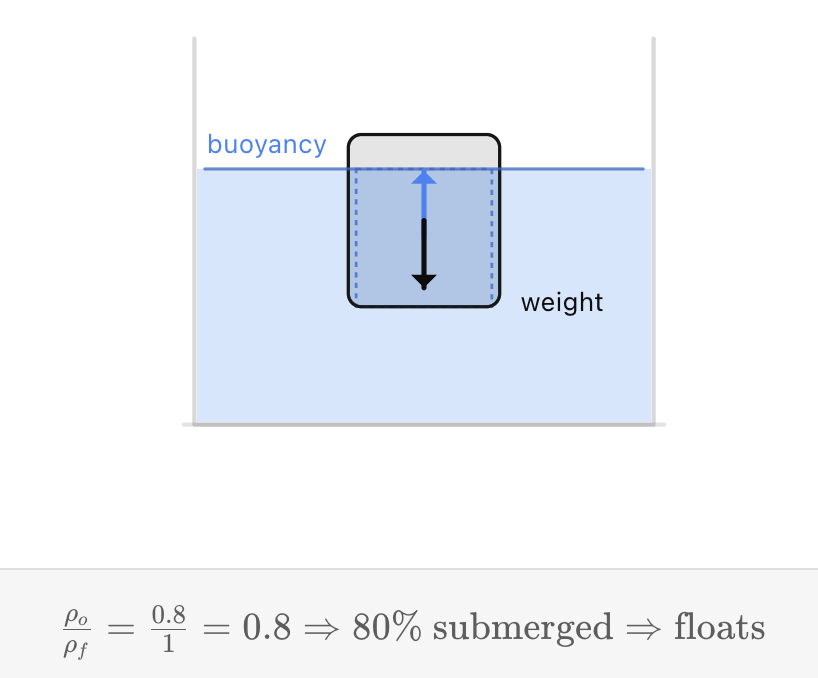
Notice that buoyancy depends on the interaction between the object and the fluid. It is not simply a property of the object itself.


Buoyant Force and Displaced Fluid

A very useful rule is:

The buoyant force on an object is equal to the weight of the fluid displaced by the object.

This is known as Archimedes' Principle.

So if an object displaces water weighing 20 N, the water produces a buoyant force of:

20 N upward

If it displaces water weighing 75 N, the buoyant force is:

75 N upward

This explains why increasing the volume of displaced water increases buoyant force.


Example: Comparing Two Submerged Objects

Object A and Object B are completely submerged in the same water.

Object A has a volume of:

200 cm³

Object B has a volume of:

600 cm³

Object B displaces three times as much water.

Therefore, Object B experiences approximately three times the buoyant force.

Notice something important:

We did not need to know the masses of the objects to compare their buoyant forces.

For completely submerged objects in the same fluid:

larger volume → more fluid displaced → greater buoyant force


Does an Object's Mass Determine Buoyant Force?

Not directly.

This is a common source of confusion.

Suppose two objects have exactly the same size and shape and are completely submerged in water.

One is made from aluminium.

The other is made from steel.

https://images.openai.com/static-rsc-4/szt4YZOEn2TkR-K2Ub1zQym2ZPV9lRSQHYWpJhMUrh6ITw3DZ2CajD77TotD2ndqi2Yk5e83MtsX0B4Bv0tCNN9dhcHAWm-gpz3TIOkDBaUQ0dLDWERXSrItmj-N7xJgrIWLL8wv7EIWvtZnAwWhtJoE12EUCw7m4rvsxZZSPzdw9aYB8zQA2G6n8bGGeJ2E?purpose=fullsize
https://images.openai.com/static-rsc-4/aPGTst7KOM5jLkpi4uODcEK-S8yHJFQixl6TsfiC4qyyzHIHnWYj18ryHFVY3UFU0-z2OickAFqJLsCtHpi4uMfmMcvyhRnhf4tGNnpJ0bm6ZF9CTiKmfDdckGWwpjpizpNWYVAN4UlzCVSIsPic9kKQ2E2fznP-rb8tqFBpgwA4Dq6QJUNZbPPTyuZ0LOz3?purpose=fullsize
https://images.openai.com/static-rsc-4/-pWaInwMyfoAZqlllR4XVvBKR9UAQZbki4D0JXEaOKGN8TXrf0jRhiokkrt8nj-JvvWCJfl1sgn-Ulb-GLGs-y0cPvRj-Hjvy0Jd-g_n1nHOSmLVtFgAyTFwXoh9y78k1Xtg6z9mtF3sqRNGcJarNdEHJbJmd0XZnTFSw19HBbMlBdmJS7j7f-Zq1sw8_nLM?purpose=fullsize
4

If both have the same volume, they displace the same volume of water.

Therefore, they experience the same buoyant force when completely submerged in the same fluid.

However, the steel object may have a greater weight.

So even though their buoyant forces are equal, their motions may be different.


Buoyant Force vs Weight

Whether an object rises, sinks, or remains at the same level depends on the net force.

Consider an object completely surrounded by water.

Two major vertical forces act on it:

Weight downward

and

Buoyant force upward

There are three important possibilities.


Situation 1: Buoyant Force Greater Than Weight

If:

Buoyant force > Weight

there is a net upward force.

The object accelerates upward.

 
       ↑↑↑
  Buoyant force
      [●]
     Weight
       ↓
 

This can happen when an object is released underwater and is less dense overall than the surrounding fluid.


Situation 2: Weight Greater Than Buoyant Force

If:

Weight > Buoyant force

there is a net downward force.

The object accelerates downward.

 
       ↑
  Buoyant force
      [●]
     Weight
      ↓↓↓
 

The object sinks.


Situation 3: Buoyant Force Equals Weight

If:

Buoyant force = Weight

the forces are balanced.

There is no net vertical force.

The object does not accelerate vertically.

 
       ↑↑
  Buoyant force
      [●]
     Weight
       ↓↓
 

Depending on the situation, the object may float at the surface or remain suspended within the fluid.


Floating Objects

A floating object settles until it displaces enough fluid for the buoyant force to balance its weight.

Therefore, for an object floating at rest:

Buoyant force = Weight

https://images.openai.com/static-rsc-4/axR10pLxh6b-gQ_ThMNeR5vjNAJWdkZfuY-tnzanLgde7GIRq6ZjUkPzAQnUlDg4vOXwf9Ey05CXKCrqymjPZjX1SBfidOUcl_ZvsJO-S1XqFfLTCmx7T-rdgqk1G8_WoTe9KUn_EhJ14UftO4tArUqGyOTKcFNoTjH0YFNeKxQxNZt_FfzZIfNKaYJUZLFC?purpose=fullsize
https://images.openai.com/static-rsc-4/-4rrvhikeoHKMZgOnYICtdZNeGA-yxGfuEsU2UFqmEbM2D_7wvcUTbMb_DpzEwG-7w3dcB6ITGbWxq4JqdpcV53Nc8yPR0u5muusRRzDC21gsGqaCPo5iPNPDAgwpEetTVzZBhjzX-AGYSBQkq3Xhbp2ZOLYY_MU2d6FZiBeMPR1hCNCdKBoyx8kqqTXeGn_?purpose=fullsize
https://images.openai.com/static-rsc-4/UksS8ddEEyM2E9-GELj_yIuKOQ_AKmMHObuoLMDbr5kibxBQUyLEQ9mAblpM2Epu3ZXZGx1UJjJ7PnnDCo_c_095aVfAL919VhxlLrs1ML22zkoe7lmdwW1kcYcO5WwfllSG7O8g9_ThQhjBVBG9RTSkgbfAnIOirmhQs0wYtXCmm0t9ZZ7pmRyrbjOCmg3H?purpose=fullsize

This is why a floating boat does not continue rising out of the water.

As it rises, less of the boat remains underwater.

Less water is displaced.

The buoyant force decreases.

Eventually:

Buoyant force = Weight

and the boat reaches equilibrium.


Why Does a Heavier Boat Sit Lower in the Water?

Imagine people getting into a small boat.

The mass and weight of the boat increase.

To remain floating:

Buoyant force must equal the new, greater weight.

How can the boat obtain a greater buoyant force?

It sinks slightly deeper.

This causes it to displace more water.

More displacement → greater buoyant force

Eventually the new buoyant force balances the greater weight.

https://images.openai.com/static-rsc-4/E2rHLJOu6g2DwB_MriM_UhwUJH72cvJA2qu5Le-K4UNeKqcTEMVOA3JfKh8QZc1betK8YvB_T0J6tsDnRruvQiNDmln3EoE235mjm54u71WDNVOB5GLjosLvJI4um_jkGk3fSmPCOiduVVExCj1nxNt1sR6I-jzHm_FptGIq3d2k1TPB4g_oAOyxynP1ZkDO?purpose=fullsize
https://images.openai.com/static-rsc-4/ART06fNY8VzDa6xTWLO3Rsrpaeu8n33z8YcMcZhOF_pzA2RGjYVabXwFK6ca2HLWMb2YLnrOcc3bXvqo6Om9do0H2wLk-HMTQsl3zxXhLJ_vjnfVBEggc1ZOmamW1ms_O70nojVC4ySOrGKRrYGnY5DBfwbtkmA3oHp5WRIKvKBYXocSoVedx-7IWlMTFFrr?purpose=fullsize
https://images.openai.com/static-rsc-4/pDiVqOBI8GX9CN3_4F8LufHp3mvIPEOMG4ZaAupdczobYLsBE0_F_xm9dhxhyoiXwBezF_MqnosoeThb46yKlKH1isJrlE2293iSeaXXkpzcQF8DsbPn1lSb_tYdOTOzsD9tqu0MoEpfZ2rkKDBbalyu9_fvO1gL67-xGdV4rSPC_1osTMJd6ncyzrnyigHZ?purpose=fullsize
6

This explains why heavily loaded ships sit lower in the water.


Why Do Ships Float?

Steel is denser than water, so a solid block of steel normally sinks.

Yet enormous steel ships float.

Why?

A ship is not a solid block of steel.

Its hull contains a large volume of air.

This gives the entire ship a large volume compared with its mass.

https://images.openai.com/static-rsc-4/OFDBvVsw737DrvlDSN4EBQhhqWeNUC8CwAo8_Gc13LejWysvTyf6Huh1tK3EKm-LIIXmxFSxNjxgdlxpIrGEFdZU7Hr4Ncc8nVw4Rt37x3--gvV4fd6SC9kFXkWa0_hgd3EOfcXEitquDbOkaZfzqtvqbANHnuWQCWUZ-KVNjt6LINndUk8J2Zzh73ogGAsZ?purpose=fullsize
https://images.openai.com/static-rsc-4/ART06fNY8VzDa6xTWLO3Rsrpaeu8n33z8YcMcZhOF_pzA2RGjYVabXwFK6ca2HLWMb2YLnrOcc3bXvqo6Om9do0H2wLk-HMTQsl3zxXhLJ_vjnfVBEggc1ZOmamW1ms_O70nojVC4ySOrGKRrYGnY5DBfwbtkmA3oHp5WRIKvKBYXocSoVedx-7IWlMTFFrr?purpose=fullsize
https://images.openai.com/static-rsc-4/gCQ-PIVBZfuCvZhw5xFKXqYFJUHJ9Bd2aK9DO6XKRQjtqnOd7BfbLp3c6s_RItcQADgCJl2iF_pTszDeaBMRgVEeTbDNKwwdeaHmiZPNDnEXnr5GlBSfL_cHorkg3Mtb_JAunRhAcy0QfKhAP7DalQy1vyQtSd0P_Iz2jNIF4sH-YmoQ43UXKuWZPTfgo4hB?purpose=fullsize
5

As the ship enters the water, it displaces a large amount of water.

Eventually, it displaces enough water that:

weight of displaced water = weight of ship

Therefore:

buoyant force = ship's weight

and the ship floats.


Buoyant Force and Fluid Density

The density of the fluid also affects buoyancy.

Consider the same object placed in:

  • freshwater
  • saltwater

Saltwater is denser than freshwater.

For the same displaced volume:

denser fluid → heavier displaced fluid → greater buoyant force

This is why people generally float slightly more easily in saltwater than in freshwater.

https://images.openai.com/static-rsc-4/qM4gk7kWRUQjwMTx6VAWsOjP68rex23JlhvP-Gn-woQQQ-a6g2pYSOU9plqxo69mA7Zq6aIen94iz0hr-Lh3_3bZk9t477E4KU-xBQKQ8ekwMbkUEBZL6eoZH70rzcp6AHacjmmy3rkC14hvH8q5Hc-IjW62G7tLWUDQqDRCUv5wNtY-LV9B_t6VyaZz1Nmh?purpose=fullsize
https://images.openai.com/static-rsc-4/ezZVr4FaaJ6CVWPxBI3Xo4JiQxIrInkrhmDT5gmkFqNZuFQjVxT1_BrwVin26u3gTNwJtW3LXWK0TuL7A7viaIcGWZZ8u8rId6O_z_jttxwvxSjM86ZgmS_cWiyt_EODnEJN5Ccz0cyTZ1WWniXp3EulI00OfSCx2GMv3vY-9Az7YFnEL-n8XxCzIUUaZJrC?purpose=fullsize
https://images.openai.com/static-rsc-4/AQI2VEJXzO4EnrrRiMvqLrrrNkfhu9VNjAbxAgW4CRm6cOYH79Xnu-4LTZlhRntEhEqp1AN7_Xe0qXh9v6NiF68dlNfM7_x8iaqr8VBVpAe2lPKcGbIeT5MgO-crZwrz-gCahYeivGK17cHbnCHhqUkK6IhgalTXxPZUIcARBGbaCih0nj0jmAt3PEK8_GGc?purpose=fullsize
5

Example: Freshwater vs Saltwater

Imagine the same completely submerged object displaces 1 litre of fluid.

If the saltwater is denser than the freshwater, then 1 litre of saltwater has greater mass.

Therefore:

Weight of displaced saltwater > Weight of displaced freshwater

Since buoyant force equals the weight of displaced fluid:

Buoyant force in saltwater > Buoyant force in freshwater


Why Objects Float Higher in Denser Fluids

Suppose a boat moves from freshwater into denser saltwater.

The boat's weight does not change.

To float:

Buoyant force = Weight

Because saltwater is denser, a smaller volume of saltwater needs to be displaced to produce the required buoyant force.

Therefore, the boat floats slightly higher in saltwater.

This is one reason ships have different safe-loading markings for different water conditions.


Submarines and Buoyant Force

Submarines control their movement partly by changing their overall density and buoyancy using ballast tanks.

https://images.openai.com/static-rsc-4/t3Guk91Syv292SHIy5-9pLsY7d3vswV7kzaihrgEluNchv5IF7QxEqaWOFOlT3jRvgw0GobnOzI0MQ8FEy4Q7_-piLBD0WFqWuWNy0uxmZB2oPcvX8JKkcwvTKywfrFchBqsymmiBX9jsM0akvahx1-c8vgGaAqEk4ObcfPaK1SIMHNvYKaFlwB2oJx3RHSl?purpose=fullsize
https://images.openai.com/static-rsc-4/DAvV8ELbNlwlsQjaqvQLz80_hm2ejAB_JtryVkuz4Fx3oa1j6hQRt5Vl36Sa9eHQRj5XOJKJ4FKB95i7dqqA9Wkg1bfQh2Wvoff1BhLd9V05ZVLoIprUvvhmJwU8nJwN70IGEby1Hp3cg45WZY7UKOImpafoo2urvuBgICm46WTh0PWlJNooxyXnRLK0qAr5?purpose=fullsize
https://images.openai.com/static-rsc-4/EzKPw8wC3xSBF-z_OoOXL5_Q-s_IfKIcGkaA4K2LFdvGguMGx5oVkjp8XA0suA98xXHfmwSFocLLHK5v7mg3qO6B2UeeU0ij7XJtujqka41uDw6nDW1ltDcQLInXRqUTwCZ5GEQkpc4uu_PUJU2IWKVSOIH-NnZXqW5VvGSWpFDzfZ0ivCuSWOj5TqWpfxpy?purpose=fullsize
6

To Dive

Water enters the ballast tanks.

The submarine's mass increases.

Its weight can become greater than the buoyant force.

The submarine descends.

To Rise

Compressed air forces water out of the ballast tanks.

The submarine's mass decreases.

The balance of forces changes, allowing it to rise.

To Remain at a Constant Depth

The submarine can adjust its buoyancy so that approximately:

Buoyant force = Weight

This condition is called neutral buoyancy.


Buoyancy in Gases

Buoyant force also acts in gases.

A helium balloon experiences an upward buoyant force because it displaces surrounding air.

https://images.openai.com/static-rsc-4/GC-OOYPK196HdP9VGYxDcnbdJpYJEA4-AbCVs_MrL_wM2ESlMbMs0JLE0cfd8MI-UA_qDQ2JPV_hk8X7R9XE-uS7rYJB6wZdIakHwVl5VfTG6hyO4_E09MFhYkYLTCMhMXH3-JtnpEjyKRCgce8ik1iP3D90Xnlwbc69jddMO4VUEqqIf-r6R8KkolVe2F_D?purpose=fullsize
https://images.openai.com/static-rsc-4/bMortkyDlp-u_AHGnQ6kwhv0k3I1dmj-ri_aQf8x4HXOaYRkzaskwbbUDZeRhFQ40KXDJz2Zn6tHfziesk9GKYJtYQBLySaY8KhGtEKgcT6Mmu67B4G3bhDas11Y5ZDRCUBEBhZgPXH_AQecS2FmyPxrI0CdN50xt3Uec80rqiNBea2ekuP-4v7WgCbiM54V?purpose=fullsize
https://images.openai.com/static-rsc-4/kqjD6uFVy24P3lBL2m316ZGHY_IoGDCO41H0rPgsvEJH6Ekl2Yx0zstwH-TzxFcDANOsf-AvSxFigYZ51PCvcPy7rXWxHpgCVSsLL-PInF-bG7YLKHo8hmWxTAXWQugTauNrdCiu8juhcm3ZZlX8L8pgPeX3H_hBDDUd032RI6tyBZdFt_uUXrOeZNrk6D9m?purpose=fullsize
6

The surrounding air has weight.

The balloon experiences a buoyant force equal to the weight of the air it displaces.

If the total weight of:

  • balloon
  • helium
  • string or basket
  • passengers or equipment

is less than the buoyant force, the balloon can accelerate upward.


Hot-Air Balloons

Hot-air balloons use the same principle.

Heating the air inside the balloon causes it to expand and become less dense than the cooler surrounding air.

The balloon displaces denser surrounding air.

If the upward buoyant force becomes greater than the total weight of the balloon system, the balloon rises.

https://images.openai.com/static-rsc-4/bMortkyDlp-u_AHGnQ6kwhv0k3I1dmj-ri_aQf8x4HXOaYRkzaskwbbUDZeRhFQ40KXDJz2Zn6tHfziesk9GKYJtYQBLySaY8KhGtEKgcT6Mmu67B4G3bhDas11Y5ZDRCUBEBhZgPXH_AQecS2FmyPxrI0CdN50xt3Uec80rqiNBea2ekuP-4v7WgCbiM54V?purpose=fullsize
https://images.openai.com/static-rsc-4/Gh4XyBligXwfjrmrq3Z5816NWECxfgZJFG6RYon0M29oysmBpIJkBUDxmt0mpeLcswVbOfOb3qKNyqd4B93NoWC4ilEjKw4feqbJgG6k_KsCFsDPlKwRmFNsHENRWYFBxJdJbouRtyuzRePhjl1we7grH7r2N9Az3ViRJ01tDMnSzXQJ3GPsT8sBh6tqYTzg?purpose=fullsize
https://images.openai.com/static-rsc-4/EmVZHMTzHEtUSG-jzMBWgU_oWCw7d8t2eY4KetSwnUHyNOlaIuORYD9l1kDRYFV9Ya8XVcGoOcpLVJc-S6O0GCDF2UFOqy6NvmtEca-FUaABul0pyFbhKQ45gdZLNfNlL-pSxs8cle0MWL-h3tvfVxqkTqiLm-TfvKkJSOkLD12vYPSUMfw7zI5Jc24fS835?purpose=fullsize
6

So buoyancy connects several ideas we have already studied:

temperature → density → buoyant force → motion


Apparent Weight in Water

You may have noticed that objects seem lighter underwater.

Their actual gravitational weight has not changed significantly.

Instead, the water provides an upward buoyant force.

For example, suppose an object has:

Weight = 100 N

and experiences:

Buoyant force = 30 N

The downward force that would be measured by a supporting scale or tension system is reduced.

Its apparent weight is:

100 N − 30 N = 70 N

So:

Apparent weight = Actual weight − Buoyant force

https://images.openai.com/static-rsc-4/6_uehXFW8kkscuxfalXnSCkWqlIpVb4SQfv3JHycQDmlB1VnjS2xCZNVHjQTGRkmzUrswGuDt3EXX3icpAmsLFqB1W548D35KAsLXu7h8nkLycjT1KN44fIlpfA2AH4NGLr8Hx_xToiJR8fvU380bskoR97c2Bi0r5II1ETfKW-IJp-QaJ-Co9iigva8iU52?purpose=fullsize
https://images.openai.com/static-rsc-4/0wbMucGzigXiNhUGCM0J488wa9RUseQqMozI8jvWKAlFCURgR9L4WHCjDdsGHWiPlqCnk-LId0-_p8IsRsyFglFvhO_RHIEXJso3Ymex-LlNx0U7PJDgJdxlFqizIvwHrwd7wnTNoDugW3_viUMnoaccZl3Tykx9z3ss6RZQu9RUJa2m-WId8lJSgKiEGe2U?purpose=fullsize
https://images.openai.com/static-rsc-4/wamdW5X1KuucXwFtr-W4-Janv6r9Y3j068R67s8pWumINMvZUp3CNV7B0sHMVGcqASmpe8q5OGn9sMRPe1d-MvQPvOKTua6uIA9jWihz4nESMan8PX0bFchIuG_XZMqOt-UtdyGzx_bpSC_6uKp0DY7L7Ref5oAzuPtur28fwIWzqu0Si5Qt-vdhcm8TEwEq?purpose=fullsize
6

Worked Example: Finding Buoyant Force from Apparent Weight

An object weighs 80 N in air.

When completely submerged in water, its apparent weight is 55 N.

Calculate the buoyant force.

Use:

Buoyant force = Actual weight − Apparent weight

Substitute:

Buoyant force = 80 − 55

Buoyant force = 25 N

Answer:

The water exerts a buoyant force of:

25 N upward


Comparing Buoyant Forces

When comparing buoyant forces, ask these questions:

Are the objects in the same fluid?

If yes, fluid density is the same.

Are they completely submerged?

If yes, compare their volumes.

Larger submerged volume → greater displacement → greater buoyant force

Are they the same size but in different fluids?

Compare fluid densities.

Denser fluid → greater buoyant force

Are the objects floating?

If they are floating at rest:

Buoyant force = object's weight

Therefore, a heavier floating object must experience a greater buoyant force.


Example: Three Objects

Consider three objects completely submerged in the same water:

  • Object A: volume = 100 cm³
  • Object B: volume = 300 cm³
  • Object C: volume = 500 cm³

Which experiences the greatest buoyant force?

Object C displaces the most water.

Therefore:

Object C experiences the greatest buoyant force.

Object A experiences the smallest.

Their masses are not needed to answer this question.


Does Greater Depth Mean Greater Buoyant Force?

This question can be tricky.

We know:

Pressure increases with depth.

So it may seem that an object moved deeper underwater must experience a greater buoyant force.

However, for a completely submerged rigid object in a liquid of approximately constant density, both the pressure on the top and the pressure on the bottom increase as the object moves deeper.

The pressure difference between the top and bottom remains approximately the same.

Therefore, the buoyant force remains approximately the same.

https://images.openai.com/static-rsc-4/9J3m8TwSh_Pg18v3XgfT8F05RH2i_XCEwvpEzkY3MxiuaWE8reOU3TM_qmkbNPTgE6KEUtiXqLDjE91T-EplxWh8w0gNTYOwxr89owhL1pYA2sED_az759tIJOyy64CJtS9k0eeqJ9DZPkqh5oHu7iVINXZYqfrs7raRAz3JHjoI7ZOjPEyfI5VdI1QW3uTL?purpose=fullsize
https://images.openai.com/static-rsc-4/vzWazcCr2gySlvtLjg33QPy-sPMFCQGTzeQPe1rJ8ai8rxkOMBCJRIV3WViM29YjXvnQ3Ft8imO0RGHnep3l7MBo2yJkl_U4qbR55nuLyNjZbjWNCvT7crNkX-J9WThReWBls8alecSc43BT8Py0HeyNG-gGDqY6zl9GrFJ7mj2X4lSMeZ8fWw5vSPJsbjYw?purpose=fullsize
https://images.openai.com/static-rsc-4/GXTga63Lny_1zslbV4NYhHK2ek8sIZlqWhP3JqSAhFgCQi0PWqVhUGmtB1e0ix1sfxtQ3K3oEAOMJpzoXAoET1CckjlPfkXKHemvINJKm9w15tzZwiMMsF3eMp2jrKV7N29QU2V32jJFopXZJ3146ieef4s0NhMGdDkfOf4lzF5Jnwx7tMXmk7Ypix5_ugAU?purpose=fullsize

So:

Greater absolute pressure does not automatically mean greater buoyant force.

For the same fully submerged rigid object in the same approximately incompressible fluid, buoyant force is approximately independent of depth.


Common Mistakes

Mistake 1: Saying buoyant force always makes objects float

Every immersed object experiences buoyant force, including objects that sink.

An object sinks when:

Weight > Buoyant force


Mistake 2: Thinking buoyant force is caused simply by "water pushing upward"

Water does push upward, but it also pushes downward and sideways.

Buoyant force results from the difference in fluid pressure between different parts of the object.


Mistake 3: Thinking a heavier submerged object always has greater buoyant force

Not necessarily.

Two completely submerged objects with the same volume in the same fluid experience the same buoyant force even if their masses are different.


Mistake 4: Thinking greater depth always means greater buoyant force

Pressure increases with depth, but the pressure on both the top and bottom increases.

For the same completely submerged rigid object in a liquid of nearly constant density, the buoyant force remains approximately constant with depth.


Mistake 5: Thinking floating means there is no gravity

Gravity still acts on a floating object.

The object floats because:

Buoyant force = Weight

The forces are balanced.


Mistake 6: Saying a floating object experiences a larger buoyant force than its weight

If an object is floating at rest:

Buoyant force = Weight

If the buoyant force remained greater than its weight, the object would accelerate upward.


Mistake 7: Thinking buoyancy only occurs in liquids

Gases are fluids too.

Air produces buoyant forces on balloons, airships, and every other object in the atmosphere.


Check Your Understanding

1. Recall

Define buoyant force and state its direction.

2. Explain

Why does a completely submerged object experience a net upward force from the surrounding water?

3. Apply

An underwater object experiences:

  • 90 N upward force from pressure on its bottom
  • 65 N downward force from pressure on its top

Calculate the buoyant force.

4. Compare

Two objects of equal volume are completely submerged in the same water.

Object A has a mass of 2 kg.

Object B has a mass of 5 kg.

Which object experiences the greater buoyant force? Explain.

5. Fluid Density

The same object is completely submerged first in freshwater and then in denser saltwater.

In which liquid does it experience the greater buoyant force? Explain.

6. Forces

An object has a weight of 40 N and experiences a buoyant force of 25 N.

Calculate the net vertical force and predict what will happen.

7. Floating

A boat weighing 12 000 N is floating at rest.

What is the buoyant force acting on the boat?

Explain how you know.

8. Challenge

A solid block is completely submerged 2 m below the surface of a swimming pool. It is then moved to 5 m below the surface without changing its volume.

The water pressure is much greater at 5 m.

Does the block necessarily experience a greater buoyant force?

Explain your answer using pressure differences.


Key Terms

  • Buoyant force – upward force exerted by a fluid on an immersed object
  • Upthrust – another name for buoyant force
  • Fluid – substance that can flow, including liquids and gases
  • Displacement – movement of fluid caused when an object occupies space within it
  • Fluid pressure – force per unit area exerted by a fluid
  • Archimedes' Principle – buoyant force equals the weight of displaced fluid
  • Apparent weight – measured weight of an object when buoyant force acts on it
  • Neutral buoyancy – condition in which buoyant force balances weight while an object is within a fluid
  • Net force – overall force after all forces are combined
  • Equilibrium – condition in which the net force is zero

Key Takeaways

  • Buoyant force is the upward force exerted by a fluid on an immersed object.
  • Buoyant force occurs in both liquids and gases.
  • Fluid pressure increases with depth, so the bottom of an immersed object usually experiences greater pressure than the top.
  • This pressure difference produces the net upward buoyant force.
  • Buoyant force increases when more fluid is displaced.
  • A denser fluid produces a greater buoyant force for the same displaced volume.
  • According to Archimedes' Principle, buoyant force equals the weight of the displaced fluid.
  • If weight > buoyant force, an object accelerates downward.
  • If buoyant force > weight, an object accelerates upward.
  • A floating object at rest has buoyant force = weight.
  • Two equally sized objects completely submerged in the same fluid can experience the same buoyant force even if their masses are different.
  • For the same rigid, completely submerged object in a nearly incompressible fluid, moving deeper does not necessarily increase buoyant force even though the surrounding pressure increases.


2. Archimedes' Principle

Learning outcomes
  • I can state Archimedes' Principle.
  • I can explain the relationship between displaced fluid and buoyant force.
  • I can calculate buoyant force using displaced fluid data.
  • I can apply Archimedes' Principle to real-world situations.
  • I can explain how Archimedes' discovery changed our understanding of floating.

Why can a steel ship float? Why does an object seem lighter underwater? How can we predict whether an object will float or sink?

More than 2,000 years ago, the Greek mathematician and scientist Archimedes described the relationship between an object, the fluid it displaces, and the upward buoyant force acting on it.

His principle remains fundamental to the design of ships, submarines, floating platforms, hydrometers, and many other technologies.

https://images.openai.com/static-rsc-4/l_qawkJP6SfRpuPsBdnMjvGfs5SExvbXWUaL-y2-wdvgMuDWcmFulWyQWDD6rt5FJmaljooi6Pe-O9EDuTef4R6FK7zjHUSXog47U1V7kHEoif0JINEPbiPiZqDjrfLOLMaq9ffDU71YI5HueScNFJ4dIaQEQdFPzdRJhT6kgGEBLK3mBGTHN8J2cDb5cdrk?purpose=fullsize
https://images.openai.com/static-rsc-4/wCVTYnQ0xooLBvM75-zy2DnwncNucOBwnPA7IE0YCPzZLj_LylkDlycl3Wlfy0mYOITY3SrlRVIIRCxiAwLen53xrul_uwfNg8t2HTwS4q9vySjlkWDVCtiRtlHCMQrmaR7QWuNPrz-dyGvn5rKOtmTMar5s023MqycM0N__spFl7nsn1npNRHM9smT78_TU?purpose=fullsize
https://images.openai.com/static-rsc-4/pDiVqOBI8GX9CN3_4F8LufHp3mvIPEOMG4ZaAupdczobYLsBE0_F_xm9dhxhyoiXwBezF_MqnosoeThb46yKlKH1isJrlE2293iSeaXXkpzcQF8DsbPn1lSb_tYdOTOzsD9tqu0MoEpfZ2rkKDBbalyu9_fvO1gL67-xGdV4rSPC_1osTMJd6ncyzrnyigHZ?purpose=fullsize
6

What Is Archimedes' Principle?

Archimedes' Principle states that an object partly or completely immersed in a fluid experiences a buoyant force equal to the weight of the fluid it displaces.

In simpler words:

Buoyant force = weight of displaced fluid

This gives us a powerful way to determine the buoyant force on an object.

Instead of measuring the forces acting on every surface of the object, we can determine how much fluid it displaces.


What Does "Displaced Fluid" Mean?

When an object is placed into a fluid, the object occupies space that was previously occupied by the fluid.

The fluid that has been pushed out of this space is called the displaced fluid.

https://images.openai.com/static-rsc-4/T8Vu2h8xIIJfYZPX8MUWCLetDl0Bzy6gxTM45IYKGwBAFGI4FtZ-252ma5Z031DfjNOCCOlY7bqv3KQBqrWprx3XoI9FK-eBLYO05W0YnHIXoUFTfx3g9uBb6ygHguKUWK31PUDAMUSYf4uiXwuNgEcrCmlFztuzjXxZkPn7otU6LlR85EU1nwMdVbK-5yO_?purpose=fullsize
https://images.openai.com/static-rsc-4/F_Wdz0D60xMwU02qKgfNAsnojHDXviVNY-aO8eqUJlcajpqfQTbhvielwVpD7cUjWSTsSCypPmxSpiv1WpgWYwec_uAR8q386NxO9YPssRKRHChXRcisiJStX3-ebzxt7NauGi5doTzbh15YcgCr6azEt8cJkrnJo7QqfY3UXy2xCgoA4vfsLBxuAzlAcYg1?purpose=fullsize
https://images.openai.com/static-rsc-4/pYmmaF2X5-TruR73ODamHhkfSy753JAxg-QOINwpC-BmtkAMrVUHbxHuh9Ieh567XwVX9dt0jiiLSOZjrKsTpjJGSKoCNfHCppA-rLx1pCegLIBlDrSB7DTVy_MN5-EICFcGtyDx7XPVlpRXnUso_Xys1z4R5UpWzEuuD5XSIetKydaGUJW04v5mru7o-Ek0?purpose=fullsize
5

Imagine placing a rock into a container filled completely to the top with water.

Some water spills out.

The volume of water pushed aside corresponds to the volume of the part of the rock that is underwater.

If the rock is completely submerged:

Volume of displaced water = Volume of rock

If only part of an object is underwater:

Volume of displaced water = Volume of submerged part

This distinction becomes especially important when studying floating objects.


From Displaced Fluid to Buoyant Force

Archimedes' Principle tells us:

Buoyant force = weight of displaced fluid

Weight is calculated using:

W = mg

Therefore:

Buoyant force = mass of displaced fluid × gravitational field strength

or:

Fᵦ = mfluid × g

where:

  • Fᵦ = buoyant force (N)
  • mfluid = mass of displaced fluid (kg)
  • g = gravitational field strength (N/kg)

This gives us our first useful method for calculating buoyant force.


Worked Example 1: Using the Mass of Displaced Water

An object displaces 3.0 kg of water.

Calculate the buoyant force.

Use:

g = 10 N/kg

According to Archimedes' Principle:

Fᵦ = weight of displaced water

So:

Fᵦ = mg

Fᵦ = 3.0 × 10

Fᵦ = 30 N

Answer

The buoyant force is:

30 N upward

Notice that we did not need to know the mass of the object.

We needed the mass of the displaced fluid.


Using Volume and Density

Sometimes we are given the volume of displaced fluid rather than its mass.

Remember the density equation:

ρ = m/V

Rearranging:

m = ρV

The weight of the displaced fluid is therefore:

W = ρVg

Since buoyant force equals the weight of displaced fluid:

Fᵦ = ρVg

where:

  • Fᵦ = buoyant force (N)
  • ρ = density of the fluid (kg/m³)
  • V = volume of displaced fluid (m³)
  • g = gravitational field strength (N/kg)

This equation connects several of the ideas we have studied:

density + displacement + gravity → buoyant force


Worked Example 2: Using Displaced Volume

A completely submerged object displaces:

0.004 m³ of freshwater

Calculate the buoyant force.

Use:

ρwater = 1000 kg/m³

g = 10 N/kg

Start with:

Fᵦ = ρVg

Substitute:

Fᵦ = 1000 × 0.004 × 10

First:

1000 × 0.004 = 4 kg

So the object displaces 4 kg of water.

Then:

Fᵦ = 4 × 10

Fᵦ = 40 N

Answer

The buoyant force is:

40 N upward


Why Does This Principle Work?

Archimedes' Principle is closely connected to fluid pressure.

Recall:

Pressure increases with depth.

Imagine a block completely submerged in water.

https://images.openai.com/static-rsc-4/pZhodpo6a3hjuuOxO9spScMsRN9S82DUj8AfkqCL-iZTwnLDx3Ewak_ZnPqjsPah1gwReDtb4Vt0Cpsnh4A-_HBuWM06pxn4fgFNg5JS35LmBi0gzaAcByNtHbzQXCOgp614w6HXRDDdCBup6juJCF1sv3zsjz-HS9qSFNVa-rSFQrm6qxdocO67ksk6H1nq?purpose=fullsize
https://images.openai.com/static-rsc-4/JX5Ks34WtaIcUICUdi1lx-9CFT-1Kfq-MDqKUdPlzjM_THFqEBCrk0TEh-m0532DOVnpGd1wI3H9prMDHyOD-zR4hg-XFoJNptrHu19yeYLYreKMFVhcAVeO1B00lQu8c6cZztLOJOBu6t6GaRBBZ3YQtxQ5hu8-ND6URqNCdV7HtUXsVPuGwkGckRNlZDv_?purpose=fullsize
https://images.openai.com/static-rsc-4/Giubt2IUekI8f2ri06_2To_4fFU0XGGiWrZAwgM15uv_6DHpuUVuargVSLzM-3664oEaK8tEWsMvblryCYgcOU1QYXwyXBVD_PCOu_rn7fb-mQjviVasAFkWy_c203BqLxNTe7VnqLqLlmRGOVlt9J9NCu3e4eMcy8uyWeHij-og9d2oYFY_dgIgrRh5Tqcq?purpose=fullsize
4

The bottom of the block is deeper than the top.

Therefore:

Pressure at bottom > Pressure at top

The water produces:

  • a downward force on the top
  • an upward force on the bottom
  • sideways forces that largely balance

Because the upward force is greater than the downward force, there is a net upward force.

That force is the buoyant force.

Archimedes' Principle gives us a convenient way to calculate that force without calculating all the individual pressure forces.


More Displaced Fluid Means More Buoyant Force

Consider two completely submerged objects in the same water.

Object A displaces:

1 kg of water

Object B displaces:

4 kg of water

Object A experiences:

Fᵦ = 1 × 10 = 10 N

Object B experiences:

Fᵦ = 4 × 10 = 40 N

Therefore:

more displaced fluid → greater buoyant force

For the same fluid and gravitational field:

Buoyant force ∝ displaced volume


Comparing Displaced Volume and Buoyant Force

Consider completely submerged objects in freshwater.

Using ρ = 1000 kg/m³ and g = 10 N/kg:
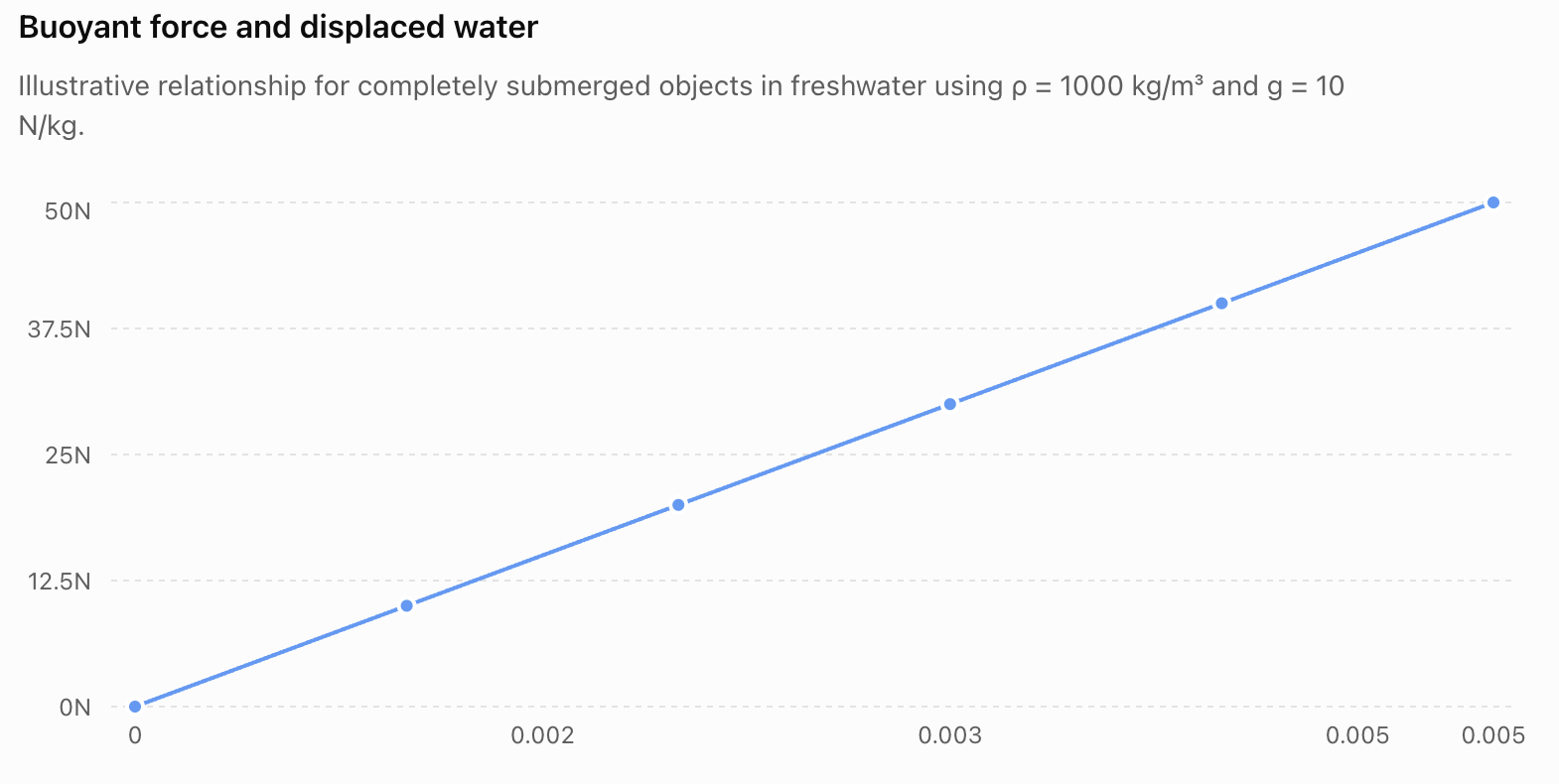
The straight-line relationship shows that doubling the displaced volume doubles the buoyant force, provided fluid density and gravity remain constant.


Worked Example 3: A Completely Submerged Block

A block has a volume of:

0.006 m³

It is completely submerged in freshwater.

Calculate the buoyant force.

Use:

ρ = 1000 kg/m³

g = 10 N/kg

Because the object is completely submerged:

Volume displaced = Volume of object

Therefore:

V = 0.006 m³

Now:

Fᵦ = ρVg

Fᵦ = 1000 × 0.006 × 10

Fᵦ = 60 N

Answer

The buoyant force is:

60 N upward


Does the Mass of the Object Matter?

Not directly when calculating buoyant force from displacement.

Imagine two objects with identical volumes:

  • one made from aluminium
  • one made from lead

Both are completely submerged in the same water.

https://images.openai.com/static-rsc-4/6hAu6JzRslBLv_-MOMojaleAej_qQZt1TXidg2aClN7lDjYogfu7j6WSSEWz2sGtV9U3kgfLK24mAZ9mo9gxgz0MbcPm6I3_w4-4yPVyeB4P_MG91olXrQ1-_b9WZrldMwMBxhV3bE1J3BvKnLwYjBmFEI-v94v_UgVqX1fcqX0BSDmbRW0eKoYVO9VYO9E-?purpose=fullsize
https://images.openai.com/static-rsc-4/-pWaInwMyfoAZqlllR4XVvBKR9UAQZbki4D0JXEaOKGN8TXrf0jRhiokkrt8nj-JvvWCJfl1sgn-Ulb-GLGs-y0cPvRj-Hjvy0Jd-g_n1nHOSmLVtFgAyTFwXoh9y78k1Xtg6z9mtF3sqRNGcJarNdEHJbJmd0XZnTFSw19HBbMlBdmJS7j7f-Zq1sw8_nLM?purpose=fullsize
https://images.openai.com/static-rsc-4/LMR5TOGPH79tTgmYYYS_2lMbJYEiWlc9IlQoh7xaXl_Q-BWmN1q45IFz_Wv05xO6OpM1shX0MVlVHGttnBsMExeSvrByTIVQnTSNWXu0awKJiU3MGCgdySlbZjewh-VIJXKxz31zckb7wwv3EBItBmodpXfvpaOpE1HHTlyzb30koH476ASm_WQp08h0loZ5?purpose=fullsize
6

Because their volumes are identical, they displace the same amount of water.

Therefore:

same displaced volume + same fluid → same buoyant force

The lead object has greater mass and therefore greater weight, but that does not mean it experiences a greater buoyant force.

This distinction is very important:

Object mass affects weight.

Displaced fluid determines buoyant force.


Floating Objects and Archimedes' Principle

A floating object is only partly submerged.

As the object enters the water, it begins displacing water.

The deeper it sinks:

more water is displaced → buoyant force increases

Eventually, the buoyant force becomes equal to the object's weight.

At that point:

Buoyant force = Weight of object

But Archimedes' Principle also tells us:

Buoyant force = Weight of displaced fluid

Therefore, for an object floating at rest:

Weight of object = Weight of displaced fluid

This is one of the most important conclusions from Archimedes' Principle.


Example: A Floating Boat

Suppose a small boat and its passengers have a total mass of:

500 kg

Their weight is:

W = mg

W = 500 × 10

W = 5000 N

Because the boat is floating at rest:

Buoyant force = 5000 N

Therefore, according to Archimedes' Principle, the boat must displace water weighing:

5000 N

In freshwater, that corresponds to a mass of:

500 kg of displaced water

So a floating 500 kg boat must displace approximately 500 kg of water.


What Happens When Cargo Is Added?

Suppose another 200 kg of cargo is loaded onto the boat.

The total mass becomes:

700 kg

The total weight becomes:

700 × 10 = 7000 N

To remain floating:

Buoyant force must increase to 7000 N

How does this happen?

The boat sinks slightly deeper.

https://images.openai.com/static-rsc-4/E2rHLJOu6g2DwB_MriM_UhwUJH72cvJA2qu5Le-K4UNeKqcTEMVOA3JfKh8QZc1betK8YvB_T0J6tsDnRruvQiNDmln3EoE235mjm54u71WDNVOB5GLjosLvJI4um_jkGk3fSmPCOiduVVExCj1nxNt1sR6I-jzHm_FptGIq3d2k1TPB4g_oAOyxynP1ZkDO?purpose=fullsize
https://images.openai.com/static-rsc-4/ART06fNY8VzDa6xTWLO3Rsrpaeu8n33z8YcMcZhOF_pzA2RGjYVabXwFK6ca2HLWMb2YLnrOcc3bXvqo6Om9do0H2wLk-HMTQsl3zxXhLJ_vjnfVBEggc1ZOmamW1ms_O70nojVC4ySOrGKRrYGnY5DBfwbtkmA3oHp5WRIKvKBYXocSoVedx-7IWlMTFFrr?purpose=fullsize
https://images.openai.com/static-rsc-4/uEpenzn4M-eTNCcEM9RvlnZnP3zkV8Sw4h_bBULdHHoIOHPTfCC1-pEaq0uFhE6tm2vUaxiJovMQbrLY0O1lDke5nEbcEYcHznEJ6AOg50Z1Wpe0lMOSI1fIlHnnWt8Dkn0N6gdw_In_R5fTShDhFmJB1uwVrHg3LGZx0kBMmMI7T8JGG0UNe0fgWLs8LNxz?purpose=fullsize
5

As it sinks deeper:

more water is displaced

Therefore:

weight of displaced water increases

and:

buoyant force increases

Eventually:

Buoyant force = 7000 N

and the boat reaches a new floating position.


Why Can a Steel Ship Float?

A solid block of steel usually sinks in water because steel is much denser than water.

Yet huge ships made largely from steel can float.

The key is the ship's shape.

https://images.openai.com/static-rsc-4/6bb4qboat6xTH7dyJlmWuY9JN81IRlno_VOJP--4HkPsrBWuis8tk9dSo0VRsHVwZQJbrpOICJLy_d1xE-hgTfU2csyqJvXw-W01jPzvMt3U28e2wHT05O30cXrX_QSbrHiRJcBt2bLHwk2c8TH0rc9njh2eEXdyvsCulKBAfb06HjpLfi5p9iP9TlcDo4op?purpose=fullsize
https://images.openai.com/static-rsc-4/ART06fNY8VzDa6xTWLO3Rsrpaeu8n33z8YcMcZhOF_pzA2RGjYVabXwFK6ca2HLWMb2YLnrOcc3bXvqo6Om9do0H2wLk-HMTQsl3zxXhLJ_vjnfVBEggc1ZOmamW1ms_O70nojVC4ySOrGKRrYGnY5DBfwbtkmA3oHp5WRIKvKBYXocSoVedx-7IWlMTFFrr?purpose=fullsize
https://images.openai.com/static-rsc-4/VKygmwS2AQyMoz7H67ANs06huJnYHSCMBOR6jf0CWUwsnoYzxbhZOtnC0V5pNFDAsUdaRReZxR6rL0aov5sbfZ136hiGNsG_OFxmw6arw07-UlysFT-e4yrvoxFevpLLqGfNLiE_8zAZML5D_RUjxt9zB35z0pgN4hbJKjKCgnO64G3-jUzdC467PzdeaepN?purpose=fullsize
5

A ship has a large hollow hull containing air.

This gives the ship a very large total volume.

As the ship settles into the water, its hull displaces more and more water.

Eventually:

Weight of displaced water = Weight of ship

At that point:

Buoyant force = Weight

and the ship floats.

The steel itself has not become less dense. Instead, the average density of the entire ship, including its air-filled spaces, is low enough for the ship to float while displacing sufficient water.


Freshwater vs Saltwater

Fluid density affects buoyant force.

The equation:

Fᵦ = ρVg

shows that increasing fluid density increases buoyant force for the same displaced volume.

Saltwater is denser than freshwater.

Therefore, the same submerged volume produces a greater buoyant force in saltwater.

https://images.openai.com/static-rsc-4/5IfnWBs1Hu6FgFTVbpXWqNrXtw3X08BPONJ0_vs8hx_u_o8ScmA8qlji4k0hmdCqCVMH0H3Pl4-16XqRYmSl5ltojtJ0orYnzSmHGl6VjeMiRmRYDPR4viVsOUotGPXu5jGR3rATEjLRfNAV9ML3nO_Fc44zr1OvA3UVVooeDOrOtT55uiVU1TWlcgWdT5Tk?purpose=fullsize
https://images.openai.com/static-rsc-4/qM4gk7kWRUQjwMTx6VAWsOjP68rex23JlhvP-Gn-woQQQ-a6g2pYSOU9plqxo69mA7Zq6aIen94iz0hr-Lh3_3bZk9t477E4KU-xBQKQ8ekwMbkUEBZL6eoZH70rzcp6AHacjmmy3rkC14hvH8q5Hc-IjW62G7tLWUDQqDRCUv5wNtY-LV9B_t6VyaZz1Nmh?purpose=fullsize
https://images.openai.com/static-rsc-4/2GkobsDL71EAFhao2gCwoeMpz4ZnP-xZjIVcynlbrYcU8xzo_aRJzMcwA-nCKs0_NAVd7cEXG_Di4YUCVV5xfJEUKco4WVU2UE5I83S1lxyRwSW21Roaj3Q_sfJOKtQFYnYIlIiP3fH2A6fkC0nPIrElljXQrePzsCEG8vmh4tSbuyIfp_YdBO6VSdYoear5?purpose=fullsize
5

This has an interesting consequence for ships.

A ship needs a certain buoyant force to balance its weight.

In denser seawater, it needs to displace a smaller volume of water to produce that force.

Therefore, a ship normally floats slightly higher in seawater than in freshwater.


Worked Example 4: Comparing Two Fluids

An object displaces:

0.002 m³

of fluid.

Compare the buoyant force in:

Fluid A: ρ = 800 kg/m³

Fluid B: ρ = 1200 kg/m³

Use:

g = 10 N/kg

Fluid A

Fᵦ = 800 × 0.002 × 10

Fᵦ = 16 N

Fluid B

Fᵦ = 1200 × 0.002 × 10

Fᵦ = 24 N

Comparison

The same displaced volume produces:

16 N in Fluid A

and:

24 N in Fluid B

The denser fluid produces the greater buoyant force.


Finding Displaced Volume

We can rearrange the buoyant-force equation.

Starting with:

Fᵦ = ρVg

To find displaced volume:

V = Fᵦ ÷ (ρg)


Worked Example 5: How Much Water Must Be Displaced?

A floating object weighs 250 N.

What volume of freshwater must it displace?

Use:

ρ = 1000 kg/m³

g = 10 N/kg

Because the object is floating:

Fᵦ = Weight

Therefore:

Fᵦ = 250 N

Now:

V = Fᵦ ÷ (ρg)

V = 250 ÷ (1000 × 10)

V = 0.025 m³

Answer

The object must displace:

0.025 m³ of freshwater


Measuring Buoyant Force Experimentally

Archimedes' Principle can be tested using a spring balance and an overflow container.

https://images.openai.com/static-rsc-4/vPxpdNhnIRJHT3TkZioS3QqWlXEaPfDEOyNMDPTMITMMD7BG9eO5TQZJRkrd9wb2FcbHFGh8j9G_3jj8YuvTGPjsdKKBz3S6FoXChDk1utxOayMvSH83URPOEiGYdP4AQUVcEUqYy8hz_nN03ZAjQAZ_E6x_7KF1c64Ysh7RRyH192rc90sh6EJ6UGb9D16O?purpose=fullsize
https://images.openai.com/static-rsc-4/VUNOdcVf090jo4DLD_OE1jF6FcNNVSet63Nd7zsO-9KuzI6CYx5a5-SgG6EE6VcI21Bm-nLRKBqjTzEEPuC0cukleH_77NoNtUUrul4is4o5nTZq7M0P9CwJU1M0ipOdbTIl77qFOHspv1FGZPMdGueptgGR5U_g_SiR8uGpdEzdkQtISaOHjccDdxloBj9D?purpose=fullsize
https://images.openai.com/static-rsc-4/6_uehXFW8kkscuxfalXnSCkWqlIpVb4SQfv3JHycQDmlB1VnjS2xCZNVHjQTGRkmzUrswGuDt3EXX3icpAmsLFqB1W548D35KAsLXu7h8nkLycjT1KN44fIlpfA2AH4NGLr8Hx_xToiJR8fvU380bskoR97c2Bi0r5II1ETfKW-IJp-QaJ-Co9iigva8iU52?purpose=fullsize

Step 1

Measure the object's weight in air.

Suppose:

Weight in air = 12 N

Step 2

Lower the object completely into water without letting it touch the container.

Suppose:

Apparent weight = 8 N

Step 3

Calculate the buoyant force:

Fᵦ = actual weight − apparent weight

Fᵦ = 12 − 8

Fᵦ = 4 N

Step 4

Collect the displaced water.

If the displaced water weighs 4 N, then:

Buoyant force = weight of displaced water

The experiment supports Archimedes' Principle.


Apparent Weight

Objects appear lighter underwater because the fluid exerts an upward buoyant force.

Therefore:

Apparent weight = Actual weight − Buoyant force

For example:

Actual weight = 70 N

Buoyant force = 25 N

Then:

Apparent weight = 70 − 25

Apparent weight = 45 N

The object's actual gravitational weight has not changed significantly.

The difference occurs because the water provides an additional upward force.


Submarines and Archimedes' Principle

Submarines use Archimedes' Principle to control their vertical motion.

https://images.openai.com/static-rsc-4/kNaDcIg7P-vYDQqHEVVneInV66fvSLSQCS48SN-2hi6JteSMvCUkTFriEV7xRb0Smj7GTK2TQYTU9oWK4CtMsMKfuOnBCP6jeU6dy7GK9hkZT2AYbBscXKROwwloYVCOxl4iL_5oOuAiSx8PPu08mgZptc4zVs6IcVFb_lRZKNIfQF1NQudavjkngTT2MfGo?purpose=fullsize
https://images.openai.com/static-rsc-4/oSXGwSKLu0KciEIU3xMUyiUGXGC-eOQMafOkPmpXks-qAzrOUqv2Ckp1z02-x38hDcP3FzZRlgjIc7WzaezOuQE5lmOYBhODOank-scRBeJdM0yNTXOQRgQXR1zcIRBbYHtFrfBByzw1G_bVsqxcV4-OjSQrlL2JTYiWKwWE7KD3T7Pgk_GPONmMhQgnJbcH?purpose=fullsize
https://images.openai.com/static-rsc-4/rmWliOZToZGgMYaHOO4N9tfrxnuofsJ1HAHnSiG79TJG4ilfJ3YX11Om9KPkZa1iip3M0SoBtLlWitZnCZFygaggBtu0S2zUAOHQfjmEG_rOsm8nHc5O4sNRAJjwy3kmtuLHUuBbIRsEqtoofr9nQ_BX8EgSHqwYrtideD0CC5NXPM33QkwK3Yl_7eMwImDW?purpose=fullsize
5

A submerged submarine displaces a large volume of water.

That displaced water produces a buoyant force.

The submarine adjusts its weight using ballast tanks.

To descend

Water enters the ballast tanks.

Mass increases → weight increases

If:

Weight > Buoyant force

the submarine accelerates downward.

To rise

Water is forced out of the ballast tanks.

Mass decreases → weight decreases

If:

Buoyant force > Weight

the submarine accelerates upward.

Neutral buoyancy

If:

Buoyant force = Weight

the submarine can remain at approximately the same depth.


Hydrometers

A hydrometer is an instrument used to measure the density of liquids.

It floats vertically in the liquid.

https://images.openai.com/static-rsc-4/qUJNkhSOnGa0lpftcLOGTYLq5YdYmI2u8mV5rMAki6K2VJvLtuLoJQINgDmbIQd3Fw60Uf6XUYEG5O-5NnHgpAwEPxab2uwefKxrUbm4IaZFfxbFanxB-vYxHDcqPFzclJbDCSc9zIM5KMdCNUSnq3U8o_6IfksXqTAqp6xog-puv6cBX5JQXH_nR_8YJ3Xg?purpose=fullsize
https://images.openai.com/static-rsc-4/Ml4p1AgAHeM3L76k0tKuBh7ifSyVsdev3QhfDe_qyv7UsNXZDMtCzlhy5sTxx8Jfep43vVsVGB6CBJLJO5KEtJz-L9VMI0CJBzcel3-GxTe_DRYJFW8q4Xz0n2rqulQuplqXQ455rcilLgw6TzX_l_i5VO1SYyEwcdS8v1DB5bjFNbA4ZhEBEybl5uWSV9IZ?purpose=fullsize
https://images.openai.com/static-rsc-4/EbzcWZYyC0q5zhKAf7Fr1JFDN5H_0rWMcDzN9E5ClmAHSXKb0XbV6-0VPrhzh8T7Azltla-zV5phhxaDUewUovOm8VRG7Uo2q6kHRFb_cKPJVQSvp4ko09HVj1ibK2VW7SBvwH-Q8KeJnclGkGZCwh8T0_1KX-S8cek-hSHMCYtOX-c5YkUk_h1IKG-eF7G_?purpose=fullsize
6

In a less-dense liquid, the hydrometer must sink farther before it displaces enough liquid to balance its weight.

In a denser liquid, it does not need to sink as far.

Therefore:

denser liquid → hydrometer floats higher

less-dense liquid → hydrometer sinks deeper

Hydrometers are an excellent practical application of Archimedes' Principle.


The Famous Story of Archimedes

Archimedes lived in the Greek city of Syracuse during the third century BCE.

A famous story says that King Hiero II asked Archimedes to determine whether a crown was made from pure gold without damaging it.

According to the traditional account, Archimedes realized while entering a bath that an immersed object displaced water.

https://images.openai.com/static-rsc-4/9cZ9CnUuXm_ZRSQ67hZZb97-cFep4xYlUrIyZ1_Ft1O-KSz8hiF2jb0Uvrq6zy0cBeyCjzlMpjMMMcj8vKU3u1qEEFrADhngzi9M6ZLJ_OsYLXhmcTzvdURCGMwWz2oopisn9cO9TFN9bJxDfeeHn17szBlkSPl6hdCW4NieLDc5MdZXZ893HlH7tVR-ejq1?purpose=fullsize
https://images.openai.com/static-rsc-4/UKXg6o6zBd3wxa2B9bCRNFMS-O_otfMuyGy6x4k4Fi4eJjprsroHjVSo8H1d8kL1UiKyMZGveEu-ZmEAdfIStYMj-vvh1lVpphMQuNultNhOaNuMyTFncSFwhlyi_RU3foYFDu8_nUXz5jexZwHLO-CFeO7fBR6IsSchLNd2kq3QwkVTtcn-84hm2UIxiDPJ?purpose=fullsize
https://images.openai.com/static-rsc-4/Q3Cs-dPZ_QWX8HUtNl-AChZe9f4FkCk2Cs_qBsPvr1J1_rvHTVWKPSkcx3lPfNwPn6yPXNFN7C3zBPZF07ThwbCTxZM_VKQs3NvD7Ubj3kh2PMNndbluwQ85xAVo2WZ8CSE-62hxslCCE97AOaCDYjDRbDyCe0zYvFGmupLqjzm6pvWgkR50s8z2E59d-AxN?purpose=fullsize

The story is often associated with Archimedes shouting:

"Eureka!"

meaning approximately "I have found it!"

The familiar bath-and-crown story was recorded long after Archimedes lived, so its exact historical details are uncertain.

The scientific idea, however, is extremely important: measurements involving displacement and buoyancy can provide information about an object's volume and density.


How Archimedes Changed Our Understanding of Floating

Before a mathematical understanding of buoyancy, floating and sinking could be observed but were harder to predict quantitatively.

Archimedes connected three important ideas:

the immersed object

the fluid it displaces

the upward force produced by the fluid

His principle showed that buoyancy could be measured and calculated.

Instead of simply saying that water "holds something up," we can predict the upward force from the amount and density of displaced fluid.

This provided a foundation for understanding:

  • floating ships
  • submerged objects
  • apparent weight
  • fluid density
  • ship loading
  • submarine buoyancy
  • hydrometers
  • marine engineering

Archimedes' work helped turn observations about floating into a quantitative scientific principle.


Does Greater Depth Increase Buoyant Force?

This is an important connection to our previous topic.

Suppose a rigid object is completely submerged in freshwater.

Moving it deeper increases the pressure around it.

However, for water treated as approximately incompressible, the object's volume does not change and the water's density remains approximately constant.

Therefore:

Fᵦ = ρVg

does not change significantly.

https://images.openai.com/static-rsc-4/vzWazcCr2gySlvtLjg33QPy-sPMFCQGTzeQPe1rJ8ai8rxkOMBCJRIV3WViM29YjXvnQ3Ft8imO0RGHnep3l7MBo2yJkl_U4qbR55nuLyNjZbjWNCvT7crNkX-J9WThReWBls8alecSc43BT8Py0HeyNG-gGDqY6zl9GrFJ7mj2X4lSMeZ8fWw5vSPJsbjYw?purpose=fullsize
https://images.openai.com/static-rsc-4/GiLAGTNkj6y97PeEEAk1efWffF-5bB04hQQDZYUomCmNUCs41cGeto9JLOPVH1jyazdMGVMyz1Bbiv29cHQxXRhVdupMX7jc6Qj7Lc5etM8uVk6Jv9HcXHLpiDdRS5EgUtFVpde2XmxkrWoBF35k35aviWwmoT6oFdv30FgKuCt7-pwxtZi6dS-vrMwIkBiP?purpose=fullsize
https://images.openai.com/static-rsc-4/pUoJsLrNiBWmLD5xymP6u1WSJPrhs_xEWl2IN_4rgczcCC_D_z6U38ZorWCJdO5WyzxEHgw6gszPh4DdBblE8_gMBWne-FyVMNgpBiA9qCXoV1H99CMBPLKK5v2DTdgl7Cjx2MCK3TGX9WGVcxobyStpDmOIE5aa-WkZ-Jwj2zFLgsMIRJ3lm7O4k3nUYlwC?purpose=fullsize

The absolute pressure is greater at the greater depth, but the difference in pressure between the top and bottom remains appropriate to produce the same buoyant force.

So:

Greater pressure does not automatically mean greater buoyant force.


A Problem-Solving Strategy

When solving Archimedes' Principle problems, follow these steps.

Step 1: Identify what has been displaced

Is the object:

  • partly submerged?
  • completely submerged?
  • floating?

Step 2: Find the displaced fluid data

Look for:

  • displaced mass
  • displaced volume
  • fluid density

Step 3: Choose the relationship

If displaced mass is known:

Fᵦ = mg

If displaced volume and fluid density are known:

Fᵦ = ρVg

If the object is floating at rest:

Fᵦ = Weight of object

Step 4: Check units

Use:

  • mass in kg
  • volume in m³
  • density in kg/m³
  • force in N

Step 5: Ask whether the answer makes sense

A larger displaced volume should generally produce a larger buoyant force in the same fluid.


Unit Conversion: A Common Challenge

Buoyancy problems often give volume in cm³, but the equation may require m³.

Remember:

1 m³ = 1 000 000 cm³

Therefore:

1000 cm³ = 0.001 m³

Also:

1 litre = 0.001 m³

and:

1 m³ = 1000 litres


Worked Example 6: Volume Conversion

A completely submerged object displaces:

2500 cm³ of water

Convert to cubic metres:

2500 cm³ = 0.0025 m³

Now calculate buoyant force:

Fᵦ = ρVg

Fᵦ = 1000 × 0.0025 × 10

Fᵦ = 25 N

Answer

The buoyant force is:

25 N upward


Common Mistakes

Mistake 1: Using the object's mass instead of the displaced fluid's mass

Archimedes' Principle states:

Buoyant force = weight of displaced fluid

It does not say buoyant force always equals the object's weight.

That is only true when an object is floating at rest or otherwise vertically balanced.


Mistake 2: Assuming a completely submerged object always floats

A completely submerged object still experiences buoyant force.

But if:

Weight > Buoyant force

the object sinks.


Mistake 3: Using the whole object's volume when it is only partly submerged

For a floating object:

Displaced volume = submerged volume

not necessarily the object's total volume.


Mistake 4: Thinking heavier objects automatically experience greater buoyant force

For completely submerged objects:

buoyant force depends on displaced volume and fluid density

not directly on the object's mass.


Mistake 5: Forgetting fluid density

The same displaced volume can produce different buoyant forces in different fluids.

Denser fluid → greater buoyant force


Mistake 6: Forgetting to convert volume units

Do not substitute cm³ directly into an equation expecting m³.

For example:

2000 cm³ = 0.002 m³

not 2 m³.


Mistake 7: Thinking floating objects experience no forces

A floating object still experiences:

  • weight downward
  • buoyant force upward

When floating at rest, these forces are balanced.


Mistake 8: Thinking Archimedes' Principle applies only to water

It applies to fluids, including liquids and gases.

A helium balloon experiences buoyancy because it displaces air.


Check Your Understanding

1. Recall

State Archimedes' Principle in your own words.

2. Explain

What does it mean when we say that an object displaces water?

3. Calculate

An object displaces 2.5 kg of water.

Using g = 10 N/kg, calculate the buoyant force.

4. Calculate

An object completely submerged in freshwater displaces:

0.008 m³

Calculate the buoyant force.

Use:

ρ = 1000 kg/m³

g = 10 N/kg

5. Compare

Two equal-volume objects are completely submerged:

  • Object A is in freshwater.
  • Object B is in denser saltwater.

Which object experiences the greater buoyant force? Explain.

6. Apply

A floating boat and its cargo have a total weight of 15 000 N.

What is:

a. the buoyant force?

b. the weight of water displaced?

Explain your reasoning.

7. Apparent Weight

A rock weighs 60 N in air and 42 N when completely submerged in water.

Calculate the buoyant force.

8. Challenge

A floating object has a mass of 300 kg.

Using:

ρwater = 1000 kg/m³

g = 10 N/kg

calculate:

a. the object's weight

b. the buoyant force

c. the volume of water that must be displaced


Key Terms

  • Archimedes' Principle – an immersed object experiences a buoyant force equal to the weight of the fluid it displaces
  • Buoyant force – upward force exerted by a fluid on an immersed object
  • Displacement – movement of fluid caused by an object occupying space within it
  • Displaced fluid – fluid pushed aside by an immersed object
  • Immersed – partly or completely surrounded by a fluid
  • Apparent weight – measured weight when a buoyant force acts on an object
  • Fluid density – mass per unit volume of a fluid
  • Neutral buoyancy – condition in which buoyant force balances weight while an object is within a fluid
  • Hydrometer – instrument that uses floating behaviour to measure liquid density
  • Overflow can – apparatus used to collect fluid displaced by an object

Key Takeaways

  • Archimedes' Principle states that the buoyant force on an immersed object equals the weight of the fluid displaced.
  • More displaced fluid generally means a greater buoyant force.
  • Buoyant force can be calculated from the mass of displaced fluid using Fᵦ = mg.
  • If displaced volume is known, buoyant force can be calculated using Fᵦ = ρVg.
  • A completely submerged object displaces a volume of fluid equal to its own volume.
  • A partly submerged object displaces only the volume of its submerged portion.
  • A floating object at rest displaces a weight of fluid equal to its own weight.
  • Denser fluids produce greater buoyant forces for the same displaced volume.
  • Ships float by displacing enough water for the buoyant force to balance their weight.
  • Submarines control their motion by changing the relationship between weight and buoyant force.
  • Archimedes' Principle turned floating and sinking into phenomena that could be measured, calculated, and predicted, forming an important foundation of fluid mechanics and marine engineering.


3. Floating Objects

Learning outcomes
  • I can explain the conditions required for an object to float.
  • I can compare floating, sinking, and neutral buoyancy.
  • I can describe how weight and buoyant force interact.
  • I can predict how changes in density affect floating behaviour.
  • I can apply floating principles to practical examples.

Why does a piece of wood float while a stone sinks? How can an enormous steel ship remain on the surface of the ocean? Why can a submarine deliberately sink, rise, or remain suspended underwater?

The answer depends on two closely connected ideas:

the forces acting on the object and the density of the object compared with the fluid.

Understanding floating therefore brings together several concepts we have already studied: density, fluid pressure, buoyant force, and Archimedes' Principle.

https://images.openai.com/static-rsc-4/yAu2bCZsmzZMoPLW7EGI8sWQoDS02YQcA199skUxVag6tA_r19SB5skxfO4rBZxIGwa8L_8IpUdOsa3kfMvnOtyIKZuARD64zTUgdt3mr2PiH2y4HBaazH8xOEk-IozP0EjVNOBk7plHtkQdxV1LL39qAlK92pJOCFBlcxxtIDc1CzDeg8GMdc5axVzuYUto?purpose=fullsize
https://images.openai.com/static-rsc-4/auM_RdMJQF6WqVp4abO0MRujk5cIWKT5Ka4DOlijHLz8H84bWuWd2wIAbWGlEwobX8-cgBtnVsBbTBSyPdpypUKLdVUeFwO6vyfmZrREmrp0drzLKvwcE-o4OlRFE1XxDsGLBRzVttuAJu7NARCRkRMT0U3i9VlZZYAQkskoyVd_apoq80kX4AY8IS1C30x8?purpose=fullsize
https://images.openai.com/static-rsc-4/uEpenzn4M-eTNCcEM9RvlnZnP3zkV8Sw4h_bBULdHHoIOHPTfCC1-pEaq0uFhE6tm2vUaxiJovMQbrLY0O1lDke5nEbcEYcHznEJ6AOg50Z1Wpe0lMOSI1fIlHnnWt8Dkn0N6gdw_In_R5fTShDhFmJB1uwVrHg3LGZx0kBMmMI7T8JGG0UNe0fgWLs8LNxz?purpose=fullsize
4

What Does It Mean to Float?

An object floats when it remains supported by a fluid rather than sinking through it.

For an object floating at rest, two important vertical forces act on it:

  • weight acts downward
  • buoyant force acts upward

For the object to remain at rest:

Buoyant force = Weight

The forces are balanced, so the net vertical force is zero.

 
        ↑
  Buoyant force
        │
     [object]
        │
      Weight
        ↓
 

This is the basic condition for an object floating at rest.


Weight and Buoyant Force

The weight of an object is caused by gravity.

W = mg

where:

  • W = weight (N)
  • m = mass (kg)
  • g = gravitational field strength (N/kg)

The buoyant force is the upward force exerted by the surrounding fluid.

According to Archimedes' Principle:

Buoyant force = weight of displaced fluid

Therefore, whether an object rises, sinks, or remains balanced depends on the relationship between these forces.

https://images.openai.com/static-rsc-4/Vv6oEPsZhPbj3mszo8an0R7sW3iwJOH6CajutS-AYsCplgOsTkijFXbDDznmaHLYVsAwvPxZN0GzvbigSm53eT6P3Z4G02Os-KdJgtsiiFPCahX2gYgMlYwIipFK2brrjRocsOH0OoFRm2OnX-nqG1tHngQ19dsR2bVVMSgJEn4_j2tge6Dqmo3njKBZSA-9?purpose=fullsize
https://images.openai.com/static-rsc-4/VxaWUBfJWUT8CQYrdET08htvYjR9AvB-4Ga8YEtu0diHZkyQjuGLbzLEZWlNNxoXOPmmJXAn3fDf0QSKsnmZy5XZ9u_1HKNcguEQAWxVbVslc3ru5TDRIyRdo3sEw9YFpSAp5SN_5mVqlZybf4naYxn7K2_WipzjQQqJtTOhrI36rgLTDCTYQAFvWeKvt7Su?purpose=fullsize
https://images.openai.com/static-rsc-4/GW6ble5RR1mH9aThQLuaxSi3eQ6_vHeJOcVdZvflv3OzLU0yrt7BeOklP_Q_zSf2EBuaHzszyb9GRvJj63YhQNkyMnUMQT_4ZFshBmQpMlpBBg5Zh0-CLIiJ8IpGWhnybKiuSheRjk8hrfN36XqUIzUPGLXYUlUO5XF1jYVtHftSv5O1CM8K5-EnB8hlzhmt?purpose=fullsize
6

Three Possible Situations

There are three main behaviours to consider:

  1. sinking
  2. rising or floating
  3. neutral buoyancy

The balance between weight and buoyant force determines which occurs.


1. Sinking

Suppose an object is completely underwater and:

Weight > Buoyant force

There is a net downward force.

Therefore, the object accelerates downward.

 
       ↑
  Buoyant force
      [●]
      ↓↓↓
     Weight
 

A stone dropped into water is a familiar example.

The stone experiences buoyant force, but that force is not large enough to balance its weight.

Weight > Buoyant force → object sinks


2. Rising and Floating

Suppose an object is completely underwater and:

Buoyant force > Weight

There is a net upward force.

The object accelerates upward.

 
      ↑↑↑
  Buoyant force
      [●]
       ↓
     Weight
 

When the object reaches the surface, part of it may emerge from the water.

As it rises out of the water, the submerged volume decreases.

Therefore:

less water displaced → smaller buoyant force

Eventually:

Buoyant force = Weight

The object then floats at the surface.


3. Neutral Buoyancy

An object has neutral buoyancy when it is completely submerged and:

Buoyant force = Weight

The forces are balanced.

 
       ↑↑
  Buoyant force
      [●]
       ↓↓
     Weight
 

The object neither accelerates upward nor downward.

It can remain suspended within the fluid.

This is different from ordinary floating because the object can remain completely underwater.

https://images.openai.com/static-rsc-4/wRQge7a7KSZIINTSRAI66FXJLvflG72y32peYmpB0jDLa_rPELj9cy16DqKTo_M7annBKWXiXKX600D3cTtXcqJdTOE1nTveyZlqMgucuAKzINZIUz7klv6OuR_LeEWlqRWcpST0VPjAuOQn9CnmnENTVuzD1xxtKjHcMLTDGVpFQ_UMR3rq3BkMbbMD4LOv?purpose=fullsize
https://images.openai.com/static-rsc-4/60SFIF5zwAcDYzN3ggLqcrnajF65YgZ0XQ9YBLB7YQLrOqA2uNC6H2J55U4QK3L4JtTNINcfowy64TH94kRtiGywK6SjbEfOUup6GRDqCgmub35Gk-vtaeLFXgzDdgjEkddwklu2YWJHXDpp0jd2VmQnjczGgRzDk4K9WVIPyoixb7NKHDt_dLmIV1BM6i8Y?purpose=fullsize
https://images.openai.com/static-rsc-4/yAu2bCZsmzZMoPLW7EGI8sWQoDS02YQcA199skUxVag6tA_r19SB5skxfO4rBZxIGwa8L_8IpUdOsa3kfMvnOtyIKZuARD64zTUgdt3mr2PiH2y4HBaazH8xOEk-IozP0EjVNOBk7plHtkQdxV1LL39qAlK92pJOCFBlcxxtIDc1CzDeg8GMdc5axVzuYUto?purpose=fullsize
7

Divers, submarines, and many aquatic organisms make use of neutral buoyancy.


Explore Floating, Sinking, and Neutral Buoyancy

The relationship between object density, fluid density and displaced fluid can be explored directly:
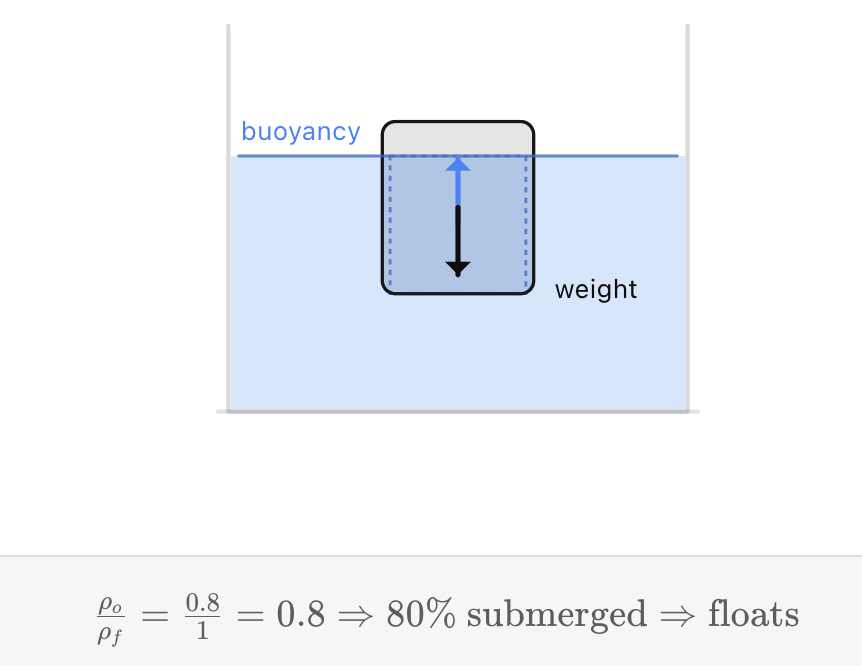
The key pattern is that the behaviour of an object depends on its density relative to the density of the surrounding fluid.


Density and Floating

Density gives us another useful way to predict floating behaviour.

Remember:

Density = mass ÷ volume

For an object placed in a fluid, compare:

density of object

with:

density of fluid

For many simple situations:

Density Comparison Behaviour
ρobject > ρfluid Sinks
ρobject < ρfluid Rises and can float
ρobject = ρfluid Neutral buoyancy

This gives us a powerful prediction rule.


Why Does Density Determine Floating?

Suppose two objects have exactly the same volume.

One has a mass of 2 kg.

The other has a mass of 8 kg.

When completely submerged in the same water, both displace the same volume of water.

Therefore, both experience the same buoyant force.

But the 8 kg object has much greater weight.

So density matters because it connects an object's mass and volume.

A high-density object has a large mass—and therefore large weight—for its volume.

A low-density object has less mass for the same volume.


Example: Wood and Steel

Consider equal-sized blocks of wood and solid steel.

https://images.openai.com/static-rsc-4/NFB2szR0YTj2_q7oCQa5ezPeb8B40gNbq4uhBQbSs_38eoZND5cF0goC8kbnG3bOr8PMDtTiyp2hsfsMa3npAA0hi6Vzc8VIyptOhftPg5OBjMziIpiAzbDjABpAgGhKMMmN6XVKwmEcDF-FjJvqb_T206VPEwhe4pB5Qpkqbhzs6ZyIb87EF6_xLDdJx29q?purpose=fullsize
https://images.openai.com/static-rsc-4/fH3iNjY2hQ5-tjv80DzooSKRJQmk6KAMSEBbKoeywvDrH_kDvOF8eVRvcLgqHwEfc8fPji9Ci61A1U76o2eRms1dXMEJ72Ny0T14mEBvXnaUvBnJ0i3S7jlJrSDv9yAegKY0KAB9zKXMKDSBDEkshY8JZniUATh4rwAb3P0EpNwmTJYL0Pk-X9snGfGRMqbY?purpose=fullsize
https://images.openai.com/static-rsc-4/rc9lWMgG8sxwqjHx_s_Lkmtf0VUL9prgPOuo8GMcTkLdgEykWtPK45fC4DhsDt3MsL2mMJQT64WuNtQNp1_Qvyq3NwO0p5gCLjMJ_DsEIB_LqPjAeeS8G-bxIL7m0kQzVYZH5X8YR7keSJoeSt_mNL-nLxQkWWMzxM2m0JFQnr16WRbEjdKpArUIzHykoWvK?purpose=fullsize
6

They have the same volume.

When completely submerged, they would displace the same amount of water and therefore experience the same buoyant force.

However:

steel has much greater mass → greater weight

The wood rises and floats.

The solid steel sinks.

This can be understood through density:

ρwood < ρwater

while:

ρsteel > ρwater


Floating Objects Are Only Partly Submerged

An important difference exists between a floating object and a completely submerged object.

A floating object usually has only part of its volume underwater.

Why?

As the object enters the water, it begins to displace water.

The farther it sinks:

more water displaced → greater buoyant force

Eventually:

Buoyant force = Weight

At this point, the object stops sinking.

https://images.openai.com/static-rsc-4/EJ-iWnx706P60_g4Yhcssk1f7elmLzO8QAvfbg7PYvyOuTqZzqHgMa3GvehRgUNKApYaL8QOra7mSxESlGgHdJIHOQn_raY_Nkth5CQhyuumIk9wK9ItiPYqpDbQ4YD2mnJ2lAmfYnk_lJbUKh5mInrKroA1sB6uY30S2N8pn-60rB_0MolAdrLO2Pl05upz?purpose=fullsize
https://images.openai.com/static-rsc-4/baG0ft9emxhzy2-0wJAFf6Y87rYjGK_URjNwCqHGWjIgX_5ELJfVk-CGuwDWsuyurLbIrAoJURimowDCai0J2YBQqcObxfFnhhL9PQqIbrLPw3iD1FI0dOKZ2Pwy1y_q0hFs_w-KKAUDDqCdjJ7ifFyWJWBE0RcKMsJhuj9B-9KA7wIsVKEnaGgF584C0qsp?purpose=fullsize
https://images.openai.com/static-rsc-4/-iDM6vm2e3vc0wrbfhwQSCClTqNpAylJ4ph0pIaf0LSoK78i6Ie2DIiZPEVCCdnsmfpzOOAz0yv0o_Ld31fXOPnwi6fL2Bn3TyTG7rLs9V3w3eW14BZe7bQoWPu83MelbsaeQDOhivfy1fVW8ClOfQPINpY8HSJp1_-E7T0Ma8U4-6dq-rgle8IY_DL5JdzB?purpose=fullsize
6

The amount below the surface depends on the object's density compared with the fluid.


How Much of an Object Is Submerged?

For a floating object:

Weight of object = Weight of displaced fluid

This leads to a useful relationship:

Fraction submerged = density of object ÷ density of fluid

For example, suppose an object has density:

600 kg/m³

and floats in freshwater with density:

1000 kg/m³

Then:

Fraction submerged = 600 ÷ 1000

Fraction submerged = 0.60

So approximately:

60% of the object is underwater

and:

40% is above the water


Worked Example 1: Fraction Submerged

A wooden block has a density of:

750 kg/m³

It floats in freshwater:

ρwater = 1000 kg/m³

Calculate the percentage of the block that is submerged.

Use:

Fraction submerged = ρobject ÷ ρfluid

Substitute:

750 ÷ 1000 = 0.75

Convert to a percentage:

0.75 × 100 = 75%

Answer

Approximately 75% of the block is submerged.

About 25% remains above the surface.


Denser Floating Objects Sit Lower

Suppose three objects all float in water.

Their densities are:

  • Object A = 300 kg/m³
  • Object B = 600 kg/m³
  • Object C = 900 kg/m³

Water has density:

1000 kg/m³

All three objects are less dense than water, so all can float.

But Object C is closest to the density of water.

It must displace more water to support its greater weight.

Therefore, it sits lowest in the water.

Object A sits highest.

So:

greater object density → greater fraction submerged

provided the object is still less dense than the fluid.


Why Does Ice Float?

Ice is less dense than liquid water.

The density of ordinary ice is approximately:

920 kg/m³

while freshwater is approximately:

1000 kg/m³.

Therefore:

ρice < ρwater

and ice floats.

https://images.openai.com/static-rsc-4/Exn-IxfI_wEjUAB0vdFeLxO3z74tHDhZRfS8T52Arh30jRqG2U8TZRxnjCR9Zamls3Sl4btg33udRa208lnrv_4Uyqq59t2oewM4_tETfQVlPVhaTo0QcQWuaSvi7hzx9Z2S5pENCtNvJxdi7Hdl9b1vHudF8sRCT37MT-MPIdKnkF45hR32RSKsbEmsXONQ?purpose=fullsize
https://images.openai.com/static-rsc-4/h0hoA00cob_rHExOTJmF1AvCm6yr07araVz6v_NcaVZuYnwePjVgeA1hfywdh9JHcVVAKbnsCE9nkZOlhkLWrM4lPPGjeHJQihF257XFelBYpEAKhhlKbjLwb9tvMr9RIDvbTDKANDd3uFtQIkT9UsDC9NX7QxjhAvgBxNfgz35pbR9RRBHm0pTAa1jiwc4u?purpose=fullsize
https://images.openai.com/static-rsc-4/UksS8ddEEyM2E9-GELj_yIuKOQ_AKmMHObuoLMDbr5kibxBQUyLEQ9mAblpM2Epu3ZXZGx1UJjJ7PnnDCo_c_095aVfAL919VhxlLrs1ML22zkoe7lmdwW1kcYcO5WwfllSG7O8g9_ThQhjBVBG9RTSkgbfAnIOirmhQs0wYtXCmm0t9ZZ7pmRyrbjOCmg3H?purpose=fullsize
6

Using the fraction-submerged relationship:

920 ÷ 1000 = 0.92

So roughly 92% of an iceberg's volume is underwater, with only about 8% above the surface.

This is the origin of the expression "the tip of the iceberg."


Why Do Steel Ships Float?

This seems like a contradiction.

Steel is much denser than water.

So why can a ship made largely from steel float?

https://images.openai.com/static-rsc-4/amRRcjmDAV9FAD1qGy2PZWEW_f5NQdLHD8s6hf-2Ukg4ZKu-lqwQUEVfY-1ftockccuU-t46TjDoALfQX0YWV0SKix8oIne3LhTlCG9jaSrdoxm3YbsQyiMDe16TtY6_MEuLwJsY_zFbDAwKMLfF8Lj4ZjFqhvL2qbci009tIo9q8ePKbZRuzoDXDJSZWlCV?purpose=fullsize
https://images.openai.com/static-rsc-4/pDiVqOBI8GX9CN3_4F8LufHp3mvIPEOMG4ZaAupdczobYLsBE0_F_xm9dhxhyoiXwBezF_MqnosoeThb46yKlKH1isJrlE2293iSeaXXkpzcQF8DsbPn1lSb_tYdOTOzsD9tqu0MoEpfZ2rkKDBbalyu9_fvO1gL67-xGdV4rSPC_1osTMJd6ncyzrnyigHZ?purpose=fullsize
https://images.openai.com/static-rsc-4/6sgYHh5LlakZCS0JiZVu925No92wq7vuIeWhTGU4OE9oy7DVGJY6M1qIfu3WJxyDIJmX_ZAXyMSPyxfUTeaL-u1w5j48e5Y_-E0yuqWu64CG1biJNrB0_MRL_m57QKC4rsaAkV09GcqXeQYt9i9LNVxkgm3DXoNuv7fQi5dIFmZ0isLpr5niF_aFBtelGFOk?purpose=fullsize
5

A ship is not a solid piece of steel.

Its hull contains enormous air-filled spaces.

The important quantity is the average density of the entire ship, including:

  • steel
  • cargo
  • fuel
  • equipment
  • passengers
  • enclosed air

The ship has a very large volume relative to its total mass.

Its overall average density can therefore be less than the density of water.

As the ship settles into the water, it displaces more water until:

Weight of displaced water = Weight of ship

Then:

Buoyant force = Weight

and the ship floats.


Loading a Ship

Suppose cargo is loaded onto a ship.

The ship's mass increases.

Therefore:

Weight increases

To remain floating:

Buoyant force must also increase

How can the ship increase its buoyant force?

It sinks slightly deeper.

https://images.openai.com/static-rsc-4/E2rHLJOu6g2DwB_MriM_UhwUJH72cvJA2qu5Le-K4UNeKqcTEMVOA3JfKh8QZc1betK8YvB_T0J6tsDnRruvQiNDmln3EoE235mjm54u71WDNVOB5GLjosLvJI4um_jkGk3fSmPCOiduVVExCj1nxNt1sR6I-jzHm_FptGIq3d2k1TPB4g_oAOyxynP1ZkDO?purpose=fullsize
https://images.openai.com/static-rsc-4/ART06fNY8VzDa6xTWLO3Rsrpaeu8n33z8YcMcZhOF_pzA2RGjYVabXwFK6ca2HLWMb2YLnrOcc3bXvqo6Om9do0H2wLk-HMTQsl3zxXhLJ_vjnfVBEggc1ZOmamW1ms_O70nojVC4ySOrGKRrYGnY5DBfwbtkmA3oHp5WRIKvKBYXocSoVedx-7IWlMTFFrr?purpose=fullsize
https://images.openai.com/static-rsc-4/2AssryNWpr07Y9bfCn3ycS4JSC61dzjrChhIAOE1o9ZQ8raDZ3ySxAhT_LftXk0dcEZWia_FMuwYdodxSowWzH6y3mGnXiwyaDOBDtPgl2LGmDaI12Ybj-wXLtwg9zoLFd56J8na_FtIGTaZl_V0233mmsgc4QDhJ8gngv9KdWYKn0BvvsLCnkd-ao2DXp52?purpose=fullsize
4

As the ship moves deeper:

more water is displaced → buoyant force increases

Eventually:

new buoyant force = new weight

and the ship reaches a new equilibrium.

This is why heavily loaded ships sit lower in the water.


The Plimsoll Line

Ships cannot safely continue taking on cargo indefinitely.

If too much cargo is loaded, the ship can sit dangerously low in the water.

Commercial ships therefore use load lines, commonly associated with the Plimsoll mark, to indicate safe loading limits under different water and seasonal conditions.

https://images.openai.com/static-rsc-4/2AssryNWpr07Y9bfCn3ycS4JSC61dzjrChhIAOE1o9ZQ8raDZ3ySxAhT_LftXk0dcEZWia_FMuwYdodxSowWzH6y3mGnXiwyaDOBDtPgl2LGmDaI12Ybj-wXLtwg9zoLFd56J8na_FtIGTaZl_V0233mmsgc4QDhJ8gngv9KdWYKn0BvvsLCnkd-ao2DXp52?purpose=fullsize
https://images.openai.com/static-rsc-4/CuhUm6EBhe7rS-pJB4wcSTaig8FxQAReOOpxAU1xYoWAX7DDAC-PFGVjOQYTaNplDGCs42XQIl2ul3JiUVvYyh46_BlYiWHuU-5dCXk5sGf6uZet8vw7eEuCUQeZQcYBdSImKGY34_QZ0NaKfeFRQQRPKPb0KO9hP42wGRttms3hLBPIXS5lR_h7rGu-68Mg?purpose=fullsize
https://images.openai.com/static-rsc-4/k9omffu9iL6YcM9UvZSMaq2_o-gpTSuszjX8PS-_TFofdeIbB2FUbU8QpRuCeR5pewx-VYTpp-7-cty2HFtZomXKEWka2jVzNj85rNSZOOlUT0anZgt1TwIs4r3Ci1EK-oBOXlNpzQNYMEB40GXsN9xl0KZY4XEAfwOVEoOwlz9fPH-0nYrgYsVX_jtmlP3V?purpose=fullsize
5

These markings help ensure that enough of the hull remains above water to maintain a safe freeboard.

This is a practical application of density, displacement, and buoyancy.


Freshwater vs Saltwater

Saltwater is denser than freshwater.

Consider the same ship floating first in freshwater and then in seawater.

The ship's weight remains the same.

Therefore, it requires the same buoyant force.

But because seawater is denser:

a smaller volume of seawater provides the required buoyant force

Therefore, the ship floats slightly higher in seawater.

https://images.openai.com/static-rsc-4/2GkobsDL71EAFhao2gCwoeMpz4ZnP-xZjIVcynlbrYcU8xzo_aRJzMcwA-nCKs0_NAVd7cEXG_Di4YUCVV5xfJEUKco4WVU2UE5I83S1lxyRwSW21Roaj3Q_sfJOKtQFYnYIlIiP3fH2A6fkC0nPIrElljXQrePzsCEG8vmh4tSbuyIfp_YdBO6VSdYoear5?purpose=fullsize
https://images.openai.com/static-rsc-4/5IfnWBs1Hu6FgFTVbpXWqNrXtw3X08BPONJ0_vs8hx_u_o8ScmA8qlji4k0hmdCqCVMH0H3Pl4-16XqRYmSl5ltojtJ0orYnzSmHGl6VjeMiRmRYDPR4viVsOUotGPXu5jGR3rATEjLRfNAV9ML3nO_Fc44zr1OvA3UVVooeDOrOtT55uiVU1TWlcgWdT5Tk?purpose=fullsize
https://images.openai.com/static-rsc-4/EXFI2UcDwUWi-PJ8_ALXfwVeuauTh6AtLniDgSLTXmziS3kJkFS60e0DErEOuc-OFwX3SUCgCrnH2KdujpVBlCDNxk2D1JL2kxMz1FIxqhG708Gij1RH7JmVDTa2xnnFGUHLRt6HRaFlpg-TQsyn803VgcEMV2lUeKMSHeyvt2iGbOXEdx1ZxPZbrnB99I00?purpose=fullsize
5

In freshwater, the ship must sink slightly deeper to displace enough water.


Worked Example 2: Floating in Different Fluids

An object has a density of:

800 kg/m³

In freshwater

ρfluid = 1000 kg/m³

Fraction submerged:

800 ÷ 1000 = 0.80

So:

80% submerged

In a denser liquid

Suppose:

ρfluid = 1200 kg/m³

Fraction submerged:

800 ÷ 1200 ≈ 0.67

So:

about 67% submerged

The object floats higher in the denser fluid.


Why Is It Easier to Float in Saltwater?

The human body has an average density relatively close to that of water.

Saltwater is denser than freshwater.

For the same submerged volume:

denser fluid → greater buoyant force

Therefore, a person generally needs to displace less saltwater to balance their weight.

https://images.openai.com/static-rsc-4/p-uBAcj5fDGqOlDzC6KXyDqrgGUMhFl26lF10iSboxsChzh_aVxA_qBcElrQd0nxmxjGbPDdSdpQGXOEYH9CxaWlSMz6LV90UV_rGAPH3544C0imtqtk34pcOBebWoHHLh3ARFeHEA-Yv-NXsg0UPkn8Nf08hVxYqlBWLLU6QpNSsTANGe7By8OR88dUuLNO?purpose=fullsize
https://images.openai.com/static-rsc-4/Za6AqO_R147W0303YRQEidSaU5lU-vyLc8DrSi9feuRpf1KoPynimXHhAB5zpayJ6cfJjuqZ2eOg_h-BBwI-5C1S_5llObqbkyb74rpODmDu-1rcIl0h2m2Gs9yXZLz-FE6CunHm04j-SOOHW_onBY0-dJyrc42Ce270dJAD7FfWUwkKNYdTy4wd5i5lCjol?purpose=fullsize
https://images.openai.com/static-rsc-4/yz4ePEy8xu2iu_RcDMSQPIPNpAwp5HkmJWN_rpwRDU7qiSrjj2_UcdsXg7UT8Ywm4-x9gKEsRS5LXlsIyY02IN9xyppqqmxe-prbnwuj7U1w_AbsHqutmXVF-JGq9nlQxQspwv8oUnd0bkpyBAgbiIhPSNcO9PMKtpm7si0456fEEPHq4URyRDM6DyOr9cLL?purpose=fullsize
6

This is why floating can feel noticeably easier in very salty water.


Submarines: Controlling Floating and Sinking

A submarine must do something more complicated than a ship.

It needs to:

  • float at the surface
  • descend
  • remain underwater
  • rise again

Submarines accomplish this partly by controlling their overall mass and buoyancy using ballast tanks.

https://images.openai.com/static-rsc-4/AANNdt_FAE8qx3EIy0fdH6EuDIhmsqRcxY9CfssqpYjrTMLQCZJ00JoYzNmXvOJ4ZP868k_KCdiDl4S9_f5pEkpA9ZV7WvwE2MzMsJS566TsQq5Qvi_2DMa7S5Fkmbwxg6naHHIPxv1HTgaf0lpngGcdKJ9adS2gJt32d3C1wUYWfUB19rwXDkNQ6DXKX9hp?purpose=fullsize
https://images.openai.com/static-rsc-4/v-huSxcDlEUp8ojqlYsb91eZuQfoBUiYdMHSv5c0amiGXMHPXt2FYKVxRmRH_DugXTLRkg24B2lf3LFAi04gi57IkTrPwD3fIP4UYP-dzq5ZNFxCiks-S_daraLYIe4gpo8uVQ6tOxWHh7iCYNlILBsCxElRcTuhY_H6uH9if-gHq6MOlCptPG2ByJuxwncM?purpose=fullsize
https://images.openai.com/static-rsc-4/kNaDcIg7P-vYDQqHEVVneInV66fvSLSQCS48SN-2hi6JteSMvCUkTFriEV7xRb0Smj7GTK2TQYTU9oWK4CtMsMKfuOnBCP6jeU6dy7GK9hkZT2AYbBscXKROwwloYVCOxl4iL_5oOuAiSx8PPu08mgZptc4zVs6IcVFb_lRZKNIfQF1NQudavjkngTT2MfGo?purpose=fullsize
4

To Dive

Water enters the ballast tanks.

Mass increases.

Weight increases.

The submarine's average density increases.

If:

ρsubmarine > ρwater

the submarine tends to descend.

To Rise

Compressed air forces water out of the ballast tanks.

Mass decreases.

Average density decreases.

The submarine can rise.

To Maintain Depth

The submarine can adjust its buoyancy so that:

Buoyant force ≈ Weight

This produces approximately neutral buoyancy.


Fish and Swim Bladders

Many bony fish use a gas-filled organ called a swim bladder to help regulate buoyancy.

https://images.openai.com/static-rsc-4/85W82U3LK4aDaPM5tB72vMUypGuyefBTQvtxHzs6DLxj7kBWng_BOmHYugI4cG17k7D8z9tp3_ltaDM2unx2qkhm1A2Aj2gukkxpWWibIfjRygtrny9h0KCDLIK0uPGu5PFzeZsiYj1e4ER26_i4wfN6uaq7gka0EALQv-pPHPe9OTGLAc4u8KaxpG_R1XTt?purpose=fullsize
https://images.openai.com/static-rsc-4/rVvGHUoI3J_Lv_HzMYuqsvakO2uJ_eqsEeV7I2nmqD2BPdWN0mgQIm6w1nIGyY9RjFInknHL3gOf6kvxTOtSdOItFxd8LWVeHojXYgBGBolshogF9fV9DGtuW07FLQkwn2e49mfugCJ9wXBgmCvTv0OTraKqbVltc5-sVe6vlJFm3_nXXQE8gcS9gmohyU3w?purpose=fullsize
https://images.openai.com/static-rsc-4/SDaT1TPuRzB3roMtSELQlHJNlCbFIiUuJLWTOYSp7U2h7ugi2zU1q7mag6NYWBSJuanFercrXoTcvkcaBWzHQQZi50GiN5a125V8_5m7TEAVbIkNoAYb-_K6Vfoy5bWxk6xMeyFr0ausbi6P86a8-h5H9q7Kr5O-qYvKCjtoBH_SsLbJQprAMiW0Nh4K4g2R?purpose=fullsize
6

Changing the amount of gas in the swim bladder changes the fish's volume and overall density.

A larger gas-filled volume can reduce average density and increase displacement.

This helps the fish maintain depth without constantly swimming upward or downward.


Scuba Divers and Neutral Buoyancy

Scuba divers also control their buoyancy.

A diver can use a buoyancy control device (BCD) that contains adjustable amounts of air.

https://images.openai.com/static-rsc-4/LtcLcvQlWzG8IbxIyEOI79zy3ERlVX9RuUCNvrQnw2A1bSJlO4kaLOxOzA4ZyGVeJBNl-xJZ84yPKP8dUwfwJKFJxJNKTsUwxQ9dizx0PodrWKaRye6bCanEIzp6m6wfUu95eaRg-CjmB4yzoWxQnN016Nu4v_6xKLSgnWgAjaalTnZGUvEcQWzHYm3LAFS6?purpose=fullsize
https://images.openai.com/static-rsc-4/2L8JDSFe_NZ2Kq9Svl6MV0hPeV0MIgj8beawLozQ_RY7Uithr4BaWYLazxHUaYIHhrh1PwqVBHBip7vd0BSpKAlqhkEA3d3hEb0qM2rJHxJOPyzLNMmhg63hOHEDc23XAEIK9579RFEjyJu7vlZBeLOUmIu5tj67aS7RlM0RvtE471dpH61coB9yVN3mHQF6?purpose=fullsize
https://images.openai.com/static-rsc-4/Pg05xu8df7NgE_Tj8pxncRKRY1EgWwOJCLMKU90uQ4HjhtGyp5And2BiMxLOrXP23onuJ8sx-FyqB-ZAAWeamAZygU3Dff8J83iALHc-DCb_-FmMBNauvj0Y1S26NF4Abp0w8dt66EUIGn84u8md6b3ivu9zIFmTe22zwMc0ybwPLh-re3IswNwpKCLcw3A7?purpose=fullsize
6

Adding air increases the diver-system's volume and can increase buoyancy.

Releasing air reduces buoyancy.

Divers try to achieve neutral buoyancy when they want to remain at approximately the same depth.

This allows them to move efficiently without constantly swimming upward or downward.


Hot-Air Balloons Also Float

Floating is not limited to liquids.

Air is a fluid.

A hot-air balloon displaces surrounding air and therefore experiences a buoyant force.

https://images.openai.com/static-rsc-4/Gh4XyBligXwfjrmrq3Z5816NWECxfgZJFG6RYon0M29oysmBpIJkBUDxmt0mpeLcswVbOfOb3qKNyqd4B93NoWC4ilEjKw4feqbJgG6k_KsCFsDPlKwRmFNsHENRWYFBxJdJbouRtyuzRePhjl1we7grH7r2N9Az3ViRJ01tDMnSzXQJ3GPsT8sBh6tqYTzg?purpose=fullsize
https://images.openai.com/static-rsc-4/EmVZHMTzHEtUSG-jzMBWgU_oWCw7d8t2eY4KetSwnUHyNOlaIuORYD9l1kDRYFV9Ya8XVcGoOcpLVJc-S6O0GCDF2UFOqy6NvmtEca-FUaABul0pyFbhKQ45gdZLNfNlL-pSxs8cle0MWL-h3tvfVxqkTqiLm-TfvKkJSOkLD12vYPSUMfw7zI5Jc24fS835?purpose=fullsize
https://images.openai.com/static-rsc-4/g8oHJM75fzsWmOOjdIzb0221kB59FjG7aGya5TaEo381BcVQ_9w3NFe58WF8V8nHPrNrgKufM0N0q9M2-0UmbqaBWUewMEhE2xNcOmBOe5kpH6qY-qnphQqdsmD3Pn70cYE44VRaQW5UoNeH5fn9lzylqLBoKB5upPBBWIt3DZdrCuIL5raqGj_MXantDUOz?purpose=fullsize
6

Heating the air inside the balloon reduces its density compared with the surrounding cooler air.

If the total average density of the balloon system becomes low enough, the buoyant force can exceed its weight.

The balloon rises.

When the upward and downward forces balance, it can maintain approximately constant altitude.


Floating Does Not Mean "No Weight"

A floating object still has weight.

For example, a cargo ship may weigh millions of newtons.

Gravity continues pulling downward.

The ship remains at the surface because water produces an equally large upward buoyant force.

Therefore:

Floating does not mean weight disappears.

It means:

Buoyant force balances weight.


Floating Does Not Require the Object's Material to Be Less Dense

Another important distinction is between:

density of the material

and

average density of the whole object

A steel ship contains steel that is denser than water.

But the entire ship includes large air-filled spaces.

Therefore, its overall average density can be low enough for it to float.

The same principle applies to:

  • hollow metal boats
  • pontoons
  • floating platforms
  • life jackets
  • some fishing floats

Shape and enclosed air can change an object's average density without changing the density of the solid material itself.


Life Jackets

A life jacket contains low-density material such as foam or air-filled chambers.

https://images.openai.com/static-rsc-4/KAu077pREepZYZj8JRCj4zDEENq9eg0lf7pyBKTrgeOt7axvKQ5ou2NEQ-JtY-EjPnUPCgZboM7Pvq19Ey0qOJpTtFIpCbX4WwSGrn1xvLY6CxVNlJP7S_-3QDJrMhUxijlF5kkZDtdHD5hGvqCPuLeKWyx_Sgn8CKX5V6fXrIYLlrp0gk1sLWsQPUuBt-Id?purpose=fullsize
https://images.openai.com/static-rsc-4/9h7M_fr_DC83gk3W4n5-MMZyt0hYUHoqSdEKgsgBS9-_wYBv4kkvdaCcU4pqhqCkgKuDZ7tAH4Lt7VGCWJMkQ2ZgN3EGRz2xq5mcsEKxi4s79e8NFEvhGXy3QIGGLJDXEe83ayz_QTGwIekU-VtZBHpxOj5BTB11eLjRkGkAIehAPTin2_Kn1EqbwYl3lrQH?purpose=fullsize
https://images.openai.com/static-rsc-4/4pTOKQ0S1fLTYdeS7rn7cKB-KjdXzwD9FwzHfCAQydJSkXqorKI8X0RTvoo4TCo6XQBYlwtMy_FRmE_vwtvD5oFYyWTAIpkcDayjXNfQqhLoTCWVh76VqRzdwFuki22bNCHjlwa6xkUpVwjB1lSXhTwfOtxunClkJRMz9vOEoiZovo7x3-M9qDJnelyEFG80?purpose=fullsize
5

Adding a life jacket increases the total volume of the person-jacket system without adding much mass.

Therefore:

average density decreases

and the system can displace more water for relatively little additional weight.

This increases the available buoyant force and helps keep the wearer at the surface.


Changing Shape Can Change Floating Behaviour

Consider a lump of modelling clay.

If rolled into a compact ball, it may sink.

But if the same clay is shaped into a wide hollow boat, it may float.

https://images.openai.com/static-rsc-4/LXV5loBuRmxekga9l4ok0HJzValF_-wsIDYBJKjIyD4w1WJ9seCyaoPCc7x21xBb0uHaHXZFsnQxf7-s-o_TTMQ2JlQWU1fL0ugbCx7aTtpfREqd19N-4VCanG_SgefgeTiAcSN-uXFJQ-UgklWzNFZzOuyAHnGRsYF9zyY4IvFTM84sHa1eB0z-5pUjjnoq?purpose=fullsize
https://images.openai.com/static-rsc-4/79RCGu8HX7DQDEIPBHsmscZ2mOJIDWmF08YHzNlCBcFAvF_faYwU1WsnAkAuXQ9LzYTItABsgmcl9OMFO-K_BSgHa1fJ1KDs1SEyHoBDVYrcXVo9ncuS4tzMY3mQiQT67XIiJp4GPORCJ2DVp5135jSXFc86ApROPRgUkjHyTfw2aGmLvsm-bXDtgLczdKRD?purpose=fullsize
https://images.openai.com/static-rsc-4/4Rx-ckvxdfRsD9TGFFGPF0v9sHvIvtslSiMp8QvImjwqV1h7ueS2vHpeqSja9C3Y6kYa12ekvwUP5HNAXc8UBjKsERexYQFdO1d4koXEw0A6D6l1q2OTVmLilgFA-srxIFTWou46W0eP1QbnKAwX-mwXuS7XQtt1657JiV6vCUFotnTnaytuQ4u-WLTfCX4U?purpose=fullsize
4

The mass has not changed.

But the hollow shape occupies a much greater volume.

This allows the object to displace more water before becoming fully submerged.

Its overall average density is reduced.

This demonstrates an important engineering idea:

Floating depends not only on what an object is made from, but also on its shape and overall density.


Worked Example 3: Predicting Behaviour

Three objects are completely submerged in freshwater.

Freshwater density:

1000 kg/m³

Object A

Density = 700 kg/m³

Because:

700 < 1000

Object A experiences a net tendency to rise.

It can eventually float at the surface.

Object B

Density = 1000 kg/m³

Because:

1000 = 1000

Object B can have neutral buoyancy.

Object C

Density = 1400 kg/m³

Because:

1400 > 1000

Object C sinks.

So:

lower density → rise

equal density → neutral buoyancy

higher density → sink


Worked Example 4: Forces

An underwater object has:

Weight = 80 N

Buoyant force = 50 N

Calculate the net force.

Take downward as the direction of the larger force:

Net force = 80 − 50

Net force = 30 N downward

Therefore, the object accelerates downward.

It sinks.


Worked Example 5: A Rising Object

An object has:

Weight = 35 N

Buoyant force = 50 N

Calculate the net force.

Net force = 50 − 35

Net force = 15 N upward

Therefore, the object accelerates upward.

When it reaches the surface, part of the object may emerge from the water.

This reduces the displaced volume until the buoyant force eventually balances its weight.


A Useful Decision Process

When predicting floating behaviour, ask:

Step 1: Is the object completely submerged?

If yes, compare either:

  • weight and buoyant force, or
  • object density and fluid density

Step 2: Compare the forces

Fᵦ > W → rises

Fᵦ < W → sinks

Fᵦ = W → balanced

Step 3: Compare densities

For a simple fully submerged object:

ρobject < ρfluid → rises

ρobject > ρfluid → sinks

ρobject = ρfluid → neutral buoyancy

Step 4: If it floats at the surface

Remember:

Buoyant force = Weight

and only enough of the object remains submerged to displace the required amount of fluid.


Common Mistakes

Mistake 1: Saying floating means buoyant force is greater than weight

If an object is floating at rest:

Buoyant force = Weight

If buoyant force were greater, the object would accelerate upward.


Mistake 2: Saying sinking objects do not experience buoyant force

Sinking objects still experience buoyant force.

They sink because:

Weight > Buoyant force


Mistake 3: Thinking all objects less dense than water remain completely underwater

An object less dense than water generally rises until part of it leaves the water.

It then displaces less water until:

Buoyant force = Weight


Mistake 4: Saying steel cannot float

A solid piece of steel normally sinks, but a hollow steel ship can float because its overall average density can be less than that of water.


Mistake 5: Thinking a heavier floating object must sink

A heavy object can float if it displaces enough fluid.

Ships are extremely heavy, but their large hulls allow them to displace enormous quantities of water.


Mistake 6: Confusing neutral buoyancy with floating at the surface

Both situations involve balanced forces, but they are not exactly the same.

A floating object is normally partly submerged at the surface.

A neutrally buoyant object can remain completely submerged within the fluid.


Mistake 7: Thinking a ship floats at the same height in every liquid

The density of the fluid matters.

A ship floats higher in denser water and lower in less-dense water.


Mistake 8: Thinking changing shape cannot affect floating

Changing shape can change the volume of water an object can displace and its overall average density.

This is why the same material can sometimes sink as a compact object but float when shaped into a hollow vessel.


Check Your Understanding

1. Recall

What two major vertical forces act on an object floating at rest?

2. Forces

A floating object has a weight of 120 N.

What is the buoyant force acting on it?

Explain how you know.

3. Compare

Complete the following:

a. Weight > buoyant force: __________

b. Weight < buoyant force: __________

c. Weight = buoyant force while completely submerged: __________

4. Density

Predict what happens when each object is completely submerged in freshwater with density 1000 kg/m³.

a. Object A: 600 kg/m³

b. Object B: 1000 kg/m³

c. Object C: 1500 kg/m³

5. Fraction Submerged

A wooden block has density:

400 kg/m³

It floats in freshwater.

Approximately what percentage of the block is underwater?

6. Apply

Explain why a cargo ship sits lower in the water after additional containers are loaded onto it.

7. Compare Fluids

A boat travels from a freshwater river into denser seawater.

Will it float higher, lower, or at the same level?

Explain using density, displacement, and buoyant force.

8. Challenge

A solid lump of metal sinks when placed in water.

A boat made from the same mass of metal floats.

Explain how this is possible even though the density of the metal itself has not changed.


Key Terms

  • Floating – remaining supported by a fluid without sinking
  • Sinking – moving downward through a fluid because the downward forces are greater
  • Buoyant force – upward force exerted by a fluid
  • Weight – gravitational force acting on an object
  • Neutral buoyancy – condition in which buoyant force balances weight while an object remains submerged
  • Average density – total mass divided by total volume of an object or system
  • Displacement – fluid pushed aside by an object
  • Equilibrium – condition in which forces are balanced and net force is zero
  • Ballast tank – tank used to adjust the mass and buoyancy of a submarine
  • Swim bladder – gas-filled organ used by many fish to regulate buoyancy
  • Freeboard – vertical distance between the waterline and the upper part of a ship's hull
  • Load line – marking indicating safe loading limits on a ship

Key Takeaways

  • An object floating at rest has buoyant force equal to its weight.
  • If weight is greater than buoyant force, an object accelerates downward.
  • If buoyant force is greater than weight, an object accelerates upward.
  • Neutral buoyancy occurs when weight and buoyant force are equal while an object is submerged.
  • An object less dense than its surrounding fluid tends to rise.
  • An object denser than its surrounding fluid tends to sink.
  • An object with the same average density as the surrounding fluid can have neutral buoyancy.
  • Floating objects displace enough fluid for the weight of displaced fluid to equal their own weight.
  • Denser floating objects sit lower in a fluid.
  • Objects float higher in denser fluids such as saltwater.
  • Ships float because their hollow structure gives them a relatively low overall average density and allows them to displace large amounts of water.
  • Submarines, divers, fish, life jackets, ships, and hot-air balloons all apply the principles of density and buoyancy in practical ways.

4. Ships and Submarines

Learning outcomes
  • I can explain how large ships float despite being made of metal.
  • I can describe how submarines control their depth.
  • I can explain the role of ballast tanks in submarines.
  • I can apply buoyancy principles to marine transportation.
  • I can evaluate engineering solutions used in ship and submarine design.

A small solid piece of steel sinks in water, yet a cargo ship made from thousands of tonnes of steel can cross an ocean without sinking. A submarine can use many of the same principles but can deliberately float, sink, rise, or remain underwater at a chosen depth.

Both technologies depend on the same fundamental ideas:

density, displacement, buoyant force, weight, and Archimedes' Principle.

The difference is how engineers control these factors.

https://images.openai.com/static-rsc-4/dFB0VDxIqPKCBBcxjhUjJglS5G_g6MD_RORWecZbXI6U3t1qQj3KFqONlmGq0u_c5O_jlzD8Am64K3yRu4dmSh1okWBl72k31Xxh6G5H8hhbao6koKoxMFty_G7fvvuA9bM21Q1aOCbXRhlZnBfgWykrsgZX3Iy8KDk0dVHyVDfgNXC-s-hJzLJirH5lk-hk?purpose=fullsize
https://images.openai.com/static-rsc-4/irN8JoFDhLBg2DkY93PQ7d89fTKui-fPj21hnVYB_RzhY6OVMK965i67Gp4vxHNLV6vUaa1Rx2vJBhvCJzYxTKbu0rXWADIbtACxLb0vmr3LFLs6uwzScohlyIDEHbIYjc1hH6ursAT1S0KcNRA8gGP7_FQPeN5Br9RWjgwE_ESm8pZmTrIisiMFUZ7p1SDe?purpose=fullsize
https://images.openai.com/static-rsc-4/uEZBb-pLj-13VKXA4VU9ORqQ2EuCtWa6ZYwCPQtA67CradD73WhDQCIQQ64KTDb1t58WpkaTdtrxdNqRwbhkFXYWYqjfnv0nwjKHIWdL5XCYB6FSqBmJyzbZLWsGcVQizGDNQ5L4uOrzZHCudc5Ry43Kxg9lEbejusrDjMawahZHJleRHbB7A7P3-pKjHU1t?purpose=fullsize
7

The Puzzle of the Steel Ship

Steel is much denser than water.

The density of steel is roughly:

7800 kg/m³

while freshwater has a density of about:

1000 kg/m³

A solid block of steel therefore sinks in water.

So why doesn't a steel ship sink?

The answer is that a ship is not a solid block of steel.

Its hull encloses a huge volume containing air.

When we consider the entire ship—including its hollow spaces—the ship's average density can be less than the density of the water in which it floats.


Average Density

The average density of an object depends on its total mass and total volume:

Average density = total mass ÷ total volume

A ship may have an enormous mass, but it also occupies an enormous volume.

Much of that volume contains air.

https://images.openai.com/static-rsc-4/amRRcjmDAV9FAD1qGy2PZWEW_f5NQdLHD8s6hf-2Ukg4ZKu-lqwQUEVfY-1ftockccuU-t46TjDoALfQX0YWV0SKix8oIne3LhTlCG9jaSrdoxm3YbsQyiMDe16TtY6_MEuLwJsY_zFbDAwKMLfF8Lj4ZjFqhvL2qbci009tIo9q8ePKbZRuzoDXDJSZWlCV?purpose=fullsize
https://images.openai.com/static-rsc-4/4U4mQs7CVlEHHBo0qrwNqHmd0sxMwOkmmerIhteXxx-ybzki9ynP_rWb6jJggHLaD7G3g1tiP-OtOA902guWAv7cEy2fjo7a4g1JOOAsBCYtvZHC3XJhZIufh8igL-_7ZA7SPkbQM9bTF0iDPvJOBcp0ccxshShrC9FmShcypiO-ZN3jAr9ZG5vmkXKw8h2A?purpose=fullsize
https://images.openai.com/static-rsc-4/3Vlbf2015VDUi3MbWMxGh6UKPm9pEhSDUk8kr750dV59rk7PVWXMXwmEcCSSdvTSNMTPo5jafXkPDpQ4LqjDfVR3-yHLdHTsZBEk0nLTa1KrCrGHXACB62ZEWqXZi47X_ZOZ6-i8WAd37Id4E09VcTnJYQf1Iaom64UMCS6xs0zPGOPE_sgmH3kf4WEbtsb8?purpose=fullsize
5

Consider two objects made from the same amount of metal.

Solid metal block

Small volume + large mass → high average density → sinks.

Hollow metal boat

Large volume + same mass → lower average density → can float.

This is why changing the shape of a material can completely change its floating behaviour.


A Simple Demonstration

Imagine a sheet of aluminium foil.

If you squeeze it into a compact ball and place it in water, it may sink or sit very low in the water.

Now take an identical sheet and shape it into a wide boat.

The mass has not changed.

But the boat shape encloses air and occupies a much larger volume.

https://images.openai.com/static-rsc-4/TS73oF40tuP4cmOkwR1LKIqNjMy6nRDtwDbjpIlEiJ7YX_h8mUBx0AfP-YSe0LZBq7Eb0O2OOQlt-hGxJTor1_GQDdOCgOuVztggvMkgzKyokIXFbPdCq9DGOsQR5E9P5Jc7zS6UOJSkTMq_ZutMOBjLDxWjPZ1pu_BBj6xNksYy-MKkNBlkZ6cWdxlJyY1a?purpose=fullsize
https://images.openai.com/static-rsc-4/Jtgcck85M9HlzQvGnVNceLMTDHyQ0igN1O2p6R1uvonexLHaYj3FB30rK2_hTs-fCfAGM_mS36HmkoWuxBOdwjAZrE9XlXHVNwenyr-EReWXL1DbajnLKaEtZJQ2dp3gBd97wJvMVeGIyf4dPFyK5Z8Jv8TsKTzT-NTQbeYmVZr_Wf7kQLXJf10z0rMiK8nv?purpose=fullsize
https://images.openai.com/static-rsc-4/gt8tWmiQeVqopClrRYGdKbLGN9OHtmUlHsT9aWOMAmaMNG4yS4NYSiplhcNGB6rFcEwxVGQphuiLd-yVxDP0YAwGov9dx-SLOD2F38EjHTb62FVeP0Z7Cit5c4d62dJ7OwBIrhZkKXowj3inHNXpkttQWe4JLapS3MVLaDGu9IF5ixG-CpyBNZxk8DK5pHI3?purpose=fullsize
4

The boat can now displace a much greater volume of water before becoming submerged.

This allows the buoyant force to become large enough to balance its weight.


Archimedes' Principle and Ships

According to Archimedes' Principle:

Buoyant force = weight of displaced fluid

As a ship enters the water, its hull pushes water aside.

The farther the ship sinks:

more water displaced → greater buoyant force

Eventually:

Buoyant force = Weight of ship

At that point, the forces are balanced and the ship floats.

 
             ↑
        Buoyant force
             │
        ┌─────────┐
      __│  SHIP   │__
~~~~~/~~└─────────┘~~\~~~~~
             │
           Weight
             ↓
 

The water does not need to be able to "hold up steel."

It needs to provide enough buoyant force to support the entire ship.


Displacement

A ship's displacement is closely related to the amount of water it pushes aside.

For a floating ship:

Weight of ship = Weight of displaced water

Suppose a ship has a total mass of:

20 000 000 kg

Then, while floating, it must displace water with approximately the same mass:

20 000 000 kg of water

That is why very large ships require enormous hull volumes.

https://images.openai.com/static-rsc-4/a8JwM055T4Frsg3XCY10OKK-2r6I43zFnXvHh2Lp0etv11tf-x28zNaNUzbf1_fPzQpgPtggCT2lAMFtNADzCW7BJpP3p2ZmV7MLWqRe6Di4LlIRb1sSOaqKBEGca3h1QUnSR7sNSfJOLd4x8nl5mTwJrnvQUjfF8dOlhy93il3jpypVuAU_nyy5qQZ7wp0O?purpose=fullsize
https://images.openai.com/static-rsc-4/E2rHLJOu6g2DwB_MriM_UhwUJH72cvJA2qu5Le-K4UNeKqcTEMVOA3JfKh8QZc1betK8YvB_T0J6tsDnRruvQiNDmln3EoE235mjm54u71WDNVOB5GLjosLvJI4um_jkGk3fSmPCOiduVVExCj1nxNt1sR6I-jzHm_FptGIq3d2k1TPB4g_oAOyxynP1ZkDO?purpose=fullsize
https://images.openai.com/static-rsc-4/VKygmwS2AQyMoz7H67ANs06huJnYHSCMBOR6jf0CWUwsnoYzxbhZOtnC0V5pNFDAsUdaRReZxR6rL0aov5sbfZ136hiGNsG_OFxmw6arw07-UlysFT-e4yrvoxFevpLLqGfNLiE_8zAZML5D_RUjxt9zB35z0pgN4hbJKjKCgnO64G3-jUzdC467PzdeaepN?purpose=fullsize
6

Worked Example: Ship Displacement

A small vessel has a total mass of:

80 000 kg

Use:

g = 10 N/kg

Step 1: Calculate the ship's weight

W = mg

W = 80 000 × 10

W = 800 000 N

Because the vessel is floating:

Buoyant force = Weight

Therefore:

Fᵦ = 800 000 N

According to Archimedes' Principle, the displaced water must also weigh:

800 000 N

Its mass is therefore:

80 000 kg

Answer

The vessel must displace 80 000 kg of water.


Why Hull Shape Matters

The hull is one of the most important parts of ship design.

A hull must allow the ship to displace enough water while also providing:

  • stability
  • cargo space
  • structural strength
  • efficient movement through water
  • sufficient freeboard
  • protection from waves
https://images.openai.com/static-rsc-4/a21Iumzl7Lxrpa2puwHSVwVzUs6jxVBpnbF0guXqu2zi3YGttopawb0hXoBYQVZaYVhA5YjHeOKpg0Mdi-gWhfkuYbG7HW7fWk7bXALERLwW92ZqTKgCY-FPxWpPououeoFRAi6A6TsxlDZ1T0d_4fdKSJUgRLrloc8phzR9YuAsKD5uud7dcWsjkKWC5I9N?purpose=fullsize
https://images.openai.com/static-rsc-4/wE8I-fKasS5qdSGRN0gnIoxjnGFiaN0UO1-4oYf7XA4qxXbVX_DIgwKXoqGXOtAjDaV162ZjMeiPDi2W-2j0z18Qc0q6tJVTXuRtj0G3KvcMy2_ZbwdvfH-NUGjChszsSuKAhKXopcQsDzDiIGuUXSXDiP6qbdHJUu3bjWCEKZMaQ2Ak2JGtRIZ1lE1WLkuf?purpose=fullsize
https://images.openai.com/static-rsc-4/Qz36kp376-QCGvVnP793aeivu9vRwvZVfL9Y9LanDnYQb7UKRkCT_MnF1BrxNcmGzsbCvkhIPmY-Gu_nvQ67woIq4KurAiobfQ5lj4pFiEW0mwxI8I1SrKpUGqHhVZL48C4qaFitRmPzGpmpJ7LvYQXAKAJwjNJhcKvpjnV8RzV02BKz6gv6qEdbSmCW58ja?purpose=fullsize
5

A very wide hull may provide excellent stability and displacement but create greater water resistance.

A narrow hull may move efficiently through water but provide less cargo space or stability.

Ship design therefore involves engineering trade-offs.

There is rarely one perfect design for every purpose.


What Happens When Cargo Is Added?

Suppose containers are loaded onto a cargo ship.

The ship's:

mass increases

Therefore:

weight increases

But a floating ship requires:

Buoyant force = Weight

So the buoyant force must also increase.

How?

The ship sinks slightly deeper into the water.

This causes:

greater submerged volume → more water displaced → greater buoyant force

https://images.openai.com/static-rsc-4/PLVDoytB41bVkVUP7Bhvi4YURyq2X_YI732N8CKuPymqzD82wXDtqYhoaEI8AQZ8nnRZiJknbcoKuzLvBFlc9GNIYBRFMXzx3c-wxdmisl5x0A3VUK9Zp4-jbhCC_dCC837iFUkL-QyhECnxx9dVP8bp6r7wzn0FbkbiUdLpBbO9L0hQw1JjI-29wLI01J4t?purpose=fullsize
https://images.openai.com/static-rsc-4/ART06fNY8VzDa6xTWLO3Rsrpaeu8n33z8YcMcZhOF_pzA2RGjYVabXwFK6ca2HLWMb2YLnrOcc3bXvqo6Om9do0H2wLk-HMTQsl3zxXhLJ_vjnfVBEggc1ZOmamW1ms_O70nojVC4ySOrGKRrYGnY5DBfwbtkmA3oHp5WRIKvKBYXocSoVedx-7IWlMTFFrr?purpose=fullsize
https://images.openai.com/static-rsc-4/ahrm9XEhEx8M6_Yuji0qNJ_yg1ngOhNQHKrlYm17JOBOlhNtMWTM6Txr-iRScJ6G_io-0ZA37vm1l7oiq3nHOfzS-U4Lz7yT98JDGpBnFbhR9d4oalZF9dTjL-C00IDkGrh7eH2DBvS_f2oO2HRqrUIiOTlHdDXuwwqPP-IhaaOF9AkCJyKUGNPZA9kzPOVF?purpose=fullsize
4

Eventually the increased buoyant force balances the new weight.

The ship then floats at a new, lower position.


Why Ships Cannot Be Loaded Indefinitely

Adding cargo causes a ship to sit lower and lower in the water.

Eventually, too much of the hull may become submerged.

This creates serious risks.

Waves may more easily wash over the deck, stability can be affected, and the vessel may no longer have a sufficient safety margin.

Ships therefore have load lines showing safe loading limits.

https://images.openai.com/static-rsc-4/k9omffu9iL6YcM9UvZSMaq2_o-gpTSuszjX8PS-_TFofdeIbB2FUbU8QpRuCeR5pewx-VYTpp-7-cty2HFtZomXKEWka2jVzNj85rNSZOOlUT0anZgt1TwIs4r3Ci1EK-oBOXlNpzQNYMEB40GXsN9xl0KZY4XEAfwOVEoOwlz9fPH-0nYrgYsVX_jtmlP3V?purpose=fullsize
https://images.openai.com/static-rsc-4/fAsidFZHw9uC8KbjAXo2y_tzVmp1jXpyx67d56fUqPOB2aFnCLSYpauFRxL_2vqjK17CKe9QysDHrAVUydnE4M1yKtuwixqIW-srbUIY9nH9chfsBu9uuzpmdAdxIWQpEH-6vN3644_WQhvM6tMxRLZs3vwZU9h8xl5hLlOWq-9GSaK4ZgroRZgN4sBmJWPW?purpose=fullsize
https://images.openai.com/static-rsc-4/CuhUm6EBhe7rS-pJB4wcSTaig8FxQAReOOpxAU1xYoWAX7DDAC-PFGVjOQYTaNplDGCs42XQIl2ul3JiUVvYyh46_BlYiWHuU-5dCXk5sGf6uZet8vw7eEuCUQeZQcYBdSImKGY34_QZ0NaKfeFRQQRPKPb0KO9hP42wGRttms3hLBPIXS5lR_h7rGu-68Mg?purpose=fullsize
5

The well-known Plimsoll mark helps indicate how deeply a ship may safely sit in different conditions.


Freshwater and Seawater

Seawater is denser than freshwater.

Suppose the same ship moves from the ocean into a freshwater river.

Its mass and weight remain approximately the same.

Therefore, it still requires the same buoyant force.

But freshwater is less dense.

To obtain the required buoyant force:

more freshwater must be displaced

Therefore, the ship sits slightly lower in freshwater.

In denser seawater, the ship floats slightly higher.

This is another reason ship loading limits must account for the type of water in which the vessel operates.


Stability Is Different from Floating

A ship can have enough buoyancy to float and still be unstable.

Buoyancy answers:

Will the ship remain supported by the water?

Stability answers:

Will the ship remain upright or return upright after being tilted?

https://images.openai.com/static-rsc-4/BqARtCr1B5QH6VmRcjLOpu_i3ub7BpmWiAEhniVd_u7PReHIQTi48bGwIqhB5cvJgMGq3AVBgrwk1HU6s6SYX31k2NjFb0dW00HTITuufdITjPSwAvfCtiKO1JRwqrdEDHSo4rPtcC4gksYX0a8yirC5AeOxTc4cnR1MhhBGkTCMTghzuh2s2H3RKEwCXixi?purpose=fullsize
https://images.openai.com/static-rsc-4/1ySGQytCfMask7BD3fUnnw5dl8OiAkzyxugHvtoN5JFSqcnqbCBja7MBXDKkVxDgpXp95oZ90-wDeAxs4X8XaKNKT-yH9-mYeu719ZIVCCr29ZU5PjiOVsxLeRLddc4EAovwmA5zNKsrJqflCYCllLcHTHfj-sOTEqe9eyuKewoEatBpiFZkUt8h8M0E8_HZ?purpose=fullsize
https://images.openai.com/static-rsc-4/4XcmG8AXJlCmEzItPS1S4WmTvbVcfnipUsxTMsCdSlIUR2FSOipCZ8YBUH6EztErV2PXiot2aa8QoStd5yXwjxPciz5lAieW3HTylMiMMM0fiBuh6ic4vIRbWBqY-q495b0ob7V052u4Hdv5OjAT0D-F9PCFqCcthxc9UPZ3d1bSyGyrTxQQWoEnzEEfabTt?purpose=fullsize
6

Engineers must carefully control:

  • centre of gravity
  • distribution of cargo
  • hull shape
  • ballast
  • centre of buoyancy

For example, placing too much heavy cargo high above the waterline can make a ship less stable.


Ballast in Ships

Ships sometimes carry ballast to improve their stability and control how they sit in the water.

Modern ships often use water stored in ballast tanks.

When a ship carries little cargo, ballast water can add mass low in the vessel.

This can help:

  • improve stability
  • maintain suitable draft
  • keep the propeller properly submerged
  • improve handling

When cargo is added, some ballast water may be removed.

So ballast allows engineers and crews to control the ship's mass distribution and position in the water.


Submarines

A surface ship is designed mainly to remain floating at the surface.

A submarine must do much more.

It needs to:

  • float at the surface
  • descend below the surface
  • control its depth
  • remain at approximately constant depth
  • rise again
https://images.openai.com/static-rsc-4/bOkayw9JZPd714wz1LwpRGK4u0mE3TtL9lpuh7pCEmEuLKsfFyGR61Y5SJwFbIZrz2JDaW3kmsqMv3ja5g6zmGCZ5ozP7zinLcuL1fw9UY8elBom-uzhqJ7CGmhrdfC5Yo60LZlUZRsTbaHy8Zs5kApY2JDKP17FiEyBQAI0lIboGDHhkWWAXvs4xwhOOAcI?purpose=fullsize
https://images.openai.com/static-rsc-4/DAvV8ELbNlwlsQjaqvQLz80_hm2ejAB_JtryVkuz4Fx3oa1j6hQRt5Vl36Sa9eHQRj5XOJKJ4FKB95i7dqqA9Wkg1bfQh2Wvoff1BhLd9V05ZVLoIprUvvhmJwU8nJwN70IGEby1Hp3cg45WZY7UKOImpafoo2urvuBgICm46WTh0PWlJNooxyXnRLK0qAr5?purpose=fullsize
https://images.openai.com/static-rsc-4/4DDxizfyvXkvPKRTHSA8GTQs30qR0vtTj9hPoSkUQPqOT5jtKyK90p5nttHdmykricfpGlpYxLlc4M2HZ1I4WeifzPnQEB5S36be0WZfH_aZOkGzJgmY4BRROnHSgPCK4uySEz0b9NHeoVUiK-eX71A8fUSgaCTRuOWbXJ7l6tb1bm0u8-lu6FaHNHGMH2xr?purpose=fullsize
5

To accomplish this, submarines control the relationship between:

weight and buoyant force

A major part of this control comes from ballast tanks.


Ballast Tanks

Ballast tanks are spaces that can contain either water or air.

They allow a submarine to change its overall mass and average density.

A simplified ballast system works like this:

At the surface

The main ballast tanks contain mostly air.

The submarine's overall average density is low enough for it to float.

To dive

Flood valves allow seawater to enter the ballast tanks.

The water replaces air that is vented from the tanks.

The submarine's mass increases.

Its average density increases.

To surface

Compressed air is introduced into the ballast tanks.

The compressed air pushes water out.

The submarine's mass decreases.

Its average density decreases.

https://images.openai.com/static-rsc-4/t3Guk91Syv292SHIy5-9pLsY7d3vswV7kzaihrgEluNchv5IF7QxEqaWOFOlT3jRvgw0GobnOzI0MQ8FEy4Q7_-piLBD0WFqWuWNy0uxmZB2oPcvX8JKkcwvTKywfrFchBqsymmiBX9jsM0akvahx1-c8vgGaAqEk4ObcfPaK1SIMHNvYKaFlwB2oJx3RHSl?purpose=fullsize
https://images.openai.com/static-rsc-4/v-huSxcDlEUp8ojqlYsb91eZuQfoBUiYdMHSv5c0amiGXMHPXt2FYKVxRmRH_DugXTLRkg24B2lf3LFAi04gi57IkTrPwD3fIP4UYP-dzq5ZNFxCiks-S_daraLYIe4gpo8uVQ6tOxWHh7iCYNlILBsCxElRcTuhY_H6uH9if-gHq6MOlCptPG2ByJuxwncM?purpose=fullsize
https://images.openai.com/static-rsc-4/rmWliOZToZGgMYaHOO4N9tfrxnuofsJ1HAHnSiG79TJG4ilfJ3YX11Om9KPkZa1iip3M0SoBtLlWitZnCZFygaggBtu0S2zUAOHQfjmEG_rOsm8nHc5O4sNRAJjwy3kmtuLHUuBbIRsEqtoofr9nQ_BX8EgSHqwYrtideD0CC5NXPM33QkwK3Yl_7eMwImDW?purpose=fullsize

How a Submarine Dives

Consider a submarine initially floating at the surface.

At first:

Buoyant force = Weight

Water is then allowed into its ballast tanks.

This increases the submarine's mass.

Therefore:

Weight increases

The submarine can become negatively buoyant:

Weight > Buoyant force

There is now a net downward force.

The submarine begins to descend.

 
       ↑
  Buoyant force
    [SUB]
       ↓↓↓
     Weight

Net force: downward
 

In real submarines, diving and depth control also involve control surfaces and propulsion, so ballast is only part of the system.


How a Submarine Rises

To surface, compressed air can force water from the main ballast tanks.

This decreases the submarine's mass.

Its weight decreases.

If:

Buoyant force > Weight

the net force is upward.

The submarine rises toward the surface.

 
      ↑↑↑
  Buoyant force
    [SUB]
       ↓
     Weight

Net force: upward
 

Once at the surface, the submarine can establish positive buoyancy so that it remains safely afloat.


Neutral Buoyancy

A submarine often needs to remain at approximately the same depth rather than continuously sinking or rising.

This requires approximately:

Buoyant force = Weight

This condition is called neutral buoyancy.
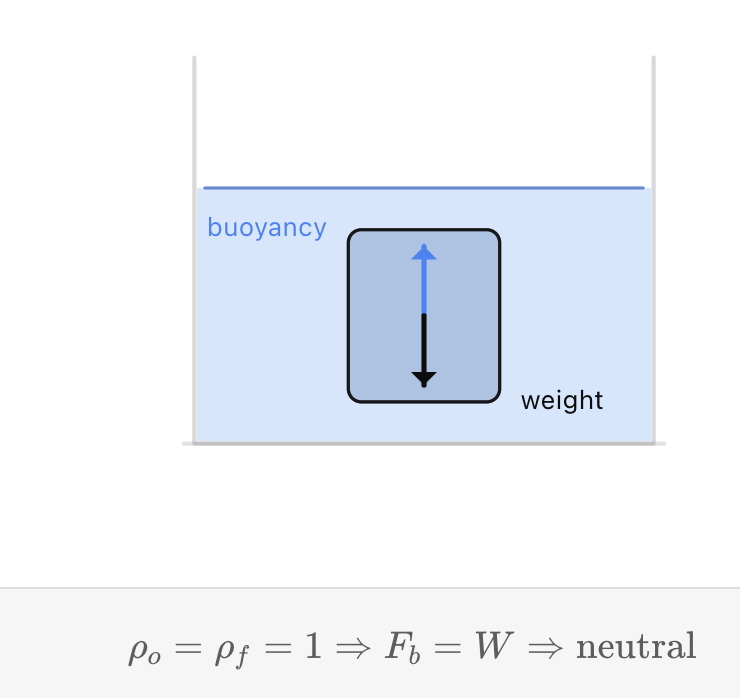
A neutrally buoyant submarine has no net vertical force from weight and buoyancy alone.

However, submarines moving through water also experience hydrodynamic forces, so actual depth control is more complicated than simply balancing these two forces.


Main Ballast Tanks vs Trim Tanks

Not all ballast tanks perform exactly the same job.

Main Ballast Tanks

These are mainly used to make large changes between:

  • surfaced operation
  • submerged operation

Flooding them helps the submarine dive.

Blowing water from them helps the submarine surface.

Trim or Variable Ballast Tanks

Smaller adjustments can be made using additional tanks.

These help control:

  • exact buoyancy
  • balance
  • trim
  • depth
https://images.openai.com/static-rsc-4/aepFvlvXl1GwLkxI5oFb0x8rjfLLWTD1foXqwBip5ZprZR_Eb779TVtk-TP6GzTeNnDqMLpk-XMyMwHcRmP73-Vu84VG1E_vFPN2kiALaMR_FznoRwzPEtm4ud5t7yV2Vs_U0FYmFzH9nMoXx6UYXLAyAZkbWhhSnT5l5609FvCduIgFR7SwcDpGb80N_quj?purpose=fullsize
https://images.openai.com/static-rsc-4/isZ4N0aaljag1xh8YnS2zTyGmvdtzkqyWXOqDBHpBM7mFJRklnbU5l6As-Q9vn3OC9Dyd4fIahKDtfJOmu-i6dW5ZpyQ6c8_kfXZWzLhESvL14HAm-fdmPXKn7NjFFRlCSgkQmIXlv0TybsW-iRKI7_x-NvlELmMsHyDDnyqqlxNSwcYjs5ehsDrPLBBGl3g?purpose=fullsize
https://images.openai.com/static-rsc-4/OWoWfm5EMibdBWe-L8XWusoiEKEHtvrrHOgASwmt81o_TktUqYmiB1gVOngq74OBORQohecxKGEf-E-2DaPm9dpqo230bt14meB12ARPR7hot6e5rGgk2HmN1QnAPOIf3M6I_KTVHxXIrKgC6yjFhZaaBEUkb0P8bnlFfr6YEbvjibkUIHG-fBAXNzlha43t?purpose=fullsize
5

Trim describes the submarine's balance from front to back.

If too much mass is concentrated toward the bow, for example, the submarine may tend to tilt nose-down.


Diving Planes and Control Surfaces

Submarines also use control surfaces sometimes called diving planes or hydroplanes.

These work somewhat like underwater wings.

As the submarine moves forward, water flowing over these surfaces can produce forces that help control depth and angle.

https://images.openai.com/static-rsc-4/q-FU-3G0WmAbcah4TGEQV11dZQXGer0FgHh1fNt8NpeObv8ioayWgv4cAC5fxRqKurrHeWFMlubD9ASCTgJEf1cqTzcBGOc-LnD11aCJP_72iHNskh7PlgplbPhTgxuWct-eJR2kl1ui-_K63G1ySPDWci5rRcmP0q4VdCsaOqaGqvIRRE4hzQrAJf2zWOpN?purpose=fullsize
https://images.openai.com/static-rsc-4/4ULlvj9c_sqIJFiPjtNI-BCo44vMwvgoJSHfrGesMv5lPE0k1wYi9FefW6xL4g7L25gsFmcwAt5KJvh0-cUHlTDl6ArEMES5aywhFjtFeMY6QMiRg7XDh7fLiVqmXNtni1eQK2PUIe0dGcpFVSUTdpOyk5UWQg5ME3R_s_rBNJzVN8WiZ6xlkonf3nmaI9pJ?purpose=fullsize
https://images.openai.com/static-rsc-4/ksvrkfGIrEuXWszXkYTjPnJ-GT-MbIT8oBOSMd9jSAHs2UsFqmasFRm6HUJl17HCHeMxAv813CTaF-rCqYBB4KamCm66XJzjORDHY1jYRyVmb14nHS3z1KNCK7tovg-IwXSKVeEzOOl4Fj50C7BPrvGdSs9Sa-imNUluvhmTNEoqlL6g48z6BqKTl9-d60ur?purpose=fullsize
5

This means submarine depth control involves two different ideas:

Buoyancy control – adjusting mass and ballast.

Hydrodynamic control – using water flow over control surfaces while moving.

This gives submarines much finer control than ballast tanks alone could provide.


A Useful Comparison

Situation Weight vs Buoyant Force Result
Ship floating Fᵦ = W Remains at surface
Submarine positively buoyant Fᵦ > W Tends to rise
Submarine negatively buoyant Fᵦ < W Tends to sink
Submarine neutrally buoyant Fᵦ = W Can remain submerged
Overloaded vessel Weight becomes too large for safe displacement Sits dangerously low

Pressure Is Another Major Challenge

Buoyancy is not the only challenge faced by submarines.

Water pressure increases with depth:

p = ρgh

The deeper a submarine travels, the greater the pressure of the surrounding water.

https://images.openai.com/static-rsc-4/VV0Zq9zpkVr77WuC9UAQLCyhO0UPfb9wEAoeVF1dqBaz0qglF96XtIflLT9CW3TX7w7RKFFqpzUY5DZI5EFJJIn9riCzoG7h2c6Om8QhIkm-ta0OgV8VMsUjwqSJePA9XR2uR7ul6t75TwoOG1EYURfiw6WXd70JmK5eRVbbfSVH-jCaWYwRbU_m0P9k0n26?purpose=fullsize
https://images.openai.com/static-rsc-4/Xi9xFk4KtFNfbnJ2TQLz3o8_dd84umBk2cA0n5Hw2jpPNBQ9oJJetuQmMRv5Z0WUeXkisGQObopVvaOfIliSCM2fwrcOoCUpkPFUCgIdxDHHoQWKaoaPHCRAaRM_11U-cfiLlFR598ySHrah7JNgXGG_0E9wocZIcu-6FgTWQ4zhXfcNj1OepjM4Dr8lviDl?purpose=fullsize
https://images.openai.com/static-rsc-4/IX9x2WuKIS_DjfyNsRnC20iBrEr2LMwirM8Obd2CyD6_FMa475Lgxe53ENdbBzW8_f5vEtVZGfS-We7hE-AYnuwF-VinF02lZPlk0WTjoMYKRsFTjWhpUDMAlIssk48wk3exeYkPp5gH9RujY2gPtiP3e17RbNswwKa9C7LqiGdGnytjz6QPF_h5_5_zWjMz?purpose=fullsize
4

Inside the submarine, the crew compartment remains at a much lower pressure than the surrounding deep water.

Therefore, the hull must withstand a large pressure difference.

This is why submarine design requires extremely strong structures.


The Pressure Hull

Submarines typically have a strong internal structure called a pressure hull.

Its purpose is to withstand the external water pressure and maintain a safe internal environment.

Rounded and cylindrical shapes are useful because they distribute external pressure more effectively than large flat surfaces.

Engineers must consider:

  • material strength
  • hull thickness
  • shape
  • operating depth
  • fatigue
  • corrosion
  • safety factors
https://images.openai.com/static-rsc-4/bgD9hZL3rWRf_Vqpn73S36Dyq27CFF4xH7AzzyUnZu06LbPlZU0CKO2wRh4BXLo7rDFyMIp6-lh-WjJT1zowbK3nLTkOI8Mde3rDHXH_KLjFA1SotVlJWAtEHLBsj4AIyoYcilAgSLpE2W_hH8nouIFKId0MmN7U4cM1pz_bn4v5uzQwhVzLdD5Zd4uRQLJW?purpose=fullsize
https://images.openai.com/static-rsc-4/z_OIhePoGlwfnmqpIBZYNQwKAH_3vz99_HzjOS9X0m8Y_1MJ47i7AS0eyyS3PBG9RHTxwdMPbXj_3ywM6A__Ja5spTcv-nwdnyjk7cjfhWLOKbOMvWlbHDY4hrMqn0VD2jMJoqZTVUcPyjpjHKq1l5U_Nv3yWxP6co6_BaU17h83NeOgLG78qXWcnyexhXcm?purpose=fullsize
https://images.openai.com/static-rsc-4/oyCuXlPojIYs-dxkVGnR0rXkRXPzEkfEPA14BXHH0XyBqnZlMuCIezjVvZthyaxnJRhXQhPlzoIVtIPoQJgJvigiiEAJDZb9Rq02u-_CD7i_GfMrLBicZxC8rKjnLPreN5DlAJKVkpjAbPEVY3Brl1UYwRWJDR7cYoycNq0XeAWKzQUT9AvwqpwPFqbgo4D5?purpose=fullsize
6

Increasing hull strength can allow greater operating depths, but it may also increase:

  • mass
  • construction difficulty
  • cost

Again, engineering involves trade-offs.


Streamlined Shapes

Ships and submarines must move through water.

Water produces drag, which opposes motion.

Engineers therefore use streamlined shapes to reduce resistance.

https://images.openai.com/static-rsc-4/ld1ENnNAK_v2RQfrShIPvNDZLVgDlT2KFj5GrTb2K37XakFA1skbnv8tms5ufyPLxb9DlaOdCqrxlSpwZ5OG62DjRFUQOdB_rzuWKUjIurP9-8VKrQMbC8fNlRE5qD5aygeaoqGIlDCNdIN74oMjsNn2NhqOsfqrlLtLmXe6sMwkMxhq3q-aI85IoSu31YS2?purpose=fullsize
https://images.openai.com/static-rsc-4/jE2ImAkiVHYgfLnLcmMYmhGS6-b7NJG6wlokj5TsrjVZNlAKOVTWoVqw8CkK_MuW6V47r0PRqszBdwljCuUr_9Cx839MEa6SrrEmU7Up0pf0N6dVjfk5tODWaBncsnI8Mdjr0hUHV1KhKMDj4ZTbDUWNoK_2CmG0WRVh9nqBBgrZJr7tNuWsTdkfnmZ5JpHp?purpose=fullsize
https://images.openai.com/static-rsc-4/Zj6GhhLc2aQXwA4mo1fMW4WwOakkOZa3qAGJwWwP-xJlAmmHYe4JXTb1ch1yeVY1dhJP-aEKz1Fd1nZhHpzekbh8sl8Ln0Niyz5kqOLgckzo0NJDhxSHRit7hISNV8UEPJimt0zx3QplwfHBl_YkNyWESz06MeftASn5WU4eRLny_NsJUR_zRMazhvoDeUxE?purpose=fullsize
5

Reducing drag can:

  • reduce fuel or energy use
  • increase speed
  • improve range
  • reduce the power required from engines

However, the ideal shape for reducing drag may not be the ideal shape for carrying cargo or withstanding pressure.

Designers must balance several requirements.


Cargo Ships: An Engineering Compromise

A cargo ship must satisfy many requirements at the same time.

It should:

  • carry a large amount of cargo
  • remain stable
  • displace enough water to float
  • resist waves
  • move efficiently
  • withstand corrosion
  • remain structurally strong
  • provide sufficient freeboard
  • operate economically
https://images.openai.com/static-rsc-4/Js1Fuy94I6LfswfrFGsTu2IQO-Q5VjzsNq4-kY9dWA-M59waz_58RVWx7tIfPihR-dH6TO2KC9o_n1H16tbrqf8fu_aA8eFad50UpPFFaYuJ7v7sgHNjO-BsIMpB2Sqe6JFn6QSmZlETqq-WwM8mbNJIFoe8bY6VQBKRFNp-VSd1BV8CbQh9HiV6LO0m-zEY?purpose=fullsize
https://images.openai.com/static-rsc-4/gE1TBMl8flZhmtoKvygL8YevZ0OtMMBSsWGNvYeir1F5z3Gf5hXABfjPXWj94Wwpl2da1ENUXlB0hRp1KgNSbHAWTLhkulJ9dF8fyXN3roGq9lQIErGmqyTizIVd1WSOv77DqfoA2xXoOXbBJ2uh2nzgfSzl2YEsyXdSFt5mVFJJ3FvAkRFzObr2bVWB74jd?purpose=fullsize
https://images.openai.com/static-rsc-4/EQh-FJ8O36D1hP8m8dQfilrrX3DoAiCmroyO2ua6PuV-QaR1qH1qwIqmafIPtWYNBcUSx8Ot0n5TtVyKQtB-QwWYlkXECbaXh-BmdUlv3Tt2kvWQu1V1NWBfZ9IXHoi5z-1S9WwIpWhk2Tp9BEmll7DayNP5tP1uViWLFNRPsd4nYteAkllcG23Ve-zQ_3p4?purpose=fullsize
5

A very wide vessel may provide excellent cargo capacity and stability but create more drag.

A very narrow vessel may move efficiently but provide less cargo space.

The final design is therefore a compromise between competing requirements.


Submarines: An Even More Complex Compromise

Submarines face additional engineering challenges.

They must:

  • withstand enormous external pressure
  • control buoyancy
  • control trim
  • move efficiently underwater
  • carry sufficient air, energy, equipment, and supplies
  • remain stable
  • control depth accurately

A design change that improves one feature can create problems elsewhere.

For example:

Thicker pressure hull → greater strength

but also:

Thicker pressure hull → greater mass

Greater mass then affects:

  • buoyancy
  • required displacement
  • propulsion
  • energy consumption

Engineering therefore involves evaluating the whole system.


Worked Example: Loading a Vessel

A vessel initially has a mass of:

500 000 kg

Cargo with a mass of:

100 000 kg

is added.

The new mass is:

600 000 kg

Using:

g = 10 N/kg

the new weight is:

W = 600 000 × 10

W = 6 000 000 N

Because the vessel floats:

Buoyant force = 6 000 000 N

Therefore, the vessel must now displace water weighing:

6 000 000 N

Adding the cargo forces the vessel to sit lower so that it can displace enough additional water.


Worked Example: Submarine Forces

A submerged submarine has:

Weight = 9 500 000 N

Buoyant force = 9 300 000 N

Calculate the net vertical force.

Net force = 9 500 000 − 9 300 000

Net force = 200 000 N downward

Therefore, ignoring other vertical forces, the submarine has a net downward force and will accelerate downward.

To establish neutral buoyancy, the submarine would need to adjust its mass or buoyancy until:

Buoyant force = Weight


Marine Transportation and Density

Density affects many aspects of marine transportation.

Ships may move through:

  • seawater
  • freshwater rivers
  • estuaries
  • ports with changing salinity

Because these waters can have different densities, the same ship may float at slightly different depths.

A ship moving from seawater into less-dense freshwater tends to sit lower.

A ship moving into denser water tends to sit higher.

Engineers and crews therefore need to consider water density when determining safe loading.


Evaluating Ship Engineering Solutions

When evaluating a ship design, we should not simply ask:

"Does it float?"

A useful engineering evaluation considers several factors.

Buoyancy

Can the hull displace enough water to support the vessel and cargo?

Stability

Will the vessel remain upright?

Strength

Can the hull withstand waves, cargo loads, and repeated stresses?

Efficiency

Does the hull reduce unnecessary drag?

Capacity

Can the ship carry enough passengers or cargo?

Safety

Does the ship maintain sufficient freeboard and reserve buoyancy?

Environmental Impact

How much energy does the vessel use, and what effects might its operation have on the environment?


Evaluating Submarine Engineering Solutions

For submarines, engineers must also consider:

Pressure resistance

Can the pressure hull withstand the intended operating depth?

Buoyancy control

Can ballast systems reliably control ascent and descent?

Trim

Can mass be distributed so the submarine remains properly balanced?

Hydrodynamics

Can the submarine move efficiently through water?

Reliability

Can critical systems continue functioning safely?

Mass

Can sufficient strength be achieved without making the submarine unnecessarily heavy?

The best engineering solution is therefore rarely the one that maximizes only one property.


Common Mistakes

Mistake 1: "Ships float because steel floats."

Steel itself is denser than water.

Ships float because their hollow shape gives the entire vessel a lower average density and allows it to displace enough water.


Mistake 2: "Ships float because they are lighter than water."

A large ship can weigh thousands or even hundreds of thousands of tonnes.

The important comparison is not simply total mass.

The ship floats because the buoyant force produced by displaced water can balance its weight.


Mistake 3: "Ballast tanks make a submarine smaller."

Ballast tanks mainly change the submarine's mass and average density by taking in or expelling water.

They do not significantly change the submarine's external hull volume.


Mistake 4: "A submarine dives because it loses buoyant force."

In a simplified model, flooding ballast tanks mainly increases the submarine's mass and weight while its external displaced volume changes very little.

The balance between weight and buoyancy changes.


Mistake 5: "A submarine uses ballast tanks alone to control depth."

Ballast is essential, but moving submarines also use control surfaces and propulsion to control their depth and orientation.


Mistake 6: "Neutral buoyancy means there are no forces."

Weight and buoyant force still act.

For neutral buoyancy:

Buoyant force = Weight

The forces balance.


Mistake 7: "If a ship floats, it is automatically stable."

Floating and stability are different.

A vessel can have sufficient buoyancy but still be poorly balanced and at risk of capsizing.


Mistake 8: "A submarine can simply be made extremely thick to survive any depth."

Increasing hull thickness can improve strength, but it also increases mass, cost, and engineering difficulty.

Submarine design requires compromises between many factors.


Check Your Understanding

1. Explain

Why does a solid steel block sink while a hollow steel ship can float?

2. Archimedes' Principle

A ship has a total mass of 2 000 000 kg.

What mass of water must it displace while floating at rest?

3. Cargo

Explain why a cargo ship sits lower in the water after containers are loaded onto it.

4. Freshwater vs Seawater

A ship travels from the ocean into a freshwater river.

Will it normally sit higher or lower in the water?

Explain why.

5. Submarine Ballast

Describe what happens inside the main ballast tanks when a submarine:

a. prepares to dive

b. surfaces

6. Forces

A submarine has:

Weight = 4.8 × 10⁶ N

Buoyant force = 5.0 × 10⁶ N

Calculate the net vertical force and predict the submarine's tendency of motion, ignoring other vertical forces.

7. Neutral Buoyancy

Explain what neutral buoyancy means and why it is useful to a submarine.

8. Engineering Challenge

A designer proposes making a submarine pressure hull much thicker so that it can travel deeper.

Explain:

  • one advantage of this change
  • two possible disadvantages

9. Evaluate

Why must ship engineers consider stability as well as buoyancy?

10. Challenge

A submarine's external volume remains approximately constant as its ballast tanks fill with seawater.

Explain why taking in ballast water can cause the submarine to descend even though the volume of water displaced by its outer hull changes very little.


Key Terms

  • Hull – main body of a ship or submarine
  • Average density – total mass divided by total volume
  • Displacement – amount of fluid pushed aside by an object
  • Buoyant force – upward force exerted by a fluid
  • Archimedes' Principle – buoyant force equals the weight of displaced fluid
  • Ballast – material or water used to control mass, stability, or buoyancy
  • Ballast tank – tank that can take in or expel water to help control buoyancy
  • Neutral buoyancy – condition in which buoyant force and weight are balanced while submerged
  • Positive buoyancy – condition in which an object tends to rise
  • Negative buoyancy – condition in which an object tends to sink
  • Trim – balance of a vessel from front to back
  • Draft – vertical distance between the waterline and the lowest part of a vessel's hull
  • Freeboard – distance between the waterline and the upper edge of the vessel's hull or deck
  • Pressure hull – strong submarine structure designed to withstand external water pressure
  • Hydrodynamics – study of fluids in motion and their interactions with objects

Key Takeaways

  • A large metal ship can float because its hollow hull gives the entire vessel a relatively low average density.
  • A floating ship displaces enough water for the buoyant force to equal its weight.
  • Adding cargo increases a ship's weight, causing it to sit deeper and displace more water.
  • Ships generally float higher in denser seawater and lower in less-dense freshwater.
  • Floating and stability are different engineering problems; a vessel must have sufficient buoyancy and stability.
  • Submarines use ballast tanks to change their mass and average density.
  • Taking water into ballast tanks increases mass and helps a submarine descend.
  • Expelling ballast water reduces mass and helps a submarine rise.
  • Neutral buoyancy occurs when buoyant force and weight are approximately equal.
  • Submarines also use control surfaces and propulsion for precise depth control.
  • Submarine pressure hulls must withstand increasing water pressure at greater depths.
  • Ship and submarine design requires engineers to balance buoyancy, stability, strength, drag, capacity, safety, mass, and efficiency rather than optimizing only one feature.

5. Applications of Buoyancy

Learning outcomes
  • I can identify examples of buoyancy in nature and technology.
  • I can explain how buoyancy affects aquatic organisms.
  • I can describe the role of buoyancy in hot-air balloons.
  • I can explain how buoyancy is used in rescue and safety equipment.
  • I can evaluate the importance of buoyancy in modern engineering.

Buoyancy is not limited to ships and submarines. It affects organisms living in oceans, divers exploring underwater environments, balloons travelling through the atmosphere, rescue equipment designed to save lives, and enormous engineering structures floating at sea.

The same principle connects all of these examples:

A fluid exerts an upward buoyant force on an object immersed in it.

According to Archimedes' Principle, the size of this force equals the weight of the fluid displaced by the object.

Because both liquids and gases are fluids, buoyancy occurs in water and air.

https://images.openai.com/static-rsc-4/60SFIF5zwAcDYzN3ggLqcrnajF65YgZ0XQ9YBLB7YQLrOqA2uNC6H2J55U4QK3L4JtTNINcfowy64TH94kRtiGywK6SjbEfOUup6GRDqCgmub35Gk-vtaeLFXgzDdgjEkddwklu2YWJHXDpp0jd2VmQnjczGgRzDk4K9WVIPyoixb7NKHDt_dLmIV1BM6i8Y?purpose=fullsize
https://images.openai.com/static-rsc-4/b-TmwPwaRQbVUFMmJnKyZqPBkA7P3907qMJumU9EM51ZzyBf8kO62MUKd69w6cTV96g1zH6y80Xfd4zikunfeKAUtYr4myO-p9eADSHOKjQ0ArCmYi3DwXfmHJpabdT-MYbiGah38m21rAuPQL1POxsQF5hdqaRReFBvb6_xRUp-EWcKtmArfI7EVN64p8xK?purpose=fullsize
https://images.openai.com/static-rsc-4/KAu077pREepZYZj8JRCj4zDEENq9eg0lf7pyBKTrgeOt7axvKQ5ou2NEQ-JtY-EjPnUPCgZboM7Pvq19Ey0qOJpTtFIpCbX4WwSGrn1xvLY6CxVNlJP7S_-3QDJrMhUxijlF5kkZDtdHD5hGvqCPuLeKWyx_Sgn8CKX5V6fXrIYLlrp0gk1sLWsQPUuBt-Id?purpose=fullsize
4

Buoyancy Is Everywhere

Some obvious examples of buoyancy include:

  • ships floating on oceans
  • submarines controlling their depth
  • fish remaining at particular depths
  • life jackets keeping people afloat
  • hot-air balloons rising
  • helium balloons floating through air
  • floating docks
  • rescue buoys
  • offshore platforms
  • scuba divers controlling their depth

Although these examples look very different, they all involve the relationship between:

weight ↓

and

buoyant force ↑

If the forces are balanced:

Fᵦ = W

there is no net vertical force.

If buoyant force is greater than weight, the object tends to accelerate upward.

If weight is greater, the object tends to accelerate downward.


Buoyancy in Aquatic Organisms

Animals living in water constantly experience buoyant force.

Without buoyancy, aquatic organisms would need to use much more energy simply to prevent themselves from sinking.

https://images.openai.com/static-rsc-4/85W82U3LK4aDaPM5tB72vMUypGuyefBTQvtxHzs6DLxj7kBWng_BOmHYugI4cG17k7D8z9tp3_ltaDM2unx2qkhm1A2Aj2gukkxpWWibIfjRygtrny9h0KCDLIK0uPGu5PFzeZsiYj1e4ER26_i4wfN6uaq7gka0EALQv-pPHPe9OTGLAc4u8KaxpG_R1XTt?purpose=fullsize
https://images.openai.com/static-rsc-4/JNUNLchUNZu80dZzO97h_qQgWKbg9p0edU55T127q6jofRr0KZLz34DagKiWN1uht17wA45YGYC1uwBRD5aWyOR1U9tPv0eiWe8p0Rj0u4LKU18nvOk6ghC__oF_E2EK2KqlGNMr4IJtjEcdvdNcTaM32Vf1XR_iooieV655OSpvGLCzPBHFL4svR9OsUZ5_?purpose=fullsize
https://images.openai.com/static-rsc-4/8xIBtMXuRE_aPtPM3EeEa9uHdq55XTSJpW-bKu5HWQ-oYqGQF7yLoymfvBTK2YAFPGZ9n9k1JxD2JigI8j6VkXgOUGYcssG6exvbahYRtw9Eu0bH_6wVSuDab9DJwNqlefcsqYOwUheet5EgoVpRCAuC3eOX5-fvCITLfJc4HE2BvJrZyqUUcEiPfsm6PHTJ?purpose=fullsize
4

Buoyancy helps aquatic organisms:

  • maintain their position in the water
  • move vertically
  • conserve energy
  • remain near food sources
  • avoid predators
  • reach suitable temperatures or light levels

Different organisms have evolved different ways of controlling or using buoyancy.


Fish and Swim Bladders

Many bony fish have an internal gas-filled organ called a swim bladder.

The swim bladder helps the fish control its buoyancy.

https://images.openai.com/static-rsc-4/rVvGHUoI3J_Lv_HzMYuqsvakO2uJ_eqsEeV7I2nmqD2BPdWN0mgQIm6w1nIGyY9RjFInknHL3gOf6kvxTOtSdOItFxd8LWVeHojXYgBGBolshogF9fV9DGtuW07FLQkwn2e49mfugCJ9wXBgmCvTv0OTraKqbVltc5-sVe6vlJFm3_nXXQE8gcS9gmohyU3w?purpose=fullsize
https://images.openai.com/static-rsc-4/SDaT1TPuRzB3roMtSELQlHJNlCbFIiUuJLWTOYSp7U2h7ugi2zU1q7mag6NYWBSJuanFercrXoTcvkcaBWzHQQZi50GiN5a125V8_5m7TEAVbIkNoAYb-_K6Vfoy5bWxk6xMeyFr0ausbi6P86a8-h5H9q7Kr5O-qYvKCjtoBH_SsLbJQprAMiW0Nh4K4g2R?purpose=fullsize
https://images.openai.com/static-rsc-4/GSHa1YEff7cg6ZykX5e6Ustb-73NfIpzllcNP2LwUE6yvL_sLX3fyhCHZzKO11h_nPbaJGstuHM8sjOfH-ngnScaLsZMCkNMIl_hyzMI9el-ghMevu9v7TacuxG2TLqdxH3htlVCSCy2R8XYmU-3Pjd5sdSy4gHWAdDJ2aUlslngga4JiJtRHnG6J_YHUM6V?purpose=fullsize
4

Changing the amount of gas in the swim bladder changes the fish's effective volume and average density.

If the swim bladder expands:

volume increases

while mass changes relatively little.

Therefore:

average density decreases

and buoyancy increases.

If the amount of gas decreases:

volume decreases

and the fish becomes less buoyant.

This allows many fish to maintain depth without constantly swimming upward.


Why Neutral Buoyancy Helps Fish

Imagine a fish that had to continuously swim upward just to prevent itself from sinking.

That would require a constant supply of energy.

Instead, many fish can approach neutral buoyancy.

At neutral buoyancy:

Buoyant force ≈ Weight
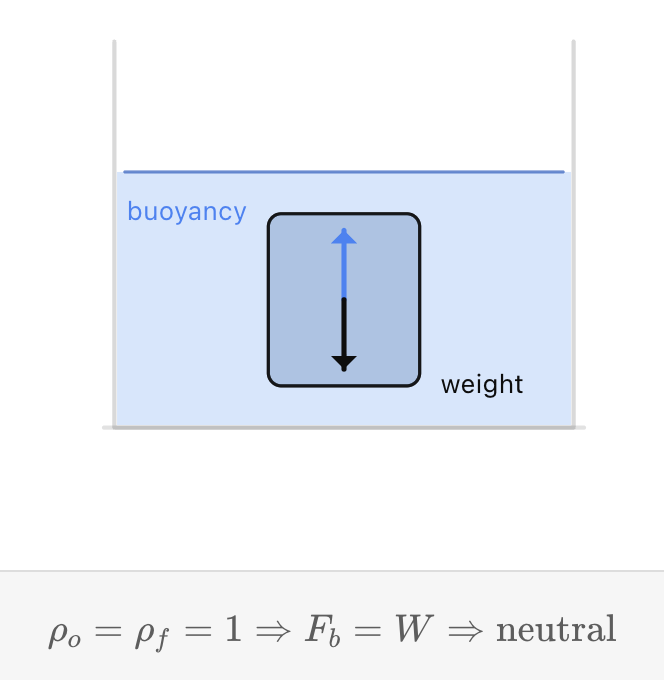
The fish can then remain at approximately the same depth with much less effort.

This is an important biological advantage because organisms need to conserve energy for:

  • finding food
  • escaping predators
  • reproduction
  • growth
  • migration

Not All Fish Have Swim Bladders

Sharks do not have the gas-filled swim bladders found in many bony fish.

Instead, sharks use several adaptations that help with buoyancy.

https://images.openai.com/static-rsc-4/hzc7YTNewtfNW4yPjEQlxIROF4iRVc5D3olJsEyKgCUVyio0-Yx7YWYq8MKMQ4TLkSpBgwTbIQCXLpoMtuvqXB30IdT6MKehPkN3_ZI909KMSY6WvTqzflY6xfbE9ELnXcjrYJg1hTB-4VPtIAZNI6ExQwUNoBQc5fQ1r44WfenWRLOP7Zn4ndWB1M1tua5G?purpose=fullsize
https://images.openai.com/static-rsc-4/Y9cUTCZM5w3GAGN2K6bI_UO9BTxw6i-MvKWK4jOrWQvvncU_9u7qzs58uwNSCwVLsyqRzsHYy12wptoi86QASe8pR3JNvfNqyQdx9BSUHhr-_ExcGBLtr9n9KXUHpXRr1pRDQD0KiwkI82D3DTOKyqvgUWS4KIKAoChzlFth-00HjlAjJlaLhXW-saYxgrBK?purpose=fullsize
https://images.openai.com/static-rsc-4/YBOm9sKae2GKLlRJVGQQ1Misexb5gJhM8ILTR_eLP-2VPyJDGpu_wAIoj5-LAr8RnLFxFEmCpQtS52NBMgXm3LWUoTt9hZtK903Mm8tXf64MW6z9_sX8wLWSkWOyJwgPHlNo4loG7BMo3BO4lx43nPJEn1aOV1RjbNajWoAF_U71_Kiv7O2lrdaH2g6Bs4aR?purpose=fullsize
5

These include:

  • large livers containing low-density oils
  • relatively lightweight skeletons made from cartilage
  • body and fin shapes that can generate hydrodynamic lift while swimming

Many sharks are still denser than seawater and therefore rely partly on forward movement to help maintain depth.

This shows that organisms can solve the same physical problem using different biological adaptations.


Jellyfish and Buoyancy

Jellyfish have bodies composed largely of water.

Their average density is therefore very close to that of the surrounding seawater.

https://images.openai.com/static-rsc-4/SMMgQOL4Eb17hdG99r19j2zrGRXS2kvI94dVowIuXodR1mGHCggfIB0-viGKPsdxixsaV1DTPVMP6P3LcDQ_c8AeStNc6qsVIVH9ptbJ_wUQp4OLcdJsvtfbtLOGw6dJSIH_82HsGQfz8hqWOcUaj9FeBBjaTK1N5ZOL2w2j0UKYJm5Jb21GF159W2Qj2b0P?purpose=fullsize
https://images.openai.com/static-rsc-4/irwnzCgGibho8witF4pinmIllWbZD9-_yc8lo3z3rLBZ6P1nx67RH9uKRePo-p74ab4l_Phk743JfxzGcCUX4Kg5yx_Bf-vyRgY85ERbNZD_oal6IapRrpwZ_EgJqcQODiI-sTxT0TsAW5u_GrxtJL0oKGRnjA3LUoxiGQiBM9aWham95WXgwftvMy9ptm5x?purpose=fullsize
https://images.openai.com/static-rsc-4/lgpO-9eVDni3woxSjYSxAqTN7T0zkLtcM6150cxBbZgMIpi_CTnF6DdBN6jHwvgU6FFRG2LaWMA4QnhYQC4idDnn_VMFMCeZsrz65AC75sE-pLDhIGPx6r7M_dHLHXHvcq6CBFzVhKzQhotwCZzxKMOU9nKSMrWOiFUyyvXFbdtntkod61PzO1n26jMl01S1?purpose=fullsize
5

This allows them to remain suspended relatively easily.

They still swim and are moved by currents, but they do not require heavy structures to support their bodies against gravity in the same way that land animals do.

Buoyancy therefore influences not only movement but also body structure.


Buoyancy and Large Marine Animals

Water provides buoyant support to large animals such as whales.

https://images.openai.com/static-rsc-4/Hil0XDFQIXv9Fwt7NrY7Ec0HS2KFjitLRPkLWowleNGM8jXXdJn0pIMvzBL2MFRycvy6HOo0KDVr1mN3Eq_LAWOIb1zYL33fmpUdpWtx4MKbTvhpT8DbBNa-p2uuJwoWzgMlahRb6MIgy7O73gCzXrgto6E377R0yPGO_YpjvoRTz5TdIAvnU9nfcW9nz-63?purpose=fullsize
https://images.openai.com/static-rsc-4/ezCP6MbZ9gh4UVu_F2J_3IzdNPw0XEjLuwM0TQtjtdOf5dgUfkkNr3xFUake2CjiekhKZr1fjeCwntIRdcGWu7irkbFAo9ALWHO7X8r82_MAVver3t5y48fyOE1xMtxChyaglFQ9iczDq04AiWgbJPEeyWnevOg_Iy2P9EZ4EYI5SZEH4i4CAJmSY-nCUdRX?purpose=fullsize
https://images.openai.com/static-rsc-4/coUQXhl4Fk65iPzn9Np7OWy0U3TUDotE5DFbkR0-qnsjJa1ls7PQ_fS8-6zAxJGUjuwAyt4fDbcifC5l70GJbsSgHMNFFaFgPmdMmURcOT5tqgMoZP7IPIeiUsgF9jiwOBJTFSb5qBUBtIi9Kogg355opmgbyoJvw4qBtmMhkCBjuG8_z7vlX2vXXZNMyp0a?purpose=fullsize
5

A whale still has enormous weight, but the surrounding water produces a large buoyant force.

This helps support its body.

On land, that buoyant support is largely absent, which is one reason extremely large aquatic animals are poorly adapted to supporting their own bodies out of water.


Buoyancy in Plants and Seeds

Buoyancy can also help plants.

Some fruits and seeds can float, allowing water to transport them to new locations.

Coconuts are a well-known example.

https://images.openai.com/static-rsc-4/0iyDSQ-6CBVrxqHkcuIBcE80tfUGEmW9B4gjKpSOCHyLuOx1uBMFTSW2iVaUlB-EZ9gcjn2XxFlmgONBgxrzFBACdb5HtmiC1y27_DW1yK4rXBSRfoybO07OwTIqwqZzGgs_7oUVgu6bTDU6vPgpeRQ2Wrg1U1yPvWRlCKb1eK3kVc08c4eWwaRv1pSrwl3x?purpose=fullsize
https://images.openai.com/static-rsc-4/fZMFp68LjDogeVDx0cUpdu4p65nmvXltfgcMdgr3dONoFu2MNbQr8QZnTH4uIrIi5axhluzHIiuOxxKRR5ChgwnVWiw5TDTv9ItyuDWjco-YSJrBh8bcpHD6fbE24278ooHlVDJVTto68oqxV7KmM-dwB_uitlwskRPdSBy_tJ4hqDE9_M3EhXLWCITWFXwu?purpose=fullsize
https://images.openai.com/static-rsc-4/q5GLWNHKdOrN8DCLoYwHquNi7j9Xn0FrhuaCIopmH7g_1mwpqaSTTzI_-kjFg1iTcszLuY7uBKAmU_ZbEWgmD2MBP2GzEXKstk-IRNkWS6IkdmJZoWsh6YHF9TZpNYRyWXzpK0FhO_-YbhfAODsZ-OjIvf92FeMK9Ciu5dU1dt78aZ0jl8Hob7iuNG8n6whm?purpose=fullsize
5

Air spaces and low-density tissues can help these structures float.

This allows rivers, currents, and oceans to contribute to seed dispersal.

Buoyancy therefore has ecological importance as well as mechanical importance.


Buoyancy in Air

Air is a gas.

Gases are fluids.

Therefore, objects surrounded by air also experience buoyant force.

Usually this force is small compared with an object's weight, so we do not notice it.

But for very large, low-density objects such as balloons, the buoyant force can become important.


Hot-Air Balloons

A hot-air balloon provides one of the clearest examples of buoyancy in a gas.

https://images.openai.com/static-rsc-4/bMortkyDlp-u_AHGnQ6kwhv0k3I1dmj-ri_aQf8x4HXOaYRkzaskwbbUDZeRhFQ40KXDJz2Zn6tHfziesk9GKYJtYQBLySaY8KhGtEKgcT6Mmu67B4G3bhDas11Y5ZDRCUBEBhZgPXH_AQecS2FmyPxrI0CdN50xt3Uec80rqiNBea2ekuP-4v7WgCbiM54V?purpose=fullsize
https://images.openai.com/static-rsc-4/Dpss74NtOnCsc-zyzV63eXYdm2kJt_a7yU4xmveFZIDjui-OcygIY3LA9CR4bZnzaFNcMqKjK9k_L3DHrdV8AlSx4b9kdiaGl9T2i0GcfBXf-JsmOvjGtaXEDuvLltwxw4TsdVX0A6KpFw2OsXUM3-WL6doNWx3qX88WBM0F5SxbR3LXl3K-XgxxBKk-Co5o?purpose=fullsize
https://images.openai.com/static-rsc-4/EmVZHMTzHEtUSG-jzMBWgU_oWCw7d8t2eY4KetSwnUHyNOlaIuORYD9l1kDRYFV9Ya8XVcGoOcpLVJc-S6O0GCDF2UFOqy6NvmtEca-FUaABul0pyFbhKQ45gdZLNfNlL-pSxs8cle0MWL-h3tvfVxqkTqiLm-TfvKkJSOkLD12vYPSUMfw7zI5Jc24fS835?purpose=fullsize
5

The balloon's large envelope contains heated air.

The surrounding atmosphere produces a buoyant force equal to the weight of the outside air displaced by the balloon.

The key is density.

Heating air causes it to expand.

The same amount of air occupies a greater volume, so its density decreases.

Therefore:

hot air is less dense than cooler surrounding air


How a Hot-Air Balloon Rises

Consider the entire balloon system:

  • envelope
  • basket
  • passengers
  • equipment
  • heated air

The balloon displaces a large volume of surrounding air.

If the buoyant force becomes greater than the total weight:

Fᵦ > W

there is a net upward force.

The balloon accelerates upward.

The basic sequence is:

burner heats air → air density decreases → average density of balloon system decreases → upward buoyancy can exceed weight → balloon rises


Maintaining Altitude

A balloon does not need to rise continuously.

To maintain approximately constant altitude, the pilot can manage the temperature of the air so that the upward and downward forces are approximately balanced:

Buoyant force ≈ Weight

If the air inside cools, its density increases and the available lift decreases.

The balloon may begin descending.

The burner can then heat the air again.

https://images.openai.com/static-rsc-4/a-RBxJEcPQ5PHYq7wS2DywWPBBpK6NHkAx9ww9_7oOPDj5w6WbNqcUv7suE4o9aSs9DBkFk70osJgtLeVfQTL2Y6WDKNJeNniloAXS85qQRYLDhPWStS29Eag_NNW182hrRrzujpLKBbgEqGVh4bfDTc_Bl5vYn07RDrLfbPURKh8n5RlhwT6y0tRLNd4Mn6?purpose=fullsize
https://images.openai.com/static-rsc-4/ofgQ4cr6uQY9xamKTDt2RT-g0UPAZvBJrCJlQoJWHj2MiceEXDlSCcFqCRZcKgHVUqQIUIbiyE51VWfnooXOKkEwABZhbVo-SVxOMnIALQ7WpM53vuq71u9p8BobSRc4sbXnQpzVTYwZsuAk7MzgDQeqaplART6EwJwVC7Fd8BIUFObDHQJmv9Qz2bYCGEUf?purpose=fullsize
https://images.openai.com/static-rsc-4/In3X4doZ2jpGQDBBtbOt-6rBW-y4NvswbTLL9G3McsZHJ8QFxv7ZoPJCGUbNJxmEiVV_QVRUBVrDps9euQYopfZEhxx7bLwJ5F23AERp1MAOLZGvj4ylBkBDfcqusK6fWnYjQxNvPttUAY6moHlobVqIwbKKawQ55tQwHGCuuCxJ_apgy3XqKD8E2J74e_e1?purpose=fullsize
5

Pilots therefore control vertical motion partly by controlling the temperature and density of the air inside the envelope.


Hot-Air Balloon vs Helium Balloon

Both use buoyancy, but they reduce average density differently.

Hot-Air Balloon Helium Balloon
Contains heated air Contains helium
Heating reduces air density Helium is naturally less dense than air
Burner controls lift Gas quantity and ballast can affect lift
Air cools over time Helium does not require heating

Both work because the balloon system can have a sufficiently low average density compared with the surrounding atmosphere.

https://images.openai.com/static-rsc-4/5nCGqq-MT6nog5rafEC5o43wcupneIsXMQ6VVnMN1cP01LWDaL1l3nhPr_R_f4fXSJuu1kd1qWMamWTIzkEPhRsqHQHjJRXtjbZlTdQyNj_i1xB_VTGA24R_zyyEpNojy5is6dWLKKv1zASuyCSxdhbW1JG2zIes2Kei_CwWojZEg8B7sjHvIHX0qOdzyaN8?purpose=fullsize
https://images.openai.com/static-rsc-4/m_6lV4HaunIVijnkhnZyZnJ6Q-jeDmtbQwsJxDmNelyR5eDddyL65FcgOWZN0SGJgWa7R9_Bp8W-I8HgQ4u5ov5EaObAjqAJhDV_a-IbmZALIyIoOFbbDnYj4rqpV51B5ojFv_6WqVG5zOgTn2g9njNn7HeRs0-4Qmf3jiaOhv5esQDQG8Xu-FXbZVQUV6Ka?purpose=fullsize
https://images.openai.com/static-rsc-4/uOPsaAT9YjMSJmC69OPPLO59SZOYfeeRld0x172e_fDWQpi0Jo0BQVuZGjmNRYPwW00My78ximDda4G3JWR6CwD8i6Ip6EgZ69M855Dpqp6lRjzpcuX1HxxsdmcdLRlxJufPxcHsYo9Xx05_tl3QyMA0nxljWTOcgxBKorc_oLkNZUx4LLAM8hB19GcwT2qr?purpose=fullsize
4

Buoyancy and Life Jackets

One of the most important safety applications of buoyancy is the life jacket, or personal flotation device.

A life jacket contains material that has a low density.

This may include:

  • closed-cell foam
  • inflatable air chambers
  • combinations of buoyant materials
https://images.openai.com/static-rsc-4/KAu077pREepZYZj8JRCj4zDEENq9eg0lf7pyBKTrgeOt7axvKQ5ou2NEQ-JtY-EjPnUPCgZboM7Pvq19Ey0qOJpTtFIpCbX4WwSGrn1xvLY6CxVNlJP7S_-3QDJrMhUxijlF5kkZDtdHD5hGvqCPuLeKWyx_Sgn8CKX5V6fXrIYLlrp0gk1sLWsQPUuBt-Id?purpose=fullsize
https://images.openai.com/static-rsc-4/y-e2pd5ExLWpOuGmpAV6yA422QLBf3hvNjAhmZ_-c7zQLf0zUUcU4coWcJ21oWY30GmU0AhKFqHhYMSCWKmUZI7UqDAExXvfxKAlIVy6R6T2CKfMigsNmREPt5SYUDf8JtXDm_Tx8nOyb8EwFaO7f6fwnOVCKfdfRHt7pXa2EOAAlxHNm8dzA9S84mVR7dST?purpose=fullsize
https://images.openai.com/static-rsc-4/e9MrcgweFHBBFCrkxrrI44bmVrS__WRD8IIGdHzzFwlcpAL-vGX6tn3qpsQRPB7pwKiVXLR796CJUy1cShanj-VnXBcTgSHxJivWZzI5nhnnE0WebKfKFFChzfhWqYw4N_4UeSg85vDjlQNu9CK54QPvkTewZ3marUY1nEfEKY5etSmCQRxINdfMj_p4UTVp?purpose=fullsize
7

The life jacket adds significant volume without adding much mass.

This lowers the average density of the:

person + life jacket system

and allows the system to displace more water.

The resulting buoyant force helps support the person at the surface.


Why Life Jackets Are Effective

Imagine a person who has difficulty keeping their head above water.

Adding a life jacket:

increases volume substantially

but:

increases mass only slightly

This allows more water to be displaced.

According to Archimedes' Principle:

more displaced water → greater available buoyant force

A properly designed flotation device can also position buoyancy around the body in ways that help keep the wearer in a safer orientation.


Life Rings and Rescue Buoys

A life ring uses the same basic principle.

https://images.openai.com/static-rsc-4/7-xtwM8v0W5C6_5QFyuepJpJbIepAXNZ4k_opdJfu-x4EqgNkJMzlBd6pOPxTFgcr4C274-1KfvmTyyRZjYiMXBlxmDyB-JDG6_nMtWHs_FgSe_A1y3yYaC-BBRtk3fTSHY_cEoVVlWw_e7IDgVY31C--Gx3PFwVppui2jJAkqNWBoEA6Fu7y9C_JlDP1qkC?purpose=fullsize
https://images.openai.com/static-rsc-4/KYJ13PRWicGpZ3vSgZDJegP-_LNNyqz3VkAWT-flilHfFctrgtA8v9f2tmbWTFkNE-QmIfbKi_xJeByyMBG0y04FihDjZudD1UUZTEvyGGePn2oB8hTTGieG0pXd8cAvQYJRFZv_WEWBepJNC9P_5GstLVD21HUVLENfeie3-Y-ZG_iPmbUXx2pX71-HvNqp?purpose=fullsize
https://images.openai.com/static-rsc-4/utsX6wSBzybygT5ayue9tascGdbduakW0HaFM13LVNcQ774GNJTB_o9kU-7cT1k-v-k3gYXTQF0klYA1dp3Ob7mDc0zGdNfdWWgO1f-wWI4D40fxuhLqHs3wEZglWDiO-yzE39ofKOFWAUf-x-kHH0_x7kWvXVSZ_lFPOBIpRwy2Bau1aB9rwOqPaX_zgo9X?purpose=fullsize
5

The ring has:

  • relatively low mass
  • relatively large volume
  • low average density

When placed in water, it floats.

A person holding onto the ring increases the total weight, causing the ring to sit deeper.

As it sits deeper:

more water is displaced → buoyant force increases

This helps support the combined person-and-ring system.


Rescue Boats and Life Rafts

Emergency life rafts are designed to provide large amounts of buoyancy while remaining relatively lightweight.

Inflatable rafts use air-filled chambers.

https://images.openai.com/static-rsc-4/WJM-xASLrhJUAcHhNvplbp3IUvlL4q9oy_ByjkkKekjbn0oQtmeArFW7RMz20rlkvk8ZcfLpMkFD3bvXxqs3RhZ2XozCyiX2edSKXSnfj-uMsoT10z_iFGzkK8GPSX9zPZPX-xzupApSPjxdWVjbXdSzHfRGs8ocOC6IJbaAx09qF7LBTdq1sBQFn6eCs3Vp?purpose=fullsize
https://images.openai.com/static-rsc-4/hdAyR2q5QqNopCutMwSVB-NSkZPRunboEi3nl8rvPaXSLCbC1-dGx9As8XK_QlIrLu3rt0bXIn8Qk0pmetyQ3nElqQ-wTPwKmMV2jj5Bzks0o4p1EqI2zvl9GrBW47BTCU9wc457Z5O2y9S7G4Yaofx-zKhk2o7AcwzLfmte41MX9cEqXDuHzJ5q0DYbYsNB?purpose=fullsize
https://images.openai.com/static-rsc-4/PSoUQA4KqGODIk3ICx1PP_scaD64xZulbOWMrafkgnwRwkXj3ERKNSgWjngPOJ3Ha9zfjWbKJMX_y6HV3yNfctbeG_XAFNJQ10qV90z9tbUUFumixrSa1NwgN9X0EnXKp-yJiVW9-cr1jzv8PtkYftVV8yH-qhfImvBHyqH4x-n21otpwG0UqwIRNxZ9ze_l?purpose=fullsize
6

Inflation dramatically increases the raft's volume without greatly increasing its mass.

This creates a low average density and allows the raft to displace enough water to support several people.

Engineers must also consider:

  • stability
  • puncture resistance
  • visibility
  • durability
  • rapid deployment
  • capacity
  • survival in waves

Buoyancy alone is necessary, but it is not the only engineering requirement.


Buoyancy Compensators for Divers

Scuba divers use a buoyancy control device, often called a BCD.

The diver can add or release air from the device.

https://images.openai.com/static-rsc-4/Xbv4D3Wi_IrJ1lBtfMaNwYhhyBJcbTWvmvtZGwUFLGdocmeHvRIhEmwEb6pVcvk2NS3GAy2ILLFH1nOn6k1XIQdBiHNkWFGfCmJo0HQHx5eiZw0e2n5AUA5i_4Z8GM7b6bpOyWMjs2L_cdvdPJRYFuV7AqFJdE1jTH95vCSXKxRzY_SR5EqA8QDXcjWb_7Tl?purpose=fullsize
https://images.openai.com/static-rsc-4/-YJBg2KqodjTo7zNcfqohu7I1JTdD1-pCj8s8zYuqUeGVm3RxBBW9BiCGHCtlAg6AlpPQ09A0U2y1ivUZRbwGpMuBAgMfGGF8CgjNm1Hahdq6YeR2lqmIUVb9TUkxqRX-S6HnPRKwx8lpiGw36Yp2_VMNLVJuWoxkQ5pJ8gT8ZtNx_hKQ7cN3b8Rr5CAZsva?purpose=fullsize
https://images.openai.com/static-rsc-4/Pg05xu8df7NgE_Tj8pxncRKRY1EgWwOJCLMKU90uQ4HjhtGyp5And2BiMxLOrXP23onuJ8sx-FyqB-ZAAWeamAZygU3Dff8J83iALHc-DCb_-FmMBNauvj0Y1S26NF4Abp0w8dt66EUIGn84u8md6b3ivu9zIFmTe22zwMc0ybwPLh-re3IswNwpKCLcw3A7?purpose=fullsize
5

Adding air increases the volume of the diver-system.

This increases the volume of water displaced.

The buoyant force increases.

Releasing air decreases the displaced volume and reduces buoyancy.

A diver can therefore adjust between:

  • positive buoyancy
  • approximately neutral buoyancy
  • negative buoyancy

This is essentially a small-scale controllable buoyancy system.


Floating Docks and Pontoons

Many docks are supported by floating structures called pontoons.

A pontoon contains a large volume of air or low-density material.

https://images.openai.com/static-rsc-4/lyIyggoL1GwTzONd_1Oc6TmLGleV6pHXgw45GpTILV5qf-ImhZ7AhfRgKm018P2Cbh6hkK1MteaQkWsth96ifV1fqImmd2a2-yDKDUqiYN0xfIo1zLN4BZ5HifE1L-TGWfBhzU8gC6Q9L1Hnm5v53k6uloHMxrwlEtCRyKkz1r4AErSOUHo6fM5M7VJjSDib?purpose=fullsize
https://images.openai.com/static-rsc-4/Dijop4bYBiJHQxLJgURyJhI5KnQBI9JfFbEAQ5au-EPgeLJXqZn56SlCub7QyyxkQyTdntlxpj1moaXyMM8ASL1nxXTymNroYnMrTgyQg6WUfiRRF0FDf4526jZn_MyWi-ssZYE4zIBo1CQj2i-QDlWKcaiywd4YfmuIy_yCGp0i3e1wla3MB9gvjaO7itGu?purpose=fullsize
https://images.openai.com/static-rsc-4/dNfE7m63H7eb9_bur1rYnXLOT_MOU5jLastQ4zvWsmf1_zp8KY1eLD-z1YmQDz1lOE2s3grj2pWPtw_UpXgm3gDP0cV_Z3l05Dwm0t5X6l4pUDubd7VUmMQVeufy1TWppapkxQuT4r0oHMKAyVkyj8TPgDEVRMlC0Ewh36mHt_MYu2JTp1j8q3wX2sYkmqCF?purpose=fullsize
5

As people or equipment are added:

weight increases

The pontoon sinks slightly deeper.

This displaces more water.

The buoyant force increases until it again balances the total weight.

The same principle allows floating bridges and work platforms to support substantial loads.


Offshore Platforms

Some offshore engineering structures are designed to float rather than rest directly on the ocean floor.

Examples include certain:

  • oil and gas platforms
  • floating wind turbine platforms
  • research platforms
  • floating production systems
https://images.openai.com/static-rsc-4/toeCwVv_4Y3S4NKQBPPZ_127hU_KYogBEikt_Im4_fDuW-NRcpjwhcz_l-VW6PFDYkruy7ecxe6UABeRXr9DsSugs2FB-zsP5-Dw4MVad5EGNIm0cYj68C-VMAuU1pyEw5qpxJXXHLujbYNs8QD7JBcxJxaVvhRxIsVenPHMNJmFctCKmqhINSfjYox9e5G5?purpose=fullsize
https://images.openai.com/static-rsc-4/hre0_EvoBMdoAIsh6uQmt9RRdnueLMoxgFRLc3Col7Hxc1VkiVOrITHmWcaOphOn2W03yklibrPRsd4qQEo1gRNb7Hu-DBmP3V1rLs2hjYTUJ2mupc8RENjsApfmh80fPQYzvU4oZAzWQNgPUK_IcJ8ICtm3r0g_21VCqtMnoQDH6G-QyLKHEU4rOAbrl_zR?purpose=fullsize
https://images.openai.com/static-rsc-4/2w9iO95hfNUgnuw3OrEkEXhUMrZaxF3G1daSMYon4sPM-t4ugpq-aL6mc7jFDfH7zLZFC4Dxo3OK51tR0F0b0pVWBqBCdEI_JdxD5b7n31wR_GPOtDmEJbT20w1IrnU5s1ppM14i2jQqa9TVQBHNgIdffs4mgZq6_twxlZVsHpR7fKf-Wf-oU1U5WS9_1LCk?purpose=fullsize
5

These structures can be enormous.

Engineers must manage:

  • buoyancy
  • stability
  • ballast
  • waves
  • wind
  • currents
  • structural strength
  • anchoring or mooring

Buoyancy makes it possible to support massive structures without constructing foundations all the way to the seabed.


Floating Bridges

Some bridges are supported by large floating pontoons rather than conventional piers extending to the bottom.

https://images.openai.com/static-rsc-4/oeicvRNJoesBF6zz5gkdWotPO-3ZEg6pHwxBpi7LtMypde6wArnb9CEHuToaZ7Vp0DpVTg-yLHYIl3bB8z_2nb62rBI32qlCqxDX1dPb26GCdc3ElQ_xmohe8wgxWYtrQb_6QHbrkueM9Tl0IDDfFe8CQa52wOke_TknTFqnP6l_CJcXLU5DVphI-nXE3COv?purpose=fullsize
https://images.openai.com/static-rsc-4/tMQWSUHSePm8gMuNyRzhb82sbOq7tjETNC9jw8VmYbwTTXWSMfRsYp7Q-sYNVS3i1J5UZQfcbphiHaVdm4pyREKK8kduYbEwRhsqolOFlzC-kcTtlQuL0Yr5sd5K4Y2YxI_Kyj-4R_8xyq_H9FIKIhZMMH4DJu4qII64GMKLBFAMQ1X_bcQq6ii36RdappwJ?purpose=fullsize
https://images.openai.com/static-rsc-4/E0LdvsQp3rxx0ldKZgH2zF6-auN4VMPeWjU03rFAfQn3Y57r2fwz-CQKG42gTvndd4z1xocRaY66oViGqitml1N25VCrYXFD932ll-QsH5vf0J1Dx-14kU36tVmmqzBMKKJRmPtkIAEViinj2N9yQ3EwQq1u4karUh5haP1WbApjeP46S611NdfNRoSfP-4g?purpose=fullsize
5

Large pontoons displace enough water to support:

  • the bridge structure
  • vehicles
  • people
  • additional loads

As traffic adds weight, the pontoons sit slightly lower and displace more water.

Engineers must ensure that the bridge remains stable under changing loads, waves, and weather conditions.


Underwater Robots

Buoyancy is also important for underwater robots.

These include:

  • remotely operated vehicles (ROVs)
  • autonomous underwater vehicles (AUVs)
  • scientific instruments
  • underwater drones
https://images.openai.com/static-rsc-4/YNbL3nlSqwvoG3fcmzUjsRkFEet390rx6E5JuVKw0Cvhn1b25DJsTj21qTNLKiFAL74ORl-upyxrl9JafK5lZZbMS58QqflhIYHRH9wZITDiP62nXtwJirExltqO-93MsadQzvlBNvyMM1izL92nKMQCcJTdWg5sXV9OOgzjFl3KCxPeeXkGsLzn_PYIfKgp?purpose=fullsize
https://images.openai.com/static-rsc-4/o0yjb65npI_rKIKVZLCBYDDuF_FxcyYn7YYF_CCMUGwpNYB4zThnIz4sN8LQNmGu4AlXhZjg235tP8nAueVN1jxQ8IFsKtItes40k-JIPvsKXcdCSl1JETiSURZjpjGSFIhOo4R0GjLnXl1m67JHtNj9UFhlyHTWWAnbASr_XSL_eF1DTb0PDA3zogeEJGN0?purpose=fullsize
https://images.openai.com/static-rsc-4/byvz8KxkCX8ljo1BG7YmXCeYdc9U2fMYWWrEIBGbKk-npOxbMGvQf0atRvPZC5xkMitymAeHLVTT8YzrF3QRuaIcWs03w2UQeWKNIP8N6bB1mTZkXiFsTWSm5UnwraOyKLX3SoASdrtPiUfGCDAd2hYp-negNUYZbF6N1-ixIGC8sjQe--s6Ggy35d_KtJj9?purpose=fullsize
7

Engineers may design these vehicles to have nearly neutral buoyancy.

Why?

If:

Buoyant force ≈ Weight

the motors do not need to continuously fight a large upward or downward force.

This can reduce energy consumption and make depth control easier.


Buoyancy and Marine Engineering

Ships, submarines, floating platforms, rescue vessels, underwater robots, and offshore structures all depend on careful control of buoyancy.

But simply producing enough buoyant force is not sufficient.

Engineers must also consider stability.

An object might float but still tip over.

https://images.openai.com/static-rsc-4/WVFc9LLj-e5dN72Fs5NX7lSfP4-dUVL0N40IM8chOK1dIX1SRzictUT6MpWkoreZrImYCSgPjazaSvqUxVQpmbcekM7PpJEAxiUbHBo2vSJX0wtP1bWhoP5IvhFtpZJXhz9gUTvM8YZULJ1GFUAjrLplNN3ROV_5Y06z3Lt4_mODiGhQs6wHkamsVqbSvR2e?purpose=fullsize
https://images.openai.com/static-rsc-4/eH440TzZ7dU3o93JyFMI5BZdWzI9_dmxulDu3kM0EgKw-sSkLEZzFBXObyKBxLqkin5137blXL9kpWaljnIpOm0gMu7K09UwdGazxNG2k5AVqNHoyWqnXSsUZMvnc-Hib4DSt-LCekyDnYaBzB-8QR_LNMFgTq2E3DMb2Fs0pfyTtHG_Pfvt9CWEQTpu2PgU?purpose=fullsize
https://images.openai.com/static-rsc-4/jM4iELMVDvYwb6bVM1c2EzEHXnvDXV9yoYdSrvODwcuJCkgp7tThDCaabr9V3812pFEkW2v06N5PzD-Qi4t1I0RSdsj--_lZ29MUOPWz_riEdnKY_W2eXc89mk2sn4IsyszNOQiIEwvVuMwN3trGLl7sEsZOHnzZx1LIbImJxLOrn_MGcE-TBXCOr0UEWKsG?purpose=fullsize
5

Engineers therefore consider:

  • centre of gravity
  • centre of buoyancy
  • hull shape
  • mass distribution
  • ballast
  • waves and currents

A successful floating structure must be both buoyant and stable.


Buoyancy and Engineering Efficiency

Buoyancy can reduce the energy required to support objects.

Consider an underwater robot.

If the robot is strongly negatively buoyant, its motors must continuously produce upward thrust to prevent it from sinking.

If it is strongly positively buoyant, its motors must continuously push downward.

But if it is nearly neutrally buoyant:

Buoyant force ≈ Weight

very little continuous vertical thrust may be required.

This can:

  • conserve battery power
  • increase operating time
  • improve control
  • reduce motor size requirements

This makes buoyancy an important part of energy-efficient engineering design.


Worked Example 1: Rescue Float

A rescue float and person have a combined weight of:

850 N

When floating calmly at rest, what buoyant force must the water provide?

For a floating system:

Fᵦ = W

Therefore:

Fᵦ = 850 N

Answer

The water provides a buoyant force of:

850 N upward


Worked Example 2: Underwater Robot

An underwater robot has:

Weight = 620 N

Buoyant force = 600 N

Calculate the net vertical force.

Net force = 620 − 600

Net force = 20 N downward

Therefore, ignoring other forces, the robot tends to accelerate downward.

Engineers could add buoyant material or increase displaced volume to bring the robot closer to neutral buoyancy.


Worked Example 3: Life Raft

A life raft and its passengers have a total mass of:

600 kg

Use:

g = 10 N/kg

Calculate the required buoyant force while floating at rest.

First:

W = mg

W = 600 × 10

W = 6000 N

Since the raft is floating:

Fᵦ = W

Therefore:

Fᵦ = 6000 N

According to Archimedes' Principle, the raft must displace water weighing:

6000 N.


Worked Example 4: Displaced Water

A floating rescue platform displaces:

350 kg of water

Using:

g = 10 N/kg

calculate the buoyant force.

According to Archimedes' Principle:

Fᵦ = weight of displaced water

Fᵦ = mg

Fᵦ = 350 × 10

Fᵦ = 3500 N

Answer

The buoyant force is:

3500 N upward

If the platform is floating at rest, the total weight of the platform and its load is also approximately 3500 N.


Evaluating Buoyancy in Engineering

When evaluating a buoyancy-based technology, asking only "Does it float?" is not enough.

Engineers must consider several requirements.

Buoyancy

Can the system produce enough buoyant force?

Stability

Will it remain in the correct orientation?

Strength

Can it withstand water pressure, waves, impacts, or loads?

Control

Can its buoyancy be adjusted if necessary?

Safety

What happens if part of the system fails?

Efficiency

Does the design minimize unnecessary energy use?

Capacity

Can it support the required people, cargo, or equipment?

Durability

Can it survive repeated use and environmental exposure?

A successful design usually involves a balance between several competing requirements.


Example Evaluation: Life Jacket

Consider a life jacket.

Advantages

  • provides additional buoyancy
  • requires little or no external energy
  • lightweight
  • relatively simple
  • can help keep a person at the surface
  • portable

Limitations

  • must fit correctly
  • has a limited buoyancy rating
  • inflatable designs may depend on successful inflation
  • damaged equipment may provide less protection
  • flotation does not remove all hazards associated with cold water, waves, currents, or injury

The engineering goal is therefore not simply to make something that floats, but to make a device that provides reliable, practical and appropriate flotation.


Example Evaluation: Hot-Air Balloon

Advantages

  • uses buoyancy rather than wings for lift
  • can remain airborne at relatively low speeds
  • vertical movement can be influenced by heating the air

Limitations

  • requires fuel to heat the air
  • movement depends strongly on atmospheric conditions
  • direct horizontal steering is limited compared with powered aircraft
  • lift depends on atmospheric density and temperature differences

The same scientific principle can therefore be useful while also creating engineering limitations.


Why Buoyancy Matters in Modern Engineering

Buoyancy allows engineers to use the surrounding fluid itself to help support enormous loads.

Consider a large floating structure.

Without buoyancy, the structure might need a solid support extending all the way to the seabed.

With buoyancy:

displaced water provides the supporting force

This makes possible technologies such as:

  • massive ships
  • floating docks
  • offshore platforms
  • floating wind systems
  • underwater vehicles
  • rescue equipment

Buoyancy can therefore reduce structural requirements, improve mobility, and allow technology to operate in environments that would otherwise be extremely difficult to access.


Connecting the Applications

Application How Buoyancy Is Used
Fish Helps maintain depth and reduce energy use
Sharks Low-density oils and hydrodynamic lift assist depth control
Jellyfish Density close to water helps them remain suspended
Hot-air balloon Displaced atmospheric air produces upward force
Helium balloon Low-density gas allows the system to rise
Life jacket Adds volume with little mass
Life raft Air-filled chambers provide large displacement
Scuba diver Adjustable air volume controls buoyancy
Floating dock Pontoons displace water to support loads
Offshore platform Large floating structures support equipment
Underwater robot Neutral buoyancy can reduce energy consumption
Ship Hull displaces enough water to support the vessel
Submarine Ballast allows controlled changes in buoyancy

Common Mistakes

Mistake 1: Thinking buoyancy only occurs in water

Buoyancy occurs in all fluids.

Air is a fluid, which is why hot-air and helium balloons experience buoyant force.


Mistake 2: Saying a hot-air balloon rises because "heat rises"

The more precise explanation is that heating the air inside the balloon reduces its density. The surrounding denser air produces buoyant force on the balloon system.


Mistake 3: Thinking life jackets make people lighter

A life jacket does not significantly reduce a person's mass.

Instead, it adds volume with relatively little mass, increasing displacement and available buoyant force.


Mistake 4: Thinking neutral buoyancy means no forces act

Weight and buoyant force still act.

At neutral buoyancy:

Fᵦ ≈ W

The forces approximately balance.


Mistake 5: Thinking all fish use swim bladders

Many bony fish use swim bladders, but sharks and some other fish use different adaptations.


Mistake 6: Thinking anything that floats is automatically safe

A floating object can still be:

  • unstable
  • overloaded
  • easily overturned
  • structurally weak

Engineering must consider stability, strength, capacity, and safety, not buoyancy alone.


Mistake 7: Thinking more buoyancy is always better

Too much positive buoyancy can also be undesirable.

A scuba diver or underwater robot needs controlled buoyancy, not simply the greatest possible upward force.

Often the goal is neutral buoyancy.


Mistake 8: Confusing buoyancy with propulsion

Buoyancy provides a vertical force resulting from displaced fluid.

Propellers, fins, motors, or engines may provide additional forces used to move or steer an object.

The two concepts are related but not the same.


Check Your Understanding

1. Recall

Give four examples of buoyancy being used in nature or technology.

2. Aquatic Organisms

Explain how a swim bladder can help a fish maintain its depth without continuously swimming upward.

3. Compare

How does a shark's method of controlling its position in water differ from that of many bony fish?

4. Hot-Air Balloons

Explain why heating the air inside a hot-air balloon can cause the balloon to rise.

Your answer should use the terms:

density, buoyant force, and weight.

5. Safety Equipment

Explain why a life jacket can help a person float even though it adds some additional mass.

6. Calculate

A person and flotation device have a combined weight of 720 N and are floating at rest.

What buoyant force does the water exert?

7. Underwater Engineering

An underwater robot has:

Weight = 450 N

Buoyant force = 450 N

Describe its buoyancy condition and explain one engineering advantage of this condition.

8. Apply

A life raft is loaded with additional passengers.

Explain what happens to:

a. its weight

b. its position in the water

c. the amount of water displaced

d. the buoyant force

9. Evaluate

Why is it not enough for an engineer designing a floating rescue platform simply to make sure that it floats?

Give at least three other factors that should be considered.

10. Challenge

An engineer is designing a battery-powered underwater research robot.

Explain why designing the robot to be almost neutrally buoyant could increase the amount of time it can operate before its battery needs recharging.


Key Terms

  • Buoyancy – tendency of an object to rise or remain supported in a fluid
  • Buoyant force – upward force exerted by a fluid on an immersed object
  • Archimedes' Principle – buoyant force equals the weight of displaced fluid
  • Neutral buoyancy – condition in which buoyant force approximately balances weight while submerged
  • Positive buoyancy – condition in which an object tends to rise
  • Negative buoyancy – condition in which an object tends to sink
  • Swim bladder – gas-filled organ that helps many fish regulate buoyancy
  • Average density – total mass divided by total volume
  • Personal flotation device (PFD) – equipment designed to provide additional flotation
  • Buoyancy control device (BCD) – adjustable flotation equipment commonly used by scuba divers
  • Pontoon – floating structure that provides buoyant support
  • Displacement – fluid pushed aside by an immersed object
  • Stability – ability of an object to maintain or return toward a suitable orientation
  • Ballast – mass used to help control buoyancy or stability

Key Takeaways

  • Buoyancy has important applications in nature, transportation, aviation, rescue, marine science, and engineering.
  • Aquatic organisms use several adaptations to control or take advantage of buoyancy.
  • Many bony fish use swim bladders to help regulate their average density and depth.
  • Hot-air balloons experience buoyancy because they displace surrounding air, and heating their internal air reduces its density.
  • Life jackets and life rafts add large volume with relatively little mass, helping increase displacement and buoyant support.
  • Scuba divers use adjustable air volume to control their buoyancy.
  • Floating docks, bridges, offshore platforms, and other structures use displaced water to support large loads.
  • Underwater robots can use neutral buoyancy to reduce the energy required for depth control.
  • Buoyancy alone does not guarantee a successful design; engineers must also consider stability, strength, control, capacity, efficiency, reliability, and safety.
  • Understanding buoyancy allows engineers to use fluids themselves as part of the supporting system, making many modern technologies possible.