Pressure in Fluids

Сайт: Young Education
Курс: Fluid Mechanics
Книга: Pressure in Fluids
Надруковано: Guest user
Дата: пʼятниця 25 вересня 2026 03:22 AM

1. What Is Pressure?

Learning outcomes
  • I can define pressure as force acting per unit area.
  • I can use the pressure equation to solve problems.
  • I can explain how changing force or area affects pressure.
  • I can identify examples of pressure in everyday life.
  • I can compare situations involving high and low pressure.

Pressure is an important idea in physics because a force does not always have the same effect. The effect of a force depends partly on how large an area the force acts over.

A person standing on snow in ordinary shoes may sink deeply into it, while the same person wearing snowshoes may stay near the surface. Their weight has not changed—the difference is the area over which the force acts.

https://images.openai.com/static-rsc-4/ULpz1ziaq3AlyM5kbs1mb0uo1TFEAUkVPosMmDsM-IA12xtUuJDhOX3BrXYdvST5XSyoM7R7kG1Mx_6FfuqDHLIOzfBRdtIPd1YgaYUjRw1RfWEaUd_-UF5GweZ704p24GY8ZwxgqHNVqgU1IHc3eMOXCRKo2rYD9LEW_aLvTKv9nOO9Tg_0arJfunfvE6YH?purpose=fullsize
https://images.openai.com/static-rsc-4/k-S4uK5YaYoyaZnDSrT4BY4iiEArPh8LW_0LTPXpF5C8BTFZPTJFM35ZFCFyl7QEkEDw4v_fIFI4EB5EFmMEu0kJ06_9ChAybkNsXN1GbO_30aqoE_QnVae9UuWJAwgclFwehN7nIBGJNJbR9_KdFVmbrsAhPwq4yGLmNqjdmBzgFNvNNWJvAWXh0ovCPV1F?purpose=fullsize
https://images.openai.com/static-rsc-4/5RJVoO4rN7oK3Q6dwWv1CXGjnEBnXgEoStKeGQ_byKkyDCGgtZ10cVu8knRnKs3mk95Az3V0o6x43jOyb864ZGEfPOAfj531wtYbgRgCsv4wi9fBwwfTNtJf0HQV7YokdG4xc9SwtuUkw5XgbLSgWWufTft8f9B4yRSUDy1dnhopcjS40dYB-1-0NI5CSJhk?purpose=fullsize
8

What Is Pressure?

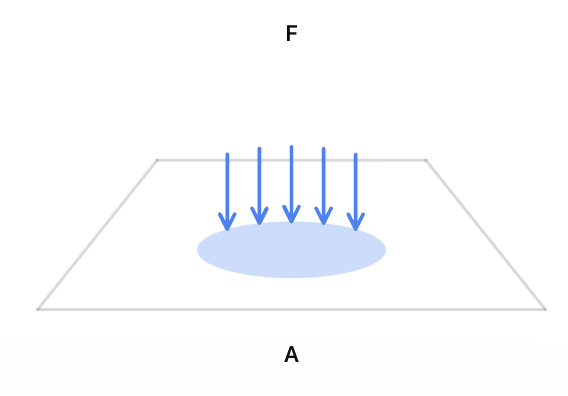
Pressure is the force acting per unit area of a surface.

This means that pressure describes how concentrated a force is.

A large force acting over a small area produces high pressure.

The same force spread over a large area produces lower pressure.

Pressure is represented by the symbol P.

The SI unit of pressure is the pascal (Pa).

1 pascal = 1 newton per square metre

So:

1 Pa = 1 N/m²


The Pressure Equation

Pressure depends on two quantities:

  • Force (F) measured in newtons (N)
  • Area (A) measured in square metres (m²)

The relationship between these quantities can be explored below.
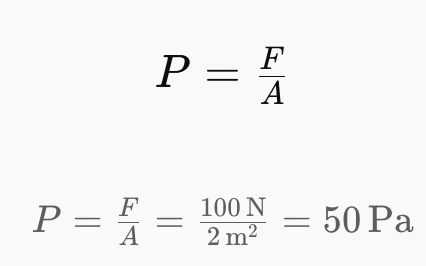
For calculations, this relationship is written as:

P = F ÷ A

where:

P = pressure (Pa)
F = force (N)
A = area (m²)


Example 1: Calculating Pressure

A box pushes down on the floor with a force of 600 N. The bottom of the box has an area of 2 m².

P = F ÷ A

P = 600 ÷ 2

P = 300 Pa

The box exerts a pressure of 300 Pa on the floor.


Rearranging the Pressure Equation

The equation can also be rearranged to calculate force or area.

To calculate force:

F = P × A

To calculate area:

A = F ÷ P

A useful equation triangle is:

 
        F
      ─────
       P A
 

Cover the quantity you want to calculate.


Example 2: Finding Force

A pressure of 500 Pa acts over an area of 4 m².

F = P × A

F = 500 × 4

F = 2000 N

The force is 2000 N.


Example 3: Finding Area

A force of 900 N produces a pressure of 300 Pa.

A = F ÷ P

A = 900 ÷ 300

A = 3 m²

The area is 3 m².


How Force Affects Pressure

If the area stays the same, increasing the force increases the pressure.

For example:

Force Area Pressure
100 N 2 m² 50 Pa
200 N 2 m² 100 Pa
400 N 2 m² 200 Pa

When the force doubles, the pressure also doubles.

Therefore:

More force → greater pressure

Less force → lower pressure

This is a direct relationship when area remains constant.

https://images.openai.com/static-rsc-4/22D1YwwHibA_knF9ndKjMr5myzjwF2kzFZxl8tnybvBcn_P8BmYMwpYLYC4fcJHH5fZP9-UdcnkoseZcC8M6CJXwHMFSU5FzdWEcs4eWLG9YGL_ti82jsL_Ad_xcL2uPdRJznd5hxnNM0lX5j53qtwMKyGktaybSLO96Smr06DfDtIzP_C7hN5A2pNvvTRar?purpose=fullsize
https://images.openai.com/static-rsc-4/Qv8Iw-ccOANpL5snuQNbz8cY4_ul3gu0DyGC_HmSFMgE7xQXkTbCvZwMvb0aTTWuDuGfkMvuJAahVLGng4tawcpgtbtj0kvWM2sOpAIIPo5tJrVUXKfhdsj2N_Sr0fE4AWh8XsxHPw5HIlLJn5taUPSCRqmnnt8cCCOBkLfuqOCKWuAIapRZF-ESL4M3nvSw?purpose=fullsize
https://images.openai.com/static-rsc-4/6Ub6-3zVBWhVWmOQOtqsQKhugORaZo8LS1ILas4HpyUUMBaq1hTE2FFjNmwsJyNiVplRFBE8qJ8z_bKr1NXCXMMhu4rCZRveKmu0OPoTpgOgVST5RJpmndaed7XXBBzT7YRSRsegN_UhBGri-WPt-2iCTDMHDg-oZ0YhMoWitBu5hwaaL_Comz47-Y_FpNlS?purpose=fullsize
5

How Area Affects Pressure

Area has the opposite effect.

If the force stays the same, spreading it over a larger area decreases the pressure.

For example:

Force Area Pressure
400 N 1 m² 400 Pa
400 N 2 m² 200 Pa
400 N 4 m² 100 Pa

When the area doubles, the pressure is halved.

Therefore:

Smaller area → greater pressure

Larger area → lower pressure

This is an inverse relationship when force remains constant.


High Pressure: Small Contact Area

Sometimes we deliberately want to create high pressure.

A sharp knife has a very thin cutting edge. Because the force is concentrated over a tiny area, the pressure can become very large.

This allows the knife to cut through materials much more easily.

https://images.openai.com/static-rsc-4/1wP4EMWiRWWnR8u0bLnrm8bloipsZBqjdBaFbrN5afTWaWKc5ny6vcnbKI1Uw5RfkolXPDyTm7oAJMeOWNpAZWNGYZqf6nHZnBttwzrO58o5hAaW9VGTxzr5KwIJ2hsFzTEMo92_1rwNaGg1u3ai1sDsqhtkBhrHo_JNhKepJ_kcpr1WAZAye_vDbbHpBn3t?purpose=fullsize
https://images.openai.com/static-rsc-4/4hpdmX35AeLOeTtmVMKJbVn5bsdMaCLqTKiDmVTWmSosvXe0s5n2et9fph-CTaMtY8vzjEClKlkRnLIUXWGPnLLdGaKnXMWNJH6ybb2isLOf0Jb6C21hY3vCw2qbmVKHKTlW0j1SIHiHLetMeLX8WxclWwOQD-KAlgODaZgTgOf0tSO1hUJj65snK__UfqTk?purpose=fullsize
https://images.openai.com/static-rsc-4/9M82owaxfwr74bo2lJ_P9RlFH7VNeOea5yo45O7mp_fAj1SA5zXlXcaQrF2Xe3w2BLzTJSuGmCTfwKYGRrcAphW4u9vKyjcjfl9FYMdZWvGrT-qlt91h3bX7XwYwn9T1YD-QGZeST19BX2CfJjBAAT96jRZD-8cAekA-18qLAN3yQkPAs-NjrHjp3KfpGCxj?purpose=fullsize
4

The same principle explains why we use:

  • sharp needles
  • nails with pointed ends
  • axes
  • scissors
  • sharp knives
  • pins
  • ice-skate blades

These objects concentrate force onto a small area, producing high pressure.

Sharp vs Blunt Knife

Imagine pressing down with a force of 50 N.

If a blunt edge contacts an area of 0.01 m²:

P = 50 ÷ 0.01 = 5000 Pa

If a much sharper edge contacts an area of 0.001 m²:

P = 50 ÷ 0.001 = 50 000 Pa

The force is identical, but the sharper edge produces 10 times more pressure.


Low Pressure: Large Contact Area

In other situations, high pressure would cause problems.

Instead, we spread the force over a larger area.

Snowshoes are a good example.

https://images.openai.com/static-rsc-4/PfsGkyY4Klfx9Urjr3C-3mBDjhPchKKHhrkygdv0lGLWytFbW-MKJtdV-czjlpuIg3Ododo6XUkx8YTOefJqTYPWeA9ennLxxrETZAx9jlRq9e7JuFxVrfViGjbVBaPs62O8EzAwZtzhLnm-xrA25-Imxevp-1uaa6qtGgTE2afd-X3Mt-hGgp-zl6N7iK5A?purpose=fullsize
https://images.openai.com/static-rsc-4/KuV_A7gROGkt5H9E86bJc3JLIZZR5vSfK6cSnYUYV8xCpCU1rby5rchTraju5E1uLenEzE0ukH5jHKfp_-wX0Y-bydsy0hEbsyC_fsgneMZdHZGj8OM2ElSMbOI3FImyjGqXo7J3or1-alIMUfowRrWjb0cZTgPdZB1mljY0cOz2plm-9kO58y7eAwHSWdU4?purpose=fullsize
https://images.openai.com/static-rsc-4/n5A4R_wblRfMcxfF-u923S_zoORf09kd8sTk2BX7qxxrgTP-E0nI80_2cPJ5vTiTQh79jujLAv6I9VVzFRrMyaYHRuMaQ9fzTl94MLmtqkSjh6qpenbcGuvPEqn1LIVOAaiOWQ2sibk7dSSUamqAk5D7gEnm8eCG0Z0Xf4fP5_NUXkgdphK8W-lFM8cAd-wH?purpose=fullsize
5

A person's weight produces a downward force.

With ordinary boots, this force acts over a relatively small area.

With snowshoes, the same force is spread across a much larger area.

Therefore:

larger area → lower pressure → less sinking

Skis work in a similar way.


Pressure and Vehicle Tyres

Vehicles can also use large contact areas to reduce pressure on the ground.

Heavy agricultural machines could sink into soft soil because their enormous weight creates a large force.

Wide tyres spread that force over a greater area.

https://images.openai.com/static-rsc-4/sQkFNydg6U7hPXZxK4WtjkrqvFwXhNXUS4l93HKTHP5z_jXkU0bTr1F4FOWlu6kIVDFEtqrkTuNbsvzUyK70AkFZgEKWMsJ0Vl32f4nb_AMgovTBhLqmND5tWsgcElC9FBxBFLprg-L3tea-cU9YneSQqKP-aqHtQeXCEqppEmZu0CI7sL2lV6RwPoOE7gaQ?purpose=fullsize
https://images.openai.com/static-rsc-4/Y69xZbeo1iAv8T1JHmO43C14h8HsLBp4INE_dy1rk1t373ZOqp7NhxYvzj6eayFNBjc8-5j3PpV5G6-xJA2K8_LNKj3sykxQ2DofFA6cn1I7kpXTWkIimIQsZV6QaX7kLzpIVTzSna9fLze_H-2u_TAjDmSvOn-tzvPg-3EpY9k01amHESEiHTTva2xAW0B3?purpose=fullsize
https://images.openai.com/static-rsc-4/meY4HO9o8fHBqjSowVwTRrck4f5Fck9CKF2MMNLo8LNoVzpoWDyeQEAbXd1tS-4GbrRMMG3ldfDBekl8_cPZkJJqrWTfR1m2bUCJYkFMUQQMNZtrX7swDpV6tKq0u1CeUpnvNadahMbdw0FLw93Rc9C_hah_7G-kxioKviVgcQvyJ_aFMzGHrKykomgBr80P?purpose=fullsize
6

Some vehicles go even further and use tracks instead of tyres.

Tank and bulldozer tracks provide a large contact area with the ground.

This reduces ground pressure and helps heavy vehicles travel across softer surfaces.


High Heels and Flat Shoes

High-heeled shoes provide a useful everyday example.

Imagine two people of equal weight.

One wears flat shoes.

The other wears high heels.

Their weights may be identical, but the heel of a high-heeled shoe has a very small contact area.

https://images.openai.com/static-rsc-4/k-S4uK5YaYoyaZnDSrT4BY4iiEArPh8LW_0LTPXpF5C8BTFZPTJFM35ZFCFyl7QEkEDw4v_fIFI4EB5EFmMEu0kJ06_9ChAybkNsXN1GbO_30aqoE_QnVae9UuWJAwgclFwehN7nIBGJNJbR9_KdFVmbrsAhPwq4yGLmNqjdmBzgFNvNNWJvAWXh0ovCPV1F?purpose=fullsize
https://images.openai.com/static-rsc-4/15kGAIWQBV0-co54V5RD4M2nefcOUe4Rrncr45KsNLhCpLqypuYB2CEon3bM35ySxfcfDd0l_RhCp3k5N8sUveNLvPqcAyo2qKFbsIR4Bioc-0BvH7wOqbTstP8JfVw3v8dYf31ajIvtjbpCocxkb6cL8AsqF7nDl8vKpa60nGj19OrbXOMFaKNSiuqcCJVA?purpose=fullsize
https://images.openai.com/static-rsc-4/ItnUekEhKVySM4rc9t11UELI6WCarXoDkgcgxulaevL0mwR1TY_XngH0DJriQa0tkqWCLbkpCS8WNs9guMFB1xY-ekVs2Dn1AvnRLpwaPEhWCELs0tPSyTHhXAEutC8DraiSY8WH9rvXEBuKEKaRCWInR0dWxXYLO6SCebGu3GTT88g5eHMSvv7a4YTyeTbT?purpose=fullsize
5

The smaller area produces much greater pressure.

This explains why high heels can:

  • sink into soft ground
  • leave marks in wooden floors
  • damage some surfaces

It also demonstrates an important principle:

A greater pressure does not necessarily mean a greater force.

The pressure can increase simply because the area decreases.


Lying Down vs Standing

Consider a person standing on the floor.

Their weight acts through the relatively small area of their feet.

Now imagine the same person lying flat on the floor.

Their weight has not changed, but the contact area is much larger.

Therefore, the pressure on the floor decreases.

https://images.openai.com/static-rsc-4/tKKGmtbvd1f8h_CVFQNN6UdENLI5IuU1vyg3Jc7LtKF3FuH7vVIbFLiAqrHiTjlmgdRM23VcVvtF_a2iHDkhztHIuK_7ULY-vjufDKWz_EKZ1WMY0TSHIKkYL2TNRWGv5W75YGq7N9NjWl6ftD30P1YukkOGD1QDuXciw8ooYRMjhN_-caZYElpq1LsoCQ-k?purpose=fullsize
https://images.openai.com/static-rsc-4/ant5y10ej7IXslBCTzm2HwFwbhPr-QpJYFngSv57xN8xhzLEpxS3nW9_kl5b7bOBjBRElQQIK46auO_iS238xg-wULERHc0SMlDwwVIMS9EM2Rp0v2plq_UBTM_5FqcwNG_5dogJA5NDV7jXsnw7v0MqoYGgP10slo3NHGXbQTDOJO-IN-aE_na156Kni2yG?purpose=fullsize
https://images.openai.com/static-rsc-4/dKw7-iXwtM6O_ctWerD8CX2di6HGHJNKtWcqWoyk_kr_fhUdEA7DrBcvmx28a3kEntvw9Ns4OlSUeHFVxxOAXqA4-5JkPSvLFP_CXJduCCNi1F1n-jhn5dSrxJxp-h2OXN3EGe7ZCxGwWfRfiQv12qTBn12ZxMlF0YdJtPh7-NmZG51bSUhP0s96UBlzp-FC?purpose=fullsize

This illustrates why it is important to consider both force and area when comparing pressure.


Pressure in Engineering

Engineers often need to control pressure.

For example, the foundations of a large building spread its weight across a large area of ground.

If the foundation were too small, the enormous weight of the building could create excessive pressure on the soil.

https://images.openai.com/static-rsc-4/R_IRrlWGH6GAO_ht5crZNPIvU6_ZdcMTQtAysCttzX3nNUtMCB1UuM0ssJgOqmvhu63X7Bb94wNIwRqp3mYK1J2Psl476rAb82BeSenNgVqLgM4qeSCyuprmndjK-7giXHFm0NnKWwcnJV00DVIHQjYNupKhcjuu3Y3a-XwUp_L-Hf1Swr5p9WYUqqZwbR36?purpose=fullsize
https://images.openai.com/static-rsc-4/RI6fK6qwrORhCcDCUZ-kOBKf_UxwYsWVi2gsc4OAq5kw8FegwCaFGeA6JNqbc1YtkKbpZa63dMTdsjGirW_97OT7W9GDCLfsraDtvXbHLSANN5xCS6SOW2mxtpmDArCsN1tDRjNZceNkXW9BbptJsXkuJVipXgw_ftgUu2ZArLHuUKGCM7M4-y6iW-PrckCK?purpose=fullsize
https://images.openai.com/static-rsc-4/M9kfOXxVfqs8SSnEXRO36JzVTBr-hsK6YWF9-oCxdWiq8mAxnFETf1V6Z9cn_zfIU-sKXGQ_mzt011jpmBYQJRMffbA9xxbQcgomLe2HWgEX2GQFQNwfvNrln0La5Y0KLoQcwCgraNUgOpGLD-T5QcR5POPJcFGWStJHu9GBypmDIGez7aYaCdRYtQkwlphJ?purpose=fullsize
5

Engineers therefore design foundations that distribute forces safely.

Similar principles are used when designing:

  • bridges
  • roads
  • dams
  • cranes
  • vehicles
  • aircraft landing gear
  • industrial machinery

Pressure and Animal Adaptations

Animals also show adaptations related to pressure.

Animals that live on soft surfaces often have relatively large feet.

For example, camels have broad feet that help spread their weight over the sand.

https://images.openai.com/static-rsc-4/wwzphkHo3ym0aeq5SJqUQpL4NkkYll_7dBydk6dvBr4hMEy3iP9Q2mpDCGW4UMMvcwcebxv6KF2wZtwG0z3qek9xkMBNRgkqS3D09AzQDmA7arsRl8u2GLlJXn11XfxoU8r7KLWcTnkV9TNTsj_8ht1xa3szJJh7JAm9eIgBEEkmBIvIxiVsbvKdyPRGVO1S?purpose=fullsize
https://images.openai.com/static-rsc-4/amf0QsgimF6hVlRTPgH5Xd0PHiUWpNu49vlFdbdjmFrsOZYXzLn2qLyjftSy_f_mfUncJvLZ_079TlfP2IyO_p0bkB8pJv4QMbFFpubOTIdaIVcukUoDZ6dfmVB_qnOf3FgjS_ft1F72nGiFFOL13O08fVxIgOUWey7QyJy5RGksh0rfymIrWi5wK_Ab5vRG?purpose=fullsize
https://images.openai.com/static-rsc-4/vhinUroRfIhrtG_4wwHRLITiWn00cGnUmSDbczXMz_lA0SSMU_71TFTo2zGipf2ntoVJQ5TwR1QcFuUFi6I_2HN3K-6WKmBgmqllzJyMlDcXtCXPup7CBhnsyvPIxXic9s8l6JvpJ2UoIWhWWdpPYKsH1XBHLd12VhYc_M0XvTQDYX3vwoNm0lwVZTtBcDL6?purpose=fullsize
6

Animals living in snowy environments may also have wide paws or feet.

The larger contact area reduces pressure, helping them avoid sinking deeply into snow or sand.


Comparing High and Low Pressure

To compare pressure correctly, you need to consider both force and area.

Situation Force Area Pressure
Sharp needle Moderate Very small Very high
Snowshoe Same body weight Large Low
High heel Same body weight Very small High
Flat shoe Same body weight Larger Lower
Tractor with wide tyres Large Large Reduced
Knife edge Moderate Very small High

A large force does not automatically mean high pressure.

Likewise, a small force does not necessarily mean low pressure.

You must consider how much area the force acts over.


A Useful Problem-Solving Method

When solving pressure problems:

Step 1: Identify the force.

Step 2: Identify the contact area.

Step 3: Check the units.

Force should normally be in newtons (N).

Area should normally be in square metres (m²).

Step 4: Choose the correct equation.

Step 5: Substitute the values.

Step 6: Calculate the answer.

Step 7: Include the correct unit.


Watch Out for Area Units

One common mistake in pressure calculations is forgetting to convert area into square metres.

For example:

1 m = 100 cm

but:

1 m² = 10 000 cm²

Therefore:

100 cm² = 0.01 m²

This difference is important because pressure calculations often involve relatively small contact areas.


Worked Example

A block exerts a downward force of 240 N. Its base measures 0.4 m × 0.2 m.

First calculate the area:

A = length × width

A = 0.4 × 0.2

A = 0.08 m²

Now calculate pressure:

P = F ÷ A

P = 240 ÷ 0.08

P = 3000 Pa

The block exerts a pressure of 3000 Pa.


Key Terms

  • Pressure – force acting per unit area
  • Force – a push or pull measured in newtons
  • Area – the size of a surface
  • Contact area – the area over which two surfaces touch
  • Pascal (Pa) – SI unit of pressure
  • High pressure – a relatively large force acting over a small area
  • Low pressure – a force spread over a relatively large area
  • Direct relationship – when one quantity increases as another increases
  • Inverse relationship – when one quantity increases as another decreases

Key Takeaways

  • Pressure is force acting per unit area.
  • Pressure is measured in pascals (Pa).
  • 1 Pa = 1 N/m².
  • Increasing force while keeping area constant increases pressure.
  • Increasing area while keeping force constant decreases pressure.
  • Sharp objects create high pressure by concentrating force over a small area.
  • Snowshoes, wide tyres, tracks, and foundations reduce pressure by spreading force over a large area.
  • High pressure does not always mean a large force—the size of the contact area is equally important.
  • Pressure is important in everyday life, engineering, transportation, construction, and biology.

2. Pressure in Liquids

Learning outcomes
  • I can explain why pressure increases with depth in a liquid.
  • I can identify factors that affect liquid pressure.
  • I can use the fluid pressure equation to solve problems.
  • I can interpret pressure-depth graphs.
  • I can apply liquid pressure concepts to underwater environments.

If you have ever dived to the bottom of a swimming pool, you may have noticed increasing pressure in your ears as you went deeper. This happens because liquid pressure increases with depth.

The deeper you travel below the surface, the more liquid there is above you. That liquid has weight, and its weight produces pressure.

This principle is important in swimming and diving, but it also affects submarines, dams, underwater pipelines, deep-sea animals, and ocean exploration.

https://images.openai.com/static-rsc-4/eWUw4PWuXsNwGpyyYKoPzjByQYnIXSUjQtP0gFVf1ZtdOksHrwdnAjgM-xsxF7Brf6jRjSZwN9yF3m-iFRzX-2KCWpOhVKOfCUTIGE5gpdAGIhm3hMC-18VkECsMTX5mpfv1Y8xIi9OB-LavQrJuhnPabPqkEWxAHAg9gU57umOn3Ep8cAFj8FXXUb5a0yp1?purpose=fullsize
https://images.openai.com/static-rsc-4/kgDKTl20hIvDCQwFIwzQ6a2M0XtOrzY1iJpjmJaMDN3DdUtvCS2Of4QkfsXjLaRhKmnipt9pZ5uUn7Mjoi_Ms-_O8nD589RPjCpvZn_66AmvXZJtW_8ILVM9FppsYB0k2GSh_M1xHbx0WIN3rH93rFrinv7UKRPWk148pR4ILVGOCE5Zh1EK-vWq-_d_MnXh?purpose=fullsize
https://images.openai.com/static-rsc-4/L8CqTuEuS0LWi_8iydHWMOqneuJejO6ipabB7jaTVQ-C5dWuC5UIGZZQlqKkJsZalkAt0Q-TzHYs9hH1VesPSn0mnHuf4MGtj3fsfruAOwflpE63LF3CHwKNBu7fzNKVtttRslihAYcL2CI9yLurCXdnIpH4QLgT3Qf2YyhzUwV7QJfjJUwS2pDmwTFzYd1Y?purpose=fullsize
7

What Is Liquid Pressure?

Liquids exert pressure on objects that are in contact with them.

Unlike a solid object resting on a table, a liquid does not exert force in only one direction. At a particular point in a stationary liquid, pressure acts in all directions.

This means that water pushes:

  • downward on the bottom of a container
  • sideways against the walls
  • against objects submerged in the water
  • against swimmers and divers

The pressure produced by the liquid itself is called hydrostatic pressure.


Why Does Pressure Increase with Depth?

Imagine standing at the bottom of a shallow swimming pool.

There is a column of water above you. The water has mass, so gravity pulls it downward. The weight of this water contributes to the pressure at your depth.

Now imagine moving to the bottom of a much deeper pool.

There is now a taller column of water above you.

https://images.openai.com/static-rsc-4/28QLJzTbVSor0VAuNew_llL2b6nHHRpSG_40VMENAz1xlCrY0mnMrqI1gd5JvYbbYrPd2eDwopnjacP5QA_vGwJPZveC5W2CD4qJP8CK7QnBZKn-iftXsjip3N2lDU792igQTN4pcsnXULqjiaQFujwPg_hjKVKWi-UpSI2dH-tW6qIbx4XRw1BahKeWkkPq?purpose=fullsize
https://images.openai.com/static-rsc-4/_ozNMv746bAONv3GsiStMwI-y_DyKIOXSGQ8fstzUG1IJzsR3v6EU_OpzSSMyxA3oSqVdp6n5SqLw33DVBNWpHo6BfUMfnlMbpmofyR0QjMt7MqvQ3QE48vKMebgLq0tajrRsAzTQHIdgs01gRJnTwrLAWkLA6JoAOSwFSraHTTr9Nt0MKdYlbWslo11zMSH?purpose=fullsize
https://images.openai.com/static-rsc-4/ek-AM00vLh8hl1DsGYDG_E0wIZXK6ufinKn_hsrGiRqEoJnXLy6jJxC-3hkQMU9-bkec3Ng3w_ImyFq2TJBUu0tskFmLshuYvzeO7PF3XcKFwMas-LEnjh44F4i_dW2BAnfZdhDTu56OCeDnsHiTMqCdaT84P4eWePw29nhNy9WcPU1V-TzkyxqFIMd32gBm?purpose=fullsize
6

A taller column of water means:

more water above you → greater weight of water → greater pressure

Therefore:

As depth increases, liquid pressure increases.

This is why a diver experiences greater pressure at 20 m below the surface than at 5 m below the surface.


Factors Affecting Liquid Pressure

For a liquid at rest, the pressure caused by the liquid depends mainly on three factors:

1. Depth

Greater depth produces greater pressure.

Greater depth → greater liquid pressure

2. Density of the Liquid

A denser liquid has more mass in the same volume.

Therefore, at the same depth:

Greater density → greater liquid pressure

For example, seawater is slightly denser than freshwater, so at the same depth it produces slightly greater pressure.

3. Gravitational Field Strength

Stronger gravity increases the weight of the liquid.

Therefore:

Greater gravitational field strength → greater liquid pressure

These three factors appear in the fluid-pressure equation.


The Fluid Pressure Equation

The pressure caused by a column of liquid can be calculated using:

p = ρgh

where:

p = pressure caused by the liquid (Pa)
ρ = density of the liquid (kg/m³)
g = gravitational field strength (N/kg)
h = depth below the surface (m)

The Greek letter ρ, pronounced rho, represents density.

For water, we usually use:

ρ ≈ 1000 kg/m³

Near Earth's surface:

g ≈ 9.8 N/kg

In many school calculations, this may be rounded to:

g ≈ 10 N/kg


Understanding the Equation

The equation

p = ρgh

shows us directly what affects liquid pressure.

If h increases, pressure increases.

If ρ increases, pressure increases.

If g increases, pressure increases.

Pressure is therefore directly proportional to all three quantities.

For example, if depth doubles while density and gravity remain constant:

pressure doubles.

If depth triples:

pressure triples.


Worked Example 1: Pressure in Water

A swimmer is 3.0 m below the surface of freshwater.

Calculate the pressure caused by the water.

Use:

ρ = 1000 kg/m³

g = 10 N/kg

h = 3.0 m

Start with:

p = ρgh

Substitute:

p = 1000 × 10 × 3

p = 30 000 Pa

Therefore, the water produces a pressure of:

30 000 Pa

or:

30 kPa

because:

1000 Pa = 1 kPa


Worked Example 2: Going Deeper

A diver moves from a depth of 4 m to a depth of 12 m.

Using freshwater and g = 10 N/kg, compare the liquid pressure.

At 4 m:

p = 1000 × 10 × 4

p = 40 000 Pa

At 12 m:

p = 1000 × 10 × 12

p = 120 000 Pa

The diver is now three times as deep.

The pressure caused by the water is also three times as large.

This demonstrates the direct relationship between pressure and depth.


Comparing Different Liquids

Density also matters.

Suppose two containers are filled to the same depth:

  • Container A contains water.
  • Container B contains a denser liquid.
https://images.openai.com/static-rsc-4/TQSMOPau7RT9CSJu-CKaOO-1dvdYkg1RAVHqKlO_VCkD8BQuwTdrYOt5gfGdmahw98TFWv_4WgL4AxDvXIcnHH-kHjTuWFAG75mXW9kITQSYUrKNA7kE5Q6FXJ3glz8J-IsQEb1VcguHGKhhalzN6wvLXSHHjx8Mv_Dww6NhmrjRDbaozpeJIwXd9YUmsRgj?purpose=fullsize
https://images.openai.com/static-rsc-4/ScQz8d_DRXLENzlmmBseBFp7lM_o7zTFug5nOnrPPNhu_WQfuTIoJKJhyzXRjzYQ4RKxyTqlUMYUF8kyiRvOp2wnkyWHP44DmlzxQI4Pb8LyeOwAglkNXAch24hPQ4AMBrYE_x3ykvnR3ox5SawWl64WkAKEQGXtCd9y2YE-wmqO2EmGRWbYzBTVfJRpnHd7?purpose=fullsize
https://images.openai.com/static-rsc-4/phgiYfTtXZuvlgdvnBhmIgM5kH6i7UaRDo1xEftrhZjC1lNlRKeWj3XwHup0QyaXgfCga698rqDcQk0gkzuGbGfLKD1pr91IifzCRT1tzUtw3qHrjLUj7TqK48yAZnanGqhnNm8yWHO0WcI2hUqZ6J7W6XU_-PJITF1i8DzQ4KAHiomqgg7pGb1PjAsruUfL?purpose=fullsize
5

At the same depth, the denser liquid produces greater pressure.

Consider water and a liquid with density 1200 kg/m³ at a depth of 2 m.

Water

p = 1000 × 10 × 2

p = 20 000 Pa

Denser liquid

p = 1200 × 10 × 2

p = 24 000 Pa

The denser liquid produces greater pressure even though the depth is identical.


Worked Example 3: Finding Depth

The equation can also be rearranged.

Suppose the pressure caused by water is 50 000 Pa.

At what depth does this occur?

Use:

ρ = 1000 kg/m³

g = 10 N/kg

Starting with:

p = ρgh

Rearrange:

h = p ÷ (ρg)

Substitute:

h = 50 000 ÷ (1000 × 10)

h = 5 m

Therefore, the depth is:

5 m


Pressure-Depth Graphs

Because liquid pressure increases directly with depth, a graph of pressure caused by the liquid against depth produces a straight line.

Here is an example for freshwater using g = 10 N/kg.
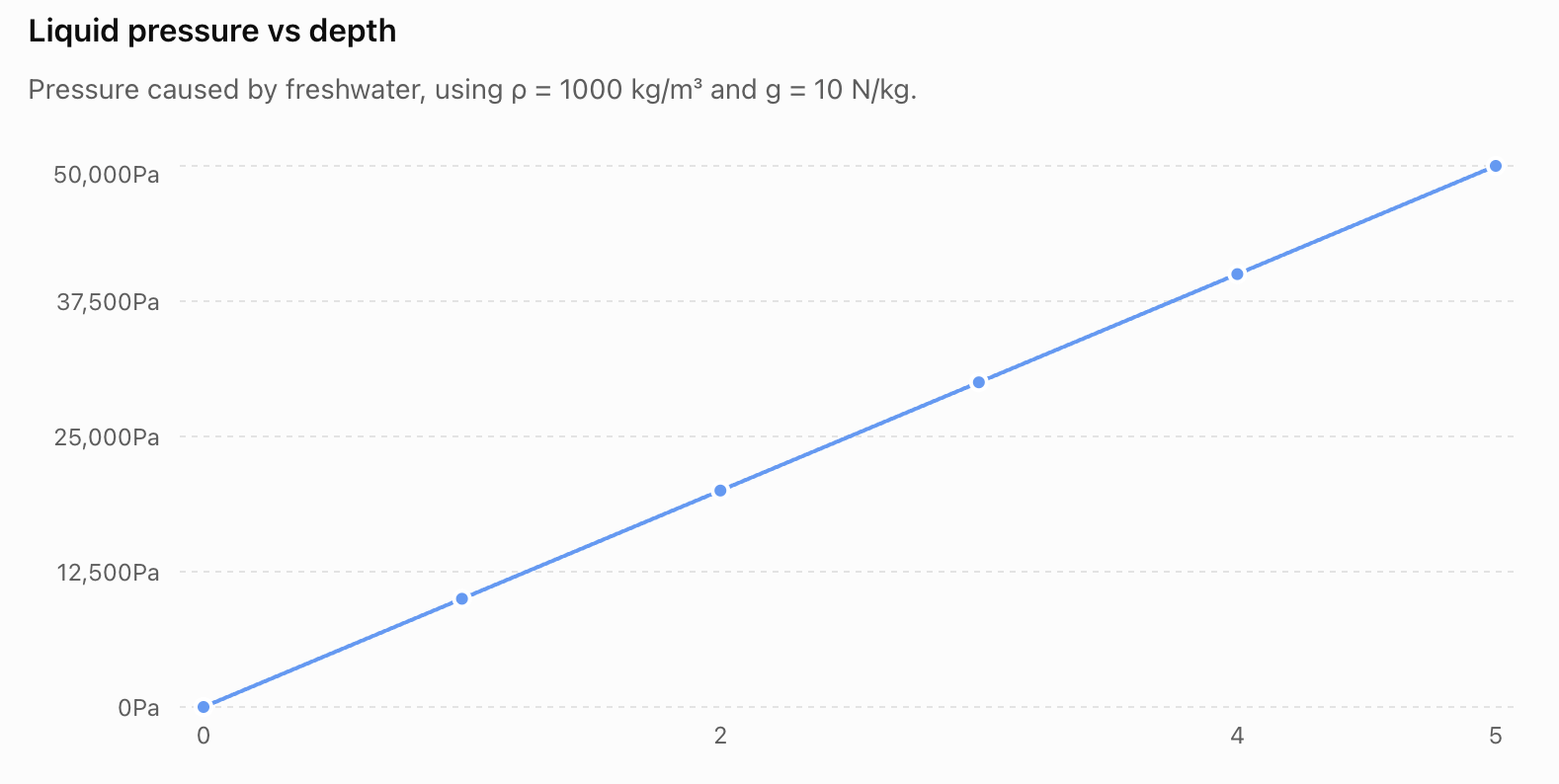
Notice that:

  • At 0 m, the pressure caused by the water is 0 Pa.
  • At 1 m, it is 10 000 Pa.
  • At 2 m, it is 20 000 Pa.
  • At 5 m, it is 50 000 Pa.

Every additional metre adds the same amount of pressure.

This creates a straight-line relationship.


Interpreting the Gradient

The steepness, or gradient, of a pressure-depth graph tells us how quickly pressure increases with depth.

From:

p = ρgh

we can see that the gradient depends on:

ρg

Therefore, if two liquids are on the same planet:

denser liquid → steeper pressure-depth graph

A less-dense liquid produces a less-steep graph.

This means you can sometimes compare the densities of liquids simply by comparing their pressure-depth graphs.


Gauge Pressure and Total Pressure

There is an important distinction when discussing pressure underwater.

The equation:

p = ρgh

calculates the pressure caused by the liquid column.

But a swimmer in an open swimming pool also has atmospheric pressure acting on the surface of the water.

Therefore, the total pressure is:

total pressure = atmospheric pressure + liquid pressure

At Earth's surface, atmospheric pressure is approximately:

101 000 Pa

or about:

101 kPa

So if water contributes another 50 000 Pa:

Total pressure ≈ 101 000 + 50 000

Total pressure ≈ 151 000 Pa

The pressure calculated using ρgh alone is sometimes called gauge pressure or hydrostatic pressure.

This distinction becomes especially important when discussing diving.


Pressure Underwater

Water is much denser than air, so pressure changes much more rapidly with depth in water than it does with height in the atmosphere.

This is why divers quickly notice pressure changes.

https://images.openai.com/static-rsc-4/EzM-882e4PdYov2HzEigxLqs1D57xL3cAqIqIvuwJgw3reIgYOtRguY-6UHkdHCMtP4DLs3iTADtsxYl8cycSnLMWCga1EFUDHALwEGH_6YPPtKDSaDrwtRcaUBLu3Vu3g2tgkpROq_eze7aKctonbr00Zco7FyVV-gJVv5bxpaHMoiYF2HIQfHZy69GgbJQ?purpose=fullsize
https://images.openai.com/static-rsc-4/OorohcxNXmXdkDdGTT82Vdt-9y_LbZD0RD_zN64qjDOpqRLVo8QYHGv5raohFIC0IRCiEl3V3ljiMoqATmdaG_XpXSDDjdH6XkCPsjyTLyCWu734aZCHGtQjSydmVenYuBjCW3TN18mCDTQB_uUQYMZiazim9kFYHPcYzMT5BkAFDE1u6p3jwTQaTyjLwRVu?purpose=fullsize
https://images.openai.com/static-rsc-4/eWUw4PWuXsNwGpyyYKoPzjByQYnIXSUjQtP0gFVf1ZtdOksHrwdnAjgM-xsxF7Brf6jRjSZwN9yF3m-iFRzX-2KCWpOhVKOfCUTIGE5gpdAGIhm3hMC-18VkECsMTX5mpfv1Y8xIi9OB-LavQrJuhnPabPqkEWxAHAg9gU57umOn3Ep8cAFj8FXXUb5a0yp1?purpose=fullsize
5

As a diver descends:

depth increases → water pressure increases

The increasing external pressure affects air spaces in the body, particularly:

  • ears
  • sinuses
  • lungs
  • diving equipment

Divers therefore need to manage pressure changes carefully.


A Useful Diving Approximation

In seawater, pressure increases by approximately one atmosphere for every 10 m of depth.

At the surface:

≈ 1 atmosphere

At 10 m:

≈ 2 atmospheres total

At 20 m:

≈ 3 atmospheres total

At 30 m:

≈ 4 atmospheres total

The extra pressure comes from the increasing column of water above the diver.

This is an approximation, but it is useful for understanding how rapidly pressure increases underwater.


Submarines and Deep-Sea Vehicles

Submarines must be designed to withstand large external pressures.

The deeper a submarine travels, the greater the pressure exerted by the surrounding water.

https://images.openai.com/static-rsc-4/0aUAa2DfBdnXTqubwfYpZnd4UVFMZjrVuweKELWl_BwdyhKiBp0VyKu07GWSKwfO33bECGGF-PeysHyO9cNlNazkt3_ym3tYe2UbcxtSwZZjz_gYOK1x_m886dNIBOiSdGBR_I38zaUyXaleKBdCZLw7E8twBN10xFLd2cFGxwUmlFaLqcI6s5_3LbFS3Qnd?purpose=fullsize
https://images.openai.com/static-rsc-4/IX9x2WuKIS_DjfyNsRnC20iBrEr2LMwirM8Obd2CyD6_FMa475Lgxe53ENdbBzW8_f5vEtVZGfS-We7hE-AYnuwF-VinF02lZPlk0WTjoMYKRsFTjWhpUDMAlIssk48wk3exeYkPp5gH9RujY2gPtiP3e17RbNswwKa9C7LqiGdGnytjz6QPF_h5_5_zWjMz?purpose=fullsize
https://images.openai.com/static-rsc-4/pErw8Msqu70rqb-lu1NP6-LniLb1mQz7hDjQiJwTOuOcMaANYR1EjTVtFZu80xuB3DQPLlntrqdgNW7NRXg-bcWWwaICiiuulUfgur_oIlQ6wWdqZ5iT---Ci6-LrhTHdP7G_tE_f_r5ZnddGbfasiLvVZJcsOjBDIUNe9bCjbPHzp0a7B34nxA0pu3vXWjD?purpose=fullsize
5

A submarine therefore requires a strong pressure hull.

Engineers must consider:

  • maximum operating depth
  • water density
  • hull material
  • hull thickness
  • hull shape
  • safety margins

Deep-sea research vehicles face even greater engineering challenges because they may descend thousands of metres below the surface.


Why Deep-Sea Submersibles Are Often Rounded

Many deep-sea vessels use spherical or nearly spherical pressure chambers.

Why?

External water pressure acts from all directions.

https://images.openai.com/static-rsc-4/7jEzGqyZEmM_oItG5S4Yra4caL4R7_6cBxz836IPpzgRkjWfPlu_1W348cRS8L5GHaWKK59f3GHVY9CvHcNYqn2eTT4uCB_tHworzzTZf2pvWqxILuLRGXnNCFXjthnKzc6cLIXNMsZgMNF4OFv9TWpGMTowBCQaQBNwepPYdnpsKH-KrTP445Do6aHeB18k?purpose=fullsize
https://images.openai.com/static-rsc-4/LoGurt8XafgRvuwHaFIEuaU2a7wxkeOhQ-5mSLjmN2jdP2dvALAJF0m7YE6pdX1ByKMGxsSmjPfSChPZg7mQS02t1cMIWgUnhT2F-qBQhIpmvIElwTBs9jZ3rK0GiZyEnaAm4WiAickiy-jEvYQhhUrkBjvN6PSGAS2diWnQK7iSITNhqydxu6SU_BY3bj6Y?purpose=fullsize
https://images.openai.com/static-rsc-4/TADMPZe1wn5KJDEzVpCpVnu8xQmqAA6yjBVX2N_XsWTMUYP_rJ__J6UkCQbP5BhWb9vp28ODEr_el9QMDu-rkibeiccLwr0cgNWplVjluyBlC3LV5Uqqk_3Lzs-nlHP85_9LhHln8osparZbzL5VBqrDk1jIn6WbuUUGVjmuZ5H-S4gb8bWu8J403u4fz5xu?purpose=fullsize
6

A rounded structure distributes the external forces more evenly than many flat-sided structures.

This helps the vessel resist deformation or collapse under enormous pressure.


Dams and Liquid Pressure

Dams provide another important application.

Water pressure increases with depth, so the bottom of a dam experiences greater pressure than the top.

https://images.openai.com/static-rsc-4/AVVEAopfdvbo3lCuuKP6NoAFx9cdTcH8Q1CT2G10tFRKWFhCfrzNZbOEanVOH_OMcy43N8AQ9IagMMDAXOcr6hbh1OaRtAc5Ih97bugiS8wUjIH_L7LpRDKsYoSWkHpwV-JwogSNre5BloVu1Qm8SVXfElnWRD-R2xeF10PNIbEUxzHMHJQUPC_9WuzMkx45?purpose=fullsize
https://images.openai.com/static-rsc-4/6NmO1ZExY3jogGgxUv6aEEOzR9SowxGHLbWBm9gdZgsqSm8suCxGcqjz7W4SLmG41y-lTy6vHM3_MJursKMrnUsShGZoP1nUC4LpkV2fDCwBQTQnyfV1FsUI53QNRMQCRj29jqM6N9Y0u897pcao4uGJ2by3RAN1wUinDi6IZlpy22xhEiQtNYoU4fagUuRc?purpose=fullsize
https://images.openai.com/static-rsc-4/VxrBqF0UvZl6SCFzZ5yyCODrenkDe-GHbChyFC-HioxTL9cDwdlXPZTukEaCmOfctX4qNJi_RQg-xjS57cOgGbG28qKhwfZforgLqQtiulif6jYoHsbooz6042nH1nehZljsYSdrdvmSTtUAwK5hu5iiiG1JZpfPTmMaWW20QLNdJrCnthyU6w5Ty6J3Frk8?purpose=fullsize
4

For this reason, many dams are:

thinner near the top

and

much thicker near the bottom

The structure must withstand the greater forces produced by the higher water pressure at greater depths.


Pressure Acts Sideways Too

A common misconception is that liquid pressure acts only downward because gravity pulls the water downward.

In reality, a stationary liquid exerts pressure in every direction.

A simple experiment demonstrates this.

Imagine a bottle containing water with holes at different heights.

https://images.openai.com/static-rsc-4/v1RsYKN9j9uq4Hp1IDBOohckuCTs60-kbM3TdKVQfSuTycLfBKdrFEJtLhppwkQN_0OAN2SxCm0CyEozrbHJ88AhqNkEEbIaUGQ2RZJEcShq1jl3mYuEimCzBaURUmCDHT3_wmBFhUP4O3ZZmRiBPrKlvJai1t0eMVlf0FD5cH4osipg8ICthUzG2L5zoYVR?purpose=fullsize
https://images.openai.com/static-rsc-4/O9SPeFgbYkdiJbcfB7GlZpHh1ztxoB2H3uDFpOKnEv-QeAbZY286RY5z1iAaZqdfgj66pdefLVIhdZnJLExQqZ56zgxB7HaLB_cdMsaIhm6ALorz5SPNhCg9lHHSwDGNyuja_og3u44dpmVgVzuVa0iCcMd_FRpt0qbLs18ODhYoISxUZHliwuBM4lFwXsST?purpose=fullsize
https://images.openai.com/static-rsc-4/hzcRgmFH4xYYJaH7unHN9OTGN0_RYP9E-L0MGB_y63RUwgXfSQjnu9Nt2bOQHctHFVOaTB6QT3C7FGozQFy5BYYQSiAFBq3Mf_MDXxGsCMSUZbn0IhzX5EBA2SxO5I2SEQuPdV_qGrTWFcIMqdUcpwNV66pKOlNdJMMAwpCWhoGrgTXVwUW0J6-6Ch_mxQPN?purpose=fullsize
4

Water shoots sideways from each hole.

The water from the lowest hole usually travels farthest because the pressure is greatest there.

This demonstrates two important ideas:

  • liquid pressure acts sideways
  • liquid pressure increases with depth

Does Container Shape Affect Pressure?

Suppose several containers have very different shapes but contain the same liquid to the same depth.

At the same depth, the pressure is the same.

https://images.openai.com/static-rsc-4/eE1zdo3DtHG8RHAaqp9Ai5udEwp9Vx_tBMXTSEOrhxgpcam_MooaU8tNLVouz1CUf4NcCBgjj7BHaaOHkw8ehqS_6sN9-8x_Pw8m78CMCndwVSjJ9RvahOB42SFZbwEEDuwwMbUcCvSMd2qlhSwEMY76PGgRINPH_9CwiKFmT3S97fkWKRaKb_KY3MVZb-CX?purpose=fullsize
https://images.openai.com/static-rsc-4/FvEkJg30dvSfWEJzfvdBx1TgTAWc99_NKWa3gq_10zjp2Pm5A7DluCMHBxcFwSU1DL3vMAQ3Q342lmnwyS5JgqgCY9JvkheQ3eIRq2YOlKanvRT7xsLb4TFSEaMZJMO7G_6_ntFrw_aGttoXbHXjI207zeSuimLy9JxLQsP2W1x77016GMOtvIrPNk0dCHd7?purpose=fullsize
https://images.openai.com/static-rsc-4/cp7qm9hIVHjqlctdlDxwQ1s1HRgtxoXAbkfQVQB5VI4r3N2qGC4QJjpomvEW9wqvE3v-CAd2AvIXCBOWAvx1ByFyqTTPLSjECFQ8LGZWeN303txOl7E36hAL3wuuawPDceC9Gha1nqUj5FglizNP1FnRTQbR6xpTB2El4hkrQla3YwWGzgh7a6Yhc2IX1RE0?purpose=fullsize
5

Why?

Look again at:

p = ρgh

Container shape does not appear in the equation.

Neither does the total volume of liquid.

Pressure at a particular depth depends on:

  • density
  • gravitational field strength
  • depth

It does not directly depend on the shape of the container.


Same Depth, Same Pressure

Another important rule is:

Points at the same depth in the same connected liquid have the same pressure.

For example, imagine three points located 2 m below the surface of the same swimming pool.

Even if they are in different horizontal positions, they experience approximately the same liquid pressure.

Their depth is the same.

Their liquid density is the same.

Gravity is the same.

Therefore:

p = ρgh

gives the same pressure.


Common Mistakes

Mistake 1: Thinking pressure depends only on depth

Depth is important, but density and gravitational field strength also affect liquid pressure.

Remember:

p = ρgh


Mistake 2: Using centimetres instead of metres

If a question gives:

50 cm

convert it first:

50 cm = 0.50 m

Then use the equation.


Mistake 3: Using density in g/cm³

The standard equation normally requires density in:

kg/m³

For example:

1.0 g/cm³ = 1000 kg/m³


Mistake 4: Adding atmospheric pressure when the question only asks for liquid pressure

If the question asks for the pressure caused by the water, use:

p = ρgh

If it asks for total or absolute pressure, atmospheric pressure may also need to be included.

Read the wording carefully.


Mistake 5: Thinking a wider container produces greater pressure

A wide container may contain more water, but pressure at a particular depth does not depend directly on the width or total volume.

At the same depth:

same liquid + same gravity → same pressure


Mistake 6: Thinking pressure acts only downward

Liquid pressure acts in all directions.

This is why water pushes against the sides of containers and against every surface of a submerged object.


Mistake 7: Confusing pressure with force

Pressure and force are related, but they are not the same quantity.

Force is measured in newtons (N).

Pressure is measured in pascals (Pa).

A pressure acting over a surface can produce a force, but pressure itself is not a force.


Check Your Understanding

1. Recall

What happens to liquid pressure as depth increases?

2. Explain

Why is the pressure greater at the bottom of a swimming pool than near the surface?

3. Calculate

Calculate the pressure caused by freshwater at a depth of 6 m.

Use:

ρ = 1000 kg/m³

g = 10 N/kg

4. Compare

Two divers are underwater.

  • Diver A is at 5 m.
  • Diver B is at 15 m.

Which diver experiences the greater pressure caused by the water? How many times greater is it?

5. Apply

Liquid X has a density of 800 kg/m³.

Liquid Y has a density of 1200 kg/m³.

Both are measured at a depth of 4 m.

Which liquid produces greater pressure? Explain without calculating first.

6. Interpret a Graph

A pressure-depth graph is a straight line through the origin.

What does this tell you about the relationship between pressure and depth?

7. Engineering

Why are many dams thicker at the bottom than at the top?

8. Challenge

Two containers have completely different shapes. Both contain freshwater to a depth of 3 m.

Is the pressure at the bottom necessarily different?

Explain your answer using the fluid-pressure equation.


Key Terms

  • Pressure – force acting per unit area
  • Liquid pressure – pressure exerted by a liquid
  • Hydrostatic pressure – pressure produced by a stationary liquid
  • Depth – vertical distance below the surface of a liquid
  • Density – mass per unit volume
  • Pascal (Pa) – SI unit of pressure
  • Atmospheric pressure – pressure produced by Earth's atmosphere
  • Gauge pressure – pressure measured relative to atmospheric pressure
  • Absolute pressure – total pressure including atmospheric pressure
  • Pressure hull – strong structure designed to withstand a pressure difference
  • Gradient – steepness of a graph

Key Takeaways

  • Liquid pressure increases with depth because deeper points have a greater weight of liquid above them.
  • Liquid pressure depends on depth, liquid density, and gravitational field strength.
  • The fluid-pressure equation is p = ρgh.
  • A denser liquid produces greater pressure at the same depth.
  • A pressure-depth graph is a straight line when density and gravity remain constant.
  • A steeper pressure-depth graph represents a greater value of ρg.
  • Liquid pressure acts in all directions, not just downward.
  • At the same depth in the same connected liquid, pressure is the same.
  • Container shape does not directly determine pressure at a given depth.
  • ρgh gives the pressure produced by the liquid; total pressure may also include atmospheric pressure.
  • Increasing underwater pressure is important in the design of dams, submarines, diving equipment, and deep-sea vehicles.


3. Pressure in Gases

Learning outcomes
  • I can explain how gas particles create pressure.
  • I can describe how pressure changes when volume changes.
  • I can explain how atmospheric pressure varies with altitude.
  • I can identify examples of gas pressure in everyday systems.
  • I can relate gas pressure to particle motion and collisions.

Gas pressure is all around us. The air inside a bicycle tyre pushes against its walls, compressed air operates tools and brakes, and Earth's atmosphere constantly pushes against everything on the planet.

Unlike solids and liquids, gases are easily compressed because their particles are relatively far apart. To understand gas pressure, we therefore need to think about what individual gas particles are doing.

https://images.openai.com/static-rsc-4/zZ_NZ7cbvBpdRLcPAwP7zl0_NhYdafWdeYW_FE4nJHdNZfolm6ec16Wv97BuFLJ072pXalezPZQPjTYmxrUbJ85KTdoau8RvG2ySVB2oszKNJnOdBkfEBe4y_CHtv9lU0YtVaUfjN_aimqeLLr1ugU-0DgFczAhOjOsmp8JCstDVTm2AmNvY2Lj5Q6ERviU3?purpose=fullsize
https://images.openai.com/static-rsc-4/3yCdK2vNUVTFrj_-htWUEXtzy6fLB9z14HZJb8BuMsfzGb4BOixN0pspupqjp3eqPHLhrzJPmM3FOMi2S_M8OU9XTBrrXceU0gWa3wmQlVhlVvJw4B3xDUiksS0aIRJVpmL7HUNlIfLyHm23XNHZTaB9LlHVJ9YizXwPUaA72MFpNhWfzaW4RStIfDLam3KW?purpose=fullsize
https://images.openai.com/static-rsc-4/ePwIIQhSc-JX3c4yz3kzufwrNLoyIZ67yTWEL9YiusIfXwaZM_1wesaXRSMygARakFTdIUy7oAT_tqZleikufHWPb2ocGqInmofhwyeHZAgTBO_-dg-Zu02g3jxymKwHJnMZnjDq1z3la4jDrOziGIYJx_kl9ziWkCUX2KP7XuHXwurbX3H-5Ma6xMfBI3Lx?purpose=fullsize
6

The Particle Model of a Gas

A gas consists of enormous numbers of tiny particles.

According to the particle model, gas particles:

  • are relatively far apart
  • move constantly
  • move rapidly and randomly
  • travel in different directions
  • collide with one another
  • collide with the walls of their container

Compared with particles in solids and liquids, gas particles have much more freedom to move throughout the available space.

You can explore how the particle arrangement of a gas differs from solids and liquids here:

 
Separated particles travel throughout the container; the sample fills it
Give feedback

Because the particles move freely, a gas spreads out to fill its container.


How Do Gas Particles Create Pressure?

Imagine air trapped inside a sealed container.

The air particles are moving constantly in random directions.

When a particle reaches the wall of the container, it collides with it and changes direction.

During the collision, the particle exerts a tiny force on the wall.

One particle produces an extremely small force. However, a container contains an enormous number of particles, producing an enormous number of collisions every second.

Together, these collisions produce a measurable force on the walls.

Because pressure is force acting per unit area:

particle collisions → force on container walls → gas pressure

https://images.openai.com/static-rsc-4/S8g4QPy-q_iz5LiH7xKoeIyeNQckQuMiD9zi6yC5Dd2HbV4cCDW5U3QDEwdilEarYa43DHnbHsAek-HLOP2D2SrgqiSjrzNs8EWHflH_H2jf6-3aj55_K1q1nZuYPzrM9BkflTxdf27IMytaa-mwEKQ0TuojZR414Y-uwDfzvFSDqrAtavUBqdaBc8ecp7V8?purpose=fullsize
https://images.openai.com/static-rsc-4/_31hYrlpMGLHSgGSYPIH6Vz1EeA7oIWMV1N8QMr_MvuDP3WZwoP-yorEpFXBjQ0GwJz9CYZcu9HXenQTEuloZVWrS3DRmtU9asjMJgPd4Q78D-7usgmtqh05m7S0pIBmjnzHQ_IgFEZqhQr8ibYhtVpqt0itBnXwZe0Q6YPDXntSZIn8OsLxct2bj4MONs-e?purpose=fullsize
https://images.openai.com/static-rsc-4/k0lDoAECcwnOL_Dkc7XdshyrOV6DEoj5Ue7pAmYFhhkFUfSOKSixHlG3TwN05CTY3CwttgTsLHqrq1FX6_MgKDZELLAyfxSnCtKM5Wl3ASWr4y4xLpznOkd5a5mX5crekndmsMl3dP5YpPPF9cunDA_6ptSFKoQrwGA5zb8FL-xVMiqxqU5iglM2NoTw_Aen?purpose=fullsize
5

This is the central idea behind gas pressure:

Gas pressure is caused by gas particles colliding with surfaces.


Pressure Acts in All Directions

Gas particles move randomly in every direction.

They therefore collide with every surface around them.

As a result, gas pressure acts in all directions.

Air inside a balloon, for example, pushes:

  • upward
  • downward
  • sideways
  • against every part of the balloon's inner surface

This is why a balloon expands in all directions when it is inflated.

https://images.openai.com/static-rsc-4/ePwIIQhSc-JX3c4yz3kzufwrNLoyIZ67yTWEL9YiusIfXwaZM_1wesaXRSMygARakFTdIUy7oAT_tqZleikufHWPb2ocGqInmofhwyeHZAgTBO_-dg-Zu02g3jxymKwHJnMZnjDq1z3la4jDrOziGIYJx_kl9ziWkCUX2KP7XuHXwurbX3H-5Ma6xMfBI3Lx?purpose=fullsize
https://images.openai.com/static-rsc-4/Yw5r8HSIXvcXXtsm81sX0AhzrhDDRJpJdocerQB3cTYIaqsis_y-ozRvZoqxfbu7bw75oqruyKf7j6xxthsSoizqtqj8DY0-WgGu5mbQJ28dh5P9_T3J6Divd6ew_zmFvJ2RY470WL6QUdFgiQYbwpATk2gLFXHaCFUpt5ryMPb065b4HpHfe6jmNdNURmdC?purpose=fullsize
https://images.openai.com/static-rsc-4/I83hBXymAn9RPyDTxsnXkrFZEG9bP3cMEGTNpEq3jWv6U8S55sOA2toLHheyCDIqkATfWf1yU0s0iD0pDcOMpB-Dw5ylW_6SFqUP4_su8uAlad5uoNPAMxpOzEw0_oGjzpEH9q6iL130Ov1GmKigVtSrQOCWg_6CqGKh0F1M4Xe2C6Q1LHhBFWatBjrOaSez?purpose=fullsize
5

What Determines Gas Pressure?

Gas pressure depends on how often particles collide with the container walls and how strongly they collide.

Three important factors are:

1. Number of Gas Particles

More particles generally means more collisions.

If the container size and temperature remain constant:

more particles → more collisions → greater pressure

This is what happens when you pump additional air into a bicycle tyre.


2. Volume

If the same gas is squeezed into a smaller space, the particles have less distance to travel before hitting the walls.

Therefore:

smaller volume → more frequent collisions → greater pressure


3. Temperature

Heating a gas increases the average kinetic energy of its particles.

The particles move faster and collide with the walls more frequently and more forcefully.

If the gas is trapped in a rigid container:

higher temperature → faster particles → greater pressure

We will concentrate mainly on the effect of volume in this topic.


Gas Pressure and Volume

Imagine gas trapped inside a cylinder with a movable piston.

If the piston is pushed downward, the gas is compressed into a smaller volume.

https://images.openai.com/static-rsc-4/VNj6yAVnxl214FNQXl70WwT9daAx01selOoAtPiTaQM6b79e2ZSYsPby_mI7adlr4p627JlIY7obgRqSVRt4fWRB4rMqgQtBXml23E9AMJweExs1k7hGrcYCwGYLPJyySZ8-7jxSdt6OH4brSehgoUWbFwLJ-cnMwilJ7HZy2v07Y2zYSHfkQySiVNAQgkVK?purpose=fullsize
https://images.openai.com/static-rsc-4/vGFW1NRC9ngk4Gk05qbanW1_Gt57jzZsgclt7pGPsDGGBAky0PhlnaRSkgB4FDkPi9lDAn_AMOvo7JN7sQqaGrIqzKSXUp96lX_npwVjb7fVFZsrmKmzIiY3JAt0gqXa3X6fNAtsSrUIoZ346VKU0sC-zMjdJ31gpyuvqTLRGcVG4ggf1swW2k02-Gow6YOL?purpose=fullsize
https://images.openai.com/static-rsc-4/tdTR-cTxW9FanVZ6r6MC8vXellWOR6-cg508SmR0hmfGlsAW4VKNJ-rguI6jV6ew4ORP19Ng4DJfdI0Cmr4PgfIRXZJYOj2oCJdUEZXMhGPoWtT0BKd-MuGDMLVKWlCgUSPhf0EbhHSk0HQ7aTiFRLZrAjRvxSxTyAvgFC1XTL5POxliFtEoWDOBtSKIGftO?purpose=fullsize
5

The number of gas particles has not changed.

But the particles now have less space in which to move.

They reach the container walls more frequently.

Therefore:

volume decreases → collision frequency increases → pressure increases

If the piston is pulled outward:

volume increases → collision frequency decreases → pressure decreases

This relationship applies when the amount of gas and its temperature remain constant.


Boyle's Law

For a fixed amount of gas at constant temperature:

pressure is inversely proportional to volume.

This relationship is known as Boyle's Law.

It can be written:

P ∝ 1/V

or:

P₁V₁ = P₂V₂

where:

  • P₁ = initial pressure
  • V₁ = initial volume
  • P₂ = final pressure
  • V₂ = final volume

This means that if volume decreases, pressure increases.

If volume increases, pressure decreases.


A Simple Example

Suppose a gas has:

Pressure = 100 kPa

Volume = 4 L

If the volume is reduced to 2 L while temperature remains constant, the volume has been halved.

The pressure therefore doubles:

New pressure = 200 kPa

So:

Volume Pressure
4 L 100 kPa
2 L 200 kPa
1 L 400 kPa

Notice the pattern:

½ the volume → 2× the pressure

¼ the volume → 4× the pressure

This is an inverse relationship.


Worked Example 1: Boyle's Law

A gas occupies 6.0 L at a pressure of 100 kPa.

It is compressed to 3.0 L.

Calculate the new pressure.

Start with:

P₁V₁ = P₂V₂

Substitute:

100 × 6.0 = P₂ × 3.0

Rearrange:

P₂ = (100 × 6.0) ÷ 3.0

P₂ = 200 kPa

The pressure doubles because the volume has been halved.


Worked Example 2: Expanding a Gas

A gas occupies 2.0 L at 300 kPa.

It expands to 6.0 L.

Calculate its new pressure.

P₁V₁ = P₂V₂

300 × 2.0 = P₂ × 6.0

P₂ = 600 ÷ 6.0

P₂ = 100 kPa

The volume became three times larger, so the pressure became three times smaller.


A Syringe Demonstration

You can experience this relationship using a syringe with its opening blocked.

Pull the plunger outward and trap some air inside.

Then push the plunger inward.

https://images.openai.com/static-rsc-4/4u9DLMUgcLMMn_kK3Qvq7OxylzEvKXbzGQS4ujmuY2pjAzIIoAs3FUnWHXazMHvA6158p8dEqhPU0qKa1-OEvodlZscPRFSojVo2s7befd6Lsm1BvD_iI9d4i1b2ttKFiWyUcHad1RoRHNNh_puzB3t61W5pdv6WDxb-EVj87U_DPSy-jxYfNAdjzL7sek-S?purpose=fullsize
https://images.openai.com/static-rsc-4/vGFW1NRC9ngk4Gk05qbanW1_Gt57jzZsgclt7pGPsDGGBAky0PhlnaRSkgB4FDkPi9lDAn_AMOvo7JN7sQqaGrIqzKSXUp96lX_npwVjb7fVFZsrmKmzIiY3JAt0gqXa3X6fNAtsSrUIoZ346VKU0sC-zMjdJ31gpyuvqTLRGcVG4ggf1swW2k02-Gow6YOL?purpose=fullsize
https://images.openai.com/static-rsc-4/B5mZgyBHNlZXPcJoaCDLJkbLsVpHGrNiVO0LRl0n3tfHUYvNozzye9UtlTqpx-xiMdyx_IVa0bApvJ4fB1CJC8MiiVhV8etxS9uS5vRehBMuo-oPLcIM7xzXKya4Eu1wgCXbokfve1fjKkLNbV8v2PxUkU4-40yk59b5bf3rWZvgDuYXjPgJjRs9uyZIKdxl?purpose=fullsize
5

As you decrease the volume, you feel increasing resistance.

Why?

The trapped air particles are being compressed into a smaller space.

They collide with the plunger more frequently, producing greater pressure.

If you release the plunger, the compressed gas can push it outward again.


Pressure-Volume Graphs

The relationship between gas pressure and volume is different from the straight-line pressure-depth relationship we saw for liquids.

For a fixed amount of gas at constant temperature:

P ∝ 1/V

Therefore, a graph of pressure against volume produces a curve.

https://images.openai.com/static-rsc-4/dpiBWC_x_zAo6huRChgAUMjY4h6xUjnbcjSdb3Ho1bQ-O7e1H2XWnG0T2rCs9hbPAppL8dy_5VfTnOfP8kgVNEzCok3BuilkpEZaFF4yGyLsU4uSjXBwCbhRwfe7PwlMHeeY0p7jCE-5qDfdFRdEdroRSzodD9VHv8hwXsCXrZ4ZOfUEtaq2Ua5NcFb26YcB?purpose=fullsize
https://images.openai.com/static-rsc-4/hoh_oIp75Gp6ZeabM-M22j9HsWfsfVQkgNNKqRjNPmLXZ7u19pRNkQsbYhQJkYfJeXIXkcpOl2T1ppsfGbx7RfSZJOoa8RXHvVGs4CqT2pEysLowC32tvrYOAYAq7pIi9g8N0YVYD5u-g-x_Yg8MkQ9IysSyhL56bUpOEpL9Nn504Wu-IVCKOVbNzOeE2dXr?purpose=fullsize
https://images.openai.com/static-rsc-4/qMVtEQUTUhwyERPIGOjq1tSID_dWVHTRRdglj40Wi0nPl6nMIdeEH9uC_p6bpccC1HhUK-Wx0avhecgMztKlbXexNuKzdUnWReptlI3oSDms_tbvo1KSI7D-fX6yvm4GVHdLp3VFhcv1QFz9ITeNRzs0pDKduPmAN9q76kqkF3dPArn7mqAXa8GWIMIjZkNk?purpose=fullsize
4

At small volumes, pressure is high.

As volume increases, pressure decreases.

The graph becomes less steep as the volume becomes larger.

This shape is characteristic of an inverse relationship.


Atmospheric Pressure

Earth is surrounded by a layer of gases called the atmosphere.

Although air may seem almost weightless, it has mass.

Gravity pulls the atmosphere toward Earth.

As a result, the atmosphere exerts pressure on Earth's surface.

This is called atmospheric pressure.

https://images.openai.com/static-rsc-4/HA9FF62rgOMWbUsXj20JrkS4cOWnCewFGekeKhuGnwSkabP4HQS4Ftx_R8QiE42wHRMpIA-YbaOAUJR4fkRm3weA6yISw2TDGRe8kzGqxh_mnNGsOcJSUAIeXc2I9Q5rAvuq9UOyj5LSAQjnQbzG7OcPj4TvuyJWWkzMFYZdsuLUYt_1Kzf1TZxsGBNdgDvM?purpose=fullsize
https://images.openai.com/static-rsc-4/FV1BGKz6yTYJ0dEh7ZelNrrVUSgjTQaoHCYKg7doalNucgpaZZWPmPkbxPQpTW2FleZ0qqXUSYEmJa521FNcZSGmJ3wZf_iHndQJhz-o0pDu6WcyuQ5TayKqwXZCl331YuP8GYgzDsIjwmMmpqwt035XCoskDbgkdZLIMirrXcBuuJvHcg47hoRTEC10UCQ-?purpose=fullsize
https://images.openai.com/static-rsc-4/1n-aYHT-YjVmpe7U3T_3MGmIiaq0k80e-4I5NIg1rvvob_VlJyTkaJZj-VZgrjmr2dKGzUfpYOzAIncr10m5zqHDF73hGlMJh_GE29eGXwXRjUOw90FQPlO_0KMs96xaSF-VLdRAghr1m2R1Qa1JFY_ZI3aPkUMEYpc4VJqPnqav-CHmld_Khv5PaT9M-K7i?purpose=fullsize
6

At sea level, average atmospheric pressure is approximately:

101 000 Pa

or:

101 kPa

This is also approximately:

1 atmosphere (1 atm)

So even while you are sitting still, the atmosphere is exerting a considerable pressure on your body.


Why Doesn't Atmospheric Pressure Crush Us?

Atmospheric pressure acts on our bodies from all directions.

However, fluids and gases inside our bodies also exert outward pressure.

Under normal conditions, these pressures are largely balanced.

This is why we do not normally notice atmospheric pressure.

We tend to notice it when there is a difference in pressure, such as during:

  • aircraft takeoff and landing
  • mountain climbing
  • diving
  • rapid changes in altitude

Atmospheric Pressure and Altitude

Atmospheric pressure decreases as altitude increases.

Why?

At low altitude, there is a large amount of atmosphere above you.

At high altitude, there is less atmosphere above you.

Therefore:

greater altitude → less air above → lower atmospheric pressure

https://images.openai.com/static-rsc-4/I0AHackHoWKhxjXMKczutroD68suIy-f7Fk50W9hSzh6NUT4zjvuR7l5Umagzq71c1iIMsctlpdnDI5quqwih_4dS3XDxEWTlMwqXX4gYAeI3uQ1CAt5A1I-GlaPXC7WYOSFN5voRu3B1pYYduBSbL3LHdHpiDneyIizLMJ_DKa8g5eTP5sMa2b66j3-dlmz?purpose=fullsize
https://images.openai.com/static-rsc-4/8ZqAU3Jb5qrIYKQEkuXTUDSCVXG9CQo1lawIDlxAaHzwosx0SqbFfqg63t-cFIk6MNsBW2kmMVmSRzUbynQvElqlCwzMpM3KbdhxIfS2IlpPKwe_F-RgWGtbrqKfdBo4yvjjeu4Cml3lPmOquo3zqjq7qX3q21ZG9FXqO72oHPjc4RTsf1EvZlLTv3R1m1k1?purpose=fullsize
https://images.openai.com/static-rsc-4/pn1JtLkeIOincCmNxgJ1prvuGkjmxP8_9k2IC7enxCkRkUUrtY61ZOjCpeTjvscL4jONvPacQMWOrQUfodmHx8JJ0dlvq_eFu45wSIq3eWhZXidMIVwVF5BOzTgWJEjX7l8ZczX6_ZQO44YyabV80thi4Ga6vVn7XXPawLzo5318rCPt8p97aCaqfWbNLSom?purpose=fullsize
5

Atmospheric pressure is therefore greatest near sea level and decreases as you travel upward through the atmosphere.


Particle Explanation of Altitude

The atmosphere also becomes less dense as altitude increases.

Near Earth's surface, gravity causes more air particles to be concentrated in the lower atmosphere.

Higher in the atmosphere:

  • particles are farther apart
  • there are fewer particles in a given volume
  • collisions occur less frequently
  • pressure is lower

This connects atmospheric pressure directly to the particle model.


Why Your Ears Pop

Your middle ear contains air.

Normally, the pressure inside your ear is close to the pressure of the surrounding atmosphere.

During rapid altitude changes, the external pressure may change faster than the pressure inside your ear.

This creates a pressure difference across the eardrum.

https://images.openai.com/static-rsc-4/PZROkkFqES36vjs9hu70AnZa7R-wy0vqWiCXQ1wnpQow78of2NUFVE6aLgFzfJ_PnBWIX9p6IIgFm1vvK7KdRX71dG8wvOQif-OjtgCCbVNuUFcYJnFIQeDlQBHm9eY-PPXIN55C_4zvHhGBNMd2QPMxeZ5uXejEMi5qRoi_WuqDLQ2iHD5wrnWk3nHVd4hI?purpose=fullsize
https://images.openai.com/static-rsc-4/g8m66Ea_p59AuloXG2uwMwL8tME6QHfcPI15BTQiwGuzUUYj6xOdMEyEuYHjl7V3NKNQeCPjkZY2ighqqmhuwKc1VnDArVyQ7zHHLtxYxeUMXvzaW1T8HT4Y6-WOFJ-HCjfGoVtgRvh1VwL4oYM1cZAoijPeWKRxAjxNjnpNnav_FSpTAPEMFfHULIpWHHti?purpose=fullsize
https://images.openai.com/static-rsc-4/ZnsAK6WT_IHt9-i85z1HBdEWYln8Jf2h2XXCXre5psbZPOXsvtRLyUvO-78fdCNnDieN2S2piA_YCcF0BZaaa2zqs49hjE1bEbjcr8f5apAOY3ZO-8pBz4TbDdcgIoUbqTUg5SalIYesancaib3FD5k7ymiuFbXvfG5YME91oPhyaQxpac02eYTB3CG_83SB?purpose=fullsize
4

The Eustachian tube helps equalize the pressure.

Swallowing or yawning can help open this tube.

When the pressures equalize, you may feel or hear a small pop.


Gas Pressure in Bicycle and Car Tyres

Tyres depend on compressed gas.

When air is pumped into a tyre, more gas particles are added.

The particles collide with the inside walls of the tyre, producing pressure.

https://images.openai.com/static-rsc-4/BoZUCky2WUpiWzAEgpkbLqgWhYVHLkau451LY77iv0dmFEr5Bo-ScMXQVIDZ7CPcg4uWrgv2kuGPqU2UYzW91l-EBgL1DXA2UcCBQ5FMq5-bUYDjS3nS7I54sAKu7RQXysVDv6E07LHxkMdepUIh6wx8-9O0499i_crnq8M6fvNv2OTVwFb3uFeEN3-V8eF5?purpose=fullsize
https://images.openai.com/static-rsc-4/2m0cV1_HA-oifNdWW_mNHoMpHCr47G5_A2gnRbDkXnTEZd8YbQjNjqa2eXsV6JLmFMI6g6nW8DrXN_P1Nuc8_lKX_uyRnBLK42DB0VpIV4JgpnqMzUDqLHEdi3IsozKivi1r5bwA55YJpvlC5mCg2x7RyiTDegKQDGN7JxS_SqjvSFMUd9GXxKmwqbe0tOHj?purpose=fullsize
https://images.openai.com/static-rsc-4/xBw_0xGVKal5GxpHvJFmtKpzQFFwKEaNqWfJmuWty3S5iI7VdJS17SW_qk51tty2ZI8phBjDdCmNJoubghpcd_wl2KFcaWIxF6-mbJcTK-3Pwo6q_kFmB4wTU2A90USI4-qnzzEy5cFf_qpxMs07rIt4hrD9MOZGa5qpmTvk5l6qDsMcT4KZyheHwbVwfDEa?purpose=fullsize

The pressure helps the tyre:

  • maintain its shape
  • support the vehicle
  • absorb bumps
  • maintain suitable contact with the road

Too little pressure can cause excessive deformation.

Too much pressure can also cause problems.

This is why tyre pressure is regularly checked.


Gas Pressure in Sports Balls

Footballs, basketballs, volleyballs, and many other sports balls contain compressed air.

The air particles push outward against the inside surface.

This pressure keeps the ball inflated.

https://images.openai.com/static-rsc-4/uzWnX9dJUNaEY_GhGz8qADgViltvE2nv1k_tBMu87U2eB3qixy_p2AakU1bjaRBwJgveYuWzdwO63TLMiDChH4v0cRrg-jfFSiDiiwsAGN5-eyeN9SNtYne8DeVyA6WVG9WrfoXkBoVyhARFhmQLdfxQAu4nCaudrCBecWTHcyzGvSDZPPOha0wyLS_2i7-h?purpose=fullsize
https://images.openai.com/static-rsc-4/6-UIIa65xXyHXKWdd-XCYwC7g16PLcvFWt7Z7JZMwQkL51wkHbgB3V5DlEVIsEAkRb14g6IXxSkckIs67wh7_7cn9RceEyXaFdeAr2VokRWjZi-3mEKC2B0Cs2qiZ4mfDQ0K9XhiZdmihHFLIlPFGG6rc5xo6_XOUkkYOvcNi1qVjdFou8vg50uBYdmRjzlM?purpose=fullsize
https://images.openai.com/static-rsc-4/y9c1I0YWOs2vOwI2Am0sA9WyC3iK4aeFBvycpHj5MJP5b2ZYIdDdAmxaadDMkhO_AYLThDTA6zchCClsyXZ7R_btDv6aaicSRC-b2aHwTKW-LiM8eP4_ow2xODiuw5HyfsTx5E0L8-z1Ltpi3-pVwlq2mC0TANBp-wUXTePiSXGc8Hu9cTA6-TrE0wlKA-OI?purpose=fullsize
4

If gas escapes:

number of particles decreases → collision rate decreases → internal pressure decreases

The ball becomes softer.

Adding air increases the number of particles and raises the pressure again.


Aerosol Cans and Gas Cylinders

Many products store gases under pressure.

Examples include:

  • aerosol cans
  • fire extinguishers
  • compressed-air cylinders
  • diving cylinders
  • medical oxygen cylinders
https://images.openai.com/static-rsc-4/4hG-8Xwd9W8NfYjwem5Oj8GHGgT5KBQnB-QJvR2ah9FCg6VIYVrBSctvJ0UvrXrG1aOGszIhcs_IcrAvYJI_zcxROzK-7Hwr8tEE_3kUGg2a26i7FfHbRzBUQWD6Ruupf5-CW-mK_gq063BTqf7idH-n1BHQJg_LKCVdAiFdRQyrSlkSjpeRS1voIot1TLS-?purpose=fullsize
https://images.openai.com/static-rsc-4/XU3uh3PbC_rICp6EHOuAkIU2v3Q0KUdP6GFq3hz9S6CHjo3wNvUedBei2y7cq1dxPPivoATEYpiu_LaHI51v_ivN0awhPc6xPuNQKTwg0iqsoRlrnzy7qbsldXH7AT4yUNFpKR5VZdCaGmU9qfOMd4ES0ExZ0uVWImVyOc7_hyy9yhgHcSpf75djRhmwEtha?purpose=fullsize
https://images.openai.com/static-rsc-4/f0GgL8HXqmUgcMBu6f5GlglkJ0JHf7tstNjfRlfiS6OEZQdEdCtzDg1AWi-bILs8BDF2yn_TcRFxSlaZhfyEVxk6w3ZDvdpJkpRB_MXg7jrvXdDMOjJ8-_eIEck3SpRkOD855C3Y0gPcreOTRc6aN1yRBAHvN1PYVk-CslBeGr1UIN_GBT__DWGWvrECSJuM?purpose=fullsize
5

A large number of gas particles may be compressed into a relatively small volume.

This creates high pressure.

The containers must therefore be strong enough to withstand the force produced by the gas.


Heating a Sealed Gas

Suppose gas is trapped inside a rigid container.

The volume cannot change.

Now heat the gas.

The particles gain kinetic energy and move faster.

As a result:

  • collisions with the walls happen more frequently
  • each collision tends to involve a greater change in momentum
  • the pressure increases

Therefore:

temperature increases → particle speed increases → pressure increases

when volume remains constant.

https://images.openai.com/static-rsc-4/9VxVVfTHtiPA489BKGe-i_NxO7rz1pcBb7Veu8QIyErzWbetvT_lUCU_7PpLEZmGsVGWOjtGspVdIy0f6JG4i81kMA28WGPH-MYiBD9ixCAuBVzQzMYWLa7FakycaWUTpxSt67S1CEq1WnIjw016wwe7fziQ9ury5eL5KqhBKKF8xwpyFdsu4G5KfRtX69Su?purpose=fullsize
https://images.openai.com/static-rsc-4/DrTtvW41AoP9Y2l-eO12wgdMBtOapI0KTJk8hObLGUtCHXIo5PY-2QkO0OS2ayvRM_m0R3Hf7Myo4mT9uXvH40QJbagVP4UTwSnJnYP_DLC3Z_HkFpXzGEy__A8CD8lrMVYGMmL2Bo4_uG-avRcUSVIqQ-hRyIRaHiIHaOA5dPecc3otJao8IerJcBU_D5E8?purpose=fullsize
https://images.openai.com/static-rsc-4/gPVhomVqzdZXIvv7ON96fM2AdzCpfK2dNNeeXi2VF_hAoBVkZrh__mQwohC7mOUoPIAt0VImZHqZ1Zsv44mN0-6HsrLQXz94tycAUj44KlMrHRrQiTsuAp4lCFHlk8RgbrTHWo6DCx85xSGbZEuhVip1TvO8F71hJc6gSDBGnwrng7NDGtghUPj17LWkf_i6?purpose=fullsize
5

This is why pressurized containers should not be exposed to excessive heat.


Everyday Applications of Gas Pressure

Gas pressure appears in many technologies and everyday situations.

System How Gas Pressure Is Used
Bicycle tyre Compressed air supports the tyre
Sports ball Internal pressure maintains its shape
Aerosol can Pressurized gas helps expel the contents
Drinking straw Pressure differences move liquid upward
Vacuum cleaner Pressure differences cause air to flow
Syringe Changing volume changes pressure
Air pump Compresses air into a smaller volume
Aircraft cabin Pressure is controlled for passengers
Pneumatic tools Compressed air transfers energy
Scuba cylinder Stores breathing gas at high pressure

Drinking Through a Straw

It is common to say that you "suck the drink upward."

A more accurate explanation involves pressure differences.

When you draw air from the straw, the pressure inside the straw decreases.

Atmospheric pressure pushing down on the surface of the drink is then greater than the pressure inside the straw.

The pressure difference pushes the liquid upward.

https://images.openai.com/static-rsc-4/Gf0LqxDY0QiHsuxqWVeTT-oe7nJKwKCWlSUv3GYPMCyonvR1BSccNiLsaJClQksRDzfiiF0OVLJeflc8hMZMS6sZlAJbGmNTXSHC_lDV4HyfyWHVvBRUG5nYpVvmuTTZWH3uPdv1mYBgs8Wm3m5tiOV0YULmPofHxBZiz62p-p0VBSAv2AmoGZgbl06O8LiV?purpose=fullsize
https://images.openai.com/static-rsc-4/fPCoVbjzTgRqGBJUI6CULEsoZxOvRfhEhpdPtV1c4BYu_TxIVhHjN7uYo6nlHF0_4Rx_rYuLCxYj0_VTpszZLbZbFdFW1LQLQmum4tbHzFE3eDnwP54ADY5e0b4jzgGZhbS3jWOuw3nwvv4MpP0EK4pOvXxEP3nx_9ZwFJxwWIZmpBdFOZhOlxfx5Xb_DFqI?purpose=fullsize
https://images.openai.com/static-rsc-4/i8zE7y7B_USCD_DH7p09msxro0YTeTce0lJmb6v6Sq599CQ0ulsOoF3MqrjBd3c3FQehbY8qqLZ5ayn0mJte9DqM57ke6rhwV_LhlNlAW-fJFUdhGG0VrqSrDLptQeZUDyUa0W3d0OsByUUIp10rbxuodsPYWxLXej0SuN2uVt6rUerDw0q5FQIBD8Xx7_Yb?purpose=fullsize

This is an important principle:

Fluids tend to move from regions of higher pressure toward regions of lower pressure.


Gas Pressure in Aircraft

Aircraft often travel at altitudes where atmospheric pressure is much lower than at Earth's surface.

Passenger cabins are therefore pressurized.

https://images.openai.com/static-rsc-4/Kwh5WZnyUehdCJpOKomPA5N-f1cDQ4NVKHPnRxUXBca-SRdjmYqEsVIQHf7z7SDa9HViYgr23yikMHFDwimmKXngflX9bzbifCkv8_hmIahw2yzsO4ZSCbqVJDrTreebb7Y7Vu97SY0Oc8jVKgtfTjbrcj_bgtwIaXGpTq3DgZ-Jxbyrj0cPOaVPh2o84a5A?purpose=fullsize
https://images.openai.com/static-rsc-4/nVDbzH7SHXKZk8dQjoApXnCmWwO60MwuDwY-lFRB5rLpJ6EGg2raeKW5iFbD5IIHFEzCaaLRy9OhXifsZDCcsqV4LFT8np7yIQ_av81rLKZVjUK1K885rEwzHsTXqesAztUJxM42SevKVnTQ6PQchlchVeB8CklYzLFnDIojIqp7HnLHg2PDSkrtYnEQARem?purpose=fullsize
https://images.openai.com/static-rsc-4/dEpKtJXyZOpzleAg37LNTBjRHin4hBIyRvvUGUYN5VZGMb99rjDHE5cOOU63dFMuLQdrYq7YKjMmF8fRRLWbZ7t7qegRgPdZ4zaTucPj3vXAPwCjFpomSoOIuS7kaFybbR0jNG1pxJGZdSp3lqJQMH2OIqJJ-c2qxhQZT5ks9ZXH6hDwfozNRAcnRX_86n_N?purpose=fullsize
5

The cabin is maintained at a pressure higher than the outside atmosphere.

The aircraft's structure must therefore withstand a pressure difference between the inside and outside of the fuselage.


Connecting Gas Pressure to Particle Motion

Whenever you encounter a gas-pressure problem, try to explain it using particles.

Ask:

How many particles are present?

How fast are they moving?

How much space do they have?

How frequently are they colliding with surfaces?

For example:

Compressing a gas

Less space → more frequent collisions → higher pressure.

Adding gas

More particles → more collisions → higher pressure.

Heating a gas

Faster particles → more frequent and stronger collisions → higher pressure.

Removing gas

Fewer particles → fewer collisions → lower pressure.

This particle explanation is much more useful than simply memorizing rules.


Common Mistakes

Mistake 1: Thinking gas particles create pressure by pushing continuously

Gas particles are not continuously pushing against the walls.

They are moving freely and colliding with the walls.

These collisions produce the pressure.


Mistake 2: Thinking smaller volume means fewer particles

Compressing a sealed gas does not remove particles.

The same particles simply occupy a smaller volume.

Same number of particles + smaller volume → more frequent collisions


Mistake 3: Saying particles become larger when a gas is heated

Heating does not normally make the particles themselves significantly larger.

Instead, they gain kinetic energy and move faster.


Mistake 4: Thinking atmospheric pressure increases with altitude

It is the opposite.

Altitude increases → atmospheric pressure decreases

There is less atmosphere above you at greater altitude.


Mistake 5: Confusing pressure with particle speed

Faster particles can increase pressure, but pressure itself is not speed.

Pressure results from the combined effects of particle collisions with surfaces.


Mistake 6: Saying there is "no pressure" at high altitude

Atmospheric pressure becomes lower with altitude, but it does not suddenly become zero.

The atmosphere gradually becomes thinner with increasing altitude.


Mistake 7: Forgetting the conditions for Boyle's Law

The simple relationship:

P₁V₁ = P₂V₂

assumes:

  • a fixed amount of gas
  • constant temperature

If the gas is heated significantly while being compressed, the situation becomes more complicated.


Check Your Understanding

1. Recall

What causes gas pressure inside a container?

2. Particle Explanation

Explain why a balloon pushes outward on its surface in all directions.

3. Volume

A sealed gas is compressed to a smaller volume while its temperature remains constant.

What happens to:

a. the number of gas particles?

b. the frequency of collisions?

c. the pressure?

4. Boyle's Law

A gas occupies 8 L at 100 kPa.

It is compressed to 4 L at constant temperature.

What is the new pressure?

5. Apply

A sealed syringe contains air. The opening is blocked and the plunger is pushed inward.

Explain why the plunger becomes increasingly difficult to push.

6. Atmospheric Pressure

Why is atmospheric pressure lower on top of a high mountain than at sea level?

7. Everyday Application

Explain why a basketball becomes softer when some of the air escapes.

8. Challenge

Two identical sealed containers contain the same amount of gas.

Container A is at 20°C.

Container B is heated to a much higher temperature.

Predict which container has the greater pressure and explain your answer using the motion and collisions of gas particles.


Key Terms

  • Gas pressure – pressure produced by gas particles colliding with surfaces
  • Particle model – model describing matter as particles in constant motion
  • Collision – interaction in which moving particles strike another particle or surface
  • Volume – amount of space occupied by a substance
  • Compression – reduction in the volume of a gas
  • Atmospheric pressure – pressure produced by Earth's atmosphere
  • Altitude – height above a reference level, usually sea level
  • Boyle's Law – relationship between pressure and volume for a fixed amount of gas at constant temperature
  • Kinetic energy – energy an object or particle has because it is moving
  • Pneumatic system – system that uses compressed gas to transfer force or energy

Key Takeaways

  • Gas particles are in constant random motion.
  • Gas pressure results from particles colliding with surfaces.
  • Gas pressure acts in all directions.
  • Compressing a gas into a smaller volume causes particles to collide with the walls more frequently, increasing pressure.
  • For a fixed amount of gas at constant temperature, pressure and volume have an inverse relationship.
  • Boyle's Law can be written as P₁V₁ = P₂V₂.
  • Heating a gas in a rigid container makes its particles move faster and generally increases pressure.
  • Atmospheric pressure is caused by Earth's atmosphere and decreases with increasing altitude.
  • Gas pressure is used in tyres, sports balls, aerosol cans, aircraft, syringes, pneumatic systems, and compressed-gas cylinders.
  • The best way to explain changes in gas pressure is to consider particle motion, collision frequency, and collision effects.


4. Pascal's Principle

Learning outcomes
  • I can state Pascal's Principle in my own words.
  • I can explain how pressure is transmitted through a fluid.
  • I can describe how hydraulic systems multiply force.
  • I can solve simple problems involving hydraulic devices.
  • I can identify applications of Pascal's Principle in technology.

Pascal's Principle explains how pressure can be transmitted through a confined fluid. It is the scientific idea behind many hydraulic systems, including car brakes, hydraulic lifts, construction equipment, and industrial machinery.

One of its most useful applications is that a relatively small input force can be used to produce a much larger output force.

https://images.openai.com/static-rsc-4/xDnkI9oPQMTYdZnpKGuZgW074IM84Uy9XbXjFvzVSuySF9DHBN-gc_hdySTaELVKD2aujct7OK-uVmcMaFTFC378J8sAt5I_y-vbrY11bMJK517iB9g1-EaScDNKWSMOL-mlONOj5uvWo3iWBXfikfFXBy6NlkU6tM5E2cX8Gq2I2JriHRPboq7oD42M_IfD?purpose=fullsize
https://images.openai.com/static-rsc-4/zGSRTBA9A6PJ-R6FLtMx55m88rS7uIO6kjts8Zlkxc6Zdg9azlGbWENVMidWQJwB7q9tLwX9gIwMKLeY57vo9SvCSSUVoBs8cQkBmrH1haFpiuHZ2Tl1YbYIJbDdMCJpQfs7fD8vYk9CIA4RXC8xE9m4hGPyxU1zt5MekdMhHfS9poWGW8BvHWQpNY_tV8Km?purpose=fullsize
https://images.openai.com/static-rsc-4/rSiubh5SJxq_FVy-gKCmivzVVQExpauVX3h5h69ipgKe7YIZyQqKB0ld8I1PLGR_tQATgU7HL7U003fYxb8LmLw65C2tRxtc3Y8dXPafGs07QJaH5hEfsiAlPPx_QyIqXkYoXmOtoh7Vc7nhmQUXRfEHk9-F5DAKD5Un8WytjBA5trpyqc09XexWLihHJXtm?purpose=fullsize
4

What Is Pascal's Principle?

Pascal's Principle states that a change in pressure applied to a confined fluid is transmitted equally throughout the fluid.

In simpler words:

If you increase the pressure at one point in an enclosed fluid, that pressure increase is transmitted throughout the fluid.

The principle is named after the French mathematician and scientist Blaise Pascal.

A fluid can be a liquid or a gas, but hydraulic systems normally use liquids because liquids are very difficult to compress.


Pressure in a Confined Liquid

Imagine a completely filled container of liquid with movable pistons at each end.

If you push down on one piston, you apply a force to the liquid.

Because:

Pressure = Force ÷ Area

the force produces pressure in the liquid.

That pressure is transmitted through the liquid to the other piston.

https://images.openai.com/static-rsc-4/xk30H7OYVkVw8XqGpFoAz0a_Dqm1OJMPcOTl2XnlTN9RCxwjVpQYqdbDQOKAi5qY9HnFeKjeRFuT1sgb6p4u5K2JdIjhq2jJdHqoSg3CptyZ8FQ8kkWuDcLdZnEmSn-71MbP5BP0dXDeSYBLkx8LLMAZqgIVsPlvKqQ9lXtygPM2SgUKerQ0G_uK_UzoXu6R?purpose=fullsize
https://images.openai.com/static-rsc-4/2vmbxYhI18Beodd85mc-NEHi9SSHElvTeMV_cYi21DYbmNN8PKTZJ6DMbukt6ABXfogHxbJXu2ZjAS2LgjKEH1KPPRR80KQd6snj4pWmtz9YbKF4pkT4l1ew6DyBF89Puj7mqZDq8lr69KR-N5kOsAve0w43fMh1pi0ICneNgt1g5LV0GBFqp6X3oHelqa5x?purpose=fullsize
https://images.openai.com/static-rsc-4/0uZZb1KaAzgEtPmOU5c__jrUnzoKOc_LbrOlwoBxanOmtBfVAKFE5uMkSDfi8jHpdRP4ssSyyHCqVFrHMiRm5CnwOyG3CP_rT_zfi9ISMF71mEVO1euOnP3fGV_X1wo3YMuypwBiQdbO_5N_DuN2dAz4glPG5Xz3qXUGSkxtyJ4epPNIGwdxd3WM89B1T3JE?purpose=fullsize
5

For an ideal hydraulic system:

Pressure at input = Pressure at output

or:

P₁ = P₂

This simple relationship makes hydraulic machines possible.


Why Are Liquids Used?

Liquids are useful in hydraulic systems because they are nearly incompressible.

If you push on a gas, its particles can be forced closer together and the gas can be compressed considerably.

Liquid particles are already much closer together.

As a result, liquids do not compress easily.

https://images.openai.com/static-rsc-4/ROI2KGYebKWMcR_e_5mWqKhNLJS2MnqHfM84GevEqLFW7Y2w3P2xIKUur1G2AHZ7NR3nJLOKxL_JVJTTSOK5Bk5oKMmTzf9bL-AO28U869EVLDwkgHj2QX5ufEouQs82SUogtTfKsajot2WgfLiDNXHv3Hkfj76iwG0DzcEXw4AB3W1L_ZdWEc3Q-q-6wLok?purpose=fullsize
https://images.openai.com/static-rsc-4/OjcF4eU-W6jsztZlGS8tgK0USqKJCIluE6xpCs_1j8dOi8OwJ4Cdlp5KZaOm7td4sD_t4ySsn-1AjNuePT8jyvUff1P3uWkfEHe8TEYF-lF7syED4d4-vHUAQTq3aaYr7eI0YNXSVOLX9CZuYMV6bY1qiAxQilN0Z_CfiXwUToOgVO89UhQFrvdd6EjS46Az?purpose=fullsize
https://images.openai.com/static-rsc-4/zfVaCygeMcrLcodblAqudEG5CRQAJoZSTJeE5qHJkpIpQDgh4-Kzvf7Ea7BWxtl-d9tCk8NIBTLVYiIoJkdwOZ8CGDt21W0GDJ93kfiEjxmNtggT8dNXZXK02kpPONINlFVtWVk64o-4YGYCTl659e5iTcKTlSwPOgp2ph9PpcAYz2GWqF-U_Ll4VGs0GF3U?purpose=fullsize
4

When force is applied to a confined hydraulic liquid, the resulting pressure can therefore be transmitted effectively through the system.

Common hydraulic fluids include specially designed oils.


The Hydraulic System

A basic hydraulic system contains:

  • a small input piston
  • a large output piston
  • a connecting tube
  • an enclosed liquid

The small piston has area A₁.

The large piston has area A₂.

A force F₁ is applied to the small piston.

The large piston produces an output force F₂.

Because the pressure is transmitted through the liquid:

P₁ = P₂

Since:

P = F ÷ A

we can write:

F₁ ÷ A₁ = F₂ ÷ A₂

This is the main equation used for simple hydraulic calculations.


How Can Hydraulics Multiply Force?

This is the particularly useful part of Pascal's Principle.

Suppose the input piston is small and the output piston is much larger.

The pressure transmitted through the fluid is the same, but that pressure acts over a much larger area at the output piston.

Because:

Force = Pressure × Area

a larger area produces a larger force.

Therefore:

small input piston → small input force

can produce:

large output piston → large output force

https://images.openai.com/static-rsc-4/veJTzDpnvU0DlegYyR-BzCDvAkY7kBWjsL21cC0hi-i02gv82pfl95tbDE0bGZp2jSDCuWCEB9i4Nusl_z2nWaqr14fvAREQAQypAmRjUvodogaMBZamMJDq1xtC6AQiVECRs0fV61_Jpz_f5IR8AStbngQvb1Iy_xYjrWS4FyqVYmjrD2aGOP4J1NgC6KGa?purpose=fullsize
https://images.openai.com/static-rsc-4/TM1bnznxxfn_-H01E9SxxphZc24ZiPkf3Nq4m_CzTgu-R_hn-_3VaC3br-rhQRMS2GF2UWZYKpUIik1YED7qbY90Nl8gFdrwmAHhkWjRXgLXuixFofgv2Ct2OxpgM2PROu1eaaQOFhhhwioA30ewhssHdasasvJNJzhzl7NR5ut9Yo7cS4WZ4pDt957Ur4IB?purpose=fullsize
https://images.openai.com/static-rsc-4/0Qwr9VhnDOHruaQUKOnV5lpRc7NCblHjLisGzdrhUroit-fbuY_8UGvNqfVYIKymTyUOS5d2mLet4Xhsp957cx_KolOY17lVa1OJUKpdekYfyPlFzt3vUmSY5jcIopYALntv18JZ3SG392Ga527EaVH8dU6VmWu31_pdQi07y-LzA_9ob1nDaAa9psk9GHmo?purpose=fullsize
4

Worked Example 1: A Hydraulic Lift

A hydraulic lift has:

Input piston area = 0.01 m²

Output piston area = 0.20 m²

A force of 100 N is applied to the input piston.

What output force is produced?

Use:

F₁ ÷ A₁ = F₂ ÷ A₂

Substitute:

100 ÷ 0.01 = F₂ ÷ 0.20

First calculate the pressure:

P = 100 ÷ 0.01

P = 10 000 Pa

The same pressure reaches the output piston.

Now:

F₂ = P × A₂

F₂ = 10 000 × 0.20

F₂ = 2000 N

Answer:

Output force = 2000 N

A 100 N input force has produced a 2000 N output force.

The force has been multiplied by:

2000 ÷ 100 = 20

So the system provides a force multiplication of 20 times.


Area Ratio and Force Multiplication

There is a useful shortcut.

The force multiplication depends on the ratio between the piston areas.

For example:

Output area ÷ Input area = 20

means that ideally:

Output force ÷ Input force = 20

Therefore:

20 times larger piston area → 20 times larger force

This gives us an important rule:

The larger the output piston compared with the input piston, the greater the force multiplication.


Worked Example 2: Finding Output Force

A hydraulic machine has:

A₁ = 5 cm²

A₂ = 100 cm²

A force of 40 N is applied to the small piston.

Calculate the output force.

Start with:

F₁ ÷ A₁ = F₂ ÷ A₂

Substitute:

40 ÷ 5 = F₂ ÷ 100

Calculate the pressure ratio:

40 ÷ 5 = 8

Therefore:

F₂ = 8 × 100

F₂ = 800 N

Answer:

Output force = 800 N

Notice that we did not need to convert cm² into m² in this example because both areas used the same units and we were using an area ratio.


Worked Example 3: Finding the Required Input Force

A hydraulic lift needs an output force of 6000 N.

The input piston has an area of 10 cm², while the output piston has an area of 300 cm².

What input force is required?

Use:

F₁ ÷ A₁ = F₂ ÷ A₂

Substitute:

F₁ ÷ 10 = 6000 ÷ 300

6000 ÷ 300 = 20

Therefore:

F₁ = 20 × 10

F₁ = 200 N

Answer:

Only 200 N of input force is needed to produce an ideal output force of 6000 N.


Where Does the Extra Force Come From?

At first, hydraulic force multiplication may appear to create force from nowhere.

A person might push with 200 N and produce an output force of 6000 N.

But hydraulics do not create energy.

There is a trade-off.

The smaller piston must move a greater distance, while the larger piston moves a smaller distance.

https://images.openai.com/static-rsc-4/M0eEGfZs1zfpBjV-GucTPh_PuanDpzeG1mPJNNnyLZaYqSeiJ3xOjiE7rlrqwZua2kCq49mpy6Dt17Pgxs7POFcgYW13UQCrLFBSbX_1pttktkkWhYUq6d4WMGaeweHedRMHSeRsThUWNiLBz4c9EoIKHbM8j1tV5SCa-WYjAmdzuxc2MjXEKArlTpJjjvcQ?purpose=fullsize
https://images.openai.com/static-rsc-4/3ykHoOUrfXZpDzBSbMd7xeAtNECmatajt5bz9kCyMfShewRdI114Jcc-sHWrgjMQh0DBaAIwYUTdkx7CTNvLBF7CzQwk15ev607Su92k7iTjes3STqZRdC2lbnRwamIKKz-EfTpqugG9xmwuRo09BgKOy9IbBpPX-uIOGmVgV8uojT1O9uKW6rqUR1uBVkj3?purpose=fullsize
https://images.openai.com/static-rsc-4/wRfEyZIx7pWhNS1LijDOeKLZRCCr7fH9jTYFFJtTp78cI9tblrpt6-zch0yrJ9I-L484pg2-YC-rT_E0uJfAaU_VtTBCinbv3FLamcDedSOX2naEcaNLOd9RRATusLbWK16AtItQatHyq0slGJNRl-JEXboS95nZIljpscq_Ihvn7AT6kwke6xK400AQ2AYX?purpose=fullsize
5

For an ideal system:

work input ≈ work output

Since:

Work = Force × Distance

a smaller force acting through a larger distance can produce a larger force acting through a smaller distance.

For example:

small force × large distance

can correspond to:

large force × small distance

So a hydraulic machine trades distance for force.


Conservation of Fluid Volume

There is another way to understand this.

When the small piston moves downward, it pushes a certain volume of liquid through the system.

That same volume must move beneath the larger piston.

The volume moved by a piston is approximately:

Volume = piston area × distance moved

Therefore:

A₁d₁ = A₂d₂

If the output piston has ten times the area, it moves only about one-tenth the distance for the same volume of fluid.

This explains why hydraulic systems can multiply force without creating energy.


Hydraulic Jacks

A hydraulic jack allows a person to lift a heavy vehicle using a relatively small force.

https://images.openai.com/static-rsc-4/LIUzhkRhtNNLNzd-B1POBKW67nv0Zn1Pp3y79_NxSTQof02xNYGByllHLwH-YcCKn2hY3K6-JgEoWtN2OFvOSpfRkU-swKr5b466KmQtUgZmrhe-tzf4ZtzPU8xGiUNWSEne59Hxv881wEmzeNl7voVMZRrF6e3Q0SOu-kjcbu7hYKpuk2hce2WtQXcdKuUY?purpose=fullsize
https://images.openai.com/static-rsc-4/FN2iijR0imYac3ryqol_9BNJ0-3P6VJuekkqJc7dgrgKn33gF0bz6g3TOT3IcNpIYvAtBpf6xS3I14L4y_JJXw4_-Cyvjcg3hMCNC7DSXP4cEVwKD3-xDQiHbnGklGfWJ-LK93Kvc-IqhSBaPSxLN00tLodYynq5fkCs6HlVdnp9sBYDN0DECZbTQ9OA3Uao?purpose=fullsize
https://images.openai.com/static-rsc-4/EnSj9uTEOahBsRcAP1At7QDERcyf9jahVT89prH52hO-X3154_I0olbYpZdJozMCDzG6nlOsLs-cf2K5-nAv51h6EW8rr28MeU868gsITHxLV_4IRWYWsuD_Lwd2K-E15HbiikEfILQDS9do7r57ND9xcxxeIoaKaabyQOC1W4AbofvBWJ_3MhD8-69L4ZjW?purpose=fullsize
5

The user applies force to a small piston.

This creates pressure in the hydraulic fluid.

The pressure is transmitted through the fluid to a larger piston.

Because the larger piston has a much greater area, it produces a much larger upward force.

This allows the vehicle to be lifted.


Hydraulic Car Brakes

One of the most important applications of Pascal's Principle is the hydraulic braking system.

When a driver presses the brake pedal:

  1. The pedal applies force to a piston in the master cylinder.
  2. The piston increases the pressure of the brake fluid.
  3. The pressure is transmitted through brake lines.
  4. The pressure acts on pistons at the wheels.
  5. These pistons press brake pads against discs or brake shoes against drums.
  6. Friction slows the wheels.
https://images.openai.com/static-rsc-4/hpAzmhg8gY2RHzn2TS77wjCccziTG17I1fRsLmf2sOunASKB5toGVa8xmHe_bGqemUqzy_qaa4rR5DPGzljEhGsbSsHA1tmxjfNbvQwhu9Ij03whsOvC1Or8hDjHzmVB8xhNmGig4vrbrwe0DDP_JrVWYXVD92-iDPyHPsJjCGsSEIwCb4zNxEqIZ7g4nVms?purpose=fullsize
https://images.openai.com/static-rsc-4/SZgw3QlKGOuiI4uN7GqBRt7fDvrB2aIpAirqEhmg9MTUZmAYJd5s2G3HBzEonlcABvet1NEuXNfO8BXeqVfyxSuA6hnDa22jJ4VezMyKH1ZXd4u0AiOyEDALgzbFLEd5Qqv9KYpB3rqxmeelSL339EPoAjbowIvGkSkgj5jnp706PVojiZnu2nGqyUTDHzBp?purpose=fullsize
https://images.openai.com/static-rsc-4/ZzNB0iT5cp9gBup5cyr7op4PlkccLqduGAuKgUcSXTQdkT4da_9lpMvBfYF5FBl9KQfWNfGvG1JMuh8rdwwdVwvaDLuClmLxuyeC_N6QDnXrstO6is9jmDYN_yIr3iYt3rsp7i0blrfjpCAKl5skUGXVvi8_QhUgWi6fyVGdTD7e2h2IkxgGxG6OjyM3BHbK?purpose=fullsize
5

The hydraulic system allows the driver's input to be transmitted efficiently to multiple wheels.


Why Air in Brake Lines Is a Problem

Hydraulic brake systems are designed to contain liquid rather than air.

Why?

Liquids are difficult to compress.

Gases are much easier to compress.

If air bubbles enter a brake line, some of the driver's input can be used to compress the air instead of effectively transmitting pressure through the system.

The brake pedal may feel soft or spongy, and braking performance can be reduced.

This is why removing air from hydraulic brake lines—called bleeding the brakes—is important.


Hydraulic Lifts

Hydraulic lifts are commonly used in:

  • vehicle repair shops
  • warehouses
  • factories
  • elevators
  • construction equipment
https://images.openai.com/static-rsc-4/zFMyJD8yf3E5RaCUcQaeMllnKhBwpA8-itBuV9y_Hk4HjQ9LV3omOI5kkHIjVikxq0MEjRe17-CdJuIuc1AacbLS9NFc3Eg-BhVxN3ewfkRGqwh9kZV_zW8ryPYgsws5uW2cNdQ4Tx8LJYuonEW7N3Ri3Q8SgZPogf8Xfg_sZNO7HC2-roU_sVaWnQ0am_LA?purpose=fullsize
https://images.openai.com/static-rsc-4/80YhfKo-PWfURPUtfwmfxBkbtcgavriJa63u7PuVT5Rz0qv-I8I8yqsSzjJS5ugmRmgKJk7XcEhfRNUvHAoP5BkJUpZ-S2M5EASxAa0zX0cVhGdP1XLkah8fLJ96XqgQxtHc1_heWuUVOkctGDkE3oExtYTkHdIvWq0hkuJYPUSfJ77OYOzR9WBo6m9E6KV-?purpose=fullsize
https://images.openai.com/static-rsc-4/mzWQHgyCZzW50N_RLbzzaVAVVR6i76_z8dAuLzoXWyndP1YWwm-uaTJvh_jbCtmw0qz5-nl9-QZosgWVTH7pOAfU0yAVdbaoHQgv94RuAZ_oyyF7Iqr2w9IjP5mbAOv6VU5qnybPr6s7DgwavlsDm6p-uzX-yLzo3AT6YwA9Z0UvM-kznp5hvz0ozNkXwdcZ?purpose=fullsize
6

A relatively small input force can produce enough output force to lift a vehicle or another heavy load.

The principle is the same:

pressure transmitted through fluid + larger output area = larger output force


Hydraulic Excavators

Excavators, loaders, cranes, and other construction machines rely heavily on hydraulics.

https://images.openai.com/static-rsc-4/u1p_nKAafLCMQXDo6jj-RF1zHJ77RrRkEoUjMTv1SqvBs1IkS5vczl3rcdSukAYdejR35H5320kI8FJ41Fsr2aQ7DfGJCmWi-GQoL43mJQs_NRR5_OTmLEIy8UFW_YcppTbgjSEHtMMaARqGFrzjbwy6FzLf1PJ9RClBii6z64VpL6ANc0Kw29ah_WApfWO4?purpose=fullsize
https://images.openai.com/static-rsc-4/e1N-A03MzdBcaZ8ovWyk3onhFhzmSl_soGX3SYyMxLDqw_Xa0CeEQIgBzdvvmdhfBnDvSOYAN5QKJPuEVg9vT5fsz-ts1eYQd4TWe8fhSva7ltgns8_cqcLQMGPaz3D-VUWw3z7j_jjV4b-uEk_6NqOusfXuRiUxw7koWfB0hif-4tcZ6BU6kb0zrZI6HDbd?purpose=fullsize
https://images.openai.com/static-rsc-4/yexkC87HyWs90AkjIowWxd4PEfK0m60cBt_ugwqhnV5KxUwWYXO7MKOJuQc35IAmPiM_OHuMC5MVYDt0Mkg9_yBn5tR46IrP0W5BLvH4LdX61gZACZMvEev6Br_7X6Ar9NUJalhyD_rxKk_ct_5VrjNLCwzdbughjNb7yaLUdY1aghpQ3m8wspx-dj1ENJef?purpose=fullsize
5

Pressurized hydraulic fluid moves pistons inside cylinders.

These cylinders can:

  • raise the boom
  • move the arm
  • operate the bucket
  • lift heavy materials
  • apply large forces

Hydraulics allow relatively compact machines to generate very large forces.


Hydraulic Presses

A hydraulic press uses Pascal's Principle to produce extremely large forces.

Hydraulic presses are used for:

  • shaping metal
  • compressing materials
  • manufacturing car parts
  • forming sheets of metal
  • crushing objects
  • industrial assembly
https://images.openai.com/static-rsc-4/nGgcORBJWJRBjB4pg8MxED9YpBPGVXRxVHpNapO4SCUNGd6nf6YJDeMIXCeie4DxceSxObw_d2wiavQoQIg5OK4DdPDJ4o5RM-e4jzcqqHIVsSb2z1v3RR2WOZwxXyVEJRD5Yqdui495YPE68TPY4kn4Wxa9Lf3STOAV9N4ITam4WKuZPFtxwHPofDMpwynq?purpose=fullsize
https://images.openai.com/static-rsc-4/AgobED6rdIiXZxSB_O9rpJat_EsMS6b318NG4DAE2FiPVNNCBlzjjEmjxqoPKWDVocrZ_-MbQH0GUStYUQwxSnLEg6OuZikE7TjFCmulvIP4AFVHPMvipqZA-F3lh7j9QZ1nEeVxJjCsP3lYA9sYXZNYTx8srTPUy6FQSGr93iT1vZqKkr1-Me070JAi-73c?purpose=fullsize
https://images.openai.com/static-rsc-4/6Ji4tYM24MSpTgw46ZQItkuIT0aL9berQkN5GXaYzDq9ICh6RjBVNa8nP8VXjGA-DdNPbPwJG3Bhg9p1wUBNe_jRXD6UeEToZTvQ_hcyjMkZaDqwhKfs81yOBFUszBhKVG7oZsQspuWRoHRkVGaQ1WBEMIg-BzutK1qn7ZgM-862_z_GYFLoiVFekKRH58Kb?purpose=fullsize
5

The input system creates pressure in hydraulic fluid.

That pressure acts on a large-area piston, creating a very large output force.


Medical Applications

Hydraulic principles can also appear in medical and dental equipment.

Examples include:

  • adjustable hospital beds
  • patient lifts
  • dental chairs
  • some surgical equipment
https://images.openai.com/static-rsc-4/mPEUnq545Tv2lf0WoP7x2HbjKfC2lrcB36nqDyUo-fKwEtmIioeNaviYmOH2Qw4CRlvrzvsyiLNPRw8h1AgXnwW7TJxWaqtE-3xgFbhoEJgt32Sz5HChNP4pEfNZ9rCKl-IfSd7d97Idl5BocxeLtj0eFgdEEq-ZYhSxm4KSQZgtA3MhjKg1GicV2r5WUIWW?purpose=fullsize
https://images.openai.com/static-rsc-4/bUyLPUbtrrrXR-zZl1Jgjf7ft3WAMAZ_Q9ydpIhmesFZTACQm0sFD1uN44zzoBv4SXeYJDWcv_1R54qW-0W0izkgaqs5JECJ5asqZy7FCGMi4QtlAljAWRdLZOCjS3vq8_Y90UmZ3c7w-s3BTYtwy4aFRONTO34aAevOKWq7TTdGYYtR-cqjsbyX5yXEY5WW?purpose=fullsize
https://images.openai.com/static-rsc-4/LmLhlz7s9R78gjdPbzVuFAQQjH8O7Uxh2zuK1mnGZF_bgkdA1MXu8xquhSHKKoPJGezEAM1FGSoWMjODtLbg3FSZCb1h5ojJwwm0o74pbCxoJIAt7aNLlPiUVDWnWTYEHp_tLkcBoMc4JHqGIcoQzfb1wqzWg7QOXTi-3XauwXu8odKNba2gaylDhJpHPjgz?purpose=fullsize
5

Hydraulic systems are useful because they can produce smooth, controlled movement while supporting large loads.


A Simple Hydraulic Model

A basic hydraulic system can be demonstrated using two syringes connected by flexible tubing and filled with water.

https://images.openai.com/static-rsc-4/h7iENS8oPm2jiO6OaED2Cx4Mso5PtYMcGQSnPL1jX7cnVTAEgZilXkXc-SWY1p7907KraADBK0ysHJPBeiHd82vzOyJMm6V72Oi0vcqu73bbalFfxt0GjHYp6oIAWja_Lo5pZdos9ogMkgmQSxYI7S2vWKYSUEZtKXRkUzHU7Tc-oiFVZDdniwiEB24VhuQ1?purpose=fullsize
https://images.openai.com/static-rsc-4/BZRgeqWD2lcQCmtwZtzFCarwjeZvOuBGFKHDuJuPu--u4_yVH9Ho5x1VpJpk7vMGYjdrUHXEi6sxNamxUXrebH11xgYC82bTKP2QKpFo_H6zpNUyMna70EWKBFksDZIBfHjCbh0D3ZPE_k_fpIkGvOO-XUdz2cnUbrCALVcDOlnZiuUTraQJ8bFLkVD1FjgB?purpose=fullsize
https://images.openai.com/static-rsc-4/VSxW5GNdLBCmihBldJCjbJsDk1Fx5stS68p-Wftk5FAHMLj8mV3DP7MkCgVJ4lsspDVqFuCRjv-dxHrqqF3aiYUKmBkvu2W1AtjFWHsf2C2museTLH3ARkN7wl1N7zY2H5VopJFslTHFMn7kjkdPjouMAwTsltTyFYcn3fTvWynraXxOtmxbugEbG2JIzLRH?purpose=fullsize
6

When one syringe is pushed:

  1. The piston applies force.
  2. Pressure increases in the water.
  3. The pressure is transmitted through the tubing.
  4. The second syringe piston moves.

If syringes of different diameters are used, students can investigate the relationship between piston area, force, and movement distance.

This provides a simple model of real hydraulic machinery.


Comparing the Two Pistons

A typical force-multiplying hydraulic system can be summarized like this:

Property Input Piston Output Piston
Area Small Large
Pressure Same Same
Force Smaller Larger
Movement distance Larger Smaller

This table highlights an important point:

The pressure is not multiplied.

The force is multiplied because the same pressure acts over a larger area.


A Step-by-Step Method for Hydraulic Problems

When solving a hydraulic problem:

Step 1: Identify the values

Look for:

  • F₁
  • A₁
  • F₂
  • A₂

Step 2: Write the relationship

F₁ ÷ A₁ = F₂ ÷ A₂

Step 3: Substitute the known values

Put each value in the correct position.

Step 4: Rearrange if necessary

Solve for the unknown quantity.

Step 5: Check your answer

If the output piston is larger, the output force should normally be larger.

This gives you a quick way to check whether your answer makes sense.


Common Mistakes

Mistake 1: Saying that force is transmitted equally

Pascal's Principle says that a change in pressure is transmitted through a confined fluid.

It does not say that the force must be the same everywhere.

If piston areas are different, the forces can be different.


Mistake 2: Thinking pressure is multiplied

A hydraulic system can multiply force, but in the ideal model the pressure increase is transmitted through the fluid.

P₁ = P₂

The larger force comes from the larger piston area.


Mistake 3: Forgetting the area of the piston

Students sometimes compare piston diameters instead of piston areas.

But the hydraulic equation uses area.

For a circular piston:

A = πr²

A piston with twice the radius has:

4 times the area

not twice the area.


Mistake 4: Thinking hydraulics create energy

A hydraulic system can increase force, but it does not create energy.

The trade-off is movement distance:

larger output force → smaller output movement


Mistake 5: Mixing area units unnecessarily

If one area is given in cm² and another in m², they must be converted to compatible units.

However, if both areas are already in cm², they can often be used directly in:

F₁/A₁ = F₂/A₂

because the area units cancel in the ratio.


Mistake 6: Thinking gases work exactly like hydraulic liquids

Pressure can be transmitted through gases, but gases are easily compressed.

Hydraulic systems generally use liquids because they are much less compressible and provide more predictable force transmission.


Mistake 7: Ignoring friction and energy losses

School calculations usually assume an ideal hydraulic system.

Real systems lose some energy through:

  • friction
  • fluid resistance
  • deformation
  • heat
  • leakage

Therefore, a real machine may produce slightly less output force than the ideal calculation predicts.


Check Your Understanding

1. Recall

State Pascal's Principle in your own words.

2. Explain

Why are liquids usually used instead of gases in hydraulic systems?

3. Apply

A hydraulic system has a small piston and a large piston.

Why can the large piston produce a greater force even though the pressure is the same?

4. Calculate

A hydraulic system has:

A₁ = 10 cm²

A₂ = 50 cm²

An input force of 60 N is applied.

Calculate the output force.

5. Calculate

A hydraulic lift must produce an output force of 4000 N.

The input piston has an area of 20 cm², and the output piston has an area of 200 cm².

Calculate the required input force.

6. Reason

A hydraulic system multiplies the input force by a factor of 10.

If the small piston moves downward by 20 cm, approximately how far will the large piston move in an ideal system?

7. Application

Explain how Pascal's Principle is used when a driver presses the brake pedal of a car.

8. Challenge

Two circular pistons have radii:

r₁ = 2 cm

r₂ = 6 cm

Without calculating the actual areas, determine how many times larger the area of piston 2 is.

Therefore, approximately how many times larger could the output force be in an ideal hydraulic system?


Key Terms

  • Pascal's Principle – a change in pressure applied to a confined fluid is transmitted throughout the fluid
  • Hydraulic system – system that uses a confined liquid to transmit pressure and force
  • Hydraulic fluid – liquid used to transmit pressure in a hydraulic system
  • Input piston – piston where the input force is applied
  • Output piston – piston that produces the output force
  • Pressure – force acting per unit area
  • Force multiplication – production of a larger output force from a smaller input force
  • Incompressible – difficult to compress
  • Hydraulic cylinder – cylinder containing fluid and a piston used to produce movement and force
  • Master cylinder – component that creates hydraulic pressure in systems such as vehicle brakes

Key Takeaways

  • Pascal's Principle states that a change in pressure applied to a confined fluid is transmitted throughout the fluid.
  • Hydraulic systems usually use liquids because liquids are very difficult to compress.
  • In an ideal hydraulic system, P₁ = P₂.
  • Hydraulic calculations can use F₁/A₁ = F₂/A₂.
  • A larger output piston can produce a larger output force.
  • Hydraulic systems multiply force because the same pressure acts over different piston areas.
  • Pressure is transmitted; force is multiplied.
  • A hydraulic system does not create energy.
  • Force multiplication comes with a trade-off: the larger piston moves a smaller distance.
  • Pascal's Principle is used in hydraulic brakes, jacks, lifts, presses, excavators, industrial machinery, and medical equipment.


5. Applications of Fluid Pressure

Learning outcomes
  • I can explain how fluid pressure is used in hydraulic machinery.
  • I can describe how pressure affects dams and underwater structures.
  • I can explain how pressure contributes to weather systems.
  • I can identify practical applications of fluid pressure in engineering.
  • I can evaluate the benefits and limitations of pressure-based technologies.

Fluid pressure is used throughout science, engineering, transportation, construction, medicine, and everyday technology. Some machines deliberately create and transmit pressure, while other structures must be designed to withstand pressure.

The same basic ideas explain how a hydraulic lift raises a car, why a dam is thicker near its base, why deep-sea vehicles require extremely strong pressure hulls, and why differences in atmospheric pressure are connected to wind and weather.

https://images.openai.com/static-rsc-4/hOtzrE45hbDGAKhN29KKIC3jvm4EbWFpb8iFsyXLmu5SILTqPWNLx5impjp4j2cIX6UHjJ5eazdLvdqLtVpIIi7xKggaoqIwMiV1Ik7tcDik3Q2NLbrnvBC3N7fgToxldOwpATTnt0ZbLcLaRJy-PGnB5GE3uuG5bpOozSnBSqQubSGd2VOCEdR8-ZlQQzdW?purpose=fullsize
https://images.openai.com/static-rsc-4/2tj4FgjWMHYv9gn0Uek6pcLA9_3uo5aPx779u6TWwhE5dU0NROmzlUJM6sLduG8FFsA7ukqeW1DgJoxD39AuRrlqbbVHeIjC804TP_l_PocRZnmsh5o-Xzq_rqsh7UJkKn_l4ofi4qCbRxnyQVqMtwLdqXp-yo-WDWZoMOpbZ8G5qgaU93H2MC_k7xgchBkx?purpose=fullsize
https://images.openai.com/static-rsc-4/y4mzMdsoNaQ3zKuQfzJyc5Ep8Wbhb5TeIQwFAQWzfW_C2yM3zzxRBZGK-OeBlM7fhXQmUyYUs_6npBkpZpQ2E8v_vhlZrbDzUg5dwEgoRWtRTBeC10Sb4GyyTdwLSSwV1brqD9RBjWxESBUagngR8H6uVLu-sT7BPw_3OcI0wRSFYQzNsb5VwU_jEsL9hKbK?purpose=fullsize
6

Fluid Pressure in Hydraulic Machinery

A hydraulic system uses a confined liquid to transmit pressure from one part of a machine to another.

Hydraulic systems rely on Pascal's Principle:

A change in pressure applied to a confined fluid is transmitted throughout the fluid.

If a force is applied to a small piston, it creates pressure in the hydraulic fluid.

Because:

P = F/A

the pressure produced at the input piston can be transmitted through the fluid to another piston.

For an ideal hydraulic system:

P₁ = P₂

Therefore:

F₁/A₁ = F₂/A₂

https://images.openai.com/static-rsc-4/YmyZRZuTK_3goIN_HXgVBj6py6P1-PkCqL-uiklQV5pao4cWH0iVTnOa3CvCJiM7rfGnWGNN2k3F__zC9LLXmBQn4ooM3J9rIFaadxl8TYWVX9CcdymSL5UL5qnCXcd0-8GClK67MJIw6nHW1_Tfv3kgzPvaEldN3qi1oN2OW9jGxpzqcCc1Mw24QZAAm3jb?purpose=fullsize
https://images.openai.com/static-rsc-4/FT92npBhdCcbeVHk9DlGSXl3LTdPSOwJMe3on0IR-U_eycEwHXVxWhokNT_xejhd7rvfjL5WBL5eHDGZrGtr682ZyI3jT7QXzhE8RTL5e6Wi1aajXMjV3Fjd5g3Gjez6VYXuu9ibT5sbzBhsKfP8_ARxLMnjcQ4MevbCORhET3HM1xWyuviJ5VFBrANjkh93?purpose=fullsize
https://images.openai.com/static-rsc-4/xDnkI9oPQMTYdZnpKGuZgW074IM84Uy9XbXjFvzVSuySF9DHBN-gc_hdySTaELVKD2aujct7OK-uVmcMaFTFC378J8sAt5I_y-vbrY11bMJK517iB9g1-EaScDNKWSMOL-mlONOj5uvWo3iWBXfikfFXBy6NlkU6tM5E2cX8Gq2I2JriHRPboq7oD42M_IfD?purpose=fullsize
6

If the output piston has a larger area than the input piston, the output force can be much larger.

This allows hydraulic machinery to move extremely heavy loads.


Example: Hydraulic Car Lift

Suppose a hydraulic car lift has:

Input piston area = 0.005 m²

Output piston area = 0.10 m²

A mechanic applies an input force of:

150 N

First calculate the pressure:

P = F/A

P = 150 ÷ 0.005

P = 30 000 Pa

This pressure is transmitted to the larger piston.

Now calculate the output force:

F = PA

F = 30 000 × 0.10

F = 3000 N

So:

150 N input → 3000 N output

The output force is 20 times greater than the input force.

This happens because the output piston has 20 times the area.


Hydraulic Excavators

Excavators provide an excellent real-world example of hydraulic pressure.

The boom, arm, and bucket are moved by hydraulic cylinders.

https://images.openai.com/static-rsc-4/sUBs4dbNAVDj-WwYUNl2p20292UJuxpZwalymY2bUh1bK20AHj-V-lhDWjGpnsebzEyG8263odNyFSy3gtSXg-8fDTcoZd4mKiKM4l04xkyBN9Wb6q9D9K823jxVkkHZQBh9njoU7DrN06trb6vNQzilAYy6_o0zEutIds6K6DSlvHJgLxge-1kBP5FFf5PK?purpose=fullsize
https://images.openai.com/static-rsc-4/CQkuu9wSvOrRxxQR7Sjp-PHMRVOu8_vQYPfmX43WjilyNioXI3ibwWUydbXN_X7wgSpRoKIEAQSkoZOysSkn_9p3dKCb998YZalsZQwNFoDgppnyoKZrHBtABU1AB7NMkW-WNBvOgN8yTHJkdz1fyrqcHvbgzywrUu4OtMeu2Uun0Oww2AaM0aL-GbPwg8kd?purpose=fullsize
https://images.openai.com/static-rsc-4/N0QWzv4JuXYBCsiuoXqk5tkbjytxFvoWJTuTXinXhawaaRMYFoL26iAbGaX8tZVBc1pTi5x5xYBDPweRvgs4etaLGNiTKd6sb2d3NKLIO-G2ihzntiNq_NdJ698Zw10gm5PxneHqQpks2-TR5MJBXcGs1M-L_KXvJ-G4aBFrVs-yJRmd2Sg_hAsQ12qJTDnq?purpose=fullsize
6

A hydraulic pump pressurizes the fluid.

The pressurized fluid enters a cylinder and pushes against a piston.

The piston moves and produces a large force.

Hydraulic systems allow an excavator to:

  • raise its boom
  • extend or retract its arm
  • move its bucket
  • dig through soil
  • lift heavy materials
  • control movements precisely

The operator does not directly provide the enormous force required. The machine's engine or motor powers the hydraulic pump.


Hydraulic Brakes

Cars, trucks, motorcycles, and many other vehicles use hydraulic braking systems.

When the driver presses the brake pedal:

  1. The pedal pushes a piston in the master cylinder.
  2. The piston increases the pressure of the brake fluid.
  3. The pressure travels through hydraulic lines.
  4. The pressure acts on pistons at the wheels.
  5. The pistons push brake pads against rotating discs.
  6. Friction slows the vehicle.
https://images.openai.com/static-rsc-4/5XkVfufLijcN7isMWJyzHJY5lCj90POew2fza5K-wSzH3ZlX9WkLxa5IuCgz-Ypp4ZGnSRgfzTbRf7e28HBPfqn5S8plDuRakLHe84oYqhGsbkVIT3Ta5xdg99XbPkXh-wTCCAqBCq-PC6yY5anwJZpwzdub9E_IeSWkaXJocvdaF-mBkCfKq5HrNP50mNtd?purpose=fullsize
https://images.openai.com/static-rsc-4/Q1umO3ID9ou9TlXmJ1oXoxRf4-WXYkz47tEIgi1D5-RnoO1YtwKSzC-4ttSAThkX61JVkL_X2rhVBP5OAFsYsIg0Ho4r-d754edGHwPs2ESU5IKD3f1Ju1clloZvdTyWsmnfkGDO2AWxmv0AZzpq9D5sBgDv-gOqtvag6s7qZlgQLd8zGNinhL3l4Iedl0c1?purpose=fullsize
https://images.openai.com/static-rsc-4/C-UAn4QlG_pBC0quIFZH1AVXtR3URSEvgmUlIWtOZUJWQF_OLPy8s5M7BQ8EmCth9aBF4-H08d79iwHYlmIXpZ98cOkoXZeK9_ulGlqCdyGyLhT2JhhYizWiBdy_lW9ptz5u5JQ-dUOquCKLxkmSR3p2ZPnWpgc9rrJ4JeGwijYpjds63z-7xR8Np0y0ziSi?purpose=fullsize
6

Hydraulic pressure makes it possible to transmit the driver's braking input efficiently to several wheels.


Other Hydraulic Technologies

Hydraulic systems are used in many machines.

Examples include:

  • car jacks
  • vehicle lifts
  • cranes
  • bulldozers
  • forklifts
  • hydraulic presses
  • aircraft control systems
  • industrial machinery
  • agricultural equipment
  • elevators
  • dental chairs
  • hospital equipment
https://images.openai.com/static-rsc-4/z9QucMuRjICPWa6PYXuyY69c9aIQxetGtqaMJBNQ5ac-fzgUIph0Vr8enokxacT6EQ7yJSbqg3IMyQBwzRMDDWY8Twfn6UhY_CIULpIF9PYKhLd6mF1fYLKrRCZ9_ZCWuWNLrB1nnVMCm3_GL0ZjyH9PamaSaoxWfnZof_SlZC9sgIhidYYDtCqpVSfRx4ZK?purpose=fullsize
https://images.openai.com/static-rsc-4/DjoWl783QyEOMaL30o6_N6zi3ZDH2WfsTcDs73BklaS2usax1libII3oX_TB4p0SQf7HGVQeLSsjDkk0UA_-qekmzpDFvPQZ1uL5JJEdomP-KP5ECylzrhH4cbSCA5Td_uX3jY4FZWJUuElbDVV7jDy8BZ1-sFIRoIs43CPpc3hvyPMSgJOmsg6niCrTqrPq?purpose=fullsize
https://images.openai.com/static-rsc-4/9pYkCY9s31CwTWpdqQ8TZRQHD4X_k26wIMUUuOBn5rEs7n98_DU7MqNGP5kKAsumYA18xH5Yl_UyqNs_CjewVVVPQcnwbH3dV1Kt5GTq-1Avj9N1t5Y4iAXn2e01Obt41EYb2IxyQQDtY9mEag_RCov2kLSP2s2urm9QIQnW8DW9jws1o-igJBvRIF4Wg_xI?purpose=fullsize
4

Hydraulics are especially useful when a machine needs to produce large, controlled forces.


Why Hydraulics Are Useful

Hydraulic systems have several advantages.

Large Forces

A relatively small input can control a much larger output force.

Smooth Movement

Hydraulic systems can provide controlled and gradual movement.

Flexible Power Transmission

Fluid can travel through hoses and pipes, allowing forces to be transmitted around parts of a machine.

Compact Components

Hydraulic cylinders can produce very large forces without requiring extremely large mechanical systems.

Precise Control

Valves can control the direction and flow rate of hydraulic fluid.

This allows operators to control powerful machinery accurately.


Limitations of Hydraulic Systems

Hydraulic technology also has disadvantages.

Fluid Leaks

Hydraulic fluid can escape from damaged hoses, seals, or connections.

This can:

  • reduce system performance
  • create slippery surfaces
  • damage equipment
  • cause environmental contamination

Maintenance

Hydraulic systems contain pumps, valves, seals, hoses, and fluid that require maintenance.

Energy Losses

Real systems are not perfectly efficient.

Some energy is lost through:

  • friction
  • fluid resistance
  • heat
  • vibration

High-Pressure Hazards

Hydraulic fluid can be stored at very high pressure. Damaged equipment can therefore be dangerous.

So hydraulic technology offers enormous advantages, but it requires careful engineering and maintenance.


Fluid Pressure and Dams

A dam must hold back an enormous quantity of water.

Water pressure increases with depth according to:

p = ρgh

where:

p = liquid pressure

ρ = liquid density

g = gravitational field strength

h = depth

As depth increases, pressure increases.

Therefore, the lower parts of a dam experience much greater water pressure than the upper parts.

https://images.openai.com/static-rsc-4/cnRtnMXtI46qw7LTPwxw5IMvXH-QpIYFijJzrA-1cT4nU9LU0OliGiOxSfu-LBMYuCU38zI33xPAXGFoc0Zu7VkDQEKNyNdpvU5eXD3gY8WB9f2JhvuPq4cufaVojXPi2Xkol50pi5IJyOsUjJhznTlXurr4NXBk_pPcvinpFY1nRp4HYPNqXMlGdqBnLXUF?purpose=fullsize
https://images.openai.com/static-rsc-4/6NmO1ZExY3jogGgxUv6aEEOzR9SowxGHLbWBm9gdZgsqSm8suCxGcqjz7W4SLmG41y-lTy6vHM3_MJursKMrnUsShGZoP1nUC4LpkV2fDCwBQTQnyfV1FsUI53QNRMQCRj29jqM6N9Y0u897pcao4uGJ2by3RAN1wUinDi6IZlpy22xhEiQtNYoU4fagUuRc?purpose=fullsize
https://images.openai.com/static-rsc-4/CsqNTmxw9bzzphXNtWdrUdKh3zFYAW_j0NmjAK3C0QMe-VQdz8pjOxIIZRUdL1-4jAvGaRzZ9vzYoG0SGXv2HyodDVkQ17ANSBtmKxSOMGNOkCgCKKO_vn0oc2ir1PCXg16r98lMKyXoYakOjCxCESmPXgTi_dr08vIpqNRzrlH6zqXwS0qK8gmZkT0eSkLg?purpose=fullsize
5

This is why many dams are constructed:

thinner near the top

and

thicker near the bottom

The base must withstand the greatest pressures and forces.


Pressure Is Not the Same Along the Dam

Imagine a dam holding water 50 m deep.

Near the surface, h is small, so the pressure caused by the water is relatively low.

Near the bottom, h is large, so the pressure is much greater.

The pressure distribution therefore looks approximately like this:

 
Water surface
│
│ → small pressure
│
│ ───→
│
│ ──────→
│
│ ─────────→
│
│ ────────────→ large pressure
└──────────────── dam bottom
 

The increasing arrow lengths represent increasing pressure with depth.


Worked Example: Pressure at the Bottom of a Dam

A reservoir is 30 m deep.

Calculate the pressure caused by the water at the bottom.

Use:

ρ = 1000 kg/m³

g = 10 N/kg

h = 30 m

Using:

p = ρgh

Substitute:

p = 1000 × 10 × 30

p = 300 000 Pa

Therefore:

p = 300 kPa

This is the pressure caused by the water alone.

If total absolute pressure were required, atmospheric pressure would also need to be considered.


Pressure and Underwater Structures

Anything placed underwater must withstand the pressure of the surrounding water.

Examples include:

  • submarines
  • research submersibles
  • underwater pipelines
  • underwater tunnels
  • diving equipment
  • offshore oil and gas equipment
  • underwater research stations
  • remotely operated vehicles
https://images.openai.com/static-rsc-4/wfJl2JCz8eeUMinavqA3mPpFefrF4RQFks94HMfFq00TZMd_dqIXIoDI_-PA7ItE0FHiZkANa1cGSyhyB-api1F5D1R0oLOe20I1MYG0NtywpDbZjIkGPS85BKmjC1WsmKiopTjmjLyJW2J9ARwfK-kjv3wqq-fm9P4YeLtVknadlGpqiar2TLC0j1SyL0nX?purpose=fullsize
https://images.openai.com/static-rsc-4/IX9x2WuKIS_DjfyNsRnC20iBrEr2LMwirM8Obd2CyD6_FMa475Lgxe53ENdbBzW8_f5vEtVZGfS-We7hE-AYnuwF-VinF02lZPlk0WTjoMYKRsFTjWhpUDMAlIssk48wk3exeYkPp5gH9RujY2gPtiP3e17RbNswwKa9C7LqiGdGnytjz6QPF_h5_5_zWjMz?purpose=fullsize
https://images.openai.com/static-rsc-4/LLa86O-BK3MBcEDqI_tZoh4Erpus3VNE4fHnooBvomUJppTX4pBN-58QAEiCHhRJc5JhKdTDvQ7YBAhaf7utg3_v74zqJXij_-eKOTSwHzMWher3UCa1NTUTFOVGgjWwypF8h4XxqJrAY7uYm26H2YZAZfhmLt9cd8MB4bwKcZiA5noIT3g-z2WNgn25sIxG?purpose=fullsize
4

As depth increases:

depth ↑ → external pressure ↑

Engineers must therefore know the maximum depth at which equipment will operate.


Submarine Pressure Hulls

A submarine contains air for its crew.

The water outside the submarine may be at much greater pressure than the air inside.

This creates a pressure difference across the hull.

The deeper the submarine travels, the larger this pressure difference becomes.

The submarine's pressure hull must resist the inward forces produced by the surrounding water.

https://images.openai.com/static-rsc-4/Xi9xFk4KtFNfbnJ2TQLz3o8_dd84umBk2cA0n5Hw2jpPNBQ9oJJetuQmMRv5Z0WUeXkisGQObopVvaOfIliSCM2fwrcOoCUpkPFUCgIdxDHHoQWKaoaPHCRAaRM_11U-cfiLlFR598ySHrah7JNgXGG_0E9wocZIcu-6FgTWQ4zhXfcNj1OepjM4Dr8lviDl?purpose=fullsize
https://images.openai.com/static-rsc-4/SqMLO23_NIkXCDsVFd4AMCVzETed7jcpil4XWjXZL32iDyMq2xIWJHdxUfpCgTC39ZrWn0jjdQV7Mu4EQmbfnn4s5nqTU2wG5DM5MeYPOIF176-oDaVy9BImWsed7O2I70HiVYEzUVeN83b1jUimIRQtEgUKLJ0-1h0Snl_pa4yScGa29nfmf3KFndsKEjub?purpose=fullsize
https://images.openai.com/static-rsc-4/y890fZxV9SnMQwhb498nZ6UlSgXMDoDkp3jKkOyv3XYC-B3Q4ylJNU_sgVQYe5Zfd6_oU7X2c1_PjkEFBIR8zuu5m8Ci-tL_Wbr0RXqscwAxdCpfWq6mCNLZ0H2j2g1J5uzc3KEA2TPKOTIDfL3Z0XK-vXf9BG4G86SgfkUNe-8JELSo7JsSkio42hPSPuUr?purpose=fullsize
5

Engineers consider:

  • hull material
  • hull thickness
  • hull shape
  • maximum operating depth
  • safety factors
  • fatigue caused by repeated dives

Why Shape Matters Underwater

Deep-sea pressure vessels are often rounded or spherical.

Water pressure acts from all directions.

A curved structure can distribute these forces more evenly than a large flat surface.

This is one reason deep-sea submersibles often contain spherical or cylindrical pressure compartments.

https://images.openai.com/static-rsc-4/7jEzGqyZEmM_oItG5S4Yra4caL4R7_6cBxz836IPpzgRkjWfPlu_1W348cRS8L5GHaWKK59f3GHVY9CvHcNYqn2eTT4uCB_tHworzzTZf2pvWqxILuLRGXnNCFXjthnKzc6cLIXNMsZgMNF4OFv9TWpGMTowBCQaQBNwepPYdnpsKH-KrTP445Do6aHeB18k?purpose=fullsize
https://images.openai.com/static-rsc-4/LoGurt8XafgRvuwHaFIEuaU2a7wxkeOhQ-5mSLjmN2jdP2dvALAJF0m7YE6pdX1ByKMGxsSmjPfSChPZg7mQS02t1cMIWgUnhT2F-qBQhIpmvIElwTBs9jZ3rK0GiZyEnaAm4WiAickiy-jEvYQhhUrkBjvN6PSGAS2diWnQK7iSITNhqydxu6SU_BY3bj6Y?purpose=fullsize
https://images.openai.com/static-rsc-4/gM3Xlb0Tx6SC0IwhyUuL4GWF6idQzD0r31ptDStaILTsN9PsVdnqZD_dlkSVQ7MoU0cFU1OylMCm18UhKg7nw462ST3v060yLou-iywBPGCkIor8bGtrIXQII3wEYk4SF5SwDbPhXydOf8qjcE3B0yzdt9sccFktspHfoqVlc5JdDm_kXSjLTY5i6pGYCUaU?purpose=fullsize
6

Shape therefore becomes an important engineering consideration when designing structures for high-pressure environments.


Underwater Pipelines

Pipelines carry oil, natural gas, water, and other materials beneath oceans and lakes.

They experience pressure from both:

  • the surrounding water
  • the fluid inside the pipe

Engineers must consider the difference between internal and external pressure.

https://images.openai.com/static-rsc-4/pQTCjG4c6AaRe8wA-sZ6rp9DP92iJxPlUxUwpNj_1YGSdlBG2zd9bj9Le7Jo6M2sIcS5UNxUHQz-FNMK4n_qhPAD0rOOlJpas85Q7YoCPMtFSAutANYLyZM3HrpfHwvhoDyVOaGVVr0qkYVRzXYNZIm5WnV4VaiD9Uhj38dGiESNKoX1sLq2veET-3DzArAS?purpose=fullsize
https://images.openai.com/static-rsc-4/tBHxUI5YGK3VKSZ6k5V2tkWY4mjZPcufi1IXAwsUcj6lGP4i73It9CTLc2y893Czb4QMGENVBN3H63Y7BUw3vZMc1M1iuhY9DAOdp9TrfXEXk2HQOYoMkuRlDyaDgZvfgFf5Xn60rV2AdSiQ6eAZmm10qd3cbf-NqjvHzsERLrEvUCSKxC_GHWt7eJ611rYV?purpose=fullsize
https://images.openai.com/static-rsc-4/4GOpnkUW44cBM6oKvRJjl9iTbsSkWre72j0FkRkIniZwNbvTz_bqIYnQ9L_xl5XCjEx0ue51oHMBA1_2XbUN3a6j5pdR7yxlety6oL0-vrNtHhNKpEk2ufvQ-mIPPpJQytSFxyTrRp2H4EdpFQZ8gASqVzhRXBjmoU-CLyb3cPtKGb5Y17HQ1Ce4G7fRBcIC?purpose=fullsize
6

If external pressure becomes too large compared with internal pressure, a poorly designed pipe could deform inward.

If internal pressure becomes too large, the pipe could fail outward.

Engineering therefore often involves controlling pressure differences, not simply pressure itself.


Atmospheric Pressure and Weather

Fluid pressure is also important in Earth's atmosphere.

Air is a fluid, and the atmosphere exerts pressure.

Atmospheric pressure is not exactly the same everywhere.

Different regions can develop:

  • high atmospheric pressure
  • low atmospheric pressure

These pressure differences contribute to the movement of air.

https://images.openai.com/static-rsc-4/L8R_Q7FJVjTA3HD43ZabK9sMqgmnsY4n34sbWkr6IrSjCBPZNZj00oprKhXiWepbaNkq_O5vXN7cVcJ9iBcBiW1VLZg3QSFU2l6F-ux-aElz6XoY-83r4LqR6FpybdqkPDGDHcn9XWYuCy7n9FkUp_hoNGJ_Ssh7_nqcIZi50HexQKvNqokJU0IFXul81PPM?purpose=fullsize
https://images.openai.com/static-rsc-4/wrZmQB0iYbTrNkYlb5Ox0zcGGRld2aSKNKT0Xzddy9odkGrkPQAXGsK0bniAF6MqxSrLE7ZhWvwcm0TEN2KUV8Oy3S_vWDXeNIOFrXApN5O3P7jMVgBOuoFICQd5zJOrSnfUnm6TC6PBWlJpTTljsZDeCizkVcOMgT509z8ggxjEJlT9znrTbs4l1nVWQi3t?purpose=fullsize
https://images.openai.com/static-rsc-4/YDiwRDIk0_9qJMf0JJQG-lwjKCwd0jNOxu--72v_4TGqS2xcJo6M2xs82-kqtifzwHKaNX2ISVdoFZAuxCZFn-mKnYlxXlOM83R1XbsY1Nk1gbuHWQn95lFcES0etiYeqKGzXUe6Jsn798MpubgbDNttjmaXqJTzgFweRYmIvQNTmOdI53OSpH6j9YJ_0dQ6?purpose=fullsize
5

Air tends to move because of pressure differences, with the pressure-gradient force directed from regions of higher pressure toward regions of lower pressure.

This movement contributes to wind.


High-Pressure Weather Systems

In a high-pressure system, air tends to sink over a broad region.

As air sinks, it is compressed and warms.

This often makes condensation and cloud formation less likely.

High-pressure systems are therefore often associated with:

  • clearer skies
  • drier conditions
  • lighter winds near the centre

However, high pressure does not guarantee sunny weather in every situation.


Low-Pressure Weather Systems

In a low-pressure system, air tends to rise.

As rising air expands, it cools.

Cooling can cause water vapour to condense into tiny droplets.

This can contribute to:

  • cloud formation
  • rain
  • storms
  • unsettled weather
https://images.openai.com/static-rsc-4/b5WTKGdqEgp2LIUod5s3d6bawnBgIopBrbPMeRhBL75JQ0s5BV7Y_pDTctYYz4nB31rZUj2uRZyBtkEvop3NrhNoSgmYZeVFTtdINiesTT7wicUXiRJ-JwjjhJLS71XUlYEN8T94tkK7piVR51HxJh3zM0YT1YHItTk7a4_X6UEZ2dGACBtkiq2L6uD0ukQt?purpose=fullsize
https://images.openai.com/static-rsc-4/TuGI2_UtgKSkbK30ruXVZrnMx3a3LZHqEMA0lMzLo9p7a_1GEEeH8V5xmmlu66au0HqrDQkKupAB66hVS17N4-QV8SDNBrReeZD8dXn4IJYeHGpbEY5lyxvwEl6h-yVZxs4eox4zfYJHjzjPu8uc7j7bTdlFDjU6hxlr2cGWlaXXIWH98n4-ZlueUWJEGnSg?purpose=fullsize
https://images.openai.com/static-rsc-4/N3jyc3VRHGk35OLSFnb_DEiFhL3ZA8wcCnWDNlV2nJBYWR7SiRonFPiXjQVVL4t2hc2uYawauankWkaCHpgNAwrO0Ml2J5lL1KMjYiEN9xu_pt1wYhbUGVtPwNFBvfSg1BI3O-VTlIglrW-pNH6NjfFL0x4wPVYwVkgrmF2Ci8GnJbYhw4IeEFfC_PbOnBuI?purpose=fullsize
6

Pressure differences are therefore an important part of weather systems.


Pressure Gradients and Wind

The difference in atmospheric pressure between two locations is called a pressure gradient when considered over distance.

A large pressure change over a short distance creates a strong pressure gradient.

This can produce stronger winds.

Weather maps often show pressure using lines called isobars.

https://images.openai.com/static-rsc-4/h0RGiO1FZ0IDaay5QkgX5_oDDEB5_p-BFFXbwpT4KkFYqAZ8XF51KtE2zXuGH_DK4IlNHfbV6N9jxXKTjfy1uqeR8NZL6bpv_abyPPFzcXgi-lLI54VlCsXosmIzsv_ppL75lsFr2kJWDPT8FwOZIjJyLsWH9ZHa1pNdWhjW2iuXhJdywaoamiMCAXga7lui?purpose=fullsize
https://images.openai.com/static-rsc-4/ao36iMSQXhtffAnzI1t6IrJ6_GJJm4vzDYn-AmZK2bqFz3ok7v-XP_HxuXdWZqsxqjUJ2C4IdV72yeZJO9lxklS2f6SBzFcvksTqp6iQirY1K1AuA8Dkq_mrQLOECBT06rTKPBY79bMgefPjjIvf2si6NC6Y75SsluGt-VzyHBrtZSUVj4w8a4yCJPRqK2Fw?purpose=fullsize
https://images.openai.com/static-rsc-4/R_NpQ4Pk2aJgIA5dPhs_9GKUH_Zgev631qvwvyYuCcwXFJojhHd_HN4CMRaLZW_TXYlwO_PK-2uVhG1Yy8V3x5yj8UWluSGqa1FMMFiWXH4q5yiKe9U4JqXLqlZE2sUJJ9XUV3CGUmoVoY5uDCbtXAKds_gJVJCAKa7wT8i1LGJOJMlFuSZ5DMrN_uLRzcWx?purpose=fullsize
5

Closely spaced isobars → stronger pressure gradient

Widely spaced isobars → weaker pressure gradient

Wind direction is also affected by Earth's rotation, surface friction, and other factors, so real atmospheric circulation is more complex than simply "air moves straight from high to low pressure."


Measuring Atmospheric Pressure

Atmospheric pressure can be measured using a barometer.

Common pressure units used in weather include:

  • pascals (Pa)
  • kilopascals (kPa)
  • hectopascals (hPa)

Meteorologists track changes in atmospheric pressure to help understand and forecast weather systems.

https://images.openai.com/static-rsc-4/NQ2F7bL4a4ZI-cIz6xb3AXsXdtA66XWHMr9XJ969ZKenlpkuzcV5fXtNK_CAAl4Rzcti79Hv8xtRJdCB4KmR0jCEbS--QvLoWfghe_9ttDx9aZRW4IKznnLXydpQo_wbF07hraPKVDaiQ6TicY-kAfoqi8JeyRG2AQEVuJyAX9bHJfimJPUyA3BDMwekZcSK?purpose=fullsize
https://images.openai.com/static-rsc-4/ON8ESwDlzGBrhABUmYRLfOyM2IKaP6OxkBcDBz8nsEUNkHVkLrk1AVaK3gBnxB7pFd5IHhNrq1vHUvb122pGTdp8ZDKOd6sjp7yB2xanZU0JcpEy-3yacPH_SKPnP22O14vpcxgQguCJ9qSp7sDGbn3WnTJM7sHc9P7pAnFouhw_CF5b9ooHY0fR3FpDjsBq?purpose=fullsize
https://images.openai.com/static-rsc-4/0zXiLoKt4r-ZDG-67gr-op77VuO6jj4n2zyk8KmNUcNN2lU_goZCx_HslvpqHlmJbyhftoFRLLK7iDDFq8HPk86WwILM1Ks66Bs7ku_jT_j3dMhwJN_ruJiKLAEyZ0bxvhOLBXrjPkPr1LoKg_CqSqDWySiH3XjsFHgNhdi-RlVk9Rv90SFWyGKrT0a3ddIp?purpose=fullsize
5

A changing barometer reading can provide information about changing atmospheric conditions.


Pneumatic Systems

Hydraulic systems use liquids, but some technologies use compressed gases instead.

These are called pneumatic systems.

Examples include:

  • air-powered drills
  • nail guns
  • bus and truck brakes
  • factory automation
  • compressed-air tools
  • pneumatic doors
  • some robotic systems
https://images.openai.com/static-rsc-4/Q_wmQIUQNagRy2b55EHmE6ZJaINeHaM3cHvtUMs7MjP5srIT6zqB5V9_fOY0V_nQSM_LhvovxwtgEcIKLa8I-yhUKzbrfLUe0ffnPLVFRv9hNT-uemjOXmt0l9bnAo1UXm-AtR5KUqrH1qBTevOdScpGqSIapJ4A4xYkHcZ5W07M7jFX3t0CYDElSm2u1wTf?purpose=fullsize
https://images.openai.com/static-rsc-4/JuwdSPXBKMxG1_-kRdUDViJwhN4gyaK_Q1qi3KfIbwr6t0KSB9ZhMHgkoi7VKgvA9e_1cf-IZG5cH2MQe4ZoEf-jVBGRGvguKt6dk1aLRtLErI3YZhK1lici5jzKwRAKZMdjDgfJ0z_QBeqiYzULklCOXbSIJRAZRJeRIuhlY0_Aj-S5jl6HM3SDxU5gsw3n?purpose=fullsize
https://images.openai.com/static-rsc-4/2Lw5DLdYaqHzVYmBc47tYuMv8VJbniRX_7pxnuQilZO5DHW9k_LciIqFptif-Bi62pNpRqbqLtB60ohbdBhfkJVpMZlyX8YebIMdRZovgPxA72IuYyTOt1EOhFWVm1rd2lst2YOj2NzS10eK3eXYZbjilOl0rgcE8Tr_EWrAv2WOZwknZV-FiQtjYFS_LIVE?purpose=fullsize
6

Compressed air stores energy and can be released to produce motion.

Unlike liquids, gases are easily compressed. This makes pneumatic systems behave differently from hydraulic systems.


Hydraulics vs Pneumatics

Feature Hydraulic System Pneumatic System
Fluid Liquid Gas
Compressibility Very low Relatively high
Typical force Very large Usually smaller
Movement Smooth and powerful Often fast
Leakage Can create liquid contamination Usually releases air
Common uses Excavators, lifts, presses Tools, automation, air brakes

Neither system is always better.

Engineers choose the system that best suits the task.


Pressure in Aircraft

Atmospheric pressure decreases with altitude.

Commercial aircraft fly at altitudes where the outside atmospheric pressure is much lower than at ground level.

The passenger cabin is therefore pressurized.

https://images.openai.com/static-rsc-4/Kwh5WZnyUehdCJpOKomPA5N-f1cDQ4NVKHPnRxUXBca-SRdjmYqEsVIQHf7z7SDa9HViYgr23yikMHFDwimmKXngflX9bzbifCkv8_hmIahw2yzsO4ZSCbqVJDrTreebb7Y7Vu97SY0Oc8jVKgtfTjbrcj_bgtwIaXGpTq3DgZ-Jxbyrj0cPOaVPh2o84a5A?purpose=fullsize
https://images.openai.com/static-rsc-4/dEpKtJXyZOpzleAg37LNTBjRHin4hBIyRvvUGUYN5VZGMb99rjDHE5cOOU63dFMuLQdrYq7YKjMmF8fRRLWbZ7t7qegRgPdZ4zaTucPj3vXAPwCjFpomSoOIuS7kaFybbR0jNG1pxJGZdSp3lqJQMH2OIqJJ-c2qxhQZT5ks9ZXH6hDwfozNRAcnRX_86n_N?purpose=fullsize
https://images.openai.com/static-rsc-4/73OBRrwflOIfDspfbVyf3P2HfJ2fAu9dY5d6Wo_tfA2DPi_zaZ7LFpcau4ltsImTBvkrROiX0jPbKj68sewpHPgMEhmLp63YRCQVsyH1QGQQF0hyqh-sm-PYT17DokXZgFELqROD5jhha7KHKHHPbEE8brfK5mlsdtSN-IBQgGaPvFixPJ3AV5aPIEj_FRLU?purpose=fullsize
5

The pressure inside the cabin is maintained at a comfortable level relative to the very low outside pressure.

This creates a pressure difference across the aircraft's fuselage.

Engineers must design the aircraft structure to withstand repeated cycles of:

pressurization → depressurization → pressurization

during its working life.


Pressure in Tyres

Vehicle tyres are another everyday pressure-based technology.

Compressed air inside a tyre pushes outward against the tyre walls.

The pressure helps the tyre maintain its shape and support the vehicle.

https://images.openai.com/static-rsc-4/2m0cV1_HA-oifNdWW_mNHoMpHCr47G5_A2gnRbDkXnTEZd8YbQjNjqa2eXsV6JLmFMI6g6nW8DrXN_P1Nuc8_lKX_uyRnBLK42DB0VpIV4JgpnqMzUDqLHEdi3IsozKivi1r5bwA55YJpvlC5mCg2x7RyiTDegKQDGN7JxS_SqjvSFMUd9GXxKmwqbe0tOHj?purpose=fullsize
https://images.openai.com/static-rsc-4/BoZUCky2WUpiWzAEgpkbLqgWhYVHLkau451LY77iv0dmFEr5Bo-ScMXQVIDZ7CPcg4uWrgv2kuGPqU2UYzW91l-EBgL1DXA2UcCBQ5FMq5-bUYDjS3nS7I54sAKu7RQXysVDv6E07LHxkMdepUIh6wx8-9O0499i_crnq8M6fvNv2OTVwFb3uFeEN3-V8eF5?purpose=fullsize
https://images.openai.com/static-rsc-4/YlRvq4qLKQIFgcrqxuVcvyoX5aMMtIUqIlbFpBmY9CzbgufRQYHgUT2mFtq26fOv4AQSY9r24lhBpIXWKGM0zkjObmLj3l7mRkHQ63XWlKc7AjVL85EM4gUQ6-r5S7zWG9DOL4m9_QgQQxsr1V9_fmPLnbsyoTBCNWwpMKj8UXmsXwX9a58pYF0kcH69NQqg?purpose=fullsize

Correct tyre pressure is important for:

  • handling
  • tyre wear
  • efficiency
  • braking
  • safety

This is another example of engineers carefully controlling gas pressure.


Benefits of Pressure-Based Technologies

Fluid-pressure technologies have transformed engineering.

Important benefits include:

Force multiplication – hydraulic systems can produce very large forces.

Control – pressure and fluid flow can be regulated precisely.

Power transmission – energy can be transferred through pipes and hoses.

Compact machinery – large forces can be produced using relatively compact components.

Flexibility – hydraulic hoses can connect moving parts.

Automation – hydraulic and pneumatic systems can be controlled using valves, sensors, and computers.


Limitations and Engineering Challenges

Pressure-based systems also create challenges.

Leakage

Hydraulic fluids can leak and cause environmental or maintenance problems.

Energy Loss

Friction and fluid resistance reduce efficiency.

Structural Stress

Pressure differences place forces on:

  • pipes
  • tanks
  • dams
  • aircraft
  • submarines
  • pressure vessels

Temperature Changes

Temperature can affect:

  • gas pressure
  • fluid viscosity
  • seals
  • system performance

Maintenance

High-pressure systems require inspection and maintenance.

Safety

Stored pressure contains energy.

A sudden failure can release that energy rapidly.

Engineers therefore use strong materials, pressure relief systems, careful testing, and safety factors.


Evaluating a Technology: Hydraulic Excavator

Consider a hydraulic excavator.

Benefits

  • produces very large forces
  • allows precise movement
  • can lift heavy loads
  • transfers power through flexible hoses
  • can operate several hydraulic cylinders

Limitations

  • hydraulic leaks are possible
  • requires pumps and an energy source
  • needs regular maintenance
  • fluid can become contaminated
  • energy is lost through friction and heat

An engineer must consider both advantages and disadvantages, rather than simply asking whether hydraulics "work."


Evaluating a Technology: Deep-Sea Submersible

A deep-sea submersible provides a different pressure challenge.

Its goal is not to use external water pressure but to survive it.

Benefits of a strong pressure hull

  • protects occupants and equipment
  • allows exploration at great depth
  • maintains a suitable internal environment

Limitations

  • strong materials can be expensive
  • thicker structures increase mass
  • extreme depths require increasingly demanding designs
  • repeated pressure cycles can stress materials
  • inspection and maintenance are essential

Engineering often involves balancing strength, mass, cost, reliability, and safety.


Connecting the Applications

Fluid pressure appears in very different situations, but the same scientific ideas connect them.

Application Important Pressure Idea
Hydraulic lift Pressure transmitted through liquid
Excavator Hydraulic pressure produces large forces
Car brakes Pressure transmitted through brake fluid
Dam Liquid pressure increases with depth
Submarine External pressure increases with depth
Underwater pipeline Internal and external pressure must be balanced
Weather Pressure differences contribute to air movement
Aircraft Cabin and outside pressures differ
Tyres Compressed gas produces internal pressure
Pneumatic tools Compressed gas transfers energy

Common Mistakes

Mistake 1: Thinking hydraulic systems multiply pressure

Hydraulic systems primarily use transmitted pressure to multiply force.

The larger output force results because the pressure acts over a larger piston area.


Mistake 2: Thinking water pressure is the same at every depth

Liquid pressure increases with depth.

Greater depth → greater pressure


Mistake 3: Thinking dams are thicker at the bottom only because there is "more water"

The more precise explanation is that hydrostatic pressure increases with depth, so the lower part of the dam experiences greater pressure and greater resulting forces.


Mistake 4: Thinking pressure acts only downward

Fluids exert pressure in all directions.

This is particularly important when considering submarines, pipes, tanks, and pressure vessels.


Mistake 5: Saying wind is caused only by pressure

Pressure differences are important, but real wind patterns are also influenced by Earth's rotation, friction, temperature differences, geography, and other factors.


Mistake 6: Assuming high pressure always means dangerous pressure

Pressure itself is not automatically dangerous.

A system becomes hazardous when materials or components cannot safely withstand the pressure or pressure difference involved.


Mistake 7: Thinking hydraulic machines create energy

Hydraulics can multiply force, but they do not create energy.

A greater output force is accompanied by a smaller movement distance in an ideal force-multiplying system.


Check Your Understanding

1. Recall

What scientific principle allows hydraulic systems to transmit pressure through a confined liquid?

2. Explain

Why can a hydraulic machine produce a larger output force when the output piston has a larger area?

3. Calculate

A hydraulic system has:

Input area = 4 cm²

Output area = 80 cm²

An input force of 50 N is applied.

Calculate the ideal output force.

4. Apply

Explain why the wall of a large dam is usually much thicker near the bottom.

5. Underwater Engineering

A research submersible travels from a depth of 500 m to 2000 m.

What happens to the surrounding water pressure? Explain why.

6. Weather

Explain how differences in atmospheric pressure contribute to wind.

7. Compare

Give one advantage of a hydraulic system and one advantage of a pneumatic system.

8. Evaluate

An engineer is designing a machine that must repeatedly lift extremely heavy objects.

Explain why hydraulics might be suitable. Then identify two limitations the engineer should consider.


Key Terms

  • Fluid pressure – pressure exerted by a liquid or gas
  • Hydraulic system – system that uses pressurized liquid to transmit force
  • Pneumatic system – system that uses compressed gas
  • Pascal's Principle – a change in pressure applied to a confined fluid is transmitted throughout the fluid
  • Hydrostatic pressure – pressure produced by a liquid at rest
  • Pressure difference – difference in pressure between two regions
  • Hydraulic cylinder – device in which pressurized fluid moves a piston
  • Pressure hull – structure designed to withstand a pressure difference
  • Atmospheric pressure – pressure exerted by Earth's atmosphere
  • Pressure gradient – change in pressure over a distance
  • Isobar – line on a weather map connecting places with equal atmospheric pressure
  • Barometer – instrument used to measure atmospheric pressure

Key Takeaways

  • Fluid pressure has important applications throughout engineering, transportation, construction, weather science, and underwater technology.
  • Hydraulic machinery uses Pascal's Principle to transmit pressure through a confined liquid.
  • Hydraulic systems can produce large forces because pressure can act over a large output piston area.
  • Hydraulic lifts, excavators, presses, brakes, and jacks all use fluid pressure.
  • Liquid pressure increases with depth, so dams must withstand greater pressure near their bases.
  • Submarines, pipelines, and deep-sea vehicles must withstand large pressure differences.
  • Atmospheric pressure differences contribute to wind and weather systems.
  • Hydraulic systems can provide large forces and precise control, but they also involve maintenance, leakage, energy losses, and high-pressure hazards.
  • Engineers must evaluate both the benefits and limitations of pressure-based technologies when choosing or designing a system.