Cell Division and Growth
1. The Cell Cycle
Learning outcomes
- I can describe the stages of the cell cycle.
- I can explain the purpose of the cell cycle in living organisms.
- I can identify the events that occur before, during, and after cell division.
- I can explain why DNA must be replicated before cell division.
- I can relate the cell cycle to growth and repair.
The Cell Cycle
Living organisms grow, replace damaged cells, and maintain tissues by producing new cells. New cells do not simply appear. They are produced when existing cells go through an organized series of events called the cell cycle.
During the cell cycle, a cell:
- grows
- carries out its normal functions
- copies its DNA
- prepares for division
- divides its nucleus
- divides into two new cells
The two cells produced are called daughter cells.


What Is the Cell Cycle?
The cell cycle is the series of stages that a cell passes through as it grows and divides.
A simplified cell cycle can be divided into three major parts:
Interphase → Mitosis → Cytokinesis
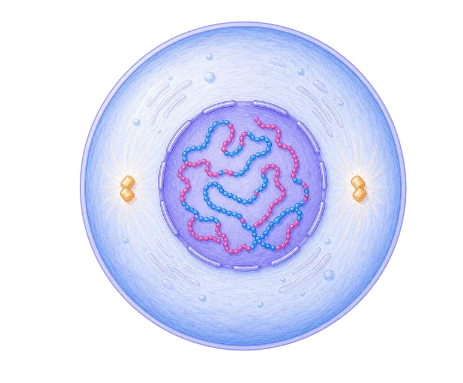
During interphase, the cell grows, performs its normal activities, copies its DNA, and prepares for division.
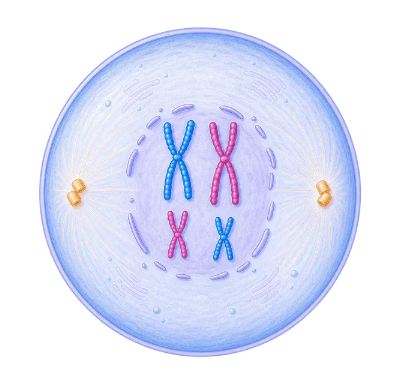
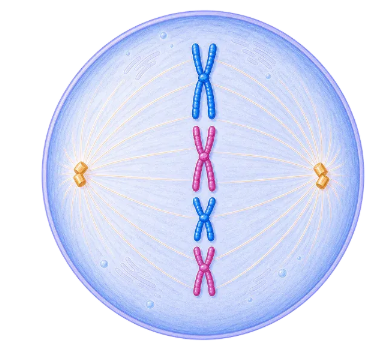
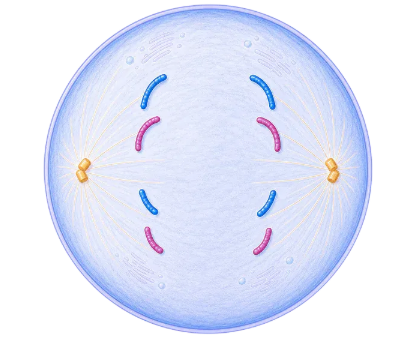
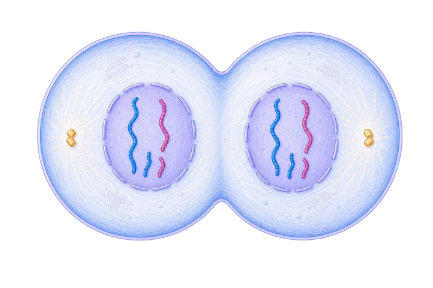
During mitosis, the copied chromosomes are separated into two nuclei.
During cytokinesis, the cytoplasm and cell membrane divide, producing two daughter cells.
The cycle can then begin again.
Why Do Cells Divide?
Cell division is necessary for several important biological processes.
These include:
- growth
- development
- repair
- replacement of old cells
- replacement of damaged cells
- asexual reproduction in some organisms
A multicellular organism begins as a single cell.
Repeated cell division increases the number of cells:
1 → 2 → 4 → 8 → 16 → 32 → ...
Eventually, millions or even trillions of cells can form.
The Main Stages of the Cell Cycle
The cell cycle can be summarized as:
Before cell division
Interphase
The cell grows, carries out normal activities, replicates its DNA, and prepares for division.
During nuclear division
Mitosis
The chromosomes are separated so that two nuclei form.
After nuclear division
Cytokinesis
The cytoplasm divides and two daughter cells are produced.
This process can be followed visually below.