Equations of Motion
1. Constant Velocity Equations
Learning outcomes
- I can describe motion at constant velocity.
- I can use the relationship between displacement, velocity, and time.
- I can calculate displacement, velocity, or time when motion occurs at constant velocity.
- I can identify situations where constant velocity equations are appropriate.
- I can solve simple motion problems involving constant velocity.
What is constant velocity?
An object moves at constant velocity when both its speed and direction remain unchanged.
During constant-velocity motion:
- The object travels through equal displacements in equal time intervals.
- Its velocity does not change.
- Its acceleration is zero.
- Its position changes at a constant rate.
For example, an object travelling east at 12 m/s has constant velocity only if it continues moving east at 12 m/s.
An object moving around a curved track at a constant speed does not have constant velocity because its direction changes.


A train travelling steadily along a straight section of track and a moving walkway operating at a fixed speed can be approximated as constant-velocity motion.
Constant velocity and zero acceleration
Acceleration is the rate at which velocity changes:
a = Δv / Δt
If velocity remains constant:
Δv = 0
Therefore:
a = 0 m/s²
Zero acceleration does not necessarily mean that an object is stationary. It can be moving at any constant velocity.
For example:
- A parked car has v = 0 m/s and a = 0 m/s².
- A train moving steadily east at 20 m/s has v = +20 m/s and a = 0 m/s².
- A cyclist moving steadily west at 5 m/s may have v = −5 m/s and a = 0 m/s².
All three objects have zero acceleration, but only the car is stationary.
Displacement, velocity and time
For constant velocity, the relationship between displacement, velocity and time is:
Displacement = velocity × time
Using symbols:
Δx = vΔt
The symbols represent:
- Δx = displacement, measured in metres, m.
- v = constant velocity, measured in metres per second, m/s.
- Δt = time interval, measured in seconds, s.
The Greek letter delta, Δ, means change in.
Therefore:
Δx = x − x₀
where:
- x₀ is the initial position.
- x is the final position.
The constant-velocity equation can also be written as:
x = x₀ + vΔt
If time begins at t = 0, it is often written:
x = x₀ + vt
This equation gives the object’s position at any time during the constant-velocity motion.
Distance and displacement
Distance and displacement are related but different.
- Distance is the total length of the path travelled.
- Displacement is the change in position, including direction.
Distance is a scalar and is never negative. Displacement is a vector and may be positive, negative or zero according to the chosen direction.
For motion at constant speed without changing direction:
Distance = speed × time
d = vt
For one-dimensional motion at constant velocity:
Displacement = velocity × time
Δx = vΔt
If an object changes direction, a single constant-velocity equation cannot describe the entire journey. Divide the journey into separate stages.
Choosing a positive direction
Before solving a velocity problem, choose a positive direction.
For example:
- East may be positive and west negative.
- Right may be positive and left negative.
- Up may be positive and down negative.
Once a direction is chosen, use it consistently.
Suppose east is positive:
- 8 m/s east becomes +8 m/s.
- 8 m/s west becomes −8 m/s.
A negative velocity describes motion in the negative direction. It does not mean that the object is moving slowly.
Rearranging the equation
Begin with:
Δx = vΔt
To find velocity:
v = Δx / Δt
To find time:
Δt = Δx / v
These equations can be remembered using the relationship:
| Quantity required | Equation |
|---|---|
| Displacement | Δx = vΔt |
| Velocity | v = Δx/Δt |
| Time | Δt = Δx/v |
For calculations involving speed and distance, use the same arrangement with scalar quantities:
d = vt
Worked example: calculating displacement
A cyclist travels east at a constant velocity of 6 m/s for 25 seconds. Calculate the displacement.
Choose east as positive.
Given:
v = +6 m/s
Δt = 25 s
Use:
Δx = vΔt
Substitute:
Δx = 6 × 25
Δx = 150 m
The cyclist’s displacement is 150 m east.
Worked example: calculating velocity
A robot moves 42 m to the left in 7 seconds at constant velocity. Calculate its velocity.
Choose right as positive. Left is therefore negative.
Given:
Δx = −42 m
Δt = 7 s
Use:
v = Δx / Δt
Substitute:
v = −42 / 7
v = −6 m/s
The robot’s velocity is 6 m/s to the left.
The negative sign communicates direction.
Worked example: calculating time
A conveyor belt moves packages at a constant speed of 1.5 m/s. How long does a package take to travel 12 m?
Given:
d = 12 m
v = 1.5 m/s
Use:
t = d/v
Substitute:
t = 12/1.5
t = 8 s
The package takes 8 seconds.


Conveyor belts are useful examples of approximately constant-speed motion. A real belt may accelerate briefly when starting and decelerate when stopping, so the equation applies to the steady part of its motion.
Calculating final position
The equation Δx = vΔt gives a change in position. If the initial position is not zero, add the displacement to the initial position:
x = x₀ + vΔt
Worked example
A cart begins at position x₀ = 5 m and moves right at a constant velocity of 3 m/s for 6 seconds.
Calculate its displacement:
Δx = vΔt
Δx = 3 × 6
Δx = 18 m
Calculate its final position:
x = x₀ + Δx
x = 5 + 18
x = 23 m
The cart travels 18 m and finishes at position 23 m.
These values are different because the cart did not begin at the origin.
Constant velocity on a position–time graph
A position–time graph for constant velocity is a straight line.
Its gradient gives velocity:
v = Δx / Δt
- A straight line with a positive gradient represents constant positive velocity.
- A horizontal line represents zero velocity.
- A straight line with a negative gradient represents constant negative velocity.
- A steeper line represents a greater velocity magnitude when the scales are the same.
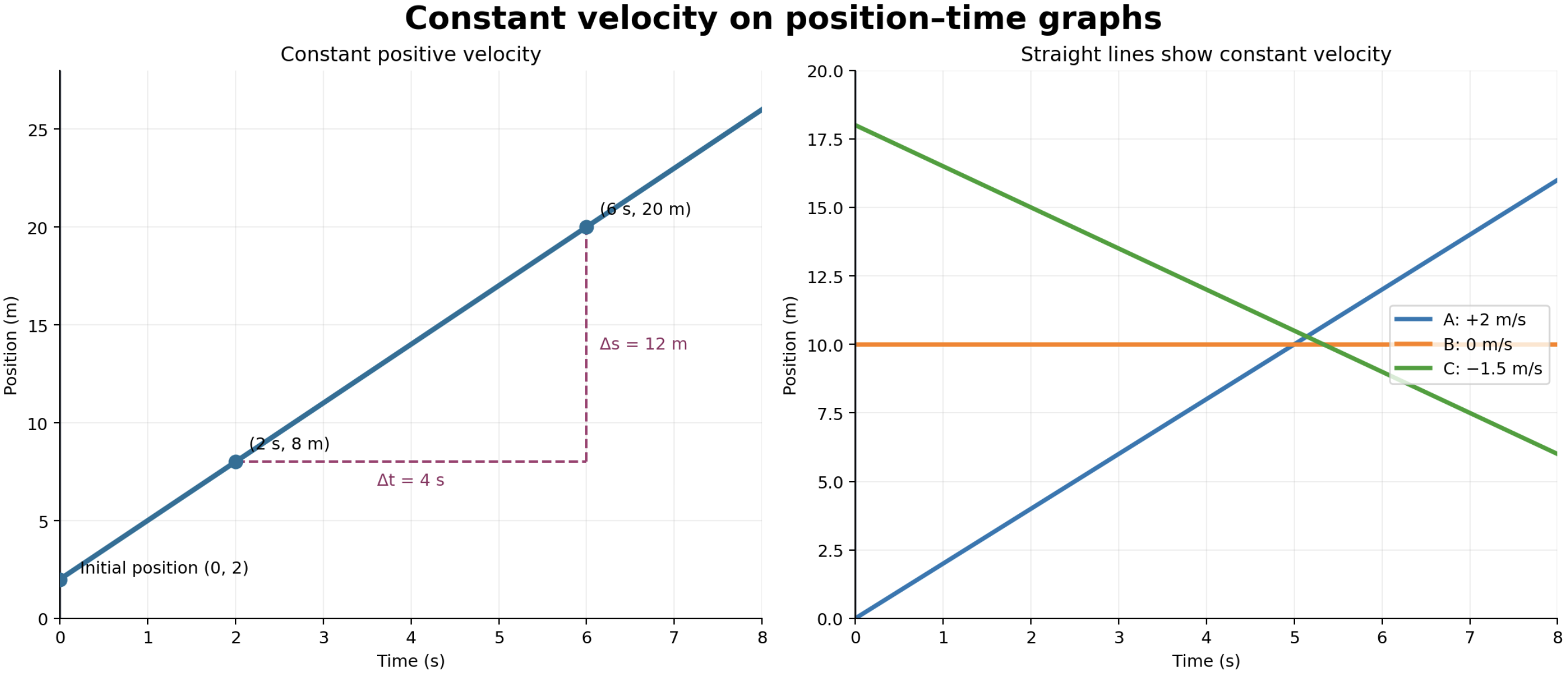
In the left graph, position changes from 8 m at 2 seconds to 20 m at 6 seconds.
The velocity is:
v = (20 − 8)/(6 − 2)
v = 12/4
v = 3 m/s
The line crosses the position axis at 2 m, so the object’s initial position is 2 m. Its equation is:
x = 2 + 3t
Interpreting the graph equation
A constant-velocity position equation has the same structure as the equation of a straight line:
x = x₀ + vt
Compare this with:
y = c + mx
In the motion equation:
- Position x is the dependent quantity.
- Time t is the independent quantity.
- Initial position x₀ is the vertical intercept.
- Velocity v is the gradient.
For example:
x = 4 + 2.5t
means:
- The object begins at position 4 m.
- It moves in the positive direction.
- Its constant velocity is 2.5 m/s.
- Its position increases by 2.5 m each second.
For:
x = 18 − 3t
the object begins at 18 m and moves in the negative direction at 3 m/s.
Constant velocity on a velocity–time graph
A constant velocity appears as a horizontal line on a velocity–time graph.
- A horizontal line above the axis represents constant positive velocity.
- A horizontal line on the axis represents rest.
- A horizontal line below the axis represents constant negative velocity.
The gradient of a horizontal line is zero, confirming that acceleration is zero.
The signed area under the velocity–time graph gives displacement.
For an object moving at +5 m/s for 8 seconds:
Δx = 5 × 8
Δx = 40 m
This is the area of a rectangle with height 5 m/s and width 8 s.
If the velocity were −5 m/s, the signed area and displacement would be −40 m.
Identifying when the equation is appropriate
The equation Δx = vΔt applies directly when velocity remains constant throughout the chosen interval.
Appropriate situations include:
- A conveyor belt moving steadily.
- A train travelling at a fixed velocity along a straight track.
- A person walking at a constant speed in one direction.
- A spacecraft coasting with approximately constant velocity.
- A vehicle during a short interval when its speed and direction do not change.
Evidence of constant velocity may include:
- A statement that velocity is constant.
- Equal displacements during equal time intervals.
- A straight line on a position–time graph.
- A horizontal line on a velocity–time graph.
- Zero acceleration throughout the interval.
When a constant-velocity equation is not appropriate
A single constant-velocity equation is not sufficient when:
- Speed increases or decreases.
- Direction changes.
- The position–time graph is curved.
- The velocity–time graph is sloped or curved.
- The acceleration is not zero.
- A journey contains stages with different velocities.
In these situations, divide the motion into suitable intervals or use an equation that accounts for acceleration.
A car journey may contain several constant-velocity stages, even if its velocity is not constant for the entire trip.
Worked example: a journey with two constant velocities
A delivery vehicle travels east at 12 m/s for 30 seconds. It then continues east at 8 m/s for 20 seconds.
The velocity is constant within each stage but changes between the stages.
First-stage displacement:
Δx₁ = 12 × 30
Δx₁ = 360 m
Second-stage displacement:
Δx₂ = 8 × 20
Δx₂ = 160 m
Total displacement:
Δx = 360 + 160
Δx = 520 m east
Total time:
Δt = 30 + 20
Δt = 50 s
Average velocity:
v_avg = 520/50
v_avg = 10.4 m/s east
The average velocity is not found by simply averaging 12 m/s and 8 m/s unless the time spent at each velocity is equal.
Worked example: motion in opposite directions
A student walks 60 m east at 2 m/s and then 20 m west at 1 m/s.
Choose east as positive.
First stage
Δx₁ = (+2)(30)
Δx₁ = +60 m
Second stage
The student travels west, so velocity is negative:
Δx₂ = (−1)(20)
Δx₂ = −20 m
Total displacement
Δx = +60 − 20
Δx = +40 m
The student finishes 40 m east of the starting point.
Total distance
Distance = 60 + 20
Distance = 80 m
Average velocity
Total time = 30 + 20 = 50 s
v_avg = 40/50
v_avg = +0.8 m/s
Average speed
Average speed = 80/50
Average speed = 1.6 m/s
This example requires two constant-velocity stages because the direction changes.
Worked example: finding when two objects meet
Two cyclists travel along the same straight path.
- Cyclist A starts at x = 0 m and travels at +5 m/s.
- Cyclist B starts at x = 30 m and travels in the same direction at +2 m/s.
Their position equations are:
xₐ = 5t
xᵦ = 30 + 2t
They meet when their positions are equal:
5t = 30 + 2t
3t = 30
t = 10 s
Their meeting position is:
x = 5(10)
x = 50 m
Cyclist A catches Cyclist B after 10 seconds at position 50 m.
A position–time graph would show two straight lines intersecting at the point (10 s, 50 m).
Relative velocity
When objects move along the same line, relative velocity describes how quickly one object’s position changes relative to the other.
For two objects A and B:
v relative = vₐ − vᵦ
In the cycling example:
v relative = 5 − 2
v relative = 3 m/s
Cyclist A closes the 30 m gap at 3 m/s:
t = 30/3
t = 10 s
If objects move towards each other, their closing speed is the sum of their speed magnitudes.
For example, two vehicles approach one another at 15 m/s and 10 m/s:
Closing speed = 15 + 10
Closing speed = 25 m/s
If they begin 200 m apart:
t = 200/25
t = 8 s
Converting units
Units must be compatible before using a motion equation.
Converting kilometres to metres
1 km = 1000 m
To convert kilometres to metres, multiply by 1000.
Converting hours to seconds
1 h = 3600 s
To convert hours to seconds, multiply by 3600.
Converting between km/h and m/s
To convert km/h to m/s:
Divide by 3.6
To convert m/s to km/h:
Multiply by 3.6
For example:
72 km/h ÷ 3.6 = 20 m/s
15 m/s × 3.6 = 54 km/h
Worked example involving unit conversion
A train moves at a constant speed of 90 km/h for 40 seconds. Calculate the distance travelled in metres.
Convert the speed:
v = 90/3.6
v = 25 m/s
Use:
d = vt
d = 25 × 40
d = 1000 m
The train travels 1000 m, or 1 km.
Applying constant velocity to light travel
Light travels through a vacuum at approximately:
c = 3.00 × 10⁸ m/s
For many basic problems, this speed is treated as constant.
Worked example
A signal travels 3.84 × 10⁸ m from Earth to the Moon. Calculate its travel time.
t = d/v
t = (3.84 × 10⁸)/(3.00 × 10⁸)
t = 1.28 s
Light takes approximately 1.28 seconds to travel from Earth to the Moon.


Constant-speed models are useful for light signals and spacecraft coasting over suitable intervals. Real motions may require more detailed models when gravity or propulsion changes the velocity significantly.
A reliable problem-solving method
Use this sequence for constant-velocity problems:
- Identify the known and unknown quantities.
- Decide whether the motion has constant speed or constant velocity.
- Choose a positive direction if direction matters.
- Convert all measurements into compatible units.
- Select the appropriate form of the equation.
- Substitute values with their signs and units.
- Calculate the answer.
- State the result with units and direction where required.
- Check whether the result is reasonable.
Checking whether an answer is reasonable
Check the units
For displacement:
(m/s) × s = m
For velocity:
m ÷ s = m/s
For time:
m ÷ (m/s) = s
Estimate the size
An object moving at 10 m/s for 5 seconds should travel about 50 m. An answer of 5000 m would suggest an error.
Check the direction
A negative displacement should agree with motion in the chosen negative direction.
Check the graph
Constant velocity should produce:
- A straight position–time graph.
- A horizontal velocity–time graph.
- A zero acceleration–time graph.
Substitute back
If an object travels 150 m at 6 m/s:
t = 150/6 = 25 s
Check:
6 × 25 = 150 m
Assumptions in constant-velocity models
Mathematical models simplify real motion. A constant-velocity model assumes:
- The object moves along a straight line.
- Its speed remains unchanged.
- Its direction remains unchanged.
- The time interval is measured accurately.
- Any brief starting or stopping stages are excluded or treated separately.
A real train may speed up, slow down and follow curved tracks. However, one steady section of its journey may still be modelled using constant velocity.
The model is useful when its assumptions are reasonable for the interval being studied.
Common misconceptions
- “Constant velocity means the object is stationary.” It can move steadily with zero acceleration.
- “Constant speed always means constant velocity.” Direction must also remain constant.
- “Distance and displacement are identical.” They are equal only in suitable one-direction motion.
- “A negative velocity means the object is slowing down.” It indicates motion in the chosen negative direction.
- “The initial position is always zero.” An object can begin anywhere relative to the origin.
- “Δx = vt applies to an entire changing-velocity journey.” Use separate stages or an acceleration model.
- “Average velocity is always the average of two velocities.” It is total displacement divided by total time.
- “A horizontal position–time graph represents constant non-zero velocity.” It represents zero velocity.
Did you know?
Constant velocity does not require zero forces. It requires zero resultant force.
For example, a car travelling steadily may have a forward driving force balanced by air resistance and friction. The forces cancel, so acceleration is zero and velocity remains constant.
Key terms
- Constant velocity: Motion with unchanged speed and direction.
- Displacement: Change in position, including direction.
- Distance: Total length of the path travelled.
- Velocity: Rate of change of displacement.
- Speed: Rate at which distance is travelled.
- Acceleration: Rate of change of velocity.
- Initial position: The object’s position at the beginning of an interval.
- Final position: The object’s position at the end of an interval.
- Time interval: The elapsed time between two events.
- Relative velocity: The velocity of one object compared with another.
- Model: A simplified mathematical description of a real situation.
Key takeaways
- Constant velocity requires constant speed and constant direction.
- An object moving at constant velocity has zero acceleration.
- Use Δx = vΔt for constant-velocity motion.
- Use x = x₀ + vΔt when the initial position is known.
- Direction can be represented using positive and negative signs.
- A straight position–time graph represents constant velocity.
- A horizontal velocity–time graph represents constant velocity.
- Divide journeys into stages when velocity changes.
- Check units, signs, assumptions and physical reasonableness.