Atomic Energy Levels and Transitions
1. Quantized Energy Levels
Learning Outcomes
- I can explain what is meant by quantized energy.
- I can distinguish between ground states and excited states.
- I can interpret atomic energy level diagrams.
- I can explain why electrons cannot exist between energy levels.
- I can describe how electrons move between energy levels.
- Spectral lines and their significance
- Energy transitions in atoms
The Relationship Between Atomic Spectra and Energy Levels 🔬🌈
Atomic spectra provide direct evidence of quantized energy levels in atoms. When electrons transition between energy levels, they absorb or emit specific wavelengths of light, producing unique spectral lines. Let’s break it down! 🔍✨
1. Energy Levels in Atoms ⚛️
📌 Electrons in an atom exist in discrete energy levels (or shells).
- Each energy level is labeled (called quantum numbers).
- Lower energy levels () are closer to the nucleus.
- Higher energy levels () are farther from the nucleus and require more energy.
🔹 Key Concept:
- Electrons cannot exist between levels → Energy is quantized, not continuous.
- Moving to a higher level requires energy absorption.
- Dropping to a lower level releases energy as light (photon emission).
2. Atomic Spectra and Electron Transitions 🌈
When electrons jump between energy levels, they absorb or emit specific amounts of energy, corresponding to specific wavelengths of light.
1️⃣ Absorption Spectrum 📥
- When an electron absorbs energy (from light, heat, or electricity), it jumps to a higher level.
- This removes specific wavelengths from white light → Dark lines appear in the spectrum.
- Example: Sunlight passing through the atmosphere shows absorption lines due to elements in space.
2️⃣ Emission Spectrum 📤
- When an electron falls back to a lower level, it emits energy as a photon.
- This produces bright spectral lines at specific wavelengths.
- Example: Neon signs and fireworks glow with distinct colors due to emission spectra.
📌 Each element has a unique spectral fingerprint because electron energy levels vary for different atoms.
3. The Energy-Wavelength Relationship 📡
The energy of emitted or absorbed light is related to its wavelength by:
where:
✅
= Energy of the photon (Joules)
✅
= Planck’s constant (
J·s)
✅
= Frequency of light (Hz)
✅
= Speed of light (
m/s)
✅
= Wavelength of emitted/absorbed light (meters)
📌 Shorter wavelengths (blue/violet light) correspond to higher energy transitions.
📌 Longer wavelengths (red light) correspond to lower energy transitions.
4. Example: The Hydrogen Spectrum 🏛️
Hydrogen has four main spectral lines in the visible range:
- Red (656 nm) → Transition from to
- Blue-green (486 nm) → Transition from to
- Blue (434 nm) → Transition from to
- Violet (410 nm) → Transition from to
📌 **These lines are part of the Balmer series, which describes visible light emissions from hydrogen.
5. Real-World Applications 🌍
✅ Astronomy 🔭 – Spectra reveal element compositions of stars and galaxies.
✅ Quantum Mechanics ⚛️ – Supports the quantum theory of discrete energy levels.
✅ Forensics & Chemistry 🧪 – Spectroscopy identifies unknown substances.
✅ Lasers & LEDs 💡 – Depend on controlled electron transitions for precise light emission.
📊 Atomic spectra are fundamental to understanding the quantum nature of atoms and the universe! 🚀✨
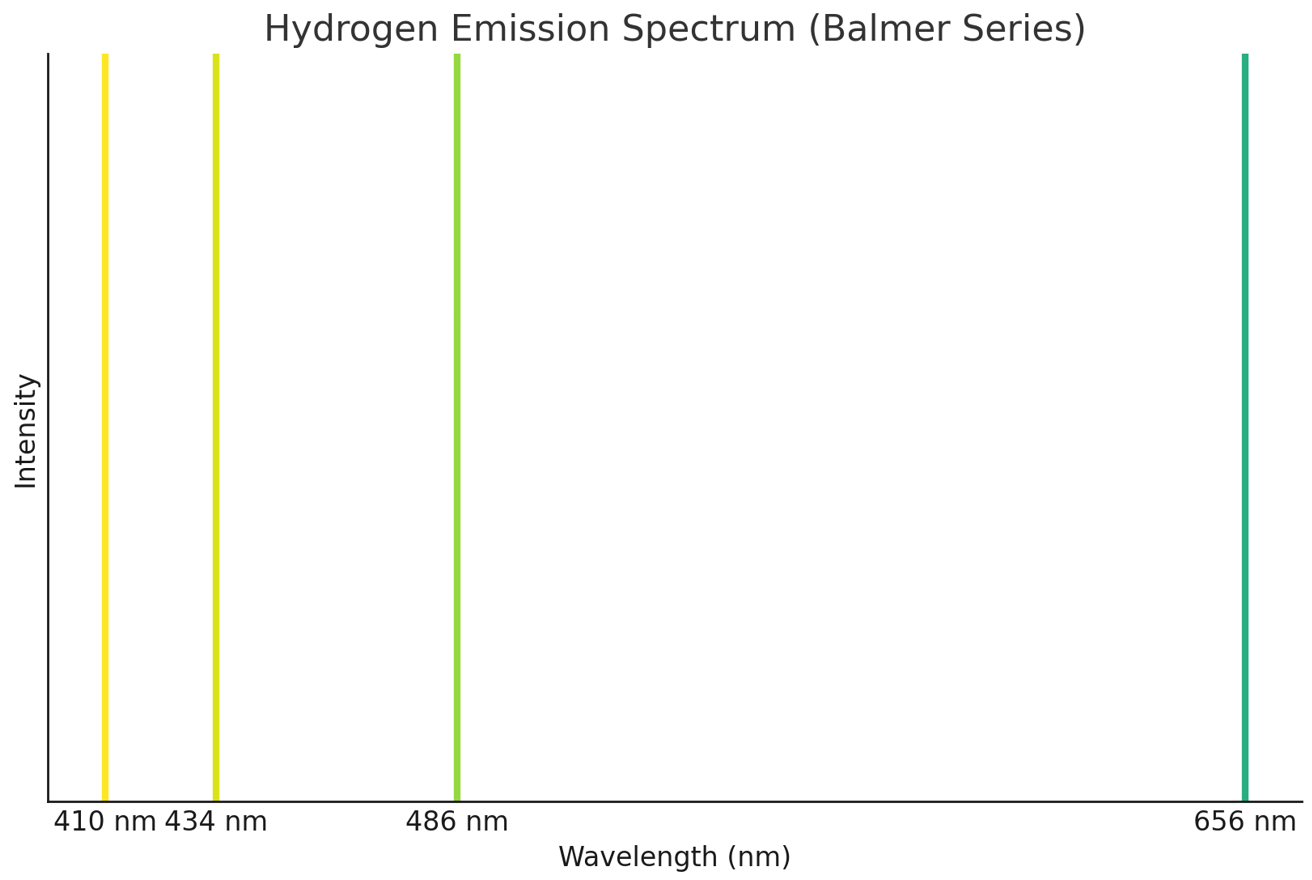
Hydrogen Emission Spectrum (Balmer Series) 🌈⚛️
This graph visually represents the atomic emission spectrum of hydrogen, showing the Balmer series of spectral lines. Let’s analyze it! 🔍✨
1. Understanding the Graph 📊
Each vertical line represents a photon emitted when an electron moves from a higher energy level to
in a hydrogen atom.
✅ 656 nm (Red Line) → Electron falls from
to
.
✅ 486 nm (Blue-Green Line) → Electron falls from
to
.
✅ 434 nm (Blue Line) → Electron falls from
to
.
✅ 410 nm (Violet Line) → Electron falls from
to
.
📌 Key Insight: Higher energy transitions correspond to shorter wavelengths (more energy), shifting toward blue/violet light.
2. Why Are These Spectral Lines Important? 🌍
✅ Astronomy 🔭 – Identifies elements in stars and distant galaxies.
✅ Quantum Mechanics ⚛️ – Proves electrons exist in quantized energy levels.
✅ Forensics & Chemistry 🧪 – Spectroscopy is used to detect unknown substances.
✅ Lasers & LEDs 💡 – Controlled emission of photons enables modern technology.
📊 Atomic spectra provide a "fingerprint" for each element, helping us explore the universe! 🚀✨
Activities:
- Experiment: Observing spectra using a spectrometer
- Group discussion on spectra of common elements
Assessment:
- Lab report on observed spectra and energy levels