Atomic Energy Levels and Transitions
| サイト: | Young Education |
| コース: | Structure of the Atom and Quantum Physics |
| ブック: | Atomic Energy Levels and Transitions |
| 印刷者: | ゲストユーザ |
| 日付: | 2026年 09月 25日(金曜日) 01:01 |
1. Quantized Energy Levels
Learning Outcomes
- I can explain what is meant by quantized energy.
- I can distinguish between ground states and excited states.
- I can interpret atomic energy level diagrams.
- I can explain why electrons cannot exist between energy levels.
- I can describe how electrons move between energy levels.
- Spectral lines and their significance
- Energy transitions in atoms
The Relationship Between Atomic Spectra and Energy Levels 🔬🌈
Atomic spectra provide direct evidence of quantized energy levels in atoms. When electrons transition between energy levels, they absorb or emit specific wavelengths of light, producing unique spectral lines. Let’s break it down! 🔍✨
1. Energy Levels in Atoms ⚛️
📌 Electrons in an atom exist in discrete energy levels (or shells).
- Each energy level is labeled (called quantum numbers).
- Lower energy levels () are closer to the nucleus.
- Higher energy levels () are farther from the nucleus and require more energy.
🔹 Key Concept:
- Electrons cannot exist between levels → Energy is quantized, not continuous.
- Moving to a higher level requires energy absorption.
- Dropping to a lower level releases energy as light (photon emission).
2. Atomic Spectra and Electron Transitions 🌈
When electrons jump between energy levels, they absorb or emit specific amounts of energy, corresponding to specific wavelengths of light.
1️⃣ Absorption Spectrum 📥
- When an electron absorbs energy (from light, heat, or electricity), it jumps to a higher level.
- This removes specific wavelengths from white light → Dark lines appear in the spectrum.
- Example: Sunlight passing through the atmosphere shows absorption lines due to elements in space.
2️⃣ Emission Spectrum 📤
- When an electron falls back to a lower level, it emits energy as a photon.
- This produces bright spectral lines at specific wavelengths.
- Example: Neon signs and fireworks glow with distinct colors due to emission spectra.
📌 Each element has a unique spectral fingerprint because electron energy levels vary for different atoms.
3. The Energy-Wavelength Relationship 📡
The energy of emitted or absorbed light is related to its wavelength by:
where:
✅
= Energy of the photon (Joules)
✅
= Planck’s constant (
J·s)
✅
= Frequency of light (Hz)
✅
= Speed of light (
m/s)
✅
= Wavelength of emitted/absorbed light (meters)
📌 Shorter wavelengths (blue/violet light) correspond to higher energy transitions.
📌 Longer wavelengths (red light) correspond to lower energy transitions.
4. Example: The Hydrogen Spectrum 🏛️
Hydrogen has four main spectral lines in the visible range:
- Red (656 nm) → Transition from to
- Blue-green (486 nm) → Transition from to
- Blue (434 nm) → Transition from to
- Violet (410 nm) → Transition from to
📌 **These lines are part of the Balmer series, which describes visible light emissions from hydrogen.
5. Real-World Applications 🌍
✅ Astronomy 🔭 – Spectra reveal element compositions of stars and galaxies.
✅ Quantum Mechanics ⚛️ – Supports the quantum theory of discrete energy levels.
✅ Forensics & Chemistry 🧪 – Spectroscopy identifies unknown substances.
✅ Lasers & LEDs 💡 – Depend on controlled electron transitions for precise light emission.
📊 Atomic spectra are fundamental to understanding the quantum nature of atoms and the universe! 🚀✨
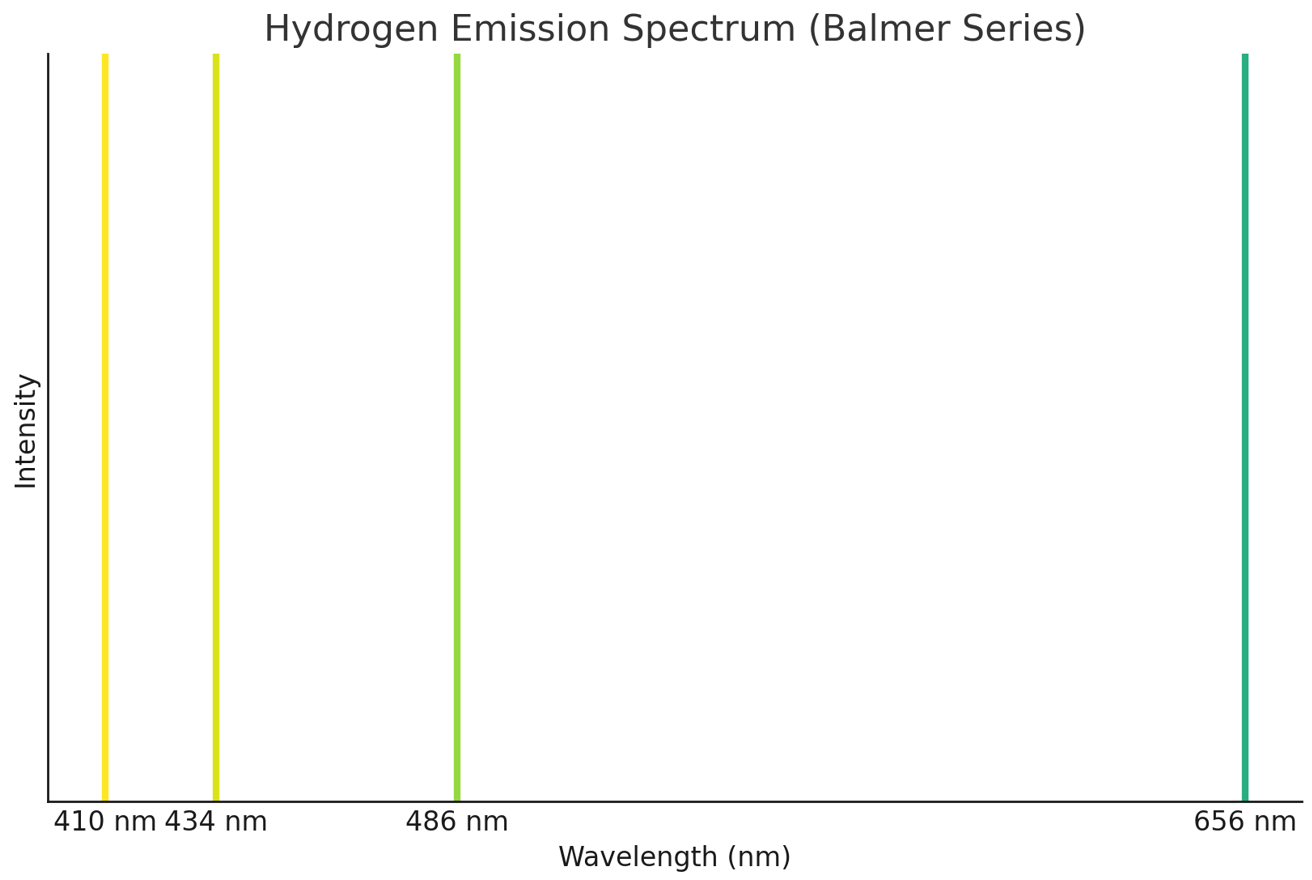
Hydrogen Emission Spectrum (Balmer Series) 🌈⚛️
This graph visually represents the atomic emission spectrum of hydrogen, showing the Balmer series of spectral lines. Let’s analyze it! 🔍✨
1. Understanding the Graph 📊
Each vertical line represents a photon emitted when an electron moves from a higher energy level to
in a hydrogen atom.
✅ 656 nm (Red Line) → Electron falls from
to
.
✅ 486 nm (Blue-Green Line) → Electron falls from
to
.
✅ 434 nm (Blue Line) → Electron falls from
to
.
✅ 410 nm (Violet Line) → Electron falls from
to
.
📌 Key Insight: Higher energy transitions correspond to shorter wavelengths (more energy), shifting toward blue/violet light.
2. Why Are These Spectral Lines Important? 🌍
✅ Astronomy 🔭 – Identifies elements in stars and distant galaxies.
✅ Quantum Mechanics ⚛️ – Proves electrons exist in quantized energy levels.
✅ Forensics & Chemistry 🧪 – Spectroscopy is used to detect unknown substances.
✅ Lasers & LEDs 💡 – Controlled emission of photons enables modern technology.
📊 Atomic spectra provide a "fingerprint" for each element, helping us explore the universe! 🚀✨
Activities:
- Experiment: Observing spectra using a spectrometer
- Group discussion on spectra of common elements
Assessment:
- Lab report on observed spectra and energy levels
2. Emission Spectra
Learning Outcomes
- I can explain how emission spectra are produced.
- I can identify the characteristics of line spectra.
- I can describe the hydrogen emission spectrum.
- I can explain why different elements have unique spectra.
- I can use spectra to identify elements.
- Bohr’s model of the atom
- Energy level diagrams
Quantization of Atomic Energy Levels ⚛️🔢
The concept of quantized energy levels is a fundamental principle of quantum mechanics. It explains why electrons in an atom can only occupy specific energy states and why atoms emit or absorb discrete spectral lines. Let’s explore this in depth! 🔍✨
1. What Does "Quantization" Mean? 📌
🔹 In classical physics, energy is continuous—an object can have any amount of energy.
🔹 In quantum mechanics, atomic energy levels are discrete (quantized)—electrons cannot exist between energy levels.
📌 Key Concept:
- Electrons in atoms can only occupy specific energy states ().
- They cannot have energy values in between these states.
- Electrons move between these levels by absorbing or emitting photons of exact energy.
🔹 Analogy: Imagine climbing a ladder. You can stand on specific steps, but you cannot hover between them—this is how electron energy levels work! 🔢
2. The Energy Levels of Hydrogen ⚛️
The allowed energy levels of a hydrogen atom are given by the Bohr Model equation:
where:
✅
= Energy of the electron in level
(electron volts, eV).
✅
= Principal quantum number (
).
✅
eV = Energy required to ionize hydrogen (ground state energy).
📌 Key Observations:
- The ground state () has the lowest energy ( eV).
- Higher energy levels () are less negative, meaning electrons are less bound to the nucleus.
- Energy gaps get smaller as increases.
🔹 Example: An electron in hydrogen can move from
to
, but it cannot exist at
!
3. Electron Transitions & Photon Emission 🌈
1️⃣ Absorption: Moving to a Higher Level 📥
- Electrons absorb energy (photon) to jump to a higher energy level.
- The photon must have exactly the right energy ().
- Example: An electron in hydrogen absorbs a 10.2 eV photon to jump from to.
2️⃣ Emission: Falling to a Lower Level 📤
- Electrons release energy as photons when they move to lower energy levels.
- The emitted photon’s energy matches the difference between energy levels.
- Example: A hydrogen electron drops from to, emitting a red photon (656 nm, Balmer series).
📌 Key Insight:
- Different elements have unique energy levels, leading to distinct atomic spectra.
4. Quantum Mechanics & Energy Quantization 🔬
1️⃣ The Bohr Model ⚛️
- Proposed by Niels Bohr, this model introduced quantized orbits.
- Explained hydrogen’s emission spectrum but failed for multi-electron atoms.
2️⃣ The Quantum Mechanical Model 🌌
- Modern quantum theory describes electrons as wavefunctions (not orbits).
- Energy levels are quantized due to the wave nature of electrons (Schrödinger Equation).
- Electrons exist in orbitals (probability regions) rather than fixed paths.
📌 Key Takeaway: Quantization arises because electron waves must fit perfectly within orbitals—just like a guitar string only vibrates at certain frequencies! 🎸
5. Real-World Applications 🌍
✅ Astronomy 🔭 – Identifying elements in stars using spectral lines.
✅ Lasers & LEDs 💡 – Controlled photon emissions power modern technology.
✅ Quantum Computing 🖥️ – Uses quantized energy levels for data processing.
✅ Medical Imaging 🏥 – MRI scans rely on atomic energy transitions.
📊 Understanding quantized energy levels helps us explore the universe and develop cutting-edge technology! 🚀✨
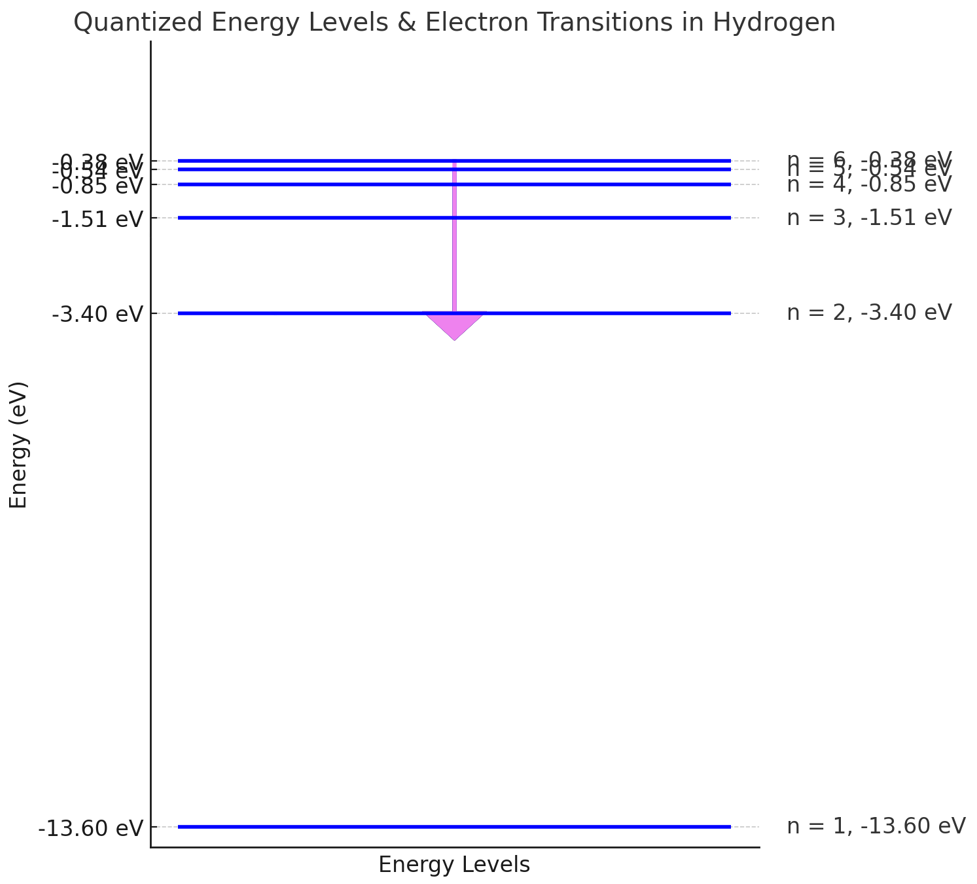
Visual Representation of Quantized Energy Levels & Electron Transitions ⚛️🌈
This diagram shows the discrete (quantized) energy levels of the hydrogen atom and how electrons transition between them. Let’s analyze it! 🔍✨
1. Understanding the Diagram 📊
🔹 Blue horizontal lines represent energy levels where electrons can exist:
- (Ground State): eV (Lowest energy, most stable).
- (Excited States): Higher energy, less stable.
🔹 Colored arrows show electron transitions:
- Electrons fall from higher levels (n = 3,4,5,6) to → Balmer series (visible spectrum).
- Different transitions emit different colors of light (red, green, blue, violet).
📌 Key Concept:
- Larger jumps = More energy emitted (shorter wavelength, higher frequency).
- Smaller jumps = Less energy emitted (longer wavelength, lower frequency).
2. Key Takeaways About Energy Quantization 📌
✅ Electrons can only occupy specific energy levels (no in-between states).
✅ Absorbing a photon moves an electron up; emitting a photon moves it down.
✅ Each transition corresponds to a specific photon energy (color of light).
3. Real-World Applications 🌍
✅ Astronomy 🔭 – Identifying star compositions from spectral lines.
✅ Quantum Mechanics ⚛️ – Explains why atoms absorb/emit specific energies.
✅ Lasers & Electronics 💡 – Utilize electron transitions for light emission.
📊 Understanding quantized energy levels allows us to explore the universe and power modern technology! 🚀✨
Activities:
- Problem-solving on energy level transitions
- Diagramming the energy levels of hydrogen
Assessment:
- Short quiz on Bohr’s model and quantization
Quantization of Atomic Energy Levels
The concept of energy quantization in atoms stems from the understanding that electrons cannot occupy arbitrary energy states but are instead restricted to specific, discrete energy levels. This idea was first proposed by Niels Bohr in 1913 as part of his atomic model, which addressed limitations in classical physics. Bohr suggested that electrons orbit the nucleus in distinct energy states and can only transition between these levels by absorbing or emitting a quantum of energy, typically in the form of a photon.
Discrete Energy Levels
In an atom, the energy of an electron depends on its distance from the nucleus. The closer an electron is to the nucleus, the lower its energy due to the attractive electrostatic force between the negatively charged electron and the positively charged nucleus. Bohr’s model introduced the idea that only certain orbits, corresponding to specific energy levels, are allowed. These energy levels are quantized, meaning that their values are discrete rather than continuous.
For the hydrogen atom, the energy of each level is given by the formula:
where
is the principal quantum number (an integer:
). The negative sign indicates that the electron is bound to the nucleus, with lower values of
corresponding to more tightly bound states.
Absorption and Emission of Photons
When an electron transitions from one energy level to another, it must absorb or emit energy equal to the difference between the two levels. If the electron jumps to a higher energy level, it absorbs a photon, and if it falls to a lower level, it emits a photon. The energy of the photon is given by:
This principle explains the discrete spectral lines observed in atomic emission and absorption spectra, such as the Balmer series for hydrogen. Each line corresponds to a specific electron transition between quantized energy levels.
Quantum Mechanics and Wave Functions
The development of quantum mechanics further refined the understanding of atomic energy levels. Instead of classical orbits, electrons are described by wave functions, which represent the probability of finding an electron in a given region of space. The solutions to the Schrödinger equation for an atom reveal that only certain energy states are allowed, corresponding to specific wave functions. These states are characterized by quantum numbers, which determine properties like energy, angular momentum, and spin.
Sublevels and Orbitals
In multi-electron atoms, energy levels are divided into sublevels (or subshells), which are further split into orbitals. The principal quantum number
defines the main energy level, while the azimuthal quantum number
defines the sublevel (e.g.,
,
,
,
). Each sublevel has a unique shape and can hold a specific number of electrons. These sublevels introduce additional complexity but still adhere to the principle of quantization.
Pauli Exclusion Principle and Electron Configuration
The Pauli exclusion principle states that no two electrons in an atom can have the same set of quantum numbers. This principle helps explain how electrons fill energy levels and sublevels in a specific order, following the Aufbau principle. The quantized nature of these levels ensures that each element has a unique electron configuration, which determines its chemical and physical properties.
Applications of Quantization
The quantization of energy levels has profound implications for fields such as spectroscopy, quantum chemistry, and laser technology. By analyzing the spectral lines emitted or absorbed by atoms, scientists can identify elements, measure temperatures, and study the composition of distant stars. Additionally, the principles of energy quantization underlie technologies like LEDs and quantum computing.
Conclusion
The quantization of atomic energy levels provides a foundational framework for modern atomic theory and quantum mechanics. It explains the discrete nature of atomic spectra, governs electron behavior in atoms, and underpins much of our understanding of matter at the microscopic level. This concept not only resolved the shortcomings of classical physics but also paved the way for groundbreaking advancements in science and technology.
3. Absorption Spectra
Learning Outcomes
- I can explain how absorption spectra are formed.
- I can compare emission and absorption spectra.
- I can describe the role of electron transitions in absorption.
- I can explain how absorption spectra are used in astronomy.
- I can interpret simple absorption spectra.
- Energy absorption and emission
- Selection rules for transitions
Analyzing Transitions Between Atomic Energy Levels: Energy Absorption & Emission ⚛️🌈
Atomic energy transitions involve electrons moving between quantized energy levels by absorbing or emitting photons. These transitions obey selection rules based on quantum mechanics. Let’s explore this in detail! 🔍✨
1. Energy Absorption vs. Emission 📥📤
🔹 Absorption (Energy Gain) 📥
- An electron absorbs a photon to jump to a higher energy level.
- The photon’s energy must exactly match the energy gap between levels.
- Example: A hydrogen electron absorbs a 10.2 eV photon to move from to.
🔹 Emission (Energy Release) 📤
- An electron falls to a lower energy level, releasing energy as a photon.
- The photon’s wavelength and frequency depend on the energy difference between levels.
- Example: An electron falling from to emits a red photon (656 nm, Balmer series).
📌 Key Concept: Larger energy jumps correspond to higher frequency (shorter wavelength) photons!
2. Energy-Wavelength Relationship 🌡️
The energy of the photon emitted/absorbed follows:
where:
✅
= Energy of the photon (Joules or eV).
✅
= Planck’s constant (
J·s).
✅
= Frequency of light (Hz).
✅
= Speed of light (
m/s).
✅
= Wavelength of emitted/absorbed light (meters).
📌 Smaller jumps emit/absorb lower-energy (red/infrared) photons.
📌 Larger jumps emit/absorb higher-energy (violet/UV) photons.
3. Selection Rules for Atomic Transitions 📏
Quantum mechanics imposes selection rules on allowed transitions between energy levels:
1️⃣ The Principal Quantum Number Rule (Δn ≠ 0) 🔢
- Electrons must change energy levels ( must change).
- Example: Allowed,.
- Forbidden: An electron cannot stay in the same energy level ( is impossible).
2️⃣ The Angular Momentum Rule (Δl = ±1) 🔄
- The electron’s angular momentum quantum number must change by 1 ().
- Example: Allowed:,.
- Forbidden:,,.
3️⃣ The Magnetic Quantum Number Rule (Δm = 0, ±1) 🧲
- The magnetic quantum number can change by 0 or ±1.
- This determines how the transition interacts with external magnetic fields.
📌 Key Takeaway: Not all electron transitions are possible—quantum selection rules dictate which transitions occur!
4. Real-World Applications 🌍
✅ Astronomy 🔭 – Identifies elements in stars via spectral absorption/emission lines.
✅ Lasers & LEDs 💡 – Controlled electron transitions produce light for communications & displays.
✅ Quantum Computing 🖥️ – Relies on precise energy level transitions for data processing.
✅ Medical Imaging 🏥 – X-ray absorption spectroscopy helps in diagnostics.
📊 Electron transitions shape the way we understand light, matter, and the universe! 🚀✨
Activities:
- Class discussion on real-world examples (e.g., neon lights)
- Numerical problems on transition energies
Assessment:
- Homework on atomic transition calculations
4. Photons and Light Energy
Learning Outcomes
- I can describe light as packets of energy called photons.
- I can explain the relationship between frequency, wavelength, and energy.
- I can use Planck's constant in calculations.
- I can calculate photon energies.
- I can explain how photons interact with atoms.
- Bohr’s angular momentum quantization
- Applications to atomic orbitals
Quantization of Angular Momentum in Atomic Systems ⚛️🔄
In quantum mechanics, angular momentum is quantized, meaning it can only take specific discrete values. This concept explains why electrons exist in fixed energy levels and orbitals rather than in a continuous range of positions. Let’s explore this fundamental principle! 🔍✨
1. What is Angular Momentum? 🔄
Angular momentum (
) describes rotational motion, and in atomic systems, it refers to the motion of electrons around the nucleus.
📌 In classical physics:
- Angular momentum is continuous; an object can have any value of.
📌 In quantum mechanics:
- Only specific values of angular momentum are allowed → Quantization occurs!
2. Quantization of Orbital Angular Momentum ⚛️
The Bohr Model and later Schrödinger’s Quantum Mechanics showed that electron orbits have quantized angular momentum, given by:
where:
✅
= Orbital angular momentum (kg·m²/s).
✅
= Reduced Planck’s constant (
=
J·s).
✅
= Azimuthal quantum number (also called orbital quantum number).
📌 Key Observations:
- The orbital quantum number determines subshells (s, p, d, f).
- can only take integer values:.
🔹 Example for Hydrogen (
):
- Possible values: 0, 1, 2 → (3s, 3p, 3d orbitals).
- Corresponding angular momentum values:
- (s-orbital) →
- (p-orbital) →
- (d-orbital) →
📌 Key Takeaway: Electrons can only have specific angular momentum values—never in between!
3. Quantization of Magnetic Angular Momentum 🧲
Angular momentum also has a z-component (projection along an axis), given by:
where:
✅
= Magnetic quantum number (
).
✅
= Component of angular momentum along a chosen axis (e.g., z-axis).
🔹 Example for
(d-orbital):
- Possible values:.
- Corresponding values:
- .
📌 Key Insight: The z-component is also quantized—electrons cannot have arbitrary orientations!
4. Spin Angular Momentum 🌀
Electrons also have intrinsic angular momentum, called spin (
):
where:
✅
= Spin quantum number (always 1/2 for electrons).
✅ Possible spin states:
→ "Spin up" or "Spin down."
📌 Key Concept: Unlike orbital angular momentum, spin does not come from motion in space—it is an intrinsic property of electrons.
5. Real-World Applications 🌍
✅ Quantum Mechanics ⚛️ – Explains atomic structure and chemical bonding.
✅ MRI Scanners 🏥 – Use spin angular momentum for medical imaging.
✅ Particle Physics 🔬 – Spin and angular momentum are fundamental in particle interactions.
✅ Semiconductor Technology 💾 – Quantum mechanics of angular momentum enables transistors and quantum computing.
📊 The quantization of angular momentum is a cornerstone of modern physics and quantum mechanics! 🚀✨
Activities:
- Deriving angular momentum formulas
- Solving numerical problems on angular momentum
Assessment:
- Problem set on quantized angular momentum
Quantization of Angular Momentum in Atomic Systems
The quantization of angular momentum is a fundamental concept in quantum mechanics and plays a crucial role in understanding atomic systems. In classical physics, angular momentum is a continuous variable, but in quantum systems, it can only take on discrete (quantized) values. This idea emerged from Niels Bohr's model of the atom and was later refined by the development of quantum mechanics.
Bohr's Model and Quantized Orbits
In Bohr's atomic model, electrons revolve around the nucleus in specific, quantized orbits. Bohr proposed that the angular momentum of an electron in these orbits is restricted to discrete values, given by:
where
is the angular momentum,
is the principal quantum number (a positive integer), and
is the reduced Planck constant (
). This quantization condition explained why electrons do not spiral into the nucleus and why atoms emit or absorb energy only at certain frequencies, producing discrete spectral lines.
Quantum Mechanical Refinement
The quantum mechanical model, based on Schrödinger's equation and wave mechanics, introduced a more detailed description of angular momentum. Angular momentum in atomic systems is described by two quantum numbers:
- Orbital angular momentum quantum number (): Determines the magnitude of the angular momentum.
- Magnetic quantum number (): Determines the orientation of the angular momentum.
The magnitude of orbital angular momentum is quantized and given by:
where
can take values from
to
for a given principal quantum number
.
Quantization of Angular Momentum Components
In addition to the magnitude, the components of angular momentum along a chosen axis (usually the
-axis) are also quantized. The
-component of angular momentum,
, is given by:
where
is the magnetic quantum number and can take values ranging from
to
in integer steps. This means that the orientation of angular momentum is restricted to specific directions, a phenomenon known as space quantization.
Spin Angular Momentum
Electrons also possess intrinsic angular momentum, called spin, which is independent of their orbital motion. Spin is characterized by the spin quantum number (
), which for electrons is always
. The spin angular momentum magnitude is given by:
and its component along the
-axis is:
where
is the spin magnetic quantum number and can be
or
. The combination of orbital and spin angular momentum explains the fine structure observed in atomic spectra.
Total Angular Momentum
In many cases, the total angular momentum of an electron is a combination of its orbital and spin angular momentum. This total angular momentum is described by the quantum number
, where:
The possible values of
range from
to
in integer steps. The quantization of total angular momentum further refines our understanding of atomic energy levels and is critical in explaining phenomena like the Zeeman effect and fine spectral splitting.
Physical Implications of Quantization
The quantization of angular momentum has profound implications for the structure and behavior of atoms. It explains why electrons occupy specific orbitals and why atoms have characteristic shapes and sizes. Additionally, it underpins the Pauli exclusion principle, which states that no two electrons in an atom can have the same set of quantum numbers, thereby dictating the structure of the periodic table.
Applications of Angular Momentum Quantization
Quantized angular momentum is essential in various fields, from atomic and molecular spectroscopy to quantum chemistry and astrophysics. It helps explain the behavior of electrons in magnetic fields (e.g., the Zeeman effect), the splitting of spectral lines, and the stability of atomic structures. Moreover, the concept is foundational in technologies such as magnetic resonance imaging (MRI) and quantum computing.
Conclusion
The quantization of angular momentum is a cornerstone of quantum mechanics, providing a framework for understanding the behavior of electrons in atoms. It not only resolves classical paradoxes but also offers profound insights into the structure and dynamics of matter at the quantum level, influencing both theoretical advancements and practical applications in science and technology.
5. Atomic Transitions
Learning Outcomes
- I can describe how electrons absorb energy.
- I can explain how excited electrons return to lower energy states.
- I can relate electron transitions to emitted photons.
- I can calculate energy changes during transitions.
- I can explain atomic transitions using energy level diagrams.
- Einstein’s explanation of the photoelectric effect
- Work function and threshold frequency
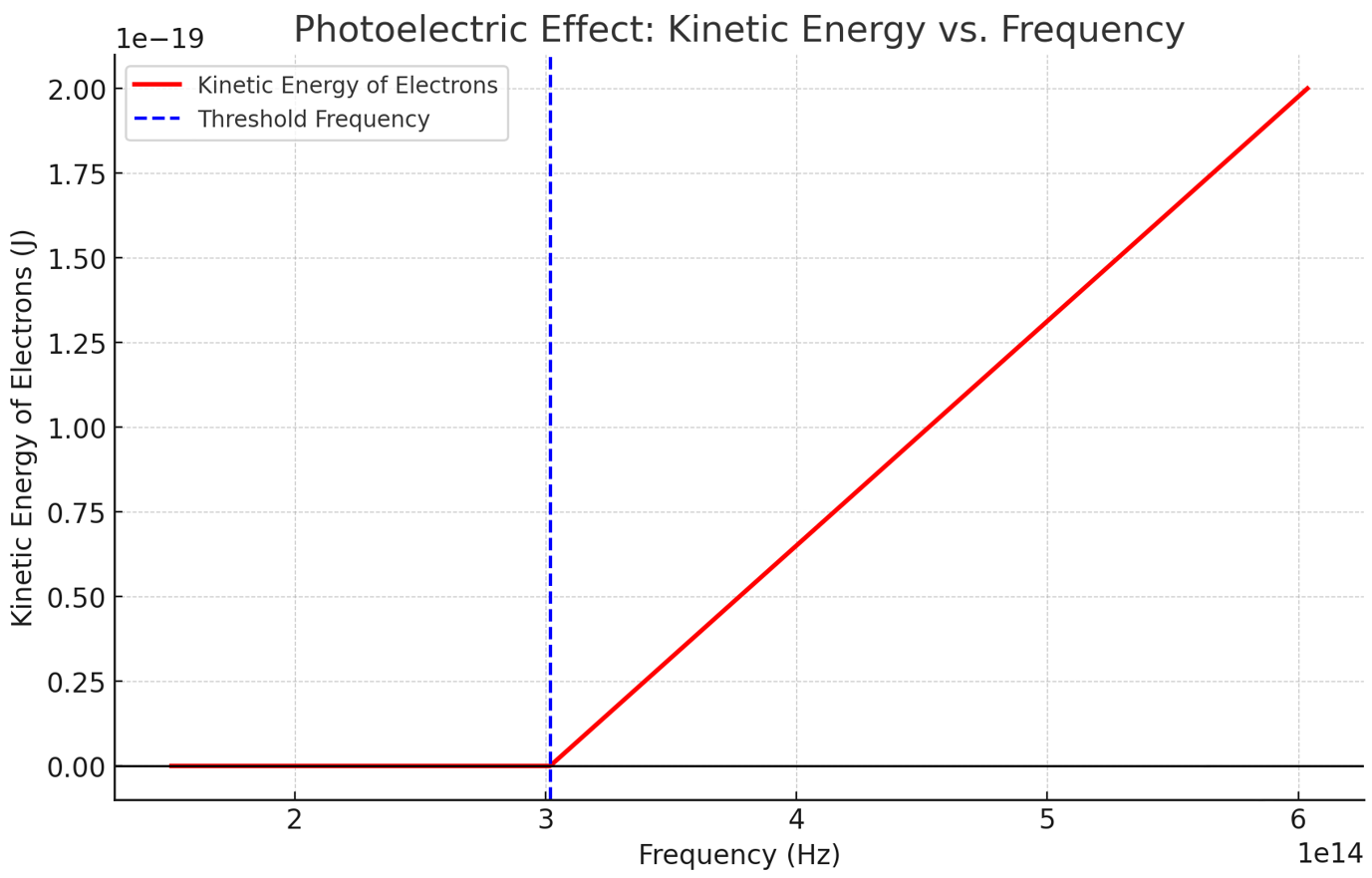
Experimental Evidence for Light’s Particle-Like Behavior: The Photoelectric Effect ⚛️🔆
Einstein’s photoelectric effect experiment provided definitive evidence that light behaves as particles (photons) rather than just waves. Let’s explore the details! 🔍✨
1. The Photoelectric Effect: Einstein’s Explanation 📸
When light of sufficient energy shines on a metal surface, it ejects electrons. This phenomenon is called the photoelectric effect.
📌 Classical Wave Theory Prediction (Incorrect)
- Increasing light intensity should increase energy of ejected electrons.
- Any frequency of light should eventually eject electrons if it’s bright enough.
- There should be a delay before electrons absorb enough energy to be emitted.
📌 Einstein’s Quantum Theory (Correct)
- Light consists of quantized energy packets (photons).
- Each photon has energy given by:
where:
✅
= Planck’s constant (
J·s).
✅
= Frequency of light (Hz).
- Only photons above a threshold frequency () can eject electrons.
- Increasing intensity adds more photons but does not increase individual photon energy.
📌 Key Takeaway: Light is made of particles (photons) carrying quantized energy!
2. Work Function and Threshold Frequency ⚡
🔹 Work Function (
) – Minimum energy needed to eject an electron from a metal.
🔹 Threshold Frequency (
) – Minimum frequency of light required to eject electrons.
- If, no electrons are emitted, no matter how bright the light is!
- If, electrons are ejected instantly with extra kinetic energy.
🔹 Kinetic Energy of Ejected Electrons:
📌 Key Insight:
- No electrons below the threshold frequency (blue dashed line in the graph).
- Above threshold, electron kinetic energy increases linearly with frequency.
3. Observational Evidence from the Graph 📊
- Below threshold frequency → No electrons ejected (kinetic energy = 0).
- Above threshold frequency → Electron kinetic energy increases linearly with frequency.
- Higher frequency photons eject faster-moving electrons.
📌 Key Takeaway: Only photon energy matters, not light intensity!
4. Real-World Applications 🌍
✅ Solar Panels ☀️ – Convert photons into electricity via the photoelectric effect.
✅ Photoelectric Sensors 📸 – Used in cameras, motion detectors, and security systems.
✅ X-ray Photoelectron Spectroscopy 🔬 – Determines elemental composition of materials.
✅ Quantum Mechanics & Modern Physics ⚛️ – This experiment helped establish wave-particle duality of light.
📊 Einstein’s work on the photoelectric effect won him the 1921 Nobel Prize in Physics! 🚀✨
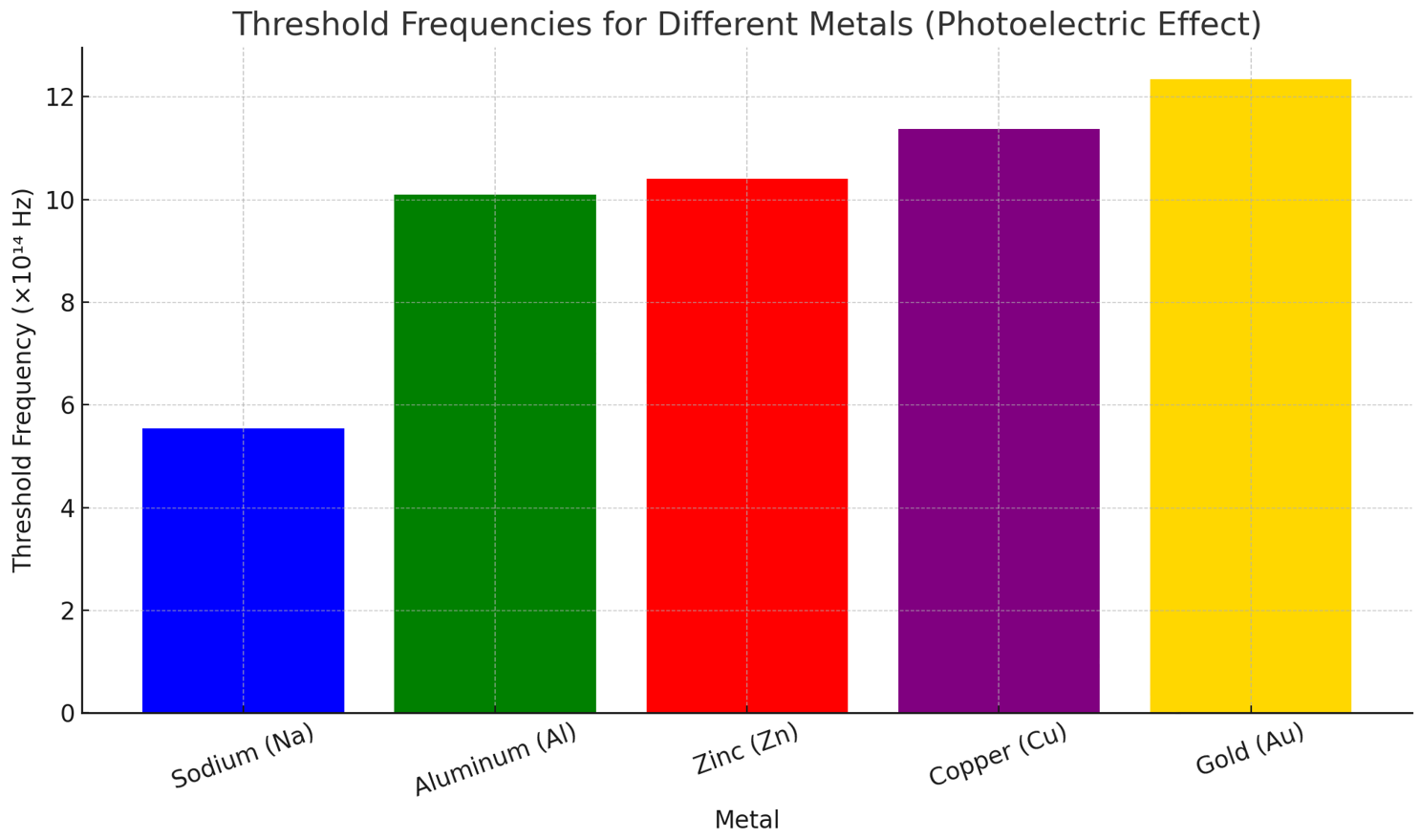
Exploring Threshold Frequencies for Different Metals ⚛️🔆
This bar chart compares the threshold frequencies for different metals in the photoelectric effect. Let’s analyze it! 🔍✨
1. What Does This Graph Show? 📊
Each metal has a different work function (
), meaning they require different threshold frequencies (
) to eject electrons.
🔹 Sodium (Na) – Lowest Threshold (Blue Bar)
- Hz
- Easily ejects electrons with visible light.
🔹 Gold (Au) – Highest Threshold (Gold Bar)
- Hz
- Requires ultraviolet (UV) light to eject electrons.
📌 Key Insight:
- Metals with low work functions (e.g., Sodium) eject electrons easily.
- Metals with high work functions (e.g., Gold) require higher-energy photons (UV light).
2. Threshold Frequency & Work Function Relationship 🔢
Using:
we see that metals with higher work functions require higher threshold frequencies.
🔹 Lower work function → Easily ejects electrons under lower-energy light.
🔹 Higher work function → Requires more energetic (shorter-wavelength) light to eject electrons.
📌 Example:
- Sodium (low work function) → Can eject electrons under red or yellow light.
- Gold (high work function) → Needs UV light for photoemission.
3. Real-World Applications 🌍
✅ Solar Panels ☀️ – Use metals with low work functions to efficiently convert sunlight into electricity.
✅ Photoelectric Sensors 📸 – Motion sensors and cameras rely on metals that respond to visible light.
✅ X-ray Spectroscopy 🔬 – Metals like gold require high-energy X-rays to emit electrons.
✅ Quantum Mechanics & Space Exploration 🚀 – Understanding work functions helps design energy-efficient materials for space technology.
📊 Different metals have unique properties that determine their response to light! 🚀✨
Activities:
- Demonstration of the photoelectric effect
- Group discussion on wave-particle duality
Assessment:
- Quiz on photoelectric principles and key equations
Photoelectric Effect
The photoelectric effect serves as compelling evidence of the particle nature of light, showcasing the behavior of photons as discrete packets of energy that interact with matter in quantized fashion, shaping the fabric of reality with mathematical precision and scientific insight.
In the photoelectric effect, when light of sufficient frequency shines on a metal surface, electrons are ejected from the material, forming an electric current. This process demonstrates that light behaves as discrete particles called photons, each carrying a specific amount of energy determined by the frequency of the light. The energy of the ejected electrons depends on the frequency of the incident light, with higher frequencies leading to more energetic electrons being emitted.
The photoelectric effect is evidence of the particle nature of light because it cannot be explained by classical wave theory alone. According to classical wave theory, the intensity of light (brightness) should determine the energy transferred to electrons, leading to a gradual increase in kinetic energy of emitted electrons. However, the photoelectric effect shows that the energy of ejected electrons is dependent on the frequency of light, not its intensity, indicating that light interacts with matter as discrete particles rather than continuous waves.
Albert Einstein's explanation of the photoelectric effect in 1905, for which he received the Nobel Prize in Physics, revolutionized our understanding of light by proposing that electromagnetic radiation is quantized into photons, each carrying energy proportional to its frequency. By treating light as a stream of particles, Einstein's theory successfully explained the experimental observations of the photoelectric effect and provided strong evidence for the particle nature of light.
Threshold Frequency
In the realm of the photoelectric effect, the threshold frequency represents the minimum frequency of light required to liberate electrons from the surface of a metal. Below the threshold frequency, photons lack the necessary energy to overcome the binding forces holding electrons in the metal, and no photoelectrons are emitted regardless of the intensity of the incident light. However, when photons with frequencies equal to or greater than the threshold frequency strike the metal surface, they transfer sufficient energy to electrons, enabling them to break free and form an electric current.
The threshold frequency is a critical parameter that depends on the material properties of the metal, specifically the work function, which is the minimum energy required to remove an electron from the surface of the metal. Photons with energies below the threshold frequency cannot provide the necessary energy to overcome the work function and release electrons, whereas photons with energies equal to or above the threshold frequency can liberate electrons and initiate the photoelectric effect.
Example:
Imagine a metal surface with a work function of 2 electronvolts (eV), requiring a minimum energy of 2 eV to liberate an electron from its confines. Let us determine the threshold frequency of light needed to release photoelectrons from this metal surface.
The energy of a photon is given by the equation:
Where:
= Energy of the photon
= Planck's constant (
J s)
= Frequency of the photon
To calculate the threshold frequency, we need to convert the work function from electronvolts to joules. Since 1 eV is approximately
joules, the work function of 2 eV is equivalent to:
Now, we can use the energy equation to find the threshold frequency. Since the energy of the photon must be equal to or greater than the work function to release electrons, we have:
Substitute the energy of the photon into the equation:
Solving for the threshold frequency:
Therefore, the threshold frequency required to release photoelectrons from the metal surface with a work function of 2 eV is approximately
. Photons with frequencies equal to or higher than this threshold frequency will possess the necessary energy to overcome the work function and initiate the photoelectric effect.