Structure of the Atom
1. Historical Development of Atomic Models
Learning Outcomes
- I can describe how atomic models changed as new evidence became available.
- I can explain the contributions of Dalton, Thomson, and Rutherford.
- I can describe how experiments challenged earlier atomic theories.
- I can explain why scientific models evolve over time.
- I can evaluate the role of evidence in developing atomic theory.
What is a scientific model?
A scientific model is a simplified representation used to describe and explain something that cannot always be observed directly.
Atoms are far too small to see using ordinary microscopes. Scientists therefore developed models based on:
- Experimental observations.
- Measurements.
- Patterns in chemical reactions.
- Predictions made by existing theories.
- Results that earlier models could not explain.
An atomic model is not intended to be a perfect miniature picture of an atom. It is a tool for explaining evidence and making testable predictions.
As new evidence became available, scientists revised or replaced earlier atomic models.
The development of atomic theory
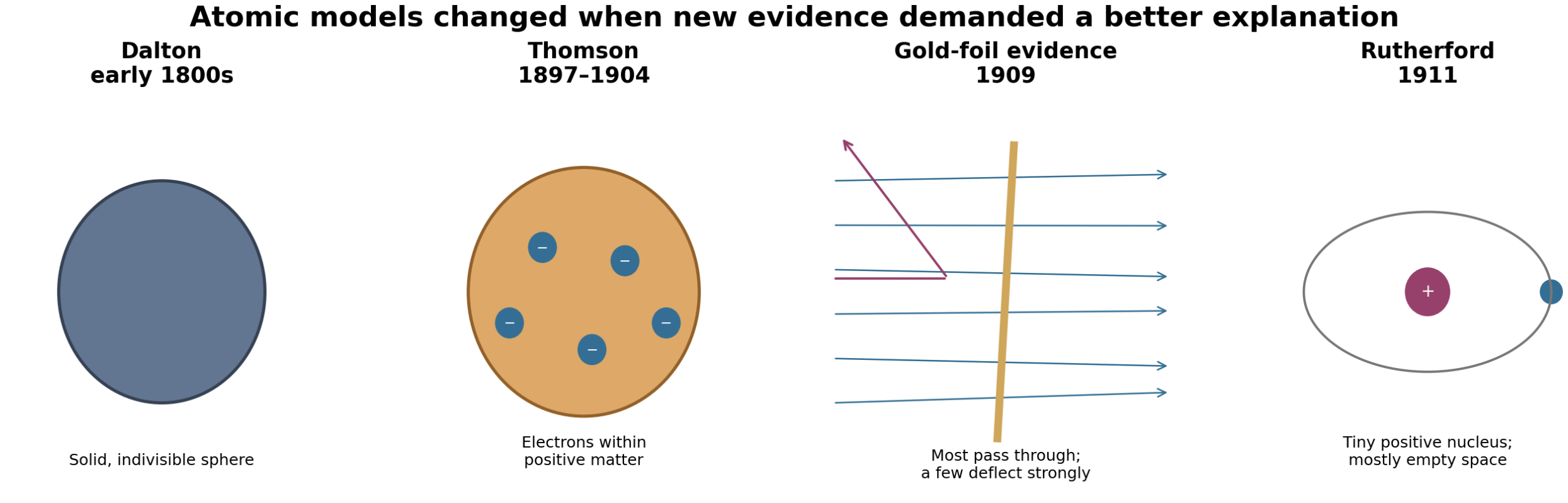
The sequence shows an important feature of science: a model may be useful for a time but still require revision when new evidence becomes available.
Early ideas about atoms
The idea that matter might be made from tiny particles is ancient.
Around the fifth century BCE, the Greek thinker Democritus suggested that matter consisted of indivisible particles called atomos, meaning “uncuttable.”
This was a philosophical proposal rather than an experimental scientific theory. Democritus did not have quantitative chemical evidence or equipment capable of testing the idea.
Modern atomic theory began much later, when scientists used measurements from chemical reactions to develop evidence-based explanations.
John Dalton and the solid-sphere model
In the early 1800s, the English scientist John Dalton developed the first modern scientific atomic theory.
Dalton studied gases and patterns in chemical reactions. His model helped explain why elements combine in consistent proportions.


Dalton represented atoms as small, solid spheres. Different elements had different kinds of atoms.
Dalton’s atomic theory
Dalton proposed that:
- All matter is made of atoms.
- Atoms of the same element are identical.
- Atoms of different elements differ in mass and properties.
- Atoms combine in simple whole-number ratios to form compounds.
- Chemical reactions rearrange atoms.
- Atoms are not created or destroyed during ordinary chemical reactions.
For example, water always contains hydrogen and oxygen in a fixed composition. Dalton explained this by proposing that atoms combine in fixed ratios.
Evidence supporting Dalton’s model
Dalton’s theory brought together several chemical laws.
Conservation of mass
In a closed system, the total mass remains constant during a chemical reaction.
Dalton explained this by proposing that reactions rearrange atoms rather than creating or destroying them.
Definite proportions
A pure compound contains the same elements in the same mass proportions.
For example, pure water has a consistent ratio of hydrogen to oxygen. Dalton explained this using a fixed combination of atoms.
Multiple proportions
When the same elements form more than one compound, their masses combine in simple whole-number ratios.
Carbon and oxygen form both carbon monoxide and carbon dioxide. The different compositions can be explained by different numbers of oxygen atoms combining with carbon atoms.
These regular numerical patterns supported the idea that matter consists of discrete particles.
Strengths of Dalton’s model
Dalton’s model:
- Connected atomic ideas to experimental chemistry.
- Explained fixed composition in compounds.
- Explained conservation of atoms during reactions.
- Helped scientists interpret chemical formulae.
- Made chemical reactions easier to represent.
It was a major improvement over unsupported philosophical ideas.
Limitations of Dalton’s model
Later evidence showed that several parts of Dalton’s theory were incomplete.
Atoms are not indivisible. They contain smaller particles, including:
- Electrons.
- Protons.
- Neutrons.
Atoms of the same element are not always identical in mass. Isotopes of an element have the same number of protons but different numbers of neutrons.
Atoms can also be changed in nuclear reactions, although they are conserved in ordinary chemical reactions.
Dalton’s model was not useless because it was incomplete. The idea of atoms as conserved units remains valuable for explaining many chemical reactions.
J. J. Thomson and the electron
During the nineteenth century, scientists investigated electrical discharges through gases in sealed glass tubes.
In 1897, the British physicist J. J. Thomson used cathode-ray experiments to provide evidence for a negatively charged particle smaller than an atom. This particle became known as the electron.


The discovery of the electron directly challenged Dalton’s claim that atoms were indivisible.
The cathode-ray experiment
A cathode-ray tube contained:
- A sealed glass tube.
- Gas at very low pressure.
- Two metal electrodes.
- A high potential difference.
When the voltage was applied, a beam travelled through the tube.
Thomson investigated how this beam responded to electric and magnetic fields.
He observed that:
- The beam was deflected by electric and magnetic fields.
- It behaved as though it contained negatively charged particles.
- The behaviour was similar even when different gases and electrode materials were used.
- The particles had a very large charge-to-mass ratio, indicating that they were much lighter than atoms.
Thomson’s reasoning
Thomson reasoned that:
- The beam contained particles because it could be deflected.
- The particles were negatively charged because of the direction of deflection.
- The particles were present in different kinds of matter.
- Atoms must contain smaller negatively charged components.
This evidence required a new atomic model.
Thomson’s atomic model
Atoms are electrically neutral overall. If they contain negative electrons, they must also contain positive charge.
Thomson proposed that an atom was:
- A sphere of positive charge.
- Embedded with negatively charged electrons.
- Electrically neutral because the charges balanced.
This became known as the plum-pudding model.
The electrons were compared with pieces of fruit distributed through positively charged material.
How Thomson challenged Dalton
Dalton’s model described the atom as a solid, indivisible particle.
Thomson’s evidence showed that:
- Atoms contain smaller particles.
- Atoms have internal structure.
- Negative charge exists within atoms.
- An atom cannot be a completely solid, indivisible sphere.
Thomson retained Dalton’s idea that atoms were units of matter, but changed the proposed internal structure.
Strengths and limitations of Thomson’s model
Thomson’s model successfully included:
- Electrons.
- Positive charge.
- Overall electrical neutrality.
However, it did not include:
- A central nucleus.
- Concentrated positive charge.
- The large amount of empty space within an atom.
Its most serious problem appeared when scientists studied how alpha particles passed through thin metal foil.
The gold-foil experiment
In 1909, Hans Geiger and Ernest Marsden carried out an experiment under the direction of Ernest Rutherford.
They aimed positively charged alpha particles at an extremely thin sheet of gold foil.
A fluorescent screen surrounding the foil detected where the alpha particles travelled.


Gold was useful because it could be hammered into a foil only a few atoms thick.
Predictions from Thomson’s model
According to Thomson’s model:
- Positive charge was spread throughout the atom.
- The atom’s mass was also broadly distributed.
- Alpha particles should pass through with little deflection.
- Large deflections should be extremely unlikely.
Alpha particles are positively charged and relatively massive. A spread-out positive charge was not expected to exert a concentrated force strong enough to turn them sharply.
The observations
The experiment produced three important observations:
- Most alpha particles passed straight through the foil.
- Some were deflected through small angles.
- A very small number were deflected through large angles or returned towards the source.
Most of the results were consistent with particles passing through little material. The rare large deflections were incompatible with Thomson’s diffuse positive charge.
Rutherford’s interpretation
Rutherford used the scattering evidence to infer that:
- Most of the atom is empty space.
- Nearly all its mass is concentrated in a tiny central region.
- Positive charge is concentrated in this central region.
- Electrons occupy the space surrounding the centre.
The small central region became known as the nucleus.
Large deflections occurred when a positively charged alpha particle passed close to the positively charged nucleus. Electrostatic repulsion caused the particle to change direction sharply.
Linking observations to conclusions
| Experimental observation | Rutherford’s conclusion |
|---|---|
| Most alpha particles passed straight through | Most of the atom is empty space |
| Some particles were slightly deflected | Positive charge affects particles passing near the centre |
| Very few particles were strongly deflected | Positive charge and mass are concentrated in a very small region |
| A tiny number returned towards the source | The central region is dense and strongly repels nearby alpha particles |
The conclusions were not direct photographs of atoms. They were inferences that best explained the observed scattering pattern.
Rutherford’s nuclear model
In 1911, Rutherford proposed the nuclear model of the atom.
In this model:
- A tiny, dense nucleus occupies the centre.
- The nucleus has positive charge.
- Most atomic mass is concentrated in the nucleus.
- Electrons move through the space around the nucleus.
- Most of the atom’s volume is empty space.
The nucleus is extremely small compared with the complete atom.
If an atom were enlarged to the size of a large stadium, its nucleus would be much smaller than the stadium itself, while the electrons would occupy the surrounding region.
How the gold-foil experiment challenged Thomson
Thomson’s model placed positive charge throughout the atom. This could explain small deflections but not the rare, very large deflections.
Rutherford’s model explained both major results:
- Most alpha particles encountered empty space and continued straight through.
- A small number passed close to the concentrated positive nucleus and were strongly repelled.
The new model was accepted because it explained the evidence more successfully.
Comparing the three models
| Feature | Dalton | Thomson | Rutherford |
|---|---|---|---|
| General structure | Solid sphere | Positive sphere containing electrons | Tiny nucleus surrounded by electrons |
| Smaller particles included | None | Electrons | Electrons and central positive region |
| Positive charge | Not separately described | Spread throughout the atom | Concentrated in the nucleus |
| Empty space | Not included | Very little or none | Most of the atom |
| Main supporting evidence | Chemical combination and mass ratios | Cathode-ray deflection | Alpha-particle scattering |
| Main limitation | Atom treated as indivisible | No nucleus | Could not fully explain electron behaviour or atomic spectra |
Each model retained useful ideas while changing features that no longer matched the evidence.
Rutherford’s contribution
Rutherford’s major contribution was not simply drawing a different atom. He used experimental evidence to locate positive charge and mass within a tiny nucleus.
His work established the basic distinction between:
- The dense central nucleus.
- The much larger region occupied by electrons.
This remains part of modern atomic theory.


Rutherford’s interpretation transformed the scientific understanding of atomic structure.
Later developments
Rutherford’s model was a major advance, but it was not the final atomic model.
Later scientists added further evidence and explanations.
Niels Bohr
In 1913, Bohr proposed that electrons occupy specific energy levels. His model helped explain the line spectra produced by atoms.
The proton
Evidence developed that the nucleus contains positively charged particles called protons. Rutherford is associated with identifying the hydrogen nucleus as a fundamental positive particle.
James Chadwick
In 1932, Chadwick provided evidence for the neutron, an uncharged particle in the nucleus.
The quantum-mechanical model
Modern atomic theory describes electrons using orbitals and probability distributions rather than simple circular paths.


Modern electron-cloud images represent regions where electrons are likely to be found. They are not photographs of electrons following fixed paths.
Why scientific models change
Scientific models change because scientific knowledge is based on evidence rather than permanent authority.
A model may be revised when:
- New technology allows more precise measurements.
- A new experiment produces unexpected results.
- Existing evidence can no longer be explained.
- A new model explains a wider range of observations.
- A new model makes more accurate predictions.
- Several independent investigations support the new explanation.
Changing a model is a strength of science. It shows that scientific explanations respond to evidence.
Models are evaluated, not simply declared true
Scientists evaluate models by asking:
- Does the model explain existing observations?
- Does it make testable predictions?
- Do experiments support those predictions?
- Can the results be repeated?
- Does the model explain evidence better than alternatives?
- Are there observations that the model cannot explain?
No model needs to look exactly like the object it represents. Its value comes from how effectively it explains and predicts.
Unexpected results drive scientific progress
The most important results in the gold-foil experiment were not the most common ones.
Most alpha particles passed straight through, as expected. However, the rare large deflections revealed that Thomson’s model was incomplete.
This shows that:
- Rare results should not automatically be ignored.
- Unexpected evidence may be scientifically important.
- A theory must explain all reliable observations.
- Scientists must be willing to revise prior assumptions.
Before accepting rare results, researchers must also check for errors, contamination or equipment problems.
Evaluating the quality of evidence
Strong experimental evidence should be:
- Measurable.
- Repeatable.
- Consistent.
- Open to examination by other scientists.
- Collected using controlled methods.
- Capable of distinguishing between competing explanations.
A single surprising observation may begin an investigation, but repeated evidence builds confidence.
Thomson’s experiments were repeated using different materials. Alpha-scattering experiments also produced consistent patterns that other scientists could investigate.
Evidence and inference
Evidence and inference are related but different.
Evidence consists of observations and measurements.
Examples include:
- A beam bends towards a positively charged plate.
- Most alpha particles pass through foil.
- A few alpha particles reverse direction.
An inference is a conclusion drawn from the evidence.
Examples include:
- The beam contains negatively charged particles.
- Most of an atom is empty space.
- Positive charge is concentrated in a small nucleus.
Scientists do not observe every part of an atom directly. They construct explanations from how matter and radiation behave.
Science as a collaborative process
Scientific discoveries rarely result from one person working entirely alone.
The development of atomic theory involved:
- Scientists who proposed models.
- Researchers who designed and performed experiments.
- Technicians who built equipment.
- Other scientists who repeated and challenged results.
- Improvements in vacuum tubes, detectors and radiation sources.
The gold-foil experiment is often called Rutherford’s experiment, but Geiger and Marsden performed the scattering work under his direction. Recognizing the wider team gives a more accurate picture of scientific progress.
A worked evidence-analysis example
Consider this statement:
“Most alpha particles passed through gold foil, but a very small number were deflected backwards.”
A strong analysis would explain:
- Thomson’s model predicted only small deflections because positive charge was spread out.
- Most particles passing through suggested that atoms contain a large amount of empty space.
- Backward deflections required a strong, concentrated repulsive force.
- The positive charge and most mass must therefore occupy a tiny nucleus.
- Rutherford’s nuclear model explained the complete pattern better than Thomson’s model.
This links the prediction, observation, inference and revised model.
Real-world connection: indirect evidence
Scientists often study objects that cannot be observed directly by analyzing their effects.
Examples include:
- Medical imaging reconstructing structures from transmitted signals.
- Astronomers detecting planets through changes in a star’s light or motion.
- Seismologists studying Earth’s interior using earthquake waves.
- Particle physicists identifying particles from detector tracks.


Rutherford’s team similarly inferred atomic structure from the paths of scattered particles.
Common misconceptions
- “Scientific models are exact pictures.” They are simplified explanatory tools.
- “Dalton discovered the atom.” Atomic ideas existed earlier, but Dalton developed a modern evidence-based theory.
- “Dalton’s model became completely useless.” It still helps explain conservation and chemical combination.
- “Thomson discovered the nucleus.” Thomson identified the electron; Rutherford developed the nuclear model.
- “Rutherford personally performed every part of the gold-foil experiment.” Geiger and Marsden conducted the scattering experiment under his direction.
- “Most alpha particles bounced backwards.” Only a very small proportion underwent large deflections.
- “Rutherford saw the nucleus directly.” He inferred it from scattering evidence.
- “A revised model proves earlier scientists were careless.” Earlier models were based on the best available evidence.
- “Scientific knowledge changes randomly.” Models change in response to evidence and improved explanations.
Did you know?
Rutherford reportedly compared the backward deflection of alpha particles to firing a projectile at thin material and having it return towards the source.
The result was surprising because Thomson’s model contained no small, concentrated region capable of producing such a strong repulsion.
Key terms
- Atom: The smallest particle of an element that retains its chemical identity.
- Atomic model: A representation used to explain atomic structure and behaviour.
- Scientific evidence: Observations and measurements used to evaluate explanations.
- Inference: A conclusion drawn from evidence.
- Cathode ray: A beam of electrons travelling through a low-pressure tube.
- Electron: A negatively charged subatomic particle.
- Plum-pudding model: Thomson’s model of electrons embedded in positive matter.
- Alpha particle: A positively charged particle containing two protons and two neutrons.
- Scattering: A change in direction caused by an interaction.
- Nucleus: The tiny, dense central region of an atom.
- Nuclear model: Rutherford’s model with concentrated positive charge in a nucleus.
- Repeatability: The ability to obtain consistent results when an investigation is repeated.
- Theory: A well-supported scientific explanation based on evidence.
Key takeaways
- Dalton used chemical evidence to develop the solid-sphere model.
- Thomson’s cathode-ray experiments provided evidence for electrons.
- The electron showed that atoms were divisible and had internal structure.
- The gold-foil results could not be fully explained by Thomson’s model.
- Rutherford inferred that atoms are mostly empty space with a tiny positive nucleus.
- Observations provide evidence, while models provide explanations.
- Reliable evidence should be measurable, repeatable and open to testing.
- Scientific models evolve when new evidence supports a better explanation.
- Revising a model is a normal and necessary part of scientific progress.