Structure of the Atom
| Website: | Young Education |
| Kurs: | Structure of the Atom and Quantum Physics |
| Buch: | Structure of the Atom |
| Gedruckt von: | Guest user |
| Datum: | Freitag, 25. September 2026, 01:05 |
1. Historical Development of Atomic Models
Learning Outcomes
- I can describe how atomic models changed as new evidence became available.
- I can explain the contributions of Dalton, Thomson, and Rutherford.
- I can describe how experiments challenged earlier atomic theories.
- I can explain why scientific models evolve over time.
- I can evaluate the role of evidence in developing atomic theory.
What is a scientific model?
A scientific model is a simplified representation used to describe and explain something that cannot always be observed directly.
Atoms are far too small to see using ordinary microscopes. Scientists therefore developed models based on:
- Experimental observations.
- Measurements.
- Patterns in chemical reactions.
- Predictions made by existing theories.
- Results that earlier models could not explain.
An atomic model is not intended to be a perfect miniature picture of an atom. It is a tool for explaining evidence and making testable predictions.
As new evidence became available, scientists revised or replaced earlier atomic models.
The development of atomic theory
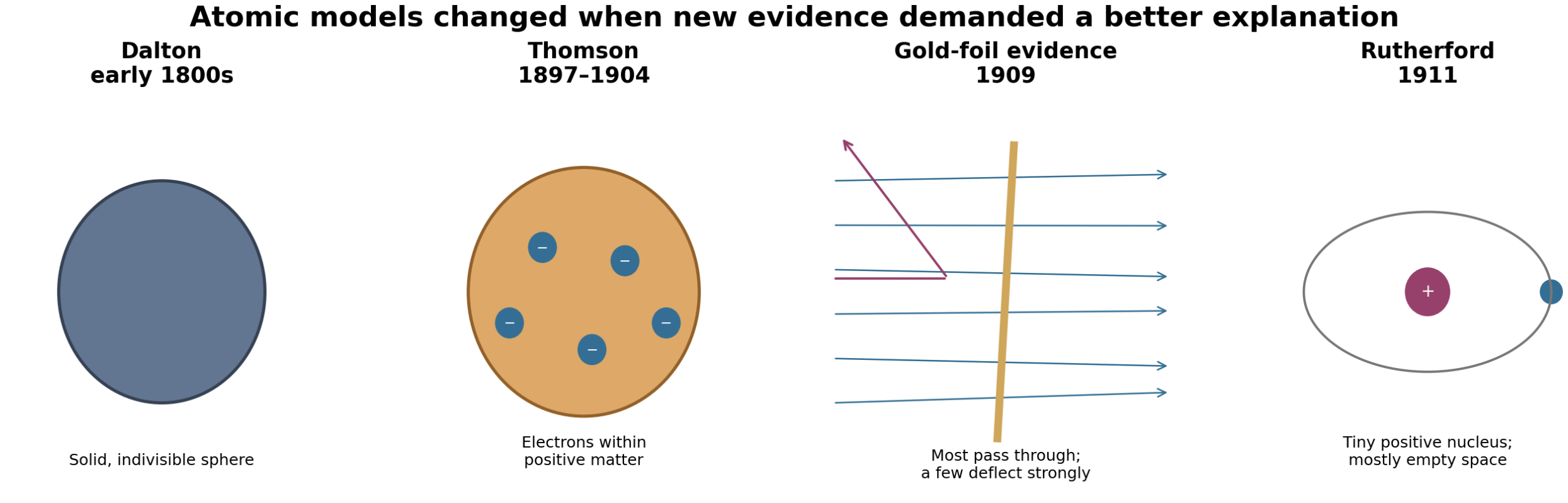
The sequence shows an important feature of science: a model may be useful for a time but still require revision when new evidence becomes available.
Early ideas about atoms
The idea that matter might be made from tiny particles is ancient.
Around the fifth century BCE, the Greek thinker Democritus suggested that matter consisted of indivisible particles called atomos, meaning “uncuttable.”
This was a philosophical proposal rather than an experimental scientific theory. Democritus did not have quantitative chemical evidence or equipment capable of testing the idea.
Modern atomic theory began much later, when scientists used measurements from chemical reactions to develop evidence-based explanations.
John Dalton and the solid-sphere model
In the early 1800s, the English scientist John Dalton developed the first modern scientific atomic theory.
Dalton studied gases and patterns in chemical reactions. His model helped explain why elements combine in consistent proportions.


Dalton represented atoms as small, solid spheres. Different elements had different kinds of atoms.
Dalton’s atomic theory
Dalton proposed that:
- All matter is made of atoms.
- Atoms of the same element are identical.
- Atoms of different elements differ in mass and properties.
- Atoms combine in simple whole-number ratios to form compounds.
- Chemical reactions rearrange atoms.
- Atoms are not created or destroyed during ordinary chemical reactions.
For example, water always contains hydrogen and oxygen in a fixed composition. Dalton explained this by proposing that atoms combine in fixed ratios.
Evidence supporting Dalton’s model
Dalton’s theory brought together several chemical laws.
Conservation of mass
In a closed system, the total mass remains constant during a chemical reaction.
Dalton explained this by proposing that reactions rearrange atoms rather than creating or destroying them.
Definite proportions
A pure compound contains the same elements in the same mass proportions.
For example, pure water has a consistent ratio of hydrogen to oxygen. Dalton explained this using a fixed combination of atoms.
Multiple proportions
When the same elements form more than one compound, their masses combine in simple whole-number ratios.
Carbon and oxygen form both carbon monoxide and carbon dioxide. The different compositions can be explained by different numbers of oxygen atoms combining with carbon atoms.
These regular numerical patterns supported the idea that matter consists of discrete particles.
Strengths of Dalton’s model
Dalton’s model:
- Connected atomic ideas to experimental chemistry.
- Explained fixed composition in compounds.
- Explained conservation of atoms during reactions.
- Helped scientists interpret chemical formulae.
- Made chemical reactions easier to represent.
It was a major improvement over unsupported philosophical ideas.
Limitations of Dalton’s model
Later evidence showed that several parts of Dalton’s theory were incomplete.
Atoms are not indivisible. They contain smaller particles, including:
- Electrons.
- Protons.
- Neutrons.
Atoms of the same element are not always identical in mass. Isotopes of an element have the same number of protons but different numbers of neutrons.
Atoms can also be changed in nuclear reactions, although they are conserved in ordinary chemical reactions.
Dalton’s model was not useless because it was incomplete. The idea of atoms as conserved units remains valuable for explaining many chemical reactions.
J. J. Thomson and the electron
During the nineteenth century, scientists investigated electrical discharges through gases in sealed glass tubes.
In 1897, the British physicist J. J. Thomson used cathode-ray experiments to provide evidence for a negatively charged particle smaller than an atom. This particle became known as the electron.


The discovery of the electron directly challenged Dalton’s claim that atoms were indivisible.
The cathode-ray experiment
A cathode-ray tube contained:
- A sealed glass tube.
- Gas at very low pressure.
- Two metal electrodes.
- A high potential difference.
When the voltage was applied, a beam travelled through the tube.
Thomson investigated how this beam responded to electric and magnetic fields.
He observed that:
- The beam was deflected by electric and magnetic fields.
- It behaved as though it contained negatively charged particles.
- The behaviour was similar even when different gases and electrode materials were used.
- The particles had a very large charge-to-mass ratio, indicating that they were much lighter than atoms.
Thomson’s reasoning
Thomson reasoned that:
- The beam contained particles because it could be deflected.
- The particles were negatively charged because of the direction of deflection.
- The particles were present in different kinds of matter.
- Atoms must contain smaller negatively charged components.
This evidence required a new atomic model.
Thomson’s atomic model
Atoms are electrically neutral overall. If they contain negative electrons, they must also contain positive charge.
Thomson proposed that an atom was:
- A sphere of positive charge.
- Embedded with negatively charged electrons.
- Electrically neutral because the charges balanced.
This became known as the plum-pudding model.
The electrons were compared with pieces of fruit distributed through positively charged material.
How Thomson challenged Dalton
Dalton’s model described the atom as a solid, indivisible particle.
Thomson’s evidence showed that:
- Atoms contain smaller particles.
- Atoms have internal structure.
- Negative charge exists within atoms.
- An atom cannot be a completely solid, indivisible sphere.
Thomson retained Dalton’s idea that atoms were units of matter, but changed the proposed internal structure.
Strengths and limitations of Thomson’s model
Thomson’s model successfully included:
- Electrons.
- Positive charge.
- Overall electrical neutrality.
However, it did not include:
- A central nucleus.
- Concentrated positive charge.
- The large amount of empty space within an atom.
Its most serious problem appeared when scientists studied how alpha particles passed through thin metal foil.
The gold-foil experiment
In 1909, Hans Geiger and Ernest Marsden carried out an experiment under the direction of Ernest Rutherford.
They aimed positively charged alpha particles at an extremely thin sheet of gold foil.
A fluorescent screen surrounding the foil detected where the alpha particles travelled.


Gold was useful because it could be hammered into a foil only a few atoms thick.
Predictions from Thomson’s model
According to Thomson’s model:
- Positive charge was spread throughout the atom.
- The atom’s mass was also broadly distributed.
- Alpha particles should pass through with little deflection.
- Large deflections should be extremely unlikely.
Alpha particles are positively charged and relatively massive. A spread-out positive charge was not expected to exert a concentrated force strong enough to turn them sharply.
The observations
The experiment produced three important observations:
- Most alpha particles passed straight through the foil.
- Some were deflected through small angles.
- A very small number were deflected through large angles or returned towards the source.
Most of the results were consistent with particles passing through little material. The rare large deflections were incompatible with Thomson’s diffuse positive charge.
Rutherford’s interpretation
Rutherford used the scattering evidence to infer that:
- Most of the atom is empty space.
- Nearly all its mass is concentrated in a tiny central region.
- Positive charge is concentrated in this central region.
- Electrons occupy the space surrounding the centre.
The small central region became known as the nucleus.
Large deflections occurred when a positively charged alpha particle passed close to the positively charged nucleus. Electrostatic repulsion caused the particle to change direction sharply.
Linking observations to conclusions
| Experimental observation | Rutherford’s conclusion |
|---|---|
| Most alpha particles passed straight through | Most of the atom is empty space |
| Some particles were slightly deflected | Positive charge affects particles passing near the centre |
| Very few particles were strongly deflected | Positive charge and mass are concentrated in a very small region |
| A tiny number returned towards the source | The central region is dense and strongly repels nearby alpha particles |
The conclusions were not direct photographs of atoms. They were inferences that best explained the observed scattering pattern.
Rutherford’s nuclear model
In 1911, Rutherford proposed the nuclear model of the atom.
In this model:
- A tiny, dense nucleus occupies the centre.
- The nucleus has positive charge.
- Most atomic mass is concentrated in the nucleus.
- Electrons move through the space around the nucleus.
- Most of the atom’s volume is empty space.
The nucleus is extremely small compared with the complete atom.
If an atom were enlarged to the size of a large stadium, its nucleus would be much smaller than the stadium itself, while the electrons would occupy the surrounding region.
How the gold-foil experiment challenged Thomson
Thomson’s model placed positive charge throughout the atom. This could explain small deflections but not the rare, very large deflections.
Rutherford’s model explained both major results:
- Most alpha particles encountered empty space and continued straight through.
- A small number passed close to the concentrated positive nucleus and were strongly repelled.
The new model was accepted because it explained the evidence more successfully.
Comparing the three models
| Feature | Dalton | Thomson | Rutherford |
|---|---|---|---|
| General structure | Solid sphere | Positive sphere containing electrons | Tiny nucleus surrounded by electrons |
| Smaller particles included | None | Electrons | Electrons and central positive region |
| Positive charge | Not separately described | Spread throughout the atom | Concentrated in the nucleus |
| Empty space | Not included | Very little or none | Most of the atom |
| Main supporting evidence | Chemical combination and mass ratios | Cathode-ray deflection | Alpha-particle scattering |
| Main limitation | Atom treated as indivisible | No nucleus | Could not fully explain electron behaviour or atomic spectra |
Each model retained useful ideas while changing features that no longer matched the evidence.
Rutherford’s contribution
Rutherford’s major contribution was not simply drawing a different atom. He used experimental evidence to locate positive charge and mass within a tiny nucleus.
His work established the basic distinction between:
- The dense central nucleus.
- The much larger region occupied by electrons.
This remains part of modern atomic theory.


Rutherford’s interpretation transformed the scientific understanding of atomic structure.
Later developments
Rutherford’s model was a major advance, but it was not the final atomic model.
Later scientists added further evidence and explanations.
Niels Bohr
In 1913, Bohr proposed that electrons occupy specific energy levels. His model helped explain the line spectra produced by atoms.
The proton
Evidence developed that the nucleus contains positively charged particles called protons. Rutherford is associated with identifying the hydrogen nucleus as a fundamental positive particle.
James Chadwick
In 1932, Chadwick provided evidence for the neutron, an uncharged particle in the nucleus.
The quantum-mechanical model
Modern atomic theory describes electrons using orbitals and probability distributions rather than simple circular paths.


Modern electron-cloud images represent regions where electrons are likely to be found. They are not photographs of electrons following fixed paths.
Why scientific models change
Scientific models change because scientific knowledge is based on evidence rather than permanent authority.
A model may be revised when:
- New technology allows more precise measurements.
- A new experiment produces unexpected results.
- Existing evidence can no longer be explained.
- A new model explains a wider range of observations.
- A new model makes more accurate predictions.
- Several independent investigations support the new explanation.
Changing a model is a strength of science. It shows that scientific explanations respond to evidence.
Models are evaluated, not simply declared true
Scientists evaluate models by asking:
- Does the model explain existing observations?
- Does it make testable predictions?
- Do experiments support those predictions?
- Can the results be repeated?
- Does the model explain evidence better than alternatives?
- Are there observations that the model cannot explain?
No model needs to look exactly like the object it represents. Its value comes from how effectively it explains and predicts.
Unexpected results drive scientific progress
The most important results in the gold-foil experiment were not the most common ones.
Most alpha particles passed straight through, as expected. However, the rare large deflections revealed that Thomson’s model was incomplete.
This shows that:
- Rare results should not automatically be ignored.
- Unexpected evidence may be scientifically important.
- A theory must explain all reliable observations.
- Scientists must be willing to revise prior assumptions.
Before accepting rare results, researchers must also check for errors, contamination or equipment problems.
Evaluating the quality of evidence
Strong experimental evidence should be:
- Measurable.
- Repeatable.
- Consistent.
- Open to examination by other scientists.
- Collected using controlled methods.
- Capable of distinguishing between competing explanations.
A single surprising observation may begin an investigation, but repeated evidence builds confidence.
Thomson’s experiments were repeated using different materials. Alpha-scattering experiments also produced consistent patterns that other scientists could investigate.
Evidence and inference
Evidence and inference are related but different.
Evidence consists of observations and measurements.
Examples include:
- A beam bends towards a positively charged plate.
- Most alpha particles pass through foil.
- A few alpha particles reverse direction.
An inference is a conclusion drawn from the evidence.
Examples include:
- The beam contains negatively charged particles.
- Most of an atom is empty space.
- Positive charge is concentrated in a small nucleus.
Scientists do not observe every part of an atom directly. They construct explanations from how matter and radiation behave.
Science as a collaborative process
Scientific discoveries rarely result from one person working entirely alone.
The development of atomic theory involved:
- Scientists who proposed models.
- Researchers who designed and performed experiments.
- Technicians who built equipment.
- Other scientists who repeated and challenged results.
- Improvements in vacuum tubes, detectors and radiation sources.
The gold-foil experiment is often called Rutherford’s experiment, but Geiger and Marsden performed the scattering work under his direction. Recognizing the wider team gives a more accurate picture of scientific progress.
A worked evidence-analysis example
Consider this statement:
“Most alpha particles passed through gold foil, but a very small number were deflected backwards.”
A strong analysis would explain:
- Thomson’s model predicted only small deflections because positive charge was spread out.
- Most particles passing through suggested that atoms contain a large amount of empty space.
- Backward deflections required a strong, concentrated repulsive force.
- The positive charge and most mass must therefore occupy a tiny nucleus.
- Rutherford’s nuclear model explained the complete pattern better than Thomson’s model.
This links the prediction, observation, inference and revised model.
Real-world connection: indirect evidence
Scientists often study objects that cannot be observed directly by analyzing their effects.
Examples include:
- Medical imaging reconstructing structures from transmitted signals.
- Astronomers detecting planets through changes in a star’s light or motion.
- Seismologists studying Earth’s interior using earthquake waves.
- Particle physicists identifying particles from detector tracks.


Rutherford’s team similarly inferred atomic structure from the paths of scattered particles.
Common misconceptions
- “Scientific models are exact pictures.” They are simplified explanatory tools.
- “Dalton discovered the atom.” Atomic ideas existed earlier, but Dalton developed a modern evidence-based theory.
- “Dalton’s model became completely useless.” It still helps explain conservation and chemical combination.
- “Thomson discovered the nucleus.” Thomson identified the electron; Rutherford developed the nuclear model.
- “Rutherford personally performed every part of the gold-foil experiment.” Geiger and Marsden conducted the scattering experiment under his direction.
- “Most alpha particles bounced backwards.” Only a very small proportion underwent large deflections.
- “Rutherford saw the nucleus directly.” He inferred it from scattering evidence.
- “A revised model proves earlier scientists were careless.” Earlier models were based on the best available evidence.
- “Scientific knowledge changes randomly.” Models change in response to evidence and improved explanations.
Did you know?
Rutherford reportedly compared the backward deflection of alpha particles to firing a projectile at thin material and having it return towards the source.
The result was surprising because Thomson’s model contained no small, concentrated region capable of producing such a strong repulsion.
Key terms
- Atom: The smallest particle of an element that retains its chemical identity.
- Atomic model: A representation used to explain atomic structure and behaviour.
- Scientific evidence: Observations and measurements used to evaluate explanations.
- Inference: A conclusion drawn from evidence.
- Cathode ray: A beam of electrons travelling through a low-pressure tube.
- Electron: A negatively charged subatomic particle.
- Plum-pudding model: Thomson’s model of electrons embedded in positive matter.
- Alpha particle: A positively charged particle containing two protons and two neutrons.
- Scattering: A change in direction caused by an interaction.
- Nucleus: The tiny, dense central region of an atom.
- Nuclear model: Rutherford’s model with concentrated positive charge in a nucleus.
- Repeatability: The ability to obtain consistent results when an investigation is repeated.
- Theory: A well-supported scientific explanation based on evidence.
Key takeaways
- Dalton used chemical evidence to develop the solid-sphere model.
- Thomson’s cathode-ray experiments provided evidence for electrons.
- The electron showed that atoms were divisible and had internal structure.
- The gold-foil results could not be fully explained by Thomson’s model.
- Rutherford inferred that atoms are mostly empty space with a tiny positive nucleus.
- Observations provide evidence, while models provide explanations.
- Reliable evidence should be measurable, repeatable and open to testing.
- Scientific models evolve when new evidence supports a better explanation.
- Revising a model is a normal and necessary part of scientific progress.
2. The Nuclear Atom
Learning Outcomes
- I can identify the main components of an atom.
- I can compare the properties of protons, neutrons, and electrons.
- I can determine the composition of atoms using nuclear notation.
- I can explain the concept of isotopes.
- I can relate atomic structure to atomic number and nucleon number.
- Atomic number, mass number, and nuclear symbols
- Isotopes and their significance
Notation for Representing Nuclei and Understanding Isotopes
The nucleus of an atom is represented using a standard notation that provides key information about the element, mass, and atomic number. Understanding this notation helps in studying nuclear reactions, isotopes, and atomic properties.
1. Standard Nuclear Notation
The nucleus of an atom is represented as: \( {A \brack Z}X \)
where:
- X = Chemical symbol of the element.
- A = Mass number (Total number of protons + neutrons).
- Z = Atomic number (Number of protons in the nucleus).
Example: Carbon-12
\( {12 \brack 6}C \)
- Z = 6 → 6 protons (Carbon's atomic number).
- A = 12 → 6 protons + 6 neutrons.
2. Understanding Isotopes
Isotopes are atoms of the same element (Z is the same) but with different mass numbers (A) due to varying numbers of neutrons.
Example: Hydrogen Isotopes
| Isotope | Symbol | Protons (Z) | Neutrons | Mass Number (A) |
|---|---|---|---|---|
| Protium | \( {1 \brack 1}H \) | 1 | 0 | 1 |
| Deuterium | \( {2 \brack 1}H \) | 1 | 1 | 2 |
| Tritium | \( {3 \brack 1}H \) | 1 | 2 | 3 |
3. Properties of Isotopes
- Same chemical behavior (same number of protons and electrons).
- Different nuclear stability (some isotopes are radioactive).
- Used in nuclear medicine, dating fossils, and energy production.
Example of Common Isotopes:
| Element | Stable Isotope | Radioactive Isotope |
|---|---|---|
| Carbon | \( {12 \brack 6}C \), \( {13 \brack 6}C \) | \( {14 \brack 6}C \) (used in carbon dating) |
| Uranium | \( {238 \brack 92}U \) | \( {235 \brack 92}U \) (used in nuclear reactors) |
4. Summary: Key Points
| Term | Definition |
|---|---|
| Atomic Number (Z) | Number of protons in the nucleus. |
| Mass Number (A) | Total number of protons + neutrons. |
| Isotopes | Atoms of the same element with different mass numbers. |
Key Takeaways
- Nuclear notation identifies elements and isotopes.
- Isotopes have the same protons but different neutrons.
- Radioactive isotopes have applications in medicine, dating, and energy.
The study of nuclear notation and isotopes is essential for chemistry, physics, and nuclear technology!
Activities:
- Diagramming isotopes of common elements
- Problem-solving exercises on nuclear notation
Assessment:
- Worksheet on nuclear symbols and isotopes
Nuclear notation is expressed by:
\( {A \brack Z} X \)
Where
- A is the mass number (number of neutrons plus electrons, or N + Z)
- Z is the atomic number (number of protons)
- X is the element symbol
Examples:
\( {4 \brack 2} He \)
This is helium, with
- an atomic number of Z = 2
- an atomic mass number of A = 4
- element symbol X = He
3. High-Energy Scattering Experiments
Learning Outcomes
- I can describe how scattering experiments provide information about atomic structure.
- I can explain the results of Rutherford's gold foil experiment.
- I can describe how high-energy electrons are used to probe nuclei.
- I can explain how scattering angles reveal structural information.
- I can evaluate evidence obtained from scattering experiments.
- Radius and mass of nuclei
- Density formula and calculations
Calculating the Density of Nuclei and Understanding Their Compact Nature
The nucleus of an atom is extremely dense, containing nearly all the atom's mass within a tiny volume. We can calculate the nuclear density to understand just how compact it is.
1. Formula for Nuclear Density
The density (ρ) of a nucleus is given by:
Since the nucleus is approximately spherical, its volume is:
\( V = \frac{4}{3} \pi R^3 \)
where:
- R is the nuclear radius, which is estimated using the empirical formula:
R = RoA1/3
where:
- A = Mass number (number of protons + neutrons).
- Ro ≈ 1.2•10-15 m (constant for nuclear size).
2. Steps to Calculate Nuclear Density
Step 1: Find the Nuclear Mass
The mass of the nucleus is approximately the total mass of its nucleons:
where:
- A = Mass number.
- = Mass of one nucleon (~1.67•10-27 kg).
Step 2: Find the Nuclear Radius
Using:
R = 1.2•10-15A1/3
Step 3: Find the Volume
\( V = \frac{4}{3} \pi R^3 \)
Step 4: Calculate Density
3. Example Calculation: Density of a Gold (\( {197 \brack 79}Au \)
) Nucleus
Step 1: Find Nuclear Mass
Gold (Au) has A = 197, so: m = 197(1.67•10-27)
m ≈ 3.29•10-25 kg
Step 2: Find Nuclear Radius
R = 1.2•10-15(197)1/3
R ≈ 7.0•10-15 m
Step 3: Find Nuclear Volume
Step 4: Calculate Density
4. Understanding Nuclear Density
(a) Nuclear Density is Extremely High
- kg/m³ is incredibly dense.
- This is billions of times denser than water.
(b) Comparison to Other Densities
| Object | Density (kg/m³) |
|---|---|
| Air | |
| Water | 103 |
| Iron | 7.9•103 |
| White Dwarf Star | 109 |
| Atomic Nucleus | 1017 |
Conclusion:
- A sugar-cube-sized piece of nuclear matter would weigh about a billion tons!
- This density is similar to neutron stars, which are made of compressed nuclear matter.
5. Summary of Nuclear Density
| Property | Key Concept |
|---|---|
| Formula | , where |
| Nuclear Radius | , where m |
| Typical Density | kg/m³ |
| Implications | Nuclei are extremely compact, similar to neutron stars. |
Key Takeaways
- The nucleus is incredibly dense (~1017 kg/m³).
- This density explains why nuclear reactions release enormous energy.
- The same physics applies to neutron stars, the densest objects in the universe.
The compact nature of nuclei makes nuclear power, fusion, and astrophysics possible!
Activities:
- Solving problems on nuclear densities
- Comparing nuclear densities to everyday materials
Assessment:
- Problem set on nuclear density calculations
Spectra
Emission and absorption spectra, the celestial fingerprints of atomic energy transitions, offer a radiant tapestry of spectral lines that illuminate the hidden realm of quantized energy levels within atoms.
Emission spectra showcase the unique pattern of light emitted by excited atoms as they transition from higher to lower energy levels. Each spectral line in the emission spectrum represents a specific energy difference between atomic levels, as electrons cascade down the energy ladder and release photons of precise energies corresponding to the transitions within the atom.
Absorption spectra reveal the missing wavelengths in a continuous spectrum when atoms absorb photons to move from lower to higher energy levels. The dark absorption lines in the spectrum signify the energy gaps absorbed by atoms, highlighting the discrete nature of atomic energy levels and the quantized steps of electron transitions within the atom.
By analyzing the emission and absorption spectra of elements, scientists can discern the distinct energy levels within atoms, unravel the mysteries of atomic structure, and quantify the discrete nature of energy transitions that define the dance of electrons in the atomic realm.
Photons
The emission and absorption of photons during atomic transitions represent the exquisite interplay of light and matter, where energy quantization and quantum leaps govern electrons and photons.
When an atom undergoes an energy transition, such as an electron moving from a higher energy level to a lower one, photons are emitted or absorbed to conserve energy and momentum in accordance with the laws of quantum mechanics.
During emission, as an excited electron drops to a lower energy level within the atom, it releases energy in the form of a photon. This photon carries away the precise amount of energy corresponding to the difference in energy between the initial and final electron states. The emitted photon's energy is directly proportional to the frequency of the light, following the relationship E = hf, where
- E is the energy of the photon,
- h is the Planck constant, and
- f is the frequency of the light.
Conversely, during absorption, when an atom absorbs a photon, an electron is promoted from a lower energy level to a higher one. The absorbed photon imparts its energy to the electron, enabling it to transition to a higher energy state. The energy of the absorbed photon precisely matches the energy required for the electron to make the leap to the higher level.
Through these intricate processes of emission and absorption, photons serve as messengers of energy, bridging the gap between atomic energy levels and quantum states, and revealing the quantized nature of energy transitions within atoms.
As the energy level difference between the initial and final states of the electron changes, so does the energy of the emitted photon, leading to a corresponding adjustment in the frequency of the light. This relationship encapsulates the essence of quantized energy levels within atoms and the precise correspondence between energy transitions and photon frequencies in the radiant realms of atomic physics and quantum mechanics.
Chemical Composition
Emission spectra, like shimmering constellations in the night sky, showcase the unique pattern of light emitted by excited atoms and molecules as they transition between energy levels. Each spectral line in the emission spectrum corresponds to a specific energy transition within the atom or molecule, revealing the distinct fingerprint of elements and compounds in the cosmic symphony of light.
Absorption spectra, akin to cosmic gateways of light absorption, unveil the missing wavelengths in a continuous spectrum when atoms and molecules absorb specific frequencies of light. The dark absorption lines in the spectrum signify the energies absorbed by the sample, providing clues to the chemical composition and identity of the substance based on the unique absorption patterns associated with different elements and compounds.
By analyzing the emission and absorption spectra of samples, scientists and researchers can unravel the chemical composition of substances, identify the presence of specific elements and compounds, and decode the spectral signatures that illuminate the ethereal dance of atoms and molecules in spectroscopy and chemical analysis.
Learning Outcomes
- I understand the relationship between the radius and the nucleon number and implications for nuclear densities
The nuclear radius, representing the distance from the center of the nucleus to its outer boundary, is intimately linked to the nucleon number, which denotes the total number of protons and neutrons within the nucleus. As the nucleon number increases, reflecting a higher concentration of protons and neutrons, the nuclear radius tends to increase as well, due to the additional nucleons contributing to the overall size of the nucleus.
The implications for nuclear densities are profound, as the density of a nucleus is determined by the distribution of nucleons within a confined volume. With a larger nucleon number and an increased nuclear radius, the density of the nucleus tends to decrease, as the same number of nucleons is spread out over a larger volume. This leads to a lower nuclear density for larger nuclei compared to smaller nuclei, where nucleons are packed more tightly within a smaller radius, resulting in higher densities.
The relationship between nuclear radius, nucleon number, and nuclear densities sheds light on the compact nature of atomic nuclei, where the delicate balance between protons and neutrons, coupled with the quantum forces that bind nucleons together, govern the cosmic dance of nuclear structure and density in the radiant realms of nuclear physics.
4. Nuclear Radius and Nuclear Density
Learning Outcomes
- I can define nuclear radius.
- I can use the nuclear radius relationship to estimate nuclear sizes.
- I can explain why nuclear radius increases with nucleon number.
- I can calculate nuclear density using radius and mass information.
- I can explain why nuclear density is approximately constant for all nuclei.
- Scattering angles and their interpretation
- Implications for nuclear size and charge distribution
Analyzing the Results of High-Energy Scattering Experiments: Scattering Angles and Nuclear Structure ⚛️🔬
High-energy scattering experiments have been essential in probing nuclear structure, revealing details about nuclear size, charge distribution, and subatomic components. The angles at which particles scatter provide critical insights into these properties.
1. Scattering Angles and Their Interpretation
When high-energy particles (such as electrons, protons, or alpha particles) collide with a nucleus, they scatter at different angles depending on nuclear charge distribution and size.
Key Observations from Scattering Angles
| Scattering Angle () | Interpretation |
|---|---|
| Small angles () | Most particles pass through, suggesting that the nucleus is mostly empty space. |
| Moderate angles () | Particles experience Coulomb repulsion due to the positive charge of the nucleus. |
| Large angles () | Particles are deflected strongly, indicating a small, dense, positively charged nucleus. |
| Backscattering () | Some particles bounce back, confirming the existence of a dense core in the nucleus. |
✅ Example: Rutherford’s Gold Foil Experiment (1911)
- Most alpha particles went straight through → Atoms are mostly empty space.
- Some particles deflected at large angles → A dense, positively charged nucleus exists.
2. Implications for Nuclear Size and Charge Distribution
By analyzing scattering angles, scientists have determined:
(a) Nuclear Size Estimation
-
The nucleus is about
m (1 femtometer) in radius, much smaller than the atomic size (~
m).
-
Using the empirical formula:
where:
- m (constant for nuclear size).
- = Mass number (number of protons + neutrons).
✅ Example:
For gold (
):
This confirms that nuclei are extremely compact.
(b) Charge Distribution Inside the Nucleus
- Higher scattering at large angles suggests the charge is concentrated in a central core.
- Electron scattering experiments (1950s) confirmed that protons are not point-like, but have an extended charge distribution.
✅ Example: Electron Scattering and the Proton Charge Radius
- Experiments show the proton has a finite size (~0.84 femtometers).
- Charge is not evenly distributed, but denser near the center.
3. Summary: Key Results from High-Energy Scattering
| Observation | Implication |
|---|---|
| Most particles pass through | Atoms are mostly empty space. |
| Some deflect at moderate angles | The nucleus is positively charged. |
| Large-angle scattering occurs | The nucleus is small and extremely dense. |
| Electron scattering refines charge distribution | Nucleons have a finite size and structure. |
Key Takeaways
✅ Scattering angles reveal nuclear size and charge distribution.
✅ Large-angle scattering confirms the nucleus is dense and positively charged.
✅ Electron scattering refines our understanding of proton structure.
Scattering experiments continue to explore nuclear physics, leading to discoveries like quarks, gluons, and nuclear forces! ⚛️🚀✨
Activities:
- Interactive simulation of scattering patterns
- Group discussion on experimental results
Assessment:
- Short-answer quiz on scattering interpretations
Rutherford Scattering
At higher energies, the quantum nature of particles becomes more pronounced, leading to phenomena such as particle-wave duality and the uncertainty principle, which can influence the scattering patterns and trajectories of particles interacting with atomic nuclei. These quantum effects can cause deviations from the classical trajectory predicted by Rutherford scattering, as particles exhibit wave-like behavior and interact with the target nucleus in a more complex manner.
Additionally, at elevated energies, the strong nuclear forces within the atomic nucleus come into play, affecting the scattering process and leading to potential deviations from the Rutherford model. These nuclear forces can cause deflections and interactions that are not accounted for in the classical scattering framework, introducing modifications to the scattering angles and cross-sections observed at higher energies.
Furthermore, relativistic effects become significant at higher energies, altering the dynamics of particle collisions and introducing corrections to the classical Rutherford scattering predictions. Relativistic considerations, such as time dilation and length contraction, can impact the interaction between particles and nuclei, leading to deviations from the expected scattering patterns based on classical physics.
Closest Approach
The distance of closest approach in head-on scattering experiments represents the point of minimum separation between the projectile and the target nucleus, where the interplay of kinetic energy, Coulomb forces, and angular momentum determines the trajectory and dynamics of the particles.
In these encounters, as the charged projectile approaches the target nucleus head-on, the Coulomb repulsion between like charges exerts a force that deflects the projectile away from the nucleus. The distance of closest approach is the distance at which the kinetic energy of the projectile is balanced by the repulsive Coulomb force, resulting in a turning point where the projectile reverses its direction and begins to move away from the nucleus.
The closest approach distance is influenced by various factors, including the initial velocity of the projectile, the charge of the nucleus, and the impact parameter, which represents the distance of closest approach from the center of the nucleus. As the projectile's velocity increases, the closest approach distance tends to decrease, as the kinetic energy of the particle overcomes the Coulomb repulsion at shorter distances, leading to closer encounters between the projectile and the nucleus.
Furthermore, the impact parameter plays a crucial role in determining the closest approach distance, with smaller impact parameters resulting in closer approaches and greater deflections of the projectile by the target nucleus. The delicate balance between kinetic energy, Coulomb forces, and angular momentum governs the dynamics of head-on scattering experiments and determines the distance of closest approach in the cosmic symphony of particle interactions.
5. Distance of Closest Approach
Learning Outcomes
- I can explain the concept of distance of closest approach.
- I can apply conservation of energy to nuclear interactions.
- I can calculate the distance of closest approach for alpha particles approaching nuclei.
- I can relate closest-approach calculations to nuclear size estimates.
- I can explain how closest-approach experiments support the nuclear model of the atom.
- Kinetic energy of alpha particles
- Coulomb force and nuclear size estimation
Estimating Nuclear Size Using Scattering Data ⚛️✨
The size of the nucleus can be estimated using alpha particle scattering experiments, particularly by analyzing:
- The kinetic energy of alpha particles as they approach the nucleus.
- The Coulomb force between the alpha particle and the nucleus.
- The distance of closest approach, where the alpha particle momentarily stops before being repelled.
1. Concept: Distance of Closest Approach
When a high-energy alpha particle (
) approaches a nucleus, it slows down due to Coulomb repulsion and eventually stops at a minimum distance, before being scattered back.
At this turning point, the initial kinetic energy (
) of the alpha particle is completely converted into electrostatic potential energy (
):
where:
- = Initial kinetic energy of the alpha particle.
- = Charge of the nucleus (, where is the atomic number).
- = Charge of the alpha particle ( C).
- = Distance of closest approach (estimate of nuclear size).
- (Coulomb’s constant, in N·m²/C²).
2. Example Calculation: Estimating Nuclear Size for Gold (
)
🔹 Given Data:
- Alpha particle energy: MeV = J.
- Gold nucleus charge:, so C.
🔹 Step 1: Solve for
✅ Result: The estimated nuclear size for gold is
femtometers (fm).
3. Implications of the Calculation
-
This confirms that nuclei are extremely small (on the femtometer scale).
-
The actual nuclear radius follows the empirical formula:
where
fm.
-
For gold (
):
🔹 Comparing with our result
fm:
- The actual nuclear radius is slightly larger because the distance of closest approach is an upper limit, not an exact radius.
- The strong nuclear force affects the exact boundary of the nucleus.
4. Summary: Key Findings
| Concept | Explanation |
|---|---|
| Scattering Experiment | Alpha particles are repelled by the Coulomb force. |
| Distance of Closest Approach | Where KE is fully converted to electric potential energy. |
| Gold Nucleus Estimate | fm, actual radius fm. |
| General Nuclear Size | Estimated using, confirming nuclear femtometer scale. |
Key Takeaways
✅ Scattering experiments provide a direct estimate of nuclear size.
✅ The nucleus is incredibly small (~1–10 fm), confirming its dense nature.
✅ These findings laid the foundation for nuclear physics, including fission and fusion reactions.
By analyzing alpha scattering, scientists uncovered the true size and structure of atomic nuclei, shaping modern nuclear science! ⚛️🚀✨
Activities:
- Numerical problems on closest approach
- Class activity: Derivation of the formula
Assessment:
- Worksheet on nuclear size calculations
Bohr Model
In the Bohr model, electrons orbit the nucleus in circular paths at specific quantized distances known as energy levels or shells. The energy of these levels is determined by the balance between the electrostatic attraction between the electron and the nucleus and the centrifugal force of the electron's motion. The formula to calculate the energy levels in the Bohr model for hydrogen is given by:
where
is the energy of the electron in the
th energy level,
is the Rydberg constant for hydrogen, and
is the principal quantum number representing the energy level (with
).
By plugging in the values for the Rydberg constant and the principal quantum number, one can calculate the discrete energy levels in the Bohr model for the hydrogen atom. These energy levels correspond to the different orbits or shells in which electrons can reside around the nucleus, each with a specific energy associated with it.
The Bohr model provides a simplified yet insightful framework for understanding the quantized nature of atomic energy levels and the spectral lines observed in the hydrogen atom. The discrete energy levels calculated in this model offer a glimpse into the cosmic symphony of electrons and nuclei, where quantum principles govern the radiant dance of particles in the celestial realm of atomic physics.
Angular Momentum
The existence of quantized energy levels and orbits in the Bohr model arises from the elegant quantization of angular momentum, a fundamental principle that governs the dynamics of particles in circular motion and shapes the ethereal landscape of atomic physics.
In the Bohr model, electrons orbit the nucleus in circular paths, akin to planets orbiting the sun, with specific quantized angular momenta determined by the integer multiples of Planck's constant divided by
(the reduced Planck constant, denoted as
). The quantization of angular momentum in the Bohr model is expressed by the formula:
where
is the angular momentum of the electron in its orbit,
is an integer representing the quantum number, and
is the reduced Planck constant. This quantization condition imposes discrete values of angular momentum on the electron, leading to the discreet orbits and energy levels observed in the hydrogen atom.
The connection between angular momentum quantization and the existence of quantized energy levels in the Bohr model is profound. The discreet values of angular momentum correspond to specific orbits or shells in which electrons can reside around the nucleus, influencing the energy levels and spectral lines observed in atomic spectra. The quantized nature of angular momentum shapes the ethereal dance of electrons in the cosmic symphony of atomic structure, revealing the intricate interplay between quantum mechanics and classical dynamics in the radiant realm of the Bohr model.