Rotational Dynamics and Torque
1. Torque
Learning outcomes
- I can define torque.
- I can calculate torque using force and lever arm distance.
- I can identify factors that affect torque.
- I can determine the direction of torque.
- I can apply torque concepts to real-world systems.
Torque
Torque is the turning effect produced by a force acting around a pivot or axis.
When you:
- open a door
- turn a wrench
- use a screwdriver
- pedal a bicycle
- turn a steering wheel
- balance on a seesaw
you are using torque.
Torque tells us how effective a force is at causing rotation.


What Is Torque?
A force can cause an object to move in a straight line, but if the force acts away from a pivot, it can also cause the object to rotate.
This rotational effect is called: Torque
Torque is sometimes also called the moment of a force.
For example, pushing on the handle of a door produces torque around the door's hinges.
The hinges act as the pivot.
Calculating Torque
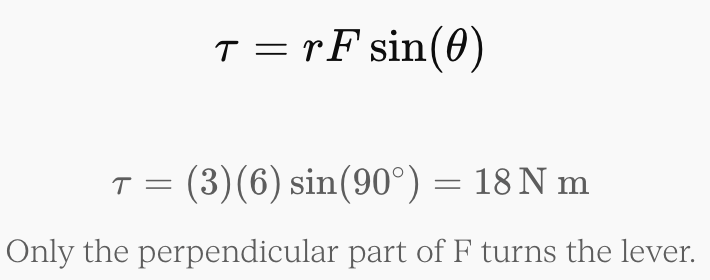
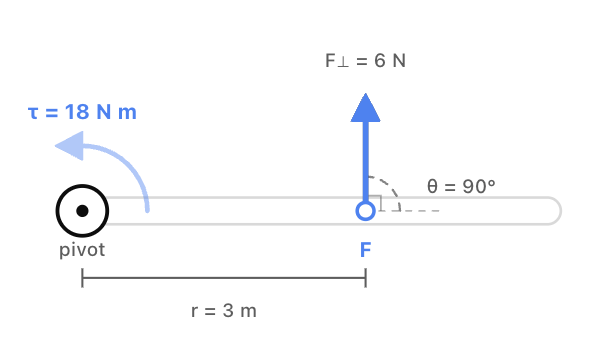
For a force acting perpendicular to a lever:
τ = Fr
where:
- τ = torque
- F = force
- r = perpendicular distance from the pivot to the line of action of the force
The SI unit of torque is: Nm or newton metre.
Force and Lever Arm
The distance between the pivot and the point where the force effectively acts is called the lever arm or moment arm.
For a perpendicular force:
Larger force → Larger torque
and:
Larger lever arm → Larger torque
This explains why applying the same force farther from the pivot produces a greater turning effect.