Rotational Dynamics and Torque
| サイト: | Young Education |
| コース: | Rigid Body Mechanics |
| ブック: | Rotational Dynamics and Torque |
| 印刷者: | Guest user |
| 日付: | 2026年 11月 9日(月曜日) 16:38 |
1. Torque
Learning outcomes
- I can define torque.
- I can calculate torque using force and lever arm distance.
- I can identify factors that affect torque.
- I can determine the direction of torque.
- I can apply torque concepts to real-world systems.
Torque
Torque is the turning effect produced by a force acting around a pivot or axis.
When you:
- open a door
- turn a wrench
- use a screwdriver
- pedal a bicycle
- turn a steering wheel
- balance on a seesaw
you are using torque.
Torque tells us how effective a force is at causing rotation.


What Is Torque?
A force can cause an object to move in a straight line, but if the force acts away from a pivot, it can also cause the object to rotate.
This rotational effect is called: Torque
Torque is sometimes also called the moment of a force.
For example, pushing on the handle of a door produces torque around the door's hinges.
The hinges act as the pivot.
Calculating Torque
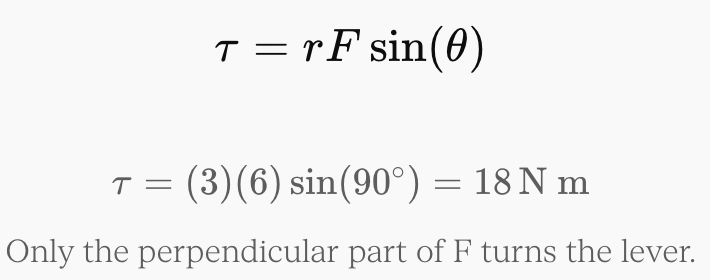
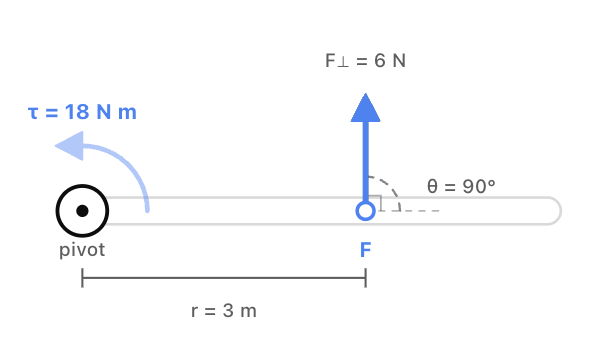
For a force acting perpendicular to a lever:
τ = Fr
where:
- τ = torque
- F = force
- r = perpendicular distance from the pivot to the line of action of the force
The SI unit of torque is: Nm or newton metre.
Force and Lever Arm
The distance between the pivot and the point where the force effectively acts is called the lever arm or moment arm.
For a perpendicular force:
Larger force → Larger torque
and:
Larger lever arm → Larger torque
This explains why applying the same force farther from the pivot produces a greater turning effect.


2. Rotational Equilibrium
Learning outcomes
- I can define rotational equilibrium.
- I can calculate net torque on an object.
- I can determine conditions for equilibrium.
- I can analyze balanced rotational systems.
- I can solve static equilibrium problems.
- .
- Examples for rods, disks, and spheres.
Rotational Equilibrium
An object is in rotational equilibrium when the combined turning effect of all forces acting on it is zero.
The turning effect of a force is called torque.
For rotational equilibrium:
Στ = 0
This means that the total clockwise torque and total counterclockwise torque balance each other.
An object in rotational equilibrium has:
α = 0
so its angular velocity does not change.
A stationary beam, balanced seesaw, hanging sign, ladder, bridge, or shelf can all provide examples of rotational equilibrium.


Torque
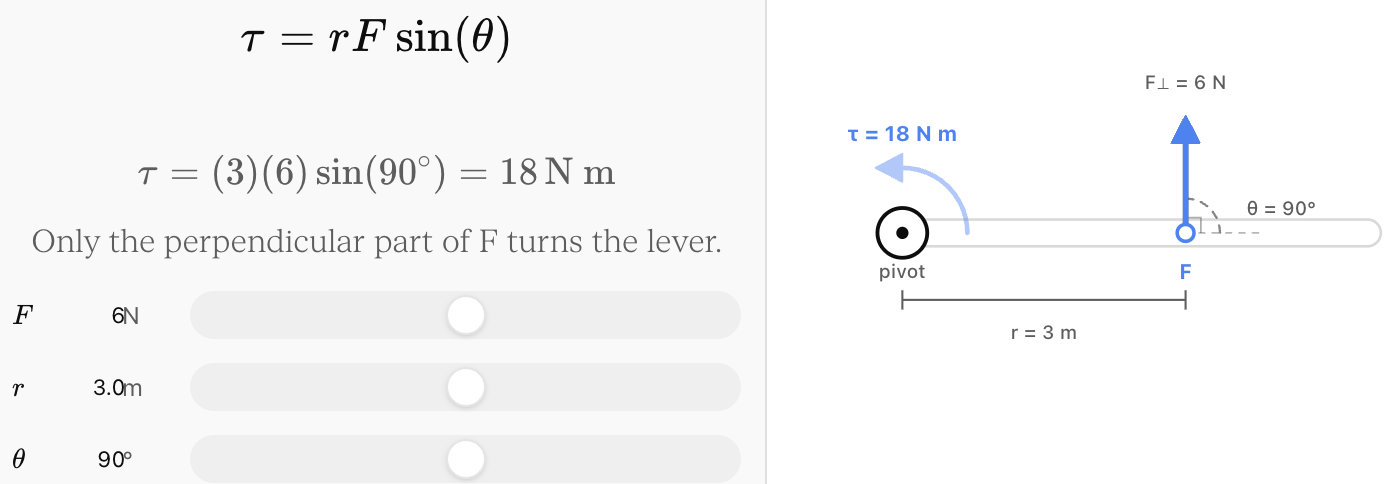
Torque measures the ability of a force to cause rotation about a pivot or axis.
It depends on:
- the magnitude of the force
- the distance from the pivot
- the angle at which the force acts


3. Moment of Inertia
Learning outcomes
- I can define moment of inertia.
- I can explain how mass distribution affects rotational motion.
- I can compare moments of inertia for different objects.
- I can calculate simple moments of inertia.
- I can predict how changing mass distribution affects rotation.
- Angular acceleration due to torque.
Moment of Inertia
Moment of inertia describes how difficult it is to change an object's rotational motion.
In linear motion, mass measures an object's resistance to linear acceleration. In rotational motion, moment of inertia plays a similar role: it measures an object's resistance to angular acceleration.
Moment of inertia is represented by:
I
Its SI unit is:
kg·m²
An object's moment of inertia depends on two important things:
- how much mass the object has
- how that mass is distributed relative to the axis of rotation
This second factor is especially important. Two objects with the same mass can have very different moments of inertia.


Mass and Rotational Inertia
In linear motion:
F = ma
A larger mass requires a larger force to produce the same acceleration.
The rotational equivalent is:
τ = Iα
where:
- τ = net torque
- I = moment of inertia
- α = angular acceleration
Therefore:
α = τ/I
For the same torque:
- smaller I → greater angular acceleration
- larger I → smaller angular acceleration
Moment of inertia is sometimes called rotational inertia because it describes resistance to changes in rotational motion.
Mass Distribution Matters
Moment of inertia does not depend only on total mass.
It also depends strongly on where the mass is located relative to the axis of rotation.
Mass farther from the axis contributes more to the moment of inertia than mass close to the axis.
For a single point mass:
I = mr²
where:
- m = mass
- r = perpendicular distance from the axis
Because r is squared, distance has a very large effect.
Worked Example: Point Mass
A:
3.0 kg
mass is located:
0.40 m
from an axis of rotation.
I = mr²
I = (3.0)(0.40²)
I = (3.0)(0.16)
I = 0.48 kg·m²
Moving the Mass Farther Out
Now move the same 3.0 kg mass to:
0.80 m
from the axis.
I = mr²
I = (3.0)(0.80²)
I = (3.0)(0.64)
I = 1.92 kg·m²
The radius doubled:
0.40 m → 0.80 m
but the moment of inertia increased by a factor of:
4
because:
I ∝ r²


Why Radius Has Such a Large Effect
For a point mass:
I = mr²
If the distance from the axis doubles:
I_new = m(2r)²
I_new = 4mr²
Therefore:
I_new = 4I
If the radius triples:
I_new = m(3r)²
I_new = 9I
If the radius is halved:
I_new = m(r/2)²
I_new = I/4
Mass distribution can therefore change rotational behaviour dramatically.
Several Point Masses
If an object consists of several point masses, their individual moments of inertia can be added.
I_total = Σmr²
or:
I_total = m₁r₁² + m₂r₂² + m₃r₃² + ...
Each mass is considered separately.
Worked Example: Two Masses
Two 2.0 kg masses are each located:
0.50 m
from an axis.
For each mass:
I = mr²
I = (2.0)(0.50²)
I = 0.50 kg·m²
There are two masses:
I_total = 0.50 + 0.50
I_total = 1.0 kg·m²
Worked Example: Masses at Different Distances
Three point masses rotate around the same axis:
- 2 kg at 1 m
- 3 kg at 2 m
- 1 kg at 3 m
Calculate the total moment of inertia.
I = Σmr²
I = (2)(1²) + (3)(2²) + (1)(3²)
I = 2 + 12 + 9
I = 23 kg·m²
Notice that the 1 kg mass contributes:
9 kg·m²
because it is farthest from the axis.
Despite having the smallest mass, it makes a large contribution to I.
Moment of Inertia Depends on the Axis
The same object can have different moments of inertia depending on the axis around which it rotates.
Consider a long rod.
It could rotate:
- around its centre
- around one end
- around another axis
The mass of the rod has not changed, but its distribution relative to the axis has changed.
Therefore:
moment of inertia must always be considered relative to a particular axis.


Common Moments of Inertia
For objects with continuous mass distributions, formulas have been derived for common shapes.
| Object | Axis | Moment of Inertia |
|---|---|---|
| Point mass | distance r from axis | I = mr² |
| Thin hoop/ring | through centre | I = MR² |
| Solid disk | through centre | I = 1/2 MR² |
| Solid cylinder | central axis | I = 1/2 MR² |
| Solid sphere | through centre | I = 2/5 MR² |
| Thin spherical shell | through centre | I = 2/3 MR² |
| Thin rod | through centre | I = 1/12 ML² |
| Thin rod | through one end | I = 1/3 ML² |
Here:
- M = total mass
- R = radius
- L = length
These equations apply to idealized uniform objects.
Comparing a Ring and a Solid Disk
Consider a thin ring and a solid disk with the same:
- mass M
- radius R
For the ring:
I_ring = MR²
For the disk:
I_disk = 1/2 MR²
Therefore:
I_ring = 2I_disk
The ring has twice the moment of inertia.
Why?
In the ring, essentially all the mass is located at radius R.
In the disk, much of the mass is closer to the axis.


Numerical Example
Suppose both objects have:
M = 4.0 kg
R = 0.50 m
For the ring:
I = MR²
I = (4.0)(0.50²)
I_ring = 1.0 kg·m²
For the disk:
I = 1/2 MR²
I = 1/2(4.0)(0.50²)
I_disk = 0.50 kg·m²
The ring is more difficult to angularly accelerate.
Comparing a Solid Sphere and Spherical Shell
For a solid sphere:
I = 2/5 MR²
For a thin spherical shell:
I = 2/3 MR²
For equal mass and radius:
2/3 > 2/5
Therefore:
I_shell > I_solid sphere
Again, the object with more mass concentrated farther from the axis has the larger moment of inertia.
Comparing Different Shapes
For objects with the same mass and outer radius:
more mass near the axis → smaller I
more mass far from the axis → larger I
For example:
| Shape | I | Relative Size |
|---|---|---|
| Solid sphere | 2/5 MR² | relatively small |
| Solid disk | 1/2 MR² | larger |
| Spherical shell | 2/3 MR² | larger still |
| Thin ring | MR² | largest of these examples |
The exact ranking depends on the objects and axes being compared, but the general principle remains:
moving mass outward increases moment of inertia.
Moment of Inertia and Angular Acceleration
Newton's Second Law for rotation is:
τ_net = Iα
Therefore:
α = τ_net/I
Suppose the same torque is applied to two objects.
Object A:
I = 2 kg·m²
Object B:
I = 8 kg·m²
The angular accelerations are:
α_A = τ/2
α_B = τ/8
Therefore:
Object A has four times the angular acceleration of Object B.
The object with the smaller moment of inertia responds more easily to torque.
Worked Example
A net torque of:
12 N·m
acts on an object with:
I = 3.0 kg·m²
Then:
α = τ/I
α = 12/3.0
α = 4.0 rad/s²
Larger Moment of Inertia
Suppose the same 12 N·m torque acts on an object with:
I = 6.0 kg·m²
Then:
α = 12/6
α = 2.0 rad/s²
Doubling I halved the angular acceleration.
For constant torque:
α ∝ 1/I
Linear and Rotational Inertia
There is an important parallel between linear and rotational motion.
| Linear Motion | Rotational Motion |
|---|---|
| Mass m | Moment of inertia I |
| Force F | Torque τ |
| Acceleration a | Angular acceleration α |
| F = ma | τ = Iα |
Mass measures resistance to linear acceleration.
Moment of inertia measures resistance to angular acceleration.
However, there is an important difference:
mass depends only on how much matter an object contains.
moment of inertia also depends on how that matter is distributed relative to the axis.
Changing Mass Distribution
Consider a rotating person holding weights.
If the person holds the weights close to their body, the masses are relatively close to the axis.
This gives a smaller moment of inertia.
If the person extends their arms, the masses move farther from the axis.
This gives a larger moment of inertia.


If there is little external torque, changing I also changes angular velocity through conservation of angular momentum, which will be explored in more detail later.
The important idea here is:
arms outward → larger I
arms inward → smaller I
Figure Skaters
A spinning figure skater provides a familiar example.
With arms extended:
- more mass is farther from the rotation axis
- moment of inertia is larger
With arms pulled inward:
- more mass is closer to the axis
- moment of inertia is smaller
The skater's mass remains essentially unchanged.
What changes is the distribution of mass.
Divers and Gymnasts
Divers and gymnasts use the same principle.
When they tuck their bodies:
- mass moves closer to the rotation axis
- moment of inertia decreases
- their rotational motion can change more rapidly
When they straighten their bodies:
- mass spreads farther from the axis
- moment of inertia increases


This allows athletes to control their rotation during jumps and flips.
A Rotating Chair Experiment
Imagine sitting on a low-friction rotating chair while holding two heavy objects.
With your arms extended, the masses are relatively far from your rotation axis.
Your moment of inertia is relatively large.
Pull the objects toward your body.
The masses move closer to the axis and your moment of inertia decreases.
This simple demonstration illustrates that I can change even though:
the total mass remains constant.
Why Heavy Rims Matter
Consider two wheels with the same total mass and radius.
Wheel A has much of its mass near the hub.
Wheel B has much of its mass concentrated around the rim.
Wheel B has the larger moment of inertia.
Therefore, the same torque produces less angular acceleration in Wheel B.


This is important when designing:
- vehicle wheels
- flywheels
- turbines
- motors
- machinery
Flywheels
A flywheel is designed to have a relatively large moment of inertia.
Much of its mass may be distributed away from the axis.
A large moment of inertia makes its rotational speed more resistant to rapid changes.
Flywheels can therefore help smooth variations in rotational motion and store rotational kinetic energy.
Rotational Kinetic Energy
A rotating object has rotational kinetic energy:
E_rot = 1/2 Iω²
This resembles linear kinetic energy:
E_k = 1/2 mv²
The comparison is:
| Linear | Rotational |
|---|---|
| E_k = 1/2 mv² | E_rot = 1/2 Iω² |
| mass m | moment of inertia I |
| speed v | angular speed ω |
Moment of inertia therefore affects not only angular acceleration but also the energy stored in rotation.
Worked Example: Rotational Energy
A flywheel has:
I = 5.0 kg·m²
and:
ω = 20 rad/s
Then:
E_rot = 1/2 Iω²
E_rot = 1/2(5.0)(20²)
E_rot = 2.5(400)
E_rot = 1000 J
Comparing Rotational Energy
Suppose two objects rotate at the same angular velocity.
Object A:
I = 2 kg·m²
Object B:
I = 6 kg·m²
Since:
E_rot = 1/2 Iω²
Object B has:
three times as much rotational kinetic energy
at the same angular velocity.
Moment of Inertia of a Rod
For a uniform thin rod rotating around its centre:
I = 1/12 ML²
For the same rod rotating around one end:
I = 1/3 ML²
Compare them:
(1/3)/(1/12) = 4
Therefore:
I_end = 4I_centre
The rod is much harder to angularly accelerate about its end because, on average, its mass is farther from the axis.


Worked Rod Example
A uniform rod has:
M = 6.0 kg
L = 2.0 m
About Its Centre
I = 1/12 ML²
I = 1/12(6)(2²)
I = 2.0 kg·m²
About One End
I = 1/3 ML²
I = 1/3(6)(2²)
I = 8.0 kg·m²
Therefore, rotating the rod around one end gives four times the moment of inertia.
Moment of Inertia of a Disk
For a solid disk rotating about its central axis:
I = 1/2 MR²
Suppose:
M = 8 kg
R = 0.40 m
Then:
I = 1/2(8)(0.40²)
I = 4(0.16)
I = 0.64 kg·m²
Moment of Inertia of a Ring
For a thin ring:
I = MR²
Suppose the ring has the same mass and radius:
M = 8 kg
R = 0.40 m
Then:
I = (8)(0.40²)
I = 1.28 kg·m²
The ring has twice the moment of inertia of the disk.
Predicting the Effect of Changing Mass
For objects whose shape and size remain the same:
I ∝ M
If mass doubles:
I doubles
If mass triples:
I triples
For example, a solid disk has:
I = 1/2 MR²
If M changes from M to 2M:
I_new = 1/2(2M)R²
I_new = 2I
Predicting the Effect of Changing Size
For many similar objects:
I ∝ R²
If radius doubles while mass remains constant:
I becomes four times larger.
For example, for a disk:
I = 1/2 MR²
If R becomes 2R:
I_new = 1/2 M(2R)²
I_new = 4(1/2 MR²)
I_new = 4I
Mass and Radius Changing Together
Suppose a thin ring changes from:
M → 2M
and:
R → 3R
Since:
I = MR²
the new moment of inertia is:
I_new = (2M)(3R)²
I_new = 18MR²
Therefore:
I_new = 18I
The radius has a particularly strong effect because it is squared.
Rotating Systems with Added Masses
Moment of inertia can also be changed by attaching masses to an existing rotating object.
Suppose a disk initially has:
I_disk = 2.0 kg·m²
Two 1.0 kg masses are attached:
0.50 m
from the axis.
Each contributes:
I = mr²
I = (1.0)(0.50²)
= 0.25 kg·m²
Two masses contribute:
0.50 kg·m²
Therefore:
I_total = 2.0 + 0.50
I_total = 2.50 kg·m²
Moving the Added Masses Outward
Now move both masses to:
1.0 m
from the axis.
Each contributes:
I = (1.0)(1.0²)
= 1.0 kg·m²
Together:
2.0 kg·m²
Therefore:
I_total = 2.0 + 2.0
I_total = 4.0 kg·m²
Moving the same masses outward significantly increased the rotational inertia.
Effect on Angular Acceleration
Suppose the net torque remains:
τ = 8 N·m
With:
I = 2.50 kg·m²
α = τ/I
α = 8/2.50
α = 3.2 rad/s²
After moving the masses outward:
I = 4.0 kg·m²
α = 8/4.0
α = 2.0 rad/s²
Moving mass outward reduced the angular acceleration produced by the same torque.
Rolling Objects
Moment of inertia also affects how objects roll.
Consider objects with the same mass and radius rolling down a slope.
An object must gain both:
- translational kinetic energy
- rotational kinetic energy
An object with a larger moment of inertia requires a larger share of its energy for rotation.
As a result, its centre of mass generally accelerates less rapidly down the slope.


For ideal rolling without slipping, objects such as a solid sphere generally reach the bottom sooner than a ring of the same mass and radius.
The reason is their different mass distributions and moments of inertia.
Comparing Rolling Objects
For equal M and R:
Thin ring:
I = MR²
Solid disk:
I = 1/2 MR²
Solid sphere:
I = 2/5 MR²
The solid sphere has the smallest rotational inertia relative to MR².
The ring has the largest.
This affects how quickly they accelerate while rolling.
Moment of Inertia and Engineering
Engineers deliberately control moment of inertia.
A small I may be useful when:
- rapid acceleration is needed
- rapid braking is needed
- machinery must respond quickly
- energy use during repeated acceleration should be reduced
A large I may be useful when:
- steady rotation is desirable
- rotational speed should resist sudden changes
- significant rotational energy needs to be stored
Vehicle Wheels
Reducing wheel mass can improve how quickly a vehicle's wheels change rotational speed.
Removing mass near the rim is especially effective because:
I depends on r²
One kilogram removed near the outer edge can affect moment of inertia much more than one kilogram removed close to the axle.
This is one reason mass distribution matters in wheel design.
Rotating Machinery
Moment of inertia affects how quickly motors, turbines, fans, and other rotating machines respond.
A motor must produce torque to change angular velocity:
τ = Iα
A machine with a large I requires greater torque to achieve the same angular acceleration.
It may also require more time to start or stop.
Moment of Inertia Is Not Torque
Moment of inertia and torque describe different things.
Moment of inertia describes resistance to angular acceleration.
Torque causes angular acceleration.
Their relationship is:
τ_net = Iα
This parallels:
F_net = ma
Moment of inertia is not itself a force or turning effect.
Moment of Inertia Is Not Angular Momentum
Moment of inertia is also different from angular momentum.
Moment of inertia:
I
describes the mass distribution.
Angular momentum:
L
describes rotational motion.
For a rigid object rotating about a fixed axis:
L = Iω
Changing I can therefore affect rotational behaviour, especially when angular momentum is conserved.
A Complete Example
A solid disk has:
M = 10 kg
R = 0.50 m
A net torque of:
τ = 15 N·m
acts on it.
Moment of Inertia
I = 1/2 MR²
I = 1/2(10)(0.50²)
I = 5(0.25)
I = 1.25 kg·m²
Angular Acceleration
τ = Iα
α = τ/I
α = 15/1.25
α = 12 rad/s²
If the disk starts from rest and the torque acts for 3.0 s:
ω_f = ω_i + αt
ω_f = 0 + (12)(3)
ω_f = 36 rad/s
This shows how moment of inertia connects torque to rotational motion.
Predicting Changes Without Full Calculations
Many moment-of-inertia problems can be solved using proportional reasoning.
If mass doubles:
I × 2
If radius doubles:
I × 4
If radius triples:
I × 9
If radius halves:
I × 1/4
If the same torque acts and I doubles:
α × 1/2
If the same torque acts and I becomes four times larger:
α × 1/4
Recognizing these patterns can make problems much faster to solve.
A Strategy for Moment of Inertia Problems
First identify the axis of rotation.
Then determine whether the object can be treated as:
- a point mass
- several point masses
- a ring
- a disk
- a cylinder
- a sphere
- a rod
Choose the appropriate expression for I.
Check that all distances are measured relative to the correct axis.
Calculate I.
If torque is involved, use:
τ_net = Iα
If rotational energy is involved, use:
E_rot = 1/2 Iω²
Finally, check whether the answer makes physical sense based on the mass distribution.
Common Mistakes
Thinking moment of inertia depends only on mass
Mass distribution is also essential.
Ignoring the axis of rotation
The same object can have different moments of inertia about different axes.
Forgetting to square the radius
For a point mass:
I = mr²
not mr.
Assuming objects with equal mass and radius have equal I
Their internal mass distributions may be different.
Thinking mass farther from the axis makes rotation easier
It increases I and makes angular acceleration harder to produce for the same torque.
Using the wrong shape formula
A ring and a solid disk do not have the same moment of inertia.
Using diameter instead of radius
Check which measurement is given.
Forgetting to add contributions from several masses
Use:
I_total = Σmr²
Confusing I with torque
I measures rotational inertia; torque causes changes in rotational motion.
Confusing moment of inertia with angular velocity
Moment of inertia describes mass distribution, not how quickly the object is rotating.
Key Terms
Moment of inertia (I) — measure of an object's resistance to angular acceleration about a particular axis.
Rotational inertia — another name for moment of inertia.
Mass distribution — arrangement of an object's mass relative to its rotation axis.
Axis of rotation — line around which an object rotates.
Point mass — idealized object whose mass is treated as concentrated at one position.
Radius (r) — perpendicular distance between a mass and the axis of rotation.
Torque (τ) — turning effect of a force.
Angular acceleration (α) — rate of change of angular velocity.
Rigid body — object whose particles maintain fixed positions relative to each other.
Thin ring — idealized circular object with its mass concentrated near one radius.
Solid disk — circular object whose mass is distributed throughout its area.
Centre of mass — average position of an object's mass distribution.
Rotational kinetic energy — energy associated with rotation, calculated using E_rot = 1/2 Iω².
Flywheel — rotating device designed to store rotational energy and resist rapid changes in angular speed.
Angular momentum — rotational quantity related to moment of inertia and angular velocity.
Key Takeaways
- Moment of inertia measures resistance to angular acceleration.
- Its symbol is I and its SI unit is kg·m².
- Moment of inertia is the rotational analogue of mass.
- Unlike ordinary mass, moment of inertia depends on how mass is distributed.
- Mass farther from the axis contributes much more strongly to I.
- For a point mass, I = mr².
- For several point masses, I_total = Σmr².
- Because radius is squared, doubling the distance from the axis increases a point mass's contribution to I by a factor of four.
- The same object can have different moments of inertia about different axes.
- A thin ring has a larger moment of inertia than a solid disk of the same mass and radius.
- Moving mass outward increases moment of inertia.
- Moving mass inward decreases moment of inertia.
- Torque and angular acceleration are related by τ_net = Iα.
- For the same torque, a larger I produces a smaller angular acceleration.
- Rotational kinetic energy is E_rot = 1/2 Iω².
- Figure skaters, divers, gymnasts, flywheels and vehicle wheels demonstrate the importance of mass distribution.
- Moment of inertia affects how quickly rotating machinery can start and stop.
- Understanding I is essential for predicting the behaviour of rotating systems.
Check Your Understanding
- Define moment of inertia and give its SI unit.
- Explain why moment of inertia is sometimes called rotational inertia.
- Calculate the moment of inertia of a 4.0 kg point mass located 0.50 m from an axis.
- The mass in Question 3 is moved to 1.0 m from the axis. Calculate its new moment of inertia and compare it with the original value.
- Three point masses are located around an axis: 2 kg at 0.50 m, 3 kg at 1.0 m, and 1 kg at 2.0 m. Calculate the total moment of inertia.
- Explain why a thin ring has a larger moment of inertia than a solid disk with the same mass and radius.
- A solid disk has mass 6.0 kg and radius 0.40 m. Calculate its moment of inertia.
- A thin ring has the same mass and radius as the disk in Question 7. Calculate its moment of inertia and compare the two values.
- A uniform rod has mass 3.0 kg and length 2.0 m. Calculate its moment of inertia when rotating about its centre.
- Calculate the moment of inertia of the same rod when rotating about one end. Explain why the answer is larger.
- A net torque of 20 N·m acts on an object with moment of inertia 5.0 kg·m². Calculate its angular acceleration.
- Two objects experience the same net torque. Object A has I = 2 kg·m², while Object B has I = 8 kg·m². Compare their angular accelerations.
- A rotating system contains two identical masses. Explain what happens to its moment of inertia if both masses are moved from 0.25 m to 0.50 m from the axis.
- Explain why pulling the arms inward changes the moment of inertia of a spinning figure skater even though the skater's total mass does not change.
- A solid disk has mass 8.0 kg, radius 0.50 m, and initially starts from rest. A constant net torque of 10 N·m acts for 4.0 s. Calculate the disk's moment of inertia, angular acceleration, final angular velocity, and rotational kinetic energy after 4.0 s.
4. Newton's Second Law for Rotation
Learning outcomes
- I can state the rotational form of Newton's Second Law.
- I can relate torque, moment of inertia, and angular acceleration.
- I can solve rotational dynamics problems.
- I can compare rotational and translational dynamics.
- I can analyze systems experiencing angular acceleration.
Newton's Second Law for Rotation
Newton's Second Law has a rotational form that describes how net torque produces angular acceleration.
In linear motion, a net force changes an object's linear velocity. In rotational motion, a net torque changes an object's angular velocity.
The rotational form of Newton's Second Law is:
Στ = Iα
where:
- Στ = net torque acting on the object
- I = moment of inertia
- α = angular acceleration
This relationship is one of the central equations of rotational dynamics.


From Linear Dynamics to Rotational Dynamics
Newton's Second Law for linear motion is:
ΣF = ma
The rotational equivalent is:
Στ = Iα
The quantities have direct parallels:
| Translational Motion | Rotational Motion |
|---|---|
| Force F | Torque τ |
| Mass m | Moment of inertia I |
| Linear acceleration a | Angular acceleration α |
| ΣF = ma | Στ = Iα |
Mass describes resistance to linear acceleration.
Moment of inertia describes resistance to angular acceleration.
Force produces linear acceleration.
Torque produces angular acceleration.
Understanding Στ = Iα
The equation tells us that angular acceleration depends on both:
- the net torque
- the moment of inertia
Rearranging:
α = Στ/I
Therefore, for a particular object:
larger net torque → larger angular acceleration
For a particular torque:
larger moment of inertia → smaller angular acceleration
Torque Produces Angular Acceleration
A force can produce torque when its line of action does not pass directly through the axis of rotation.
For a force applied at distance r:
τ = rF sin θ
For a perpendicular force:
τ = rF
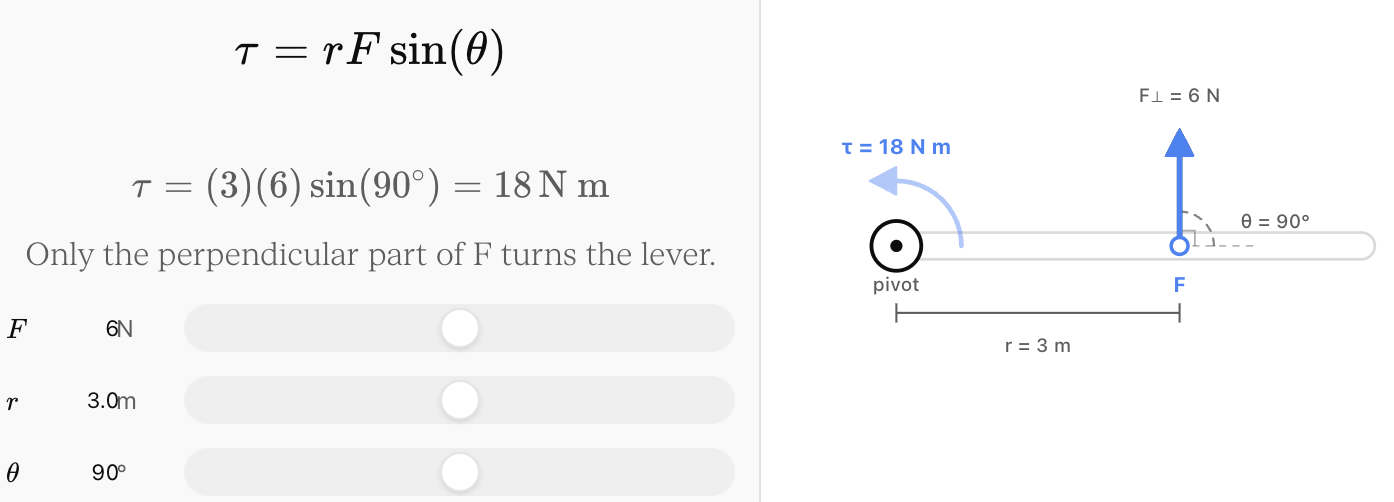
Increasing the force, increasing the lever arm, or making the force more perpendicular can increase the torque and therefore increase the angular acceleration.
Worked Example: Simple Rotational Dynamics
A wheel has moment of inertia:
I = 4.0 kg·m²
A net torque of:
τ = 12 N·m
acts on it.
Find its angular acceleration.
Use:
Στ = Iα
Rearrange:
α = Στ/I
α = 12/4.0
α = 3.0 rad/s²
The wheel's angular velocity changes by 3.0 rad/s each second.
Increasing the Torque
Suppose the same wheel experiences:
τ = 24 N·m
Then:
α = 24/4.0
α = 6.0 rad/s²
Doubling the net torque doubled the angular acceleration.
For constant I:
α ∝ τ
Increasing the Moment of Inertia
Now suppose:
τ = 12 N·m
but:
I = 8.0 kg·m²
Then:
α = 12/8.0
α = 1.5 rad/s²
Compared with the original 4.0 kg·m² wheel, doubling the moment of inertia halved the angular acceleration.
For constant torque:
α ∝ 1/I
Why Moment of Inertia Matters
Moment of inertia depends on:
- total mass
- shape
- size
- mass distribution
- axis of rotation
Moving mass farther from the axis generally increases I.
Therefore, the same torque produces less angular acceleration when more of the object's mass is distributed far from the axis.


Example: Moving Mass Outward
Suppose a rotating system initially has:
I = 2.0 kg·m²
and experiences:
τ = 10 N·m
Then:
α = 10/2.0
α = 5.0 rad/s²
The masses are then moved outward so that:
I = 5.0 kg·m²
With the same torque:
α = 10/5.0
α = 2.0 rad/s²
Moving the mass outward made the system more resistant to angular acceleration.
Net Torque
Usually, more than one torque acts on an object.
Newton's Second Law uses the net torque:
Στ = τ₁ + τ₂ + τ₃ + ...
A common sign convention is:
counterclockwise = positive
clockwise = negative
The torques must therefore be added with their signs before using:
Στ = Iα
Worked Example: Opposing Torques
A disk experiences:
- 18 N·m counterclockwise
- 6 N·m clockwise
Take counterclockwise as positive.
Στ = +18 − 6
Στ = +12 N·m
If:
I = 3.0 kg·m²
then:
α = 12/3.0
α = +4.0 rad/s²
The positive sign indicates angular acceleration in the counterclockwise direction.
Several Torques
Suppose a rotating object experiences:
- +20 N·m
- −8 N·m
- −5 N·m
- +3 N·m
Then:
Στ = 20 − 8 − 5 + 3
Στ = +10 N·m
If:
I = 2.5 kg·m²
then:
α = 10/2.5
α = +4.0 rad/s²
Always calculate the net torque before calculating angular acceleration.
Zero Net Torque
If:
Στ = 0
then:
Στ = Iα
0 = Iα
Therefore:
α = 0
This means the object's angular velocity does not change.
The object could be:
- stationary
- rotating at constant angular velocity
Zero net torque does not necessarily mean zero angular velocity.
Rotational Equilibrium
When:
Στ = 0
an object is in rotational equilibrium.
For example, if:
τ_CCW = +25 N·m
and:
τ_CW = −25 N·m
then:
Στ = 0
and:
α = 0
This connects Newton's Second Law for rotation directly to rotational equilibrium.
Torque from an Applied Force
Suppose a force of:
40 N
acts perpendicular to a lever:
0.50 m
from the axis.
Torque:
τ = rF
τ = (0.50)(40)
τ = 20 N·m
If the rotating system has:
I = 5.0 kg·m²
then:
α = τ/I
α = 20/5.0
α = 4.0 rad/s²
This type of problem requires two steps:
- calculate torque
- use Στ = Iα
Force Applied at an Angle
Suppose:
F = 60 N
r = 0.40 m
θ = 30°
Then:
τ = rF sin θ
τ = (0.40)(60)(sin 30°)
τ = (0.40)(60)(0.50)
τ = 12 N·m
If:
I = 3.0 kg·m²
then:
α = 12/3.0
α = 4.0 rad/s²
Only the component of the force perpendicular to the lever arm contributes to torque.
Force Through the Axis
If a force's line of action passes directly through the rotation axis:
τ = 0
Even a very large force can produce no angular acceleration if it produces no torque.
This explains why the location and direction of a force matter in rotational dynamics.
Force Applied at Different Distances
Suppose a 20 N perpendicular force acts on a wheel.
At:
r = 0.10 m
τ = (0.10)(20)
τ = 2 N·m
At:
r = 0.50 m
τ = (0.50)(20)
τ = 10 N·m
The same force produces five times the torque when applied five times farther from the axis.
If I remains constant, it also produces five times the angular acceleration.
Door Example
A door provides a simple example of rotational dynamics.
The hinges form the rotation axis.
If you push close to the hinges:
- r is small
- torque is small
- angular acceleration is small
If you push at the handle:
- r is larger
- torque is larger
- angular acceleration is larger
This is why door handles are placed far from the hinges.


Rotating Disk
For a solid disk rotating around its central axis:
I = 1/2 MR²
Suppose:
M = 6.0 kg
R = 0.40 m
First calculate I:
I = 1/2(6.0)(0.40²)
I = 3.0(0.16)
I = 0.48 kg·m²
If a net torque of:
2.4 N·m
acts on the disk:
α = 2.4/0.48
α = 5.0 rad/s²
From Angular Acceleration to Angular Velocity
Once angular acceleration is known, rotational kinematics can be used.
For constant α:
ω_f = ω_i + αt
Suppose the disk in the previous example starts from rest and the torque acts for:
4.0 s
Then:
ω_f = 0 + (5.0)(4.0)
ω_f = 20 rad/s
Rotational dynamics determines α.
Rotational kinematics then describes the resulting motion.
Finding Angular Displacement
For constant angular acceleration:
Δθ = ω_i t + 1/2 αt²
For the same disk:
ω_i = 0
α = 5.0 rad/s²
t = 4.0 s
Then:
Δθ = 1/2(5.0)(4.0²)
Δθ = 2.5(16)
Δθ = 40 rad
Number of revolutions:
N = 40/(2π)
N ≈ 6.37 revolutions
Dynamics and Kinematics Work Together
A common rotational problem may require several stages.
Dynamics
Use the forces to calculate torque:
τ = rF sin θ
Newton's Second Law
Use torque to calculate angular acceleration:
Στ = Iα
Kinematics
Use angular acceleration to calculate motion:
ω_f = ω_i + αt
or:
Δθ = ω_i t + 1/2 αt²
This chain is extremely important:
force → torque → angular acceleration → rotational motion
Comparing Translational and Rotational Problem Solving
The same pattern appears in linear mechanics.
Linear
force → linear acceleration → linear motion
ΣF = ma
then use equations such as:
v_f = v_i + at
Rotational
torque → angular acceleration → rotational motion
Στ = Iα
then use:
ω_f = ω_i + αt
The mathematics and reasoning are closely related.
Complete Linear-Rotational Comparison
| Translational | Rotational |
|---|---|
| Position x | Angular position θ |
| Displacement Δx | Angular displacement Δθ |
| Velocity v | Angular velocity ω |
| Acceleration a | Angular acceleration α |
| Mass m | Moment of inertia I |
| Force F | Torque τ |
| ΣF = ma | Στ = Iα |
| p = mv | L = Iω |
| E_k = 1/2 mv² | E_rot = 1/2 Iω² |
These parallels help organize rotational mechanics.
A Wheel Driven by a Force
Consider a solid wheel with:
M = 8.0 kg
R = 0.50 m
A tangential force of:
F = 12 N
acts at its edge.
Assume no other torque.
Torque
τ = rF
τ = (0.50)(12)
τ = 6.0 N·m
Moment of Inertia
For a solid disk:
I = 1/2 MR²
I = 1/2(8.0)(0.50²)
I = 4(0.25)
I = 1.0 kg·m²
Angular Acceleration
α = τ/I
α = 6.0/1.0
α = 6.0 rad/s²
If it begins from rest, after 3 s:
ω = αt
ω = (6.0)(3)
ω = 18 rad/s
A Ring Under the Same Conditions
Now replace the solid disk with a thin ring having the same:
- mass
- radius
- applied force
For a ring:
I = MR²
I = (8.0)(0.50²)
I = 2.0 kg·m²
The torque remains:
6.0 N·m
Therefore:
α = 6.0/2.0
α = 3.0 rad/s²
The ring has twice the moment of inertia, so it has half the angular acceleration.


Why Shape Matters
The disk and ring have:
- the same mass
- the same radius
- the same applied force
- the same torque
Yet they have different angular accelerations.
The reason is their different mass distributions.
For the ring, more mass lies far from the axis.
Therefore:
I_ring > I_disk
and consequently:
α_ring < α_disk
for the same torque.
Rod Rotating About Its Centre
For a uniform rod rotating about its centre:
I = 1/12 ML²
Suppose:
M = 3.0 kg
L = 2.0 m
Then:
I = 1/12(3.0)(2.0²)
I = 1.0 kg·m²
If:
τ = 4.0 N·m
then:
α = 4.0/1.0
α = 4.0 rad/s²
Rod Rotating About One End
For the same rod rotating about one end:
I = 1/3 ML²
I = 1/3(3.0)(2.0²)
I = 4.0 kg·m²
With the same torque:
α = 4.0/4.0
α = 1.0 rad/s²
Changing the axis changed the moment of inertia and therefore changed the angular acceleration.
Pulley Systems
Newton's Second Law for rotation is particularly useful for pulleys.
A tension force acting on the edge of a pulley produces torque:
τ = rT
If two different tensions act on opposite sides:
τ_net = (T₁ − T₂)r
depending on the chosen direction.
Then:
(T₁ − T₂)r = Iα


Linear and Angular Acceleration in a Pulley
If a rope does not slip on the pulley:
a = rα
Therefore:
α = a/r
This connects the rotational motion of the pulley to the linear motion of the rope and attached masses.
Worked Pulley Example
A pulley has:
I = 0.50 kg·m²
r = 0.20 m
Two tensions act:
T₁ = 30 N
T₂ = 20 N
Net torque:
τ_net = (T₁ − T₂)r
τ_net = (30 − 20)(0.20)
τ_net = 2.0 N·m
Angular acceleration:
α = τ/I
α = 2.0/0.50
α = 4.0 rad/s²
The linear acceleration of the rope is:
a = rα
a = (0.20)(4.0)
a = 0.80 m/s²
Why Real Pulleys Matter
In introductory problems, pulleys are sometimes treated as massless.
A massless pulley is assumed to have negligible moment of inertia.
A real pulley has:
I > 0
so some of the system's torque is required to angularly accelerate it.
This can make the acceleration of a real system smaller than the acceleration predicted using an ideal massless pulley.
Rotational Dynamics of Gears
For meshing gears, forces at the contact points produce torques.
Because:
τ = rF
a larger gear can experience a larger torque from the same tangential force.
However, its moment of inertia may also be larger.
The resulting angular acceleration depends on:
α = τ/I
Therefore, gear behaviour depends on both torque and rotational inertia.


Motors and Rotational Dynamics
Electric motors generate torque.
If a motor produces approximately constant net torque:
α = τ/I
A motor can accelerate a low-inertia system quickly.
A high-inertia system accelerates more slowly unless the motor provides greater torque.
This is important when selecting motors for:
- robots
- conveyor systems
- elevators
- manufacturing equipment
- electric vehicles
Frictional Torque
Friction can oppose rotation and produce a torque opposite the motion.
Suppose a motor produces:
τ_motor = +30 N·m
while friction produces:
τ_friction = −6 N·m
Then:
Στ = 30 − 6
Στ = 24 N·m
If:
I = 8 kg·m²
then:
α = 24/8
α = 3 rad/s²
The motor's torque is not necessarily the same as the net torque.
Braking Torque
Brakes deliberately produce torque opposite the angular velocity.
Suppose a wheel rotates counterclockwise, so:
ω > 0
A braking torque acts clockwise:
τ < 0
Therefore:
α < 0
and the wheel slows down.
Worked Braking Example
A wheel has:
I = 2.0 kg·m²
ω_i = 24 rad/s
A constant braking torque of:
−8.0 N·m
is applied.
Angular acceleration:
α = τ/I
α = −8.0/2.0
α = −4.0 rad/s²
Stopping time:
ω_f = ω_i + αt
0 = 24 − 4t
t = 6.0 s
Angular Displacement While Braking
For the same wheel:
Δθ = [(ω_i + ω_f)/2]t
Δθ = (24 + 0)/2
Δθ = 12(6)
Δθ = 72 rad
Number of revolutions:
N = 72/(2π)
N ≈ 11.5 revolutions
The wheel completes more than 11 rotations while stopping.
Rotational Direction and Signs
Choosing a sign convention is essential.
For example:
counterclockwise = positive
Then:
- counterclockwise torque → positive τ
- clockwise torque → negative τ
- positive α → angular velocity changes counterclockwise
- negative α → angular velocity changes clockwise
The sign of α does not by itself tell you whether the object is speeding up.
Compare α with ω.
Speeding Up and Slowing Down
If ω and α have the same sign:
rotational speed increases
If ω and α have opposite signs:
rotational speed decreases
For example:
ω = +10 rad/s
α = −2 rad/s²
The object is rotating counterclockwise but slowing down.
If:
ω = −10 rad/s
α = −2 rad/s²
the object is rotating clockwise and speeding up.
Newton's Second Law and Rotational Equilibrium
Newton's Second Law also explains rotational equilibrium.
If:
Στ = 0
then:
Iα = 0
and:
α = 0
If the object is initially stationary, it remains rotationally stationary unless a net torque acts.
This is the rotational counterpart of Newton's First Law.
Rotational Dynamics and Energy
Torque can also transfer energy to a rotating object.
For constant torque acting through angular displacement:
W = τΔθ
The rotational kinetic energy is:
E_rot = 1/2 Iω²
The work-energy relationship becomes:
W_net = ΔE_rot
This provides another way to analyze some rotational systems.
Worked Energy Example
A constant torque of:
10 N·m
rotates a wheel through:
20 rad
Work done:
W = τΔθ
W = (10)(20)
W = 200 J
If the wheel begins from rest and losses are negligible:
E_rot = 200 J
If:
I = 4.0 kg·m²
then:
200 = 1/2(4.0)ω²
200 = 2ω²
ω² = 100
ω = 10 rad/s
A Complete Rotational Dynamics Problem
A solid disk has:
M = 12 kg
R = 0.50 m
A tangential force of:
F = 18 N
acts at its edge.
A frictional torque of:
1.5 N·m
opposes the motion.
The disk begins from rest.
Find its angular acceleration and angular velocity after 5.0 s.
Applied Torque
τ_applied = rF
τ_applied = (0.50)(18)
τ_applied = 9.0 N·m
Net Torque
τ_net = 9.0 − 1.5
τ_net = 7.5 N·m
Moment of Inertia
For a solid disk:
I = 1/2 MR²
I = 1/2(12)(0.50²)
I = 6(0.25)
I = 1.5 kg·m²
Angular Acceleration
α = τ_net/I
α = 7.5/1.5
α = 5.0 rad/s²
Angular Velocity
ω_f = ω_i + αt
ω_f = 0 + (5.0)(5.0)
ω_f = 25 rad/s
This problem combines force, torque, moment of inertia and rotational kinematics.
Analyzing Rotational Systems
A useful approach is to work through the system in a logical sequence.
Identify the rotation axis.
All torques and moments of inertia must refer to the same axis.
Draw the forces.
Identify which forces produce torque.
Choose a positive rotational direction.
Usually counterclockwise is positive.
Calculate each torque.
Use:
τ = rF sin θ
or the perpendicular moment arm.
Calculate net torque.
Add the torques with their signs.
Determine the moment of inertia.
Use the appropriate expression for the object's mass distribution.
Apply Newton's Second Law.
Στ = Iα
Use rotational kinematics if necessary.
Once α is known, determine ω, θ, or t.
Common Mistakes
Using an individual torque instead of net torque
Newton's Second Law uses:
Στ
not simply the largest torque.
Forgetting torque direction
Clockwise and counterclockwise torques should have opposite signs.
Confusing torque with force
Force and torque are related but different quantities.
Ignoring the lever arm
A force through the axis produces no torque.
Using mass instead of moment of inertia
The rotational equation is:
Στ = Iα
not τ = mα.
Ignoring mass distribution
Moment of inertia depends on where the mass lies relative to the axis.
Assuming larger torque always means larger α
Moment of inertia must also be considered.
Assuming larger I means faster rotation
A larger I means greater resistance to changes in angular velocity.
Forgetting frictional torque
Applied torque and net torque may not be the same.
Confusing angular velocity with angular acceleration
Torque produces angular acceleration, not directly angular velocity.
Using linear acceleration where angular acceleration is required
Use α in rad/s².
Using rotational kinematics before finding α
In many dynamics problems, first calculate net torque and I, then determine α.
Key Terms
Newton's Second Law for rotation — relationship between net torque, moment of inertia and angular acceleration.
Net torque (Στ) — sum of all torques acting about an axis, including their directions.
Torque (τ) — turning effect of a force about an axis.
Moment of inertia (I) — measure of an object's resistance to angular acceleration.
Angular acceleration (α) — rate of change of angular velocity.
Lever arm — distance associated with the turning effect of a force.
Axis of rotation — line around which an object rotates.
Rotational dynamics — study of the torques and rotational inertia responsible for rotational motion.
Rotational equilibrium — condition in which net torque is zero.
Frictional torque — torque that opposes rotational motion.
Braking torque — torque deliberately applied opposite the rotation to reduce angular velocity.
Tangential force — force acting tangent to a circular path and therefore perpendicular to the radius.
Angular velocity (ω) — rate of change of angular position.
Rotational kinetic energy — kinetic energy associated with rotation, E_rot = 1/2 Iω².
Rotational work — energy transferred by torque acting through an angular displacement.
Key Takeaways
- Newton's Second Law for rotation is Στ = Iα.
- Net torque plays the rotational role that net force plays in linear motion.
- Moment of inertia plays the rotational role that mass plays in linear motion.
- Angular acceleration plays the rotational role that linear acceleration plays in linear motion.
- For constant I, greater net torque produces greater angular acceleration.
- For constant net torque, greater moment of inertia produces smaller angular acceleration.
- Torque depends on the applied force, its distance from the axis, and its direction.
- For a perpendicular force, τ = rF.
- Multiple torques must be combined to determine net torque.
- Clockwise and counterclockwise torques have opposite signs.
- If Στ = 0, then α = 0.
- Zero angular acceleration does not necessarily mean zero angular velocity.
- Mass distribution affects rotational dynamics through moment of inertia.
- A ring and a disk can respond differently to the same torque even if they have the same mass and radius.
- Frictional torque reduces the net torque available for angular acceleration.
- Braking torque can produce angular acceleration opposite to the angular velocity.
- Dynamics determines angular acceleration; kinematics can then determine angular velocity and displacement.
- Pulley systems connect rotational and linear motion through a = rα.
- Work done by a constant torque can be calculated using W = τΔθ.
- Rotational kinetic energy is E_rot = 1/2 Iω².
- Newton's laws provide a unified framework for both translational and rotational dynamics.
Check Your Understanding
- State Newton's Second Law for rotation and define each quantity.
- An object has moment of inertia 4.0 kg·m² and experiences a net torque of 20 N·m. Calculate its angular acceleration.
- The same torque acts on an object with twice the moment of inertia. Calculate its angular acceleration and explain the change.
- A 30 N force acts perpendicular to a lever 0.40 m from its axis. Calculate the torque.
- If the system in Question 4 has I = 3.0 kg·m², calculate its angular acceleration.
- A disk experiences +25 N·m, −10 N·m, and −5 N·m of torque. If I = 2.0 kg·m², calculate the net torque and angular acceleration.
- Explain why a force directed through the rotation axis produces no angular acceleration even if the force is large.
- A solid disk has mass 8.0 kg and radius 0.50 m. Calculate its moment of inertia. If a net torque of 6.0 N·m acts on it, calculate its angular acceleration.
- A thin ring has the same mass and radius as the disk in Question 8. Calculate its angular acceleration under the same torque and explain why the result differs.
- A wheel has I = 3.0 kg·m² and initially rotates at 20 rad/s. A constant braking torque of −6.0 N·m is applied. Calculate its angular acceleration and the time required to stop.
- For Question 10, calculate the angular displacement while the wheel is stopping.
- A pulley has I = 0.80 kg·m² and radius 0.25 m. Tensions of 40 N and 24 N act on opposite sides. Calculate the net torque, angular acceleration, and linear acceleration of the rope.
- A motor provides 30 N·m of torque while friction provides an opposing torque of 6 N·m. The rotating machinery has I = 8.0 kg·m². If it starts from rest, calculate its angular acceleration and angular velocity after 10 s.
- Explain how moving mass farther from an axis affects moment of inertia and the angular acceleration produced by a fixed torque.
- A solid disk of mass 10 kg and radius 0.40 m starts from rest. A 25 N tangential force acts at its rim while friction produces an opposing torque of 2.0 N·m. Calculate the applied torque, net torque, moment of inertia, angular acceleration, angular velocity after 5.0 s, and angular displacement during those 5.0 s.
5. Applications of Rotational Dynamics
Learning outcomes
- I can apply rotational dynamics to wheels and gears.
- I can explain how levers increase mechanical advantage.
- I can analyze rotational systems in engineering.
- I can evaluate rotational motion in sports.
- I can solve practical rotational mechanics problems.
- Applications in machinery and sports.


