Atomic Nuclei and Radioactivity
1. Structure of the Atom
Learning outcomes
- I can identify the particles that make up an atom.
- I can describe the location and charge of protons, neutrons, and electrons.
- I can explain how the nucleus differs from the electron cloud.
- I can determine the atomic number and mass number of an atom.
- I can distinguish between atoms and ions.
Structure of the Atom
Everything around us is made of matter, and matter is made of extremely small particles called atoms.
An atom is the smallest particle of an element that still has the chemical properties of that element.
Atoms themselves contain three main types of subatomic particles:
- protons
- neutrons
- electrons
The number and arrangement of these particles determine the identity, mass, and electrical charge of an atom.


The Three Subatomic Particles
Protons, neutrons, and electrons have different locations, charges, and masses.
| Particle | Location | Relative Charge | Relative Mass |
|---|---|---|---|
| Proton | Nucleus | +1 | 1 |
| Neutron | Nucleus | 0 | 1 |
| Electron | Electron cloud | −1 | About 1/1836 |
Protons and neutrons have approximately the same mass.
Electrons have much less mass.
Protons
A proton is a positively charged particle found in the nucleus.
Protons have:
- relative charge = +1
- relative mass = 1
- location = nucleus
The number of protons determines which element an atom is.
For example:
- hydrogen atoms have 1 proton
- carbon atoms have 6 protons
- oxygen atoms have 8 protons
- sodium atoms have 11 protons
Changing the number of protons changes the identity of the element.
Neutrons
A neutron is an electrically neutral particle found in the nucleus.
Neutrons have:
- relative charge = 0
- relative mass = 1
- location = nucleus
Neutrons contribute to the mass of an atom but do not contribute to its electrical charge.
Atoms of the same element can sometimes contain different numbers of neutrons. These are called isotopes.
For example, carbon atoms always have 6 protons, but different carbon isotopes can contain different numbers of neutrons.
Electrons
An electron is a negatively charged particle found outside the nucleus.
Electrons have:
- relative charge = −1
- relative mass ≈ 1/1836
- location = electron cloud
Electrons are responsible for many of the chemical properties of elements.
They are especially important in:
- chemical bonding
- ion formation
- chemical reactions
- electrical conductivity


The Nucleus
At the center of an atom is the nucleus.
The nucleus contains:
- protons
- neutrons
The nucleus is:
- extremely small
- positively charged overall
- very dense
- responsible for almost all of the atom's mass
Even though the nucleus occupies only a tiny fraction of the atom's volume, almost all of the atom's mass is concentrated there.
The Electron Cloud
Electrons occupy regions around the nucleus called the electron cloud.
The electron cloud:
- contains electrons
- occupies most of the atom's volume
- has an overall negative charge
- contains very little of the atom's mass
In introductory models, electrons are often shown arranged in shells or energy levels around the nucleus.
These diagrams are useful models, although electrons do not actually travel around the nucleus in simple circular paths like planets around the Sun.


Nucleus vs Electron Cloud
| Nucleus | Electron Cloud |
|---|---|
| Center of atom | Surrounds nucleus |
| Contains protons and neutrons | Contains electrons |
| Positive overall | Negative overall |
| Very small volume | Most of atom's volume |
| Contains almost all atomic mass. | Contains very little atomic mass |
| Very dense | Mostly empty space |
The atom therefore has a tiny, massive nucleus surrounded by a much larger region occupied by electrons.
Atoms Are Mostly Empty Space
The nucleus is extremely small compared with the entire atom.
If an atom were enlarged to the size of a large stadium, its nucleus would still be tiny compared with the stadium itself.
Most of the atom's volume is the region associated with its electrons.
This means that matter that appears completely solid is, at the atomic scale, largely empty space.
Neutral Atoms
A normal atom is electrically neutral.
This means:
number of protons = number of electrons
The positive charges from the protons balance the negative charges from the electrons.
For example, a neutral oxygen atom contains:
- 8 protons
- 8 electrons
Total positive charge = +8
Total negative charge = −8
Overall charge = 0
Atomic Number
The atomic number is the number of protons in the nucleus of an atom.
Therefore:
Atomic number = number of protons
The atomic number is sometimes represented by:
Z
Every element has a unique atomic number.
For example:
| Element | Atomic Number | Protons |
|---|---|---|
| Hydrogen | 1 | 1 |
| Helium | 2 | 2 |
| Carbon | 6 | 6 |
| Oxygen | 8 | 8 |
| Sodium | 11 | 11 |
| Chlorine | 17 | 17 |
The periodic table is arranged according to increasing atomic number.
Atomic Number Identifies the Element
The number of protons determines the identity of an element.
For example:
6 protons → carbon
7 protons → nitrogen
8 protons → oxygen
9 protons → fluorine
If the number of neutrons changes, it can still be the same element.
If the number of electrons changes, it can still be the same element.
But if the number of protons changes, the element changes.
Mass Number
The mass number is the total number of protons and neutrons in the nucleus.
Therefore:
Mass number = number of protons + number of neutrons
The mass number is usually represented by:
A
Electrons are not included because their masses are extremely small compared with protons and neutrons.
Calculating the Number of Neutrons
Because:
Mass number = protons + neutrons
we can rearrange this relationship:
Number of neutrons = mass number − atomic number
Remember:
Atomic number = number of protons
Therefore:
Neutrons = mass number − atomic number
Worked Example: Carbon
A carbon atom has:
Atomic number = 6
Mass number = 12
Number of protons:
= atomic number
= 6
Number of neutrons:
= mass number − atomic number
= 12 − 6
= 6
For a neutral carbon atom:
electrons = protons
Therefore:
electrons = 6
The atom contains:
- 6 protons
- 6 neutrons
- 6 electrons
Worked Example: Sodium
A sodium atom has:
Atomic number = 11
Mass number = 23
Protons:
= 11
Neutrons:
= 23 − 11
= 12
Because the atom is neutral:
Electrons:
= 11
Therefore, this sodium atom contains:
- 11 protons
- 12 neutrons
- 11 electrons
Nuclear Symbol Notation
Atoms can be represented using notation showing their atomic number and mass number.
A general representation is:
\( {A \brack Z} X \)
where:
A = mass number
Z = atomic number
X = chemical symbol
For example, carbon-12 can be represented as:
¹²₆C
This tells us:
Mass number = 12
Atomic number = 6
Therefore:
Protons = 6
Neutrons = 12 − 6 = 6
Determining Atomic Composition
When you know the numbers of protons, neutrons, and electrons, you can determine the atom's identity, mass number, and charge.
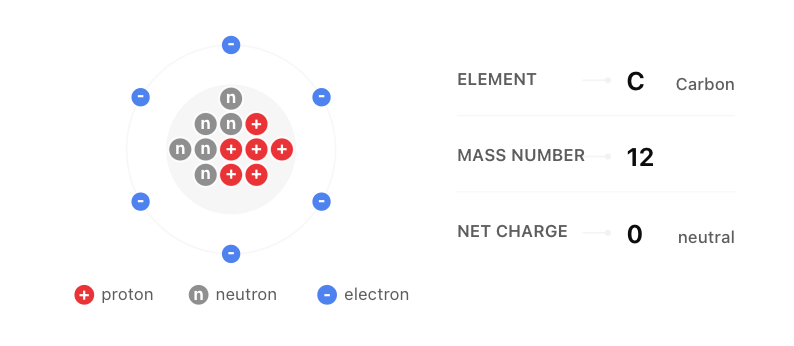
A useful strategy is:
Protons → identify the element
Protons + neutrons → determine mass number
Compare protons and electrons → determine charge
Worked Example
A particle contains:
- 15 protons
- 16 neutrons
- 15 electrons
Step 1: Identify the element.
15 protons means atomic number 15.
The element is phosphorus.
Step 2: Determine mass number.
15 + 16 = 31
Mass number = 31
Step 3: Determine charge.
15 protons and 15 electrons balance.
Overall charge = 0
Therefore, the particle is a neutral phosphorus-31 atom.
Atoms and Ions
An atom is electrically neutral because it contains equal numbers of protons and electrons.
An ion is a charged particle formed when an atom gains or loses electrons.
The number of protons does not normally change during ion formation.
Instead, electrons are transferred.


Positive Ions
A positive ion, or cation, forms when an atom loses one or more electrons.
Consider sodium.
A neutral sodium atom has:
11 protons
11 electrons
If it loses one electron:
11 protons
10 electrons
Charge:
+11 + (−10) = +1
Therefore:
Na → Na⁺
The sodium ion has a charge of +1.
Negative Ions
A negative ion, or anion, forms when an atom gains one or more electrons.
Consider chlorine.
A neutral chlorine atom has:
17 protons
17 electrons
If it gains one electron:
17 protons
18 electrons
Charge:
+17 + (−18) = −1
Therefore:
Cl → Cl⁻
The chloride ion has a charge of −1.
Determining the Charge of an Ion
The overall charge can be determined by comparing protons and electrons.
Charge = number of protons − number of electrons
For example:
12 protons and 10 electrons:
Charge = 12 − 10
= +2
The particle has a 2+ charge.
Another example:
9 protons and 10 electrons:
Charge = 9 − 10
= −1
The particle has a 1− charge.
Atoms vs Ions
| Atom | Ion |
|---|---|
| Electrically neutral | Electrically charged |
| Protons = electrons | Protons ≠ electrons |
| Has no overall charge | Has positive or negative charge |
| Has not gained or lost electrons overall. | Has gained or lost electrons |
The identity of the element remains the same because the number of protons remains unchanged.
Cations vs Anions
| Cation | Anion |
|---|---|
| Positive ion | Negative ion |
| Loses electrons | Gains electrons |
| More protons than electrons. | More electrons than protons |
| Example: Na⁺ | Example: Cl⁻ |
A useful memory aid is:
Lose electrons → positive
Gain electrons → negative
This happens because electrons carry negative charge.
Ion Formation and the Nucleus
When an atom becomes an ion:
- the number of protons stays the same
- the number of neutrons stays the same
- the number of electrons changes
Therefore:
- atomic number stays the same
- mass number stays the same
- electrical charge changes
Ion formation is an electronic change, not a change to the nucleus.
Worked Example: Magnesium Ion
A magnesium ion contains:
- 12 protons
- 12 neutrons
- 10 electrons
Atomic number:
= 12
Mass number:
= 12 + 12
= 24
Charge:
= 12 − 10
= +2
Therefore, the particle is:
Mg²⁺
Worked Example: Oxide Ion
An oxygen particle contains:
- 8 protons
- 8 neutrons
- 10 electrons
Atomic number:
= 8
Mass number:
= 8 + 8
= 16
Charge:
= 8 − 10
= −2
Therefore, the particle is:
O²⁻
Worked Example: Identify an Unknown Particle
An unknown particle contains:
- 17 protons
- 18 neutrons
- 18 electrons
Step 1: Identify the element.
17 protons means atomic number 17.
The element is chlorine.
Step 2: Calculate mass number.
17 + 18 = 35
Mass number = 35
Step 3: Determine charge.
17 − 18 = −1
Therefore, the particle is a chloride ion, Cl⁻, with mass number 35.
Isotopes
Atoms of the same element always have the same number of protons.
However, they may have different numbers of neutrons.
These atoms are called isotopes.
For example:
Carbon-12:
- 6 protons
- 6 neutrons
Carbon-14:
- 6 protons
- 8 neutrons
Both are carbon because both have 6 protons.
Their mass numbers are different because they contain different numbers of neutrons.


Atom, Ion, and Isotope
These terms describe different ideas.
Atom
A neutral particle with equal numbers of protons and electrons.
Ion
A charged particle formed by gaining or losing electrons.
Isotope
An atom of an element with a particular number of neutrons.
An isotope can also become an ion.
For example, changing electrons affects charge, while changing neutrons affects isotope identity.
Changing protons changes the element itself.
A Useful Particle Checklist
When given information about an atom or ion, work in this order:
1. Count the protons.
This identifies the element and gives the atomic number.
2. Add protons and neutrons.
This gives the mass number.
3. Compare protons and electrons.
This determines the charge.
Remember:
protons = element
protons + neutrons = mass number
protons compared with electrons = charge
Common Misconceptions
Electrons are found inside the nucleus.
Incorrect. Protons and neutrons are in the nucleus. Electrons occupy regions outside the nucleus.
Protons and electrons have approximately the same mass.
Incorrect. A proton is about 1836 times more massive than an electron.
Atomic number is the number of protons plus neutrons.
Incorrect. Atomic number is the number of protons.
Mass number includes electrons.
Incorrect. Mass number is the total number of protons and neutrons.
An ion forms when the number of protons changes.
Incorrect. Ions form when atoms gain or lose electrons.
A positive ion has gained positive particles.
Incorrect. A positive ion usually forms because an atom has lost negative electrons.
An isotope and an ion are the same thing.
Incorrect. Isotopes differ in neutron number. Ions differ in electron number.
Electrons orbit the nucleus exactly like planets orbit the Sun.
This is a useful introductory model, but modern atomic theory describes electrons as occupying regions of probability called orbitals within the electron cloud.
Did You Know?
The nucleus contains almost all of an atom's mass but occupies only a tiny fraction of its volume.
If the nucleus were enlarged to roughly the size of a small object in the center of a large stadium, the region occupied by the electrons would extend across much of the stadium.
This enormous difference in scale is one reason atoms are often described as being mostly empty space.
Key Terms
Atom – The smallest particle of an element that retains its chemical properties.
Subatomic particle – A particle smaller than an atom, such as a proton, neutron, or electron.
Proton – A positively charged particle found in the nucleus.
Neutron – A neutral particle found in the nucleus.
Electron – A negatively charged particle found outside the nucleus.
Nucleus – The small, dense center of an atom containing protons and neutrons.
Electron cloud – The region surrounding the nucleus where electrons are found.
Atomic number – The number of protons in an atom's nucleus.
Mass number – The total number of protons and neutrons.
Ion – A charged particle formed when an atom gains or loses electrons.
Cation – A positively charged ion.
Anion – A negatively charged ion.
Isotope – An atom of an element with a particular number of neutrons.
Key Takeaways
- Atoms contain protons, neutrons, and electrons.
- Protons have a +1 charge.
- Neutrons have no charge.
- Electrons have a −1 charge.
- Protons and neutrons are located in the nucleus.
- Electrons occupy the electron cloud around the nucleus.
- Almost all atomic mass is concentrated in the nucleus.
- The electron cloud occupies most of the atom's volume.
- Atomic number = number of protons.
- Mass number = protons + neutrons.
- Neutrons = mass number − atomic number.
- Neutral atoms have equal numbers of protons and electrons.
- Ions form when atoms gain or lose electrons.
- Losing electrons produces a positive ion.
- Gaining electrons produces a negative ion.
- Changing the number of electrons changes the charge.
- Changing the number of neutrons changes the isotope.
- Changing the number of protons changes the element.