Atomic Nuclei and Radioactivity

Site: Young Education
Cursus: Radioactive Decay
Boek: Atomic Nuclei and Radioactivity
Afgedrukt door: Guest user
Datum: maandag, 9 november 2026, 16:39

1. Structure of the Atom

Learning outcomes
  • I can identify the particles that make up an atom.
  • I can describe the location and charge of protons, neutrons, and electrons.
  • I can explain how the nucleus differs from the electron cloud.
  • I can determine the atomic number and mass number of an atom.
  • I can distinguish between atoms and ions.

Structure of the Atom

Everything around us is made of matter, and matter is made of extremely small particles called atoms.

An atom is the smallest particle of an element that still has the chemical properties of that element.

Atoms themselves contain three main types of subatomic particles:

  • protons
  • neutrons
  • electrons

The number and arrangement of these particles determine the identity, mass, and electrical charge of an atom.

https://images.openai.com/static-rsc-4/ecl0JXGhQ3h81zpn4N43incwU2QodfbIoVxjZyDhxJ1tKdUuer7s6dZr6yzz3l_jzGQ76xOhlaG7ZD_wIgHipsXNXBv6QBVyaa1_VWJwTN-FTf39Bn0-g5xySKe74f8vWNEhG1JWWQH2IJbqNp_rw0dV3mOa9opx6JL6Frkmf9z9_7xGpe-NUoM8DEX6PiUL?purpose=fullsize
 
https://images.openai.com/static-rsc-4/z-UjuXyPUDIDDWDJsfIgMWeXyn4VV8S-nb0afZGe7-GjU0--TMHLvQElstIPucAih_m-DGRIJ_F8Q23Tyam6m45O_w6Vz3yOsIhTxHAC8SCJl4vMVaVePfqPcNbossgaOvCIWkm77HVUiUxs5oDoWP3__VVoRqn_sHXRkjvwFXTJV5rxdfeQBDWyQo-ZE68K?purpose=fullsize
 
https://images.openai.com/static-rsc-4/OeKYU8KH-6SIMFn_tw2XFBg43G1NcGDEjE8SjMivoi5HXSiF081AGvP8ZcPWEHs43YruUcmIBK669eTWupUZrMh4dXjhEskM8LOhT0Y6p9LidCtxq6EcD4lQ-sx_IRgtyE7GdVUHApeLNtgHBvYqqlQa28ZjfZcUcaHvLldYzhMKiHi6_-BTzelt_7Qj-lrL?purpose=fullsize
 
6

The Three Subatomic Particles

Protons, neutrons, and electrons have different locations, charges, and masses.

Particle Location Relative Charge  Relative Mass 
Proton Nucleus +1 1
Neutron Nucleus 0 1
Electron  Electron cloud  −1  About 1/1836 

Protons and neutrons have approximately the same mass.

Electrons have much less mass.


Protons

A proton is a positively charged particle found in the nucleus.

Protons have:

  • relative charge = +1
  • relative mass = 1
  • location = nucleus

The number of protons determines which element an atom is.

For example:

  • hydrogen atoms have 1 proton
  • carbon atoms have 6 protons
  • oxygen atoms have 8 protons
  • sodium atoms have 11 protons

Changing the number of protons changes the identity of the element.


Neutrons

A neutron is an electrically neutral particle found in the nucleus.

Neutrons have:

  • relative charge = 0
  • relative mass = 1
  • location = nucleus

Neutrons contribute to the mass of an atom but do not contribute to its electrical charge.

Atoms of the same element can sometimes contain different numbers of neutrons. These are called isotopes.

For example, carbon atoms always have 6 protons, but different carbon isotopes can contain different numbers of neutrons.


Electrons

An electron is a negatively charged particle found outside the nucleus.

Electrons have:

  • relative charge = −1
  • relative mass ≈ 1/1836
  • location = electron cloud

Electrons are responsible for many of the chemical properties of elements.

They are especially important in:

  • chemical bonding
  • ion formation
  • chemical reactions
  • electrical conductivity
https://images.openai.com/static-rsc-4/vACuUeqY-MUciN4-NWKUk8qwXMfJeRnD9UIjNzdyvoUnQ6mmtJ4o7Oh7SFBOj6JG0Ke84x3s-SzppDFr775RdkE1_4tDxGFyL3jfTJkc4sSm86hljyzDY_jEzSIpopAoLNNYKS-M8mXBTlAF2XuLdhJSEFAZbUC9q7i-w3qm9m3hL1HSl5hRt9n6HAc4b5gL?purpose=fullsize
 
https://images.openai.com/static-rsc-4/dBCQHlgBS1LbI3DIpecPzcVS4ZhmYoTUBXOXk4hiFH-W9HnJWKTuMnBhhnB3txw63D1KI1PwLhk6t818NTdeBCjmdunXS-ah9Gf-gjR4G5S044-y2KWJyUYJ5kgJWtmCHajOfcZ8NjzpOE7qP_Bhi82-PUn0Y1ncGJL8aE3jIGo-CByygbSU316CRVEPmNhE?purpose=fullsize
 
https://images.openai.com/static-rsc-4/cjBO88-zseWjMCLvlYY_akxWFqUMDWCPqfiunAfklPZD-es9fgDZiQjUEFK0HNYJaY612Rx2mpGwB9zXCUAXK1K2NMPYTvtDStoZfszAmMdUxHVa-iG3IddKA9bqytG414ZItpwC4oRol7fhXFVw5NQk4t-_kFhhAhq0a1hDv9bhMCC4YzBniFVpKQEXH8vv?purpose=fullsize
 
5

The Nucleus

At the center of an atom is the nucleus.

The nucleus contains:

  • protons
  • neutrons

The nucleus is:

  • extremely small
  • positively charged overall
  • very dense
  • responsible for almost all of the atom's mass

Even though the nucleus occupies only a tiny fraction of the atom's volume, almost all of the atom's mass is concentrated there.


The Electron Cloud

Electrons occupy regions around the nucleus called the electron cloud.

The electron cloud:

  • contains electrons
  • occupies most of the atom's volume
  • has an overall negative charge
  • contains very little of the atom's mass

In introductory models, electrons are often shown arranged in shells or energy levels around the nucleus.

These diagrams are useful models, although electrons do not actually travel around the nucleus in simple circular paths like planets around the Sun.

https://images.openai.com/static-rsc-4/nGcyxQtCLjqXd_Y7j5Nj8TwcGPNjVGVYfB-aeHyTk3_fLVKyA-zVK4h09yS5DE7mrc37JTaGvx0-soxxPo9E08Xic1T0vn11_tEP3TmDxO34RlDbsyyarzJlsfDxnW2DpVlbDGFmQZXF9aDF7b3fu86E5V3IGVLKGcEBa2q4lRauu4lPgRXPa9ALWHKjH2yO?purpose=fullsize
 
https://images.openai.com/static-rsc-4/YHQtWD_9JScgJ9G_ReAJ0FvLChGUj-D2wjF_OcJpf7mBlSTIB6ricSc4aPUsFj7PUdn6t5A5p86JJAUgRwJPryrcPwyjCQDMbwL_pVnM_jMXaKcEC2QZiJEcMgdUlEvk9UKb9Qcwf-PIf7PsayYgfyPHWxXH8z8CNK2bHZAgDdN_5rQXHdlLxvcQwVrpHAo8?purpose=fullsize
 
https://images.openai.com/static-rsc-4/z-UjuXyPUDIDDWDJsfIgMWeXyn4VV8S-nb0afZGe7-GjU0--TMHLvQElstIPucAih_m-DGRIJ_F8Q23Tyam6m45O_w6Vz3yOsIhTxHAC8SCJl4vMVaVePfqPcNbossgaOvCIWkm77HVUiUxs5oDoWP3__VVoRqn_sHXRkjvwFXTJV5rxdfeQBDWyQo-ZE68K?purpose=fullsize
 
5

Nucleus vs Electron Cloud

Nucleus Electron Cloud
Center of atom Surrounds nucleus
Contains protons and neutrons Contains electrons
Positive overall Negative overall
Very small volume Most of atom's volume
Contains almost all atomic mass.   Contains very little atomic mass
Very dense Mostly empty space

The atom therefore has a tiny, massive nucleus surrounded by a much larger region occupied by electrons.


Atoms Are Mostly Empty Space

The nucleus is extremely small compared with the entire atom.

If an atom were enlarged to the size of a large stadium, its nucleus would still be tiny compared with the stadium itself.

Most of the atom's volume is the region associated with its electrons.

This means that matter that appears completely solid is, at the atomic scale, largely empty space.


Neutral Atoms

A normal atom is electrically neutral.

This means:

number of protons = number of electrons

The positive charges from the protons balance the negative charges from the electrons.

For example, a neutral oxygen atom contains:

  • 8 protons
  • 8 electrons

Total positive charge = +8

Total negative charge = −8

Overall charge = 0


Atomic Number

The atomic number is the number of protons in the nucleus of an atom.

Therefore:

Atomic number = number of protons

The atomic number is sometimes represented by:

Z

Every element has a unique atomic number.

For example:

Element  Atomic Number  Protons
Hydrogen 1 1
Helium 2 2
Carbon 6 6
Oxygen 8 8
Sodium 11 11
Chlorine 17 17

The periodic table is arranged according to increasing atomic number.


Atomic Number Identifies the Element

The number of protons determines the identity of an element.

For example:

6 protons → carbon

7 protons → nitrogen

8 protons → oxygen

9 protons → fluorine

If the number of neutrons changes, it can still be the same element.

If the number of electrons changes, it can still be the same element.

But if the number of protons changes, the element changes.


Mass Number

The mass number is the total number of protons and neutrons in the nucleus.

Therefore:

Mass number = number of protons + number of neutrons

The mass number is usually represented by:

A

Electrons are not included because their masses are extremely small compared with protons and neutrons.


Calculating the Number of Neutrons

Because:

Mass number = protons + neutrons

we can rearrange this relationship:

Number of neutrons = mass number − atomic number

Remember:

Atomic number = number of protons

Therefore:

Neutrons = mass number − atomic number


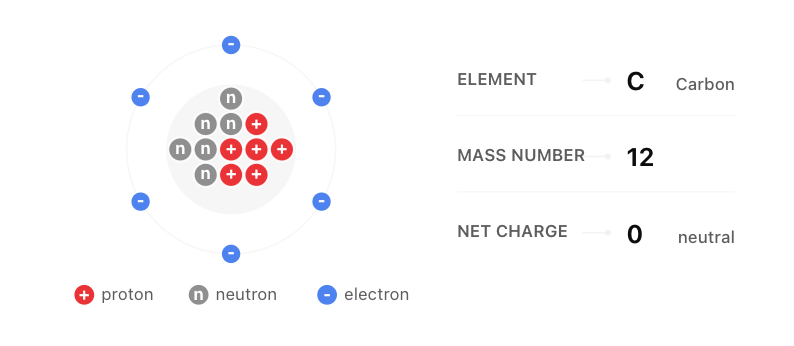
Worked Example: Carbon

A carbon atom has:

Atomic number = 6

Mass number = 12

Number of protons:

= atomic number

= 6

Number of neutrons:

= mass number − atomic number

= 12 − 6

= 6

For a neutral carbon atom:

electrons = protons

Therefore:

electrons = 6

The atom contains:

  • 6 protons
  • 6 neutrons
  • 6 electrons

Worked Example: Sodium

A sodium atom has:

Atomic number = 11

Mass number = 23

Protons:

= 11

Neutrons:

= 23 − 11

= 12

Because the atom is neutral:

Electrons:

= 11

Therefore, this sodium atom contains:

  • 11 protons
  • 12 neutrons
  • 11 electrons

Nuclear Symbol Notation

Atoms can be represented using notation showing their atomic number and mass number.

A general representation is:

\( {A \brack Z} X \)

where:

A = mass number

Z = atomic number

X = chemical symbol

For example, carbon-12 can be represented as:

¹²₆C

This tells us:

Mass number = 12

Atomic number = 6

Therefore:

Protons = 6

Neutrons = 12 − 6 = 6


Determining Atomic Composition

When you know the numbers of protons, neutrons, and electrons, you can determine the atom's identity, mass number, and charge.
A useful strategy is:

Protons → identify the element

Protons + neutrons → determine mass number

Compare protons and electrons → determine charge


Worked Example

A particle contains:

  • 15 protons
  • 16 neutrons
  • 15 electrons

Step 1: Identify the element.

15 protons means atomic number 15.

The element is phosphorus.

Step 2: Determine mass number.

15 + 16 = 31

Mass number = 31

Step 3: Determine charge.

15 protons and 15 electrons balance.

Overall charge = 0

Therefore, the particle is a neutral phosphorus-31 atom.


Atoms and Ions

An atom is electrically neutral because it contains equal numbers of protons and electrons.

An ion is a charged particle formed when an atom gains or loses electrons.

The number of protons does not normally change during ion formation.

Instead, electrons are transferred.

https://images.openai.com/static-rsc-4/6NjYqRM8bcXnVW4k9EfmuTK6mrKvZtXKEWdv7CB3hTx2qHo7abPyI28Wk42XRKhqE_8E_bW7puaQmGFHiVnX6JfwCVbzcnGDyGODUqnYhIhZpwqMSNxOFO2bR2rqdZ05LyuTNnzVUVTy_jQR9-J480iz1DPfHwRusH5ojcxHoo5vablD8mfyB-2QX-HCHdpZ?purpose=fullsize
 
https://images.openai.com/static-rsc-4/Rt-_Sm88oEXQiSARD5sez5_hCk-N4tqlcWQ1YaOCB4M-KurQzWDfAvKTcWuueXD71BIYtSVP_dyXqOj2ZUZe1jrZmTVRoFay6cUWjbIEN_jw5gWD9uaVW7awM101f7Wb-7KTpx3CgKf_6f_tgIfxjEEzmfNdABdI2W4JWcWFKus_tkpcqQN8cvBjFWvUFtVK?purpose=fullsize
 
https://images.openai.com/static-rsc-4/U03XYBLlkMPrXolcPnyITtnUw_3HDb64fXMECXw5N90k49z_EjL4Q1EC-ZJ2ExG99ieoOLcqgvPK7-Ii1AVY18VAN27i764gaEPhNuGHfB4gj-Ce4Qb-dCp_U7cA7zQ6JjuieaR0VABLSgczb4pQg646pHt4FrB1oUib8xhC-cXRDlQPo1L0nEaBAW1xMTNK?purpose=fullsize
 
4

Positive Ions

A positive ion, or cation, forms when an atom loses one or more electrons.

Consider sodium.

A neutral sodium atom has:

11 protons

11 electrons

If it loses one electron:

11 protons

10 electrons

Charge:

+11 + (−10) = +1

Therefore:

Na → Na⁺

The sodium ion has a charge of +1.


Negative Ions

A negative ion, or anion, forms when an atom gains one or more electrons.

Consider chlorine.

A neutral chlorine atom has:

17 protons

17 electrons

If it gains one electron:

17 protons

18 electrons

Charge:

+17 + (−18) = −1

Therefore:

Cl → Cl⁻

The chloride ion has a charge of −1.


Determining the Charge of an Ion

The overall charge can be determined by comparing protons and electrons.

Charge = number of protons − number of electrons

For example:

12 protons and 10 electrons:

Charge = 12 − 10

= +2

The particle has a 2+ charge.

Another example:

9 protons and 10 electrons:

Charge = 9 − 10

= −1

The particle has a 1− charge.


Atoms vs Ions

Atom Ion
Electrically neutral Electrically charged
Protons = electrons Protons ≠ electrons
Has no overall charge Has positive or negative charge
Has not gained or lost electrons overall.   Has gained or lost electrons

The identity of the element remains the same because the number of protons remains unchanged.


Cations vs Anions

Cation Anion
Positive ion Negative ion
Loses electrons Gains electrons
More protons than electrons.   More electrons than protons
Example: Na⁺ Example: Cl⁻

A useful memory aid is:

Lose electrons → positive

Gain electrons → negative

This happens because electrons carry negative charge.


Ion Formation and the Nucleus

When an atom becomes an ion:

  • the number of protons stays the same
  • the number of neutrons stays the same
  • the number of electrons changes

Therefore:

  • atomic number stays the same
  • mass number stays the same
  • electrical charge changes

Ion formation is an electronic change, not a change to the nucleus.


Worked Example: Magnesium Ion

A magnesium ion contains:

  • 12 protons
  • 12 neutrons
  • 10 electrons

Atomic number:

= 12

Mass number:

= 12 + 12

= 24

Charge:

= 12 − 10

= +2

Therefore, the particle is:

Mg²⁺


Worked Example: Oxide Ion

An oxygen particle contains:

  • 8 protons
  • 8 neutrons
  • 10 electrons

Atomic number:

= 8

Mass number:

= 8 + 8

= 16

Charge:

= 8 − 10

= −2

Therefore, the particle is:

O²⁻


Worked Example: Identify an Unknown Particle

An unknown particle contains:

  • 17 protons
  • 18 neutrons
  • 18 electrons

Step 1: Identify the element.

17 protons means atomic number 17.

The element is chlorine.

Step 2: Calculate mass number.

17 + 18 = 35

Mass number = 35

Step 3: Determine charge.

17 − 18 = −1

Therefore, the particle is a chloride ion, Cl⁻, with mass number 35.


Isotopes

Atoms of the same element always have the same number of protons.

However, they may have different numbers of neutrons.

These atoms are called isotopes.

For example:

Carbon-12:

  • 6 protons
  • 6 neutrons

Carbon-14:

  • 6 protons
  • 8 neutrons

Both are carbon because both have 6 protons.

Their mass numbers are different because they contain different numbers of neutrons.

https://images.openai.com/static-rsc-4/GY_FhM52OU53kNdndX30dGNDypYGPZqTnbWgbeJHD-pnhW01rV8e6umTP3ouy11hxv1ZtoqjKz96DsQDYsqihV2zHXdc1-EnkjkW6Vj9h00eF9EF_0YxnylM21ZagVtErUFzPBo38sgvlnBGo2HV6iOvl9yw-Tok7lN9KjZquzoGtI7QkD0iog1oS9EktoXy?purpose=fullsize
 
https://images.openai.com/static-rsc-4/q6QbvKXQbD386pRQaSZO0BCpfdhE5ay48MQzBZbnPuuWzEvmcwBCUQzaNh3uVYvGxCjnIwoCyZHzgmVqzQI7yubynuHB2LwyxCP_3sfna13NgTgOl1egeeMJ0eHkA1BUtTvPHPP9orZcnmRgRBCE_TEnBY7PX3Ti_TMz49Eqa2IunkYCDiCGZIaWhR2ALrdv?purpose=fullsize
 
https://images.openai.com/static-rsc-4/s5_Dz7h-KJ7OZGbtzCZ-Z0se2a7HrzXDyWxtTV494JYyxAbgfn3ghNxaoPAZI8lTtOnf7f_YBM1_kgi1sKtmkj1vM9iSfLlb-evTnHDDP4gsd08dxim8obKt0fdqnD-ZVKip3VsoSm1RM3lgMrwy62q7FIGq8a9RQnWjwB4mU8sbYEXX74-lvLuoEvQwufHy?purpose=fullsize
 
5

Atom, Ion, and Isotope

These terms describe different ideas.

Atom

A neutral particle with equal numbers of protons and electrons.

Ion

A charged particle formed by gaining or losing electrons.

Isotope

An atom of an element with a particular number of neutrons.

An isotope can also become an ion.

For example, changing electrons affects charge, while changing neutrons affects isotope identity.

Changing protons changes the element itself.


A Useful Particle Checklist

When given information about an atom or ion, work in this order:

1. Count the protons.

This identifies the element and gives the atomic number.

2. Add protons and neutrons.

This gives the mass number.

3. Compare protons and electrons.

This determines the charge.

Remember:

protons = element

protons + neutrons = mass number

protons compared with electrons = charge


Common Misconceptions

Electrons are found inside the nucleus.

Incorrect. Protons and neutrons are in the nucleus. Electrons occupy regions outside the nucleus.

Protons and electrons have approximately the same mass.

Incorrect. A proton is about 1836 times more massive than an electron.

Atomic number is the number of protons plus neutrons.

Incorrect. Atomic number is the number of protons.

Mass number includes electrons.

Incorrect. Mass number is the total number of protons and neutrons.

An ion forms when the number of protons changes.

Incorrect. Ions form when atoms gain or lose electrons.

A positive ion has gained positive particles.

Incorrect. A positive ion usually forms because an atom has lost negative electrons.

An isotope and an ion are the same thing.

Incorrect. Isotopes differ in neutron number. Ions differ in electron number.

Electrons orbit the nucleus exactly like planets orbit the Sun.

This is a useful introductory model, but modern atomic theory describes electrons as occupying regions of probability called orbitals within the electron cloud.

Did You Know?

The nucleus contains almost all of an atom's mass but occupies only a tiny fraction of its volume.

If the nucleus were enlarged to roughly the size of a small object in the center of a large stadium, the region occupied by the electrons would extend across much of the stadium.

This enormous difference in scale is one reason atoms are often described as being mostly empty space.

Key Terms

Atom – The smallest particle of an element that retains its chemical properties.

Subatomic particle – A particle smaller than an atom, such as a proton, neutron, or electron.

Proton – A positively charged particle found in the nucleus.

Neutron – A neutral particle found in the nucleus.

Electron – A negatively charged particle found outside the nucleus.

Nucleus – The small, dense center of an atom containing protons and neutrons.

Electron cloud – The region surrounding the nucleus where electrons are found.

Atomic number – The number of protons in an atom's nucleus.

Mass number – The total number of protons and neutrons.

Ion – A charged particle formed when an atom gains or loses electrons.

Cation – A positively charged ion.

Anion – A negatively charged ion.

Isotope – An atom of an element with a particular number of neutrons.

Key Takeaways

  • Atoms contain protons, neutrons, and electrons.
  • Protons have a +1 charge.
  • Neutrons have no charge.
  • Electrons have a −1 charge.
  • Protons and neutrons are located in the nucleus.
  • Electrons occupy the electron cloud around the nucleus.
  • Almost all atomic mass is concentrated in the nucleus.
  • The electron cloud occupies most of the atom's volume.
  • Atomic number = number of protons.
  • Mass number = protons + neutrons.
  • Neutrons = mass number − atomic number.
  • Neutral atoms have equal numbers of protons and electrons.
  • Ions form when atoms gain or lose electrons.
  • Losing electrons produces a positive ion.
  • Gaining electrons produces a negative ion.
  • Changing the number of electrons changes the charge.
  • Changing the number of neutrons changes the isotope.
  • Changing the number of protons changes the element.

2. Isotopes

Learning outcomes
  • I can define isotopes.
  • I can explain why isotopes of the same element have different masses.
  • I can determine the number of protons and neutrons in an isotope.
  • I can interpret isotope notation.
  • I can identify examples of common isotopes.

3. Nuclear Stability

Learning outcomes
  • I can explain why some nuclei are stable while others are unstable.
  • I can describe the role of the neutron-to-proton ratio in nuclear stability.
  • I can identify unstable isotopes.
  • I can explain why unstable nuclei undergo radioactive decay.
  • I can distinguish between stable and radioactive isotopes.

Why Are Some Nuclei Stable?

Atomic nuclei contain protons and neutrons packed into an extremely small region.

Protons are positively charged, so they repel one another through the electrostatic force. At the same time, protons and neutrons experience the strong nuclear force, which can hold nucleons together when they are extremely close.

A nucleus is stable when the combination and arrangement of its protons and neutrons allow it to remain together without spontaneously changing.

An unstable nucleus eventually changes into a more stable arrangement by undergoing radioactive decay.

https://images.openai.com/static-rsc-4/WlWmgYYuREy9XLxKmSfdVXRDHj4arxbPrmp6FfJd4-dGdWbwlaYgZKR4CmiixwmFe6Ke_Born9hHgaIlAZ4Ay5pRli8HBlmVmuGe-L04k-RzUif23IbBuvMj0iV5LAj4bxr-66ikl0vgWroDqFX-8dXULj1BULZauM_O1LPM8dAepxRM3H0Tkqt8oeVc7AKG?purpose=fullsize
 
https://images.openai.com/static-rsc-4/DDcEIvsFQTt8EzIp70NtFKzdJ1GLuZAA_er5469-wpMDXViVcVZ9i3BgJPFVJp5zeqqwbx5nILmU6yWL8vcMXp4AtaxffvBrqt71CYLE-QE_i5E67JLjx3ooVnDe0-p9EpF9B0UYClxo80np2KA1_jrGPXABWVZsveKlQSThxhiILtLzbwSZor4bAzTEI-xj?purpose=fullsize
 
https://images.openai.com/static-rsc-4/D5NxTu64c2Z8z8Bp7qVhmLnUpA1HifER2q1hV3YHEGgH9s7zlKfEiVi1FsAOgorunnlMxKHz_IXLgfo5cJROEAgInszJTLhQKZ15UJbuNtjuT_7NYpMbewM_APTnpYGPom-8lSqGP3UsM9fqa1fdHbtSaeviG1D4InhVBYiY0Wt7mxlpt4-gEfNUPP79hyvT?purpose=fullsize
 
5

The Forces Inside the Nucleus

Two interactions are especially important when thinking about nuclear stability.

Strong Nuclear Force

The strong nuclear force:

  • Acts between nucleons.
  • Is attractive over typical distances between neighbouring nucleons.
  • Is extremely strong at nuclear distances.
  • Acts only over a very short range.

It helps bind protons and neutrons together in the nucleus.

Electrostatic Repulsion

Every proton has a positive electric charge.

Therefore, every proton electrically repels every other proton in the nucleus.

This repulsion tends to push the nucleus apart.

Nuclear stability therefore depends partly on the balance between the attractive nuclear interaction and the electrical repulsion between protons.

https://images.openai.com/static-rsc-4/2ZkP90iN-_SfJMTQh1agFUAo8opHlWY0vxmT9qi_aC3RYjxsxk77NK6VHoh6Yrehzp7c_mmV1tkTGYcabXSUFgiQgoJXJMyfFey9gcMCSMtfFQx-CG7xBBWNwx8bnXELcVzgCYozjMJ0yYA43c1khUMGdZQYoFA5ycQA17nWDnJ-Bgfc6AxZ4Z3n80NqE7Hq?purpose=fullsize
 
https://images.openai.com/static-rsc-4/UHocwsT3Jh2v-9qXC021IDb2fYjpdfsbdbE08L_8HEt5uKlXjJZaYlKgt5Fab5G-MTUk9E5au_DYdUfzZ6mi24RFfKfR9PfIa4OyHiGvC23kyYVu278vw1bfkSDcU228qgzVXHvNCVkcxgQtOgfNROmMlJN3q_RSKdCDvhMbCENIkBxZXNLxcJGLdwB1jT1u?purpose=fullsize
 
https://images.openai.com/static-rsc-4/fiQvnI2TVVFm75-Lejqsqz5l8pTfhyTLSzYy3_KWvoe0BW1Lct_jyWPS6kDjii5VGadoK6fKlADVLSCBwgitAlo5xVNnJm661TwtE5C1j6160c3ltIJq71ZQm8iG0Kl9sm7qEEZkhLT1M5pU79X5J-reYme3iwdKmY-2ArouDvFmCKB3Zm2b1cBPIGsGdwGN?purpose=fullsize
 
5

Why Are Neutrons Important?

Neutrons contribute to the attractive nuclear interactions between nucleons without adding additional electrical repulsion.

This makes neutrons particularly important in larger nuclei.

A nucleus with too few neutrons relative to its number of protons may be unstable.

However, simply adding more and more neutrons does not guarantee stability.

A nucleus can also become unstable if it contains too many neutrons.

This leads to an important concept:

Nuclear stability depends strongly on the balance between the numbers of neutrons and protons.


Neutron-to-Proton Ratio

The neutron-to-proton ratio compares the number of neutrons, N, with the number of protons, Z.

It can be written in ordinary text as:

Neutron-to-proton ratio = N / Z

For example, carbon-12 contains:

  • 6 neutrons
  • 6 protons

Therefore:

N / Z = 6 / 6 = 1

Carbon-12 is stable.


Stability in Light Nuclei

For many light stable nuclei, the number of neutrons is approximately equal to the number of protons.

For example:

Carbon-12

  • 6 protons
  • 6 neutrons
  • N / Z = 1

Oxygen-16

  • 8 protons
  • 8 neutrons
  • N / Z = 1

Calcium-40

  • 20 protons
  • 20 neutrons
  • N / Z = 1

This does not mean that every nucleus with equal numbers of protons and neutrons is stable. It is a general pattern rather than an absolute rule.


Stability in Heavier Nuclei

As nuclei become larger, the situation changes.

A larger nucleus contains more protons, so there is more electrostatic repulsion.

Stable heavier nuclei therefore generally require more neutrons than protons.

For example, lead-208 contains:

  • 82 protons
  • 126 neutrons

Its neutron-to-proton ratio is approximately:

N / Z = 126 / 82 ≈ 1.54

Therefore, the stable neutron-to-proton ratio generally increases as nuclei become heavier.

https://images.openai.com/static-rsc-4/czZtWEB4PPrId94TuQQXzWt0wk_z4u5BTYBVnHpeeVMJp81o5YT2EtAgNbosleiyxRKLVQs7C_-NNHQhwkpQWEGlDrxaJV9n2sqJI4lUrFJuwlNbS2T78WaM7POjpvnDL7V4eDhD3mlXs2Qok0632BcfAZ5UvrDfX4Q5xnwCBu-CdT2usNqIyXmNzsF77ZcM?purpose=fullsize
 
https://images.openai.com/static-rsc-4/aglElusCj5dL_2jYoAx8TM02lRppHVLYl6Et22lCvSuJRBoC8elg3zMwipDh_SRYKqrxBtzI_4blzDh_raGe858RISuVw2CvHs3GHUid8yPjuHD3Z929j1dLEyPnC1yyI1jQQ5oY-L2OSf6p_U03Ybi7WSyAfQz6DIkuNe0GgRHGskU6TTL-EfYkcKualBzV?purpose=fullsize
 
https://images.openai.com/static-rsc-4/nbxcCcIWzd27nzGh_ug82yEVISZNcvOIdte4FvsmEcTaUrV1Bv5Nx3oz-f4GUITzV2xfGBFNmusuI2WkoyeKzdOEG3Dzhm1CZxkPxFfBgmq2cmWpfSQMd0fe7PxisRCgMffzVmmjrYseIjDa6VMJI-dXs1dStGiX7VDYFP7HsURFOO41HOty7Lj3S0iA6ADh?purpose=fullsize
 
5

The Band of Stability

If neutron number is plotted against proton number for many nuclei, the stable nuclei occupy a region often called the band of stability or valley of stability.

For lighter nuclei, this region lies relatively close to:

N = Z

For heavier nuclei, the stable region shifts toward:

N > Z

This pattern shows that there is no single neutron-to-proton ratio that guarantees stability for every nucleus.

Instead, the most stable balance changes with nuclear size.


Too Many Neutrons

A nucleus with too many neutrons relative to its proton number may be unstable.

One way such a nucleus can move toward greater stability is through beta-minus decay.

During beta-minus decay, a neutron is transformed into a proton, with other particles also being emitted.

At the nuclear level:

neutron → proton + electron + antineutrino

The emitted electron is the beta-minus particle.

The important change in the nucleus is:

  • Neutrons decrease by 1.
  • Protons increase by 1.
  • Nucleon number stays the same.

This can move a neutron-rich nucleus closer to the stable region.


Too Many Protons

A nucleus can also be unstable because it has too many protons relative to its number of neutrons.

Such nuclei may move toward greater stability through processes such as beta-plus decay or electron capture.

In beta-plus decay, a proton is transformed into a neutron, with other particles emitted.

The important nuclear change is:

  • Protons decrease by 1.
  • Neutrons increase by 1.
  • Nucleon number remains unchanged.

This can move a proton-rich nucleus toward a more stable neutron-to-proton balance.

https://images.openai.com/static-rsc-4/aglElusCj5dL_2jYoAx8TM02lRppHVLYl6Et22lCvSuJRBoC8elg3zMwipDh_SRYKqrxBtzI_4blzDh_raGe858RISuVw2CvHs3GHUid8yPjuHD3Z929j1dLEyPnC1yyI1jQQ5oY-L2OSf6p_U03Ybi7WSyAfQz6DIkuNe0GgRHGskU6TTL-EfYkcKualBzV?purpose=fullsize
 
https://images.openai.com/static-rsc-4/j6570Jrfqa3KP4maXao5GSbw6EcNO2AykCwOfgiPFyKzRr8OOe00PX1e9LWt8u8U0pt3gabREol2u5511MPFdaAx279P9kyJjZLQlY3lcq55V3ziomGq-0J6TrfRJQGNYVY80twV44Ue2yJcxPshv2owvwHnlYeIVwKrwAZDOlzBwA4MZUrgQphnKeyogGtl?purpose=fullsize
 
https://images.openai.com/static-rsc-4/CsfPC2pETC1ZOkTSg81Z10XNVoATbO7yoANDvBZPb2LHeSEjStpAt1CS_rQJYKjFV0FHOp2DNZEP71fWg0U2pB6779HjghXoqOIDremmuJi0lpnrBeTIUTEtBiACdOVSJ3P1aMXu4vfRpg7LDrRsNrcxYTNbjIbu8mSiGs2pXML3xRGkbGIwyAe3T65NtYs2?purpose=fullsize
 
5

Very Heavy Nuclei

For very large nuclei, having additional neutrons is eventually not enough to maintain stability.

The nucleus contains so many positively charged protons that electrical repulsion becomes increasingly significant.

Very heavy nuclei are therefore generally unstable.

They may undergo processes such as:

  • Alpha decay
  • Beta decay
  • Spontaneous fission

For example, uranium-238 contains:

  • 92 protons
  • 146 neutrons

Despite having many more neutrons than protons, uranium-238 is still radioactive.

This shows why the neutron-to-proton ratio is important but is not the only factor determining nuclear stability.


What Is a Stable Isotope?

A stable isotope has a nucleus that does not spontaneously undergo radioactive decay.

Examples include:

  • Hydrogen-1
  • Carbon-12
  • Carbon-13
  • Oxygen-16
  • Oxygen-18

These nuclei can persist without spontaneously changing into different nuclei.


What Is a Radioactive Isotope?

A radioactive isotope, or radioisotope, contains an unstable nucleus.

The nucleus spontaneously changes through radioactive decay.

Examples include:

  • Hydrogen-3
  • Carbon-14
  • Cobalt-60
  • Uranium-235
  • Uranium-238

During radioactive decay, the nucleus emits particles and/or electromagnetic radiation and changes toward a more stable configuration.

https://images.openai.com/static-rsc-4/1kxEqd5tEJBjpxbnXWXZLnaGaQsj87WvojifnHvMGfmD9XQBHNaJmvUYAelsiuUx_LrBgWYHEQdJ3h-tZJozdP1q1JMZqojza2kc07xW0a4RIz_WEvq2iybmECRypOPrwp9ZjVJqjPVYUFZ9yHQ0vDJHvtKgXE4G7ksoKPsJc3RSU_opgpBLVzsog6wMGnzi?purpose=fullsize
 
https://images.openai.com/static-rsc-4/G-IJascAd9OP4DLVb7618SjKIYfWMuhpQmF9yLRlprKjDjis6HVaupQPg1mc_OpQRc27IOncTgemJq5Cpm8TKszwwbCSQwehJexZZtEhbj_CZ7suI6cOdbCpoyCkmF1CTuQ5X9j6jUToTYPUruBxLgcZc4Jp8y4aslfXdD9tHFlj9s-IH2ASNkfVgyK3mOFY?purpose=fullsize
 
https://images.openai.com/static-rsc-4/1L-TSlnYFw8EjtBW-RBA0Gckmd-X8NDDiCP7fj6p2jLXwXHP9lGdoQBsUADs9eyTaz2kC15LDbvJPDmdSvFHN0YpNhC_qkVHqZrOUoHLjp8FtT6fAod0YNkkcAlDww-LhnIcGMrpG4TT6R7pTtlWiVmcyihA-Zr9y2LGIcCGp3p6h0pQjZPNpkbYMrvw1eR-?purpose=fullsize
 
5

Example: Carbon Isotopes

Carbon provides a useful comparison.

Carbon-12

Carbon-12 contains:

  • 6 protons
  • 6 neutrons

It is stable.

Carbon-13

Carbon-13 contains:

  • 6 protons
  • 7 neutrons

It is also stable.

Carbon-14

Carbon-14 contains:

  • 6 protons
  • 8 neutrons

Carbon-14 is radioactive.

It undergoes beta-minus decay.

This demonstrates an important point:

Atoms can belong to the same element while having nuclei with different stabilities.

All three are carbon because they all contain 6 protons.

https://images.openai.com/static-rsc-4/OJVEiRu0g1WNEdUfFgrtThwtB1jZEM_91dne6_9Rd5wdXd3ol0tTl68T-5p3oixzHLhRbZhf2E-NyLM21q_7DPN2aoudD4PPo1546f1s1e_l_CTdkdrLqcBRGXWi1XxaD9AookiXdt_zWjBkAXzkQ8kxfQghpTjSGlAIEicNUPG2lSVy-IfE-QRUh1ea9wYN?purpose=fullsize
 
https://images.openai.com/static-rsc-4/EmDmH2_u7CBpKNqBykeSeSx0Qd_iEY1SsD1uvnO4xxm1QA73XrT4eDj6IqjjDNkgOACMPNNdg5dCsB6vSu5Zon6CSpAMB15Z4iTqhLeDpnqRP_zOA-7sFFEq9j5jn6aCwameWZiUfvwVq4FvB8BcwQQe8VPYckkXPHzuXAlHonQBd0KsqiXpjlUI-_X0LnjB?purpose=fullsize
 
https://images.openai.com/static-rsc-4/CYfi9o_4mRVfnZ08H51eWzA76P1cy_EFx5dLnoYx7U8tSC0kMoa2e8bD92FuOnEh_7dBI5dm2m_6VVmFl5y-xZsSHKCdQHPq3QheZ5UyYUroY_Rbt-EqJRGpObXgJdKvCRurieYGn0ZWOq0aVZJed_UTQg2z6_sGJCb6Gj1-yVtuM5YMcC5tKVXwQHxuHljH?purpose=fullsize
 
4

Example: Hydrogen Isotopes

The three well-known isotopes of hydrogen also illustrate nuclear stability.

Hydrogen-1

  • 1 proton
  • 0 neutrons
  • Stable

Hydrogen-2

  • 1 proton
  • 1 neutron
  • Stable

Hydrogen-2 is also called deuterium.

Hydrogen-3

  • 1 proton
  • 2 neutrons
  • Radioactive

Hydrogen-3 is also called tritium.

Tritium has an unstable neutron-to-proton balance and undergoes beta-minus decay.


Identifying an Unstable Isotope

Sometimes an isotope can be identified as unstable from known nuclear data.

For example:

¹⁴₆C

contains:

  • 6 protons
  • 14 − 6 = 8 neutrons

Carbon-14 is known to be radioactive.

Compare this with:

¹²₆C

which contains:

  • 6 protons
  • 6 neutrons

Carbon-12 is stable.

However, the neutron-to-proton ratio should not be treated as a simple formula that can always determine whether an unfamiliar isotope is stable.

Actual nuclear stability depends on several aspects of nuclear structure.


Why Do Unstable Nuclei Decay?

An unstable nucleus is in a configuration that can transform into a lower-energy, more stable configuration.

Radioactive decay allows this transformation to occur.

The nucleus may emit:

  • Alpha particles
  • Beta particles
  • Gamma radiation
  • Other particles in particular nuclear processes

The exact type of decay depends on the structure and energy of the nucleus.

Radioactive decay is therefore a nuclear process, not a chemical reaction.


Radioactive Decay Is Spontaneous

An important feature of radioactive decay is that it occurs spontaneously.

For a particular unstable nucleus, we cannot normally predict exactly when it will decay.

It might decay:

  • Almost immediately
  • Several seconds later
  • Years later
  • Millions or billions of years later

However, when very large numbers of radioactive nuclei are present, their overall behaviour is statistically predictable.

This leads to the concept of half-life, which is used to describe the rate of radioactive decay.


Stable Does Not Mean Unchanging in Every Situation

Calling a nucleus stable means that it does not spontaneously undergo radioactive decay under ordinary conditions.

It does not mean that the nucleus can never change.

Nuclei can undergo nuclear reactions if they interact with particles or other nuclei under suitable conditions.

The distinction is therefore between:

Spontaneous radioactive decay

and:

A nuclear reaction caused by an interaction


Stability Is More Complicated Than N / Z Alone

The neutron-to-proton ratio is an important guide, but real nuclear stability also depends on nuclear structure.

Important factors include:

  • Number of protons
  • Number of neutrons
  • Nuclear energy
  • Arrangement of nucleons
  • Binding of nucleons within the nucleus

Some numbers of protons and neutrons produce particularly stable nuclear arrangements.

Therefore, two nuclei with apparently similar neutron-to-proton ratios can have different stabilities.


Nuclear Binding

A stable nucleus exists because energy would be required to separate its nucleons.

The nucleons are held together by nuclear interactions.

The concept of binding energy describes how strongly the nucleus is bound.

In general, nuclear stability is closely related to how energetically favourable the arrangement of nucleons is.

An unstable nucleus can sometimes transform into a configuration with greater stability by releasing energy through radioactive decay.

https://images.openai.com/static-rsc-4/XvYIfuo-B2RYGqj2Ddr7Yfl_PCbHTOQQYWULxKyrdhuiw0sle5YZeU2Vbodr5ggSO-RkhZAAnsxu6PWkmiXDy2uTY2lZdiSc3UB0Jk2HqpfnbcigttP1goN3lG-dJd6LQCzO1N5K9T9J8OgDiiaVfy6PUXG8iDm56ACq1luJV4fGfc-RFlJW7VMNYDwXxqRM?purpose=fullsize
 
https://images.openai.com/static-rsc-4/uUWskzM1TDjmWQbCBv-UCx65UZRPfvjN6Hnc_taEXuNWXJQFWfkcItmj--Scycy_SvDHeKilpoIl0a5uPTOOkWTK58WDPBdDYBilerztyCIjiDB1RfVW1D-x2BsT-rlb6X_3vck7ZrF9InzgovGaE0lF0CUqsUKs5fhGrm9aQOKuWEERdgGBnrrMb_YP_pki?purpose=fullsize
 
https://images.openai.com/static-rsc-4/aglElusCj5dL_2jYoAx8TM02lRppHVLYl6Et22lCvSuJRBoC8elg3zMwipDh_SRYKqrxBtzI_4blzDh_raGe858RISuVw2CvHs3GHUid8yPjuHD3Z929j1dLEyPnC1yyI1jQQ5oY-L2OSf6p_U03Ybi7WSyAfQz6DIkuNe0GgRHGskU6TTL-EfYkcKualBzV?purpose=fullsize
 
6

Stable vs Radioactive Isotopes

Stable Isotope Radioactive Isotope
Does not spontaneously decay Spontaneously undergoes radioactive decay
Nucleus remains unchanged under ordinary conditions Nucleus transforms with time
No characteristic radioactive emissions Emits radiation during decay
Can persist indefinitely under ordinary conditions Characterized by a particular decay probability and half-life

Both stable and radioactive isotopes are still isotopes.

The difference concerns the stability of their nuclei.


Predicting General Trends

The following patterns are useful when considering nuclear stability:

Light stable nuclei

Usually have similar numbers of protons and neutrons.

Heavier stable nuclei

Usually contain more neutrons than protons.

Very neutron-rich nuclei

Are often radioactive.

Very proton-rich nuclei

Are often radioactive.

Very heavy nuclei

Are generally radioactive.

These are useful trends, but they should not be treated as perfect rules for every individual isotope.


Common Mistakes

Assuming Stable Nuclei Always Have Equal Numbers of Protons and Neutrons

This is approximately true for many light stable nuclei.

Heavy stable nuclei normally contain more neutrons than protons.

Assuming More Neutrons Always Increase Stability

Additional neutrons can help stabilize larger nuclei, but too many neutrons can also make a nucleus unstable.

Assuming the N / Z Ratio Alone Determines Stability

The ratio is an important indicator, but nuclear stability also depends on nuclear structure and binding.

Confusing Radioactive Isotopes with Different Elements

Carbon-12 and carbon-14 are both carbon because they both contain 6 protons.

Carbon-14 being radioactive does not make it a different element.

Thinking Radioactive Decay Is a Chemical Reaction

Radioactive decay changes the nucleus.

Chemical reactions primarily involve electrons.

Thinking Scientists Can Predict When One Particular Nucleus Will Decay

Individual radioactive decay events are unpredictable.

Scientists can predict the statistical behaviour of large numbers of nuclei.

Assuming Stable Means the Nucleus Can Never Change

Stable nuclei do not spontaneously decay, but they can participate in nuclear reactions under suitable conditions.


Check Your Understanding

1. What is meant by nuclear stability?

2. Which force helps bind nucleons together?

3. Why do protons repel one another?

4. Why are neutrons important for the stability of larger nuclei?

5. What is meant by the neutron-to-proton ratio?

6. Calculate N / Z for carbon-12.

7. Why do heavier stable nuclei generally contain more neutrons than protons?

8. What is the band of stability?

9. Why can a nucleus with too many neutrons be unstable?

10. Carbon-14 contains 6 protons and 8 neutrons. How does its composition differ from carbon-12?

11. Explain the difference between a stable isotope and a radioactive isotope.

12. Why are very heavy nuclei generally unstable?

13. Explain why uranium-238 can be radioactive even though it contains considerably more neutrons than protons.

14. Why is radioactive decay described as spontaneous?

15. Explain why the neutron-to-proton ratio is useful but cannot by itself perfectly predict nuclear stability.


Key Terms

  • Nuclear stability – the ability of a nucleus to remain without spontaneously undergoing radioactive decay.
  • Stable isotope – an isotope whose nucleus does not spontaneously decay.
  • Radioactive isotope – an isotope with an unstable nucleus that undergoes radioactive decay.
  • Neutron-to-proton ratio – the ratio of the number of neutrons to the number of protons in a nucleus.
  • Strong nuclear force – the interaction responsible for binding nucleons within nuclei.
  • Electrostatic repulsion – the repulsive interaction between positively charged protons.
  • Band of stability – the region containing stable nuclei when neutron number is plotted against proton number.
  • Radioactive decay – the spontaneous transformation of an unstable atomic nucleus.
  • Radioisotope – another term for a radioactive isotope.
  • Beta-minus decay – a radioactive process that converts a neutron into a proton while emitting a beta-minus particle and an antineutrino.
  • Binding energy – the energy associated with binding nucleons together in a nucleus.
  • Half-life – the time required for the expected number of undecayed nuclei in a large sample to decrease to half its original value.

Key Takeaways

  • Nuclear stability depends on the balance of interactions and the arrangement of protons and neutrons in the nucleus.
  • The strong nuclear interaction helps bind nucleons together, while positively charged protons electrically repel one another.
  • The neutron-to-proton ratio is an important indicator of nuclear stability.
  • Many light stable nuclei have approximately equal numbers of neutrons and protons.
  • Heavier stable nuclei generally require more neutrons than protons.
  • Too many or too few neutrons relative to the proton number can result in an unstable nucleus.
  • Very heavy nuclei are generally radioactive.
  • Stable isotopes do not spontaneously undergo radioactive decay.
  • Radioactive isotopes contain unstable nuclei that spontaneously decay.
  • Radioactive decay allows an unstable nucleus to transform toward a more stable, lower-energy configuration.
  • Carbon-12 and carbon-13 are stable, while carbon-14 is radioactive.
  • The neutron-to-proton ratio is useful for understanding stability, but it is not the only factor involved.
  • Nuclear stability is ultimately connected to nuclear structure, interactions between nucleons, and nuclear binding energy.


4. Radioactivity

Learning outcomes
  • I can define radioactivity.
  • I can explain that radioactive decay occurs randomly.
  • I can distinguish between spontaneous decay and chemical reactions.
  • I can describe how radioactive decay changes the nucleus.
  • I can identify naturally occurring sources of radioactivity.

5. Background Radiation

Learning outcomes
  • I can define background radiation.
  • I can identify natural sources of background radiation.
  • I can identify human-made sources of background radiation.
  • I can compare relative contributions from different radiation sources.
  • I can explain why background radiation levels vary between locations.

What Is Background Radiation?

Background radiation is the ionising radiation that is continuously present in our surroundings, even when no obvious radioactive source is nearby.

Everyone is exposed to some background radiation throughout their lives.

It comes from a mixture of:

  • Natural sources, which occur naturally in the environment.
  • Human-made sources, which result from human activities involving radiation.

Background radiation levels are not identical everywhere. They vary with location, altitude, geology, buildings, medical exposure, and other factors.

https://images.openai.com/static-rsc-4/zuRwFZzJUT5xOeTjMd9UdmaI2P4tY_hmAcosNWkbzNFLugLUlvDhOqkI4ySkZH2OdTgHuVpOCTm_wOWmDmSzVCErFUZeNtADjwIluqR1bKOnkCRbjY4ilwRLtMYXyv-C-oPT5obo0g82oh97ApIfKlMJ5hoMmmSFbI-Xj5gofG76vJIKQzji89DjxiQFD34L?purpose=fullsize
 
https://images.openai.com/static-rsc-4/T5OFzcZCwKLGVBt5BY5WvoneAkP82Kxq-LvpZcUEw5U4Vlj0XVhawoCjQQeJerxHB6PvjlsrVl7wMcpeaYs3Y29d4IaIvaxBY1MKnke9F7mZdjFQSi8DUAP4qoLw72ZRtxyYL-J2QYQdbY2O2twfDxGX359Xtpuy7dRMncafI4Puida0LLEkGqPe84tGqgu0?purpose=fullsize
 
https://images.openai.com/static-rsc-4/tIJNUtdic8ZOKHgXX8soxvBtjowhAxuWdji95HGubAOaMwgtfnYA2AE26abiRvbYiBUqBAWq2c5Zf7bp8_rS3JPhZ7M_czUMLWF2PvE1-4gxCTva9eewNKMcnxSd-K1ZWnesJgzvZpXq84hwmy5KgZ8BSK2GARe9c0Zs-iLU2sYk8VpB_pVVk3Atv9lHpvID?purpose=fullsize
 
5

Natural and Human-Made Sources

Most background radiation experienced by the general population comes from natural sources.

Important natural sources include:

  • Radon gas
  • Rocks and soil
  • Cosmic radiation
  • Radioactive isotopes inside our bodies
  • Radioactive materials in food and water

Human-made sources include:

  • Medical X-rays
  • CT scans
  • Nuclear medicine
  • Some industrial and research activities
  • Residual radioactive material from past nuclear weapons testing and nuclear accidents

The relative contribution of each source depends strongly on where a person lives and their individual circumstances.


Natural Sources of Background Radiation

Radon Gas

Radon is often one of the largest natural contributors to radiation exposure.

Radon is a radioactive gas produced naturally in decay chains involving uranium present in rocks and soil.

Because radon is a gas, it can:

  • Move through cracks and spaces in the ground.
  • Enter buildings through foundations.
  • Accumulate in poorly ventilated spaces.
  • Be inhaled into the lungs.

The amount of radon varies greatly from one location to another because different types of rock contain different concentrations of uranium.

https://images.openai.com/static-rsc-4/jkP1SF7aWb71i4cwFtMmJdNo8H5oukGgJZKoLQjSYeVMwLSCDZQf9symGijQoLHK71AYhJW5JYrAiPMEZgz1rQp4RWovReswnXm77GJB4FKo3zS8bNQVVeWu2Suk3q9qQbITiM749_rg7wNInCtXX0iKJh4Hm_p-eWi1CMbgfSjJiAkNgFglP4nCyIhR_7jW?purpose=fullsize
 
https://images.openai.com/static-rsc-4/EX4VHsWmEgE_5wMBMLVbuereJSOmtYnevyN8WBiPFIgWP_M4iPsjysqABdjG1n9u0u2fpv_BQQEXMDND2Kgwui0JNu8aBLMPD6CHrK9rkdyDsxrEuwXafC_5uEhhTqT34onIf187k68mAws2UfUpQohZBhHjbxl2-Y1D1MoihqEeNsBC1tBqWz0QU8Tj3oK-?purpose=fullsize
 
https://images.openai.com/static-rsc-4/K1zZMgbt7kP39jMElriJNr3psdVpuf21TBBPoWTMva5d9IORk66d8vr4jtRmekLGwrorOOywSHtn6eK4iYrbouSssKBnh7SSBqKUPso7o59qUsSiZKlnzSV9KWzcl3ZO6T69FY257Yyjl8ZZ2dCoVOA7wyvAWEbsT2YmLF-bVQE3SHH53cFpKKCBuQIcvHgU?purpose=fullsize
 
5

Why Radon Levels Vary

Two neighbouring regions can have very different radon levels.

Important factors include:

  • Local geology
  • Uranium content of rocks
  • Soil type
  • Cracks and openings beneath buildings
  • Building design
  • Ventilation

Buildings can sometimes allow radon to accumulate to concentrations considerably greater than those found outdoors.

This is one reason indoor background radiation can vary between buildings in the same general area.


Rocks and Soil

Many rocks naturally contain small quantities of radioactive isotopes.

Examples include isotopes of:

  • Uranium
  • Thorium
  • Potassium

These radioactive materials have existed naturally in Earth's crust for billions of years.

Their decay produces radiation that contributes to the background radiation around us.

https://images.openai.com/static-rsc-4/6v_oEDMQ2qXKBvKboiK_roHo1OOdsEKshHsXWbEtze-jYGqkJG40-apFDtg8-FhwSO4U5v46r4NpdWDvo6R3cHna9MDi52FtB5skj_TrbeP4VrsTCZofFtUIldnJUuxUDShmsW8YCQtIyAwTeAZzrUZ1KsQ_ZcQuAvjYz-5XQfS-Mq21yCC-_dzFLIJcwp-j?purpose=fullsize
 
https://images.openai.com/static-rsc-4/JHuZMoRx9KUYisrIceA1ZqmDMlreeXWRdQwZ7vnJbUzyUg0tV4XuKmpNFZghWiLWiuiwXbMv7QNRS7B-T1dgr-6JZexk_ILaNMzfcI3jRXwaCEsLMep9MLEDSx1h16YdGyOpPQibh91Geu-m2aUotv5qA_fHtk5hYn8JU3UyGBEyhFZaLNnmQ1vkdkDCDgFG?purpose=fullsize
 
https://images.openai.com/static-rsc-4/knon3mjnk2JG5wf3MqE_UpUuMibGBSAq6up7pYBYSpHO06_Ynn-GWbhJ1_o1RpS4L-D99d1GtUNxYVR_U1trfCBFKTmmZVElTc-i5zOwvvE25By8jaI5AtexvYIkt1hbQeXTRDhR01t0bWsruFRIu2Np_7nIrthW-PfNFSCN8EO14Iv2OsILZeJJIWqeAJGH?purpose=fullsize
 
5

Building Materials

Some building materials are made from naturally occurring rock.

Materials such as:

  • Granite
  • Stone
  • Concrete
  • Brick

can contain small quantities of naturally radioactive isotopes.

The amount varies according to the materials and where they originated.

This does not mean that ordinary stone or concrete buildings are automatically dangerous. It simply means that natural radioactivity in construction materials can make a small contribution to background radiation.


Cosmic Radiation

Earth is continuously exposed to high-energy particles arriving from space.

These are known as cosmic rays.

When cosmic rays enter Earth's atmosphere, they collide with atoms and molecules and can produce additional particles and radiation.

The atmosphere therefore acts as a partial shield.

https://images.openai.com/static-rsc-4/NS-VxmiZohwSVG7d8mbOy8W2vYb9mpTnv7IseIVvS518__svgCKXBTNS1HrdeSQDc4OxpSrcnuLOM-JFZr74ssVfyq5I5i0fH_aNOQTh3WrvC-KGQkMZIrn49ToniqmUAAucFZtdjfyxM5rfSfFI7U37oFNYDogL1HkH2gwmSuJfQkaOFDunx6diIWQ0YiMH?purpose=fullsize
 
https://images.openai.com/static-rsc-4/zW7ynljIskgtBUx9tGZ-GE_Nc7EP5hn-MHrwHrh3qjl9ddHsUBIIRlLnnhs2BRWelZGSi00bDAFAmmDUzp_Dba_teZ8-xGDmOQm3Ig95ls3Vi0hoMoxROt173F4DGimcBfKODfG6HwhXFp7L4AYJQWZdw4wXgCFARCFYhhBSVoujsn0pgZiqHNQqPXevm_8B?purpose=fullsize
 
https://images.openai.com/static-rsc-4/ZeT1d3D5O_FmWMDS-_ykBHluDoURe0DZ_cOBtZp5SjNcMQbyqlLxSptnrt5dhT4JwXnVkODcYpEf4bmB_HdplOzJDfW9IQ4urRwK_Lv1BMzyGwxkq_0c1yZ_kAZHQQhXZma_WO5wLKnSwu-giDkrz-VvuS1xtOnFtkxr5c_qjvJ0Az4rx-CJcVrQZQbNdvEg?purpose=fullsize
 
5

Effect of Altitude

Cosmic radiation generally increases with altitude.

At sea level, there is a large amount of atmosphere above us.

At high altitude, there is less atmosphere available to absorb the incoming radiation.

Therefore:

Higher altitude → generally greater cosmic radiation exposure

People living at high elevations therefore tend to receive more cosmic radiation than people living near sea level.

Airline passengers and flight crews also experience increased cosmic radiation while flying at high altitude.


Radioactive Isotopes in Food and the Body

Small amounts of radioactive material occur naturally in food, water, and living organisms.

Examples include:

  • Potassium-40
  • Carbon-14

Potassium is an essential element required by the body.

Natural potassium contains a very small proportion of radioactive potassium-40.

As a result, the human body naturally contains a small amount of radioactive material.

This is normal and has been true throughout human history.


Carbon-14

Carbon-14 is produced naturally in Earth's atmosphere through interactions involving cosmic radiation.

Carbon dioxide containing carbon-14 can enter plants through photosynthesis.

It then moves through food chains.

As a result, living organisms naturally contain small quantities of carbon-14.

After an organism dies, it stops exchanging carbon with the environment. The carbon-14 already present gradually decays.

This is the basis of radiocarbon dating.


Human-Made Sources of Background Radiation

Medical Radiation

For many people, the largest source of human-made radiation exposure comes from medicine.

Medical uses of ionising radiation include:

  • X-rays
  • CT scans
  • Nuclear medicine
  • Some cancer treatments

Medical radiation is deliberately used because it can provide important diagnostic or therapeutic benefits.

https://images.openai.com/static-rsc-4/3StBTSl0sb5rCTDBx4lN5VxiVMFca4LI7IdtaLtcT9ivmrSp8RltT6rl4xE81dkVMmdp6gWIGfD6v_l5guOUjpve3rjaY44u_i7279_K6YfOPNnaLjfKEebi9OdFZ3kLpwM4iUd0RP27-_BOsnhpdfCnIRqIs-Po_S4lmTB1iP0KjWHUdaQhAd1vc2nUU-Po?purpose=fullsize
 
https://images.openai.com/static-rsc-4/KAwE1t-RkyMprWin_r-AqtfYU_f33ieGs7f4txGnGuFe9yIdQ6xcCPDoJxRYf3WlY-n7awETa9c6QQ3BDiSmL8vExaqpBwbojCzOBMcAQHUcB4JwSj2axN1-q7sigUzN101O1v9Rq2pL6bRcOzbb6j2mJaKiZNEMf-lm7JXJKAowSV-ge_j2Cg5qop8u86z2?purpose=fullsize
 
https://images.openai.com/static-rsc-4/2NRlIPmEffecRWcDG7CVuvSbqzNJd27oV4rvbs5EXEP3KMeMZh0i64NWdpn6aSgqEVnbuFSGEOIoB_qd8_KoDsJUQvkDsLrgcM3xe8j7i971dJmEHeAZS1oQNBTZys-PHDNpiZlGmzbeHV_jq2aXBs9vu3YsZ3pP225KPmh-1PO9IqYWBBmqDUN5Ewc59ad6?purpose=fullsize
 
4

X-Rays

X-rays can pass through the body and are absorbed differently by different tissues.

This makes them useful for producing images of structures such as bones.

A medical X-ray therefore exposes a patient to a controlled amount of ionising radiation.

The amount depends on:

  • The body part being examined
  • The imaging equipment
  • The number of images required
  • The imaging procedure

Medical professionals aim to obtain the required diagnostic information while keeping radiation exposure appropriately controlled.


CT Scans

A CT scan uses X-rays from many different directions to produce detailed images of structures inside the body.

CT scans can provide much more detailed information than many conventional X-rays.

Because multiple X-ray measurements are involved, a CT examination can result in a larger radiation dose than a simple X-ray examination, although the dose varies substantially with the type of scan.


Nuclear Medicine

Some medical procedures introduce small amounts of radioactive substances into the body.

These substances are called radioactive tracers.

Detectors outside the body can detect radiation emitted by the tracer and provide information about the function of organs and tissues.

Radioactive materials can also be used in some medical treatments.


Industry and Research

Radioactive materials and radiation are also used in industry and scientific research.

Applications include:

  • Measuring the thickness of materials
  • Detecting leaks
  • Inspecting welds
  • Sterilising equipment
  • Scientific experiments
  • Tracing the movement of substances

These activities can contribute to radiation exposure, particularly for workers who use radiation sources, although such work is normally subject to radiation-safety controls.


Nuclear Power

Nuclear power stations contain large quantities of radioactive materials.

During normal operation, radiation and radioactive materials are carefully contained and monitored.

For most members of the public, routine exposure associated with normally operating nuclear power facilities is generally a small component compared with major natural sources and, for many individuals, medical exposure.

However, nuclear facilities require strict monitoring because accidental releases can increase environmental radiation levels.

https://images.openai.com/static-rsc-4/ImoR3LjTkpB2pgDx6ffCo1hFioY_IFXoy-2qHxquK-JuvkLkKnt2SFgOC6N75vENXLjVGxE6xBAKe_KGwFo_Amg_acM4qslDejugNmxFVAsIgHuKBjDi52xWmed6RWmfycNW43yqdmJacwshuabSYB_RHfn2laevmlgG0PvW_JbVsVWWe59UsVMHmP1Fpkht?purpose=fullsize
 
https://images.openai.com/static-rsc-4/N-UGsj3IWYZUP2Z5orkMLWAg9kldj1SHE7TZkRq2SrcATGQRn3_nToFxFw9wSlkDDWgLDC1PqKQHFaBWba8mb5FWfS6A8IXStmuvzRQo5kq-pwWuQxKEX8sII-GQGJtWtRQrVEH0O1O8VMK518oQVzPmNkDfNtBFpX8zvgkIYAcvGKKrdJf491QtpFJZTIIi?purpose=fullsize
 
https://images.openai.com/static-rsc-4/hWrxYnThFW3BKtsj4I62mY_4zyMMAwVzmWqen7sUUvUuencYXNb4ptfQoCW7HucckAwZfYMJLEP_V2isL5DdYIVoPAWvx5anGsWs7CHK3LDNBfP2Vnx5D9Fq9IhDK8ETowB9ufOTTd-ZEFtr0B3xSGOjjgx3e94MMNF2VVHvlzRSZ7IYBHf5cWeWzbmWPIIg?purpose=fullsize
 
6

Nuclear Weapons Testing

Atmospheric nuclear weapons tests carried out mainly during the twentieth century released radioactive materials into the environment.

Some radioactive material was transported around the world through the atmosphere before eventually being deposited on land and water.

This material is often called radioactive fallout.

Today, residual fallout generally represents a relatively small component of background radiation in most locations, although its historical and environmental importance remains significant.


Nuclear Accidents

Major nuclear accidents can release radioactive materials into the environment.

The effects can vary greatly depending on:

  • The type and quantity of radioactive material released
  • Weather conditions
  • Distance from the source
  • Local geography
  • Cleanup and containment measures
  • The half-lives of the released isotopes

Areas affected by significant releases may experience elevated radiation levels for extended periods.


Comparing Sources of Background Radiation

Contributions Are Not the Same Everywhere

It is tempting to create one fixed percentage chart showing where background radiation comes from.

However, such a chart would only apply to a particular population, place, and time period.

For example, one person's exposure might be dominated by radon, while another person's exposure might be strongly influenced by medical imaging.

Therefore, it is more useful to understand the major factors controlling exposure.

For many populations:

  • Natural sources make a substantial contribution.
  • Radon can be a major natural source.
  • Cosmic radiation contributes everywhere but increases with altitude.
  • Terrestrial radiation depends on local geology.
  • Medical exposure can be an important human-made contribution.
  • Contributions from nuclear power during normal operation are generally much smaller than major natural and medical sources.

A Relative Comparison

A general comparison can be made without assuming exact percentages:

Source Origin Typical importance
Radon Natural Often a major contributor
Rocks and soil Natural Important and location-dependent
Cosmic radiation Natural Present everywhere; greater at altitude
Food and body Natural Small but continuous
Medical imaging Human-made Can be significant and highly individual
Nuclear industry Human-made Usually small for the general public during normal operation
Historical fallout Human-made Usually a relatively small present-day contribution in most places

These descriptions are general. Actual contributions can differ considerably.


Why Background Radiation Varies

Geology

Local geology can have a major effect on background radiation.

Some rocks contain greater concentrations of naturally radioactive elements than others.

Areas containing uranium-rich rocks may therefore have:

  • Greater terrestrial radiation
  • Greater radon production

This can produce significant regional differences.

https://images.openai.com/static-rsc-4/3IJ_bqFCSDOOM2oIbNxfP4gj2blLBPf1cHugz9aLr6Ryr_6ZhJ9ApRdpNsTh_k_Ph8Z6aVaAr8ZaUN26Ab2yBoLX_wjLk_4lLk1-P4pWBCt-nwMSxWQHO-kZWYlAepOpcB3k3dVluqB8SIKr4ikQ_-AMbgvylRX083BHz0CCW7AAM_zVbrU4Hetb-oomXAXe?purpose=fullsize
 
https://images.openai.com/static-rsc-4/uQpYuRJWBG29ldQuPgtBklzmv3eSh6bEd8tdBQjiMNk1LP9BGASgLbPOelP-rJWxFxi6akxEBTiKoE70DOWG1plt4m4WeR_tHzUmhPxGX91kH9l168u6NMcLcnVP7x2Vow-iitUbuSMtY9ETTtDoWAvqjMjvgtKpId0oWQcVgp8_IIM9vPfiwzzghdehAako?purpose=fullsize
 
https://images.openai.com/static-rsc-4/UGjFQxBuOLygmPrdC8tq0kEvawzfibIRzvxNXxqWd1jLjVW5IRJAUYOab1LJbNpBK-0xFmaZngBwzSkiTLXwCLZGbks9eIGGVlLxXno5oOR0yR4vT9qWHbUvIfxDRoZ2CzcY4WP2uCgxdoil1xEwNy2yu1sj5Z0MvNjHVvsbuPwmK7dFGA5KkFqRtg6tdnKh?purpose=fullsize
 
4

Altitude

Altitude affects exposure to cosmic radiation.

At higher elevations:

  • The atmosphere is thinner.
  • Less shielding is present above you.
  • More cosmic radiation reaches the surface.

Therefore, mountain communities generally experience more cosmic radiation than coastal communities at sea level.


Building Design

Buildings can influence background radiation, particularly through radon.

Factors include:

  • Foundation design
  • Cracks in floors
  • Ventilation
  • Basement construction
  • Building materials

A poorly ventilated building in a high-radon area may have considerably greater indoor radon concentrations than a well-ventilated building nearby.


Lifestyle and Occupation

Background exposure can also vary between individuals.

For example:

  • Frequent flyers receive more cosmic radiation.
  • Airline crews spend substantial amounts of time at high altitude.
  • Some workers use radioactive materials or radiation-producing equipment.
  • Some patients undergo more medical imaging than others.

Therefore, two people living in the same city can still have different annual radiation exposures.


Background Radiation and Radiation Detectors

Suppose you switch on a radiation detector in a laboratory with no radioactive source nearby.

The detector may still record radiation.

For example:

Background count rate = 18 counts per minute

Now suppose a radioactive source is placed nearby and the detector reads:

Measured count rate = 83 counts per minute

The approximate count rate due to the source is:

Source count rate = measured count rate − background count rate

Therefore:

Source count rate = 83 − 18

Source count rate = 65 counts per minute

This correction is important when carrying out radiation experiments.


Why Background Measurements Fluctuate

Because radioactive decay is random, background count rate is not perfectly constant.

For example, repeated one-minute measurements might give:

  • 18 counts
  • 22 counts
  • 17 counts
  • 21 counts
  • 19 counts

This does not necessarily mean the background radiation source has changed.

Random variation is expected.

Scientists can improve their estimate by:

  • Measuring for a longer period
  • Repeating measurements
  • Calculating an average

Worked Example: Average Background Count

Suppose five measurements give:

16, 19, 18, 21, 16 counts per minute

Total:

16 + 19 + 18 + 21 + 16 = 90

Average:

90 / 5 = 18

Therefore:

Average background count rate = 18 counts per minute

If a source produces a measured count rate of 118 counts per minute:

Corrected source count rate = 118 − 18

Therefore:

Corrected source count rate = 100 counts per minute


Background Radiation Is Not the Same Everywhere

There is no single universal background radiation level.

A detector reading depends on:

  • Location
  • Altitude
  • Local geology
  • Radon concentration
  • Building materials
  • Nearby radiation sources
  • Detector type
  • Measurement time

For experimental work, students should therefore measure the local background count rather than assuming a universal value.


Common Mistakes

Thinking Background Radiation Is Entirely Human-Made

Much background radiation comes from natural sources that existed long before modern technology.

Thinking Background Radiation Is Entirely Natural

Medical procedures and other human activities can also contribute to radiation exposure.

Assuming Every Location Has the Same Background Level

Background radiation varies with geology, altitude, buildings and other environmental factors.

Assuming Nuclear Power Is Always the Largest Source

For the general public during normal operation, nuclear power is generally a much smaller source than major natural sources and, for many people, medical exposure.

Forgetting About Radon

Radon can be one of the largest contributors to natural radiation exposure.

Thinking Background Count Should Stay Exactly Constant

Radioactive processes are random, so detector readings naturally fluctuate.

Forgetting to Subtract Background Count

When investigating a radioactive source:

Source count rate = measured count rate − background count rate

Confusing Activity with Count Rate

Activity is the actual number of nuclear decays per second.

Count rate is the number of events detected by a particular detector per unit time.

A detector normally records only some of the radiation emitted by a source.


Check Your Understanding

1. Define background radiation.

2. Give four natural sources of background radiation.

3. Give three human-made sources of radiation exposure.

4. Explain how radon gas is produced.

5. Why can radon levels vary between different locations?

6. Why does cosmic radiation increase with altitude?

7. Explain why living organisms naturally contain small quantities of radioactive material.

8. Why can medical imaging make an important contribution to an individual's radiation exposure?

9. Explain why there is no single percentage breakdown of background radiation that applies everywhere.

10. How can local geology affect background radiation?

11. Explain how building design can affect radon exposure.

12. A detector measures 76 counts per minute near a source. The background count is 14 counts per minute. Calculate the corrected count rate.

13. Why might repeated measurements of background radiation give slightly different results?

14. Why should background radiation be measured during a radiation experiment?

15. Explain why two people living in the same city could receive different amounts of radiation exposure.


Key Terms

  • Background radiation – ionising radiation continuously present in the environment.
  • Natural background radiation – radiation originating from naturally occurring sources.
  • Human-made radiation – radiation exposure resulting from human activities.
  • Radon – a naturally occurring radioactive gas produced in radioactive decay chains in rocks and soil.
  • Cosmic radiation – radiation associated with high-energy particles arriving from space.
  • Terrestrial radiation – radiation originating from naturally radioactive materials in Earth's crust.
  • Radioactive fallout – radioactive material deposited in the environment following atmospheric nuclear releases.
  • Background count rate – the detector count rate measured without the investigated source present.
  • Count rate – the number of radiation events recorded by a detector per unit time.
  • Activity – the number of nuclear decays occurring per second.
  • Becquerel (Bq) – the SI unit of radioactive activity, equal to one decay per second.
  • Ionising radiation – radiation capable of removing electrons from atoms or molecules.

Key Takeaways

  • Background radiation is the ionising radiation continuously present in our surroundings.
  • Background radiation comes from both natural and human-made sources.
  • Important natural sources include radon, rocks and soil, cosmic radiation, and radioactive isotopes in living organisms.
  • Radon can be a major source of natural radiation exposure.
  • Cosmic radiation generally increases with altitude.
  • Local geology influences terrestrial radiation and radon levels.
  • Medical imaging is an important human-made source of radiation exposure for many people.
  • Radiation from normally operating nuclear facilities is generally a relatively small contribution to public exposure compared with major natural sources.
  • The relative contributions from different sources vary with location and individual circumstances.
  • Background radiation levels can vary because of geology, altitude, building design, ventilation, occupation and lifestyle.
  • Detector measurements of background radiation fluctuate because radioactive processes are random.
  • Background count should be measured and subtracted when determining the count rate produced by a radioactive source.