Work and Energy
1. Energy Stores
Learning outcomes
- I can identify and describe the main energy stores, including kinetic, gravitational potential, chemical, elastic, nuclear, electrostatic, and internal (thermal) energy stores.
- I can explain how energy can be transferred between stores through mechanical work, electrical currents, heating, and waves.
- I can distinguish between energy stores and energy transfer pathways.
- I can interpret and construct simple energy flow diagrams showing energy transfers within a system.
- I can apply the principle of conservation of energy to explain how energy is transformed and transferred between stores.
What Is Energy?
Energy is a quantity that can be stored and transferred.
When something happens—an object moves, a battery powers a device, water boils, or a ball falls—energy is being transferred between energy stores.
A useful way to think about energy is:
Energy starts in a store → is transferred → ends in another storeEnergy is measured in joules (J).
Importantly, energy does not disappear when it is used. It is transferred from one store to another.
The Main Energy Stores
There are several important ways in which energy can be stored within a system.
Kinetic Energy Store
A moving object has energy in its kinetic energy store.
The faster an object moves, the greater its kinetic energy.
Examples include:
- A moving car
- A running person
- A spinning fan
- A flying football
- Water flowing in a river
An object that is not moving has no kinetic energy.


Gravitational Potential Energy Store
An object can have energy in a gravitational potential energy store because of its position in a gravitational field.
Near Earth's surface, raising an object increases its gravitational potential energy.
For example, a book on a high shelf has more gravitational potential energy than the same book on the floor.
Examples include:
- Water stored behind a dam
- A person at the top of a diving board
- A roller coaster at the top of a hill
- A rock held above the ground
When these objects fall, energy can be transferred from the gravitational potential store to the kinetic store.
Chemical Energy Store
Energy can be stored chemically in substances.
Examples include:
- Food
- Fuels
- Batteries
- Wood
- Natural gas
When chemical reactions occur, energy can be transferred from the chemical energy store to other stores.
For example, when fuel burns in a car engine, energy from the chemical store of the fuel is transferred to other stores, including the kinetic store of the car and the internal energy stores of the engine and surroundings.
Elastic Energy Store
Energy can be stored when an elastic object is stretched or compressed.
This is called an elastic energy store.
Examples include:
- A stretched elastic band
- A compressed spring
- A drawn bow
- A stretched trampoline
When the object returns toward its original shape, energy can be transferred from its elastic store.
For example:
Elastic store of bow → kinetic store of arrow


Nuclear Energy Store
Energy is stored within atomic nuclei.
This is called a nuclear energy store.
Energy can be transferred from nuclear stores during processes such as:
- Nuclear fission – splitting large nuclei
- Nuclear fusion – joining small nuclei
- Radioactive decay
The Sun transfers enormous amounts of energy from nuclear stores through nuclear fusion.
Electrostatic Energy Store
Energy can be stored when electric charges attract or repel each other.
This is called an electrostatic energy store.
For example, rubbing a balloon against hair can cause electric charge to build up. The charged balloon and nearby objects form an electrostatic system in which energy can be stored.
Electrostatic stores become especially important when studying electric fields and charged particles.
Internal (Thermal) Energy Store
Objects contain energy because of the movement and arrangement of their particles.
This is called the internal energy store.
When an object's temperature increases, its internal energy usually increases.
For example:
cold water → heating → hot waterThe hot water has a greater internal energy store.
The term thermal energy is often used informally, but in the energy-stores model we normally refer to an object's internal energy store.
Energy Stores vs Energy Transfers
This distinction is extremely important.
An energy store describes where energy is held.
An energy transfer pathway describes how energy moves from one store to another.
For example, heating is not an energy store. Heating is a way of transferring energy.
Similarly, light is not an energy store. Electromagnetic waves can transfer energy.
Think of it as:
STORE → TRANSFER PATHWAY → STOREThe Four Main Energy Transfer Pathways
Energy can be transferred between stores in four main ways.
| Transfer Pathway. | Description | Example |
|---|---|---|
| Mechanical work | A force moves an object | Lifting a box |
| Electrical work | Charges move through a circuit | Battery powering a motor |
| Heating | Energy transfers because of a temperature difference | Heating water |
| Waves | Energy is carried by waves | Sunlight reaching Earth |
Let's examine each one.
Mechanical Work
Energy is transferred mechanically when a force causes an object to move.
Imagine lifting a box from the floor.
Energy is transferred from the chemical store in your body to the gravitational potential store of the box.
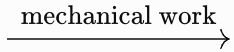 Gravitational potential store
Mechanical energy transfer also occurs when:
- A car accelerates.
- A person pushes a trolley.
- A falling object accelerates.
- A spring launches an object.
Electrical Work
Energy can be transferred when an electric current flows.
For example, consider a battery connected to a lamp.
Chemical store of battery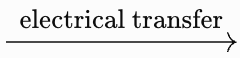 Internal energy stores of lamp and surroundings
Some energy is also transferred away from the lamp by electromagnetic waves, including visible light and infrared radiation.
Heating
Energy can be transferred because there is a temperature difference.
Energy transfers from hotter regions toward colder regions.
For example, when a metal spoon is placed in hot soup, energy is transferred from the soup to the spoon by heating.
The internal energy store of the spoon increases.


Waves
Waves can transfer energy from one place to another.
Examples include:
- Visible light
- Infrared radiation
- Sound waves
- Microwaves
For example, energy from the Sun reaches Earth mainly through electromagnetic waves.
A speaker transfers energy to its surroundings through sound waves.
Remember:
Waves are a transfer pathway, not an energy store.
Energy Flow Diagrams
An energy flow diagram shows where energy starts, how it is transferred, and where it ends up.
Consider a falling ball.
Initially, the ball has energy in its gravitational potential store.
As it falls:
Gravitational potential store → Kinetic storeThe gravitational potential energy decreases while the kinetic energy increases.
When the ball hits the ground, some of its kinetic energy is transferred to the internal energy stores of the ball and surroundings and some is transferred away by sound waves.
A more complete diagram might therefore be:
Gravitational potential → Kinetic → \( {Internal \ energy \ stores \brace Energy \ transferred \ by \ sound} \){</span><span class="vlist-r"><span class="vlist"><span class="mord">Internal energy stores</span><span class="mord">Energy transferred by sound</span></span><span class="vlist-s"></span></span></span></span><hr data-start="8095" data-end="8098"> <h1 data-section-id="547urd" data-start="8100" data-end="8136">Example: A Battery-Powered Toy Car</h1> <p data-start="8138" data-end="8178">Consider a toy car powered by a battery.</p> <p data-start="8180" data-end="8234">Initially, energy is stored chemically in the battery.</p> <p data-start="8236" data-end="8324">The battery produces an electric current, transferring energy electrically to the motor.</p> <p data-start="8326" data-end="8359">The motor causes the car to move.</p> <p data-start="8361" data-end="8371">Therefore:</p> <span class="vlist-r"><span class="mord">Chemical store <img class="img-fluid" src="https://yedu.ca/pluginfile.php/3714/mod_book/chapter/4689/Screenshot%202026-08-21%20at%207.23.08%E2%80%AFAM.png" width="165" height="39">Kinetic store</span></span></div> <div class="fbskMG_root markdown prose dark:prose-invert wrap-break-word w-full light markdown-new-styling"> </div> <div class="fbskMG_root markdown prose dark:prose-invert wrap-break-word w-full light markdown-new-styling"><span class="vlist-r"><span class="mord"><span class="vlist-r"><span class="vlist-s"></span></span></span><span class="vlist-s"></span></span> <p data-start="8474" data-end="8549">However, not all the transferred energy increases the car's kinetic energy.</p> <p data-start="8551" data-end="8611">Some energy is transferred to the internal energy stores of:</p> <ul data-start="8613" data-end="8671"> <li data-section-id="1lk1e7u" data-start="8613" data-end="8624">The motor</li> <li data-section-id="1048ltd" data-start="8625" data-end="8637">The wheels</li> <li data-section-id="1wxr3j1" data-start="8638" data-end="8659">The surrounding air</li> <li data-section-id="1li48nd" data-start="8660" data-end="8671">The floor</li> </ul> <p data-start="8673" data-end="8717">Some may also be transferred by sound waves.</p> <hr data-start="8719" data-end="8722"> <h1 data-section-id="wnpbo3" data-start="8724" data-end="8754">Useful and Dissipated Energy</h1> <p data-start="8756" data-end="8826">In many systems, we want energy to be transferred in a particular way.</p> <p data-start="8828" data-end="8867">This is the <strong data-start="8840" data-end="8866">useful energy transfer</strong>.</p> <p data-start="8869" data-end="8962">However, some energy is usually transferred to the surroundings in ways that are less useful.</p> <p data-start="8964" data-end="8998">For example, in an electric motor:</p> <span class="katex-html" aria-hidden="true"><span class="base"><span class="mord">Electrical transfer </span><span class="mrel">→ <span class="minner"><span class="delimsizing size4">\( {Kinetic \ store \ — \ useful \brace Internal \ stores \ — \ dissipated} \)
Dissipated energy usually spreads into the internal energy stores of the surroundings.
It has not been destroyed. It has simply become less useful for doing the task we wanted.
Conservation of Energy
One of the most important principles in physics is the principle of conservation of energy.
It states:
Energy cannot be created or destroyed.Energy can only be:
- Transferred between stores.
- Transferred between objects.
- Spread into the surroundings.
Therefore, in a closed system:
Total energy before = Total energy afterWorked Example: A Roller Coaster
Imagine a roller coaster at the top of a hill.
At the top
The roller coaster has a large amount of energy in its:
gravitational potential storeMoving downhill
As the roller coaster falls, energy is transferred:
Gravitational potential store→Kinetic storeThe roller coaster speeds up.
At the bottom
Its gravitational potential energy has decreased while its kinetic energy has increased.
Some energy has also been transferred to the internal energy stores of the wheels, track, air, and surroundings because of friction and air resistance.


The total energy is still conserved.
Worked Example: A Bouncing Ball
A ball is held above the ground.
Initially:
Energy in gravitational potential storeThe ball is released:
Gravitational potential → KineticThe ball hits the ground and deforms:
Kinetic → Elastic storeThe ball springs upward:
Elastic → Kinetic → Gravitational potentialThe ball does not normally return to its original height because some energy is transferred to the internal energy stores of the ball, floor, and surroundings and some is transferred by sound waves.
Energy has not disappeared.
Common Mistakes
Mistake 1: Calling heat an energy store
Instead of:
The object contains heat energy.
It is better to say:
The object has energy in its internal energy store.
Heating describes a transfer pathway.
Mistake 2: Saying energy is used up
Energy is not destroyed.
Instead of:
The car uses up energy.
Say:
Energy is transferred between stores and some is dissipated to the surroundings.
Mistake 3: Calling light an energy store
Light transfers energy through electromagnetic waves.
Therefore, waves are a transfer pathway, not an energy store.
Key Vocabulary
Energy store – A way in which energy is stored within a system.
Energy transfer – The movement of energy from one store or system to another.
Kinetic energy store – Energy associated with a moving object.
Gravitational potential energy store – Energy associated with an object's position in a gravitational field.
Chemical energy store – Energy associated with chemical substances.
Elastic energy store – Energy stored when an object is stretched or compressed.
Nuclear energy store – Energy associated with atomic nuclei.
Electrostatic energy store – Energy associated with the positions of electric charges.
Internal energy store – Energy associated with the particles within a substance.
Dissipation – The spreading of energy into the surroundings, usually into internal energy stores.
Conservation of energy – The principle that energy cannot be created or destroyed.
Key Takeaways
- Energy can be held in kinetic, gravitational potential, chemical, elastic, nuclear, electrostatic, and internal energy stores.
- An energy store describes where energy is held.
- A transfer pathway describes how energy moves between stores.
- The four main transfer pathways are mechanical work, electrical work, heating, and waves.
- Energy flow diagrams can show energy moving between different stores.
- Energy that spreads into the surroundings is dissipated, not destroyed.
- According to the principle of conservation of energy, energy cannot be created or destroyed.
- In a closed system: Total energy before = Total energy after