Diffraction and Interference
1. Double Slit Diffraction
Learning Outcomes
- I can explain how double slit diffraction occurs when waves pass through two narrow openings and interfere with one another.
- I can describe the formation of constructive and destructive interference patterns in a double slit experiment.
- I can identify the conditions required for bright fringes and dark fringes to form on a screen.
- I can relate wavelength, slit separation, and screen distance to the spacing of interference fringes.
- I can explain how the double slit experiment demonstrates the wave nature of light and matter.
- Coherent and monochromatic sources.
- Phase difference and fringe formation.
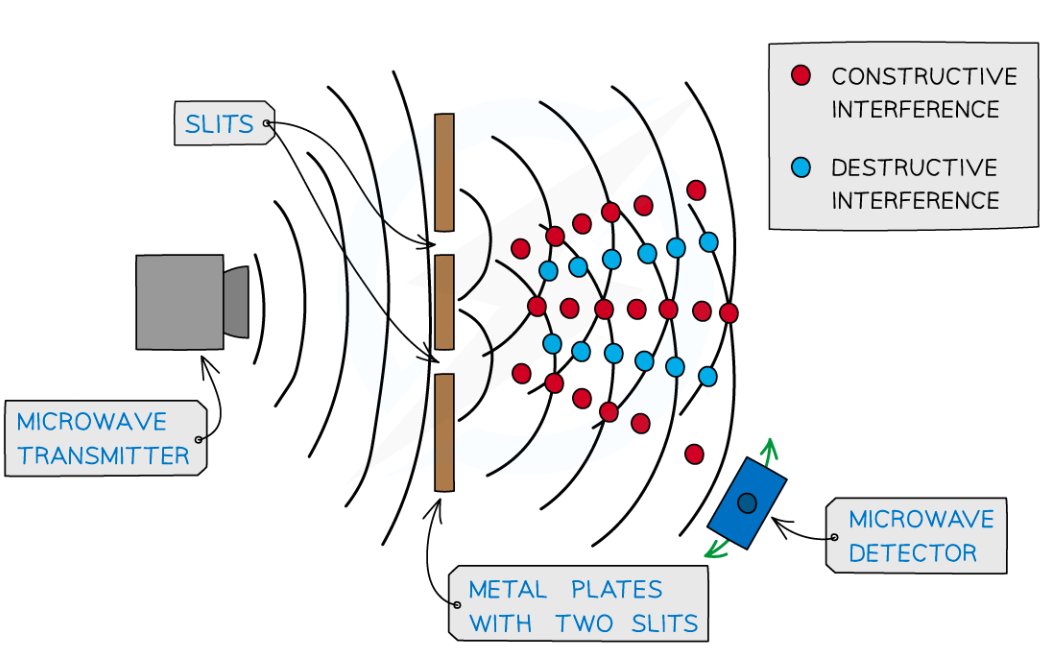
When waves pass through a narrow opening, they spread out in a process called diffraction. If waves pass through two closely spaced slits, the diffracted waves from each slit overlap and interfere with one another. This produces a pattern of alternating bright and dark regions known as an interference pattern. The double slit experiment is one of the most important demonstrations of wave behavior in physics.
In the double slit experiment, coherent waves pass through two narrow slits separated by a small distance. The two slits act as sources of waves that spread outward and overlap. At some points, the waves arrive in phase and produce constructive interference, creating bright fringes on a screen. At other points, the waves arrive out of phase and produce destructive interference, creating dark fringes.
Constructive interference occurs when the path difference between the two waves is equal to a whole number of wavelengths:
where:
- d = slit separation
- θ = angle to the bright fringe
- n = order number(0,1,2,3,…)
- λ = wavelength
Destructive interference occurs when the path difference is equal to a half-integer multiple of the wavelength:
These relationships determine where bright and dark fringes appear on the screen.
For small diffraction angles, the spacing between fringes on the screen can be approximated using:
where:
- Δy = fringe spacing
- λ = wavelength
- L = distance from the slits to the screen
- d = slit separation
This equation shows that:
- larger wavelengths produce wider fringe spacing,
- increasing the screen distance increases fringe spacing,
- increasing slit separation decreases fringe spacing.
Example 1: Fringe Spacing
Suppose light of wavelength
600nm passes through slits separated by
0.20mm. The screen is
2.0m away.
Using:
The bright fringes are spaced
6.0mm apart.
The double slit experiment provided strong evidence that light behaves as a wave. If light consisted only of particles traveling in straight lines, the interference pattern would not form. Instead, the alternating bright and dark fringes show that light waves combine through superposition.
One of the most remarkable discoveries in modern physics is that not only light, but also electrons and other particles, can produce double slit interference patterns. This demonstrates the principle of wave-particle duality, which states that matter can display both particle-like and wave-like behavior.
The double slit experiment has become one of the foundational experiments of quantum physics. It reveals that waves can interfere with themselves and that probability plays a major role in the behavior of microscopic particles.
Double slit diffraction has many practical applications. Interference principles are used in:
- diffraction gratings,
- spectroscopy,
- holography,
- optical instruments,
- semiconductor technology,
- and modern quantum experiments.
The study of double slit diffraction demonstrates how simple wave interactions can produce highly organized interference patterns and provides deep insight into the nature of light and matter.
- Key Topics:
- The principle of superposition and constructive/destructive interference.
- Young’s Double-Slit Experiment: Conditions for bright and dark fringes.
- Mathematical derivation of fringe patterns: .
- Focus: Analyze interference patterns produced by wave superposition in double-slit experiments.