Diffraction and Interference
| Site: | Young Education |
| Cours: | Oscillations and Resonance |
| Livre: | Diffraction and Interference |
| Imprimé par: | ゲストユーザ |
| Date: | vendredi, 25 septembre 2026, 01:01 |
1. Double Slit Diffraction
Learning Outcomes
- I can explain how double slit diffraction occurs when waves pass through two narrow openings and interfere with one another.
- I can describe the formation of constructive and destructive interference patterns in a double slit experiment.
- I can identify the conditions required for bright fringes and dark fringes to form on a screen.
- I can relate wavelength, slit separation, and screen distance to the spacing of interference fringes.
- I can explain how the double slit experiment demonstrates the wave nature of light and matter.
- Coherent and monochromatic sources.
- Phase difference and fringe formation.
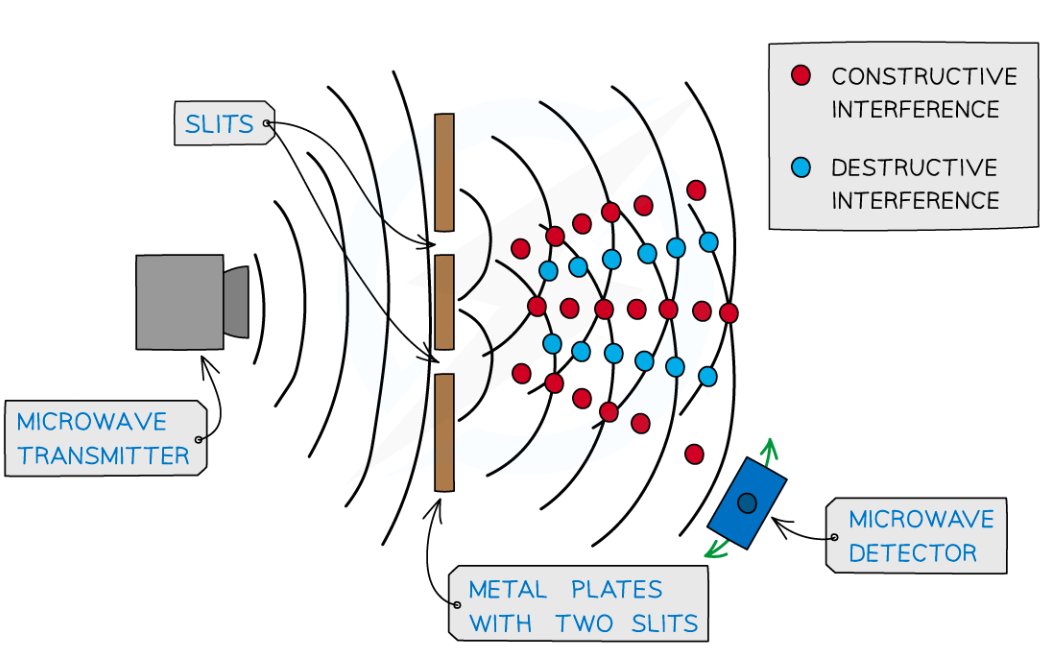
When waves pass through a narrow opening, they spread out in a process called diffraction. If waves pass through two closely spaced slits, the diffracted waves from each slit overlap and interfere with one another. This produces a pattern of alternating bright and dark regions known as an interference pattern. The double slit experiment is one of the most important demonstrations of wave behavior in physics.
In the double slit experiment, coherent waves pass through two narrow slits separated by a small distance. The two slits act as sources of waves that spread outward and overlap. At some points, the waves arrive in phase and produce constructive interference, creating bright fringes on a screen. At other points, the waves arrive out of phase and produce destructive interference, creating dark fringes.
Constructive interference occurs when the path difference between the two waves is equal to a whole number of wavelengths:
where:
- d = slit separation
- θ = angle to the bright fringe
- n = order number(0,1,2,3,…)
- λ = wavelength
Destructive interference occurs when the path difference is equal to a half-integer multiple of the wavelength:
These relationships determine where bright and dark fringes appear on the screen.
For small diffraction angles, the spacing between fringes on the screen can be approximated using:
where:
- Δy = fringe spacing
- λ = wavelength
- L = distance from the slits to the screen
- d = slit separation
This equation shows that:
- larger wavelengths produce wider fringe spacing,
- increasing the screen distance increases fringe spacing,
- increasing slit separation decreases fringe spacing.
Example 1: Fringe Spacing
Suppose light of wavelength
600nm passes through slits separated by
0.20mm. The screen is
2.0m away.
Using:
The bright fringes are spaced
6.0mm apart.
The double slit experiment provided strong evidence that light behaves as a wave. If light consisted only of particles traveling in straight lines, the interference pattern would not form. Instead, the alternating bright and dark fringes show that light waves combine through superposition.
One of the most remarkable discoveries in modern physics is that not only light, but also electrons and other particles, can produce double slit interference patterns. This demonstrates the principle of wave-particle duality, which states that matter can display both particle-like and wave-like behavior.
The double slit experiment has become one of the foundational experiments of quantum physics. It reveals that waves can interfere with themselves and that probability plays a major role in the behavior of microscopic particles.
Double slit diffraction has many practical applications. Interference principles are used in:
- diffraction gratings,
- spectroscopy,
- holography,
- optical instruments,
- semiconductor technology,
- and modern quantum experiments.
The study of double slit diffraction demonstrates how simple wave interactions can produce highly organized interference patterns and provides deep insight into the nature of light and matter.
- Key Topics:
- The principle of superposition and constructive/destructive interference.
- Young’s Double-Slit Experiment: Conditions for bright and dark fringes.
- Mathematical derivation of fringe patterns: .
- Focus: Analyze interference patterns produced by wave superposition in double-slit experiments.
2. Single Slit Diffraction
Learning outcomes
- I can explain how diffraction occurs when waves pass through a single narrow slit or opening.
- I can describe how interference within a single slit produces a diffraction pattern with bright and dark regions.
- I can identify the central maximum and explain why it is wider and brighter than the surrounding fringes.
- I can relate slit width and wavelength to the amount of diffraction observed.
- I can apply the single slit diffraction condition to determine the angles of diffraction minima.
- Intensity distribution of single-slit diffraction.
- Diffraction condition: .
Diffraction Pattern of a Single Slit 🌊🔬
When light passes through a single narrow slit, it spreads out rather than traveling in a straight line—this is diffraction! But what’s fascinating is the resulting intensity pattern: Instead of a single bright spot, we see a central maximum flanked by smaller, dimmer fringes. Let's explore why this happens and how to describe the intensity mathematically! 🤓✨
1️⃣ Understanding Single-Slit Diffraction: Why Do We See Fringes? 🎯
🔹 When light waves pass through a narrow slit, each point in the slit acts as a secondary source (Huygens’ Principle).
🔹 These wavelets interfere as they propagate forward.
🔹 At some angles, the waves reinforce each other (constructive interference—bright fringes).
🔹 At other angles, they cancel each other out (destructive interference—dark fringes).
💡 Key Difference from Double-Slit Interference:
- Instead of equally spaced bright and dark fringes, we get a broad central maximum with smaller, fading side fringes.
- The central maximum is much brighter and wider than the secondary fringes.
2️⃣ Intensity Distribution: Where Are the Bright and Dark Fringes? 📊
The intensity of light in the single-slit diffraction pattern follows a mathematical function based on the sine function squared. The formula for intensity at an angle
is:
where:
✅
= Maximum intensity at
(central maximum)
✅
, where:
- = Slit width
- = Wavelength of light
- = Angle relative to the center
Key Takeaways from the Formula:
🔹 The intensity drops off rapidly for higher angles.
🔹 The first dark fringe occurs where
, which simplifies to:
🔹 The central maximum is about twice as wide as the secondary fringes.
📌 Graph Suggestion! A plot of intensity vs. angle would help show how the central peak dominates while the side fringes fade away. Would you like me to generate one? 😊
3️⃣ Finding the Locations of Dark Fringes (Minima) 🔎
To find where dark fringes appear, we use the equation:
where
(no
because that’s the bright central maximum).
🔹 First dark fringe:
→
🔹 Second dark fringe:
→
The bright fringes (except the central maximum) do not follow a simple equation like in double-slit interference, but they occur between the dark fringes.
4️⃣ Worked Example: Single-Slit Diffraction Calculation 🧮✨
🔹 Problem:
A single slit of width
mm is illuminated by red light (
nm). Find the angle at which the first dark fringe appears.
🔹 Solution:
Using the formula for the first minimum:
✅ Answer: The first dark fringe appears at
from the central maximum.
5️⃣ Real-World Applications of Single-Slit Diffraction 🌍🔬
✔ Apertures in Cameras & Telescopes: The diffraction limit determines the smallest detail a lens can resolve! 📷🔭
✔ Laser Beam Shaping: Used in optical engineering to control beam profiles. 💡
✔ X-ray Crystallography: Diffraction from atomic lattices helps reveal molecular structures. 🧪
✔ Microscope Resolution: Affects how finely a microscope can distinguish details. 🔬
Final Thoughts 🤯
✅ Single-slit diffraction creates an intensity pattern where the central maximum is brightest and widest.
✅ Dark fringes occur where waves destructively interfere (
).
✅ Intensity follows a sinc-squared function, meaning side fringes quickly diminish in brightness.
✅ This effect sets fundamental limits on resolution in imaging systems like cameras and microscopes.
Activities:
- Conduct a single-slit diffraction experiment with a laser.
- Solve problems on intensity and fringe positions.
Assessment: Lab report on single-slit diffraction.
In the realm of single-slit diffraction, a beam of light encounters a narrow slit, giving rise to a phenomenon where light waves diffract and spread out, generating a pattern of bright and dark fringes on a screen. To solve single-slit diffraction problems involving angles, wavelengths, and slit width, one can wield the tools of wave optics and the mathematics of diffraction to unravel the cosmic symphony of light bending and weaving its way through the slit.
Here's a poetic guide to solving single-slit diffraction problems:
-
Angle of Diffraction (θ):
- The angle at which light diffracts after passing through the slit can be calculated using the formula:
Where:- = Angle of diffraction
- = Order of the diffraction maximum
- = Wavelength of light
- = Width of the slit
- The angle at which light diffracts after passing through the slit can be calculated using the formula:
-
Wavelength of Light (λ):
- By analyzing the diffraction pattern and measuring the angle of diffraction, one can determine the wavelength of light used in the experiment. This can be done by rearranging the angle of diffraction formula:
- By analyzing the diffraction pattern and measuring the angle of diffraction, one can determine the wavelength of light used in the experiment. This can be done by rearranging the angle of diffraction formula:
-
Slit Width (a):
- The width of the slit through which light passes plays a crucial role in determining the diffraction pattern. By measuring the angle of diffraction and the wavelength of light, one can calculate the width of the slit using the formula:
- The width of the slit through which light passes plays a crucial role in determining the diffraction pattern. By measuring the angle of diffraction and the wavelength of light, one can calculate the width of the slit using the formula:
- Key Topics:
- Diffraction through a single slit: Intensity and fringe patterns.
- The diffraction condition: .
- Diffraction gratings and their applications in spectroscopy.
- Focus: Explore the effects of diffraction through single slits and gratings and their applications.
Single Slit Diffraction
When waves pass through a narrow opening or around an obstacle, they spread out into the surrounding space. This phenomenon is called diffraction. Diffraction occurs with all types of waves, including water waves, sound waves, and light waves. The amount of spreading depends on the size of the opening compared to the wavelength of the wave.
In single slit diffraction, waves pass through one narrow slit and spread out on the other side. The diffracted waves from different parts of the slit interfere with one another, producing a characteristic diffraction pattern on a screen. For light waves, this pattern consists of a broad bright central region surrounded by alternating dark and dimmer bright fringes.
The central bright region is called the central maximum. It is much wider and brighter than the surrounding fringes because most of the diffracted waves interfere constructively near the center. The smaller side fringes occur because of alternating constructive and destructive interference at larger angles.
The condition for destructive interference, which produces dark fringes (minima), is:
a\sin\theta = n\lambda
where:
-
(a) = slit width
-
(\theta) = angle to the diffraction minimum
-
(n = 1,2,3,\dots)
-
(\lambda) = wavelength
This equation predicts the angles where dark regions appear in the diffraction pattern.
The amount of diffraction depends strongly on the relationship between slit width and wavelength. When the slit is much larger than the wavelength, diffraction is small and the wave travels mostly straight through. When the slit width becomes comparable to the wavelength, diffraction becomes much more noticeable.
Example 1: Effect of Slit Width
Suppose light with wavelength (500 , \text{nm}) passes through two different slits:
-
Slit A: (0.50 , \text{mm})
-
Slit B: (0.05 , \text{mm})
The narrower slit produces a much wider diffraction pattern because the light spreads out more strongly.
The angle to the first minimum can be estimated using:
[
a\sin\theta = \lambda
]
For small angles:
[
\sin\theta \approx \theta
]
so:
[
\theta \approx \frac{\lambda}{a}
]
This relationship shows that:
-
increasing wavelength increases diffraction,
-
decreasing slit width increases diffraction.
Example 2: Calculating a Diffraction Angle
Light with wavelength (600 , \text{nm}) passes through a slit of width (2.0\times10^{-5},\text{m}).
Using:
[
a\sin\theta = \lambda
]
[
(2.0\times10^{-5})\sin\theta = 6.0\times10^{-7}
]
[
\sin\theta = 0.03
]
[
\theta \approx 1.7^\circ
]
The first dark fringe appears at an angle of approximately (1.7^\circ).
Single slit diffraction provides strong evidence for the wave nature of light. If light behaved only as particles moving in straight lines, the spreading and interference pattern would not occur. Instead, the diffraction pattern demonstrates that light waves spread and interfere after passing through a narrow opening.
Single Slit Diffraction and Double Slit Interference
In a real double slit experiment, each slit has a finite width rather than being infinitely thin. This means that each slit not only produces interference with the other slit, but also produces its own single slit diffraction pattern. As a result, the double slit interference fringes are contained within a broader diffraction envelope.
The overall pattern seen on the screen is therefore actually a combination of:
-
double slit interference, which determines the spacing of the bright and dark fringes,
-
and single slit diffraction, which controls the overall intensity distribution.
Near the center of the pattern, the diffraction intensity is greatest, so the interference fringes are brightest. Farther from the center, the diffraction intensity decreases, causing the fringes to become dimmer and eventually disappear.
This means that the single slit diffraction pattern acts like an “envelope” surrounding the double slit fringes.
Example 3: Diffraction Envelope
Suppose a double slit experiment produces many evenly spaced interference fringes. If the slit width is decreased, the single slit diffraction envelope becomes wider. As a result, more interference fringes fit inside the central maximum.
At certain angles, destructive single slit diffraction can completely eliminate interference fringes. Even if the double slit condition predicts constructive interference, no bright fringe appears if the single slit diffraction intensity is zero at that angle.
This combined behavior demonstrates that diffraction and interference are deeply connected wave phenomena. The double slit experiment cannot be fully understood without considering the diffraction produced by each individual slit.
Single slit diffraction also has many important practical applications. Diffraction effects are important in:
-
spectroscopy,
-
optical engineering,
-
lasers,
-
radio transmission,
-
telescopes and microscopes,
-
and scientific imaging systems.
Diffraction ultimately limits the resolving power of optical instruments because light spreads as it passes through apertures. Understanding diffraction is therefore essential in optics, astronomy, engineering, and modern physics.
The study of single slit diffraction reveals how wave interference produces organized intensity patterns and demonstrates the fundamental wave behavior of light and other types of waves.
3. Diffraction Gratings
Learning Outcomes
- I can explain how diffraction gratings produce interference patterns using many closely spaced slits.
- I can describe how constructive interference creates bright diffraction maxima at specific angles.
- I can apply the diffraction grating equation to calculate wavelengths, diffraction angles, or slit spacing.
- I can explain how diffraction gratings separate light into its component wavelengths to produce spectra.
- I can analyze practical applications of diffraction gratings in spectroscopy, astronomy, and optical technology.
- Grating equation: .
- Applications in spectroscopy and optical filters.
Diffraction Gratings in Optics 🌈🔬
A diffraction grating is an optical component that splits and disperses light into its different wavelengths, creating a spectral pattern. It's widely used in spectroscopy, lasers, and optical devices where precise wavelength separation is needed. Let's explore how it works and why it's so useful! 🤓✨
1️⃣ What is a Diffraction Grating? 📜
A diffraction grating consists of many closely spaced parallel slits or grooves that cause light to diffract and interfere. These slits or grooves are separated by a small distance
, typically on the order of micrometers or even nanometers!
🔹 Types of Diffraction Gratings:
✅ Transmission Grating: Light passes through slits (used in spectrometers).
✅ Reflection Grating: Light reflects off finely ruled surfaces (used in telescopes and laser optics).
💡 Fun Fact: A CD or DVD acts like a diffraction grating, splitting light into different colors! 💿🌈
2️⃣ How Does a Diffraction Grating Work? 🎯
When light encounters the grating:
- Each slit acts as a wave source, producing multiple wavefronts.
- These wavefronts interfere constructively at specific angles, creating bright fringes at different wavelengths.
- Unlike a double slit, which produces only a few interference fringes, a grating produces a sharper, more detailed spectrum!
✅ Grating Equation (Where Bright Fringes Appear):
where:
- = Spacing between adjacent slits (grating spacing)
- = Angle at which a specific wavelength appears
- = Order of diffraction ()
- = Wavelength of light
💡 Key Takeaway: Each wavelength of light is diffracted at a different angle, creating a color spectrum.
📌 Graph Suggestion! A diagram showing multiple diffraction orders and how different wavelengths spread out would be useful. Want me to make one? 😊
3️⃣ Advantages of Diffraction Gratings Over Prisms & Slits 🚀
🔹 Sharper and More Separated Spectra:
- A grating spreads colors more evenly than a prism, which bends shorter wavelengths more than longer ones.
- The higher the number of slits, the sharper the spectral lines.
🔹 Higher Resolution:
- Resolution improves as the number of lines per millimeter increases.
- Used in high-precision spectroscopy! 🔬
🔹 Customizable for Specific Wavelengths:
- The angle of diffraction can be tuned for different wavelengths using the grating equation.
4️⃣ Worked Example: Finding Diffraction Angles 🧮✨
🔹 Problem:
A diffraction grating has 5000 lines per cm and is illuminated with green light (
nm). Find the angle for the first-order diffraction peak (
).
🔹 Solution:
1️⃣ First, find the slit spacing
:
Since there are 5000 lines per cm, this is
lines per meter.
2️⃣ Use the grating equation:
✅ Answer: The first-order peak appears at 16.0°.
For higher orders (
etc.), the angle increases! 🔺
5️⃣ Real-World Applications of Diffraction Gratings 🌍
✔ Spectroscopy: Identifying chemical compositions of stars, gases, and materials. 🔭✨
✔ Laser Optics: Beam splitters and wavelength selectors in laser systems. 💡🔬
✔ Telecommunications: Used in fiber optics for wavelength division multiplexing (WDM). 📡📞
✔ Holography: Creates 3D holograms using interference patterns. 🏆📸
✔ Security Features: Diffraction-based security patterns on banknotes and credit cards. 💳🔍
Final Thoughts 🤯
✅ Diffraction gratings split light into its component wavelengths with high precision.
✅ They work by constructive interference of waves from multiple slits.
✅ The diffraction angle depends on the wavelength and the slit spacing
.
✅ They are widely used in spectroscopy, lasers, and optical systems.
Activities:
- Analyze the diffraction patterns of a grating.
- Solve problems using the grating equation.
Assessment: Problem set on diffraction gratings.
When tackling interference problems with diffraction gratings, one delves into the delicate interplay of light waves interacting with the periodic structure of the grating, giving rise to a rich spectrum of diffracted orders and spectral lines. To solve these problems involving diffraction gratings, one can employ the tools of wave optics and the mathematics of diffraction to unravel the intricate patterns of interference and diffraction that adorn the canvas of perception.
Here's a poetic guide to solving interference problems with diffraction gratings:
-
Grating Equation:
- The fundamental equation for a diffraction grating is given by:
Where:- = Order of the diffracted beam
- = Wavelength of light
- = Grating spacing
- = Angle of incidence
- = Angle of diffraction
- The fundamental equation for a diffraction grating is given by:
-
Calculating Angles:
- By manipulating the grating equation, one can calculate the angles of diffraction for different orders of spectral lines produced by the grating, providing insights into the angular distribution of diffracted beams and the spectral composition of the diffracted light.
-
Spectral Lines:
- The diffraction grating disperses light into its component wavelengths, creating a pattern of spectral lines that reveal the unique fingerprint of the light source. By analyzing the positions and intensities of these spectral lines, one can extract valuable information about the properties of light and the characteristics of the diffraction grating.
4. Interference and Diffraction Patterns
Learning outcomes
- I can distinguish between interference patterns and diffraction patterns produced by waves.
- I can explain how constructive and destructive interference produce bright and dark regions in wave patterns.
- I can describe how diffraction envelopes influence the intensity distribution of interference fringes.
- I can compare the patterns produced by single slits, double slits, and diffraction gratings.
- I can analyze and interpret diffraction and interference patterns using wave behavior and superposition principles.
Interference and Diffraction Patterns
When waves overlap in the same region of space, they combine according to the principle of superposition. The resulting wave pattern depends on how the waves interact with one another. Two of the most important wave behaviors that arise from superposition are interference and diffraction. These phenomena are fundamental in understanding the behavior of light, sound, water waves, and many other types of waves.
Interference occurs when two or more waves combine after traveling from different sources or paths. Depending on the phase relationship between the waves, they may produce either constructive or destructive interference. In constructive interference, waves arrive in phase, causing their amplitudes to add together and produce bright or high-intensity regions. In destructive interference, waves arrive out of phase, causing amplitudes to partially or completely cancel.
For light waves, constructive interference produces bright fringes, while destructive interference produces dark fringes. The conditions for double slit interference are:
For constructive interference:
dsinθ = = nλ
For destructive interference:
dsinθ = \( (n + \frac{1}{2}) \lambda \)
where:
- d = slit separation
- θ = diffraction angle
- n = interference order
- λ = wavelength
These equations determine where bright and dark fringes appear on a screen.
Diffraction occurs when waves spread out after passing through an opening or around an obstacle. In single slit diffraction, waves from different parts of the slit interfere with one another to produce a broad central maximum surrounded by weaker side fringes.
The condition for diffraction minima in a single slit pattern is:
a\sin\theta = n\lambda
where:
-
(a) = slit width
-
(n = 1,2,3,\dots)
This equation predicts the angles where destructive interference creates dark regions in the diffraction pattern.
Although interference and diffraction are often discussed separately, they are closely related phenomena. Both arise because waves combine through superposition. In fact, diffraction itself can be understood as interference between waves originating from different parts of the same wavefront.
Different optical systems produce different types of patterns. In single slit diffraction, the pattern consists of a broad central maximum with weaker side fringes. In double slit interference, evenly spaced bright and dark fringes appear because of interference between waves from two slits. In diffraction gratings, many closely spaced slits produce extremely sharp and intense bright maxima.
One important idea is that real double slit patterns are actually controlled by both interference and diffraction simultaneously. Each slit in a double slit system has a finite width, meaning each slit produces its own single slit diffraction pattern. The interference fringes are therefore contained inside a larger diffraction envelope.
Near the center of the screen, the diffraction envelope is brightest, so the interference fringes have high intensity. Farther from the center, the diffraction intensity decreases, causing the fringes to fade. At certain angles, the diffraction envelope may reduce the intensity to zero, causing some interference fringes to disappear completely.
Example 1: Comparing Patterns
-
A single slit produces one broad central maximum.
-
A double slit produces many evenly spaced fringes.
-
A diffraction grating produces extremely narrow and bright maxima.
As the number of slits increases, the bright maxima become sharper and more intense because constructive interference occurs more precisely at specific angles.
The appearance of diffraction and interference patterns depends strongly on wavelength and geometry. Larger wavelengths generally produce wider diffraction patterns and greater fringe spacing. Narrower slits increase diffraction, while larger slit separations decrease fringe spacing.
Example 2: Wavelength Effects
Red light has a longer wavelength than blue light. In a diffraction experiment, red light therefore spreads out more and produces wider fringe spacing than blue light.
Interference and diffraction patterns provide strong evidence for the wave nature of light. These patterns cannot be explained by particles traveling only in straight lines. Instead, they reveal that light behaves as a wave capable of spreading, overlapping, and interfering.
The study of interference and diffraction has many practical applications, including:
-
spectroscopy,
-
lasers,
-
holography,
-
optical engineering,
-
telescopes and microscopes,
-
fiber optics,
-
and quantum physics experiments.
Understanding how these patterns form allows scientists and engineers to analyze light, measure wavelengths, and design advanced optical systems.
5. Factors Affecting Diffraction and Interference
Learning outcomes
- I can explain how wavelength affects the amount of diffraction and the spacing of interference patterns.
- I can describe how slit width influences the width and intensity of diffraction patterns.
- I can analyze how slit separation affects fringe spacing in double slit interference.
- I can explain how the number of slits in a diffraction grating affects the sharpness and intensity of diffraction maxima.
- I can predict how changes in experimental setup, such as screen distance or coherence, alter diffraction and interference patterns.
Factors Affecting Diffraction and Interference
The appearance of diffraction and interference patterns depends strongly on the properties of the waves and the geometry of the experimental setup. By changing factors such as wavelength, slit width, slit separation, or the number of slits, the shape and spacing of the patterns can change significantly. Understanding these relationships is essential in wave optics and helps explain the operation of many scientific and technological devices.
One of the most important factors affecting diffraction and interference is wavelength. Longer wavelengths diffract more strongly than shorter wavelengths. This means that waves with larger wavelengths spread out more after passing through an opening.
For diffraction patterns, the angle to diffraction minima is given by:
a\sin\theta = n\lambda
where:
-
(a) = slit width
-
(\theta) = diffraction angle
-
= order number
-
(\lambda) = wavelength
This equation shows that increasing the wavelength increases the diffraction angle, causing the pattern to spread out more widely.
Example 1: Wavelength and Diffraction
Red light has a longer wavelength than blue light. When both pass through the same slit, red light produces a wider diffraction pattern because it spreads out more strongly.
Wavelength also affects the spacing of interference fringes in double slit experiments. The fringe spacing is given by:
\Delta y = \frac{\lambda L}{d}
where:
-
(\Delta y) = fringe spacing
-
(\lambda) = wavelength
-
(L) = screen distance
-
(d) = slit separation
This relationship shows that larger wavelengths produce larger fringe spacing.
Another important factor is slit width. In single slit diffraction, narrower slits produce greater diffraction and wider central maxima. Wider slits produce less spreading and narrower diffraction patterns.
Example 2: Slit Width
If the width of a single slit is reduced, the central diffraction maximum becomes wider because the waves spread out more after passing through the smaller opening.
In double slit interference, the slit separation strongly affects the spacing between interference fringes. Larger slit separations produce smaller fringe spacing, while smaller slit separations produce wider fringe spacing.
Example 3: Slit Separation
Suppose two double slit experiments use the same wavelength and screen distance:
-
Experiment A uses a slit separation of (0.20 , \text{mm})
-
Experiment B uses a slit separation of (0.40 , \text{mm})
Experiment B produces fringes that are spaced more closely together because the slit separation is larger.
The number of slits also affects diffraction and interference patterns. A double slit produces relatively broad bright fringes, while a diffraction grating with many slits produces very sharp and intense maxima. As the number of slits increases:
-
bright maxima become narrower,
-
intensity increases,
-
dark regions become more pronounced.
This occurs because constructive interference becomes much more precise when many waves combine together.
Example 4: Diffraction Gratings
A diffraction grating with 10,000 slits per centimeter produces much sharper spectral lines than a double slit system, making it useful in spectroscopy for analyzing wavelengths accurately.
The distance from the slits to the screen also affects the appearance of patterns. Increasing the screen distance increases the spacing between fringes and spreads the pattern over a larger area.
Example 5: Screen Distance
If the screen in a double slit experiment is moved farther away, the interference fringes become farther apart and easier to observe.
Another important requirement for stable interference patterns is coherence. Coherent sources produce waves with a constant phase relationship and the same frequency. Without coherence, the interference pattern becomes unstable or disappears entirely.
In real optical systems, diffraction and interference patterns often combine together. For example, double slit interference fringes are controlled by a broader single slit diffraction envelope. The diffraction pattern determines the overall intensity distribution, while interference determines the spacing of bright and dark fringes.
Understanding the factors that affect diffraction and interference patterns is essential in many applications of wave physics, including:
-
spectroscopy,
-
lasers,
-
holography,
-
optical communication,
-
astronomy,
-
and microscopy.
By carefully controlling wavelength, slit dimensions, and geometry, scientists and engineers can manipulate wave behavior for a wide range of technologies and experiments.