Exponential and Logarithmic Equations
5. Mixed Exponential and Logarithmic Problems
Learning outcomes
- I can combine exponential and logarithmic techniques.
- I can select efficient solution methods.
- I can solve multi-step problems.
- I can communicate complete mathematical reasoning.
- I can evaluate the reasonableness of solutions.
Mixed Exponential and Logarithmic Problems
Introduction
Exponential functions and logarithmic functions are closely connected. They are inverse functions, meaning that each can be used to reverse the operation performed by the other.
An exponential function uses a variable as an exponent:
y = 2ˣ
A logarithmic function determines the exponent needed to produce a particular value:
x = log₂
Many mathematical problems involve both types of functions. Some require logarithms to solve exponential equations, while others require exponential expressions to simplify logarithmic equations.
More advanced problems may involve:
-
Exponential equations with logarithmic expressions.
-
Logarithmic equations containing exponential expressions.
-
Equations with several exponential or logarithmic terms.
-
Inequalities involving exponential growth or decay.
-
Problems requiring substitution, factoring, and logarithmic properties.
-
Real-world models involving growth, decay, finance, and scientific measurements.
The challenge is often not performing the calculations but recognising which mathematical technique will solve the problem most efficiently.


The Relationship Between Exponentials and Logarithms
The fundamental relationship is:
aˣ = b ⇔ logₐ(b) = x
where:
-
a > 0.
-
a ≠ 1.
-
b > 0.
For example:
2⁵ = 32
is equivalent to:
log₂(32) = 5
The two statements express the same relationship.
Inverse Function Identities
Two particularly useful identities are:
logₐ(aˣ) = x
for every real x, and:
a^[logₐ(x)] = x
for x > 0.
Examples:
log₃(3⁷) = 7
5^[log₅(12)] = 12
ln(e⁴) = 4
e^[ln(20)] = 20
These identities are essential for simplifying mixed exponential and logarithmic expressions.
Reviewing the Essential Rules
Exponent Rules
-
aᵐ × aⁿ = a^(m+n)
-
aᵐ/aⁿ = a^(m−n)
-
(aᵐ)ⁿ = a^(mn)
-
a⁰ = 1
-
a⁻ⁿ = 1/aⁿ
-
a^(1/n) = ⁿ√a, for positive a
Logarithm Rules
For positive M and N:
-
logₐ(MN) = logₐ(M) + logₐ(N)
-
logₐ(M/N) = logₐ(M) − logₐ(N)
-
logₐ(Mᵏ) = klogₐ(M)
-
logₐ(1) = 0
-
logₐ(a) = 1
Change-of-Base Formula
logₐ(b) = ln(b)/ln(a)
or:
logₐ(b) = log(b)/log(a)
These rules allow complicated expressions to be rewritten in simpler forms.
Choosing an Efficient Solution Method
Different equation structures suggest different methods.
|
Problem structure |
Recommended method |
|---|---|
|
2ˣ = 64 |
Rewrite using common bases |
|
3^(2x−1) = 20 |
Take logarithms |
|
log₅(x − 2) = 3 |
Convert to exponential form |
|
log₂(x) + log₂(x − 3) = 2 |
Combine logarithms |
|
4ˣ − 5(2ˣ) + 4 = 0 |
Use substitution |
|
[ln(x)]² − 3ln(x) + 2 = 0 |
Use substitution |
|
e^[ln(x + 4)] = 12 |
Apply inverse identities |
|
2ˣ = x + 3 |
Use numerical or graphical methods |
|
3ˣ > 20 |
Take logarithms and solve an inequality |
|
log₂(x − 1) ≤ 3 |
Convert to exponential form and check the domain |
Questions to Ask Before Solving
Before beginning a problem, consider:
-
Can both sides be written using a common base?
-
Can logarithmic properties combine several terms?
-
Can an inverse-function identity simplify the expression?
-
Does a repeated expression suggest substitution?
-
Will logarithms isolate the unknown exponent?
-
Are there domain restrictions?
-
Could algebraic manipulation introduce extraneous solutions?
-
Is an exact answer possible, or is numerical approximation required?
Choosing an efficient method can significantly reduce the number of steps required.
Simplifying Mixed Expressions
Some mixed expressions can be simplified immediately using inverse-function identities.
Worked Example
Simplify:
log₂(2^(3x−4))
Since logarithms and exponentials with the same base are inverse functions:
log₂(2^(3x−4)) = 3x − 4
Final Answer: 3x − 4
Worked Example
Simplify:
e^[ln(5x + 2)]
Using the inverse identity:
e^[ln(5x + 2)] = 5x + 2
However, the original logarithm requires:
5x + 2 > 0
Therefore:
x > −2/5
The simplified expression is 5x + 2, but the original domain restriction must be preserved.
Worked Example
Simplify:
3^[2log₃(x)]
First apply the logarithmic power rule:
2log₃(x) = log₃(x²)
Therefore:
3^[2log₃(x)] = 3^[log₃(x²)]
= x²
Final Answer: x², where x > 0
The restriction x > 0 comes from the original expression log₃(x).
Solving Exponential Equations Using Logarithms
When the unknown appears in an exponent and common bases are unavailable, logarithms are usually the most efficient method.
Worked Example
Solve:
4^(2x−1) = 30
Step 1: Take Natural Logarithms
ln[4^(2x−1)] = ln(30)
Step 2: Apply the Power Rule
(2x − 1)ln(4) = ln(30)
Step 3: Isolate the Exponent
2x − 1 = ln(30)/ln(4)
Step 4: Solve
x = [1 + ln(30)/ln(4)]/2
Step 5: Calculate
x ≈ 1.727
Step 6: Verify
Using the unrounded solution:
4^(2x−1) = 30
The equation is satisfied.
Why This Method Is Efficient
The right side is not a convenient integer power of 4.
Using logarithms avoids unnecessary attempts to rewrite 30 using a common base.
Solving Logarithmic Equations Using Exponential Form
When the unknown appears inside a logarithm, converting to exponential form is often the simplest approach.
Worked Example
Solve:
log₃(2x + 5) = 4
Step 1: Identify the Domain
2x + 5 > 0
x > −5/2
Step 2: Convert to Exponential Form
2x + 5 = 3⁴
Step 3: Simplify
2x + 5 = 81
2x = 76
x = 38
Step 4: Verify
log₃[2(38) + 5] = log₃(81) = 4
The solution is valid.
Solving Equations with Logarithms and Exponentials Together
Some equations contain logarithmic and exponential operations within the same expression.
These often become simple when inverse identities are recognised.
Worked Example
Solve:
ln(e^(2x+1)) = 9
Step 1: Apply the Inverse Identity
ln(e^(2x+1)) = 2x + 1
Therefore:
2x + 1 = 9
Step 2: Solve
2x = 8
x = 4
Step 3: Verify
ln(e⁹) = 9
The equation is satisfied.
Worked Example: Exponential Outside a Logarithm
Solve:
2^[log₂(3x−1)] = 11
Step 1: Identify the Domain
3x − 1 > 0
x > 1/3
Step 2: Apply the Inverse Identity
2^[log₂(3x−1)] = 3x − 1
Therefore:
3x − 1 = 11
Step 3: Solve
3x = 12
x = 4
Step 4: Verify
3(4) − 1 = 11
The logarithmic argument is positive, and the equation is satisfied.
Worked Example: Different Exponential and Logarithmic Bases
Solve:
log₂(3ˣ) = 6
Step 1: Apply the Logarithmic Power Rule
xlog₂(3) = 6
Step 2: Solve
x = 6/log₂(3)
Using change of base:
x = 6ln(2)/ln(3)
Step 3: Calculate
x ≈ 3.786
Alternative Method
Convert the original equation to exponential form:
3ˣ = 2⁶
3ˣ = 64
Take logarithms:
x = ln(64)/ln(3)
This is equivalent because:
ln(64) = 6ln(2)
Important Observation
A problem may have several correct solution methods.
An efficient solver chooses the method that gives the clearest reasoning with the fewest unnecessary steps.
Solving Equations with Multiple Exponential Terms
Some exponential equations contain expressions that resemble quadratic equations.
Worked Example
Solve:
2^(2x) − 7(2ˣ) + 12 = 0
Step 1: Recognise the Structure
Since:
2^(2x) = (2ˣ)²
let:
u = 2ˣ
The equation becomes:
u² − 7u + 12 = 0
Step 2: Factorise
(u − 3)(u − 4) = 0
Therefore:
u = 3 or u = 4
Step 3: Substitute Back
Case 1
2ˣ = 3
Take logarithms:
x = ln(3)/ln(2)
x ≈ 1.585
Case 2
2ˣ = 4
2ˣ = 2²
x = 2
Step 4: Verify
For x = log₂(3), we have 2ˣ = 3:
3² − 7(3) + 12 = 9 − 21 + 12 = 0
For x = 2, we have 2ˣ = 4:
4² − 7(4) + 12 = 16 − 28 + 12 = 0
Final Answer
x = log₂(3) or x = 2
Approximately:
x ≈ 1.585 or x = 2
Solving Equations with Multiple Logarithmic Terms
Worked Example
Solve:
log₂(x) + log₂(x − 2) = 4
Step 1: Identify the Domain
x > 0
x − 2 > 0
Therefore:
x > 2
Step 2: Apply the Product Rule
log₂[x(x − 2)] = 4
Step 3: Convert to Exponential Form
x(x − 2) = 2⁴
x(x − 2) = 16
Step 4: Expand
x² − 2x − 16 = 0
Step 5: Apply the Quadratic Formula
x = [2 ± √(4 + 64)]/2
x = [2 ± √68]/2
x = 1 ± √17
Step 6: Check the Domain
The candidates are approximately:
x ≈ 5.123
x ≈ −3.123
Since x > 2, reject the negative value.
Final Answer
x = 1 + √17 ≈ 5.123
Verification
The exact solution satisfies:
x(x − 2) = 16
Therefore:
log₂(x) + log₂(x − 2)
= log₂(16)
= 4
The solution is valid.
Combining Exponential and Logarithmic Substitution
Some problems require recognising a repeated logarithmic or exponential expression.
Worked Example
Solve:
[ln(x)]² − 5ln(x) + 6 = 0
Step 1: Identify the Domain
x > 0
Step 2: Substitute
Let:
u = ln(x)
The equation becomes:
u² − 5u + 6 = 0
Step 3: Factorise
(u − 2)(u − 3) = 0
Therefore:
u = 2 or u = 3
Step 4: Substitute Back
ln(x) = 2
x = e²
or:
ln(x) = 3
x = e³
Final Answer
x = e² or x = e³
Approximately:
x ≈ 7.389 or x ≈ 20.086
Both values are positive and satisfy the original equation.
Worked Example: Substitution with an Exponential Expression
Solve:
e^(2x) − 6eˣ + 8 = 0
Step 1: Substitute
Let:
u = eˣ
Since eˣ > 0:
u > 0
The equation becomes:
u² − 6u + 8 = 0
Step 2: Factorise
(u − 2)(u − 4) = 0
Therefore:
u = 2 or u = 4
Step 3: Substitute Back
eˣ = 2
x = ln(2)
or:
eˣ = 4
x = ln(4)
Final Answer
x = ln(2) or x = ln(4)
Approximately:
x ≈ 0.693 or x ≈ 1.386
Both solutions are valid.
Multi-Step Equations Requiring Several Techniques
More advanced problems may require logarithmic properties, exponent rules, factoring, and domain analysis in the same solution.
Worked Example
Solve:
log₂(x − 1) + log₂(x + 2) = log₂(4x + 8)
Step 1: Identify Domain Restrictions
x − 1 > 0
x > 1
x + 2 > 0
x > −2
4x + 8 > 0
x > −2
Combined domain:
x > 1
Step 2: Combine the Left Side
log₂[(x − 1)(x + 2)] = log₂(4x + 8)
Step 3: Equate Arguments
(x − 1)(x + 2) = 4x + 8
Step 4: Expand
x² + x − 2 = 4x + 8
Step 5: Rearrange
x² − 3x − 10 = 0
Step 6: Factorise
(x − 5)(x + 2) = 0
Therefore:
x = 5 or x = −2
Step 7: Check the Domain
Since x > 1:
x = 5 is valid.
x = −2 is invalid.
Step 8: Verify
For x = 5:
Left side:
log₂(4) + log₂(7)
= log₂(28)
Right side:
log₂(28)
Both sides are equal.
Final Answer
x = 5
Why This Is a Multi-Step Problem
The solution requires:
-
Domain analysis.
-
Logarithmic properties.
-
Converting to algebra.
-
Factoring a quadratic.
-
Rejecting an extraneous solution.
-
Verification.
Each step is necessary for a complete mathematical argument.
A More Challenging Mixed Equation
Solve:
ln(x) + ln(x − 2) = 2ln(3)
Step 1: Identify the Domain
x > 0
x − 2 > 0
Therefore:
x > 2
Step 2: Apply Logarithmic Rules
The left side becomes:
ln[x(x − 2)]
The right side becomes:
ln(3²) = ln(9)
Therefore:
ln[x(x − 2)] = ln(9)
Step 3: Equate Arguments
x(x − 2) = 9
Step 4: Expand
x² − 2x − 9 = 0
Step 5: Use the Quadratic Formula
x = [2 ± √(4 + 36)]/2
x = [2 ± √40]/2
x = 1 ± √10
Step 6: Check the Domain
x = 1 + √10 ≈ 4.162
x = 1 − √10 ≈ −2.162
Only the first satisfies x > 2.
Final Answer
x = 1 + √10 ≈ 4.162
Solving Mixed Inequalities
Exponential and logarithmic inequalities may require the same techniques used for equations, with additional attention to inequality directions.
Worked Example: Exponential Inequality
Solve:
3^(2x−1) > 20
Step 1: Take Natural Logarithms
ln[3^(2x−1)] > ln(20)
Step 2: Apply the Power Rule
(2x − 1)ln(3) > ln(20)
Step 3: Divide
Since ln(3) > 0:
2x − 1 > ln(20)/ln(3)
Step 4: Solve
x > [1 + ln(20)/ln(3)]/2
Step 5: Calculate
x > 1.863
Final Answer
Approximately:
(1.863, ∞)
Worked Example: Logarithmic Inequality
Solve:
log₃(x − 2) ≤ 2
Step 1: Identify the Domain
x − 2 > 0
x > 2
Step 2: Convert to Exponential Form
Since 3 > 1:
x − 2 ≤ 3²
Step 3: Solve
x − 2 ≤ 9
x ≤ 11
Step 4: Combine with the Domain
2 < x ≤ 11
Final Answer
(2, 11]
Important Principle
Solving the algebraic inequality is not sufficient.
The final interval must also satisfy the logarithmic domain.
A Mixed Inequality with an Inverse Identity
Solve:
ln(e^(3x−2)) ≥ 7
Step 1: Simplify
ln(e^(3x−2)) = 3x − 2
Therefore:
3x − 2 ≥ 7
Step 2: Solve
3x ≥ 9
x ≥ 3
Final Answer
[3, ∞)
No logarithmic argument restriction is needed beyond positivity of e^(3x−2), which holds for every real x.
Graphical Interpretation of Mixed Problems
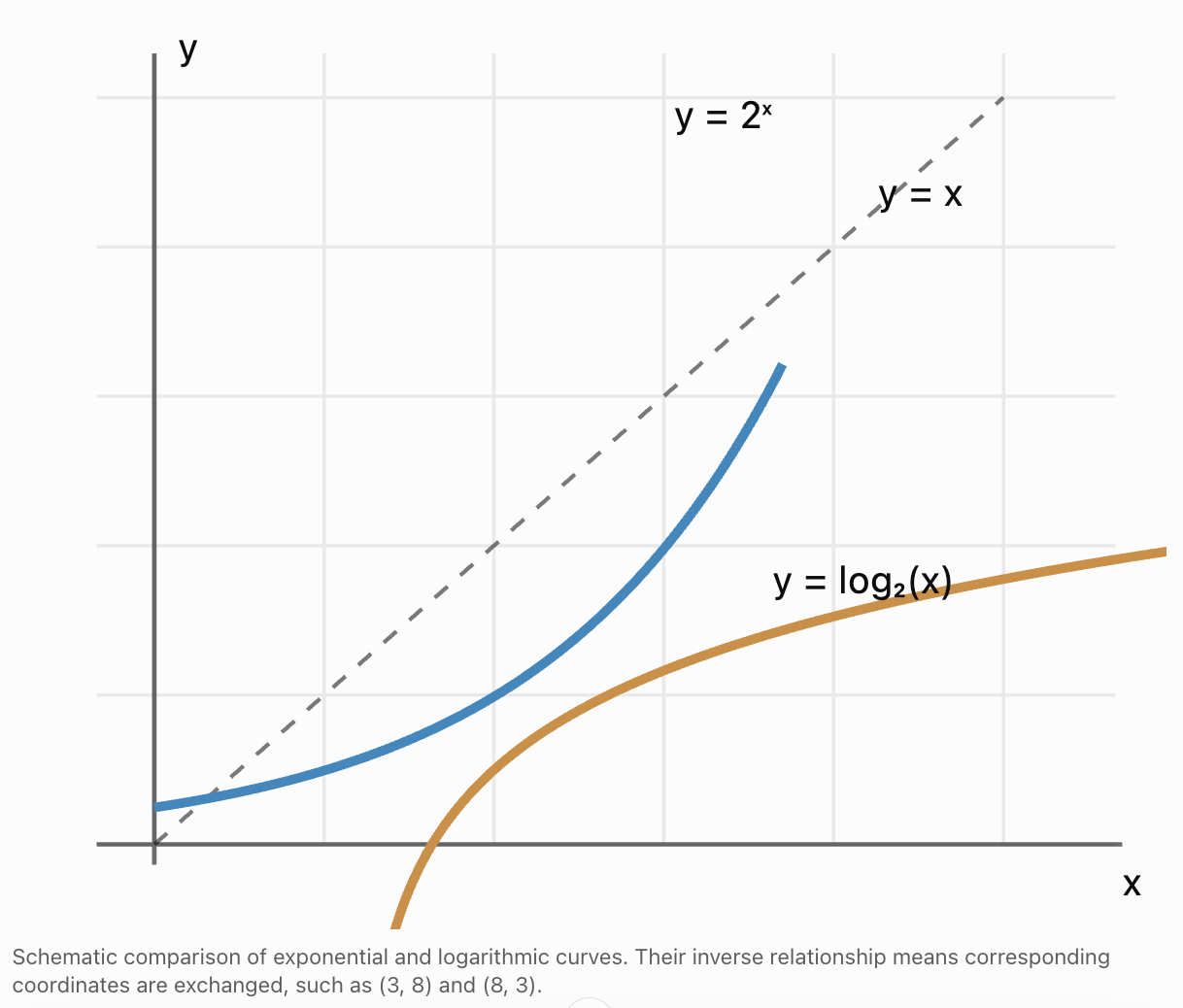
Exponential and logarithmic functions are inverse functions.
Their graphs are reflections of one another across the line:
y = x
For example:
y = 2ˣ
and:
y = log₂(x)
are inverse functions.
Why Graphs Are Useful
Graphs can help determine:
-
Whether an equation has one or several solutions.
-
Where exponential and logarithmic functions intersect.
-
Whether a solution is reasonable.
-
Which intervals satisfy an inequality.
-
Whether a mathematical model increases or decreases.
Some mixed equations cannot be solved using elementary algebra.
For example:
2ˣ = x + 3
This equation has two real solutions, which can be approximated numerically.
Graphing the functions:
y = 2ˣ
and:
y = x + 3
reveals two intersection points.
Numerical methods give approximately:
x ≈ −2.863 and x ≈ 2.445
In such cases, graphical or numerical methods may be more efficient than attempting to force an algebraic solution.
Evaluating the Reasonableness of Solutions
Finding an answer is only part of solving a mathematical problem.
A complete solution should also consider whether the result makes sense.
Questions to Ask
-
Does the solution satisfy the original equation?
-
Is the value within the allowed domain?
-
Does the sign of the answer make sense?
-
Is the magnitude reasonable?
-
Does the solution agree with an estimate?
-
Are the units correct?
-
Does the result fit the real-world context?
-
Has rounding affected the answer?
-
Does the model have limitations?
Example: Estimating Before Calculating
Solve:
2ˣ = 20
We know:
2⁴ = 16
2⁵ = 32
Therefore:
4 < x < 5
Using logarithms:
x = ln(20)/ln(2)
x ≈ 4.322
This agrees with the estimate.
If the calculator produced x = 43.22, the result would clearly be unreasonable.
Verifying Exact and Approximate Solutions
Exact Solutions
For:
3ˣ = 81
the solution is:
x = 4
Verification:
3⁴ = 81
Approximate Solutions
For:
5ˣ = 17
the exact solution is:
x = ln(17)/ln(5)
Approximately:
x ≈ 1.760
Substituting a rounded value gives an approximate result.
The most accurate verification uses the unrounded logarithmic expression.
Checking Domain Restrictions
Consider:
log₂(x − 3) = 2
Solving gives:
x − 3 = 4
x = 7
The domain requires x > 3.
Since 7 > 3, the solution is valid.
By contrast, any proposed value x ≤ 3 must be rejected before evaluating the logarithm.
Practical Application: Compound Interest
Exponential models describe how investments grow, while logarithms determine the time required to reach a target.
The compound interest formula is:
A = P(1 + r/n)^(nt)
where:
-
A is the final amount.
-
P is the initial investment.
-
r is the annual interest rate.
-
n is the number of compounding periods per year.
-
t is time in years.
Worked Example
An investment of $8000 earns 4.5% annual interest, compounded monthly.
How long will it take to reach $12000?
Step 1: Write the Equation
12000 = 8000(1 + 0.045/12)^(12t)
Step 2: Simplify
1.5 = 1.00375^(12t)
Step 3: Take Natural Logarithms
ln(1.5) = 12t ln(1.00375)
Step 4: Solve
t = ln(1.5)/[12ln(1.00375)]
Step 5: Calculate
t ≈ 9.03 years
Step 6: Evaluate Reasonableness
The investment needs to increase by 50%.
At an annual interest rate of approximately 4.5%, a time of about nine years is reasonable.
Interpretation
The model reaches $12000 after approximately 9.03 years.
Because interest is credited monthly, the account first reaches or exceeds the target after 109 complete months.

Practical Application: Population Growth
Suppose a population grows according to:
P(t) = 1500e^(0.06t)
where t is measured in years.
Worked Example
When will the population exceed 4000?
Step 1: Write the Inequality
1500e^(0.06t) > 4000
Step 2: Divide
e^(0.06t) > 8/3
Step 3: Take Natural Logarithms
0.06t > ln(8/3)
Step 4: Solve
t > ln(8/3)/0.06
Step 5: Calculate
t > 16.35 years
Interpretation
The model predicts that the population exceeds 4000 after approximately 16.35 years.
Reasonableness Check
The initial population is 1500.
The target population is more than twice as large.
At a continuous growth rate of 6%, a time of approximately 16 years is plausible.
However, real populations may not continue growing exponentially indefinitely.
Practical Application: Radioactive Decay
Radioactive decay can be modelled using:
N(t) = N₀e^(−λt)
where:
-
N(t) is the amount remaining.
-
N₀ is the initial amount.
-
λ is the decay constant.
-
t is elapsed time.
Worked Example
A radioactive sample begins with 500 g.
Its decay constant is 0.08 per year.
When will the sample fall below 100 g?
Step 1: Write the Inequality
500e^(−0.08t) < 100
Step 2: Divide
e^(−0.08t) < 0.2
Step 3: Take Natural Logarithms
−0.08t < ln(0.2)
Step 4: Divide by a Negative Number
Reverse the inequality:
t > ln(0.2)/(−0.08)
Step 5: Calculate
t > 20.12 years
Interpretation
The sample falls below 100 g after approximately 20.12 years.
Reasonableness Check
The amount decreases to one-fifth of its initial mass.
A decay constant of 0.08 per year gives a half-life of:
t₁/₂ = ln(2)/0.08
t₁/₂ ≈ 8.66 years
After two half-lives, the amount is one-quarter of the original mass.
Therefore, reaching one-fifth should take slightly longer than two half-lives.
The calculated result is reasonable.


Practical Application: Bacterial Growth
A bacterial population doubles every 3 hours.
The model is:
N(t) = 400 × 2^(t/3)
Worked Example
When will the population reach 10000 bacteria?
Step 1: Write the Equation
10000 = 400 × 2^(t/3)
Step 2: Divide
25 = 2^(t/3)
Step 3: Take Logarithms
ln(25) = (t/3)ln(2)
Step 4: Solve
t = 3ln(25)/ln(2)
Step 5: Calculate
t ≈ 13.93 hours
Reasonableness Check
After four doubling periods, or 12 hours:
N = 400 × 2⁴ = 6400
After five doubling periods, or 15 hours:
N = 400 × 2⁵ = 12800
Therefore, reaching 10000 between 12 and 15 hours is reasonable.
The calculated time of 13.93 hours fits this interval.
Practical Application: pH and Hydrogen-Ion Activity
The pH scale uses a logarithmic relationship:
pH = −log₁₀(a_H⁺)
where a_H⁺ is dimensionless hydrogen-ion activity.
Worked Example
A solution has pH 3.5.
Another solution has pH 5.0.
Compare their hydrogen-ion activities.
Step 1: Use the pH Difference
ΔpH = 5.0 − 3.5
ΔpH = 1.5
Step 2: Calculate the Ratio
Activity ratio = 10^1.5
Step 3: Evaluate
Activity ratio ≈ 31.6
Interpretation
The solution with pH 3.5 has approximately 31.6 times the hydrogen-ion activity of the solution with pH 5.0.
Reasonableness Check
A one-unit pH difference corresponds to a factor of 10.
A two-unit difference corresponds to a factor of 100.
Therefore, a 1.5-unit difference should produce a factor between 10 and 100.
The calculated ratio is reasonable.

Communicating Complete Mathematical Reasoning
A correct numerical answer is not always a complete mathematical solution.
Clear mathematical communication should show how the result was obtained and why it is valid.
A Strong Mathematical Solution Includes
-
A clear statement of the problem.
-
The relevant formula or mathematical principle.
-
Any domain restrictions.
-
Correct substitutions.
-
Logical algebraic steps.
-
Accurate calculations.
-
Verification.
-
Appropriate units.
-
A concluding interpretation.
Example of an Incomplete Solution
Problem:
Solve 3ˣ = 20.
Incomplete answer:
x = 2.727
Although the numerical value is correct, the method is not explained.
Example of a Complete Solution
We are given:
3ˣ = 20
Take natural logarithms:
ln(3ˣ) = ln(20)
Apply the power rule:
xln(3) = ln(20)
Divide by ln(3):
x = ln(20)/ln(3)
Calculate:
x ≈ 2.727
Verification:
3² ≈ 9
3³ = 27
Since 20 lies between 9 and 27, the solution should lie between 2 and 3.
The calculated value is reasonable.
Final Statement
The solution is x = ln(20)/ln(3) ≈ 2.727.
This explanation demonstrates the mathematical reasoning rather than simply reporting the answer.
A General Problem-Solving Strategy
For mixed exponential and logarithmic problems, the following procedure is useful.
Identify the Structure
Determine whether the problem contains:
-
An unknown exponent.
-
An unknown logarithmic argument.
-
Multiple exponential terms.
-
Multiple logarithmic terms.
-
A repeated expression.
-
An inequality.
-
A real-world growth or decay model.
Select an Efficient Method
Choose from:
-
Common bases.
-
Exponent laws.
-
Logarithmic properties.
-
Inverse-function identities.
-
Change of base.
-
Substitution.
-
Factoring.
-
Quadratic formula.
-
Graphical methods.
-
Numerical methods.
Identify Restrictions
Check:
-
Logarithmic arguments must be positive.
-
Exponential expressions with positive bases are positive.
-
Denominators cannot equal zero.
-
Square-root expressions must satisfy real-domain restrictions.
-
Practical quantities may require nonnegative values.
Solve Carefully
Show each algebraic transformation.
Avoid unnecessary rounding.
Verify
Substitute the solution into the original equation or inequality.
Reject invalid candidates.
Evaluate Reasonableness
Estimate expected values and compare with the result.
Communicate the Conclusion
Include units, appropriate precision, and an interpretation.
Common Mistakes
Using logarithms when common bases would be simpler
Always check whether a direct exponent comparison is possible.
Forgetting inverse-function identities
Expressions such as ln(eˣ) can be simplified immediately.
Confusing exponential and logarithmic forms
Remember that aˣ = b is equivalent to logₐ(b) = x.
Applying logarithmic rules incorrectly
For example:
log(a + b) is not generally equal to log(a) + log(b).
Ignoring domain restrictions
Every real logarithmic argument must be positive.
Accepting extraneous solutions
Candidate solutions must satisfy the original equation.
Forgetting positivity after substitution
If u = 2ˣ, then u > 0.
Equating exponents with different bases
Common bases must be established first.
Reversing inequalities incorrectly
An inequality reverses when multiplying or dividing by a negative number.
Rounding too early
Keep exact logarithmic expressions until the final calculation.
Failing to verify solutions
A transformed equation may admit invalid candidates.
Ignoring practical constraints
Real-world models may require nonnegative time or discrete compounding intervals.
Providing an answer without mathematical reasoning
A complete solution should show the method and explain the conclusion.
Failing to evaluate reasonableness
Estimation is a useful way to detect errors.
Key Terms
-
Exponential Function: A function in which the variable appears in an exponent.
-
Logarithmic Function: The inverse of an exponential function.
-
Inverse Function: A function that reverses another function's operation.
-
Exponential Equation: An equation containing an unknown exponent.
-
Logarithmic Equation: An equation containing an unknown variable inside a logarithm.
-
Exponential Inequality: An inequality involving exponential expressions.
-
Logarithmic Inequality: An inequality involving logarithmic expressions.
-
Base: The number raised to a power or used as the base of a logarithm.
-
Exponent: The power to which a base is raised.
-
Argument: The expression inside a logarithm.
-
Common Base: A shared base used to simplify exponential expressions.
-
Natural Logarithm: A logarithm with base e.
-
Common Logarithm: A logarithm with base 10.
-
Change-of-Base Formula: A formula that expresses a logarithm using another base.
-
Product Rule: A logarithmic rule converting multiplication into addition.
-
Quotient Rule: A logarithmic rule converting division into subtraction.
-
Power Rule: A logarithmic rule converting an exponent into a multiplier.
-
Domain: The set of allowable input values.
-
Domain Restriction: A condition limiting valid values of a variable.
-
Extraneous Solution: A candidate solution that does not satisfy the original equation.
-
Substitution: Replacing an expression with a simpler variable.
-
Factorisation: Rewriting an expression as a product of factors.
-
Quadratic Equation: An equation whose highest variable power is 2.
-
Quadratic Formula: A formula used to solve quadratic equations.
-
Graphical Solution: A solution found by examining graphs.
-
Numerical Method: A computational technique used to approximate solutions.
-
Verification: Checking a proposed solution in the original problem.
-
Reasonableness Check: An evaluation of whether a result makes mathematical and practical sense.
-
Exact Solution: A solution expressed without numerical rounding.
-
Approximate Solution: A numerical estimate of an exact value.
-
Exponential Growth: Growth by a constant multiplicative factor over equal intervals.
-
Exponential Decay: Decrease by a constant multiplicative factor over equal intervals.
-
Compound Interest: Interest calculated on an initial principal and accumulated interest.
-
Decay Constant: A parameter describing continuous exponential decay.
-
Half-Life: The time required for a decaying quantity to decrease to half its original amount.
-
Threshold: A boundary value used to determine whether a condition has been reached.
-
Mathematical Model: A mathematical representation of a real-world process.
Key Takeaways
-
Exponential and logarithmic functions are inverse functions.
-
Exponential equations can often be solved using common bases or logarithms.
-
Logarithmic equations can often be solved by converting to exponential form.
-
Inverse-function identities simplify many mixed expressions.
-
Logarithmic properties help combine multiple logarithmic terms.
-
Exponent laws help simplify exponential expressions before solving.
-
Substitution can transform complicated equations into quadratic equations.
-
Factoring and the quadratic formula are useful for solving transformed equations.
-
Domain restrictions must be preserved throughout logarithmic calculations.
-
Exponential expressions with positive bases are always positive.
-
Extraneous solutions must be identified and rejected.
-
Mixed inequalities require careful attention to inequality directions.
-
Graphical methods can help identify the number and approximate locations of solutions.
-
Numerical methods are useful when exact algebraic solutions are impractical.
-
Choosing an efficient method is an important mathematical skill.
-
Complete solutions should include logical algebraic steps and appropriate explanations.
-
Verification ensures that calculated answers satisfy the original problem.
-
Reasonableness checks help identify errors and evaluate mathematical results.
-
Exact expressions should be retained until numerical approximations are required.
-
Exponential and logarithmic models are widely used in finance, biology, chemistry, physics, and environmental science.
-
Practical solutions should include correct units and consideration of model limitations.
-
Successful mixed problem solving requires selecting appropriate techniques, combining them logically, and evaluating the validity and meaning of the final answer.
Check Your Understanding
Recall and Understanding
-
Explain how exponential and logarithmic functions are related.
-
Describe when using common bases is more efficient than using logarithms.
-
Explain why logarithmic domain restrictions must be checked.
-
Describe how substitution can simplify equations containing repeated exponential or logarithmic expressions.
-
Explain why estimating a solution before calculating can be useful.
Application
-
Solve 3^(2x−1) = 50, giving the answer to three decimal places.
-
Solve log₄(3x + 1) = 3.
-
Simplify e^[ln(2x + 5)] and state its domain.
-
Solve 2^(2x) − 5(2ˣ) + 6 = 0.
-
Solve log₂(x) + log₂(x − 4) = 5, checking for extraneous solutions.
Analysis and Challenge
-
Solve [ln(x)]² − 4ln(x) + 3 = 0, giving exact and approximate answers.
-
Solve log₃(x + 2) + log₃(x − 1) = log₃(4x + 4), checking all domain restrictions.
-
Solve 4^(x+1) > 30 using logarithms and express the solution in interval notation.
-
An investment of $7500 earns 5.2% annual interest, compounded monthly. Determine how long it takes to reach $12000 and explain how the answer can be checked for reasonableness.
-
A radioactive substance follows N(t) = 600e^(−0.075t). Determine when its mass falls below 150 g. Show all steps, verify the result, and interpret the answer.
Final Summary
Mixed exponential and logarithmic problems require a flexible approach to mathematical problem solving.
The most important skill is recognising the structure of an equation or inequality and selecting an efficient method.
Common bases, logarithmic properties, inverse-function identities, substitution, factoring, and numerical methods all provide useful techniques.
More advanced problems may require several methods to be combined in a logical sequence.
Domain restrictions and verification are essential, especially when logarithmic expressions or transformed quadratic equations are involved.
Reasonableness checks help determine whether a mathematical result is consistent with expected values and real-world conditions.
Exponential and logarithmic techniques are particularly important in finance, population modelling, radioactive decay, chemistry, and other scientific applications.
The central principle is that effective mathematical problem solving involves more than obtaining an answer: it requires choosing appropriate methods, communicating complete reasoning, verifying solutions, and evaluating whether the results make sense.