Exponential Function
4. Exponential Growth and Decay
Learning outcomes
- I can distinguish exponential growth from exponential decay.
- I can model growth and decay using exponential equations.
- I can determine growth and decay rates.
- I can interpret exponential models.
- I can solve practical growth and decay problems.
Exponential Growth and Decay
Many quantities in the real world change by the same percentage over equal periods of time. When this happens, the change can often be modelled using an exponential function.
Examples include:
- populations increasing
- money earning compound interest
- bacteria reproducing
- the value of some products decreasing
- radioactive substances decaying
- medicines being removed from the body
The key idea is that exponential change involves repeated multiplication, rather than repeated addition or subtraction.


Linear Change vs. Exponential Change
It is important to distinguish linear change from exponential change.
A linear relationship changes by the same amount during each interval.
For example:
100, 120, 140, 160, 180
The amount increases by 20 each time.
An exponential relationship changes by the same factor or percentage during each interval.
For example:
100, 120, 144, 172.8, 207.36
Each value is multiplied by:
1.20
This represents a 20% increase each time.
Compare
| Type | What stays constant? | Example |
|---|---|---|
| Linear | Amount added or subtracted | +20 each year |
| Exponential | Percentage or multiplication factor | ×1.20 each year |
This distinction is one of the most important ideas in exponential modelling.
Exponential Growth
Exponential growth occurs when a quantity increases by the same percentage over equal time intervals.
A common model is:
A = A₀(1 + r)ᵗ
where:
- A = amount after time t
- A₀ = initial amount
- r = growth rate written as a decimal
- t = number of time periods
The expression:
1 + r
is called the growth factor.
Example
A population begins at 2,000 and grows by 6% each year.
Initial amount:
A₀ = 2000
Growth rate:
r = 0.06
Growth factor:
1 + 0.06 = 1.06
Therefore:
A = 2000(1.06)ᵗ
This equation models the population after t years.
Converting Percentages to Decimals
Growth and decay rates must normally be written as decimals when substituted into exponential equations.
For example:
5% = 0.05
12% = 0.12
25% = 0.25
0.5% = 0.005
To convert a percentage to a decimal, divide by 100.
For example:
8% ÷ 100 = 0.08
Growth Factors
The growth factor tells us what number the quantity is multiplied by during each time interval.
For growth:
growth factor = 1 + r
Examples
| Growth rate | Growth factor |
|---|---|
| 3% | 1.03 |
| 8% | 1.08 |
| 15% | 1.15 |
| 25% | 1.25 |
| 60% | 1.60 |
If a quantity increases by 12% each year, it retains its original 100% and gains another 12%.
100% + 12% = 112%
112% = 1.12
So it is multiplied by 1.12 each year.
Worked Example: Population Growth
A town has a population of 15,000. Its population grows by 4% each year. Estimate the population after 6 years.
Use:
A = A₀(1 + r)ᵗ
Substitute:
A = 15000(1.04)⁶
A ≈ 18,980
So the predicted population after 6 years is approximately:
18,980 people
Notice that we do not simply calculate 4% of 15,000 and add that same amount six times. Each year's growth is based on the new population.


Exponential Decay
Exponential decay occurs when a quantity decreases by the same percentage over equal time intervals.
A common model is:
A = A₀(1 − r)ᵗ
The expression:
1 − r
is called the decay factor.
Example
A machine is worth $20,000 and loses 15% of its value each year.
Initial value:
A₀ = 20000
Decay rate:
r = 0.15
Decay factor:
1 − 0.15 = 0.85
Therefore:
A = 20000(0.85)ᵗ
Each year, the machine retains 85% of its previous value.
Decay Factors
For exponential decay:
decay factor = 1 − r
Examples
| Decay rate | Decay factor |
|---|---|
| 5% | 0.95 |
| 10% | 0.90 |
| 18% | 0.82 |
| 25% | 0.75 |
| 40% | 0.60 |
A factor between 0 and 1 indicates exponential decay.
For example:
A = 500(0.72)ᵗ
Since:
0 < 0.72 < 1
the model represents decay.
The decay rate is:
1 − 0.72 = 0.28
Therefore:
decay rate = 28%
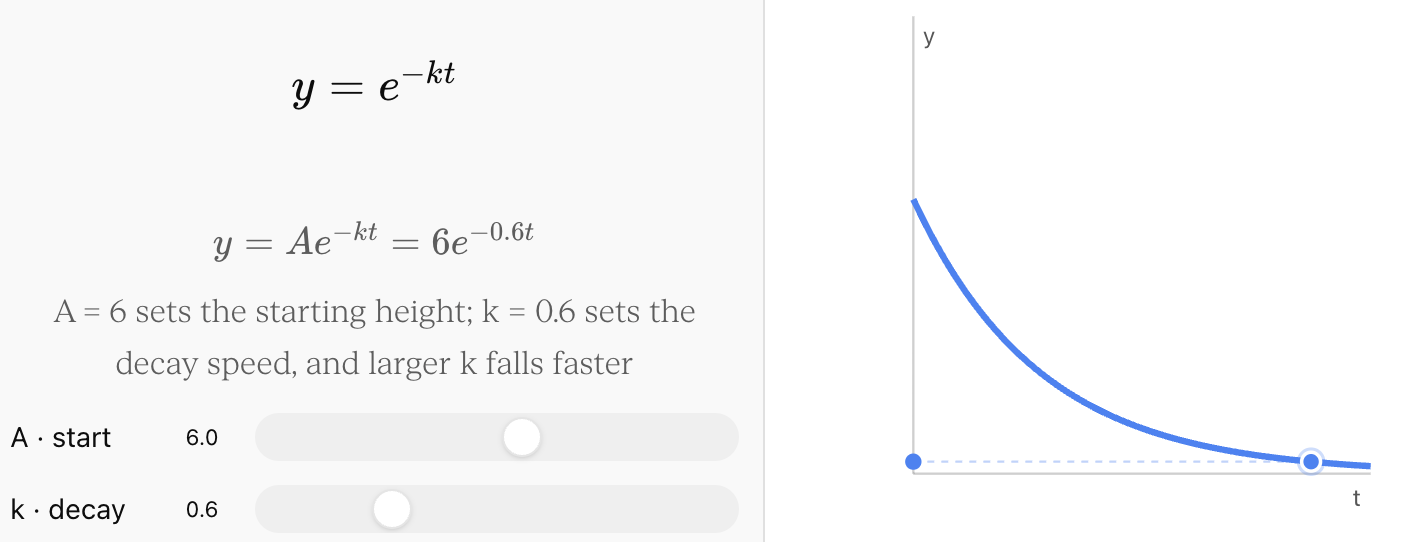
The decreasing behaviour of an exponential model can be explored directly here: