Geometric Reasoning and Applications
4. Multi-Step Geometric Problem Solving
Learning outcomes
- I can combine multiple geometric concepts to solve problems.
- I can select appropriate strategies for unfamiliar problems.
- I can communicate complete mathematical solutions.
- I can justify each step in my reasoning.
- I can evaluate whether my solution is reasonable.
Introduction
Many geometric problems cannot be solved using just one formula or theorem.
An architect designing a roof may need to use Pythagoras' theorem, trigonometry, surface area, and scale drawings. An engineer designing a container may need to calculate volume, determine missing dimensions, estimate material costs, and evaluate whether the design is practical. A surveyor may need to combine angles, distances, similar triangles, and coordinate geometry to determine the position of an inaccessible object.
These are examples of multi-step geometric problems.
The challenge is not simply knowing mathematical formulas. It is recognizing how different geometric concepts fit together, selecting an efficient strategy, organizing calculations, and explaining why each step is valid.
A successful geometric solution should be mathematically correct, logically justified, clearly communicated, and reasonable in the original context.
What Makes a Geometric Problem Multi-Step?
A multi-step geometric problem requires two or more connected calculations or reasoning processes.
For example, suppose we want to calculate the area of a triangular roof.
We may know the roof's horizontal width and angle of inclination, but not its sloping length.
To solve the problem, we must:
-
Use trigonometry to determine the sloping length.
-
Use the sloping length to calculate the roof area.
-
Convert the area into a material requirement.
-
Evaluate whether additional material is needed for waste.
The result from one step becomes the input for the next.
This creates a chain of mathematical reasoning.
The Main Geometric Concepts
Multi-step problems may combine several topics.
|
Concept |
Main purpose |
|---|---|
|
Angles and parallel lines |
Determine unknown angles |
|
Triangle properties |
Use angle sums and geometric relationships |
|
Pythagoras' theorem |
Calculate missing sides in right triangles |
|
Trigonometry |
Connect angles and side lengths |
|
Similarity |
Compare proportional shapes |
|
Congruence |
Establish equal corresponding sides and angles |
|
Coordinate geometry |
Calculate distances, slopes, and midpoints |
|
Transformations |
Analyse position, orientation, and scale |
|
Area |
Measure two-dimensional regions |
|
Surface area |
Calculate exposed surface material |
|
Volume |
Calculate three-dimensional space |
|
Scale factors |
Relate dimensions of similar figures |
|
Geometric modelling |
Represent and analyse real-world situations |
The most important skill is recognizing which concepts are relevant and how they should be combined.
A Systematic Problem-Solving Method
A reliable strategy is to use six stages.
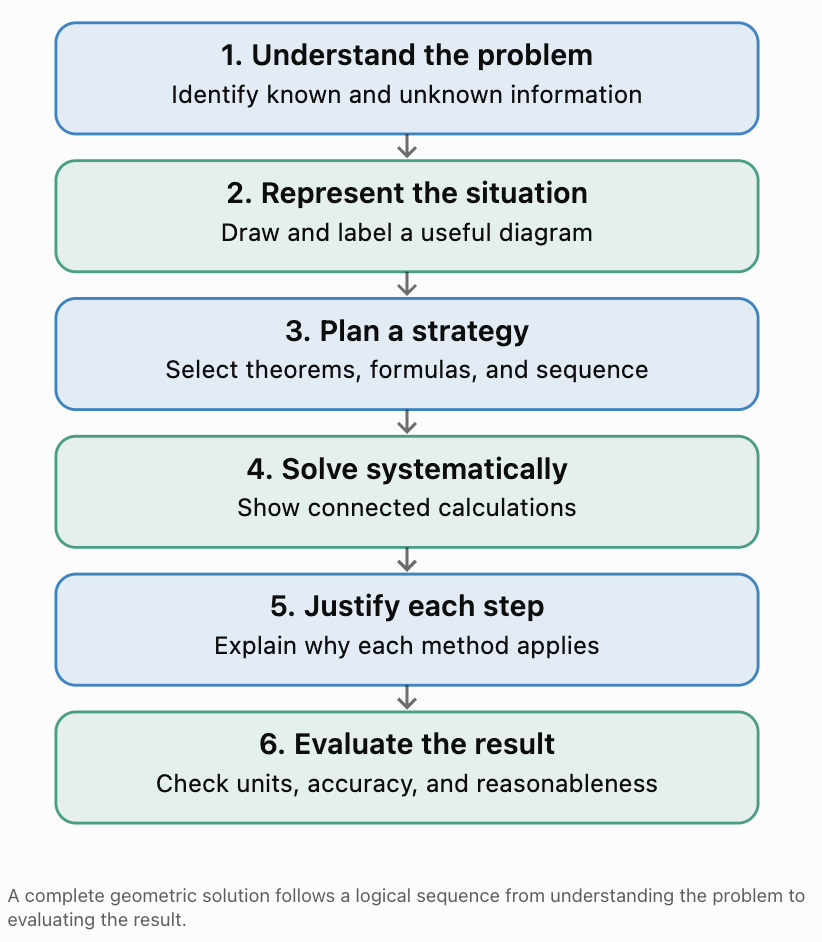
Stage 1: Understand the Problem
Read the problem carefully.
Identify:
-
What information is given.
-
What must be calculated or proved.
-
Which measurements are known.
-
Which relationships are implied.
-
Whether the problem contains any assumptions or restrictions.
Stage 2: Represent the Situation
Draw a diagram whenever possible.
A good diagram should include:
-
Clearly labelled points.
-
Known lengths and angles.
-
Unknown quantities represented by variables.
-
Right-angle symbols.
-
Parallel-line markings where appropriate.
-
Relevant units.
The diagram does not need to be drawn perfectly to scale, but its relationships must be represented correctly.
Stage 3: Plan a Strategy
Ask:
What do I need to know immediately before I can find the final answer?
Then work backwards.
For example:
To calculate a roof's surface area, we need its sloping length.
To calculate the sloping length, we may need Pythagoras' theorem.
This suggests the sequence:
Pythagoras → Sloping length → Surface area.
Stage 4: Solve Systematically
Write each calculation in a logical order.
Keep unrounded values in intermediate steps whenever possible.
Stage 5: Justify Each Step
Explain why the chosen method is valid.
For example:
-
“These triangles are similar because they have two equal corresponding angles.”
-
“Pythagoras' theorem applies because the triangle is right-angled.”
-
“The slopes are negative reciprocals, so the lines are perpendicular.”
Stage 6: Evaluate the Result
Check:
-
Are the units correct?
-
Are the dimensions physically possible?
-
Does the answer match the diagram?
-
Is the answer consistent with known geometric properties?
-
Is the precision appropriate?
-
Does the answer make sense in context?
Working Backwards from the Required Answer
One of the most effective strategies for unfamiliar problems is working backwards.
Suppose a problem asks for the cost of roofing material.
The final calculation is:
Cost = Area × Price per square metre.
But the roof area may require a sloping length.
That length may require a right-triangle calculation.
The problem can therefore be organized as:
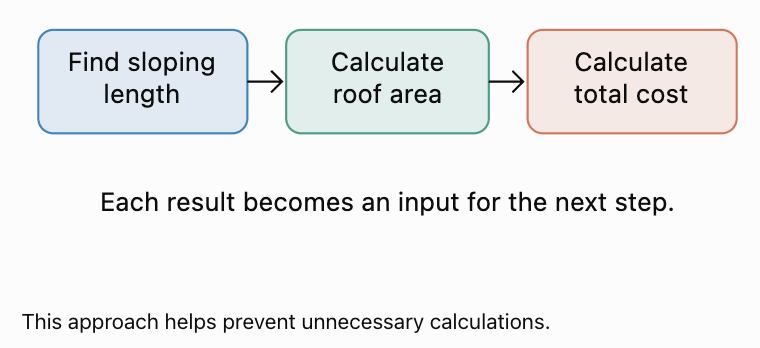
This approach helps prevent unnecessary calculations.
Worked Example 1: Roof Design Using Pythagoras and Area
A symmetrical pitched roof covers a building that is 10 m wide and 14 m long.
The roof ridge is 3 m above the top of the walls.
Assume there is no roof overhang.
Calculate:
a) The sloping distance from an eave to the ridge.
b) The total area of the two roof slopes.
c) The cost of roof covering at $42 per square metre.
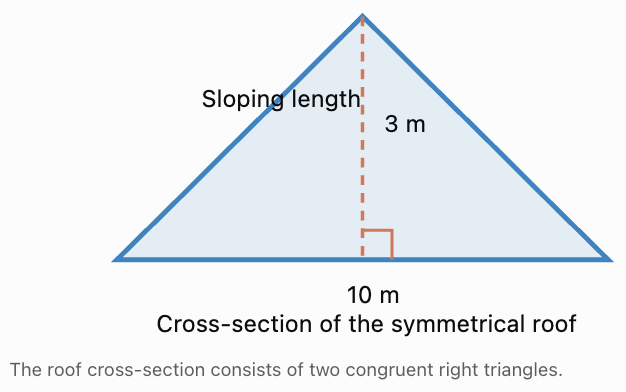
Step 1: Find half the building width
Half-width = 10/2 = 5 m.
Step 2: Apply Pythagoras' theorem
The sloping length L is the hypotenuse.
L² = 5² + 3².
L² = 25 + 9.
L = √34.
L ≈ 5.83 m.
Step 3: Calculate roof area
Each roof slope is a rectangle.
Area of one slope:
A₁ = 14√34.
Both slopes:
A_total = 2 × 14√34
= 28√34
≈ 163.27 m².
Step 4: Calculate cost
Cost = 28√34 × 42
≈ $6857.20.
Final answers:
-
Sloping length ≈ 5.83 m.
-
Total roof area ≈ 163.27 m².
-
Estimated covering cost ≈ $6857.20.
Justification: Pythagoras' theorem applies because the ridge height and half-width are perpendicular. Each roof slope is rectangular under the stated model.
Evaluation: The roof area is greater than the building's horizontal footprint of 140 m², which is reasonable because the roof is sloped. The estimate excludes waste, overlaps, and installation costs.
Combining Similarity and Trigonometry
Similarity and trigonometry are especially useful when measurements cannot be obtained directly.
Worked Example 2: Estimating a Tower's Height
A surveyor stands 50 m from the base of a vertical tower.
The angle of elevation to the top is 34°.
The surveyor's instrument is 1.5 m above level ground.
Calculate the tower's height.
Step 1: Identify the right triangle
Horizontal distance = 50 m.
Angle = 34°.
Unknown vertical distance above the instrument = h.
Step 2: Choose tangent
tan 34° = h/50.
h = 50 tan 34°.
h ≈ 33.73 m.
Step 3: Include instrument height
H = 33.73 + 1.5
Answer: H ≈ 35.23 m.
Justification: Tangent relates opposite and adjacent sides in a right triangle.
Evaluation: The result assumes the tower is vertical, the ground is level, and the angle and distance measurements are accurate.
Worked Example 3: Similar Triangles and Area
A triangular sign has base 12 cm and height 8 cm.
A larger, similar sign has base 30 cm.
Find:
a) The larger sign's height.
b) Its area.
c) The ratio of the two areas.
Step 1: Find the linear scale factor
k = 30/12 = 2.5.
Step 2: Find the new height
h = 8 × 2.5
= 20 cm.
Step 3: Calculate the larger area
A = ½ × 30 × 20
= 300 cm².
Step 4: Compare areas
Original area:
A₁ = ½ × 12 × 8 = 48 cm².
Area ratio:
300/48 = 6.25.
This agrees with:
k² = 2.5² = 6.25.
Answers: Height = 20 cm; area = 300 cm²; area ratio = 6.25 : 1.
Justification: Similar figures have proportional corresponding lengths, and their areas scale by the square of the linear scale factor.
Combining Coordinate Geometry and Geometric Proof
Coordinate geometry can be used to prove relationships before calculating other measurements.
Worked Example 4: Proving a Shape Is a Rectangle and Finding Its Area
Quadrilateral ABCD has vertices:
A(1, 2)
B(7, 5)
C(5, 9)
D(−1, 6).
Prove that ABCD is a rectangle and calculate its area.
Step 1: Calculate the slopes
m_AB = (5 − 2)/(7 − 1) = 3/6 = 1/2.
m_BC = (9 − 5)/(5 − 7) = 4/−2 = −2.
m_CD = (6 − 9)/(−1 − 5) = −3/−6 = 1/2.
m_DA = (2 − 6)/(1 − (−1)) = −4/2 = −2.
Step 2: Establish parallel sides
m_AB = m_CD.
Therefore, AB ∥ CD.
m_BC = m_DA.
Therefore, BC ∥ AD.
Both pairs of opposite sides are parallel, so ABCD is a parallelogram.
Step 3: Establish a right angle
m_AB × m_BC = (1/2)(−2) = −1.
Therefore, AB ⟂ BC.
A parallelogram with one right angle is a rectangle.
Step 4: Calculate adjacent side lengths
AB = √((7 − 1)² + (5 − 2)²)
= √45 = 3√5.
BC = √((5 − 7)² + (9 − 5)²)
= √20 = 2√5.
Step 5: Calculate area
A = AB × BC
= 3√5 × 2√5
= 6 × 5
Answer: ABCD is a rectangle with area 30 square units.
Justification: Slopes establish parallelism and perpendicularity; the distance formula establishes side lengths.
Evaluation: The area is positive and consistent with the side lengths. The figure is not necessarily axis-aligned, so simply subtracting coordinate extremes would not give its area.
Combining Transformations and Measurement
Transformations can change a figure's position, orientation, or size.
Translations, reflections, and rotations preserve lengths, angles, perimeter, and area.
Dilations preserve angles and shape but change size.
For a positive scale factor k:
-
Lengths are multiplied by k.
-
Perimeters are multiplied by k.
-
Areas are multiplied by k².
-
Volumes of similar solids are multiplied by k³.
Worked Example 5: Transforming and Enlarging a Triangle
Triangle ABC has vertices:
A(1, 1)
B(4, 1)
C(1, 3).
The triangle is translated 2 units right and 3 units up, then enlarged by scale factor 2 about the origin.
Find the final coordinates and area.
Step 1: Translate
Translation rule:
(x, y) → (x + 2, y + 3).
A′(3, 4)
B′(6, 4)
C′(3, 6).
Step 2: Enlarge
Dilation rule:
(x, y) → (2x, 2y).
A″(6, 8)
B″(12, 8)
C″(6, 12).
Step 3: Calculate original area
AB = 3 units.
AC = 2 units.
Original area:
A = ½ × 3 × 2
= 3 square units.
Step 4: Apply the area scale factor
New area:
A″ = 3 × 2²
= 12 square units.
Answer: Final coordinates are (6, 8), (12, 8), and (6, 12); final area = 12 square units.
Justification: Translation preserves area, while dilation by scale factor 2 multiplies area by 4.
Evaluation: The final triangle has legs 6 and 4 units, giving area ½ × 6 × 4 = 12, confirming the result.
Combining Surface Area, Volume, and Cost
Real-world design problems frequently require several measurements.
Worked Example 6: Designing a Cylindrical Water Tank
A closed cylindrical tank must hold 5000 L of water.
Its internal radius is 1 m.
Assume negligible wall thickness and use the same dimensions to estimate its external surface area.
Find:
a) The required height.
b) The surface area.
c) The material cost at $85 per square metre.
Step 1: Convert capacity to volume
1000 L = 1 m³.
Therefore:
5000 L = 5 m³.
Step 2: Find height
V = πr²h.
5 = π(1²)h.
h = 5/π
≈ 1.59 m.
Step 3: Calculate surface area
SA = 2πr² + 2πrh.
SA = 2π(1²) + 2π(1)(5/π).
SA = 2π + 10
≈ 16.28 m².
Step 4: Calculate cost
Cost = 85(10 + 2π)
≈ $1384.07.
Answers: Height ≈ 1.59 m; surface area ≈ 16.28 m²; material cost ≈ $1384.07.
Justification: The volume formula determines the required height, and the closed-cylinder surface-area formula determines the material area.
Evaluation: The model ignores wall thickness, seams, supports, fittings, and manufacturing waste. A real tank would need additional design considerations.
Selecting Strategies for Unfamiliar Problems
An unfamiliar problem may not state which theorem or formula to use. Instead, the solver must recognize useful relationships.
A good strategy is to examine the available information and identify the mathematical structure.
|
Clue in the problem |
Possible strategy |
|---|---|
|
Right angle and two sides |
Pythagoras' theorem |
|
Right angle, acute angle, and a side |
Sine, cosine, or tangent |
|
Two similar shapes |
Proportions and scale factors |
|
Coordinates of vertices |
Slopes, distances, and midpoints |
|
Parallel lines |
Corresponding or alternate angles |
|
Several connected shapes |
Composite area or volume |
|
A solid with unknown dimensions |
Rearrange a volume or surface-area formula |
|
A design with a fixed capacity |
Use constraints to express dimensions algebraically |
|
An unknown length needed for a later calculation |
Work backwards from the final objective |
|
A geometric claim requiring proof |
Identify sufficient conditions and justify them |
The most effective strategy is not necessarily the one involving the most advanced mathematics. It is the one that establishes the required result clearly and efficiently.
Worked Example 7: A Problem with Hidden Right Triangles
An isosceles triangle has equal sides of 13 cm and a base of 10 cm.
Find its area and perimeter.
At first, the triangle does not appear to provide enough information for an area calculation because its perpendicular height is unknown.
However, an altitude drawn from the apex of an isosceles triangle to its base also bisects the base.
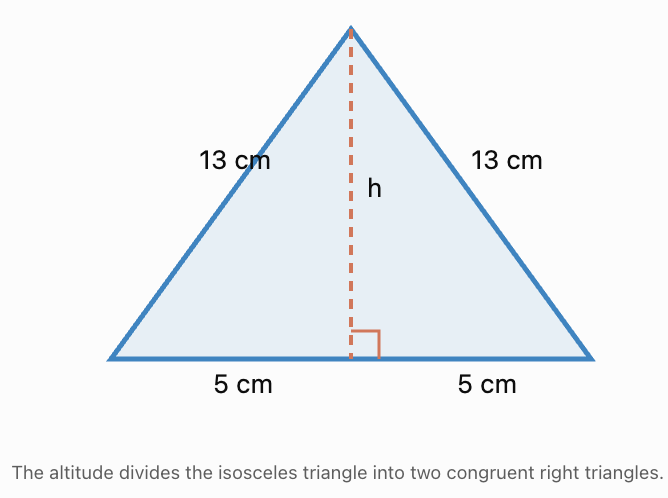
Step 1: Find half the base.
10/2 = 5 cm.
Step 2: Find the height using Pythagoras.
h² + 5² = 13².
h² = 169 − 25 = 144.
h = 12 cm.
Step 3: Calculate area.
A = ½ × 10 × 12
= 60 cm².
Step 4: Calculate perimeter.
P = 13 + 13 + 10
= 36 cm.
Answers: Area = 60 cm²; perimeter = 36 cm.
Justification: The altitude of an isosceles triangle from its apex bisects its base, creating right triangles.
Evaluation: The height is shorter than the equal sides, as expected. Both the area and perimeter have appropriate units.
Worked Example 8: Choosing Between Two Possible Designs
A rectangular garden must have an area of 120 m².
Two designs are proposed:
-
Design A: 12 m by 10 m.
-
Design B: 15 m by 8 m.
A fence will surround the entire garden.
Which design requires less fencing, and by how much?
Step 1: Verify the area constraint.
Design A:
12 × 10 = 120 m².
Design B:
15 × 8 = 120 m².
Both satisfy the area requirement.
Step 2: Calculate perimeters.
Design A:
P_A = 2(12 + 10) = 44 m.
Design B:
P_B = 2(15 + 8) = 46 m.
Step 3: Compare.
46 − 44 = 2 m.
Answer: Design A requires 2 m less fencing.
Justification: Perimeter measures the distance around the garden, so it determines the required fencing length.
Evaluation: The designs have the same area but different perimeters. This shows that equal areas do not necessarily imply equal boundary lengths.
For a fixed rectangular area, dimensions closer to those of a square generally produce a smaller perimeter.
Worked Example 9: A Coordinate and Trigonometry Challenge
A right-angled triangular park has vertices:
A(0, 0), B(12, 0), C(12, 5).
Coordinates are measured in metres.
Find:
a) The three side lengths.
b) The area.
c) The angle at A.
d) The shortest distance from A to the line BC.
Step 1: Calculate side lengths.
AB = 12 m because AB is horizontal.
BC = 5 m because BC is vertical.
AC = √(12² + 5²)
= √169 = 13 m.
Step 2: Calculate area.
AB and BC are perpendicular.
A = ½ × 12 × 5
= 30 m².
Step 3: Find angle A.
tan A = 5/12.
A = tan⁻¹(5/12)
≈ 22.62°.
Step 4: Find the shortest distance from A to BC.
BC lies on the vertical line x = 12.
The perpendicular distance from A(0, 0) to this line is horizontal.
Therefore:
d = 12 m.
Answers: Sides = 5 m, 12 m, 13 m; area = 30 m²; ∠A ≈ 22.62°; shortest distance = 12 m.
Evaluation: The smallest acute angle is opposite the shortest side, which is consistent with the result.
Worked Example 10: Combining Volume, Similarity, and Material Use
A cylindrical container has radius 3 cm and height 10 cm.
A geometrically similar container is made with twice the original linear dimensions.
Find:
a) The original volume.
b) The enlarged volume.
c) The ratio of surface areas.
d) The percentage increase in volume.
Step 1: Original volume
V₁ = π(3²)(10)
= 90π cm³.
Step 2: Apply the volume scale factor
Linear scale factor k = 2.
Volume scale factor = 2³ = 8.
V₂ = 8 × 90π
= 720π cm³.
Step 3: Surface-area ratio
Area scale factor = 2² = 4.
Therefore:
SA₂ : SA₁ = 4 : 1.
Step 4: Percentage increase in volume
Increase = V₂ − V₁
= 7V₁.
Percentage increase:
(7V₁/V₁) × 100%
= 700%.
Answers: Original volume = 90π cm³; enlarged volume = 720π cm³; surface-area ratio = 4:1; volume increase = 700%.
A doubling of every length creates eight times the volume, not twice the volume.
Communicating Complete Mathematical Solutions
A complete mathematical solution should be understandable to someone who has not already solved the problem.
A useful structure is:
Given: State the known measurements or relationships.
Required: Identify what must be found or proved.
Method: Explain the mathematical strategy.
Working: Show equations, substitutions, and calculations.
Justification: State why the method or theorem applies.
Conclusion: Give the final result with appropriate units.
Evaluation: Check the answer against the conditions of the problem.
Example: Improving a Written Solution
Problem: A ladder 5 m long reaches 4 m up a vertical wall. How far is its base from the wall?
An incomplete response might say:
“5² − 4² = 9, so 3.”
A complete response would be:
“The wall and level ground are perpendicular, so the ladder forms the hypotenuse of a right triangle. By Pythagoras' theorem, x² + 4² = 5². Therefore, x² = 25 − 16 = 9, giving x = 3 m. The base of the ladder is 3 m from the wall. This is reasonable because the horizontal distance is shorter than the 5 m ladder.”
The second solution communicates both the calculation and the mathematical reasoning.
Mathematical Justification
A justification explains why a mathematical step is valid.
Consider these examples.
|
Calculation or claim |
Mathematical justification |
|---|---|
|
a² + b² = c² |
Pythagoras' theorem applies to a right triangle |
|
θ = tan⁻¹(O/A) |
Tangent relates opposite and adjacent sides |
|
Two triangles have proportional corresponding sides |
They may be similar by SSS similarity |
|
Two distinct lines have equal slopes |
They are parallel |
|
Two lines have slopes whose product is −1 |
They are perpendicular, when both slopes are finite and nonzero |
|
New area = k² × original area |
Area scaling theorem for similar figures |
|
V = ⅓Bh |
Volume formula for a pyramid |
|
Two triangles are congruent by SAS |
Two corresponding sides and their included angles are equal |
A good proof or explanation identifies the specific conditions that make a theorem applicable.
Worked Example 11: Proving and Using Triangle Similarity
Triangles ABC and DEF have:
AB = 6 cm
BC = 8 cm
AC = 10 cm
DE = 9 cm
EF = 12 cm
DF = 15 cm.
Prove that the triangles are similar and compare their areas.
Step 1: Compare corresponding sides.
DE/AB = 9/6 = 1.5.
EF/BC = 12/8 = 1.5.
DF/AC = 15/10 = 1.5.
All three corresponding side ratios are equal.
Therefore:
△ABC ∼ △DEF by SSS similarity.
Step 2: Determine the linear scale factor.
k = 1.5.
Step 3: Determine the area ratio.
Area scale factor:
k² = 1.5² = 2.25.
Therefore:
Area DEF / Area ABC = 2.25.
Conclusion: The triangles are similar, and triangle DEF has 2.25 times the area of triangle ABC.
Justification: Corresponding sides are proportional, satisfying SSS similarity. Similar figures have areas proportional to the squares of corresponding side lengths.
Evaluating Whether a Solution Is Reasonable
A correct-looking numerical answer may still be impossible or inappropriate.
Several checks can help.
1. Check the Units
A distance should be measured in length units.
An area should be measured in square units.
A volume should be measured in cubic units.
2. Check Geometric Constraints
In a right triangle:
-
The hypotenuse must be the longest side.
-
The two acute angles must add to 90°.
-
Side lengths must be positive.
For any nondegenerate triangle, the sum of any two side lengths must exceed the third.
3. Estimate Before Calculating
If a rectangular garden is approximately 20 m by 10 m, its area should be around 200 m².
An answer of 20,000 m² would suggest an error.
4. Check Using a Different Method
A right-triangle side can sometimes be checked using both trigonometry and Pythagoras.
A quadrilateral's area might be checked using coordinate geometry and a geometric decomposition.
5. Consider Practical Conditions
A roof-area calculation may be correct but exclude overhangs.
A tank-volume calculation may ignore wall thickness.
A ramp design may be mathematically valid but fail applicable construction requirements.
Worked Example 12: Detecting an Impossible Triangle
A student claims that a triangle has side lengths:
4 cm, 7 cm, and 12 cm.
Is this possible?
Use the triangle inequality.
The sum of the two shorter sides must exceed the longest side.
4 + 7 = 11.
But:
11 < 12.
Therefore, the triangle inequality is violated.
Conclusion: No triangle can have these three side lengths.
This is an example of checking feasibility before attempting a longer calculation.
Real-World Applications
Architecture
Building design combines angles, similarity, lengths, areas, and three-dimensional measurements.
Surveying
Surveyors combine coordinate geometry and trigonometry to calculate distances and positions.
Engineering
Engineers use geometric models to check dimensions, material requirements, and design constraints.
Landscape design
Planners combine composite areas, perimeters, scales, and costs to design outdoor spaces.
Worked Example 13: Comprehensive Garden Design
A rectangular garden measures 18 m by 12 m.
A circular pond of radius 2 m occupies part of the garden.
A straight diagonal path crosses the garden from one corner to the opposite corner. The path is 1 m wide, measured perpendicular to its centreline.
For a simplified estimate, model the path as a rectangle whose length equals the garden's diagonal. Assume the path does not overlap the pond and ignore any part extending beyond the garden boundary.
Calculate:
a) The diagonal length.
b) The estimated path area.
c) The pond area.
d) The remaining planting area.
e) The planting cost at $18 per square metre.
Step 1: Garden area
A_garden = 18 × 12
= 216 m².
Step 2: Diagonal length
d = √(18² + 12²)
= √468
= 6√13
≈ 21.63 m.
Step 3: Estimated path area
A_path ≈ 1 × 6√13
≈ 21.63 m².
Step 4: Pond area
A_pond = π(2²)
= 4π
≈ 12.57 m².
Step 5: Planting area
A_planting ≈ 216 − 6√13 − 4π
≈ 181.80 m².
Step 6: Planting cost
Cost ≈ 18(216 − 6√13 − 4π)
≈ $3272.45.
Answers:
-
Diagonal ≈ 21.63 m.
-
Estimated path area ≈ 21.63 m².
-
Pond area ≈ 12.57 m².
-
Estimated planting area ≈ 181.80 m².
-
Estimated planting cost ≈ $3272.45.
Evaluation: The diagonal-path rectangle is an approximation. An exact design would need to account for how the path meets the garden boundaries, and the assumed absence of overlap with the pond would need to be verified. The result is suitable as a preliminary estimate rather than a final construction measurement.
Common Mistakes
Mistake 1: Starting Calculations Without a Plan
Identify the final objective and determine which intermediate quantities are required.
Mistake 2: Selecting a Formula Based Only on the Shape's Appearance
Check that the conditions of the formula or theorem are satisfied.
Mistake 3: Assuming Every Triangle Is Right-Angled
Pythagoras' theorem and basic SOH–CAH–TOA relationships require a right triangle.
Mistake 4: Confusing Similarity with Congruence
Similar figures have equal corresponding angles and proportional sides.
Congruent figures have equal corresponding sides and angles.
Mistake 5: Using the Wrong Scale Factor
Length scales by k, area by k², and volume by k³ for positive k.
Mistake 6: Rounding Intermediate Values Too Early
Keep exact expressions or sufficient decimal precision until the final calculation.
Mistake 7: Forgetting to Justify a Conclusion
A correct calculation does not automatically explain why a geometric statement follows.
Mistake 8: Assuming a Diagram Is Drawn to Scale
Use the given information rather than estimating lengths or angles visually.
Mistake 9: Using Incorrect Units
Check that each result uses the appropriate measurement units.
Mistake 10: Counting Hidden or Overlapping Surfaces
Composite surface-area problems require identifying only the exposed surfaces.
Mistake 11: Confusing Horizontal and Sloping Distances
The hypotenuse is longer than either leg of a right triangle.
Mistake 12: Using Inconsistent Coordinate Subtraction
When calculating slopes, use the same point order in the numerator and denominator.
Mistake 13: Proving Too Little
Showing one pair of parallel sides does not necessarily establish that a quadrilateral is a parallelogram.
Mistake 14: Giving an Answer Without Interpretation
Explain what the result represents in the original problem.
Mistake 15: Ignoring Assumptions
A geometric model may rely on level ground, straight edges, or negligible thickness.
Mistake 16: Reporting Unjustified Precision
The precision of a final answer should reflect the precision of the input measurements.
Mistake 17: Failing to Check Feasibility
A proposed triangle, building, or container may violate geometric or practical constraints.
Mistake 18: Treating One Numerical Example as a General Proof
A general theorem requires reasoning that applies to all cases satisfying its assumptions.
Key Terms
-
Multi-Step Problem: A problem requiring several connected calculations or deductions.
-
Problem-Solving Strategy: An organized method for reaching a mathematical conclusion.
-
Geometric Reasoning: Using properties and relationships of shapes to solve problems.
-
Deductive Reasoning: Drawing conclusions logically from established facts.
-
Justification: An explanation of why a mathematical step is valid.
-
Theorem: A mathematical statement established by proof.
-
Proof: A logical argument establishing a mathematical claim.
-
Working Backwards: Starting from the required result to identify necessary earlier steps.
-
Auxiliary Line: An additional line drawn to reveal useful geometric relationships.
-
Pythagoras' Theorem: The relationship a² + b² = c² in a right triangle.
-
Trigonometry: Mathematics relating angles and side lengths.
-
Similarity: Equality of shape with proportional corresponding dimensions.
-
Congruence: Equality of shape and size.
-
Scale Factor: The multiplier relating corresponding lengths.
-
Coordinate Geometry: The study of geometric relationships using coordinates.
-
Slope: The ratio of vertical change to horizontal change.
-
Distance Formula: A formula for calculating the distance between coordinate points.
-
Transformation: A mapping that changes a figure's position, orientation, or size.
-
Composite Figure: A figure formed from simpler shapes.
-
Perimeter: Distance around a two-dimensional figure.
-
Area: Two-dimensional space enclosed by a figure.
-
Surface Area: Total area of a solid's exposed surfaces.
-
Volume: Three-dimensional space occupied by a solid.
-
Geometric Model: A mathematical representation of a real object or situation.
-
Constraint: A condition a solution or design must satisfy.
-
Optimization: Finding the best solution under specified conditions.
-
Exact Value: A value expressed without approximation.
-
Approximation: A value close to the exact or true value.
-
Reasonableness Check: A test of whether a result is consistent with the problem.
-
Triangle Inequality: The sum of any two side lengths of a triangle exceeds the third.
-
Mathematical Communication: Presenting mathematical ideas and reasoning clearly.
-
Evaluation: Checking a solution's accuracy, limitations, and suitability.
Key Takeaways
-
Multi-step geometry problems combine several mathematical concepts.
-
Understanding the problem is essential before calculating.
-
A labelled diagram helps organize information.
-
Working backwards can reveal the necessary sequence of calculations.
-
Pythagoras' theorem applies to right triangles.
-
Trigonometry relates acute angles and side lengths in right triangles.
-
Similarity provides proportional relationships.
-
Coordinate geometry helps establish lengths, angles, and geometric properties.
-
Transformations can preserve or change geometric measurements.
-
Composite areas and volumes require careful decomposition.
-
Real-world design problems often involve constraints.
-
Every important mathematical step should be justified.
-
A complete solution includes working, reasoning, and a conclusion.
-
Units must match the quantity being calculated.
-
Exact values should be retained when practical.
-
Different methods can sometimes be used to check the same result.
-
Geometric constraints help identify impossible answers.
-
Mathematical models depend on assumptions.
-
Reasonableness checks are part of solving the problem.
-
Strong geometric problem solving combines accuracy, efficiency, communication, and critical evaluation.
Check Your Understanding
Show complete calculations, justify your methods, and evaluate the reasonableness of your results.
Question 1: Triangle Area and Perimeter
An isosceles triangle has equal sides of 10 cm and a base of 12 cm.
Find its perpendicular height, area, and perimeter.
Question 2: Roof Design
A symmetrical pitched roof covers a building 8 m wide and 12 m long.
The roof ridge rises 3 m above the walls.
Find the sloping length from eave to ridge and the total area of both roof slopes, assuming no overhang.
Question 3: Trigonometry and Height
An observer stands 30 m from a vertical tower.
The angle of elevation to its top is 48°.
The observer's eyes are 1.6 m above level ground.
Find the tower's height.
Question 4: Similarity and Area
Two triangles are similar.
The smaller triangle has sides of 6 cm, 8 cm, and 10 cm.
The larger triangle has a corresponding longest side of 25 cm.
Find the other two sides of the larger triangle and the ratio of the larger triangle's area to the smaller triangle's area.
Question 5: Coordinate Geometry
Quadrilateral ABCD has vertices:
A(0, 0), B(6, 2), C(4, 8), D(−2, 6).
Prove that it is a square and calculate its area.
Question 6: Container Design
A closed cylinder must have a volume of 2000 cm³.
Its radius is 5 cm.
Find its required height and total surface area.
Question 7: Composite Volume
A solid consists of a cylinder with a hemisphere on top.
Both have radius 3 cm.
The cylinder is 8 cm high.
Find the total volume and external surface area, including the bottom circular base.
Question 8: Scaling
A model building has volume 1200 cm³ and surface area 800 cm².
The full-size building is geometrically similar with a linear scale factor of 20.
Find the full-size volume and surface area.
Question 9: Ramp Design
A ramp must rise 0.75 m over a horizontal run of 9 m.
Find its sloping length and angle of inclination.
Question 10: Garden Design
A rectangular garden measures 16 m by 10 m.
A circular pond of radius 2 m is located inside it.
Find the remaining garden area and the cost of covering it with grass at $12 per square metre.
Question 11: Mathematical Justification
A student claims that a triangle with sides 5 cm, 12 cm, and 13 cm is right-angled.
Determine whether the claim is correct and justify your conclusion.
Question 12: Comprehensive Challenge
A school is designing a small building with:
-
Length = 10 m.
-
Width = 6 m.
-
Wall height = 4 m.
-
A symmetrical pitched roof rising 2 m above the walls.
-
No roof overhang.
Find:
a) The rectangular section's volume.
b) The roof section's volume.
c) The total enclosed volume.
d) The sloping length of each roof section.
e) The total area of the two roof slopes.
f) The roof covering cost at $50 per square metre.
g) Two assumptions and two checks that help evaluate the result.
Fully Worked Answers
Answer 1: Triangle Area and Perimeter
Equal sides = 10 cm.
Base = 12 cm.
The altitude from the apex bisects the base.
Half-base = 6 cm.
Step 1: Find the height.
h² + 6² = 10².
h² = 100 − 36 = 64.
h = 8 cm.
Step 2: Find the area.
A = ½ × 12 × 8
= 48 cm².
Step 3: Find the perimeter.
P = 10 + 10 + 12
= 32 cm.
Answers: Height = 8 cm; area = 48 cm²; perimeter = 32 cm.
The height is shorter than the equal sides, which is reasonable.
Answer 2: Roof Design
Building width = 8 m.
Building length = 12 m.
Roof rise = 3 m.
Step 1: Find half-width.
8/2 = 4 m.
Step 2: Find sloping length.
L² = 4² + 3²
= 16 + 9 = 25.
L = 5 m.
Step 3: Find roof area.
Each roof slope is a rectangle measuring 12 m by 5 m.
Total area:
A = 2 × 12 × 5
= 120 m².
Answers: Sloping length = 5 m; total roof area = 120 m².
Answer 3: Tower Height
Horizontal distance = 30 m.
Angle of elevation = 48°.
Eye height = 1.6 m.
Vertical distance above eye level:
h = 30 tan 48°
≈ 33.32 m.
Total tower height:
H = 33.32 + 1.6
Answer: Approximately 34.92 m.
The eye height must be included because the angle is measured from the observer's eye level.
Answer 4: Similarity and Area
Smaller triangle sides:
6 cm, 8 cm, 10 cm.
Larger longest side = 25 cm.
Step 1: Find scale factor.
k = 25/10 = 2.5.
Step 2: Find remaining sides.
6 × 2.5 = 15 cm.
8 × 2.5 = 20 cm.
Step 3: Find area ratio.
k² = 2.5² = 6.25.
Answers: Larger triangle sides = 15 cm, 20 cm, 25 cm; area ratio = 6.25:1.
Answer 5: Coordinate Geometry
A(0, 0), B(6, 2), C(4, 8), D(−2, 6).
Step 1: Calculate slopes.
m_AB = 2/6 = 1/3.
m_BC = (8 − 2)/(4 − 6) = −3.
m_CD = (6 − 8)/(−2 − 4) = 1/3.
m_DA = (0 − 6)/(0 − (−2)) = −3.
Opposite sides are parallel, so ABCD is a parallelogram.
Step 2: Establish a right angle.
m_AB × m_BC = (1/3)(−3) = −1.
Therefore, AB ⟂ BC.
The parallelogram is a rectangle.
Step 3: Establish equal adjacent sides.
AB = √(6² + 2²) = √40.
BC = √((−2)² + 6²) = √40.
Thus AB = BC.
A rectangle with equal adjacent sides is a square.
Step 4: Calculate area.
A = (√40)²
= 40 square units.
Answer: ABCD is a square with area 40 square units.
Answer 6: Container Design
Volume = 2000 cm³.
Radius = 5 cm.
Step 1: Find height.
V = πr²h.
2000 = 25πh.
h = 2000/(25π)
= 80/π
≈ 25.46 cm.
Step 2: Find surface area.
SA = 2πr² + 2πrh.
SA = 2π(25) + 2π(5)(80/π)
= 50π + 800
≈ 957.08 cm².
Answers: Height ≈ 25.46 cm; surface area ≈ 957.08 cm².
Answer 7: Composite Volume and Surface Area
Radius = 3 cm.
Cylinder height = 8 cm.
Step 1: Cylinder volume.
V₁ = π(3²)(8)
= 72π cm³.
Step 2: Hemisphere volume.
V₂ = ⅔π(3³)
= 18π cm³.
Step 3: Total volume.
V = 72π + 18π
= 90π
≈ 282.74 cm³.
Step 4: External surface area.
Cylinder curved surface:
2πrh = 2π(3)(8) = 48π.
Hemisphere curved surface:
2πr² = 18π.
Bottom circular base:
πr² = 9π.
Total:
SA = 48π + 18π + 9π
= 75π
≈ 235.62 cm².
Answers: Volume ≈ 282.74 cm³; external surface area ≈ 235.62 cm².
The shared circular contact surface is internal and must not be counted.
Answer 8: Scaling
Linear scale factor = 20.
Volume scale factor
20³ = 8000.
Full-size volume:
1200 × 8000
= 9,600,000 cm³.
Surface-area scale factor
20² = 400.
Full-size surface area:
800 × 400
= 320,000 cm².
Answers: Volume = 9,600,000 cm³; surface area = 320,000 cm².
Equivalent measurements are 9.6 m³ and 32 m².
Answer 9: Ramp Design
Vertical rise = 0.75 m.
Horizontal run = 9 m.
Step 1: Sloping length.
L = √(9² + 0.75²)
= √81.5625
≈ 9.03 m.
Step 2: Angle of inclination.
tan θ = 0.75/9.
θ = tan⁻¹(0.75/9)
≈ 4.76°.
Answers: Sloping length ≈ 9.03 m; angle ≈ 4.76°.
The sloping length is slightly longer than the horizontal run, which is reasonable.
Answer 10: Garden Design
Garden dimensions = 16 m by 10 m.
Pond radius = 2 m.
Step 1: Rectangle area.
A₁ = 16 × 10
= 160 m².
Step 2: Pond area.
A₂ = π(2²)
= 4π m².
Step 3: Remaining area.
A = 160 − 4π
≈ 147.43 m².
Step 4: Grass cost.
Cost = 12(160 − 4π)
≈ $1769.20.
Answers: Remaining area ≈ 147.43 m²; estimated grass cost ≈ $1769.20.
This assumes the pond lies entirely inside the garden and grass can be purchased for the exact area required.
Answer 11: Mathematical Justification
Triangle sides:
5 cm, 12 cm, 13 cm.
The longest side is 13 cm.
Test the converse of Pythagoras' theorem:
5² + 12² = 25 + 144 = 169.
13² = 169.
Therefore:
5² + 12² = 13².
Conclusion: The triangle is right-angled.
The right angle is opposite the 13 cm side.
Answer 12: Comprehensive Challenge
Building dimensions:
Length = 10 m.
Width = 6 m.
Wall height = 4 m.
Roof rise = 2 m.
a) Rectangular volume
V₁ = 10 × 6 × 4
Answer: 240 m³.
b) Roof volume
Triangular cross-section:
B = ½ × 6 × 2
= 6 m².
Roof length = 10 m.
V₂ = 6 × 10
Answer: 60 m³.
c) Total volume
V = 240 + 60
Answer: 300 m³.
d) Sloping roof length
Half-width:
6/2 = 3 m.
Pythagoras:
L² = 3² + 2²
= 13.
L = √13
≈ 3.61 m.
Answer: Approximately 3.61 m.
e) Total roof area
Each roof slope is a rectangle with length 10 m and sloping width √13 m.
A = 2 × 10 × √13
= 20√13
≈ 72.11 m².
Answer: Approximately 72.11 m².
f) Roof covering cost
Cost = 50 × 20√13
= 1000√13
≈ $3605.55.
Answer: Approximately $3605.55.
g) Assumptions and checks
Two assumptions:
-
The building is rectangular and the roof is symmetrical.
-
The roof has no overhang and its slopes are flat rectangular surfaces.
Two reasonableness checks:
-
The sloping roof length, approximately 3.61 m, is greater than the 3 m horizontal half-width.
-
The roof area, approximately 72.11 m², exceeds the horizontal footprint of 60 m² because the roof is sloped.
The model could be refined by including roof overhangs, construction details, and material waste.
Final Course Connections
Multi-step geometric problem solving brings together the major ideas of geometry: angles, triangles, similarity, congruence, transformations, coordinate methods, trigonometry, area, surface area, volume, and mathematical modelling.
The central skill is recognizing how these concepts connect. A problem that initially appears unfamiliar often becomes manageable when it is divided into smaller, logically connected steps.
A strong solution does more than produce a numerical answer. It identifies an appropriate strategy, communicates the working clearly, justifies the mathematical reasoning, and evaluates whether the conclusion is reasonable.
The goal is not simply to find an answer, but to construct a complete, convincing mathematical solution.
This completes Multi-Step Geometric Problem Solving, with detailed explanations, 13 worked examples, supporting diagrams, real-world applications, common mistakes, key terms, key takeaways, and 12 practice questions with fully worked answers.