Geometric Reasoning and Applications
| Site: | Young Education |
| Cursus: | Geometry and Proof |
| Boek: | Geometric Reasoning and Applications |
| Afgedrukt door: | Guest user |
| Datum: | maandag, 9 november 2026, 16:35 |
1. Area and Volume
Learning outcomes
- I can calculate the area of composite figures.
- I can calculate the surface area of three-dimensional objects.
- I can calculate the volume of prisms, cylinders, pyramids, cones, and spheres.
- I can select appropriate formulas for different solids.
- I can solve real-world measurement problems.
Introduction
How much paint is needed to cover the walls of a room? How much water can a cylindrical tank hold? How much cardboard is needed to make a box? How can we calculate the area of an irregular garden or the volume of a cone-shaped container?
These questions involve area, surface area, and volume.
Area measures the amount of two-dimensional space inside a shape. Surface area measures the total area of the surfaces of a three-dimensional object. Volume measures the amount of three-dimensional space occupied by a solid.
Although many objects have complicated shapes, we can often calculate their measurements by dividing them into simpler figures.
In this lesson, we will explore how to calculate the area of composite figures, determine surface areas and volumes of common solids, select appropriate formulas, and solve practical measurement problems.
Understanding Area, Surface Area, and Volume
|
Measurement |
Meaning |
Typical units |
|---|---|---|
|
Perimeter |
Distance around a 2D shape |
cm, m, km |
|
Area |
Space enclosed by a 2D shape |
cm², m², km² |
|
Surface area |
Total area of the exposed surfaces of a 3D object |
cm², m² |
|
Volume |
Space occupied by a 3D object |
cm³, m³ |
|
Capacity |
Amount a container can hold |
mL, L |
These measurements are related but are not interchangeable.
For example, a rectangular box may have:
-
A perimeter around its base.
-
An area for each face.
-
A total surface area.
-
An internal volume.
Each measurement answers a different question.
Units of Measurement
Length
Length is measured in one-dimensional units.
Examples:
1 m = 100 cm
1 km = 1000 m
Area
Area is measured in square units.
1 m² = 10,000 cm²
This is because:
1 m² = 100 cm × 100 cm = 10,000 cm².
Volume
Volume is measured in cubic units.
1 m³ = 1,000,000 cm³
This is because:
1 m³ = 100 cm × 100 cm × 100 cm.
Capacity
1 cm³ = 1 mL
1000 cm³ = 1 L
1 m³ = 1000 L
These conversions are especially important in practical problems involving containers, tanks, swimming pools, and liquids.
Essential Area Formulas
Before calculating composite areas, we need to understand the formulas for common two-dimensional shapes.
|
Shape |
Area formula |
|---|---|
|
Rectangle |
A = lw |
|
Square |
A = s² |
|
Triangle |
A = ½bh |
|
Parallelogram |
A = bh |
|
Trapezoid |
A = ½(a + b)h |
|
Circle |
A = πr² |
|
Semicircle |
A = ½πr² |
|
Quarter-circle |
A = ¼πr² |
|
Sector |
A = (θ/360°)πr² |
Where:
-
l = length
-
w = width
-
s = side length
-
b = base
-
h = perpendicular height
-
a and b = parallel sides of a trapezoid
-
r = radius
-
θ = central angle of a sector
The height used in area formulas must be perpendicular to the base.
Area of Composite Figures
A composite figure is a shape formed by combining two or more simpler shapes.
For example, an L-shaped floor can be divided into rectangles. A garden may consist of a rectangle and a semicircle. A metal plate may contain a circular hole that must be subtracted from its total area.
There are two main strategies.
Addition method: Divide the figure into non-overlapping shapes and add their areas.
Subtraction method: Calculate the area of a larger shape and subtract missing regions.
Worked Example 1: L-Shaped Floor
An L-shaped floor is formed from a rectangle measuring 12 m by 8 m, with a 5 m by 3 m rectangle removed from one corner.
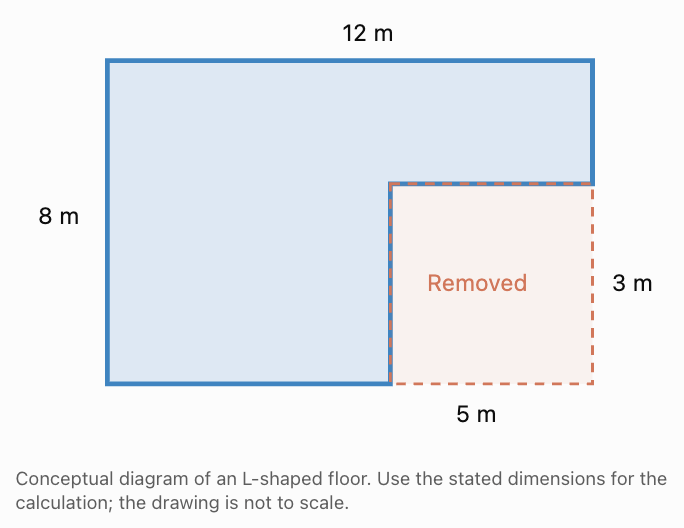
Step 1: Calculate the area of the large rectangle.
A = 12 × 8 = 96 m².
Step 2: Calculate the area of the removed rectangle.
A = 5 × 3 = 15 m².
Step 3: Subtract.
Composite area = 96 − 15
Answer: 81 m².
Worked Example 2: Rectangle with a Semicircle
A garden consists of a rectangle measuring 10 m by 6 m, with a semicircle attached along one of the 6 m sides.
Find the total area.
Step 1: Rectangle area
A_rectangle = 10 × 6 = 60 m².
Step 2: Semicircle radius
The diameter is 6 m.
r = 6/2 = 3 m.
Step 3: Semicircle area
A_semicircle = ½πr²
= ½π(3²)
= 4.5π
≈ 14.14 m².
Step 4: Add.
A_total = 60 + 4.5π
≈ 74.14 m².
Answer: Approximately 74.14 m².
Worked Example 3: Circular Hole in a Square
A square metal plate has side length 20 cm. A circular hole of radius 4 cm is cut from its centre.
Find the remaining metal area.
Square area:
A_square = 20² = 400 cm².
Hole area:
A_circle = π(4²) = 16π cm².
Remaining area:
A = 400 − 16π
≈ 349.73 cm².
Answer: Approximately 349.73 cm².
Worked Example 4: Trapezoid and Triangle
A composite figure consists of a trapezoid with parallel sides 8 cm and 14 cm and perpendicular height 5 cm, together with a triangle of base 8 cm and perpendicular height 4 cm. The two regions meet along an edge without overlapping.
Trapezoid area:
A₁ = ½(8 + 14)(5)
= 55 cm².
Triangle area:
A₂ = ½(8)(4)
= 16 cm².
Total area:
A = 55 + 16
Answer: 71 cm².
Choosing the Best Composite-Area Strategy
When solving a composite-area problem:
-
Identify the simple shapes making up the figure.
-
Mark all known dimensions.
-
Calculate missing dimensions if necessary.
-
Decide whether addition or subtraction is more efficient.
-
Calculate each area separately.
-
Combine the areas.
-
Check that the final answer has square units.
A common error is adding areas that overlap, thereby counting the same region twice.
Surface Area of Three-Dimensional Objects
The surface area of a solid is the total area of its outer surfaces.
For a closed solid, every exterior face or curved surface is included.
For an open container, any missing face must be excluded.
A net is a two-dimensional arrangement of surfaces that can be folded to form a three-dimensional object.
Nets are especially useful for understanding surface-area formulas.
Surface Area of a Rectangular Prism
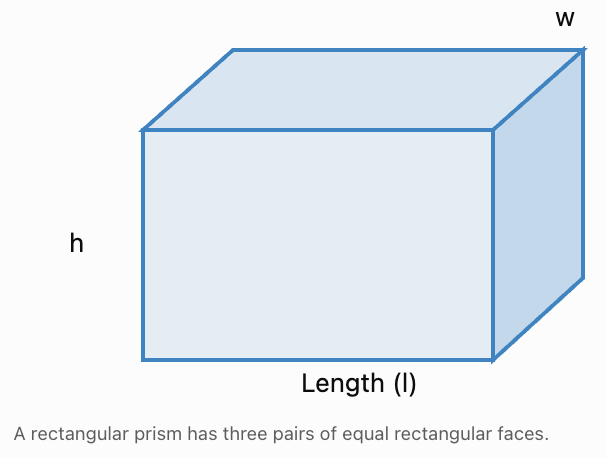
A rectangular prism has six rectangular faces.
If its length is l, width is w, and height is h:
SA = 2lw + 2lh + 2wh
or:
SA = 2(lw + lh + wh)
Worked Example 5: Surface Area of a Box
A closed box measures:
Length = 12 cm
Width = 5 cm
Height = 8 cm.
Calculate its total surface area.
SA = 2(lw + lh + wh)
= 2(12 × 5 + 12 × 8 + 5 × 8)
= 2(60 + 96 + 40)
= 2(196)
Answer: 392 cm².
Worked Example 6: Open-Top Box
A box measures 10 cm by 6 cm by 4 cm and has no lid.
Find its surface area.
Base:
10 × 6 = 60 cm².
Two longer sides:
2(10 × 4) = 80 cm².
Two shorter sides:
2(6 × 4) = 48 cm².
Total:
SA = 60 + 80 + 48
Answer: 188 cm².
Do not include the missing top face.
Surface Area of a Cube
A cube has six congruent square faces.
If its side length is s:
SA = 6s²
Worked Example 7: Cube
A cube has side length 7 cm.
SA = 6 × 7²
= 6 × 49
Answer: 294 cm².
Surface Area of a Prism
A prism has two congruent parallel bases and a constant cross-section.
For a right prism:
SA = 2B + Ph
Where:
-
B = area of one base.
-
P = perimeter of the base.
-
h = perpendicular distance between the bases.
The expression Ph represents the lateral surface area of a right prism.
Worked Example 8: Triangular Prism
A right triangular prism has a right-triangle base with sides 3 cm, 4 cm, and 5 cm.
The prism length is 10 cm.
Step 1: Area of one triangular base
B = ½ × 3 × 4
= 6 cm².
Step 2: Perimeter of the base
P = 3 + 4 + 5 = 12 cm.
Step 3: Lateral surface area
Ph = 12 × 10 = 120 cm².
Step 4: Total surface area
SA = 2(6) + 120
Answer: 132 cm².
Surface Area of a Cylinder
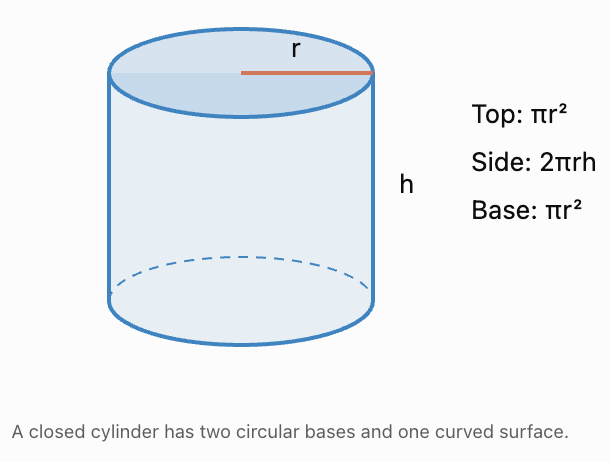
A cylinder has:
-
Two circular bases.
-
One curved surface.
If a cylinder is cut along its curved surface and unfolded, the curved surface forms a rectangle.
The rectangle's width is the circumference of the circular base, 2πr.
Its height is h.
Therefore:
Curved surface area = 2πrh.
The two circular bases have combined area:
2πr².
For a closed cylinder:
SA = 2πr² + 2πrh
or:
SA = 2πr(r + h)
Worked Example 9: Closed Cylinder
A cylinder has radius 4 cm and height 10 cm.
SA = 2πr² + 2πrh
= 2π(4²) + 2π(4)(10)
= 32π + 80π
= 112π
≈ 351.86 cm².
Answer: Approximately 351.86 cm².
Worked Example 10: Open-Top Cylinder
A cylindrical container has radius 3 m and height 5 m. It has a base but no lid.
Surface area:
SA = πr² + 2πrh
= π(3²) + 2π(3)(5)
= 9π + 30π
= 39π
≈ 122.52 m².
Answer: Approximately 122.52 m².
Surface Area of a Pyramid
A pyramid has one polygonal base and triangular side faces meeting at an apex.
For a regular right pyramid:
SA = B + ½Pl
Where:
-
B = base area.
-
P = base perimeter.
-
l = slant height of a triangular face.
The slant height is measured along the face from its apex to the midpoint of the corresponding base edge.
It is not the vertical height.
Worked Example 11: Square Pyramid
A regular square pyramid has:
Base side length = 8 cm
Slant height = 5 cm.
Base area:
B = 8² = 64 cm².
Base perimeter:
P = 4 × 8 = 32 cm.
Lateral surface area:
½Pl = ½ × 32 × 5 = 80 cm².
Total:
SA = 64 + 80
Answer: 144 cm².
For an irregular pyramid, calculate the area of each triangular face individually and add the base area.
Surface Area of a Cone
A cone has:
-
One circular base.
-
One curved surface.
For a right circular cone:
SA = πr² + πrl
Where:
-
r = radius.
-
l = slant height.
The curved surface area is:
CSA = πrl
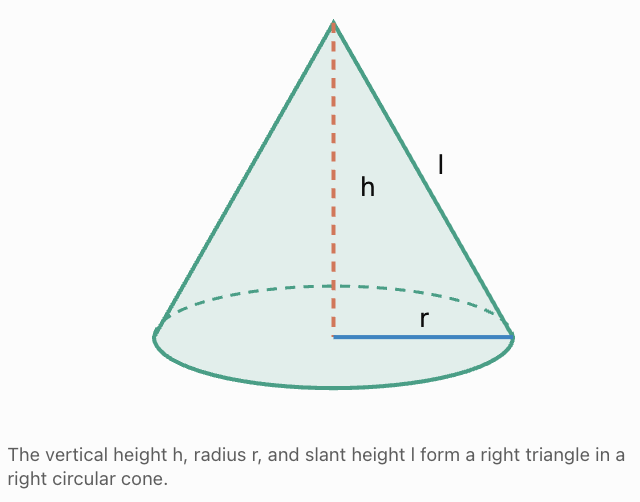
The slant height can be found using:
l = √(r² + h²)
Worked Example 12: Cone Surface Area
A right cone has radius 6 cm and vertical height 8 cm.
First calculate slant height:
l = √(6² + 8²)
= √100 = 10 cm.
Now calculate surface area:
SA = πr² + πrl
= π(6²) + π(6)(10)
= 36π + 60π
= 96π
≈ 301.59 cm².
Answer: Approximately 301.59 cm².
Surface Area of a Sphere
A sphere is a perfectly round three-dimensional solid.
Every point on its surface is the same distance from its centre.
The surface area formula is:
SA = 4πr²
Worked Example 13: Sphere
A sphere has radius 5 cm.
SA = 4π(5²)
= 4π(25)
= 100π
≈ 314.16 cm².
Answer: Approximately 314.16 cm².
Surface Area Formula Summary
|
Solid |
Total surface area |
|---|---|
|
Cube |
6s² |
|
Rectangular prism |
2(lw + lh + wh) |
|
Right prism |
2B + Ph |
|
Closed cylinder |
2πr² + 2πrh |
|
Regular right pyramid |
B + ½Pl |
|
Right circular cone |
πr² + πrl |
|
Sphere |
4πr² |
For open or composite solids, identify which surfaces are actually exposed rather than automatically applying the closed-solid formula.
Volume of Three-Dimensional Solids
Volume measures the space occupied by a solid.
For prisms and cylinders, the volume is the area of the base multiplied by the perpendicular height.
For pyramids and cones, the volume is one-third of the corresponding prism or cylinder with the same base area and height.
Volume of a Prism
For any prism:
V = Bh
Where:
-
B = area of the base.
-
h = perpendicular height between the bases.
For a rectangular prism:
V = lwh
Worked Example 14: Rectangular Prism
A storage box measures:
Length = 15 cm
Width = 8 cm
Height = 6 cm.
V = 15 × 8 × 6
Answer: 720 cm³.
Worked Example 15: Triangular Prism
A triangular prism has a triangular base with base 10 cm and perpendicular height 6 cm.
The prism length is 12 cm.
Area of triangular base:
B = ½ × 10 × 6
= 30 cm².
Volume:
V = 30 × 12
Answer: 360 cm³.
Volume of a Cylinder
The base of a cylinder is a circle.
Base area:
B = πr².
Therefore:
V = πr²h
Worked Example 16: Cylinder
A cylinder has radius 5 cm and height 12 cm.
V = π(5²)(12)
= 300π
≈ 942.48 cm³.
Answer: Approximately 942.48 cm³.
Volume of a Pyramid
The volume of a pyramid is:
V = ⅓Bh
Where B is the base area and h is the perpendicular height from the apex to the plane of the base.
Worked Example 17: Square Pyramid
A square pyramid has:
Base side = 9 cm
Vertical height = 12 cm.
Base area:
B = 9² = 81 cm².
Volume:
V = ⅓ × 81 × 12
Answer: 324 cm³.
The slant height is not used in the volume formula.
Volume of a Cone
The volume of a right circular cone is:
V = ⅓πr²h
Worked Example 18: Cone
A cone has radius 4 cm and vertical height 9 cm.
V = ⅓π(4²)(9)
= ⅓π(16)(9)
= 48π
≈ 150.80 cm³.
Answer: Approximately 150.80 cm³.
Why Is a Cone One-Third of a Cylinder?
A cone and cylinder with the same base area and perpendicular height have volumes in the ratio:
Cone : Cylinder = 1 : 3
For example, if a cylinder holds 900 mL, a cone with the same base radius and height holds:
900/3 = 300 mL.
The same relationship holds between a pyramid and a prism with equal base areas and perpendicular heights.
Volume of a Sphere
The volume of a sphere is:
V = ⁴⁄₃πr³
Worked Example 19: Sphere
A sphere has radius 6 cm.
V = ⁴⁄₃π(6³)
= ⁴⁄₃π(216)
= 288π
≈ 904.78 cm³.
Answer: Approximately 904.78 cm³.
Volume of a Hemisphere
A hemisphere is half a sphere.
Its volume is:
V = ⅔πr³
Worked Example 20: Hemisphere
A hemisphere has radius 3 cm.
V = ⅔π(3³)
= ⅔π(27)
= 18π
≈ 56.55 cm³.
Answer: Approximately 56.55 cm³.
Volume Formula Summary
|
Solid |
Volume |
|---|---|
|
Cube |
s³ |
|
Rectangular prism |
lwh |
|
Any prism |
Bh |
|
Cylinder |
πr²h |
|
Pyramid |
⅓Bh |
|
Cone |
⅓πr²h |
|
Sphere |
⁴⁄₃πr³ |
|
Hemisphere |
⅔πr³ |
Selecting the Appropriate Formula
A useful first question is: What type of solid am I measuring?
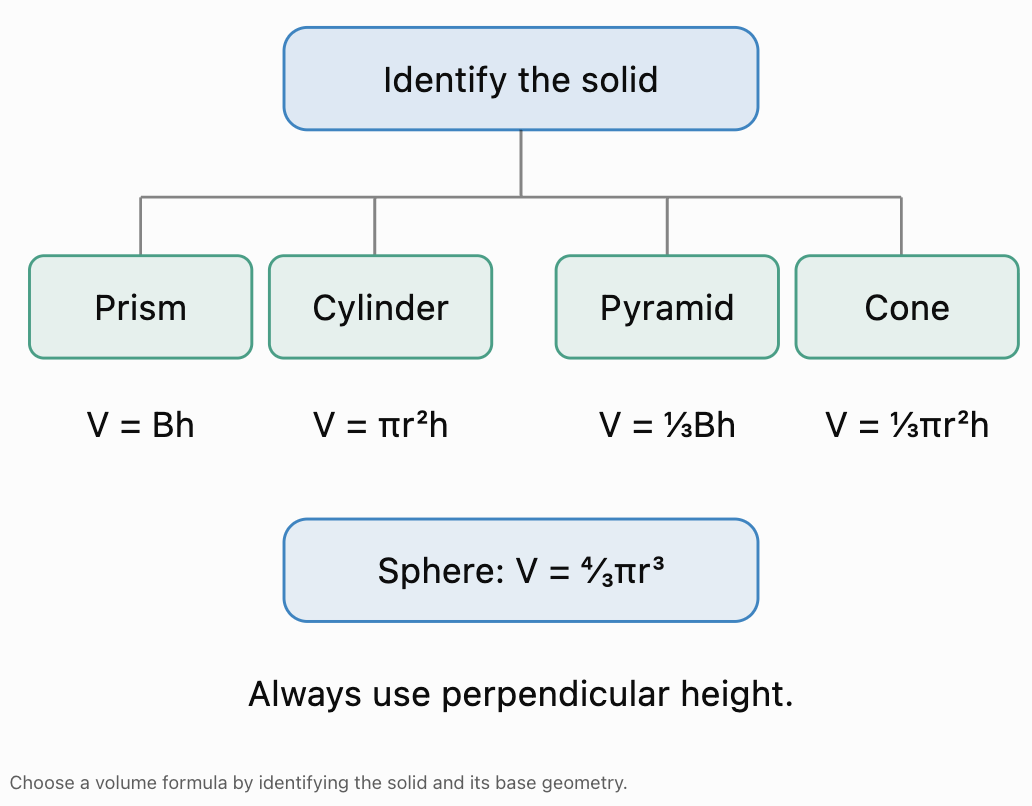
For surface area, identify the exposed faces and curved surfaces. For volume, identify the base area and perpendicular height, except for spheres, which use the radius directly.
Composite Three-Dimensional Solids
Some objects are formed by joining or removing simpler solids.
The volume of a composite solid can often be found by:
V_total = V₁ + V₂ + …
or:
V_remaining = V_large − V_removed
Worked Example 21: Cylinder with a Hemisphere
A solid consists of a cylinder with a hemisphere attached to its top.
Both have radius 3 cm.
The cylinder has height 10 cm.
Cylinder volume:
V_cylinder = π(3²)(10)
= 90π cm³.
Hemisphere volume:
V_hemisphere = ⅔π(3³)
= 18π cm³.
Total:
V = 90π + 18π
= 108π
≈ 339.29 cm³.
Answer: Approximately 339.29 cm³.
Worked Example 22: Drilled Cylindrical Hole
A rectangular block measures 12 cm by 10 cm by 8 cm.
A cylindrical hole of radius 2 cm is drilled vertically through its 8 cm height.
Rectangular prism volume:
V₁ = 12 × 10 × 8 = 960 cm³.
Cylindrical hole volume:
V₂ = π(2²)(8) = 32π cm³.
Remaining volume:
V = 960 − 32π
≈ 859.47 cm³.
Answer: Approximately 859.47 cm³.
Surface Area of Composite Solids
Surface area requires additional care.
When two solids are joined, their shared contact surfaces are not exposed.
Therefore, we must exclude these internal surfaces.
Worked Example 23: Cylinder with Hemispherical Top
A closed solid consists of a cylinder of radius 4 cm and height 8 cm, with a hemisphere attached to its top.
Find its external surface area.
The exposed surfaces are:
-
Curved surface of the cylinder.
-
Curved surface of the hemisphere.
-
Circular base of the cylinder.
Cylinder curved surface:
2πrh = 2π(4)(8) = 64π.
Hemisphere curved surface:
2πr² = 2π(4²) = 32π.
Bottom base:
πr² = 16π.
Total:
SA = 64π + 32π + 16π
= 112π
≈ 351.86 cm².
Answer: Approximately 351.86 cm².
The circular contact surface between the cylinder and hemisphere is internal and is not counted.
Real-World Measurement Problems
Area, surface area, and volume calculations are used in construction, manufacturing, engineering, packaging, architecture, and everyday life.
Painting and decorating
Surface area determines how much paint, wallpaper, or protective coating is needed.
Water storage
Volume calculations determine the capacity of tanks, reservoirs, and containers.
Packaging
Surface area estimates material requirements, while volume determines internal storage capacity.
Landscaping
Composite area calculations determine the amount of turf, paving, or soil needed.
Worked Example 24: Painting a Room
A room measures:
Length = 6 m
Width = 4 m
Height = 3 m.
There is one door measuring 2 m by 0.9 m and two windows, each measuring 1.5 m by 1.2 m.
Calculate the wall area to be painted, excluding the door and windows.
Step 1: Total wall area
Two longer walls:
2(6 × 3) = 36 m².
Two shorter walls:
2(4 × 3) = 24 m².
Total wall area:
36 + 24 = 60 m².
Step 2: Door area
2 × 0.9 = 1.8 m².
Step 3: Window area
2(1.5 × 1.2) = 3.6 m².
Step 4: Subtract openings
Paintable area:
60 − 1.8 − 3.6
Answer: 54.6 m².
If one litre of paint covers 10 m² per coat:
54.6/10 = 5.46 L.
For two coats:
5.46 × 2 = 10.92 L.
Allowing for some waste, approximately 12 L would be a reasonable purchase quantity.
Worked Example 25: Water Tank Capacity
A cylindrical tank has internal radius 1.5 m and internal height 4 m.
Find its capacity in litres.
Volume:
V = πr²h
= π(1.5²)(4)
= 9π
≈ 28.274 m³.
Convert to litres:
28.274 × 1000
≈ 28,274 L.
Answer: Approximately 28,274 L.
Worked Example 26: Cost of Flooring
An L-shaped room has an area of 72 m².
Floor tiles cost $28 per square metre.
Calculate the tile cost, allowing 10% extra for cutting and breakage.
Required tile area:
72 × 1.10 = 79.2 m².
Cost:
79.2 × 28
Answer: $2,217.60.
This assumes tiles can be purchased in the exact required quantity. In practice, packages may need to be rounded up.
Worked Example 27: Comparing Containers
A cylindrical container has radius 4 cm and height 12 cm.
A cone has the same radius and height.
Compare their volumes.
Cylinder:
V = π(4²)(12)
= 192π cm³.
Cone:
V = ⅓π(4²)(12)
= 64π cm³.
Ratio:
192π : 64π = 3 : 1.
Answer: The cylinder has three times the volume of the cone.
Scaling and Measurement
When a three-dimensional object is enlarged or reduced, its dimensions change according to the scale factor.
If the linear scale factor is k:
Length scale factor = k
Surface area scale factor = k²
Volume scale factor = k³
For positive k, these formulas apply directly. For negative coordinate dilations, lengths scale by |k|, areas by k², and volumes by |k|³.
Worked Example 28: Enlarging a Cube
A cube has side length 3 cm.
It is enlarged by linear scale factor 4.
Original surface area:
SA = 6(3²) = 54 cm².
New surface area:
SA′ = 54 × 4²
= 54 × 16
= 864 cm².
Original volume:
V = 3³ = 27 cm³.
New volume:
V′ = 27 × 4³
= 27 × 64
= 1728 cm³.
Answers: New surface area = 864 cm²; new volume = 1728 cm³.
Common Mistakes
Mistake 1: Confusing Area and Volume
Area is measured in square units, while volume is measured in cubic units.
Mistake 2: Using Diameter Instead of Radius
For circles, cylinders, cones, and spheres, formulas use the radius.
If the diameter is 10 cm, the radius is 5 cm.
Mistake 3: Forgetting to Square or Cube the Radius
Cylinder volume uses r².
Sphere volume uses r³.
Mistake 4: Using Slant Height Instead of Vertical Height
Cone and pyramid volume formulas use perpendicular height.
Mistake 5: Forgetting the One-Third Factor
Pyramids and cones have volume equal to one-third of the corresponding prism or cylinder.
Mistake 6: Counting Hidden Surfaces
When solids are joined, their internal contact surfaces are not part of the external surface area.
Mistake 7: Including Missing Faces
An open-top box or cylinder does not include a top surface.
Mistake 8: Adding Overlapping Areas Twice
Composite figures should be divided into non-overlapping regions.
Mistake 9: Incorrect Unit Conversions
1 m² = 10,000 cm², not 100 cm².
1 m³ = 1,000,000 cm³, not 1000 cm³.
Mistake 10: Using the Wrong Formula
A cylinder and a cone may have similar appearances but different volume formulas.
Mistake 11: Rounding Too Early
Keep π and intermediate values exact until the final step when possible.
Mistake 12: Forgetting Units
Area answers require squared units.
Volume answers require cubed units.
Mistake 13: Confusing Surface Area with Capacity
A tank's surface area determines material requirements.
Its volume determines how much liquid it can hold.
Mistake 14: Ignoring Practical Constraints
Real-world problems may require extra material for waste, seams, overlaps, or packaging.
Mistake 15: Using the Linear Scale Factor for Area or Volume
A scale factor of 2 multiplies surface area by 4 and volume by 8.
Key Terms
-
Area: The amount of two-dimensional space inside a figure.
-
Composite Figure: A figure formed from two or more simpler shapes.
-
Perimeter: The distance around a two-dimensional figure.
-
Surface Area: The total area of the surfaces of a three-dimensional object.
-
Volume: The amount of three-dimensional space occupied by a solid.
-
Capacity: The amount a container can hold.
-
Square Unit: A unit used to measure area.
-
Cubic Unit: A unit used to measure volume.
-
Prism: A solid with two congruent parallel polygonal bases and a constant cross-section.
-
Rectangular Prism: A prism with rectangular faces.
-
Cube: A solid with six congruent square faces.
-
Cylinder: A solid with two congruent parallel circular bases and a curved surface.
-
Pyramid: A solid with a polygonal base and triangular faces meeting at an apex.
-
Cone: A solid with a circular base and a curved surface meeting at an apex.
-
Sphere: A solid whose surface points are equally distant from its centre.
-
Hemisphere: Half of a sphere.
-
Base Area: The area of a solid's base.
-
Lateral Surface Area: The area of the side faces or curved side surface, excluding bases.
-
Curved Surface Area: The area of a curved exterior surface.
-
Slant Height: The height measured along a face or sloping surface.
-
Perpendicular Height: The shortest distance measured at right angles to a base plane.
-
Radius: The distance from the centre of a circle or sphere to its boundary.
-
Diameter: Twice the radius.
-
Net: A flat arrangement of faces that can be folded into a solid.
-
Cross-Section: The shape formed by slicing a solid with a plane.
-
Scale Factor: A multiplier used to enlarge or reduce dimensions.
-
Unit Conversion: Changing a measurement from one unit to another.
-
Displacement: A method of measuring volume by the amount of fluid displaced.
-
Exact Value: A value expressed without approximation, often using π or radicals.
-
Approximation: A rounded or estimated value.
Key Takeaways
-
Area measures two-dimensional space.
-
Surface area measures the exposed surfaces of a three-dimensional solid.
-
Volume measures three-dimensional space.
-
Composite areas can be calculated by addition or subtraction.
-
Rectangle area is lw.
-
Triangle area is ½bh.
-
Circle area is πr².
-
Rectangular prism volume is lwh.
-
General prism volume is Bh.
-
Cylinder volume is πr²h.
-
Pyramid volume is ⅓Bh.
-
Cone volume is ⅓πr²h.
-
Sphere volume is ⁴⁄₃πr³.
-
A closed cylinder has surface area 2πr² + 2πrh.
-
A right cone has surface area πr² + πrl.
-
A sphere has surface area 4πr².
-
Surface-area problems require identifying the exposed faces.
-
Volume problems require the correct base area and perpendicular height.
-
Linear scaling by k changes area by k² and volume by k³ for positive k.
-
Real-world measurement problems require correct units, suitable formulas, and reasonable interpretation.
Check Your Understanding
Show your working. Use π where appropriate and round decimal answers to two decimal places unless otherwise stated.
Question 1: Composite Area
An L-shaped figure is formed from a rectangle measuring 14 cm by 9 cm, with a 6 cm by 4 cm rectangle removed.
Find the remaining area.
Question 2: Rectangle and Semicircle
A composite figure consists of a rectangle measuring 12 cm by 8 cm with a semicircle attached along an 8 cm side.
Find the total area.
Question 3: Circular Hole
A square plate has side length 18 cm.
A circular hole of radius 5 cm is removed.
Find the remaining area.
Question 4: Trapezoid
A trapezoid has parallel sides of 9 cm and 15 cm and perpendicular height 7 cm.
Find its area.
Question 5: Rectangular Prism Surface Area
A closed rectangular prism measures 10 cm by 6 cm by 4 cm.
Find its total surface area.
Question 6: Cube Surface Area
A cube has side length 9 cm.
Find its total surface area.
Question 7: Triangular Prism Surface Area
A right triangular prism has a triangular base with sides 5 cm, 12 cm, and 13 cm.
The prism length is 8 cm.
Find its total surface area.
Question 8: Cylinder Surface Area
A closed cylinder has radius 3 cm and height 11 cm.
Find its total surface area.
Question 9: Cone Surface Area
A right cone has radius 5 cm and vertical height 12 cm.
Find its total surface area.
Question 10: Sphere Surface Area
A sphere has diameter 14 cm.
Find its surface area.
Question 11: Rectangular Prism Volume
A box measures 18 cm by 7 cm by 5 cm.
Find its volume.
Question 12: Cylinder Volume
A cylinder has radius 6 cm and height 9 cm.
Find its volume.
Question 13: Pyramid Volume
A square pyramid has base side length 10 cm and perpendicular height 15 cm.
Find its volume.
Question 14: Cone Volume
A cone has radius 3 cm and height 14 cm.
Find its volume.
Question 15: Sphere Volume
A sphere has radius 4 cm.
Find its volume.
Question 16: Composite Volume
A solid consists of a cylinder with a hemisphere attached on top.
Both have radius 5 cm.
The cylinder height is 12 cm.
Find the total volume.
Question 17: Water Tank
A cylindrical water tank has radius 2 m and height 3.5 m.
Find its capacity in litres.
Question 18: Painting a Wall
A wall measures 8 m by 3 m.
It contains a window measuring 2 m by 1.5 m.
Paint covers 6 m² per litre per coat.
How many litres are needed for two coats, before allowing for waste?
Question 19: Scaling
A cube has volume 64 cm³.
It is enlarged by a linear scale factor of 3.
Find:
a) Its new volume.
b) Its original side length.
c) Its new side length.
d) Its new surface area.
Question 20: Comprehensive Challenge
A closed solid consists of a cylinder with a cone attached on top.
Both have radius 4 cm.
The cylinder height is 10 cm.
The cone has vertical height 3 cm.
Find:
a) The volume of the cylinder.
b) The volume of the cone.
c) The total volume.
d) The slant height of the cone.
e) The total external surface area, including the bottom circular base but excluding the internal circular surface where the solids meet.
f) The total volume in litres.
Fully Worked Answers
Answer 1: Composite Area
Large rectangle:
A₁ = 14 × 9 = 126 cm².
Removed rectangle:
A₂ = 6 × 4 = 24 cm².
Remaining area:
A = 126 − 24
Answer: 102 cm².
Answer 2: Rectangle and Semicircle
Rectangle area:
A₁ = 12 × 8 = 96 cm².
Semicircle diameter = 8 cm.
Radius = 4 cm.
Semicircle area:
A₂ = ½π(4²) = 8π cm².
Total:
A = 96 + 8π
≈ 121.13 cm².
Answer: 121.13 cm².
Answer 3: Circular Hole
Square area:
18² = 324 cm².
Circle area:
π(5²) = 25π cm².
Remaining area:
324 − 25π
≈ 245.46 cm².
Answer: 245.46 cm².
Answer 4: Trapezoid
A = ½(a + b)h
= ½(9 + 15)(7)
= ½(24)(7)
Answer: 84 cm².
Answer 5: Rectangular Prism Surface Area
SA = 2(lw + lh + wh)
= 2(10 × 6 + 10 × 4 + 6 × 4)
= 2(60 + 40 + 24)
Answer: 248 cm².
Answer 6: Cube Surface Area
SA = 6s²
= 6(9²)
= 6 × 81
Answer: 486 cm².
Answer 7: Triangular Prism Surface Area
The base is a right triangle with legs 5 cm and 12 cm.
Base area:
B = ½ × 5 × 12 = 30 cm².
Base perimeter:
P = 5 + 12 + 13 = 30 cm.
Prism length = 8 cm.
SA = 2B + Ph
= 2(30) + 30(8)
= 60 + 240
Answer: 300 cm².
Answer 8: Cylinder Surface Area
SA = 2πr² + 2πrh
= 2π(3²) + 2π(3)(11)
= 18π + 66π
= 84π
≈ 263.89 cm².
Answer: 263.89 cm².
Answer 9: Cone Surface Area
Radius = 5 cm.
Height = 12 cm.
Slant height:
l = √(5² + 12²)
= √169 = 13 cm.
Surface area:
SA = πr² + πrl
= 25π + 65π
= 90π
≈ 282.74 cm².
Answer: 282.74 cm².
Answer 10: Sphere Surface Area
Diameter = 14 cm.
Radius = 7 cm.
SA = 4πr²
= 4π(7²)
= 196π
≈ 615.75 cm².
Answer: 615.75 cm².
Answer 11: Rectangular Prism Volume
V = lwh
= 18 × 7 × 5
Answer: 630 cm³.
Answer 12: Cylinder Volume
V = πr²h
= π(6²)(9)
= 324π
≈ 1017.88 cm³.
Answer: 1017.88 cm³.
Answer 13: Pyramid Volume
Base area:
B = 10² = 100 cm².
Volume:
V = ⅓Bh
= ⅓(100)(15)
Answer: 500 cm³.
Answer 14: Cone Volume
V = ⅓πr²h
= ⅓π(3²)(14)
= 42π
≈ 131.95 cm³.
Answer: 131.95 cm³.
Answer 15: Sphere Volume
V = ⁴⁄₃πr³
= ⁴⁄₃π(4³)
= 256π/3
≈ 268.08 cm³.
Answer: 268.08 cm³.
Answer 16: Composite Volume
Cylinder:
V₁ = π(5²)(12)
= 300π cm³.
Hemisphere:
V₂ = ⅔π(5³)
= 250π/3 cm³.
Total:
V = 300π + 250π/3
= 1150π/3
≈ 1204.28 cm³.
Answer: 1204.28 cm³.
Answer 17: Water Tank
Radius = 2 m.
Height = 3.5 m.
V = π(2²)(3.5)
= 14π
≈ 43.9823 m³.
Convert to litres:
43.9823 × 1000
≈ 43,982.30 L.
Answer: Approximately 43,982.30 L.
Answer 18: Painting a Wall
Wall area:
8 × 3 = 24 m².
Window area:
2 × 1.5 = 3 m².
Paintable area:
24 − 3 = 21 m².
For two coats:
21 × 2 = 42 m² of coverage.
Paint required:
42/6 = 7 L.
Answer: 7 litres.
Answer 19: Scaling
Original volume = 64 cm³.
Scale factor = 3.
a) New volume
Volume scale factor = 3³ = 27.
V′ = 64 × 27
Answer: 1728 cm³.
b) Original side length
s³ = 64.
s = ∛64 = 4 cm.
Answer: 4 cm.
c) New side length
s′ = 4 × 3
Answer: 12 cm.
d) New surface area
SA = 6(12²)
= 6 × 144
Answer: 864 cm².
Answer 20: Comprehensive Challenge
Cylinder radius = 4 cm.
Cylinder height = 10 cm.
Cone radius = 4 cm.
Cone height = 3 cm.
a) Cylinder volume
V₁ = πr²h
= π(4²)(10)
Answer: 160π cm³.
b) Cone volume
V₂ = ⅓πr²h
= ⅓π(4²)(3)
Answer: 16π cm³.
c) Total volume
V = 160π + 16π
= 176π
≈ 552.92 cm³.
Answer: 552.92 cm³.
d) Slant height
l = √(r² + h²)
= √(4² + 3²)
= √25
Answer: 5 cm.
e) External surface area
The exposed surfaces are:
Cylinder curved surface:
2πrh = 2π(4)(10) = 80π cm².
Cone curved surface:
πrl = π(4)(5) = 20π cm².
Bottom circular base:
πr² = 16π cm².
Total:
SA = 80π + 20π + 16π
= 116π
≈ 364.42 cm².
Answer: 364.42 cm².
f) Convert total volume to litres
Total volume:
176π ≈ 552.92 cm³.
Since 1000 cm³ = 1 L:
552.92/1000 ≈ 0.55292 L.
Answer: Approximately 0.553 L.
Final Course Connections
Area, surface area, and volume are essential tools for understanding and measuring the physical world.
Composite-area calculations help us work with irregular two-dimensional shapes. Surface-area calculations allow us to determine the material needed to cover or construct three-dimensional objects. Volume calculations help us determine how much space objects occupy or how much liquid containers can hold.
The most important skill is learning to identify the shape, select the appropriate formula, use the correct dimensions, and interpret the answer in its real-world context.
This completes Area and Volume, covering all five learning targets with detailed explanations, worked examples, diagrams, practical applications, common mistakes, key terms, key takeaways, and fully worked practice questions.
2. Trigonometry in Geometry
Learning outcomes
- I can identify the sine, cosine, and tangent ratios.
- I can solve right triangles using trigonometry.
- I can determine angles using inverse trigonometric functions.
- I can solve real-world problems involving trigonometry.
- I can interpret solutions in context.
Introduction
How can we calculate the height of a building without climbing it? How can a surveyor determine the width of a river without crossing it? How do engineers calculate the correct angle for a ramp, roof, or support beam?
These problems can be solved using trigonometry.
Trigonometry is the branch of mathematics that studies relationships between angles and side lengths in triangles. In right-angled triangles, three fundamental ratios—sine, cosine, and tangent—allow us to calculate unknown sides and angles.
These ratios connect geometry with algebra and provide powerful tools for solving real-world measurement problems.
In this lesson, we will explore the three trigonometric ratios, solve right-angled triangles, calculate unknown angles using inverse trigonometric functions, apply trigonometry to practical situations, and interpret our answers in context.
Right-Angled Triangles
A right-angled triangle contains one angle of 90°.
The three sides are identified relative to one of the two acute angles.
-
Hypotenuse: The longest side, opposite the right angle.
-
Opposite side: The side directly opposite the angle being considered.
-
Adjacent side: The non-hypotenuse side next to the angle being considered.
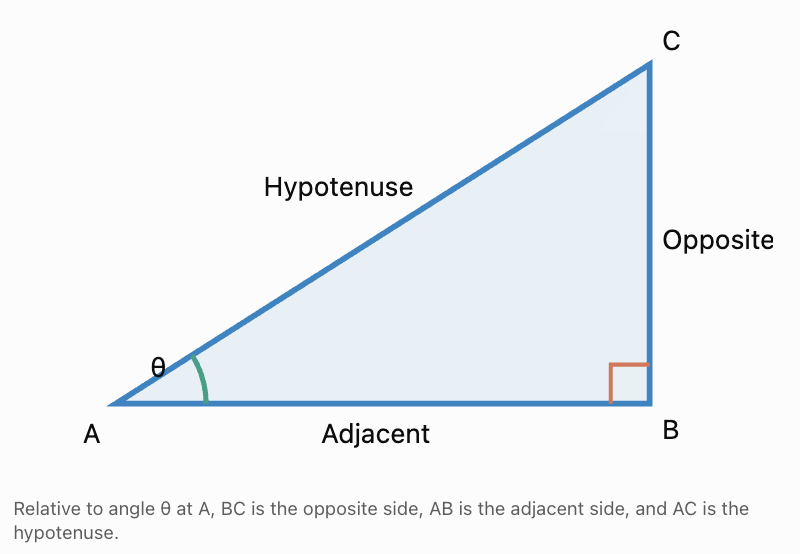
An important observation is that the names opposite and adjacent depend on which acute angle is being considered.
If we change the reference angle from A to C, the opposite and adjacent sides exchange roles. The hypotenuse remains the same.
Worked Example 1: Identifying Sides
Consider a right triangle with:
-
AB = 6 cm
-
BC = 8 cm
-
AC = 10 cm
-
Right angle at B.
Relative to angle A:
-
Opposite = BC = 8 cm.
-
Adjacent = AB = 6 cm.
-
Hypotenuse = AC = 10 cm.
Relative to angle C:
-
Opposite = AB = 6 cm.
-
Adjacent = BC = 8 cm.
-
Hypotenuse = AC = 10 cm.
Correctly identifying the sides is the first step in solving almost every right-triangle trigonometry problem.
Similar Triangles and Trigonometric Ratios
Why do sine, cosine, and tangent work?
Consider two right triangles that share the same acute angle θ.
Because both triangles have a 90° angle and the same angle θ, they are similar by the AA similarity criterion.
Corresponding side lengths are proportional.
Therefore, the ratios of corresponding sides are constant.
For example, consider a 3–4–5 triangle and a 6–8–10 triangle.
Side
Smaller triangle
Larger triangle
Opposite
3
6
Adjacent
4
8
Hypotenuse
5
10
The ratios are:
Opposite / Hypotenuse = 3/5 = 6/10.
Adjacent / Hypotenuse = 4/5 = 8/10.
Opposite / Adjacent = 3/4 = 6/8.
These ratios depend on the angle, not on the overall size of the triangle.
This is the mathematical foundation of trigonometry.
The Three Trigonometric Ratios
Sine
Sine compares the opposite side with the hypotenuse.
sin θ = Opposite / Hypotenuse
Cosine
Cosine compares the adjacent side with the hypotenuse.
cos θ = Adjacent / Hypotenuse
Tangent
Tangent compares the opposite side with the adjacent side.
tan θ = Opposite / Adjacent
A common memory aid is:
SOH – CAH – TOA
-
SOH: Sine = Opposite / Hypotenuse.
-
CAH: Cosine = Adjacent / Hypotenuse.
-
TOA: Tangent = Opposite / Adjacent.
Worked Example 2: Finding All Three Ratios
A right triangle has:
Opposite = 9 cm
Adjacent = 12 cm
Hypotenuse = 15 cm.
Find sin θ, cos θ, and tan θ.
Sine:
sin θ = 9/15 = 3/5 = 0.6.
Cosine:
cos θ = 12/15 = 4/5 = 0.8.
Tangent:
tan θ = 9/12 = 3/4 = 0.75.
Answers:
sin θ = 0.6
cos θ = 0.8
tan θ = 0.75.
The units cancel because these are ratios of lengths.
Choosing the Correct Trigonometric Ratio
The most important decision is choosing which ratio contains the known and unknown sides.
Known or required sides
Ratio
Opposite and hypotenuse
Sine
Adjacent and hypotenuse
Cosine
Opposite and adjacent
Tangent
A useful procedure is:
-
Mark the reference angle.
-
Label the sides O, A, and H.
-
Identify the known and unknown sides.
-
Choose the ratio containing those sides.
-
Substitute values and solve.
For example, if the opposite side is unknown and the hypotenuse is known, use sine.
If the adjacent side is unknown and the opposite side is known, use tangent.
Exact Trigonometric Values
Some angles have exact trigonometric ratios.
Angle
sin θ
cos θ
tan θ
0°
0
1
0
30°
1/2
√3/2
√3/3
45°
√2/2
√2/2
1
60°
√3/2
1/2
√3
90°
1
0
Undefined
The values at 0° and 90° can be understood as limiting cases for right-triangle ratios or using the unit circle.
For general angles, calculators provide decimal approximations.
Special Right Triangles
A 45°–45°–90° triangle has side ratio:
1 : 1 : √2
A 30°–60°–90° triangle has side ratio:
1 : √3 : 2
These relationships are useful for solving problems without a calculator.
Worked Example 3: A 45° Triangle
A right triangle has one acute angle of 45° and one leg of 7 cm.
Because both acute angles are 45°, the legs are equal.
Other leg = 7 cm.
Hypotenuse:
h = 7√2
≈ 9.90 cm.
Answers: Other leg = 7 cm; hypotenuse ≈ 9.90 cm.
Calculating Unknown Sides Using Trigonometry
Once we know an acute angle and at least one side of a right triangle, we can calculate the remaining side lengths.
Worked Example 4: Finding the Opposite Side Using Sine
A right triangle has:
θ = 35°
Hypotenuse = 12 cm.
Find the opposite side x.
Step 1: Choose sine.
sin 35° = x/12.
Step 2: Rearrange.
x = 12 sin 35°.
Step 3: Calculate.
x ≈ 12 × 0.5736
x ≈ 6.88 cm.
Answer: The opposite side is approximately 6.88 cm.
Worked Example 5: Finding the Adjacent Side Using Cosine
A right triangle has:
θ = 40°
Hypotenuse = 15 m.
Find the adjacent side x.
cos 40° = x/15.
Rearrange:
x = 15 cos 40°.
Calculate:
x ≈ 15 × 0.7660
Answer: x ≈ 11.49 m.
Worked Example 6: Finding the Opposite Side Using Tangent
A right triangle has:
θ = 28°
Adjacent side = 9 cm.
Find the opposite side.
tan 28° = x/9.
x = 9 tan 28°.
x ≈ 9 × 0.5317
Answer: x ≈ 4.79 cm.
Worked Example 7: Finding the Hypotenuse
A right triangle has:
θ = 52°
Opposite side = 8 cm.
Find the hypotenuse h.
sin 52° = 8/h.
Multiply both sides by h:
h sin 52° = 8.
Divide by sin 52°:
h = 8/sin 52°.
h ≈ 8/0.7880
Answer: h ≈ 10.15 cm.
Notice that when the unknown side appears in the denominator, we must rearrange carefully.
Worked Example 8: Finding the Adjacent Side Using Tangent
A right triangle has:
θ = 63°
Opposite side = 14 m.
Find the adjacent side x.
tan 63° = 14/x.
x tan 63° = 14.
x = 14/tan 63°.
x ≈ 7.13 m.
Answer: x ≈ 7.13 m.
Solving a Complete Right Triangle
To solve a triangle means to determine all unknown side lengths and angles.
A right triangle contains:
-
One angle of 90°.
-
Two acute angles whose sum is 90°.
-
Three side lengths related by Pythagoras' theorem and trigonometric ratios.
Worked Example 9: Solving a Right Triangle
A right triangle ABC has:
∠B = 90°
∠A = 37°
AB = 10 cm.
Find:
a) ∠C
b) BC
c) AC.
Step 1: Find the remaining angle.
∠C = 180° − 90° − 37°
∠C = 53°.
Step 2: Find BC.
Relative to angle A:
BC is opposite.
AB is adjacent.
Use tangent:
tan 37° = BC/10.
BC = 10 tan 37°.
BC ≈ 7.54 cm.
Step 3: Find AC.
AC is the hypotenuse.
Use cosine:
cos 37° = 10/AC.
AC = 10/cos 37°.
AC ≈ 12.52 cm.
Step 4: Check using Pythagoras.
10² + 7.54² ≈ 12.52².
100 + 56.85 ≈ 156.75.
The small difference is caused by rounding.
Using unrounded values gives the expected relationship.
Pythagoras' Theorem and Trigonometry
Pythagoras' theorem states:
a² + b² = c²
where c is the hypotenuse.
Trigonometry and Pythagoras are complementary tools.
Use Pythagoras when two sides are known and the third side is required.
Use trigonometry when an acute angle and a side are known, or when an acute angle must be calculated from side lengths.
Worked Example 10: Combining Both Methods
A right triangle has legs measuring 5 cm and 12 cm.
Find the hypotenuse and the smaller acute angle.
Step 1: Pythagoras
h² = 5² + 12²
h² = 25 + 144 = 169.
h = 13 cm.
Step 2: Trigonometry
The smaller acute angle θ is opposite the shorter leg, 5 cm.
tan θ = 5/12.
θ = tan⁻¹(5/12).
θ ≈ 22.62°.
Answers: Hypotenuse = 13 cm; smaller acute angle ≈ 22.62°.
Inverse Trigonometric Functions
Ordinary trigonometric functions calculate ratios from angles.
Inverse trigonometric functions calculate angles from ratios.
The three inverse functions are:
θ = sin⁻¹(O/H)
θ = cos⁻¹(A/H)
θ = tan⁻¹(O/A)
The notation sin⁻¹ means inverse sine, also called arcsine.
It does not mean 1/sin θ.
For a right-triangle problem, the inverse functions return the acute angle associated with the side ratio.
Worked Example 11: Finding an Angle Using Inverse Sine
A right triangle has:
Opposite = 7 cm
Hypotenuse = 13 cm.
Find θ.
sin θ = 7/13.
θ = sin⁻¹(7/13).
θ ≈ 32.58°.
Answer: θ ≈ 32.58°.
Worked Example 12: Finding an Angle Using Inverse Cosine
A right triangle has:
Adjacent = 8 m
Hypotenuse = 11 m.
cos θ = 8/11.
θ = cos⁻¹(8/11).
Answer: θ ≈ 43.34°.
Worked Example 13: Finding an Angle Using Inverse Tangent
A right triangle has:
Opposite = 9 cm
Adjacent = 16 cm.
tan θ = 9/16.
θ = tan⁻¹(9/16).
Answer: θ ≈ 29.36°.
Calculator Settings: Degrees and Radians
Angles may be measured in degrees or radians.
In most introductory geometry problems, angles are given in degrees.
Before calculating:
-
Check that your calculator is in degree mode.
-
Enter the ratio correctly.
-
Use the inverse function when calculating an angle.
-
Round only at the final step.
For example:
sin⁻¹(0.5) = 30° in degree mode.
In radian mode:
sin⁻¹(0.5) ≈ 0.5236 radians.
Both are correct representations of the same angle.
Checking Whether an Answer Is Reasonable
For an acute angle:
-
If opposite = adjacent, θ = 45°.
-
If opposite is smaller than adjacent, θ is less than 45°.
-
If opposite is larger than adjacent, θ is greater than 45°.
Also:
0 < sin θ < 1
0 < cos θ < 1
tan θ > 0.
These checks apply to acute angles in right triangles.
Trigonometry on the Coordinate Plane
Trigonometry is closely connected to coordinate geometry.
Consider a point P(x, y) in the first quadrant, with distance r from the origin.
The horizontal and vertical distances form a right triangle.
The angle θ is measured anticlockwise from the positive x-axis.
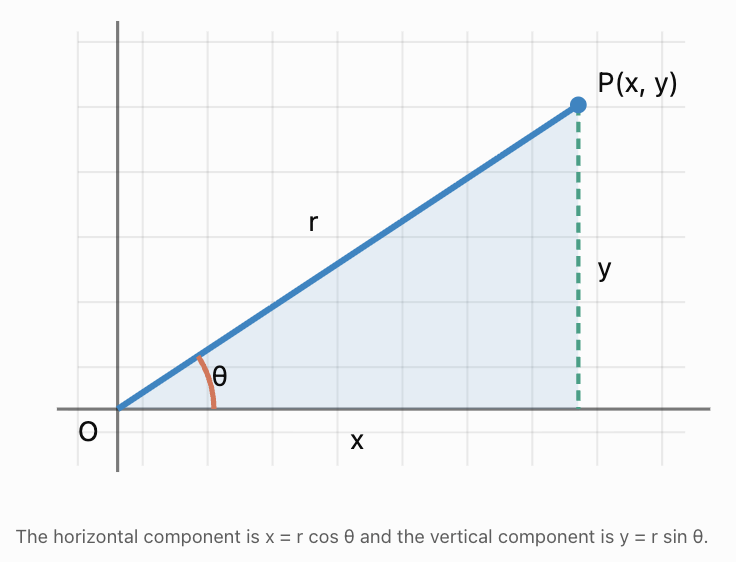
From the triangle:
cos θ = x/r
sin θ = y/r.
Therefore:
x = r cos θ
y = r sin θ
These equations are important in geometry, physics, navigation, engineering, and vector mathematics.
Worked Example 14: Finding Coordinates from an Angle
A point is 20 units from the origin at an angle of 35° above the positive x-axis.
Find its coordinates.
Horizontal coordinate:
x = 20 cos 35°
x ≈ 16.38.
Vertical coordinate:
y = 20 sin 35°
y ≈ 11.47.
Answer: P ≈ (16.38, 11.47).
Worked Example 15: Finding Direction from Coordinates
A point is located at P(8, 6).
Find its distance from the origin and its direction angle.
Distance:
r = √(8² + 6²)
= √100 = 10.
Angle:
tan θ = 6/8.
θ = tan⁻¹(6/8).
θ ≈ 36.87°.
Answer: Distance = 10 units; direction = 36.87° above the positive x-axis.
For points in other quadrants, the signs of x and y must be considered to determine the correct direction angle.
Angles of Elevation and Depression
Trigonometry is often used to calculate heights and distances that are difficult to measure directly.
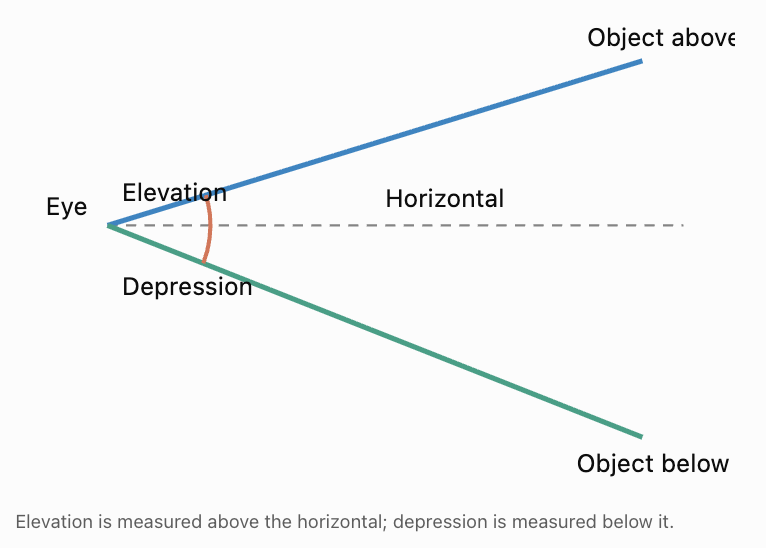
Angle of Elevation
The angle of elevation is the angle measured upward from a horizontal line to an object above the observer.
Angle of Depression
The angle of depression is the angle measured downward from a horizontal line to an object below the observer.
Worked Example 16: Height of a Building
A student stands 30 m from the base of a building.
The angle of elevation to the top is 42°.
Assume the student's eye is at ground level for this simplified model.
Find the height h of the building.
Opposite = h.
Adjacent = 30 m.
Use tangent:
tan 42° = h/30.
h = 30 tan 42°.
h ≈ 27.01 m.
Answer: The building is approximately 27.01 m tall.
In a real measurement, the observer's eye height would need to be added.
Worked Example 17: Including Eye Height
An observer's eyes are 1.6 m above the ground.
The observer stands 25 m from a building.
The angle of elevation to the top is 38°.
Vertical height above the observer's eyes:
h = 25 tan 38°
h ≈ 19.53 m.
Total building height:
H = 19.53 + 1.6
Answer: Approximately 21.13 m.
Worked Example 18: Angle of Depression
A person stands on a platform 45 m above level ground.
The angle of depression to a car is 30°.
Find the horizontal distance x from the point directly beneath the observer to the car.
tan 30° = 45/x.
x = 45/tan 30°.
x = 45√3.
Answer: Approximately 77.94 m.
The angle of depression equals the corresponding angle of elevation because the horizontal lines are parallel.
Real-World Applications of Trigonometry
Trigonometry is used whenever angles and distances must be related.
Surveying and mapping
Surveyors use angles and distances to determine inaccessible heights, slopes, and positions.
Architecture and accessibility
Designers use trigonometry to determine ramp angles, lengths, and vertical rises.
Engineering and construction
Engineers calculate the horizontal and vertical reach of angled beams, cables, and crane booms.
Navigation and geography
Trigonometry helps calculate gradients, elevation changes, and horizontal distances.
Worked Example 19: Designing a Ramp
A ramp rises vertically by 0.75 m and makes an angle of 6° with the horizontal.
Find the ramp length L.
Opposite = 0.75 m.
Hypotenuse = L.
sin 6° = 0.75/L.
L = 0.75/sin 6°.
L ≈ 7.18 m.
Answer: The ramp must be approximately 7.18 m long.
This is the sloping length of the ramp, not its horizontal footprint.
For actual accessibility design, local regulations may impose additional requirements for gradient, landings, handrails, and other features.
Worked Example 20: Finding the Angle of a Ramp
A ramp has a horizontal length of 8 m and rises vertically by 0.6 m.
Find its angle of inclination.
tan θ = 0.6/8.
tan θ = 0.075.
θ = tan⁻¹(0.075).
Answer: θ ≈ 4.29°.
The slope can also be expressed as a percentage:
Gradient = (Rise / Horizontal run) × 100%
= (0.6/8) × 100%
= 7.5%.
An angle of approximately 4.29° corresponds to a 7.5% gradient.
Worked Example 21: Ladder Against a Wall
A 6 m ladder rests against a vertical wall.
The ladder makes an angle of 70° with the horizontal ground.
Find:
a) The height reached.
b) The distance of the ladder's base from the wall.
a) Height
h = 6 sin 70°
h ≈ 5.64 m.
b) Horizontal distance
x = 6 cos 70°
x ≈ 2.05 m.
Answers: Height ≈ 5.64 m; horizontal distance ≈ 2.05 m.
This is an idealized geometry model; safe ladder placement also depends on practical safety requirements.
Worked Example 22: A Kite
A kite is attached to a taut 80 m string.
The string makes an angle of 55° with the horizontal.
Assume the string is straight and the hand holding it is at ground level.
Find the kite's height.
sin 55° = h/80.
h = 80 sin 55°.
Answer: h ≈ 65.53 m.
If the string is held 1.2 m above the ground, the kite's height above the ground would be approximately:
65.53 + 1.2 = 66.73 m.
Worked Example 23: Width of a River
A surveyor observes a point directly opposite on the far bank of a river.
After walking 40 m along the straight near bank, the surveyor measures a 35° angle between the bank and the line of sight to the point.
Assume the original crossing direction is perpendicular to the bank.
Let w be the river width.
tan 35° = w/40.
w = 40 tan 35°.
Answer: w ≈ 28.01 m.
This allows the surveyor to estimate the river width without crossing it.
Worked Example 24: Roof Design
A symmetrical roof has a horizontal half-span of 5 m.
Each sloping side makes an angle of 32° with the horizontal.
Find:
a) The roof rise.
b) The length of one sloping side.
a) Roof rise
tan 32° = h/5.
h = 5 tan 32°.
h ≈ 3.12 m.
b) Sloping length
cos 32° = 5/L.
L = 5/cos 32°.
L ≈ 5.90 m.
Answers: Rise ≈ 3.12 m; sloping length ≈ 5.90 m.
Worked Example 25: Crane Boom
A crane boom is 18 m long and makes an angle of 48° with the horizontal.
Find its horizontal and vertical components.
Horizontal reach:
x = 18 cos 48°
x ≈ 12.04 m.
Vertical rise:
y = 18 sin 48°
y ≈ 13.38 m.
Answers: Horizontal component ≈ 12.04 m; vertical component ≈ 13.38 m.
These values describe the boom relative to its pivot. They do not necessarily give the hook's exact position or height above the ground.
Interpreting Trigonometric Solutions
A mathematically correct calculation is not always a complete real-world answer.
After solving a problem, consider:
Units: Is the answer in metres, centimetres, or degrees?
Meaning: Does the answer represent vertical height, horizontal distance, or sloping length?
Reasonableness: Is the hypotenuse longer than either leg?
Precision: Are the input measurements precise enough to justify the reported decimals?
Assumptions: Are the ground and wall perpendicular? Is the string straight? Is the object vertical?
Physical constraints: Are there safety, design, or practical requirements beyond the geometric calculation?
For example, calculating that a ramp needs a length of 7.18 m does not automatically prove that the ramp satisfies building regulations.
Common Mistakes
Mistake 1: Confusing Opposite and Adjacent
Always label the sides relative to the angle being considered.
Mistake 2: Identifying the Wrong Hypotenuse
The hypotenuse is always opposite the right angle and is always the longest side.
Mistake 3: Choosing the Wrong Ratio
Use the ratio involving the known and unknown sides.
Mistake 4: Using Inverse Trigonometry to Find a Side
Inverse trigonometric functions are generally used to calculate angles from ratios.
Mistake 5: Confusing sin⁻¹ θ with 1/sin θ
Inverse sine is not the reciprocal of sine.
Mistake 6: Using Radian Mode Instead of Degree Mode
Check the calculator setting before evaluating trigonometric functions.
Mistake 7: Rearranging Incorrectly
From sin θ = O/H:
O = H sin θ
H = O/sin θ.
Mistake 8: Forgetting Pythagoras' Theorem
When two sides are known, Pythagoras may be the most efficient method.
Mistake 9: Assuming Trigonometry Works Only with Drawn-to-Scale Diagrams
The ratios depend on exact mathematical relationships, not the appearance of the drawing.
Mistake 10: Using the Wrong Angle
Check whether the angle is measured from the horizontal, vertical, or another line.
Mistake 11: Confusing Vertical Height and Sloping Distance
A ladder's length is not the same as the height it reaches.
Mistake 12: Ignoring Eye Height
When calculating a building's height, the observer's eye height may need to be included.
Mistake 13: Rounding Too Early
Keep unrounded calculator values until the final answer.
Mistake 14: Ignoring Real-World Assumptions
Real measurements may involve uneven ground, flexible cables, or nonvertical objects.
Mistake 15: Reporting an Impossible Side Length
The hypotenuse must be longer than either leg in a nondegenerate right triangle.
Mistake 16: Using SOH–CAH–TOA Directly on Non-Right Triangles
These basic side-ratio definitions apply to right triangles. Non-right triangles generally require additional methods such as the Law of Sines or Law of Cosines.
Key Terms
-
Trigonometry: The study of relationships involving angles and side lengths.
-
Right-Angled Triangle: A triangle containing a 90° angle.
-
Hypotenuse: The longest side of a right triangle, opposite the right angle.
-
Opposite Side: The side opposite a chosen angle.
-
Adjacent Side: The non-hypotenuse side next to a chosen angle.
-
Sine: Ratio of opposite side to hypotenuse.
-
Cosine: Ratio of adjacent side to hypotenuse.
-
Tangent: Ratio of opposite side to adjacent side.
-
SOH–CAH–TOA: Memory aid for the three trigonometric ratios.
-
Inverse Sine: Function used to find an angle from a sine ratio.
-
Inverse Cosine: Function used to find an angle from a cosine ratio.
-
Inverse Tangent: Function used to find an angle from a tangent ratio.
-
Arcsine: Another name for inverse sine.
-
Arccosine: Another name for inverse cosine.
-
Arctangent: Another name for inverse tangent.
-
Degree: A unit of angle measurement.
-
Radian: Another unit of angle measurement.
-
Angle of Elevation: An upward angle measured from the horizontal.
-
Angle of Depression: A downward angle measured from the horizontal.
-
Pythagoras' Theorem: Relationship a² + b² = c² in a right triangle.
-
Exact Value: A mathematical value expressed without rounding.
-
Approximation: A value estimated to a specified precision.
-
Gradient: The ratio of vertical rise to horizontal run.
-
Inclination: The angle a line or surface makes with a reference direction.
-
Horizontal Component: The part of a length or vector in the horizontal direction.
-
Vertical Component: The part of a length or vector in the vertical direction.
-
Surveying: Measuring positions, distances, and angles on land.
-
Coordinate Geometry: The use of coordinates and algebra to study geometric relationships.
-
Model Assumption: A simplifying condition used to represent a real-world situation mathematically.
Key Takeaways
-
Trigonometry connects angles and side lengths.
-
The basic sine, cosine, and tangent ratios are defined using right triangles.
-
Sine compares opposite and hypotenuse.
-
Cosine compares adjacent and hypotenuse.
-
Tangent compares opposite and adjacent.
-
SOH–CAH–TOA helps recall the ratios.
-
The hypotenuse is always opposite the right angle.
-
Opposite and adjacent depend on the reference angle.
-
Similar triangles explain why trigonometric ratios are constant for a given angle.
-
Ordinary trigonometric functions can calculate unknown sides.
-
Inverse trigonometric functions can calculate unknown acute angles.
-
A right triangle's two acute angles add to 90°.
-
Pythagoras' theorem can be combined with trigonometry.
-
Degree and radian modes must not be confused.
-
Angles of elevation and depression are measured from the horizontal.
-
Horizontal components can be calculated using cosine.
-
Vertical components can be calculated using sine.
-
Trigonometry is used in surveying, engineering, construction, and navigation.
-
Real-world problems require correct units and sensible assumptions.
-
Every solution should be checked for mathematical and practical reasonableness.
Check Your Understanding
Show all calculations. Unless otherwise stated, round lengths to two decimal places and angles to one decimal place.
Question 1: Identifying Sides
A right triangle ABC has ∠B = 90°.
Relative to angle A, identify:
a) The hypotenuse.
b) The opposite side.
c) The adjacent side.
Question 2: Trigonometric Ratios
A right triangle has:
Opposite = 5 cm
Adjacent = 12 cm
Hypotenuse = 13 cm.
Find:
a) sin θ
b) cos θ
c) tan θ.
Question 3: Sine
A right triangle has an angle of 30° and a hypotenuse of 18 cm.
Find the opposite side.
Question 4: Cosine
A right triangle has an angle of 60° and a hypotenuse of 20 m.
Find the adjacent side.
Question 5: Tangent
A right triangle has an angle of 40° and an adjacent side of 7 cm.
Find the opposite side.
Question 6: Finding the Hypotenuse
A right triangle has an angle of 35° and an opposite side of 9 cm.
Find the hypotenuse.
Question 7: Finding the Adjacent Side
A right triangle has an angle of 50° and an opposite side of 12 cm.
Find the adjacent side.
Question 8: Inverse Sine
A right triangle has an opposite side of 6 cm and a hypotenuse of 10 cm.
Find θ.
Question 9: Inverse Cosine
A right triangle has an adjacent side of 9 cm and a hypotenuse of 15 cm.
Find θ.
Question 10: Inverse Tangent
A right triangle has an opposite side of 8 cm and an adjacent side of 11 cm.
Find θ.
Question 11: Solving a Complete Triangle
Triangle ABC has:
∠B = 90°
∠A = 42°
AB = 14 cm.
Find:
a) ∠C
b) BC
c) AC.
Question 12: Pythagoras and Trigonometry
A right triangle has legs of 9 cm and 12 cm.
Find:
a) The hypotenuse.
b) The smaller acute angle.
Question 13: Building Height
A person stands 40 m from the base of a building.
The angle of elevation to the top is 35°.
Assume the observer's eye is at ground level.
Find the building's height.
Question 14: Ladder
A 7 m ladder makes an angle of 65° with the horizontal ground.
Find:
a) The height reached.
b) The distance from the wall to the ladder's base.
Question 15: Ramp
A ramp rises vertically by 0.8 m over a horizontal distance of 10 m.
Find:
a) Its angle of inclination.
b) Its sloping length.
Question 16: Angle of Depression
A person stands on a cliff 60 m above sea level.
The angle of depression to a boat is 25°.
Assuming the boat is at sea level, find its horizontal distance from the base of the cliff.
Question 17: Coordinate Trigonometry
A point is 25 units from the origin at an angle of 30° above the positive x-axis.
Find its coordinates.
Question 18: Crane Boom
A crane boom is 22 m long and makes an angle of 55° with the horizontal.
Find:
a) Its horizontal reach.
b) Its vertical rise.
Question 19: River Width
A surveyor walks 50 m along a straight riverbank from a point directly opposite a landmark.
The angle between the riverbank and the line of sight to the landmark is 38°.
Assuming the crossing direction is perpendicular to the riverbank, find the river's width.
Question 20: Comprehensive Challenge
An observer stands 45 m from the base of a vertical tower.
The observer's eye height is 1.7 m above level ground.
The angle of elevation to the top of the tower is 52°.
Find:
a) The vertical distance from the observer's eyes to the top.
b) The total height of the tower.
c) The straight-line distance from the observer's eyes to the top.
d) The angle of depression from the top of the tower to the observer's eyes.
e) Explain why the calculated tower height is only an estimate in a real-world investigation.
Fully Worked Answers
Answer 1: Identifying Sides
Triangle ABC has a right angle at B.
The hypotenuse is opposite the right angle.
Relative to angle A:
a) Hypotenuse = AC
b) Opposite = BC
c) Adjacent = AB
Answer 2: Trigonometric Ratios
Opposite = 5 cm
Adjacent = 12 cm
Hypotenuse = 13 cm.
a) Sine
sin θ = Opposite / Hypotenuse
sin θ = 5/13 ≈ 0.3846.
b) Cosine
cos θ = Adjacent / Hypotenuse
cos θ = 12/13 ≈ 0.9231.
c) Tangent
tan θ = Opposite / Adjacent
tan θ = 5/12 ≈ 0.4167.
Answers: sin θ = 5/13, cos θ = 12/13, tan θ = 5/12.
Answer 3: Sine
Angle = 30°.
Hypotenuse = 18 cm.
sin 30° = x/18.
x = 18 sin 30°.
x = 18 × 0.5.
Answer: 9 cm.
Answer 4: Cosine
Angle = 60°.
Hypotenuse = 20 m.
cos 60° = x/20.
x = 20 cos 60°.
x = 20 × 0.5.
Answer: 10 m.
Answer 5: Tangent
Angle = 40°.
Adjacent = 7 cm.
tan 40° = x/7.
x = 7 tan 40°.
Answer: x ≈ 5.87 cm.
Answer 6: Finding the Hypotenuse
Angle = 35°.
Opposite = 9 cm.
sin 35° = 9/h.
h sin 35° = 9.
h = 9/sin 35°.
Answer: h ≈ 15.69 cm.
This is reasonable because the hypotenuse is longer than the opposite side.
Answer 7: Finding the Adjacent Side
Angle = 50°.
Opposite = 12 cm.
tan 50° = 12/x.
x tan 50° = 12.
x = 12/tan 50°.
Answer: x ≈ 10.07 cm.
Answer 8: Inverse Sine
Opposite = 6 cm.
Hypotenuse = 10 cm.
sin θ = 6/10.
sin θ = 0.6.
θ = sin⁻¹(0.6).
Answer: θ ≈ 36.9°.
Answer 9: Inverse Cosine
Adjacent = 9 cm.
Hypotenuse = 15 cm.
cos θ = 9/15.
cos θ = 0.6.
θ = cos⁻¹(0.6).
Answer: θ ≈ 53.1°.
Answer 10: Inverse Tangent
Opposite = 8 cm.
Adjacent = 11 cm.
tan θ = 8/11.
θ = tan⁻¹(8/11).
Answer: θ ≈ 36.0°.
Answer 11: Solving a Complete Triangle
Given:
∠B = 90°
∠A = 42°
AB = 14 cm.
a) Find angle C.
∠C = 180° − 90° − 42°.
Answer: ∠C = 48°.
b) Find BC.
Relative to angle A:
BC is opposite.
AB is adjacent.
tan 42° = BC/14.
BC = 14 tan 42°.
Answer: BC ≈ 12.61 cm.
c) Find AC.
AC is the hypotenuse.
cos 42° = 14/AC.
AC = 14/cos 42°.
Answer: AC ≈ 18.84 cm.
Check:
The hypotenuse is longer than either leg, as expected.
Answer 12: Pythagoras and Trigonometry
Legs = 9 cm and 12 cm.
a) Hypotenuse
h² = 9² + 12².
h² = 81 + 144.
h² = 225.
h = √225.
Answer: 15 cm.
b) Smaller acute angle
The smaller angle is opposite the shorter leg.
tan θ = 9/12.
θ = tan⁻¹(9/12).
Answer: θ ≈ 36.9°.
Answer 13: Building Height
Horizontal distance = 40 m.
Angle of elevation = 35°.
Let h represent the building's height.
tan 35° = h/40.
h = 40 tan 35°.
Answer: The building is approximately 28.01 m tall.
This assumes level ground and that the observer's eye is at ground level.
Answer 14: Ladder
Ladder length = 7 m.
Angle with ground = 65°.
a) Height reached
sin 65° = h/7.
h = 7 sin 65°.
Answer: h ≈ 6.34 m.
b) Horizontal distance
cos 65° = x/7.
x = 7 cos 65°.
Answer: x ≈ 2.96 m.
Both distances are shorter than the ladder, which is the hypotenuse.
Answer 15: Ramp
Vertical rise = 0.8 m.
Horizontal distance = 10 m.
a) Angle of inclination
tan θ = 0.8/10.
tan θ = 0.08.
θ = tan⁻¹(0.08).
Answer: θ ≈ 4.6°.
b) Sloping length
Use Pythagoras:
L² = 10² + 0.8².
L² = 100 + 0.64.
L = √100.64.
Answer: L ≈ 10.03 m.
The ramp's sloping length is slightly longer than its horizontal run.
Answer 16: Angle of Depression
Cliff height = 60 m.
Angle of depression = 25°.
The corresponding angle of elevation from the boat is also 25°.
Let x represent the horizontal distance.
tan 25° = 60/x.
x = 60/tan 25°.
Answer: The boat is approximately 128.67 m horizontally from the cliff's base.
Answer 17: Coordinate Trigonometry
Distance from origin = 25 units.
Angle = 30°.
Horizontal coordinate
x = 25 cos 30°.
x = 25(√3/2).
x ≈ 21.65.
Vertical coordinate
y = 25 sin 30°.
y = 25(1/2).
y = 12.5.
Answer: P ≈ (21.65, 12.50).
Answer 18: Crane Boom
Boom length = 22 m.
Angle with horizontal = 55°.
a) Horizontal reach
x = 22 cos 55°.
Answer: x ≈ 12.62 m.
b) Vertical rise
y = 22 sin 55°.
Answer: y ≈ 18.02 m.
The vertical component is larger because the boom's angle exceeds 45°.
Answer 19: River Width
Distance walked along bank = 50 m.
Angle = 38°.
Let w represent the river width.
The width is opposite the 38° angle, and the distance walked is adjacent.
tan 38° = w/50.
w = 50 tan 38°.
Answer: The river is approximately 39.06 m wide.
This calculation assumes the riverbank and crossing direction form a right angle.
Answer 20: Comprehensive Challenge
Given:
Horizontal distance = 45 m.
Eye height = 1.7 m.
Angle of elevation = 52°.
a) Vertical distance from eyes to tower top
Let h represent the vertical distance.
tan 52° = h/45.
h = 45 tan 52°.
Answer: h ≈ 57.60 m.
b) Total tower height
Tower height = Vertical distance above eyes + Eye height.
H = 57.597... + 1.7.
H ≈ 59.30 m.
Answer: The tower is approximately 59.30 m tall.
c) Straight-line distance to tower top
Let d represent the line-of-sight distance.
cos 52° = 45/d.
d = 45/cos 52°.
Answer: d ≈ 73.09 m.
d) Angle of depression
The horizontal line through the observer and the horizontal line through the tower top are parallel.
Therefore, the angle of depression equals the angle of elevation by alternate interior angles.
Answer: 52°.
e) Why is the tower height an estimate?
The calculation assumes:
-
The ground is level.
-
The tower is vertical.
-
The horizontal distance is measured accurately.
-
The observer's eye height is correct.
-
The angle of elevation is measured accurately.
In practice, small measurement errors can affect the final answer.
For example, an error of only one degree in the measured angle could noticeably change the calculated height.
Conclusion: The mathematical model gives an estimated tower height of approximately 59.30 m, subject to the accuracy of the measurements and assumptions.
Final Course Connections
Trigonometry provides a powerful connection between geometry, algebra, and real-world measurement.
The three fundamental ratios—sine, cosine, and tangent—allow us to calculate unknown sides in right triangles. Inverse trigonometric functions allow us to determine unknown angles. Together with Pythagoras' theorem, these methods enable us to solve complete triangles and investigate practical situations involving heights, distances, slopes, and directions.
The most important skill is learning to identify the correct sides, choose the appropriate ratio, perform the calculation accurately, and explain what the answer means in context.
This completes Trigonometry in Geometry, including all five learning targets, detailed explanations, worked examples, supporting diagrams, real-world applications, common mistakes, key terms, key takeaways, and 20 practice questions with fully worked answers.
-
3. Geometric Modelling
Learning outcomes
- I can represent real-world objects using geometric models.
- I can estimate measurements using geometry.
- I can apply geometric reasoning to design problems.
- I can interpret geometric data.
- I can evaluate the accuracy of geometric models.
Introduction
How can an architect design a building before construction begins? How can an engineer estimate the amount of material required to manufacture a container? How can a city planner calculate the area of an irregular park? How can scientists estimate the size of objects that are difficult to measure directly?
These problems can be solved using geometric modelling.
Geometric modelling involves representing real-world objects, structures, and situations using mathematical shapes, measurements, and relationships.
A building might be represented by rectangular prisms. A water tank might be modelled as a cylinder. A curved roof might be approximated by part of a circle. An irregular plot of land might be divided into triangles and trapezoids.
These models simplify complicated situations so that we can calculate dimensions, estimate quantities, compare designs, and make informed decisions.
However, a mathematical model is not necessarily a perfect representation of reality. Real objects may have irregular surfaces, imperfect measurements, or features that are deliberately ignored.
An important part of geometric modelling is therefore understanding both what a model can tell us and where its limitations lie.
What Is a Geometric Model?
A geometric model is a mathematical representation of an object or situation using points, lines, angles, curves, two-dimensional shapes, or three-dimensional solids.
A model may be:
-
A labelled diagram of an object.
-
A scale drawing of a building.
-
A coordinate representation of a map.
-
A three-dimensional model of a container.
-
A collection of simple shapes representing a complex object.
-
An algebraic equation describing a geometric relationship.
For example, a cylindrical water tank can be represented using its radius and height.
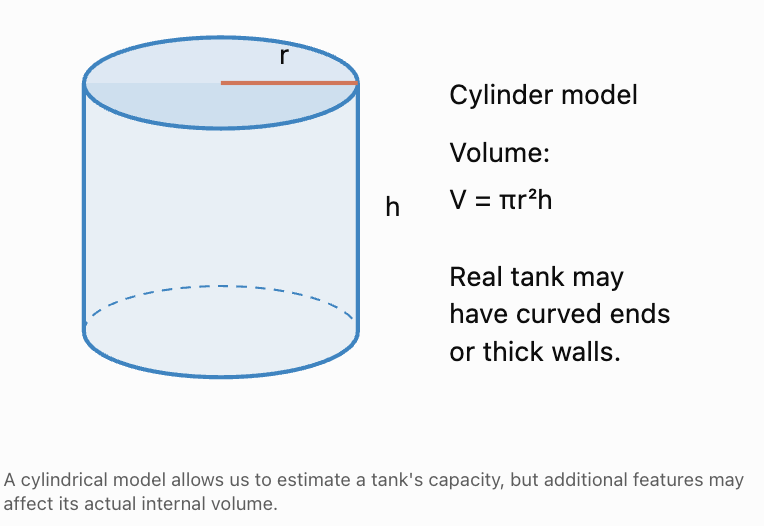
A model is useful when it captures the important features of the real object while remaining simple enough to analyse.
The Geometric Modelling Process
Geometric modelling is not just choosing a formula. It is a process of making assumptions, performing calculations, and evaluating results.
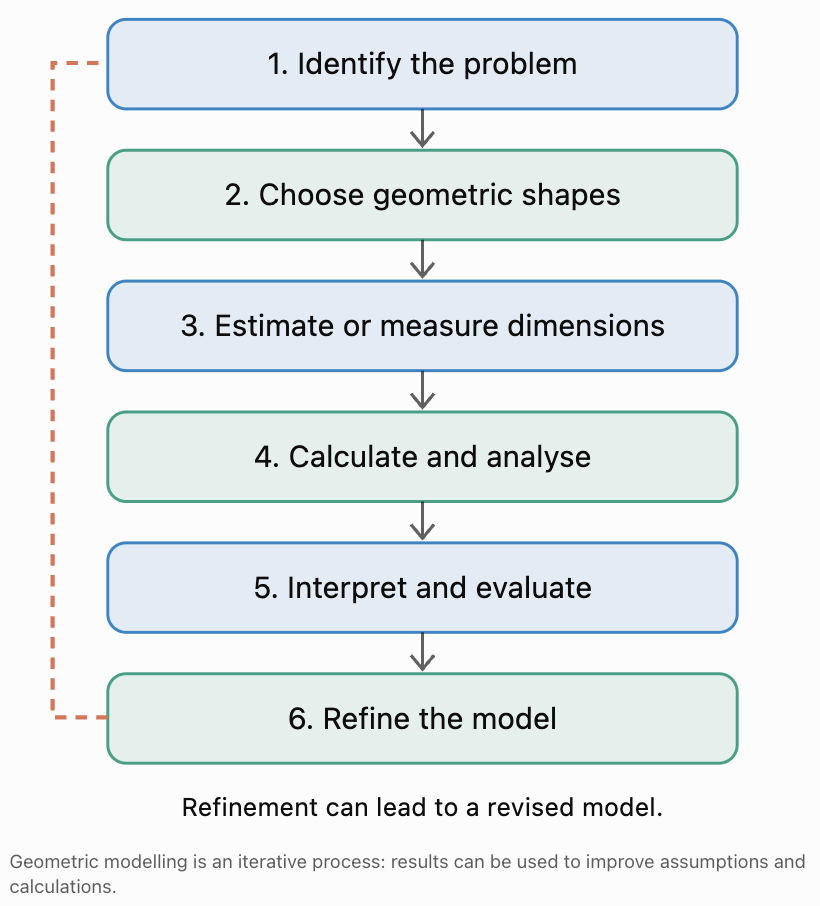
Step 1: Identify the Problem
Decide what needs to be calculated.
Examples include area, volume, distance, height, angle, material quantity, or cost.
Step 2: Choose an Appropriate Model
Represent the object using geometric shapes.
For example, a storage building might be modelled as a rectangular prism with a triangular-prism roof.
Step 3: Measure or Estimate Dimensions
Collect lengths, angles, radii, heights, or coordinates.
All measurements should use consistent units.
Step 4: Apply Mathematics
Use formulas, Pythagoras' theorem, trigonometry, similarity, coordinate geometry, or other appropriate techniques.
Step 5: Interpret the Result
Explain what the answer means in the original situation.
A calculated volume might represent storage capacity, while a calculated area might represent the amount of material required.
Step 6: Evaluate and Refine
Compare the model with reality.
Consider whether the assumptions were reasonable and whether a more detailed model would improve accuracy.
Representing Real-World Objects with Simple Shapes
Many complex objects can be approximated by combinations of familiar shapes.
|
Real-world object |
Possible geometric model |
|---|---|
|
Shipping box |
Rectangular prism |
|
Water tank |
Cylinder |
|
Football |
Sphere |
|
Ice-cream cone |
Cone |
|
Building roof |
Triangular prism |
|
Tent |
Triangular prism or pyramid |
|
Archway |
Rectangle and semicircle |
|
Garden pond |
Circle, ellipse, or composite shape |
|
Storage silo |
Cylinder and cone |
|
Irregular land plot |
Collection of triangles and trapezoids |
The most appropriate model depends on the purpose.
A spherical model of a ball may be sufficient for calculating approximate volume, but a detailed computer model may be needed to study its surface texture.
Worked Example 1: Modelling a Storage Building
A small storage building has:
-
A rectangular base measuring 10 m by 6 m.
-
Wall height of 4 m.
-
A symmetrical pitched roof rising 2 m above the walls.
Estimate the building's enclosed volume, assuming negligible wall and roof thickness.
The building can be divided into:
-
A rectangular prism.
-
A triangular prism.
Step 1: Rectangular prism volume
V₁ = 10 × 6 × 4
V₁ = 240 m³.
Step 2: Roof volume
The triangular cross-section has:
Base = 6 m.
Height = 2 m.
Area = ½ × 6 × 2 = 6 m².
Roof length = 10 m.
V₂ = 6 × 10 = 60 m³.
Step 3: Total volume
V = 240 + 60
Answer: Estimated enclosed volume = 300 m³.
The model assumes the roof has a uniform triangular cross-section and ignores internal supports, wall thickness, and other structural details.
Worked Example 2: Modelling a Storage Silo
A grain silo consists of a cylinder with a cone-shaped roof.
The cylinder has:
Radius = 3 m.
Height = 12 m.
The cone has:
Radius = 3 m.
Height = 2 m.
Calculate the total geometric volume of the exterior shape.
Cylinder:
V₁ = πr²h
= π(3²)(12)
= 108π m³.
Cone:
V₂ = ⅓πr²h
= ⅓π(3²)(2)
= 6π m³.
Total:
V = 114π
≈ 358.14 m³.
Answer: Approximately 358.14 m³.
This is the volume enclosed by the idealized outer shape, not necessarily the usable grain-storage capacity. The roof space may not be filled, and the walls occupy some volume.
Estimating Measurements Using Geometry
In many real-world situations, exact measurements are unavailable or difficult to obtain.
Geometry allows us to make useful estimates from limited information.
Common techniques include:
-
Using scale drawings.
-
Applying similarity and proportions.
-
Using trigonometry to estimate inaccessible heights.
-
Dividing irregular shapes into simpler regions.
-
Using coordinates to estimate distances.
-
Using known dimensions as reference measurements.
An estimate should be realistic and appropriately precise. Reporting a result to six decimal places is rarely justified when the original measurements were only approximate.
Scale Drawings and Scale Factors
A scale drawing represents an object at a different size while preserving its proportions.
For example, a scale of 1:100 means:
1 cm on the drawing represents 100 cm in reality.
Since 100 cm = 1 m:
1 cm on the drawing represents 1 m in reality.
For a scale of 1:n:
Actual length = Drawing length × n.
Drawing length = Actual length / n.
Both lengths must initially use the same units.
Worked Example 3: Interpreting a Floor Plan
A rectangular room measures 7.2 cm by 4.8 cm on a drawing with scale 1:50.
Find its actual dimensions and floor area.
Step 1: Actual length
7.2 × 50 = 360 cm = 3.6 m.
Step 2: Actual width
4.8 × 50 = 240 cm = 2.4 m.
Step 3: Floor area
A = 3.6 × 2.4
Answer: Dimensions = 3.6 m by 2.4 m; area = 8.64 m².
Worked Example 4: Estimating a Park's Area
A rectangular park is represented on a map by a rectangle measuring 5 cm by 3 cm.
The map scale is 1:2000.
Actual length:
5 × 2000 = 10,000 cm = 100 m.
Actual width:
3 × 2000 = 6000 cm = 60 m.
Area:
A = 100 × 60
Answer: Estimated park area = 6000 m².
This model would overestimate the area if the real park had significantly rounded corners or irregular boundaries inside the rectangle.
Estimating Heights Using Similar Triangles
When two triangles have equal corresponding angles, they are similar.
Their corresponding sides are proportional.
This allows us to estimate an object's height using its shadow.
Worked Example 5: Height of a Tree
A vertical measuring stick is 1.5 m tall and casts a shadow 2 m long.
At the same time, a tree casts a shadow 12 m long.
Assume the ground is level and sunlight reaches both objects at the same angle.
Let h represent the tree's height.
By similar triangles:
h/12 = 1.5/2.
Multiply by 12:
h = 12 × 1.5/2
Answer: Estimated tree height = 9 m.
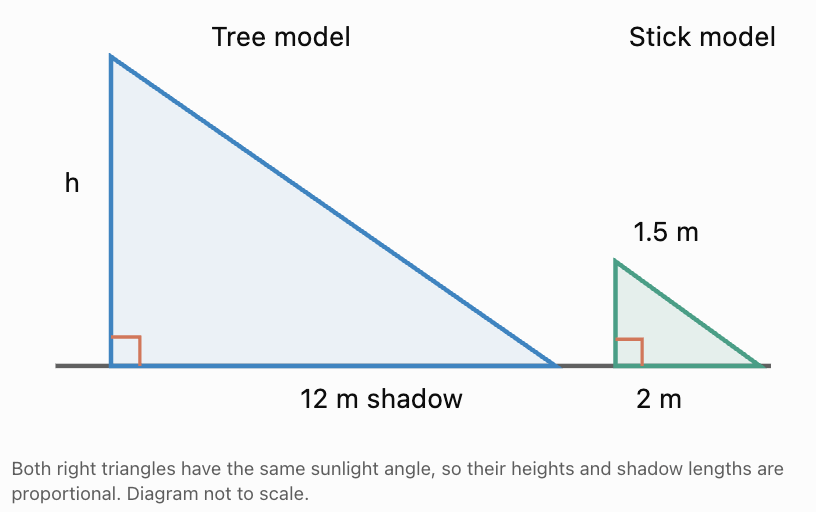
Estimating Inaccessible Distances Using Trigonometry
Trigonometry is useful when direct measurement is impractical.
Worked Example 6: Estimating a Building's Height
A surveyor stands 40 m horizontally from a building.
The angle of elevation to the top is 38°.
The surveyor's instrument is 1.5 m above the ground.
Find the building's estimated height.
Vertical distance above instrument:
h = 40 tan 38°
h ≈ 31.25 m.
Add instrument height:
H = 31.25 + 1.5
Answer: Estimated building height ≈ 32.75 m.
The result assumes that the building is vertical and the ground between the instrument and building is level.
Estimating Irregular Areas
Irregular shapes can be approximated using rectangles, triangles, trapezoids, or circular regions.
A more detailed subdivision often improves the estimate, provided the measurements are reliable.
Worked Example 7: Irregular Garden
A garden is approximated by three non-overlapping regions:
-
Rectangle: 8 m by 5 m.
-
Triangle: base 4 m, perpendicular height 3 m.
-
Semicircle: radius 2 m.
Rectangle:
A₁ = 8 × 5 = 40 m².
Triangle:
A₂ = ½ × 4 × 3 = 6 m².
Semicircle:
A₃ = ½π(2²) = 2π m².
Total:
A = 40 + 6 + 2π
≈ 52.28 m².
Answer: Estimated garden area ≈ 52.28 m².
The accuracy depends on how closely these shapes follow the garden's actual boundary.
Estimation and Significant Figures
Measurements are rarely exact.
Suppose a room is measured as:
Length = 5.2 m.
Width = 3.7 m.
Its calculated area is:
A = 5.2 × 3.7 = 19.24 m².
If the original dimensions are only accurate to the nearest 0.1 m, reporting the area as 19.240000 m² would imply unjustified precision.
A sensible report might be:
Estimated area ≈ 19.2 m².
The appropriate precision depends on the measurement quality and the intended use.
Applying Geometric Reasoning to Design Problems
Geometric modelling is especially useful when a design must satisfy constraints.
Examples include:
-
A container must hold a specified volume.
-
A ramp must rise to a given height.
-
A roof must fit a building of known width.
-
A package must minimize material use.
-
A walkway must fit within an available area.
A constraint is a condition that the design must satisfy.
A design objective is something the designer wants to achieve, such as minimizing cost, maximizing capacity, or improving accessibility.
Worked Example 8: Designing a Cylindrical Container
A manufacturer wants to design a closed cylindrical container with a volume of 1000 cm³.
One proposed design has radius 5 cm.
Find the required height.
Volume formula:
V = πr²h.
Substitute:
1000 = π(5²)h.
1000 = 25πh.
Rearrange:
h = 1000/(25π)
h = 40/π
≈ 12.73 cm.
Answer: Required height ≈ 12.73 cm.
Now estimate the material needed for the idealized closed cylinder.
SA = 2πr² + 2πrh.
SA = 2π(25) + 2π(5)(40/π).
SA = 50π + 400
≈ 557.08 cm².
Answer: The idealized container requires approximately 557.08 cm² of surface material.
This excludes seams, thickness, manufacturing waste, and any lid overlap.
Worked Example 9: Comparing Two Container Designs
Two closed cylindrical containers must each hold 1000 cm³.
Design A has radius 5 cm.
Design B has radius 6 cm.
Which requires less surface material?
For a fixed volume:
h = V/(πr²).
The closed-cylinder surface area is:
SA = 2πr² + 2πrh.
Substitute the height expression:
SA = 2πr² + 2V/r.
Design A
r = 5.
SA_A = 2π(25) + 2000/5
= 50π + 400
≈ 557.08 cm².
Design B
r = 6.
SA_B = 2π(36) + 2000/6
= 72π + 333.33...
≈ 559.53 cm².
Difference:
559.53 − 557.08 ≈ 2.45 cm².
Conclusion: Design A uses approximately 2.45 cm² less surface material.
The difference is small. A practical manufacturer would also consider stability, stacking, lid design, and production cost.
Worked Example 10: Designing a Roof
A building is 12 m wide.
A symmetrical pitched roof has a rise of 3 m from the top of the walls to the ridge.
Find the length of each sloping roof section from eave to ridge, assuming no overhang.
Half the building width:
12/2 = 6 m.
Use Pythagoras:
L² = 6² + 3²
L² = 45.
L = √45
≈ 6.71 m.
Answer: Each sloping section is approximately 6.71 m long.
If the building is 15 m long, the total area of the two rectangular roof slopes is:
A = 2 × 15 × √45
≈ 201.25 m².
Answer: Idealized roof area ≈ 201.25 m².
Additional material would be needed for overlaps, cuts, and overhangs.
Worked Example 11: Designing a Ramp
A raised entrance is 0.6 m above the surrounding ground.
The designer proposes a straight ramp with a gradient of 1:12, meaning 1 unit of vertical rise for every 12 units of horizontal run.
Required horizontal run:
12 × 0.6 = 7.2 m.
Sloping length:
L = √(7.2² + 0.6²)
L = √52.20
≈ 7.22 m.
Angle:
θ = tan⁻¹(0.6/7.2)
≈ 4.76°.
Answers: Horizontal run = 7.2 m; sloping length ≈ 7.22 m; angle ≈ 4.76°.
A complete design must also check applicable accessibility and building requirements. The geometry alone does not establish compliance.
Worked Example 12: Choosing a Packaging Design
Two rectangular boxes have the same volume of 1000 cm³.
Box A: 10 cm × 10 cm × 10 cm.
Box B: 20 cm × 10 cm × 5 cm.
Both volumes are:
V = 1000 cm³.
Box A surface area
SA_A = 6 × 10²
= 600 cm².
Box B surface area
SA_B = 2(20 × 10 + 20 × 5 + 10 × 5)
= 2(200 + 100 + 50)
= 700 cm².
Conclusion: Box A requires 100 cm² less surface material.
For these two designs, the cube is more material-efficient. However, shape selection may also depend on the object being packaged.
Interpreting Geometric Data
Geometric data may be presented as:
-
Tables of dimensions.
-
Scale drawings and maps.
-
Coordinate points.
-
Angles and distances.
-
Cross-sectional diagrams.
-
Area and volume measurements.
-
Digital design models.
Interpreting geometric data means understanding what these measurements represent and how they relate to one another.
Coordinates and Real-World Positions
A coordinate system can represent locations on a map, building plan, or design drawing.
The distance between two points A(x₁, y₁) and B(x₂, y₂) is:
d = √((x₂ − x₁)² + (y₂ − y₁)²)
Worked Example 13: Planning a Walkway
A park map uses coordinates measured in metres.
A fountain is located at A(3, 4).
A playground is located at B(15, 9).
Find the straight-line distance between them.
d = √((15 − 3)² + (9 − 4)²)
d = √(12² + 5²)
d = √169
Answer: 13 m.
This represents the direct distance, not necessarily the distance along an existing path.
Interpreting a Measurement Table
Suppose three rectangular storage areas have the following dimensions.
|
Area |
Length |
Width |
|---|---|---|
|
A |
8 m |
6 m |
|
B |
10 m |
5 m |
|
C |
12 m |
4 m |
Calculate each area.
Area A:
8 × 6 = 48 m².
Area B:
10 × 5 = 50 m².
Area C:
12 × 4 = 48 m².
Although Area C is the longest, it does not have the greatest area.
Conclusion: Area B is largest at 50 m².
This illustrates why one dimension alone is insufficient to compare two-dimensional size.
Worked Example 14: Interpreting Volume Data
Three cylindrical tanks have the following dimensions.
|
Tank |
Radius |
Height |
|---|---|---|
|
A |
2 m |
6 m |
|
B |
3 m |
3 m |
|
C |
1.5 m |
10 m |
Use V = πr²h.
Tank A:
V_A = π(2²)(6) = 24π ≈ 75.40 m³.
Tank B:
V_B = π(3²)(3) = 27π ≈ 84.82 m³.
Tank C:
V_C = π(1.5²)(10) = 22.5π ≈ 70.69 m³.
Conclusion: Tank B has the greatest volume.
Even though Tank C is tallest, its smaller radius reduces its capacity.
This is because the radius is squared in the volume formula.
Interpreting Scale and Proportion
If an object is enlarged by a positive linear scale factor k:
Length changes by k.
Area changes by k².
Volume changes by k³.
Worked Example 15: Scaling a Prototype
A model container has:
Volume = 250 cm³.
Surface area = 180 cm².
The full-size version has a linear scale factor of 4.
Full-size volume:
V = 250 × 4³
= 250 × 64
= 16,000 cm³.
Full-size surface area:
SA = 180 × 4²
= 180 × 16
= 2880 cm².
Answers: Volume = 16,000 cm³; surface area = 2880 cm².
This assumes the full-size container is geometrically similar to the prototype.
Interpreting Geometric Graphs
Graphs can show how one measurement changes when another changes.
For a cylinder with fixed height h:
V = πhr².
Therefore, volume is proportional to r², not r.
For a cylinder with fixed radius r:
V = πr²h.
Therefore, volume is directly proportional to height.
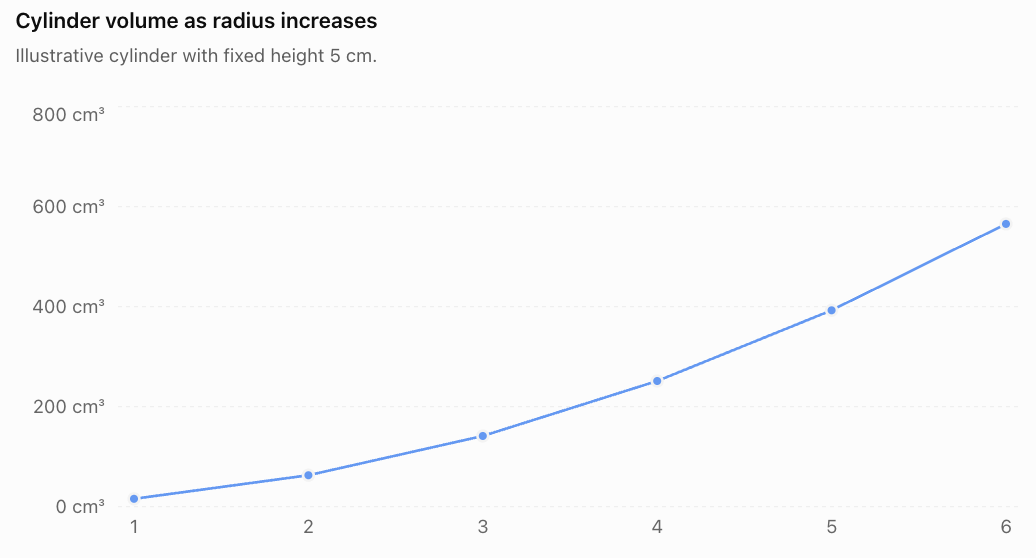
If the radius doubles while height stays constant:
V_new = π(2r)²h
= 4πr²h
= 4V_original.
Doubling the radius quadruples the volume of a cylinder of fixed height.
Understanding this relationship is important when interpreting geometric measurements and designing containers.
Evaluating the Accuracy of Geometric Models
A mathematical model is useful only if its assumptions and measurements are appropriate for the problem.
A model can be mathematically correct while still producing an inaccurate prediction of the real world.
For example, a spherical model of Earth is useful for many calculations, but Earth is not a perfect sphere.
Similarly, modelling a water tank as a cylinder may ignore wall thickness, rounded ends, and internal components.
Accuracy, Precision, and Error
Accuracy describes how close a result is to the true or accepted value.
Precision describes the resolution or repeatability of measurements.
Absolute error is the magnitude of the difference between an estimate and the reference value.
Absolute error = |Estimated value − Reference value|
Percentage error = (Absolute error / |Reference value|) × 100%
Percentage error requires a nonzero reference value.
Worked Example 16: Evaluating an Area Estimate
A geometric model estimates a garden's area as 85 m².
A more accurate survey determines the area to be 82 m².
Absolute error:
|85 − 82| = 3 m².
Percentage error:
(3/82) × 100%
≈ 3.66%.
Answers: Absolute error = 3 m²; percentage error ≈ 3.66%.
The model overestimates the garden area.
Sources of Error
Geometric models can be inaccurate because of several factors.
Measurement Error
A tape measure, ruler, or angle-measuring instrument has limited precision.
Simplifying Assumptions
A real object may not be perfectly circular, rectangular, vertical, or symmetrical.
Rounding Error
Rounding intermediate calculations can introduce small errors.
Scale Error
A printed or displayed scale drawing may have been resized.
Model Selection Error
A cylinder may be a poor approximation for a container with strongly tapered sides.
Construction Variation
The actual manufactured object may differ slightly from its design dimensions.
Worked Example 17: Effect of Measurement Error
A square plate is measured as having side length 10.0 cm.
Suppose the actual side length could be anywhere from 9.9 cm to 10.1 cm.
Estimated area:
A = 10.0² = 100 cm².
Minimum possible area:
A_min = 9.9² = 98.01 cm².
Maximum possible area:
A_max = 10.1² = 102.01 cm².
Therefore, the area could lie between:
98.01 cm² and 102.01 cm².
A small uncertainty in side length produces a larger absolute uncertainty in area.
Worked Example 18: Why Volume Is Sensitive to Radius
A spherical object has estimated radius 10 cm.
Estimated volume:
V = ⁴⁄₃π(10³)
≈ 4188.79 cm³.
Suppose the true radius is 10.5 cm.
Actual volume:
V_actual = ⁴⁄₃π(10.5³)
≈ 4849.05 cm³.
Percentage underestimate relative to the actual volume:
((4849.05 − 4188.79)/4849.05) × 100%
≈ 13.62%.
Conclusion: A 5% underestimate in radius produces approximately a 13.62% underestimate in volume relative to the true volume.
The volume difference is substantial because radius is cubed.
Comparing Different Models
Suppose a pond has an irregular outline.
Three possible models are:
-
A rectangle.
-
An ellipse.
-
A collection of small measured trapezoids.
The rectangular model may be easiest to calculate but could be inaccurate.
The ellipse may better match a smoothly curved pond.
A detailed subdivision may provide a more accurate estimate if the boundary measurements are reliable.
The best model is not always the most complicated model. It is the one that provides sufficient accuracy for the intended decision.
Worked Example 19: Comparing Two Pond Models
A pond has approximate maximum length 20 m and maximum width 12 m.
Model A: Rectangle
A = 20 × 12
= 240 m².
Model B: Ellipse
An ellipse has area:
A = πab
where a and b are its semi-major and semi-minor axes.
a = 10 m.
b = 6 m.
A = π(10)(6)
= 60π
≈ 188.50 m².
The models differ by:
240 − 188.50 = 51.50 m².
As a percentage of the elliptical estimate:
(51.50/188.50) × 100%
≈ 27.32%.
Conclusion: The choice of model makes a significant difference.
Without actual boundary measurements, we cannot say which estimate is more accurate. We can only identify the assumptions and compare their predictions.
Improving a Geometric Model
A model can often be improved by:
-
Collecting more accurate measurements.
-
Dividing complex objects into smaller regions.
-
Replacing unsuitable shapes with better approximations.
-
Including important physical features.
-
Checking calculations against measured results.
-
Using appropriate units and precision.
-
Testing how sensitive the result is to changes in measurements.
For example, a simple model of a storage tank might ignore wall thickness. A refined model could use the tank's internal radius and height rather than its external dimensions.
Real-World Applications of Geometric Modelling
Architecture
Architects use scale drawings and three-dimensional models to plan buildings, calculate dimensions, and estimate materials.
Engineering
Engineers use geometric models to design components, test dimensions, and compare alternative solutions.
Geography and surveying
Surveyors use coordinates, triangulation, and scaled maps to estimate distances, areas, and elevations.
Product design and manufacturing
Designers use prototypes to investigate size, shape, capacity, material use, and manufacturing constraints.
Integrated Design Investigation: A School Garden
A school plans to create a rectangular garden measuring 12 m by 8 m.
A circular pond of radius 1.5 m will be placed inside the garden.
The remaining area will be covered with grass.
A fence will surround the rectangular garden, leaving a 2 m-wide entrance.
Grass costs $15 per square metre.
Fencing costs $40 per metre.
Part A: Garden Area
A = 12 × 8
Garden area = 96 m².
Part B: Pond Area
A = πr²
= π(1.5²)
= 2.25π
≈ 7.07 m².
Part C: Grass Area
A_grass = 96 − 2.25π
≈ 88.93 m².
Part D: Grass Cost
Cost = (96 − 2.25π) × 15
≈ $1334.00.
Part E: Fencing Length
Perimeter:
P = 2(12 + 8)
= 40 m.
Subtract the entrance:
40 − 2 = 38 m.
Part F: Fencing Cost
Cost = 38 × 40
= $1520.
Part G: Total Estimated Cost
Total = Grass cost + Fencing cost
≈ 1334.00 + 1520
Total estimated cost ≈ $2854.00.
Part H: Evaluate the Model
The model assumes:
-
The garden is exactly rectangular.
-
The pond is exactly circular.
-
The measurements are accurate.
-
Grass is purchased by exact area.
-
No extra grass is required for waste.
-
Fencing costs are uniform.
-
Installation and labour costs are excluded.
A more realistic budget would include waste allowances, labour, site preparation, and additional materials.
This investigation illustrates the complete modelling process: representing the situation, calculating quantities, interpreting costs, and evaluating limitations.
Common Mistakes
Mistake 1: Assuming a Model Is Identical to Reality
A model is a simplified representation, not an exact copy.
Mistake 2: Choosing an Unsuitable Shape
A rectangular model may be inappropriate for a highly irregular object.
Mistake 3: Ignoring Important Dimensions
Volume calculations require three-dimensional information.
Mistake 4: Confusing Drawing Measurements with Actual Measurements
Always apply the scale factor correctly.
Mistake 5: Applying the Linear Scale Factor to Area or Volume
Area changes by the square of the scale factor.
Volume changes by the cube.
Mistake 6: Using Inconsistent Units
Convert all measurements into compatible units before calculating.
Mistake 7: Confusing Radius and Diameter
The radius is half the diameter.
Mistake 8: Assuming an Estimate Is Exact
A result calculated from approximate measurements is also approximate.
Mistake 9: Reporting Too Many Decimal Places
The precision of the answer should reflect the precision of the measurements.
Mistake 10: Ignoring Internal Dimensions
A container's external volume is not necessarily its usable capacity.
Mistake 11: Forgetting Material Waste
Construction and manufacturing often require extra materials.
Mistake 12: Ignoring Overlapping Regions
Composite areas and volumes must not double-count shared regions.
Mistake 13: Choosing a Model Without Explaining Assumptions
A complete model should state its simplifying conditions.
Mistake 14: Comparing Models Without a Reference Measurement
Two models may give different estimates, but the difference alone does not reveal which is more accurate.
Mistake 15: Misinterpreting Geometric Data
A taller cylinder does not necessarily have a greater volume than a shorter cylinder.
Mistake 16: Confusing Absolute and Percentage Error
Absolute error uses the original measurement units.
Percentage error expresses the difference relative to a reference value.
Mistake 17: Ignoring the Purpose of the Model
A simple model may be sufficient for a rough estimate but inadequate for manufacturing.
Mistake 18: Failing to Evaluate the Result
Always ask whether the answer is reasonable and useful in the real-world situation.
Key Terms
-
Geometric Modelling: Representing real-world objects or situations using geometry.
-
Mathematical Model: A mathematical representation of a real situation.
-
Approximation: A value or representation close to, but not necessarily equal to, the true value.
-
Estimate: An approximate calculation based on available information.
-
Assumption: A condition accepted to simplify a model.
-
Constraint: A requirement that a design must satisfy.
-
Design Objective: A goal such as minimizing material use or maximizing capacity.
-
Scale Drawing: A drawing in which lengths are proportional to actual lengths.
-
Scale Factor: The ratio between corresponding dimensions.
-
Similarity: Equality of shape with proportional corresponding lengths.
-
Composite Figure: A figure made from simpler shapes.
-
Cross-Section: A shape formed by cutting a solid with a plane.
-
Surface Area: The total area of a solid's surfaces.
-
Volume: The amount of three-dimensional space occupied by a solid.
-
Capacity: The amount a container can hold.
-
Coordinate Geometry: The study of geometry using coordinates and algebra.
-
Triangulation: Using triangles and measured relationships to determine positions or distances.
-
Trigonometry: Mathematics relating angles and side lengths.
-
Gradient: The ratio of vertical change to horizontal change.
-
Prototype: An early model used to test a design.
-
CAD: Computer-Aided Design.
-
Geometric Data: Measurements and relationships describing shapes or positions.
-
Accuracy: Closeness to a true or accepted value.
-
Precision: Fineness or repeatability of measurements.
-
Absolute Error: The magnitude of the difference between an estimate and a reference value.
-
Percentage Error: Error expressed as a percentage of the reference value.
-
Measurement Uncertainty: A range or quantity describing uncertainty in a measurement.
-
Model Refinement: Improving a model using better measurements or assumptions.
-
Sensitivity: How strongly a result changes when an input changes.
-
Optimization: Finding the best solution under specified conditions.
-
Validation: Comparing a model's predictions with observations or reliable measurements.
-
Real-World Interpretation: Explaining what a mathematical result means in context.
Key Takeaways
-
Geometric models simplify real-world objects and situations.
-
Common shapes can represent complicated structures.
-
A model should be chosen according to the problem's purpose.
-
Scale drawings preserve proportions.
-
Similar triangles can estimate inaccessible heights and distances.
-
Trigonometry can calculate unknown measurements.
-
Composite shapes help approximate irregular areas and volumes.
-
Design problems often involve constraints and objectives.
-
Surface area is useful for estimating material requirements.
-
Volume is useful for estimating capacity.
-
Coordinate geometry helps model positions and distances.
-
Tables and graphs can reveal geometric relationships.
-
A linear scale factor k changes area by k² and volume by k³.
-
All measurements contain some degree of uncertainty.
-
A mathematically correct model can still be inaccurate in practice.
-
Model assumptions should be stated clearly.
-
Absolute and percentage error help evaluate estimates.
-
Small dimension errors can produce larger area and volume errors.
-
Model refinement can improve accuracy and usefulness.
-
A complete geometric model includes representation, calculation, interpretation, and evaluation.
Check Your Understanding
Show your working. State assumptions where appropriate and round answers sensibly.
Question 1: Choosing a Model
Suggest a suitable geometric model for each object:
a) A shipping box.
b) A cylindrical water tank.
c) A football.
d) A tent with a triangular cross-section.
e) A storage silo with a conical roof.
Question 2: Scale Drawing
A rectangular room measures 6 cm by 4 cm on a scale drawing of 1:100.
Find its actual dimensions and area.
Question 3: Similar Triangles
A 2 m pole casts a shadow 3 m long.
At the same time, a tree casts a shadow 15 m long.
Estimate the tree's height.
Question 4: Building Height
A surveyor stands 35 m from a building.
The angle of elevation to the top is 40°.
The surveyor's instrument is 1.4 m above the ground.
Estimate the building's height.
Question 5: Composite Area
A garden is modelled as a rectangle measuring 10 m by 6 m with a semicircle attached along a 6 m side.
Estimate its area.
Question 6: Storage Box
A rectangular storage box measures 15 cm by 10 cm by 8 cm.
Find:
a) Its volume.
b) Its total surface area if it is closed.
Question 7: Cylindrical Tank
A cylindrical tank has internal radius 2 m and height 5 m.
Find its capacity in litres.
Question 8: Building Model
A building is modelled as a rectangular prism measuring 12 m by 8 m by 5 m, with a triangular-prism roof of height 2 m.
The triangular roof cross-section has base 8 m, and the roof extends along the 12 m length.
Find the total enclosed volume.
Question 9: Coordinate Distance
Two points on a park map have coordinates:
A(2, 3)
B(14, 8).
Coordinates are measured in metres.
Find their straight-line distance.
Question 10: Container Design
A closed cylindrical container must have volume 500 cm³.
Its radius is 4 cm.
Find:
a) The required height.
b) Its total surface area.
Question 11: Comparing Boxes
Two boxes have dimensions:
Box A: 8 cm × 8 cm × 8 cm.
Box B: 16 cm × 8 cm × 4 cm.
Find:
a) The volume of each box.
b) The surface area of each closed box.
c) Which design uses less material.
Question 12: Scaling
A prototype has volume 300 cm³ and surface area 200 cm².
The full-size object has a linear scale factor of 5.
Find its volume and surface area.
Question 13: Percentage Error
A geometric model estimates a pond's area as 150 m².
A survey gives an area of 144 m².
Find:
a) The absolute error.
b) The percentage error.
c) Whether the model overestimates or underestimates the area.
Question 14: Measurement Uncertainty
A square has a measured side length of 12.0 cm, with possible actual lengths from 11.9 cm to 12.1 cm.
Find:
a) The estimated area.
b) The minimum possible area.
c) The maximum possible area.
Question 15: Interpreting Geometric Data
Three cylinders have the following dimensions:
|
Cylinder |
Radius |
Height |
|---|---|---|
|
A |
2 cm |
10 cm |
|
B |
3 cm |
5 cm |
|
C |
4 cm |
3 cm |
Which cylinder has the greatest volume?
Question 16: Ramp Design
A ramp must rise 0.9 m.
Its proposed gradient is 1:15, meaning one unit of rise for every 15 units of horizontal run.
Find:
a) The horizontal run.
b) The sloping length.
c) The angle of inclination.
Question 17: Evaluating Models
An irregular pond is approximated by:
-
A rectangle measuring 18 m by 10 m.
-
An ellipse with major axis 18 m and minor axis 10 m.
Calculate the area predicted by each model.
Explain why neither model can automatically be considered more accurate.
Question 18: Comprehensive Design Challenge
A school wants to build a rectangular outdoor storage shed.
The shed has:
Length = 8 m.
Width = 5 m.
Wall height = 3 m.
A symmetrical pitched roof rises 1.5 m above the walls.
The shed has one door measuring 2 m by 1 m.
The roof has no overhang.
Wall cladding costs $35 per m².
Roof covering costs $45 per m².
Find:
a) The volume of the rectangular section.
b) The volume of the roof section.
c) The total enclosed volume.
d) The external wall area excluding the door and the two triangular gable ends.
e) The area of the two triangular gable ends.
f) The total wall cladding area including the gable ends but excluding the door.
g) The sloping length from the eave to the ridge.
h) The total roof covering area.
i) The estimated cladding and roof-covering cost.
j) Three limitations of the geometric model.
Fully Worked Answers
Answer 1: Choosing a Model
a) Shipping box: Rectangular prism.
b) Water tank: Cylinder.
c) Football: Sphere, assuming a spherical football.
d) Tent: Triangular prism.
e) Storage silo: Cylinder with a cone-shaped roof.
These models simplify the objects by representing their main geometric features.
Answer 2: Scale Drawing
Drawing scale = 1:100.
Drawing dimensions:
6 cm by 4 cm.
Actual length:
6 × 100 = 600 cm = 6 m.
Actual width:
4 × 100 = 400 cm = 4 m.
Area:
A = 6 × 4
Answer: Actual dimensions = 6 m by 4 m; area = 24 m².
Answer 3: Similar Triangles
Pole height = 2 m.
Pole shadow = 3 m.
Tree shadow = 15 m.
By similar triangles:
h/15 = 2/3.
h = 15 × 2/3
Answer: Estimated tree height = 10 m.
This assumes the sunlight angle and ground conditions are the same for both objects.
Answer 4: Building Height
Horizontal distance = 35 m.
Angle of elevation = 40°.
Instrument height = 1.4 m.
Vertical distance above instrument:
h = 35 tan 40°
h ≈ 29.37 m.
Total building height:
H = 29.37 + 1.4
Answer: Approximately 30.77 m.
Answer 5: Composite Area
Rectangle:
A₁ = 10 × 6 = 60 m².
Semicircle diameter = 6 m.
Radius = 3 m.
Semicircle area:
A₂ = ½π(3²)
= 4.5π
≈ 14.14 m².
Total:
A = 60 + 4.5π
Answer: Approximately 74.14 m².
Answer 6: Storage Box
Length = 15 cm.
Width = 10 cm.
Height = 8 cm.
a) Volume
V = lwh
= 15 × 10 × 8
Answer: 1200 cm³.
b) Surface area
SA = 2(lw + lh + wh)
= 2(150 + 120 + 80)
= 2(350)
Answer: 700 cm².
Answer 7: Cylindrical Tank
Radius = 2 m.
Height = 5 m.
V = πr²h
= π(2²)(5)
= 20π
≈ 62.83 m³.
Convert to litres:
20π × 1000 = 20,000π
Answer: Approximately 62,831.85 L.
Answer 8: Building Model
Rectangular section:
V₁ = 12 × 8 × 5
= 480 m³.
Triangular roof cross-section:
B = ½ × 8 × 2
= 8 m².
Roof volume:
V₂ = 8 × 12
= 96 m³.
Total:
V = 480 + 96
Answer: 576 m³.
Answer 9: Coordinate Distance
A(2, 3), B(14, 8).
d = √((14 − 2)² + (8 − 3)²)
d = √(12² + 5²)
d = √169
Answer: 13 m.
Answer 10: Container Design
Volume = 500 cm³.
Radius = 4 cm.
a) Height
V = πr²h.
500 = 16πh.
h = 500/(16π)
Answer: h ≈ 9.95 cm.
b) Surface area
SA = 2πr² + 2πrh.
Substitute the exact height:
SA = 2π(4²) + 2π(4)(500/(16π))
= 32π + 250
Answer: SA ≈ 350.53 cm².
Answer 11: Comparing Boxes
a) Volumes
Box A:
V_A = 8 × 8 × 8 = 512 cm³.
Box B:
V_B = 16 × 8 × 4 = 512 cm³.
Both boxes have equal volume.
b) Surface areas
Box A:
SA_A = 6 × 8²
= 384 cm².
Box B:
SA_B = 2(16 × 8 + 16 × 4 + 8 × 4)
= 2(128 + 64 + 32)
= 448 cm².
c) Comparison
Difference:
448 − 384 = 64 cm².
Answer: Box A requires 64 cm² less surface material.
Answer 12: Scaling
Linear scale factor = 5.
Volume scale factor:
5³ = 125.
New volume:
300 × 125
Answer: 37,500 cm³.
Surface area scale factor:
5² = 25.
New surface area:
200 × 25
Answer: 5000 cm².
Answer 13: Percentage Error
Estimated area = 150 m².
Surveyed area = 144 m².
a) Absolute error
|150 − 144| = 6 m².
Answer: 6 m².
b) Percentage error
(6/144) × 100%
Answer: Approximately 4.17%.
c) Interpretation
The estimate is greater than the surveyed value.
Answer: The model overestimates the area.
Answer 14: Measurement Uncertainty
Estimated side length = 12.0 cm.
Possible range = 11.9 cm to 12.1 cm.
a) Estimated area
A = 12.0²
Answer: 144 cm².
b) Minimum possible area
A_min = 11.9²
Answer: 141.61 cm².
c) Maximum possible area
A_max = 12.1²
Answer: 146.41 cm².
Therefore, the actual area could lie within the interval:
141.61 cm² to 146.41 cm².
Answer 15: Interpreting Geometric Data
Use:
V = πr²h.
Cylinder A
V_A = π(2²)(10)
= 40π
≈ 125.66 cm³.
Cylinder B
V_B = π(3²)(5)
= 45π
≈ 141.37 cm³.
Cylinder C
V_C = π(4²)(3)
= 48π
≈ 150.80 cm³.
Answer: Cylinder C has the greatest volume, approximately 150.80 cm³.
Although Cylinder C has the smallest height, its larger radius produces the greatest volume.
Answer 16: Ramp Design
Vertical rise = 0.9 m.
Gradient = 1:15.
a) Horizontal run
Horizontal run = 15 × 0.9
Answer: 13.5 m.
b) Sloping length
L = √(13.5² + 0.9²)
L = √183.06
Answer: L ≈ 13.53 m.
c) Angle of inclination
tan θ = 0.9/13.5
θ = tan⁻¹(0.9/13.5)
Answer: θ ≈ 3.81°.
Answer 17: Evaluating Models
Rectangle model
A = 18 × 10
Answer: 180 m².
Ellipse model
Major axis = 18 m.
Semi-major axis = 9 m.
Minor axis = 10 m.
Semi-minor axis = 5 m.
A = πab
= π(9)(5)
= 45π
Answer: Approximately 141.37 m².
Evaluation
The models differ by:
180 − 141.37 ≈ 38.63 m².
Neither model can automatically be considered more accurate because the actual pond boundary has not been measured.
If the pond is approximately oval, the ellipse may be more appropriate.
If the pond has relatively straight sides and square corners, the rectangle may be more appropriate.
More detailed boundary measurements would help determine which model better represents the pond.
Answer 18: Comprehensive Design Challenge
Given:
Length = 8 m.
Width = 5 m.
Wall height = 3 m.
Roof rise = 1.5 m.
Door = 2 m by 1 m.
a) Volume of rectangular section
V₁ = 8 × 5 × 3
Answer: 120 m³.
b) Volume of roof section
Triangular cross-sectional area:
B = ½ × 5 × 1.5
= 3.75 m².
Roof length = 8 m.
V₂ = 3.75 × 8
Answer: 30 m³.
c) Total enclosed volume
V = 120 + 30
Answer: 150 m³.
d) External wall area excluding door and gable ends
Perimeter of rectangular base:
P = 2(8 + 5)
= 26 m.
Rectangular wall area:
A = 26 × 3
= 78 m².
Door area:
A_door = 2 × 1 = 2 m².
Remaining rectangular wall area:
78 − 2
Answer: 76 m².
e) Area of triangular gable ends
One gable:
A = ½ × 5 × 1.5
= 3.75 m².
Two gables:
2 × 3.75
Answer: 7.5 m².
f) Total wall cladding area
A = 76 + 7.5
Answer: 83.5 m².
g) Sloping roof length
Half the building width:
5/2 = 2.5 m.
Use Pythagoras:
L² = 2.5² + 1.5²
L² = 6.25 + 2.25
L² = 8.5.
L = √8.5
Answer: L ≈ 2.92 m.
h) Total roof covering area
There are two rectangular roof slopes.
Each has:
Length = 8 m.
Sloping width = √8.5 m.
Total area:
A = 2 × 8 × √8.5
= 16√8.5
Answer: Approximately 46.65 m².
i) Estimated material cost
Wall cladding:
83.5 × $35
= $2922.50.
Roof covering:
16√8.5 × $45
≈ $2099.14.
Total:
$2922.50 + $2099.14
Answer: Approximately $5021.64.
This includes the specified cladding and roof-covering material costs only.
j) Three limitations
-
The model assumes perfectly rectangular walls and a symmetrical pitched roof.
-
It ignores material waste, overlaps, thickness, and construction details.
-
It excludes labour, fixings, foundations, and other construction costs.
A more accurate model would incorporate detailed construction drawings, actual material dimensions, and realistic waste allowances.
Final Course Connections
Geometric modelling connects classroom mathematics with the process of solving real-world problems.
By representing complicated objects using simpler shapes, we can estimate areas, volumes, distances, and material requirements. Scale drawings, similarity, trigonometry, coordinate geometry, and measurement formulas allow us to analyse designs and compare possible solutions.
Equally important is the ability to evaluate a model. Every model depends on assumptions, and its usefulness depends on how accurately those assumptions represent the situation.
The central principle of geometric modelling is to choose a useful representation, calculate carefully, interpret the results, and evaluate how well the model represents reality.
This completes Geometric Modelling, covering all five learning targets with comprehensive explanations, worked examples, supporting diagrams, practical applications, common mistakes, key terms, key takeaways, and 18 practice questions with fully worked answers.
4. Multi-Step Geometric Problem Solving
Learning outcomes
- I can combine multiple geometric concepts to solve problems.
- I can select appropriate strategies for unfamiliar problems.
- I can communicate complete mathematical solutions.
- I can justify each step in my reasoning.
- I can evaluate whether my solution is reasonable.
Introduction
Many geometric problems cannot be solved using just one formula or theorem.
An architect designing a roof may need to use Pythagoras' theorem, trigonometry, surface area, and scale drawings. An engineer designing a container may need to calculate volume, determine missing dimensions, estimate material costs, and evaluate whether the design is practical. A surveyor may need to combine angles, distances, similar triangles, and coordinate geometry to determine the position of an inaccessible object.
These are examples of multi-step geometric problems.
The challenge is not simply knowing mathematical formulas. It is recognizing how different geometric concepts fit together, selecting an efficient strategy, organizing calculations, and explaining why each step is valid.
A successful geometric solution should be mathematically correct, logically justified, clearly communicated, and reasonable in the original context.
What Makes a Geometric Problem Multi-Step?
A multi-step geometric problem requires two or more connected calculations or reasoning processes.
For example, suppose we want to calculate the area of a triangular roof.
We may know the roof's horizontal width and angle of inclination, but not its sloping length.
To solve the problem, we must:
-
Use trigonometry to determine the sloping length.
-
Use the sloping length to calculate the roof area.
-
Convert the area into a material requirement.
-
Evaluate whether additional material is needed for waste.
The result from one step becomes the input for the next.
This creates a chain of mathematical reasoning.
The Main Geometric Concepts
Multi-step problems may combine several topics.
|
Concept |
Main purpose |
|---|---|
|
Angles and parallel lines |
Determine unknown angles |
|
Triangle properties |
Use angle sums and geometric relationships |
|
Pythagoras' theorem |
Calculate missing sides in right triangles |
|
Trigonometry |
Connect angles and side lengths |
|
Similarity |
Compare proportional shapes |
|
Congruence |
Establish equal corresponding sides and angles |
|
Coordinate geometry |
Calculate distances, slopes, and midpoints |
|
Transformations |
Analyse position, orientation, and scale |
|
Area |
Measure two-dimensional regions |
|
Surface area |
Calculate exposed surface material |
|
Volume |
Calculate three-dimensional space |
|
Scale factors |
Relate dimensions of similar figures |
|
Geometric modelling |
Represent and analyse real-world situations |
The most important skill is recognizing which concepts are relevant and how they should be combined.
A Systematic Problem-Solving Method
A reliable strategy is to use six stages.
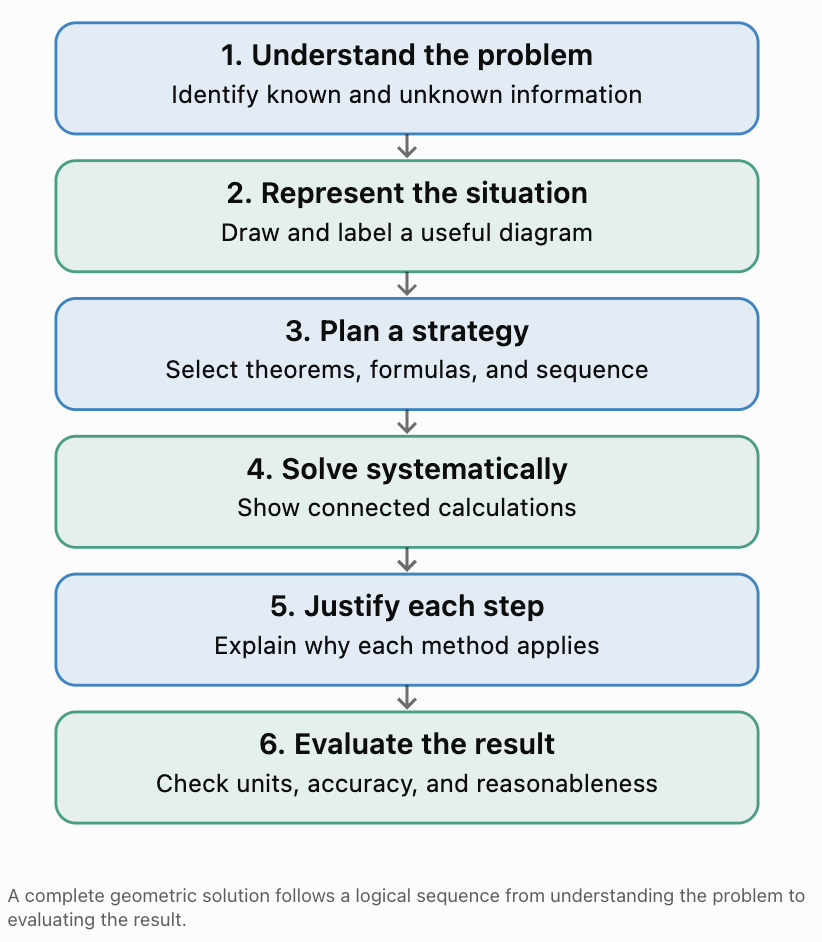
Stage 1: Understand the Problem
Read the problem carefully.
Identify:
-
What information is given.
-
What must be calculated or proved.
-
Which measurements are known.
-
Which relationships are implied.
-
Whether the problem contains any assumptions or restrictions.
Stage 2: Represent the Situation
Draw a diagram whenever possible.
A good diagram should include:
-
Clearly labelled points.
-
Known lengths and angles.
-
Unknown quantities represented by variables.
-
Right-angle symbols.
-
Parallel-line markings where appropriate.
-
Relevant units.
The diagram does not need to be drawn perfectly to scale, but its relationships must be represented correctly.
Stage 3: Plan a Strategy
Ask:
What do I need to know immediately before I can find the final answer?
Then work backwards.
For example:
To calculate a roof's surface area, we need its sloping length.
To calculate the sloping length, we may need Pythagoras' theorem.
This suggests the sequence:
Pythagoras → Sloping length → Surface area.
Stage 4: Solve Systematically
Write each calculation in a logical order.
Keep unrounded values in intermediate steps whenever possible.
Stage 5: Justify Each Step
Explain why the chosen method is valid.
For example:
-
“These triangles are similar because they have two equal corresponding angles.”
-
“Pythagoras' theorem applies because the triangle is right-angled.”
-
“The slopes are negative reciprocals, so the lines are perpendicular.”
Stage 6: Evaluate the Result
Check:
-
Are the units correct?
-
Are the dimensions physically possible?
-
Does the answer match the diagram?
-
Is the answer consistent with known geometric properties?
-
Is the precision appropriate?
-
Does the answer make sense in context?
Working Backwards from the Required Answer
One of the most effective strategies for unfamiliar problems is working backwards.
Suppose a problem asks for the cost of roofing material.
The final calculation is:
Cost = Area × Price per square metre.
But the roof area may require a sloping length.
That length may require a right-triangle calculation.
The problem can therefore be organized as:
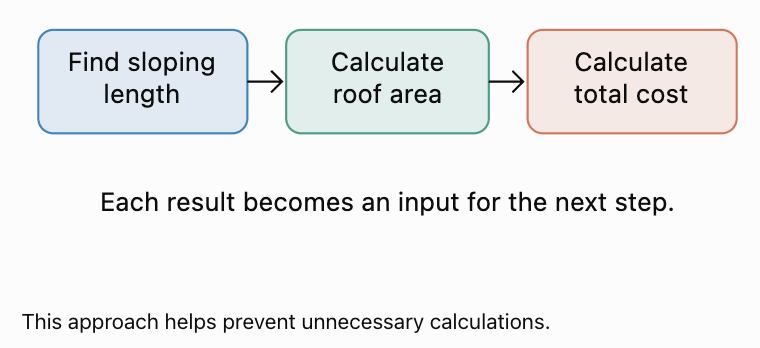
This approach helps prevent unnecessary calculations.
Worked Example 1: Roof Design Using Pythagoras and Area
A symmetrical pitched roof covers a building that is 10 m wide and 14 m long.
The roof ridge is 3 m above the top of the walls.
Assume there is no roof overhang.
Calculate:
a) The sloping distance from an eave to the ridge.
b) The total area of the two roof slopes.
c) The cost of roof covering at $42 per square metre.
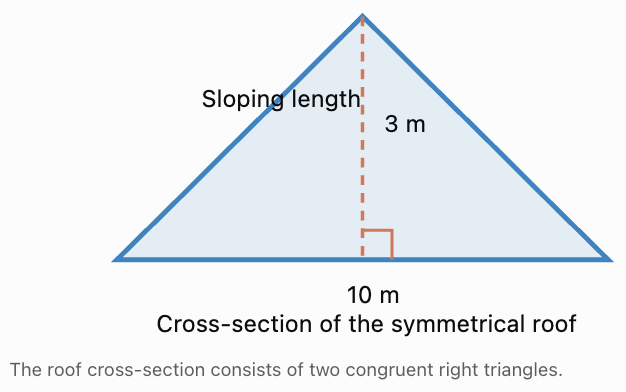
Step 1: Find half the building width
Half-width = 10/2 = 5 m.
Step 2: Apply Pythagoras' theorem
The sloping length L is the hypotenuse.
L² = 5² + 3².
L² = 25 + 9.
L = √34.
L ≈ 5.83 m.
Step 3: Calculate roof area
Each roof slope is a rectangle.
Area of one slope:
A₁ = 14√34.
Both slopes:
A_total = 2 × 14√34
= 28√34
≈ 163.27 m².
Step 4: Calculate cost
Cost = 28√34 × 42
≈ $6857.20.
Final answers:
-
Sloping length ≈ 5.83 m.
-
Total roof area ≈ 163.27 m².
-
Estimated covering cost ≈ $6857.20.
Justification: Pythagoras' theorem applies because the ridge height and half-width are perpendicular. Each roof slope is rectangular under the stated model.
Evaluation: The roof area is greater than the building's horizontal footprint of 140 m², which is reasonable because the roof is sloped. The estimate excludes waste, overlaps, and installation costs.
Combining Similarity and Trigonometry
Similarity and trigonometry are especially useful when measurements cannot be obtained directly.
Worked Example 2: Estimating a Tower's Height
A surveyor stands 50 m from the base of a vertical tower.
The angle of elevation to the top is 34°.
The surveyor's instrument is 1.5 m above level ground.
Calculate the tower's height.
Step 1: Identify the right triangle
Horizontal distance = 50 m.
Angle = 34°.
Unknown vertical distance above the instrument = h.
Step 2: Choose tangent
tan 34° = h/50.
h = 50 tan 34°.
h ≈ 33.73 m.
Step 3: Include instrument height
H = 33.73 + 1.5
Answer: H ≈ 35.23 m.
Justification: Tangent relates opposite and adjacent sides in a right triangle.
Evaluation: The result assumes the tower is vertical, the ground is level, and the angle and distance measurements are accurate.
Worked Example 3: Similar Triangles and Area
A triangular sign has base 12 cm and height 8 cm.
A larger, similar sign has base 30 cm.
Find:
a) The larger sign's height.
b) Its area.
c) The ratio of the two areas.
Step 1: Find the linear scale factor
k = 30/12 = 2.5.
Step 2: Find the new height
h = 8 × 2.5
= 20 cm.
Step 3: Calculate the larger area
A = ½ × 30 × 20
= 300 cm².
Step 4: Compare areas
Original area:
A₁ = ½ × 12 × 8 = 48 cm².
Area ratio:
300/48 = 6.25.
This agrees with:
k² = 2.5² = 6.25.
Answers: Height = 20 cm; area = 300 cm²; area ratio = 6.25 : 1.
Justification: Similar figures have proportional corresponding lengths, and their areas scale by the square of the linear scale factor.
Combining Coordinate Geometry and Geometric Proof
Coordinate geometry can be used to prove relationships before calculating other measurements.
Worked Example 4: Proving a Shape Is a Rectangle and Finding Its Area
Quadrilateral ABCD has vertices:
A(1, 2)
B(7, 5)
C(5, 9)
D(−1, 6).
Prove that ABCD is a rectangle and calculate its area.
Step 1: Calculate the slopes
m_AB = (5 − 2)/(7 − 1) = 3/6 = 1/2.
m_BC = (9 − 5)/(5 − 7) = 4/−2 = −2.
m_CD = (6 − 9)/(−1 − 5) = −3/−6 = 1/2.
m_DA = (2 − 6)/(1 − (−1)) = −4/2 = −2.
Step 2: Establish parallel sides
m_AB = m_CD.
Therefore, AB ∥ CD.
m_BC = m_DA.
Therefore, BC ∥ AD.
Both pairs of opposite sides are parallel, so ABCD is a parallelogram.
Step 3: Establish a right angle
m_AB × m_BC = (1/2)(−2) = −1.
Therefore, AB ⟂ BC.
A parallelogram with one right angle is a rectangle.
Step 4: Calculate adjacent side lengths
AB = √((7 − 1)² + (5 − 2)²)
= √45 = 3√5.
BC = √((5 − 7)² + (9 − 5)²)
= √20 = 2√5.
Step 5: Calculate area
A = AB × BC
= 3√5 × 2√5
= 6 × 5
Answer: ABCD is a rectangle with area 30 square units.
Justification: Slopes establish parallelism and perpendicularity; the distance formula establishes side lengths.
Evaluation: The area is positive and consistent with the side lengths. The figure is not necessarily axis-aligned, so simply subtracting coordinate extremes would not give its area.
Combining Transformations and Measurement
Transformations can change a figure's position, orientation, or size.
Translations, reflections, and rotations preserve lengths, angles, perimeter, and area.
Dilations preserve angles and shape but change size.
For a positive scale factor k:
-
Lengths are multiplied by k.
-
Perimeters are multiplied by k.
-
Areas are multiplied by k².
-
Volumes of similar solids are multiplied by k³.
Worked Example 5: Transforming and Enlarging a Triangle
Triangle ABC has vertices:
A(1, 1)
B(4, 1)
C(1, 3).
The triangle is translated 2 units right and 3 units up, then enlarged by scale factor 2 about the origin.
Find the final coordinates and area.
Step 1: Translate
Translation rule:
(x, y) → (x + 2, y + 3).
A′(3, 4)
B′(6, 4)
C′(3, 6).
Step 2: Enlarge
Dilation rule:
(x, y) → (2x, 2y).
A″(6, 8)
B″(12, 8)
C″(6, 12).
Step 3: Calculate original area
AB = 3 units.
AC = 2 units.
Original area:
A = ½ × 3 × 2
= 3 square units.
Step 4: Apply the area scale factor
New area:
A″ = 3 × 2²
= 12 square units.
Answer: Final coordinates are (6, 8), (12, 8), and (6, 12); final area = 12 square units.
Justification: Translation preserves area, while dilation by scale factor 2 multiplies area by 4.
Evaluation: The final triangle has legs 6 and 4 units, giving area ½ × 6 × 4 = 12, confirming the result.
Combining Surface Area, Volume, and Cost
Real-world design problems frequently require several measurements.
Worked Example 6: Designing a Cylindrical Water Tank
A closed cylindrical tank must hold 5000 L of water.
Its internal radius is 1 m.
Assume negligible wall thickness and use the same dimensions to estimate its external surface area.
Find:
a) The required height.
b) The surface area.
c) The material cost at $85 per square metre.
Step 1: Convert capacity to volume
1000 L = 1 m³.
Therefore:
5000 L = 5 m³.
Step 2: Find height
V = πr²h.
5 = π(1²)h.
h = 5/π
≈ 1.59 m.
Step 3: Calculate surface area
SA = 2πr² + 2πrh.
SA = 2π(1²) + 2π(1)(5/π).
SA = 2π + 10
≈ 16.28 m².
Step 4: Calculate cost
Cost = 85(10 + 2π)
≈ $1384.07.
Answers: Height ≈ 1.59 m; surface area ≈ 16.28 m²; material cost ≈ $1384.07.
Justification: The volume formula determines the required height, and the closed-cylinder surface-area formula determines the material area.
Evaluation: The model ignores wall thickness, seams, supports, fittings, and manufacturing waste. A real tank would need additional design considerations.
Selecting Strategies for Unfamiliar Problems
An unfamiliar problem may not state which theorem or formula to use. Instead, the solver must recognize useful relationships.
A good strategy is to examine the available information and identify the mathematical structure.
|
Clue in the problem |
Possible strategy |
|---|---|
|
Right angle and two sides |
Pythagoras' theorem |
|
Right angle, acute angle, and a side |
Sine, cosine, or tangent |
|
Two similar shapes |
Proportions and scale factors |
|
Coordinates of vertices |
Slopes, distances, and midpoints |
|
Parallel lines |
Corresponding or alternate angles |
|
Several connected shapes |
Composite area or volume |
|
A solid with unknown dimensions |
Rearrange a volume or surface-area formula |
|
A design with a fixed capacity |
Use constraints to express dimensions algebraically |
|
An unknown length needed for a later calculation |
Work backwards from the final objective |
|
A geometric claim requiring proof |
Identify sufficient conditions and justify them |
The most effective strategy is not necessarily the one involving the most advanced mathematics. It is the one that establishes the required result clearly and efficiently.
Worked Example 7: A Problem with Hidden Right Triangles
An isosceles triangle has equal sides of 13 cm and a base of 10 cm.
Find its area and perimeter.
At first, the triangle does not appear to provide enough information for an area calculation because its perpendicular height is unknown.
However, an altitude drawn from the apex of an isosceles triangle to its base also bisects the base.
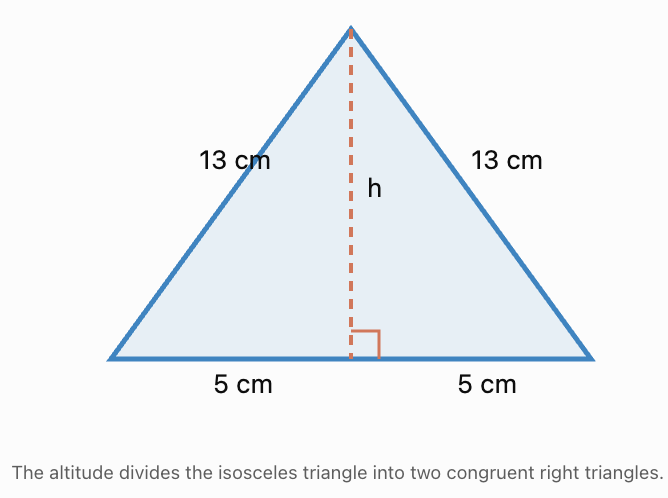
Step 1: Find half the base.
10/2 = 5 cm.
Step 2: Find the height using Pythagoras.
h² + 5² = 13².
h² = 169 − 25 = 144.
h = 12 cm.
Step 3: Calculate area.
A = ½ × 10 × 12
= 60 cm².
Step 4: Calculate perimeter.
P = 13 + 13 + 10
= 36 cm.
Answers: Area = 60 cm²; perimeter = 36 cm.
Justification: The altitude of an isosceles triangle from its apex bisects its base, creating right triangles.
Evaluation: The height is shorter than the equal sides, as expected. Both the area and perimeter have appropriate units.
Worked Example 8: Choosing Between Two Possible Designs
A rectangular garden must have an area of 120 m².
Two designs are proposed:
-
Design A: 12 m by 10 m.
-
Design B: 15 m by 8 m.
A fence will surround the entire garden.
Which design requires less fencing, and by how much?
Step 1: Verify the area constraint.
Design A:
12 × 10 = 120 m².
Design B:
15 × 8 = 120 m².
Both satisfy the area requirement.
Step 2: Calculate perimeters.
Design A:
P_A = 2(12 + 10) = 44 m.
Design B:
P_B = 2(15 + 8) = 46 m.
Step 3: Compare.
46 − 44 = 2 m.
Answer: Design A requires 2 m less fencing.
Justification: Perimeter measures the distance around the garden, so it determines the required fencing length.
Evaluation: The designs have the same area but different perimeters. This shows that equal areas do not necessarily imply equal boundary lengths.
For a fixed rectangular area, dimensions closer to those of a square generally produce a smaller perimeter.
Worked Example 9: A Coordinate and Trigonometry Challenge
A right-angled triangular park has vertices:
A(0, 0), B(12, 0), C(12, 5).
Coordinates are measured in metres.
Find:
a) The three side lengths.
b) The area.
c) The angle at A.
d) The shortest distance from A to the line BC.
Step 1: Calculate side lengths.
AB = 12 m because AB is horizontal.
BC = 5 m because BC is vertical.
AC = √(12² + 5²)
= √169 = 13 m.
Step 2: Calculate area.
AB and BC are perpendicular.
A = ½ × 12 × 5
= 30 m².
Step 3: Find angle A.
tan A = 5/12.
A = tan⁻¹(5/12)
≈ 22.62°.
Step 4: Find the shortest distance from A to BC.
BC lies on the vertical line x = 12.
The perpendicular distance from A(0, 0) to this line is horizontal.
Therefore:
d = 12 m.
Answers: Sides = 5 m, 12 m, 13 m; area = 30 m²; ∠A ≈ 22.62°; shortest distance = 12 m.
Evaluation: The smallest acute angle is opposite the shortest side, which is consistent with the result.
Worked Example 10: Combining Volume, Similarity, and Material Use
A cylindrical container has radius 3 cm and height 10 cm.
A geometrically similar container is made with twice the original linear dimensions.
Find:
a) The original volume.
b) The enlarged volume.
c) The ratio of surface areas.
d) The percentage increase in volume.
Step 1: Original volume
V₁ = π(3²)(10)
= 90π cm³.
Step 2: Apply the volume scale factor
Linear scale factor k = 2.
Volume scale factor = 2³ = 8.
V₂ = 8 × 90π
= 720π cm³.
Step 3: Surface-area ratio
Area scale factor = 2² = 4.
Therefore:
SA₂ : SA₁ = 4 : 1.
Step 4: Percentage increase in volume
Increase = V₂ − V₁
= 7V₁.
Percentage increase:
(7V₁/V₁) × 100%
= 700%.
Answers: Original volume = 90π cm³; enlarged volume = 720π cm³; surface-area ratio = 4:1; volume increase = 700%.
A doubling of every length creates eight times the volume, not twice the volume.
Communicating Complete Mathematical Solutions
A complete mathematical solution should be understandable to someone who has not already solved the problem.
A useful structure is:
Given: State the known measurements or relationships.
Required: Identify what must be found or proved.
Method: Explain the mathematical strategy.
Working: Show equations, substitutions, and calculations.
Justification: State why the method or theorem applies.
Conclusion: Give the final result with appropriate units.
Evaluation: Check the answer against the conditions of the problem.
Example: Improving a Written Solution
Problem: A ladder 5 m long reaches 4 m up a vertical wall. How far is its base from the wall?
An incomplete response might say:
“5² − 4² = 9, so 3.”
A complete response would be:
“The wall and level ground are perpendicular, so the ladder forms the hypotenuse of a right triangle. By Pythagoras' theorem, x² + 4² = 5². Therefore, x² = 25 − 16 = 9, giving x = 3 m. The base of the ladder is 3 m from the wall. This is reasonable because the horizontal distance is shorter than the 5 m ladder.”
The second solution communicates both the calculation and the mathematical reasoning.
Mathematical Justification
A justification explains why a mathematical step is valid.
Consider these examples.
|
Calculation or claim |
Mathematical justification |
|---|---|
|
a² + b² = c² |
Pythagoras' theorem applies to a right triangle |
|
θ = tan⁻¹(O/A) |
Tangent relates opposite and adjacent sides |
|
Two triangles have proportional corresponding sides |
They may be similar by SSS similarity |
|
Two distinct lines have equal slopes |
They are parallel |
|
Two lines have slopes whose product is −1 |
They are perpendicular, when both slopes are finite and nonzero |
|
New area = k² × original area |
Area scaling theorem for similar figures |
|
V = ⅓Bh |
Volume formula for a pyramid |
|
Two triangles are congruent by SAS |
Two corresponding sides and their included angles are equal |
A good proof or explanation identifies the specific conditions that make a theorem applicable.
Worked Example 11: Proving and Using Triangle Similarity
Triangles ABC and DEF have:
AB = 6 cm
BC = 8 cm
AC = 10 cm
DE = 9 cm
EF = 12 cm
DF = 15 cm.
Prove that the triangles are similar and compare their areas.
Step 1: Compare corresponding sides.
DE/AB = 9/6 = 1.5.
EF/BC = 12/8 = 1.5.
DF/AC = 15/10 = 1.5.
All three corresponding side ratios are equal.
Therefore:
△ABC ∼ △DEF by SSS similarity.
Step 2: Determine the linear scale factor.
k = 1.5.
Step 3: Determine the area ratio.
Area scale factor:
k² = 1.5² = 2.25.
Therefore:
Area DEF / Area ABC = 2.25.
Conclusion: The triangles are similar, and triangle DEF has 2.25 times the area of triangle ABC.
Justification: Corresponding sides are proportional, satisfying SSS similarity. Similar figures have areas proportional to the squares of corresponding side lengths.
Evaluating Whether a Solution Is Reasonable
A correct-looking numerical answer may still be impossible or inappropriate.
Several checks can help.
1. Check the Units
A distance should be measured in length units.
An area should be measured in square units.
A volume should be measured in cubic units.
2. Check Geometric Constraints
In a right triangle:
-
The hypotenuse must be the longest side.
-
The two acute angles must add to 90°.
-
Side lengths must be positive.
For any nondegenerate triangle, the sum of any two side lengths must exceed the third.
3. Estimate Before Calculating
If a rectangular garden is approximately 20 m by 10 m, its area should be around 200 m².
An answer of 20,000 m² would suggest an error.
4. Check Using a Different Method
A right-triangle side can sometimes be checked using both trigonometry and Pythagoras.
A quadrilateral's area might be checked using coordinate geometry and a geometric decomposition.
5. Consider Practical Conditions
A roof-area calculation may be correct but exclude overhangs.
A tank-volume calculation may ignore wall thickness.
A ramp design may be mathematically valid but fail applicable construction requirements.
Worked Example 12: Detecting an Impossible Triangle
A student claims that a triangle has side lengths:
4 cm, 7 cm, and 12 cm.
Is this possible?
Use the triangle inequality.
The sum of the two shorter sides must exceed the longest side.
4 + 7 = 11.
But:
11 < 12.
Therefore, the triangle inequality is violated.
Conclusion: No triangle can have these three side lengths.
This is an example of checking feasibility before attempting a longer calculation.
Real-World Applications
Architecture
Building design combines angles, similarity, lengths, areas, and three-dimensional measurements.
Surveying
Surveyors combine coordinate geometry and trigonometry to calculate distances and positions.
Engineering
Engineers use geometric models to check dimensions, material requirements, and design constraints.
Landscape design
Planners combine composite areas, perimeters, scales, and costs to design outdoor spaces.
Worked Example 13: Comprehensive Garden Design
A rectangular garden measures 18 m by 12 m.
A circular pond of radius 2 m occupies part of the garden.
A straight diagonal path crosses the garden from one corner to the opposite corner. The path is 1 m wide, measured perpendicular to its centreline.
For a simplified estimate, model the path as a rectangle whose length equals the garden's diagonal. Assume the path does not overlap the pond and ignore any part extending beyond the garden boundary.
Calculate:
a) The diagonal length.
b) The estimated path area.
c) The pond area.
d) The remaining planting area.
e) The planting cost at $18 per square metre.
Step 1: Garden area
A_garden = 18 × 12
= 216 m².
Step 2: Diagonal length
d = √(18² + 12²)
= √468
= 6√13
≈ 21.63 m.
Step 3: Estimated path area
A_path ≈ 1 × 6√13
≈ 21.63 m².
Step 4: Pond area
A_pond = π(2²)
= 4π
≈ 12.57 m².
Step 5: Planting area
A_planting ≈ 216 − 6√13 − 4π
≈ 181.80 m².
Step 6: Planting cost
Cost ≈ 18(216 − 6√13 − 4π)
≈ $3272.45.
Answers:
-
Diagonal ≈ 21.63 m.
-
Estimated path area ≈ 21.63 m².
-
Pond area ≈ 12.57 m².
-
Estimated planting area ≈ 181.80 m².
-
Estimated planting cost ≈ $3272.45.
Evaluation: The diagonal-path rectangle is an approximation. An exact design would need to account for how the path meets the garden boundaries, and the assumed absence of overlap with the pond would need to be verified. The result is suitable as a preliminary estimate rather than a final construction measurement.
Common Mistakes
Mistake 1: Starting Calculations Without a Plan
Identify the final objective and determine which intermediate quantities are required.
Mistake 2: Selecting a Formula Based Only on the Shape's Appearance
Check that the conditions of the formula or theorem are satisfied.
Mistake 3: Assuming Every Triangle Is Right-Angled
Pythagoras' theorem and basic SOH–CAH–TOA relationships require a right triangle.
Mistake 4: Confusing Similarity with Congruence
Similar figures have equal corresponding angles and proportional sides.
Congruent figures have equal corresponding sides and angles.
Mistake 5: Using the Wrong Scale Factor
Length scales by k, area by k², and volume by k³ for positive k.
Mistake 6: Rounding Intermediate Values Too Early
Keep exact expressions or sufficient decimal precision until the final calculation.
Mistake 7: Forgetting to Justify a Conclusion
A correct calculation does not automatically explain why a geometric statement follows.
Mistake 8: Assuming a Diagram Is Drawn to Scale
Use the given information rather than estimating lengths or angles visually.
Mistake 9: Using Incorrect Units
Check that each result uses the appropriate measurement units.
Mistake 10: Counting Hidden or Overlapping Surfaces
Composite surface-area problems require identifying only the exposed surfaces.
Mistake 11: Confusing Horizontal and Sloping Distances
The hypotenuse is longer than either leg of a right triangle.
Mistake 12: Using Inconsistent Coordinate Subtraction
When calculating slopes, use the same point order in the numerator and denominator.
Mistake 13: Proving Too Little
Showing one pair of parallel sides does not necessarily establish that a quadrilateral is a parallelogram.
Mistake 14: Giving an Answer Without Interpretation
Explain what the result represents in the original problem.
Mistake 15: Ignoring Assumptions
A geometric model may rely on level ground, straight edges, or negligible thickness.
Mistake 16: Reporting Unjustified Precision
The precision of a final answer should reflect the precision of the input measurements.
Mistake 17: Failing to Check Feasibility
A proposed triangle, building, or container may violate geometric or practical constraints.
Mistake 18: Treating One Numerical Example as a General Proof
A general theorem requires reasoning that applies to all cases satisfying its assumptions.
Key Terms
-
Multi-Step Problem: A problem requiring several connected calculations or deductions.
-
Problem-Solving Strategy: An organized method for reaching a mathematical conclusion.
-
Geometric Reasoning: Using properties and relationships of shapes to solve problems.
-
Deductive Reasoning: Drawing conclusions logically from established facts.
-
Justification: An explanation of why a mathematical step is valid.
-
Theorem: A mathematical statement established by proof.
-
Proof: A logical argument establishing a mathematical claim.
-
Working Backwards: Starting from the required result to identify necessary earlier steps.
-
Auxiliary Line: An additional line drawn to reveal useful geometric relationships.
-
Pythagoras' Theorem: The relationship a² + b² = c² in a right triangle.
-
Trigonometry: Mathematics relating angles and side lengths.
-
Similarity: Equality of shape with proportional corresponding dimensions.
-
Congruence: Equality of shape and size.
-
Scale Factor: The multiplier relating corresponding lengths.
-
Coordinate Geometry: The study of geometric relationships using coordinates.
-
Slope: The ratio of vertical change to horizontal change.
-
Distance Formula: A formula for calculating the distance between coordinate points.
-
Transformation: A mapping that changes a figure's position, orientation, or size.
-
Composite Figure: A figure formed from simpler shapes.
-
Perimeter: Distance around a two-dimensional figure.
-
Area: Two-dimensional space enclosed by a figure.
-
Surface Area: Total area of a solid's exposed surfaces.
-
Volume: Three-dimensional space occupied by a solid.
-
Geometric Model: A mathematical representation of a real object or situation.
-
Constraint: A condition a solution or design must satisfy.
-
Optimization: Finding the best solution under specified conditions.
-
Exact Value: A value expressed without approximation.
-
Approximation: A value close to the exact or true value.
-
Reasonableness Check: A test of whether a result is consistent with the problem.
-
Triangle Inequality: The sum of any two side lengths of a triangle exceeds the third.
-
Mathematical Communication: Presenting mathematical ideas and reasoning clearly.
-
Evaluation: Checking a solution's accuracy, limitations, and suitability.
Key Takeaways
-
Multi-step geometry problems combine several mathematical concepts.
-
Understanding the problem is essential before calculating.
-
A labelled diagram helps organize information.
-
Working backwards can reveal the necessary sequence of calculations.
-
Pythagoras' theorem applies to right triangles.
-
Trigonometry relates acute angles and side lengths in right triangles.
-
Similarity provides proportional relationships.
-
Coordinate geometry helps establish lengths, angles, and geometric properties.
-
Transformations can preserve or change geometric measurements.
-
Composite areas and volumes require careful decomposition.
-
Real-world design problems often involve constraints.
-
Every important mathematical step should be justified.
-
A complete solution includes working, reasoning, and a conclusion.
-
Units must match the quantity being calculated.
-
Exact values should be retained when practical.
-
Different methods can sometimes be used to check the same result.
-
Geometric constraints help identify impossible answers.
-
Mathematical models depend on assumptions.
-
Reasonableness checks are part of solving the problem.
-
Strong geometric problem solving combines accuracy, efficiency, communication, and critical evaluation.
Check Your Understanding
Show complete calculations, justify your methods, and evaluate the reasonableness of your results.
Question 1: Triangle Area and Perimeter
An isosceles triangle has equal sides of 10 cm and a base of 12 cm.
Find its perpendicular height, area, and perimeter.
Question 2: Roof Design
A symmetrical pitched roof covers a building 8 m wide and 12 m long.
The roof ridge rises 3 m above the walls.
Find the sloping length from eave to ridge and the total area of both roof slopes, assuming no overhang.
Question 3: Trigonometry and Height
An observer stands 30 m from a vertical tower.
The angle of elevation to its top is 48°.
The observer's eyes are 1.6 m above level ground.
Find the tower's height.
Question 4: Similarity and Area
Two triangles are similar.
The smaller triangle has sides of 6 cm, 8 cm, and 10 cm.
The larger triangle has a corresponding longest side of 25 cm.
Find the other two sides of the larger triangle and the ratio of the larger triangle's area to the smaller triangle's area.
Question 5: Coordinate Geometry
Quadrilateral ABCD has vertices:
A(0, 0), B(6, 2), C(4, 8), D(−2, 6).
Prove that it is a square and calculate its area.
Question 6: Container Design
A closed cylinder must have a volume of 2000 cm³.
Its radius is 5 cm.
Find its required height and total surface area.
Question 7: Composite Volume
A solid consists of a cylinder with a hemisphere on top.
Both have radius 3 cm.
The cylinder is 8 cm high.
Find the total volume and external surface area, including the bottom circular base.
Question 8: Scaling
A model building has volume 1200 cm³ and surface area 800 cm².
The full-size building is geometrically similar with a linear scale factor of 20.
Find the full-size volume and surface area.
Question 9: Ramp Design
A ramp must rise 0.75 m over a horizontal run of 9 m.
Find its sloping length and angle of inclination.
Question 10: Garden Design
A rectangular garden measures 16 m by 10 m.
A circular pond of radius 2 m is located inside it.
Find the remaining garden area and the cost of covering it with grass at $12 per square metre.
Question 11: Mathematical Justification
A student claims that a triangle with sides 5 cm, 12 cm, and 13 cm is right-angled.
Determine whether the claim is correct and justify your conclusion.
Question 12: Comprehensive Challenge
A school is designing a small building with:
-
Length = 10 m.
-
Width = 6 m.
-
Wall height = 4 m.
-
A symmetrical pitched roof rising 2 m above the walls.
-
No roof overhang.
Find:
a) The rectangular section's volume.
b) The roof section's volume.
c) The total enclosed volume.
d) The sloping length of each roof section.
e) The total area of the two roof slopes.
f) The roof covering cost at $50 per square metre.
g) Two assumptions and two checks that help evaluate the result.
Fully Worked Answers
Answer 1: Triangle Area and Perimeter
Equal sides = 10 cm.
Base = 12 cm.
The altitude from the apex bisects the base.
Half-base = 6 cm.
Step 1: Find the height.
h² + 6² = 10².
h² = 100 − 36 = 64.
h = 8 cm.
Step 2: Find the area.
A = ½ × 12 × 8
= 48 cm².
Step 3: Find the perimeter.
P = 10 + 10 + 12
= 32 cm.
Answers: Height = 8 cm; area = 48 cm²; perimeter = 32 cm.
The height is shorter than the equal sides, which is reasonable.
Answer 2: Roof Design
Building width = 8 m.
Building length = 12 m.
Roof rise = 3 m.
Step 1: Find half-width.
8/2 = 4 m.
Step 2: Find sloping length.
L² = 4² + 3²
= 16 + 9 = 25.
L = 5 m.
Step 3: Find roof area.
Each roof slope is a rectangle measuring 12 m by 5 m.
Total area:
A = 2 × 12 × 5
= 120 m².
Answers: Sloping length = 5 m; total roof area = 120 m².
Answer 3: Tower Height
Horizontal distance = 30 m.
Angle of elevation = 48°.
Eye height = 1.6 m.
Vertical distance above eye level:
h = 30 tan 48°
≈ 33.32 m.
Total tower height:
H = 33.32 + 1.6
Answer: Approximately 34.92 m.
The eye height must be included because the angle is measured from the observer's eye level.
Answer 4: Similarity and Area
Smaller triangle sides:
6 cm, 8 cm, 10 cm.
Larger longest side = 25 cm.
Step 1: Find scale factor.
k = 25/10 = 2.5.
Step 2: Find remaining sides.
6 × 2.5 = 15 cm.
8 × 2.5 = 20 cm.
Step 3: Find area ratio.
k² = 2.5² = 6.25.
Answers: Larger triangle sides = 15 cm, 20 cm, 25 cm; area ratio = 6.25:1.
Answer 5: Coordinate Geometry
A(0, 0), B(6, 2), C(4, 8), D(−2, 6).
Step 1: Calculate slopes.
m_AB = 2/6 = 1/3.
m_BC = (8 − 2)/(4 − 6) = −3.
m_CD = (6 − 8)/(−2 − 4) = 1/3.
m_DA = (0 − 6)/(0 − (−2)) = −3.
Opposite sides are parallel, so ABCD is a parallelogram.
Step 2: Establish a right angle.
m_AB × m_BC = (1/3)(−3) = −1.
Therefore, AB ⟂ BC.
The parallelogram is a rectangle.
Step 3: Establish equal adjacent sides.
AB = √(6² + 2²) = √40.
BC = √((−2)² + 6²) = √40.
Thus AB = BC.
A rectangle with equal adjacent sides is a square.
Step 4: Calculate area.
A = (√40)²
= 40 square units.
Answer: ABCD is a square with area 40 square units.
Answer 6: Container Design
Volume = 2000 cm³.
Radius = 5 cm.
Step 1: Find height.
V = πr²h.
2000 = 25πh.
h = 2000/(25π)
= 80/π
≈ 25.46 cm.
Step 2: Find surface area.
SA = 2πr² + 2πrh.
SA = 2π(25) + 2π(5)(80/π)
= 50π + 800
≈ 957.08 cm².
Answers: Height ≈ 25.46 cm; surface area ≈ 957.08 cm².
Answer 7: Composite Volume and Surface Area
Radius = 3 cm.
Cylinder height = 8 cm.
Step 1: Cylinder volume.
V₁ = π(3²)(8)
= 72π cm³.
Step 2: Hemisphere volume.
V₂ = ⅔π(3³)
= 18π cm³.
Step 3: Total volume.
V = 72π + 18π
= 90π
≈ 282.74 cm³.
Step 4: External surface area.
Cylinder curved surface:
2πrh = 2π(3)(8) = 48π.
Hemisphere curved surface:
2πr² = 18π.
Bottom circular base:
πr² = 9π.
Total:
SA = 48π + 18π + 9π
= 75π
≈ 235.62 cm².
Answers: Volume ≈ 282.74 cm³; external surface area ≈ 235.62 cm².
The shared circular contact surface is internal and must not be counted.
Answer 8: Scaling
Linear scale factor = 20.
Volume scale factor
20³ = 8000.
Full-size volume:
1200 × 8000
= 9,600,000 cm³.
Surface-area scale factor
20² = 400.
Full-size surface area:
800 × 400
= 320,000 cm².
Answers: Volume = 9,600,000 cm³; surface area = 320,000 cm².
Equivalent measurements are 9.6 m³ and 32 m².
Answer 9: Ramp Design
Vertical rise = 0.75 m.
Horizontal run = 9 m.
Step 1: Sloping length.
L = √(9² + 0.75²)
= √81.5625
≈ 9.03 m.
Step 2: Angle of inclination.
tan θ = 0.75/9.
θ = tan⁻¹(0.75/9)
≈ 4.76°.
Answers: Sloping length ≈ 9.03 m; angle ≈ 4.76°.
The sloping length is slightly longer than the horizontal run, which is reasonable.
Answer 10: Garden Design
Garden dimensions = 16 m by 10 m.
Pond radius = 2 m.
Step 1: Rectangle area.
A₁ = 16 × 10
= 160 m².
Step 2: Pond area.
A₂ = π(2²)
= 4π m².
Step 3: Remaining area.
A = 160 − 4π
≈ 147.43 m².
Step 4: Grass cost.
Cost = 12(160 − 4π)
≈ $1769.20.
Answers: Remaining area ≈ 147.43 m²; estimated grass cost ≈ $1769.20.
This assumes the pond lies entirely inside the garden and grass can be purchased for the exact area required.
Answer 11: Mathematical Justification
Triangle sides:
5 cm, 12 cm, 13 cm.
The longest side is 13 cm.
Test the converse of Pythagoras' theorem:
5² + 12² = 25 + 144 = 169.
13² = 169.
Therefore:
5² + 12² = 13².
Conclusion: The triangle is right-angled.
The right angle is opposite the 13 cm side.
Answer 12: Comprehensive Challenge
Building dimensions:
Length = 10 m.
Width = 6 m.
Wall height = 4 m.
Roof rise = 2 m.
a) Rectangular volume
V₁ = 10 × 6 × 4
Answer: 240 m³.
b) Roof volume
Triangular cross-section:
B = ½ × 6 × 2
= 6 m².
Roof length = 10 m.
V₂ = 6 × 10
Answer: 60 m³.
c) Total volume
V = 240 + 60
Answer: 300 m³.
d) Sloping roof length
Half-width:
6/2 = 3 m.
Pythagoras:
L² = 3² + 2²
= 13.
L = √13
≈ 3.61 m.
Answer: Approximately 3.61 m.
e) Total roof area
Each roof slope is a rectangle with length 10 m and sloping width √13 m.
A = 2 × 10 × √13
= 20√13
≈ 72.11 m².
Answer: Approximately 72.11 m².
f) Roof covering cost
Cost = 50 × 20√13
= 1000√13
≈ $3605.55.
Answer: Approximately $3605.55.
g) Assumptions and checks
Two assumptions:
-
The building is rectangular and the roof is symmetrical.
-
The roof has no overhang and its slopes are flat rectangular surfaces.
Two reasonableness checks:
-
The sloping roof length, approximately 3.61 m, is greater than the 3 m horizontal half-width.
-
The roof area, approximately 72.11 m², exceeds the horizontal footprint of 60 m² because the roof is sloped.
The model could be refined by including roof overhangs, construction details, and material waste.
Final Course Connections
Multi-step geometric problem solving brings together the major ideas of geometry: angles, triangles, similarity, congruence, transformations, coordinate methods, trigonometry, area, surface area, volume, and mathematical modelling.
The central skill is recognizing how these concepts connect. A problem that initially appears unfamiliar often becomes manageable when it is divided into smaller, logically connected steps.
A strong solution does more than produce a numerical answer. It identifies an appropriate strategy, communicates the working clearly, justifies the mathematical reasoning, and evaluates whether the conclusion is reasonable.
The goal is not simply to find an answer, but to construct a complete, convincing mathematical solution.
This completes Multi-Step Geometric Problem Solving, with detailed explanations, 13 worked examples, supporting diagrams, real-world applications, common mistakes, key terms, key takeaways, and 12 practice questions with fully worked answers.
5. Mathematical Proof and Communication
Learning outcomes
- I can construct complete geometric proofs.
- I can justify mathematical arguments using definitions and theorems.
- I can identify flaws in mathematical reasoning.
- I can communicate geometric ideas using precise mathematical language.
- I can connect concepts from throughout the course to solve complex problems.
Introduction
How can we be certain that a geometric statement is always true?
A diagram may suggest that two lines are parallel, two triangles are congruent, or a quadrilateral is a rectangle. However, appearances can be misleading. A drawing may be inaccurate, and a relationship that holds in one example may not hold in every case.
Mathematics requires more than observation. It requires proof.
A mathematical proof is a logical argument that establishes a conclusion using accepted definitions, previously established theorems, and valid reasoning.
For example, we may observe that the diagonals of a rectangle appear to have equal lengths. A proof explains why this must be true for every rectangle, not just for one particular drawing.
Mathematical communication is equally important. A correct conclusion is not a complete mathematical argument unless the reasoning is clearly explained. Mathematicians must identify assumptions, use precise language, justify each step, and organize their ideas so that others can understand and verify them.
These skills connect geometry with algebra, coordinate methods, transformations, trigonometry, and mathematical modelling.
What Is a Mathematical Proof?
A mathematical proof is a sequence of logically connected statements demonstrating that a conclusion follows necessarily from established facts.
A proof usually begins with information that is known or assumed to be true and ends with the statement that must be established.
For example:
Given: Triangle ABC is isosceles, with AB = AC.
Prove: ∠ABC = ∠BCA.
The proof must explain why the equality of two sides implies the equality of the opposite angles.
Simply measuring the angles or observing that they look equal is not sufficient.
The Structure of a Proof
A well-organized proof usually contains:
-
Given: The starting information.
-
To Prove: The conclusion that must be established.
-
Construction: Any additional lines or points introduced to help the argument.
-
Statements: Mathematical facts established during the proof.
-
Reasons: Definitions, postulates, or theorems justifying each statement.
-
Conclusion: The required result.
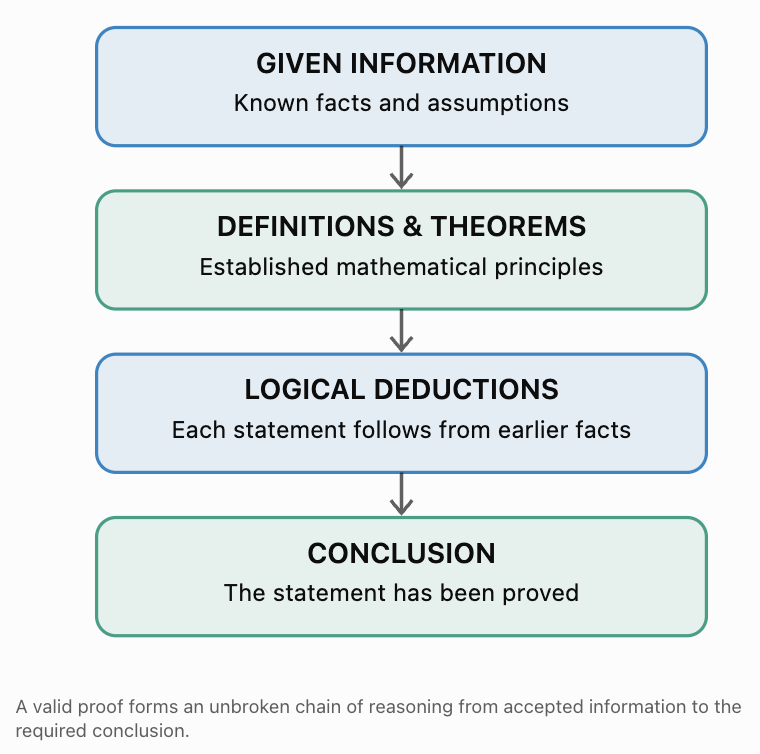
Proof Versus Observation
Consider the statement:
"The diagonals of a rectangle are equal."
We could draw a rectangle, measure both diagonals, and observe that they have the same length.
However, this does not prove the statement for every rectangle.
A proof must establish the relationship using geometric properties.
For a rectangle ABCD, triangles ABC and BAD can be shown to be congruent because:
-
AB is a common side.
-
BC = AD because opposite sides of a rectangle are equal.
-
∠ABC = ∠BAD = 90°.
Therefore, △ABC ≅ △BAD by SAS congruence.
Corresponding sides AC and BD are equal.
Thus, the diagonals of a rectangle are equal.
This conclusion follows from established properties rather than measurement.
Deductive and Inductive Reasoning
Inductive Reasoning
Inductive reasoning involves identifying patterns from examples and using them to form a conjecture.
For example, a student measures the interior angles of several triangles and finds that each sum is approximately 180°.
The student conjectures:
"The interior angles of every triangle sum to 180°."
This is a useful observation, but it is not a general proof.
Deductive Reasoning
Deductive reasoning begins with accepted facts and uses logical steps to establish a conclusion.
For example, the angle-sum theorem for triangles can be proved using parallel-line angle relationships in Euclidean geometry.
Deductive reasoning establishes that the result applies to every triangle satisfying the relevant assumptions.
Why the Difference Matters
Inductive reasoning helps mathematicians discover patterns.
Deductive reasoning establishes whether those patterns are always true.
A complete mathematical investigation often uses both.
Definitions, Postulates, and Theorems
A geometric proof relies on several types of mathematical statements.
Definitions
A definition explains the precise meaning of a mathematical term.
Examples:
-
A midpoint divides a segment into two equal segments.
-
A perpendicular bisector is perpendicular to a segment and passes through its midpoint.
-
A rectangle is a quadrilateral with four right angles.
-
A rhombus is a quadrilateral with four equal sides.
Postulates or Axioms
A postulate is a mathematical statement accepted as a starting point within a particular system.
For example, in Euclidean geometry, the parallel postulate governs the behavior of parallel lines.
Theorems
A theorem is a statement that has been established by proof.
Examples include:
-
Pythagoras' theorem.
-
The triangle angle-sum theorem.
-
The exterior-angle theorem.
-
The base-angle theorem for isosceles triangles.
-
The properties of parallel lines cut by a transversal.
Corollaries
A corollary is a result that follows readily from a previously established theorem.
For example, because the interior angles of a triangle sum to 180°, the two acute angles of a right triangle sum to 90°.
Constructing Complete Geometric Proofs
There are several common formats for presenting geometric proofs.
Two-Column Proof
A two-column proof places mathematical statements in one column and their justifications in another.
Statement
Reason
AB = AC
Given
AD = AD
Reflexive property
∠BAD = ∠DAC
Given that AD bisects ∠BAC
△BAD ≅ △CAD
SAS congruence
BD = DC
Corresponding parts of congruent triangles
This format makes the logical structure explicit.
Paragraph Proof
A paragraph proof presents the same reasoning in connected sentences.
For example:
"Since AB = AC and AD bisects ∠BAC, we know that ∠BAD = ∠DAC. Also, AD is common to both triangles. Therefore, △BAD ≅ △CAD by SAS congruence. It follows that BD = DC because corresponding parts of congruent triangles are equal."
Paragraph proofs are useful when communicating mathematical ideas in written explanations.
Flow Proof
A flow proof uses arrows to show how facts lead to conclusions.
For example:
AB = AC, AD = AD, and ∠BAD = ∠DAC
↓
△BAD ≅ △CAD by SAS
↓
BD = DC.
All three formats can represent valid proofs. The essential requirement is that each conclusion follows logically from justified statements.
Worked Example 1: Proving the Base Angles of an Isosceles Triangle
Given: Triangle ABC has AB = AC.
Prove: ∠ABC = ∠BCA.
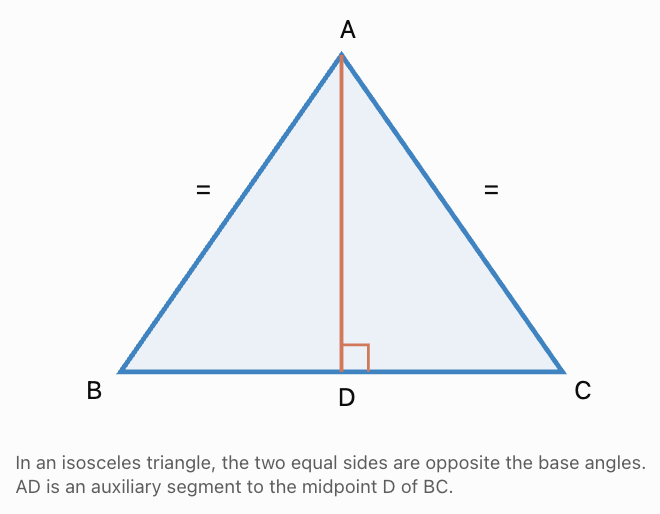
Construction: Let D be the midpoint of BC and draw AD.
Statement
Reason
AB = AC
Given
BD = DC
D is the midpoint of BC
AD = AD
Reflexive property
△ABD ≅ △ACD
SSS congruence
∠ABD = ∠ACD
Corresponding angles of congruent triangles
∠ABC = ∠BCA
D lies on BC
Conclusion: The base angles of an isosceles triangle are equal.
The proof establishes a general property of every nondegenerate isosceles triangle.
Worked Example 2: Proving That the Diagonals of a Parallelogram Bisect Each Other
Given: ABCD is a parallelogram. Its diagonals AC and BD intersect at E.
Prove: AE = EC and BE = ED.
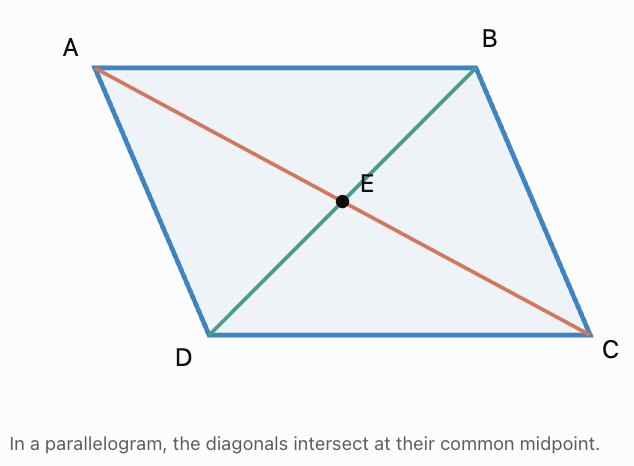
Proof:
Since ABCD is a parallelogram:
AB ∥ CD.
Therefore:
∠EAB = ∠ECD, by alternate interior angles.
∠EBA = ∠EDC, by alternate interior angles.
Also:
AB = CD, because opposite sides of a parallelogram are equal.
Therefore:
△EAB ≅ △ECD by ASA congruence.
Hence:
AE = EC
and
BE = ED,
because corresponding parts of congruent triangles are equal.
Conclusion: The diagonals of a parallelogram bisect each other.
This proof combines parallel-line angle properties, congruence, and corresponding parts.
Using Congruence and Similarity in Proofs
Triangle congruence and similarity are among the most useful tools in geometric reasoning.
Triangle Congruence
Two triangles are congruent when they have exactly the same size and shape.
The main congruence criteria are:
Criterion
Meaning
SSS
Three pairs of corresponding sides are equal
SAS
Two pairs of sides and their included angles are equal
ASA
Two pairs of angles and their included side are equal
AAS
Two pairs of angles and a corresponding non-included side are equal
RHS or HL
Right triangles have equal hypotenuses and one corresponding leg
The order of corresponding vertices matters.
For example:
△ABC ≅ △DEF
means:
A ↔ D, B ↔ E, C ↔ F.
Therefore:
AB = DE, BC = EF, and AC = DF.
Triangle Similarity
Similar triangles have the same shape but may differ in size.
The main similarity criteria are:
-
AA: Two pairs of corresponding angles are equal.
-
SAS similarity: Two pairs of corresponding sides are proportional, and their included angles are equal.
-
SSS similarity: All three pairs of corresponding sides are proportional.
Similar triangles have equal corresponding angles and proportional corresponding sides.
Worked Example 3: Proving Similarity and Finding a Length
In triangle ABC, D lies on AB and E lies on AC.
DE is parallel to BC.
Given:
AD = 6 cm
DB = 4 cm
AE = 9 cm.
Find AC.
Step 1: Establish similarity
Because DE ∥ BC:
∠ADE = ∠ABC, by corresponding angles.
∠AED = ∠ACB, by corresponding angles.
Therefore:
△ADE ∼ △ABC by AA similarity.
Step 2: Identify corresponding sides
AB = AD + DB
= 6 + 4 = 10 cm.
By similarity:
AD/AB = AE/AC.
Substitute:
6/10 = 9/AC.
Cross-multiply:
6AC = 90.
AC = 15 cm.
Answer: AC = 15 cm.
Justification: The proportional relationship follows from AA similarity, which was established using parallel-line angle properties.
Evaluation: AC is longer than AE, as expected because E lies between A and C.
Worked Example 4: Proving the Midpoint Theorem
Given: D is the midpoint of AB, and E is the midpoint of AC in triangle ABC.
Prove: DE ∥ BC and DE = ½BC.
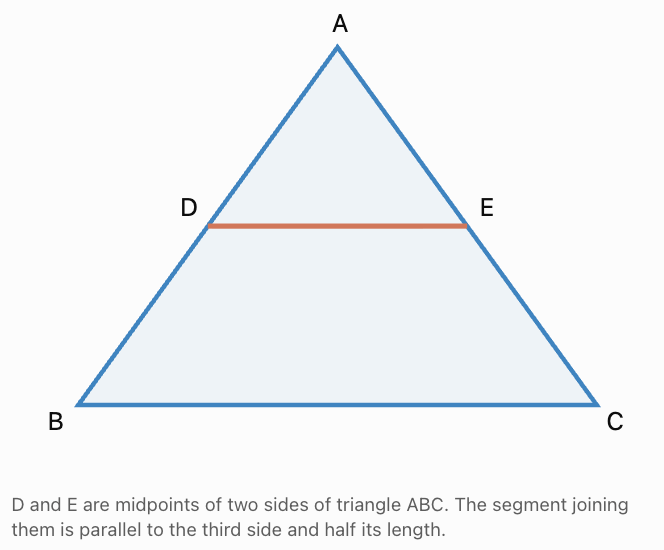
Step 1: Use the midpoint definition
Since D is the midpoint of AB:
AD = DB.
Therefore:
AD/AB = 1/2.
Similarly:
AE/AC = 1/2.
Thus:
AD/AB = AE/AC.
Step 2: Establish similarity
The triangles ADE and ABC share angle A.
Their two sides surrounding angle A are proportional.
Therefore:
△ADE ∼ △ABC by SAS similarity.
Step 3: Establish parallelism
Corresponding angles are equal:
∠ADE = ∠ABC.
By the converse of the corresponding-angles theorem:
DE ∥ BC.
Step 4: Establish the length relationship
From similarity:
DE/BC = AD/AB = 1/2.
Therefore:
DE = ½BC.
This completes both parts of the proof.
Proving Relationships Using Coordinates
Coordinate geometry provides an algebraic approach to geometric proof.
Instead of relying only on angle relationships or congruent triangles, we can use slopes, distances, and midpoints.
The three most important coordinate formulas are:
Distance formula
d = √((x₂ − x₁)² + (y₂ − y₁)²)
Midpoint formula
M = ((x₁ + x₂)/2, (y₁ + y₂)/2)
Slope formula
m = (y₂ − y₁)/(x₂ − x₁), provided x₂ ≠ x₁.
For nonvertical lines:
-
Equal slopes indicate parallel lines, provided the lines are distinct.
-
Slopes with product −1 indicate perpendicular lines.
Vertical lines have undefined slope. They are parallel to other vertical lines and perpendicular to horizontal lines.
Worked Example 5: Proving a Quadrilateral Is a Rectangle
Consider the quadrilateral with vertices:
A(1, 1)
B(7, 3)
C(6, 6)
D(0, 4).
Prove that ABCD is a rectangle.
Step 1: Calculate slopes
m_AB = (3 − 1)/(7 − 1) = 2/6 = 1/3.
m_BC = (6 − 3)/(6 − 7) = 3/−1 = −3.
m_CD = (4 − 6)/(0 − 6) = −2/−6 = 1/3.
m_DA = (1 − 4)/(1 − 0) = −3.
Step 2: Establish parallelism
AB ∥ CD because both have slope 1/3.
BC ∥ DA because both have slope −3.
Therefore, ABCD is a parallelogram.
Step 3: Establish perpendicularity
m_AB × m_BC = (1/3)(−3) = −1.
Therefore, AB ⟂ BC.
A parallelogram with a right angle is a rectangle.
Conclusion: ABCD is a rectangle.
This is a complete coordinate proof because it establishes the defining conditions of the shape rather than relying on appearance.
Worked Example 6: Proving That a Triangle Is Isosceles
Triangle ABC has vertices:
A(0, 5)
B(−3, 0)
C(3, 0).
Prove that it is isosceles.
Calculate AB:
AB = √((−3 − 0)² + (0 − 5)²)
= √(9 + 25)
= √34.
Calculate AC:
AC = √((3 − 0)² + (0 − 5)²)
= √(9 + 25)
= √34.
Therefore:
AB = AC.
Conclusion: Triangle ABC is isosceles by the definition of an isosceles triangle.
Notice that no angle measurements were required.
Worked Example 7: Proving a General Parallelogram Property with Coordinates
Prove that the diagonals of every parallelogram bisect each other.
Choose a general parallelogram with vertices:
A(0, 0)
B(a, b)
D(c, d)
C(a + c, b + d).
The form of C follows from the parallelogram's opposite-side relationships.
Step 1: Find the midpoint of AC
M_AC = ((0 + a + c)/2, (0 + b + d)/2).
Therefore:
M_AC = ((a + c)/2, (b + d)/2).
Step 2: Find the midpoint of BD
M_BD = ((a + c)/2, (b + d)/2).
The midpoints are identical.
Conclusion: The diagonals have the same midpoint and therefore bisect each other.
Unlike a proof using one particular set of numerical coordinates, this algebraic argument applies to every nondegenerate parallelogram represented in this form.
Identifying Flaws in Mathematical Reasoning
An important mathematical skill is recognizing when an argument is incomplete or invalid.
A conclusion may be correct even when the reasoning used to reach it is incorrect.
Common Logical Errors
1. Assuming what must be proved
Example:
"AB = AC because triangle ABC is isosceles."
This is circular if the task is to prove the triangle is isosceles and no independent reason has been given for AB = AC.
2. Using a theorem without satisfying its conditions
Example:
"Two triangles are congruent because they have two equal angles."
Two equal corresponding angles establish similarity, not necessarily congruence.
3. Confusing a theorem with its converse
Example:
"All rectangles have equal diagonals, so any quadrilateral with equal diagonals must be a rectangle."
This is false. An isosceles trapezoid can also have equal diagonals.
4. Treating a diagram as proof
Example:
"These lines are parallel because they look parallel."
Visual appearance is insufficient.
5. Generalizing from one example
Example:
"One triangle has angles summing to 180°, so all triangles must have this property."
The conclusion is true in Euclidean geometry, but the argument does not establish it.
6. Using an invalid congruence condition
SSA (two sides and a non-included angle) does not generally guarantee triangle congruence.
Worked Example 8: Why SSA Is Not a General Congruence Criterion
Suppose a triangle has:
AB = 10 cm
BC = 7 cm
∠A = 30°.
The Law of Sines gives:
sin C/AB = sin A/BC.
Therefore:
sin C/10 = sin 30°/7.
sin C = 10 × 0.5/7
= 5/7.
One possible angle is:
C ≈ 45.58°.
However, another possible angle is:
C ≈ 180° − 45.58°
≈ 134.42°.
Both produce valid triangles because the remaining angles are positive.
The triangles have the same given two sides and non-included angle, but different shapes.
Conclusion: SSA information does not always determine a unique triangle.
This explains why a proof cannot simply claim congruence from SSA.
Worked Example 9: Finding the Flaw in a Parallelogram Argument
A student writes:
"ABCD has one pair of opposite sides parallel. Therefore, ABCD is a parallelogram."
What is wrong?
A parallelogram requires both pairs of opposite sides to be parallel.
One pair alone is insufficient.
How can the proof be repaired?
Establish:
AB ∥ CD
and
BC ∥ AD.
Alternatively, prove another sufficient condition, such as one pair of opposite sides being both parallel and equal in length.
The correction depends on the information available.
Counterexamples
A counterexample is a specific example showing that a general statement is false.
To disprove the statement:
"Every quadrilateral with equal diagonals is a rectangle,"
consider an isosceles trapezoid with vertices:
A(−3, 0)
B(3, 0)
C(2, 2)
D(−2, 2).
Its diagonals have lengths:
AC = √((2 + 3)² + (2 − 0)²) = √29.
BD = √((−2 − 3)² + (2 − 0)²) = √29.
The diagonals are equal.
However, AB and CD have different lengths, so the quadrilateral is not a parallelogram and therefore not a rectangle.
One valid counterexample is enough to disprove a universal claim.
It does not establish a different universal theorem; it only shows that the original claim is false.
Communicating Geometry with Precise Mathematical Language
Mathematical communication depends on correct vocabulary, notation, and logical connections.
Compare the following statements.
Imprecise statement
Precise mathematical statement
The sides look the same.
AB = AC, so triangle ABC is isosceles.
These lines go in the same direction.
AB ∥ CD.
The lines make a square corner.
AB ⟂ BC, so ∠ABC = 90°.
The triangles are the same.
△ABC ≅ △DEF by SAS congruence.
One triangle is bigger.
△DEF is an enlargement of △ABC with scale factor 2.
The middle point is here.
M is the midpoint of AB, so AM = MB.
The angles match.
∠ABC = ∠DEF because they are corresponding angles.
The answer seems right.
The result satisfies the given dimensions and geometric constraints.
Mathematical Symbols
Symbol
Meaning
∠ABC
Angle ABC, with vertex B
△ABC
Triangle ABC
AB = CD
Segments AB and CD have equal lengths
AB ∥ CD
Lines AB and CD are parallel
AB ⟂ CD
Lines AB and CD are perpendicular
△ABC ≅ △DEF
The triangles are congruent
△ABC ∼ △DEF
The triangles are similar
∴
Therefore
∵
Because
⇒
Implies
⇔
If and only if
Use the words therefore, because, since, hence, and by the theorem to make the reasoning explicit.
For example:
"Since AB ∥ CD, alternate interior angles are equal. Therefore, ∠BAC = ∠ACD."
This is stronger than simply writing two equal angle expressions without explanation.
Necessary and Sufficient Conditions
A condition is necessary if it must hold whenever a statement is true.
A condition is sufficient if it guarantees that the statement is true.
For example:
-
Having four right angles is sufficient for a quadrilateral to be a rectangle.
-
Having equal diagonals is necessary for a rectangle, but not sufficient on its own.
This distinction is important when writing proofs.
A statement may be true in one direction but false in the other.
Worked Example 10: Proving a Quadrilateral Is a Square
Given: ABCD is a rectangle, and AB = BC.
Prove: ABCD is a square.
Proof:
Because ABCD is a rectangle, all four angles are right angles.
Also, opposite sides of a rectangle are equal:
AB = CD
and
BC = AD.
Since AB = BC is given, it follows that:
AB = BC = CD = AD.
Therefore, ABCD has four equal sides and four right angles.
Conclusion: ABCD is a square by definition.
This is an efficient proof because it uses established rectangle properties rather than proving each right angle separately.
Connecting Geometry, Algebra, and Trigonometry
Complex proofs often require several mathematical ideas.
For example, algebra can establish a length relationship, trigonometry can establish an angle relationship, and similarity can connect both.
Worked Example 11: Proving Pythagoras' Theorem Using Similarity
Consider a right triangle ABC with:
∠C = 90°.
Let the hypotenuse AB have length c.
Let:
BC = a
AC = b.
Draw altitude CD perpendicular to AB.
Let:
AD = x
DB = y.
Then:
x + y = c.
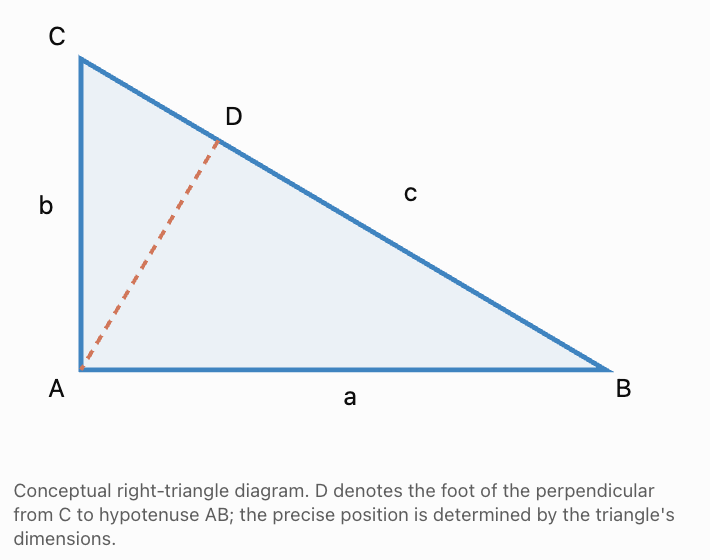
The altitude creates two smaller right triangles similar to the original triangle.
From △ACD ∼ △ABC:
b/c = x/b.
Therefore:
b² = cx.
From △CBD ∼ △ABC:
a/c = y/a.
Therefore:
a² = cy.
Add the equations:
a² + b² = cx + cy.
Factor:
a² + b² = c(x + y).
Since x + y = c:
a² + b² = c².
This proves Pythagoras' theorem using similarity.
The proof demonstrates how a theorem about lengths can be established using angle relationships and proportional sides.
Worked Example 12: Proving the Distance Formula
Consider two points:
A(x₁, y₁)
B(x₂, y₂).
Draw horizontal and vertical segments forming a right triangle with AB as the hypotenuse.
The horizontal leg has length:
|x₂ − x₁|.
The vertical leg has length:
|y₂ − y₁|.
By Pythagoras' theorem:
AB² = (x₂ − x₁)² + (y₂ − y₁)².
Taking the nonnegative square root:
AB = √((x₂ − x₁)² + (y₂ − y₁)²).
Thus, the coordinate distance formula follows directly from Pythagoras' theorem.
This connects Euclidean geometry with algebraic coordinates.
Worked Example 13: A Combined Proof and Calculation
Triangle ABC has vertices:
A(0, 0)
B(8, 0)
C(4, 6).
Prove that the triangle is isosceles, find its area, and calculate its base angles.
Step 1: Prove equal sides
AC = √(4² + 6²)
= √52
= 2√13.
BC = √((4 − 8)² + 6²)
= √52
= 2√13.
Therefore:
AC = BC.
Triangle ABC is isosceles.
Step 2: Find the area
AB = 8 units.
The perpendicular height from C to AB is 6 units.
A = ½ × 8 × 6
= 24 square units.
Step 3: Find a base angle
The altitude from C meets AB at its midpoint (4, 0).
This creates a right triangle with:
Opposite = 6.
Adjacent = 4.
tan θ = 6/4.
θ = tan⁻¹(1.5)
≈ 56.31°.
Because the triangle is isosceles:
∠A = ∠B ≈ 56.31°.
The apex angle is:
∠C = 180° − 2(56.31°)
≈ 67.38°.
Answers:
-
Triangle ABC is isosceles.
-
Area = 24 square units.
-
Base angles ≈ 56.31° each.
-
Apex angle ≈ 67.38°.
Evaluation: The angles sum to approximately 180°, and the two equal sides are opposite equal angles.
Real-World Applications of Proof and Mathematical Communication
Architecture
Architects justify dimensions, geometric relationships, and design choices using precise drawings and calculations.
Structural engineering
Engineers use geometric relationships to analyse structures and verify design calculations.
Mathematics education
Clear proofs help students distinguish between a correct answer and a valid mathematical argument.
Computer-aided design
Geometric constraints and logical relationships help define accurate, consistent digital models.
A Comprehensive Proof Strategy
For difficult problems, use the following sequence:
-
Identify the conclusion. What exactly must be proved?
-
List the givens. Which facts are established?
-
Translate the information. Convert words into geometric statements and equations.
-
Identify a sufficient condition. What theorem would guarantee the conclusion?
-
Work backwards. What intermediate facts would establish that condition?
-
Add useful constructions. Consider an altitude, diagonal, midpoint, or parallel line.
-
Build the argument. Use definitions, congruence, similarity, coordinate formulas, or algebra.
-
Check for gaps. Does every statement follow from justified facts?
-
Present the proof clearly. Use consistent notation and complete sentences.
-
Evaluate the conclusion. Check for contradictions, special cases, and unstated assumptions.
Worked Example 14: A Comprehensive Quadrilateral Proof
Given: ABCD is a parallelogram, and AC = BD.
Prove: ABCD is a rectangle.
Step 1: Use parallelogram properties
Opposite sides of a parallelogram are equal.
Therefore:
AD = BC.
Also:
AB = AB, by the reflexive property.
Step 2: Compare triangles
Consider △BAD and △ABC.
We have:
BA = AB.
AD = BC.
BD = AC, given.
Therefore:
△BAD ≅ △ABC by SSS congruence.
Step 3: Compare corresponding angles
From congruence:
∠BAD = ∠ABC.
Step 4: Use consecutive-angle properties
Consecutive angles of a parallelogram are supplementary.
Therefore:
∠BAD + ∠ABC = 180°.
Since they are equal:
2∠BAD = 180°.
∠BAD = 90°.
Therefore, ABCD has a right angle.
A parallelogram with one right angle is a rectangle.
Conclusion: ABCD is a rectangle.
This proof connects congruence, parallelogram properties, supplementary angles, and quadrilateral classification.
Common Mistakes
Mistake 1: Assuming a Diagram Is Accurate
A diagram may suggest equal lengths or angles, but those relationships must be given or proved.
Mistake 2: Confusing Evidence with Proof
Measuring several examples supports a conjecture but does not establish a universal theorem.
Mistake 3: Using Circular Reasoning
Do not assume the conclusion while attempting to prove it.
Mistake 4: Applying a Theorem Without Checking Its Conditions
For example, Pythagoras' theorem requires a right triangle.
Mistake 5: Using SSA as a General Congruence Criterion
SSA does not generally guarantee congruence.
Mistake 6: Confusing Similarity and Congruence
AA establishes similarity, not congruence.
Mistake 7: Reversing a Theorem Without Justification
A true statement does not automatically have a true converse.
Mistake 8: Assuming Equal Diagonals Prove a Rectangle
Equal diagonals alone are insufficient.
Mistake 9: Using Incorrect Corresponding Vertices
When writing △ABC ≅ △DEF, the vertex order determines the correspondence.
Mistake 10: Claiming Lines Are Perpendicular Because Their Slopes Differ
Different slopes do not necessarily indicate perpendicularity.
Mistake 11: Omitting Reasons
Each important statement in a proof should be supported by a definition, theorem, given fact, or earlier deduction.
Mistake 12: Using Imprecise Language
Statements such as “the triangles are the same” should be replaced with precise mathematical terminology.
Mistake 13: Proving Only Part of the Conclusion
If a problem asks you to prove that a quadrilateral is a square, showing only that it is a rectangle is insufficient.
Mistake 14: Treating a Numerical Example as a General Proof
A specific example may illustrate a theorem, but it does not prove that theorem universally.
Mistake 15: Confusing Necessary and Sufficient Conditions
A condition that every rectangle satisfies may not be enough to establish that an arbitrary quadrilateral is a rectangle.
Mistake 16: Ignoring Special Cases
A proof should account for all configurations allowed by its assumptions.
Mistake 17: Failing to State Assumptions
A geometric argument may depend on Euclidean geometry, nondegenerate triangles, or the position of a point on a segment.
Mistake 18: Giving a Correct Answer with Invalid Reasoning
A conclusion can be true even when the argument used to obtain it is flawed.
Mistake 19: Confusing Approximation with Equality
An approximate measurement should not be used as proof of an exact geometric relationship.
Mistake 20: Failing to Review the Proof
Before finishing, check that the argument has no missing steps, contradictions, or unjustified assumptions.
Key Terms
-
Mathematical Proof: A logical argument establishing a mathematical statement.
-
Deductive Reasoning: Deriving conclusions from accepted facts using valid logic.
-
Inductive Reasoning: Forming conjectures from observed patterns.
-
Conjecture: A mathematical statement believed to be true but not yet proved.
-
Definition: A precise explanation of a mathematical concept.
-
Axiom: A statement accepted as a starting point in a mathematical system.
-
Postulate: An accepted starting statement, particularly in geometry.
-
Theorem: A mathematical statement established by proof.
-
Corollary: A result that follows readily from an established theorem.
-
Lemma: An intermediate theorem used in proving another result.
-
Given: Information accepted as true at the beginning of a proof.
-
Conclusion: The statement established by the proof.
-
Justification: A mathematical reason supporting a statement.
-
Logical Deduction: A conclusion that follows from established premises.
-
Two-Column Proof: A proof organized into statements and reasons.
-
Paragraph Proof: A proof expressed in connected mathematical sentences.
-
Flow Proof: A proof represented as a sequence or network of logical implications.
-
Auxiliary Construction: An additional line, point, or shape introduced to help a proof.
-
Congruence: Equality of shape and size.
-
Similarity: Equality of shape with proportional corresponding lengths.
-
Corresponding Parts: Matching sides or angles in related figures.
-
SSS Congruence: Congruence established using three pairs of equal sides.
-
SAS Congruence: Congruence established using two pairs of sides and their included angles.
-
ASA Congruence: Congruence established using two pairs of angles and the included side.
-
AA Similarity: Similarity established using two pairs of equal corresponding angles.
-
Converse: A statement formed by reversing the hypothesis and conclusion of another statement.
-
Counterexample: An example demonstrating that a general statement is false.
-
Circular Reasoning: Using the conclusion as part of its own justification.
-
Necessary Condition: A condition that must hold for a statement to be true.
-
Sufficient Condition: A condition that guarantees a statement is true.
-
Coordinate Proof: A proof using coordinates and algebraic relationships.
-
General Proof: A proof establishing a statement for every case covered by its assumptions.
-
Reflexive Property: A quantity is equal to itself.
-
Transitive Property: If a = b and b = c, then a = c.
-
Triangle Inequality: The sum of any two sides of a nondegenerate triangle exceeds the third.
-
Mathematical Communication: Presenting mathematical ideas using precise language, notation, and reasoning.
Key Takeaways
-
A mathematical proof establishes a conclusion through logical reasoning.
-
Observation and measurement are not substitutes for general proof.
-
Definitions provide the foundation for geometric arguments.
-
Theorems must be applied only when their conditions are satisfied.
-
Congruence can establish equality of corresponding lengths and angles.
-
Similarity can establish proportional relationships.
-
Parallel-line properties help prove angle relationships.
-
Coordinate methods provide algebraic proofs of geometric properties.
-
Auxiliary constructions can reveal useful relationships.
-
Two-column, paragraph, and flow proofs can all communicate valid reasoning.
-
A proof must identify why each important statement is true.
-
Correct mathematical notation improves clarity.
-
A true conclusion does not guarantee that the argument is valid.
-
Counterexamples disprove universal statements.
-
Necessary and sufficient conditions are not interchangeable.
-
A theorem and its converse must be considered separately.
-
General coordinate proofs can use variables rather than specific numerical examples.
-
Geometry connects naturally with algebra and trigonometry.
-
Complex proofs often combine several mathematical concepts.
-
Clear mathematical communication makes reasoning understandable and verifiable.
Check Your Understanding
For each question, provide complete reasoning. Use definitions and theorems to justify your conclusions.
Question 1: Understanding Proof
Explain the difference between inductive and deductive reasoning.
Why is measuring the angles of five triangles not sufficient to prove the triangle angle-sum theorem?
Question 2: Isosceles Triangles
Triangle ABC has AB = AC.
Point D is the midpoint of BC.
Prove that AD is perpendicular to BC.
Question 3: Parallelogram Properties
ABCD is a parallelogram.
Prove that opposite sides AB and CD have equal lengths.
Question 4: Similar Triangles
In triangle ABC, D lies on AB and E lies on AC.
DE ∥ BC.
Given:
AD = 4 cm
AB = 10 cm
AE = 6 cm.
Prove that △ADE ∼ △ABC and calculate AC.
Question 5: Coordinate Proof
Quadrilateral ABCD has vertices:
A(0, 0)
B(6, 0)
C(6, 4)
D(0, 4).
Prove that ABCD is a rectangle.
Then determine whether it is a square.
Question 6: Identifying a Flaw
A student writes:
"Triangle ABC has two angles equal to two angles in triangle DEF. Therefore, the triangles are congruent."
Explain the error and state what can actually be concluded.
Question 7: Counterexample
A student claims:
"Every quadrilateral with four equal sides is a square."
Determine whether the statement is true.
If false, give a counterexample and explain why it disproves the statement.
Question 8: Pythagoras' Theorem
A triangle has side lengths:
9 cm, 12 cm, and 15 cm.
Prove that it is right-angled.
Identify which side is opposite the right angle.
Question 9: Midpoint Formula
A line segment has endpoints:
A(2, 4)
B(10, 12).
Find its midpoint.
Explain why the midpoint divides the segment into two equal lengths.
Question 10: Proving a Rhombus
Quadrilateral ABCD has vertices:
A(0, 3)
B(4, 0)
C(8, 3)
D(4, 6).
Prove that ABCD is a rhombus.
Determine whether it is also a square.
Question 11: Evaluating a Mathematical Argument
A student claims:
"All rectangles have equal diagonals. Quadrilateral ABCD has equal diagonals. Therefore, ABCD is a rectangle."
Explain why the argument is invalid.
State an additional condition that, together with equal diagonals, would be sufficient to prove that ABCD is a rectangle.
Question 12: Comprehensive Geometric Proof
Triangle ABC has vertices:
A(0, 0)
B(8, 0)
C(4, 6).
Point D is the midpoint of AB.
Prove that:
a) AC = BC.
b) AD = DB.
c) CD ⟂ AB.
d) △ACD ≅ △BCD.
e) ∠CAD = ∠DBC.
Then calculate:
f) The area of triangle ABC.
g) The length of AC.
h) The measure of ∠CAB.
Finally, explain how coordinate geometry, congruence, and trigonometry are connected in this problem.
Fully Worked Answers
Answer 1: Understanding Proof
Inductive reasoning uses examples or observations to identify patterns and form conjectures.
Deductive reasoning uses accepted facts and valid logical steps to establish conclusions.
Measuring five triangles may suggest that their angle sums equal 180°, but the measurements cannot establish that the result holds for every possible triangle.
The observations may also contain measurement errors.
A general proof is required to establish the theorem for all Euclidean triangles.
Answer 2: Isosceles Triangles
Given:
AB = AC.
D is the midpoint of BC.
Prove: AD ⟂ BC.
Proof:
Since D is the midpoint of BC:
BD = DC.
Also:
AB = AC, given.
AD = AD, by the reflexive property.
Therefore:
△ABD ≅ △ACD by SSS congruence.
Corresponding angles are equal:
∠ADB = ∠ADC.
Because B, D, and C are collinear:
∠ADB + ∠ADC = 180°.
Since the two angles are equal:
2∠ADB = 180°.
∠ADB = 90°.
Therefore:
AD ⟂ BC.
This proves that the median from the apex of an isosceles triangle is perpendicular to its base.
Answer 3: Parallelogram Properties
Given: ABCD is a parallelogram.
Prove: AB = CD.
Construction: Draw diagonal AC.
Since ABCD is a parallelogram:
AB ∥ CD
and
BC ∥ AD.
Therefore:
∠BAC = ∠DCA, by alternate interior angles.
∠BCA = ∠DAC, by alternate interior angles.
Also:
AC = AC, by the reflexive property.
Therefore:
△BAC ≅ △DCA by ASA congruence.
Corresponding sides are equal:
AB = CD.
This proves that opposite sides of a parallelogram have equal lengths.
Answer 4: Similar Triangles
Given:
DE ∥ BC.
AD = 4 cm.
AB = 10 cm.
AE = 6 cm.
Step 1: Prove similarity
Because DE ∥ BC:
∠ADE = ∠ABC.
∠AED = ∠ACB.
These are corresponding angles.
Therefore:
△ADE ∼ △ABC by AA similarity.
Step 2: Use corresponding side ratios
AD/AB = AE/AC.
4/10 = 6/AC.
Cross-multiply:
4AC = 60.
AC = 15 cm.
Answer: △ADE ∼ △ABC, and AC = 15 cm.
Answer 5: Coordinate Proof
Vertices:
A(0, 0)
B(6, 0)
C(6, 4)
D(0, 4).
Step 1: Establish parallel sides
AB and CD are horizontal.
Therefore:
AB ∥ CD.
BC and AD are vertical.
Therefore:
BC ∥ AD.
Thus, ABCD is a parallelogram.
Step 2: Establish perpendicularity
Horizontal and vertical lines are perpendicular.
Therefore:
AB ⟂ BC.
A parallelogram with one right angle is a rectangle.
Step 3: Determine whether it is a square
AB = 6 units.
BC = 4 units.
Since:
AB ≠ BC,
the adjacent sides are not equal.
Conclusion: ABCD is a rectangle but not a square.
Answer 6: Identifying a Flaw
The student has confused similarity with congruence.
Two pairs of equal corresponding angles establish that the triangles are similar by AA similarity.
However, the triangles may have different sizes.
Therefore, the correct conclusion is:
△ABC ∼ △DEF, assuming the stated angles correspond in that order.
Additional information would be needed to prove congruence.
For example, equality of one pair of corresponding sides would establish congruence once similarity has been proved.
Answer 7: Counterexample
The statement is false.
A non-square rhombus has four equal sides but does not have four right angles.
For example, a rhombus with interior angles of 60° and 120° has four equal sides but is not a square.
Therefore:
Not every quadrilateral with four equal sides is a square.
The counterexample disproves the universal claim.
Answer 8: Pythagoras' Theorem
Side lengths:
9 cm, 12 cm, 15 cm.
The longest side is 15 cm.
Calculate:
9² + 12² = 81 + 144 = 225.
15² = 225.
Therefore:
9² + 12² = 15².
By the converse of Pythagoras' theorem, the triangle is right-angled.
Conclusion: The right angle is opposite the 15 cm side.
Answer 9: Midpoint Formula
A(2, 4)
B(10, 12).
Midpoint:
M = ((2 + 10)/2, (4 + 12)/2)
= (6, 8).
Answer: M(6, 8).
To verify equal lengths:
AM = √((6 − 2)² + (8 − 4)²)
= √(16 + 16)
= √32.
MB = √((10 − 6)² + (12 − 8)²)
= √(16 + 16)
= √32.
Therefore:
AM = MB.
Since M also lies halfway along the line segment from A to B, it is the midpoint.
Answer 10: Proving a Rhombus
Vertices:
A(0, 3)
B(4, 0)
C(8, 3)
D(4, 6).
Step 1: Calculate side lengths
AB = √(4² + (−3)²) = 5.
BC = √(4² + 3²) = 5.
CD = √((−4)² + 3²) = 5.
DA = √((−4)² + (−3)²) = 5.
Therefore:
AB = BC = CD = DA.
ABCD is a rhombus by definition.
Step 2: Determine whether it is a square
Slope of AB:
m_AB = −3/4.
Slope of BC:
m_BC = 3/4.
Their product is:
(−3/4)(3/4) = −9/16.
This is not −1.
Therefore, AB is not perpendicular to BC.
The rhombus does not have a right angle.
Conclusion: ABCD is a rhombus but not a square.
Answer 11: Evaluating a Mathematical Argument
The argument is invalid because it assumes that the converse of a true theorem must also be true.
Every rectangle has equal diagonals, but equal diagonals alone do not guarantee a rectangle.
An isosceles trapezoid is a counterexample.
One sufficient additional condition is:
ABCD is a parallelogram.
A parallelogram with equal diagonals is a rectangle, as established in Worked Example 14.
Thus, equal diagonals together with the parallelogram condition are sufficient.
Answer 12: Comprehensive Geometric Proof
Given:
A(0, 0)
B(8, 0)
C(4, 6).
D is the midpoint of AB.
a) Prove AC = BC
AC = √((4 − 0)² + (6 − 0)²)
= √52.
BC = √((4 − 8)² + (6 − 0)²)
= √52.
Therefore:
AC = BC.
Triangle ABC is isosceles.
b) Prove AD = DB
Midpoint of AB:
D = ((0 + 8)/2, (0 + 0)/2)
= (4, 0).
AD = 4 units.
DB = 4 units.
Therefore:
AD = DB.
c) Prove CD ⟂ AB
A and B both have y-coordinate 0, so AB is horizontal.
C(4, 6) and D(4, 0) have the same x-coordinate, so CD is vertical.
Horizontal and vertical lines are perpendicular.
Therefore:
CD ⟂ AB.
d) Prove △ACD ≅ △BCD
We know:
AC = BC, from part a.
AD = DB, from part b.
CD = CD, by the reflexive property.
Therefore:
△ACD ≅ △BCD by SSS congruence.
e) Prove ∠CAD = ∠DBC
The triangles are congruent.
Corresponding angles of congruent triangles are equal.
Therefore:
∠CAD = ∠DBC.
f) Calculate area
AB = 8 units.
CD = 6 units.
Since CD ⟂ AB, CD is the perpendicular height.
A = ½ × 8 × 6
Answer: 24 square units.
g) Calculate AC
AC = √52
= 2√13
Answer: AC = 2√13 ≈ 7.21 units.
h) Calculate ∠CAB
Consider right triangle ACD.
AD = 4.
CD = 6.
tan ∠CAD = 6/4.
∠CAD = tan⁻¹(1.5).
Since D lies on AB:
∠CAB = ∠CAD.
Answer: ∠CAB ≈ 56.31°.
i) Explain the mathematical connections
This problem combines several mathematical ideas:
-
Coordinate geometry establishes the midpoint, equal side lengths, and perpendicular lines.
-
Congruence proves the equality of corresponding angles.
-
Trigonometry calculates an angle using known side lengths.
-
Area geometry uses the perpendicular height and base.
-
Deductive reasoning connects these results into a complete argument.
The result is a good example of how different mathematical concepts can support and verify one another.
Final Course Connections
Mathematical proof and communication bring together the major ideas of geometry into a coherent system of reasoning.
Definitions provide precise meanings. Theorems establish reliable relationships. Congruence and similarity connect shapes. Coordinate geometry converts geometric relationships into algebraic calculations. Trigonometry allows us to determine unknown angles and lengths. Logical reasoning connects these ideas to establish conclusions.
A complete mathematical solution should answer three questions:
-
What is true? State the conclusion precisely.
-
Why is it true? Justify the conclusion using valid mathematical reasoning.
-
How do we know the argument is complete? Check the assumptions, logical steps, and possible counterexamples.
The ultimate goal is to move beyond simply calculating answers and develop the ability to construct, explain, evaluate, and defend mathematical arguments.
This completes Mathematical Proof and Communication, with comprehensive coverage of all five learning targets, 14 worked examples, diagrams, real-world applications, common mistakes, key terms, key takeaways, and 12 practice questions with fully worked answers.
-