Coordinate Geometry and Transformations
5. Coordinate Proof
Learning outcomes
- I can prove geometric relationships using coordinates.
- I can verify congruence using coordinate methods.
- I can verify parallel and perpendicular lines algebraically.
- I can justify geometric conclusions with calculations.
- I can compare coordinate proofs with classical proofs.
Introduction
How can we prove that a triangle is right-angled without using a protractor? How can we demonstrate that a quadrilateral is a rectangle, rhombus, or square using only the coordinates of its vertices? And how can algebra help us establish geometric facts with certainty?
The answer is coordinate proof.
Coordinate proof combines algebra and geometry. Instead of relying only on diagrams and traditional geometric theorems, we assign coordinates to points and use mathematical calculations to prove relationships.
For example, we can use:
-
The distance formula to prove that sides are equal.
-
The midpoint formula to prove that diagonals bisect each other.
-
The slope formula to prove that lines are parallel or perpendicular.
-
Coordinate calculations and congruence theorems to prove that triangles are congruent.
-
Logical mathematical arguments to explain why these calculations establish a geometric conclusion.
Coordinate proofs are especially useful because they turn visual relationships into precise algebraic statements.
In this lesson, we will learn how to construct complete coordinate proofs, verify congruence, prove parallelism and perpendicularity, and compare coordinate methods with classical Euclidean geometry.
What Is a Coordinate Proof?
A coordinate proof is a mathematical argument that uses coordinates and algebraic calculations to establish a geometric property.
A coordinate proof typically involves four stages:
-
Represent the figure: Identify or assign coordinates to important points.
-
Calculate relationships: Use slope, distance, midpoint, or equations of lines.
-
Apply geometric theorems: Connect the calculations to known geometric properties.
-
State a justified conclusion: Explain exactly what has been proved.
For example, suppose a triangle has vertices:
A(0, 0), B(6, 0), C(0, 8).
The horizontal segment AB has length 6.
The vertical segment AC has length 8.
Horizontal and vertical lines are perpendicular.
Therefore, ∠BAC = 90°, so triangle ABC is right-angled at A.
We can also calculate BC:
BC = √((0 − 6)² + (8 − 0)²)
BC = √(36 + 64)
BC = 10.
Since:
6² + 8² = 10²
the converse of Pythagoras' theorem confirms that the triangle is right-angled.
This is a coordinate proof because the conclusion follows from exact calculations and established mathematical principles.
Essential Coordinate Geometry Formulas
Before constructing proofs, we need three fundamental formulas.
Distance Formula
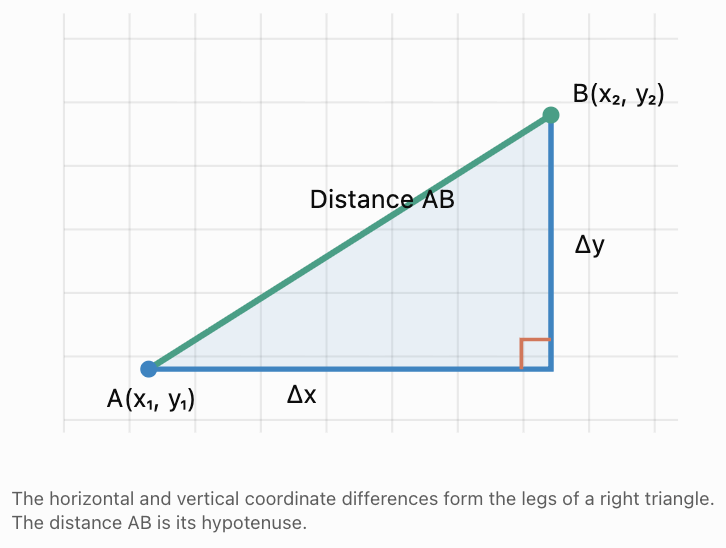
For points A(x₁, y₁) and B(x₂, y₂):
AB = √((x₂ − x₁)² + (y₂ − y₁)²)
The distance formula comes from Pythagoras' theorem.
Midpoint Formula
The midpoint of segment AB is:
M = ((x₁ + x₂)/2, (y₁ + y₂)/2)
The midpoint formula is useful for proving that diagonals bisect each other and identifying centres of symmetry.
Slope Formula
For a nonvertical line through A(x₁, y₁) and B(x₂, y₂):
m = (y₂ − y₁)/(x₂ − x₁)
The slope describes the direction of a line.
For distinct nonvertical lines:
-
Equal slopes establish parallelism.
-
Negative reciprocal slopes establish perpendicularity when both slopes are nonzero.
-
A horizontal line is perpendicular to a vertical line.
A vertical line has undefined slope.
Using Distance to Prove Equal Lengths
Two segments have equal lengths if their calculated distances are equal.
Worked Example 1: Proving an Isosceles Triangle
Triangle ABC has vertices:
A(0, 5)
B(−3, 0)
C(3, 0).
Prove that triangle ABC is isosceles.
Step 1: Calculate AB.
AB = √((−3 − 0)² + (0 − 5)²)
AB = √(9 + 25)
AB = √34.
Step 2: Calculate AC.
AC = √((3 − 0)² + (0 − 5)²)
AC = √(9 + 25)
AC = √34.
Step 3: Compare.
AB = AC.
Conclusion: Triangle ABC is isosceles because it has two equal sides.
Notice that the coordinates also show reflection symmetry across the y-axis, giving another way to understand the result.
Using Midpoints to Prove Geometric Relationships
A segment is bisected when it is divided into two equal parts.
If two diagonals share the same midpoint, they bisect each other.
Worked Example 2: Proving Diagonals Bisect Each Other
Consider quadrilateral ABCD:
A(1, 1)
B(7, 3)
C(9, 9)
D(3, 7).
Find the midpoint of AC:
M_AC = ((1 + 9)/2, (1 + 9)/2)
M_AC = (5, 5).
Find the midpoint of BD:
M_BD = ((7 + 3)/2, (3 + 7)/2)
M_BD = (5, 5).
The diagonals have the same midpoint.
Therefore, they bisect each other.
A quadrilateral whose diagonals bisect each other is a parallelogram.
Conclusion: ABCD is a parallelogram.
This proof uses the converse of a standard parallelogram theorem.
Proving Parallel Lines Using Slopes
Two distinct nonvertical lines are parallel when they have equal slopes.
For example:
Line AB has slope 2.
Line CD has slope 2.
If the lines are distinct, then:
AB ∥ CD
The symbol ∥ means is parallel to.
Worked Example 3: Proving Opposite Sides Are Parallel
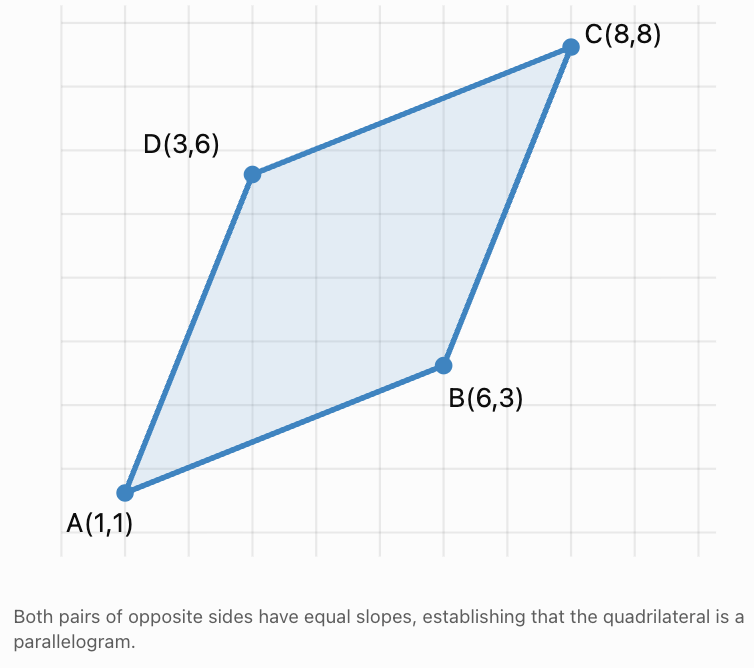
Quadrilateral ABCD has vertices:
A(1, 1)
B(6, 3)
C(8, 8)
D(3, 6).
Prove that ABCD is a parallelogram.
Step 1: Calculate the slope of AB.
m_AB = (3 − 1)/(6 − 1)
m_AB = 2/5.
Step 2: Calculate the slope of CD.
m_CD = (6 − 8)/(3 − 8)
m_CD = −2/−5 = 2/5.
Therefore:
AB ∥ CD.
Step 3: Calculate the slope of BC.
m_BC = (8 − 3)/(8 − 6)
m_BC = 5/2.
Step 4: Calculate the slope of AD.
m_AD = (6 − 1)/(3 − 1)
m_AD = 5/2.
Therefore:
BC ∥ AD.
Step 5: Apply the parallelogram theorem.
Both pairs of opposite sides are parallel.
Conclusion: ABCD is a parallelogram.
An Important Detail: Equal Slopes Are Not Always Enough
If two lines have equal slopes, they may be parallel or coincident.
For example:
y = 2x + 1
and
y = 2x + 1
describe the same line.
To establish that two lines are distinct and parallel, verify that they are not coincident. In a nondegenerate quadrilateral, distinct opposite sides are normally clear from the vertex coordinates.
Proving Perpendicular Lines Algebraically
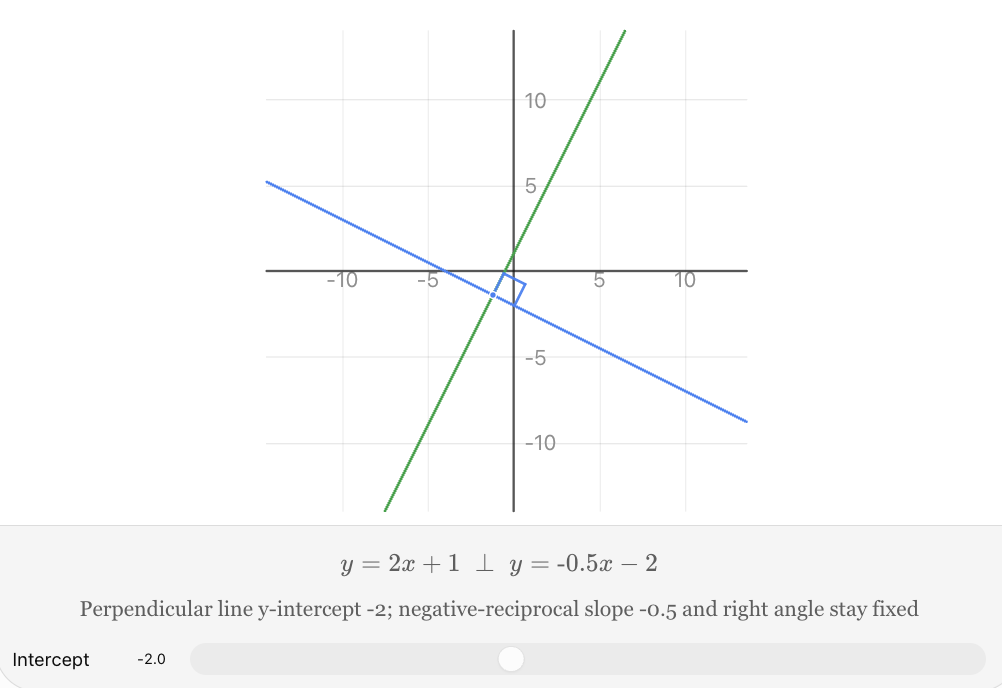
Two lines are perpendicular if they intersect at 90°.
For nonvertical, nonhorizontal lines:
m₁ × m₂ = −1
This is called the negative reciprocal slope relationship.
Worked Example 4: Proving a Right Triangle
Triangle ABC has vertices:
A(1, 2)
B(5, 4)
C(3, 8).
Prove that the triangle is right-angled.
Step 1: Calculate the slope of AB.
m_AB = (4 − 2)/(5 − 1)
m_AB = 2/4 = 1/2.
Step 2: Calculate the slope of BC.
m_BC = (8 − 4)/(3 − 5)
m_BC = 4/−2 = −2.
Step 3: Multiply the slopes.
m_AB × m_BC = (1/2)(−2)
= −1.
Therefore:
AB ⟂ BC.
Conclusion: Triangle ABC is right-angled at B.
Alternative Proof Using Pythagoras
Calculate the squared side lengths.
AB² = (5 − 1)² + (4 − 2)²
AB² = 16 + 4 = 20.
BC² = (3 − 5)² + (8 − 4)²
BC² = 4 + 16 = 20.
AC² = (3 − 1)² + (8 − 2)²
AC² = 4 + 36 = 40.
Since:
AB² + BC² = AC²
20 + 20 = 40.
By the converse of Pythagoras' theorem, ∠ABC = 90°.
Both methods establish the same conclusion.
Special Case: Horizontal and Vertical Lines
Suppose:
A(2, 3), B(8, 3), C(8, 9).
AB is horizontal because its endpoints have equal y-coordinates.
BC is vertical because its endpoints have equal x-coordinates.
Horizontal and vertical lines are perpendicular.
Therefore, ∠ABC = 90°.
We do not use the slope product rule here because the slope of BC is undefined.
Proving Congruence Using Coordinates
Two figures are congruent if they have the same shape and size.
Corresponding sides and angles are equal.
For triangles, we can use coordinate calculations together with standard congruence theorems.
|
Congruence theorem |
What must be established |
|---|---|
|
SSS |
Three pairs of corresponding sides are equal |
|
SAS |
Two pairs of corresponding sides and the included angle are equal |
|
ASA |
Two pairs of corresponding angles and the included side are equal |
|
AAS |
Two pairs of corresponding angles and a non-included side are equal |
|
RHS / HL |
Two right triangles have equal hypotenuses and one corresponding leg |
In coordinate geometry, SSS is often particularly convenient because distances can be calculated directly.
Worked Example 5: Proving Triangles Congruent Using SSS
Triangle ABC has vertices:
A(0, 0), B(4, 0), C(1, 3).
Triangle DEF has vertices:
D(6, 1), E(10, 1), F(7, 4).
Prove that the triangles are congruent.
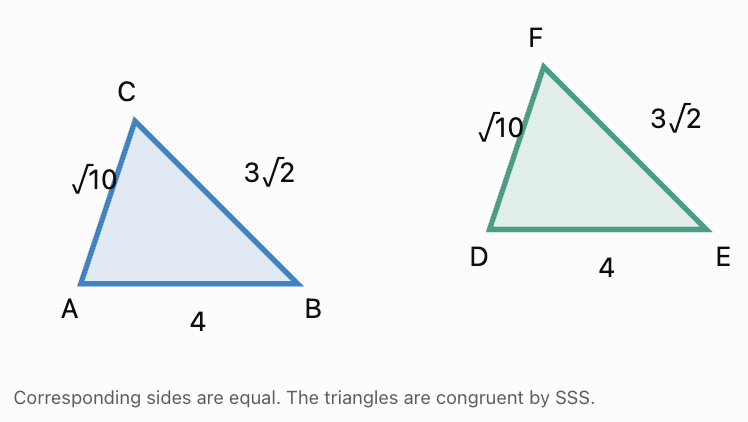
Step 1: Calculate the sides of ABC.
AB = √((4 − 0)² + (0 − 0)²) = 4.
AC = √((1 − 0)² + (3 − 0)²) = √10.
BC = √((1 − 4)² + (3 − 0)²) = √18 = 3√2.
Step 2: Calculate the sides of DEF.
DE = √((10 − 6)² + (1 − 1)²) = 4.
DF = √((7 − 6)² + (4 − 1)²) = √10.
EF = √((7 − 10)² + (4 − 1)²) = √18 = 3√2.
Step 3: Compare corresponding sides.
AB = DE
AC = DF
BC = EF.
All three pairs of corresponding sides are equal.
Conclusion: △ABC ≅ △DEF by SSS congruence.
The symbol ≅ means is congruent to.
Worked Example 6: Proving Congruence Using SAS
Consider triangles ABC and DEF with:
A(0, 0), B(5, 0), C(0, 3)
D(2, 2), E(7, 2), F(2, 5).
Step 1: Establish one pair of equal sides.
AB = 5
DE = 5.
Step 2: Establish another pair of equal sides.
AC = 3
DF = 3.
Step 3: Establish the included angles.
AB and DE are horizontal.
AC and DF are vertical.
Therefore:
∠BAC = ∠EDF = 90°.
The included angles are equal.
Conclusion: △ABC ≅ △DEF by SAS congruence.
This proof combines distances and perpendicularity.
Using Coordinates to Prove Properties of Quadrilaterals
Coordinate proofs are especially effective for classifying quadrilaterals.
A useful strategy is to prove the simplest sufficient conditions rather than calculate every possible property.
|
Figure |
Sufficient conditions |
|---|---|
|
Parallelogram |
Both pairs of opposite sides parallel |
|
Rectangle |
Parallelogram with one right angle |
|
Rhombus |
Parallelogram with two adjacent sides equal |
|
Square |
Rectangle with two adjacent sides equal |
|
Kite |
Two distinct pairs of adjacent equal sides |
|
Isosceles trapezoid |
Exactly one pair of parallel sides and equal nonparallel sides, using the exclusive definition |
Worked Example 7: Proving a Rectangle
Quadrilateral ABCD has vertices:
A(1, 1)
B(5, 3)
C(3, 7)
D(−1, 5).
Step 1: Prove opposite sides parallel.
m_AB = (3 − 1)/(5 − 1) = 1/2.
m_CD = (5 − 7)/(−1 − 3) = 1/2.
Therefore, AB ∥ CD.
m_BC = (7 − 3)/(3 − 5) = −2.
m_AD = (5 − 1)/(−1 − 1) = −2.
Therefore, BC ∥ AD.
ABCD is a parallelogram.
Step 2: Prove one right angle.
m_AB × m_BC = (1/2)(−2) = −1.
Therefore, AB ⟂ BC.
Conclusion: ABCD is a rectangle because it is a parallelogram with a right angle.
Worked Example 8: Proving a Square
Consider:
A(0, 0), B(4, 2), C(2, 6), D(−2, 4).
Step 1: Calculate the side lengths.
AB² = 4² + 2² = 20.
BC² = (−2)² + 4² = 20.
CD² = (−4)² + (−2)² = 20.
DA² = 2² + (−4)² = 20.
Therefore:
AB = BC = CD = DA = √20.
All four sides are equal.
Step 2: Prove one right angle.
m_AB = 2/4 = 1/2.
m_BC = 4/(−2) = −2.
Their product is −1.
Therefore, AB ⟂ BC.
A quadrilateral with four equal sides is a rhombus, and a rhombus with a right angle is a square.
Conclusion: ABCD is a square.
This is a shorter proof than separately establishing every angle and both pairs of parallel sides.
Using Diagonals in Coordinate Proofs
Diagonals provide another powerful way to prove quadrilateral properties.
Important Diagonal Theorems
-
In a parallelogram, the diagonals bisect each other.
-
In a rectangle, the diagonals are equal and bisect each other.
-
In a rhombus, the diagonals bisect each other at right angles.
-
In a square, the diagonals are equal, perpendicular, and bisect each other.
These properties also have useful converses when combined with the appropriate conditions.
Worked Example 9: Proving a Rectangle Using Diagonals
Quadrilateral ABCD has vertices:
A(0, 0), B(6, 0), C(6, 4), D(0, 4).
Step 1: Find the midpoint of AC.
M_AC = ((0 + 6)/2, (0 + 4)/2)
M_AC = (3, 2).
Step 2: Find the midpoint of BD.
M_BD = ((6 + 0)/2, (0 + 4)/2)
M_BD = (3, 2).
The diagonals bisect each other, so ABCD is a parallelogram.
Step 3: Compare diagonal lengths.
AC = √(6² + 4²) = √52.
BD = √((0 − 6)² + (4 − 0)²) = √52.
Therefore, AC = BD.
A parallelogram with equal diagonals is a rectangle.
Conclusion: ABCD is a rectangle.
Choosing Coordinates for an Efficient Proof
Sometimes a geometry problem gives a diagram but no coordinates.
In these cases, we can choose coordinates strategically.
The aim is to simplify the calculations without restricting the generality of the figure.
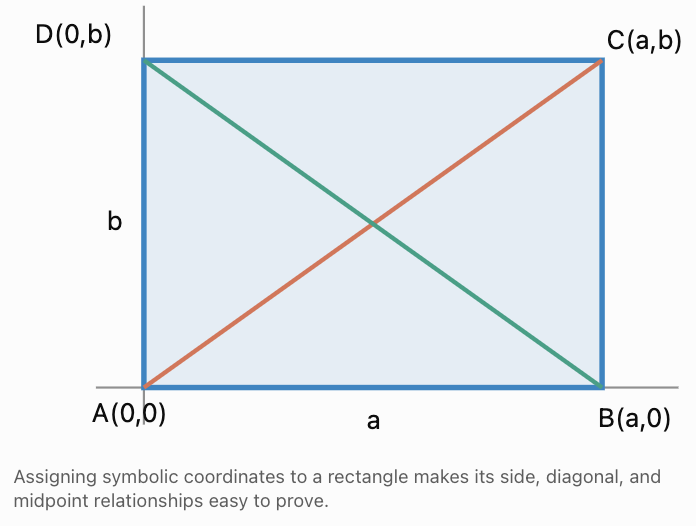
For example, a general rectangle with width a and height b can be represented by:
A(0, 0)
B(a, 0)
C(a, b)
D(0, b)
where a > 0 and b > 0.
This is convenient because two sides lie on the coordinate axes.
Worked Example 10: Proving Rectangle Diagonals Are Equal
Use the general rectangle:
A(0, 0)
B(a, 0)
C(a, b)
D(0, b).
Calculate AC:
AC = √((a − 0)² + (b − 0)²)
AC = √(a² + b²).
Calculate BD:
BD = √((0 − a)² + (b − 0)²)
BD = √(a² + b²).
Therefore:
AC = BD.
Conclusion: The diagonals of every rectangle are equal in length.
Unlike a proof using one numerical rectangle, this symbolic coordinate proof establishes the result for all rectangles.
Proving the Midsegment Theorem
The triangle midsegment theorem states that the segment joining the midpoints of two sides of a triangle is parallel to the third side and half its length.
Worked Example 11: General Coordinate Proof
Let triangle ABC have vertices:
A(0, 0)
B(2a, 0)
C(2b, 2c)
where a > 0 and c ≠ 0.
Let M be the midpoint of AB and N the midpoint of AC.
Step 1: Find M.
M = ((0 + 2a)/2, (0 + 0)/2)
M = (a, 0).
Step 2: Find N.
N = ((0 + 2b)/2, (0 + 2c)/2)
N = (b, c).
Step 3: Compare direction vectors.
Vector MN = (b − a, c).
Vector BC = (2b − 2a, 2c).
Therefore:
Vector BC = 2 × Vector MN.
The direction vectors are scalar multiples, so MN ∥ BC.
Step 4: Compare lengths.
MN = √((b − a)² + c²).
BC = √((2b − 2a)² + (2c)²)
BC = 2√((b − a)² + c²).
Therefore:
MN = BC/2.
Conclusion: The segment joining two side midpoints is parallel to the third side and half its length.
This proof is general because a, b, and c represent variable coordinates.
Coordinate Proofs and Classical Geometric Proofs
There are two major approaches to proving geometric relationships.
Coordinate Proof
A coordinate proof uses algebraic calculations.
For example, to prove that the diagonals of a rectangle are equal, calculate both diagonal lengths using the distance formula.
Classical Geometric Proof
A classical Euclidean proof uses established geometric relationships, such as congruence, parallel-line angle theorems, and properties of triangles.
For example, consider rectangle ABCD.
Triangles ABC and BAD have:
-
AB as a common side.
-
BC = AD because opposite sides of a rectangle are equal.
-
∠ABC = ∠BAD = 90°.
Therefore, △ABC ≅ △BAD by SAS.
Their corresponding hypotenuses are equal:
AC = BD.
Comparing the Methods
|
Feature |
Coordinate proof |
Classical proof |
|---|---|---|
|
Main tools |
Algebra, slopes, distances, midpoints |
Angles, congruence, geometric theorems |
|
Strength |
Converts geometry into calculations |
Reveals structural geometric relationships |
|
Useful when |
Coordinates or algebraic models are available |
Angle and side relationships are clear |
|
Common difficulty |
Algebraic errors or inefficient coordinates |
Finding a suitable theorem or construction |
|
Generality |
Can prove general results with variables |
Can prove general results directly |
Neither method is automatically better.
The most efficient method depends on the information given and the relationship to be proved.
Worked Example 12: Two Proofs of the Same Result
Claim: The base angles of an isosceles triangle are equal.
Coordinate approach
Choose:
A(0, h)
B(−a, 0)
C(a, 0)
with a > 0 and h > 0.
The y-axis reflects B onto C and leaves A fixed.
Reflection preserves angles.
Therefore, the base angles at B and C are equal.
Classical approach
In △ABC:
AB = AC.
Compare △ABC with △ACB.
AB = AC.
AC = AB.
BC = CB.
The triangles are congruent by SSS.
Therefore, their corresponding base angles are equal.
Both arguments are valid, but they emphasize different mathematical ideas.
How to Communicate a Complete Coordinate Proof
A good proof is more than a collection of calculations.
Every calculation must support a logical conclusion.
Use this structure:
Given: State the coordinates and relevant information.
To prove: Identify the geometric relationship.
Calculations: Show the required slope, distance, midpoint, or other calculations.
Reasoning: State the theorem connecting those calculations to the conclusion.
Conclusion: Clearly state what has been proved.
Example of Weak Reasoning
“Both slopes are 3, so it is a parallelogram.”
This is incomplete because only one pair of sides may have been checked.
Improved Reasoning
“AB and CD have equal slopes, so they are parallel. BC and AD also have equal slopes, so they are parallel. Since both pairs of opposite sides are parallel, ABCD is a parallelogram.”
The improved proof explains exactly why the conclusion follows.
Real-World Applications
Architecture and construction
Coordinate methods help verify perpendicular walls, parallel edges, and equal distances in building plans.
Surveying and mapping
Surveyors use coordinates and distances to establish property boundaries and verify geometric relationships.
Engineering and CAD
Engineers use coordinate geometry to verify dimensions, alignment, and the relationships between components.
Robotics and computer graphics
Coordinate calculations help determine whether paths intersect, components are aligned, and shapes have the required geometry.
Worked Example 13: Checking a Building Corner
A floor plan has three points:
A(2, 1)
B(10, 5)
C(7, 11).
Coordinates are measured in metres.
An engineer wants to determine whether the corner at B is exactly 90°.
Calculate:
m_AB = (5 − 1)/(10 − 2) = 4/8 = 1/2.
m_BC = (11 − 5)/(7 − 10) = 6/−3 = −2.
Since:
(1/2)(−2) = −1,
AB and BC are perpendicular.
Conclusion: The corner at B is a right angle.
Worked Example 14: Verifying a Rectangular Plot
A land survey gives:
A(0, 0)
B(12, 0)
C(12, 7)
D(0, 7).
Step 1: AB and CD are horizontal.
Step 2: BC and AD are vertical.
Step 3: Horizontal and vertical lines are perpendicular.
Therefore, all four interior angles are right angles.
Conclusion: ABCD is a rectangle.
Its area is:
A = 12 × 7 = 84 m².
Common Mistakes
Mistake 1: Trusting the Appearance of a Diagram
A shape may look like a square or right triangle without actually being one.
Use exact calculations.
Mistake 2: Using an Incorrect Distance Formula
Remember to square both coordinate differences before adding.
Correct:
d = √((Δx)² + (Δy)²).
Mistake 3: Reversing Only One Coordinate Difference
The slope formula must use a consistent subtraction order.
Mistake 4: Confusing Equal Slopes with Perpendicular Slopes
Equal slopes indicate parallel or coincident lines.
Negative reciprocal slopes indicate perpendicular lines.
Mistake 5: Applying the Negative Reciprocal Rule to Vertical Lines
A vertical line has undefined slope.
It is perpendicular to a horizontal line.
Mistake 6: Proving Only One Pair of Opposite Sides Parallel
This alone does not establish that a quadrilateral is a parallelogram.
Mistake 7: Assuming Equal Diagonals Always Mean a Rectangle
Some non-rectangular quadrilaterals also have equal diagonals.
First establish that the quadrilateral is a parallelogram, or use another sufficient condition.
Mistake 8: Assuming Perpendicular Diagonals Always Mean a Rhombus
Some kites have perpendicular diagonals but are not rhombuses.
Additional properties are needed.
Mistake 9: Failing to Match Corresponding Sides
When proving triangle congruence, the side correspondences must be consistent with the stated vertex order.
Mistake 10: Using SSA as a General Congruence Rule
Two sides and a non-included angle do not generally establish triangle congruence.
Mistake 11: Proving a General Theorem Using Only One Numerical Example
One rectangle with equal diagonals does not prove that all rectangles have equal diagonals.
Use general coordinates or a general classical argument.
Mistake 12: Giving Calculations Without Geometric Reasoning
Always state the theorem or property that connects the calculations to the conclusion.
Mistake 13: Making an Unjustified Classification
Proving four equal sides establishes a rhombus, not necessarily a square.
A right angle must also be established.
Mistake 14: Choosing Complicated Coordinates
When coordinates are not supplied, place a convenient vertex at the origin and align a side with an axis when possible.
Key Terms
-
Coordinate Proof: A geometric proof using coordinates and algebra.
-
Cartesian Plane: A coordinate system with perpendicular x- and y-axes.
-
Ordered Pair: Coordinates written as (x, y).
-
Distance Formula: Formula for calculating the distance between two points.
-
Midpoint Formula: Formula for locating the midpoint of a segment.
-
Slope: The ratio of vertical change to horizontal change.
-
Parallel Lines: Distinct coplanar lines that never intersect.
-
Perpendicular Lines: Lines that intersect at 90°.
-
Negative Reciprocal: The reciprocal of a number with the opposite sign.
-
Collinear Points: Points lying on the same line.
-
Congruence: Equality of shape and size.
-
SSS Congruence: Triangle congruence established by three equal corresponding sides.
-
SAS Congruence: Triangle congruence established by two sides and their included angle.
-
ASA Congruence: Triangle congruence established by two angles and their included side.
-
AAS Congruence: Triangle congruence established by two angles and a corresponding non-included side.
-
RHS / HL Congruence: Congruence of right triangles with equal hypotenuses and one equal corresponding leg.
-
Parallelogram: A quadrilateral with both pairs of opposite sides parallel.
-
Rectangle: A quadrilateral with four right angles.
-
Rhombus: A quadrilateral with four equal sides.
-
Square: A quadrilateral with four equal sides and four right angles.
-
Diagonal: A segment joining two nonadjacent vertices of a polygon.
-
Bisect: To divide into two equal parts.
-
Perpendicular Bisector: A perpendicular line through a segment's midpoint.
-
Midsegment: A segment joining the midpoints of two sides of a triangle.
-
Converse: A statement formed by reversing the hypothesis and conclusion of another statement.
-
Theorem: A mathematical statement established by proof.
-
Classical Proof: A geometric proof based on Euclidean relationships and theorems.
-
General Proof: A proof that establishes a statement for every case satisfying its assumptions.
-
Counterexample: An example showing that a general statement is false.
-
Logical Justification: Reasoning that explains why a conclusion follows from known facts.
Key Takeaways
-
Coordinate proofs connect algebra and geometry.
-
The distance formula establishes lengths and equal sides.
-
The midpoint formula establishes bisection and central relationships.
-
The slope formula establishes parallelism and perpendicularity.
-
Equal slopes establish parallelism for distinct nonvertical lines.
-
Negative reciprocal slopes establish perpendicularity when both slopes are defined and nonzero.
-
Horizontal and vertical lines are perpendicular.
-
Triangle congruence can be proved using coordinate calculations and congruence theorems.
-
SSS is often an efficient coordinate congruence method.
-
Parallelograms can be proved using slopes or diagonal midpoints.
-
Rectangles can be proved by establishing a parallelogram with a right angle.
-
Squares require both equal sides and right angles.
-
Diagonal relationships provide alternative proof strategies.
-
General coordinates can establish results for entire classes of figures.
-
Classical and coordinate proofs can establish the same geometric theorem.
-
A proof must explain why calculations support its conclusion.
-
A diagram alone is not sufficient evidence.
-
Efficient proofs use the minimum sufficient conditions.
-
Coordinate methods are useful in engineering, mapping, architecture, and computer graphics.
-
Mathematical conclusions should always follow logically from established facts.
Check Your Understanding
Show complete calculations and justify every geometric conclusion.
Question 1: Distance Formula
Find the distance between A(−2, 3) and B(4, 11).
Question 2: Midpoint Formula
Find the midpoint of the segment joining P(−5, 7) and Q(9, −1).
Question 3: Parallel Lines
Determine whether AB and CD are parallel.
A(1, 2), B(5, 10)
C(−3, 1), D(0, 7).
Question 4: Perpendicular Lines
Determine whether AB and BC are perpendicular.
A(1, 1), B(7, 4), C(5, 8).
Question 5: Isosceles Triangle
Triangle ABC has vertices:
A(0, 6), B(−4, 0), C(4, 0).
Prove that it is isosceles.
Question 6: Right Triangle
Triangle PQR has vertices:
P(0, 0), Q(6, 0), R(6, 8).
Prove that it is right-angled using two different methods.
Question 7: Congruence by SSS
Triangle ABC has vertices:
A(0, 0), B(3, 0), C(0, 4).
Triangle DEF has vertices:
D(5, 2), E(8, 2), F(5, 6).
Prove that the triangles are congruent.
Question 8: Congruence by SAS
Triangle ABC has vertices:
A(0, 0), B(4, 0), C(0, 5).
Triangle DEF has vertices:
D(2, 3), E(6, 3), F(2, 8).
Prove that the triangles are congruent using SAS.
Question 9: Parallelogram Proof
Quadrilateral ABCD has vertices:
A(1, 1), B(6, 2), C(8, 7), D(3, 6).
Prove that it is a parallelogram using slopes.
Question 10: Diagonal Midpoints
Quadrilateral ABCD has vertices:
A(0, 0), B(8, 2), C(10, 8), D(2, 6).
Use diagonal midpoints to prove that it is a parallelogram.
Question 11: Rectangle Proof
Quadrilateral ABCD has vertices:
A(1, 1), B(7, 4), C(5, 8), D(−1, 5).
Prove that it is a rectangle.
Question 12: Square Proof
Quadrilateral ABCD has vertices:
A(0, 0), B(3, 3), C(0, 6), D(−3, 3).
Prove that it is a square.
Question 13: Rhombus Proof
Quadrilateral ABCD has vertices:
A(0, 0), B(5, 2), C(10, 0), D(5, −2).
Prove that it is a rhombus and explain why it is not a square.
Question 14: Collinearity
Prove that the points A(−2, −3), B(1, 3), and C(4, 9) are collinear.
Question 15: Perpendicular Bisector
Find the equation of the perpendicular bisector of the segment joining A(2, 1) and B(8, 5).
Question 16: Classical Versus Coordinate Proof
Explain two different ways to prove that the diagonals of a rectangle are equal:
a) Using coordinates.
b) Using classical geometry.
Question 17: General Coordinate Proof
A rectangle has vertices:
A(0, 0), B(a, 0), C(a, b), D(0, b)
where a > 0 and b > 0.
Prove that its diagonals bisect each other.
Question 18: Comprehensive Challenge
Quadrilateral ABCD has vertices:
A(0, 0)
B(6, 2)
C(4, 8)
D(−2, 6).
a) Calculate the slopes of all four sides.
b) Prove that ABCD is a parallelogram.
c) Prove that one interior angle is 90°.
d) Calculate the lengths of AB and BC.
e) Classify the quadrilateral as precisely as possible.
f) Find the midpoint of both diagonals.
g) Explain which calculations were necessary to prove the classification and which provided additional confirmation.
Fully Worked Answers
Answer 1: Distance Formula
A(−2, 3), B(4, 11).
AB = √((4 − (−2))² + (11 − 3)²)
AB = √(6² + 8²)
AB = √100
Answer: AB = 10 units.
Answer 2: Midpoint Formula
P(−5, 7), Q(9, −1).
M = ((−5 + 9)/2, (7 + (−1))/2)
M = (4/2, 6/2)
Answer: M(2, 3).
Answer 3: Parallel Lines
m_AB = (10 − 2)/(5 − 1) = 8/4 = 2.
m_CD = (7 − 1)/(0 − (−3)) = 6/3 = 2.
The slopes are equal.
The lines are distinct because C does not lie on AB.
Conclusion: AB ∥ CD.
Answer 4: Perpendicular Lines
m_AB = (4 − 1)/(7 − 1) = 3/6 = 1/2.
m_BC = (8 − 4)/(5 − 7) = 4/−2 = −2.
Multiply:
(1/2)(−2) = −1.
Conclusion: AB ⟂ BC.
Answer 5: Isosceles Triangle
A(0, 6), B(−4, 0), C(4, 0).
AB = √((−4)² + (−6)²)
AB = √52.
AC = √(4² + (−6)²)
AC = √52.
Therefore:
AB = AC.
Conclusion: △ABC is isosceles.
Answer 6: Right Triangle
P(0, 0), Q(6, 0), R(6, 8).
Method 1: Slopes and directions
PQ is horizontal because both points have y-coordinate 0.
QR is vertical because both points have x-coordinate 6.
Horizontal and vertical lines are perpendicular.
Therefore, ∠PQR = 90°.
Method 2: Pythagoras
PQ = 6.
QR = 8.
PR = √(6² + 8²) = 10.
Since:
6² + 8² = 10²,
the converse of Pythagoras' theorem establishes that the triangle is right-angled at Q.
Answer 7: SSS Congruence
Triangle ABC:
AB = 3.
AC = 4.
BC = √(3² + 4²) = 5.
Triangle DEF:
DE = 3.
DF = 4.
EF = √(3² + 4²) = 5.
Thus:
AB = DE
AC = DF
BC = EF.
Conclusion: △ABC ≅ △DEF by SSS.
Answer 8: SAS Congruence
Triangle ABC:
AB = 4.
AC = 5.
AB is horizontal and AC is vertical, so ∠BAC = 90°.
Triangle DEF:
DE = 4.
DF = 5.
DE is horizontal and DF is vertical, so ∠EDF = 90°.
Therefore:
AB = DE
AC = DF
∠BAC = ∠EDF.
Conclusion: △ABC ≅ △DEF by SAS.
Answer 9: Parallelogram Proof
A(1, 1), B(6, 2), C(8, 7), D(3, 6).
m_AB = (2 − 1)/(6 − 1) = 1/5.
m_CD = (6 − 7)/(3 − 8) = 1/5.
Therefore, AB ∥ CD.
m_BC = (7 − 2)/(8 − 6) = 5/2.
m_AD = (6 − 1)/(3 − 1) = 5/2.
Therefore, BC ∥ AD.
Conclusion: ABCD is a parallelogram because both pairs of opposite sides are parallel.
Answer 10: Diagonal Midpoints
A(0, 0), B(8, 2), C(10, 8), D(2, 6).
Midpoint of AC:
M_AC = ((0 + 10)/2, (0 + 8)/2)
M_AC = (5, 4).
Midpoint of BD:
M_BD = ((8 + 2)/2, (2 + 6)/2)
M_BD = (5, 4).
The diagonals have the same midpoint.
Therefore, they bisect each other.
Conclusion: ABCD is a parallelogram.
Answer 11: Rectangle Proof
A(1, 1), B(7, 4), C(5, 8), D(−1, 5).
Calculate slopes:
m_AB = (4 − 1)/(7 − 1) = 1/2.
m_CD = (5 − 8)/(−1 − 5) = 1/2.
m_BC = (8 − 4)/(5 − 7) = −2.
m_AD = (5 − 1)/(−1 − 1) = −2.
Opposite sides are parallel, so ABCD is a parallelogram.
Next:
m_AB × m_BC = (1/2)(−2) = −1.
Therefore, AB ⟂ BC.
Conclusion: ABCD is a rectangle because it is a parallelogram with one right angle.
Answer 12: Square Proof
A(0, 0), B(3, 3), C(0, 6), D(−3, 3).
Calculate squared side lengths:
AB² = 3² + 3² = 18.
BC² = (−3)² + 3² = 18.
CD² = (−3)² + (−3)² = 18.
DA² = 3² + (−3)² = 18.
All four sides are equal.
Next:
m_AB = 3/3 = 1.
m_BC = 3/(−3) = −1.
Their product is −1.
Therefore, AB ⟂ BC.
Conclusion: ABCD is a square because it has four equal sides and a right angle.
Answer 13: Rhombus Proof
A(0, 0), B(5, 2), C(10, 0), D(5, −2).
Squared side lengths:
AB² = 5² + 2² = 29.
BC² = 5² + (−2)² = 29.
CD² = (−5)² + (−2)² = 29.
DA² = (−5)² + 2² = 29.
All four sides have length √29.
Therefore, ABCD is a rhombus.
To determine whether it is a square:
m_AB = 2/5.
m_BC = −2/5.
Their product is:
(2/5)(−2/5) = −4/25.
This is not −1.
Therefore, adjacent sides are not perpendicular.
Conclusion: ABCD is a rhombus but not a square.
Answer 14: Collinearity
A(−2, −3), B(1, 3), C(4, 9).
m_AB = (3 − (−3))/(1 − (−2))
m_AB = 6/3 = 2.
m_BC = (9 − 3)/(4 − 1)
m_BC = 6/3 = 2.
The segments have equal slopes and share point B.
Conclusion: A, B, and C are collinear.
Answer 15: Perpendicular Bisector
A(2, 1), B(8, 5).
Midpoint:
M = ((2 + 8)/2, (1 + 5)/2)
M = (5, 3).
Slope AB:
m_AB = (5 − 1)/(8 − 2)
m_AB = 4/6 = 2/3.
Perpendicular slope:
m = −3/2.
Use point-slope form:
y − 3 = −(3/2)(x − 5)
y − 3 = −3x/2 + 15/2
y = −3x/2 + 21/2.
Answer: y = −(3/2)x + 21/2.
Equivalent standard form:
3x + 2y = 21.
Answer 16: Classical Versus Coordinate Proof
a) Coordinate method
Assign rectangle vertices:
A(0, 0), B(a, 0), C(a, b), D(0, b).
Calculate:
AC = √(a² + b²).
BD = √((−a)² + b²) = √(a² + b²).
Therefore:
AC = BD.
b) Classical method
Consider triangles ABC and BAD.
AB is common.
BC = AD because opposite sides of a rectangle are equal.
∠ABC = ∠BAD = 90°.
The triangles are congruent by SAS.
Their corresponding hypotenuses are equal.
Therefore:
AC = BD.
Both proofs establish the same result.
Answer 17: General Coordinate Proof
Rectangle vertices:
A(0, 0)
B(a, 0)
C(a, b)
D(0, b).
Midpoint of AC:
M_AC = ((0 + a)/2, (0 + b)/2)
M_AC = (a/2, b/2).
Midpoint of BD:
M_BD = ((a + 0)/2, (0 + b)/2)
M_BD = (a/2, b/2).
Both diagonals have the same midpoint.
Conclusion: The diagonals of a rectangle bisect each other.
Because a and b are arbitrary positive dimensions, the proof applies to every rectangle.
Answer 18: Comprehensive Challenge
A(0, 0), B(6, 2), C(4, 8), D(−2, 6).
a) Calculate the slopes.
m_AB = 2/6 = 1/3.
m_BC = (8 − 2)/(4 − 6) = 6/−2 = −3.
m_CD = (6 − 8)/(−2 − 4) = −2/−6 = 1/3.
m_DA = (0 − 6)/(0 − (−2)) = −6/2 = −3.
b) Prove parallelogram.
m_AB = m_CD = 1/3.
Therefore, AB ∥ CD.
m_BC = m_DA = −3.
Therefore, BC ∥ AD.
Both pairs of opposite sides are parallel.
Thus, ABCD is a parallelogram.
c) Prove a right angle.
m_AB × m_BC = (1/3)(−3) = −1.
Therefore, AB ⟂ BC.
So ∠ABC = 90°.
d) Calculate AB and BC.
AB = √((6 − 0)² + (2 − 0)²)
AB = √40 = 2√10.
BC = √((4 − 6)² + (8 − 2)²)
BC = √40 = 2√10.
Therefore:
AB = BC.
e) Classify the quadrilateral.
ABCD is a parallelogram with a right angle, so it is a rectangle.
It also has equal adjacent sides.
Therefore:
ABCD is a square.
f) Find diagonal midpoints.
Midpoint of AC:
M_AC = ((0 + 4)/2, (0 + 8)/2)
M_AC = (2, 4).
Midpoint of BD:
M_BD = ((6 + (−2))/2, (2 + 6)/2)
M_BD = (2, 4).
Both diagonals share midpoint (2, 4).
g) Necessary and additional calculations
The slopes proved that ABCD is a parallelogram with a right angle.
The side lengths established that adjacent sides are equal.
Together, these results were sufficient to prove that ABCD is a square.
The diagonal midpoint calculations provided additional confirmation of its parallelogram structure but were not necessary once the square had been established.
Final Course Connections
Coordinate proof brings together several major mathematical ideas: algebra, coordinate geometry, transformations, congruence, and deductive reasoning.
The most important skill is not simply calculating slopes or distances. It is knowing which calculations are needed, which theorem they support, and how to turn the results into a complete mathematical argument.
Coordinate methods and classical geometric proofs complement one another. Learning both approaches develops flexibility and strengthens mathematical reasoning.
This completes Coordinate Proof, covering all five learning targets with comprehensive explanations, diagrams, worked examples, applications, common mistakes, key terms, key takeaways, and fully worked assessment questions.