Coordinate Geometry and Transformations
| サイト: | Young Education |
| コース: | Geometry and Proof |
| ブック: | Coordinate Geometry and Transformations |
| 印刷者: | Guest user |
| 日付: | 2026年 11月 9日(月曜日) 16:36 |
1. Distance and Midpoint
Learning outcomes
- I can calculate distances between points.
- I can determine midpoint coordinates.
- I can apply coordinate geometry formulas.
- I can solve geometric problems on the coordinate plane.
- I can interpret geometric relationships using coordinates.
Introduction
Imagine looking at a map and trying to determine the shortest distance between two locations. Or suppose an engineer needs to find the exact centre of a bridge, a designer wants to position an object halfway between two points, or a computer programmer needs to calculate the distance between objects on a screen.
All these problems can be solved using coordinate geometry.
Coordinate geometry connects algebra and geometry by representing points, lines, and shapes using numbers and equations.
Two of its most useful tools are the distance formula and the midpoint formula.
The distance formula calculates the straight-line distance between two points, while the midpoint formula identifies the point exactly halfway between them.
Together, these formulas allow us to investigate triangles, quadrilaterals, circles, symmetry, and many practical measurement problems.
The Cartesian Coordinate Plane
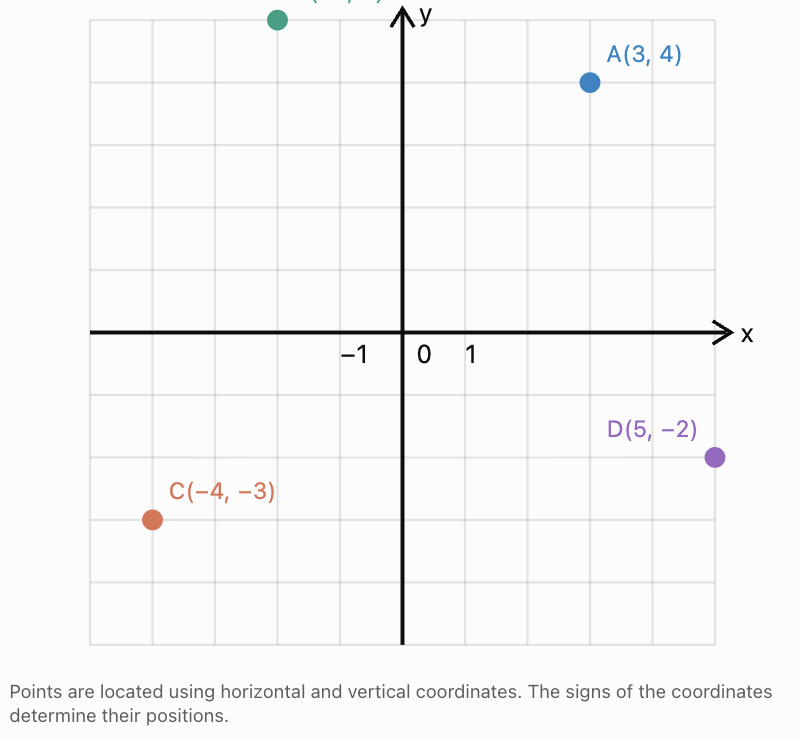
The Cartesian coordinate plane consists of two perpendicular number lines:
-
The x-axis is horizontal.
-
The y-axis is vertical.
They intersect at the origin, (0, 0).
Every point is represented by an ordered pair:
(x, y)
The first coordinate tells us how far to move horizontally from the origin.
The second coordinate tells us how far to move vertically.
For example:
-
A(3, 4) is 3 units right and 4 units up.
-
B(−2, 5) is 2 units left and 5 units up.
-
C(−4, −3) is 4 units left and 3 units down.
-
D(5, −2) is 5 units right and 2 units down.
Horizontal and Vertical Distances
Before calculating distances between arbitrary points, we should understand horizontal and vertical distances.
Horizontal Distance
For two points with the same y-coordinate:
A(x₁, y) and B(x₂, y)
The distance is:
d = |x₂ − x₁|
The vertical bars indicate absolute value.
Worked Example 1: Horizontal Distance
Find the distance between:
A(−3, 4) and B(5, 4).
The y-coordinates are equal, so the points lie on a horizontal line.
d = |5 − (−3)|
d = |8|
Answer: 8 units.
Vertical Distance
For two points with the same x-coordinate:
A(x, y₁) and B(x, y₂)
The distance is:
d = |y₂ − y₁|
Worked Example 2: Vertical Distance
Find the distance between:
C(2, −5) and D(2, 3).
The x-coordinates are equal.
d = |3 − (−5)|
d = |8|
Answer: 8 units.
Deriving the Distance Formula
Suppose two points are not on the same horizontal or vertical line.
Let:
A(x₁, y₁)
B(x₂, y₂)
Draw a horizontal line from A and a vertical line from B until they meet.
This creates a right-angled triangle.
Its horizontal side has length:
|x₂ − x₁|
Its vertical side has length:
|y₂ − y₁|
The straight-line distance AB is the hypotenuse.
By the Pythagorean theorem:
AB² = (x₂ − x₁)² + (y₂ − y₁)²
Taking the positive square root gives the distance formula.
The squared differences ensure that negative coordinate differences do not produce negative contributions to distance.
Worked Example 3: Distance Between Two Points
Find the distance between:
A(1, 2) and B(7, 10).
Step 1: Identify coordinates.
x₁ = 1, y₁ = 2
x₂ = 7, y₂ = 10
Step 2: Calculate horizontal and vertical changes.
Δx = 7 − 1 = 6
Δy = 10 − 2 = 8
Step 3: Apply the distance formula.
d = √(6² + 8²)
d = √(36 + 64)
d = √100
Answer: 10 units.
Worked Example 4: Negative Coordinates
Find the distance between:
P(−4, −1) and Q(2, 7).
Step 1: Find coordinate differences.
Δx = 2 − (−4) = 6
Δy = 7 − (−1) = 8
Step 2: Calculate.
d = √(6² + 8²)
d = √100
Answer: 10 units.
Worked Example 5: Exact Radical Distance
Find the distance between:
A(−2, 3) and B(4, 6).
Δx = 4 − (−2) = 6
Δy = 6 − 3 = 3
d = √(6² + 3²)
d = √45
d = √(9 × 5)
d = 3√5
d ≈ 6.71
Answer: 3√5 units, or approximately 6.71 units.
When possible, give exact answers in simplified radical form before calculating decimal approximations.
Important Properties of Distance
Distance has several fundamental properties.
Non-negativity
Distance can never be negative.
AB ≥ 0
Symmetry
The distance from A to B equals the distance from B to A.
AB = BA
Zero distance
AB = 0 only when A and B represent the same point.
Triangle inequality
For any three points A, B, and C:
AB ≤ AC + CB
The direct straight-line distance cannot be greater than a route that passes through another point.
These properties help us check whether our calculations are reasonable.
The Midpoint of a Line Segment
The midpoint is the point exactly halfway between the endpoints of a line segment.
If M is the midpoint of AB, then:
AM = MB
The midpoint can be found by averaging the x-coordinates and averaging the y-coordinates.
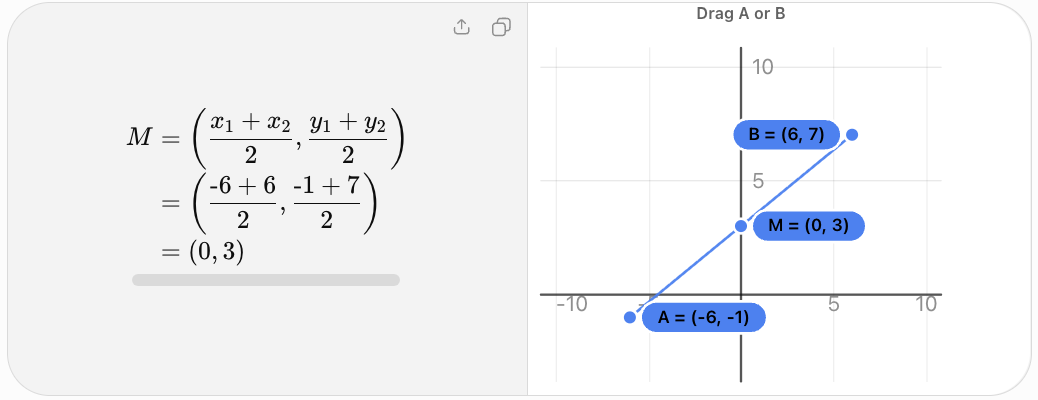
The midpoint formula is:
M = ((x₁ + x₂)/2, (y₁ + y₂)/2)
This formula works regardless of which quadrants contain the endpoints.
Why Does the Midpoint Formula Work?
Consider the endpoints:
A(x₁, y₁) and B(x₂, y₂).
To travel halfway from A to B, we move half the horizontal displacement and half the vertical displacement.
The midpoint's x-coordinate is:
x_M = x₁ + (x₂ − x₁)/2
Simplifying:
x_M = (x₁ + x₂)/2
Similarly:
y_M = y₁ + (y₂ − y₁)/2
y_M = (y₁ + y₂)/2
Therefore:
M = ((x₁ + x₂)/2, (y₁ + y₂)/2)
This demonstrates that the midpoint is the average position of the endpoints.
Worked Example 6: Finding a Midpoint
Find the midpoint of:
A(2, 4) and B(8, 10).
Step 1: Average the x-coordinates.
x_M = (2 + 8)/2 = 5
Step 2: Average the y-coordinates.
y_M = (4 + 10)/2 = 7
Answer: M(5, 7).
Worked Example 7: Midpoint with Negative Coordinates
Find the midpoint of:
P(−6, 3) and Q(4, −5).
x_M = (−6 + 4)/2 = −1
y_M = (3 + (−5))/2 = −1
Answer: M(−1, −1).
Worked Example 8: Midpoint with Fractional Coordinates
Find the midpoint of:
A(1, 2) and B(4, 7).
x_M = (1 + 4)/2 = 5/2
y_M = (2 + 7)/2 = 9/2
Answer: M(5/2, 9/2), or M(2.5, 4.5).
A midpoint does not have to have integer coordinates.
Finding a Missing Endpoint
Sometimes the midpoint and one endpoint are known, and we must determine the other endpoint.
Suppose:
A(x₁, y₁) is known.
M(mₓ, mᵧ) is the midpoint.
B(x₂, y₂) is unknown.
Starting with the midpoint formula:
mₓ = (x₁ + x₂)/2
Multiply by 2:
2mₓ = x₁ + x₂
Rearrange:
x₂ = 2mₓ − x₁
Similarly:
y₂ = 2mᵧ − y₁
Worked Example 9: Missing Endpoint
The midpoint of AB is M(3, 5).
One endpoint is A(−2, 8).
Find B.
Step 1: Calculate the missing x-coordinate.
x₂ = 2(3) − (−2)
x₂ = 6 + 2
x₂ = 8
Step 2: Calculate the missing y-coordinate.
y₂ = 2(5) − 8
y₂ = 2
Answer: B(8, 2).
Verification:
M = ((−2 + 8)/2, (8 + 2)/2)
M = (3, 5).
The calculated endpoint is correct.
Worked Example 10: Algebraic Midpoint Problem
The endpoints of a segment are:
A(2x − 1, 4)
B(7, 2y + 6).
The midpoint is M(5, 3).
Find x and y.
Step 1: Use the x-coordinate.
((2x − 1) + 7)/2 = 5
(2x + 6)/2 = 5
2x + 6 = 10
2x = 4
x = 2
Step 2: Use the y-coordinate.
(4 + 2y + 6)/2 = 3
(2y + 10)/2 = 3
2y + 10 = 6
2y = −4
y = −2
Answer: x = 2 and y = −2.
Comparing Distance and Midpoint
Although both formulas use the coordinates of two points, they answer different questions.
Feature
Distance formula
Midpoint formula
Purpose
Finds the length of a segment
Finds its halfway point
Result
A non-negative number
An ordered pair
Main operation
Square differences, add, square root
Average coordinates
Units
Length units
Coordinate units
Common applications
Side lengths, perimeters, radii
Centres, diagonals, symmetry
For example, given A(1, 1) and B(7, 9):
Distance:
AB = √(6² + 8²) = 10 units
Midpoint:
M = ((1 + 7)/2, (1 + 9)/2)
M = (4, 5).
The midpoint is 5 units from each endpoint.
Using Distance to Classify Triangles
The distance formula can be used to calculate all three sides of a triangle.
Once we know the side lengths, we can classify the triangle.
-
Equilateral: All three sides equal.
-
Isosceles: At least two sides equal.
-
Scalene: All three sides different.
-
Right-angled: The side lengths satisfy the Pythagorean theorem.
Worked Example 11: Proving a Triangle Is Isosceles
Triangle ABC has vertices:
A(0, 4)
B(−3, 0)
C(3, 0).
Prove that the triangle is isosceles.
Step 1: Find AB.
AB = √((−3 − 0)² + (0 − 4)²)
AB = √(9 + 16)
AB = 5
Step 2: Find AC.
AC = √((3 − 0)² + (0 − 4)²)
AC = √(9 + 16)
AC = 5
Since:
AB = AC
triangle ABC has two equal sides.
Conclusion: Triangle ABC is isosceles.
Worked Example 12: Proving a Triangle Is Right-Angled
Triangle PQR has vertices:
P(1, 1)
Q(5, 1)
R(5, 4).
Calculate the side lengths.
PQ = √((5 − 1)² + (1 − 1)²) = 4
QR = √((5 − 5)² + (4 − 1)²) = 3
PR = √((5 − 1)² + (4 − 1)²) = 5
Check the Pythagorean relationship:
3² + 4² = 9 + 16 = 25
5² = 25
Therefore:
PQ² + QR² = PR².
By the converse of the Pythagorean theorem, triangle PQR is right-angled at Q.
Conclusion: Triangle PQR is a right triangle.
Worked Example 13: Triangle Perimeter
A triangle has vertices:
A(0, 0)
B(6, 0)
C(3, 4).
Find its perimeter.
AB = 6
AC = √(3² + 4²) = 5
BC = √((3 − 6)² + (4 − 0)²)
BC = √(9 + 16) = 5
Perimeter = 6 + 5 + 5
Answer: 16 units.
The triangle is also isosceles because AC = BC.
Using Coordinates to Investigate Quadrilaterals
Distance and midpoint formulas can reveal important properties of quadrilaterals.
For example:
-
Equal side lengths may identify a rhombus.
-
Equal diagonals can help identify a rectangle.
-
Diagonals with the same midpoint establish that a quadrilateral is a parallelogram.
-
Four equal sides and equal diagonals can establish that a parallelogram is a square.
It is important to use enough information to justify the classification. Equal diagonals alone, for example, do not prove that a quadrilateral is a rectangle.
Worked Example 14: Proving a Quadrilateral Is a Parallelogram
Consider quadrilateral ABCD with vertices in order:
A(1, 1)
B(7, 2)
C(9, 6)
D(3, 5).
Prove that ABCD is a parallelogram.
Step 1: Find the midpoint of diagonal AC.
M_AC = ((1 + 9)/2, (1 + 6)/2)
M_AC = (5, 3.5)
Step 2: Find the midpoint of diagonal BD.
M_BD = ((7 + 3)/2, (2 + 5)/2)
M_BD = (5, 3.5)
The diagonals have the same midpoint.
Therefore, they bisect each other.
A quadrilateral whose diagonals bisect each other is a parallelogram.
Conclusion: ABCD is a parallelogram.
Worked Example 15: Proving a Quadrilateral Is a Rectangle
Consider the vertices:
A(1, 1)
B(7, 1)
C(7, 5)
D(1, 5).
Step 1: Find the diagonal midpoints.
AC midpoint:
((1 + 7)/2, (1 + 5)/2) = (4, 3)
BD midpoint:
((7 + 1)/2, (1 + 5)/2) = (4, 3)
The diagonals bisect each other, so ABCD is a parallelogram.
Step 2: Calculate diagonal lengths.
AC = √((7 − 1)² + (5 − 1)²)
AC = √52 = 2√13
BD = √((1 − 7)² + (5 − 1)²)
BD = √52 = 2√13
The diagonals are equal.
A parallelogram with equal diagonals is a rectangle.
Conclusion: ABCD is a rectangle.
Worked Example 16: Proving a Quadrilateral Is a Square
Consider:
A(−2, −2)
B(2, −2)
C(2, 2)
D(−2, 2).
Step 1: Calculate side lengths.
AB = 4
BC = 4
CD = 4
DA = 4
All four sides are equal.
Step 2: Calculate diagonals.
AC = √(4² + 4²) = 4√2
BD = √((−4)² + 4²) = 4√2
The diagonals are equal.
Step 3: Verify that diagonals bisect each other.
Midpoint of AC = (0, 0)
Midpoint of BD = (0, 0)
Therefore, the quadrilateral is a parallelogram.
It has four equal sides and equal diagonals.
A parallelogram with these properties is a square.
Conclusion: ABCD is a square.
Midpoints and Triangle Geometry
The midpoint formula is useful for studying medians and midsegments of triangles.
A median connects a vertex to the midpoint of the opposite side.
A midsegment joins the midpoints of two sides of a triangle.
The midsegment theorem states:
A segment joining the midpoints of two sides of a triangle is parallel to the third side and half its length.
Worked Example 17: Finding a Median
Triangle ABC has vertices:
A(2, 8)
B(−4, 0)
C(6, 0).
Find the length of the median from A to BC.
Step 1: Find the midpoint of BC.
M = ((−4 + 6)/2, (0 + 0)/2)
M = (1, 0)
Step 2: Find the distance AM.
AM = √((1 − 2)² + (0 − 8)²)
AM = √(1 + 64)
AM = √65
AM ≈ 8.06
Answer: The median has length √65 units, approximately 8.06 units.
Worked Example 18: Verifying the Midsegment Theorem
Triangle ABC has vertices:
A(0, 6)
B(−4, 0)
C(8, 0).
Let M be the midpoint of AB and N the midpoint of AC.
Step 1: Find M.
M = ((0 − 4)/2, (6 + 0)/2)
M = (−2, 3)
Step 2: Find N.
N = ((0 + 8)/2, (6 + 0)/2)
N = (4, 3)
Step 3: Calculate MN.
Both points have y-coordinate 3.
MN = |4 − (−2)| = 6
Step 4: Calculate BC.
BC = |8 − (−4)| = 12
Therefore:
MN = BC/2.
Both MN and BC are horizontal, so they are parallel.
Conclusion: MN is parallel to BC and half its length.
Interpreting Geometric Relationships Using Coordinates
Coordinate geometry allows us to translate geometric statements into algebraic relationships.
Equal Distances
If PA = PB, then P is equidistant from A and B.
All points equidistant from two distinct fixed points lie on the perpendicular bisector of the segment joining them.
Shared Midpoints
If the diagonals of a quadrilateral have the same midpoint, they bisect each other.
This establishes that the quadrilateral is a parallelogram.
Symmetry
The midpoint between a point and its reflected image lies on the axis of reflection, provided the reflection is across a straight line.
For example:
A(−3, 2)
B(5, 2)
Midpoint = (1, 2).
The points are reflections of each other across the vertical line x = 1.
Collinearity
Three points are collinear if they lie on the same straight line.
Distance can help verify collinearity.
If B lies between A and C, then:
AB + BC = AC.
Conversely, if this equality holds for three distinct points, B lies on segment AC.
Worked Example 19: Verifying Collinearity
Given:
A(1, 2)
B(4, 6)
C(7, 10).
Calculate:
AB = √(3² + 4²) = 5
BC = √(3² + 4²) = 5
AC = √(6² + 8²) = 10
Since:
AB + BC = AC
5 + 5 = 10
the points lie on the same straight line, with B between A and C.
Also, because AB = BC, B is the midpoint of AC.
Conclusion: The points are collinear and B is the midpoint of AC.
The Equation of a Circle from Its Centre and Radius
The distance formula also leads directly to the equation of a circle.
A circle consists of all points that are a fixed distance r from its centre.
Suppose the centre is:
C(h, k).
A point P(x, y) lies on the circle if its distance from C equals r.
Using the distance formula:
√((x − h)² + (y − k)²) = r
Square both sides:
(x − h)² + (y − k)² = r²
This is the standard equation of a circle.
Worked Example 20: Testing Whether a Point Lies on a Circle
A circle has centre C(2, −1) and radius 5.
Determine whether P(5, 3) lies on the circle.
Step 1: Calculate the distance CP.
CP = √((5 − 2)² + (3 − (−1))²)
CP = √(3² + 4²)
CP = √25
CP = 5
Step 2: Compare with the radius.
The distance from P to the centre equals the radius.
Conclusion: P lies on the circle.
The circle's equation is:
(x − 2)² + (y + 1)² = 25.
Real-World Applications
Navigation and Mapping
A map can be represented using a coordinate system.
Suppose two locations are represented by:
A(2, 3) and B(8, 11),
where each coordinate unit represents 100 m.
The coordinate differences are:
Δx = 6
Δy = 8
Distance = √(6² + 8²) = 10 coordinate units.
Converting:
10 × 100 = 1000 m.
The straight-line distance is 1 km.
The actual walking or driving route may be longer because roads do not always follow the straight-line path.
Construction and Engineering
Engineers use coordinates to determine distances between structural points and locate central positions.
For example, a support beam may need to be installed exactly halfway between two columns.
If the columns are represented by:
A(4, 2) and B(12, 6),
then the midpoint is:
M = ((4 + 12)/2, (2 + 6)/2)
M = (8, 4).
The midpoint formula gives the support location.
Computer Graphics and Game Design
Computer graphics use coordinates to position objects on a screen.
The distance formula can determine whether two objects are close enough to interact.
For example, if a character is at (3, 5) and an object is at (9, 13):
d = √(6² + 8²) = 10.
A game could use this distance to decide whether the character can interact with the object.
Sports and Field Measurements
Coordinate geometry can help analyze positions on sports fields.
Suppose a player is at (10, 15) and a target is at (34, 22), with coordinates measured in metres.
Distance:
d = √((34 − 10)² + (22 − 15)²)
d = √(24² + 7²)
d = √625
d = 25 m.
The straight-line distance is 25 m.
Robotics
Robotic systems use coordinates to locate components and calculate movements.
A robot may need to move between two positions or locate the midpoint of a component.
In three-dimensional environments, the distance formula extends to:
d = √((x₂ − x₁)² + (y₂ − y₁)² + (z₂ − z₁)²)
The two-dimensional formula studied here is the foundation for that extension.
Common Mistakes
Mistake 1: Subtracting Coordinates in the Wrong Pairings
Incorrect:
d = √((x₂ − y₁)² + (y₂ − x₁)²)
Correct:
d = √((x₂ − x₁)² + (y₂ − y₁)²)
Always subtract x-coordinates from x-coordinates and y-coordinates from y-coordinates.
Mistake 2: Forgetting Negative Signs
For example:
5 − (−3) = 8
not 2.
Use parentheses when subtracting negative coordinates.
Mistake 3: Forgetting the Square Root
The distance formula requires a square root.
If the sum of squared differences is 100, the distance is 10, not 100.
Mistake 4: Adding Instead of Averaging for a Midpoint
Incorrect:
M = (x₁ + x₂, y₁ + y₂)
Correct:
M = ((x₁ + x₂)/2, (y₁ + y₂)/2)
Mistake 5: Dividing Only One Coordinate by Two
Both the x-coordinate sum and the y-coordinate sum must be divided by 2.
Mistake 6: Confusing Distance and Midpoint
Distance produces a single number.
Midpoint produces an ordered pair.
Mistake 7: Rounding Too Early
Keep exact radical forms until the final step.
For example:
√45 = 3√5
is preferable to immediately using 6.71 in further calculations.
Mistake 8: Assuming the Midpoint Must Have Integer Coordinates
Midpoints can contain fractions or decimals.
For example, the midpoint of (1, 2) and (4, 7) is (2.5, 4.5).
Mistake 9: Using Insufficient Evidence to Classify a Shape
Equal diagonals do not automatically prove that a quadrilateral is a rectangle.
Use additional properties such as the diagonals bisecting each other.
Mistake 10: Confusing Straight-Line Distance with Travel Distance
The distance formula gives the shortest straight-line distance in a flat coordinate plane.
A real travel route may be longer.
Mistake 11: Ignoring Units and Scale
If one coordinate unit represents 50 m, a calculated distance of 8 coordinate units represents 400 m.
Mistake 12: Assuming a Diagram Is Drawn to Scale
Coordinate calculations provide precise evidence.
Visual appearance alone is not sufficient to establish equal lengths or geometric relationships.
Key Terms
-
Coordinate Geometry: The study of geometric objects using coordinates and algebra.
-
Cartesian Plane: A plane formed by two perpendicular coordinate axes.
-
Origin: The point (0, 0), where the coordinate axes intersect.
-
x-axis: The horizontal coordinate axis.
-
y-axis: The vertical coordinate axis.
-
Ordered Pair: Two numbers (x, y) specifying a point's location.
-
Quadrant: One of the four regions formed by the coordinate axes.
-
Distance: The length of the straight-line segment joining two points.
-
Distance Formula: A formula derived from the Pythagorean theorem for finding the distance between coordinate points.
-
Midpoint: The point exactly halfway between two endpoints.
-
Midpoint Formula: A formula that averages the endpoint coordinates.
-
Endpoint: A point marking the end of a line segment.
-
Line Segment: A portion of a line bounded by two endpoints.
-
Displacement: A change in position, including direction.
-
Horizontal Change: The difference between x-coordinates.
-
Vertical Change: The difference between y-coordinates.
-
Absolute Value: The non-negative distance of a number from zero.
-
Pythagorean Theorem: The relationship a² + b² = c² in a right triangle.
-
Hypotenuse: The side opposite the right angle in a right triangle.
-
Radical: An expression containing a root, such as √5.
-
Isosceles Triangle: A triangle with at least two equal sides.
-
Scalene Triangle: A triangle with three unequal sides.
-
Median: A segment connecting a triangle's vertex to the midpoint of the opposite side.
-
Midsegment: A segment joining the midpoints of two sides of a triangle.
-
Collinear Points: Points lying on the same straight line.
-
Perpendicular Bisector: A line perpendicular to a segment through its midpoint.
-
Diagonal: A segment connecting non-adjacent vertices of a polygon.
-
Symmetry: A geometric relationship in which a transformation preserves a figure's structure.
-
Circumcircle: A circle passing through all vertices of a polygon.
-
Scale: The relationship between coordinate measurements and real-world distances.
Key Takeaways
-
Every point on the Cartesian plane is represented by an ordered pair (x, y).
-
Horizontal distance is the absolute difference between x-coordinates.
-
Vertical distance is the absolute difference between y-coordinates.
-
The distance formula is derived from the Pythagorean theorem.
-
Distance is always non-negative.
-
The order of the endpoints does not affect the distance.
-
Exact radical answers should be simplified where possible.
-
The midpoint is found by averaging the x-coordinates and y-coordinates separately.
-
A midpoint is equally distant from both endpoints.
-
A missing endpoint can be found using the midpoint and the known endpoint.
-
Distance calculations can classify triangles.
-
Equal side lengths can establish that a triangle is isosceles.
-
The converse of the Pythagorean theorem can establish that a triangle is right-angled.
-
Diagonals sharing the same midpoint establish that a quadrilateral is a parallelogram.
-
Midpoints help locate medians, midsegments, and centres of symmetry.
-
Distance relationships can help verify collinearity.
-
The equation of a circle follows from the distance formula.
-
Coordinate geometry is useful in navigation, engineering, sports, robotics, and computer graphics.
-
Correct units and scale are essential in practical applications.
-
Coordinate geometry provides algebraic evidence for geometric properties.
Check Your Understanding
Show all working. Give exact answers where possible and decimal approximations when requested.
Question 1: Horizontal Distance
Find the distance between:
A(−7, 3) and B(5, 3).
Question 2: Vertical Distance
Find the distance between:
P(4, −6) and Q(4, 8).
Question 3: Distance Formula
Find the distance between:
A(2, 1) and B(8, 9).
Question 4: Negative Coordinates
Calculate the distance between:
P(−5, −2) and Q(1, 6).
Question 5: Exact Radical Distance
Find the exact distance between:
A(−3, 2) and B(4, 5).
Simplify your answer.
Question 6: Basic Midpoint
Find the midpoint of:
A(4, 6) and B(10, 14).
Question 7: Midpoint with Negative Coordinates
Find the midpoint of:
P(−8, 5) and Q(6, −3).
Question 8: Missing Endpoint
The midpoint of AB is M(4, −2).
One endpoint is A(−3, 5).
Find B.
Question 9: Algebraic Midpoint
The endpoints are:
A(2x + 1, 4)
B(9, 3y − 2).
The midpoint is M(7, 4).
Find x and y.
Question 10: Isosceles Triangle
Triangle ABC has vertices:
A(0, 5)
B(−4, 0)
C(4, 0).
Prove that ABC is isosceles.
Question 11: Right Triangle
Triangle PQR has vertices:
P(1, 2)
Q(7, 2)
R(7, 10).
Calculate the three side lengths and prove that the triangle is right-angled.
Question 12: Parallelogram Proof
Quadrilateral ABCD has vertices:
A(1, 2)
B(6, 3)
C(8, 8)
D(3, 7).
Use midpoint calculations to prove that ABCD is a parallelogram.
Question 13: Triangle Median
Triangle ABC has vertices:
A(2, 10)
B(−4, 0)
C(8, 0).
Find the length of the median from A to BC.
Question 14: Collinearity
Given:
A(−2, −1)
B(1, 3)
C(4, 7).
Use distances to prove that A, B, and C are collinear.
Question 15: Real-World Application
A park map uses a coordinate system in which one unit represents 50 m.
Two entrances are located at:
A(−3, 4)
B(9, 9).
Find:
a) The straight-line distance between the entrances in coordinate units.
b) The distance in metres.
c) The midpoint between the entrances.
Question 16: Comprehensive Challenge
A quadrilateral has vertices:
A(−2, −1)
B(4, −1)
C(4, 5)
D(−2, 5).
Use coordinate geometry to:
a) Calculate all four side lengths.
b) Calculate both diagonal lengths.
c) Find the midpoint of each diagonal.
d) Prove that the quadrilateral is a square.
e) Find the centre and radius of the circle passing through all four vertices.
f) Write the equation of that circle.
Fully Worked Answers
Answer 1: Horizontal Distance
Given:
A(−7, 3)
B(5, 3)
The y-coordinates are equal.
d = |5 − (−7)|
d = |12|
Answer: 12 units.
Answer 2: Vertical Distance
Given:
P(4, −6)
Q(4, 8)
The x-coordinates are equal.
d = |8 − (−6)|
d = |14|
Answer: 14 units.
Answer 3: Distance Formula
Given:
A(2, 1)
B(8, 9)
Horizontal change:
Δx = 8 − 2 = 6
Vertical change:
Δy = 9 − 1 = 8
Distance:
d = √(6² + 8²)
d = √100
Answer: 10 units.
Answer 4: Negative Coordinates
Given:
P(−5, −2)
Q(1, 6)
Δx = 1 − (−5) = 6
Δy = 6 − (−2) = 8
d = √(6² + 8²)
d = √100
Answer: 10 units.
Answer 5: Exact Radical Distance
Given:
A(−3, 2)
B(4, 5)
Δx = 4 − (−3) = 7
Δy = 5 − 2 = 3
d = √(7² + 3²)
d = √(49 + 9)
d = √58
Since 58 has no perfect-square factor greater than 1, the radical is already simplified.
Answer: √58 units, approximately 7.62 units.
Answer 6: Basic Midpoint
Given:
A(4, 6)
B(10, 14)
M = ((4 + 10)/2, (6 + 14)/2)
M = (14/2, 20/2)
Answer: M(7, 10).
Answer 7: Negative Coordinates
Given:
P(−8, 5)
Q(6, −3)
M = ((−8 + 6)/2, (5 − 3)/2)
M = (−2/2, 2/2)
Answer: M(−1, 1).
Answer 8: Missing Endpoint
Given:
M(4, −2)
A(−3, 5)
Let B(x, y).
Using the midpoint formula:
(−3 + x)/2 = 4
−3 + x = 8
x = 11
For the y-coordinate:
(5 + y)/2 = −2
5 + y = −4
y = −9
Answer: B(11, −9).
Verification:
M = ((−3 + 11)/2, (5 − 9)/2)
M = (4, −2).
Answer 9: Algebraic Midpoint
Given:
A(2x + 1, 4)
B(9, 3y − 2)
M(7, 4).
Step 1: Solve for x.
((2x + 1) + 9)/2 = 7
(2x + 10)/2 = 7
2x + 10 = 14
2x = 4
x = 2
Step 2: Solve for y.
(4 + 3y − 2)/2 = 4
(3y + 2)/2 = 4
3y + 2 = 8
3y = 6
y = 2
Answer: x = 2 and y = 2.
Answer 10: Isosceles Triangle
Given:
A(0, 5)
B(−4, 0)
C(4, 0).
Calculate AB:
AB = √((−4 − 0)² + (0 − 5)²)
AB = √(16 + 25)
AB = √41
Calculate AC:
AC = √((4 − 0)² + (0 − 5)²)
AC = √(16 + 25)
AC = √41
Since AB = AC, the triangle has two equal sides.
Therefore, triangle ABC is isosceles.
Answer 11: Right Triangle
Given:
P(1, 2)
Q(7, 2)
R(7, 10).
Step 1: Calculate PQ.
PQ = |7 − 1| = 6
Step 2: Calculate QR.
QR = |10 − 2| = 8
Step 3: Calculate PR.
PR = √((7 − 1)² + (10 − 2)²)
PR = √(36 + 64)
PR = 10
Step 4: Apply the converse of the Pythagorean theorem.
PQ² + QR² = 6² + 8²
= 36 + 64
= 100
PR² = 10² = 100
Therefore:
PQ² + QR² = PR².
Conclusion: Triangle PQR is right-angled at Q.
Answer 12: Parallelogram Proof
Given:
A(1, 2)
B(6, 3)
C(8, 8)
D(3, 7).
Step 1: Find the midpoint of AC.
M_AC = ((1 + 8)/2, (2 + 8)/2)
M_AC = (4.5, 5)
Step 2: Find the midpoint of BD.
M_BD = ((6 + 3)/2, (3 + 7)/2)
M_BD = (4.5, 5)
The diagonals have the same midpoint.
Therefore, the diagonals bisect each other.
A quadrilateral whose diagonals bisect each other is a parallelogram.
Conclusion: ABCD is a parallelogram.
Answer 13: Triangle Median
Given:
A(2, 10)
B(−4, 0)
C(8, 0).
Step 1: Find the midpoint of BC.
M = ((−4 + 8)/2, (0 + 0)/2)
M = (2, 0)
Step 2: Calculate AM.
AM = √((2 − 2)² + (0 − 10)²)
AM = √100
AM = 10
Answer: The median is 10 units long.
Answer 14: Collinearity
Given:
A(−2, −1)
B(1, 3)
C(4, 7).
Step 1: Calculate AB.
AB = √((1 + 2)² + (3 + 1)²)
AB = √(3² + 4²)
AB = 5
Step 2: Calculate BC.
BC = √((4 − 1)² + (7 − 3)²)
BC = √(3² + 4²)
BC = 5
Step 3: Calculate AC.
AC = √((4 + 2)² + (7 + 1)²)
AC = √(6² + 8²)
AC = 10
Since:
AB + BC = AC
5 + 5 = 10
the triangle inequality holds with equality.
Therefore, B lies on the segment joining A and C.
Conclusion: A, B, and C are collinear.
Answer 15: Real-World Application
Given:
A(−3, 4)
B(9, 9)
Scale = 50 m per coordinate unit.
a) Straight-line distance in coordinate units
Δx = 9 − (−3) = 12
Δy = 9 − 4 = 5
d = √(12² + 5²)
d = √169
d = 13 units
b) Distance in metres
Distance = 13 × 50
Distance = 650 m
c) Midpoint
M = ((−3 + 9)/2, (4 + 9)/2)
M = (3, 6.5)
Answers:
a) 13 coordinate units.
b) 650 m.
c) M(3, 6.5).
Answer 16: Comprehensive Challenge
Given:
A(−2, −1)
B(4, −1)
C(4, 5)
D(−2, 5).
a) Calculate all four side lengths.
AB = |4 − (−2)| = 6
BC = |5 − (−1)| = 6
CD = |−2 − 4| = 6
DA = |−1 − 5| = 6
Therefore:
AB = BC = CD = DA = 6.
b) Calculate diagonal lengths.
AC = √((4 + 2)² + (5 + 1)²)
AC = √(36 + 36)
AC = √72
AC = 6√2
BD = √((−2 − 4)² + (5 + 1)²)
BD = √(36 + 36)
BD = 6√2
Therefore:
AC = BD = 6√2.
c) Find the midpoint of each diagonal.
Midpoint of AC:
M_AC = ((−2 + 4)/2, (−1 + 5)/2)
M_AC = (1, 2)
Midpoint of BD:
M_BD = ((4 − 2)/2, (−1 + 5)/2)
M_BD = (1, 2)
Both diagonals have the same midpoint.
d) Prove that ABCD is a square.
The four sides are equal.
The diagonals have the same midpoint, so the quadrilateral is a parallelogram.
The diagonals are also equal.
A parallelogram with equal diagonals is a rectangle.
A rectangle with four equal sides is a square.
Therefore, ABCD is a square.
e) Find the centre and radius of the circumcircle.
The diagonals intersect at:
O(1, 2).
Since the quadrilateral is a square, the diagonal intersection is equally distant from all four vertices.
Therefore, O is the circumcentre.
The radius is half a diagonal:
r = 6√2/2
r = 3√2
Centre: (1, 2).
Radius: 3√2 units.
f) Write the equation of the circle.
The standard equation is:
(x − h)² + (y − k)² = r²
Substitute:
h = 1
k = 2
r = 3√2
Therefore:
(x − 1)² + (y − 2)² = (3√2)²
Final equation: (x − 1)² + (y − 2)² = 18.
Final Course Connections
Distance and midpoint are foundational concepts in coordinate geometry.
The distance formula connects algebra to the Pythagorean theorem, while the midpoint formula connects coordinate averages to geometric symmetry.
Together, they allow us to calculate lengths, classify shapes, establish geometric properties, locate centres, and solve practical problems involving positions and measurements.
These skills prepare us for further study of gradients, equations of lines, perpendicular bisectors, circles, transformations, and more advanced analytic geometry.
This completes Distance and Midpoint, including all five learning targets, detailed explanations, worked examples, geometric applications, common mistakes, key terms, key takeaways, and fully worked practice questions.
-
2. Slopes and Equations of Lines
Learning outcomes
- I can calculate the slope of a line.
- I can identify parallel and perpendicular lines.
- I can determine equations of lines.
- I can solve problems involving linear relationships.
- I can apply coordinate methods to geometry.
Introduction
Imagine walking up a steep hill, designing a wheelchair ramp, comparing the cost of two mobile phone plans, or calculating how quickly water rises in a tank. Although these situations seem different, they all involve the same mathematical idea: how one quantity changes in relation to another.
In coordinate geometry, this relationship is described using the slope, or gradient, of a line.
Slope tells us how steep a line is and whether it rises or falls as we move from left to right. Equations of lines allow us to describe these relationships precisely, predict unknown values, and solve practical problems.
Slopes also reveal important geometric relationships. Two lines may be parallel, perpendicular, or intersect at a particular point. Using coordinates and algebra, we can prove these properties rather than relying on how a diagram looks.
Understanding Slope
The slope of a line measures its steepness and direction.
It compares the vertical change to the horizontal change between two points.
In everyday language:
Slope = Rise ÷ Run
where:
-
Rise is the vertical change.
-
Run is the horizontal change.
The slope is usually represented by the letter m.
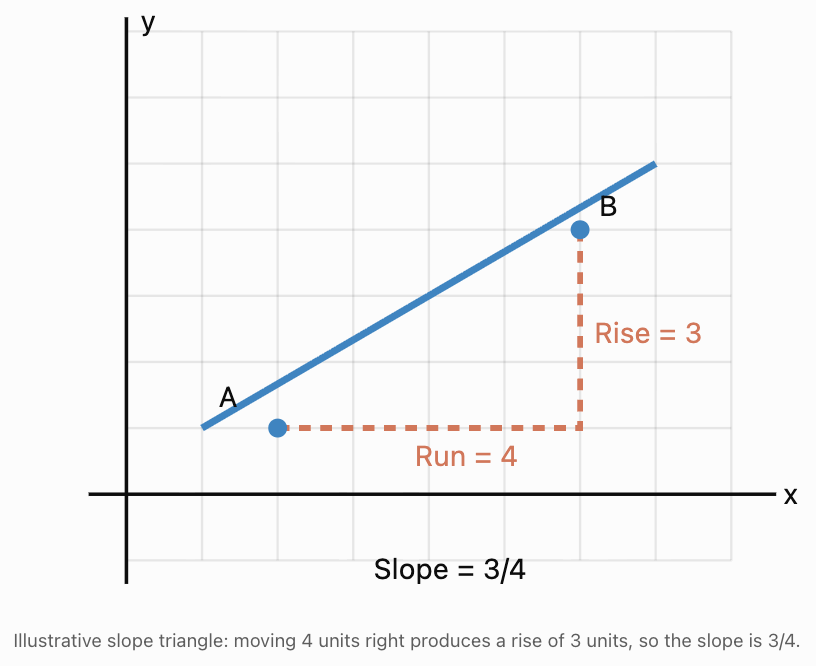
A slope of 3/4 means that for every 4 units moved horizontally to the right, the line rises by 3 units.
The Slope Formula
Suppose a line passes through:
A(x₁, y₁) and B(x₂, y₂).
The vertical change is:
Δy = y₂ − y₁
The horizontal change is:
Δx = x₂ − x₁
Therefore, the slope is:
This formula works whenever x₂ ≠ x₁.
Worked Example 1: Finding Slope from Two Points
Find the slope of the line through A(2, 3) and B(8, 9).
Step 1: Identify the coordinates.
x₁ = 2, y₁ = 3
x₂ = 8, y₂ = 9
Step 2: Calculate the changes.
Rise = 9 − 3 = 6
Run = 8 − 2 = 6
Step 3: Divide.
m = 6/6
Answer: m = 1.
The line rises 1 unit for every 1 unit moved right.
Worked Example 2: Negative Slope
Find the slope through P(−3, 7) and Q(5, −1).
m = (−1 − 7)/(5 − (−3))
m = −8/8
Answer: m = −1.
The line falls by 1 unit for every 1 unit moved right.
Worked Example 3: Fractional Slope
Find the slope through A(−2, 1) and B(4, 4).
m = (4 − 1)/(4 − (−2))
m = 3/6
Answer: m = 1/2.
Types of Slopes
Positive Slope
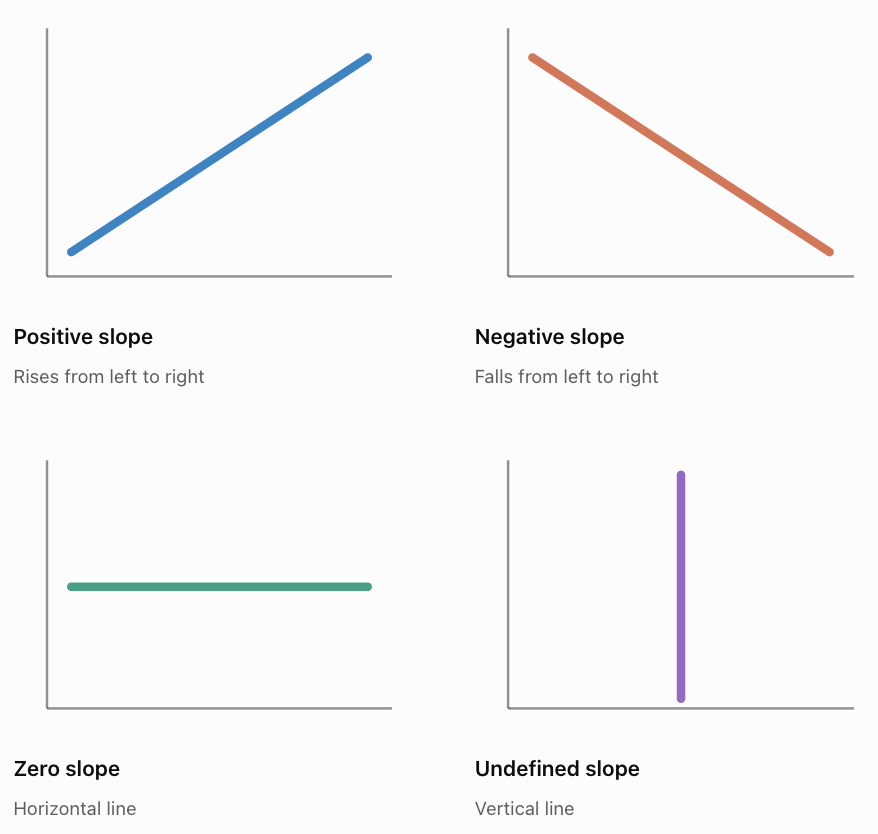
A line with positive slope rises from left to right.
Examples:
m = 2
m = 1/3
m = 5
Negative Slope
A line with negative slope falls from left to right.
Examples:
m = −2
m = −1/4
m = −5
Zero Slope
A horizontal line has no vertical change.
m = 0
Example:
y = 4
Undefined Slope
A vertical line has no horizontal change.
The slope formula would require division by zero, which is undefined.
Example:
x = −3
Important: Undefined slope is not the same as zero slope.
Interpreting the Steepness of Lines
For nonvertical lines, the absolute value of the slope indicates steepness.
Compare:
m = 1/2
m = 2
m = −4
The line with slope −4 is the steepest because:
|−4| = 4
is the largest absolute slope.
The negative sign tells us the direction, not the steepness.
Slope from a Graph
To calculate slope from a graph:
-
Choose two points that lie exactly on the line.
-
Count the vertical change.
-
Count the horizontal change.
-
Divide rise by run.
-
Include the correct sign.
For example, if a line falls 6 units while moving 3 units right:
m = −6/3 = −2.
Slope from a Table
Slope can also be calculated from a table of values.
|
x |
y |
|---|---|
|
1 |
5 |
|
3 |
9 |
|
5 |
13 |
|
7 |
17 |
As x increases by 2, y increases by 4.
Therefore:
m = 4/2 = 2.
The constant rate of change indicates a linear relationship.
Worked Example 4: Finding a Missing Coordinate
The slope between A(2, 5) and B(8, k) is 3.
Find k.
Use:
m = (y₂ − y₁)/(x₂ − x₁)
3 = (k − 5)/(8 − 2)
3 = (k − 5)/6
18 = k − 5
Answer: k = 23.
Check:
(23 − 5)/(8 − 2) = 18/6 = 3.
Parallel Lines
Two distinct lines are parallel if they lie in the same plane and never intersect.
Parallel nonvertical lines have equal slopes.
For example:
y = 2x + 3
y = 2x − 5
Both lines have slope 2, so they are parallel.
The y-intercepts differ, so they are distinct lines.
Parallel Line Rule
For two nonvertical lines:
m₁ = m₂
If the lines also have the same intercept, they are the same line rather than two distinct parallel lines.
All vertical lines are parallel to one another.
Worked Example 5: Identifying Parallel Lines
Determine whether the lines through these points are parallel.
Line 1: A(1, 2), B(5, 10)
Line 2: C(−2, 3), D(1, 9)
Step 1: Calculate the first slope.
m₁ = (10 − 2)/(5 − 1)
m₁ = 8/4 = 2
Step 2: Calculate the second slope.
m₂ = (9 − 3)/(1 − (−2))
m₂ = 6/3 = 2
The slopes are equal.
The lines are distinct because C does not lie on the first line.
Conclusion: The lines are parallel.
Perpendicular Lines
Two lines are perpendicular if they intersect at a right angle.
For two nonvertical, nonhorizontal lines, their slopes are negative reciprocals.
If one line has slope m, a perpendicular line has slope:
m_perpendicular = −1/m
Equivalently:
m₁ × m₂ = −1
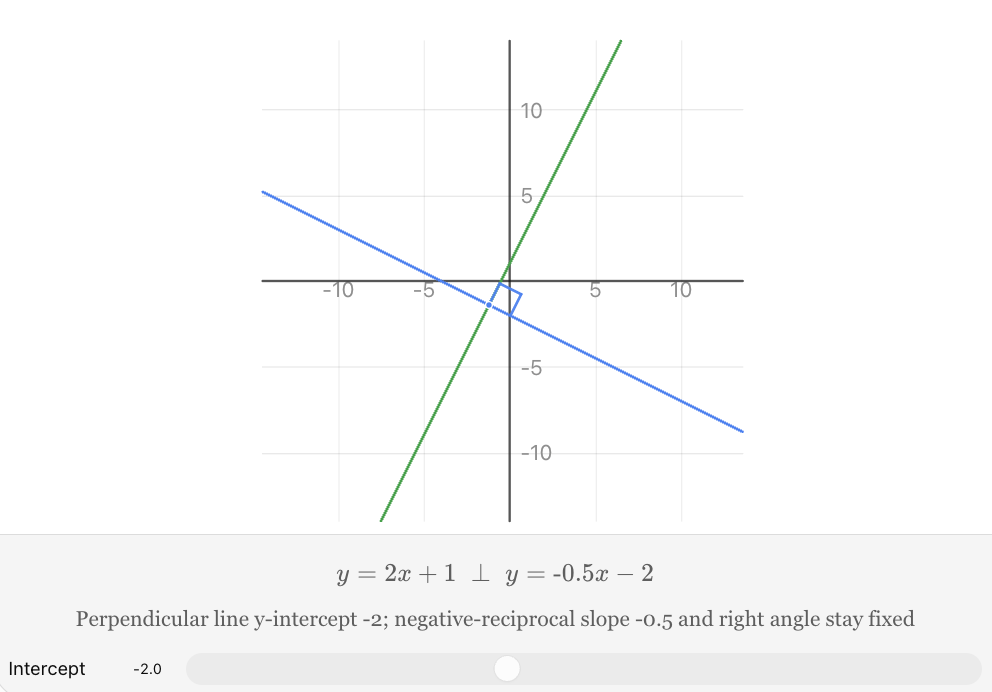
For example:
-
If m₁ = 2, then m₂ = −1/2.
-
If m₁ = −3, then m₂ = 1/3.
-
If m₁ = 1/4, then m₂ = −4.
A horizontal line is perpendicular to a vertical line. Their slopes do not satisfy the product rule because a vertical slope is undefined.
Worked Example 6: Identifying Perpendicular Lines
Determine whether the following lines are perpendicular.
Line 1 passes through A(0, 1) and B(4, 9).
Line 2 passes through C(2, 5) and D(6, 3).
First slope:
m₁ = (9 − 1)/(4 − 0)
m₁ = 8/4 = 2
Second slope:
m₂ = (3 − 5)/(6 − 2)
m₂ = −2/4 = −1/2
Multiply:
m₁ × m₂ = 2 × (−1/2) = −1.
Conclusion: The lines are perpendicular.
Why Does the Negative Reciprocal Rule Work?
Suppose one line has direction vector (a, b), where a ≠ 0.
Its slope is:
m₁ = b/a.
A perpendicular direction vector is (−b, a).
If b ≠ 0, the perpendicular line has slope:
m₂ = a/(−b) = −a/b.
Therefore:
m₁m₂ = (b/a)(−a/b) = −1.
This explains the negative reciprocal relationship.
Equations of Straight Lines
An equation of a line describes all points that lie on that line.
Several forms are useful, depending on the information provided.
Slope-Intercept Form
The most familiar form is:
y = mx + b
where:
-
m = slope.
-
b = y-intercept.
The y-intercept is the y-coordinate where the line crosses the y-axis.
At the y-intercept:
x = 0.
Worked Example 7: Identifying Slope and Intercept
Consider:
y = 3x − 4
The slope is:
m = 3
The y-intercept is:
b = −4
Therefore, the line passes through (0, −4) and rises 3 units for every 1 unit moved right.
Worked Example 8: Writing an Equation from Slope and Intercept
A line has slope −2 and y-intercept 5.
Use:
y = mx + b
Substitute:
m = −2
b = 5
Answer: y = −2x + 5.
Point-Slope Form
If the slope and one point are known, use:
y − y₁ = m(x − x₁)
This is called point-slope form.
It comes directly from the slope formula:
m = (y − y₁)/(x − x₁).
Multiplying by (x − x₁) gives the point-slope equation.
Worked Example 9: Equation from a Point and Slope
Find the equation of a line with slope 3 passing through (2, 5).
Use:
y − y₁ = m(x − x₁)
Substitute:
y − 5 = 3(x − 2)
Expand:
y − 5 = 3x − 6
Add 5:
Answer: y = 3x − 1.
Verification:
When x = 2:
y = 3(2) − 1 = 5.
The line passes through the required point.
Finding an Equation from Two Points
When two points are given:
-
Calculate the slope.
-
Substitute the slope and one point into point-slope form.
-
Rearrange into the requested form.
-
Check the equation using the second point.
Worked Example 10: Equation from Two Points
Find the equation of the line through:
A(1, 4) and B(5, 12).
Step 1: Calculate slope.
m = (12 − 4)/(5 − 1)
m = 8/4 = 2
Step 2: Use point-slope form.
y − 4 = 2(x − 1)
Step 3: Expand.
y − 4 = 2x − 2
y = 2x + 2
Answer: y = 2x + 2.
Verification:
At x = 5:
y = 2(5) + 2 = 12.
Standard Form
Another common form is:
Ax + By = C
where A, B, and C are constants.
For example:
2x + 3y = 12.
Rearrange to slope-intercept form:
3y = −2x + 12
y = −(2/3)x + 4.
Therefore:
Slope = −2/3
y-intercept = 4.
Standard form is particularly useful for solving simultaneous equations and finding intercepts.
Worked Example 11: Converting to Slope-Intercept Form
Convert:
4x − 2y = 10
into slope-intercept form.
Subtract 4x:
−2y = −4x + 10
Divide by −2:
Answer: y = 2x − 5.
The slope is 2 and the y-intercept is −5.
Horizontal and Vertical Line Equations
A horizontal line has equation:
y = c
where c is a constant.
Example:
y = 6
All points on this line have y-coordinate 6.
A vertical line has equation:
x = c
Example:
x = −2
All points on this line have x-coordinate −2.
Vertical lines cannot be written in slope-intercept form because their slope is undefined.
Intercepts of a Line
The x-intercept is where the line crosses the x-axis.
At the x-intercept:
y = 0.
The y-intercept is where the line crosses the y-axis.
At the y-intercept:
x = 0.
Worked Example 12: Finding Both Intercepts
Find the intercepts of:
3x + 2y = 12.
x-intercept:
Set y = 0.
3x = 12
x = 4
So the x-intercept is (4, 0).
y-intercept:
Set x = 0.
2y = 12
y = 6
So the y-intercept is (0, 6).
These two points are sufficient to draw the line.
Equations of Parallel and Perpendicular Lines
When writing the equation of a line that is parallel or perpendicular to another line, first identify the original slope.
Then use the given point to determine the new equation.
Worked Example 13: Equation of a Parallel Line
Find the equation of the line parallel to:
y = 4x − 7
and passing through (2, 3).
Step 1: Identify the slope.
The given line has slope 4.
Parallel lines have equal slopes.
Therefore:
m = 4.
Step 2: Use point-slope form.
y − 3 = 4(x − 2)
Step 3: Rearrange.
y − 3 = 4x − 8
Answer: y = 4x − 5.
Worked Example 14: Equation of a Perpendicular Line
Find the equation of the line perpendicular to:
y = 2x + 1
and passing through (4, 3).
Step 1: Find the perpendicular slope.
Original slope = 2.
Perpendicular slope = −1/2.
Step 2: Use point-slope form.
y − 3 = −(1/2)(x − 4)
Step 3: Expand.
y − 3 = −x/2 + 2
Answer: y = −x/2 + 5.
Verification:
The slope product is:
2 × (−1/2) = −1.
Solving Problems Involving Linear Relationships
A linear equation can model a relationship with a constant rate of change.
The general model is:
y = mx + b
where:
-
m represents the rate of change.
-
b represents the initial value.
-
x is the independent variable.
-
y is the dependent variable.
Worked Example 15: Taxi Fare
A taxi company charges a fixed booking fee of $4 and $2.50 per kilometre.
Let:
x = distance travelled in kilometres
C = total cost in dollars.
The cost model is:
C = 2.50x + 4.
a) Find the cost of an 8 km journey.
C = 2.50(8) + 4
C = 20 + 4
C = $24.
b) Find the distance travelled if the fare is $39.
39 = 2.50x + 4
35 = 2.50x
x = 14 km.
c) Interpret the slope.
The slope is 2.50.
It represents the increase in fare of $2.50 for every additional kilometre.
d) Interpret the intercept.
The intercept is 4.
It represents the fixed booking fee.
Worked Example 16: Comparing Two Mobile Plans
Plan A costs $15 per month plus $0.10 per minute.
Plan B costs $25 per month plus $0.05 per minute.
Let x represent the number of minutes used.
Plan A:
A = 15 + 0.10x
Plan B:
B = 25 + 0.05x
Find when the plans cost the same.
Set the costs equal:
15 + 0.10x = 25 + 0.05x
0.05x = 10
x = 200.
Substitute:
A = 15 + 0.10(200) = $35
B = 25 + 0.05(200) = $35.
Answer: Both plans cost $35 at 200 minutes.
For fewer than 200 minutes, Plan A is cheaper.
For more than 200 minutes, Plan B is cheaper.
The intersection of the two lines represents the break-even point.
Finding the Intersection of Two Lines
Two nonparallel lines intersect at exactly one point.
The coordinates of the intersection satisfy both equations.
Worked Example 17: Solving a Linear System
Find the intersection of:
y = 2x + 1
y = −x + 10.
Set the equations equal:
2x + 1 = −x + 10
3x = 9
x = 3.
Substitute:
y = 2(3) + 1
y = 7.
Answer: The lines intersect at (3, 7).
Verification:
First line: 7 = 2(3) + 1.
Second line: 7 = −3 + 10.
Both equations are satisfied.
Using Slope in Coordinate Geometry
Slope can be used to prove geometric relationships between points, line segments, and polygons.
Proving Parallel Sides
If two distinct line segments have equal slopes, they lie on parallel lines.
Proving Perpendicular Sides
If two nonvertical, nonhorizontal segments have slopes whose product is −1, they are perpendicular.
Proving Collinearity
Three points are collinear if they lie on the same line.
For distinct points A, B, and C with defined slopes, showing:
m_AB = m_BC
establishes collinearity.
For vertical lines, compare x-coordinates instead.
Worked Example 18: Proving Three Points Are Collinear
Given:
A(1, 2)
B(4, 8)
C(7, 14).
Find the slope of AB:
m_AB = (8 − 2)/(4 − 1)
m_AB = 6/3 = 2.
Find the slope of BC:
m_BC = (14 − 8)/(7 − 4)
m_BC = 6/3 = 2.
The segments have equal slopes and share point B.
Therefore, A, B, and C lie on the same straight line.
Conclusion: The points are collinear.
Worked Example 19: Proving a Quadrilateral Is a Parallelogram
Consider:
A(1, 1)
B(6, 3)
C(8, 8)
D(3, 6).
Calculate the slopes of opposite sides.
AB:
m_AB = (3 − 1)/(6 − 1) = 2/5
CD:
m_CD = (6 − 8)/(3 − 8) = (−2)/(−5) = 2/5
Therefore:
AB ∥ CD.
BC:
m_BC = (8 − 3)/(8 − 6) = 5/2
AD:
m_AD = (6 − 1)/(3 − 1) = 5/2
Therefore:
BC ∥ AD.
Both pairs of opposite sides are parallel.
Conclusion: ABCD is a parallelogram.
Worked Example 20: Proving a Right Angle
Triangle ABC has vertices:
A(1, 1)
B(5, 3)
C(3, 7).
Find the slopes of AB and BC.
AB:
m_AB = (3 − 1)/(5 − 1)
m_AB = 2/4 = 1/2.
BC:
m_BC = (7 − 3)/(3 − 5)
m_BC = 4/(−2) = −2.
Multiply:
(1/2)(−2) = −1.
Therefore:
AB ⟂ BC.
Conclusion: ∠ABC = 90°, so triangle ABC is right-angled at B.
Perpendicular Bisectors and Coordinate Geometry
A perpendicular bisector of a line segment passes through its midpoint and meets the segment at 90°.
It is important in geometry because every point on the perpendicular bisector is equally distant from the segment's endpoints.
To find its equation:
-
Find the midpoint of the segment.
-
Calculate the segment's slope.
-
Determine the perpendicular slope.
-
Use point-slope form with the midpoint.
Worked Example 21: Perpendicular Bisector
Find the equation of the perpendicular bisector of the segment joining:
A(2, 1) and B(8, 5).
Step 1: Find the midpoint.
M = ((2 + 8)/2, (1 + 5)/2)
M = (5, 3).
Step 2: Find the slope of AB.
m_AB = (5 − 1)/(8 − 2)
m_AB = 4/6 = 2/3.
Step 3: Find the perpendicular slope.
m = −3/2.
Step 4: Use point-slope form.
y − 3 = −(3/2)(x − 5)
Expand:
y − 3 = −3x/2 + 15/2
y = −3x/2 + 21/2.
Answer: y = −(3/2)x + 21/2.
In standard form:
3x + 2y = 21.
Finding the Equation of an Altitude
An altitude of a triangle is a line through a vertex perpendicular to the opposite side or its extension.
Worked Example 22: Altitude of a Triangle
Triangle ABC has vertices:
A(1, 6)
B(−2, 0)
C(4, 2).
Find the equation of the altitude from A.
Step 1: Calculate the slope of BC.
m_BC = (2 − 0)/(4 − (−2))
m_BC = 2/6 = 1/3.
Step 2: Find the perpendicular slope.
m_altitude = −3.
Step 3: Use point A(1, 6).
y − 6 = −3(x − 1)
y − 6 = −3x + 3
Answer: y = −3x + 9.
Proving a Quadrilateral Is a Rectangle
A rectangle has four right angles.
One way to prove that a quadrilateral is a rectangle is to establish that it is a parallelogram with one right angle.
Worked Example 23: Rectangle Proof
Consider:
A(1, 1)
B(5, 3)
C(3, 7)
D(−1, 5).
Step 1: Calculate slopes of opposite sides.
AB:
m_AB = (3 − 1)/(5 − 1) = 1/2
CD:
m_CD = (5 − 7)/(−1 − 3) = (−2)/(−4) = 1/2
Therefore:
AB ∥ CD.
BC:
m_BC = (7 − 3)/(3 − 5) = −2
AD:
m_AD = (5 − 1)/(−1 − 1) = −2
Therefore:
BC ∥ AD.
Both pairs of opposite sides are parallel, so ABCD is a parallelogram.
Step 2: Check perpendicularity.
m_AB × m_BC = (1/2)(−2) = −1.
Therefore:
AB ⟂ BC.
The parallelogram has one right angle.
Conclusion: ABCD is a rectangle.
Real-World Applications
Road and Railway Gradients
Road gradients describe the change in elevation relative to horizontal distance.
A road rises 15 m over a horizontal distance of 300 m.
Slope:
m = 15/300 = 0.05.
Percentage gradient:
0.05 × 100% = 5%.
The road has a 5% gradient.
A 5% gradient means the road rises 5 m for every 100 m of horizontal travel.
Wheelchair Ramp Design
A ramp rises 0.6 m over a horizontal distance of 7.2 m.
Slope:
m = 0.6/7.2
m = 1/12.
The ramp rises 1 unit for every 12 horizontal units.
This ratio can be written as:
1:12.
Actual accessibility requirements depend on the applicable building codes and other design conditions, including landings and handrails.
Business and Economics
Linear models describe costs, revenue, and profits when rates are constant.
Suppose a company has fixed costs of $500 and a variable cost of $12 per item.
Its cost function is:
C = 12x + 500.
The slope represents the additional cost per item.
The y-intercept represents the fixed cost.
Science and Experimental Data
In science, the slope of a graph often represents a physical quantity.
Examples include:
-
Distance–time graph: slope represents speed for motion in one direction.
-
Displacement–time graph: slope represents velocity.
-
Velocity–time graph: slope represents acceleration.
-
Force–extension graph: slope represents spring constant when force is plotted vertically.
-
Mass–volume graph: slope represents density when mass is plotted vertically.
The meaning of the slope depends on the variables and units on the axes.
Computer Graphics
Coordinate geometry allows designers to position lines and determine their orientations.
Parallel and perpendicular constraints are particularly useful when constructing geometric patterns, floor plans, and technical drawings.
Common Mistakes
Mistake 1: Reversing Rise and Run
Incorrect:
m = horizontal change/vertical change
Correct:
m = vertical change/horizontal change.
Mistake 2: Subtracting Coordinates in Different Orders
If the numerator uses y₂ − y₁, the denominator must use x₂ − x₁.
Do not reverse the order in only one part.
Mistake 3: Confusing Negative and Positive Slopes
A line falling from left to right has negative slope.
A line rising from left to right has positive slope.
Mistake 4: Confusing Zero and Undefined Slope
Horizontal line:
m = 0
Vertical line:
m is undefined.
Mistake 5: Assuming Parallel Lines Must Have Positive Slopes
Parallel lines can both have negative slopes.
The important property is that their slopes are equal.
Mistake 6: Forgetting the Negative Sign for Perpendicular Slopes
The perpendicular slope of 3 is −1/3, not 1/3.
Mistake 7: Assuming Reciprocal Slopes Are Perpendicular
Slopes 2 and 1/2 are not perpendicular.
Their product is 1, not −1.
Mistake 8: Confusing Slope with the y-Intercept
In:
y = 4x − 7
the slope is 4 and the y-intercept is −7.
Mistake 9: Incorrectly Rearranging Equations
When solving for y, every term must be divided by the coefficient of y.
Mistake 10: Forgetting to Substitute the Given Point
When finding a line equation from a slope and point, the point determines the intercept.
Mistake 11: Assuming Equal Slopes Always Mean Distinct Parallel Lines
Two equations with the same slope and intercept describe the same line.
Mistake 12: Ignoring Units in Applications
A slope of 5 may mean 5 metres per second, 5 dollars per item, or another rate depending on the variables.
Mistake 13: Confusing a Graph's Slope with Its Physical Angle
A slope of 1 corresponds to a 45° angle only when the coordinate axes use equal physical scales.
Mistake 14: Assuming Linear Models Work Everywhere
A linear model assumes a constant rate of change.
Many real-world relationships become nonlinear outside a limited range.
Key Terms
-
Slope: A measure of the steepness and direction of a line.
-
Gradient: Another name for slope.
-
Rise: The vertical change between two points.
-
Run: The horizontal change between two points.
-
Rate of Change: The amount one quantity changes relative to another.
-
Positive Slope: A slope describing a line that rises from left to right.
-
Negative Slope: A slope describing a line that falls from left to right.
-
Zero Slope: The slope of a horizontal line.
-
Undefined Slope: The slope of a vertical line.
-
Parallel Lines: Distinct coplanar lines that never intersect.
-
Perpendicular Lines: Lines that intersect at 90°.
-
Negative Reciprocal: The reciprocal of a number with its sign reversed.
-
Linear Equation: An equation representing a straight-line relationship.
-
Slope-Intercept Form: The equation y = mx + b.
-
Point-Slope Form: The equation y − y₁ = m(x − x₁).
-
Standard Form: A linear equation written as Ax + By = C.
-
x-Intercept: The point where a line crosses the x-axis.
-
y-Intercept: The point where a line crosses the y-axis.
-
Collinear Points: Points lying on the same straight line.
-
Intersection: A point shared by two or more lines.
-
Linear Model: A mathematical model with a constant rate of change.
-
Independent Variable: The variable whose value is chosen or controlled.
-
Dependent Variable: The variable whose value depends on another variable.
-
Perpendicular Bisector: A line perpendicular to a segment through its midpoint.
-
Altitude: A perpendicular line from a triangle vertex to the opposite side or its extension.
-
Coordinate Proof: A geometric proof using coordinates and algebra.
-
Constant Rate of Change: A relationship in which equal changes in one variable produce equal changes in another.
Key Takeaways
-
Slope measures the steepness and direction of a line.
-
Slope is calculated using rise divided by run.
-
Positive slopes rise from left to right.
-
Negative slopes fall from left to right.
-
Horizontal lines have zero slope.
-
Vertical lines have undefined slope.
-
Parallel nonvertical lines have equal slopes.
-
Perpendicular nonvertical, nonhorizontal lines have negative reciprocal slopes.
-
Slope-intercept form is y = mx + b.
-
Point-slope form is y − y₁ = m(x − x₁).
-
Standard form is Ax + By = C.
-
Two points determine a unique straight line.
-
The y-intercept occurs where x = 0.
-
The x-intercept occurs where y = 0.
-
Linear relationships have constant rates of change.
-
Intersections of lines can represent solutions to practical problems.
-
Slopes can establish parallelism, perpendicularity, and collinearity.
-
Coordinate methods can prove properties of triangles and quadrilaterals.
-
Perpendicular bisectors combine midpoint and slope calculations.
-
Linear equations are widely used in engineering, science, business, and everyday measurement.
Check Your Understanding
Show all working. Explain your reasoning when asked to justify a geometric relationship.
Question 1: Basic Slope
Find the slope of the line through:
A(2, 3) and B(8, 15).
Question 2: Negative Slope
Find the slope through:
P(−4, 9) and Q(2, −3).
Question 3: Horizontal and Vertical Lines
Determine the slope of:
a) y = −5
b) x = 7.
Question 4: Missing Coordinate
The slope between A(3, 4) and B(9, k) is −2.
Find k.
Question 5: Parallel Lines
Determine whether the lines through the following pairs of points are parallel.
Line 1: A(1, 2), B(5, 10)
Line 2: C(−3, 1), D(0, 7).
Question 6: Perpendicular Lines
Determine whether the lines are perpendicular.
Line 1: A(0, 2), B(6, 5)
Line 2: C(1, 7), D(3, 3).
Question 7: Slope-Intercept Form
Identify the slope and y-intercept of:
y = −3x + 8.
Question 8: Equation from Slope and Point
Find the equation of a line with slope 4 passing through (2, 7).
Question 9: Equation from Two Points
Find the equation of the line through:
A(−2, 1) and B(4, 13).
Question 10: Standard Form
Convert:
6x + 3y = 15
into slope-intercept form.
Identify its slope and y-intercept.
Question 11: Parallel Line Equation
Find the equation of the line parallel to:
y = −2x + 6
and passing through (3, 4).
Question 12: Perpendicular Line Equation
Find the equation of the line perpendicular to:
y = (3/4)x − 2
and passing through (6, 1).
Question 13: Intercepts
Find the x-intercept and y-intercept of:
4x + 5y = 20.
Question 14: Intersection of Lines
Find the point of intersection of:
y = 3x − 2
y = −x + 10.
Question 15: Linear Application
A delivery company charges a fixed fee of $6 and $1.80 per kilometre.
a) Write a linear equation for the delivery cost.
b) Calculate the cost of a 15 km delivery.
c) Find the distance if the delivery costs $42.
d) Explain the meaning of the slope and y-intercept.
Question 16: Coordinate Proof
Triangle ABC has vertices:
A(1, 1)
B(7, 4)
C(4, 10).
Use slopes to prove that triangle ABC has a right angle.
Question 17: Perpendicular Bisector
Find the equation of the perpendicular bisector of the segment joining:
A(−2, 3) and B(4, 7).
Question 18: Comprehensive Challenge
A quadrilateral has vertices:
A(0, 0)
B(6, 2)
C(4, 8)
D(−2, 6).
a) Calculate the slopes of all four sides.
b) Prove that opposite sides are parallel.
c) Prove that two adjacent sides are perpendicular.
d) Classify the quadrilateral.
e) Find the equations of lines AB and BC.
f) Find the midpoint of diagonal AC.
Fully Worked Answers
Answer 1: Basic Slope
Given:
A(2, 3)
B(8, 15)
m = (15 − 3)/(8 − 2)
m = 12/6
Answer: m = 2.
Answer 2: Negative Slope
Given:
P(−4, 9)
Q(2, −3)
m = (−3 − 9)/(2 − (−4))
m = −12/6
Answer: m = −2.
Answer 3: Horizontal and Vertical Lines
a) y = −5
This is a horizontal line.
Slope = 0.
b) x = 7
This is a vertical line.
Slope is undefined.
Answer 4: Missing Coordinate
Given:
A(3, 4)
B(9, k)
m = −2.
Use the slope formula:
−2 = (k − 4)/(9 − 3)
−2 = (k − 4)/6
−12 = k − 4
Answer: k = −8.
Answer 5: Parallel Lines
Line 1:
m₁ = (10 − 2)/(5 − 1)
m₁ = 8/4 = 2.
Line 2:
m₂ = (7 − 1)/(0 − (−3))
m₂ = 6/3 = 2.
The slopes are equal, and the lines are distinct.
Conclusion: The lines are parallel.
Answer 6: Perpendicular Lines
Line 1:
m₁ = (5 − 2)/(6 − 0)
m₁ = 3/6 = 1/2.
Line 2:
m₂ = (3 − 7)/(3 − 1)
m₂ = −4/2 = −2.
Multiply:
m₁m₂ = (1/2)(−2) = −1.
Conclusion: The lines are perpendicular.
Answer 7: Slope-Intercept Form
Given:
y = −3x + 8.
Compare with:
y = mx + b.
Therefore:
m = −3
b = 8.
Answer: Slope = −3; y-intercept = (0, 8).
Answer 8: Equation from Slope and Point
Given:
m = 4
Point = (2, 7).
Use point-slope form:
y − 7 = 4(x − 2)
y − 7 = 4x − 8
Answer: y = 4x − 1.
Answer 9: Equation from Two Points
Given:
A(−2, 1)
B(4, 13).
Step 1: Calculate slope.
m = (13 − 1)/(4 − (−2))
m = 12/6 = 2.
Step 2: Use point-slope form.
y − 1 = 2(x + 2)
y − 1 = 2x + 4
Answer: y = 2x + 5.
Answer 10: Standard Form
Given:
6x + 3y = 15.
Subtract 6x:
3y = −6x + 15.
Divide by 3:
y = −2x + 5.
Answer: y = −2x + 5.
Slope = −2.
y-intercept = (0, 5).
Answer 11: Parallel Line Equation
Given:
y = −2x + 6.
The slope is −2.
A parallel line has the same slope.
Use point (3, 4):
y − 4 = −2(x − 3)
y − 4 = −2x + 6
Answer: y = −2x + 10.
Answer 12: Perpendicular Line Equation
Given:
y = (3/4)x − 2.
Original slope = 3/4.
Perpendicular slope = −4/3.
Use point (6, 1):
y − 1 = −(4/3)(x − 6)
y − 1 = −4x/3 + 8
Answer: y = −(4/3)x + 9.
Answer 13: Intercepts
Given:
4x + 5y = 20.
x-intercept:
Set y = 0.
4x = 20
x = 5.
x-intercept = (5, 0).
y-intercept:
Set x = 0.
5y = 20
y = 4.
y-intercept = (0, 4).
Answer 14: Intersection of Lines
Given:
y = 3x − 2
y = −x + 10.
Set equal:
3x − 2 = −x + 10
4x = 12
x = 3.
Substitute:
y = 3(3) − 2
y = 7.
Answer: (3, 7).
Answer 15: Linear Application
Let:
x = delivery distance in kilometres
C = delivery cost in dollars.
a) Equation
C = 1.80x + 6.
b) Cost for 15 km
C = 1.80(15) + 6
C = 27 + 6
C = $33.
c) Distance for a $42 delivery
42 = 1.80x + 6
36 = 1.80x
x = 20 km.
d) Interpretation
Slope = 1.80.
The delivery cost increases by $1.80 per additional kilometre.
Intercept = 6.
The company charges a fixed fee of $6.
Answer 16: Coordinate Proof
Given:
A(1, 1)
B(7, 4)
C(4, 10).
Calculate slope AB:
m_AB = (4 − 1)/(7 − 1)
m_AB = 3/6 = 1/2.
Calculate slope BC:
m_BC = (10 − 4)/(4 − 7)
m_BC = 6/(−3) = −2.
Multiply:
m_AB × m_BC = (1/2)(−2) = −1.
Therefore:
AB ⟂ BC.
Conclusion: Triangle ABC is right-angled at B.
Answer 17: Perpendicular Bisector
Given:
A(−2, 3)
B(4, 7).
Step 1: Find the midpoint.
M = ((−2 + 4)/2, (3 + 7)/2)
M = (1, 5).
Step 2: Find the slope of AB.
m_AB = (7 − 3)/(4 − (−2))
m_AB = 4/6 = 2/3.
Step 3: Find the perpendicular slope.
m = −3/2.
Step 4: Find the equation.
y − 5 = −(3/2)(x − 1)
y − 5 = −3x/2 + 3/2
y = −3x/2 + 13/2.
Answer: y = −(3/2)x + 13/2.
Equivalent standard form:
3x + 2y = 13.
Answer 18: Comprehensive Challenge
Given:
A(0, 0)
B(6, 2)
C(4, 8)
D(−2, 6).
a) Calculate the slopes.
AB:
m_AB = (2 − 0)/(6 − 0) = 1/3.
BC:
m_BC = (8 − 2)/(4 − 6) = 6/(−2) = −3.
CD:
m_CD = (6 − 8)/(−2 − 4) = (−2)/(−6) = 1/3.
DA:
m_DA = (0 − 6)/(0 − (−2)) = −6/2 = −3.
b) Prove opposite sides are parallel.
m_AB = m_CD = 1/3.
Therefore:
AB ∥ CD.
m_BC = m_DA = −3.
Therefore:
BC ∥ AD.
Both pairs of opposite sides are parallel.
Hence, ABCD is a parallelogram.
c) Prove adjacent sides are perpendicular.
m_AB × m_BC = (1/3)(−3) = −1.
Therefore:
AB ⟂ BC.
The parallelogram has a right angle.
d) Classify the quadrilateral.
A parallelogram with a right angle is a rectangle.
To determine whether it is also a square, calculate two adjacent side lengths.
AB = √(6² + 2²) = √40 = 2√10.
BC = √((4 − 6)² + (8 − 2)²)
BC = √(4 + 36) = 2√10.
The adjacent sides are equal.
A rectangle with equal adjacent sides is a square.
Conclusion: ABCD is a square.
e) Find equations of AB and BC.
Line AB has slope 1/3 and passes through (0, 0).
Therefore:
AB: y = x/3.
Line BC has slope −3 and passes through (6, 2).
Use point-slope form:
y − 2 = −3(x − 6)
y − 2 = −3x + 18
BC: y = −3x + 20.
f) Find the midpoint of AC.
A(0, 0)
C(4, 8)
M = ((0 + 4)/2, (0 + 8)/2)
Answer: M(2, 4).
Final Course Connections
Slopes and equations of lines provide a powerful connection between algebra and geometry.
Slope describes how quantities change, while linear equations describe all points belonging to a straight line. Parallel and perpendicular slope relationships allow us to investigate geometric structures using numerical evidence.
These ideas are essential for coordinate proofs, perpendicular bisectors, triangle altitudes, linear modelling, graph interpretation, and systems of equations.
This completes Slopes and Equations of Lines, covering all five learning targets with detailed explanations, worked examples, geometric applications, real-world contexts, common mistakes, key terms, key takeaways, and fully worked assessment questions.
3. Transformations
Learning outcomes
- I can perform translations.
- I can perform reflections.
- I can perform rotations.
- I can perform enlargements (dilations).
- I can describe transformations using mathematical notation.
Introduction
Imagine moving a shape across a computer screen, seeing its reflection in a mirror, rotating a wheel, or enlarging a photograph. Although these actions appear different, they can all be described using mathematical transformations.
A transformation is a rule that changes the position, orientation, or size of a geometric figure.
Transformations are fundamental to geometry because they allow us to investigate how shapes move and how their properties change. They also connect geometry to algebra through coordinate rules.
In this lesson, we will study four important transformations:
-
Translations: Sliding a shape without turning it.
-
Reflections: Flipping a shape across a line.
-
Rotations: Turning a shape around a fixed point.
-
Enlargements (dilations): Changing the size of a shape using a scale factor.
We will also learn how to describe each transformation precisely using coordinates, vectors, and mathematical notation.
Understanding Transformations
A transformation takes each point of an original figure and maps it to a new point.
The original figure is called the object or preimage.
The transformed figure is called the image.
For example, if point A(2, 3) is transformed to A′(6, 5), we write:
A(2, 3) → A′(6, 5)
The prime symbol (′) identifies the image of a point.
If a triangle has vertices A, B, and C, its image is usually labelled A′, B′, and C′.
Types of Transformations
|
Transformation |
Position changes? |
Orientation changes? |
Size changes? |
|---|---|---|---|
|
Translation |
Usually |
No |
No |
|
Reflection |
Usually |
Reversed |
No |
|
Rotation |
Usually |
No reversal |
No |
|
Enlargement |
Usually |
Reversed only for negative scale factors |
Yes, unless |k| = 1 |
Here, orientation means the clockwise or counterclockwise order of the vertices, not simply the direction a shape faces.
Translations, reflections, and rotations are rigid transformations because they preserve distances and angles.
Dilations preserve angles and proportional side lengths but may change distances.
Translations
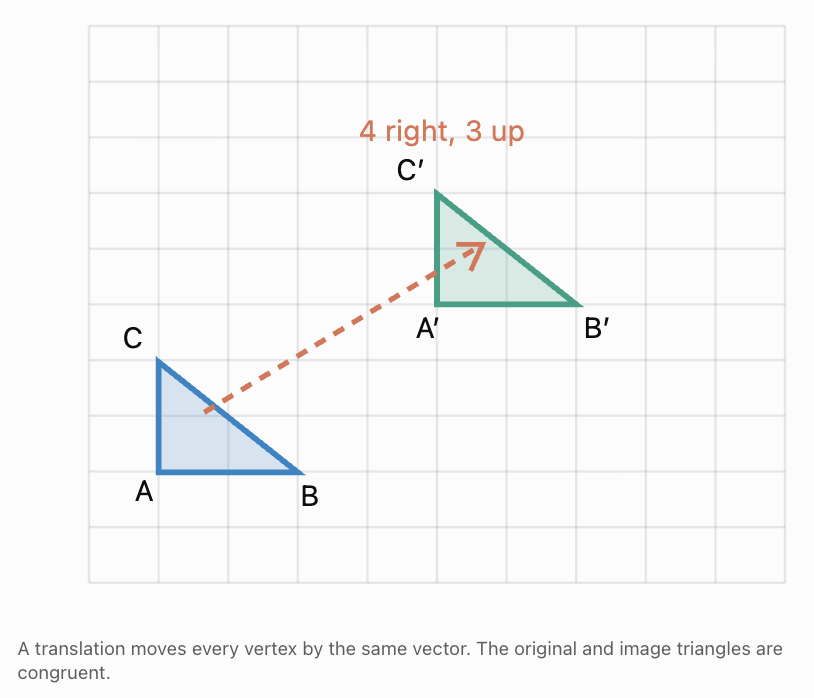
A translation moves every point of a figure the same distance in the same direction.
A translation does not change the shape's size or orientation.
For example, moving a triangle 4 units right and 3 units up is a translation.
Translation Rules
A translation by a units horizontally and b units vertically is written:
(x, y) → (x + a, y + b)
where:
-
Positive a moves points right.
-
Negative a moves points left.
-
Positive b moves points up.
-
Negative b moves points down.
Vector Notation
A translation can also be described using a column vector:
For example, the vector (4, 3) means 4 units right and 3 units up.
The vector (−5, −2) means 5 units left and 2 units down.
Worked Example 1: Translating a Point
Translate P(−2, 5) by the vector (6, −3).
Apply:
(x, y) → (x + 6, y − 3)
P′ = (−2 + 6, 5 − 3)
Answer: P′(4, 2).
Worked Example 2: Translating a Triangle
Triangle ABC has vertices:
A(1, 2)
B(4, 2)
C(2, 5).
Translate the triangle 3 units left and 4 units down.
The rule is:
(x, y) → (x − 3, y − 4)
Apply it to each vertex:
A′ = (1 − 3, 2 − 4) = (−2, −2)
B′ = (4 − 3, 2 − 4) = (1, −2)
C′ = (2 − 3, 5 − 4) = (−1, 1)
Answer: A′(−2, −2), B′(1, −2), C′(−1, 1).
Worked Example 3: Finding the Translation Vector
Point A(−3, 4) is translated to A′(2, −1).
Find the translation vector.
Horizontal change:
Δx = 2 − (−3) = 5
Vertical change:
Δy = −1 − 4 = −5
Answer: Translation vector (5, −5).
The transformation moves 5 units right and 5 units down.
Properties of Translations
Translations preserve:
-
Side lengths.
-
Angle measures.
-
Perimeter.
-
Area.
-
Parallelism.
-
Collinearity.
-
Orientation.
A translated figure is always congruent to its original figure.
Reflections
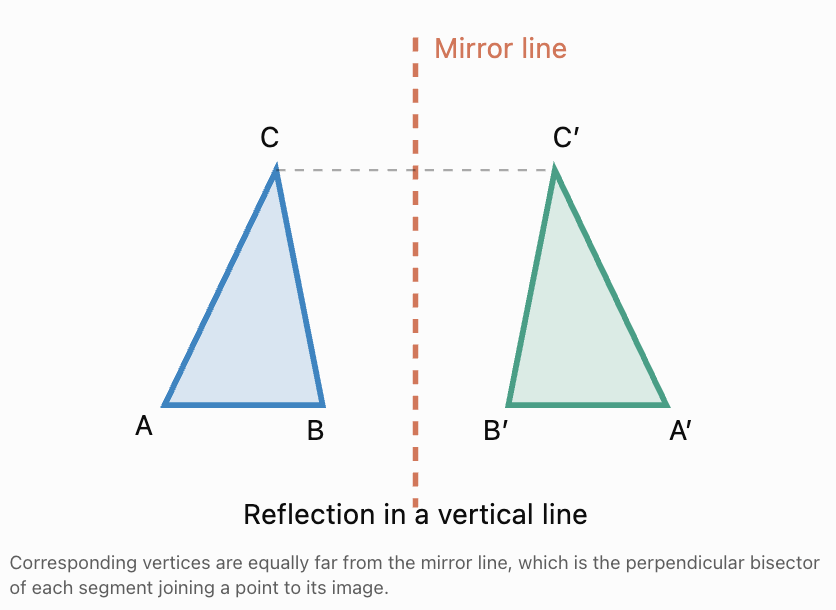
A reflection flips a figure across a fixed line called the line of reflection or mirror line.
Each point and its image lie on opposite sides of the mirror line at equal perpendicular distances from it, unless the point lies on the line and remains fixed.
Reflection in the x-Axis
When reflecting across the x-axis:
-
The x-coordinate stays the same.
-
The y-coordinate changes sign.
Rule: (x, y) → (x, −y)
For example:
A(3, 4) → A′(3, −4)
B(−2, −5) → B′(−2, 5)
Reflection in the y-Axis
When reflecting across the y-axis:
-
The x-coordinate changes sign.
-
The y-coordinate stays the same.
Rule: (x, y) → (−x, y)
For example:
P(4, 3) → P′(−4, 3)
Q(−6, −2) → Q′(6, −2)
Reflection in the Line y = x
Reflection across y = x swaps the coordinates.
Rule: (x, y) → (y, x)
Example:
A(2, 5) → A′(5, 2)
B(−3, 4) → B′(4, −3)
Reflection in the Line y = −x
Reflection across y = −x swaps the coordinates and changes both signs.
Rule: (x, y) → (−y, −x)
Example:
A(3, 5) → A′(−5, −3)
B(−2, 4) → B′(−4, 2)
Reflections in Other Horizontal and Vertical Lines
For reflection in the vertical line x = a:
(x, y) → (2a − x, y)
For reflection in the horizontal line y = b:
(x, y) → (x, 2b − y)
Worked Example 4: Reflection in x = 3
Reflect P(7, −2) in the line x = 3.
Use:
x′ = 2(3) − 7 = −1
y′ = −2
Answer: P′(−1, −2).
Check:
P is 4 units to the right of x = 3.
P′ is 4 units to the left.
Worked Example 5: Reflection in y = −2
Reflect A(4, 5) in y = −2.
Use:
x′ = 4
y′ = 2(−2) − 5 = −9
Answer: A′(4, −9).
Worked Example 6: Reflecting a Triangle
Triangle ABC has vertices:
A(1, 2)
B(4, 2)
C(2, 6).
Reflect the triangle in the y-axis.
Rule:
(x, y) → (−x, y)
Therefore:
A′(−1, 2)
B′(−4, 2)
C′(−2, 6)
The reflected triangle has the same side lengths and angles, but its orientation is reversed.
Properties of Reflections
Reflections preserve:
-
Lengths.
-
Angles.
-
Perimeter.
-
Area.
-
Parallelism.
However, a reflection reverses orientation.
A clockwise arrangement of vertices becomes counterclockwise, and vice versa.
The line of reflection is the perpendicular bisector of the segment joining each non-fixed point to its image.
Rotations
A rotation turns a figure around a fixed point called the centre of rotation.
Every point moves through the same angle, and its distance from the centre remains unchanged.
A rotation is described by three pieces of information:
-
The centre of rotation.
-
The angle of rotation.
-
The direction of rotation: clockwise or counterclockwise.
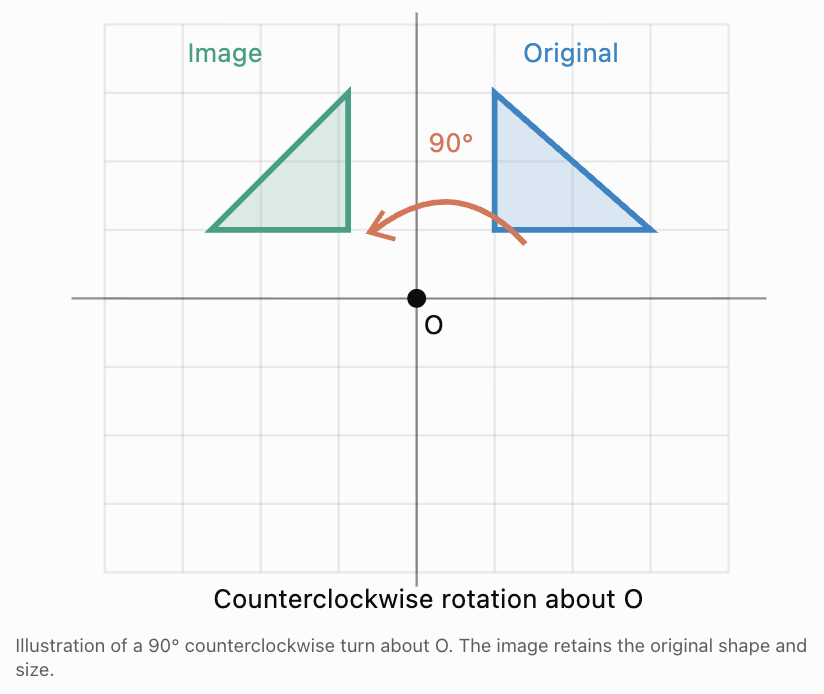
Rotations About the Origin
For rotations about (0, 0), the following rules are especially useful.
Rotation
Coordinate rule
90° counterclockwise
(x, y) → (−y, x)
90° clockwise
(x, y) → (y, −x)
180° either direction
(x, y) → (−x, −y)
270° counterclockwise
(x, y) → (y, −x)
270° clockwise
(x, y) → (−y, x)
360°
(x, y) → (x, y)
Notice that a 270° counterclockwise rotation is equivalent to a 90° clockwise rotation.
Worked Example 7: Rotating a Point 90° Counterclockwise
Rotate P(3, 5) through 90° counterclockwise about the origin.
Use:
(x, y) → (−y, x)
Therefore:
P(3, 5) → P′(−5, 3)
Answer: P′(−5, 3).
Worked Example 8: Rotating a Point 90° Clockwise
Rotate A(−4, 2) through 90° clockwise about the origin.
Use:
(x, y) → (y, −x)
A(−4, 2) → A′(2, 4)
Answer: A′(2, 4).
Worked Example 9: Rotating a Triangle Through 180°
Triangle ABC has vertices:
A(1, 2)
B(5, 2)
C(2, 6).
Rotate the triangle through 180° about the origin.
Rule:
(x, y) → (−x, −y)
Apply the rule:
A′(−1, −2)
B′(−5, −2)
C′(−2, −6)
Answer: The image triangle has vertices (−1, −2), (−5, −2), and (−2, −6).
Rotations About Other Centres
Not every rotation occurs about the origin.
Suppose the centre of rotation is C(h, k).
We can rotate a point P(x, y) using three steps:
-
Subtract the centre's coordinates to move the centre temporarily to the origin.
-
Apply the required rotation rule.
-
Add the centre's coordinates back.
For a 90° counterclockwise rotation about C(h, k):
(x, y) → (h − (y − k), k + (x − h))
For a 180° rotation about C(h, k):
(x, y) → (2h − x, 2k − y)
Worked Example 10: Rotation About a Different Centre
Rotate P(5, 3) through 90° counterclockwise about C(2, 1).
Step 1: Translate relative to the centre.
P − C = (5 − 2, 3 − 1)
= (3, 2)
Step 2: Rotate 90° counterclockwise.
(3, 2) → (−2, 3)
Step 3: Add the centre back.
P′ = (2 − 2, 1 + 3)
Answer: P′(0, 4).
Verification:
CP = √(3² + 2²) = √13
CP′ = √((0 − 2)² + (4 − 1)²) = √13
The distance from the centre is preserved.
Rotations Through Arbitrary Angles
For more advanced coordinate geometry, a point can be rotated counterclockwise through any angle θ about the origin using:
x′ = x cos θ − y sin θ
y′ = x sin θ + y cos θ
This formula includes the familiar 90°, 180°, and 270° rules.
For example, at θ = 90°:
cos 90° = 0
sin 90° = 1
Therefore:
x′ = −y
y′ = x
This produces the standard 90° counterclockwise rule.
Properties of Rotations
Rotations preserve:
-
Distances.
-
Angle measures.
-
Perimeter.
-
Area.
-
Parallelism.
-
Orientation.
The centre of rotation remains fixed.
A figure and its rotated image are congruent.
Enlargements and Dilations
An enlargement, also called a dilation, changes the size of a figure relative to a fixed point.
The fixed point is called the centre of enlargement.
The amount of enlargement or reduction is determined by the scale factor, k.
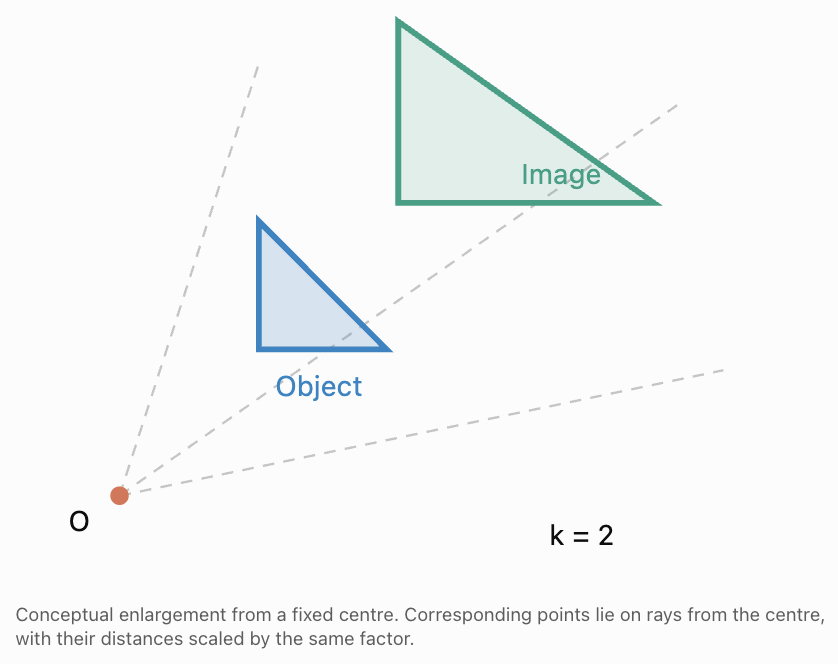
Understanding Scale Factors
Scale factor
Effect
k > 1
Enlargement
0 < k < 1
Reduction
k = 1
No change
k = 0
Every point maps to the centre
k < 0
Image lies on the opposite side of the centre, with size multiplied by |k|
In some school courses, enlargement includes reductions, while dilation is used as the broader term.
Dilations About the Origin
For a dilation with scale factor k centred at the origin:
(x, y) → (kx, ky)
Worked Example 11: Enlargement by Scale Factor 3
Enlarge P(2, −4) by scale factor 3 about the origin.
P′ = (3 × 2, 3 × (−4))
Answer: P′(6, −12).
Worked Example 12: Reduction by Scale Factor 1/2
Triangle ABC has vertices:
A(2, 4)
B(8, 4)
C(4, 10).
Reduce the triangle by scale factor 1/2 about the origin.
Apply:
(x, y) → (x/2, y/2)
A′(1, 2)
B′(4, 2)
C′(2, 5)
Every side length is halved.
The image is similar to the original triangle.
Worked Example 13: Negative Scale Factor
Dilate P(3, −2) by scale factor −2 about the origin.
P′ = (−2 × 3, −2 × (−2))
Answer: P′(−6, 4).
The image lies on the opposite side of the origin, twice as far away.
A negative dilation is equivalent to a positive dilation of scale factor |k| combined with a 180° rotation about the same centre.
Dilations About Other Centres
If the centre of dilation is C(h, k₀) and the scale factor is s, the rule is:
(x, y) → (h + s(x − h), k₀ + s(y − k₀))
The symbols k₀ and s are used here to distinguish the centre's y-coordinate from the scale factor.
Worked Example 14: Enlargement About a Fixed Centre
Enlarge P(5, 4) by scale factor 2 about C(1, 2).
Step 1: Find the displacement from C to P.
(5 − 1, 4 − 2) = (4, 2)
Step 2: Multiply by the scale factor.
2(4, 2) = (8, 4)
Step 3: Add the centre coordinates.
P′ = (1 + 8, 2 + 4)
Answer: P′(9, 6).
Worked Example 15: Finding a Scale Factor
A segment of length 5 cm is enlarged to 17.5 cm.
Find the scale factor.
Scale factor = Image length ÷ Original length
s = 17.5/5
Answer: s = 3.5.
This determines the magnitude of the scale factor. The sign would require information about the centre and relative positions.
How Dilations Affect Length, Perimeter, and Area
If a figure is dilated by scale factor s:
Image length = |s| × Original length
Image perimeter = |s| × Original perimeter
Image area = s² × Original area
The area scale factor is the square of the linear scale factor.
Worked Example 16: Enlarging a Rectangle
A rectangle measures 4 cm by 7 cm.
It is enlarged by scale factor 3.
Original perimeter:
P = 2(4 + 7) = 22 cm
Original area:
A = 4 × 7 = 28 cm²
New dimensions:
12 cm by 21 cm
New perimeter:
P′ = 3 × 22 = 66 cm
New area:
A′ = 3² × 28
A′ = 9 × 28
A′ = 252 cm²
Answers: New perimeter = 66 cm; new area = 252 cm².
Properties of Dilations
Dilations preserve:
-
Angle measures.
-
Collinearity.
-
Parallelism.
-
Ratios of corresponding side lengths.
Dilations generally do not preserve:
-
Individual side lengths.
-
Perimeter.
-
Area.
A figure and its dilated image are similar, but not necessarily congruent.
For negative scale factors, orientation in the clockwise/counterclockwise sense is still preserved in the plane; the figure is additionally turned through 180° about the centre.
Describing Transformations Using Mathematical Notation
A transformation description should contain enough information to determine the image uniquely.
Transformation
Required information
Example
Translation
Translation vector
(x, y) → (x + 4, y − 2)
Reflection
Mirror line
Reflection in y = x
Rotation
Centre, angle, direction
90° clockwise about (0, 0)
Dilation
Centre and scale factor
Centre (1, 2), scale factor 3
A transformation can also be written using function notation.
For example:
T(x, y) = (x + 4, y − 2)
R(x, y) = (−y, x)
D(x, y) = (2x, 2y)
These represent a translation, a 90° counterclockwise rotation about the origin, and a dilation of scale factor 2 about the origin, respectively.
Matrix Notation
In more advanced mathematics, linear transformations can be represented using matrices.
A 90° counterclockwise rotation about the origin is:
\[ \begin{pmatrix}x'\\y'\end{pmatrix} = \begin{pmatrix}0&-1\\1&0\end{pmatrix} \begin{pmatrix}x\\y\end{pmatrix} \]A dilation of scale factor s about the origin is:
\[ \begin{pmatrix}x'\\y'\end{pmatrix} = \begin{pmatrix}s&0\\0&s\end{pmatrix} \begin{pmatrix}x\\y\end{pmatrix} \]Translations require adding a vector rather than multiplying the coordinate pair by a 2 × 2 matrix alone.
These representations become especially useful in computer graphics, robotics, and advanced geometry.
Combining Transformations
Sometimes a figure undergoes more than one transformation.
This is called a composition of transformations.
For example, a shape might first be reflected and then translated.
The order of transformations matters.
Worked Example 17: Translation Followed by Reflection
Point P(2, 3) is:
-
Translated by (4, −1).
-
Reflected in the y-axis.
Find its final coordinates.
First transformation: Translation
P(2, 3) → P′(6, 2)
Second transformation: Reflection
P′(6, 2) → P″(−6, 2)
Answer: P″(−6, 2).
Now reverse the order.
Reflect first:
(2, 3) → (−2, 3)
Then translate:
(−2, 3) → (2, 2)
The result is different.
Therefore, transformation composition is not generally commutative.
Worked Example 18: Rotation Followed by Dilation
Point A(3, 1) is rotated 90° counterclockwise about the origin, then dilated by scale factor 2 about the origin.
Rotation:
(3, 1) → (−1, 3)
Dilation:
(−1, 3) → (−2, 6)
Answer: A″(−2, 6).
In this particular example, reversing the order gives the same result because both transformations share the origin as their centre and uniform dilations commute with rotations about that centre.
Inverse Transformations
An inverse transformation reverses the effect of another transformation.
Original transformation
Inverse
Translation by (a, b)
Translation by (−a, −b)
Reflection in a line
Reflection in the same line
Rotation by θ about C
Rotation by −θ about C
Dilation by s about C
Dilation by 1/s about C, provided s ≠ 0
Worked Example 19: Finding the Original Point
A point is translated by (−5, 7), producing P′(2, 9).
Find the original point P.
The inverse translation is:
(5, −7)
Apply it:
P = (2 + 5, 9 − 7)
Answer: P(7, 2).
Verification:
(7, 2) + (−5, 7) = (2, 9).
Transformation Geometry and Congruence
Two figures are congruent if one can be mapped onto the other using a sequence of rigid transformations.
Rigid transformations include:
-
Translations.
-
Reflections.
-
Rotations.
For congruent figures:
Corresponding side lengths are equal.
Corresponding angles are equal.
Their perimeters and areas are equal.
Two figures are similar if one can be obtained from the other through a dilation and possibly rigid transformations.
Similarity preserves angles and proportional side lengths.
Worked Example 20: Classifying a Transformation
Triangle ABC has vertices:
A(1, 1), B(3, 1), C(1, 4).
Its image has vertices:
A′(2, 2), B′(6, 2), C′(2, 8).
Determine the transformation.
Compare corresponding coordinates:
A(1, 1) → A′(2, 2)
B(3, 1) → B′(6, 2)
C(1, 4) → C′(2, 8)
Every coordinate has been multiplied by 2.
Therefore:
(x, y) → (2x, 2y)
Answer: Dilation of scale factor 2 about the origin.
The triangles are similar, but not congruent.
Real-World Applications
Architecture and tessellations
Translations, reflections, and rotations create repeating patterns in floor tiles, walls, and decorative designs.
Computer graphics
Transformations control the position, orientation, and scale of objects in animations, games, and digital design.
Robotics
Rotations and translations describe the movements of robotic arms and their components.
Maps and scale drawings
Dilations allow real-world objects and distances to be represented at different scales.
Worked Example 21: Scale Drawing
A building is 18 m wide.
A scale drawing uses a scale factor of 1/200.
Find the width on the drawing.
Convert:
18 m = 1800 cm
Drawing width = 1800/200
Answer: 9 cm.
Worked Example 22: Rotational Symmetry
A regular hexagon has six equally spaced vertices around its centre.
Find the smallest positive angle that maps the hexagon onto itself.
Angle = 360°/6
Answer: 60°.
The hexagon has rotational symmetry of order 6.
Common Mistakes
Mistake 1: Confusing Translation and Reflection
A translation slides a shape.
A reflection flips it across a mirror line.
Mistake 2: Moving Different Vertices by Different Amounts
In a translation, every point must move by the same vector.
Mistake 3: Reflecting Across the Wrong Axis
Reflection in the x-axis changes the sign of y.
Reflection in the y-axis changes the sign of x.
Mistake 4: Forgetting the Mirror Line
A reflection must be described using its line of reflection.
Mistake 5: Confusing Clockwise and Counterclockwise Rotations
A 90° clockwise rotation is different from a 90° counterclockwise rotation.
Mistake 6: Forgetting the Centre of Rotation
A rotation must specify its centre.
Rotations around different centres generally produce different images.
Mistake 7: Assuming a Rotation Changes Size
Rotations preserve lengths, angles, perimeter, and area.
Mistake 8: Multiplying Coordinates Without Considering the Dilation Centre
The simple rule (x, y) → (sx, sy) applies only to dilations centred at the origin.
Mistake 9: Confusing Linear and Area Scale Factors
A scale factor of 3 multiplies lengths by 3 but areas by 9.
Mistake 10: Treating Negative Scale Factors as Ordinary Reductions
A negative scale factor places the image on the opposite side of the centre.
Its size is determined by the absolute value of the scale factor.
Mistake 11: Assuming Transformation Order Never Matters
Translation followed by reflection may produce a different result from reflection followed by translation.
Mistake 12: Confusing Congruence and Similarity
Rigid transformations preserve congruence.
Dilations preserve similarity, but generally change size.
Mistake 13: Describing a Transformation Incompletely
“Rotate 90°” is incomplete without a direction and centre.
“Enlarge by 2” is incomplete without the centre of enlargement.
Mistake 14: Forgetting Corresponding Vertices
Always transform each vertex individually and preserve the correspondence between labels.
Key Terms
-
Transformation: A rule mapping points to new positions.
-
Object / Preimage: The original figure before a transformation.
-
Image: The resulting figure after a transformation.
-
Mapping: A rule associating each point with its image.
-
Translation: A transformation that moves every point by the same vector.
-
Translation Vector: A vector describing horizontal and vertical displacement.
-
Reflection: A transformation that flips a figure across a line.
-
Mirror Line: The fixed line used in a reflection.
-
Rotation: A transformation that turns a figure about a fixed centre.
-
Centre of Rotation: The fixed point around which a figure rotates.
-
Angle of Rotation: The amount of turning.
-
Clockwise: Turning in the direction of a clock's hands.
-
Counterclockwise: Turning opposite to a clock's hands.
-
Dilation: A transformation that scales distances from a fixed centre.
-
Enlargement: A dilation that increases size; in some curricula, the term also includes reductions.
-
Reduction: A dilation with a positive scale factor between 0 and 1.
-
Scale Factor: The multiplier determining image dimensions.
-
Centre of Enlargement: The fixed centre of a dilation.
-
Rigid Transformation: A transformation preserving distances and angles.
-
Congruent Figures: Figures with identical shape and size.
-
Similar Figures: Figures with equal corresponding angles and proportional sides.
-
Orientation: The clockwise or counterclockwise ordering of corresponding vertices.
-
Composition: The application of multiple transformations in sequence.
-
Inverse Transformation: A transformation that reverses another.
-
Symmetry: A transformation that maps a figure onto itself.
-
Rotational Symmetry: Symmetry under a rotation smaller than 360°.
-
Line Symmetry: Symmetry under reflection in a line.
-
Invariant Point: A point that remains fixed under a transformation.
-
Coordinate Rule: An algebraic description of how coordinates change.
Key Takeaways
-
A transformation maps an object to an image.
-
Translations move every point by the same vector.
-
Reflections flip figures across a mirror line.
-
Rotations turn figures around a fixed centre.
-
Dilations change distances from a fixed centre by a scale factor.
-
Translation, reflection, and rotation preserve size and shape.
-
Reflections reverse orientation.
-
Rotations preserve orientation and distances from the centre.
-
Reflection in the x-axis changes the sign of y.
-
Reflection in the y-axis changes the sign of x.
-
Reflection in y = x swaps coordinates.
-
A 90° counterclockwise rotation about the origin maps (x, y) to (−y, x).
-
A 180° rotation about the origin maps (x, y) to (−x, −y).
-
A dilation about the origin maps (x, y) to (sx, sy).
-
A dilation multiplies lengths and perimeters by |s| and areas by s².
-
Rigid transformations produce congruent figures.
-
Dilations produce similar figures.
-
Compositions of transformations may depend on their order.
-
Inverse transformations can recover the original figure.
-
Mathematical notation provides precise descriptions of geometric transformations.
Check Your Understanding
Show your working and give the correct mathematical notation for each transformation.
Question 1: Translation of a Point
Translate A(−3, 5) by the vector (7, −4).
Find A′.
Question 2: Translation of a Triangle
Triangle ABC has vertices:
A(1, 2), B(4, 2), C(2, 6).
Translate the triangle 5 units left and 3 units up.
Find A′, B′, and C′.
Question 3: Finding a Translation Vector
P(−4, 7) is translated to P′(3, −2).
Find the translation vector.
Question 4: Reflection in the x-Axis
Reflect P(−5, 8) in the x-axis.
Question 5: Reflection in the y-Axis
Reflect A(4, −7) in the y-axis.
Question 6: Reflection in y = x
Reflect B(−3, 6) in the line y = x.
Question 7: Reflection in x = 2
Reflect C(7, −4) in the line x = 2.
Question 8: Rotation About the Origin
Rotate P(5, 2) through 90° counterclockwise about the origin.
Question 9: Clockwise Rotation
Rotate A(−2, 7) through 90° clockwise about the origin.
Question 10: Rotation Through 180°
Rotate B(4, −6) through 180° about the origin.
Question 11: Rotation About Another Centre
Rotate P(6, 4) through 180° about C(2, 1).
Question 12: Dilation About the Origin
Dilate A(−3, 5) by scale factor 4 about the origin.
Question 13: Reduction
Triangle ABC has vertices:
A(4, 6), B(10, 6), C(6, 12).
Reduce the triangle by scale factor 1/2 about the origin.
Question 14: Dilation About Another Centre
Dilate P(5, 7) by scale factor 3 about C(1, 2).
Question 15: Scale Factor and Area
A triangle has area 24 cm².
It is enlarged by scale factor 2.5.
Find its new area.
Question 16: Identifying a Transformation
Point A(3, 4) maps to A′(−4, 3).
Point B(6, 1) maps to B′(−1, 6).
Identify a single transformation that maps both points correctly.
Question 17: Composition of Transformations
Point P(2, −3) is:
-
Reflected in the y-axis.
-
Translated by (5, 4).
Find its final coordinates.
Question 18: Inverse Transformation
A point is translated by (−6, 8), producing Q′(3, 11).
Find Q.
Question 19: Congruence and Similarity
A square with side length 5 cm undergoes:
a) A translation by (3, −2).
b) A reflection in the y-axis.
c) A rotation through 90°.
d) A dilation by scale factor 3.
For each transformation, state whether the image is congruent to the original and calculate its area.
Question 20: Comprehensive Challenge
Triangle ABC has vertices:
A(1, 1)
B(5, 1)
C(2, 4).
It undergoes the following transformations in order:
-
Translation by (−2, 3).
-
Reflection in the y-axis.
-
Rotation through 90° counterclockwise about the origin.
-
Dilation by scale factor 2 about the origin.
Find the coordinates after each transformation and the final image coordinates.
Then determine the scale factor relating the final triangle to the original, and the ratio of their areas.
Fully Worked Answers
Answer 1: Translation
Given:
A(−3, 5)
Vector = (7, −4)
Apply:
(x, y) → (x + 7, y − 4)
A′ = (−3 + 7, 5 − 4)
Answer: A′(4, 1).
Answer 2: Translation of a Triangle
Translation rule:
(x, y) → (x − 5, y + 3)
A(1, 2) → A′(−4, 5)
B(4, 2) → B′(−1, 5)
C(2, 6) → C′(−3, 9)
Answer: A′(−4, 5), B′(−1, 5), C′(−3, 9).
Answer 3: Translation Vector
Given:
P(−4, 7) → P′(3, −2)
Horizontal displacement:
3 − (−4) = 7
Vertical displacement:
−2 − 7 = −9
Answer: (7, −9).
Answer 4: Reflection in the x-Axis
Rule:
(x, y) → (x, −y)
P(−5, 8) → P′(−5, −8)
Answer: P′(−5, −8).
Answer 5: Reflection in the y-Axis
Rule:
(x, y) → (−x, y)
A(4, −7) → A′(−4, −7)
Answer: A′(−4, −7).
Answer 6: Reflection in y = x
Rule:
(x, y) → (y, x)
B(−3, 6) → B′(6, −3)
Answer: B′(6, −3).
Answer 7: Reflection in x = 2
Rule:
(x, y) → (4 − x, y)
C(7, −4) → C′(4 − 7, −4)
Answer: C′(−3, −4).
The original point is 5 units right of x = 2; its image is 5 units left.
Answer 8: Rotation Counterclockwise
Rule:
(x, y) → (−y, x)
P(5, 2) → P′(−2, 5)
Answer: P′(−2, 5).
Answer 9: Rotation Clockwise
Rule:
(x, y) → (y, −x)
A(−2, 7) → A′(7, 2)
Answer: A′(7, 2).
Answer 10: Rotation Through 180°
Rule:
(x, y) → (−x, −y)
B(4, −6) → B′(−4, 6)
Answer: B′(−4, 6).
Answer 11: Rotation About Another Centre
Centre:
C(2, 1)
Original point:
P(6, 4)
For a 180° rotation:
x′ = 2(2) − 6 = −2
y′ = 2(1) − 4 = −2
Answer: P′(−2, −2).
Answer 12: Dilation
Scale factor = 4.
Rule:
(x, y) → (4x, 4y)
A(−3, 5) → A′(−12, 20)
Answer: A′(−12, 20).
Answer 13: Reduction
Scale factor = 1/2.
Rule:
(x, y) → (x/2, y/2)
A(4, 6) → A′(2, 3)
B(10, 6) → B′(5, 3)
C(6, 12) → C′(3, 6)
Answer: A′(2, 3), B′(5, 3), C′(3, 6).
Answer 14: Dilation About Another Centre
Centre:
C(1, 2)
Point:
P(5, 7)
Scale factor = 3.
Displacement from centre:
(5 − 1, 7 − 2) = (4, 5)
Multiply by 3:
(12, 15)
Add the centre:
P′ = (1 + 12, 2 + 15)
Answer: P′(13, 17).
Answer 15: Scale Factor and Area
Original area = 24 cm².
Scale factor = 2.5.
Area scale factor:
2.5² = 6.25
New area:
A′ = 24 × 6.25
Answer: 150 cm².
Answer 16: Identifying a Transformation
Given:
A(3, 4) → A′(−4, 3)
B(6, 1) → B′(−1, 6)
Both mappings follow:
(x, y) → (−y, x)
This is the rule for a 90° counterclockwise rotation about the origin.
Answer: Rotation 90° counterclockwise about (0, 0).
Answer 17: Composition
Start:
P(2, −3)
Step 1: Reflect in the y-axis.
(2, −3) → (−2, −3)
Step 2: Translate by (5, 4).
(−2, −3) → (−2 + 5, −3 + 4)
Answer: P″(3, 1).
Answer 18: Inverse Translation
Given:
Translation vector = (−6, 8)
Image = Q′(3, 11)
Inverse vector:
(6, −8)
Therefore:
Q = (3 + 6, 11 − 8)
Answer: Q(9, 3).
Answer 19: Congruence and Similarity
Original square:
Side length = 5 cm
Area = 5² = 25 cm².
a) Translation
Translations preserve size and shape.
Congruent: Yes.
Area: 25 cm².
b) Reflection
Reflections preserve size and shape.
Congruent: Yes.
Area: 25 cm².
c) Rotation
Rotations preserve size and shape.
Congruent: Yes.
Area: 25 cm².
d) Dilation by scale factor 3
New side length:
5 × 3 = 15 cm
New area:
15² = 225 cm².
Congruent: No.
Similar: Yes.
Answer: The first three transformations produce congruent squares of area 25 cm². The dilation produces a similar square of area 225 cm².
Answer 20: Comprehensive Challenge
Original triangle:
A(1, 1)
B(5, 1)
C(2, 4)
Step 1: Translate by (−2, 3).
Rule:
(x, y) → (x − 2, y + 3)
A′(−1, 4)
B′(3, 4)
C′(0, 7)
Step 2: Reflect in the y-axis.
Rule:
(x, y) → (−x, y)
A″(1, 4)
B″(−3, 4)
C″(0, 7)
Step 3: Rotate 90° counterclockwise about the origin.
Rule:
(x, y) → (−y, x)
A‴(−4, 1)
B‴(−4, −3)
C‴(−7, 0)
Step 4: Dilate by scale factor 2 about the origin.
Rule:
(x, y) → (2x, 2y)
Final coordinates:
A⁽⁴⁾(−8, 2)
B⁽⁴⁾(−8, −6)
C⁽⁴⁾(−14, 0)
Summary Table
Stage
A
B
C
Original
(1, 1)
(5, 1)
(2, 4)
Translation
(−1, 4)
(3, 4)
(0, 7)
Reflection
(1, 4)
(−3, 4)
(0, 7)
Rotation
(−4, 1)
(−4, −3)
(−7, 0)
Dilation
(−8, 2)
(−8, −6)
(−14, 0)
Scale factor
The first three transformations are rigid and preserve side lengths.
The final dilation multiplies all lengths by 2.
Therefore, the final triangle is similar to the original with scale factor 2.
Area ratio
Area scale factor = 2² = 4.
Therefore:
Final area : Original area = 4 : 1.
As a check, the original triangle has base AB = 4 and height 3.
Original area:
A = ½ × 4 × 3 = 6 square units.
The final triangle has base A⁽⁴⁾B⁽⁴⁾ = 8 and perpendicular height 6.
Final area:
A′ = ½ × 8 × 6 = 24 square units.
24/6 = 4, confirming the area ratio.
Final Course Connections
Transformations provide a powerful way to understand geometric movement, symmetry, congruence, and similarity.
Translations describe movement, reflections describe mirror symmetry, rotations describe turning, and dilations describe changes in scale. Coordinate rules allow us to perform all four transformations accurately and communicate them using precise mathematical notation.
These ideas form the foundation for tessellations, geometric constructions, computer graphics, robotics, scale drawings, and more advanced transformation geometry.
This completes Transformations, with comprehensive coverage of translations, reflections, rotations, enlargements, coordinate notation, worked examples, applications, common mistakes, key terms, key takeaways, and fully worked practice questions.
-
4. Symmetry
Learning outcomes
- I can identify lines of symmetry.
- I can identify rotational symmetry.
- I can determine the order of rotational symmetry.
- I can describe symmetry in geometric figures.
- I can apply symmetry to solve problems.
Introduction
Look at the wings of a butterfly, the petals of a flower, the pattern on a tiled floor, or the design of a bicycle wheel. Many objects have an arrangement that repeats or balances in a particular way.
This mathematical property is called symmetry.
Symmetry occurs when a figure can be reflected, rotated, or otherwise transformed and still match its original appearance.
Symmetry is important because it helps us understand geometric shapes, identify patterns, solve problems, and explain why many designs appear balanced or regular.
In this lesson, we will explore two major types of symmetry:
-
Line symmetry (reflection symmetry): A figure can be folded or reflected across a line so that its two halves match.
-
Rotational symmetry: A figure can be turned around a fixed point and still match its original position.
We will also investigate the order of rotational symmetry, use symmetry to calculate unknown angles and coordinates, and apply symmetry in geometry, architecture, science, and everyday life.
What Is Symmetry?
A geometric figure has symmetry if a transformation maps the figure exactly onto itself.
This means that after the transformation, the figure occupies the same set of points as before.
For example:
-
A square has several lines of symmetry.
-
A rectangle has two lines of symmetry.
-
An equilateral triangle has three lines of symmetry.
-
A regular pentagon has rotational symmetry of order 5.
-
A general scalene triangle has no line symmetry and no nontrivial rotational symmetry.
The word nontrivial refers to a symmetry other than leaving the figure unchanged or making a complete 360° rotation.
Symmetry can be studied using diagrams, folding, mirrors, coordinates, transformations, and algebraic reasoning.
Line Symmetry
A figure has line symmetry if it can be reflected across a line and remain unchanged.
The line is called the line of symmetry or axis of symmetry.
A useful way to imagine line symmetry is to fold a shape along the proposed symmetry line.
If the two halves match exactly, the line is an axis of symmetry.
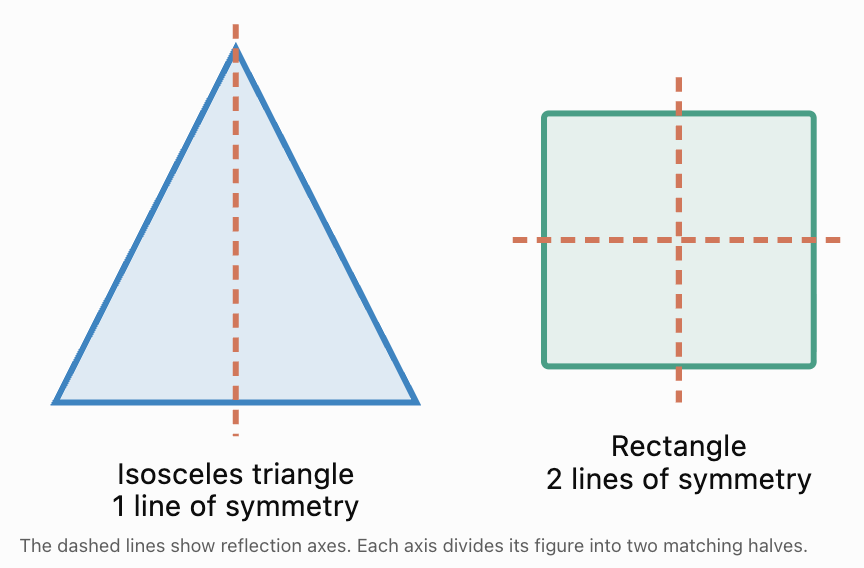
Important Properties of a Line of Symmetry
A line of symmetry:
-
Divides a figure into two mirror-image halves.
-
Passes through the midpoint of every segment joining a point to its reflected image.
-
Is perpendicular to the segment joining corresponding non-fixed points.
-
Leaves points on the symmetry line unchanged.
-
Preserves lengths, angles, perimeter, and area under reflection.
A figure may have no lines of symmetry, one line, several lines, or infinitely many lines.
Finding Lines of Symmetry
To determine the lines of symmetry of a figure:
-
Examine the overall shape.
-
Imagine folding it across a possible line.
-
Check whether every point on one side matches a point on the other.
-
Repeat for other possible lines.
-
Count only the lines that produce an exact match.
Common Geometric Figures
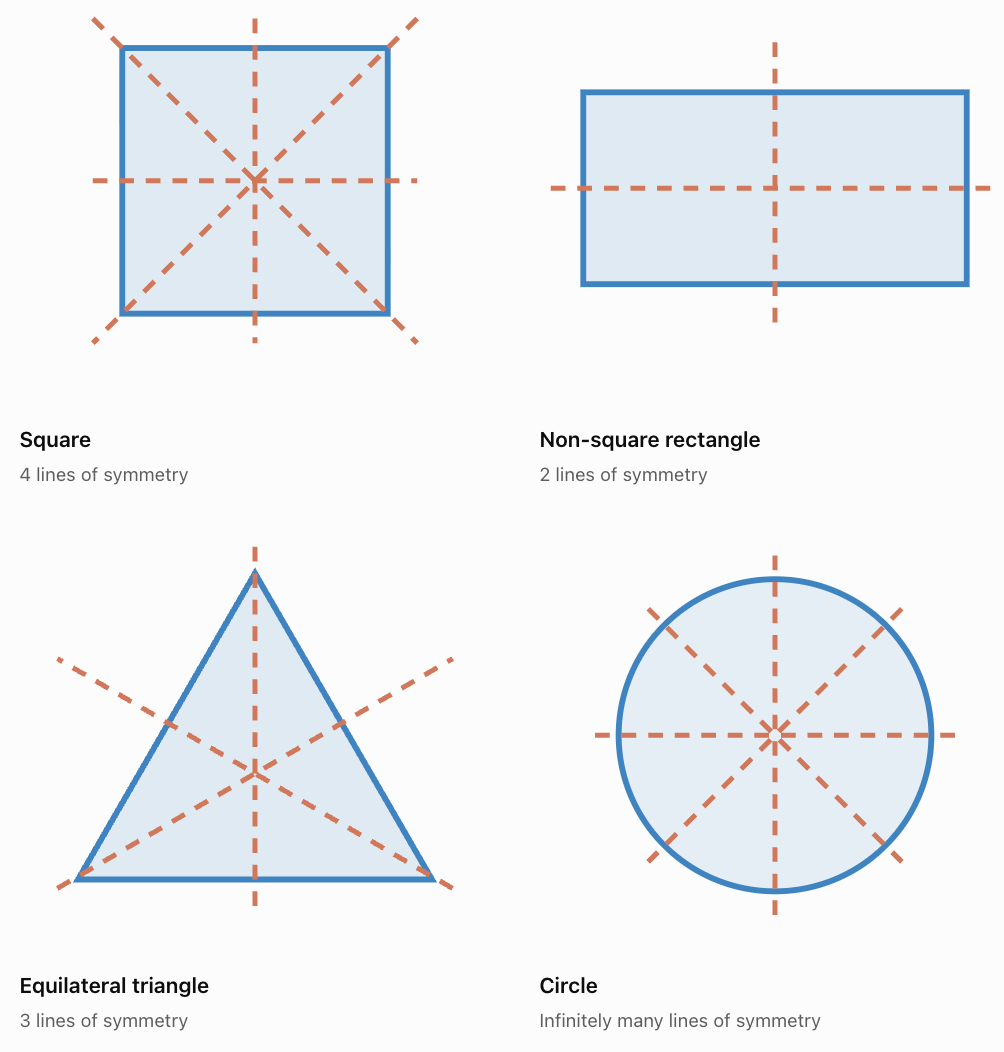
The circle has infinitely many symmetry lines because every diameter lies along an axis of symmetry.
Symmetry in Triangles
Equilateral Triangle
An equilateral triangle has:
-
Three equal sides.
-
Three equal angles of 60°.
-
Three lines of symmetry.
Each symmetry line passes through a vertex and the midpoint of the opposite side.
Isosceles Triangle
An isosceles triangle with exactly two equal sides has one line of symmetry.
It passes through the vertex between the equal sides and the midpoint of the base.
Scalene Triangle
A scalene triangle has three different side lengths.
It has no lines of symmetry.
Worked Example 1: Classifying a Triangle
A triangle has side lengths 8 cm, 8 cm, and 12 cm.
Determine its number of lines of symmetry.
Step 1: Identify the equal sides.
Two sides are 8 cm long.
Step 2: Classify the triangle.
It is an isosceles triangle, but not equilateral.
Answer: 1 line of symmetry.
The symmetry line passes through the vertex where the equal sides meet and the midpoint of the 12 cm base.
Symmetry in Quadrilaterals
|
Quadrilateral |
Number of lines of symmetry |
|---|---|
|
Square |
4 |
|
Non-square rectangle |
2 |
|
Non-square rhombus |
2 |
|
Non-square kite with two distinct pairs of adjacent equal sides |
1 |
|
General parallelogram |
0 |
|
Isosceles trapezoid (non-rectangle) |
1 |
|
General irregular quadrilateral |
Usually 0 |
A non-square rhombus has two lines of symmetry along its diagonals.
A general parallelogram has no reflection symmetry, although it does have rotational symmetry.
Worked Example 2: Finding the Symmetry of a Rectangle
A rectangle measures 12 cm by 7 cm.
How many lines of symmetry does it have?
Because its length and width are different, it is not a square.
It has:
-
One vertical line through its centre.
-
One horizontal line through its centre.
Its diagonals are not lines of symmetry.
Answer: 2 lines of symmetry.
Rotational Symmetry
A figure has rotational symmetry if it can be rotated through an angle greater than 0° and less than 360° about a fixed point and still match its original appearance.
The fixed point is the centre of rotation.
For example, a square matches its original position after rotations of:
90°, 180°, 270°, and 360°.
The 360° turn is included when counting the order of rotational symmetry.
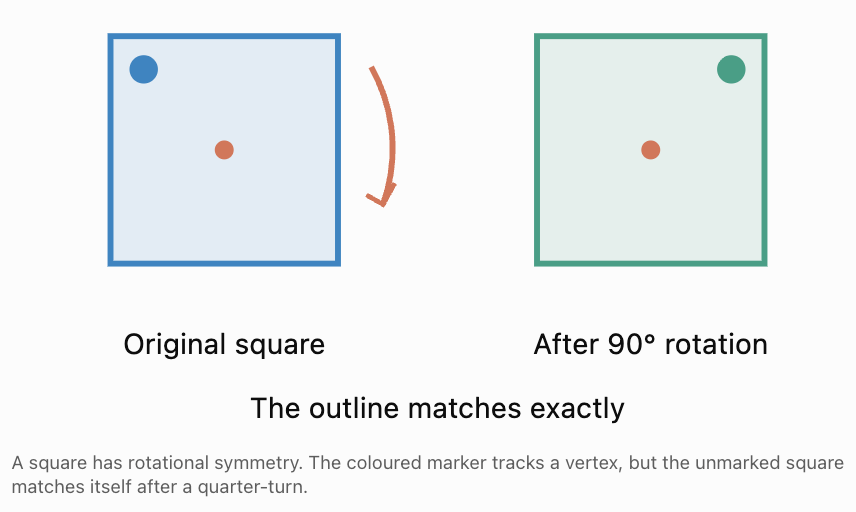
Order of Rotational Symmetry
The order of rotational symmetry is the number of times a figure matches itself during one complete 360° rotation, including its original position after a full turn.
For example:
-
An equilateral triangle has order 3.
-
A square has order 4.
-
A regular pentagon has order 5.
-
A regular hexagon has order 6.
-
A non-square rectangle has order 2.
A figure that matches itself only after a full 360° turn has rotational symmetry of order 1.
Formula for the Order of Rotational Symmetry
If the smallest positive angle of rotational symmetry is θ:
Order = 360° ÷ θ
Conversely:
Smallest angle = 360° ÷ Order
These formulas apply to figures with a finite rotational symmetry order greater than 1.
Worked Example 3: Finding the Order
A shape matches itself after every 72° rotation.
Find its rotational symmetry order.
Order = 360°/72°
Order = 5
Answer: Rotational symmetry of order 5.
Worked Example 4: Finding the Smallest Angle
A figure has rotational symmetry of order 8.
Find the smallest positive angle of rotation.
Angle = 360°/8
Answer: 45°.
The figure matches itself after rotations of:
45°, 90°, 135°, 180°, 225°, 270°, 315°, and 360°.
Rotational Symmetry in Common Figures
|
Figure |
Order |
Smallest positive angle |
|---|---|---|
|
Equilateral triangle |
3 |
120° |
|
Square |
4 |
90° |
|
Non-square rectangle |
2 |
180° |
|
Non-square rhombus |
2 |
180° |
|
General parallelogram |
2 |
180° |
|
Regular pentagon |
5 |
72° |
|
Regular hexagon |
6 |
60° |
|
Regular octagon |
8 |
45° |
|
General scalene triangle |
1 |
No nontrivial angle |
A circle has rotational symmetry through every angle about its centre. It therefore has infinitely many rotational symmetries, rather than a finite order.
Regular Polygons and Symmetry
A regular polygon has all sides equal and all interior angles equal.
A regular polygon with n sides has:
n lines of symmetry
and
rotational symmetry of order n.
Its smallest positive angle of rotational symmetry is:
θ = 360°/n
Worked Example 5: Regular Nonagon
A regular nonagon has 9 sides.
Determine:
a) The number of lines of symmetry.
b) The order of rotational symmetry.
c) The smallest positive angle of rotational symmetry.
a) Lines of symmetry
A regular polygon has one symmetry line for each side.
Answer: 9.
b) Rotational symmetry order
Order = number of sides = 9.
c) Smallest positive angle
θ = 360°/9
θ = 40°.
Answers: 9 lines, order 9, smallest angle 40°.
Why Do Regular Polygons Have n Lines of Symmetry?
A regular polygon has evenly spaced vertices around its centre.
Reflection across an appropriate line through the centre maps its vertices onto one another.
For an odd-sided regular polygon, each symmetry line passes through one vertex and the midpoint of the opposite side.
For an even-sided regular polygon, half of the symmetry lines pass through opposite vertices, and half pass through midpoints of opposite sides.
There are exactly n such reflection axes.
Worked Example 6: Regular Dodecagon
A regular dodecagon has 12 sides.
Its lines of symmetry consist of:
6 lines joining opposite vertices.
6 lines joining midpoints of opposite sides.
Total:
6 + 6 = 12.
Its rotational symmetry order is 12.
Smallest positive rotation:
360°/12 = 30°.
Answer: 12 lines of symmetry, rotational order 12, smallest angle 30°.
Comparing Line and Rotational Symmetry
A figure can have both kinds of symmetry, only rotational symmetry, only line symmetry, or neither.
For ordinary finite plane figures, a shape with exactly one reflection axis but no nontrivial rotational symmetry is common, such as a non-equilateral isosceles triangle.
A general parallelogram has rotational symmetry of order 2 but no reflection symmetry.
A figure can also be designed to have reflection symmetry without any rotational symmetry beyond a full turn.
Worked Example 7: Symmetry of a Parallelogram
A parallelogram is not a rectangle or a rhombus.
Determine its symmetry.
A general parallelogram does not have any line of symmetry.
However, rotating it through 180° about the intersection of its diagonals maps it onto itself.
Answer: 0 lines of symmetry; rotational symmetry of order 2.
Symmetry and Coordinate Geometry
Coordinate geometry allows us to describe symmetry precisely using algebra.
Reflection Symmetry Using Coordinates
For a point P(x, y):
|
Reflection line |
Image coordinates |
|---|---|
|
x-axis |
(x, −y) |
|
y-axis |
(−x, y) |
|
y = x |
(y, x) |
|
y = −x |
(−y, −x) |
|
x = a |
(2a − x, y) |
|
y = b |
(x, 2b − y) |
These rules help us find missing points and test whether figures are symmetrical.
Worked Example 8: Finding a Reflected Point
Point A(5, 3) is reflected in the line x = 2.
Find A′.
Reflection rule:
(x, y) → (2a − x, y)
Here:
a = 2.
Therefore:
x′ = 2(2) − 5 = −1
y′ = 3
Answer: A′(−1, 3).
The line x = 2 is halfway between x = 5 and x = −1.
Finding a Line of Symmetry from Two Points
If A and A′ are mirror images, their line of symmetry is the perpendicular bisector of AA′.
For horizontal or vertical segments, this is especially easy.
Worked Example 9: Finding the Mirror Line
Point P(−4, 6) is reflected to P′(8, 6).
Find the line of reflection.
The segment PP′ is horizontal.
Its midpoint is:
M = ((−4 + 8)/2, (6 + 6)/2)
M = (2, 6)
The perpendicular bisector is vertical.
Answer: x = 2.
Rotational Symmetry Using Coordinates
A 180° rotation about the origin follows:
(x, y) → (−x, −y)
A 180° rotation about C(h, k) follows:
(x, y) → (2h − x, 2k − y)
This is especially useful for identifying central symmetry.
Worked Example 10: Finding the Centre of Rotational Symmetry
A point A(−3, 2) maps to A′(7, 8) under a 180° rotation.
Find the centre of rotation.
For a 180° rotation, the centre is the midpoint of A and A′.
C = ((−3 + 7)/2, (2 + 8)/2)
C = (2, 5)
Answer: C(2, 5).
Symmetry and Missing Coordinates
Symmetry can help determine unknown coordinates in geometric figures.
Worked Example 11: Completing a Symmetric Triangle
Triangle ABC is symmetrical about the y-axis.
One base vertex is A(−5, 2), and the other base vertex B is its reflection.
The third vertex is C(0, 8).
Find B.
Reflection in the y-axis follows:
(x, y) → (−x, y)
Therefore:
A(−5, 2) → B(5, 2)
Answer: B(5, 2).
The triangle is isosceles because the y-axis is its symmetry line.
Symmetry and Angle Problems
Symmetry can be used to calculate unknown angles without measuring them.
In a figure with reflection symmetry, corresponding angles are equal.
Worked Example 12: Isosceles Triangle
An isosceles triangle has a vertex angle of 46°.
Find each base angle.
The line of symmetry exchanges the two base vertices.
Therefore, the base angles are equal.
Sum of angles:
180° − 46° = 134°
Each base angle:
134°/2 = 67°
Answer: Each base angle is 67°.
Worked Example 13: Regular Pentagon
Find the interior angle of a regular pentagon.
The sum of interior angles of an n-sided polygon is:
(n − 2) × 180°.
For n = 5:
Sum = 3 × 180° = 540°.
All interior angles are equal.
Each angle:
540°/5 = 108°.
Answer: 108°.
Its rotational symmetry order is 5, and its smallest rotational angle is 72°.
Symmetry and Area
Symmetry can simplify area calculations by dividing a figure into matching parts.
If a line of symmetry divides a figure into two halves, their areas are equal.
Worked Example 14: Symmetric Garden
A garden has a total area of 180 m² and one line of symmetry dividing it into two matching regions.
Find the area of each region.
Area of each half:
180/2 = 90 m².
Answer: 90 m².
Worked Example 15: Regular Hexagon
A regular hexagon has a total area of 216 cm².
It is divided into six congruent triangles by joining its centre to all vertices.
Find the area of each triangle.
Area of each triangle:
216/6 = 36 cm².
Answer: 36 cm².
This division is possible because the hexagon has rotational symmetry of order 6.
Symmetry and Patterns
Symmetry is useful in creating and analysing repeating geometric designs.
A design may contain:
-
Reflection symmetry.
-
Rotational symmetry.
-
Translation symmetry.
-
Combinations of these transformations.
For example, a repeated floor-tile pattern may remain unchanged when shifted by a particular distance.
This is called translational symmetry.
A figure can also have glide reflection symmetry, where a reflection is followed by a translation parallel to the reflection line.
These ideas are important in tessellations, wallpaper patterns, and mathematical crystallography.
Real-World Applications of Symmetry
Biology and nature
Butterflies, many leaves, and numerous animal body plans show approximate bilateral symmetry. This arrangement can be useful in studying body structure and development.
Architecture
Architects use symmetry to create visual balance and organize structural and decorative features.
Art and design
Rotational and reflection symmetry are used in mandalas, mosaics, logos, and repeating decorative patterns.
Science and crystals
Snowflakes often display approximate sixfold symmetry, reflecting the molecular structure and growth processes of ice crystals.
Engineering and Manufacturing
Symmetry is important in engineering because balanced designs can distribute forces or mass in useful ways.
For example, a wheel with evenly spaced spokes has rotational symmetry.
If the wheel has 12 identical evenly spaced spokes, the arrangement has rotational symmetry of order 12, assuming no other features break the pattern.
Smallest positive rotational angle:
360°/12 = 30°.
Physics
Symmetry plays a major role in physics.
Physical laws often remain unchanged under certain transformations.
Examples include:
-
Translational symmetry: Physical laws are the same at different locations under the same conditions.
-
Rotational symmetry: Physical laws do not depend on a preferred spatial direction.
-
Time-translation symmetry: Physical laws remain the same over time under the same conditions.
In more advanced physics, these symmetries are connected to conservation laws through Noether's theorem.
Computer Graphics
Symmetry helps designers create shapes efficiently.
For example, instead of drawing every repeated feature individually, a program can create one feature and rotate copies around a centre.
If a pattern contains 10 equally spaced features:
Angle between features = 360°/10 = 36°.
The same geometric rule can generate the entire pattern.
Common Mistakes
Mistake 1: Assuming Every Figure Has a Line of Symmetry
Some figures, such as general scalene triangles and general parallelograms, have no reflection symmetry.
Mistake 2: Confusing Line Symmetry with Rotational Symmetry
A line of symmetry involves reflection.
Rotational symmetry involves turning a figure around a centre.
Mistake 3: Counting Only Half the Symmetry Lines
A square has four lines of symmetry, including both diagonals.
Mistake 4: Assuming a Rectangle Has Four Lines of Symmetry
A non-square rectangle has only two lines of symmetry.
Its diagonals are not reflection axes.
Mistake 5: Forgetting the Full Turn When Counting Rotational Order
A square matches itself at 90°, 180°, 270°, and 360°.
Its order is 4, not 3.
Mistake 6: Confusing Rotational Order with the Smallest Angle
For a regular hexagon:
Order = 6
Smallest angle = 60°.
These quantities are related but are not the same.
Mistake 7: Assuming Every Figure with Rotational Symmetry Has Line Symmetry
A general parallelogram has rotational symmetry of order 2 but no line symmetry.
Mistake 8: Treating Approximate Symmetry as Exact
Natural objects may appear symmetrical but often contain small differences.
Mathematical symmetry requires an exact match.
Mistake 9: Forgetting the Centre of Rotation
Rotational symmetry occurs about a particular fixed point.
Mistake 10: Assuming a Shape with Order 1 Has Nontrivial Rotational Symmetry
Order 1 means the figure matches only after a full 360° rotation.
Mistake 11: Assuming All Polygons Have the Same Symmetry as Regular Polygons
An irregular hexagon does not necessarily have six lines of symmetry or rotational order 6.
Mistake 12: Misidentifying Corresponding Points
In reflection symmetry, corresponding points must be equally far from the mirror line along perpendicular directions.
Mistake 13: Using Symmetry Without Checking the Whole Figure
A line may divide one part of a figure evenly without being a symmetry line for the entire figure.
Mistake 14: Confusing a Design's Symmetry with Its Underlying Shape
A square outline has four reflection axes, but a decoration placed inside it may reduce or eliminate those symmetries.
Key Terms
-
Symmetry: A property in which a transformation maps a figure onto itself.
-
Line Symmetry: Symmetry under reflection across a line.
-
Reflection Symmetry: Another name for line symmetry.
-
Line of Symmetry: A line dividing a figure into matching mirror-image halves.
-
Axis of Symmetry: Another name for a line of symmetry.
-
Mirror Image: The image produced by reflection.
-
Reflection: A transformation that flips a figure across a line.
-
Rotational Symmetry: Symmetry under rotation about a fixed centre.
-
Centre of Rotation: The fixed point around which a figure turns.
-
Order of Rotational Symmetry: The number of matching positions during a complete turn.
-
Angle of Rotation: The angle through which a figure turns.
-
Smallest Positive Angle of Rotation: The least nonzero rotation that maps a figure onto itself.
-
Regular Polygon: A polygon with all sides and all interior angles equal.
-
Irregular Polygon: A polygon that is not regular.
-
Equilateral Triangle: A triangle with three equal sides.
-
Isosceles Triangle: A triangle with at least two equal sides.
-
Scalene Triangle: A triangle with three different side lengths.
-
Perpendicular Bisector: A line perpendicular to a segment through its midpoint.
-
Congruence: Equality of shape and size.
-
Corresponding Points: Points matched by a transformation.
-
Invariant Point: A point unchanged by a transformation.
-
Bilateral Symmetry: Symmetry across one plane or line, depending on the context.
-
Radial Symmetry: Symmetry arranged around a central point or axis.
-
Translational Symmetry: Symmetry under a translation.
-
Glide Reflection: A reflection followed by a translation along the reflection line.
-
Tessellation: A pattern of shapes covering a plane without gaps or overlaps.
-
Symmetric Figure: A figure possessing at least one nontrivial symmetry.
-
Asymmetric Figure: A figure without nontrivial symmetry of the kind being considered.
Key Takeaways
-
Symmetry occurs when a transformation maps a figure exactly onto itself.
-
Line symmetry involves reflection across an axis.
-
A line of symmetry divides a figure into matching halves.
-
A square has four lines of symmetry.
-
A non-square rectangle has two lines of symmetry.
-
An equilateral triangle has three lines of symmetry.
-
A non-equilateral isosceles triangle has one line of symmetry.
-
A scalene triangle has no lines of symmetry.
-
A circle has infinitely many lines of symmetry.
-
Rotational symmetry involves turning a figure about a fixed centre.
-
The order of rotational symmetry counts matching positions in one complete turn.
-
The smallest positive rotational angle equals 360° divided by the order.
-
A regular n-sided polygon has n lines of symmetry.
-
A regular n-sided polygon has rotational symmetry of order n.
-
A general parallelogram has rotational symmetry of order 2.
-
Coordinate rules can be used to identify and prove symmetry.
-
Symmetry can help calculate missing angles, coordinates, and areas.
-
Symmetry is widely used in nature, architecture, engineering, and design.
-
Approximate symmetry is common in real objects, but mathematical symmetry requires an exact match.
-
Symmetry provides an important connection between geometry, transformations, and algebra.
Check Your Understanding
Show all working for calculation questions and justify your reasoning where appropriate.
Question 1: Line Symmetry
How many lines of symmetry does each figure have?
a) Square
b) Non-square rectangle
c) Equilateral triangle
d) General scalene triangle
e) Circle
Question 2: Isosceles Triangle
An isosceles triangle has side lengths 6 cm, 6 cm, and 9 cm.
How many lines of symmetry does it have?
Describe the position of the line.
Question 3: Rotational Symmetry
Find the order of rotational symmetry of:
a) Square
b) Equilateral triangle
c) Regular hexagon
d) Non-square rectangle
e) General parallelogram
Question 4: Smallest Angle
A figure has rotational symmetry of order 10.
Find its smallest positive angle of rotational symmetry.
Question 5: Finding the Order
A figure matches itself after every 45° rotation.
Find its rotational symmetry order.
Question 6: Regular Polygon
A regular octagon has eight sides.
Find:
a) The number of lines of symmetry.
b) The rotational symmetry order.
c) The smallest positive rotational angle.
Question 7: Regular Polygon with Unknown Sides
A regular polygon has a smallest positive rotational angle of 24°.
Find the number of sides.
Question 8: Reflection in the y-Axis
Reflect A(−7, 4) in the y-axis.
Find A′.
Question 9: Reflection in a Vertical Line
Point P(8, 3) is reflected in the line x = 2.
Find P′.
Question 10: Finding a Mirror Line
Point A(−5, 4) is reflected to A′(3, 4).
Find the equation of the line of reflection.
Question 11: Centre of Rotational Symmetry
Point P(−4, 1) maps to P′(6, 9) under a 180° rotation.
Find the centre of rotation.
Question 12: Isosceles Triangle Angles
An isosceles triangle has a vertex angle of 38°.
Find both base angles.
Question 13: Regular Polygon Interior Angle
Find the interior angle of a regular octagon.
Question 14: Area and Symmetry
A regular hexagon has a total area of 300 cm².
It is divided into six congruent triangles by joining the centre to the vertices.
Find the area of each triangle.
Question 15: Rotational Pattern
A circular design contains 15 identical, equally spaced features.
Assuming no other details break the symmetry, find:
a) Its rotational symmetry order.
b) The smallest positive angle that maps the design onto itself.
Question 16: Comparing Symmetry
Explain why a general parallelogram has rotational symmetry but no line symmetry.
Question 17: Coordinate Geometry
Triangle ABC has vertices:
A(−4, 2)
B(4, 2)
C(0, 8).
a) Identify its line of symmetry.
b) Use the distance formula to prove that it is isosceles.
c) Find the midpoint of AB.
Question 18: Comprehensive Challenge
A regular polygon has 12 lines of symmetry.
a) How many sides does it have?
b) What is its rotational symmetry order?
c) What is its smallest positive angle of rotational symmetry?
d) Find each interior angle.
e) Find each exterior angle.
f) Find the total sum of its interior angles.
g) Explain how its symmetry lines are arranged.
Fully Worked Answers
Answer 1: Line Symmetry
a) Square: 4 lines.
b) Non-square rectangle: 2 lines.
c) Equilateral triangle: 3 lines.
d) General scalene triangle: 0 lines.
e) Circle: Infinitely many lines.
Each line of symmetry must map the entire figure onto itself under reflection.
Answer 2: Isosceles Triangle
The triangle has two equal sides of 6 cm.
Therefore, it is isosceles but not equilateral.
Its symmetry line passes through the vertex where the equal sides meet and the midpoint of the 9 cm base.
Answer: 1 line of symmetry.
Answer 3: Rotational Symmetry
a) Square: Order 4.
b) Equilateral triangle: Order 3.
c) Regular hexagon: Order 6.
d) Non-square rectangle: Order 2.
e) General parallelogram: Order 2.
Answer 4: Smallest Angle
Order = 10.
Smallest angle:
θ = 360°/10
Answer: 36°.
Answer 5: Finding the Order
Smallest positive angle = 45°.
Order = 360°/45°
Answer: Order 8.
Answer 6: Regular Octagon
A regular octagon has 8 sides.
a) Lines of symmetry = 8.
b) Rotational symmetry order = 8.
c) Smallest positive angle:
360°/8 = 45°.
Answers: 8 lines, order 8, smallest angle 45°.
Answer 7: Regular Polygon with Unknown Sides
Smallest angle = 24°.
For a regular polygon:
n = 360°/24°
n = 15.
Answer: 15 sides (regular pentadecagon).
Answer 8: Reflection in the y-Axis
Rule:
(x, y) → (−x, y)
A(−7, 4) → A′(7, 4)
Answer: A′(7, 4).
Answer 9: Reflection in x = 2
Use:
x′ = 2a − x
a = 2
x′ = 4 − 8 = −4
The y-coordinate remains 3.
Answer: P′(−4, 3).
Answer 10: Finding the Mirror Line
Given:
A(−5, 4)
A′(3, 4).
The segment AA′ is horizontal.
Find its midpoint:
M = ((−5 + 3)/2, (4 + 4)/2)
M = (−1, 4).
The perpendicular bisector is vertical.
Answer: x = −1.
Answer 11: Centre of Rotational Symmetry
A 180° rotation maps a point to another point on the opposite side of the centre.
The centre is their midpoint.
C = ((−4 + 6)/2, (1 + 9)/2)
C = (2/2, 10/2)
Answer: C(1, 5).
Answer 12: Isosceles Triangle Angles
Vertex angle = 38°.
The base angles are equal.
Sum of base angles:
180° − 38° = 142°.
Each base angle:
142°/2 = 71°.
Answer: 71° and 71°.
Answer 13: Regular Octagon Interior Angle
For an n-sided polygon:
Sum of interior angles = (n − 2) × 180°.
For n = 8:
Sum = 6 × 180° = 1080°.
Each interior angle:
1080°/8 = 135°.
Answer: 135°.
Answer 14: Area and Symmetry
Total area = 300 cm².
Number of congruent triangles = 6.
Area of each:
300/6 = 50 cm².
Answer: 50 cm².
Answer 15: Rotational Pattern
There are 15 identical equally spaced features.
a) Rotational symmetry order = 15.
b) Smallest positive angle:
360°/15 = 24°.
Answers: Order 15 and angle 24°.
Answer 16: General Parallelogram
A general parallelogram has opposite sides equal and parallel.
Its diagonals bisect each other.
The intersection of its diagonals is the centre of a 180° rotation.
Under this rotation:
-
Each vertex maps to its opposite vertex.
-
Each side maps to its opposite side.
-
The figure matches itself exactly.
Therefore, its rotational symmetry order is 2.
However, a general parallelogram has no reflection axis because reflecting it across a proposed line does not map all its vertices and sides onto themselves.
Conclusion: A general parallelogram has rotational symmetry of order 2 and no lines of symmetry.
Answer 17: Coordinate Geometry
Given:
A(−4, 2)
B(4, 2)
C(0, 8).
a) Identify the line of symmetry.
Points A and B are reflections of each other across the y-axis.
Point C lies on the y-axis.
Therefore:
Line of symmetry: x = 0.
b) Prove the triangle is isosceles.
Calculate AC:
AC = √((0 − (−4))² + (8 − 2)²)
AC = √(4² + 6²)
AC = √52
AC = 2√13.
Calculate BC:
BC = √((0 − 4)² + (8 − 2)²)
BC = √((−4)² + 6²)
BC = √52
BC = 2√13.
Since:
AC = BC
triangle ABC is isosceles.
c) Find the midpoint of AB.
M = ((−4 + 4)/2, (2 + 2)/2)
M = (0, 2).
Answer: M(0, 2).
The symmetry line passes through C(0, 8) and M(0, 2).
Answer 18: Comprehensive Challenge
The regular polygon has 12 lines of symmetry.
a) Number of sides
A regular polygon has the same number of sides as lines of symmetry.
Answer: 12 sides.
It is a regular dodecagon.
b) Rotational symmetry order
For a regular polygon:
Order = number of sides.
Answer: Order 12.
c) Smallest positive rotational angle
θ = 360°/12
Answer: 30°.
d) Each interior angle
Interior angle = ((n − 2) × 180°)/n
= ((12 − 2) × 180°)/12
= 1800°/12
Answer: 150°.
e) Each exterior angle
Exterior angle = 360°/12
Answer: 30°.
Alternatively:
180° − 150° = 30°.
f) Sum of interior angles
Sum = (n − 2) × 180°
= 10 × 180°
Answer: 1800°.
g) Arrangement of symmetry lines
Because the regular dodecagon has an even number of sides, its symmetry lines occur in two groups:
-
Six lines joining pairs of opposite vertices.
-
Six lines joining the midpoints of pairs of opposite sides.
All 12 lines pass through the centre.
Final Course Connections
Symmetry provides a way to understand the structure and balance of geometric figures.
Line symmetry describes reflection, while rotational symmetry describes how figures match themselves after turning. These properties help us classify shapes, investigate regular polygons, calculate unknown measurements, and establish geometric relationships using coordinates.
Symmetry also connects mathematics to biology, chemistry, physics, architecture, art, engineering, and computer graphics.
This completes Symmetry, with coverage of all five learning targets, geometric explanations, worked examples, diagrams, real-world applications, common mistakes, key terms, key takeaways, and fully worked practice questions.
5. Coordinate Proof
Learning outcomes
- I can prove geometric relationships using coordinates.
- I can verify congruence using coordinate methods.
- I can verify parallel and perpendicular lines algebraically.
- I can justify geometric conclusions with calculations.
- I can compare coordinate proofs with classical proofs.
Introduction
How can we prove that a triangle is right-angled without using a protractor? How can we demonstrate that a quadrilateral is a rectangle, rhombus, or square using only the coordinates of its vertices? And how can algebra help us establish geometric facts with certainty?
The answer is coordinate proof.
Coordinate proof combines algebra and geometry. Instead of relying only on diagrams and traditional geometric theorems, we assign coordinates to points and use mathematical calculations to prove relationships.
For example, we can use:
-
The distance formula to prove that sides are equal.
-
The midpoint formula to prove that diagonals bisect each other.
-
The slope formula to prove that lines are parallel or perpendicular.
-
Coordinate calculations and congruence theorems to prove that triangles are congruent.
-
Logical mathematical arguments to explain why these calculations establish a geometric conclusion.
Coordinate proofs are especially useful because they turn visual relationships into precise algebraic statements.
In this lesson, we will learn how to construct complete coordinate proofs, verify congruence, prove parallelism and perpendicularity, and compare coordinate methods with classical Euclidean geometry.
What Is a Coordinate Proof?
A coordinate proof is a mathematical argument that uses coordinates and algebraic calculations to establish a geometric property.
A coordinate proof typically involves four stages:
-
Represent the figure: Identify or assign coordinates to important points.
-
Calculate relationships: Use slope, distance, midpoint, or equations of lines.
-
Apply geometric theorems: Connect the calculations to known geometric properties.
-
State a justified conclusion: Explain exactly what has been proved.
For example, suppose a triangle has vertices:
A(0, 0), B(6, 0), C(0, 8).
The horizontal segment AB has length 6.
The vertical segment AC has length 8.
Horizontal and vertical lines are perpendicular.
Therefore, ∠BAC = 90°, so triangle ABC is right-angled at A.
We can also calculate BC:
BC = √((0 − 6)² + (8 − 0)²)
BC = √(36 + 64)
BC = 10.
Since:
6² + 8² = 10²
the converse of Pythagoras' theorem confirms that the triangle is right-angled.
This is a coordinate proof because the conclusion follows from exact calculations and established mathematical principles.
Essential Coordinate Geometry Formulas
Before constructing proofs, we need three fundamental formulas.
Distance Formula
For points A(x₁, y₁) and B(x₂, y₂):
AB = √((x₂ − x₁)² + (y₂ − y₁)²)
The distance formula comes from Pythagoras' theorem.
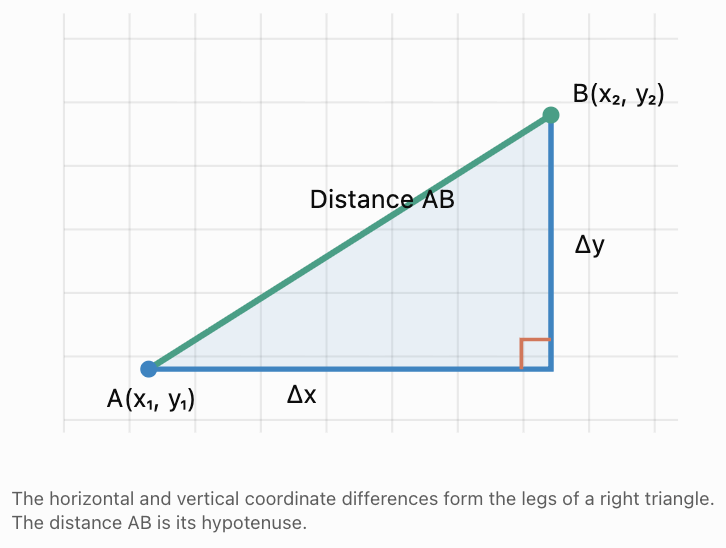
Midpoint Formula
The midpoint of segment AB is:
M = ((x₁ + x₂)/2, (y₁ + y₂)/2)
The midpoint formula is useful for proving that diagonals bisect each other and identifying centres of symmetry.
Slope Formula
For a nonvertical line through A(x₁, y₁) and B(x₂, y₂):
m = (y₂ − y₁)/(x₂ − x₁)
The slope describes the direction of a line.
For distinct nonvertical lines:
-
Equal slopes establish parallelism.
-
Negative reciprocal slopes establish perpendicularity when both slopes are nonzero.
-
A horizontal line is perpendicular to a vertical line.
A vertical line has undefined slope.
Using Distance to Prove Equal Lengths
Two segments have equal lengths if their calculated distances are equal.
Worked Example 1: Proving an Isosceles Triangle
Triangle ABC has vertices:
A(0, 5)
B(−3, 0)
C(3, 0).
Prove that triangle ABC is isosceles.
Step 1: Calculate AB.
AB = √((−3 − 0)² + (0 − 5)²)
AB = √(9 + 25)
AB = √34.
Step 2: Calculate AC.
AC = √((3 − 0)² + (0 − 5)²)
AC = √(9 + 25)
AC = √34.
Step 3: Compare.
AB = AC.
Conclusion: Triangle ABC is isosceles because it has two equal sides.
Notice that the coordinates also show reflection symmetry across the y-axis, giving another way to understand the result.
Using Midpoints to Prove Geometric Relationships
A segment is bisected when it is divided into two equal parts.
If two diagonals share the same midpoint, they bisect each other.
Worked Example 2: Proving Diagonals Bisect Each Other
Consider quadrilateral ABCD:
A(1, 1)
B(7, 3)
C(9, 9)
D(3, 7).
Find the midpoint of AC:
M_AC = ((1 + 9)/2, (1 + 9)/2)
M_AC = (5, 5).
Find the midpoint of BD:
M_BD = ((7 + 3)/2, (3 + 7)/2)
M_BD = (5, 5).
The diagonals have the same midpoint.
Therefore, they bisect each other.
A quadrilateral whose diagonals bisect each other is a parallelogram.
Conclusion: ABCD is a parallelogram.
This proof uses the converse of a standard parallelogram theorem.
Proving Parallel Lines Using Slopes
Two distinct nonvertical lines are parallel when they have equal slopes.
For example:
Line AB has slope 2.
Line CD has slope 2.
If the lines are distinct, then:
AB ∥ CD
The symbol ∥ means is parallel to.
Worked Example 3: Proving Opposite Sides Are Parallel
Quadrilateral ABCD has vertices:
A(1, 1)
B(6, 3)
C(8, 8)
D(3, 6).
Prove that ABCD is a parallelogram.
Step 1: Calculate the slope of AB.
m_AB = (3 − 1)/(6 − 1)
m_AB = 2/5.
Step 2: Calculate the slope of CD.
m_CD = (6 − 8)/(3 − 8)
m_CD = −2/−5 = 2/5.
Therefore:
AB ∥ CD.
Step 3: Calculate the slope of BC.
m_BC = (8 − 3)/(8 − 6)
m_BC = 5/2.
Step 4: Calculate the slope of AD.
m_AD = (6 − 1)/(3 − 1)
m_AD = 5/2.
Therefore:
BC ∥ AD.
Step 5: Apply the parallelogram theorem.
Both pairs of opposite sides are parallel.
Conclusion: ABCD is a parallelogram.
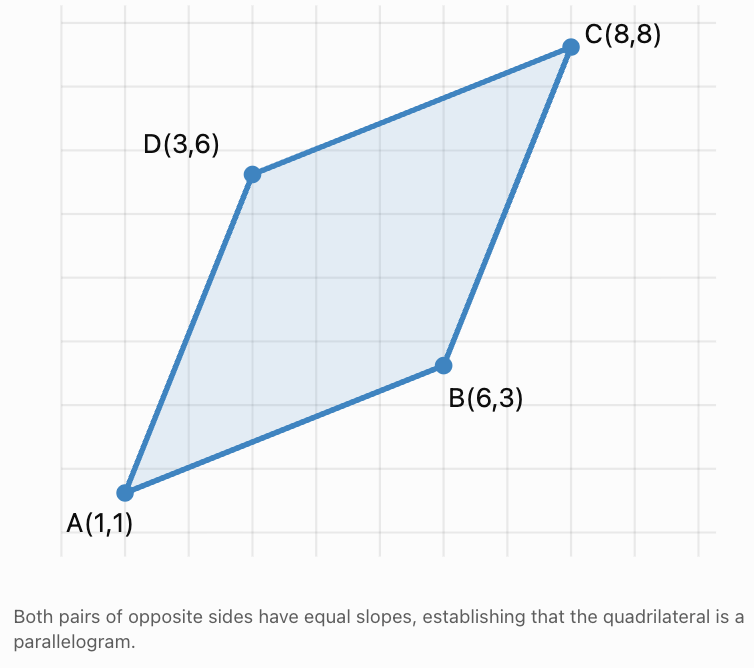
An Important Detail: Equal Slopes Are Not Always Enough
If two lines have equal slopes, they may be parallel or coincident.
For example:
y = 2x + 1
and
y = 2x + 1
describe the same line.
To establish that two lines are distinct and parallel, verify that they are not coincident. In a nondegenerate quadrilateral, distinct opposite sides are normally clear from the vertex coordinates.
Proving Perpendicular Lines Algebraically
Two lines are perpendicular if they intersect at 90°.
For nonvertical, nonhorizontal lines:
m₁ × m₂ = −1
This is called the negative reciprocal slope relationship.
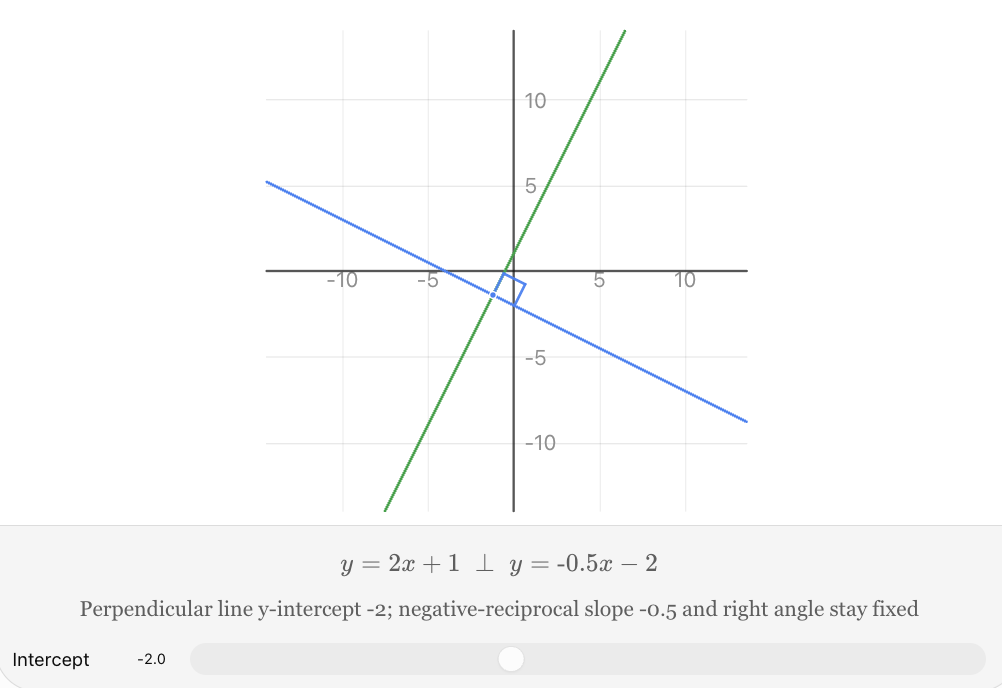
Worked Example 4: Proving a Right Triangle
Triangle ABC has vertices:
A(1, 2)
B(5, 4)
C(3, 8).
Prove that the triangle is right-angled.
Step 1: Calculate the slope of AB.
m_AB = (4 − 2)/(5 − 1)
m_AB = 2/4 = 1/2.
Step 2: Calculate the slope of BC.
m_BC = (8 − 4)/(3 − 5)
m_BC = 4/−2 = −2.
Step 3: Multiply the slopes.
m_AB × m_BC = (1/2)(−2)
= −1.
Therefore:
AB ⟂ BC.
Conclusion: Triangle ABC is right-angled at B.
Alternative Proof Using Pythagoras
Calculate the squared side lengths.
AB² = (5 − 1)² + (4 − 2)²
AB² = 16 + 4 = 20.
BC² = (3 − 5)² + (8 − 4)²
BC² = 4 + 16 = 20.
AC² = (3 − 1)² + (8 − 2)²
AC² = 4 + 36 = 40.
Since:
AB² + BC² = AC²
20 + 20 = 40.
By the converse of Pythagoras' theorem, ∠ABC = 90°.
Both methods establish the same conclusion.
Special Case: Horizontal and Vertical Lines
Suppose:
A(2, 3), B(8, 3), C(8, 9).
AB is horizontal because its endpoints have equal y-coordinates.
BC is vertical because its endpoints have equal x-coordinates.
Horizontal and vertical lines are perpendicular.
Therefore, ∠ABC = 90°.
We do not use the slope product rule here because the slope of BC is undefined.
Proving Congruence Using Coordinates
Two figures are congruent if they have the same shape and size.
Corresponding sides and angles are equal.
For triangles, we can use coordinate calculations together with standard congruence theorems.
|
Congruence theorem |
What must be established |
|---|---|
|
SSS |
Three pairs of corresponding sides are equal |
|
SAS |
Two pairs of corresponding sides and the included angle are equal |
|
ASA |
Two pairs of corresponding angles and the included side are equal |
|
AAS |
Two pairs of corresponding angles and a non-included side are equal |
|
RHS / HL |
Two right triangles have equal hypotenuses and one corresponding leg |
In coordinate geometry, SSS is often particularly convenient because distances can be calculated directly.
Worked Example 5: Proving Triangles Congruent Using SSS
Triangle ABC has vertices:
A(0, 0), B(4, 0), C(1, 3).
Triangle DEF has vertices:
D(6, 1), E(10, 1), F(7, 4).
Prove that the triangles are congruent.
Step 1: Calculate the sides of ABC.
AB = √((4 − 0)² + (0 − 0)²) = 4.
AC = √((1 − 0)² + (3 − 0)²) = √10.
BC = √((1 − 4)² + (3 − 0)²) = √18 = 3√2.
Step 2: Calculate the sides of DEF.
DE = √((10 − 6)² + (1 − 1)²) = 4.
DF = √((7 − 6)² + (4 − 1)²) = √10.
EF = √((7 − 10)² + (4 − 1)²) = √18 = 3√2.
Step 3: Compare corresponding sides.
AB = DE
AC = DF
BC = EF.
All three pairs of corresponding sides are equal.
Conclusion: △ABC ≅ △DEF by SSS congruence.
The symbol ≅ means is congruent to.
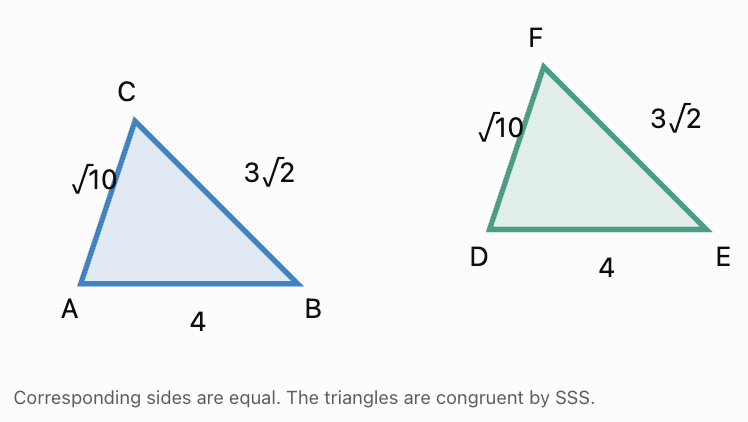
Worked Example 6: Proving Congruence Using SAS
Consider triangles ABC and DEF with:
A(0, 0), B(5, 0), C(0, 3)
D(2, 2), E(7, 2), F(2, 5).
Step 1: Establish one pair of equal sides.
AB = 5
DE = 5.
Step 2: Establish another pair of equal sides.
AC = 3
DF = 3.
Step 3: Establish the included angles.
AB and DE are horizontal.
AC and DF are vertical.
Therefore:
∠BAC = ∠EDF = 90°.
The included angles are equal.
Conclusion: △ABC ≅ △DEF by SAS congruence.
This proof combines distances and perpendicularity.
Using Coordinates to Prove Properties of Quadrilaterals
Coordinate proofs are especially effective for classifying quadrilaterals.
A useful strategy is to prove the simplest sufficient conditions rather than calculate every possible property.
|
Figure |
Sufficient conditions |
|---|---|
|
Parallelogram |
Both pairs of opposite sides parallel |
|
Rectangle |
Parallelogram with one right angle |
|
Rhombus |
Parallelogram with two adjacent sides equal |
|
Square |
Rectangle with two adjacent sides equal |
|
Kite |
Two distinct pairs of adjacent equal sides |
|
Isosceles trapezoid |
Exactly one pair of parallel sides and equal nonparallel sides, using the exclusive definition |
Worked Example 7: Proving a Rectangle
Quadrilateral ABCD has vertices:
A(1, 1)
B(5, 3)
C(3, 7)
D(−1, 5).
Step 1: Prove opposite sides parallel.
m_AB = (3 − 1)/(5 − 1) = 1/2.
m_CD = (5 − 7)/(−1 − 3) = 1/2.
Therefore, AB ∥ CD.
m_BC = (7 − 3)/(3 − 5) = −2.
m_AD = (5 − 1)/(−1 − 1) = −2.
Therefore, BC ∥ AD.
ABCD is a parallelogram.
Step 2: Prove one right angle.
m_AB × m_BC = (1/2)(−2) = −1.
Therefore, AB ⟂ BC.
Conclusion: ABCD is a rectangle because it is a parallelogram with a right angle.
Worked Example 8: Proving a Square
Consider:
A(0, 0), B(4, 2), C(2, 6), D(−2, 4).
Step 1: Calculate the side lengths.
AB² = 4² + 2² = 20.
BC² = (−2)² + 4² = 20.
CD² = (−4)² + (−2)² = 20.
DA² = 2² + (−4)² = 20.
Therefore:
AB = BC = CD = DA = √20.
All four sides are equal.
Step 2: Prove one right angle.
m_AB = 2/4 = 1/2.
m_BC = 4/(−2) = −2.
Their product is −1.
Therefore, AB ⟂ BC.
A quadrilateral with four equal sides is a rhombus, and a rhombus with a right angle is a square.
Conclusion: ABCD is a square.
This is a shorter proof than separately establishing every angle and both pairs of parallel sides.
Using Diagonals in Coordinate Proofs
Diagonals provide another powerful way to prove quadrilateral properties.
Important Diagonal Theorems
-
In a parallelogram, the diagonals bisect each other.
-
In a rectangle, the diagonals are equal and bisect each other.
-
In a rhombus, the diagonals bisect each other at right angles.
-
In a square, the diagonals are equal, perpendicular, and bisect each other.
These properties also have useful converses when combined with the appropriate conditions.
Worked Example 9: Proving a Rectangle Using Diagonals
Quadrilateral ABCD has vertices:
A(0, 0), B(6, 0), C(6, 4), D(0, 4).
Step 1: Find the midpoint of AC.
M_AC = ((0 + 6)/2, (0 + 4)/2)
M_AC = (3, 2).
Step 2: Find the midpoint of BD.
M_BD = ((6 + 0)/2, (0 + 4)/2)
M_BD = (3, 2).
The diagonals bisect each other, so ABCD is a parallelogram.
Step 3: Compare diagonal lengths.
AC = √(6² + 4²) = √52.
BD = √((0 − 6)² + (4 − 0)²) = √52.
Therefore, AC = BD.
A parallelogram with equal diagonals is a rectangle.
Conclusion: ABCD is a rectangle.
Choosing Coordinates for an Efficient Proof
Sometimes a geometry problem gives a diagram but no coordinates.
In these cases, we can choose coordinates strategically.
The aim is to simplify the calculations without restricting the generality of the figure.
For example, a general rectangle with width a and height b can be represented by:
A(0, 0)
B(a, 0)
C(a, b)
D(0, b)
where a > 0 and b > 0.
This is convenient because two sides lie on the coordinate axes.
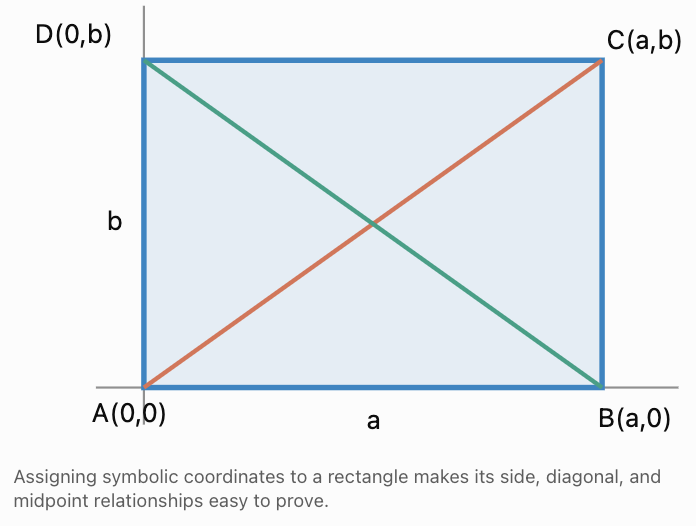
Worked Example 10: Proving Rectangle Diagonals Are Equal
Use the general rectangle:
A(0, 0)
B(a, 0)
C(a, b)
D(0, b).
Calculate AC:
AC = √((a − 0)² + (b − 0)²)
AC = √(a² + b²).
Calculate BD:
BD = √((0 − a)² + (b − 0)²)
BD = √(a² + b²).
Therefore:
AC = BD.
Conclusion: The diagonals of every rectangle are equal in length.
Unlike a proof using one numerical rectangle, this symbolic coordinate proof establishes the result for all rectangles.
Proving the Midsegment Theorem
The triangle midsegment theorem states that the segment joining the midpoints of two sides of a triangle is parallel to the third side and half its length.
Worked Example 11: General Coordinate Proof
Let triangle ABC have vertices:
A(0, 0)
B(2a, 0)
C(2b, 2c)
where a > 0 and c ≠ 0.
Let M be the midpoint of AB and N the midpoint of AC.
Step 1: Find M.
M = ((0 + 2a)/2, (0 + 0)/2)
M = (a, 0).
Step 2: Find N.
N = ((0 + 2b)/2, (0 + 2c)/2)
N = (b, c).
Step 3: Compare direction vectors.
Vector MN = (b − a, c).
Vector BC = (2b − 2a, 2c).
Therefore:
Vector BC = 2 × Vector MN.
The direction vectors are scalar multiples, so MN ∥ BC.
Step 4: Compare lengths.
MN = √((b − a)² + c²).
BC = √((2b − 2a)² + (2c)²)
BC = 2√((b − a)² + c²).
Therefore:
MN = BC/2.
Conclusion: The segment joining two side midpoints is parallel to the third side and half its length.
This proof is general because a, b, and c represent variable coordinates.
Coordinate Proofs and Classical Geometric Proofs
There are two major approaches to proving geometric relationships.
Coordinate Proof
A coordinate proof uses algebraic calculations.
For example, to prove that the diagonals of a rectangle are equal, calculate both diagonal lengths using the distance formula.
Classical Geometric Proof
A classical Euclidean proof uses established geometric relationships, such as congruence, parallel-line angle theorems, and properties of triangles.
For example, consider rectangle ABCD.
Triangles ABC and BAD have:
-
AB as a common side.
-
BC = AD because opposite sides of a rectangle are equal.
-
∠ABC = ∠BAD = 90°.
Therefore, △ABC ≅ △BAD by SAS.
Their corresponding hypotenuses are equal:
AC = BD.
Comparing the Methods
|
Feature |
Coordinate proof |
Classical proof |
|---|---|---|
|
Main tools |
Algebra, slopes, distances, midpoints |
Angles, congruence, geometric theorems |
|
Strength |
Converts geometry into calculations |
Reveals structural geometric relationships |
|
Useful when |
Coordinates or algebraic models are available |
Angle and side relationships are clear |
|
Common difficulty |
Algebraic errors or inefficient coordinates |
Finding a suitable theorem or construction |
|
Generality |
Can prove general results with variables |
Can prove general results directly |
Neither method is automatically better.
The most efficient method depends on the information given and the relationship to be proved.
Worked Example 12: Two Proofs of the Same Result
Claim: The base angles of an isosceles triangle are equal.
Coordinate approach
Choose:
A(0, h)
B(−a, 0)
C(a, 0)
with a > 0 and h > 0.
The y-axis reflects B onto C and leaves A fixed.
Reflection preserves angles.
Therefore, the base angles at B and C are equal.
Classical approach
In △ABC:
AB = AC.
Compare △ABC with △ACB.
AB = AC.
AC = AB.
BC = CB.
The triangles are congruent by SSS.
Therefore, their corresponding base angles are equal.
Both arguments are valid, but they emphasize different mathematical ideas.
How to Communicate a Complete Coordinate Proof
A good proof is more than a collection of calculations.
Every calculation must support a logical conclusion.
Use this structure:
Given: State the coordinates and relevant information.
To prove: Identify the geometric relationship.
Calculations: Show the required slope, distance, midpoint, or other calculations.
Reasoning: State the theorem connecting those calculations to the conclusion.
Conclusion: Clearly state what has been proved.
Example of Weak Reasoning
“Both slopes are 3, so it is a parallelogram.”
This is incomplete because only one pair of sides may have been checked.
Improved Reasoning
“AB and CD have equal slopes, so they are parallel. BC and AD also have equal slopes, so they are parallel. Since both pairs of opposite sides are parallel, ABCD is a parallelogram.”
The improved proof explains exactly why the conclusion follows.
Real-World Applications
Architecture and construction
Coordinate methods help verify perpendicular walls, parallel edges, and equal distances in building plans.
Surveying and mapping
Surveyors use coordinates and distances to establish property boundaries and verify geometric relationships.
Engineering and CAD
Engineers use coordinate geometry to verify dimensions, alignment, and the relationships between components.
Robotics and computer graphics
Coordinate calculations help determine whether paths intersect, components are aligned, and shapes have the required geometry.
Worked Example 13: Checking a Building Corner
A floor plan has three points:
A(2, 1)
B(10, 5)
C(7, 11).
Coordinates are measured in metres.
An engineer wants to determine whether the corner at B is exactly 90°.
Calculate:
m_AB = (5 − 1)/(10 − 2) = 4/8 = 1/2.
m_BC = (11 − 5)/(7 − 10) = 6/−3 = −2.
Since:
(1/2)(−2) = −1,
AB and BC are perpendicular.
Conclusion: The corner at B is a right angle.
Worked Example 14: Verifying a Rectangular Plot
A land survey gives:
A(0, 0)
B(12, 0)
C(12, 7)
D(0, 7).
Step 1: AB and CD are horizontal.
Step 2: BC and AD are vertical.
Step 3: Horizontal and vertical lines are perpendicular.
Therefore, all four interior angles are right angles.
Conclusion: ABCD is a rectangle.
Its area is:
A = 12 × 7 = 84 m².
Common Mistakes
Mistake 1: Trusting the Appearance of a Diagram
A shape may look like a square or right triangle without actually being one.
Use exact calculations.
Mistake 2: Using an Incorrect Distance Formula
Remember to square both coordinate differences before adding.
Correct:
d = √((Δx)² + (Δy)²).
Mistake 3: Reversing Only One Coordinate Difference
The slope formula must use a consistent subtraction order.
Mistake 4: Confusing Equal Slopes with Perpendicular Slopes
Equal slopes indicate parallel or coincident lines.
Negative reciprocal slopes indicate perpendicular lines.
Mistake 5: Applying the Negative Reciprocal Rule to Vertical Lines
A vertical line has undefined slope.
It is perpendicular to a horizontal line.
Mistake 6: Proving Only One Pair of Opposite Sides Parallel
This alone does not establish that a quadrilateral is a parallelogram.
Mistake 7: Assuming Equal Diagonals Always Mean a Rectangle
Some non-rectangular quadrilaterals also have equal diagonals.
First establish that the quadrilateral is a parallelogram, or use another sufficient condition.
Mistake 8: Assuming Perpendicular Diagonals Always Mean a Rhombus
Some kites have perpendicular diagonals but are not rhombuses.
Additional properties are needed.
Mistake 9: Failing to Match Corresponding Sides
When proving triangle congruence, the side correspondences must be consistent with the stated vertex order.
Mistake 10: Using SSA as a General Congruence Rule
Two sides and a non-included angle do not generally establish triangle congruence.
Mistake 11: Proving a General Theorem Using Only One Numerical Example
One rectangle with equal diagonals does not prove that all rectangles have equal diagonals.
Use general coordinates or a general classical argument.
Mistake 12: Giving Calculations Without Geometric Reasoning
Always state the theorem or property that connects the calculations to the conclusion.
Mistake 13: Making an Unjustified Classification
Proving four equal sides establishes a rhombus, not necessarily a square.
A right angle must also be established.
Mistake 14: Choosing Complicated Coordinates
When coordinates are not supplied, place a convenient vertex at the origin and align a side with an axis when possible.
Key Terms
-
Coordinate Proof: A geometric proof using coordinates and algebra.
-
Cartesian Plane: A coordinate system with perpendicular x- and y-axes.
-
Ordered Pair: Coordinates written as (x, y).
-
Distance Formula: Formula for calculating the distance between two points.
-
Midpoint Formula: Formula for locating the midpoint of a segment.
-
Slope: The ratio of vertical change to horizontal change.
-
Parallel Lines: Distinct coplanar lines that never intersect.
-
Perpendicular Lines: Lines that intersect at 90°.
-
Negative Reciprocal: The reciprocal of a number with the opposite sign.
-
Collinear Points: Points lying on the same line.
-
Congruence: Equality of shape and size.
-
SSS Congruence: Triangle congruence established by three equal corresponding sides.
-
SAS Congruence: Triangle congruence established by two sides and their included angle.
-
ASA Congruence: Triangle congruence established by two angles and their included side.
-
AAS Congruence: Triangle congruence established by two angles and a corresponding non-included side.
-
RHS / HL Congruence: Congruence of right triangles with equal hypotenuses and one equal corresponding leg.
-
Parallelogram: A quadrilateral with both pairs of opposite sides parallel.
-
Rectangle: A quadrilateral with four right angles.
-
Rhombus: A quadrilateral with four equal sides.
-
Square: A quadrilateral with four equal sides and four right angles.
-
Diagonal: A segment joining two nonadjacent vertices of a polygon.
-
Bisect: To divide into two equal parts.
-
Perpendicular Bisector: A perpendicular line through a segment's midpoint.
-
Midsegment: A segment joining the midpoints of two sides of a triangle.
-
Converse: A statement formed by reversing the hypothesis and conclusion of another statement.
-
Theorem: A mathematical statement established by proof.
-
Classical Proof: A geometric proof based on Euclidean relationships and theorems.
-
General Proof: A proof that establishes a statement for every case satisfying its assumptions.
-
Counterexample: An example showing that a general statement is false.
-
Logical Justification: Reasoning that explains why a conclusion follows from known facts.
Key Takeaways
-
Coordinate proofs connect algebra and geometry.
-
The distance formula establishes lengths and equal sides.
-
The midpoint formula establishes bisection and central relationships.
-
The slope formula establishes parallelism and perpendicularity.
-
Equal slopes establish parallelism for distinct nonvertical lines.
-
Negative reciprocal slopes establish perpendicularity when both slopes are defined and nonzero.
-
Horizontal and vertical lines are perpendicular.
-
Triangle congruence can be proved using coordinate calculations and congruence theorems.
-
SSS is often an efficient coordinate congruence method.
-
Parallelograms can be proved using slopes or diagonal midpoints.
-
Rectangles can be proved by establishing a parallelogram with a right angle.
-
Squares require both equal sides and right angles.
-
Diagonal relationships provide alternative proof strategies.
-
General coordinates can establish results for entire classes of figures.
-
Classical and coordinate proofs can establish the same geometric theorem.
-
A proof must explain why calculations support its conclusion.
-
A diagram alone is not sufficient evidence.
-
Efficient proofs use the minimum sufficient conditions.
-
Coordinate methods are useful in engineering, mapping, architecture, and computer graphics.
-
Mathematical conclusions should always follow logically from established facts.
Check Your Understanding
Show complete calculations and justify every geometric conclusion.
Question 1: Distance Formula
Find the distance between A(−2, 3) and B(4, 11).
Question 2: Midpoint Formula
Find the midpoint of the segment joining P(−5, 7) and Q(9, −1).
Question 3: Parallel Lines
Determine whether AB and CD are parallel.
A(1, 2), B(5, 10)
C(−3, 1), D(0, 7).
Question 4: Perpendicular Lines
Determine whether AB and BC are perpendicular.
A(1, 1), B(7, 4), C(5, 8).
Question 5: Isosceles Triangle
Triangle ABC has vertices:
A(0, 6), B(−4, 0), C(4, 0).
Prove that it is isosceles.
Question 6: Right Triangle
Triangle PQR has vertices:
P(0, 0), Q(6, 0), R(6, 8).
Prove that it is right-angled using two different methods.
Question 7: Congruence by SSS
Triangle ABC has vertices:
A(0, 0), B(3, 0), C(0, 4).
Triangle DEF has vertices:
D(5, 2), E(8, 2), F(5, 6).
Prove that the triangles are congruent.
Question 8: Congruence by SAS
Triangle ABC has vertices:
A(0, 0), B(4, 0), C(0, 5).
Triangle DEF has vertices:
D(2, 3), E(6, 3), F(2, 8).
Prove that the triangles are congruent using SAS.
Question 9: Parallelogram Proof
Quadrilateral ABCD has vertices:
A(1, 1), B(6, 2), C(8, 7), D(3, 6).
Prove that it is a parallelogram using slopes.
Question 10: Diagonal Midpoints
Quadrilateral ABCD has vertices:
A(0, 0), B(8, 2), C(10, 8), D(2, 6).
Use diagonal midpoints to prove that it is a parallelogram.
Question 11: Rectangle Proof
Quadrilateral ABCD has vertices:
A(1, 1), B(7, 4), C(5, 8), D(−1, 5).
Prove that it is a rectangle.
Question 12: Square Proof
Quadrilateral ABCD has vertices:
A(0, 0), B(3, 3), C(0, 6), D(−3, 3).
Prove that it is a square.
Question 13: Rhombus Proof
Quadrilateral ABCD has vertices:
A(0, 0), B(5, 2), C(10, 0), D(5, −2).
Prove that it is a rhombus and explain why it is not a square.
Question 14: Collinearity
Prove that the points A(−2, −3), B(1, 3), and C(4, 9) are collinear.
Question 15: Perpendicular Bisector
Find the equation of the perpendicular bisector of the segment joining A(2, 1) and B(8, 5).
Question 16: Classical Versus Coordinate Proof
Explain two different ways to prove that the diagonals of a rectangle are equal:
a) Using coordinates.
b) Using classical geometry.
Question 17: General Coordinate Proof
A rectangle has vertices:
A(0, 0), B(a, 0), C(a, b), D(0, b)
where a > 0 and b > 0.
Prove that its diagonals bisect each other.
Question 18: Comprehensive Challenge
Quadrilateral ABCD has vertices:
A(0, 0)
B(6, 2)
C(4, 8)
D(−2, 6).
a) Calculate the slopes of all four sides.
b) Prove that ABCD is a parallelogram.
c) Prove that one interior angle is 90°.
d) Calculate the lengths of AB and BC.
e) Classify the quadrilateral as precisely as possible.
f) Find the midpoint of both diagonals.
g) Explain which calculations were necessary to prove the classification and which provided additional confirmation.
Fully Worked Answers
Answer 1: Distance Formula
A(−2, 3), B(4, 11).
AB = √((4 − (−2))² + (11 − 3)²)
AB = √(6² + 8²)
AB = √100
Answer: AB = 10 units.
Answer 2: Midpoint Formula
P(−5, 7), Q(9, −1).
M = ((−5 + 9)/2, (7 + (−1))/2)
M = (4/2, 6/2)
Answer: M(2, 3).
Answer 3: Parallel Lines
m_AB = (10 − 2)/(5 − 1) = 8/4 = 2.
m_CD = (7 − 1)/(0 − (−3)) = 6/3 = 2.
The slopes are equal.
The lines are distinct because C does not lie on AB.
Conclusion: AB ∥ CD.
Answer 4: Perpendicular Lines
m_AB = (4 − 1)/(7 − 1) = 3/6 = 1/2.
m_BC = (8 − 4)/(5 − 7) = 4/−2 = −2.
Multiply:
(1/2)(−2) = −1.
Conclusion: AB ⟂ BC.
Answer 5: Isosceles Triangle
A(0, 6), B(−4, 0), C(4, 0).
AB = √((−4)² + (−6)²)
AB = √52.
AC = √(4² + (−6)²)
AC = √52.
Therefore:
AB = AC.
Conclusion: △ABC is isosceles.
Answer 6: Right Triangle
P(0, 0), Q(6, 0), R(6, 8).
Method 1: Slopes and directions
PQ is horizontal because both points have y-coordinate 0.
QR is vertical because both points have x-coordinate 6.
Horizontal and vertical lines are perpendicular.
Therefore, ∠PQR = 90°.
Method 2: Pythagoras
PQ = 6.
QR = 8.
PR = √(6² + 8²) = 10.
Since:
6² + 8² = 10²,
the converse of Pythagoras' theorem establishes that the triangle is right-angled at Q.
Answer 7: SSS Congruence
Triangle ABC:
AB = 3.
AC = 4.
BC = √(3² + 4²) = 5.
Triangle DEF:
DE = 3.
DF = 4.
EF = √(3² + 4²) = 5.
Thus:
AB = DE
AC = DF
BC = EF.
Conclusion: △ABC ≅ △DEF by SSS.
Answer 8: SAS Congruence
Triangle ABC:
AB = 4.
AC = 5.
AB is horizontal and AC is vertical, so ∠BAC = 90°.
Triangle DEF:
DE = 4.
DF = 5.
DE is horizontal and DF is vertical, so ∠EDF = 90°.
Therefore:
AB = DE
AC = DF
∠BAC = ∠EDF.
Conclusion: △ABC ≅ △DEF by SAS.
Answer 9: Parallelogram Proof
A(1, 1), B(6, 2), C(8, 7), D(3, 6).
m_AB = (2 − 1)/(6 − 1) = 1/5.
m_CD = (6 − 7)/(3 − 8) = 1/5.
Therefore, AB ∥ CD.
m_BC = (7 − 2)/(8 − 6) = 5/2.
m_AD = (6 − 1)/(3 − 1) = 5/2.
Therefore, BC ∥ AD.
Conclusion: ABCD is a parallelogram because both pairs of opposite sides are parallel.
Answer 10: Diagonal Midpoints
A(0, 0), B(8, 2), C(10, 8), D(2, 6).
Midpoint of AC:
M_AC = ((0 + 10)/2, (0 + 8)/2)
M_AC = (5, 4).
Midpoint of BD:
M_BD = ((8 + 2)/2, (2 + 6)/2)
M_BD = (5, 4).
The diagonals have the same midpoint.
Therefore, they bisect each other.
Conclusion: ABCD is a parallelogram.
Answer 11: Rectangle Proof
A(1, 1), B(7, 4), C(5, 8), D(−1, 5).
Calculate slopes:
m_AB = (4 − 1)/(7 − 1) = 1/2.
m_CD = (5 − 8)/(−1 − 5) = 1/2.
m_BC = (8 − 4)/(5 − 7) = −2.
m_AD = (5 − 1)/(−1 − 1) = −2.
Opposite sides are parallel, so ABCD is a parallelogram.
Next:
m_AB × m_BC = (1/2)(−2) = −1.
Therefore, AB ⟂ BC.
Conclusion: ABCD is a rectangle because it is a parallelogram with one right angle.
Answer 12: Square Proof
A(0, 0), B(3, 3), C(0, 6), D(−3, 3).
Calculate squared side lengths:
AB² = 3² + 3² = 18.
BC² = (−3)² + 3² = 18.
CD² = (−3)² + (−3)² = 18.
DA² = 3² + (−3)² = 18.
All four sides are equal.
Next:
m_AB = 3/3 = 1.
m_BC = 3/(−3) = −1.
Their product is −1.
Therefore, AB ⟂ BC.
Conclusion: ABCD is a square because it has four equal sides and a right angle.
Answer 13: Rhombus Proof
A(0, 0), B(5, 2), C(10, 0), D(5, −2).
Squared side lengths:
AB² = 5² + 2² = 29.
BC² = 5² + (−2)² = 29.
CD² = (−5)² + (−2)² = 29.
DA² = (−5)² + 2² = 29.
All four sides have length √29.
Therefore, ABCD is a rhombus.
To determine whether it is a square:
m_AB = 2/5.
m_BC = −2/5.
Their product is:
(2/5)(−2/5) = −4/25.
This is not −1.
Therefore, adjacent sides are not perpendicular.
Conclusion: ABCD is a rhombus but not a square.
Answer 14: Collinearity
A(−2, −3), B(1, 3), C(4, 9).
m_AB = (3 − (−3))/(1 − (−2))
m_AB = 6/3 = 2.
m_BC = (9 − 3)/(4 − 1)
m_BC = 6/3 = 2.
The segments have equal slopes and share point B.
Conclusion: A, B, and C are collinear.
Answer 15: Perpendicular Bisector
A(2, 1), B(8, 5).
Midpoint:
M = ((2 + 8)/2, (1 + 5)/2)
M = (5, 3).
Slope AB:
m_AB = (5 − 1)/(8 − 2)
m_AB = 4/6 = 2/3.
Perpendicular slope:
m = −3/2.
Use point-slope form:
y − 3 = −(3/2)(x − 5)
y − 3 = −3x/2 + 15/2
y = −3x/2 + 21/2.
Answer: y = −(3/2)x + 21/2.
Equivalent standard form:
3x + 2y = 21.
Answer 16: Classical Versus Coordinate Proof
a) Coordinate method
Assign rectangle vertices:
A(0, 0), B(a, 0), C(a, b), D(0, b).
Calculate:
AC = √(a² + b²).
BD = √((−a)² + b²) = √(a² + b²).
Therefore:
AC = BD.
b) Classical method
Consider triangles ABC and BAD.
AB is common.
BC = AD because opposite sides of a rectangle are equal.
∠ABC = ∠BAD = 90°.
The triangles are congruent by SAS.
Their corresponding hypotenuses are equal.
Therefore:
AC = BD.
Both proofs establish the same result.
Answer 17: General Coordinate Proof
Rectangle vertices:
A(0, 0)
B(a, 0)
C(a, b)
D(0, b).
Midpoint of AC:
M_AC = ((0 + a)/2, (0 + b)/2)
M_AC = (a/2, b/2).
Midpoint of BD:
M_BD = ((a + 0)/2, (0 + b)/2)
M_BD = (a/2, b/2).
Both diagonals have the same midpoint.
Conclusion: The diagonals of a rectangle bisect each other.
Because a and b are arbitrary positive dimensions, the proof applies to every rectangle.
Answer 18: Comprehensive Challenge
A(0, 0), B(6, 2), C(4, 8), D(−2, 6).
a) Calculate the slopes.
m_AB = 2/6 = 1/3.
m_BC = (8 − 2)/(4 − 6) = 6/−2 = −3.
m_CD = (6 − 8)/(−2 − 4) = −2/−6 = 1/3.
m_DA = (0 − 6)/(0 − (−2)) = −6/2 = −3.
b) Prove parallelogram.
m_AB = m_CD = 1/3.
Therefore, AB ∥ CD.
m_BC = m_DA = −3.
Therefore, BC ∥ AD.
Both pairs of opposite sides are parallel.
Thus, ABCD is a parallelogram.
c) Prove a right angle.
m_AB × m_BC = (1/3)(−3) = −1.
Therefore, AB ⟂ BC.
So ∠ABC = 90°.
d) Calculate AB and BC.
AB = √((6 − 0)² + (2 − 0)²)
AB = √40 = 2√10.
BC = √((4 − 6)² + (8 − 2)²)
BC = √40 = 2√10.
Therefore:
AB = BC.
e) Classify the quadrilateral.
ABCD is a parallelogram with a right angle, so it is a rectangle.
It also has equal adjacent sides.
Therefore:
ABCD is a square.
f) Find diagonal midpoints.
Midpoint of AC:
M_AC = ((0 + 4)/2, (0 + 8)/2)
M_AC = (2, 4).
Midpoint of BD:
M_BD = ((6 + (−2))/2, (2 + 6)/2)
M_BD = (2, 4).
Both diagonals share midpoint (2, 4).
g) Necessary and additional calculations
The slopes proved that ABCD is a parallelogram with a right angle.
The side lengths established that adjacent sides are equal.
Together, these results were sufficient to prove that ABCD is a square.
The diagonal midpoint calculations provided additional confirmation of its parallelogram structure but were not necessary once the square had been established.
Final Course Connections
Coordinate proof brings together several major mathematical ideas: algebra, coordinate geometry, transformations, congruence, and deductive reasoning.
The most important skill is not simply calculating slopes or distances. It is knowing which calculations are needed, which theorem they support, and how to turn the results into a complete mathematical argument.
Coordinate methods and classical geometric proofs complement one another. Learning both approaches develops flexibility and strengthens mathematical reasoning.
This completes Coordinate Proof, covering all five learning targets with comprehensive explanations, diagrams, worked examples, applications, common mistakes, key terms, key takeaways, and fully worked assessment questions.