Coordinate Geometry and Transformations
4. Symmetry
Learning outcomes
- I can identify lines of symmetry.
- I can identify rotational symmetry.
- I can determine the order of rotational symmetry.
- I can describe symmetry in geometric figures.
- I can apply symmetry to solve problems.
Introduction
Look at the wings of a butterfly, the petals of a flower, the pattern on a tiled floor, or the design of a bicycle wheel. Many objects have an arrangement that repeats or balances in a particular way.
This mathematical property is called symmetry.
Symmetry occurs when a figure can be reflected, rotated, or otherwise transformed and still match its original appearance.
Symmetry is important because it helps us understand geometric shapes, identify patterns, solve problems, and explain why many designs appear balanced or regular.
In this lesson, we will explore two major types of symmetry:
-
Line symmetry (reflection symmetry): A figure can be folded or reflected across a line so that its two halves match.
-
Rotational symmetry: A figure can be turned around a fixed point and still match its original position.
We will also investigate the order of rotational symmetry, use symmetry to calculate unknown angles and coordinates, and apply symmetry in geometry, architecture, science, and everyday life.
What Is Symmetry?
A geometric figure has symmetry if a transformation maps the figure exactly onto itself.
This means that after the transformation, the figure occupies the same set of points as before.
For example:
-
A square has several lines of symmetry.
-
A rectangle has two lines of symmetry.
-
An equilateral triangle has three lines of symmetry.
-
A regular pentagon has rotational symmetry of order 5.
-
A general scalene triangle has no line symmetry and no nontrivial rotational symmetry.
The word nontrivial refers to a symmetry other than leaving the figure unchanged or making a complete 360° rotation.
Symmetry can be studied using diagrams, folding, mirrors, coordinates, transformations, and algebraic reasoning.
Line Symmetry
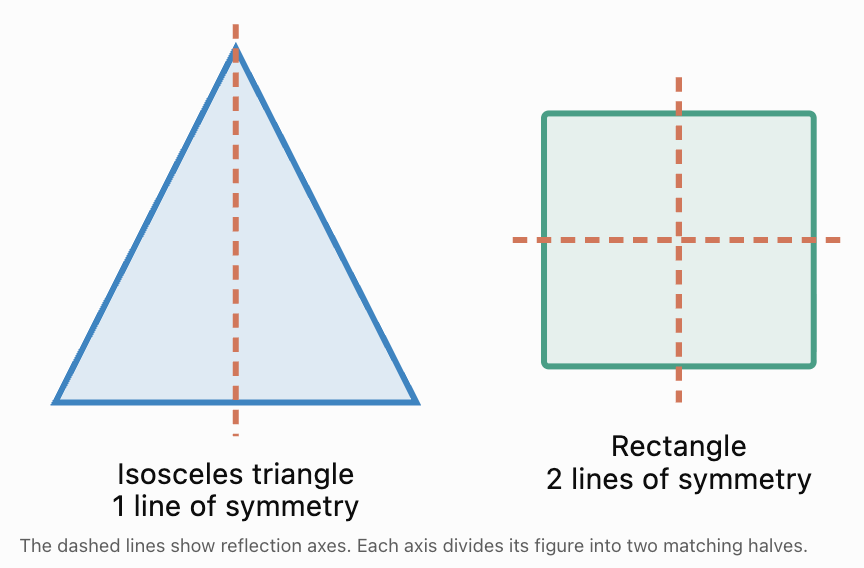
A figure has line symmetry if it can be reflected across a line and remain unchanged.
The line is called the line of symmetry or axis of symmetry.
A useful way to imagine line symmetry is to fold a shape along the proposed symmetry line.
If the two halves match exactly, the line is an axis of symmetry.
Important Properties of a Line of Symmetry
A line of symmetry:
-
Divides a figure into two mirror-image halves.
-
Passes through the midpoint of every segment joining a point to its reflected image.
-
Is perpendicular to the segment joining corresponding non-fixed points.
-
Leaves points on the symmetry line unchanged.
-
Preserves lengths, angles, perimeter, and area under reflection.
A figure may have no lines of symmetry, one line, several lines, or infinitely many lines.
Finding Lines of Symmetry
To determine the lines of symmetry of a figure:
-
Examine the overall shape.
-
Imagine folding it across a possible line.
-
Check whether every point on one side matches a point on the other.
-
Repeat for other possible lines.
-
Count only the lines that produce an exact match.
Common Geometric Figures
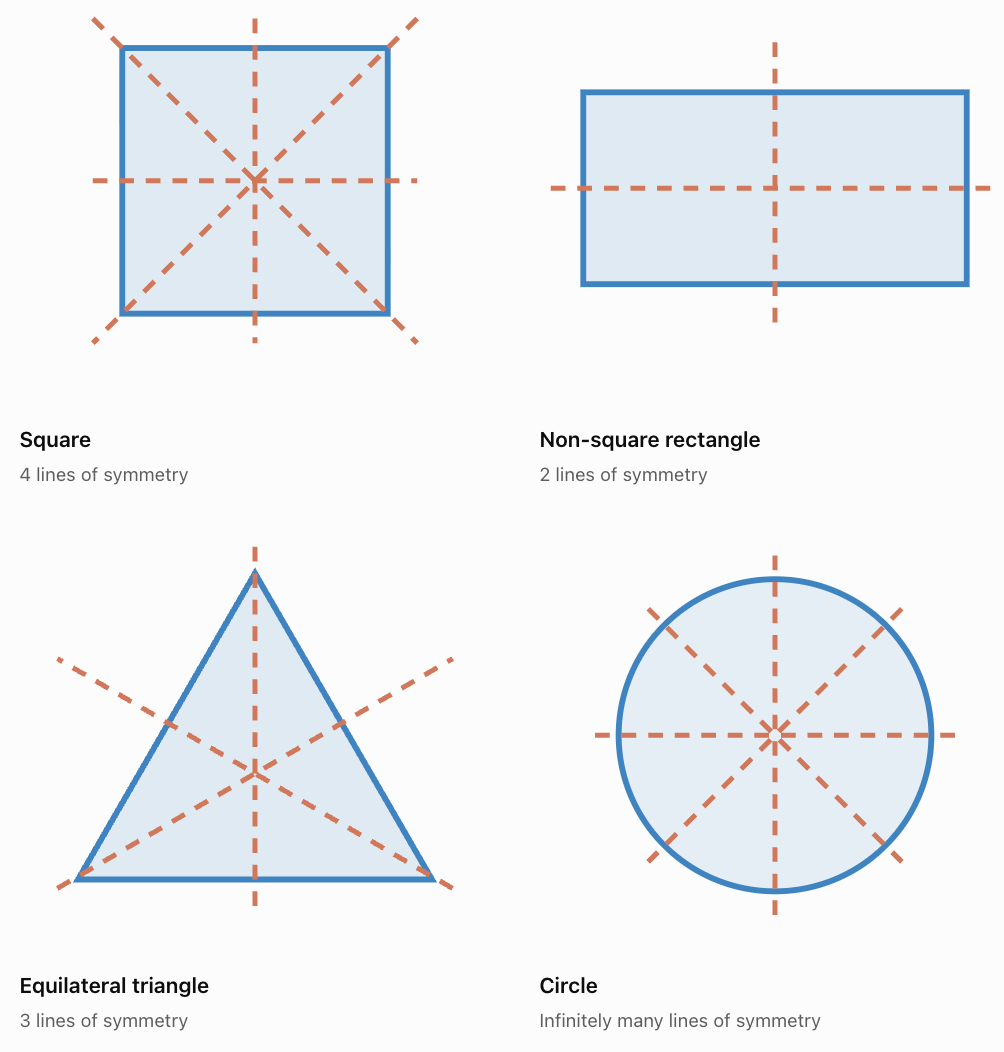
The circle has infinitely many symmetry lines because every diameter lies along an axis of symmetry.
Symmetry in Triangles
Equilateral Triangle
An equilateral triangle has:
-
Three equal sides.
-
Three equal angles of 60°.
-
Three lines of symmetry.
Each symmetry line passes through a vertex and the midpoint of the opposite side.
Isosceles Triangle
An isosceles triangle with exactly two equal sides has one line of symmetry.
It passes through the vertex between the equal sides and the midpoint of the base.
Scalene Triangle
A scalene triangle has three different side lengths.
It has no lines of symmetry.
Worked Example 1: Classifying a Triangle
A triangle has side lengths 8 cm, 8 cm, and 12 cm.
Determine its number of lines of symmetry.
Step 1: Identify the equal sides.
Two sides are 8 cm long.
Step 2: Classify the triangle.
It is an isosceles triangle, but not equilateral.
Answer: 1 line of symmetry.
The symmetry line passes through the vertex where the equal sides meet and the midpoint of the 12 cm base.
Symmetry in Quadrilaterals
|
Quadrilateral |
Number of lines of symmetry |
|---|---|
|
Square |
4 |
|
Non-square rectangle |
2 |
|
Non-square rhombus |
2 |
|
Non-square kite with two distinct pairs of adjacent equal sides |
1 |
|
General parallelogram |
0 |
|
Isosceles trapezoid (non-rectangle) |
1 |
|
General irregular quadrilateral |
Usually 0 |
A non-square rhombus has two lines of symmetry along its diagonals.
A general parallelogram has no reflection symmetry, although it does have rotational symmetry.
Worked Example 2: Finding the Symmetry of a Rectangle
A rectangle measures 12 cm by 7 cm.
How many lines of symmetry does it have?
Because its length and width are different, it is not a square.
It has:
-
One vertical line through its centre.
-
One horizontal line through its centre.
Its diagonals are not lines of symmetry.
Answer: 2 lines of symmetry.
Rotational Symmetry
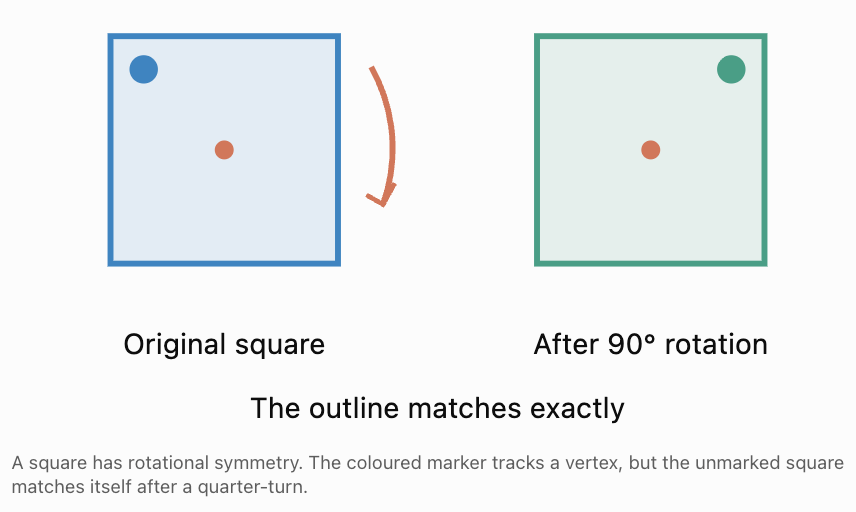
A figure has rotational symmetry if it can be rotated through an angle greater than 0° and less than 360° about a fixed point and still match its original appearance.
The fixed point is the centre of rotation.
For example, a square matches its original position after rotations of:
90°, 180°, 270°, and 360°.
The 360° turn is included when counting the order of rotational symmetry.
Order of Rotational Symmetry
The order of rotational symmetry is the number of times a figure matches itself during one complete 360° rotation, including its original position after a full turn.
For example:
-
An equilateral triangle has order 3.
-
A square has order 4.
-
A regular pentagon has order 5.
-
A regular hexagon has order 6.
-
A non-square rectangle has order 2.
A figure that matches itself only after a full 360° turn has rotational symmetry of order 1.
Formula for the Order of Rotational Symmetry
If the smallest positive angle of rotational symmetry is θ:
Order = 360° ÷ θ
Conversely:
Smallest angle = 360° ÷ Order
These formulas apply to figures with a finite rotational symmetry order greater than 1.
Worked Example 3: Finding the Order
A shape matches itself after every 72° rotation.
Find its rotational symmetry order.
Order = 360°/72°
Order = 5
Answer: Rotational symmetry of order 5.
Worked Example 4: Finding the Smallest Angle
A figure has rotational symmetry of order 8.
Find the smallest positive angle of rotation.
Angle = 360°/8
Answer: 45°.
The figure matches itself after rotations of:
45°, 90°, 135°, 180°, 225°, 270°, 315°, and 360°.
Rotational Symmetry in Common Figures
|
Figure |
Order |
Smallest positive angle |
|---|---|---|
|
Equilateral triangle |
3 |
120° |
|
Square |
4 |
90° |
|
Non-square rectangle |
2 |
180° |
|
Non-square rhombus |
2 |
180° |
|
General parallelogram |
2 |
180° |
|
Regular pentagon |
5 |
72° |
|
Regular hexagon |
6 |
60° |
|
Regular octagon |
8 |
45° |
|
General scalene triangle |
1 |
No nontrivial angle |
A circle has rotational symmetry through every angle about its centre. It therefore has infinitely many rotational symmetries, rather than a finite order.
Regular Polygons and Symmetry
A regular polygon has all sides equal and all interior angles equal.
A regular polygon with n sides has:
n lines of symmetry
and
rotational symmetry of order n.
Its smallest positive angle of rotational symmetry is:
θ = 360°/n
Worked Example 5: Regular Nonagon
A regular nonagon has 9 sides.
Determine:
a) The number of lines of symmetry.
b) The order of rotational symmetry.
c) The smallest positive angle of rotational symmetry.
a) Lines of symmetry
A regular polygon has one symmetry line for each side.
Answer: 9.
b) Rotational symmetry order
Order = number of sides = 9.
c) Smallest positive angle
θ = 360°/9
θ = 40°.
Answers: 9 lines, order 9, smallest angle 40°.
Why Do Regular Polygons Have n Lines of Symmetry?
A regular polygon has evenly spaced vertices around its centre.
Reflection across an appropriate line through the centre maps its vertices onto one another.
For an odd-sided regular polygon, each symmetry line passes through one vertex and the midpoint of the opposite side.
For an even-sided regular polygon, half of the symmetry lines pass through opposite vertices, and half pass through midpoints of opposite sides.
There are exactly n such reflection axes.
Worked Example 6: Regular Dodecagon
A regular dodecagon has 12 sides.
Its lines of symmetry consist of:
6 lines joining opposite vertices.
6 lines joining midpoints of opposite sides.
Total:
6 + 6 = 12.
Its rotational symmetry order is 12.
Smallest positive rotation:
360°/12 = 30°.
Answer: 12 lines of symmetry, rotational order 12, smallest angle 30°.
Comparing Line and Rotational Symmetry
A figure can have both kinds of symmetry, only rotational symmetry, only line symmetry, or neither.
For ordinary finite plane figures, a shape with exactly one reflection axis but no nontrivial rotational symmetry is common, such as a non-equilateral isosceles triangle.
A general parallelogram has rotational symmetry of order 2 but no reflection symmetry.
A figure can also be designed to have reflection symmetry without any rotational symmetry beyond a full turn.
Worked Example 7: Symmetry of a Parallelogram
A parallelogram is not a rectangle or a rhombus.
Determine its symmetry.
A general parallelogram does not have any line of symmetry.
However, rotating it through 180° about the intersection of its diagonals maps it onto itself.
Answer: 0 lines of symmetry; rotational symmetry of order 2.
Symmetry and Coordinate Geometry
Coordinate geometry allows us to describe symmetry precisely using algebra.
Reflection Symmetry Using Coordinates
For a point P(x, y):
|
Reflection line |
Image coordinates |
|---|---|
|
x-axis |
(x, −y) |
|
y-axis |
(−x, y) |
|
y = x |
(y, x) |
|
y = −x |
(−y, −x) |
|
x = a |
(2a − x, y) |
|
y = b |
(x, 2b − y) |
These rules help us find missing points and test whether figures are symmetrical.
Worked Example 8: Finding a Reflected Point
Point A(5, 3) is reflected in the line x = 2.
Find A′.
Reflection rule:
(x, y) → (2a − x, y)
Here:
a = 2.
Therefore:
x′ = 2(2) − 5 = −1
y′ = 3
Answer: A′(−1, 3).
The line x = 2 is halfway between x = 5 and x = −1.
Finding a Line of Symmetry from Two Points
If A and A′ are mirror images, their line of symmetry is the perpendicular bisector of AA′.
For horizontal or vertical segments, this is especially easy.
Worked Example 9: Finding the Mirror Line
Point P(−4, 6) is reflected to P′(8, 6).
Find the line of reflection.
The segment PP′ is horizontal.
Its midpoint is:
M = ((−4 + 8)/2, (6 + 6)/2)
M = (2, 6)
The perpendicular bisector is vertical.
Answer: x = 2.
Rotational Symmetry Using Coordinates
A 180° rotation about the origin follows:
(x, y) → (−x, −y)
A 180° rotation about C(h, k) follows:
(x, y) → (2h − x, 2k − y)
This is especially useful for identifying central symmetry.
Worked Example 10: Finding the Centre of Rotational Symmetry
A point A(−3, 2) maps to A′(7, 8) under a 180° rotation.
Find the centre of rotation.
For a 180° rotation, the centre is the midpoint of A and A′.
C = ((−3 + 7)/2, (2 + 8)/2)
C = (2, 5)
Answer: C(2, 5).
Symmetry and Missing Coordinates
Symmetry can help determine unknown coordinates in geometric figures.
Worked Example 11: Completing a Symmetric Triangle
Triangle ABC is symmetrical about the y-axis.
One base vertex is A(−5, 2), and the other base vertex B is its reflection.
The third vertex is C(0, 8).
Find B.
Reflection in the y-axis follows:
(x, y) → (−x, y)
Therefore:
A(−5, 2) → B(5, 2)
Answer: B(5, 2).
The triangle is isosceles because the y-axis is its symmetry line.
Symmetry and Angle Problems
Symmetry can be used to calculate unknown angles without measuring them.
In a figure with reflection symmetry, corresponding angles are equal.
Worked Example 12: Isosceles Triangle
An isosceles triangle has a vertex angle of 46°.
Find each base angle.
The line of symmetry exchanges the two base vertices.
Therefore, the base angles are equal.
Sum of angles:
180° − 46° = 134°
Each base angle:
134°/2 = 67°
Answer: Each base angle is 67°.
Worked Example 13: Regular Pentagon
Find the interior angle of a regular pentagon.
The sum of interior angles of an n-sided polygon is:
(n − 2) × 180°.
For n = 5:
Sum = 3 × 180° = 540°.
All interior angles are equal.
Each angle:
540°/5 = 108°.
Answer: 108°.
Its rotational symmetry order is 5, and its smallest rotational angle is 72°.
Symmetry and Area
Symmetry can simplify area calculations by dividing a figure into matching parts.
If a line of symmetry divides a figure into two halves, their areas are equal.
Worked Example 14: Symmetric Garden
A garden has a total area of 180 m² and one line of symmetry dividing it into two matching regions.
Find the area of each region.
Area of each half:
180/2 = 90 m².
Answer: 90 m².
Worked Example 15: Regular Hexagon
A regular hexagon has a total area of 216 cm².
It is divided into six congruent triangles by joining its centre to all vertices.
Find the area of each triangle.
Area of each triangle:
216/6 = 36 cm².
Answer: 36 cm².
This division is possible because the hexagon has rotational symmetry of order 6.
Symmetry and Patterns
Symmetry is useful in creating and analysing repeating geometric designs.
A design may contain:
-
Reflection symmetry.
-
Rotational symmetry.
-
Translation symmetry.
-
Combinations of these transformations.
For example, a repeated floor-tile pattern may remain unchanged when shifted by a particular distance.
This is called translational symmetry.
A figure can also have glide reflection symmetry, where a reflection is followed by a translation parallel to the reflection line.
These ideas are important in tessellations, wallpaper patterns, and mathematical crystallography.
Real-World Applications of Symmetry
Biology and nature
Butterflies, many leaves, and numerous animal body plans show approximate bilateral symmetry. This arrangement can be useful in studying body structure and development.
Architecture
Architects use symmetry to create visual balance and organize structural and decorative features.
Art and design
Rotational and reflection symmetry are used in mandalas, mosaics, logos, and repeating decorative patterns.
Science and crystals
Snowflakes often display approximate sixfold symmetry, reflecting the molecular structure and growth processes of ice crystals.
Engineering and Manufacturing
Symmetry is important in engineering because balanced designs can distribute forces or mass in useful ways.
For example, a wheel with evenly spaced spokes has rotational symmetry.
If the wheel has 12 identical evenly spaced spokes, the arrangement has rotational symmetry of order 12, assuming no other features break the pattern.
Smallest positive rotational angle:
360°/12 = 30°.
Physics
Symmetry plays a major role in physics.
Physical laws often remain unchanged under certain transformations.
Examples include:
-
Translational symmetry: Physical laws are the same at different locations under the same conditions.
-
Rotational symmetry: Physical laws do not depend on a preferred spatial direction.
-
Time-translation symmetry: Physical laws remain the same over time under the same conditions.
In more advanced physics, these symmetries are connected to conservation laws through Noether's theorem.
Computer Graphics
Symmetry helps designers create shapes efficiently.
For example, instead of drawing every repeated feature individually, a program can create one feature and rotate copies around a centre.
If a pattern contains 10 equally spaced features:
Angle between features = 360°/10 = 36°.
The same geometric rule can generate the entire pattern.
Common Mistakes
Mistake 1: Assuming Every Figure Has a Line of Symmetry
Some figures, such as general scalene triangles and general parallelograms, have no reflection symmetry.
Mistake 2: Confusing Line Symmetry with Rotational Symmetry
A line of symmetry involves reflection.
Rotational symmetry involves turning a figure around a centre.
Mistake 3: Counting Only Half the Symmetry Lines
A square has four lines of symmetry, including both diagonals.
Mistake 4: Assuming a Rectangle Has Four Lines of Symmetry
A non-square rectangle has only two lines of symmetry.
Its diagonals are not reflection axes.
Mistake 5: Forgetting the Full Turn When Counting Rotational Order
A square matches itself at 90°, 180°, 270°, and 360°.
Its order is 4, not 3.
Mistake 6: Confusing Rotational Order with the Smallest Angle
For a regular hexagon:
Order = 6
Smallest angle = 60°.
These quantities are related but are not the same.
Mistake 7: Assuming Every Figure with Rotational Symmetry Has Line Symmetry
A general parallelogram has rotational symmetry of order 2 but no line symmetry.
Mistake 8: Treating Approximate Symmetry as Exact
Natural objects may appear symmetrical but often contain small differences.
Mathematical symmetry requires an exact match.
Mistake 9: Forgetting the Centre of Rotation
Rotational symmetry occurs about a particular fixed point.
Mistake 10: Assuming a Shape with Order 1 Has Nontrivial Rotational Symmetry
Order 1 means the figure matches only after a full 360° rotation.
Mistake 11: Assuming All Polygons Have the Same Symmetry as Regular Polygons
An irregular hexagon does not necessarily have six lines of symmetry or rotational order 6.
Mistake 12: Misidentifying Corresponding Points
In reflection symmetry, corresponding points must be equally far from the mirror line along perpendicular directions.
Mistake 13: Using Symmetry Without Checking the Whole Figure
A line may divide one part of a figure evenly without being a symmetry line for the entire figure.
Mistake 14: Confusing a Design's Symmetry with Its Underlying Shape
A square outline has four reflection axes, but a decoration placed inside it may reduce or eliminate those symmetries.
Key Terms
-
Symmetry: A property in which a transformation maps a figure onto itself.
-
Line Symmetry: Symmetry under reflection across a line.
-
Reflection Symmetry: Another name for line symmetry.
-
Line of Symmetry: A line dividing a figure into matching mirror-image halves.
-
Axis of Symmetry: Another name for a line of symmetry.
-
Mirror Image: The image produced by reflection.
-
Reflection: A transformation that flips a figure across a line.
-
Rotational Symmetry: Symmetry under rotation about a fixed centre.
-
Centre of Rotation: The fixed point around which a figure turns.
-
Order of Rotational Symmetry: The number of matching positions during a complete turn.
-
Angle of Rotation: The angle through which a figure turns.
-
Smallest Positive Angle of Rotation: The least nonzero rotation that maps a figure onto itself.
-
Regular Polygon: A polygon with all sides and all interior angles equal.
-
Irregular Polygon: A polygon that is not regular.
-
Equilateral Triangle: A triangle with three equal sides.
-
Isosceles Triangle: A triangle with at least two equal sides.
-
Scalene Triangle: A triangle with three different side lengths.
-
Perpendicular Bisector: A line perpendicular to a segment through its midpoint.
-
Congruence: Equality of shape and size.
-
Corresponding Points: Points matched by a transformation.
-
Invariant Point: A point unchanged by a transformation.
-
Bilateral Symmetry: Symmetry across one plane or line, depending on the context.
-
Radial Symmetry: Symmetry arranged around a central point or axis.
-
Translational Symmetry: Symmetry under a translation.
-
Glide Reflection: A reflection followed by a translation along the reflection line.
-
Tessellation: A pattern of shapes covering a plane without gaps or overlaps.
-
Symmetric Figure: A figure possessing at least one nontrivial symmetry.
-
Asymmetric Figure: A figure without nontrivial symmetry of the kind being considered.
Key Takeaways
-
Symmetry occurs when a transformation maps a figure exactly onto itself.
-
Line symmetry involves reflection across an axis.
-
A line of symmetry divides a figure into matching halves.
-
A square has four lines of symmetry.
-
A non-square rectangle has two lines of symmetry.
-
An equilateral triangle has three lines of symmetry.
-
A non-equilateral isosceles triangle has one line of symmetry.
-
A scalene triangle has no lines of symmetry.
-
A circle has infinitely many lines of symmetry.
-
Rotational symmetry involves turning a figure about a fixed centre.
-
The order of rotational symmetry counts matching positions in one complete turn.
-
The smallest positive rotational angle equals 360° divided by the order.
-
A regular n-sided polygon has n lines of symmetry.
-
A regular n-sided polygon has rotational symmetry of order n.
-
A general parallelogram has rotational symmetry of order 2.
-
Coordinate rules can be used to identify and prove symmetry.
-
Symmetry can help calculate missing angles, coordinates, and areas.
-
Symmetry is widely used in nature, architecture, engineering, and design.
-
Approximate symmetry is common in real objects, but mathematical symmetry requires an exact match.
-
Symmetry provides an important connection between geometry, transformations, and algebra.
Check Your Understanding
Show all working for calculation questions and justify your reasoning where appropriate.
Question 1: Line Symmetry
How many lines of symmetry does each figure have?
a) Square
b) Non-square rectangle
c) Equilateral triangle
d) General scalene triangle
e) Circle
Question 2: Isosceles Triangle
An isosceles triangle has side lengths 6 cm, 6 cm, and 9 cm.
How many lines of symmetry does it have?
Describe the position of the line.
Question 3: Rotational Symmetry
Find the order of rotational symmetry of:
a) Square
b) Equilateral triangle
c) Regular hexagon
d) Non-square rectangle
e) General parallelogram
Question 4: Smallest Angle
A figure has rotational symmetry of order 10.
Find its smallest positive angle of rotational symmetry.
Question 5: Finding the Order
A figure matches itself after every 45° rotation.
Find its rotational symmetry order.
Question 6: Regular Polygon
A regular octagon has eight sides.
Find:
a) The number of lines of symmetry.
b) The rotational symmetry order.
c) The smallest positive rotational angle.
Question 7: Regular Polygon with Unknown Sides
A regular polygon has a smallest positive rotational angle of 24°.
Find the number of sides.
Question 8: Reflection in the y-Axis
Reflect A(−7, 4) in the y-axis.
Find A′.
Question 9: Reflection in a Vertical Line
Point P(8, 3) is reflected in the line x = 2.
Find P′.
Question 10: Finding a Mirror Line
Point A(−5, 4) is reflected to A′(3, 4).
Find the equation of the line of reflection.
Question 11: Centre of Rotational Symmetry
Point P(−4, 1) maps to P′(6, 9) under a 180° rotation.
Find the centre of rotation.
Question 12: Isosceles Triangle Angles
An isosceles triangle has a vertex angle of 38°.
Find both base angles.
Question 13: Regular Polygon Interior Angle
Find the interior angle of a regular octagon.
Question 14: Area and Symmetry
A regular hexagon has a total area of 300 cm².
It is divided into six congruent triangles by joining the centre to the vertices.
Find the area of each triangle.
Question 15: Rotational Pattern
A circular design contains 15 identical, equally spaced features.
Assuming no other details break the symmetry, find:
a) Its rotational symmetry order.
b) The smallest positive angle that maps the design onto itself.
Question 16: Comparing Symmetry
Explain why a general parallelogram has rotational symmetry but no line symmetry.
Question 17: Coordinate Geometry
Triangle ABC has vertices:
A(−4, 2)
B(4, 2)
C(0, 8).
a) Identify its line of symmetry.
b) Use the distance formula to prove that it is isosceles.
c) Find the midpoint of AB.
Question 18: Comprehensive Challenge
A regular polygon has 12 lines of symmetry.
a) How many sides does it have?
b) What is its rotational symmetry order?
c) What is its smallest positive angle of rotational symmetry?
d) Find each interior angle.
e) Find each exterior angle.
f) Find the total sum of its interior angles.
g) Explain how its symmetry lines are arranged.
Fully Worked Answers
Answer 1: Line Symmetry
a) Square: 4 lines.
b) Non-square rectangle: 2 lines.
c) Equilateral triangle: 3 lines.
d) General scalene triangle: 0 lines.
e) Circle: Infinitely many lines.
Each line of symmetry must map the entire figure onto itself under reflection.
Answer 2: Isosceles Triangle
The triangle has two equal sides of 6 cm.
Therefore, it is isosceles but not equilateral.
Its symmetry line passes through the vertex where the equal sides meet and the midpoint of the 9 cm base.
Answer: 1 line of symmetry.
Answer 3: Rotational Symmetry
a) Square: Order 4.
b) Equilateral triangle: Order 3.
c) Regular hexagon: Order 6.
d) Non-square rectangle: Order 2.
e) General parallelogram: Order 2.
Answer 4: Smallest Angle
Order = 10.
Smallest angle:
θ = 360°/10
Answer: 36°.
Answer 5: Finding the Order
Smallest positive angle = 45°.
Order = 360°/45°
Answer: Order 8.
Answer 6: Regular Octagon
A regular octagon has 8 sides.
a) Lines of symmetry = 8.
b) Rotational symmetry order = 8.
c) Smallest positive angle:
360°/8 = 45°.
Answers: 8 lines, order 8, smallest angle 45°.
Answer 7: Regular Polygon with Unknown Sides
Smallest angle = 24°.
For a regular polygon:
n = 360°/24°
n = 15.
Answer: 15 sides (regular pentadecagon).
Answer 8: Reflection in the y-Axis
Rule:
(x, y) → (−x, y)
A(−7, 4) → A′(7, 4)
Answer: A′(7, 4).
Answer 9: Reflection in x = 2
Use:
x′ = 2a − x
a = 2
x′ = 4 − 8 = −4
The y-coordinate remains 3.
Answer: P′(−4, 3).
Answer 10: Finding the Mirror Line
Given:
A(−5, 4)
A′(3, 4).
The segment AA′ is horizontal.
Find its midpoint:
M = ((−5 + 3)/2, (4 + 4)/2)
M = (−1, 4).
The perpendicular bisector is vertical.
Answer: x = −1.
Answer 11: Centre of Rotational Symmetry
A 180° rotation maps a point to another point on the opposite side of the centre.
The centre is their midpoint.
C = ((−4 + 6)/2, (1 + 9)/2)
C = (2/2, 10/2)
Answer: C(1, 5).
Answer 12: Isosceles Triangle Angles
Vertex angle = 38°.
The base angles are equal.
Sum of base angles:
180° − 38° = 142°.
Each base angle:
142°/2 = 71°.
Answer: 71° and 71°.
Answer 13: Regular Octagon Interior Angle
For an n-sided polygon:
Sum of interior angles = (n − 2) × 180°.
For n = 8:
Sum = 6 × 180° = 1080°.
Each interior angle:
1080°/8 = 135°.
Answer: 135°.
Answer 14: Area and Symmetry
Total area = 300 cm².
Number of congruent triangles = 6.
Area of each:
300/6 = 50 cm².
Answer: 50 cm².
Answer 15: Rotational Pattern
There are 15 identical equally spaced features.
a) Rotational symmetry order = 15.
b) Smallest positive angle:
360°/15 = 24°.
Answers: Order 15 and angle 24°.
Answer 16: General Parallelogram
A general parallelogram has opposite sides equal and parallel.
Its diagonals bisect each other.
The intersection of its diagonals is the centre of a 180° rotation.
Under this rotation:
-
Each vertex maps to its opposite vertex.
-
Each side maps to its opposite side.
-
The figure matches itself exactly.
Therefore, its rotational symmetry order is 2.
However, a general parallelogram has no reflection axis because reflecting it across a proposed line does not map all its vertices and sides onto themselves.
Conclusion: A general parallelogram has rotational symmetry of order 2 and no lines of symmetry.
Answer 17: Coordinate Geometry
Given:
A(−4, 2)
B(4, 2)
C(0, 8).
a) Identify the line of symmetry.
Points A and B are reflections of each other across the y-axis.
Point C lies on the y-axis.
Therefore:
Line of symmetry: x = 0.
b) Prove the triangle is isosceles.
Calculate AC:
AC = √((0 − (−4))² + (8 − 2)²)
AC = √(4² + 6²)
AC = √52
AC = 2√13.
Calculate BC:
BC = √((0 − 4)² + (8 − 2)²)
BC = √((−4)² + 6²)
BC = √52
BC = 2√13.
Since:
AC = BC
triangle ABC is isosceles.
c) Find the midpoint of AB.
M = ((−4 + 4)/2, (2 + 2)/2)
M = (0, 2).
Answer: M(0, 2).
The symmetry line passes through C(0, 8) and M(0, 2).
Answer 18: Comprehensive Challenge
The regular polygon has 12 lines of symmetry.
a) Number of sides
A regular polygon has the same number of sides as lines of symmetry.
Answer: 12 sides.
It is a regular dodecagon.
b) Rotational symmetry order
For a regular polygon:
Order = number of sides.
Answer: Order 12.
c) Smallest positive rotational angle
θ = 360°/12
Answer: 30°.
d) Each interior angle
Interior angle = ((n − 2) × 180°)/n
= ((12 − 2) × 180°)/12
= 1800°/12
Answer: 150°.
e) Each exterior angle
Exterior angle = 360°/12
Answer: 30°.
Alternatively:
180° − 150° = 30°.
f) Sum of interior angles
Sum = (n − 2) × 180°
= 10 × 180°
Answer: 1800°.
g) Arrangement of symmetry lines
Because the regular dodecagon has an even number of sides, its symmetry lines occur in two groups:
-
Six lines joining pairs of opposite vertices.
-
Six lines joining the midpoints of pairs of opposite sides.
All 12 lines pass through the centre.
Final Course Connections
Symmetry provides a way to understand the structure and balance of geometric figures.
Line symmetry describes reflection, while rotational symmetry describes how figures match themselves after turning. These properties help us classify shapes, investigate regular polygons, calculate unknown measurements, and establish geometric relationships using coordinates.
Symmetry also connects mathematics to biology, chemistry, physics, architecture, art, engineering, and computer graphics.
This completes Symmetry, with coverage of all five learning targets, geometric explanations, worked examples, diagrams, real-world applications, common mistakes, key terms, key takeaways, and fully worked practice questions.