Coordinate Geometry and Transformations
1. Distance and Midpoint
Learning outcomes
- I can calculate distances between points.
- I can determine midpoint coordinates.
- I can apply coordinate geometry formulas.
- I can solve geometric problems on the coordinate plane.
- I can interpret geometric relationships using coordinates.
Introduction
Imagine looking at a map and trying to determine the shortest distance between two locations. Or suppose an engineer needs to find the exact centre of a bridge, a designer wants to position an object halfway between two points, or a computer programmer needs to calculate the distance between objects on a screen.
All these problems can be solved using coordinate geometry.
Coordinate geometry connects algebra and geometry by representing points, lines, and shapes using numbers and equations.
Two of its most useful tools are the distance formula and the midpoint formula.
The distance formula calculates the straight-line distance between two points, while the midpoint formula identifies the point exactly halfway between them.
Together, these formulas allow us to investigate triangles, quadrilaterals, circles, symmetry, and many practical measurement problems.
The Cartesian Coordinate Plane
The Cartesian coordinate plane consists of two perpendicular number lines:
-
The x-axis is horizontal.
-
The y-axis is vertical.
They intersect at the origin, (0, 0).
Every point is represented by an ordered pair:
(x, y)
The first coordinate tells us how far to move horizontally from the origin.
The second coordinate tells us how far to move vertically.
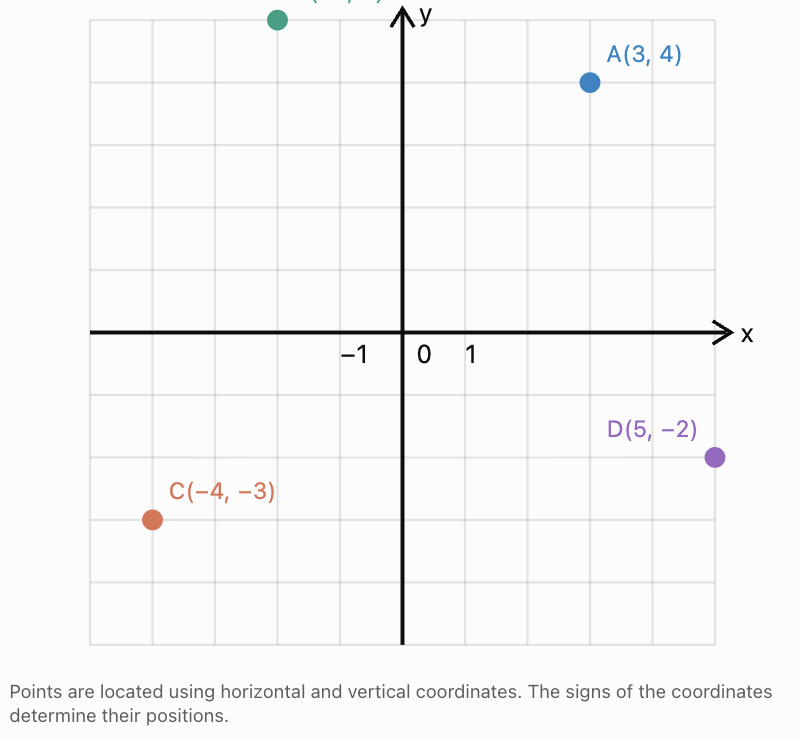
For example:
-
A(3, 4) is 3 units right and 4 units up.
-
B(−2, 5) is 2 units left and 5 units up.
-
C(−4, −3) is 4 units left and 3 units down.
-
D(5, −2) is 5 units right and 2 units down.
Horizontal and Vertical Distances
Before calculating distances between arbitrary points, we should understand horizontal and vertical distances.
Horizontal Distance
For two points with the same y-coordinate:
A(x₁, y) and B(x₂, y)
The distance is:
d = |x₂ − x₁|
The vertical bars indicate absolute value.
Worked Example 1: Horizontal Distance
Find the distance between:
A(−3, 4) and B(5, 4).
The y-coordinates are equal, so the points lie on a horizontal line.
d = |5 − (−3)|
d = |8|
Answer: 8 units.
Vertical Distance
For two points with the same x-coordinate:
A(x, y₁) and B(x, y₂)
The distance is:
d = |y₂ − y₁|
Worked Example 2: Vertical Distance
Find the distance between:
C(2, −5) and D(2, 3).
The x-coordinates are equal.
d = |3 − (−5)|
d = |8|
Answer: 8 units.
Deriving the Distance Formula
Suppose two points are not on the same horizontal or vertical line.
Let:
A(x₁, y₁)
B(x₂, y₂)
Draw a horizontal line from A and a vertical line from B until they meet.
This creates a right-angled triangle.
Its horizontal side has length:
|x₂ − x₁|
Its vertical side has length:
|y₂ − y₁|
The straight-line distance AB is the hypotenuse.
By the Pythagorean theorem:
AB² = (x₂ − x₁)² + (y₂ − y₁)²
Taking the positive square root gives the distance formula.
The squared differences ensure that negative coordinate differences do not produce negative contributions to distance.
Worked Example 3: Distance Between Two Points
Find the distance between:
A(1, 2) and B(7, 10).
Step 1: Identify coordinates.
x₁ = 1, y₁ = 2
x₂ = 7, y₂ = 10
Step 2: Calculate horizontal and vertical changes.
Δx = 7 − 1 = 6
Δy = 10 − 2 = 8
Step 3: Apply the distance formula.
d = √(6² + 8²)
d = √(36 + 64)
d = √100
Answer: 10 units.
Worked Example 4: Negative Coordinates
Find the distance between:
P(−4, −1) and Q(2, 7).
Step 1: Find coordinate differences.
Δx = 2 − (−4) = 6
Δy = 7 − (−1) = 8
Step 2: Calculate.
d = √(6² + 8²)
d = √100
Answer: 10 units.
Worked Example 5: Exact Radical Distance
Find the distance between:
A(−2, 3) and B(4, 6).
Δx = 4 − (−2) = 6
Δy = 6 − 3 = 3
d = √(6² + 3²)
d = √45
d = √(9 × 5)
d = 3√5
d ≈ 6.71
Answer: 3√5 units, or approximately 6.71 units.
When possible, give exact answers in simplified radical form before calculating decimal approximations.
Important Properties of Distance
Distance has several fundamental properties.
Non-negativity
Distance can never be negative.
AB ≥ 0
Symmetry
The distance from A to B equals the distance from B to A.
AB = BA
Zero distance
AB = 0 only when A and B represent the same point.
Triangle inequality
For any three points A, B, and C:
AB ≤ AC + CB
The direct straight-line distance cannot be greater than a route that passes through another point.
These properties help us check whether our calculations are reasonable.
The Midpoint of a Line Segment
The midpoint is the point exactly halfway between the endpoints of a line segment.
If M is the midpoint of AB, then:
AM = MB
The midpoint can be found by averaging the x-coordinates and averaging the y-coordinates.
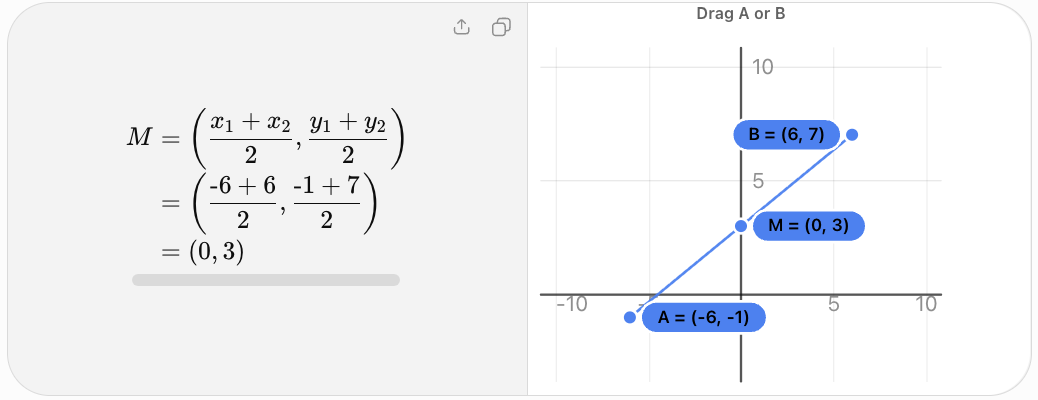
The midpoint formula is:
M = ((x₁ + x₂)/2, (y₁ + y₂)/2)
This formula works regardless of which quadrants contain the endpoints.
Why Does the Midpoint Formula Work?
Consider the endpoints:
A(x₁, y₁) and B(x₂, y₂).
To travel halfway from A to B, we move half the horizontal displacement and half the vertical displacement.
The midpoint's x-coordinate is:
x_M = x₁ + (x₂ − x₁)/2
Simplifying:
x_M = (x₁ + x₂)/2
Similarly:
y_M = y₁ + (y₂ − y₁)/2
y_M = (y₁ + y₂)/2
Therefore:
M = ((x₁ + x₂)/2, (y₁ + y₂)/2)
This demonstrates that the midpoint is the average position of the endpoints.
Worked Example 6: Finding a Midpoint
Find the midpoint of:
A(2, 4) and B(8, 10).
Step 1: Average the x-coordinates.
x_M = (2 + 8)/2 = 5
Step 2: Average the y-coordinates.
y_M = (4 + 10)/2 = 7
Answer: M(5, 7).
Worked Example 7: Midpoint with Negative Coordinates
Find the midpoint of:
P(−6, 3) and Q(4, −5).
x_M = (−6 + 4)/2 = −1
y_M = (3 + (−5))/2 = −1
Answer: M(−1, −1).
Worked Example 8: Midpoint with Fractional Coordinates
Find the midpoint of:
A(1, 2) and B(4, 7).
x_M = (1 + 4)/2 = 5/2
y_M = (2 + 7)/2 = 9/2
Answer: M(5/2, 9/2), or M(2.5, 4.5).
A midpoint does not have to have integer coordinates.
Finding a Missing Endpoint
Sometimes the midpoint and one endpoint are known, and we must determine the other endpoint.
Suppose:
A(x₁, y₁) is known.
M(mₓ, mᵧ) is the midpoint.
B(x₂, y₂) is unknown.
Starting with the midpoint formula:
mₓ = (x₁ + x₂)/2
Multiply by 2:
2mₓ = x₁ + x₂
Rearrange:
x₂ = 2mₓ − x₁
Similarly:
y₂ = 2mᵧ − y₁
Worked Example 9: Missing Endpoint
The midpoint of AB is M(3, 5).
One endpoint is A(−2, 8).
Find B.
Step 1: Calculate the missing x-coordinate.
x₂ = 2(3) − (−2)
x₂ = 6 + 2
x₂ = 8
Step 2: Calculate the missing y-coordinate.
y₂ = 2(5) − 8
y₂ = 2
Answer: B(8, 2).
Verification:
M = ((−2 + 8)/2, (8 + 2)/2)
M = (3, 5).
The calculated endpoint is correct.
Worked Example 10: Algebraic Midpoint Problem
The endpoints of a segment are:
A(2x − 1, 4)
B(7, 2y + 6).
The midpoint is M(5, 3).
Find x and y.
Step 1: Use the x-coordinate.
((2x − 1) + 7)/2 = 5
(2x + 6)/2 = 5
2x + 6 = 10
2x = 4
x = 2
Step 2: Use the y-coordinate.
(4 + 2y + 6)/2 = 3
(2y + 10)/2 = 3
2y + 10 = 6
2y = −4
y = −2
Answer: x = 2 and y = −2.
Comparing Distance and Midpoint
Although both formulas use the coordinates of two points, they answer different questions.
Feature
Distance formula
Midpoint formula
Purpose
Finds the length of a segment
Finds its halfway point
Result
A non-negative number
An ordered pair
Main operation
Square differences, add, square root
Average coordinates
Units
Length units
Coordinate units
Common applications
Side lengths, perimeters, radii
Centres, diagonals, symmetry
For example, given A(1, 1) and B(7, 9):
Distance:
AB = √(6² + 8²) = 10 units
Midpoint:
M = ((1 + 7)/2, (1 + 9)/2)
M = (4, 5).
The midpoint is 5 units from each endpoint.
Using Distance to Classify Triangles
The distance formula can be used to calculate all three sides of a triangle.
Once we know the side lengths, we can classify the triangle.
-
Equilateral: All three sides equal.
-
Isosceles: At least two sides equal.
-
Scalene: All three sides different.
-
Right-angled: The side lengths satisfy the Pythagorean theorem.
Worked Example 11: Proving a Triangle Is Isosceles
Triangle ABC has vertices:
A(0, 4)
B(−3, 0)
C(3, 0).
Prove that the triangle is isosceles.
Step 1: Find AB.
AB = √((−3 − 0)² + (0 − 4)²)
AB = √(9 + 16)
AB = 5
Step 2: Find AC.
AC = √((3 − 0)² + (0 − 4)²)
AC = √(9 + 16)
AC = 5
Since:
AB = AC
triangle ABC has two equal sides.
Conclusion: Triangle ABC is isosceles.
Worked Example 12: Proving a Triangle Is Right-Angled
Triangle PQR has vertices:
P(1, 1)
Q(5, 1)
R(5, 4).
Calculate the side lengths.
PQ = √((5 − 1)² + (1 − 1)²) = 4
QR = √((5 − 5)² + (4 − 1)²) = 3
PR = √((5 − 1)² + (4 − 1)²) = 5
Check the Pythagorean relationship:
3² + 4² = 9 + 16 = 25
5² = 25
Therefore:
PQ² + QR² = PR².
By the converse of the Pythagorean theorem, triangle PQR is right-angled at Q.
Conclusion: Triangle PQR is a right triangle.
Worked Example 13: Triangle Perimeter
A triangle has vertices:
A(0, 0)
B(6, 0)
C(3, 4).
Find its perimeter.
AB = 6
AC = √(3² + 4²) = 5
BC = √((3 − 6)² + (4 − 0)²)
BC = √(9 + 16) = 5
Perimeter = 6 + 5 + 5
Answer: 16 units.
The triangle is also isosceles because AC = BC.
Using Coordinates to Investigate Quadrilaterals
Distance and midpoint formulas can reveal important properties of quadrilaterals.
For example:
-
Equal side lengths may identify a rhombus.
-
Equal diagonals can help identify a rectangle.
-
Diagonals with the same midpoint establish that a quadrilateral is a parallelogram.
-
Four equal sides and equal diagonals can establish that a parallelogram is a square.
It is important to use enough information to justify the classification. Equal diagonals alone, for example, do not prove that a quadrilateral is a rectangle.
Worked Example 14: Proving a Quadrilateral Is a Parallelogram
Consider quadrilateral ABCD with vertices in order:
A(1, 1)
B(7, 2)
C(9, 6)
D(3, 5).
Prove that ABCD is a parallelogram.
Step 1: Find the midpoint of diagonal AC.
M_AC = ((1 + 9)/2, (1 + 6)/2)
M_AC = (5, 3.5)
Step 2: Find the midpoint of diagonal BD.
M_BD = ((7 + 3)/2, (2 + 5)/2)
M_BD = (5, 3.5)
The diagonals have the same midpoint.
Therefore, they bisect each other.
A quadrilateral whose diagonals bisect each other is a parallelogram.
Conclusion: ABCD is a parallelogram.
Worked Example 15: Proving a Quadrilateral Is a Rectangle
Consider the vertices:
A(1, 1)
B(7, 1)
C(7, 5)
D(1, 5).
Step 1: Find the diagonal midpoints.
AC midpoint:
((1 + 7)/2, (1 + 5)/2) = (4, 3)
BD midpoint:
((7 + 1)/2, (1 + 5)/2) = (4, 3)
The diagonals bisect each other, so ABCD is a parallelogram.
Step 2: Calculate diagonal lengths.
AC = √((7 − 1)² + (5 − 1)²)
AC = √52 = 2√13
BD = √((1 − 7)² + (5 − 1)²)
BD = √52 = 2√13
The diagonals are equal.
A parallelogram with equal diagonals is a rectangle.
Conclusion: ABCD is a rectangle.
Worked Example 16: Proving a Quadrilateral Is a Square
Consider:
A(−2, −2)
B(2, −2)
C(2, 2)
D(−2, 2).
Step 1: Calculate side lengths.
AB = 4
BC = 4
CD = 4
DA = 4
All four sides are equal.
Step 2: Calculate diagonals.
AC = √(4² + 4²) = 4√2
BD = √((−4)² + 4²) = 4√2
The diagonals are equal.
Step 3: Verify that diagonals bisect each other.
Midpoint of AC = (0, 0)
Midpoint of BD = (0, 0)
Therefore, the quadrilateral is a parallelogram.
It has four equal sides and equal diagonals.
A parallelogram with these properties is a square.
Conclusion: ABCD is a square.
Midpoints and Triangle Geometry
The midpoint formula is useful for studying medians and midsegments of triangles.
A median connects a vertex to the midpoint of the opposite side.
A midsegment joins the midpoints of two sides of a triangle.
The midsegment theorem states:
A segment joining the midpoints of two sides of a triangle is parallel to the third side and half its length.
Worked Example 17: Finding a Median
Triangle ABC has vertices:
A(2, 8)
B(−4, 0)
C(6, 0).
Find the length of the median from A to BC.
Step 1: Find the midpoint of BC.
M = ((−4 + 6)/2, (0 + 0)/2)
M = (1, 0)
Step 2: Find the distance AM.
AM = √((1 − 2)² + (0 − 8)²)
AM = √(1 + 64)
AM = √65
AM ≈ 8.06
Answer: The median has length √65 units, approximately 8.06 units.
Worked Example 18: Verifying the Midsegment Theorem
Triangle ABC has vertices:
A(0, 6)
B(−4, 0)
C(8, 0).
Let M be the midpoint of AB and N the midpoint of AC.
Step 1: Find M.
M = ((0 − 4)/2, (6 + 0)/2)
M = (−2, 3)
Step 2: Find N.
N = ((0 + 8)/2, (6 + 0)/2)
N = (4, 3)
Step 3: Calculate MN.
Both points have y-coordinate 3.
MN = |4 − (−2)| = 6
Step 4: Calculate BC.
BC = |8 − (−4)| = 12
Therefore:
MN = BC/2.
Both MN and BC are horizontal, so they are parallel.
Conclusion: MN is parallel to BC and half its length.
Interpreting Geometric Relationships Using Coordinates
Coordinate geometry allows us to translate geometric statements into algebraic relationships.
Equal Distances
If PA = PB, then P is equidistant from A and B.
All points equidistant from two distinct fixed points lie on the perpendicular bisector of the segment joining them.
Shared Midpoints
If the diagonals of a quadrilateral have the same midpoint, they bisect each other.
This establishes that the quadrilateral is a parallelogram.
Symmetry
The midpoint between a point and its reflected image lies on the axis of reflection, provided the reflection is across a straight line.
For example:
A(−3, 2)
B(5, 2)
Midpoint = (1, 2).
The points are reflections of each other across the vertical line x = 1.
Collinearity
Three points are collinear if they lie on the same straight line.
Distance can help verify collinearity.
If B lies between A and C, then:
AB + BC = AC.
Conversely, if this equality holds for three distinct points, B lies on segment AC.
Worked Example 19: Verifying Collinearity
Given:
A(1, 2)
B(4, 6)
C(7, 10).
Calculate:
AB = √(3² + 4²) = 5
BC = √(3² + 4²) = 5
AC = √(6² + 8²) = 10
Since:
AB + BC = AC
5 + 5 = 10
the points lie on the same straight line, with B between A and C.
Also, because AB = BC, B is the midpoint of AC.
Conclusion: The points are collinear and B is the midpoint of AC.
The Equation of a Circle from Its Centre and Radius
The distance formula also leads directly to the equation of a circle.
A circle consists of all points that are a fixed distance r from its centre.
Suppose the centre is:
C(h, k).
A point P(x, y) lies on the circle if its distance from C equals r.
Using the distance formula:
√((x − h)² + (y − k)²) = r
Square both sides:
(x − h)² + (y − k)² = r²
This is the standard equation of a circle.
Worked Example 20: Testing Whether a Point Lies on a Circle
A circle has centre C(2, −1) and radius 5.
Determine whether P(5, 3) lies on the circle.
Step 1: Calculate the distance CP.
CP = √((5 − 2)² + (3 − (−1))²)
CP = √(3² + 4²)
CP = √25
CP = 5
Step 2: Compare with the radius.
The distance from P to the centre equals the radius.
Conclusion: P lies on the circle.
The circle's equation is:
(x − 2)² + (y + 1)² = 25.
Real-World Applications
Navigation and Mapping
A map can be represented using a coordinate system.
Suppose two locations are represented by:
A(2, 3) and B(8, 11),
where each coordinate unit represents 100 m.
The coordinate differences are:
Δx = 6
Δy = 8
Distance = √(6² + 8²) = 10 coordinate units.
Converting:
10 × 100 = 1000 m.
The straight-line distance is 1 km.
The actual walking or driving route may be longer because roads do not always follow the straight-line path.
Construction and Engineering
Engineers use coordinates to determine distances between structural points and locate central positions.
For example, a support beam may need to be installed exactly halfway between two columns.
If the columns are represented by:
A(4, 2) and B(12, 6),
then the midpoint is:
M = ((4 + 12)/2, (2 + 6)/2)
M = (8, 4).
The midpoint formula gives the support location.
Computer Graphics and Game Design
Computer graphics use coordinates to position objects on a screen.
The distance formula can determine whether two objects are close enough to interact.
For example, if a character is at (3, 5) and an object is at (9, 13):
d = √(6² + 8²) = 10.
A game could use this distance to decide whether the character can interact with the object.
Sports and Field Measurements
Coordinate geometry can help analyze positions on sports fields.
Suppose a player is at (10, 15) and a target is at (34, 22), with coordinates measured in metres.
Distance:
d = √((34 − 10)² + (22 − 15)²)
d = √(24² + 7²)
d = √625
d = 25 m.
The straight-line distance is 25 m.
Robotics
Robotic systems use coordinates to locate components and calculate movements.
A robot may need to move between two positions or locate the midpoint of a component.
In three-dimensional environments, the distance formula extends to:
d = √((x₂ − x₁)² + (y₂ − y₁)² + (z₂ − z₁)²)
The two-dimensional formula studied here is the foundation for that extension.
Common Mistakes
Mistake 1: Subtracting Coordinates in the Wrong Pairings
Incorrect:
d = √((x₂ − y₁)² + (y₂ − x₁)²)
Correct:
d = √((x₂ − x₁)² + (y₂ − y₁)²)
Always subtract x-coordinates from x-coordinates and y-coordinates from y-coordinates.
Mistake 2: Forgetting Negative Signs
For example:
5 − (−3) = 8
not 2.
Use parentheses when subtracting negative coordinates.
Mistake 3: Forgetting the Square Root
The distance formula requires a square root.
If the sum of squared differences is 100, the distance is 10, not 100.
Mistake 4: Adding Instead of Averaging for a Midpoint
Incorrect:
M = (x₁ + x₂, y₁ + y₂)
Correct:
M = ((x₁ + x₂)/2, (y₁ + y₂)/2)
Mistake 5: Dividing Only One Coordinate by Two
Both the x-coordinate sum and the y-coordinate sum must be divided by 2.
Mistake 6: Confusing Distance and Midpoint
Distance produces a single number.
Midpoint produces an ordered pair.
Mistake 7: Rounding Too Early
Keep exact radical forms until the final step.
For example:
√45 = 3√5
is preferable to immediately using 6.71 in further calculations.
Mistake 8: Assuming the Midpoint Must Have Integer Coordinates
Midpoints can contain fractions or decimals.
For example, the midpoint of (1, 2) and (4, 7) is (2.5, 4.5).
Mistake 9: Using Insufficient Evidence to Classify a Shape
Equal diagonals do not automatically prove that a quadrilateral is a rectangle.
Use additional properties such as the diagonals bisecting each other.
Mistake 10: Confusing Straight-Line Distance with Travel Distance
The distance formula gives the shortest straight-line distance in a flat coordinate plane.
A real travel route may be longer.
Mistake 11: Ignoring Units and Scale
If one coordinate unit represents 50 m, a calculated distance of 8 coordinate units represents 400 m.
Mistake 12: Assuming a Diagram Is Drawn to Scale
Coordinate calculations provide precise evidence.
Visual appearance alone is not sufficient to establish equal lengths or geometric relationships.
Key Terms
-
Coordinate Geometry: The study of geometric objects using coordinates and algebra.
-
Cartesian Plane: A plane formed by two perpendicular coordinate axes.
-
Origin: The point (0, 0), where the coordinate axes intersect.
-
x-axis: The horizontal coordinate axis.
-
y-axis: The vertical coordinate axis.
-
Ordered Pair: Two numbers (x, y) specifying a point's location.
-
Quadrant: One of the four regions formed by the coordinate axes.
-
Distance: The length of the straight-line segment joining two points.
-
Distance Formula: A formula derived from the Pythagorean theorem for finding the distance between coordinate points.
-
Midpoint: The point exactly halfway between two endpoints.
-
Midpoint Formula: A formula that averages the endpoint coordinates.
-
Endpoint: A point marking the end of a line segment.
-
Line Segment: A portion of a line bounded by two endpoints.
-
Displacement: A change in position, including direction.
-
Horizontal Change: The difference between x-coordinates.
-
Vertical Change: The difference between y-coordinates.
-
Absolute Value: The non-negative distance of a number from zero.
-
Pythagorean Theorem: The relationship a² + b² = c² in a right triangle.
-
Hypotenuse: The side opposite the right angle in a right triangle.
-
Radical: An expression containing a root, such as √5.
-
Isosceles Triangle: A triangle with at least two equal sides.
-
Scalene Triangle: A triangle with three unequal sides.
-
Median: A segment connecting a triangle's vertex to the midpoint of the opposite side.
-
Midsegment: A segment joining the midpoints of two sides of a triangle.
-
Collinear Points: Points lying on the same straight line.
-
Perpendicular Bisector: A line perpendicular to a segment through its midpoint.
-
Diagonal: A segment connecting non-adjacent vertices of a polygon.
-
Symmetry: A geometric relationship in which a transformation preserves a figure's structure.
-
Circumcircle: A circle passing through all vertices of a polygon.
-
Scale: The relationship between coordinate measurements and real-world distances.
Key Takeaways
-
Every point on the Cartesian plane is represented by an ordered pair (x, y).
-
Horizontal distance is the absolute difference between x-coordinates.
-
Vertical distance is the absolute difference between y-coordinates.
-
The distance formula is derived from the Pythagorean theorem.
-
Distance is always non-negative.
-
The order of the endpoints does not affect the distance.
-
Exact radical answers should be simplified where possible.
-
The midpoint is found by averaging the x-coordinates and y-coordinates separately.
-
A midpoint is equally distant from both endpoints.
-
A missing endpoint can be found using the midpoint and the known endpoint.
-
Distance calculations can classify triangles.
-
Equal side lengths can establish that a triangle is isosceles.
-
The converse of the Pythagorean theorem can establish that a triangle is right-angled.
-
Diagonals sharing the same midpoint establish that a quadrilateral is a parallelogram.
-
Midpoints help locate medians, midsegments, and centres of symmetry.
-
Distance relationships can help verify collinearity.
-
The equation of a circle follows from the distance formula.
-
Coordinate geometry is useful in navigation, engineering, sports, robotics, and computer graphics.
-
Correct units and scale are essential in practical applications.
-
Coordinate geometry provides algebraic evidence for geometric properties.
Check Your Understanding
Show all working. Give exact answers where possible and decimal approximations when requested.
Question 1: Horizontal Distance
Find the distance between:
A(−7, 3) and B(5, 3).
Question 2: Vertical Distance
Find the distance between:
P(4, −6) and Q(4, 8).
Question 3: Distance Formula
Find the distance between:
A(2, 1) and B(8, 9).
Question 4: Negative Coordinates
Calculate the distance between:
P(−5, −2) and Q(1, 6).
Question 5: Exact Radical Distance
Find the exact distance between:
A(−3, 2) and B(4, 5).
Simplify your answer.
Question 6: Basic Midpoint
Find the midpoint of:
A(4, 6) and B(10, 14).
Question 7: Midpoint with Negative Coordinates
Find the midpoint of:
P(−8, 5) and Q(6, −3).
Question 8: Missing Endpoint
The midpoint of AB is M(4, −2).
One endpoint is A(−3, 5).
Find B.
Question 9: Algebraic Midpoint
The endpoints are:
A(2x + 1, 4)
B(9, 3y − 2).
The midpoint is M(7, 4).
Find x and y.
Question 10: Isosceles Triangle
Triangle ABC has vertices:
A(0, 5)
B(−4, 0)
C(4, 0).
Prove that ABC is isosceles.
Question 11: Right Triangle
Triangle PQR has vertices:
P(1, 2)
Q(7, 2)
R(7, 10).
Calculate the three side lengths and prove that the triangle is right-angled.
Question 12: Parallelogram Proof
Quadrilateral ABCD has vertices:
A(1, 2)
B(6, 3)
C(8, 8)
D(3, 7).
Use midpoint calculations to prove that ABCD is a parallelogram.
Question 13: Triangle Median
Triangle ABC has vertices:
A(2, 10)
B(−4, 0)
C(8, 0).
Find the length of the median from A to BC.
Question 14: Collinearity
Given:
A(−2, −1)
B(1, 3)
C(4, 7).
Use distances to prove that A, B, and C are collinear.
Question 15: Real-World Application
A park map uses a coordinate system in which one unit represents 50 m.
Two entrances are located at:
A(−3, 4)
B(9, 9).
Find:
a) The straight-line distance between the entrances in coordinate units.
b) The distance in metres.
c) The midpoint between the entrances.
Question 16: Comprehensive Challenge
A quadrilateral has vertices:
A(−2, −1)
B(4, −1)
C(4, 5)
D(−2, 5).
Use coordinate geometry to:
a) Calculate all four side lengths.
b) Calculate both diagonal lengths.
c) Find the midpoint of each diagonal.
d) Prove that the quadrilateral is a square.
e) Find the centre and radius of the circle passing through all four vertices.
f) Write the equation of that circle.
Fully Worked Answers
Answer 1: Horizontal Distance
Given:
A(−7, 3)
B(5, 3)
The y-coordinates are equal.
d = |5 − (−7)|
d = |12|
Answer: 12 units.
Answer 2: Vertical Distance
Given:
P(4, −6)
Q(4, 8)
The x-coordinates are equal.
d = |8 − (−6)|
d = |14|
Answer: 14 units.
Answer 3: Distance Formula
Given:
A(2, 1)
B(8, 9)
Horizontal change:
Δx = 8 − 2 = 6
Vertical change:
Δy = 9 − 1 = 8
Distance:
d = √(6² + 8²)
d = √100
Answer: 10 units.
Answer 4: Negative Coordinates
Given:
P(−5, −2)
Q(1, 6)
Δx = 1 − (−5) = 6
Δy = 6 − (−2) = 8
d = √(6² + 8²)
d = √100
Answer: 10 units.
Answer 5: Exact Radical Distance
Given:
A(−3, 2)
B(4, 5)
Δx = 4 − (−3) = 7
Δy = 5 − 2 = 3
d = √(7² + 3²)
d = √(49 + 9)
d = √58
Since 58 has no perfect-square factor greater than 1, the radical is already simplified.
Answer: √58 units, approximately 7.62 units.
Answer 6: Basic Midpoint
Given:
A(4, 6)
B(10, 14)
M = ((4 + 10)/2, (6 + 14)/2)
M = (14/2, 20/2)
Answer: M(7, 10).
Answer 7: Negative Coordinates
Given:
P(−8, 5)
Q(6, −3)
M = ((−8 + 6)/2, (5 − 3)/2)
M = (−2/2, 2/2)
Answer: M(−1, 1).
Answer 8: Missing Endpoint
Given:
M(4, −2)
A(−3, 5)
Let B(x, y).
Using the midpoint formula:
(−3 + x)/2 = 4
−3 + x = 8
x = 11
For the y-coordinate:
(5 + y)/2 = −2
5 + y = −4
y = −9
Answer: B(11, −9).
Verification:
M = ((−3 + 11)/2, (5 − 9)/2)
M = (4, −2).
Answer 9: Algebraic Midpoint
Given:
A(2x + 1, 4)
B(9, 3y − 2)
M(7, 4).
Step 1: Solve for x.
((2x + 1) + 9)/2 = 7
(2x + 10)/2 = 7
2x + 10 = 14
2x = 4
x = 2
Step 2: Solve for y.
(4 + 3y − 2)/2 = 4
(3y + 2)/2 = 4
3y + 2 = 8
3y = 6
y = 2
Answer: x = 2 and y = 2.
Answer 10: Isosceles Triangle
Given:
A(0, 5)
B(−4, 0)
C(4, 0).
Calculate AB:
AB = √((−4 − 0)² + (0 − 5)²)
AB = √(16 + 25)
AB = √41
Calculate AC:
AC = √((4 − 0)² + (0 − 5)²)
AC = √(16 + 25)
AC = √41
Since AB = AC, the triangle has two equal sides.
Therefore, triangle ABC is isosceles.
Answer 11: Right Triangle
Given:
P(1, 2)
Q(7, 2)
R(7, 10).
Step 1: Calculate PQ.
PQ = |7 − 1| = 6
Step 2: Calculate QR.
QR = |10 − 2| = 8
Step 3: Calculate PR.
PR = √((7 − 1)² + (10 − 2)²)
PR = √(36 + 64)
PR = 10
Step 4: Apply the converse of the Pythagorean theorem.
PQ² + QR² = 6² + 8²
= 36 + 64
= 100
PR² = 10² = 100
Therefore:
PQ² + QR² = PR².
Conclusion: Triangle PQR is right-angled at Q.
Answer 12: Parallelogram Proof
Given:
A(1, 2)
B(6, 3)
C(8, 8)
D(3, 7).
Step 1: Find the midpoint of AC.
M_AC = ((1 + 8)/2, (2 + 8)/2)
M_AC = (4.5, 5)
Step 2: Find the midpoint of BD.
M_BD = ((6 + 3)/2, (3 + 7)/2)
M_BD = (4.5, 5)
The diagonals have the same midpoint.
Therefore, the diagonals bisect each other.
A quadrilateral whose diagonals bisect each other is a parallelogram.
Conclusion: ABCD is a parallelogram.
Answer 13: Triangle Median
Given:
A(2, 10)
B(−4, 0)
C(8, 0).
Step 1: Find the midpoint of BC.
M = ((−4 + 8)/2, (0 + 0)/2)
M = (2, 0)
Step 2: Calculate AM.
AM = √((2 − 2)² + (0 − 10)²)
AM = √100
AM = 10
Answer: The median is 10 units long.
Answer 14: Collinearity
Given:
A(−2, −1)
B(1, 3)
C(4, 7).
Step 1: Calculate AB.
AB = √((1 + 2)² + (3 + 1)²)
AB = √(3² + 4²)
AB = 5
Step 2: Calculate BC.
BC = √((4 − 1)² + (7 − 3)²)
BC = √(3² + 4²)
BC = 5
Step 3: Calculate AC.
AC = √((4 + 2)² + (7 + 1)²)
AC = √(6² + 8²)
AC = 10
Since:
AB + BC = AC
5 + 5 = 10
the triangle inequality holds with equality.
Therefore, B lies on the segment joining A and C.
Conclusion: A, B, and C are collinear.
Answer 15: Real-World Application
Given:
A(−3, 4)
B(9, 9)
Scale = 50 m per coordinate unit.
a) Straight-line distance in coordinate units
Δx = 9 − (−3) = 12
Δy = 9 − 4 = 5
d = √(12² + 5²)
d = √169
d = 13 units
b) Distance in metres
Distance = 13 × 50
Distance = 650 m
c) Midpoint
M = ((−3 + 9)/2, (4 + 9)/2)
M = (3, 6.5)
Answers:
a) 13 coordinate units.
b) 650 m.
c) M(3, 6.5).
Answer 16: Comprehensive Challenge
Given:
A(−2, −1)
B(4, −1)
C(4, 5)
D(−2, 5).
a) Calculate all four side lengths.
AB = |4 − (−2)| = 6
BC = |5 − (−1)| = 6
CD = |−2 − 4| = 6
DA = |−1 − 5| = 6
Therefore:
AB = BC = CD = DA = 6.
b) Calculate diagonal lengths.
AC = √((4 + 2)² + (5 + 1)²)
AC = √(36 + 36)
AC = √72
AC = 6√2
BD = √((−2 − 4)² + (5 + 1)²)
BD = √(36 + 36)
BD = 6√2
Therefore:
AC = BD = 6√2.
c) Find the midpoint of each diagonal.
Midpoint of AC:
M_AC = ((−2 + 4)/2, (−1 + 5)/2)
M_AC = (1, 2)
Midpoint of BD:
M_BD = ((4 − 2)/2, (−1 + 5)/2)
M_BD = (1, 2)
Both diagonals have the same midpoint.
d) Prove that ABCD is a square.
The four sides are equal.
The diagonals have the same midpoint, so the quadrilateral is a parallelogram.
The diagonals are also equal.
A parallelogram with equal diagonals is a rectangle.
A rectangle with four equal sides is a square.
Therefore, ABCD is a square.
e) Find the centre and radius of the circumcircle.
The diagonals intersect at:
O(1, 2).
Since the quadrilateral is a square, the diagonal intersection is equally distant from all four vertices.
Therefore, O is the circumcentre.
The radius is half a diagonal:
r = 6√2/2
r = 3√2
Centre: (1, 2).
Radius: 3√2 units.
f) Write the equation of the circle.
The standard equation is:
(x − h)² + (y − k)² = r²
Substitute:
h = 1
k = 2
r = 3√2
Therefore:
(x − 1)² + (y − 2)² = (3√2)²
Final equation: (x − 1)² + (y − 2)² = 18.
Final Course Connections
Distance and midpoint are foundational concepts in coordinate geometry.
The distance formula connects algebra to the Pythagorean theorem, while the midpoint formula connects coordinate averages to geometric symmetry.
Together, they allow us to calculate lengths, classify shapes, establish geometric properties, locate centres, and solve practical problems involving positions and measurements.
These skills prepare us for further study of gradients, equations of lines, perpendicular bisectors, circles, transformations, and more advanced analytic geometry.
This completes Distance and Midpoint, including all five learning targets, detailed explanations, worked examples, geometric applications, common mistakes, key terms, key takeaways, and fully worked practice questions.
-