Polygons and Circles
5. Geometric Proofs with Circles and Polygons
Learning outcomes
- I can prove properties involving polygons.
- I can prove properties involving circles.
- I can combine multiple theorems in a proof.
- I can justify geometric relationships logically.
- I can communicate complete mathematical arguments.
Introduction
Geometry is not only about calculating angles, lengths, and areas. It is also about understanding why mathematical relationships are true.
For example, we know that the interior angles of a triangle add to 180°. We know that opposite angles in a cyclic quadrilateral add to 180°, and that the diagonals of a parallelogram bisect each other.
But how can we demonstrate that these properties are always true, rather than simply observing them in a diagram?
The answer is geometric proof.
A geometric proof is a logical argument that begins with known facts and uses established mathematical principles to reach a conclusion.
Proofs allow us to connect different areas of geometry. A problem involving a circle might require properties of triangles, parallel lines, and quadrilaterals. A polygon problem might require algebra, congruence, similarity, or circle theorems.
By learning to construct complete proofs, we develop mathematical reasoning skills that extend far beyond geometry.
What Is a Geometric Proof?
A geometric proof is a sequence of logically justified statements demonstrating that a geometric claim must be true.
A valid proof usually contains:
-
Given information: Facts stated in the question.
-
Statement to prove: The conclusion we must establish.
-
Construction: Additional lines or points that may help.
-
Mathematical reasoning: A sequence of deductions.
-
Justification: The theorem, definition, or property supporting each deduction.
-
Conclusion: A clear statement of what has been proved.
Example: A Simple Triangle Proof
Given: Triangle ABC has AB = AC.
Prove: ∠ABC = ∠BCA.
Reasoning:
AB = AC.
Therefore, triangle ABC is isosceles.
The base angles of an isosceles triangle are equal.
Hence:
∠ABC = ∠BCA.
This is a complete proof because the conclusion follows from a known geometric theorem.
Mathematical Statements and Their Converses
A geometric theorem often has the form:
If P is true, then Q is true.
For example:
If a quadrilateral is a rectangle, then its diagonals are equal.
The converse reverses the statement:
If a quadrilateral has equal diagonals, then it is a rectangle.
The converse is not always true.
An isosceles trapezoid can have equal diagonals without being a rectangle.
Therefore, proving a theorem does not automatically prove its converse.
Counterexamples
A counterexample is a single example showing that a general statement is false.
Consider the statement:
“All quadrilaterals with equal diagonals are rectangles.”
An isosceles trapezoid with equal diagonals provides a counterexample.
A counterexample disproves a universal claim, but it does not establish a replacement theorem.
Deductive and Inductive Reasoning
Inductive Reasoning
Inductive reasoning involves observing patterns and forming conjectures.
For example:
-
A triangle has interior angle sum 180°.
-
A quadrilateral has interior angle sum 360°.
-
A pentagon has interior angle sum 540°.
We might conjecture that an n-sided polygon has interior angle sum:
S = (n − 2) × 180°.
Observing examples provides evidence, but not a complete proof.
Deductive Reasoning
Deductive reasoning begins with established facts and uses logic to prove a conclusion.
For the polygon angle sum, we can divide a simple polygon into n − 2 triangles.
Each triangle has angle sum 180°.
Therefore:
S = (n − 2) × 180°.
This establishes the formula for every simple polygon, not merely the examples we have checked.
Common Facts Used in Geometric Proofs
Before constructing more advanced proofs, we should recall several important geometric relationships.
|
Geometric fact |
Mathematical relationship |
|---|---|
|
Angles on a straight line |
Sum = 180° |
|
Angles around a point |
Sum = 360° |
|
Vertically opposite angles |
Equal |
|
Triangle interior angles |
Sum = 180° |
|
Exterior angle of a triangle |
Sum of two remote interior angles |
|
Alternate interior angles of parallel lines |
Equal |
|
Corresponding angles of parallel lines |
Equal |
|
Co-interior angles of parallel lines |
Sum = 180° |
|
Base angles of an isosceles triangle |
Equal |
|
Opposite angles of a parallelogram |
Equal |
|
Adjacent angles of a parallelogram |
Sum = 180° |
|
Angle at centre of a circle |
Twice the inscribed angle on the same arc |
|
Angle in a semicircle |
90° |
|
Opposite angles of a cyclic quadrilateral |
Sum = 180° |
|
Radius to a point of tangency |
Perpendicular to tangent |
These facts are the building blocks of longer geometric arguments.
Proving Polygon Properties
Polygons are closed figures formed by straight line segments.
Many polygon proofs involve dividing the figure into triangles, using parallel lines, or establishing congruent triangles.
Proof 1: Interior Angle Sum of a Polygon
Theorem: The sum of the interior angles of a simple polygon with n sides is:
S = (n − 2) × 180°.
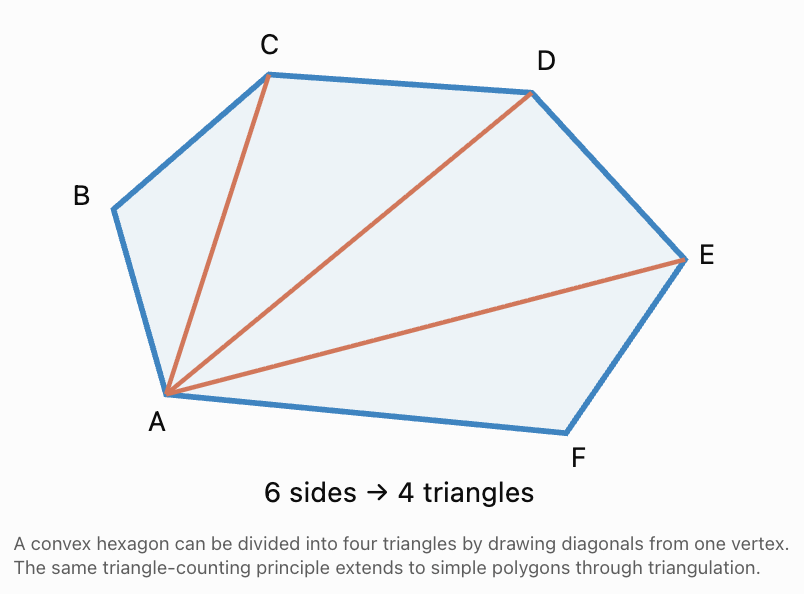
Given: A simple polygon with n sides.
Prove: S = (n − 2) × 180°.
Proof:
-
Every simple polygon can be triangulated into non-overlapping triangles whose vertices are polygon vertices.
-
A triangulation of an n-sided simple polygon contains n − 2 triangles.
-
Each triangle has an interior angle sum of 180°.
-
The triangle angles together make up all the interior angles of the polygon.
Therefore:
S = (n − 2) × 180°.
Hence, the theorem is proved.
Worked Example 1: Applying the Polygon Angle Sum Theorem
A polygon has an interior angle sum of 1980°.
Find its number of sides.
S = (n − 2) × 180°
1980 = (n − 2) × 180
11 = n − 2
n = 13
Answer: The polygon has 13 sides.
Proof 2: Exterior Angle Sum of a Convex Polygon
Theorem: The sum of one exterior angle at each vertex of a convex polygon is 360°.
Given: A convex polygon with n sides.
Proof:
Each interior angle and its adjacent exterior angle form a straight line.
Therefore:
Interior angle + Exterior angle = 180°.
For n vertices:
Sum of interior angles + Sum of exterior angles = 180n.
The interior angle sum is:
180(n − 2).
Therefore:
180(n − 2) + Sum of exterior angles = 180n.
Rearranging:
Sum of exterior angles = 180n − 180(n − 2)
= 180n − 180n + 360
= 360°.
Therefore, the exterior angle sum is always 360°.
Proof 3: Opposite Sides of a Parallelogram Are Equal
Given: ABCD is a parallelogram.
Prove: AB = CD and BC = AD.
Draw diagonal AC.
Since AB ∥ CD:
∠BAC = ∠DCA.
These are alternate interior angles.
Since BC ∥ AD:
∠BCA = ∠DAC.
These are also alternate interior angles.
AC is common to both triangles.
Therefore:
△ABC ≅ △CDA by ASA.
Corresponding sides of congruent triangles are equal.
Hence:
AB = CD
BC = AD.
The opposite sides of a parallelogram are equal.
Proof 4: Diagonals of a Parallelogram Bisect Each Other
Given: ABCD is a parallelogram, and diagonals AC and BD intersect at O.
Prove: AO = OC and BO = OD.
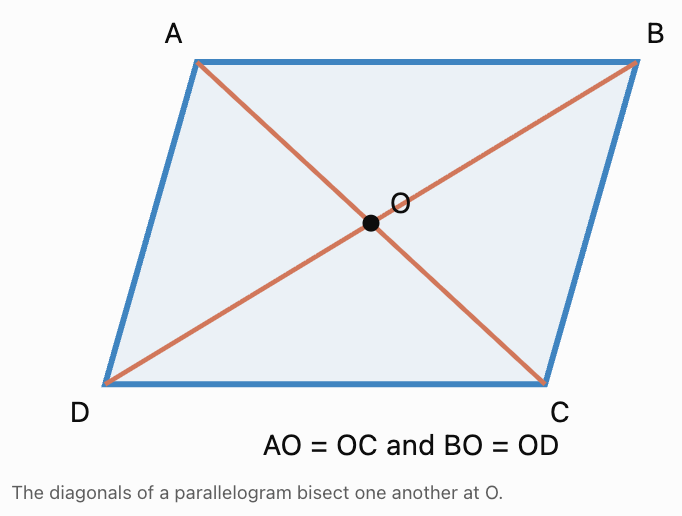
Consider triangles AOB and COD.
Since AB ∥ CD:
∠ABO = ∠CDO
∠BAO = ∠DCO.
Also, opposite sides of a parallelogram are equal:
AB = CD.
Therefore:
△AOB ≅ △COD by ASA.
Corresponding sides are equal.
Thus:
AO = OC
BO = OD.
Therefore, the diagonals bisect each other.
Proving Circle Properties
Circle theorems provide relationships between radii, chords, tangents, arcs, and angles.
Many of these theorems can be proved using isosceles triangles and previously established angle properties.
Proof 5: A Radius Is Perpendicular to a Tangent
Theorem: A tangent to a circle is perpendicular to the radius at the point of tangency.
Given: A circle with centre O and tangent line t touching the circle at T.
Prove: OT ⟂ t.
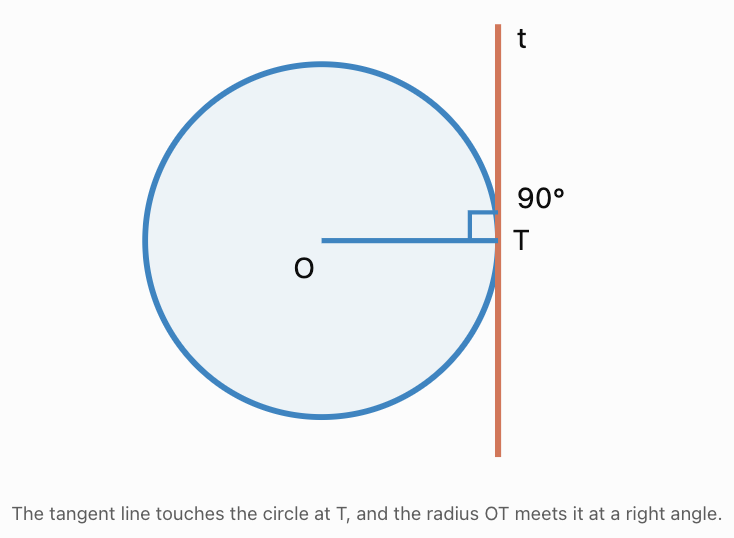
Proof by contradiction:
Assume OT is not perpendicular to t.
Draw the perpendicular from O to t, meeting t at P.
Since OT is not perpendicular to t, P and T are different points.
Triangle OPT is right-angled at P.
Therefore, OT is the hypotenuse, so:
OP < OT.
But OT is a radius, so OT = r.
Therefore:
OP < r.
This means P lies inside the circle.
A line passing through an interior point of a circle intersects the circle at two distinct points.
That contradicts the fact that t is a tangent, which intersects the circle at exactly one point.
Therefore, our assumption is false.
Hence, OT ⟂ t.
Proof 6: Tangents from the Same External Point Are Equal
Given: PA and PB are tangents from an external point P to a circle with centre O.
Prove: PA = PB.
Join OA, OB, and OP.
Because radii are perpendicular to tangents:
∠OAP = 90°
∠OBP = 90°.
OA = OB because both are radii.
OP is common to triangles OAP and OBP.
Therefore:
△OAP ≅ △OBP by RHS congruence.
Corresponding sides are equal.
Hence:
PA = PB.
Worked Example 2: Algebraic Tangent Lengths
Two tangents from P have lengths:
PA = 4x + 3
PB = 7x − 12.
Find x and both lengths.
Tangents from the same external point are equal.
4x + 3 = 7x − 12
15 = 3x
x = 5
PA = 4(5) + 3 = 23
PB = 7(5) − 12 = 23
Answer: x = 5 and both tangents are 23 units long.
Proof 7: The Inscribed Angle Theorem
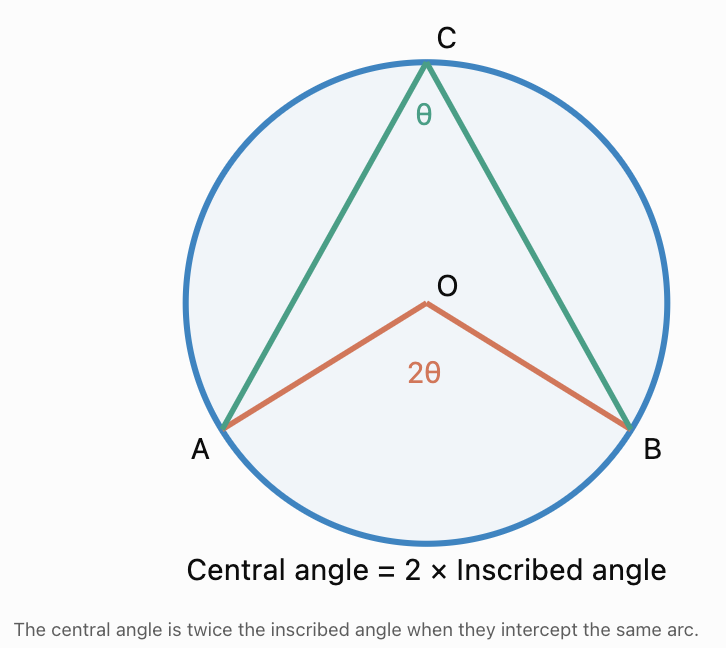
Theorem: An inscribed angle is half the measure of the central angle intercepting the same arc.
Suppose A, B, and C lie on a circle with centre O.
The central angle ∠AOB and inscribed angle ∠ACB intercept the same arc AB.
Then:
∠AOB = 2∠ACB
when ∠AOB denotes the central angle corresponding to that arc.
Proof
We first consider the case in which one side of the inscribed angle passes through the centre.
Let C, O, and B be collinear, with CB a diameter.
Join OA.
Since OA = OC, triangle AOC is isosceles.
Let:
∠ACO = ∠OAC = x.
The triangle angle sum gives:
∠AOC = 180° − 2x.
Because OB is opposite OC:
∠AOB = 180° − ∠AOC
∠AOB = 2x.
Since C, O, and B are collinear:
∠ACB = x.
Therefore:
∠AOB = 2∠ACB.
For the general case, draw the diameter from C through O.
This divides the inscribed angle into two smaller angles, or expresses it as their difference.
Applying the result above to each smaller angle and adding or subtracting as appropriate gives:
Central angle = 2 × Inscribed angle.
This proves the theorem.
Worked Example 3: Central and Inscribed Angles
A central angle is (6x + 20)°.
An inscribed angle intercepting the same arc is (2x + 30)°.
Find x.
Use:
Central angle = 2 × Inscribed angle.
6x + 20 = 2(2x + 30)
6x + 20 = 4x + 60
2x = 40
x = 20
Central angle:
6(20) + 20 = 140°.
Inscribed angle:
2(20) + 30 = 70°.
Answer: x = 20, central angle = 140°, inscribed angle = 70°.
Proof 8: An Angle in a Semicircle Is a Right Angle
Given: AB is a diameter of a circle, and C lies on its circumference.
Prove: ∠ACB = 90°.
Because AB is a diameter, the arc AB not containing C measures 180°.
By the inscribed angle theorem:
∠ACB = ½ × 180°
Therefore:
∠ACB = 90°.
This theorem is sometimes called Thales' theorem.
Worked Example 4: Triangle in a Semicircle
AB is a diameter, and C lies on the circumference.
∠CAB = 32°.
Find ∠ABC.
By the angle in a semicircle theorem:
∠ACB = 90°.
Using the triangle angle sum:
32° + 90° + ∠ABC = 180°
∠ABC = 58°.
Answer: 58°.
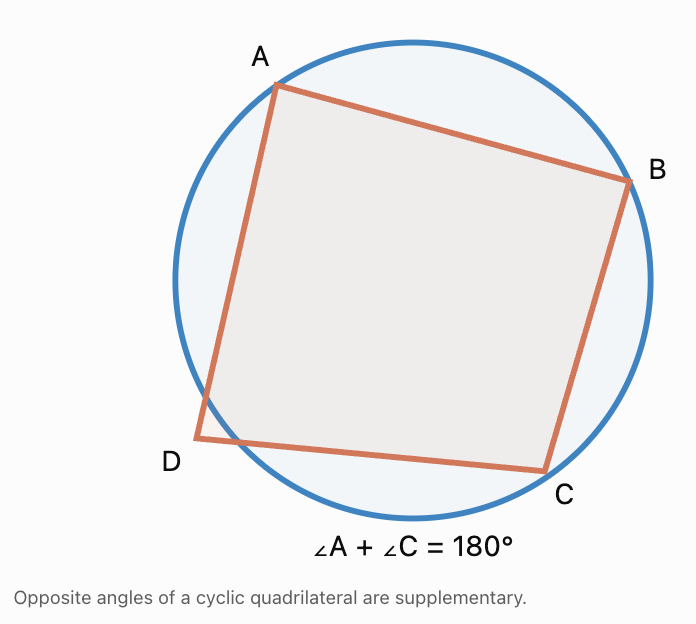
Proof 9: Opposite Angles of a Cyclic Quadrilateral Are Supplementary
A cyclic quadrilateral is a quadrilateral with all four vertices on the same circle.
Given: ABCD is cyclic.
Prove:
∠A + ∠C = 180°.
Proof:
Angle A intercepts arc BCD.
Angle C intercepts arc BAD.
These arcs together form the complete circle.
Therefore:
Arc BCD + Arc BAD = 360°.
By the inscribed angle theorem:
∠A = ½ × arc BCD
∠C = ½ × arc BAD.
Adding:
∠A + ∠C = ½ × 360°
∠A + ∠C = 180°.
Similarly:
∠B + ∠D = 180°.
Hence, opposite angles of a cyclic quadrilateral are supplementary.
Worked Example 5: Algebraic Cyclic Quadrilateral
In cyclic quadrilateral ABCD:
∠A = (3x + 15)°
∠C = (5x − 11)°.
Find x.
Opposite angles sum to 180°.
(3x + 15) + (5x − 11) = 180
8x + 4 = 180
8x = 176
x = 22
Then:
∠A = 81°
∠C = 99°.
Verification:
81 + 99 = 180°.
Answer: x = 22.
Combining Multiple Theorems in a Proof
Many challenging geometry problems cannot be solved using a single theorem.
Instead, we must recognize how several geometric relationships fit together.
For example, a proof may involve:
-
Identifying an isosceles triangle using equal radii.
-
Calculating angles using the triangle angle sum.
-
Applying the inscribed angle theorem.
-
Recognizing a cyclic quadrilateral.
-
Using supplementary angles to establish the final result.
The key is to work from the given information toward the statement that must be proved.
Proof 10: The Tangent–Chord Theorem
Theorem: The angle between a tangent and a chord equals the angle in the alternate segment of the circle.
Given: A tangent touches a circle at A. AB is a chord, and C is a point on the opposite arc AB.
Prove: The angle between the tangent and chord AB equals ∠ACB.
Proof
Let O be the centre.
Join OA and OB.
Because OA = OB, triangle AOB is isosceles.
Let the central angle ∠AOB be 2x, where this angle intercepts the arc AB not containing C.
The base angles are:
∠OAB = ∠ABO = (180° − 2x)/2
Therefore:
∠OAB = 90° − x.
The radius OA is perpendicular to the tangent at A.
Hence, the acute angle between the tangent and chord AB is:
90° − (90° − x) = x.
By the inscribed angle theorem:
∠ACB = ½∠AOB = x.
Therefore:
The angle between the tangent and chord equals ∠ACB.
The supplementary tangent–chord angle corresponds to the inscribed angle on the other arc.
This proof combines the properties of isosceles triangles, tangent–radius perpendicularity, and the inscribed angle theorem.
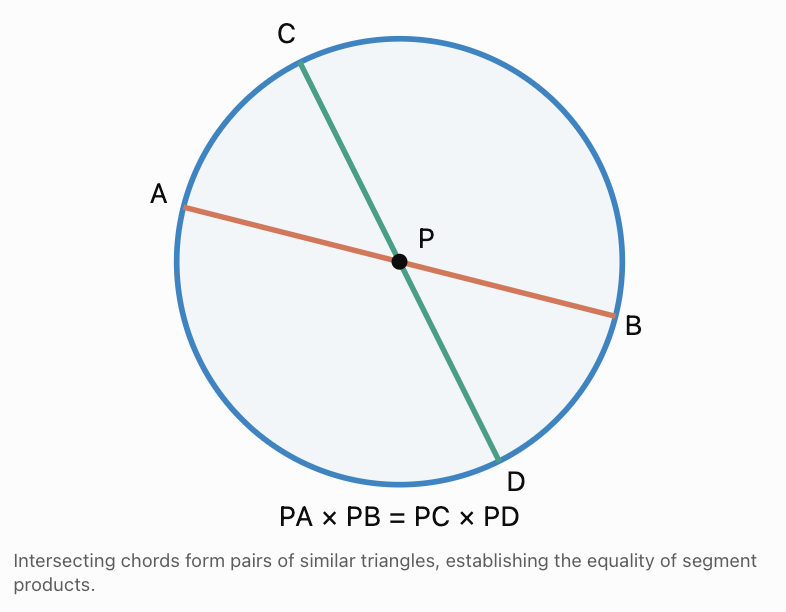
Proof 11: The Intersecting Chords Theorem
Theorem: If two chords intersect inside a circle, the products of their segment lengths are equal.
Given: Chords AB and CD intersect at P.
Prove:
PA × PB = PC × PD.
Proof
Consider triangles PAC and PDB.
First:
∠APC = ∠DPB
because they are vertically opposite angles.
Next:
∠PAC = ∠PDB
because they are inscribed angles intercepting the same arc BC.
Therefore:
△PAC ∼ △PDB by AA similarity.
Corresponding side ratios are equal:
PA/PD = PC/PB
Cross-multiply:
PA × PB = PC × PD.
Hence, the intersecting chords theorem is proved.
Worked Example 6: Intersecting Chords
Two chords intersect at P.
PA = 4 cm
PB = 9 cm
PC = 6 cm
Find PD.
Using the theorem:
PA × PB = PC × PD
4 × 9 = 6 × PD
36 = 6PD
PD = 6 cm
Answer: PD = 6 cm.
Proof 12: Opposite Angles of a Cyclic Quadrilateral and an Exterior Angle
Theorem: An exterior angle of a cyclic quadrilateral equals its opposite interior angle.
Given: ABCD is a cyclic quadrilateral. Side AB is extended beyond B to E.
Prove:
∠EBC = ∠ADC.
Proof
Since ABCD is cyclic:
∠ABC + ∠ADC = 180°.
Since A, B, and E lie on a straight line:
∠ABC + ∠EBC = 180°.
Both ∠ADC and ∠EBC are supplementary to ∠ABC.
Therefore:
∠EBC = ∠ADC.
This proof combines the cyclic quadrilateral theorem with angles on a straight line.
Proof 13: A Parallelogram Inscribed in a Circle Is a Rectangle
This is an important example of combining polygon and circle theorems.
Given: ABCD is both a parallelogram and a cyclic quadrilateral.
Prove: ABCD is a rectangle.
Proof
Since ABCD is a parallelogram, opposite angles are equal.
Therefore:
∠A = ∠C.
Since ABCD is cyclic, opposite angles are supplementary.
Therefore:
∠A + ∠C = 180°.
Substitute ∠C = ∠A:
2∠A = 180°.
∠A = 90°.
Hence:
∠C = 90°.
The same reasoning gives:
∠B = ∠D = 90°.
All four interior angles are right angles.
A parallelogram with four right angles is a rectangle.
Therefore, ABCD is a rectangle.
This proof is especially useful because it connects two different families of geometric properties.
Proof 14: A Rectangle Can Be Inscribed in a Circle
Given: ABCD is a rectangle.
Prove: Its four vertices lie on a circle.
Proof
Let O be the intersection of diagonals AC and BD.
Since ABCD is a rectangle, its diagonals are equal:
AC = BD.
Also, diagonals of a parallelogram bisect each other.
Therefore:
AO = OC = AC/2
BO = OD = BD/2.
Since AC = BD:
AO = BO = CO = DO.
Thus, all four vertices are the same distance from O.
A circle centred at O with radius OA passes through A, B, C, and D.
Therefore, every rectangle is cyclic.
Together, Proofs 13 and 14 establish that a parallelogram is cyclic if and only if it is a rectangle.
Proof 15: Pythagoras' Theorem Using a Circle
Given: Triangle ABC is inscribed in a circle with diameter AB.
Prove:
AB² = AC² + BC².
Proof
Since AB is a diameter:
∠ACB = 90°
by the angle in a semicircle theorem.
Therefore, triangle ABC is right-angled at C.
By the Pythagorean theorem:
AC² + BC² = AB².
Hence, AB² = AC² + BC².
Strictly speaking, this is an application of the Pythagorean theorem rather than an independent proof of it. It demonstrates how a circle theorem establishes the condition needed to use another theorem.
Worked Example 7: A Multi-Theorem Circle Problem
AB is a diameter of a circle, and C lies on the circumference.
The lengths are:
AC = 9 cm
BC = 12 cm.
A tangent touches the circle at A.
Find:
a) AB.
b) The radius.
c) The angle between the tangent at A and AB.
Solution
a) Find AB.
Because AB is a diameter:
∠ACB = 90°.
Use the Pythagorean theorem:
AB² = AC² + BC²
AB² = 9² + 12²
AB² = 81 + 144
AB² = 225
AB = 15 cm.
b) Find the radius.
r = AB/2
r = 15/2
r = 7.5 cm.
c) Find the tangent angle.
AB lies along the radius OA.
A tangent is perpendicular to the radius at the point of tangency.
Therefore, the angle between the tangent and AB is 90°.
Answers: AB = 15 cm, r = 7.5 cm, tangent angle = 90°.
Worked Example 8: Combining a Cyclic Quadrilateral and a Triangle
ABCD is cyclic.
Diagonal AC is drawn.
Given:
∠ABC = 112°
∠BAC = 28°
∠CAD = 35°.
Find:
a) ∠ADC.
b) ∠BCA.
c) ∠BCD.
Solution
a) Find ∠ADC.
Opposite angles of a cyclic quadrilateral are supplementary.
∠ABC + ∠ADC = 180°
112° + ∠ADC = 180°
∠ADC = 68°.
b) Find ∠BCA.
In triangle ABC:
∠BAC + ∠ABC + ∠BCA = 180°
28° + 112° + ∠BCA = 180°
∠BCA = 40°.
c) Find ∠BCD.
First find ∠ACD using triangle ACD.
∠CAD + ∠ADC + ∠ACD = 180°
35° + 68° + ∠ACD = 180°
∠ACD = 77°.
Diagonal AC divides angle BCD into two parts:
∠BCD = ∠BCA + ∠ACD
∠BCD = 40° + 77°
∠BCD = 117°.
Final answers:
a) 68°.
b) 40°.
c) 117°.
Verification: ∠BAD = 28° + 35° = 63°, and 63° + 117° = 180°, as required for opposite angles of a cyclic quadrilateral.
Writing Complete Mathematical Arguments
A correct numerical answer is not always a complete geometric proof.
When asked to prove, justify, or show that a statement is true, we must communicate the reasoning connecting the given information to the conclusion.
Two-Column Proofs
A two-column proof separates mathematical statements from their justifications.
For example, suppose ABCD is a parallelogram.
We want to prove that ∠A = ∠C.
|
Statement |
Reason |
|---|---|
|
AB ∥ CD and AD ∥ BC |
Definition of a parallelogram |
|
∠A + ∠B = 180° |
Co-interior angles |
|
∠B + ∠C = 180° |
Co-interior angles |
|
∠A + ∠B = ∠B + ∠C |
Both expressions equal 180° |
|
∠A = ∠C |
Subtract ∠B from both sides |
This is a complete deductive argument.
Paragraph Proofs
The same proof can be written as a paragraph:
Since ABCD is a parallelogram, both pairs of opposite sides are parallel. Co-interior angles along parallel lines are supplementary, so ∠A + ∠B = 180° and ∠B + ∠C = 180°. Therefore, ∠A + ∠B = ∠B + ∠C. Subtracting ∠B from both sides gives ∠A = ∠C. Hence, opposite angles of a parallelogram are equal.
Both formats are valid.
How to Improve the Clarity of a Proof
A strong proof should:
-
Identify the given information.
-
State exactly what must be proved.
-
Label the diagram clearly.
-
Use established definitions and theorems.
-
Explain why each statement follows.
-
Avoid assuming the conclusion.
-
Use consistent angle and point notation.
-
Finish with a clear concluding statement.
Strategies for Complex Geometric Proofs
Strategy 1: Work Forward from the Given Information
Ask:
What can I immediately conclude from the facts provided?
For example, if two sides of a triangle are radii of the same circle, they are equal.
Therefore, the triangle is isosceles.
This gives equal base angles, which may lead to further angle relationships.
Strategy 2: Work Backward from the Conclusion
Ask:
What would be sufficient to prove the required result?
For example, to prove a quadrilateral is a rectangle, we might show that it is a parallelogram with one right angle.
Alternatively, we could prove directly that all four angles are right angles.
Strategy 3: Draw Auxiliary Lines
An auxiliary line is an additional line introduced to help solve a problem.
Useful constructions include:
-
Drawing a diagonal in a quadrilateral.
-
Joining the centre of a circle to a point on its circumference.
-
Drawing a diameter through an inscribed angle's vertex.
-
Joining the centre to the point of tangency.
-
Drawing a perpendicular to a chord.
-
Extending a side to create an exterior angle.
These constructions reveal triangles, parallel lines, and angle relationships that may not initially be visible.
Strategy 4: Look for Congruent or Similar Triangles
Congruent triangles have equal corresponding sides and angles.
Common congruence criteria include:
-
SSS
-
SAS
-
ASA
-
AAS
-
RHS
Similar triangles have equal corresponding angles and proportional corresponding sides.
Common similarity criteria include:
-
AA
-
SAS similarity
-
SSS similarity
Strategy 5: Check the Logic
Every statement must follow from something already known.
For example, this is invalid:
“The diagonals look equal, so the quadrilateral is a rectangle.”
The diagram's appearance is not sufficient evidence.
A stronger argument might establish that the quadrilateral is a parallelogram and that its diagonals are equal. Those two facts together are sufficient to prove it is a rectangle.
Real-World Applications of Geometric Proofs
Architecture and Structural Engineering
Engineers use geometric reasoning to understand structural shapes.
Triangle congruence and rigidity help explain why triangulated frameworks are common in bridges and roofs.
Proofs also help establish geometric constraints in designs, although real structures additionally require analysis of forces, materials, and loads.
Surveying and Land Measurement
Surveyors use triangles, angles, and distances to determine positions and measurements.
Similarity and congruence can justify relationships between measured lengths and inaccessible distances.
Computer-Aided Design
Computer-aided design software uses geometric constraints such as parallelism, perpendicularity, tangency, and equal lengths.
A geometric model can be designed so that certain relationships remain true even when dimensions change.
Optical and Mechanical Systems
Circular geometry is important in the design of gears, bearings, and rotating components.
Theorems involving tangents, radii, and angles help describe contact geometry and geometric constraints.
Common Mistakes
Mistake 1: Using a Diagram as Evidence
A line may appear perpendicular or two sides may appear equal.
Unless this information is given or proved, it cannot be assumed.
Mistake 2: Confusing a Theorem with Its Converse
A rectangle has equal diagonals.
However, equal diagonals alone do not prove a quadrilateral is a rectangle.
Mistake 3: Stating a Result Without a Reason
Weak argument:
“∠A = ∠C.”
Better argument:
“∠A = ∠C because opposite angles of a parallelogram are equal.”
Mistake 4: Assuming the Conclusion
A proof is circular if it uses the result being proved as one of its premises.
For example, when proving that diagonals bisect each other, we cannot begin by assuming that they bisect each other.
Mistake 5: Using a Circle Theorem with the Wrong Arc
Central and inscribed angles must intercept the same arc for the usual doubling relationship to apply.
Mistake 6: Assuming All Quadrilaterals Are Cyclic
Not every quadrilateral has four vertices on one circle.
The cyclic quadrilateral angle theorem applies only when cyclicity is established.
Mistake 7: Incorrect Triangle Correspondence
When proving triangles congruent or similar, the order of corresponding vertices must be consistent.
Mistake 8: Omitting a Necessary Step
A proof may be mathematically correct in idea but incomplete if a key relationship is unexplained.
Mistake 9: Confusing Numerical Verification with General Proof
Checking that a property works for several examples does not prove it for all cases.
Mistake 10: Using the Wrong Angle Relationship
For example:
-
Vertically opposite angles are equal.
-
Adjacent angles on a straight line sum to 180°.
-
Opposite angles of a cyclic quadrilateral sum to 180°.
These are distinct properties and must be applied in the correct circumstances.
Mistake 11: Forgetting the Conditions of a Theorem
A radius is perpendicular to a tangent at the point of tangency, not at every point on the tangent line.
Mistake 12: Giving an Incomplete Conclusion
A proof should end by explicitly stating the result established.
For example:
“Therefore, ABCD is a rectangle.”
Key Terms
-
Geometric Proof: A logical argument demonstrating that a geometric statement is true.
-
Theorem: A mathematical statement established by proof.
-
Postulate: A statement accepted as true without proof within an axiomatic system.
-
Definition: A precise explanation of a mathematical concept.
-
Conjecture: A mathematical statement believed to be true but not yet proved.
-
Deductive Reasoning: Using established facts and logical rules to reach a conclusion.
-
Inductive Reasoning: Using observed patterns to develop a general conjecture.
-
Given: Information provided at the beginning of a proof.
-
Conclusion: The statement established at the end of a proof.
-
Converse: A statement formed by reversing the hypothesis and conclusion of another statement.
-
Counterexample: An example that demonstrates a general statement is false.
-
Auxiliary Line: A line added to a diagram to help construct a proof.
-
Parallel Lines: Coplanar lines that do not intersect.
-
Perpendicular Lines: Lines that intersect at 90°.
-
Supplementary Angles: Two angles whose measures add to 180°.
-
Vertically Opposite Angles: Equal angles formed opposite each other by intersecting lines.
-
Isosceles Triangle: A triangle with at least two equal sides.
-
Parallelogram: A quadrilateral with two pairs of opposite parallel sides.
-
Cyclic Quadrilateral: A quadrilateral with all four vertices on the same circle.
-
Central Angle: An angle whose vertex is at the centre of a circle.
-
Inscribed Angle: An angle whose vertex lies on a circle and whose sides are chords.
-
Tangent: A line meeting a circle at exactly one point.
-
Chord: A segment connecting two points on a circle.
-
Diameter: A chord passing through the centre of a circle.
-
Alternate Segment Theorem: A theorem relating tangent–chord angles to inscribed angles.
-
Intersecting Chords Theorem: A relationship between the products of chord segments.
-
Two-Column Proof: A proof presenting statements alongside their justifications.
-
Paragraph Proof: A proof written as a connected mathematical explanation.
Key Takeaways
-
Geometric proofs establish why mathematical statements are true.
-
A complete proof uses given information, valid deductions, and justified conclusions.
-
Diagrams help us understand problems but are not sufficient evidence on their own.
-
The interior angle sum of a simple n-sided polygon is (n − 2) × 180°.
-
The exterior angle sum of a convex polygon is 360°.
-
Opposite sides and angles of parallelograms are equal.
-
The diagonals of a parallelogram bisect each other.
-
A radius is perpendicular to a tangent at the point of tangency.
-
Tangents from the same external point are equal.
-
An inscribed angle is half the measure of its intercepted arc.
-
An angle in a semicircle is 90°.
-
Opposite angles of a cyclic quadrilateral are supplementary.
-
The tangent–chord theorem connects tangent angles with inscribed angles.
-
The intersecting chords theorem follows from similar triangles.
-
A cyclic parallelogram must be a rectangle.
-
Complex proofs often combine triangle, polygon, and circle theorems.
-
Auxiliary constructions can reveal useful geometric relationships.
-
Clear communication requires stating the reason for each deduction.
-
A counterexample can disprove a general claim.
-
Mathematical proof is a fundamental tool in geometry, engineering, and logical problem solving.
Check Your Understanding
For each question, show all necessary reasoning. When a proof is requested, explain why each step is valid.
Question 1: Polygon Angle Sum
Prove that the interior angle sum of a convex octagon is 1080°.
Explain how triangulation justifies your calculation.
Question 2: Exterior Angles
Prove that the exterior angles of a convex pentagon add to 360°.
Question 3: Parallelogram Properties
ABCD is a parallelogram.
Prove that ∠A = ∠C using supplementary angle relationships.
Question 4: Diagonals
ABCD is a parallelogram whose diagonals intersect at O.
If:
AO = 3x + 2
OC = 5x − 10
Find x and AC.
Explain the theorem used.
Question 5: Tangent Properties
PA and PB are tangents from external point P to a circle.
Given:
PA = 6x − 4
PB = 3x + 11
Find x and the tangent lengths.
Explain why the lengths are equal.
Question 6: Central and Inscribed Angles
A central angle and an inscribed angle intercept the same arc.
The central angle is (8x + 10)°.
The inscribed angle is (3x + 20)°.
Find x and both angles.
Question 7: Semicircle Theorem
AB is a diameter of a circle.
C lies on the circumference.
Given:
∠CAB = 37°.
Find ∠ABC.
Justify each step.
Question 8: Cyclic Quadrilateral
ABCD is cyclic.
Given:
∠A = (4x + 15)°
∠C = (6x − 25)°.
Find x, ∠A, and ∠C.
Question 9: Intersecting Chords
Two chords AB and CD intersect at P.
Given:
PA = 5 cm
PB = 12 cm
PC = 6 cm.
Find PD.
Explain which triangles can be used to prove the theorem.
Question 10: Combined Polygon and Circle Proof
ABCD is both a parallelogram and a cyclic quadrilateral.
Prove that ABCD is a rectangle.
Question 11: Converse and Counterexample
Consider the statement:
“If a quadrilateral has equal diagonals, then it is a rectangle.”
Is this statement always true?
Provide a counterexample or proof.
Question 12: Tangent–Chord Theorem
A tangent touches a circle at A.
AB is a chord, and C lies on the circle in the alternate segment.
The angle between the tangent and AB is 52°.
Find ∠ACB and explain why.
Question 13: Multi-Step Angle Problem
ABCD is a cyclic quadrilateral.
Diagonal AC is drawn.
Given:
∠ABC = 105°
∠BAC = 30°
∠CAD = 25°.
Find:
a) ∠ADC.
b) ∠BCA.
c) ∠ACD.
d) ∠BCD.
Justify each calculation.
Question 14: Comprehensive Proof Challenge
A rectangle ABCD is inscribed in a circle with centre O.
The diagonals AC and BD intersect at O.
Prove that:
a) AC = BD.
b) AO = BO = CO = DO.
c) The circle passes through all four vertices.
d) Each diagonal is a diameter of the circle.
Your proof should combine properties of rectangles, parallelograms, and circles.
Fully Worked Answers
Answer 1: Polygon Angle Sum
An octagon has eight sides.
Draw diagonals from one vertex to all non-adjacent vertices.
This divides a convex octagon into:
8 − 2 = 6 triangles.
Each triangle has an interior angle sum of 180°.
Therefore:
S = 6 × 180°
S = 1080°.
Conclusion: The interior angles of a convex octagon add to 1080° because it can be divided into six triangles.
Answer 2: Exterior Angles
A convex pentagon has five interior angles.
Its interior angle sum is:
S = (5 − 2) × 180°
S = 540°.
At each vertex:
Interior angle + Exterior angle = 180°.
For five vertices:
Sum of interior angles + Sum of exterior angles = 5 × 180°
540° + Sum of exterior angles = 900°.
Therefore:
Sum of exterior angles = 900° − 540°
Sum = 360°.
Answer 3: Parallelogram Angles
ABCD is a parallelogram.
Therefore:
AB ∥ CD
AD ∥ BC.
Because AB ∥ CD, co-interior angles give:
∠A + ∠D = 180°.
Because AD ∥ BC:
∠D + ∠C = 180°.
Therefore:
∠A + ∠D = ∠D + ∠C.
Subtract ∠D from both sides:
∠A = ∠C.
Hence, opposite angles of a parallelogram are equal.
Answer 4: Diagonals
Given:
AO = 3x + 2
OC = 5x − 10.
Diagonals of a parallelogram bisect each other.
Therefore:
AO = OC.
3x + 2 = 5x − 10
12 = 2x
x = 6.
Then:
AO = 3(6) + 2 = 20
OC = 5(6) − 10 = 20.
Therefore:
AC = AO + OC
AC = 20 + 20
Answer: x = 6 and AC = 40 units.
Answer 5: Tangent Properties
Tangents from the same external point are equal.
Therefore:
PA = PB.
6x − 4 = 3x + 11
3x = 15
x = 5.
Then:
PA = 6(5) − 4 = 26
PB = 3(5) + 11 = 26.
Answer: x = 5 and both tangents are 26 units long.
The tangent lengths are equal because the right triangles formed by the two radii, tangents, and the common segment from P to the centre are congruent.
Answer 6: Central and Inscribed Angles
Given:
Central angle = (8x + 10)°
Inscribed angle = (3x + 20)°.
The central angle is twice the inscribed angle.
Therefore:
8x + 10 = 2(3x + 20)
8x + 10 = 6x + 40
2x = 30
x = 15.
Central angle:
8(15) + 10 = 130°.
Inscribed angle:
3(15) + 20 = 65°.
Verification:
130° = 2 × 65°.
Answer: x = 15, central angle = 130°, inscribed angle = 65°.
Answer 7: Semicircle Theorem
AB is a diameter.
Therefore, by the angle in a semicircle theorem:
∠ACB = 90°.
The interior angles of triangle ABC sum to 180°.
37° + 90° + ∠ABC = 180°
∠ABC = 180° − 127°
Answer: ∠ABC = 53°.
Answer 8: Cyclic Quadrilateral
Given:
∠A = (4x + 15)°
∠C = (6x − 25)°.
Opposite angles of a cyclic quadrilateral sum to 180°.
(4x + 15) + (6x − 25) = 180
10x − 10 = 180
10x = 190
x = 19.
Then:
∠A = 4(19) + 15 = 91°.
∠C = 6(19) − 25 = 89°.
Verification:
91° + 89° = 180°.
Answer: x = 19, ∠A = 91°, ∠C = 89°.
Answer 9: Intersecting Chords
Use the intersecting chords theorem:
PA × PB = PC × PD.
Substitute:
5 × 12 = 6 × PD
60 = 6PD
PD = 10 cm.
Answer: PD = 10 cm.
To justify the theorem, consider triangles PAC and PDB.
They have equal vertically opposite angles at P and another equal angle pair because inscribed angles intercepting the same arc are equal.
Therefore, the triangles are similar by AA.
Their corresponding side ratios establish the product relationship.
Answer 10: Cyclic Parallelogram
Given: ABCD is both a parallelogram and a cyclic quadrilateral.
Prove: ABCD is a rectangle.
Because ABCD is a parallelogram:
∠A = ∠C.
Because ABCD is cyclic:
∠A + ∠C = 180°.
Substitute:
2∠A = 180°
∠A = 90°.
Therefore:
∠C = 90°.
Similarly:
∠B = ∠D
and:
∠B + ∠D = 180°.
Hence:
∠B = ∠D = 90°.
All four angles are right angles.
Therefore, ABCD is a rectangle.
Answer 11: Converse and Counterexample
The statement is false.
An isosceles trapezoid has equal diagonals but does not necessarily have four right angles.
For example, an isosceles trapezoid with unequal parallel bases has equal diagonals but is not a rectangle.
This provides a counterexample.
The correct statement is:
If a parallelogram has equal diagonals, then it is a rectangle.
The additional condition that the quadrilateral is a parallelogram is essential.
Answer 12: Tangent–Chord Theorem
The tangent–chord theorem states that the angle between a tangent and chord equals the inscribed angle in the alternate segment.
Given:
Tangent–chord angle = 52°.
Therefore:
∠ACB = 52°.
This follows because the tangent is perpendicular to the radius at A, and the central angle subtending the chord is twice the corresponding inscribed angle.
Answer 13: Multi-Step Angle Problem
Given:
∠ABC = 105°
∠BAC = 30°
∠CAD = 25°.
a) Find ∠ADC.
Opposite angles of a cyclic quadrilateral are supplementary.
∠ABC + ∠ADC = 180°
105° + ∠ADC = 180°
∠ADC = 75°.
b) Find ∠BCA.
Triangle ABC has angle sum 180°.
30° + 105° + ∠BCA = 180°
∠BCA = 45°.
c) Find ∠ACD.
Triangle ACD has angle sum 180°.
25° + 75° + ∠ACD = 180°
∠ACD = 80°.
d) Find ∠BCD.
Diagonal AC divides ∠BCD into two angles.
∠BCD = ∠BCA + ∠ACD
∠BCD = 45° + 80°
∠BCD = 125°.
Final answers:
a) 75°.
b) 45°.
c) 80°.
d) 125°.
Verification:
∠BAD = 30° + 25° = 55°.
Since ABCD is cyclic:
∠BAD + ∠BCD = 180°.
55° + 125° = 180°.
The result is consistent.
Answer 14: Comprehensive Proof Challenge
Given: ABCD is a rectangle. Its diagonals intersect at O.
a) Prove AC = BD.
Consider triangles ABC and BAD.
AB is common.
BC = AD because opposite sides of a rectangle are equal.
∠ABC = ∠BAD = 90°.
Therefore:
△ABC ≅ △BAD by SAS.
Corresponding sides are equal.
Hence:
AC = BD.
b) Prove AO = BO = CO = DO.
A rectangle is a parallelogram.
The diagonals of a parallelogram bisect each other.
Therefore:
AO = OC = AC/2
BO = OD = BD/2.
Since AC = BD:
AC/2 = BD/2.
Thus:
AO = BO = CO = DO.
c) Prove the circle passes through all four vertices.
From part b:
AO = BO = CO = DO.
Therefore, A, B, C, and D are equally distant from O.
By the definition of a circle, all points at the same distance from O lie on the circle centred at O.
Hence, a circle centred at O with radius OA passes through all four vertices.
d) Prove both diagonals are diameters.
Since A, O, and C are collinear, AC passes through the centre O.
Both A and C lie on the circle.
Therefore, AC is a diameter.
Similarly, B, O, and D are collinear, and B and D lie on the circle.
Therefore, BD is also a diameter.
Conclusion: The diagonals of a rectangle are equal, bisect each other, and serve as diameters of its circumcircle.
Final Course Connections
Geometric proofs bring together many of the most important ideas studied throughout geometry.
Polygon properties rely on triangle angle sums, parallel lines, congruence, and logical deduction. Circle properties extend these ideas through radii, chords, tangents, and inscribed angles.
The most challenging problems often require several theorems to be applied in sequence.
The essential skill is not simply memorizing geometric rules, but understanding when each theorem applies, why it is valid, and how it connects to other mathematical relationships.
This completes Geometric Proofs with Circles and Polygons, including proofs of polygon properties, circle theorems, multi-theorem arguments, logical justification, and clear mathematical communication.