Polygons and Circles
| Сайт: | Young Education |
| Курс: | Geometry and Proof |
| Книга: | Polygons and Circles |
| Надруковано: | Guest user |
| Дата: | понеділок 9 листопада 2026 16:39 PM |
1. Properties of Polygons
Learning outcomes
- I can classify polygons.
- I can calculate interior and exterior angle sums.
- I can identify regular polygons.
- I can solve angle problems involving polygons.
- I can justify polygon properties.
Introduction
Polygons are everywhere in mathematics, architecture, engineering, art, and nature. The triangular framework of a bridge, the rectangular shape of a classroom, the hexagonal cells of a honeycomb, and the pentagonal patterns of a football all involve polygons.
Although polygons can have many different shapes and sizes, they follow predictable mathematical rules. These rules allow us to classify polygons, calculate their angles, identify regular shapes, and explain why certain geometric relationships are always true.
One of the most important discoveries in geometry is that the sum of the interior angles of a polygon depends only on its number of sides, not on its size or exact shape.
For example, every triangle has an interior angle sum of 180°, while every quadrilateral has an interior angle sum of 360°.
By understanding how polygons can be divided into triangles, we can extend these results to polygons with any number of sides.
In this lesson, we will explore polygon classification, interior and exterior angles, regular polygons, multi-step angle problems, and mathematical justifications for polygon properties.
What Is a Polygon?
A polygon is a closed, two-dimensional shape formed by three or more straight line segments.
The line segments are called sides, and the points where they meet are called vertices.
A polygon must satisfy several conditions:
-
It must be a closed shape.
-
It must be two-dimensional.
-
All its sides must be straight.
-
It must have at least three sides.
-
Its sides meet at endpoints to form a single boundary without crossing.
A circle is not a polygon because its boundary is curved.
An open shape is not a polygon because its sides do not form a closed boundary.
A conventional simple polygon does not have sides that cross one another.
Parts of a Polygon
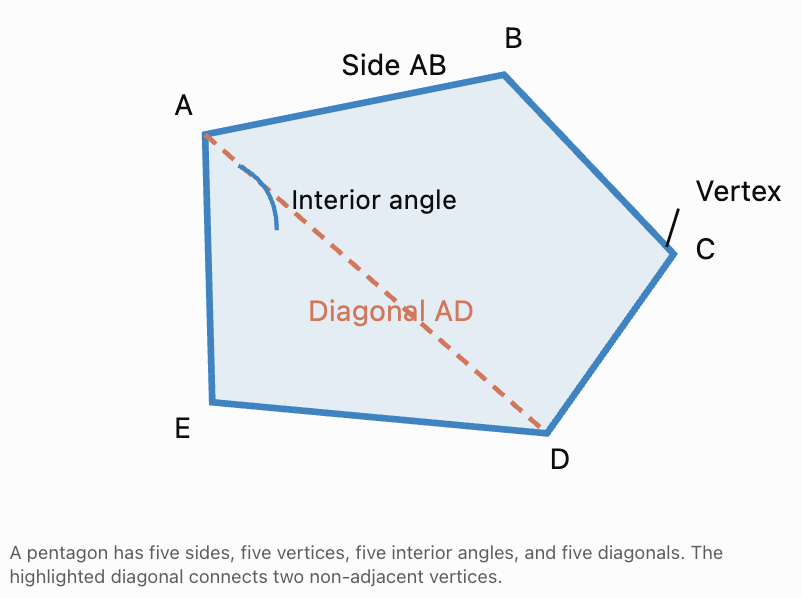
The important parts of a polygon include:
Side: A straight line segment forming part of the boundary.
Vertex: A point where two adjacent sides meet.
Interior angle: An angle formed inside the polygon by two adjacent sides.
Exterior angle: An angle formed outside the polygon when a side is extended.
Diagonal: A line segment joining two non-adjacent vertices.
Classifying Polygons by Number of Sides
Polygons are commonly named according to the number of sides they have.
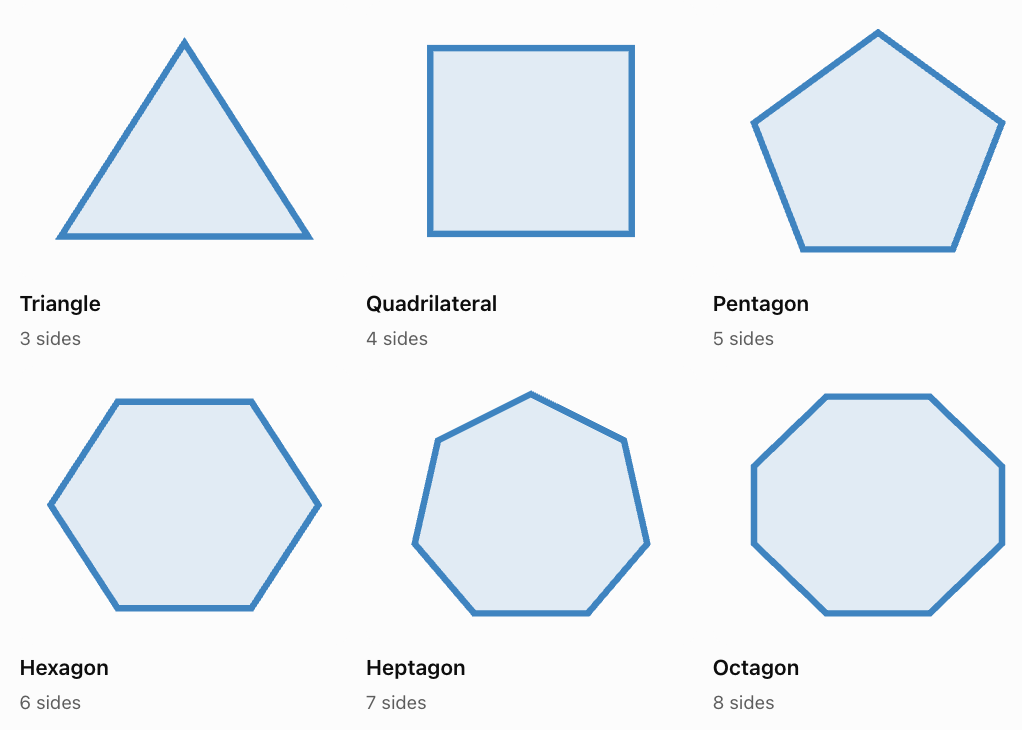
Other polygon names include:
|
Number of sides |
Polygon name |
|---|---|
|
9 |
Nonagon |
|
10 |
Decagon |
|
11 |
Hendecagon or undecagon |
|
12 |
Dodecagon |
|
15 |
Pentadecagon |
|
20 |
Icosagon |
The number of sides is usually represented by the variable n.
Classifying Polygons by Shape
Polygons can also be classified according to their angles, sides, and overall shape.
Convex Polygons
A convex polygon has every interior angle less than 180°.
A line segment joining any two points inside a convex polygon lies entirely inside the polygon.
All regular polygons are convex under the usual school-geometry definition.
Concave Polygons
A concave polygon has at least one interior angle greater than 180°.
Such an angle is called a reflex angle.
A concave polygon has an indentation, and some line segments connecting points inside it may pass outside the polygon.
Equilateral and Equiangular Polygons
An equilateral polygon has all sides equal in length.
An equiangular polygon has all interior angles equal.
A regular polygon is both equilateral and equiangular.
For example:
-
A square is regular because all four sides and all four angles are equal.
-
A rectangle that is not a square is equiangular but not equilateral.
-
A rhombus that is not a square is equilateral but not equiangular.
-
Every equilateral triangle is also equiangular and therefore regular.
Interior Angles of Polygons
The interior angle sum is the total of all angles inside a polygon.
The sum depends on the number of sides.
Why Is the Interior Angle Sum of a Triangle 180°?
In Euclidean geometry, the interior angles of every triangle add to 180°.
If a triangle has angles A, B, and C:
A + B + C = 180°
This is one of the fundamental angle properties used throughout geometry.
Dividing Polygons into Triangles
A convex polygon can be divided into triangles by drawing diagonals from one vertex to all non-adjacent vertices.
A quadrilateral can be divided into 2 triangles.
A pentagon can be divided into 3 triangles.
A hexagon can be divided into 4 triangles.
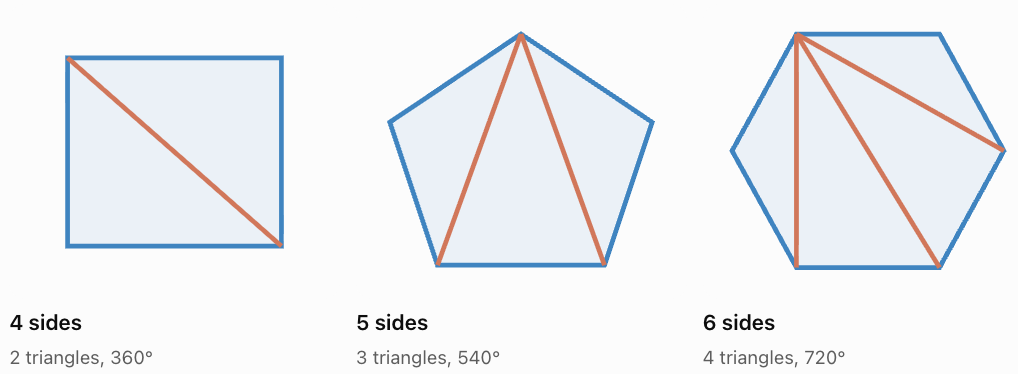
The pattern is:
Number of triangles = Number of sides − 2
Therefore, for an n-sided polygon:
Number of triangles = n − 2
Since each triangle has an angle sum of 180°:
Interior angle sum = (n − 2) × 180°
Using S to represent the interior angle sum:
This formula applies to simple polygons, whether convex or concave.
Interior Angle Sum Table
|
Polygon |
Sides |
Interior angle sum |
|
|---|---|---|---|
|
Triangle |
3 |
1 |
180° |
|
Quadrilateral |
4 |
2 |
360° |
|
Pentagon |
5 |
3 |
540° |
|
Hexagon |
6 |
4 |
720° |
|
Heptagon |
7 |
5 |
900° |
|
Octagon |
8 |
6 |
1080° |
|
Nonagon |
9 |
7 |
1260° |
|
Decagon |
10 |
8 |
1440° |
|
Dodecagon |
12 |
10 |
1800° |
Worked Example 1: Interior Angle Sum of a Nonagon
Calculate the sum of the interior angles of a nonagon.
Step 1: Identify n.
A nonagon has 9 sides.
n = 9
Step 2: Apply the formula.
S = (n − 2) × 180°
S = (9 − 2) × 180°
S = 7 × 180°
Answer: 1260°.
Worked Example 2: Finding the Number of Sides
A polygon has an interior angle sum of 1980°.
How many sides does it have?
Step 1: Use the formula.
(n − 2) × 180° = 1980°
Step 2: Divide by 180°.
n − 2 = 11
Step 3: Solve.
n = 13
Answer: The polygon has 13 sides.
Worked Example 3: Finding a Missing Interior Angle
A pentagon has interior angles:
95°, 110°, 125°, 100°, and x°.
Find x.
Step 1: Calculate the angle sum.
S = (5 − 2) × 180°
S = 540°
Step 2: Form an equation.
95 + 110 + 125 + 100 + x = 540
430 + x = 540
Step 3: Solve.
x = 110°
Answer: The missing angle is 110°.
Exterior Angles of Polygons
An exterior angle is formed when one side of a polygon is extended beyond a vertex.
For a convex polygon, the interior angle and its adjacent exterior angle form a straight line.
Therefore:
Interior angle + Exterior angle = 180°
For example, if an interior angle is 125°:
Exterior angle = 180° − 125°
Exterior angle = 55°
The Exterior Angle Sum Theorem
The sum of one exterior angle at each vertex of any convex polygon, measured consistently around the boundary, is:
This is true regardless of the number of sides.
For example:
-
Triangle: exterior angle sum = 360°.
-
Pentagon: exterior angle sum = 360°.
-
Octagon: exterior angle sum = 360°.
-
Decagon: exterior angle sum = 360°.
Why Do Exterior Angles Add to 360°?
Imagine walking around the boundary of a polygon.
At every vertex, you turn through an exterior angle.
After travelling completely around the polygon and returning to your starting direction, you have made one full turn.
One full turn is 360°.
Therefore, the exterior angles sum to 360°.
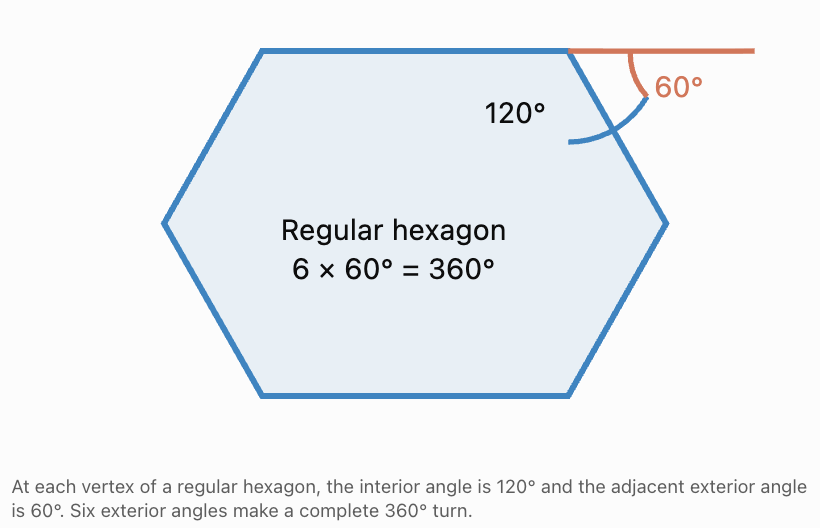
For concave polygons, the corresponding theorem uses signed exterior turning angles, allowing turns in opposite directions. Their signed sum is 360° when the boundary is traversed once counterclockwise.
For most introductory angle problems, we work with convex polygons and positive exterior angles.
Worked Example 4: Missing Exterior Angle
A convex pentagon has exterior angles:
65°, 70°, 80°, 55°, and x°.
Find x.
Step 1: Use the exterior angle sum.
65 + 70 + 80 + 55 + x = 360
Step 2: Simplify.
270 + x = 360
Step 3: Solve.
x = 90°
Answer: 90°.
Worked Example 5: Interior and Exterior Angle Relationship
An interior angle of a convex polygon is 148°.
Find its adjacent exterior angle.
Interior + Exterior = 180°
148 + e = 180
e = 32°
Answer: 32°.
Regular Polygons
A regular polygon has all sides equal in length and all interior angles equal.
Examples include:
-
Equilateral triangle.
-
Square.
-
Regular pentagon.
-
Regular hexagon.
-
Regular octagon.
An irregular polygon does not have both of these properties.
Interior Angle of a Regular Polygon
For a regular polygon, all interior angles are equal.
Therefore:
Interior angle = Interior angle sum / Number of sides
An equivalent formula is:
Both formulas give the same result.
Exterior Angle of a Regular Polygon
Since all exterior angles are equal and their sum is 360°:
The interior and exterior angles satisfy:
I + E = 180°
Regular Polygon Angle Table
|
Polygon |
Number of sides |
Each interior angle |
Each exterior angle |
|---|---|---|---|
|
Equilateral triangle |
3 |
60° |
120° |
|
Square |
4 |
90° |
90° |
|
Regular pentagon |
5 |
108° |
72° |
|
Regular hexagon |
6 |
120° |
60° |
|
Regular octagon |
8 |
135° |
45° |
|
Regular decagon |
10 |
144° |
36° |
|
Regular dodecagon |
12 |
150° |
30° |
Worked Example 6: Interior Angle of a Regular Octagon
Find each interior angle of a regular octagon.
Step 1: Identify n.
n = 8
Step 2: Use the formula.
I = [(n − 2) × 180°]/n
I = [(8 − 2) × 180°]/8
I = 1080°/8
Answer: 135°.
Worked Example 7: Finding the Number of Sides from an Exterior Angle
Each exterior angle of a regular polygon is 24°.
How many sides does it have?
Step 1: Use the exterior angle formula.
E = 360°/n
Step 2: Substitute.
24 = 360/n
Step 3: Solve.
24n = 360
n = 15
Answer: The regular polygon has 15 sides.
Worked Example 8: Finding the Number of Sides from an Interior Angle
Each interior angle of a regular polygon is 156°.
Find the number of sides.
Step 1: Find the exterior angle.
E = 180° − 156°
E = 24°
Step 2: Find n.
n = 360°/24°
n = 15
Answer: 15 sides.
This approach is often more efficient than solving the full interior-angle formula.
Central Angles of Regular Polygons
A regular polygon has a centre that is equally distant from all its vertices.
Joining the centre to every vertex divides the polygon into congruent isosceles triangles.
The angle at the centre of each triangle is called a central angle.
Because angles around a point sum to 360°:
For a regular polygon, the central angle has the same numerical measure as each exterior angle.
Worked Example 9: Central Angle of a Regular Decagon
A regular decagon has 10 sides.
Central angle:
C = 360°/10
C = 36°
Each interior angle is:
I = 180° − 36°
I = 144°
Answer: Central angle = 36°, interior angle = 144°.
Solving Algebraic Angle Problems
Some polygon problems involve angles expressed algebraically.
We use the interior or exterior angle sum to form an equation.
Worked Example 10: Algebraic Interior Angles
The interior angles of a quadrilateral are:
(2x + 10)°, (3x − 5)°, (x + 25)°, and (2x + 10)°.
Find x and all four angles.
Step 1: Use the quadrilateral angle sum.
The interior angle sum is 360°.
(2x + 10) + (3x − 5) + (x + 25) + (2x + 10) = 360
Step 2: Simplify.
8x + 40 = 360
8x = 320
x = 40
Step 3: Calculate each angle.
2x + 10 = 90°
3x − 5 = 115°
x + 25 = 65°
2x + 10 = 90°
Step 4: Verify.
90 + 115 + 65 + 90 = 360°
Answer: x = 40; the angles are 90°, 115°, 65°, and 90°.
Worked Example 11: Algebraic Exterior Angles
The exterior angles of a convex pentagon are:
x°, (x + 10)°, (2x − 5)°, (x + 25)°, and (x + 30)°.
Find x.
Step 1: Use the exterior angle sum.
x + (x + 10) + (2x − 5) + (x + 25) + (x + 30) = 360
Step 2: Simplify.
6x + 60 = 360
6x = 300
x = 50
Step 3: Calculate the angles.
50°, 60°, 95°, 75°, 80°.
Step 4: Verify.
50 + 60 + 95 + 75 + 80 = 360°
Answer: x = 50.
Worked Example 12: Finding a Polygon from an Angle Relationship
The interior angle of a regular polygon is five times its exterior angle.
Find the number of sides.
Step 1: Define the exterior angle.
Let E be the exterior angle.
Then:
I = 5E
Step 2: Use the supplementary relationship.
I + E = 180°
5E + E = 180°
6E = 180°
E = 30°
Step 3: Find the number of sides.
n = 360°/30°
n = 12
Answer: The polygon is a regular dodecagon.
Diagonals of Polygons
A diagonal is a line segment connecting two non-adjacent vertices of a polygon.
The number of diagonals increases as the number of sides increases.
Deriving the Diagonal Formula
Consider a polygon with n vertices.
From any one vertex, we can draw a segment to the other n − 1 vertices.
However, three of these connections are not diagonals:
-
The connection to the vertex itself is not counted.
-
The connections to the two adjacent vertices are sides.
Therefore, each vertex connects to:
n − 3 diagonals.
Across all n vertices, this gives:
n(n − 3)
But each diagonal has been counted twice, once from each endpoint.
Therefore, the total number of diagonals is:
Worked Example 13: Diagonals of a Decagon
Find the number of diagonals in a decagon.
n = 10
D = n(n − 3)/2
D = 10(10 − 3)/2
D = 10 × 7/2
Answer: 35 diagonals.
Worked Example 14: Finding the Number of Sides from Diagonals
A polygon has 20 diagonals. How many sides does it have?
Use:
n(n − 3)/2 = 20
Multiply by 2:
n(n − 3) = 40
Expand:
n² − 3n − 40 = 0
Factor:
(n − 8)(n + 5) = 0
n = 8 or n = −5
A polygon cannot have a negative number of sides.
Answer: The polygon is an octagon.
This problem connects geometry with quadratic equations.
Justifying Polygon Properties
In mathematics, knowing that a rule works is different from understanding why it works.
A mathematical justification uses established facts and logical reasoning to demonstrate that a statement is true.
Proof 1: Interior Angle Sum
Claim: The interior angle sum of a simple n-sided polygon is (n − 2) × 180°.
Reasoning:
-
A simple polygon with n sides can be divided into n − 2 triangles without overlapping interiors.
-
Each triangle has an interior angle sum of 180°.
-
The angles of these triangles collectively make up the polygon's interior angles.
-
Therefore, the total is (n − 2) × 180°.
Thus:
S = (n − 2) × 180°.
This establishes the interior angle sum formula for simple polygons.
Proof 2: Exterior Angle Sum
Claim: The sum of one exterior angle at each vertex of a convex polygon is 360°.
Let the interior angles be I₁, I₂, ..., Iₙ.
Let the corresponding exterior angles be E₁, E₂, ..., Eₙ.
At each vertex:
I + E = 180°
Adding this relationship for all n vertices:
Sum of interior angles + Sum of exterior angles = 180n
We already know:
Sum of interior angles = 180(n − 2)
Substitute:
180(n − 2) + Sum of exterior angles = 180n
Therefore:
Sum of exterior angles = 180n − 180(n − 2)
= 180n − 180n + 360
Sum of exterior angles = 360°.
This is an algebraic proof that works for any convex polygon.
Proof 3: Interior Angle of a Regular Polygon
Claim: Each interior angle of a regular n-sided polygon is:
I = 180° − 360°/n
Reasoning:
A regular polygon has n equal exterior angles.
Their sum is 360°.
Therefore, each exterior angle is:
E = 360°/n
Each interior angle and adjacent exterior angle add to 180°.
Hence:
I = 180° − E
Substituting:
I = 180° − 360°/n.
Proof 4: Why a Regular Polygon Has Equal Central Angles
A regular polygon has equally spaced vertices around its circumcircle.
Joining the centre to each vertex divides a full revolution into n equal central angles.
Because angles around a point sum to 360°:
Central angle = 360°/n.
This also explains why the central and exterior angles of a regular polygon are equal.
Real-World Applications
Application 1: Architecture and Structural Design
Triangles are frequently used in structural frameworks because a triangle with fixed side lengths cannot change shape without changing at least one side length.
Rectangular frameworks, by comparison, may deform into parallelograms unless they are braced.
Engineers often divide larger polygonal structures into triangles to improve rigidity.
This is called triangulation.
Application 2: Honeycomb Structures
Honeycombs contain approximately hexagonal cells.
A regular hexagon has:
-
Six equal sides.
-
Six equal interior angles of 120°.
-
Six exterior angles of 60°.
Three regular hexagons can meet around a point because:
120° + 120° + 120° = 360°.
This allows hexagons to tile a flat surface without gaps.
Application 3: Floor Tiling
A tessellation is a pattern of shapes that covers a plane without gaps or overlaps.
For regular polygons of one type to meet edge-to-edge around every vertex, their interior angles must fit exactly into 360°.
For example:
Equilateral triangles: 60° each.
360°/60° = 6 triangles.
Squares: 90° each.
360°/90° = 4 squares.
Regular hexagons: 120° each.
360°/120° = 3 hexagons.
Regular pentagons have interior angles of 108°.
360°/108° = 3⅓.
Because a whole number of regular pentagons cannot fit around a point in this way, regular pentagons alone cannot form a regular edge-to-edge tessellation.
Application 4: Road Signs
A standard stop sign is octagonal.
A regular octagon has:
Interior angle:
I = (8 − 2) × 180°/8
I = 135°
Exterior angle:
E = 360°/8
E = 45°
Its distinctive shape helps drivers recognize the sign.
Application 5: Computer Graphics and Game Design
Three-dimensional models in computer graphics are often represented using polygon meshes.
Complex surfaces are approximated using many small polygons, particularly triangles and quadrilaterals.
Understanding polygon properties helps with:
-
Constructing digital shapes.
-
Subdividing surfaces.
-
Measuring angles and dimensions.
-
Designing symmetrical patterns.
-
Building geometric models.
Common Mistakes
Mistake 1: Confusing Interior Angle Sum with One Interior Angle
For a regular hexagon:
Interior angle sum = 720°.
Each interior angle = 120°.
These are different quantities.
Mistake 2: Forgetting to Subtract 2
Incorrect:
S = n × 180°
Correct:
S = (n − 2) × 180°.
Mistake 3: Assuming All Polygons Are Regular
A polygon may have equal sides without equal angles, or equal angles without equal sides.
A regular polygon must satisfy both conditions.
Mistake 4: Thinking the Exterior Angle Sum Depends on the Number of Sides
The exterior angle sum of every convex polygon is 360°, regardless of the number of sides.
Mistake 5: Using 360°/n for Interior Angles
The formula 360°/n gives each exterior angle or central angle of a regular polygon.
Each interior angle is:
180° − 360°/n.
Mistake 6: Applying Regular Polygon Formulas to Irregular Polygons
An irregular pentagon still has an interior angle sum of 540°, but its individual angles are not necessarily 108°.
Mistake 7: Confusing Concave and Convex Polygons
A convex polygon has no reflex interior angles.
A concave polygon has at least one reflex interior angle.
Mistake 8: Counting Diagonals Twice
The formula n(n − 3) counts each diagonal from both endpoints.
Divide by 2 to obtain the correct number.
Mistake 9: Accepting Impossible Answers
A polygon cannot have 2.5 sides or a negative number of sides.
The number of sides must be a whole number of at least 3.
Mistake 10: Giving an Answer Without Justification
A complete geometry solution should state the relevant property or theorem, show the calculation, and explain the conclusion.
Key Terms
-
Polygon: A closed two-dimensional figure formed by at least three straight sides.
-
Side: A line segment forming part of a polygon's boundary.
-
Vertex: A point where two adjacent sides meet.
-
Interior Angle: An angle inside a polygon formed by adjacent sides.
-
Exterior Angle: An angle formed when a side of a polygon is extended.
-
Diagonal: A segment connecting two non-adjacent vertices.
-
Triangle: A polygon with three sides.
-
Quadrilateral: A polygon with four sides.
-
Pentagon: A polygon with five sides.
-
Hexagon: A polygon with six sides.
-
Heptagon: A polygon with seven sides.
-
Octagon: A polygon with eight sides.
-
Nonagon: A polygon with nine sides.
-
Decagon: A polygon with ten sides.
-
Regular Polygon: A polygon with all sides equal and all interior angles equal.
-
Irregular Polygon: A polygon that is not regular.
-
Equilateral Polygon: A polygon with all sides equal.
-
Equiangular Polygon: A polygon with all interior angles equal.
-
Convex Polygon: A polygon with every interior angle less than 180°.
-
Concave Polygon: A polygon with at least one reflex interior angle.
-
Reflex Angle: An angle greater than 180° and less than 360°.
-
Interior Angle Sum: The sum of all interior angles of a polygon.
-
Exterior Angle Sum: The sum of one exterior angle at each vertex, measured consistently.
-
Central Angle: An angle formed at the centre of a regular polygon by segments to adjacent vertices.
-
Supplementary Angles: Two angles whose measures add to 180°.
-
Tessellation: A pattern covering a plane without gaps or overlaps.
-
Triangulation: Dividing a polygon or geometric structure into triangles.
-
Geometric Proof: A logical explanation demonstrating why a geometric statement is true.
Key Takeaways
-
Polygons are closed, two-dimensional shapes with three or more straight sides.
-
Polygons can be classified by number of sides, angle properties, and side lengths.
-
Convex polygons have all interior angles less than 180°.
-
Concave polygons have at least one reflex interior angle.
-
Regular polygons have equal sides and equal interior angles.
-
The interior angle sum of an n-sided simple polygon is (n − 2) × 180°.
-
The exterior angle sum of a convex polygon is always 360°.
-
Each interior angle of a regular polygon is [(n − 2) × 180°]/n.
-
Each exterior angle of a regular polygon is 360°/n.
-
Each central angle of a regular polygon is 360°/n.
-
An interior angle and its adjacent exterior angle are supplementary.
-
A polygon with n sides has n(n − 3)/2 diagonals.
-
Algebra can be used to solve missing-angle problems.
-
Polygon properties can be justified through triangulation, angle relationships, and logical reasoning.
-
Polygon geometry has applications in architecture, engineering, tessellations, and computer graphics.
Check Your Understanding
Question 1: Classifying Polygons
Name the polygon with:
a) 5 sides.
b) 7 sides.
c) 10 sides.
d) 12 sides.
Explain the difference between a regular and an irregular polygon.
Question 2: Interior Angle Sums
Calculate the interior angle sum of:
a) A hexagon.
b) An octagon.
c) A decagon.
d) A 15-sided polygon.
Question 3: Finding the Number of Sides
A polygon has an interior angle sum of 2340°.
How many sides does it have?
Question 4: Missing Interior Angle
A hexagon has interior angles:
105°, 120°, 135°, 140°, 110°, and x°.
Find x.
Question 5: Exterior Angles
A convex pentagon has exterior angles:
65°, 80°, 55°, 70°, and x°.
Find x.
Question 6: Regular Polygon Angles
Calculate each interior and exterior angle of:
a) A regular pentagon.
b) A regular nonagon.
c) A regular dodecagon.
Question 7: Finding the Number of Sides
Each exterior angle of a regular polygon is 18°.
Find the number of sides.
Question 8: Algebraic Angle Problem
The interior angles of a quadrilateral are:
(x + 20)°, (2x + 10)°, (x + 40)°, and (2x − 10)°.
Find x and all four angles.
Question 9: Diagonals
a) How many diagonals does a heptagon have?
b) A polygon has 27 diagonals. How many sides does it have?
Question 10: Angle Relationships
The interior angle of a regular polygon is four times its exterior angle.
Find:
a) Each exterior angle.
b) Each interior angle.
c) The number of sides.
Question 11: Tessellations
Explain why regular hexagons can tessellate a plane by themselves, but regular pentagons cannot form a regular edge-to-edge tessellation by themselves.
Use angle calculations to justify your answer.
Question 12: Comprehensive Challenge
A convex hexagon has exterior angles:
(x + 10)°, (2x − 5)°, (x + 20)°, (x + 15)°, (2x − 10)°, and (x + 10)°.
a) Find x.
b) Calculate all six exterior angles.
c) Calculate the corresponding interior angles.
d) Verify both the exterior and interior angle sums.
Fully Worked Answers
Answer 1: Classifying Polygons
a) Pentagon.
b) Heptagon.
c) Decagon.
d) Dodecagon.
A regular polygon has all sides equal and all interior angles equal.
An irregular polygon does not satisfy both of these conditions.
Answer 2: Interior Angle Sums
Use:
S = (n − 2) × 180°.
a) Hexagon
S = (6 − 2) × 180°
S = 4 × 180°
S = 720°.
b) Octagon
S = (8 − 2) × 180°
S = 6 × 180°
S = 1080°.
c) Decagon
S = (10 − 2) × 180°
S = 8 × 180°
S = 1440°.
d) 15-sided polygon
S = (15 − 2) × 180°
S = 13 × 180°
S = 2340°.
Answer 3: Number of Sides
Given:
S = 2340°.
Use:
(n − 2) × 180° = 2340°
Divide by 180°:
n − 2 = 13
n = 15
Answer: 15 sides.
Answer 4: Missing Interior Angle
A hexagon has interior angle sum:
S = (6 − 2) × 180° = 720°.
Add the known angles:
105 + 120 + 135 + 140 + 110 = 610°
Therefore:
610 + x = 720
x = 110°
Answer: 110°.
Answer 5: Exterior Angles
The exterior angle sum is 360°.
65 + 80 + 55 + 70 + x = 360
270 + x = 360
x = 90°
Answer: 90°.
Answer 6: Regular Polygon Angles
Use:
E = 360°/n
I = 180° − E
a) Regular pentagon
E = 360°/5 = 72°
I = 180° − 72° = 108°
b) Regular nonagon
E = 360°/9 = 40°
I = 180° − 40° = 140°
c) Regular dodecagon
E = 360°/12 = 30°
I = 180° − 30° = 150°
Answer 7: Number of Sides
Given:
E = 18°.
Use:
n = 360°/E
n = 360°/18°
n = 20
Answer: 20 sides.
Answer 8: Algebraic Angles
The interior angle sum of a quadrilateral is 360°.
Form the equation:
(x + 20) + (2x + 10) + (x + 40) + (2x − 10) = 360
Collect like terms:
6x + 60 = 360
6x = 300
x = 50
Calculate each angle:
x + 20 = 70°
2x + 10 = 110°
x + 40 = 90°
2x − 10 = 90°
Check:
70 + 110 + 90 + 90 = 360°
Answer: x = 50; angles are 70°, 110°, 90°, and 90°.
Answer 9: Diagonals
Use:
D = n(n − 3)/2.
a) Heptagon
n = 7
D = 7(7 − 3)/2
D = 7 × 4/2
D = 14
Answer: 14 diagonals.
b) Polygon with 27 diagonals
n(n − 3)/2 = 27
n(n − 3) = 54
n² − 3n − 54 = 0
Factor:
(n − 9)(n + 6) = 0
n = 9 or n = −6
Reject the negative solution.
Answer: 9 sides, so the polygon is a nonagon.
Answer 10: Interior and Exterior Relationship
Given:
I = 4E
Interior and exterior angles are supplementary:
I + E = 180°
Substitute:
4E + E = 180°
5E = 180°
E = 36°
Therefore:
I = 4 × 36° = 144°
Find the number of sides:
n = 360°/36°
n = 10
Answers:
a) Exterior angle = 36°.
b) Interior angle = 144°.
c) 10 sides, a regular decagon.
Answer 11: Tessellations
A regular hexagon has interior angle:
I = [(6 − 2) × 180°]/6
I = 720°/6
I = 120°
Three regular hexagons meeting at a point produce:
3 × 120° = 360°
Therefore, they fit around a point without gaps or overlaps.
A regular pentagon has interior angle:
I = [(5 − 2) × 180°]/5
I = 540°/5
I = 108°
Three pentagons give:
3 × 10⁸° = 324°
This leaves a gap of 36°.
Four pentagons give:
4 × 10⁸° = 432°
This produces an overlap of 72°.
Therefore, regular pentagons cannot form a regular edge-to-edge tessellation using only copies of themselves.
Answer 12: Comprehensive Challenge
The exterior angles are:
(x + 10), (2x − 5), (x + 20), (x + 15), (2x − 10), (x + 10).
a) Find x.
Their sum is 360°.
(x + 10) + (2x − 5) + (x + 20) + (x + 15) + (2x − 10) + (x + 10) = 360
8x + 40 = 360
8x = 320
x = 40
b) Calculate exterior angles.
x + 10 = 50°
2x − 5 = 75°
x + 20 = 60°
x + 15 = 55°
2x − 10 = 70°
x + 10 = 50°
Exterior angles:
50°, 75°, 60°, 55°, 70°, 50°.
c) Calculate interior angles.
Each interior angle is supplementary to its exterior angle.
180 − 50 = 130°
180 − 75 = 105°
180 − 60 = 120°
180 − 55 = 125°
180 − 70 = 110°
180 − 50 = 130°
Interior angles:
130°, 105°, 120°, 125°, 110°, 130°.
d) Verify the sums.
Exterior:
50 + 75 + 60 + 55 + 70 + 50 = 360°
Interior:
130 + 105 + 120 + 125 + 110 + 130 = 720°
Using the formula for a hexagon:
S = (6 − 2) × 180° = 720°
Both results are correct.
This completes Properties of Polygons, covering classification, interior and exterior angle sums, regular polygons, algebraic angle problems, and geometric justification. The lesson also connects polygon geometry to diagonals, tessellations, architecture, and mathematical proof. For Moodle, all essential definitions, formulas, worked examples, and answers are provided as selectable text. Images and diagrams are supplementary.
2. Quadrilaterals
Learning outcomes
- I can classify quadrilaterals.
- I can identify the properties of parallelograms.
- I can distinguish rectangles, rhombi, squares, trapezoids, and kites.
- I can solve problems involving quadrilaterals.
- I can prove quadrilateral properties.
Introduction
Quadrilaterals are among the most common geometric shapes in everyday life. We see them in windows, doors, floor tiles, computer screens, buildings, bridges, and countless manufactured objects.
Although all quadrilaterals have four sides, their properties can be very different. Some have parallel sides, some have equal sides, some contain right angles, and others have special relationships between their diagonals.
A rectangle, for example, has four right angles, while a rhombus has four equal sides. A square has both properties, making it a special type of rectangle and a special type of rhombus.
Understanding these relationships allows us to classify shapes accurately, solve problems involving unknown lengths and angles, and justify geometric properties using mathematical reasoning.
In this lesson, we will investigate the major families of quadrilaterals, including parallelograms, rectangles, rhombi, squares, trapezoids, and kites. We will also explore their diagonals, symmetry, area formulas, and geometric proofs.
What Is a Quadrilateral?
A quadrilateral is a polygon with four straight sides, four vertices, and four interior angles.
The word comes from quadri, meaning four, and lateral, meaning side.
Every simple quadrilateral has an interior angle sum of 360°.
This follows from the polygon interior angle sum formula:
S = (n − 2) × 180°
For a quadrilateral, n = 4.
S = (4 − 2) × 180°
S = 2 × 180°
S = 360°
Therefore, if the four interior angles are A, B, C, and D:
A + B + C + D = 360°
Parts of a Quadrilateral
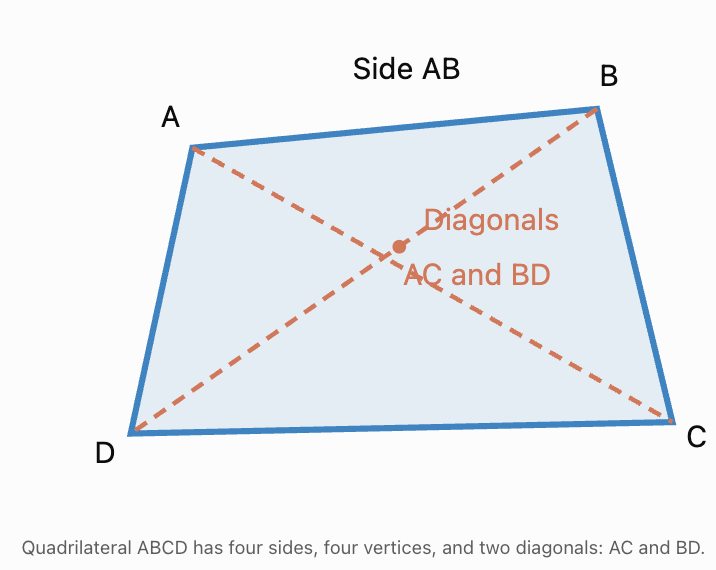
The important features are:
-
Sides: AB, BC, CD, and DA.
-
Vertices: A, B, C, and D.
-
Interior angles: ∠A, ∠B, ∠C, and ∠D.
-
Opposite sides: AB and CD; BC and AD.
-
Adjacent sides: Two sides that share a vertex.
-
Diagonals: AC and BD, connecting opposite vertices.
Quadrilaterals can be convex or concave.
A convex quadrilateral has all interior angles less than 180°.
A concave quadrilateral has one reflex interior angle greater than 180°.
Most of the special quadrilaterals studied in this lesson are convex.
Classifying Quadrilaterals
Quadrilaterals can be classified according to their side lengths, parallel sides, angles, and diagonal properties.
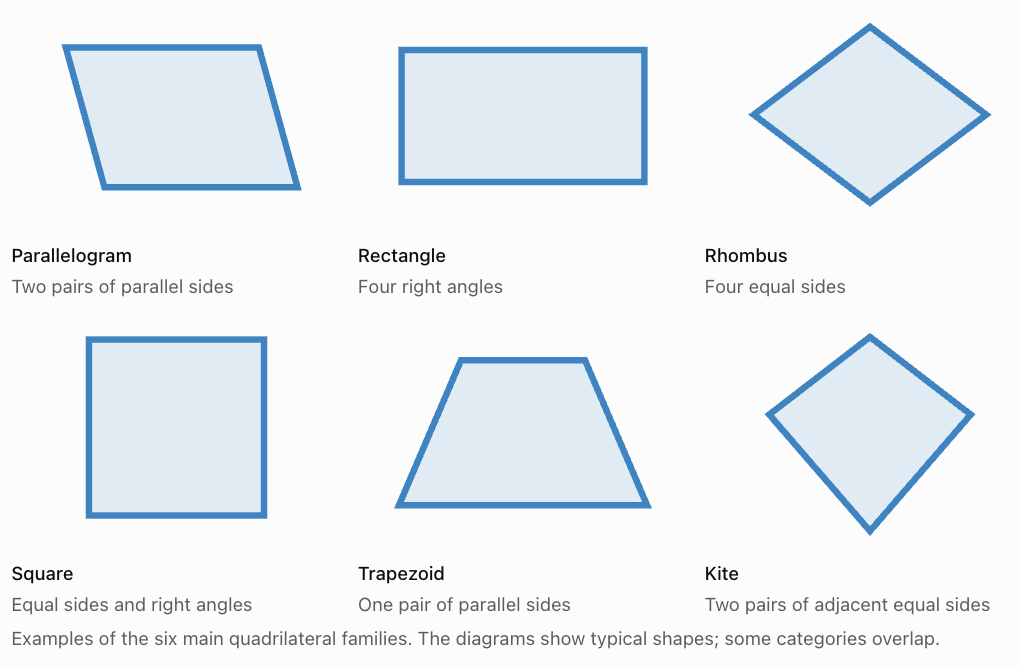
Important Classification Convention
There are two common definitions of a trapezoid:
-
Exclusive definition: A quadrilateral with exactly one pair of parallel sides.
-
Inclusive definition: A quadrilateral with at least one pair of parallel sides.
Under the inclusive definition, parallelograms are also trapezoids.
In this lesson, we will use the exclusive definition for trapezoids unless otherwise stated. This makes it easier to distinguish trapezoids from parallelograms.
For kites, we will use the common school definition of two distinct pairs of adjacent equal sides, excluding rhombi. Some mathematical conventions include rhombi as special kites.
The Quadrilateral Family
The relationships between special quadrilaterals are important.
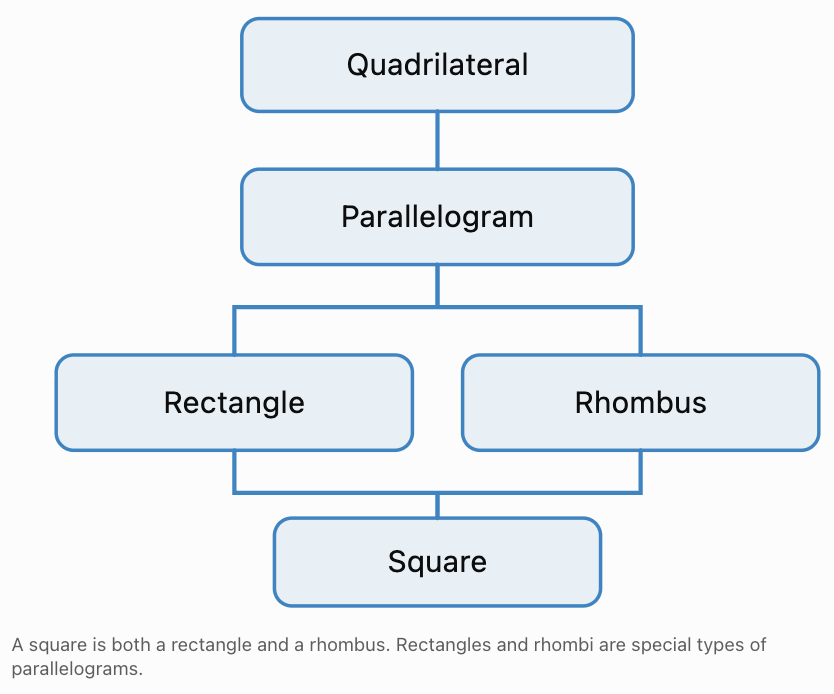
This means:
-
Every square is a rectangle.
-
Every square is a rhombus.
-
Every rectangle is a parallelogram.
-
Every rhombus is a parallelogram.
-
Not every rectangle is a square.
-
Not every rhombus is a square.
-
Not every parallelogram is a rectangle or rhombus.
These relationships are useful when deciding which properties can be applied to a particular shape.
Properties of Parallelograms
A parallelogram is a quadrilateral with two pairs of opposite sides parallel.
If ABCD is a parallelogram:
AB ∥ CD
BC ∥ AD
The symbol ∥ means “is parallel to.”
Main Properties
-
Opposite sides are parallel.
-
Opposite sides are equal in length.
-
Opposite angles are equal.
-
Adjacent interior angles are supplementary.
-
Diagonals bisect each other.
-
Each diagonal divides the parallelogram into two congruent triangles.
Visualizing a Parallelogram
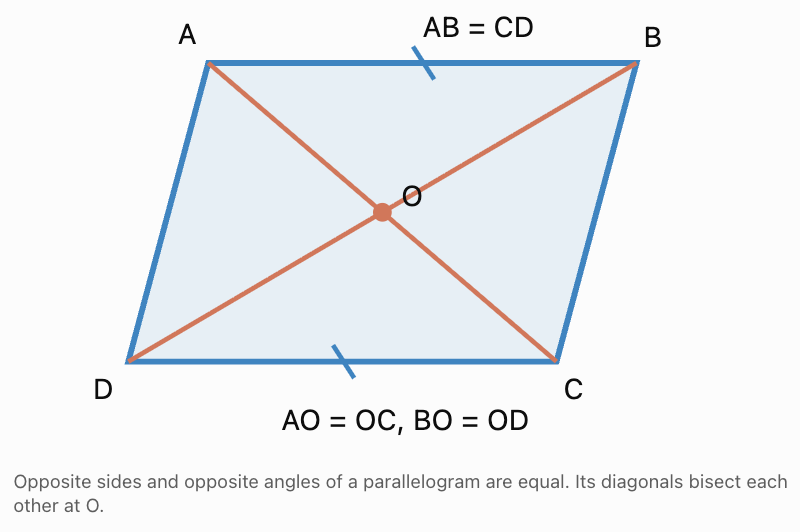
Opposite Sides Are Equal
For parallelogram ABCD:
AB = CD
BC = AD
Opposite Angles Are Equal
∠A = ∠C
∠B = ∠D
Adjacent Angles Are Supplementary
∠A + ∠B = 180°
∠B + ∠C = 180°
This follows from the properties of parallel lines crossed by a transversal.
Diagonals Bisect Each Other
If diagonals AC and BD intersect at O:
AO = OC
BO = OD
The diagonals do not necessarily have equal lengths.
This distinction is important.
Worked Example 1: Angles in a Parallelogram
In parallelogram ABCD:
∠A = 68°.
Find the other three angles.
Step 1: Use opposite angles.
∠C = ∠A = 68°.
Step 2: Use supplementary adjacent angles.
∠A + ∠B = 180°
68° + ∠B = 180°
∠B = 112°
Step 3: Use opposite angles again.
∠D = ∠B = 112°.
Final answer:
∠A = 68°
∠B = 112°
∠C = 68°
∠D = 112°
Verification:
68 + 112 + 68 + 112 = 360°.
Worked Example 2: Solving for Side Lengths
In parallelogram PQRS:
PQ = 3x + 4
RS = 5x − 8
Find x and the length of PQ.
Step 1: Use the opposite-side property.
PQ = RS
3x + 4 = 5x − 8
Step 2: Solve.
12 = 2x
x = 6
Step 3: Substitute.
PQ = 3(6) + 4
PQ = 22
Answer: x = 6 and PQ = 22 units.
Worked Example 3: Diagonals of a Parallelogram
The diagonals of parallelogram ABCD intersect at O.
AO = 2x + 3
OC = 5x − 9
Find x and AC.
Because the diagonals bisect each other:
AO = OC
2x + 3 = 5x − 9
12 = 3x
x = 4
Then:
AO = 2(4) + 3 = 11
OC = 11
Therefore:
AC = AO + OC
AC = 22 units.
Answer: x = 4 and AC = 22 units.
Rectangles
A rectangle is a parallelogram with four right angles.
Every interior angle is 90°.
Properties of Rectangles
A rectangle has all the properties of a parallelogram, plus additional properties.
-
Opposite sides are parallel.
-
Opposite sides are equal.
-
All four interior angles are 90°.
-
Diagonals bisect each other.
-
Diagonals are equal in length.
-
It has two lines of reflection symmetry through the midpoints of opposite sides.
-
It has rotational symmetry of order 2.
A square has additional symmetry, but a non-square rectangle has exactly two lines of symmetry.
Diagonals of a Rectangle
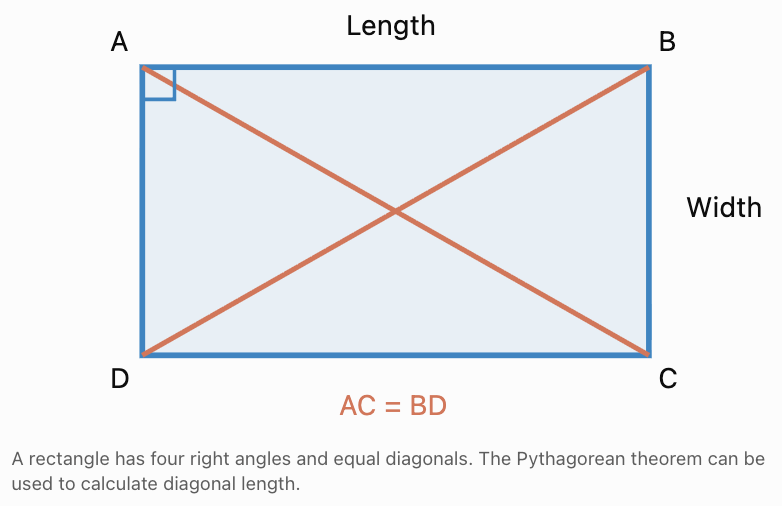
If a rectangle has length l and width w, its diagonal d satisfies:
d² = l² + w²
Therefore:
Worked Example 4: Diagonal of a Rectangle
A rectangular classroom is 12 m long and 9 m wide.
Find the distance between opposite corners.
Step 1: Apply the Pythagorean theorem.
d² = 12² + 9²
d² = 144 + 81
d² = 225
Step 2: Take the square root.
d = √225
Answer: The diagonal is 15 m.
Worked Example 5: Algebraic Diagonals
The diagonals of a rectangle have lengths:
AC = 4x + 6
BD = 7x − 9
Find x and the diagonal length.
Since rectangle diagonals are equal:
4x + 6 = 7x − 9
15 = 3x
x = 5
Substitute:
AC = 4(5) + 6 = 26
BD = 7(5) − 9 = 26
Answer: x = 5 and each diagonal is 26 units.
Rhombi
A rhombus is a parallelogram with four equal sides.
A rhombus does not necessarily have right angles.
Properties of a Rhombus
-
All four sides are equal.
-
Opposite sides are parallel.
-
Opposite angles are equal.
-
Adjacent angles are supplementary.
-
Diagonals bisect each other.
-
Diagonals intersect at right angles.
-
Each diagonal bisects a pair of opposite interior angles.
-
Each diagonal is a line of reflection symmetry.
A rhombus has two lines of reflection symmetry.
Diagonals of a Rhombus
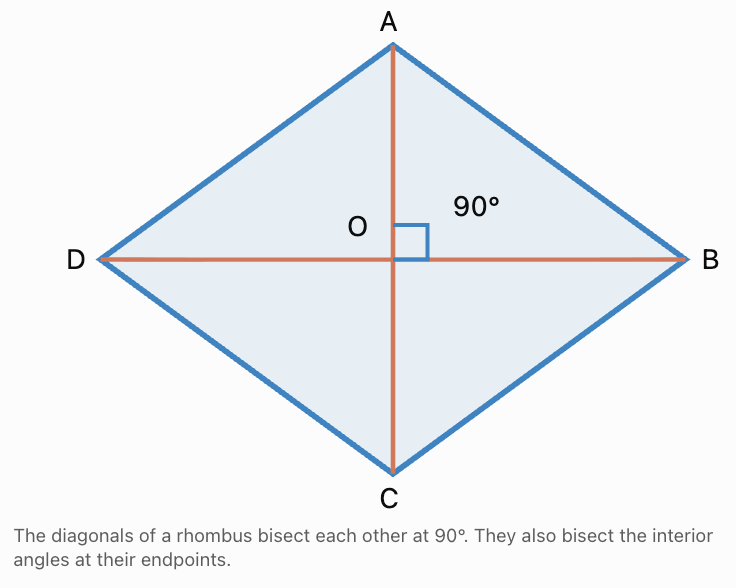
Area of a Rhombus
The area can be calculated using:
Area = Base × Perpendicular height
Or, if the diagonals have lengths d₁ and d₂:
Worked Example 6: Area of a Rhombus
A rhombus has diagonals of 16 cm and 12 cm.
Find its area.
A = d₁d₂/2
A = (16 × 12)/2
A = 192/2
Answer: 96 cm².
Worked Example 7: Side Length of a Rhombus
A rhombus has diagonals measuring 24 cm and 10 cm.
Find its side length.
Step 1: Halve the diagonals.
The diagonals bisect each other.
Half of the first diagonal = 12 cm.
Half of the second diagonal = 5 cm.
Step 2: Use the Pythagorean theorem.
The half-diagonals form the perpendicular legs of a right triangle, with a rhombus side as its hypotenuse.
s² = 12² + 5²
s² = 144 + 25
s² = 169
s = 13 cm
Answer: Each side is 13 cm.
The perimeter is:
P = 4(13) = 52 cm.
Squares
A square is a quadrilateral with four equal sides and four right angles.
It combines the properties of a rectangle and a rhombus.
Properties of Squares
-
All four sides are equal.
-
Opposite sides are parallel.
-
All four angles are 90°.
-
Diagonals are equal.
-
Diagonals bisect each other.
-
Diagonals intersect at 90°.
-
Diagonals bisect the interior angles.
-
It has four lines of reflection symmetry.
-
It has rotational symmetry of order 4.
Comparing Rectangles, Rhombi, and Squares
|
Property |
Rectangle |
Rhombus |
Square |
|---|---|---|---|
|
Opposite sides parallel |
Yes |
Yes |
Yes |
|
Opposite sides equal |
Yes |
Yes |
Yes |
|
All sides equal |
Not necessarily |
Yes |
Yes |
|
All angles 90° |
Yes |
Not necessarily |
Yes |
|
Diagonals bisect each other |
Yes |
Yes |
Yes |
|
Diagonals equal |
Yes |
Not necessarily |
Yes |
|
Diagonals perpendicular |
Not necessarily |
Yes |
Yes |
|
Diagonals bisect vertex angles |
Not necessarily |
Yes |
Yes |
Square Formulas
For a square with side length s:
Perimeter:
P = 4s
Area:
A = s²
Diagonal:
d = s√2
The diagonal formula follows from the Pythagorean theorem:
d² = s² + s²
d² = 2s²
d = s√2
Worked Example 8: Finding the Side of a Square
A square has a diagonal of 10√2 cm.
Find its side length, perimeter, and area.
Step 1: Use the diagonal formula.
d = s√2
10√2 = s√2
s = 10 cm
Step 2: Calculate perimeter.
P = 4s = 4(10)
P = 40 cm
Step 3: Calculate area.
A = s² = 10²
A = 100 cm²
Answer: Side = 10 cm, perimeter = 40 cm, area = 100 cm².
Trapezoids
A trapezoid is a quadrilateral with exactly one pair of parallel sides under the exclusive definition used in this lesson.
The parallel sides are called the bases.
The other two sides are called the legs.
The perpendicular distance between the bases is the height.
Types of Trapezoids
General trapezoid: Has one pair of parallel sides, with no additional symmetry required.
Isosceles trapezoid: Has equal legs.
Right trapezoid: Has two right angles.
Properties of an Isosceles Trapezoid
-
The legs are equal.
-
The angles along each base are equal.
-
The diagonals are equal in length.
-
It has one line of reflection symmetry through the midpoints of the bases.
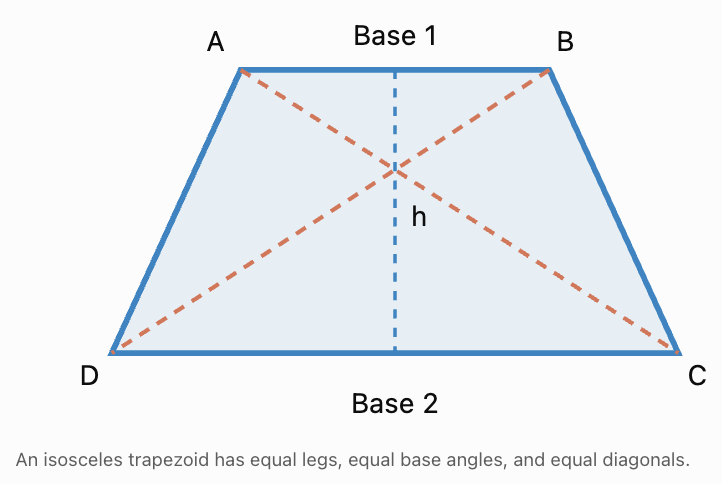
Area of a Trapezoid
The area is the average of the two base lengths multiplied by the height.
\[ A=\frac{(a+b)h}{2} \]where:
-
a and b are the parallel base lengths.
-
h is the perpendicular height.
This formula can be justified by combining two congruent trapezoids to form a parallelogram with base a + b and height h.
Worked Example 9: Area of a Trapezoid
A trapezoid has parallel sides of 12 cm and 20 cm, and a height of 7 cm.
Find its area.
A = (a + b)h/2
A = (12 + 20)(7)/2
A = 32 × 7/2
A = 224/2
Answer: 112 cm².
Worked Example 10: Angles in an Isosceles Trapezoid
An isosceles trapezoid has a lower base angle of 72°.
Find its other three angles.
Step 1: Use equal base angles.
The other lower base angle is also 72°.
Step 2: Use parallel-line properties.
The angles along each leg are supplementary.
Upper angle = 180° − 72°
Upper angle = 108°.
Both upper base angles are 108°.
Answer: 72°, 72°, 108°, and 108°.
Verification:
72 + 72 + 108 + 108 = 360°.
Worked Example 11: Finding a Missing Base
A trapezoid has an area of 150 cm², a height of 10 cm, and one base of 12 cm.
Find the other base.
Use:
A = (a + b)h/2
Substitute:
150 = (12 + b)(10)/2
150 = 5(12 + b)
30 = 12 + b
b = 18
Answer: The other base is 18 cm.
Kites
A kite is a quadrilateral with two distinct pairs of adjacent equal sides.
Unlike a parallelogram, its equal sides are next to each other rather than opposite one another.
Properties of a Kite
For a typical convex kite:
-
Two pairs of adjacent sides are equal.
-
One pair of opposite angles is equal.
-
The diagonals are perpendicular.
-
One diagonal bisects the other.
-
The diagonal joining the vertices where the equal sides meet bisects those two vertex angles.
-
That diagonal is a line of reflection symmetry.
The diagonals do not generally bisect each other.
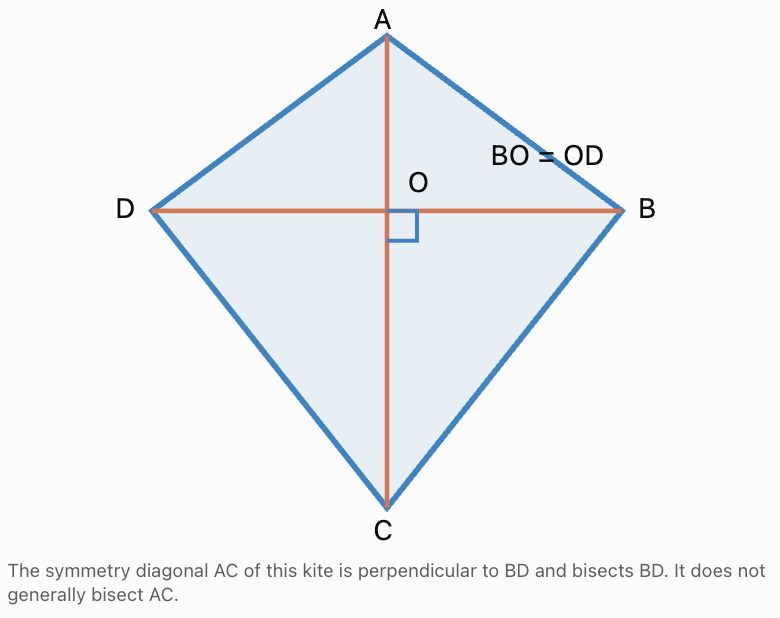
Area of a Kite
The area of a kite can be calculated using its diagonals:
\[ A=\frac{d_1d_2}{2} \]This is the same diagonal-area formula used for a rhombus.
Worked Example 12: Area of a Kite
A kite has diagonals measuring 18 cm and 14 cm.
Find its area.
A = d₁d₂/2
A = 18 × 14/2
A = 252/2
Answer: 126 cm².
Worked Example 13: Finding an Angle in a Kite
A kite has interior angles:
∠A = 80°
∠B = 110°
∠C = x°
∠D = 110°
Find x.
Step 1: Use the quadrilateral angle sum.
80 + 110 + x + 110 = 360
300 + x = 360
x = 60°
Answer: x = 60°.
The two equal angles, ∠B and ∠D, are consistent with the kite's symmetry.
Comparing All Six Quadrilaterals
Property
Parallelogram
Rectangle
Rhombus
Square
Isosceles trapezoid
Kite
Opposite sides parallel in two pairs
Yes
Yes
Yes
Yes
No
No
All sides equal
Not necessarily
Not necessarily
Yes
Yes
No
No
Four right angles
Not necessarily
Yes
No*
Yes
No
No
Opposite angles equal in both pairs
Yes
Yes
Yes
Yes
No
No
Diagonals bisect each other
Yes
Yes
Yes
Yes
No
No
Diagonals equal
Not necessarily
Yes
Not necessarily
Yes
Yes
Not necessarily
Diagonals perpendicular
Not necessarily
Not necessarily
Yes
Yes
Not necessarily
Yes
*Under this classification, a rhombus may have four right angles; in that case it is a square.
A kite can also be a rhombus under the inclusive definition of kites, but this lesson uses the exclusive convention.
Solving Multi-Step Quadrilateral Problems
More challenging problems may require several geometric properties together.
Worked Example 14: Parallelogram Angles with Algebra
In parallelogram ABCD:
∠A = (3x + 15)°
∠B = (5x − 11)°.
Find x and all four angles.
Adjacent angles in a parallelogram are supplementary.
(3x + 15) + (5x − 11) = 180
8x + 4 = 180
8x = 176
x = 22
Calculate:
∠A = 3(22) + 15 = 81°
∠B = 5(22) − 11 = 99°
Opposite angles are equal:
∠C = 81°
∠D = 99°
Answer: x = 22; angles are 81°, 99°, 81°, and 99°.
Worked Example 15: Finding an Unknown Diagonal
A rhombus has an area of 120 cm² and one diagonal of 16 cm.
Find the other diagonal.
Use:
A = d₁d₂/2
120 = 16d₂/2
120 = 8d₂
d₂ = 15 cm
Answer: The second diagonal is 15 cm.
Worked Example 16: A Square Inside a Rectangle
A rectangle measures 18 cm by 12 cm.
A square with side length 8 cm is removed from one corner.
Find the remaining area.
Rectangle area:
Aᵣ = 18 × 12 = 216 cm²
Square area:
Aₛ = 8² = 64 cm²
Remaining area:
216 − 64 = 152 cm²
Answer: 152 cm².
This illustrates how properties of different quadrilaterals can be combined in composite-area problems.
Proving Quadrilateral Properties
In geometry, a proof is a logical argument that establishes why a mathematical statement must be true.
Rather than relying on how a diagram looks, we use definitions, angle properties, congruent triangles, and established theorems.
Quadrilateral proofs frequently involve:
-
Parallel-line angle relationships.
-
Triangle congruence.
-
Properties of diagonals.
-
The Pythagorean theorem.
-
Coordinate geometry.
-
Algebraic relationships.
Proof 1: Opposite Sides of a Parallelogram Are Equal
Given: ABCD is a parallelogram.
Prove: AB = CD and BC = AD.
Draw diagonal AC.
Since AB ∥ CD:
∠BAC = ∠DCA
These are alternate interior angles.
Since BC ∥ AD:
∠BCA = ∠DAC
These are also alternate interior angles.
The triangles share side AC.
Therefore:
AC = AC
By the Angle-Side-Angle (ASA) congruence rule:
△ABC ≅ △CDA
Corresponding sides of congruent triangles are equal.
Therefore:
AB = CD and BC = AD.
This proves that opposite sides of a parallelogram are equal.
Proof 2: Opposite Angles of a Parallelogram Are Equal
Given: ABCD is a parallelogram.
Prove: ∠A = ∠C and ∠B = ∠D.
From the previous proof:
△ABC ≅ △CDA
Corresponding angles of congruent triangles are equal.
Therefore:
∠ABC = ∠CDA
Hence:
∠B = ∠D
The other pair of opposite angles can be established by adding the equal corresponding angles on either side of diagonal AC.
Therefore:
∠A = ∠C and ∠B = ∠D.
Proof 3: Diagonals of a Parallelogram Bisect Each Other
Given: ABCD is a parallelogram, and diagonals AC and BD intersect at O.
Prove: AO = OC and BO = OD.
Consider triangles AOB and COD.
Since AB ∥ CD:
∠ABO = ∠CDO
∠BAO = ∠DCO
Opposite sides of a parallelogram are equal:
AB = CD
Therefore, by ASA:
△AOB ≅ △COD
Corresponding sides are equal.
Thus:
AO = OC
BO = OD
Therefore, the diagonals bisect each other.
Proof 4: Diagonals of a Rectangle Are Equal
Given: ABCD is a rectangle.
Prove: AC = BD.
Consider triangles ABC and BAD.
AB is common to both triangles.
Opposite sides of a rectangle are equal:
BC = AD
Both triangles contain a right angle:
∠ABC = ∠BAD = 90°
Therefore, by Side-Angle-Side (SAS):
△ABC ≅ △BAD
Corresponding sides are equal.
Hence:
AC = BD.
Proof 5: Diagonals of a Rhombus Are Perpendicular
Given: ABCD is a rhombus, and its diagonals intersect at O.
Prove: AC ⟂ BD.
Since a rhombus is a parallelogram, its diagonals bisect each other.
Therefore:
BO = OD
Also, all sides of a rhombus are equal:
AB = AD
The triangles AOB and AOD share AO.
Thus:
AB = AD
BO = OD
AO = AO
By Side-Side-Side (SSS):
△AOB ≅ △AOD
Therefore:
∠AOB = ∠AOD
These two angles form a straight line, so their sum is 180°.
Since they are equal:
∠AOB = ∠AOD = 90°
Therefore:
AC ⟂ BD.
Proof 6: The Midpoint Theorem for a Trapezoid
The segment joining the midpoints of the legs of a trapezoid is called its midsegment.
If the two parallel bases have lengths a and b, the midsegment length m is:
\[ m=\frac{a+b}{2} \]Justification Using Coordinates
Place a trapezoid with vertices:
A = (0, 0)
B = (b, 0)
D = (p, h)
C = (p + a, h)
The parallel bases AB and DC have lengths b and a.
Let M be the midpoint of AD:
M = (p/2, h/2)
Let N be the midpoint of BC:
N = ((b + p + a)/2, h/2)
Both midpoints have the same y-coordinate, so MN is parallel to the bases.
Its length is the difference between their x-coordinates:
MN = (b + p + a)/2 − p/2
MN = (a + b)/2
Therefore:
The trapezoid midsegment is parallel to both bases and has length (a + b)/2.
Worked Example 17: Trapezoid Midsegment
A trapezoid has bases of 14 cm and 26 cm.
Find its midsegment.
m = (a + b)/2
m = (14 + 26)/2
m = 40/2
Answer: 20 cm.
Proving Quadrilateral Properties with Coordinates
Coordinate geometry provides another method for investigating and proving quadrilateral properties.
Important tools include:
Distance formula
\[ d=\sqrt{(x_2-x_1)^2+(y_2-y_1)^2} \]Midpoint formula
\[ M=\left(\frac{x_1+x_2}{2},\frac{y_1+y_2}{2}\right) \]Slope formula
\[ m=\frac{y_2-y_1}{x_2-x_1} \]For nonvertical lines:
-
Equal slopes indicate parallel lines.
-
Slopes with product −1 indicate perpendicular lines.
Vertical and horizontal lines must be handled separately.
Worked Example 18: Classifying a Quadrilateral from Coordinates
Consider quadrilateral ABCD with:
A = (1, 1)
B = (7, 1)
C = (9, 5)
D = (3, 5)
Determine its most specific classification.
Step 1: Calculate the slopes of opposite sides.
AB is horizontal, so its slope is 0.
CD is also horizontal, so its slope is 0.
Therefore:
AB ∥ CD
Slope of BC:
m = (5 − 1)/(9 − 7)
m = 4/2 = 2
Slope of AD:
m = (5 − 1)/(3 − 1)
m = 4/2 = 2
Therefore:
BC ∥ AD
Both pairs of opposite sides are parallel.
The quadrilateral is a parallelogram.
Step 2: Check whether it is a rectangle.
The slope of AB is 0, while BC has slope 2.
These sides are not perpendicular.
Therefore, it is not a rectangle.
Step 3: Check whether it is a rhombus.
Length AB:
AB = 7 − 1 = 6
Length BC:
BC = √[(9 − 7)² + (5 − 1)²]
BC = √(4 + 16)
BC = √20 = 2√5
Since 6 ≠ 2√5, adjacent sides are not equal.
Therefore, it is not a rhombus.
Conclusion: The quadrilateral is a parallelogram, but not a rectangle, rhombus, or square.
Real-World Applications
Architecture and Construction
Rectangles and squares are common in buildings because they are easy to measure, align, and combine into larger structures.
Builders use diagonal measurements to check whether rectangular frames are square.
For example, a frame intended to be 3 m wide and 4 m tall should have diagonals of:
d = √(3² + 4²)
d = √25
d = 5 m
Equal diagonals help verify a rectangular frame when the opposite sides are also correctly aligned.
Bridge and Roof Structures
Parallelograms can deform when their angles change, even if their side lengths remain fixed.
For this reason, engineers often add diagonal bracing to rectangular or parallelogram-shaped frameworks.
The bracing creates triangles that resist deformation.
Kite Design
Traditional diamond-shaped kites often use perpendicular supports.
Their geometric symmetry can help distribute forces and maintain balance during flight.
The diagonals are also useful when calculating the surface area of a kite-shaped design.
Land Measurement
Surveyors and landscape designers use quadrilateral geometry to calculate areas of land.
A trapezoidal plot with parallel sides of 30 m and 50 m and a perpendicular height of 20 m has area:
A = (30 + 50)(20)/2
A = 800 m²
Accurate area calculations are important for planning, construction, and material estimates.
Common Mistakes
Mistake 1: Assuming All Parallelograms Are Rectangles
A parallelogram does not necessarily have right angles.
A rectangle is a special parallelogram with four right angles.
Mistake 2: Assuming a Square Is Not a Rectangle
A square has four right angles, so it satisfies the definition of a rectangle.
Every square is also a rhombus because all four sides are equal.
Mistake 3: Assuming Parallelogram Diagonals Are Equal
Parallelogram diagonals bisect each other, but they are not necessarily equal.
Equal diagonals are an additional property of rectangles and squares.
Mistake 4: Confusing Rhombus and Rectangle Properties
A rhombus has four equal sides, but its angles need not be 90°.
A rectangle has four right angles, but its sides need not all be equal.
Mistake 5: Assuming Kite Diagonals Bisect Each Other
In a typical kite, one diagonal bisects the other.
Both diagonals do not generally bisect each other.
Mistake 6: Using the Wrong Height in an Area Formula
The height of a parallelogram or trapezoid is the perpendicular distance between parallel sides.
A slanted side is not necessarily the height.
Mistake 7: Confusing Equal and Perpendicular Diagonals
Equal diagonals and perpendicular diagonals are different properties.
For example:
-
Rectangle: diagonals equal.
-
Rhombus: diagonals perpendicular.
-
Square: diagonals both equal and perpendicular.
Mistake 8: Forgetting the Trapezoid Definition Convention
Some courses define trapezoids as having exactly one pair of parallel sides, while others allow at least one pair.
Check the definition being used.
Mistake 9: Relying on the Appearance of a Diagram
A shape that looks like a rectangle may not have right angles unless the diagram or problem provides sufficient information.
Use given properties, calculations, or proofs.
Mistake 10: Failing to Justify Geometric Conclusions
Instead of writing only “AB = CD,” explain:
“AB = CD because opposite sides of a parallelogram are equal.”
A clear justification identifies the property supporting the conclusion.
Key Terms
-
Quadrilateral: A polygon with four sides.
-
Parallelogram: A quadrilateral with two pairs of opposite sides parallel.
-
Rectangle: A parallelogram with four right angles.
-
Rhombus: A parallelogram with four equal sides.
-
Square: A quadrilateral with four equal sides and four right angles.
-
Trapezoid: A quadrilateral with exactly one pair of parallel sides under the exclusive definition.
-
Isosceles Trapezoid: A trapezoid with equal nonparallel legs.
-
Right Trapezoid: A trapezoid containing two right angles.
-
Kite: A quadrilateral with two distinct pairs of adjacent equal sides under the exclusive definition.
-
Opposite Sides: Sides that do not share a vertex.
-
Adjacent Sides: Sides that meet at a common vertex.
-
Opposite Angles: Angles at non-adjacent vertices.
-
Diagonal: A segment connecting opposite vertices of a quadrilateral.
-
Bisect: To divide into two equal parts.
-
Perpendicular: Meeting at a right angle.
-
Parallel: Lines that lie in the same plane and never intersect.
-
Supplementary Angles: Two angles that sum to 180°.
-
Line of Symmetry: A line dividing a figure into two mirror-image halves.
-
Rotational Symmetry: A property in which a figure matches itself after a rotation of less than 360°.
-
Midsegment: A segment joining the midpoints of the legs of a trapezoid.
-
Coordinate Proof: A geometric proof using coordinates, slopes, distances, or midpoints.
-
Geometric Proof: A logical argument establishing a geometric property.
Key Takeaways
-
Every quadrilateral has four sides and an interior angle sum of 360°.
-
Parallelograms have two pairs of opposite parallel sides.
-
Opposite sides and opposite angles of parallelograms are equal.
-
Adjacent angles of parallelograms are supplementary.
-
Diagonals of parallelograms bisect each other.
-
Rectangles are parallelograms with four right angles and equal diagonals.
-
Rhombi are parallelograms with four equal sides and perpendicular diagonals.
-
Squares combine the properties of rectangles and rhombi.
-
Trapezoids have one pair of parallel sides under the exclusive definition.
-
Isosceles trapezoids have equal legs, equal base angles, and equal diagonals.
-
Kites have two pairs of adjacent equal sides and perpendicular diagonals.
-
Area formulas depend on the geometric structure of the quadrilateral.
-
Diagonal properties help distinguish quadrilateral families.
-
Coordinate geometry can be used to classify and prove quadrilateral properties.
-
Geometric proofs explain why relationships hold rather than relying on visual appearance.
Check Your Understanding
Question 1: Classification
Classify each quadrilateral as specifically as possible.
a) A quadrilateral with four right angles and opposite sides equal.
b) A quadrilateral with four equal sides but no right angles.
c) A quadrilateral with four equal sides and four right angles.
d) A quadrilateral with exactly one pair of parallel sides.
e) A quadrilateral with two distinct pairs of adjacent equal sides.
Question 2: Parallelogram Angles
In parallelogram ABCD:
∠A = 74°.
Find ∠B, ∠C, and ∠D.
Question 3: Algebraic Side Lengths
In parallelogram PQRS:
PQ = 4x + 7
RS = 7x − 8
Find x and PQ.
Question 4: Rectangle Diagonal
A rectangle measures 15 cm by 8 cm.
Calculate the length of its diagonal.
Question 5: Rhombus Area
A rhombus has diagonals of 20 cm and 14 cm.
Find its area.
Question 6: Square Properties
A square has an area of 144 cm².
Find:
a) Its side length.
b) Its perimeter.
c) Its diagonal length.
Question 7: Trapezoid Area
A trapezoid has parallel bases of 16 cm and 28 cm and a height of 9 cm.
Find its area.
Question 8: Kite Angles
A kite has angles:
∠A = 90°
∠B = 105°
∠C = x°
∠D = 105°.
Find x.
Question 9: Trapezoid Midsegment
A trapezoid has bases of 18 cm and 32 cm.
Find its midsegment length.
Question 10: Quadrilateral Proof
Explain why the diagonals of a rectangle are equal.
Use triangle congruence in your explanation.
Question 11: Coordinate Geometry
A quadrilateral has vertices:
A = (0, 0)
B = (6, 0)
C = (6, 4)
D = (0, 4)
Show that ABCD is a rectangle and determine whether it is a square.
Question 12: Comprehensive Challenge
A rhombus has a perimeter of 52 cm and one diagonal of 24 cm.
Find:
a) The length of each side.
b) Half the length of the given diagonal.
c) Half the length of the other diagonal.
d) The full length of the other diagonal.
e) The area of the rhombus.
Show all working and explain the geometric properties used.
Fully Worked Answers
Answer 1: Classification
a) Rectangle.
It has four right angles and opposite sides equal.
b) Rhombus.
All four sides are equal, but the angles are not right angles.
c) Square.
It has four equal sides and four right angles.
d) Trapezoid.
It has exactly one pair of parallel sides under our chosen definition.
e) Kite.
It has two distinct pairs of adjacent equal sides.
Answer 2: Parallelogram Angles
Given:
∠A = 74°
Opposite angles are equal:
∠C = 74°
Adjacent angles are supplementary:
∠B = 180° − 74°
∠B = 106°
Opposite angles are equal:
∠D = 106°
Answer: ∠B = 106°, ∠C = 74°, ∠D = 106°.
Verification:
74 + 106 + 74 + 106 = 360°.
Answer 3: Algebraic Side Lengths
Opposite sides of a parallelogram are equal.
PQ = RS
4x + 7 = 7x − 8
15 = 3x
x = 5
Substitute:
PQ = 4(5) + 7
PQ = 27
Answer: x = 5 and PQ = 27 units.
Answer 4: Rectangle Diagonal
Use the Pythagorean theorem:
d² = 15² + 8²
d² = 225 + 64
d² = 289
d = √289
Answer: 17 cm.
Answer 5: Rhombus Area
A = d₁d₂/2
A = 20 × 14/2
A = 280/2
Answer: 140 cm².
Answer 6: Square Properties
Given:
Area = 144 cm².
a) Side length
A = s²
144 = s²
s = 12 cm
b) Perimeter
P = 4s
P = 4(12)
P = 48 cm
c) Diagonal
d = s√2
d = 12√2 cm
Approximately:
d ≈ 16.97 cm
Answers: Side = 12 cm, perimeter = 48 cm, diagonal = 12√2 cm.
Answer 7: Trapezoid Area
Given:
a = 16 cm
b = 28 cm
h = 9 cm
Use:
A = (a + b)h/2
A = (16 + 28)(9)/2
A = 44 × 9/2
A = 396/2
Answer: 198 cm².
Answer 8: Kite Angles
Every quadrilateral has an interior angle sum of 360°.
90 + 105 + x + 105 = 360
300 + x = 360
x = 60°
Answer: 60°.
Answer 9: Trapezoid Midsegment
Use:
m = (a + b)/2
m = (18 + 32)/2
m = 50/2
Answer: 25 cm.
Answer 10: Rectangle Diagonal Proof
Let ABCD be a rectangle.
Consider triangles ABC and BAD.
AB is common to both triangles.
BC = AD because opposite sides of a rectangle are equal.
∠ABC = ∠BAD = 90° because all rectangle angles are right angles.
Therefore, by SAS congruence:
△ABC ≅ △BAD
Corresponding sides of congruent triangles are equal.
Therefore:
AC = BD.
Hence, the diagonals of a rectangle are equal.
Answer 11: Coordinate Geometry
Given:
A = (0, 0)
B = (6, 0)
C = (6, 4)
D = (0, 4)
Step 1: Check opposite sides.
AB is horizontal.
CD is horizontal.
Therefore:
AB ∥ CD
BC is vertical.
AD is vertical.
Therefore:
BC ∥ AD
Both pairs of opposite sides are parallel, so ABCD is a parallelogram.
Step 2: Check right angles.
Horizontal and vertical lines are perpendicular.
Therefore, all four interior angles are 90°.
ABCD is a rectangle.
Step 3: Check side lengths.
AB = 6 units.
BC = 4 units.
Since 6 ≠ 4, not all four sides are equal.
Therefore, ABCD is not a square.
Answer: ABCD is a rectangle but not a square.
Answer 12: Comprehensive Challenge
A rhombus has perimeter 52 cm and one diagonal 24 cm.
a) Side length
A rhombus has four equal sides.
s = 52/4
s = 13 cm
b) Half the given diagonal
The diagonals bisect each other.
24/2 = 12 cm
c) Half the other diagonal
The diagonals of a rhombus are perpendicular.
Their halves form a right triangle with the rhombus side as its hypotenuse.
Let x represent half the unknown diagonal.
Use the Pythagorean theorem:
13² = 12² + x²
169 = 144 + x²
x² = 25
x = 5 cm
d) Full second diagonal
d₂ = 2(5)
d₂ = 10 cm
e) Area
A = d₁d₂/2
A = 24 × 10/2
A = 240/2
A = 120 cm²
Final answers:
-
Side length = 13 cm.
-
Half of the first diagonal = 12 cm.
-
Half of the second diagonal = 5 cm.
-
Second diagonal = 10 cm.
-
Area = 120 cm².
The solution uses three important rhombus properties: all sides are equal, diagonals bisect each other, and diagonals are perpendicular.
This completes Quadrilaterals, with comprehensive coverage of classification, parallelogram properties, rectangles, rhombi, squares, trapezoids, kites, problem solving, and geometric proofs.
-
3. Circles
Learning outcomes
- I can identify the parts of a circle.
- I can solve problems involving chords, tangents, and secants.
- I can identify central and inscribed angles.
- I can solve angle problems involving circles.
- I can justify circle theorems.
Introduction
Circles are among the most important shapes in geometry. They appear in wheels, gears, clocks, lenses, pipes, sports fields, and architectural designs. Their perfect symmetry makes them useful in both mathematics and engineering.
Unlike polygons, which are formed from straight sides, a circle is a continuous curved shape. Every point on the circle is the same distance from its centre.
Although this definition is simple, circles contain many interesting geometric relationships. Chords, tangents, secants, arcs, and angles are connected by powerful mathematical rules.
For example, an angle formed at the centre of a circle is twice the angle formed at the circumference when both angles intercept the same arc. A tangent always meets the radius at a right angle. Two chords intersecting inside a circle produce a special relationship between their lengths.
Understanding these properties allows us to calculate unknown angles and distances, solve multi-step geometry problems, and explain why circle theorems are true.
What Is a Circle?
A circle is the set of all points in a plane that are a fixed distance from a given point.
The fixed point is called the centre, and the fixed distance is called the radius.
A circle is named using its centre. For example, a circle with centre O is called circle O.
Parts of a Circle
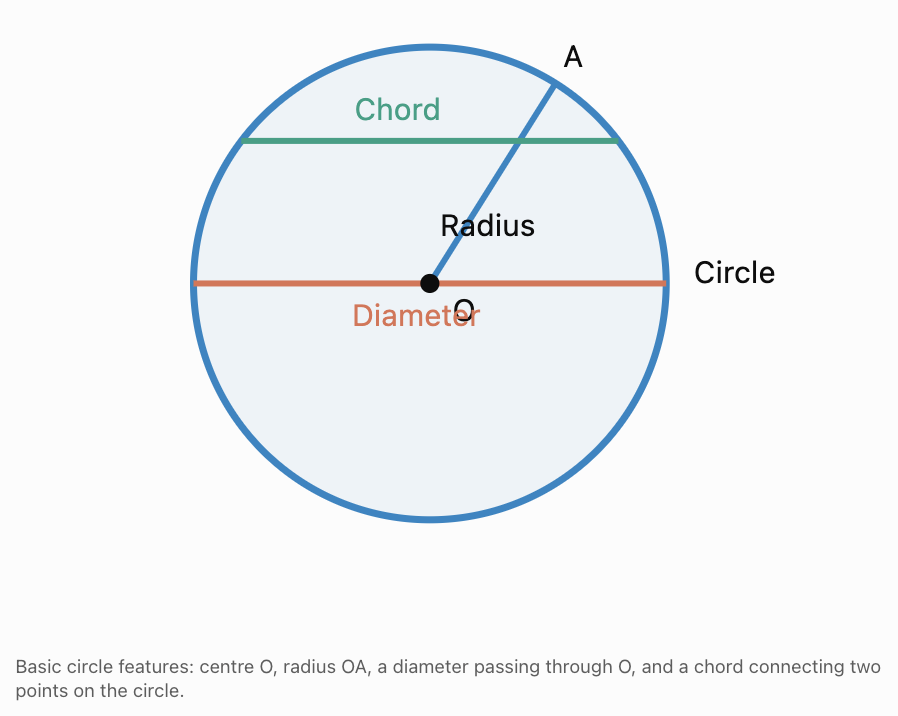
Centre
The centre is the point equally distant from every point on the circle.
Radius
A radius is a line segment connecting the centre to a point on the circle.
All radii of the same circle are equal.
If the radius is r:
r = Distance from centre to circumference.
Diameter
A diameter is a chord passing through the centre.
The diameter is twice the radius.
d = 2r
Therefore:
r = d/2
The diameter is the longest chord of a circle.
Circumference
The circumference is the distance around the circle.
C = 2πr
or:
C = πd
Area
The area enclosed by a circle is:
A = πr²
Chord
A chord is a straight line segment connecting two points on the circle.
Every diameter is a chord, but not every chord is a diameter.
Arc
An arc is part of the circumference between two points.
A minor arc is less than half the circumference.
A major arc is more than half the circumference.
A semicircle is an arc equal to half the circumference.
Sector
A sector is a region bounded by two radii and the arc between them.
A sector resembles a slice of pizza.
Segment
A segment is a region bounded by a chord and its corresponding arc.
Tangent
A tangent is a line that touches a circle at exactly one point.
That point is called the point of tangency.
Secant
A secant is a line that intersects a circle at two distinct points.
Understanding Chords
Chords are important because their lengths and positions are closely related to the centre of a circle.
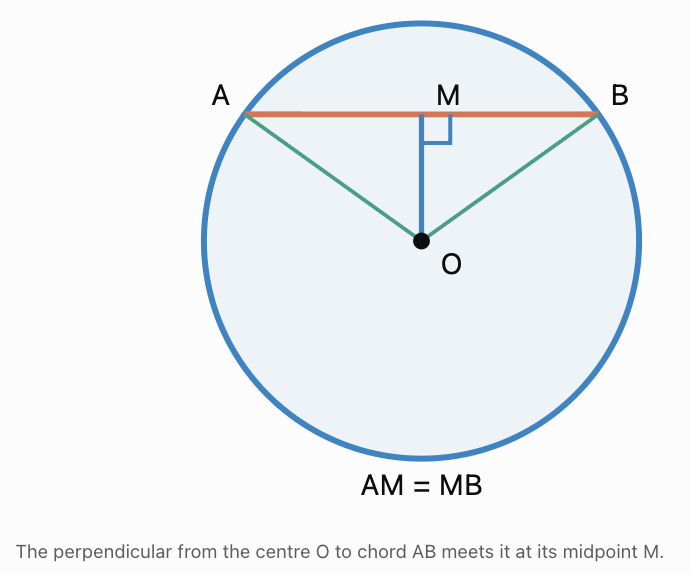
Property 1: The Perpendicular from the Centre Bisects a Chord
If a line from the centre of a circle meets a chord at 90°, it divides the chord into two equal parts.
Suppose AB is a chord and OM is perpendicular to AB.
Then:
AM = MB
Why Is This True?
OA and OB are radii, so:
OA = OB
OM is common to triangles OMA and OMB.
Both triangles have a right angle at M.
Therefore, the triangles are congruent by the right-angle–hypotenuse–side criterion.
Hence:
AM = MB
Property 2: Equal Chords Are Equidistant from the Centre
In the same circle, equal-length chords lie the same perpendicular distance from the centre.
Conversely, chords equally distant from the centre have equal lengths.
Property 3: Longer Chords Are Closer to the Centre
The closer a chord lies to the centre, the longer it is.
The longest chord is the diameter, which passes directly through the centre.
Worked Example 1: Finding a Chord Length
A circle has radius 13 cm. A chord is 5 cm from the centre.
Find the length of the chord.
Step 1: Identify the right triangle.
The perpendicular from the centre bisects the chord.
Let x be half the chord length.
The radius is the hypotenuse.
Step 2: Apply the Pythagorean theorem.
x² + 5² = 13²
x² + 25 = 169
x² = 144
x = 12
Step 3: Find the full chord.
Chord length = 2 × 12
Answer: 24 cm.
Worked Example 2: Finding the Distance from the Centre
A circle has radius 10 cm and a chord of length 16 cm.
Find the perpendicular distance from the centre to the chord.
Step 1: Halve the chord.
Half-chord = 16/2 = 8 cm
Step 2: Use the Pythagorean theorem.
Let d be the perpendicular distance.
d² + 8² = 10²
d² + 64 = 100
d² = 36
d = 6
Answer: The chord is 6 cm from the centre.
Tangents to Circles
A tangent touches a circle at one point.
Tangents have two particularly important properties.
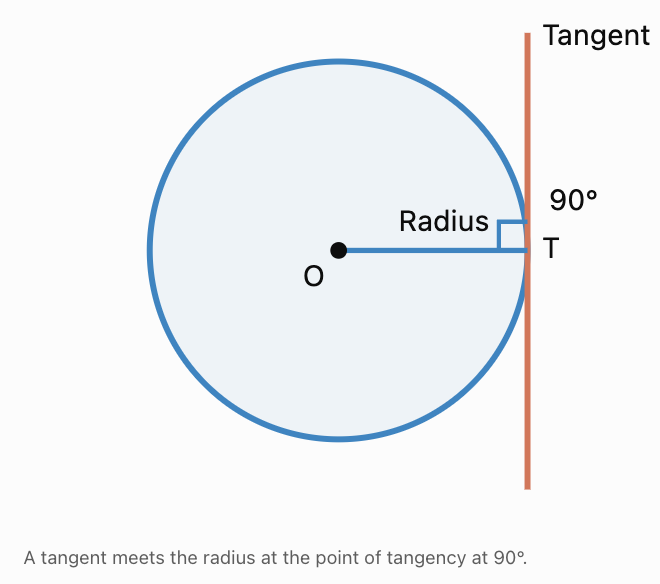
Tangent Property 1: Radius and Tangent Are Perpendicular
A radius drawn to the point of tangency is perpendicular to the tangent.
If line PT is tangent to a circle at T and O is the centre:
OT ⟂ PT
Therefore:
∠OTP = 90°
Tangent Property 2: Tangents from the Same External Point Are Equal
Suppose PA and PB are tangents from the same external point P.
Then:
PA = PB
This property is useful when solving problems involving two tangents.
Worked Example 3: Tangent Length
A circle has centre O and radius 6 cm.
A point P lies 10 cm from O.
PT is a tangent to the circle at T.
Find PT.
Step 1: Recognize the right triangle.
OT is perpendicular to PT.
Therefore, triangle OTP is right-angled.
Step 2: Apply the Pythagorean theorem.
OP² = OT² + PT²
10² = 6² + PT²
100 = 36 + PT²
PT² = 64
PT = 8
Answer: PT = 8 cm.
Worked Example 4: Two Tangents from One Point
From point P, two tangents PA and PB touch a circle.
PA = 3x + 4
PB = 5x − 8
Find x and the tangent lengths.
Tangents from the same external point are equal.
Therefore:
3x + 4 = 5x − 8
12 = 2x
x = 6
Substitute:
PA = 3(6) + 4 = 22
PB = 5(6) − 8 = 22
Answer: x = 6, and each tangent is 22 units long.
Secants and Intersecting Chords
A secant is a line that crosses a circle at two distinct points.
When chords and secants intersect, their segment lengths follow special relationships.
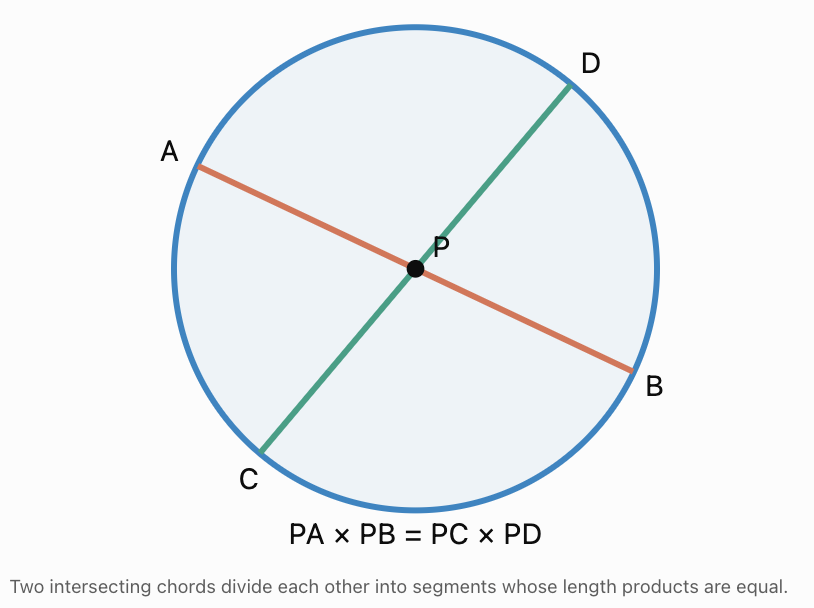
The Intersecting Chords Theorem
If two chords intersect inside a circle, the products of their segment lengths are equal.
Suppose chords AB and CD intersect at P.
Then:
PA × PB = PC × PD
Worked Example 5: Intersecting Chords
Two chords intersect inside a circle.
The first chord is divided into segments of 4 cm and 9 cm.
The second chord is divided into segments of 6 cm and x cm.
Find x.
Apply the theorem:
4 × 9 = 6 × x
36 = 6x
x = 6
Answer: x = 6 cm.
The Secant–Secant Theorem
When two secants are drawn from the same external point, the product of each secant's external segment and its whole length is equal.
Suppose P is outside a circle.
One secant intersects the circle at A and B, with A closer to P.
Another intersects at C and D, with C closer to P.
Then:
PA × PB = PC × PD
Remember:
PB is the entire length from P to the farther intersection B.
PD is the entire length from P to the farther intersection D.
Worked Example 6: Two Secants
Two secants are drawn from point P.
For the first secant:
External segment = 4 cm
Whole secant = 12 cm
For the second secant:
External segment = 6 cm
Whole secant = x cm
Find x.
Use:
4 × 12 = 6 × x
48 = 6x
x = 8
Answer: The whole second secant is 8 cm.
Its internal segment is:
8 − 6 = 2 cm.
The Tangent–Secant Theorem
If a tangent and secant are drawn from the same external point:
(Tangent length)² = External secant segment × Whole secant length
Using t for the tangent, a for the external secant segment, and b for the whole secant:
Worked Example 7: Tangent–Secant Length
A tangent from point P has length x cm.
A secant from P has an external segment of 5 cm and an internal segment of 15 cm.
Find x.
Step 1: Find the whole secant.
Whole secant = 5 + 15 = 20 cm
Step 2: Apply the theorem.
x² = 5 × 20
x² = 100
x = 10
Answer: The tangent is 10 cm long.
We use the positive square root because length cannot be negative.
Central Angles
A central angle is an angle whose vertex lies at the centre of the circle.
Its sides are radii.
If ∠AOB is a central angle, it intercepts arc AB.
The measure of a central angle is equal to the degree measure of its intercepted minor arc.
For example:
If ∠AOB = 80°, then minor arc AB measures 80°.
Central Angles and Arc Length
A central angle determines what fraction of the circumference an arc occupies.
For a central angle θ measured in degrees:
where:
-
L = arc length
-
θ = central angle
-
r = radius
Sector Area
The area of a sector is the same fraction of the full circle's area.
Worked Example 8: Arc Length
A circle has radius 12 cm.
Find the length of the arc intercepted by a central angle of 60°.
L = (60/360) × 2π(12)
L = (1/6) × 24π
L = 4π cm
Approximately:
L ≈ 12.57 cm
Answer: 4π cm, or approximately 12.57 cm.
Worked Example 9: Sector Area
A circle has radius 9 cm and central angle 120°.
Find the sector area.
A = (120/360) × π(9²)
A = (1/3) × 81π
A = 27π cm²
Approximately:
A ≈ 84.82 cm²
Answer: 27π cm².
Inscribed Angles
An inscribed angle has its vertex on the circumference of a circle.
Its sides are chords.
A central angle has its vertex at the centre.
An inscribed angle has its vertex on the circle.
This distinction is fundamental.
The Inscribed Angle Theorem
An inscribed angle is half the measure of the central angle intercepting the same arc.
If ∠AOB is the central angle and ∠ACB is the inscribed angle intercepting the same arc AB:
Equivalently:
Central angle = 2 × Inscribed angle
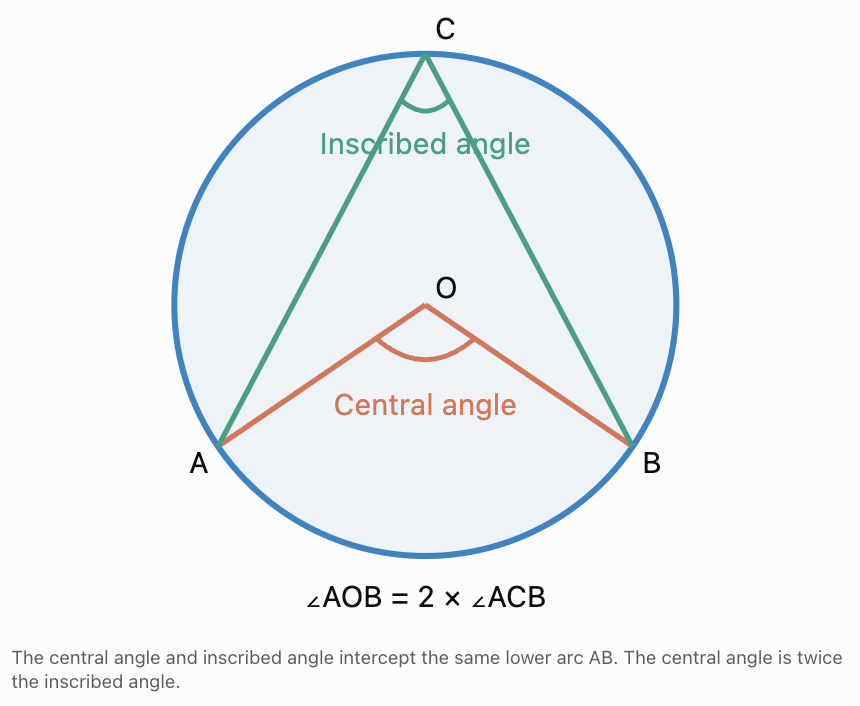
Worked Example 10: Finding an Inscribed Angle
A central angle measures 110°.
Find an inscribed angle intercepting the same arc.
Inscribed angle = Central angle / 2
Inscribed angle = 110°/2
Answer: 55°.
Worked Example 11: Finding a Central Angle
An inscribed angle measures 38°.
Find the central angle intercepting the same arc.
Central angle = 2 × Inscribed angle
Central angle = 2 × 38°
Answer: 76°.
Angles in the Same Segment
Two inscribed angles that intercept the same arc are equal.
This is sometimes called the angles in the same segment theorem.
If points C and D lie on the same arc between A and B, and both ∠ACB and ∠ADB intercept the other arc AB:
∠ACB = ∠ADB
Why Is This True?
Both angles are half the measure of the same intercepted arc.
Therefore, they must be equal.
Worked Example 12: Angles in the Same Segment
Two inscribed angles intercept the same arc.
One angle measures 47°.
Find the other angle.
Since both angles intercept the same arc:
Answer: 47°.
Angles in a Semicircle
An angle inscribed in a semicircle is always a right angle.
If AB is a diameter and C is any other point on the circle:
∠ACB = 90°
Why?
The diameter AB intercepts a semicircle measuring 180°.
An inscribed angle intercepting that semicircle is half its measure.
∠ACB = 180°/2
∠ACB = 90°
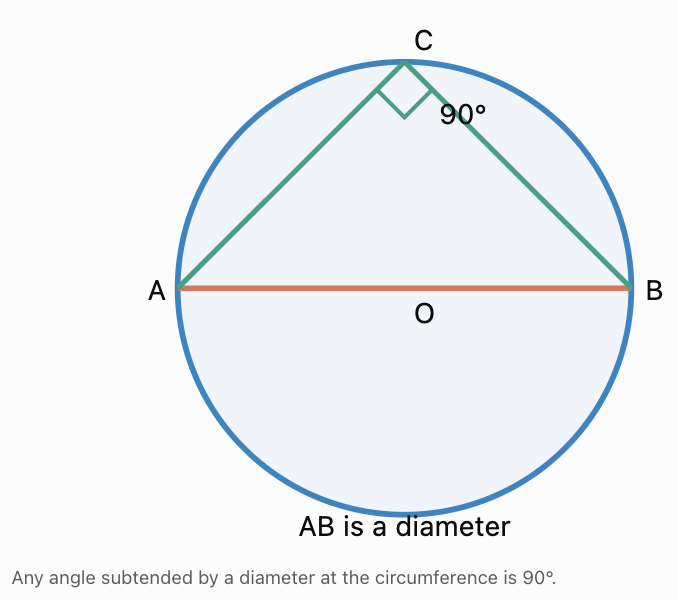
Worked Example 13: Triangle in a Semicircle
AB is a diameter of a circle.
C lies on the circumference.
If ∠CAB = 35°, find ∠ABC.
Step 1: Apply the semicircle theorem.
∠ACB = 90°.
Step 2: Use the triangle angle sum.
∠CAB + ∠ABC + ∠ACB = 180°
35° + ∠ABC + 90° = 180°
∠ABC = 55°
Answer: 55°.
Cyclic Quadrilaterals
A cyclic quadrilateral is a quadrilateral whose four vertices lie on the same circle.
Its most important property is:
Opposite angles of a cyclic quadrilateral add to 180°.
If ABCD is cyclic:
∠A + ∠C = 180°
∠B + ∠D = 180°
Why Is This True?
Opposite angles intercept two arcs that together form the entire circle.
The two arc measures add to 360°.
Each inscribed angle is half its intercepted arc.
Therefore:
Sum of opposite angles = 360°/2
Sum = 180°.
Worked Example 14: Cyclic Quadrilateral
ABCD is a cyclic quadrilateral.
∠A = 112°.
Find ∠C.
Opposite angles are supplementary.
∠A + ∠C = 180°
112° + ∠C = 180°
Answer: ∠C = 68°.
Worked Example 15: Algebraic Cyclic Quadrilateral
In cyclic quadrilateral ABCD:
∠A = (3x + 10)°
∠C = (5x − 6)°.
Find x.
Opposite angles add to 180°.
(3x + 10) + (5x − 6) = 180
8x + 4 = 180
8x = 176
x = 22
Then:
∠A = 3(22) + 10 = 76°
∠C = 5(22) − 6 = 104°
Verification:
76 + 104 = 180°.
Answer: x = 22.
Tangent–Chord Theorem
The tangent–chord theorem, also called the alternate segment theorem, states:
The angle between a tangent and a chord equals the inscribed angle in the opposite segment of the circle.
Suppose a tangent touches a circle at A and AB is a chord.
The angle between the tangent and AB equals the angle ACB, where C lies on the opposite arc AB.
Worked Example 16: Tangent–Chord Angle
A tangent touches a circle at A.
The angle between the tangent and chord AB is 64°.
Find the angle subtended by chord AB at a point C on the opposite arc.
By the tangent–chord theorem:
∠ACB = 64°.
Answer: 64°.
Angles Formed by Intersecting Chords
When two chords intersect inside a circle, the angle formed equals half the sum of the measures of the arcs intercepted by that angle and its vertically opposite angle.
If chords AB and CD intersect at P:
The arc notation refers to the measures of the corresponding arcs in degrees.
Worked Example 17: Intersecting Chord Angles
Two chords intersect inside a circle.
The intercepted arcs measure 80° and 120°.
Find the angle formed between the chords.
Angle = (80° + 120°)/2
Angle = 200°/2
Answer: 100°.
Angles Formed Outside a Circle
When two secants, two tangents, or a tangent and secant meet outside a circle, the angle formed equals half the difference between the intercepted arc measures.
Worked Example 18: Two Secants
Two secants intersect outside a circle.
Their intercepted arcs measure 150° and 50°.
Find the exterior angle.
Angle = (150° − 50°)/2
Angle = 100°/2
Answer: 50°.
Worked Example 19: Two Tangents
Two tangents meet at an external point P.
The minor arc between the points of tangency measures 130°.
Find the angle between the tangents.
The major arc measures:
360° − 130° = 230°.
The exterior angle is:
(230° − 130°)/2
= 100°/2
= 50°.
Answer: 50°.
An equivalent shortcut is:
Angle between tangents = 180° − Minor arc measure
= 180° − 130°
= 50°.
Justifying Circle Theorems
Circle theorems are not simply formulas to memorize. They follow logically from basic geometric properties.
Many circle proofs use:
-
Equal radii.
-
Isosceles triangles.
-
Triangle angle sums.
-
Exterior angles of triangles.
-
Congruent triangles.
-
Similar triangles.
-
Supplementary angles.
Proof 1: The Inscribed Angle Theorem
Claim: An inscribed angle is half the central angle intercepting the same arc.
Consider circle O with points A, B, and C on its circumference.
Suppose C lies on the major arc AB, and the central angle AOB intercepts the minor arc AB.
Draw diameter CD through O, with D opposite C.
Because OA = OC, triangle AOC is isosceles.
Therefore:
∠OAC = ∠ACO
Let each equal angle be α.
Then:
∠AOC = 180° − 2α
Since OD is the extension of OC:
∠AOD = 180° − ∠AOC
∠AOD = 2α
Therefore:
∠AOD = 2∠ACD
Similarly:
∠DOB = 2∠DCB
When D lies on the minor arc AB, adding the two central angles gives:
∠AOB = 2∠ACB
For the other possible positions of D, the corresponding angles are subtracted rather than added, producing the same result.
Thus:
The central angle is twice the inscribed angle intercepting the same arc.
Proof 2: Angles in the Same Segment Are Equal
Given: Two inscribed angles intercept the same arc AB.
Prove: The angles are equal.
Let the central angle subtending arc AB be θ.
By the inscribed angle theorem:
First inscribed angle = θ/2
Second inscribed angle = θ/2
Therefore:
The two inscribed angles are equal.
Proof 3: An Angle in a Semicircle Is 90°
Given: AB is a diameter and C lies on the circle.
Prove: ∠ACB = 90°.
The central angle AOB is a straight angle:
∠AOB = 180°.
By the inscribed angle theorem:
∠ACB = 180°/2
Therefore:
∠ACB = 90°.
Proof 4: Opposite Angles of a Cyclic Quadrilateral Are Supplementary
Given: ABCD is a cyclic quadrilateral.
Prove: ∠A + ∠C = 180°.
Angle A intercepts arc BCD.
Angle C intercepts arc BAD.
These two arcs together make the full circle:
Arc BCD + Arc BAD = 360°.
By the inscribed angle theorem:
∠A = 1/2 × arc BCD
∠C = 1/2 × arc BAD
Adding:
∠A + ∠C = 1/2 × 360°
Therefore:
∠A + ∠C = 180°.
The same reasoning proves:
∠B + ∠D = 180°.
Proof 5: Tangents from an External Point Are Equal
Given: PA and PB are tangents from external point P to a circle with centre O.
Prove: PA = PB.
Join OA, OB, and OP.
Because a radius is perpendicular to a tangent:
∠OAP = 90°
∠OBP = 90°
Also:
OA = OB because both are radii.
OP is common to both triangles.
Therefore, right triangles OAP and OBP are congruent by the right-angle–hypotenuse–side criterion.
Corresponding sides are equal.
Hence:
PA = PB.
Proof 6: The Intersecting Chords Theorem
Given: Chords AB and CD intersect at P.
Prove: PA × PB = PC × PD.
Consider triangles PAC and PDB.
∠APC = ∠DPB because they are vertically opposite angles.
∠PAC = ∠PDB because both are inscribed angles intercepting arc BC.
Therefore:
△PAC ∼ △PDB
The triangles are similar by AA similarity.
Corresponding side ratios give:
PA/PD = PC/PB
Cross-multiplying:
PA × PB = PC × PD.
This proves the intersecting chords theorem.
Real-World Applications
Wheels and Rotating Machinery
Wheels depend on the geometric properties of circles.
Every point on the rim lies at the same distance from the axle.
The circumference determines how far a wheel travels in one complete revolution.
For a wheel with radius 35 cm:
C = 2π(35)
C = 70π cm
C ≈ 219.9 cm
One complete revolution moves the wheel approximately 2.20 m, assuming it rolls without slipping.
Road and Railway Curves
Engineers use circular arcs and other smooth curves to design roads and railway tracks.
The radius of curvature affects how sharply a vehicle must turn.
Arc length calculations help determine the distance along curved sections.
Architecture and Arches
Circular and semicircular arches are common in architecture.
Architects use circle geometry to calculate:
-
Arc lengths.
-
Chord widths.
-
Central angles.
-
Radius and diameter.
-
Positions of supports.
Sports Fields
Circular markings are common in sports.
For example, centre circles and penalty arcs are constructed using specified radii.
Circle geometry ensures that these markings have consistent dimensions.
Optics and Engineering Design
Circular lenses, pipes, bearings, and gears require accurate measurements of radius, diameter, chords, and tangents.
Tangents are especially useful when determining the direction of motion or contact at a point on a circular surface.
Common Mistakes
Mistake 1: Confusing Radius and Diameter
The diameter is twice the radius.
d = 2r
Do not substitute the diameter into formulas that require the radius.
Mistake 2: Confusing a Chord with a Secant
A chord is a segment with endpoints on the circle.
A secant is an entire line crossing the circle at two points.
Mistake 3: Assuming Every Chord Passes Through the Centre
Only diameters pass through the centre.
Other chords do not.
Mistake 4: Forgetting the Tangent–Radius Right Angle
A tangent and radius meet at 90° at the point of tangency.
This is frequently the key to solving a tangent-length problem.
Mistake 5: Confusing Central and Inscribed Angles
The central angle is twice the inscribed angle when both intercept the same arc.
Mistake 6: Using the Wrong Arc
The inscribed angle theorem depends on the intercepted arc.
Two angles must intercept the same arc for the usual equality rule to apply.
Mistake 7: Confusing Chord-Length Products
For intersecting chords, multiply the two segments of each chord.
PA × PB = PC × PD
Do not add them.
Mistake 8: Using Only the Internal Part of a Secant
In the secant–secant and tangent–secant theorems, use the whole secant length from the external point to the farther intersection.
Mistake 9: Forgetting Opposite Angles in Cyclic Quadrilaterals
Opposite angles sum to 180°.
Adjacent angles do not necessarily sum to 180°.
Mistake 10: Confusing Angle Formulas for Intersections
Inside the circle:
Angle = Half the sum of intercepted arcs.
Outside the circle:
Angle = Half the difference of intercepted arcs.
Mistake 11: Treating a Diagram as Proof
A geometric relationship should be justified using established properties, not simply by how a diagram appears.
Key Terms
-
Circle: The set of all points in a plane equally distant from a fixed centre.
-
Centre: The fixed point equally distant from every point on a circle.
-
Radius: A segment from the centre to a point on the circle.
-
Diameter: A chord passing through the centre.
-
Circumference: The distance around a circle.
-
Chord: A segment connecting two points on a circle.
-
Arc: A portion of the circumference.
-
Minor Arc: An arc measuring less than 180°.
-
Major Arc: An arc measuring more than 180°.
-
Semicircle: An arc measuring 180°.
-
Sector: A region bounded by two radii and an arc.
-
Segment: A region bounded by a chord and an arc.
-
Tangent: A line touching a circle at exactly one point.
-
Point of Tangency: The point where a tangent touches the circle.
-
Secant: A line intersecting a circle at two points.
-
Central Angle: An angle whose vertex is at the centre of a circle.
-
Inscribed Angle: An angle whose vertex is on the circle and whose sides are chords.
-
Intercepted Arc: The arc lying between the points where an angle's sides meet the circle.
-
Cyclic Quadrilateral: A quadrilateral whose vertices lie on the same circle.
-
Intersecting Chords Theorem: A theorem relating products of chord segments.
-
Secant–Secant Theorem: A theorem relating products of external and whole secant lengths.
-
Tangent–Secant Theorem: A theorem relating tangent length to secant lengths.
-
Tangent–Chord Theorem: A theorem relating a tangent–chord angle to an inscribed angle.
-
Inscribed Angle Theorem: An inscribed angle measures half its intercepted arc.
-
Geometric Proof: A logical argument demonstrating why a geometric property is true.
Key Takeaways
-
A circle consists of all points equally distant from its centre.
-
The diameter is twice the radius.
-
A chord joins two points on the circle.
-
The perpendicular from the centre to a chord bisects the chord.
-
Equal chords are equally distant from the centre.
-
A tangent touches a circle at one point.
-
A tangent is perpendicular to the radius at the point of tangency.
-
Tangents drawn from the same external point have equal lengths.
-
Intersecting chords satisfy PA × PB = PC × PD.
-
Secant–secant relationships involve external segments and whole secant lengths.
-
The tangent–secant theorem states t² = ab.
-
A central angle has the same degree measure as its intercepted minor arc.
-
An inscribed angle is half the measure of its intercepted arc.
-
Inscribed angles intercepting the same arc are equal.
-
An angle in a semicircle is 90°.
-
Opposite angles of a cyclic quadrilateral sum to 180°.
-
The tangent–chord theorem relates tangent angles to inscribed angles.
-
Intersecting chords and secants create angle relationships involving intercepted arcs.
-
Circle theorems can be justified using isosceles triangles, congruence, similarity, and angle properties.
-
Circle geometry has applications in engineering, architecture, transport, sports, and design.
Check Your Understanding
Question 1: Parts of a Circle
Define:
a) Radius.
b) Diameter.
c) Chord.
d) Tangent.
e) Secant.
Question 2: Radius and Circumference
A circle has radius 7 cm.
Calculate:
a) Diameter.
b) Circumference in terms of π.
c) Area in terms of π.
Question 3: Chord Length
A circle has radius 15 cm.
A chord is 9 cm from the centre.
Find the length of the chord.
Question 4: Tangent Length
A point P is 17 cm from the centre O of a circle.
The circle has radius 8 cm.
Find the length of a tangent from P to the circle.
Question 5: Equal Tangents
Two tangents from the same external point have lengths:
PA = 4x + 3
PB = 6x − 7
Find x and the tangent lengths.
Question 6: Intersecting Chords
Two chords intersect inside a circle.
The first chord has segments of 6 cm and 8 cm.
The second has segments of 4 cm and x cm.
Find x.
Question 7: Tangent–Secant Theorem
A tangent has length 12 cm.
A secant from the same external point has an external segment of 8 cm.
Find the whole secant length.
Question 8: Central and Inscribed Angles
A central angle measures 136°.
Find an inscribed angle intercepting the same minor arc.
Question 9: Angles in a Semicircle
AB is a diameter.
C lies on the circumference.
If ∠CAB = 42°, find ∠ABC.
Question 10: Cyclic Quadrilateral
ABCD is a cyclic quadrilateral.
∠A = 115°.
∠B = 78°.
Find ∠C and ∠D.
Question 11: Arc Length
A circle has radius 10 cm.
Find the length of an arc intercepted by a central angle of 72°.
Give your answer in terms of π.
Question 12: Exterior Angle from Secants
Two secants intersect outside a circle.
The intercepted arcs measure 170° and 50°.
Find the exterior angle.
Question 13: Algebraic Cyclic Quadrilateral
In cyclic quadrilateral ABCD:
∠A = (4x + 12)°
∠C = (6x − 22)°.
Find x and both angles.
Question 14: Comprehensive Challenge
A circle has centre O and radius 10 cm.
Point P lies outside the circle, with OP = 26 cm.
A tangent PT touches the circle at T.
A secant from P intersects the circle at A and B, where A is closer to P.
The external segment PA is 8 cm.
Find:
a) The tangent length PT.
b) The whole secant length PB.
c) The internal segment AB.
d) Explain which circle theorems were used.
Fully Worked Answers
Answer 1: Parts of a Circle
a) Radius: A line segment connecting the centre to a point on the circle.
b) Diameter: A chord passing through the centre.
c) Chord: A line segment connecting two points on the circle.
d) Tangent: A line touching the circle at exactly one point.
e) Secant: A line intersecting the circle at two distinct points.
Answer 2: Radius and Circumference
Given:
r = 7 cm
a) Diameter
d = 2r
d = 2(7)
d = 14 cm
b) Circumference
C = 2πr
C = 2π(7)
C = 14π cm
c) Area
A = πr²
A = π(7²)
A = 49π cm²
Answer 3: Chord Length
Given:
Radius = 15 cm
Distance from centre = 9 cm
The perpendicular from the centre bisects the chord.
Let x represent half the chord length.
Use the Pythagorean theorem:
x² + 9² = 15²
x² + 81 = 225
x² = 144
x = 12
Full chord length:
2(12) = 24 cm
Answer: 24 cm.
Answer 4: Tangent Length
Given:
OP = 17 cm
OT = 8 cm
Since the radius is perpendicular to the tangent:
OP² = OT² + PT²
17² = 8² + PT²
289 = 64 + PT²
PT² = 225
PT = 15
Answer: 15 cm.
Answer 5: Equal Tangents
Tangents from the same external point are equal.
Therefore:
4x + 3 = 6x − 7
10 = 2x
x = 5
Substitute:
PA = 4(5) + 3 = 23
PB = 6(5) − 7 = 23
Answer: x = 5 and both tangents are 23 units long.
Answer 6: Intersecting Chords
Use:
PA × PB = PC × PD
Substitute:
6 × 8 = 4 × x
48 = 4x
x = 12
Answer: 12 cm.
Answer 7: Tangent–Secant Theorem
Given:
Tangent length = 12 cm
External secant segment = 8 cm
Whole secant = x
Use:
t² = ab
12² = 8x
144 = 8x
x = 18
Answer: The whole secant is 18 cm.
Answer 8: Central and Inscribed Angles
The inscribed angle is half the central angle when both intercept the same arc.
Inscribed angle = 136°/2
Answer: 68°.
Answer 9: Angles in a Semicircle
AB is a diameter.
Therefore:
∠ACB = 90°.
The angles of a triangle sum to 180°.
42° + ∠ABC + 90° = 180°
∠ABC = 180° − 132°
Answer: 48°.
Answer 10: Cyclic Quadrilateral
Opposite angles of a cyclic quadrilateral are supplementary.
∠A + ∠C = 180°
115° + ∠C = 180°
∠C = 65°
Similarly:
∠B + ∠D = 180°
78° + ∠D = 180°
∠D = 102°
Answer: ∠C = 65° and ∠D = 102°.
Answer 11: Arc Length
Given:
r = 10 cm
θ = 72°
Use:
L = (θ/360°) × 2πr
L = (72/360) × 2π(10)
L = (1/5) × 20π
L = 4π cm
Answer: 4π cm.
Answer 12: Exterior Angle from Secants
Use:
Exterior angle = (Larger arc − Smaller arc)/2
Angle = (170° − 50°)/2
Angle = 120°/2
Answer: 60°.
Answer 13: Algebraic Cyclic Quadrilateral
Given:
∠A = (4x + 12)°
∠C = (6x − 22)°.
Opposite angles are supplementary.
(4x + 12) + (6x − 22) = 180
10x − 10 = 180
10x = 190
x = 19
Calculate:
∠A = 4(19) + 12
∠A = 88°
∠C = 6(19) − 22
∠C = 92°
Verification:
88° + 92° = 180°.
Answer: x = 19, ∠A = 88°, and ∠C = 92°.
Answer 14: Comprehensive Challenge
Given:
Radius OT = 10 cm
OP = 26 cm
External secant segment PA = 8 cm
a) Tangent length PT
A radius is perpendicular to a tangent at the point of tangency.
Therefore, triangle OTP is right-angled.
Use the Pythagorean theorem:
OP² = OT² + PT²
26² = 10² + PT²
676 = 100 + PT²
PT² = 576
PT = 24 cm
b) Whole secant length PB
Use the tangent–secant theorem:
PT² = PA × PB
24² = 8 × PB
576 = 8PB
PB = 72 cm
c) Internal segment AB
The whole secant is the external segment plus the internal segment.
PB = PA + AB
72 = 8 + AB
AB = 64 cm
d) Theorems used
First, we used the tangent–radius theorem to establish a right angle.
Next, we used the Pythagorean theorem to calculate the tangent length.
Finally, we used the tangent–secant theorem to relate the tangent length to the secant segments.
Final answers:
-
PT = 24 cm
-
PB = 72 cm
-
AB = 64 cm
Note: These calculated lengths follow the stated equations, but the full set of measurements is not geometrically consistent with a circle of radius 10 cm and OP = 26 cm. A secant's whole length from P cannot exceed OP + r = 36 cm. Thus the given PA = 8 cm cannot describe a real secant from this point. This is an important reminder to verify geometric feasibility as well as algebra.
This completes Circles, including circle terminology, chords, tangents, secants, central and inscribed angles, angle relationships, circle theorems, geometric proofs, and real-world applications.
4. Circumference and Area
Learning outcomes
- I can calculate the circumference of circles.
- I can calculate the area of circles.
- I can calculate arc lengths.
- I can calculate sector areas.
- I can solve real-world measurement problems.
Introduction
Circles are found throughout everyday life, from bicycle wheels and clocks to circular gardens, running tracks, pipes, and pizza trays. Understanding how to measure circles is essential in mathematics, science, engineering, architecture, and design.
Two of the most important measurements are circumference and area.
Circumference measures the distance around a circle, while area measures the space enclosed by the circle.
We can also measure parts of circles. An arc is a portion of the circumference, while a sector is a portion of the circular area. These measurements help us solve practical problems involving curved paths, rotating objects, circular materials, and land areas.
In this lesson, we will calculate circumferences, areas, arc lengths, and sector areas, then combine these skills to solve increasingly challenging real-world problems.
Understanding the Parts of a Circle
A circle is the set of all points in a plane that are the same distance from a fixed point called the centre.
The most important measurements are:
-
Radius (r): The distance from the centre to the circle.
-
Diameter (d): The distance across the circle through its centre.
-
Circumference (C): The distance around the circle.
-
Area (A): The space enclosed by the circle.
-
Arc: A portion of the circumference.
-
Sector: A region enclosed by two radii and the arc between them.
-
Central angle (θ): An angle formed by two radii at the centre.
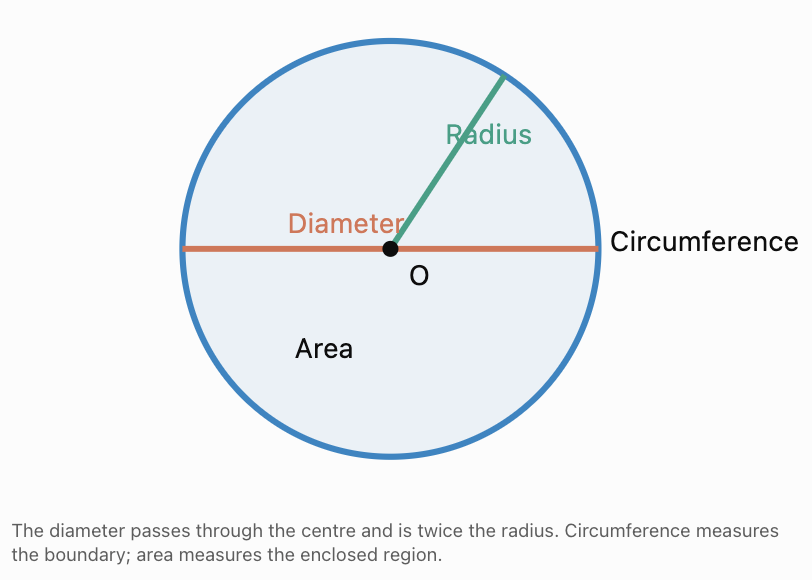
The radius and diameter are related by:
d = 2r
r = d/2
For example, a circle with a diameter of 18 cm has a radius of:
r = 18/2 = 9 cm.
Understanding π (Pi)
The number π is one of the most important constants in mathematics.
It represents the ratio of the circumference of any circle to its diameter.
π = Circumference ÷ Diameter
For every circle:
C/d = π
The value of π is approximately:
π ≈ 3.14159265...
It is an irrational number, meaning its decimal representation continues indefinitely without repeating.
For calculations, we commonly use:
π ≈ 3.14
However, a calculator's π key gives more accurate results.
Important: Keep π in your calculations until the final step whenever possible. This reduces rounding errors.
Circumference of a Circle
The circumference is the distance around the boundary of a circle.
Because π is the ratio of circumference to diameter:
C = πd
Since d = 2r, the formula can also be written using the radius.
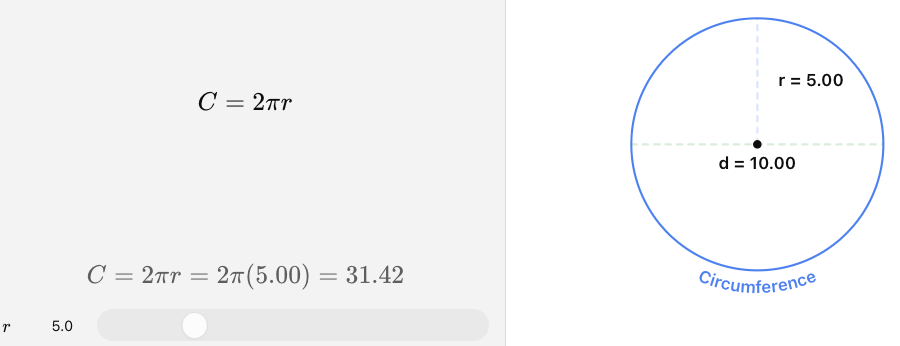
Here:
-
C = circumference.
-
r = radius.
-
d = diameter.
-
π ≈ 3.14159.
The circumference is measured in linear units such as millimetres, centimetres, metres, or kilometres.
Worked Example 1: Circumference from Radius
A circle has radius 7 cm.
Find its circumference.
Step 1: Identify the radius.
r = 7 cm
Step 2: Substitute into the formula.
C = 2πr
C = 2 × π × 7
C = 14π cm
Step 3: Calculate an approximation.
C ≈ 43.98 cm
Answer: 14π cm, or approximately 43.98 cm.
Worked Example 2: Circumference from Diameter
A circular table has diameter 1.6 m.
Find the distance around its edge.
Step 1: Identify the diameter.
d = 1.6 m
Step 2: Apply the formula.
C = πd
C = 1.6π m
Step 3: Calculate.
C ≈ 5.03 m
Answer: Approximately 5.03 m.
Worked Example 3: Finding Radius from Circumference
A circular track has circumference 94.2 m.
Find its radius.
Step 1: Write the formula.
C = 2πr
Step 2: Rearrange for r.
r = C/(2π)
Step 3: Substitute.
r = 94.2/(2π)
r ≈ 14.99 m
Answer: Approximately 15.0 m.
The slight difference from exactly 15 m is due to rounding in the given circumference.
How Circumference Changes with Radius
Circumference is directly proportional to radius.
If the radius doubles, the circumference doubles.
If the radius triples, the circumference triples.
Radius
Circumference
2 cm
4π cm
4 cm
8π cm
6 cm
12π cm
8 cm
16π cm
10 cm
20π cm
This is a linear relationship.
The circumference grows at a constant rate of 2π units for every additional unit of radius.
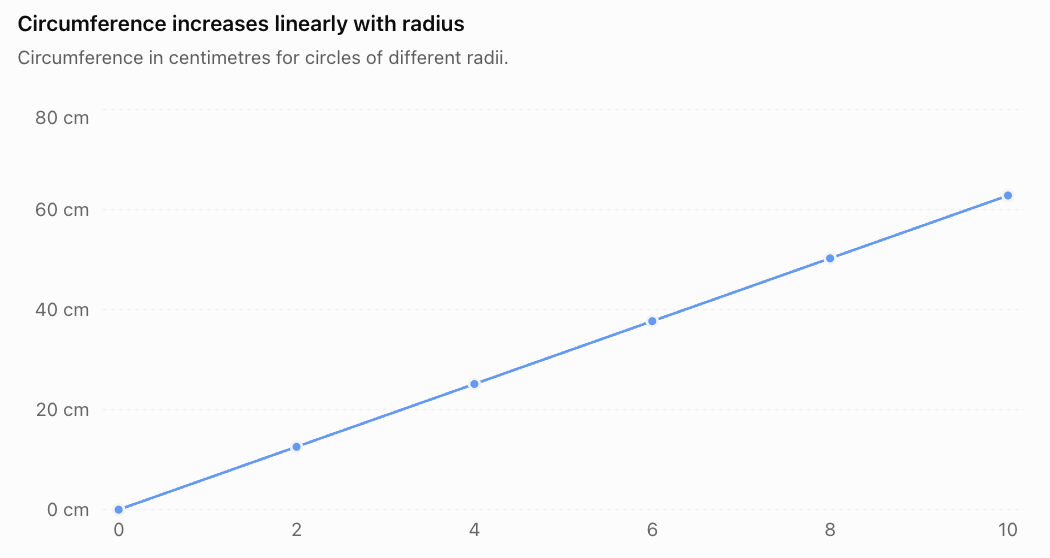
Area of a Circle
The area is the amount of two-dimensional space enclosed by a circle.
The formula is:
A = πr²
where:
-
A = area.
-
r = radius.
-
π ≈ 3.14159.
Notice that the radius is squared.
This means the area changes much faster than the circumference as the radius increases.
Why Is the Formula A = πr²?
Imagine dividing a circle into many thin sectors, like slices of pizza.
If we arrange these sectors alternately, they form a shape that becomes increasingly similar to a rectangle as the sectors become thinner.
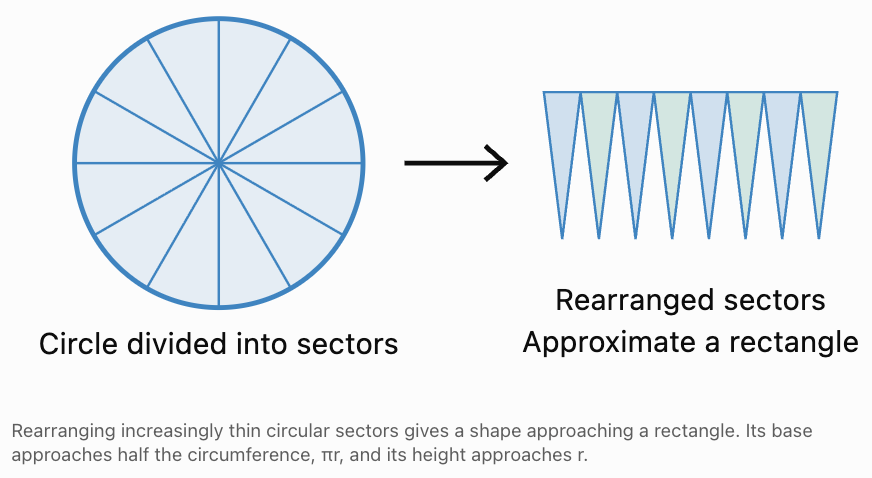
The approximate rectangle has:
Base = Half the circumference = πr
Height = r
Area = Base × Height
A = πr × r
Therefore:
A = πr²
This explains why the radius must be squared.
Worked Example 4: Area from Radius
A circle has radius 8 cm.
Find its area.
Step 1: Write the formula.
A = πr²
Step 2: Substitute.
A = π(8²)
A = 64π cm²
Step 3: Approximate.
A ≈ 201.06 cm²
Answer: 64π cm², or approximately 201.06 cm².
Worked Example 5: Area from Diameter
A circular garden has diameter 14 m.
Find its area.
Step 1: Find the radius.
r = 14/2 = 7 m
Step 2: Calculate the area.
A = πr²
A = π(7²)
A = 49π m²
A ≈ 153.94 m²
Answer: Approximately 153.94 m².
Worked Example 6: Finding Radius from Area
A circular pond has an area of 200 m².
Find its radius.
Step 1: Begin with the formula.
A = πr²
Step 2: Rearrange.
r² = A/π
r = √(A/π)
Step 3: Substitute.
r = √(200/π)
r ≈ 7.98 m
Answer: Approximately 7.98 m.
How Area Changes with Radius
Unlike circumference, area is proportional to the square of the radius.
If the radius doubles:
New area = π(2r)² = 4πr²
The area becomes four times as large.
If the radius triples:
New area = π(3r)² = 9πr²
The area becomes nine times as large.
Radius
Area
2 cm
4π cm²
4 cm
16π cm²
6 cm
36π cm²
8 cm
64π cm²
10 cm
100π cm²
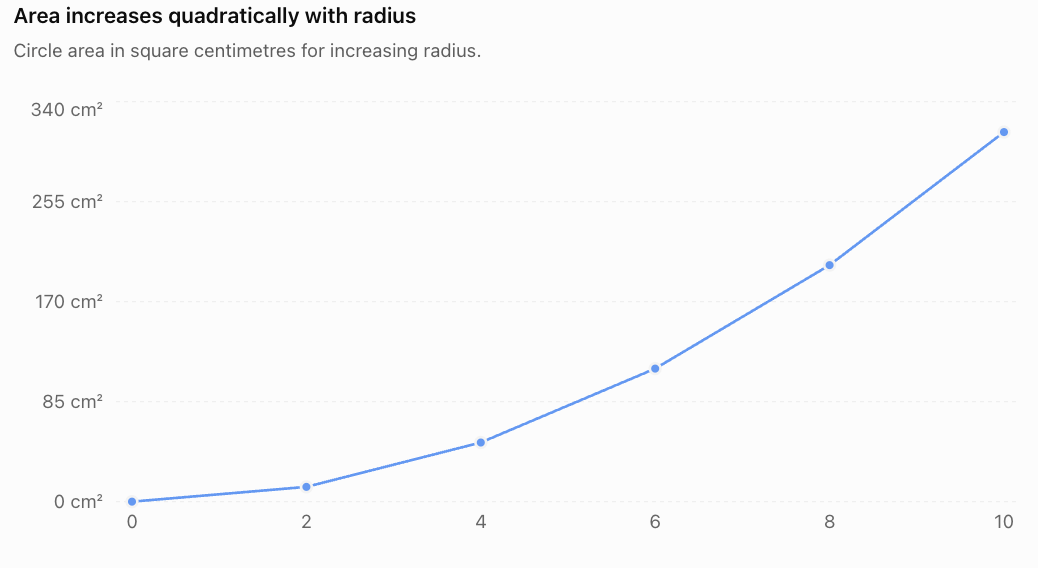
This is a quadratic relationship.
It explains why a small increase in the radius of a circular object can create a much larger increase in its area.
Arc Length
An arc is part of the circumference of a circle.
An arc can be measured in two different ways:
-
Arc measure: The angle corresponding to the arc, measured in degrees.
-
Arc length: The actual distance along the curved boundary, measured in units such as centimetres or metres.
These are not the same quantity.
For example, two circles can both contain 90° arcs, but the larger circle will have the longer arc.
Understanding Central Angles
A central angle has its vertex at the centre of the circle.
A complete revolution around the centre is 360°.
Therefore:
-
A 180° central angle represents half the circumference.
-
A 90° central angle represents one-quarter of the circumference.
-
A 60° central angle represents one-sixth of the circumference.
-
A 45° central angle represents one-eighth of the circumference.
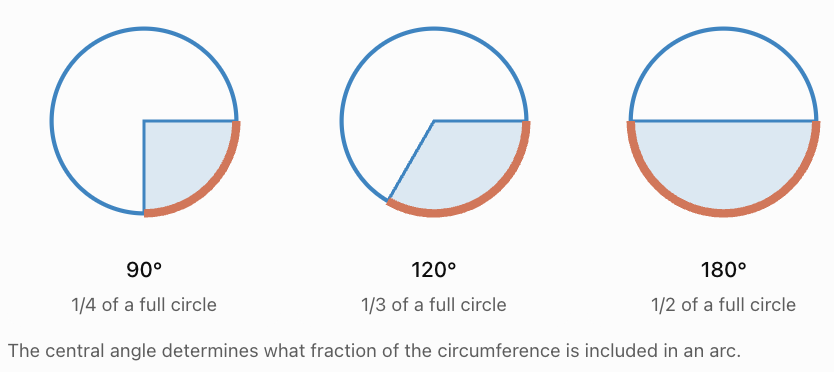
Arc Length Formula
For a central angle θ measured in degrees:
Arc length = (θ/360°) × 2πr
In symbols:
L = (θ/360°) × 2πr
where:
-
L = arc length.
-
θ = central angle in degrees.
-
r = radius.
The formula works because an arc is a fraction of the complete circumference.
Worked Example 7: A Quarter-Circle Arc
A circle has radius 12 cm.
Find the arc length corresponding to a central angle of 90°.
Step 1: Identify the fraction of the circle.
90/360 = 1/4
Step 2: Apply the formula.
L = (90/360) × 2π(12)
L = (1/4) × 24π
L = 6π cm
Step 3: Approximate.
L ≈ 18.85 cm
Answer: 6π cm, or approximately 18.85 cm.
Worked Example 8: An Arc with a 135° Central Angle
A circle has radius 8 m.
Find the length of an arc subtended by a central angle of 135°.
L = (135/360) × 2π(8)
Simplify:
135/360 = 3/8
Therefore:
L = (3/8) × 16π
L = 6π m
L ≈ 18.85 m
Answer: Approximately 18.85 m.
Worked Example 9: Finding the Central Angle
An arc has length 10π cm in a circle with radius 15 cm.
Find its central angle.
Step 1: Apply the formula.
10π = (θ/360) × 2π(15)
10π = (θ/360) × 30π
Step 2: Divide by π.
10 = 30θ/360
Step 3: Solve.
3600 = 30θ
θ = 120°
Answer: 120°.
Worked Example 10: Finding the Radius from Arc Length
An arc measures 8π cm and subtends a central angle of 120°.
Find the radius.
L = (θ/360) × 2πr
8π = (120/360) × 2πr
8π = (1/3) × 2πr
Multiply by 3:
24π = 2πr
r = 12 cm
Answer: 12 cm.
Arc Length Using Radians
Angles can also be measured in radians.
One complete circle contains 2π radians.
When θ is measured in radians, the arc length formula becomes:
L = rθ
For example, if:
r = 6 cm
θ = π/3 radians
Then:
L = 6 × π/3
L = 2π cm
Important: Use L = rθ only when θ is measured in radians. For angles measured in degrees, use the degree-based formula.
Sector Area
A sector is the region enclosed by two radii and the arc between them.
It is often described as a slice of a circle.
Like arc length, sector area depends on the central angle.
A 90° sector occupies one-quarter of the circle.
A 180° sector occupies half the circle.
A 60° sector occupies one-sixth of the circle.
Sector Area Formula
For a central angle θ measured in degrees:
Sector area = (θ/360°) × πr²
In symbols:
A_sector = (θ/360°) × πr²
where:
-
A_sector = area of the sector.
-
θ = central angle in degrees.
-
r = radius.
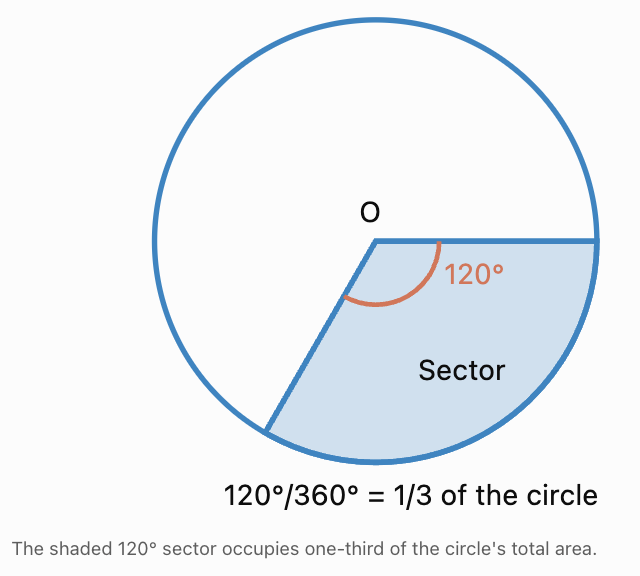
Worked Example 11: Area of a 60° Sector
A circle has radius 9 cm.
Find the area of a sector with central angle 60°.
Step 1: Calculate the fraction of the circle.
60/360 = 1/6
Step 2: Apply the sector formula.
A_sector = (1/6) × π(9²)
A_sector = (1/6) × 81π
A_sector = 13.5π cm²
Step 3: Approximate.
A_sector ≈ 42.41 cm²
Answer: 13.5π cm², or approximately 42.41 cm².
Worked Example 12: Area of a 150° Sector
A circle has diameter 20 cm.
Find the area of a 150° sector.
Step 1: Find the radius.
r = 20/2 = 10 cm
Step 2: Apply the formula.
A_sector = (150/360) × π(10²)
A_sector = (5/12) × 100π
A_sector = 125π/3 cm²
Step 3: Approximate.
A_sector ≈ 130.90 cm²
Answer: Approximately 130.90 cm².
Worked Example 13: Finding a Central Angle from Sector Area
A sector has area 30π cm².
The circle has radius 12 cm.
Find the central angle.
Step 1: Substitute into the formula.
30π = (θ/360) × π(12²)
30π = (θ/360) × 144π
Step 2: Divide by π.
30 = 144θ/360
Step 3: Solve.
10800 = 144θ
θ = 75°
Answer: 75°.
Worked Example 14: Finding the Radius from Sector Area
A 90° sector has area 25π cm².
Find the radius.
Step 1: Apply the formula.
25π = (90/360) × πr²
25π = (1/4)πr²
Step 2: Multiply by 4 and divide by π.
100 = r²
Step 3: Take the positive square root.
r = 10 cm
Answer: 10 cm.
Sector Area Using Radians
When θ is measured in radians:
A_sector = ½r²θ
For example:
r = 8 cm
θ = π/2 radians
A_sector = ½ × 8² × π/2
A_sector = 16π cm²
This formula is particularly useful in advanced trigonometry and calculus.
Relationship Between Arc Length and Sector Area
For a sector with radius r and arc length L:
A_sector = ½rL
This follows from the radian formulas:
L = rθ
A_sector = ½r²θ
Substituting θ = L/r:
A_sector = ½r²(L/r)
A_sector = ½rL
Worked Example 15: Sector Area from Arc Length
A sector has radius 10 cm and arc length 8 cm.
Find its area.
A_sector = ½rL
A_sector = ½ × 10 × 8
Answer: 40 cm².
This method avoids calculating the central angle.
Perimeter of a Sector
The perimeter of a sector includes:
-
The curved arc.
-
The first radius.
-
The second radius.
Therefore:
P_sector = L + 2r
This is different from the arc length alone.
Worked Example 16: Perimeter of a Sector
A sector has radius 6 cm and central angle 120°.
Find its perimeter.
Step 1: Calculate the arc length.
L = (120/360) × 2π(6)
L = 4π cm
Step 2: Add the two radii.
P = 4π + 2(6)
P = 4π + 12
P ≈ 24.57 cm
Answer: 12 + 4π cm, or approximately 24.57 cm.
Composite Shapes Involving Circles
Many real-world objects are not complete circles. They may combine circles, semicircles, rectangles, triangles, or sectors.
The key strategy is to divide a complicated shape into simpler shapes whose measurements we already know.
Semicircles
A semicircle is half a circle.
Area:
A = ½πr²
The curved arc of a semicircle has length:
L = πr
However, the perimeter of a semicircle includes its diameter.
P = πr + 2r
Worked Example 17: Semicircular Window
A semicircular window has diameter 2 m.
Find its area and total perimeter.
Step 1: Find the radius.
r = 2/2 = 1 m
Step 2: Calculate the area.
A = ½π(1²)
A = π/2 m²
A ≈ 1.57 m²
Step 3: Calculate the curved length.
L = πr = π m
Step 4: Add the diameter.
P = π + 2
P ≈ 5.14 m
Answer: Area ≈ 1.57 m²; perimeter ≈ 5.14 m.
Annuli: The Area Between Two Circles
An annulus is the ring-shaped region between two concentric circles.
If the outer radius is R and the inner radius is r:
A_annulus = π(R² − r²)
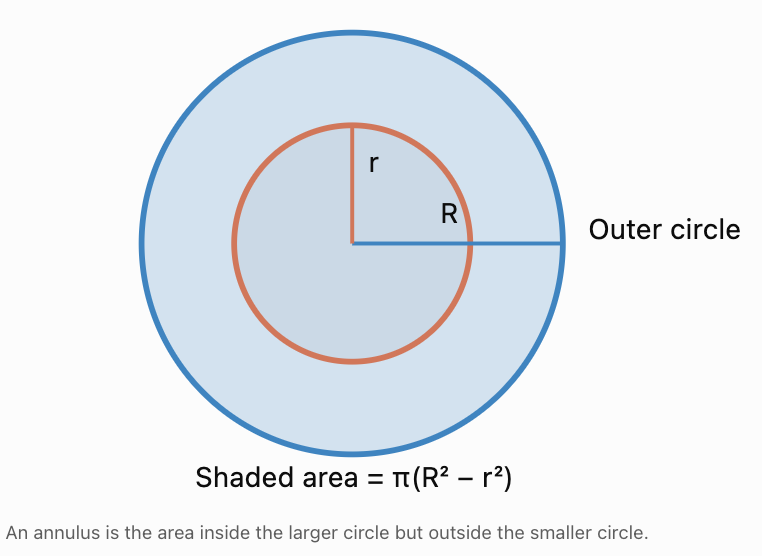
Worked Example 18: Circular Pathway
A circular pond has radius 5 m.
A pathway of uniform width 2 m surrounds the pond.
Find the area of the pathway.
Step 1: Find the outer radius.
R = 5 + 2 = 7 m
Step 2: Subtract the inner area from the outer area.
A = π(7² − 5²)
A = π(49 − 25)
A = 24π m²
A ≈ 75.40 m²
Answer: Approximately 75.40 m².
Real-World Measurement Problems
Application 1: Bicycle Wheel Distance
A bicycle wheel has radius 35 cm.
How far does the bicycle travel after 250 complete wheel revolutions, assuming no slipping?
Step 1: Calculate circumference.
C = 2π(35)
C = 70π cm
Step 2: Multiply by revolutions.
Distance = 250 × 70π
Distance = 17500π cm
Step 3: Convert to metres.
Distance = 175π m
Distance ≈ 549.78 m
Answer: Approximately 549.78 m.
This shows how circumference is used to calculate distance from rotational motion.
Application 2: Circular Garden Costs
A circular garden has radius 4.5 m.
A gardener wants to install edging around the garden and cover the inside with soil.
Edging costs $12 per metre.
Soil coverage costs $8 per square metre.
Find the total cost, ignoring waste and rounding purchases.
Step 1: Calculate edging length.
C = 2π(4.5)
C = 9π m
C ≈ 28.27 m
Edging cost:
12 × 9π = 108π
≈ $339.29
Step 2: Calculate soil area.
A = π(4.5²)
A = 20.25π m²
Soil cost:
8 × 20.25π = 162π
≈ $508.94
Step 3: Calculate total cost.
Total = 108π + 162π
Total = 270π
Total ≈ $848.23
Answer: Approximately $848.23.
In practice, the gardener may need to buy whole packages or allow extra materials for waste.
Application 3: Pizza Size Comparison
A restaurant sells two circular pizzas.
Small pizza diameter = 20 cm.
Large pizza diameter = 30 cm.
Compare their areas.
Small pizza:
r = 10 cm
A = π(10²) = 100π cm²
Large pizza:
r = 15 cm
A = π(15²) = 225π cm²
Area ratio:
225π/100π = 2.25
Answer: The large pizza has 2.25 times the area of the small pizza.
Although the diameter is only 1.5 times as large, the area is 2.25 times as large.
This is a useful reminder that area increases with the square of the radius.
Application 4: Circular Running Track
A runner follows a circular path with radius 50 m.
How many complete laps are needed to run at least 2 km?
Step 1: Calculate the lap length.
C = 2π(50)
C = 100π m
C ≈ 314.16 m
Step 2: Divide the target distance by the lap length.
Number of laps = 2000/(100π)
≈ 6.37
Step 3: Interpret.
The runner must complete at least 7 whole laps to reach or exceed 2 km.
Answer: 7 complete laps.
Application 5: Sprinkler Coverage
A sprinkler waters a 120° sector of a circle with radius 9 m.
Find the watered area.
A_sector = (120/360) × π(9²)
A_sector = (1/3) × 81π
A_sector = 27π m²
A_sector ≈ 84.82 m²
Answer: Approximately 84.82 m².
This model assumes the sprinkler covers the entire sector evenly and that there are no obstructions.
Application 6: A Circular Track with Two Straight Sections
A stadium track is formed from two straight sections, each 100 m long, joined by two semicircular ends of radius 35 m.
Find the total distance around the track.
Step 1: Add the straight sections.
Straight distance = 2 × 100 = 200 m
Step 2: Combine the semicircular ends.
Two semicircles make one complete circle.
Curved distance = 2π(35)
= 70π m
Step 3: Add the distances.
Total = 200 + 70π
Total ≈ 419.91 m
Answer: Approximately 419.91 m.
This is a simplified geometric model, not a statement about official athletics track dimensions.
Choosing the Correct Formula
Measurement required
Formula
Diameter
d = 2r
Circumference
C = 2πr or πd
Circle area
A = πr²
Arc length (degrees)
L = (θ/360°) × 2πr
Sector area (degrees)
A = (θ/360°) × πr²
Arc length (radians)
L = rθ
Sector area (radians)
A = ½r²θ
Sector area from arc length
A = ½rL
Sector perimeter
P = L + 2r
Semicircle area
A = ½πr²
Semicircle perimeter
P = πr + 2r
Annulus area
A = π(R² − r²)
A General Problem-Solving Strategy
When solving a measurement problem involving circles:
-
Identify the shape. Is it a circle, semicircle, sector, annulus, or composite figure?
-
Identify the measurements. Are you given a radius, diameter, angle, arc length, or area?
-
Choose the correct formula. Distinguish length from area.
-
Convert units if necessary. Use consistent units before calculating.
-
Substitute carefully. Remember to square the radius for area.
-
Keep π until the final step. Avoid premature rounding.
-
Interpret the result. Check whether the answer is reasonable and whether practical rounding is required.
Common Mistakes
Mistake 1: Confusing Radius and Diameter
If a circle has diameter 12 cm, its radius is 6 cm, not 12 cm.
Always identify whether the given measurement is a radius or diameter.
Mistake 2: Using the Circumference Formula for Area
Circumference:
C = 2πr
Area:
A = πr²
Circumference measures length. Area measures enclosed space.
Mistake 3: Forgetting to Square the Radius
Incorrect:
A = πr
Correct:
A = πr²
For a circle with radius 5 cm:
A = 25π cm², not 5π cm².
Mistake 4: Squaring the Diameter Instead of the Radius
If the diameter is 10 cm:
r = 5 cm
A = π(5²) = 25π cm²
Do not calculate π(10²) unless 10 cm is the radius.
Mistake 5: Using the Wrong Units
Circumference is measured in units such as cm or m.
Area is measured in square units such as cm² or m².
Mistake 6: Forgetting the Central Angle Fraction
A 60° sector is not the entire circle.
It occupies:
60/360 = 1/6
of the circle.
Mistake 7: Confusing Arc Length with Sector Perimeter
Arc length measures only the curved boundary.
Sector perimeter includes the arc and two radii.
P_sector = L + 2r
Mistake 8: Forgetting the Straight Edge of a Semicircle
The curved length of a semicircle is πr.
Its complete perimeter is:
P = πr + 2r
Mistake 9: Rounding Too Early
Using π = 3.14 at every intermediate step can introduce errors.
Keep π in exact form until the final calculation.
Mistake 10: Assuming Area and Circumference Increase at the Same Rate
Doubling the radius doubles the circumference but quadruples the area.
Mistake 11: Mixing Degrees and Radians
The formula L = rθ requires θ in radians.
If θ is in degrees, use:
L = (θ/360°) × 2πr
Mistake 12: Ignoring Practical Constraints
In real-world problems, materials may be sold in fixed quantities.
A calculation of 6.3 rolls of edging may require purchasing 7 rolls.
The mathematical result must be interpreted in context.
Key Terms
-
Circle: The set of points in a plane equally distant from a fixed centre.
-
Centre: The fixed point from which all radii are measured.
-
Radius: The distance from the centre to the circle.
-
Diameter: The distance across a circle through its centre.
-
Circumference: The distance around a circle.
-
Area: The amount of two-dimensional space enclosed by a shape.
-
Pi (π): The constant ratio of a circle's circumference to its diameter.
-
Arc: A portion of the circumference.
-
Arc Length: The distance along a circular arc.
-
Central Angle: An angle formed at the centre by two radii.
-
Sector: A region bounded by two radii and their intercepted arc.
-
Sector Area: The area enclosed within a sector.
-
Minor Arc: An arc measuring less than 180°.
-
Major Arc: An arc measuring more than 180°.
-
Semicircle: Half of a circle.
-
Annulus: A ring-shaped region between two concentric circles.
-
Concentric Circles: Circles sharing the same centre.
-
Radian: A unit of angle measurement based on the ratio of arc length to radius.
-
Linear Measurement: A measurement of length, such as metres.
-
Square Units: Units of area, such as cm² or m².
-
Composite Shape: A shape formed from two or more simpler shapes.
-
Direct Proportion: A relationship in which two quantities increase or decrease by the same factor.
-
Quadratic Relationship: A relationship involving the square of a variable.
-
Mathematical Model: A mathematical representation of a real-world situation.
Key Takeaways
-
The diameter of a circle is twice its radius.
-
The circumference is the distance around a circle.
-
Circumference can be calculated using C = 2πr or C = πd.
-
The area of a circle is A = πr².
-
Circumference is proportional to radius.
-
Area is proportional to the square of radius.
-
Doubling the radius doubles circumference but quadruples area.
-
Arc length is a fraction of the full circumference.
-
Arc length in degrees is L = (θ/360°) × 2πr.
-
Sector area is a fraction of the full circle's area.
-
Sector area in degrees is A = (θ/360°) × πr².
-
With radians, L = rθ and A_sector = ½r²θ.
-
The perimeter of a sector includes its arc and both radii.
-
Composite circular areas can be found by adding or subtracting simpler areas.
-
Circle measurement formulas are useful in transport, construction, landscaping, manufacturing, and design.
-
Units, rounding, and practical constraints are essential when interpreting real-world answers.
Check Your Understanding
Show all working. Give exact answers in terms of π where possible, followed by approximations when requested.
Question 1: Circumference
Calculate the circumference of a circle with radius 9 cm.
Give your answer in terms of π and to two decimal places.
Question 2: Diameter and Circumference
A circular table has diameter 2.4 m.
Calculate its circumference to two decimal places.
Question 3: Finding the Radius
A circle has circumference 36π cm.
Find its radius.
Question 4: Area of a Circle
A circle has radius 11 cm.
Calculate its area in terms of π.
Question 5: Area from Diameter
A circular garden has diameter 18 m.
Calculate its area to two decimal places.
Question 6: Finding Radius from Area
A circle has area 81π cm².
Find its radius and diameter.
Question 7: Arc Length
A circle has radius 15 cm.
Calculate the arc length corresponding to a central angle of 72°.
Question 8: Sector Area
A circle has radius 12 cm.
Calculate the area of a 135° sector.
Question 9: Finding a Central Angle
An arc of length 5π cm belongs to a circle with radius 10 cm.
Find the central angle.
Question 10: Sector Perimeter
A sector has radius 8 cm and central angle 90°.
Calculate its complete perimeter.
Question 11: Annulus Area
Two concentric circles have radii 10 cm and 6 cm.
Find the area of the region between them.
Question 12: Wheel Revolutions
A wheel has diameter 80 cm.
How many complete revolutions are needed to travel at least 1 km, assuming the wheel rolls without slipping?
Question 13: Comparing Circles
Circle B has a radius three times that of Circle A.
Determine:
a) The ratio of their circumferences.
b) The ratio of their areas.
Explain your reasoning.
Question 14: Circular Garden Costs
A circular garden has radius 6 m.
Edging costs $15 per metre.
Grass costs $9 per square metre.
Calculate the total cost of edging and covering the garden with grass.
Assume materials can be purchased in exact quantities.
Question 15: Comprehensive Challenge
A circular park has radius 20 m.
A walking path of uniform width 3 m is constructed around the outside of the park.
A decorative fence is installed around the outer boundary of the path.
Calculate:
a) The outer radius.
b) The area of the walking path.
c) The length of fencing required.
d) The cost of the path if construction costs $45 per square metre.
e) The cost of the fence if fencing costs $30 per metre.
f) The total cost of the project.
Use full precision in intermediate calculations and round final monetary answers to the nearest cent.
Fully Worked Answers
Answer 1: Circumference
Given:
r = 9 cm
C = 2πr
C = 2π(9)
C = 18π cm
C ≈ 56.55 cm
Answer: 18π cm, or 56.55 cm.
Answer 2: Diameter and Circumference
Given:
d = 2.4 m
C = πd
C = 2.4π m
C ≈ 7.54 m
Answer: 7.54 m.
Answer 3: Finding the Radius
Given:
C = 36π cm
Use:
C = 2πr
36π = 2πr
Divide by 2π:
r = 18 cm
Answer: 18 cm.
Answer 4: Area of a Circle
Given:
r = 11 cm
A = πr²
A = π(11²)
A = 121π cm²
Answer: 121π cm².
Answer 5: Area from Diameter
Given:
d = 18 m
First find the radius:
r = 18/2 = 9 m
Then:
A = πr²
A = π(9²)
A = 81π m²
A ≈ 254.47 m²
Answer: 254.47 m².
Answer 6: Finding Radius from Area
Given:
A = 81π cm²
A = πr²
81π = πr²
Divide by π:
81 = r²
r = 9 cm
Diameter:
d = 2r = 18 cm
Answer: Radius = 9 cm; diameter = 18 cm.
Answer 7: Arc Length
Given:
r = 15 cm
θ = 72°
L = (θ/360°) × 2πr
L = (72/360) × 2π(15)
L = (1/5) × 30π
L = 6π cm
L ≈ 18.85 cm
Answer: 6π cm, or approximately 18.85 cm.
Answer 8: Sector Area
Given:
r = 12 cm
θ = 135°
A_sector = (θ/360°) × πr²
A_sector = (135/360) × π(12²)
A_sector = (3/8) × 144π
A_sector = 54π cm²
A_sector ≈ 169.65 cm²
Answer: 54π cm², or approximately 169.65 cm².
Answer 9: Finding a Central Angle
Given:
L = 5π cm
r = 10 cm
Use:
L = (θ/360°) × 2πr
5π = (θ/360) × 20π
Divide by π:
5 = 20θ/360
Multiply by 360:
1800 = 20θ
θ = 90°
Answer: 90°.
Answer 10: Sector Perimeter
Given:
r = 8 cm
θ = 90°
Step 1: Calculate the arc length.
L = (90/360) × 2π(8)
L = (1/4) × 16π
L = 4π cm
Step 2: Add the two radii.
P = L + 2r
P = 4π + 16
P ≈ 28.57 cm
Answer: 16 + 4π cm, or approximately 28.57 cm.
Answer 11: Annulus Area
Given:
Outer radius R = 10 cm
Inner radius r = 6 cm
Use:
A = π(R² − r²)
A = π(10² − 6²)
A = π(100 − 36)
A = 64π cm²
A ≈ 201.06 cm²
Answer: 64π cm², or approximately 201.06 cm².
Answer 12: Wheel Revolutions
Given:
Diameter = 80 cm
Distance = 1 km = 100,000 cm
Step 1: Calculate circumference.
C = πd
C = 80π cm
Step 2: Calculate the number of revolutions.
Revolutions = Distance/Circumference
= 100000/(80π)
= 1250/π
≈ 397.89
Step 3: Interpret the result.
The wheel must make at least 398 complete revolutions to travel 1 km or more.
Answer: 398 complete revolutions.
Answer 13: Comparing Circles
Let Circle A have radius r.
Circle B has radius 3r.
a) Circumference ratio
Circle A:
C_A = 2πr
Circle B:
C_B = 2π(3r) = 6πr
Therefore:
C_B/C_A = 6πr/(2πr) = 3
Circumference ratio B : A = 3 : 1.
b) Area ratio
Circle A:
A_A = πr²
Circle B:
A_B = π(3r)² = 9πr²
Therefore:
A_B/A_A = 9
Area ratio B : A = 9 : 1.
The circumference scales directly with radius, while area scales with the square of radius.
Answer 14: Circular Garden Costs
Given:
r = 6 m
Edging cost = $15/m
Grass cost = $9/m²
Step 1: Calculate circumference.
C = 2π(6) = 12π m
Step 2: Calculate edging cost.
Edging cost = 15 × 12π
= 180π dollars
≈ $565.49
Step 3: Calculate area.
A = π(6²)
A = 36π m²
Step 4: Calculate grass cost.
Grass cost = 9 × 36π
= 324π dollars
≈ $1,017.88
Step 5: Calculate total cost without intermediate rounding.
Total = 180π + 324π
Total = 504π
Total ≈ $1,583.36
Answer: Approximately $1,583.36.
Answer 15: Comprehensive Challenge
Given:
Park radius = 20 m
Path width = 3 m
Path construction = $45/m²
Fence = $30/m
a) Outer radius
R = 20 + 3
Answer: 23 m.
b) Area of the walking path
The path forms an annulus.
A = π(R² − r²)
A = π(23² − 20²)
A = π(529 − 400)
A = 129π m²
A ≈ 405.27 m²
Answer: 129π m², or approximately 405.27 m².
c) Length of fencing
The fence follows the outer circumference.
C = 2πR
C = 2π(23)
C = 46π m
C ≈ 144.51 m
Answer: 46π m, or approximately 144.51 m.
d) Cost of constructing the path
Cost = Area × Cost per square metre
Cost = 129π × 45
Cost = 5805π dollars
Cost ≈ $18,236.81
Answer: $18,236.81.
e) Cost of fencing
Cost = Circumference × Cost per metre
Cost = 46π × 30
Cost = 1380π dollars
Cost ≈ $4,335.40
Answer: $4,335.40.
f) Total project cost
Add the exact expressions before rounding:
Total = 5805π + 1380π
Total = 7185π dollars
Total ≈ $22,572.21
Final answer: $22,572.21.
This problem combines circumference, area, annuli, unit-based pricing, and practical interpretation.
Final Course Connections
Circumference and area provide an important link between geometry and algebra.
Circumference is a linear function of radius:
C(r) = 2πr
Area is a quadratic function of radius:
A(r) = πr²
Arc length and sector area extend these relationships to portions of circles, while composite shapes allow us to apply them to more complex situations.
The central problem-solving skill is recognizing what is being measured: a length, an area, a curved boundary, or a combination of regions.
This completes Circumference and Area, with all five learning targets covered through explanations, worked examples, visual representations, practical applications, and fully worked assessment questions.
-
-
5. Geometric Proofs with Circles and Polygons
Learning outcomes
- I can prove properties involving polygons.
- I can prove properties involving circles.
- I can combine multiple theorems in a proof.
- I can justify geometric relationships logically.
- I can communicate complete mathematical arguments.
Introduction
Geometry is not only about calculating angles, lengths, and areas. It is also about understanding why mathematical relationships are true.
For example, we know that the interior angles of a triangle add to 180°. We know that opposite angles in a cyclic quadrilateral add to 180°, and that the diagonals of a parallelogram bisect each other.
But how can we demonstrate that these properties are always true, rather than simply observing them in a diagram?
The answer is geometric proof.
A geometric proof is a logical argument that begins with known facts and uses established mathematical principles to reach a conclusion.
Proofs allow us to connect different areas of geometry. A problem involving a circle might require properties of triangles, parallel lines, and quadrilaterals. A polygon problem might require algebra, congruence, similarity, or circle theorems.
By learning to construct complete proofs, we develop mathematical reasoning skills that extend far beyond geometry.
What Is a Geometric Proof?
A geometric proof is a sequence of logically justified statements demonstrating that a geometric claim must be true.
A valid proof usually contains:
-
Given information: Facts stated in the question.
-
Statement to prove: The conclusion we must establish.
-
Construction: Additional lines or points that may help.
-
Mathematical reasoning: A sequence of deductions.
-
Justification: The theorem, definition, or property supporting each deduction.
-
Conclusion: A clear statement of what has been proved.
Example: A Simple Triangle Proof
Given: Triangle ABC has AB = AC.
Prove: ∠ABC = ∠BCA.
Reasoning:
AB = AC.
Therefore, triangle ABC is isosceles.
The base angles of an isosceles triangle are equal.
Hence:
∠ABC = ∠BCA.
This is a complete proof because the conclusion follows from a known geometric theorem.
Mathematical Statements and Their Converses
A geometric theorem often has the form:
If P is true, then Q is true.
For example:
If a quadrilateral is a rectangle, then its diagonals are equal.
The converse reverses the statement:
If a quadrilateral has equal diagonals, then it is a rectangle.
The converse is not always true.
An isosceles trapezoid can have equal diagonals without being a rectangle.
Therefore, proving a theorem does not automatically prove its converse.
Counterexamples
A counterexample is a single example showing that a general statement is false.
Consider the statement:
“All quadrilaterals with equal diagonals are rectangles.”
An isosceles trapezoid with equal diagonals provides a counterexample.
A counterexample disproves a universal claim, but it does not establish a replacement theorem.
Deductive and Inductive Reasoning
Inductive Reasoning
Inductive reasoning involves observing patterns and forming conjectures.
For example:
-
A triangle has interior angle sum 180°.
-
A quadrilateral has interior angle sum 360°.
-
A pentagon has interior angle sum 540°.
We might conjecture that an n-sided polygon has interior angle sum:
S = (n − 2) × 180°.
Observing examples provides evidence, but not a complete proof.
Deductive Reasoning
Deductive reasoning begins with established facts and uses logic to prove a conclusion.
For the polygon angle sum, we can divide a simple polygon into n − 2 triangles.
Each triangle has angle sum 180°.
Therefore:
S = (n − 2) × 180°.
This establishes the formula for every simple polygon, not merely the examples we have checked.
Common Facts Used in Geometric Proofs
Before constructing more advanced proofs, we should recall several important geometric relationships.
|
Geometric fact |
Mathematical relationship |
|---|---|
|
Angles on a straight line |
Sum = 180° |
|
Angles around a point |
Sum = 360° |
|
Vertically opposite angles |
Equal |
|
Triangle interior angles |
Sum = 180° |
|
Exterior angle of a triangle |
Sum of two remote interior angles |
|
Alternate interior angles of parallel lines |
Equal |
|
Corresponding angles of parallel lines |
Equal |
|
Co-interior angles of parallel lines |
Sum = 180° |
|
Base angles of an isosceles triangle |
Equal |
|
Opposite angles of a parallelogram |
Equal |
|
Adjacent angles of a parallelogram |
Sum = 180° |
|
Angle at centre of a circle |
Twice the inscribed angle on the same arc |
|
Angle in a semicircle |
90° |
|
Opposite angles of a cyclic quadrilateral |
Sum = 180° |
|
Radius to a point of tangency |
Perpendicular to tangent |
These facts are the building blocks of longer geometric arguments.
Proving Polygon Properties
Polygons are closed figures formed by straight line segments.
Many polygon proofs involve dividing the figure into triangles, using parallel lines, or establishing congruent triangles.
Proof 1: Interior Angle Sum of a Polygon
Theorem: The sum of the interior angles of a simple polygon with n sides is:
S = (n − 2) × 180°.
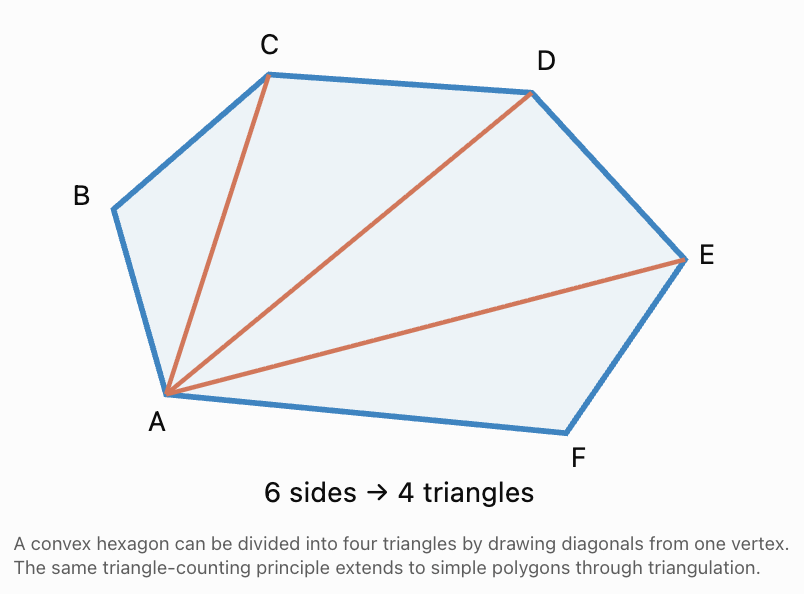
Given: A simple polygon with n sides.
Prove: S = (n − 2) × 180°.
Proof:
-
Every simple polygon can be triangulated into non-overlapping triangles whose vertices are polygon vertices.
-
A triangulation of an n-sided simple polygon contains n − 2 triangles.
-
Each triangle has an interior angle sum of 180°.
-
The triangle angles together make up all the interior angles of the polygon.
Therefore:
S = (n − 2) × 180°.
Hence, the theorem is proved.
Worked Example 1: Applying the Polygon Angle Sum Theorem
A polygon has an interior angle sum of 1980°.
Find its number of sides.
S = (n − 2) × 180°
1980 = (n − 2) × 180
11 = n − 2
n = 13
Answer: The polygon has 13 sides.
Proof 2: Exterior Angle Sum of a Convex Polygon
Theorem: The sum of one exterior angle at each vertex of a convex polygon is 360°.
Given: A convex polygon with n sides.
Proof:
Each interior angle and its adjacent exterior angle form a straight line.
Therefore:
Interior angle + Exterior angle = 180°.
For n vertices:
Sum of interior angles + Sum of exterior angles = 180n.
The interior angle sum is:
180(n − 2).
Therefore:
180(n − 2) + Sum of exterior angles = 180n.
Rearranging:
Sum of exterior angles = 180n − 180(n − 2)
= 180n − 180n + 360
= 360°.
Therefore, the exterior angle sum is always 360°.
Proof 3: Opposite Sides of a Parallelogram Are Equal
Given: ABCD is a parallelogram.
Prove: AB = CD and BC = AD.
Draw diagonal AC.
Since AB ∥ CD:
∠BAC = ∠DCA.
These are alternate interior angles.
Since BC ∥ AD:
∠BCA = ∠DAC.
These are also alternate interior angles.
AC is common to both triangles.
Therefore:
△ABC ≅ △CDA by ASA.
Corresponding sides of congruent triangles are equal.
Hence:
AB = CD
BC = AD.
The opposite sides of a parallelogram are equal.
Proof 4: Diagonals of a Parallelogram Bisect Each Other
Given: ABCD is a parallelogram, and diagonals AC and BD intersect at O.
Prove: AO = OC and BO = OD.
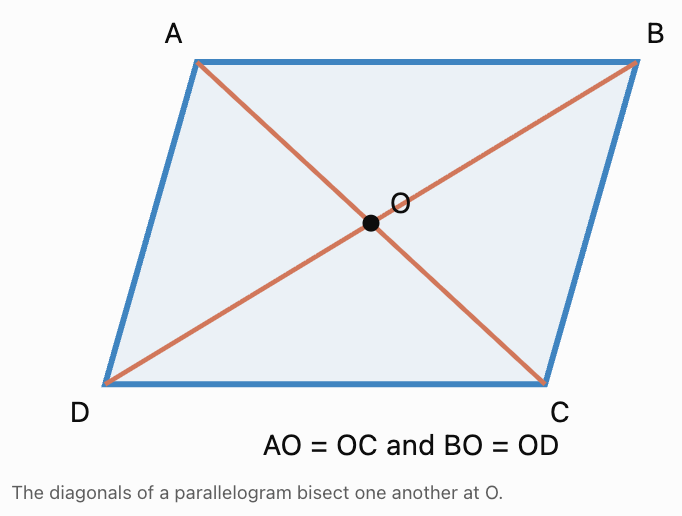
Consider triangles AOB and COD.
Since AB ∥ CD:
∠ABO = ∠CDO
∠BAO = ∠DCO.
Also, opposite sides of a parallelogram are equal:
AB = CD.
Therefore:
△AOB ≅ △COD by ASA.
Corresponding sides are equal.
Thus:
AO = OC
BO = OD.
Therefore, the diagonals bisect each other.
Proving Circle Properties
Circle theorems provide relationships between radii, chords, tangents, arcs, and angles.
Many of these theorems can be proved using isosceles triangles and previously established angle properties.
Proof 5: A Radius Is Perpendicular to a Tangent
Theorem: A tangent to a circle is perpendicular to the radius at the point of tangency.
Given: A circle with centre O and tangent line t touching the circle at T.
Prove: OT ⟂ t.
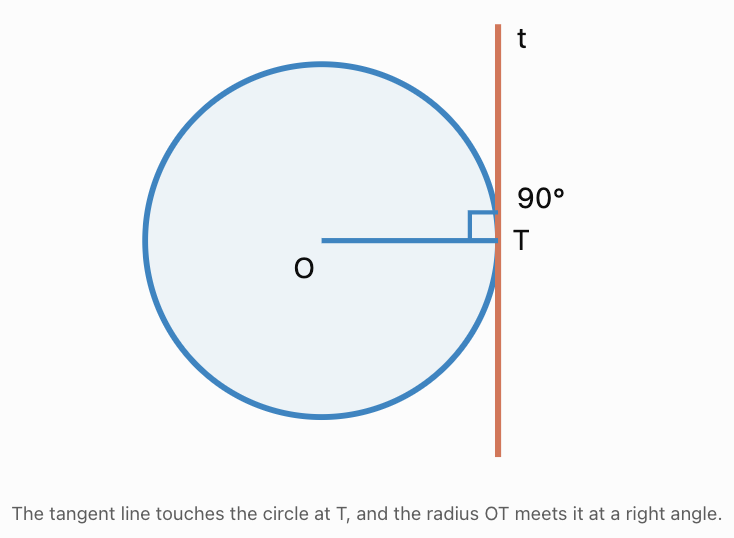
Proof by contradiction:
Assume OT is not perpendicular to t.
Draw the perpendicular from O to t, meeting t at P.
Since OT is not perpendicular to t, P and T are different points.
Triangle OPT is right-angled at P.
Therefore, OT is the hypotenuse, so:
OP < OT.
But OT is a radius, so OT = r.
Therefore:
OP < r.
This means P lies inside the circle.
A line passing through an interior point of a circle intersects the circle at two distinct points.
That contradicts the fact that t is a tangent, which intersects the circle at exactly one point.
Therefore, our assumption is false.
Hence, OT ⟂ t.
Proof 6: Tangents from the Same External Point Are Equal
Given: PA and PB are tangents from an external point P to a circle with centre O.
Prove: PA = PB.
Join OA, OB, and OP.
Because radii are perpendicular to tangents:
∠OAP = 90°
∠OBP = 90°.
OA = OB because both are radii.
OP is common to triangles OAP and OBP.
Therefore:
△OAP ≅ △OBP by RHS congruence.
Corresponding sides are equal.
Hence:
PA = PB.
Worked Example 2: Algebraic Tangent Lengths
Two tangents from P have lengths:
PA = 4x + 3
PB = 7x − 12.
Find x and both lengths.
Tangents from the same external point are equal.
4x + 3 = 7x − 12
15 = 3x
x = 5
PA = 4(5) + 3 = 23
PB = 7(5) − 12 = 23
Answer: x = 5 and both tangents are 23 units long.
Proof 7: The Inscribed Angle Theorem
Theorem: An inscribed angle is half the measure of the central angle intercepting the same arc.
Suppose A, B, and C lie on a circle with centre O.
The central angle ∠AOB and inscribed angle ∠ACB intercept the same arc AB.
Then:
∠AOB = 2∠ACB
when ∠AOB denotes the central angle corresponding to that arc.
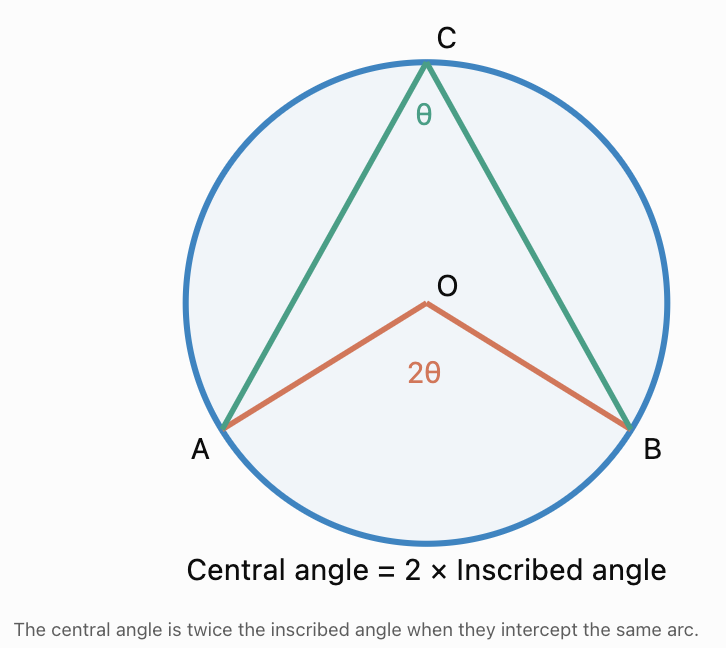
Proof
We first consider the case in which one side of the inscribed angle passes through the centre.
Let C, O, and B be collinear, with CB a diameter.
Join OA.
Since OA = OC, triangle AOC is isosceles.
Let:
∠ACO = ∠OAC = x.
The triangle angle sum gives:
∠AOC = 180° − 2x.
Because OB is opposite OC:
∠AOB = 180° − ∠AOC
∠AOB = 2x.
Since C, O, and B are collinear:
∠ACB = x.
Therefore:
∠AOB = 2∠ACB.
For the general case, draw the diameter from C through O.
This divides the inscribed angle into two smaller angles, or expresses it as their difference.
Applying the result above to each smaller angle and adding or subtracting as appropriate gives:
Central angle = 2 × Inscribed angle.
This proves the theorem.
Worked Example 3: Central and Inscribed Angles
A central angle is (6x + 20)°.
An inscribed angle intercepting the same arc is (2x + 30)°.
Find x.
Use:
Central angle = 2 × Inscribed angle.
6x + 20 = 2(2x + 30)
6x + 20 = 4x + 60
2x = 40
x = 20
Central angle:
6(20) + 20 = 140°.
Inscribed angle:
2(20) + 30 = 70°.
Answer: x = 20, central angle = 140°, inscribed angle = 70°.
Proof 8: An Angle in a Semicircle Is a Right Angle
Given: AB is a diameter of a circle, and C lies on its circumference.
Prove: ∠ACB = 90°.
Because AB is a diameter, the arc AB not containing C measures 180°.
By the inscribed angle theorem:
∠ACB = ½ × 180°
Therefore:
∠ACB = 90°.
This theorem is sometimes called Thales' theorem.
Worked Example 4: Triangle in a Semicircle
AB is a diameter, and C lies on the circumference.
∠CAB = 32°.
Find ∠ABC.
By the angle in a semicircle theorem:
∠ACB = 90°.
Using the triangle angle sum:
32° + 90° + ∠ABC = 180°
∠ABC = 58°.
Answer: 58°.
Proof 9: Opposite Angles of a Cyclic Quadrilateral Are Supplementary
A cyclic quadrilateral is a quadrilateral with all four vertices on the same circle.
Given: ABCD is cyclic.
Prove:
∠A + ∠C = 180°.
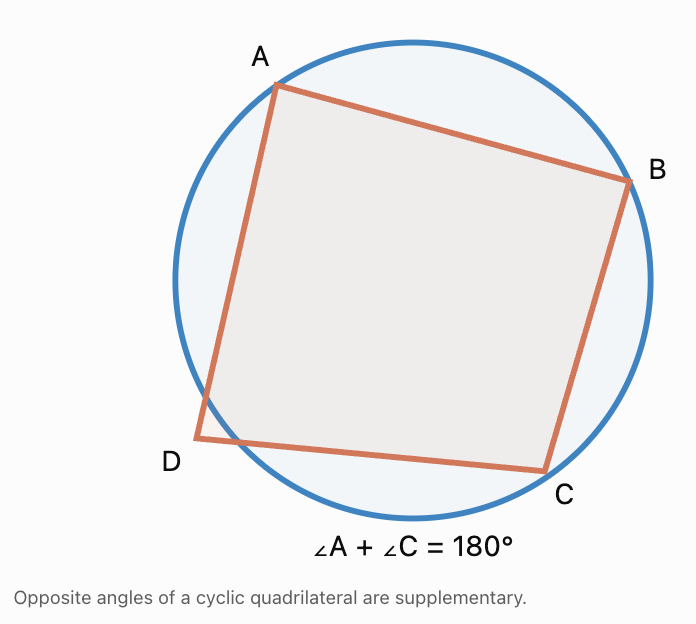
Proof:
Angle A intercepts arc BCD.
Angle C intercepts arc BAD.
These arcs together form the complete circle.
Therefore:
Arc BCD + Arc BAD = 360°.
By the inscribed angle theorem:
∠A = ½ × arc BCD
∠C = ½ × arc BAD.
Adding:
∠A + ∠C = ½ × 360°
∠A + ∠C = 180°.
Similarly:
∠B + ∠D = 180°.
Hence, opposite angles of a cyclic quadrilateral are supplementary.
Worked Example 5: Algebraic Cyclic Quadrilateral
In cyclic quadrilateral ABCD:
∠A = (3x + 15)°
∠C = (5x − 11)°.
Find x.
Opposite angles sum to 180°.
(3x + 15) + (5x − 11) = 180
8x + 4 = 180
8x = 176
x = 22
Then:
∠A = 81°
∠C = 99°.
Verification:
81 + 99 = 180°.
Answer: x = 22.
Combining Multiple Theorems in a Proof
Many challenging geometry problems cannot be solved using a single theorem.
Instead, we must recognize how several geometric relationships fit together.
For example, a proof may involve:
-
Identifying an isosceles triangle using equal radii.
-
Calculating angles using the triangle angle sum.
-
Applying the inscribed angle theorem.
-
Recognizing a cyclic quadrilateral.
-
Using supplementary angles to establish the final result.
The key is to work from the given information toward the statement that must be proved.
Proof 10: The Tangent–Chord Theorem
Theorem: The angle between a tangent and a chord equals the angle in the alternate segment of the circle.
Given: A tangent touches a circle at A. AB is a chord, and C is a point on the opposite arc AB.
Prove: The angle between the tangent and chord AB equals ∠ACB.
Proof
Let O be the centre.
Join OA and OB.
Because OA = OB, triangle AOB is isosceles.
Let the central angle ∠AOB be 2x, where this angle intercepts the arc AB not containing C.
The base angles are:
∠OAB = ∠ABO = (180° − 2x)/2
Therefore:
∠OAB = 90° − x.
The radius OA is perpendicular to the tangent at A.
Hence, the acute angle between the tangent and chord AB is:
90° − (90° − x) = x.
By the inscribed angle theorem:
∠ACB = ½∠AOB = x.
Therefore:
The angle between the tangent and chord equals ∠ACB.
The supplementary tangent–chord angle corresponds to the inscribed angle on the other arc.
This proof combines the properties of isosceles triangles, tangent–radius perpendicularity, and the inscribed angle theorem.
Proof 11: The Intersecting Chords Theorem
Theorem: If two chords intersect inside a circle, the products of their segment lengths are equal.
Given: Chords AB and CD intersect at P.
Prove:
PA × PB = PC × PD.
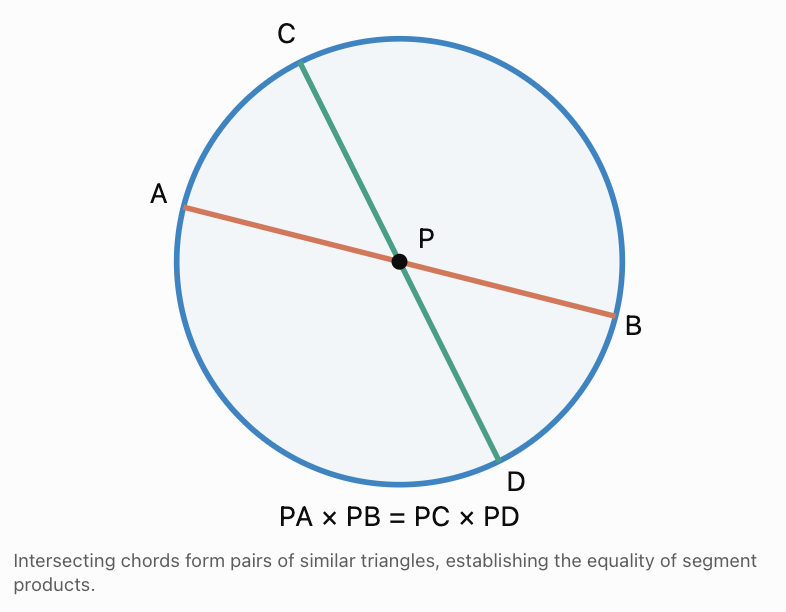
Proof
Consider triangles PAC and PDB.
First:
∠APC = ∠DPB
because they are vertically opposite angles.
Next:
∠PAC = ∠PDB
because they are inscribed angles intercepting the same arc BC.
Therefore:
△PAC ∼ △PDB by AA similarity.
Corresponding side ratios are equal:
PA/PD = PC/PB
Cross-multiply:
PA × PB = PC × PD.
Hence, the intersecting chords theorem is proved.
Worked Example 6: Intersecting Chords
Two chords intersect at P.
PA = 4 cm
PB = 9 cm
PC = 6 cm
Find PD.
Using the theorem:
PA × PB = PC × PD
4 × 9 = 6 × PD
36 = 6PD
PD = 6 cm
Answer: PD = 6 cm.
Proof 12: Opposite Angles of a Cyclic Quadrilateral and an Exterior Angle
Theorem: An exterior angle of a cyclic quadrilateral equals its opposite interior angle.
Given: ABCD is a cyclic quadrilateral. Side AB is extended beyond B to E.
Prove:
∠EBC = ∠ADC.
Proof
Since ABCD is cyclic:
∠ABC + ∠ADC = 180°.
Since A, B, and E lie on a straight line:
∠ABC + ∠EBC = 180°.
Both ∠ADC and ∠EBC are supplementary to ∠ABC.
Therefore:
∠EBC = ∠ADC.
This proof combines the cyclic quadrilateral theorem with angles on a straight line.
Proof 13: A Parallelogram Inscribed in a Circle Is a Rectangle
This is an important example of combining polygon and circle theorems.
Given: ABCD is both a parallelogram and a cyclic quadrilateral.
Prove: ABCD is a rectangle.
Proof
Since ABCD is a parallelogram, opposite angles are equal.
Therefore:
∠A = ∠C.
Since ABCD is cyclic, opposite angles are supplementary.
Therefore:
∠A + ∠C = 180°.
Substitute ∠C = ∠A:
2∠A = 180°.
∠A = 90°.
Hence:
∠C = 90°.
The same reasoning gives:
∠B = ∠D = 90°.
All four interior angles are right angles.
A parallelogram with four right angles is a rectangle.
Therefore, ABCD is a rectangle.
This proof is especially useful because it connects two different families of geometric properties.
Proof 14: A Rectangle Can Be Inscribed in a Circle
Given: ABCD is a rectangle.
Prove: Its four vertices lie on a circle.
Proof
Let O be the intersection of diagonals AC and BD.
Since ABCD is a rectangle, its diagonals are equal:
AC = BD.
Also, diagonals of a parallelogram bisect each other.
Therefore:
AO = OC = AC/2
BO = OD = BD/2.
Since AC = BD:
AO = BO = CO = DO.
Thus, all four vertices are the same distance from O.
A circle centred at O with radius OA passes through A, B, C, and D.
Therefore, every rectangle is cyclic.
Together, Proofs 13 and 14 establish that a parallelogram is cyclic if and only if it is a rectangle.
Proof 15: Pythagoras' Theorem Using a Circle
Given: Triangle ABC is inscribed in a circle with diameter AB.
Prove:
AB² = AC² + BC².
Proof
Since AB is a diameter:
∠ACB = 90°
by the angle in a semicircle theorem.
Therefore, triangle ABC is right-angled at C.
By the Pythagorean theorem:
AC² + BC² = AB².
Hence, AB² = AC² + BC².
Strictly speaking, this is an application of the Pythagorean theorem rather than an independent proof of it. It demonstrates how a circle theorem establishes the condition needed to use another theorem.
Worked Example 7: A Multi-Theorem Circle Problem
AB is a diameter of a circle, and C lies on the circumference.
The lengths are:
AC = 9 cm
BC = 12 cm.
A tangent touches the circle at A.
Find:
a) AB.
b) The radius.
c) The angle between the tangent at A and AB.
Solution
a) Find AB.
Because AB is a diameter:
∠ACB = 90°.
Use the Pythagorean theorem:
AB² = AC² + BC²
AB² = 9² + 12²
AB² = 81 + 144
AB² = 225
AB = 15 cm.
b) Find the radius.
r = AB/2
r = 15/2
r = 7.5 cm.
c) Find the tangent angle.
AB lies along the radius OA.
A tangent is perpendicular to the radius at the point of tangency.
Therefore, the angle between the tangent and AB is 90°.
Answers: AB = 15 cm, r = 7.5 cm, tangent angle = 90°.
Worked Example 8: Combining a Cyclic Quadrilateral and a Triangle
ABCD is cyclic.
Diagonal AC is drawn.
Given:
∠ABC = 112°
∠BAC = 28°
∠CAD = 35°.
Find:
a) ∠ADC.
b) ∠BCA.
c) ∠BCD.
Solution
a) Find ∠ADC.
Opposite angles of a cyclic quadrilateral are supplementary.
∠ABC + ∠ADC = 180°
112° + ∠ADC = 180°
∠ADC = 68°.
b) Find ∠BCA.
In triangle ABC:
∠BAC + ∠ABC + ∠BCA = 180°
28° + 112° + ∠BCA = 180°
∠BCA = 40°.
c) Find ∠BCD.
First find ∠ACD using triangle ACD.
∠CAD + ∠ADC + ∠ACD = 180°
35° + 68° + ∠ACD = 180°
∠ACD = 77°.
Diagonal AC divides angle BCD into two parts:
∠BCD = ∠BCA + ∠ACD
∠BCD = 40° + 77°
∠BCD = 117°.
Final answers:
a) 68°.
b) 40°.
c) 117°.
Verification: ∠BAD = 28° + 35° = 63°, and 63° + 117° = 180°, as required for opposite angles of a cyclic quadrilateral.
Writing Complete Mathematical Arguments
A correct numerical answer is not always a complete geometric proof.
When asked to prove, justify, or show that a statement is true, we must communicate the reasoning connecting the given information to the conclusion.
Two-Column Proofs
A two-column proof separates mathematical statements from their justifications.
For example, suppose ABCD is a parallelogram.
We want to prove that ∠A = ∠C.
|
Statement |
Reason |
|---|---|
|
AB ∥ CD and AD ∥ BC |
Definition of a parallelogram |
|
∠A + ∠B = 180° |
Co-interior angles |
|
∠B + ∠C = 180° |
Co-interior angles |
|
∠A + ∠B = ∠B + ∠C |
Both expressions equal 180° |
|
∠A = ∠C |
Subtract ∠B from both sides |
This is a complete deductive argument.
Paragraph Proofs
The same proof can be written as a paragraph:
Since ABCD is a parallelogram, both pairs of opposite sides are parallel. Co-interior angles along parallel lines are supplementary, so ∠A + ∠B = 180° and ∠B + ∠C = 180°. Therefore, ∠A + ∠B = ∠B + ∠C. Subtracting ∠B from both sides gives ∠A = ∠C. Hence, opposite angles of a parallelogram are equal.
Both formats are valid.
How to Improve the Clarity of a Proof
A strong proof should:
-
Identify the given information.
-
State exactly what must be proved.
-
Label the diagram clearly.
-
Use established definitions and theorems.
-
Explain why each statement follows.
-
Avoid assuming the conclusion.
-
Use consistent angle and point notation.
-
Finish with a clear concluding statement.
Strategies for Complex Geometric Proofs
Strategy 1: Work Forward from the Given Information
Ask:
What can I immediately conclude from the facts provided?
For example, if two sides of a triangle are radii of the same circle, they are equal.
Therefore, the triangle is isosceles.
This gives equal base angles, which may lead to further angle relationships.
Strategy 2: Work Backward from the Conclusion
Ask:
What would be sufficient to prove the required result?
For example, to prove a quadrilateral is a rectangle, we might show that it is a parallelogram with one right angle.
Alternatively, we could prove directly that all four angles are right angles.
Strategy 3: Draw Auxiliary Lines
An auxiliary line is an additional line introduced to help solve a problem.
Useful constructions include:
-
Drawing a diagonal in a quadrilateral.
-
Joining the centre of a circle to a point on its circumference.
-
Drawing a diameter through an inscribed angle's vertex.
-
Joining the centre to the point of tangency.
-
Drawing a perpendicular to a chord.
-
Extending a side to create an exterior angle.
These constructions reveal triangles, parallel lines, and angle relationships that may not initially be visible.
Strategy 4: Look for Congruent or Similar Triangles
Congruent triangles have equal corresponding sides and angles.
Common congruence criteria include:
-
SSS
-
SAS
-
ASA
-
AAS
-
RHS
Similar triangles have equal corresponding angles and proportional corresponding sides.
Common similarity criteria include:
-
AA
-
SAS similarity
-
SSS similarity
Strategy 5: Check the Logic
Every statement must follow from something already known.
For example, this is invalid:
“The diagonals look equal, so the quadrilateral is a rectangle.”
The diagram's appearance is not sufficient evidence.
A stronger argument might establish that the quadrilateral is a parallelogram and that its diagonals are equal. Those two facts together are sufficient to prove it is a rectangle.
Real-World Applications of Geometric Proofs
Architecture and Structural Engineering
Engineers use geometric reasoning to understand structural shapes.
Triangle congruence and rigidity help explain why triangulated frameworks are common in bridges and roofs.
Proofs also help establish geometric constraints in designs, although real structures additionally require analysis of forces, materials, and loads.
Surveying and Land Measurement
Surveyors use triangles, angles, and distances to determine positions and measurements.
Similarity and congruence can justify relationships between measured lengths and inaccessible distances.
Computer-Aided Design
Computer-aided design software uses geometric constraints such as parallelism, perpendicularity, tangency, and equal lengths.
A geometric model can be designed so that certain relationships remain true even when dimensions change.
Optical and Mechanical Systems
Circular geometry is important in the design of gears, bearings, and rotating components.
Theorems involving tangents, radii, and angles help describe contact geometry and geometric constraints.
Common Mistakes
Mistake 1: Using a Diagram as Evidence
A line may appear perpendicular or two sides may appear equal.
Unless this information is given or proved, it cannot be assumed.
Mistake 2: Confusing a Theorem with Its Converse
A rectangle has equal diagonals.
However, equal diagonals alone do not prove a quadrilateral is a rectangle.
Mistake 3: Stating a Result Without a Reason
Weak argument:
“∠A = ∠C.”
Better argument:
“∠A = ∠C because opposite angles of a parallelogram are equal.”
Mistake 4: Assuming the Conclusion
A proof is circular if it uses the result being proved as one of its premises.
For example, when proving that diagonals bisect each other, we cannot begin by assuming that they bisect each other.
Mistake 5: Using a Circle Theorem with the Wrong Arc
Central and inscribed angles must intercept the same arc for the usual doubling relationship to apply.
Mistake 6: Assuming All Quadrilaterals Are Cyclic
Not every quadrilateral has four vertices on one circle.
The cyclic quadrilateral angle theorem applies only when cyclicity is established.
Mistake 7: Incorrect Triangle Correspondence
When proving triangles congruent or similar, the order of corresponding vertices must be consistent.
Mistake 8: Omitting a Necessary Step
A proof may be mathematically correct in idea but incomplete if a key relationship is unexplained.
Mistake 9: Confusing Numerical Verification with General Proof
Checking that a property works for several examples does not prove it for all cases.
Mistake 10: Using the Wrong Angle Relationship
For example:
-
Vertically opposite angles are equal.
-
Adjacent angles on a straight line sum to 180°.
-
Opposite angles of a cyclic quadrilateral sum to 180°.
These are distinct properties and must be applied in the correct circumstances.
Mistake 11: Forgetting the Conditions of a Theorem
A radius is perpendicular to a tangent at the point of tangency, not at every point on the tangent line.
Mistake 12: Giving an Incomplete Conclusion
A proof should end by explicitly stating the result established.
For example:
“Therefore, ABCD is a rectangle.”
Key Terms
-
Geometric Proof: A logical argument demonstrating that a geometric statement is true.
-
Theorem: A mathematical statement established by proof.
-
Postulate: A statement accepted as true without proof within an axiomatic system.
-
Definition: A precise explanation of a mathematical concept.
-
Conjecture: A mathematical statement believed to be true but not yet proved.
-
Deductive Reasoning: Using established facts and logical rules to reach a conclusion.
-
Inductive Reasoning: Using observed patterns to develop a general conjecture.
-
Given: Information provided at the beginning of a proof.
-
Conclusion: The statement established at the end of a proof.
-
Converse: A statement formed by reversing the hypothesis and conclusion of another statement.
-
Counterexample: An example that demonstrates a general statement is false.
-
Auxiliary Line: A line added to a diagram to help construct a proof.
-
Parallel Lines: Coplanar lines that do not intersect.
-
Perpendicular Lines: Lines that intersect at 90°.
-
Supplementary Angles: Two angles whose measures add to 180°.
-
Vertically Opposite Angles: Equal angles formed opposite each other by intersecting lines.
-
Isosceles Triangle: A triangle with at least two equal sides.
-
Parallelogram: A quadrilateral with two pairs of opposite parallel sides.
-
Cyclic Quadrilateral: A quadrilateral with all four vertices on the same circle.
-
Central Angle: An angle whose vertex is at the centre of a circle.
-
Inscribed Angle: An angle whose vertex lies on a circle and whose sides are chords.
-
Tangent: A line meeting a circle at exactly one point.
-
Chord: A segment connecting two points on a circle.
-
Diameter: A chord passing through the centre of a circle.
-
Alternate Segment Theorem: A theorem relating tangent–chord angles to inscribed angles.
-
Intersecting Chords Theorem: A relationship between the products of chord segments.
-
Two-Column Proof: A proof presenting statements alongside their justifications.
-
Paragraph Proof: A proof written as a connected mathematical explanation.
Key Takeaways
-
Geometric proofs establish why mathematical statements are true.
-
A complete proof uses given information, valid deductions, and justified conclusions.
-
Diagrams help us understand problems but are not sufficient evidence on their own.
-
The interior angle sum of a simple n-sided polygon is (n − 2) × 180°.
-
The exterior angle sum of a convex polygon is 360°.
-
Opposite sides and angles of parallelograms are equal.
-
The diagonals of a parallelogram bisect each other.
-
A radius is perpendicular to a tangent at the point of tangency.
-
Tangents from the same external point are equal.
-
An inscribed angle is half the measure of its intercepted arc.
-
An angle in a semicircle is 90°.
-
Opposite angles of a cyclic quadrilateral are supplementary.
-
The tangent–chord theorem connects tangent angles with inscribed angles.
-
The intersecting chords theorem follows from similar triangles.
-
A cyclic parallelogram must be a rectangle.
-
Complex proofs often combine triangle, polygon, and circle theorems.
-
Auxiliary constructions can reveal useful geometric relationships.
-
Clear communication requires stating the reason for each deduction.
-
A counterexample can disprove a general claim.
-
Mathematical proof is a fundamental tool in geometry, engineering, and logical problem solving.
Check Your Understanding
For each question, show all necessary reasoning. When a proof is requested, explain why each step is valid.
Question 1: Polygon Angle Sum
Prove that the interior angle sum of a convex octagon is 1080°.
Explain how triangulation justifies your calculation.
Question 2: Exterior Angles
Prove that the exterior angles of a convex pentagon add to 360°.
Question 3: Parallelogram Properties
ABCD is a parallelogram.
Prove that ∠A = ∠C using supplementary angle relationships.
Question 4: Diagonals
ABCD is a parallelogram whose diagonals intersect at O.
If:
AO = 3x + 2
OC = 5x − 10
Find x and AC.
Explain the theorem used.
Question 5: Tangent Properties
PA and PB are tangents from external point P to a circle.
Given:
PA = 6x − 4
PB = 3x + 11
Find x and the tangent lengths.
Explain why the lengths are equal.
Question 6: Central and Inscribed Angles
A central angle and an inscribed angle intercept the same arc.
The central angle is (8x + 10)°.
The inscribed angle is (3x + 20)°.
Find x and both angles.
Question 7: Semicircle Theorem
AB is a diameter of a circle.
C lies on the circumference.
Given:
∠CAB = 37°.
Find ∠ABC.
Justify each step.
Question 8: Cyclic Quadrilateral
ABCD is cyclic.
Given:
∠A = (4x + 15)°
∠C = (6x − 25)°.
Find x, ∠A, and ∠C.
Question 9: Intersecting Chords
Two chords AB and CD intersect at P.
Given:
PA = 5 cm
PB = 12 cm
PC = 6 cm.
Find PD.
Explain which triangles can be used to prove the theorem.
Question 10: Combined Polygon and Circle Proof
ABCD is both a parallelogram and a cyclic quadrilateral.
Prove that ABCD is a rectangle.
Question 11: Converse and Counterexample
Consider the statement:
“If a quadrilateral has equal diagonals, then it is a rectangle.”
Is this statement always true?
Provide a counterexample or proof.
Question 12: Tangent–Chord Theorem
A tangent touches a circle at A.
AB is a chord, and C lies on the circle in the alternate segment.
The angle between the tangent and AB is 52°.
Find ∠ACB and explain why.
Question 13: Multi-Step Angle Problem
ABCD is a cyclic quadrilateral.
Diagonal AC is drawn.
Given:
∠ABC = 105°
∠BAC = 30°
∠CAD = 25°.
Find:
a) ∠ADC.
b) ∠BCA.
c) ∠ACD.
d) ∠BCD.
Justify each calculation.
Question 14: Comprehensive Proof Challenge
A rectangle ABCD is inscribed in a circle with centre O.
The diagonals AC and BD intersect at O.
Prove that:
a) AC = BD.
b) AO = BO = CO = DO.
c) The circle passes through all four vertices.
d) Each diagonal is a diameter of the circle.
Your proof should combine properties of rectangles, parallelograms, and circles.
Fully Worked Answers
Answer 1: Polygon Angle Sum
An octagon has eight sides.
Draw diagonals from one vertex to all non-adjacent vertices.
This divides a convex octagon into:
8 − 2 = 6 triangles.
Each triangle has an interior angle sum of 180°.
Therefore:
S = 6 × 180°
S = 1080°.
Conclusion: The interior angles of a convex octagon add to 1080° because it can be divided into six triangles.
Answer 2: Exterior Angles
A convex pentagon has five interior angles.
Its interior angle sum is:
S = (5 − 2) × 180°
S = 540°.
At each vertex:
Interior angle + Exterior angle = 180°.
For five vertices:
Sum of interior angles + Sum of exterior angles = 5 × 180°
540° + Sum of exterior angles = 900°.
Therefore:
Sum of exterior angles = 900° − 540°
Sum = 360°.
Answer 3: Parallelogram Angles
ABCD is a parallelogram.
Therefore:
AB ∥ CD
AD ∥ BC.
Because AB ∥ CD, co-interior angles give:
∠A + ∠D = 180°.
Because AD ∥ BC:
∠D + ∠C = 180°.
Therefore:
∠A + ∠D = ∠D + ∠C.
Subtract ∠D from both sides:
∠A = ∠C.
Hence, opposite angles of a parallelogram are equal.
Answer 4: Diagonals
Given:
AO = 3x + 2
OC = 5x − 10.
Diagonals of a parallelogram bisect each other.
Therefore:
AO = OC.
3x + 2 = 5x − 10
12 = 2x
x = 6.
Then:
AO = 3(6) + 2 = 20
OC = 5(6) − 10 = 20.
Therefore:
AC = AO + OC
AC = 20 + 20
Answer: x = 6 and AC = 40 units.
Answer 5: Tangent Properties
Tangents from the same external point are equal.
Therefore:
PA = PB.
6x − 4 = 3x + 11
3x = 15
x = 5.
Then:
PA = 6(5) − 4 = 26
PB = 3(5) + 11 = 26.
Answer: x = 5 and both tangents are 26 units long.
The tangent lengths are equal because the right triangles formed by the two radii, tangents, and the common segment from P to the centre are congruent.
Answer 6: Central and Inscribed Angles
Given:
Central angle = (8x + 10)°
Inscribed angle = (3x + 20)°.
The central angle is twice the inscribed angle.
Therefore:
8x + 10 = 2(3x + 20)
8x + 10 = 6x + 40
2x = 30
x = 15.
Central angle:
8(15) + 10 = 130°.
Inscribed angle:
3(15) + 20 = 65°.
Verification:
130° = 2 × 65°.
Answer: x = 15, central angle = 130°, inscribed angle = 65°.
Answer 7: Semicircle Theorem
AB is a diameter.
Therefore, by the angle in a semicircle theorem:
∠ACB = 90°.
The interior angles of triangle ABC sum to 180°.
37° + 90° + ∠ABC = 180°
∠ABC = 180° − 127°
Answer: ∠ABC = 53°.
Answer 8: Cyclic Quadrilateral
Given:
∠A = (4x + 15)°
∠C = (6x − 25)°.
Opposite angles of a cyclic quadrilateral sum to 180°.
(4x + 15) + (6x − 25) = 180
10x − 10 = 180
10x = 190
x = 19.
Then:
∠A = 4(19) + 15 = 91°.
∠C = 6(19) − 25 = 89°.
Verification:
91° + 89° = 180°.
Answer: x = 19, ∠A = 91°, ∠C = 89°.
Answer 9: Intersecting Chords
Use the intersecting chords theorem:
PA × PB = PC × PD.
Substitute:
5 × 12 = 6 × PD
60 = 6PD
PD = 10 cm.
Answer: PD = 10 cm.
To justify the theorem, consider triangles PAC and PDB.
They have equal vertically opposite angles at P and another equal angle pair because inscribed angles intercepting the same arc are equal.
Therefore, the triangles are similar by AA.
Their corresponding side ratios establish the product relationship.
Answer 10: Cyclic Parallelogram
Given: ABCD is both a parallelogram and a cyclic quadrilateral.
Prove: ABCD is a rectangle.
Because ABCD is a parallelogram:
∠A = ∠C.
Because ABCD is cyclic:
∠A + ∠C = 180°.
Substitute:
2∠A = 180°
∠A = 90°.
Therefore:
∠C = 90°.
Similarly:
∠B = ∠D
and:
∠B + ∠D = 180°.
Hence:
∠B = ∠D = 90°.
All four angles are right angles.
Therefore, ABCD is a rectangle.
Answer 11: Converse and Counterexample
The statement is false.
An isosceles trapezoid has equal diagonals but does not necessarily have four right angles.
For example, an isosceles trapezoid with unequal parallel bases has equal diagonals but is not a rectangle.
This provides a counterexample.
The correct statement is:
If a parallelogram has equal diagonals, then it is a rectangle.
The additional condition that the quadrilateral is a parallelogram is essential.
Answer 12: Tangent–Chord Theorem
The tangent–chord theorem states that the angle between a tangent and chord equals the inscribed angle in the alternate segment.
Given:
Tangent–chord angle = 52°.
Therefore:
∠ACB = 52°.
This follows because the tangent is perpendicular to the radius at A, and the central angle subtending the chord is twice the corresponding inscribed angle.
Answer 13: Multi-Step Angle Problem
Given:
∠ABC = 105°
∠BAC = 30°
∠CAD = 25°.
a) Find ∠ADC.
Opposite angles of a cyclic quadrilateral are supplementary.
∠ABC + ∠ADC = 180°
105° + ∠ADC = 180°
∠ADC = 75°.
b) Find ∠BCA.
Triangle ABC has angle sum 180°.
30° + 105° + ∠BCA = 180°
∠BCA = 45°.
c) Find ∠ACD.
Triangle ACD has angle sum 180°.
25° + 75° + ∠ACD = 180°
∠ACD = 80°.
d) Find ∠BCD.
Diagonal AC divides ∠BCD into two angles.
∠BCD = ∠BCA + ∠ACD
∠BCD = 45° + 80°
∠BCD = 125°.
Final answers:
a) 75°.
b) 45°.
c) 80°.
d) 125°.
Verification:
∠BAD = 30° + 25° = 55°.
Since ABCD is cyclic:
∠BAD + ∠BCD = 180°.
55° + 125° = 180°.
The result is consistent.
Answer 14: Comprehensive Proof Challenge
Given: ABCD is a rectangle. Its diagonals intersect at O.
a) Prove AC = BD.
Consider triangles ABC and BAD.
AB is common.
BC = AD because opposite sides of a rectangle are equal.
∠ABC = ∠BAD = 90°.
Therefore:
△ABC ≅ △BAD by SAS.
Corresponding sides are equal.
Hence:
AC = BD.
b) Prove AO = BO = CO = DO.
A rectangle is a parallelogram.
The diagonals of a parallelogram bisect each other.
Therefore:
AO = OC = AC/2
BO = OD = BD/2.
Since AC = BD:
AC/2 = BD/2.
Thus:
AO = BO = CO = DO.
c) Prove the circle passes through all four vertices.
From part b:
AO = BO = CO = DO.
Therefore, A, B, C, and D are equally distant from O.
By the definition of a circle, all points at the same distance from O lie on the circle centred at O.
Hence, a circle centred at O with radius OA passes through all four vertices.
d) Prove both diagonals are diameters.
Since A, O, and C are collinear, AC passes through the centre O.
Both A and C lie on the circle.
Therefore, AC is a diameter.
Similarly, B, O, and D are collinear, and B and D lie on the circle.
Therefore, BD is also a diameter.
Conclusion: The diagonals of a rectangle are equal, bisect each other, and serve as diameters of its circumcircle.
Final Course Connections
Geometric proofs bring together many of the most important ideas studied throughout geometry.
Polygon properties rely on triangle angle sums, parallel lines, congruence, and logical deduction. Circle properties extend these ideas through radii, chords, tangents, and inscribed angles.
The most challenging problems often require several theorems to be applied in sequence.
The essential skill is not simply memorizing geometric rules, but understanding when each theorem applies, why it is valid, and how it connects to other mathematical relationships.
This completes Geometric Proofs with Circles and Polygons, including proofs of polygon properties, circle theorems, multi-theorem arguments, logical justification, and clear mathematical communication.