Polygons and Circles
4. Circumference and Area
Learning outcomes
- I can calculate the circumference of circles.
- I can calculate the area of circles.
- I can calculate arc lengths.
- I can calculate sector areas.
- I can solve real-world measurement problems.
Introduction
Circles are found throughout everyday life, from bicycle wheels and clocks to circular gardens, running tracks, pipes, and pizza trays. Understanding how to measure circles is essential in mathematics, science, engineering, architecture, and design.
Two of the most important measurements are circumference and area.
Circumference measures the distance around a circle, while area measures the space enclosed by the circle.
We can also measure parts of circles. An arc is a portion of the circumference, while a sector is a portion of the circular area. These measurements help us solve practical problems involving curved paths, rotating objects, circular materials, and land areas.
In this lesson, we will calculate circumferences, areas, arc lengths, and sector areas, then combine these skills to solve increasingly challenging real-world problems.
Understanding the Parts of a Circle
A circle is the set of all points in a plane that are the same distance from a fixed point called the centre.
The most important measurements are:
-
Radius (r): The distance from the centre to the circle.
-
Diameter (d): The distance across the circle through its centre.
-
Circumference (C): The distance around the circle.
-
Area (A): The space enclosed by the circle.
-
Arc: A portion of the circumference.
-
Sector: A region enclosed by two radii and the arc between them.
-
Central angle (θ): An angle formed by two radii at the centre.
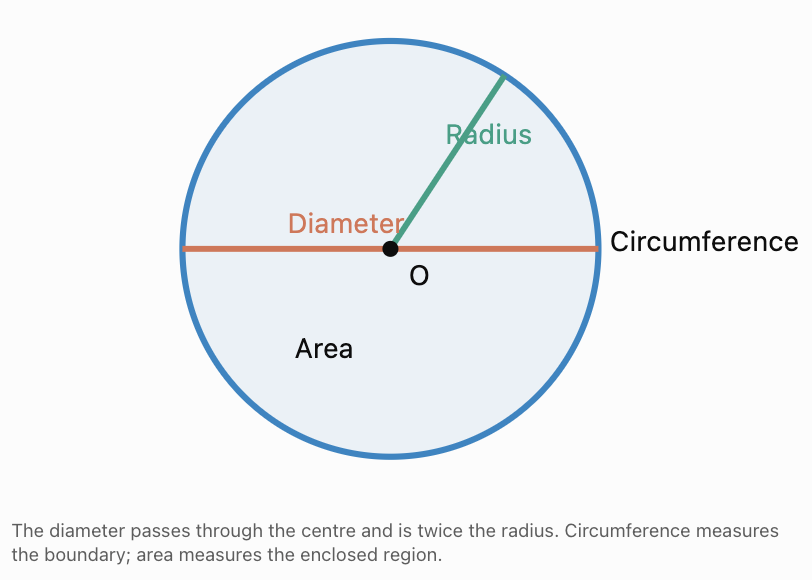
The radius and diameter are related by:
d = 2r
r = d/2
For example, a circle with a diameter of 18 cm has a radius of:
r = 18/2 = 9 cm.
Understanding π (Pi)
The number π is one of the most important constants in mathematics.
It represents the ratio of the circumference of any circle to its diameter.
π = Circumference ÷ Diameter
For every circle:
C/d = π
The value of π is approximately:
π ≈ 3.14159265...
It is an irrational number, meaning its decimal representation continues indefinitely without repeating.
For calculations, we commonly use:
π ≈ 3.14
However, a calculator's π key gives more accurate results.
Important: Keep π in your calculations until the final step whenever possible. This reduces rounding errors.
Circumference of a Circle
The circumference is the distance around the boundary of a circle.
Because π is the ratio of circumference to diameter:
C = πd
Since d = 2r, the formula can also be written using the radius.
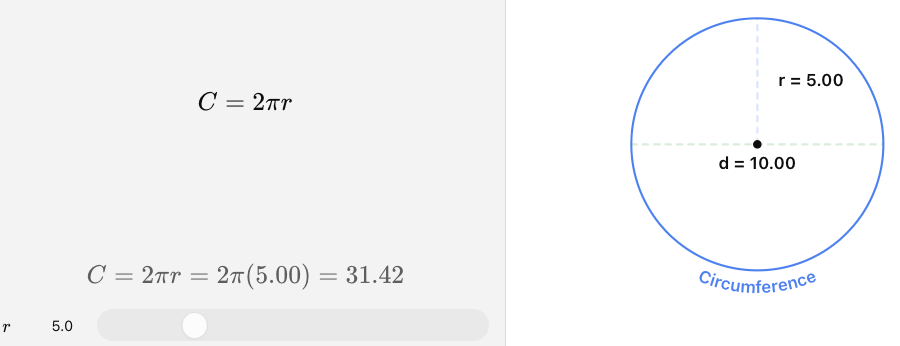
Here:
-
C = circumference.
-
r = radius.
-
d = diameter.
-
π ≈ 3.14159.
The circumference is measured in linear units such as millimetres, centimetres, metres, or kilometres.
Worked Example 1: Circumference from Radius
A circle has radius 7 cm.
Find its circumference.
Step 1: Identify the radius.
r = 7 cm
Step 2: Substitute into the formula.
C = 2πr
C = 2 × π × 7
C = 14π cm
Step 3: Calculate an approximation.
C ≈ 43.98 cm
Answer: 14π cm, or approximately 43.98 cm.
Worked Example 2: Circumference from Diameter
A circular table has diameter 1.6 m.
Find the distance around its edge.
Step 1: Identify the diameter.
d = 1.6 m
Step 2: Apply the formula.
C = πd
C = 1.6π m
Step 3: Calculate.
C ≈ 5.03 m
Answer: Approximately 5.03 m.
Worked Example 3: Finding Radius from Circumference
A circular track has circumference 94.2 m.
Find its radius.
Step 1: Write the formula.
C = 2πr
Step 2: Rearrange for r.
r = C/(2π)
Step 3: Substitute.
r = 94.2/(2π)
r ≈ 14.99 m
Answer: Approximately 15.0 m.
The slight difference from exactly 15 m is due to rounding in the given circumference.
How Circumference Changes with Radius
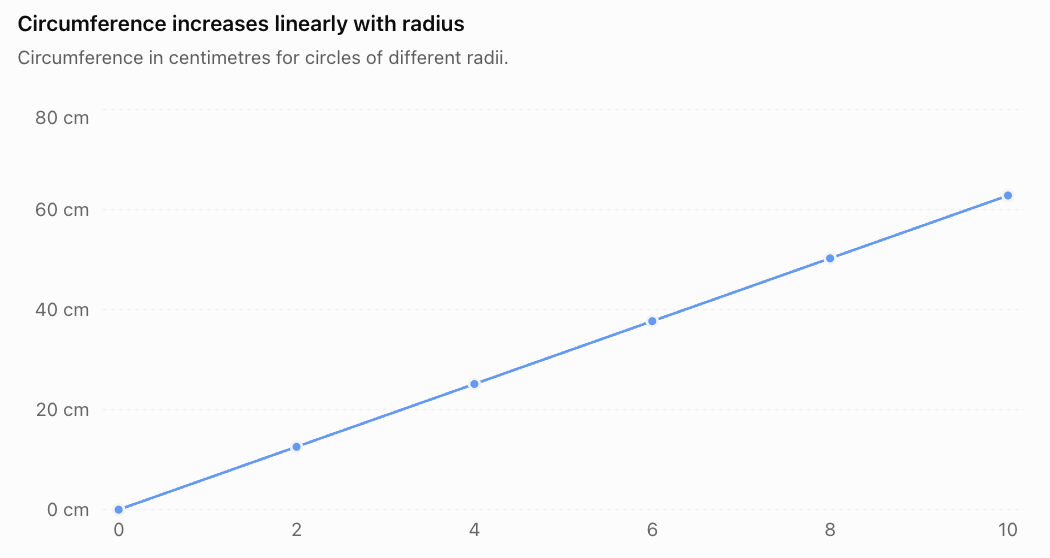
Circumference is directly proportional to radius.
If the radius doubles, the circumference doubles.
If the radius triples, the circumference triples.
Radius
Circumference
2 cm
4π cm
4 cm
8π cm
6 cm
12π cm
8 cm
16π cm
10 cm
20π cm
This is a linear relationship.
The circumference grows at a constant rate of 2π units for every additional unit of radius.
Area of a Circle
The area is the amount of two-dimensional space enclosed by a circle.
The formula is:
A = πr²
where:
-
A = area.
-
r = radius.
-
π ≈ 3.14159.
Notice that the radius is squared.
This means the area changes much faster than the circumference as the radius increases.
Why Is the Formula A = πr²?
Imagine dividing a circle into many thin sectors, like slices of pizza.
If we arrange these sectors alternately, they form a shape that becomes increasingly similar to a rectangle as the sectors become thinner.
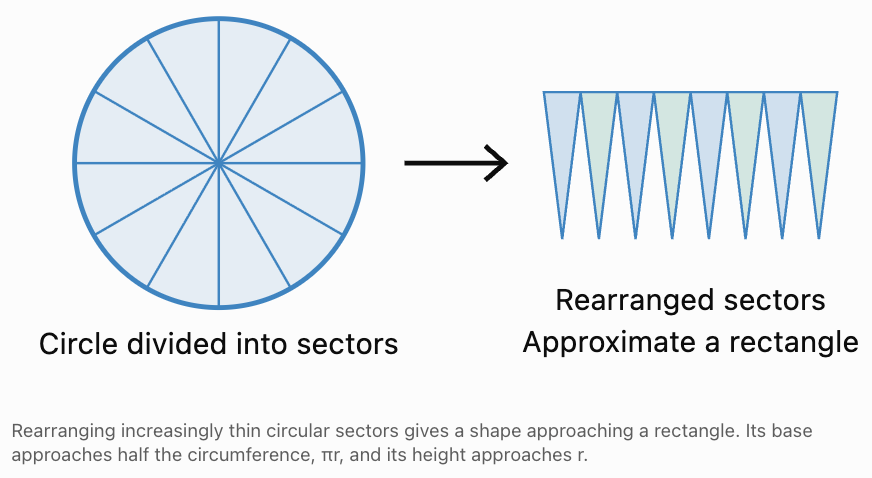
The approximate rectangle has:
Base = Half the circumference = πr
Height = r
Area = Base × Height
A = πr × r
Therefore:
A = πr²
This explains why the radius must be squared.
Worked Example 4: Area from Radius
A circle has radius 8 cm.
Find its area.
Step 1: Write the formula.
A = πr²
Step 2: Substitute.
A = π(8²)
A = 64π cm²
Step 3: Approximate.
A ≈ 201.06 cm²
Answer: 64π cm², or approximately 201.06 cm².
Worked Example 5: Area from Diameter
A circular garden has diameter 14 m.
Find its area.
Step 1: Find the radius.
r = 14/2 = 7 m
Step 2: Calculate the area.
A = πr²
A = π(7²)
A = 49π m²
A ≈ 153.94 m²
Answer: Approximately 153.94 m².
Worked Example 6: Finding Radius from Area
A circular pond has an area of 200 m².
Find its radius.
Step 1: Begin with the formula.
A = πr²
Step 2: Rearrange.
r² = A/π
r = √(A/π)
Step 3: Substitute.
r = √(200/π)
r ≈ 7.98 m
Answer: Approximately 7.98 m.
How Area Changes with Radius
Unlike circumference, area is proportional to the square of the radius.
If the radius doubles:
New area = π(2r)² = 4πr²
The area becomes four times as large.
If the radius triples:
New area = π(3r)² = 9πr²
The area becomes nine times as large.
Radius
Area
2 cm
4π cm²
4 cm
16π cm²
6 cm
36π cm²
8 cm
64π cm²
10 cm
100π cm²
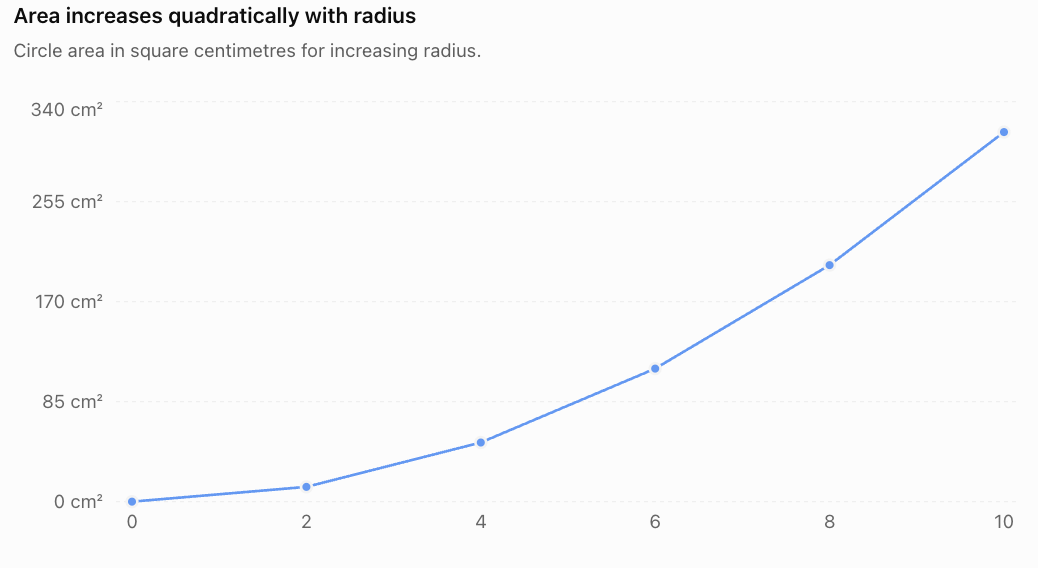
This is a quadratic relationship.
It explains why a small increase in the radius of a circular object can create a much larger increase in its area.
Arc Length
An arc is part of the circumference of a circle.
An arc can be measured in two different ways:
-
Arc measure: The angle corresponding to the arc, measured in degrees.
-
Arc length: The actual distance along the curved boundary, measured in units such as centimetres or metres.
These are not the same quantity.
For example, two circles can both contain 90° arcs, but the larger circle will have the longer arc.
Understanding Central Angles
A central angle has its vertex at the centre of the circle.
A complete revolution around the centre is 360°.
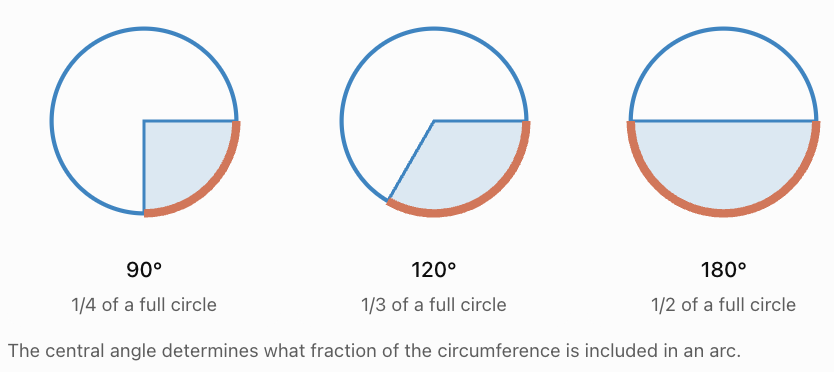
Therefore:
-
A 180° central angle represents half the circumference.
-
A 90° central angle represents one-quarter of the circumference.
-
A 60° central angle represents one-sixth of the circumference.
-
A 45° central angle represents one-eighth of the circumference.
Arc Length Formula
For a central angle θ measured in degrees:
Arc length = (θ/360°) × 2πr
In symbols:
L = (θ/360°) × 2πr
where:
-
L = arc length.
-
θ = central angle in degrees.
-
r = radius.
The formula works because an arc is a fraction of the complete circumference.
Worked Example 7: A Quarter-Circle Arc
A circle has radius 12 cm.
Find the arc length corresponding to a central angle of 90°.
Step 1: Identify the fraction of the circle.
90/360 = 1/4
Step 2: Apply the formula.
L = (90/360) × 2π(12)
L = (1/4) × 24π
L = 6π cm
Step 3: Approximate.
L ≈ 18.85 cm
Answer: 6π cm, or approximately 18.85 cm.
Worked Example 8: An Arc with a 135° Central Angle
A circle has radius 8 m.
Find the length of an arc subtended by a central angle of 135°.
L = (135/360) × 2π(8)
Simplify:
135/360 = 3/8
Therefore:
L = (3/8) × 16π
L = 6π m
L ≈ 18.85 m
Answer: Approximately 18.85 m.
Worked Example 9: Finding the Central Angle
An arc has length 10π cm in a circle with radius 15 cm.
Find its central angle.
Step 1: Apply the formula.
10π = (θ/360) × 2π(15)
10π = (θ/360) × 30π
Step 2: Divide by π.
10 = 30θ/360
Step 3: Solve.
3600 = 30θ
θ = 120°
Answer: 120°.
Worked Example 10: Finding the Radius from Arc Length
An arc measures 8π cm and subtends a central angle of 120°.
Find the radius.
L = (θ/360) × 2πr
8π = (120/360) × 2πr
8π = (1/3) × 2πr
Multiply by 3:
24π = 2πr
r = 12 cm
Answer: 12 cm.
Arc Length Using Radians
Angles can also be measured in radians.
One complete circle contains 2π radians.
When θ is measured in radians, the arc length formula becomes:
L = rθ
For example, if:
r = 6 cm
θ = π/3 radians
Then:
L = 6 × π/3
L = 2π cm
Important: Use L = rθ only when θ is measured in radians. For angles measured in degrees, use the degree-based formula.
Sector Area
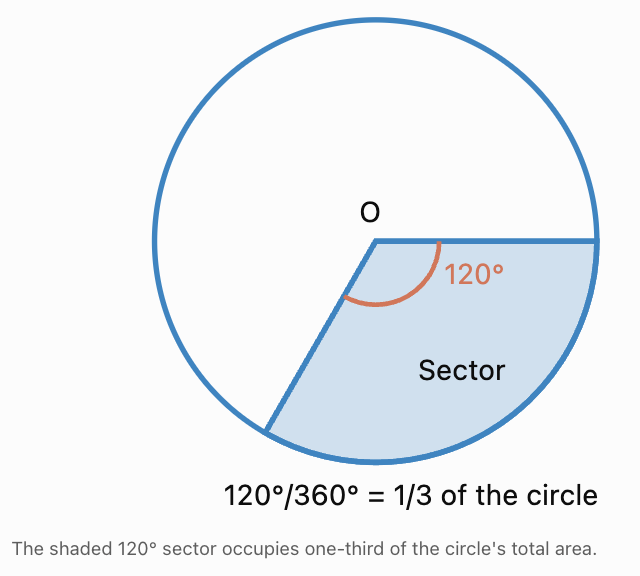
A sector is the region enclosed by two radii and the arc between them.
It is often described as a slice of a circle.
Like arc length, sector area depends on the central angle.
A 90° sector occupies one-quarter of the circle.
A 180° sector occupies half the circle.
A 60° sector occupies one-sixth of the circle.
Sector Area Formula
For a central angle θ measured in degrees:
Sector area = (θ/360°) × πr²
In symbols:
A_sector = (θ/360°) × πr²
where:
-
A_sector = area of the sector.
-
θ = central angle in degrees.
-
r = radius.
Worked Example 11: Area of a 60° Sector
A circle has radius 9 cm.
Find the area of a sector with central angle 60°.
Step 1: Calculate the fraction of the circle.
60/360 = 1/6
Step 2: Apply the sector formula.
A_sector = (1/6) × π(9²)
A_sector = (1/6) × 81π
A_sector = 13.5π cm²
Step 3: Approximate.
A_sector ≈ 42.41 cm²
Answer: 13.5π cm², or approximately 42.41 cm².
Worked Example 12: Area of a 150° Sector
A circle has diameter 20 cm.
Find the area of a 150° sector.
Step 1: Find the radius.
r = 20/2 = 10 cm
Step 2: Apply the formula.
A_sector = (150/360) × π(10²)
A_sector = (5/12) × 100π
A_sector = 125π/3 cm²
Step 3: Approximate.
A_sector ≈ 130.90 cm²
Answer: Approximately 130.90 cm².
Worked Example 13: Finding a Central Angle from Sector Area
A sector has area 30π cm².
The circle has radius 12 cm.
Find the central angle.
Step 1: Substitute into the formula.
30π = (θ/360) × π(12²)
30π = (θ/360) × 144π
Step 2: Divide by π.
30 = 144θ/360
Step 3: Solve.
10800 = 144θ
θ = 75°
Answer: 75°.
Worked Example 14: Finding the Radius from Sector Area
A 90° sector has area 25π cm².
Find the radius.
Step 1: Apply the formula.
25π = (90/360) × πr²
25π = (1/4)πr²
Step 2: Multiply by 4 and divide by π.
100 = r²
Step 3: Take the positive square root.
r = 10 cm
Answer: 10 cm.
Sector Area Using Radians
When θ is measured in radians:
A_sector = ½r²θ
For example:
r = 8 cm
θ = π/2 radians
A_sector = ½ × 8² × π/2
A_sector = 16π cm²
This formula is particularly useful in advanced trigonometry and calculus.
Relationship Between Arc Length and Sector Area
For a sector with radius r and arc length L:
A_sector = ½rL
This follows from the radian formulas:
L = rθ
A_sector = ½r²θ
Substituting θ = L/r:
A_sector = ½r²(L/r)
A_sector = ½rL
Worked Example 15: Sector Area from Arc Length
A sector has radius 10 cm and arc length 8 cm.
Find its area.
A_sector = ½rL
A_sector = ½ × 10 × 8
Answer: 40 cm².
This method avoids calculating the central angle.
Perimeter of a Sector
The perimeter of a sector includes:
-
The curved arc.
-
The first radius.
-
The second radius.
Therefore:
P_sector = L + 2r
This is different from the arc length alone.
Worked Example 16: Perimeter of a Sector
A sector has radius 6 cm and central angle 120°.
Find its perimeter.
Step 1: Calculate the arc length.
L = (120/360) × 2π(6)
L = 4π cm
Step 2: Add the two radii.
P = 4π + 2(6)
P = 4π + 12
P ≈ 24.57 cm
Answer: 12 + 4π cm, or approximately 24.57 cm.
Composite Shapes Involving Circles
Many real-world objects are not complete circles. They may combine circles, semicircles, rectangles, triangles, or sectors.
The key strategy is to divide a complicated shape into simpler shapes whose measurements we already know.
Semicircles
A semicircle is half a circle.
Area:
A = ½πr²
The curved arc of a semicircle has length:
L = πr
However, the perimeter of a semicircle includes its diameter.
P = πr + 2r
Worked Example 17: Semicircular Window
A semicircular window has diameter 2 m.
Find its area and total perimeter.
Step 1: Find the radius.
r = 2/2 = 1 m
Step 2: Calculate the area.
A = ½π(1²)
A = π/2 m²
A ≈ 1.57 m²
Step 3: Calculate the curved length.
L = πr = π m
Step 4: Add the diameter.
P = π + 2
P ≈ 5.14 m
Answer: Area ≈ 1.57 m²; perimeter ≈ 5.14 m.
Annuli: The Area Between Two Circles
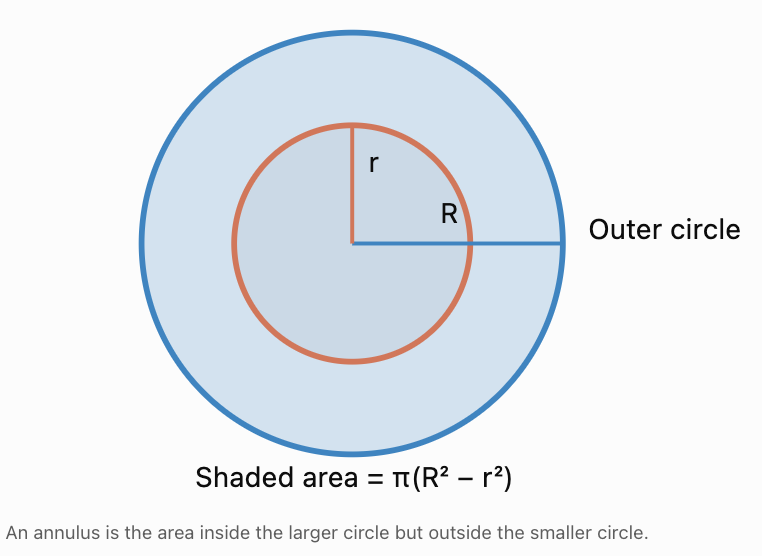
An annulus is the ring-shaped region between two concentric circles.
If the outer radius is R and the inner radius is r:
A_annulus = π(R² − r²)
Worked Example 18: Circular Pathway
A circular pond has radius 5 m.
A pathway of uniform width 2 m surrounds the pond.
Find the area of the pathway.
Step 1: Find the outer radius.
R = 5 + 2 = 7 m
Step 2: Subtract the inner area from the outer area.
A = π(7² − 5²)
A = π(49 − 25)
A = 24π m²
A ≈ 75.40 m²
Answer: Approximately 75.40 m².
Real-World Measurement Problems
Application 1: Bicycle Wheel Distance
A bicycle wheel has radius 35 cm.
How far does the bicycle travel after 250 complete wheel revolutions, assuming no slipping?
Step 1: Calculate circumference.
C = 2π(35)
C = 70π cm
Step 2: Multiply by revolutions.
Distance = 250 × 70π
Distance = 17500π cm
Step 3: Convert to metres.
Distance = 175π m
Distance ≈ 549.78 m
Answer: Approximately 549.78 m.
This shows how circumference is used to calculate distance from rotational motion.
Application 2: Circular Garden Costs
A circular garden has radius 4.5 m.
A gardener wants to install edging around the garden and cover the inside with soil.
Edging costs $12 per metre.
Soil coverage costs $8 per square metre.
Find the total cost, ignoring waste and rounding purchases.
Step 1: Calculate edging length.
C = 2π(4.5)
C = 9π m
C ≈ 28.27 m
Edging cost:
12 × 9π = 108π
≈ $339.29
Step 2: Calculate soil area.
A = π(4.5²)
A = 20.25π m²
Soil cost:
8 × 20.25π = 162π
≈ $508.94
Step 3: Calculate total cost.
Total = 108π + 162π
Total = 270π
Total ≈ $848.23
Answer: Approximately $848.23.
In practice, the gardener may need to buy whole packages or allow extra materials for waste.
Application 3: Pizza Size Comparison
A restaurant sells two circular pizzas.
Small pizza diameter = 20 cm.
Large pizza diameter = 30 cm.
Compare their areas.
Small pizza:
r = 10 cm
A = π(10²) = 100π cm²
Large pizza:
r = 15 cm
A = π(15²) = 225π cm²
Area ratio:
225π/100π = 2.25
Answer: The large pizza has 2.25 times the area of the small pizza.
Although the diameter is only 1.5 times as large, the area is 2.25 times as large.
This is a useful reminder that area increases with the square of the radius.
Application 4: Circular Running Track
A runner follows a circular path with radius 50 m.
How many complete laps are needed to run at least 2 km?
Step 1: Calculate the lap length.
C = 2π(50)
C = 100π m
C ≈ 314.16 m
Step 2: Divide the target distance by the lap length.
Number of laps = 2000/(100π)
≈ 6.37
Step 3: Interpret.
The runner must complete at least 7 whole laps to reach or exceed 2 km.
Answer: 7 complete laps.
Application 5: Sprinkler Coverage
A sprinkler waters a 120° sector of a circle with radius 9 m.
Find the watered area.
A_sector = (120/360) × π(9²)
A_sector = (1/3) × 81π
A_sector = 27π m²
A_sector ≈ 84.82 m²
Answer: Approximately 84.82 m².
This model assumes the sprinkler covers the entire sector evenly and that there are no obstructions.
Application 6: A Circular Track with Two Straight Sections
A stadium track is formed from two straight sections, each 100 m long, joined by two semicircular ends of radius 35 m.
Find the total distance around the track.
Step 1: Add the straight sections.
Straight distance = 2 × 100 = 200 m
Step 2: Combine the semicircular ends.
Two semicircles make one complete circle.
Curved distance = 2π(35)
= 70π m
Step 3: Add the distances.
Total = 200 + 70π
Total ≈ 419.91 m
Answer: Approximately 419.91 m.
This is a simplified geometric model, not a statement about official athletics track dimensions.
Choosing the Correct Formula
Measurement required
Formula
Diameter
d = 2r
Circumference
C = 2πr or πd
Circle area
A = πr²
Arc length (degrees)
L = (θ/360°) × 2πr
Sector area (degrees)
A = (θ/360°) × πr²
Arc length (radians)
L = rθ
Sector area (radians)
A = ½r²θ
Sector area from arc length
A = ½rL
Sector perimeter
P = L + 2r
Semicircle area
A = ½πr²
Semicircle perimeter
P = πr + 2r
Annulus area
A = π(R² − r²)
A General Problem-Solving Strategy
When solving a measurement problem involving circles:
-
Identify the shape. Is it a circle, semicircle, sector, annulus, or composite figure?
-
Identify the measurements. Are you given a radius, diameter, angle, arc length, or area?
-
Choose the correct formula. Distinguish length from area.
-
Convert units if necessary. Use consistent units before calculating.
-
Substitute carefully. Remember to square the radius for area.
-
Keep π until the final step. Avoid premature rounding.
-
Interpret the result. Check whether the answer is reasonable and whether practical rounding is required.
Common Mistakes
Mistake 1: Confusing Radius and Diameter
If a circle has diameter 12 cm, its radius is 6 cm, not 12 cm.
Always identify whether the given measurement is a radius or diameter.
Mistake 2: Using the Circumference Formula for Area
Circumference:
C = 2πr
Area:
A = πr²
Circumference measures length. Area measures enclosed space.
Mistake 3: Forgetting to Square the Radius
Incorrect:
A = πr
Correct:
A = πr²
For a circle with radius 5 cm:
A = 25π cm², not 5π cm².
Mistake 4: Squaring the Diameter Instead of the Radius
If the diameter is 10 cm:
r = 5 cm
A = π(5²) = 25π cm²
Do not calculate π(10²) unless 10 cm is the radius.
Mistake 5: Using the Wrong Units
Circumference is measured in units such as cm or m.
Area is measured in square units such as cm² or m².
Mistake 6: Forgetting the Central Angle Fraction
A 60° sector is not the entire circle.
It occupies:
60/360 = 1/6
of the circle.
Mistake 7: Confusing Arc Length with Sector Perimeter
Arc length measures only the curved boundary.
Sector perimeter includes the arc and two radii.
P_sector = L + 2r
Mistake 8: Forgetting the Straight Edge of a Semicircle
The curved length of a semicircle is πr.
Its complete perimeter is:
P = πr + 2r
Mistake 9: Rounding Too Early
Using π = 3.14 at every intermediate step can introduce errors.
Keep π in exact form until the final calculation.
Mistake 10: Assuming Area and Circumference Increase at the Same Rate
Doubling the radius doubles the circumference but quadruples the area.
Mistake 11: Mixing Degrees and Radians
The formula L = rθ requires θ in radians.
If θ is in degrees, use:
L = (θ/360°) × 2πr
Mistake 12: Ignoring Practical Constraints
In real-world problems, materials may be sold in fixed quantities.
A calculation of 6.3 rolls of edging may require purchasing 7 rolls.
The mathematical result must be interpreted in context.
Key Terms
-
Circle: The set of points in a plane equally distant from a fixed centre.
-
Centre: The fixed point from which all radii are measured.
-
Radius: The distance from the centre to the circle.
-
Diameter: The distance across a circle through its centre.
-
Circumference: The distance around a circle.
-
Area: The amount of two-dimensional space enclosed by a shape.
-
Pi (π): The constant ratio of a circle's circumference to its diameter.
-
Arc: A portion of the circumference.
-
Arc Length: The distance along a circular arc.
-
Central Angle: An angle formed at the centre by two radii.
-
Sector: A region bounded by two radii and their intercepted arc.
-
Sector Area: The area enclosed within a sector.
-
Minor Arc: An arc measuring less than 180°.
-
Major Arc: An arc measuring more than 180°.
-
Semicircle: Half of a circle.
-
Annulus: A ring-shaped region between two concentric circles.
-
Concentric Circles: Circles sharing the same centre.
-
Radian: A unit of angle measurement based on the ratio of arc length to radius.
-
Linear Measurement: A measurement of length, such as metres.
-
Square Units: Units of area, such as cm² or m².
-
Composite Shape: A shape formed from two or more simpler shapes.
-
Direct Proportion: A relationship in which two quantities increase or decrease by the same factor.
-
Quadratic Relationship: A relationship involving the square of a variable.
-
Mathematical Model: A mathematical representation of a real-world situation.
Key Takeaways
-
The diameter of a circle is twice its radius.
-
The circumference is the distance around a circle.
-
Circumference can be calculated using C = 2πr or C = πd.
-
The area of a circle is A = πr².
-
Circumference is proportional to radius.
-
Area is proportional to the square of radius.
-
Doubling the radius doubles circumference but quadruples area.
-
Arc length is a fraction of the full circumference.
-
Arc length in degrees is L = (θ/360°) × 2πr.
-
Sector area is a fraction of the full circle's area.
-
Sector area in degrees is A = (θ/360°) × πr².
-
With radians, L = rθ and A_sector = ½r²θ.
-
The perimeter of a sector includes its arc and both radii.
-
Composite circular areas can be found by adding or subtracting simpler areas.
-
Circle measurement formulas are useful in transport, construction, landscaping, manufacturing, and design.
-
Units, rounding, and practical constraints are essential when interpreting real-world answers.
Check Your Understanding
Show all working. Give exact answers in terms of π where possible, followed by approximations when requested.
Question 1: Circumference
Calculate the circumference of a circle with radius 9 cm.
Give your answer in terms of π and to two decimal places.
Question 2: Diameter and Circumference
A circular table has diameter 2.4 m.
Calculate its circumference to two decimal places.
Question 3: Finding the Radius
A circle has circumference 36π cm.
Find its radius.
Question 4: Area of a Circle
A circle has radius 11 cm.
Calculate its area in terms of π.
Question 5: Area from Diameter
A circular garden has diameter 18 m.
Calculate its area to two decimal places.
Question 6: Finding Radius from Area
A circle has area 81π cm².
Find its radius and diameter.
Question 7: Arc Length
A circle has radius 15 cm.
Calculate the arc length corresponding to a central angle of 72°.
Question 8: Sector Area
A circle has radius 12 cm.
Calculate the area of a 135° sector.
Question 9: Finding a Central Angle
An arc of length 5π cm belongs to a circle with radius 10 cm.
Find the central angle.
Question 10: Sector Perimeter
A sector has radius 8 cm and central angle 90°.
Calculate its complete perimeter.
Question 11: Annulus Area
Two concentric circles have radii 10 cm and 6 cm.
Find the area of the region between them.
Question 12: Wheel Revolutions
A wheel has diameter 80 cm.
How many complete revolutions are needed to travel at least 1 km, assuming the wheel rolls without slipping?
Question 13: Comparing Circles
Circle B has a radius three times that of Circle A.
Determine:
a) The ratio of their circumferences.
b) The ratio of their areas.
Explain your reasoning.
Question 14: Circular Garden Costs
A circular garden has radius 6 m.
Edging costs $15 per metre.
Grass costs $9 per square metre.
Calculate the total cost of edging and covering the garden with grass.
Assume materials can be purchased in exact quantities.
Question 15: Comprehensive Challenge
A circular park has radius 20 m.
A walking path of uniform width 3 m is constructed around the outside of the park.
A decorative fence is installed around the outer boundary of the path.
Calculate:
a) The outer radius.
b) The area of the walking path.
c) The length of fencing required.
d) The cost of the path if construction costs $45 per square metre.
e) The cost of the fence if fencing costs $30 per metre.
f) The total cost of the project.
Use full precision in intermediate calculations and round final monetary answers to the nearest cent.
Fully Worked Answers
Answer 1: Circumference
Given:
r = 9 cm
C = 2πr
C = 2π(9)
C = 18π cm
C ≈ 56.55 cm
Answer: 18π cm, or 56.55 cm.
Answer 2: Diameter and Circumference
Given:
d = 2.4 m
C = πd
C = 2.4π m
C ≈ 7.54 m
Answer: 7.54 m.
Answer 3: Finding the Radius
Given:
C = 36π cm
Use:
C = 2πr
36π = 2πr
Divide by 2π:
r = 18 cm
Answer: 18 cm.
Answer 4: Area of a Circle
Given:
r = 11 cm
A = πr²
A = π(11²)
A = 121π cm²
Answer: 121π cm².
Answer 5: Area from Diameter
Given:
d = 18 m
First find the radius:
r = 18/2 = 9 m
Then:
A = πr²
A = π(9²)
A = 81π m²
A ≈ 254.47 m²
Answer: 254.47 m².
Answer 6: Finding Radius from Area
Given:
A = 81π cm²
A = πr²
81π = πr²
Divide by π:
81 = r²
r = 9 cm
Diameter:
d = 2r = 18 cm
Answer: Radius = 9 cm; diameter = 18 cm.
Answer 7: Arc Length
Given:
r = 15 cm
θ = 72°
L = (θ/360°) × 2πr
L = (72/360) × 2π(15)
L = (1/5) × 30π
L = 6π cm
L ≈ 18.85 cm
Answer: 6π cm, or approximately 18.85 cm.
Answer 8: Sector Area
Given:
r = 12 cm
θ = 135°
A_sector = (θ/360°) × πr²
A_sector = (135/360) × π(12²)
A_sector = (3/8) × 144π
A_sector = 54π cm²
A_sector ≈ 169.65 cm²
Answer: 54π cm², or approximately 169.65 cm².
Answer 9: Finding a Central Angle
Given:
L = 5π cm
r = 10 cm
Use:
L = (θ/360°) × 2πr
5π = (θ/360) × 20π
Divide by π:
5 = 20θ/360
Multiply by 360:
1800 = 20θ
θ = 90°
Answer: 90°.
Answer 10: Sector Perimeter
Given:
r = 8 cm
θ = 90°
Step 1: Calculate the arc length.
L = (90/360) × 2π(8)
L = (1/4) × 16π
L = 4π cm
Step 2: Add the two radii.
P = L + 2r
P = 4π + 16
P ≈ 28.57 cm
Answer: 16 + 4π cm, or approximately 28.57 cm.
Answer 11: Annulus Area
Given:
Outer radius R = 10 cm
Inner radius r = 6 cm
Use:
A = π(R² − r²)
A = π(10² − 6²)
A = π(100 − 36)
A = 64π cm²
A ≈ 201.06 cm²
Answer: 64π cm², or approximately 201.06 cm².
Answer 12: Wheel Revolutions
Given:
Diameter = 80 cm
Distance = 1 km = 100,000 cm
Step 1: Calculate circumference.
C = πd
C = 80π cm
Step 2: Calculate the number of revolutions.
Revolutions = Distance/Circumference
= 100000/(80π)
= 1250/π
≈ 397.89
Step 3: Interpret the result.
The wheel must make at least 398 complete revolutions to travel 1 km or more.
Answer: 398 complete revolutions.
Answer 13: Comparing Circles
Let Circle A have radius r.
Circle B has radius 3r.
a) Circumference ratio
Circle A:
C_A = 2πr
Circle B:
C_B = 2π(3r) = 6πr
Therefore:
C_B/C_A = 6πr/(2πr) = 3
Circumference ratio B : A = 3 : 1.
b) Area ratio
Circle A:
A_A = πr²
Circle B:
A_B = π(3r)² = 9πr²
Therefore:
A_B/A_A = 9
Area ratio B : A = 9 : 1.
The circumference scales directly with radius, while area scales with the square of radius.
Answer 14: Circular Garden Costs
Given:
r = 6 m
Edging cost = $15/m
Grass cost = $9/m²
Step 1: Calculate circumference.
C = 2π(6) = 12π m
Step 2: Calculate edging cost.
Edging cost = 15 × 12π
= 180π dollars
≈ $565.49
Step 3: Calculate area.
A = π(6²)
A = 36π m²
Step 4: Calculate grass cost.
Grass cost = 9 × 36π
= 324π dollars
≈ $1,017.88
Step 5: Calculate total cost without intermediate rounding.
Total = 180π + 324π
Total = 504π
Total ≈ $1,583.36
Answer: Approximately $1,583.36.
Answer 15: Comprehensive Challenge
Given:
Park radius = 20 m
Path width = 3 m
Path construction = $45/m²
Fence = $30/m
a) Outer radius
R = 20 + 3
Answer: 23 m.
b) Area of the walking path
The path forms an annulus.
A = π(R² − r²)
A = π(23² − 20²)
A = π(529 − 400)
A = 129π m²
A ≈ 405.27 m²
Answer: 129π m², or approximately 405.27 m².
c) Length of fencing
The fence follows the outer circumference.
C = 2πR
C = 2π(23)
C = 46π m
C ≈ 144.51 m
Answer: 46π m, or approximately 144.51 m.
d) Cost of constructing the path
Cost = Area × Cost per square metre
Cost = 129π × 45
Cost = 5805π dollars
Cost ≈ $18,236.81
Answer: $18,236.81.
e) Cost of fencing
Cost = Circumference × Cost per metre
Cost = 46π × 30
Cost = 1380π dollars
Cost ≈ $4,335.40
Answer: $4,335.40.
f) Total project cost
Add the exact expressions before rounding:
Total = 5805π + 1380π
Total = 7185π dollars
Total ≈ $22,572.21
Final answer: $22,572.21.
This problem combines circumference, area, annuli, unit-based pricing, and practical interpretation.
Final Course Connections
Circumference and area provide an important link between geometry and algebra.
Circumference is a linear function of radius:
C(r) = 2πr
Area is a quadratic function of radius:
A(r) = πr²
Arc length and sector area extend these relationships to portions of circles, while composite shapes allow us to apply them to more complex situations.
The central problem-solving skill is recognizing what is being measured: a length, an area, a curved boundary, or a combination of regions.
This completes Circumference and Area, with all five learning targets covered through explanations, worked examples, visual representations, practical applications, and fully worked assessment questions.
-
-