Polygons and Circles
3. Circles
Learning outcomes
- I can identify the parts of a circle.
- I can solve problems involving chords, tangents, and secants.
- I can identify central and inscribed angles.
- I can solve angle problems involving circles.
- I can justify circle theorems.
Introduction
Circles are among the most important shapes in geometry. They appear in wheels, gears, clocks, lenses, pipes, sports fields, and architectural designs. Their perfect symmetry makes them useful in both mathematics and engineering.
Unlike polygons, which are formed from straight sides, a circle is a continuous curved shape. Every point on the circle is the same distance from its centre.
Although this definition is simple, circles contain many interesting geometric relationships. Chords, tangents, secants, arcs, and angles are connected by powerful mathematical rules.
For example, an angle formed at the centre of a circle is twice the angle formed at the circumference when both angles intercept the same arc. A tangent always meets the radius at a right angle. Two chords intersecting inside a circle produce a special relationship between their lengths.
Understanding these properties allows us to calculate unknown angles and distances, solve multi-step geometry problems, and explain why circle theorems are true.
What Is a Circle?
A circle is the set of all points in a plane that are a fixed distance from a given point.
The fixed point is called the centre, and the fixed distance is called the radius.
A circle is named using its centre. For example, a circle with centre O is called circle O.
Parts of a Circle
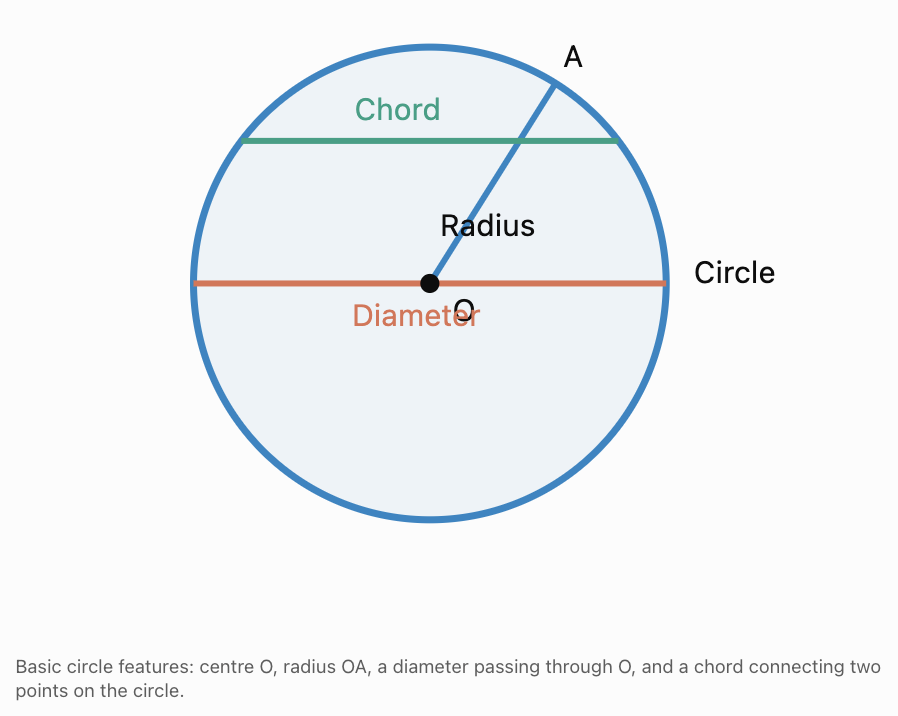
Centre
The centre is the point equally distant from every point on the circle.
Radius
A radius is a line segment connecting the centre to a point on the circle.
All radii of the same circle are equal.
If the radius is r:
r = Distance from centre to circumference.
Diameter
A diameter is a chord passing through the centre.
The diameter is twice the radius.
d = 2r
Therefore:
r = d/2
The diameter is the longest chord of a circle.
Circumference
The circumference is the distance around the circle.
C = 2πr
or:
C = πd
Area
The area enclosed by a circle is:
A = πr²
Chord
A chord is a straight line segment connecting two points on the circle.
Every diameter is a chord, but not every chord is a diameter.
Arc
An arc is part of the circumference between two points.
A minor arc is less than half the circumference.
A major arc is more than half the circumference.
A semicircle is an arc equal to half the circumference.
Sector
A sector is a region bounded by two radii and the arc between them.
A sector resembles a slice of pizza.
Segment
A segment is a region bounded by a chord and its corresponding arc.
Tangent
A tangent is a line that touches a circle at exactly one point.
That point is called the point of tangency.
Secant
A secant is a line that intersects a circle at two distinct points.
Understanding Chords
Chords are important because their lengths and positions are closely related to the centre of a circle.
Property 1: The Perpendicular from the Centre Bisects a Chord
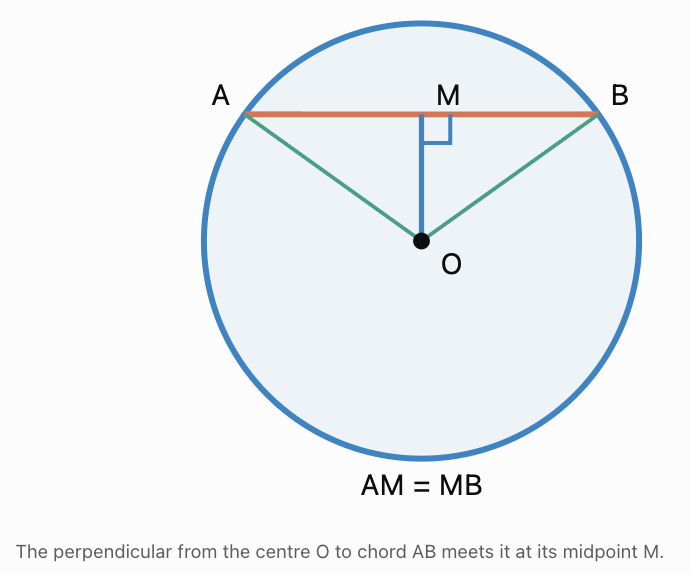
If a line from the centre of a circle meets a chord at 90°, it divides the chord into two equal parts.
Suppose AB is a chord and OM is perpendicular to AB.
Then:
AM = MB
Why Is This True?
OA and OB are radii, so:
OA = OB
OM is common to triangles OMA and OMB.
Both triangles have a right angle at M.
Therefore, the triangles are congruent by the right-angle–hypotenuse–side criterion.
Hence:
AM = MB
Property 2: Equal Chords Are Equidistant from the Centre
In the same circle, equal-length chords lie the same perpendicular distance from the centre.
Conversely, chords equally distant from the centre have equal lengths.
Property 3: Longer Chords Are Closer to the Centre
The closer a chord lies to the centre, the longer it is.
The longest chord is the diameter, which passes directly through the centre.
Worked Example 1: Finding a Chord Length
A circle has radius 13 cm. A chord is 5 cm from the centre.
Find the length of the chord.
Step 1: Identify the right triangle.
The perpendicular from the centre bisects the chord.
Let x be half the chord length.
The radius is the hypotenuse.
Step 2: Apply the Pythagorean theorem.
x² + 5² = 13²
x² + 25 = 169
x² = 144
x = 12
Step 3: Find the full chord.
Chord length = 2 × 12
Answer: 24 cm.
Worked Example 2: Finding the Distance from the Centre
A circle has radius 10 cm and a chord of length 16 cm.
Find the perpendicular distance from the centre to the chord.
Step 1: Halve the chord.
Half-chord = 16/2 = 8 cm
Step 2: Use the Pythagorean theorem.
Let d be the perpendicular distance.
d² + 8² = 10²
d² + 64 = 100
d² = 36
d = 6
Answer: The chord is 6 cm from the centre.
Tangents to Circles
A tangent touches a circle at one point.
Tangents have two particularly important properties.
Tangent Property 1: Radius and Tangent Are Perpendicular
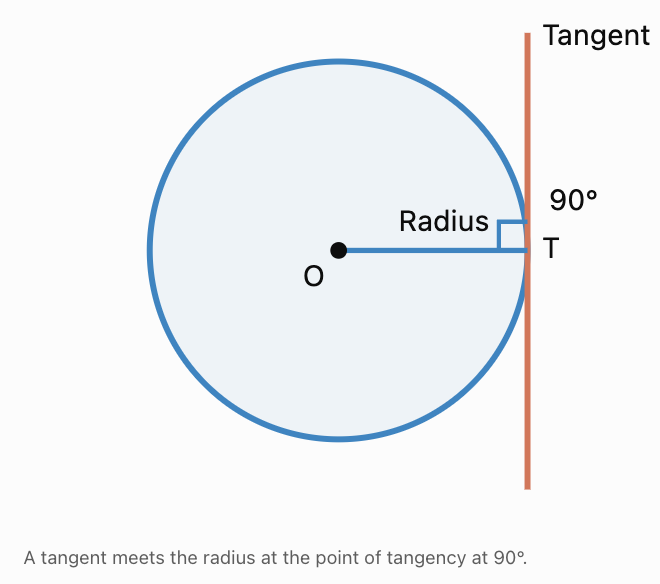
A radius drawn to the point of tangency is perpendicular to the tangent.
If line PT is tangent to a circle at T and O is the centre:
OT ⟂ PT
Therefore:
∠OTP = 90°
Tangent Property 2: Tangents from the Same External Point Are Equal
Suppose PA and PB are tangents from the same external point P.
Then:
PA = PB
This property is useful when solving problems involving two tangents.
Worked Example 3: Tangent Length
A circle has centre O and radius 6 cm.
A point P lies 10 cm from O.
PT is a tangent to the circle at T.
Find PT.
Step 1: Recognize the right triangle.
OT is perpendicular to PT.
Therefore, triangle OTP is right-angled.
Step 2: Apply the Pythagorean theorem.
OP² = OT² + PT²
10² = 6² + PT²
100 = 36 + PT²
PT² = 64
PT = 8
Answer: PT = 8 cm.
Worked Example 4: Two Tangents from One Point
From point P, two tangents PA and PB touch a circle.
PA = 3x + 4
PB = 5x − 8
Find x and the tangent lengths.
Tangents from the same external point are equal.
Therefore:
3x + 4 = 5x − 8
12 = 2x
x = 6
Substitute:
PA = 3(6) + 4 = 22
PB = 5(6) − 8 = 22
Answer: x = 6, and each tangent is 22 units long.
Secants and Intersecting Chords
A secant is a line that crosses a circle at two distinct points.
When chords and secants intersect, their segment lengths follow special relationships.
The Intersecting Chords Theorem
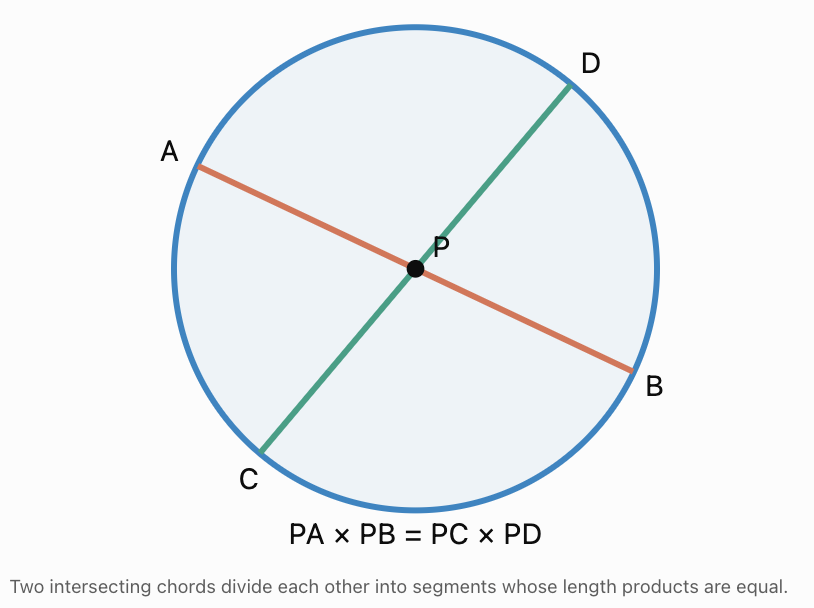
If two chords intersect inside a circle, the products of their segment lengths are equal.
Suppose chords AB and CD intersect at P.
Then:
PA × PB = PC × PD
Worked Example 5: Intersecting Chords
Two chords intersect inside a circle.
The first chord is divided into segments of 4 cm and 9 cm.
The second chord is divided into segments of 6 cm and x cm.
Find x.
Apply the theorem:
4 × 9 = 6 × x
36 = 6x
x = 6
Answer: x = 6 cm.
The Secant–Secant Theorem
When two secants are drawn from the same external point, the product of each secant's external segment and its whole length is equal.
Suppose P is outside a circle.
One secant intersects the circle at A and B, with A closer to P.
Another intersects at C and D, with C closer to P.
Then:
PA × PB = PC × PD
Remember:
PB is the entire length from P to the farther intersection B.
PD is the entire length from P to the farther intersection D.
Worked Example 6: Two Secants
Two secants are drawn from point P.
For the first secant:
External segment = 4 cm
Whole secant = 12 cm
For the second secant:
External segment = 6 cm
Whole secant = x cm
Find x.
Use:
4 × 12 = 6 × x
48 = 6x
x = 8
Answer: The whole second secant is 8 cm.
Its internal segment is:
8 − 6 = 2 cm.
The Tangent–Secant Theorem
If a tangent and secant are drawn from the same external point:
(Tangent length)² = External secant segment × Whole secant length
Using t for the tangent, a for the external secant segment, and b for the whole secant:
Worked Example 7: Tangent–Secant Length
A tangent from point P has length x cm.
A secant from P has an external segment of 5 cm and an internal segment of 15 cm.
Find x.
Step 1: Find the whole secant.
Whole secant = 5 + 15 = 20 cm
Step 2: Apply the theorem.
x² = 5 × 20
x² = 100
x = 10
Answer: The tangent is 10 cm long.
We use the positive square root because length cannot be negative.
Central Angles
A central angle is an angle whose vertex lies at the centre of the circle.
Its sides are radii.
If ∠AOB is a central angle, it intercepts arc AB.
The measure of a central angle is equal to the degree measure of its intercepted minor arc.
For example:
If ∠AOB = 80°, then minor arc AB measures 80°.
Central Angles and Arc Length
A central angle determines what fraction of the circumference an arc occupies.
For a central angle θ measured in degrees:
where:
-
L = arc length
-
θ = central angle
-
r = radius
Sector Area
The area of a sector is the same fraction of the full circle's area.
Worked Example 8: Arc Length
A circle has radius 12 cm.
Find the length of the arc intercepted by a central angle of 60°.
L = (60/360) × 2π(12)
L = (1/6) × 24π
L = 4π cm
Approximately:
L ≈ 12.57 cm
Answer: 4π cm, or approximately 12.57 cm.
Worked Example 9: Sector Area
A circle has radius 9 cm and central angle 120°.
Find the sector area.
A = (120/360) × π(9²)
A = (1/3) × 81π
A = 27π cm²
Approximately:
A ≈ 84.82 cm²
Answer: 27π cm².
Inscribed Angles
An inscribed angle has its vertex on the circumference of a circle.
Its sides are chords.
A central angle has its vertex at the centre.
An inscribed angle has its vertex on the circle.
This distinction is fundamental.
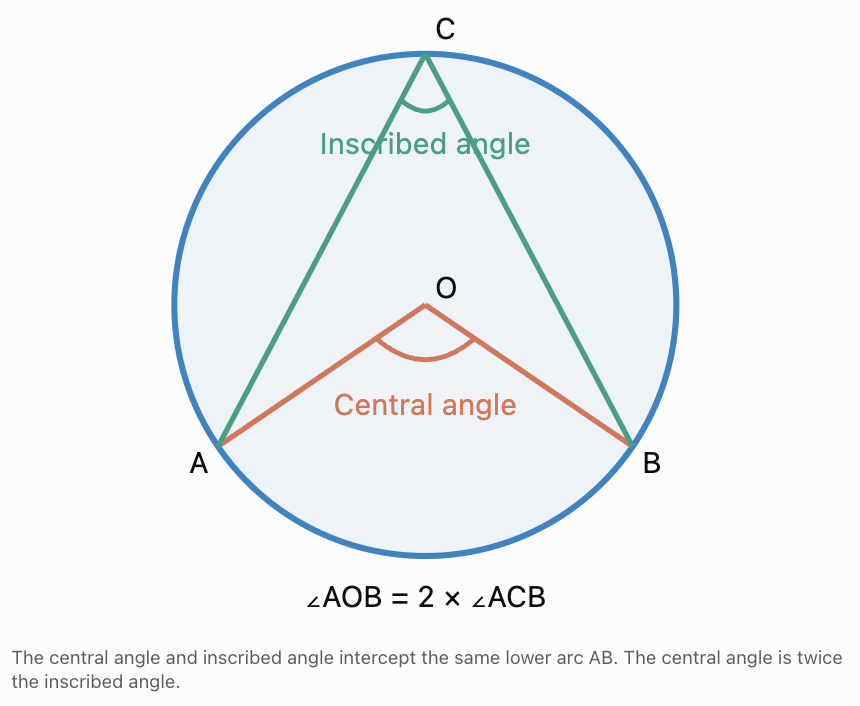
The Inscribed Angle Theorem
An inscribed angle is half the measure of the central angle intercepting the same arc.
If ∠AOB is the central angle and ∠ACB is the inscribed angle intercepting the same arc AB:
Equivalently:
Central angle = 2 × Inscribed angle
Worked Example 10: Finding an Inscribed Angle
A central angle measures 110°.
Find an inscribed angle intercepting the same arc.
Inscribed angle = Central angle / 2
Inscribed angle = 110°/2
Answer: 55°.
Worked Example 11: Finding a Central Angle
An inscribed angle measures 38°.
Find the central angle intercepting the same arc.
Central angle = 2 × Inscribed angle
Central angle = 2 × 38°
Answer: 76°.
Angles in the Same Segment
Two inscribed angles that intercept the same arc are equal.
This is sometimes called the angles in the same segment theorem.
If points C and D lie on the same arc between A and B, and both ∠ACB and ∠ADB intercept the other arc AB:
∠ACB = ∠ADB
Why Is This True?
Both angles are half the measure of the same intercepted arc.
Therefore, they must be equal.
Worked Example 12: Angles in the Same Segment
Two inscribed angles intercept the same arc.
One angle measures 47°.
Find the other angle.
Since both angles intercept the same arc:
Answer: 47°.
Angles in a Semicircle
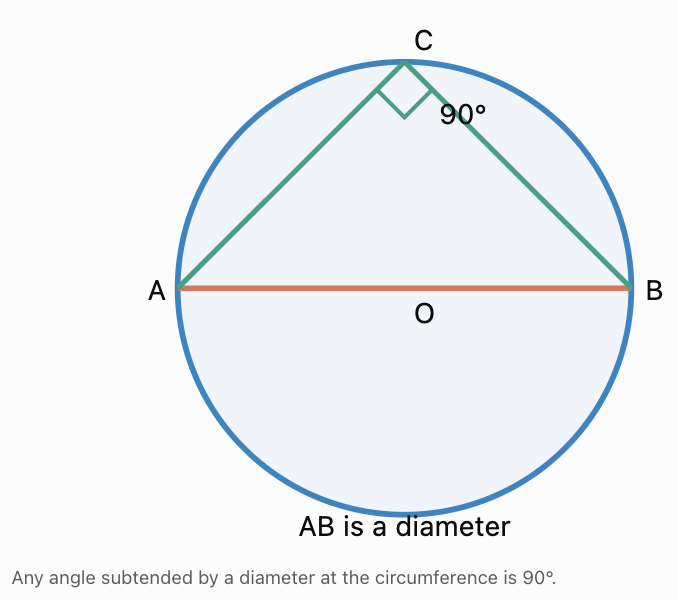
An angle inscribed in a semicircle is always a right angle.
If AB is a diameter and C is any other point on the circle:
∠ACB = 90°
Why?
The diameter AB intercepts a semicircle measuring 180°.
An inscribed angle intercepting that semicircle is half its measure.
∠ACB = 180°/2
∠ACB = 90°
Worked Example 13: Triangle in a Semicircle
AB is a diameter of a circle.
C lies on the circumference.
If ∠CAB = 35°, find ∠ABC.
Step 1: Apply the semicircle theorem.
∠ACB = 90°.
Step 2: Use the triangle angle sum.
∠CAB + ∠ABC + ∠ACB = 180°
35° + ∠ABC + 90° = 180°
∠ABC = 55°
Answer: 55°.
Cyclic Quadrilaterals
A cyclic quadrilateral is a quadrilateral whose four vertices lie on the same circle.
Its most important property is:
Opposite angles of a cyclic quadrilateral add to 180°.
If ABCD is cyclic:
∠A + ∠C = 180°
∠B + ∠D = 180°
Why Is This True?
Opposite angles intercept two arcs that together form the entire circle.
The two arc measures add to 360°.
Each inscribed angle is half its intercepted arc.
Therefore:
Sum of opposite angles = 360°/2
Sum = 180°.
Worked Example 14: Cyclic Quadrilateral
ABCD is a cyclic quadrilateral.
∠A = 112°.
Find ∠C.
Opposite angles are supplementary.
∠A + ∠C = 180°
112° + ∠C = 180°
Answer: ∠C = 68°.
Worked Example 15: Algebraic Cyclic Quadrilateral
In cyclic quadrilateral ABCD:
∠A = (3x + 10)°
∠C = (5x − 6)°.
Find x.
Opposite angles add to 180°.
(3x + 10) + (5x − 6) = 180
8x + 4 = 180
8x = 176
x = 22
Then:
∠A = 3(22) + 10 = 76°
∠C = 5(22) − 6 = 104°
Verification:
76 + 104 = 180°.
Answer: x = 22.
Tangent–Chord Theorem
The tangent–chord theorem, also called the alternate segment theorem, states:
The angle between a tangent and a chord equals the inscribed angle in the opposite segment of the circle.
Suppose a tangent touches a circle at A and AB is a chord.
The angle between the tangent and AB equals the angle ACB, where C lies on the opposite arc AB.
Worked Example 16: Tangent–Chord Angle
A tangent touches a circle at A.
The angle between the tangent and chord AB is 64°.
Find the angle subtended by chord AB at a point C on the opposite arc.
By the tangent–chord theorem:
∠ACB = 64°.
Answer: 64°.
Angles Formed by Intersecting Chords
When two chords intersect inside a circle, the angle formed equals half the sum of the measures of the arcs intercepted by that angle and its vertically opposite angle.
If chords AB and CD intersect at P:
The arc notation refers to the measures of the corresponding arcs in degrees.
Worked Example 17: Intersecting Chord Angles
Two chords intersect inside a circle.
The intercepted arcs measure 80° and 120°.
Find the angle formed between the chords.
Angle = (80° + 120°)/2
Angle = 200°/2
Answer: 100°.
Angles Formed Outside a Circle
When two secants, two tangents, or a tangent and secant meet outside a circle, the angle formed equals half the difference between the intercepted arc measures.
Worked Example 18: Two Secants
Two secants intersect outside a circle.
Their intercepted arcs measure 150° and 50°.
Find the exterior angle.
Angle = (150° − 50°)/2
Angle = 100°/2
Answer: 50°.
Worked Example 19: Two Tangents
Two tangents meet at an external point P.
The minor arc between the points of tangency measures 130°.
Find the angle between the tangents.
The major arc measures:
360° − 130° = 230°.
The exterior angle is:
(230° − 130°)/2
= 100°/2
= 50°.
Answer: 50°.
An equivalent shortcut is:
Angle between tangents = 180° − Minor arc measure
= 180° − 130°
= 50°.
Justifying Circle Theorems
Circle theorems are not simply formulas to memorize. They follow logically from basic geometric properties.
Many circle proofs use:
-
Equal radii.
-
Isosceles triangles.
-
Triangle angle sums.
-
Exterior angles of triangles.
-
Congruent triangles.
-
Similar triangles.
-
Supplementary angles.
Proof 1: The Inscribed Angle Theorem
Claim: An inscribed angle is half the central angle intercepting the same arc.
Consider circle O with points A, B, and C on its circumference.
Suppose C lies on the major arc AB, and the central angle AOB intercepts the minor arc AB.
Draw diameter CD through O, with D opposite C.
Because OA = OC, triangle AOC is isosceles.
Therefore:
∠OAC = ∠ACO
Let each equal angle be α.
Then:
∠AOC = 180° − 2α
Since OD is the extension of OC:
∠AOD = 180° − ∠AOC
∠AOD = 2α
Therefore:
∠AOD = 2∠ACD
Similarly:
∠DOB = 2∠DCB
When D lies on the minor arc AB, adding the two central angles gives:
∠AOB = 2∠ACB
For the other possible positions of D, the corresponding angles are subtracted rather than added, producing the same result.
Thus:
The central angle is twice the inscribed angle intercepting the same arc.
Proof 2: Angles in the Same Segment Are Equal
Given: Two inscribed angles intercept the same arc AB.
Prove: The angles are equal.
Let the central angle subtending arc AB be θ.
By the inscribed angle theorem:
First inscribed angle = θ/2
Second inscribed angle = θ/2
Therefore:
The two inscribed angles are equal.
Proof 3: An Angle in a Semicircle Is 90°
Given: AB is a diameter and C lies on the circle.
Prove: ∠ACB = 90°.
The central angle AOB is a straight angle:
∠AOB = 180°.
By the inscribed angle theorem:
∠ACB = 180°/2
Therefore:
∠ACB = 90°.
Proof 4: Opposite Angles of a Cyclic Quadrilateral Are Supplementary
Given: ABCD is a cyclic quadrilateral.
Prove: ∠A + ∠C = 180°.
Angle A intercepts arc BCD.
Angle C intercepts arc BAD.
These two arcs together make the full circle:
Arc BCD + Arc BAD = 360°.
By the inscribed angle theorem:
∠A = 1/2 × arc BCD
∠C = 1/2 × arc BAD
Adding:
∠A + ∠C = 1/2 × 360°
Therefore:
∠A + ∠C = 180°.
The same reasoning proves:
∠B + ∠D = 180°.
Proof 5: Tangents from an External Point Are Equal
Given: PA and PB are tangents from external point P to a circle with centre O.
Prove: PA = PB.
Join OA, OB, and OP.
Because a radius is perpendicular to a tangent:
∠OAP = 90°
∠OBP = 90°
Also:
OA = OB because both are radii.
OP is common to both triangles.
Therefore, right triangles OAP and OBP are congruent by the right-angle–hypotenuse–side criterion.
Corresponding sides are equal.
Hence:
PA = PB.
Proof 6: The Intersecting Chords Theorem
Given: Chords AB and CD intersect at P.
Prove: PA × PB = PC × PD.
Consider triangles PAC and PDB.
∠APC = ∠DPB because they are vertically opposite angles.
∠PAC = ∠PDB because both are inscribed angles intercepting arc BC.
Therefore:
△PAC ∼ △PDB
The triangles are similar by AA similarity.
Corresponding side ratios give:
PA/PD = PC/PB
Cross-multiplying:
PA × PB = PC × PD.
This proves the intersecting chords theorem.
Real-World Applications
Wheels and Rotating Machinery
Wheels depend on the geometric properties of circles.
Every point on the rim lies at the same distance from the axle.
The circumference determines how far a wheel travels in one complete revolution.
For a wheel with radius 35 cm:
C = 2π(35)
C = 70π cm
C ≈ 219.9 cm
One complete revolution moves the wheel approximately 2.20 m, assuming it rolls without slipping.
Road and Railway Curves
Engineers use circular arcs and other smooth curves to design roads and railway tracks.
The radius of curvature affects how sharply a vehicle must turn.
Arc length calculations help determine the distance along curved sections.
Architecture and Arches
Circular and semicircular arches are common in architecture.
Architects use circle geometry to calculate:
-
Arc lengths.
-
Chord widths.
-
Central angles.
-
Radius and diameter.
-
Positions of supports.
Sports Fields
Circular markings are common in sports.
For example, centre circles and penalty arcs are constructed using specified radii.
Circle geometry ensures that these markings have consistent dimensions.
Optics and Engineering Design
Circular lenses, pipes, bearings, and gears require accurate measurements of radius, diameter, chords, and tangents.
Tangents are especially useful when determining the direction of motion or contact at a point on a circular surface.
Common Mistakes
Mistake 1: Confusing Radius and Diameter
The diameter is twice the radius.
d = 2r
Do not substitute the diameter into formulas that require the radius.
Mistake 2: Confusing a Chord with a Secant
A chord is a segment with endpoints on the circle.
A secant is an entire line crossing the circle at two points.
Mistake 3: Assuming Every Chord Passes Through the Centre
Only diameters pass through the centre.
Other chords do not.
Mistake 4: Forgetting the Tangent–Radius Right Angle
A tangent and radius meet at 90° at the point of tangency.
This is frequently the key to solving a tangent-length problem.
Mistake 5: Confusing Central and Inscribed Angles
The central angle is twice the inscribed angle when both intercept the same arc.
Mistake 6: Using the Wrong Arc
The inscribed angle theorem depends on the intercepted arc.
Two angles must intercept the same arc for the usual equality rule to apply.
Mistake 7: Confusing Chord-Length Products
For intersecting chords, multiply the two segments of each chord.
PA × PB = PC × PD
Do not add them.
Mistake 8: Using Only the Internal Part of a Secant
In the secant–secant and tangent–secant theorems, use the whole secant length from the external point to the farther intersection.
Mistake 9: Forgetting Opposite Angles in Cyclic Quadrilaterals
Opposite angles sum to 180°.
Adjacent angles do not necessarily sum to 180°.
Mistake 10: Confusing Angle Formulas for Intersections
Inside the circle:
Angle = Half the sum of intercepted arcs.
Outside the circle:
Angle = Half the difference of intercepted arcs.
Mistake 11: Treating a Diagram as Proof
A geometric relationship should be justified using established properties, not simply by how a diagram appears.
Key Terms
-
Circle: The set of all points in a plane equally distant from a fixed centre.
-
Centre: The fixed point equally distant from every point on a circle.
-
Radius: A segment from the centre to a point on the circle.
-
Diameter: A chord passing through the centre.
-
Circumference: The distance around a circle.
-
Chord: A segment connecting two points on a circle.
-
Arc: A portion of the circumference.
-
Minor Arc: An arc measuring less than 180°.
-
Major Arc: An arc measuring more than 180°.
-
Semicircle: An arc measuring 180°.
-
Sector: A region bounded by two radii and an arc.
-
Segment: A region bounded by a chord and an arc.
-
Tangent: A line touching a circle at exactly one point.
-
Point of Tangency: The point where a tangent touches the circle.
-
Secant: A line intersecting a circle at two points.
-
Central Angle: An angle whose vertex is at the centre of a circle.
-
Inscribed Angle: An angle whose vertex is on the circle and whose sides are chords.
-
Intercepted Arc: The arc lying between the points where an angle's sides meet the circle.
-
Cyclic Quadrilateral: A quadrilateral whose vertices lie on the same circle.
-
Intersecting Chords Theorem: A theorem relating products of chord segments.
-
Secant–Secant Theorem: A theorem relating products of external and whole secant lengths.
-
Tangent–Secant Theorem: A theorem relating tangent length to secant lengths.
-
Tangent–Chord Theorem: A theorem relating a tangent–chord angle to an inscribed angle.
-
Inscribed Angle Theorem: An inscribed angle measures half its intercepted arc.
-
Geometric Proof: A logical argument demonstrating why a geometric property is true.
Key Takeaways
-
A circle consists of all points equally distant from its centre.
-
The diameter is twice the radius.
-
A chord joins two points on the circle.
-
The perpendicular from the centre to a chord bisects the chord.
-
Equal chords are equally distant from the centre.
-
A tangent touches a circle at one point.
-
A tangent is perpendicular to the radius at the point of tangency.
-
Tangents drawn from the same external point have equal lengths.
-
Intersecting chords satisfy PA × PB = PC × PD.
-
Secant–secant relationships involve external segments and whole secant lengths.
-
The tangent–secant theorem states t² = ab.
-
A central angle has the same degree measure as its intercepted minor arc.
-
An inscribed angle is half the measure of its intercepted arc.
-
Inscribed angles intercepting the same arc are equal.
-
An angle in a semicircle is 90°.
-
Opposite angles of a cyclic quadrilateral sum to 180°.
-
The tangent–chord theorem relates tangent angles to inscribed angles.
-
Intersecting chords and secants create angle relationships involving intercepted arcs.
-
Circle theorems can be justified using isosceles triangles, congruence, similarity, and angle properties.
-
Circle geometry has applications in engineering, architecture, transport, sports, and design.
Check Your Understanding
Question 1: Parts of a Circle
Define:
a) Radius.
b) Diameter.
c) Chord.
d) Tangent.
e) Secant.
Question 2: Radius and Circumference
A circle has radius 7 cm.
Calculate:
a) Diameter.
b) Circumference in terms of π.
c) Area in terms of π.
Question 3: Chord Length
A circle has radius 15 cm.
A chord is 9 cm from the centre.
Find the length of the chord.
Question 4: Tangent Length
A point P is 17 cm from the centre O of a circle.
The circle has radius 8 cm.
Find the length of a tangent from P to the circle.
Question 5: Equal Tangents
Two tangents from the same external point have lengths:
PA = 4x + 3
PB = 6x − 7
Find x and the tangent lengths.
Question 6: Intersecting Chords
Two chords intersect inside a circle.
The first chord has segments of 6 cm and 8 cm.
The second has segments of 4 cm and x cm.
Find x.
Question 7: Tangent–Secant Theorem
A tangent has length 12 cm.
A secant from the same external point has an external segment of 8 cm.
Find the whole secant length.
Question 8: Central and Inscribed Angles
A central angle measures 136°.
Find an inscribed angle intercepting the same minor arc.
Question 9: Angles in a Semicircle
AB is a diameter.
C lies on the circumference.
If ∠CAB = 42°, find ∠ABC.
Question 10: Cyclic Quadrilateral
ABCD is a cyclic quadrilateral.
∠A = 115°.
∠B = 78°.
Find ∠C and ∠D.
Question 11: Arc Length
A circle has radius 10 cm.
Find the length of an arc intercepted by a central angle of 72°.
Give your answer in terms of π.
Question 12: Exterior Angle from Secants
Two secants intersect outside a circle.
The intercepted arcs measure 170° and 50°.
Find the exterior angle.
Question 13: Algebraic Cyclic Quadrilateral
In cyclic quadrilateral ABCD:
∠A = (4x + 12)°
∠C = (6x − 22)°.
Find x and both angles.
Question 14: Comprehensive Challenge
A circle has centre O and radius 10 cm.
Point P lies outside the circle, with OP = 26 cm.
A tangent PT touches the circle at T.
A secant from P intersects the circle at A and B, where A is closer to P.
The external segment PA is 8 cm.
Find:
a) The tangent length PT.
b) The whole secant length PB.
c) The internal segment AB.
d) Explain which circle theorems were used.
Fully Worked Answers
Answer 1: Parts of a Circle
a) Radius: A line segment connecting the centre to a point on the circle.
b) Diameter: A chord passing through the centre.
c) Chord: A line segment connecting two points on the circle.
d) Tangent: A line touching the circle at exactly one point.
e) Secant: A line intersecting the circle at two distinct points.
Answer 2: Radius and Circumference
Given:
r = 7 cm
a) Diameter
d = 2r
d = 2(7)
d = 14 cm
b) Circumference
C = 2πr
C = 2π(7)
C = 14π cm
c) Area
A = πr²
A = π(7²)
A = 49π cm²
Answer 3: Chord Length
Given:
Radius = 15 cm
Distance from centre = 9 cm
The perpendicular from the centre bisects the chord.
Let x represent half the chord length.
Use the Pythagorean theorem:
x² + 9² = 15²
x² + 81 = 225
x² = 144
x = 12
Full chord length:
2(12) = 24 cm
Answer: 24 cm.
Answer 4: Tangent Length
Given:
OP = 17 cm
OT = 8 cm
Since the radius is perpendicular to the tangent:
OP² = OT² + PT²
17² = 8² + PT²
289 = 64 + PT²
PT² = 225
PT = 15
Answer: 15 cm.
Answer 5: Equal Tangents
Tangents from the same external point are equal.
Therefore:
4x + 3 = 6x − 7
10 = 2x
x = 5
Substitute:
PA = 4(5) + 3 = 23
PB = 6(5) − 7 = 23
Answer: x = 5 and both tangents are 23 units long.
Answer 6: Intersecting Chords
Use:
PA × PB = PC × PD
Substitute:
6 × 8 = 4 × x
48 = 4x
x = 12
Answer: 12 cm.
Answer 7: Tangent–Secant Theorem
Given:
Tangent length = 12 cm
External secant segment = 8 cm
Whole secant = x
Use:
t² = ab
12² = 8x
144 = 8x
x = 18
Answer: The whole secant is 18 cm.
Answer 8: Central and Inscribed Angles
The inscribed angle is half the central angle when both intercept the same arc.
Inscribed angle = 136°/2
Answer: 68°.
Answer 9: Angles in a Semicircle
AB is a diameter.
Therefore:
∠ACB = 90°.
The angles of a triangle sum to 180°.
42° + ∠ABC + 90° = 180°
∠ABC = 180° − 132°
Answer: 48°.
Answer 10: Cyclic Quadrilateral
Opposite angles of a cyclic quadrilateral are supplementary.
∠A + ∠C = 180°
115° + ∠C = 180°
∠C = 65°
Similarly:
∠B + ∠D = 180°
78° + ∠D = 180°
∠D = 102°
Answer: ∠C = 65° and ∠D = 102°.
Answer 11: Arc Length
Given:
r = 10 cm
θ = 72°
Use:
L = (θ/360°) × 2πr
L = (72/360) × 2π(10)
L = (1/5) × 20π
L = 4π cm
Answer: 4π cm.
Answer 12: Exterior Angle from Secants
Use:
Exterior angle = (Larger arc − Smaller arc)/2
Angle = (170° − 50°)/2
Angle = 120°/2
Answer: 60°.
Answer 13: Algebraic Cyclic Quadrilateral
Given:
∠A = (4x + 12)°
∠C = (6x − 22)°.
Opposite angles are supplementary.
(4x + 12) + (6x − 22) = 180
10x − 10 = 180
10x = 190
x = 19
Calculate:
∠A = 4(19) + 12
∠A = 88°
∠C = 6(19) − 22
∠C = 92°
Verification:
88° + 92° = 180°.
Answer: x = 19, ∠A = 88°, and ∠C = 92°.
Answer 14: Comprehensive Challenge
Given:
Radius OT = 10 cm
OP = 26 cm
External secant segment PA = 8 cm
a) Tangent length PT
A radius is perpendicular to a tangent at the point of tangency.
Therefore, triangle OTP is right-angled.
Use the Pythagorean theorem:
OP² = OT² + PT²
26² = 10² + PT²
676 = 100 + PT²
PT² = 576
PT = 24 cm
b) Whole secant length PB
Use the tangent–secant theorem:
PT² = PA × PB
24² = 8 × PB
576 = 8PB
PB = 72 cm
c) Internal segment AB
The whole secant is the external segment plus the internal segment.
PB = PA + AB
72 = 8 + AB
AB = 64 cm
d) Theorems used
First, we used the tangent–radius theorem to establish a right angle.
Next, we used the Pythagorean theorem to calculate the tangent length.
Finally, we used the tangent–secant theorem to relate the tangent length to the secant segments.
Final answers:
-
PT = 24 cm
-
PB = 72 cm
-
AB = 64 cm
Note: These calculated lengths follow the stated equations, but the full set of measurements is not geometrically consistent with a circle of radius 10 cm and OP = 26 cm. A secant's whole length from P cannot exceed OP + r = 36 cm. Thus the given PA = 8 cm cannot describe a real secant from this point. This is an important reminder to verify geometric feasibility as well as algebra.
This completes Circles, including circle terminology, chords, tangents, secants, central and inscribed angles, angle relationships, circle theorems, geometric proofs, and real-world applications.