Polygons and Circles
2. Quadrilaterals
Learning outcomes
- I can classify quadrilaterals.
- I can identify the properties of parallelograms.
- I can distinguish rectangles, rhombi, squares, trapezoids, and kites.
- I can solve problems involving quadrilaterals.
- I can prove quadrilateral properties.
Introduction
Quadrilaterals are among the most common geometric shapes in everyday life. We see them in windows, doors, floor tiles, computer screens, buildings, bridges, and countless manufactured objects.
Although all quadrilaterals have four sides, their properties can be very different. Some have parallel sides, some have equal sides, some contain right angles, and others have special relationships between their diagonals.
A rectangle, for example, has four right angles, while a rhombus has four equal sides. A square has both properties, making it a special type of rectangle and a special type of rhombus.
Understanding these relationships allows us to classify shapes accurately, solve problems involving unknown lengths and angles, and justify geometric properties using mathematical reasoning.
In this lesson, we will investigate the major families of quadrilaterals, including parallelograms, rectangles, rhombi, squares, trapezoids, and kites. We will also explore their diagonals, symmetry, area formulas, and geometric proofs.
What Is a Quadrilateral?
A quadrilateral is a polygon with four straight sides, four vertices, and four interior angles.
The word comes from quadri, meaning four, and lateral, meaning side.
Every simple quadrilateral has an interior angle sum of 360°.
This follows from the polygon interior angle sum formula:
S = (n − 2) × 180°
For a quadrilateral, n = 4.
S = (4 − 2) × 180°
S = 2 × 180°
S = 360°
Therefore, if the four interior angles are A, B, C, and D:
A + B + C + D = 360°
Parts of a Quadrilateral
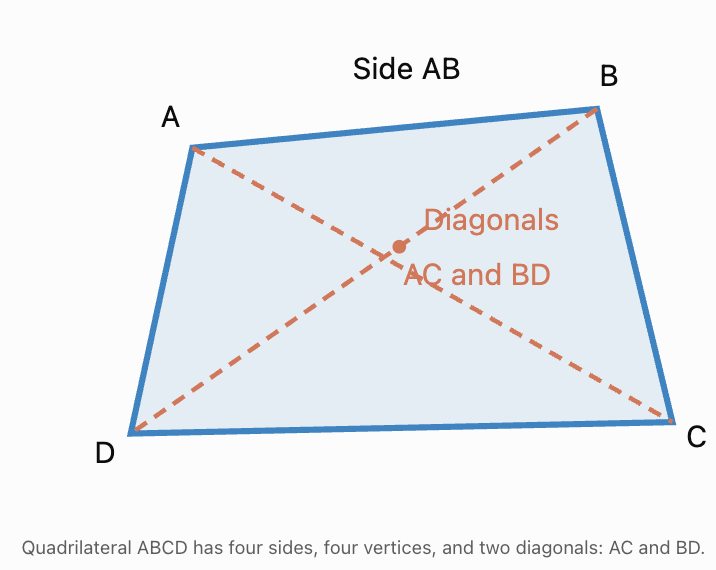
The important features are:
-
Sides: AB, BC, CD, and DA.
-
Vertices: A, B, C, and D.
-
Interior angles: ∠A, ∠B, ∠C, and ∠D.
-
Opposite sides: AB and CD; BC and AD.
-
Adjacent sides: Two sides that share a vertex.
-
Diagonals: AC and BD, connecting opposite vertices.
Quadrilaterals can be convex or concave.
A convex quadrilateral has all interior angles less than 180°.
A concave quadrilateral has one reflex interior angle greater than 180°.
Most of the special quadrilaterals studied in this lesson are convex.
Classifying Quadrilaterals
Quadrilaterals can be classified according to their side lengths, parallel sides, angles, and diagonal properties.
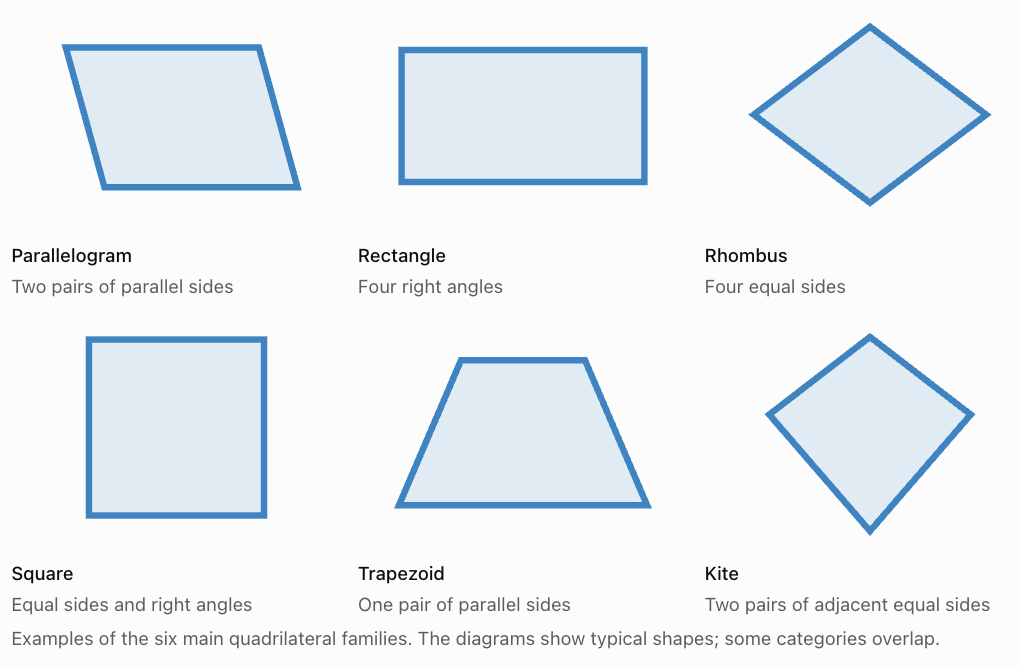
Important Classification Convention
There are two common definitions of a trapezoid:
-
Exclusive definition: A quadrilateral with exactly one pair of parallel sides.
-
Inclusive definition: A quadrilateral with at least one pair of parallel sides.
Under the inclusive definition, parallelograms are also trapezoids.
In this lesson, we will use the exclusive definition for trapezoids unless otherwise stated. This makes it easier to distinguish trapezoids from parallelograms.
For kites, we will use the common school definition of two distinct pairs of adjacent equal sides, excluding rhombi. Some mathematical conventions include rhombi as special kites.
The Quadrilateral Family
The relationships between special quadrilaterals are important.
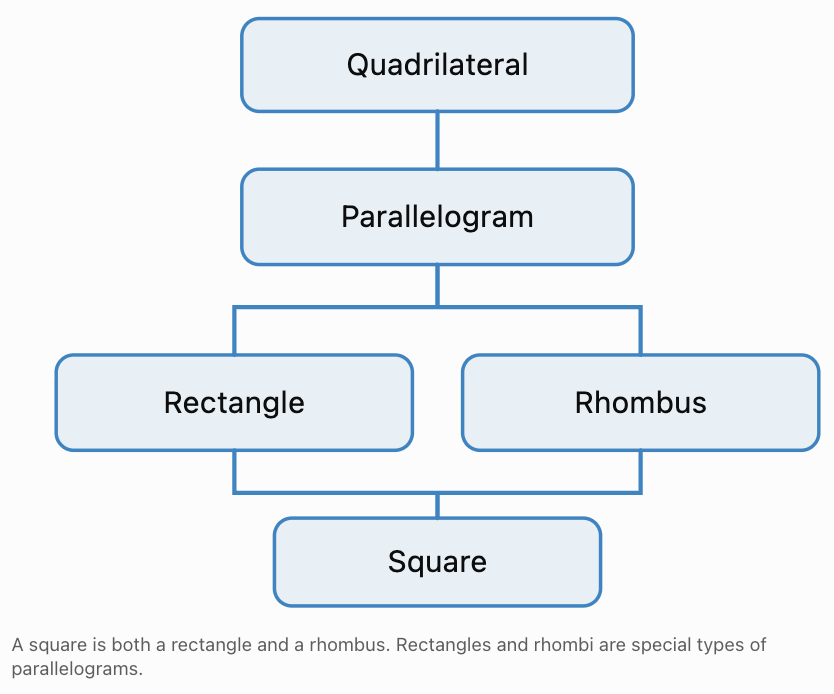
This means:
-
Every square is a rectangle.
-
Every square is a rhombus.
-
Every rectangle is a parallelogram.
-
Every rhombus is a parallelogram.
-
Not every rectangle is a square.
-
Not every rhombus is a square.
-
Not every parallelogram is a rectangle or rhombus.
These relationships are useful when deciding which properties can be applied to a particular shape.
Properties of Parallelograms
A parallelogram is a quadrilateral with two pairs of opposite sides parallel.
If ABCD is a parallelogram:
AB ∥ CD
BC ∥ AD
The symbol ∥ means “is parallel to.”
Main Properties
-
Opposite sides are parallel.
-
Opposite sides are equal in length.
-
Opposite angles are equal.
-
Adjacent interior angles are supplementary.
-
Diagonals bisect each other.
-
Each diagonal divides the parallelogram into two congruent triangles.
Visualizing a Parallelogram
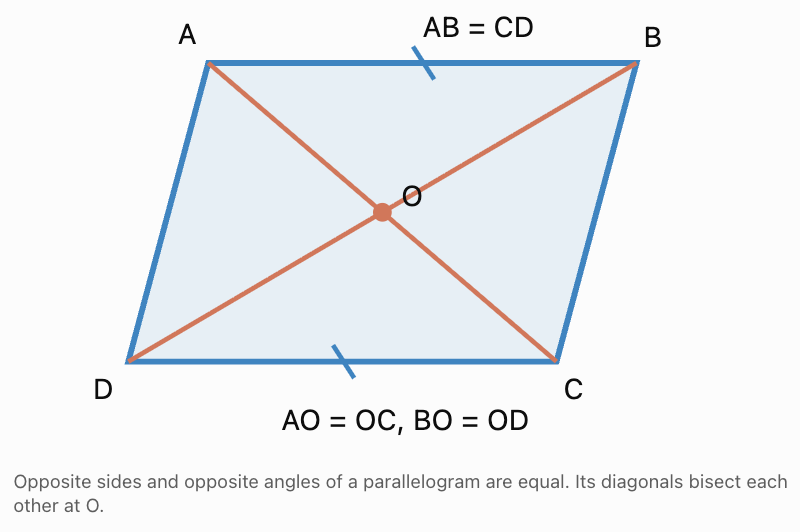
Opposite Sides Are Equal
For parallelogram ABCD:
AB = CD
BC = AD
Opposite Angles Are Equal
∠A = ∠C
∠B = ∠D
Adjacent Angles Are Supplementary
∠A + ∠B = 180°
∠B + ∠C = 180°
This follows from the properties of parallel lines crossed by a transversal.
Diagonals Bisect Each Other
If diagonals AC and BD intersect at O:
AO = OC
BO = OD
The diagonals do not necessarily have equal lengths.
This distinction is important.
Worked Example 1: Angles in a Parallelogram
In parallelogram ABCD:
∠A = 68°.
Find the other three angles.
Step 1: Use opposite angles.
∠C = ∠A = 68°.
Step 2: Use supplementary adjacent angles.
∠A + ∠B = 180°
68° + ∠B = 180°
∠B = 112°
Step 3: Use opposite angles again.
∠D = ∠B = 112°.
Final answer:
∠A = 68°
∠B = 112°
∠C = 68°
∠D = 112°
Verification:
68 + 112 + 68 + 112 = 360°.
Worked Example 2: Solving for Side Lengths
In parallelogram PQRS:
PQ = 3x + 4
RS = 5x − 8
Find x and the length of PQ.
Step 1: Use the opposite-side property.
PQ = RS
3x + 4 = 5x − 8
Step 2: Solve.
12 = 2x
x = 6
Step 3: Substitute.
PQ = 3(6) + 4
PQ = 22
Answer: x = 6 and PQ = 22 units.
Worked Example 3: Diagonals of a Parallelogram
The diagonals of parallelogram ABCD intersect at O.
AO = 2x + 3
OC = 5x − 9
Find x and AC.
Because the diagonals bisect each other:
AO = OC
2x + 3 = 5x − 9
12 = 3x
x = 4
Then:
AO = 2(4) + 3 = 11
OC = 11
Therefore:
AC = AO + OC
AC = 22 units.
Answer: x = 4 and AC = 22 units.
Rectangles
A rectangle is a parallelogram with four right angles.
Every interior angle is 90°.
Properties of Rectangles
A rectangle has all the properties of a parallelogram, plus additional properties.
-
Opposite sides are parallel.
-
Opposite sides are equal.
-
All four interior angles are 90°.
-
Diagonals bisect each other.
-
Diagonals are equal in length.
-
It has two lines of reflection symmetry through the midpoints of opposite sides.
-
It has rotational symmetry of order 2.
A square has additional symmetry, but a non-square rectangle has exactly two lines of symmetry.
Diagonals of a Rectangle
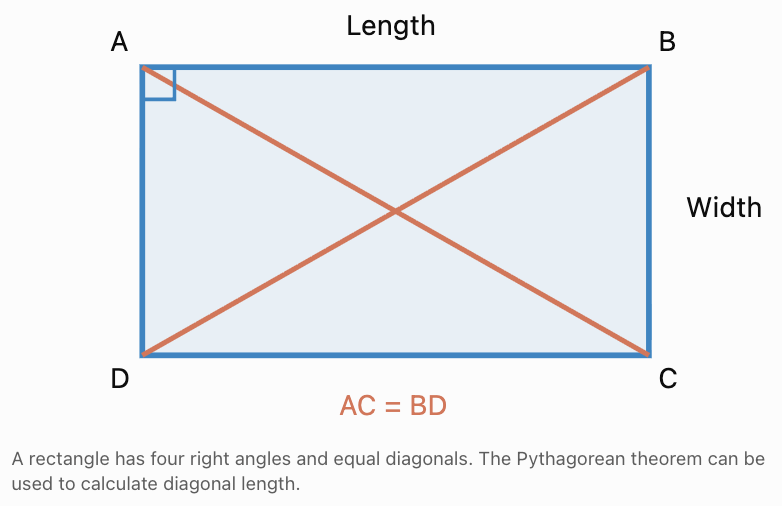
If a rectangle has length l and width w, its diagonal d satisfies:
d² = l² + w²
Therefore:
Worked Example 4: Diagonal of a Rectangle
A rectangular classroom is 12 m long and 9 m wide.
Find the distance between opposite corners.
Step 1: Apply the Pythagorean theorem.
d² = 12² + 9²
d² = 144 + 81
d² = 225
Step 2: Take the square root.
d = √225
Answer: The diagonal is 15 m.
Worked Example 5: Algebraic Diagonals
The diagonals of a rectangle have lengths:
AC = 4x + 6
BD = 7x − 9
Find x and the diagonal length.
Since rectangle diagonals are equal:
4x + 6 = 7x − 9
15 = 3x
x = 5
Substitute:
AC = 4(5) + 6 = 26
BD = 7(5) − 9 = 26
Answer: x = 5 and each diagonal is 26 units.
Rhombi
A rhombus is a parallelogram with four equal sides.
A rhombus does not necessarily have right angles.
Properties of a Rhombus
-
All four sides are equal.
-
Opposite sides are parallel.
-
Opposite angles are equal.
-
Adjacent angles are supplementary.
-
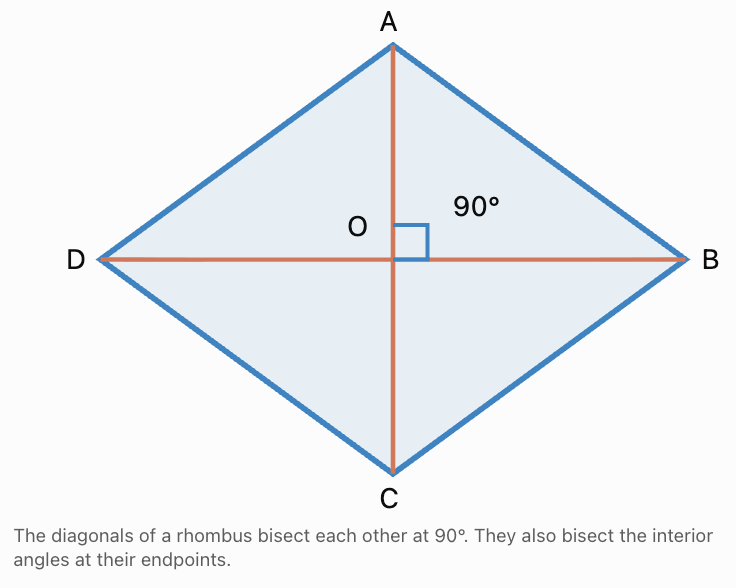
Diagonals bisect each other.
-
Diagonals intersect at right angles.
-
Each diagonal bisects a pair of opposite interior angles.
-
Each diagonal is a line of reflection symmetry.
A rhombus has two lines of reflection symmetry.
Diagonals of a Rhombus
Area of a Rhombus
The area can be calculated using:
Area = Base × Perpendicular height
Or, if the diagonals have lengths d₁ and d₂:
Worked Example 6: Area of a Rhombus
A rhombus has diagonals of 16 cm and 12 cm.
Find its area.
A = d₁d₂/2
A = (16 × 12)/2
A = 192/2
Answer: 96 cm².
Worked Example 7: Side Length of a Rhombus
A rhombus has diagonals measuring 24 cm and 10 cm.
Find its side length.
Step 1: Halve the diagonals.
The diagonals bisect each other.
Half of the first diagonal = 12 cm.
Half of the second diagonal = 5 cm.
Step 2: Use the Pythagorean theorem.
The half-diagonals form the perpendicular legs of a right triangle, with a rhombus side as its hypotenuse.
s² = 12² + 5²
s² = 144 + 25
s² = 169
s = 13 cm
Answer: Each side is 13 cm.
The perimeter is:
P = 4(13) = 52 cm.
Squares
A square is a quadrilateral with four equal sides and four right angles.
It combines the properties of a rectangle and a rhombus.
Properties of Squares
-
All four sides are equal.
-
Opposite sides are parallel.
-
All four angles are 90°.
-
Diagonals are equal.
-
Diagonals bisect each other.
-
Diagonals intersect at 90°.
-
Diagonals bisect the interior angles.
-
It has four lines of reflection symmetry.
-
It has rotational symmetry of order 4.
Comparing Rectangles, Rhombi, and Squares
|
Property |
Rectangle |
Rhombus |
Square |
|---|---|---|---|
|
Opposite sides parallel |
Yes |
Yes |
Yes |
|
Opposite sides equal |
Yes |
Yes |
Yes |
|
All sides equal |
Not necessarily |
Yes |
Yes |
|
All angles 90° |
Yes |
Not necessarily |
Yes |
|
Diagonals bisect each other |
Yes |
Yes |
Yes |
|
Diagonals equal |
Yes |
Not necessarily |
Yes |
|
Diagonals perpendicular |
Not necessarily |
Yes |
Yes |
|
Diagonals bisect vertex angles |
Not necessarily |
Yes |
Yes |
Square Formulas
For a square with side length s:
Perimeter:
P = 4s
Area:
A = s²
Diagonal:
d = s√2
The diagonal formula follows from the Pythagorean theorem:
d² = s² + s²
d² = 2s²
d = s√2
Worked Example 8: Finding the Side of a Square
A square has a diagonal of 10√2 cm.
Find its side length, perimeter, and area.
Step 1: Use the diagonal formula.
d = s√2
10√2 = s√2
s = 10 cm
Step 2: Calculate perimeter.
P = 4s = 4(10)
P = 40 cm
Step 3: Calculate area.
A = s² = 10²
A = 100 cm²
Answer: Side = 10 cm, perimeter = 40 cm, area = 100 cm².
Trapezoids
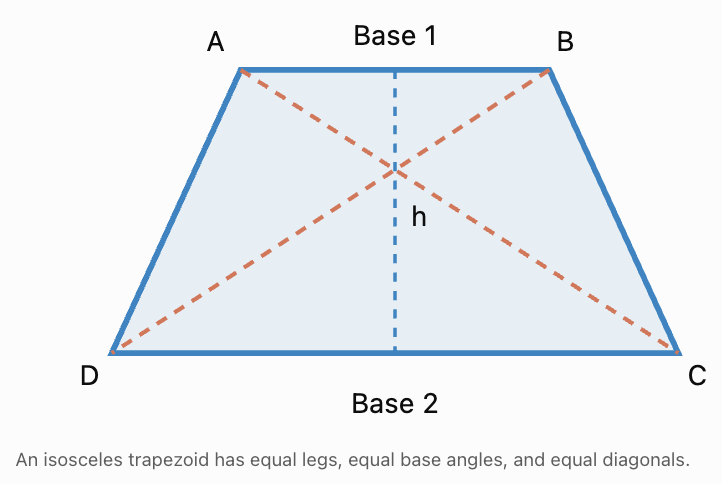
A trapezoid is a quadrilateral with exactly one pair of parallel sides under the exclusive definition used in this lesson.
The parallel sides are called the bases.
The other two sides are called the legs.
The perpendicular distance between the bases is the height.
Types of Trapezoids
General trapezoid: Has one pair of parallel sides, with no additional symmetry required.
Isosceles trapezoid: Has equal legs.
Right trapezoid: Has two right angles.
Properties of an Isosceles Trapezoid
-
The legs are equal.
-
The angles along each base are equal.
-
The diagonals are equal in length.
-
It has one line of reflection symmetry through the midpoints of the bases.
Area of a Trapezoid
The area is the average of the two base lengths multiplied by the height.
\[ A=\frac{(a+b)h}{2} \]where:
-
a and b are the parallel base lengths.
-
h is the perpendicular height.
This formula can be justified by combining two congruent trapezoids to form a parallelogram with base a + b and height h.
Worked Example 9: Area of a Trapezoid
A trapezoid has parallel sides of 12 cm and 20 cm, and a height of 7 cm.
Find its area.
A = (a + b)h/2
A = (12 + 20)(7)/2
A = 32 × 7/2
A = 224/2
Answer: 112 cm².
Worked Example 10: Angles in an Isosceles Trapezoid
An isosceles trapezoid has a lower base angle of 72°.
Find its other three angles.
Step 1: Use equal base angles.
The other lower base angle is also 72°.
Step 2: Use parallel-line properties.
The angles along each leg are supplementary.
Upper angle = 180° − 72°
Upper angle = 108°.
Both upper base angles are 108°.
Answer: 72°, 72°, 108°, and 108°.
Verification:
72 + 72 + 108 + 108 = 360°.
Worked Example 11: Finding a Missing Base
A trapezoid has an area of 150 cm², a height of 10 cm, and one base of 12 cm.
Find the other base.
Use:
A = (a + b)h/2
Substitute:
150 = (12 + b)(10)/2
150 = 5(12 + b)
30 = 12 + b
b = 18
Answer: The other base is 18 cm.
Kites
A kite is a quadrilateral with two distinct pairs of adjacent equal sides.
Unlike a parallelogram, its equal sides are next to each other rather than opposite one another.
Properties of a Kite
For a typical convex kite:
-
Two pairs of adjacent sides are equal.
-
One pair of opposite angles is equal.
-
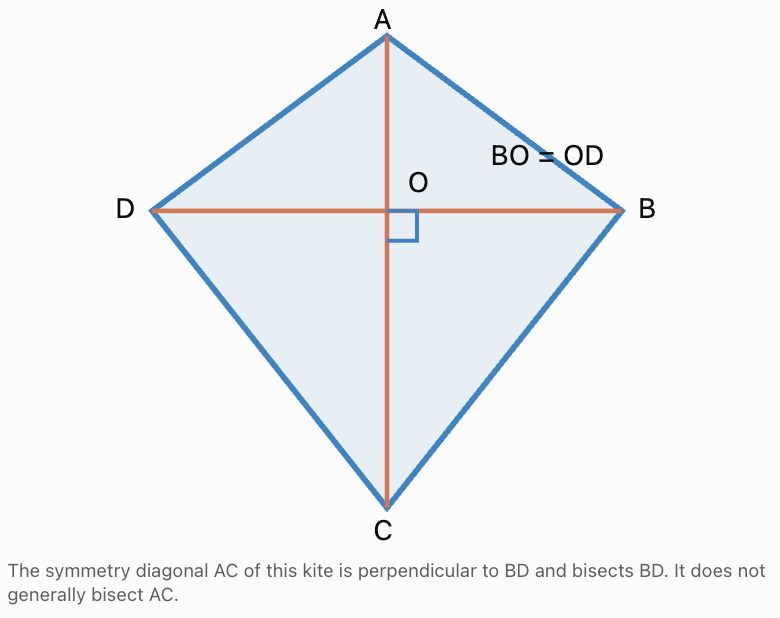
The diagonals are perpendicular.
-
One diagonal bisects the other.
-
The diagonal joining the vertices where the equal sides meet bisects those two vertex angles.
-
That diagonal is a line of reflection symmetry.
The diagonals do not generally bisect each other.
Area of a Kite
The area of a kite can be calculated using its diagonals:
\[ A=\frac{d_1d_2}{2} \]This is the same diagonal-area formula used for a rhombus.
Worked Example 12: Area of a Kite
A kite has diagonals measuring 18 cm and 14 cm.
Find its area.
A = d₁d₂/2
A = 18 × 14/2
A = 252/2
Answer: 126 cm².
Worked Example 13: Finding an Angle in a Kite
A kite has interior angles:
∠A = 80°
∠B = 110°
∠C = x°
∠D = 110°
Find x.
Step 1: Use the quadrilateral angle sum.
80 + 110 + x + 110 = 360
300 + x = 360
x = 60°
Answer: x = 60°.
The two equal angles, ∠B and ∠D, are consistent with the kite's symmetry.
Comparing All Six Quadrilaterals
Property
Parallelogram
Rectangle
Rhombus
Square
Isosceles trapezoid
Kite
Opposite sides parallel in two pairs
Yes
Yes
Yes
Yes
No
No
All sides equal
Not necessarily
Not necessarily
Yes
Yes
No
No
Four right angles
Not necessarily
Yes
No*
Yes
No
No
Opposite angles equal in both pairs
Yes
Yes
Yes
Yes
No
No
Diagonals bisect each other
Yes
Yes
Yes
Yes
No
No
Diagonals equal
Not necessarily
Yes
Not necessarily
Yes
Yes
Not necessarily
Diagonals perpendicular
Not necessarily
Not necessarily
Yes
Yes
Not necessarily
Yes
*Under this classification, a rhombus may have four right angles; in that case it is a square.
A kite can also be a rhombus under the inclusive definition of kites, but this lesson uses the exclusive convention.
Solving Multi-Step Quadrilateral Problems
More challenging problems may require several geometric properties together.
Worked Example 14: Parallelogram Angles with Algebra
In parallelogram ABCD:
∠A = (3x + 15)°
∠B = (5x − 11)°.
Find x and all four angles.
Adjacent angles in a parallelogram are supplementary.
(3x + 15) + (5x − 11) = 180
8x + 4 = 180
8x = 176
x = 22
Calculate:
∠A = 3(22) + 15 = 81°
∠B = 5(22) − 11 = 99°
Opposite angles are equal:
∠C = 81°
∠D = 99°
Answer: x = 22; angles are 81°, 99°, 81°, and 99°.
Worked Example 15: Finding an Unknown Diagonal
A rhombus has an area of 120 cm² and one diagonal of 16 cm.
Find the other diagonal.
Use:
A = d₁d₂/2
120 = 16d₂/2
120 = 8d₂
d₂ = 15 cm
Answer: The second diagonal is 15 cm.
Worked Example 16: A Square Inside a Rectangle
A rectangle measures 18 cm by 12 cm.
A square with side length 8 cm is removed from one corner.
Find the remaining area.
Rectangle area:
Aᵣ = 18 × 12 = 216 cm²
Square area:
Aₛ = 8² = 64 cm²
Remaining area:
216 − 64 = 152 cm²
Answer: 152 cm².
This illustrates how properties of different quadrilaterals can be combined in composite-area problems.
Proving Quadrilateral Properties
In geometry, a proof is a logical argument that establishes why a mathematical statement must be true.
Rather than relying on how a diagram looks, we use definitions, angle properties, congruent triangles, and established theorems.
Quadrilateral proofs frequently involve:
-
Parallel-line angle relationships.
-
Triangle congruence.
-
Properties of diagonals.
-
The Pythagorean theorem.
-
Coordinate geometry.
-
Algebraic relationships.
Proof 1: Opposite Sides of a Parallelogram Are Equal
Given: ABCD is a parallelogram.
Prove: AB = CD and BC = AD.
Draw diagonal AC.
Since AB ∥ CD:
∠BAC = ∠DCA
These are alternate interior angles.
Since BC ∥ AD:
∠BCA = ∠DAC
These are also alternate interior angles.
The triangles share side AC.
Therefore:
AC = AC
By the Angle-Side-Angle (ASA) congruence rule:
△ABC ≅ △CDA
Corresponding sides of congruent triangles are equal.
Therefore:
AB = CD and BC = AD.
This proves that opposite sides of a parallelogram are equal.
Proof 2: Opposite Angles of a Parallelogram Are Equal
Given: ABCD is a parallelogram.
Prove: ∠A = ∠C and ∠B = ∠D.
From the previous proof:
△ABC ≅ △CDA
Corresponding angles of congruent triangles are equal.
Therefore:
∠ABC = ∠CDA
Hence:
∠B = ∠D
The other pair of opposite angles can be established by adding the equal corresponding angles on either side of diagonal AC.
Therefore:
∠A = ∠C and ∠B = ∠D.
Proof 3: Diagonals of a Parallelogram Bisect Each Other
Given: ABCD is a parallelogram, and diagonals AC and BD intersect at O.
Prove: AO = OC and BO = OD.
Consider triangles AOB and COD.
Since AB ∥ CD:
∠ABO = ∠CDO
∠BAO = ∠DCO
Opposite sides of a parallelogram are equal:
AB = CD
Therefore, by ASA:
△AOB ≅ △COD
Corresponding sides are equal.
Thus:
AO = OC
BO = OD
Therefore, the diagonals bisect each other.
Proof 4: Diagonals of a Rectangle Are Equal
Given: ABCD is a rectangle.
Prove: AC = BD.
Consider triangles ABC and BAD.
AB is common to both triangles.
Opposite sides of a rectangle are equal:
BC = AD
Both triangles contain a right angle:
∠ABC = ∠BAD = 90°
Therefore, by Side-Angle-Side (SAS):
△ABC ≅ △BAD
Corresponding sides are equal.
Hence:
AC = BD.
Proof 5: Diagonals of a Rhombus Are Perpendicular
Given: ABCD is a rhombus, and its diagonals intersect at O.
Prove: AC ⟂ BD.
Since a rhombus is a parallelogram, its diagonals bisect each other.
Therefore:
BO = OD
Also, all sides of a rhombus are equal:
AB = AD
The triangles AOB and AOD share AO.
Thus:
AB = AD
BO = OD
AO = AO
By Side-Side-Side (SSS):
△AOB ≅ △AOD
Therefore:
∠AOB = ∠AOD
These two angles form a straight line, so their sum is 180°.
Since they are equal:
∠AOB = ∠AOD = 90°
Therefore:
AC ⟂ BD.
Proof 6: The Midpoint Theorem for a Trapezoid
The segment joining the midpoints of the legs of a trapezoid is called its midsegment.
If the two parallel bases have lengths a and b, the midsegment length m is:
\[ m=\frac{a+b}{2} \]Justification Using Coordinates
Place a trapezoid with vertices:
A = (0, 0)
B = (b, 0)
D = (p, h)
C = (p + a, h)
The parallel bases AB and DC have lengths b and a.
Let M be the midpoint of AD:
M = (p/2, h/2)
Let N be the midpoint of BC:
N = ((b + p + a)/2, h/2)
Both midpoints have the same y-coordinate, so MN is parallel to the bases.
Its length is the difference between their x-coordinates:
MN = (b + p + a)/2 − p/2
MN = (a + b)/2
Therefore:
The trapezoid midsegment is parallel to both bases and has length (a + b)/2.
Worked Example 17: Trapezoid Midsegment
A trapezoid has bases of 14 cm and 26 cm.
Find its midsegment.
m = (a + b)/2
m = (14 + 26)/2
m = 40/2
Answer: 20 cm.
Proving Quadrilateral Properties with Coordinates
Coordinate geometry provides another method for investigating and proving quadrilateral properties.
Important tools include:
Distance formula
\[ d=\sqrt{(x_2-x_1)^2+(y_2-y_1)^2} \]Midpoint formula
\[ M=\left(\frac{x_1+x_2}{2},\frac{y_1+y_2}{2}\right) \]Slope formula
\[ m=\frac{y_2-y_1}{x_2-x_1} \]For nonvertical lines:
-
Equal slopes indicate parallel lines.
-
Slopes with product −1 indicate perpendicular lines.
Vertical and horizontal lines must be handled separately.
Worked Example 18: Classifying a Quadrilateral from Coordinates
Consider quadrilateral ABCD with:
A = (1, 1)
B = (7, 1)
C = (9, 5)
D = (3, 5)
Determine its most specific classification.
Step 1: Calculate the slopes of opposite sides.
AB is horizontal, so its slope is 0.
CD is also horizontal, so its slope is 0.
Therefore:
AB ∥ CD
Slope of BC:
m = (5 − 1)/(9 − 7)
m = 4/2 = 2
Slope of AD:
m = (5 − 1)/(3 − 1)
m = 4/2 = 2
Therefore:
BC ∥ AD
Both pairs of opposite sides are parallel.
The quadrilateral is a parallelogram.
Step 2: Check whether it is a rectangle.
The slope of AB is 0, while BC has slope 2.
These sides are not perpendicular.
Therefore, it is not a rectangle.
Step 3: Check whether it is a rhombus.
Length AB:
AB = 7 − 1 = 6
Length BC:
BC = √[(9 − 7)² + (5 − 1)²]
BC = √(4 + 16)
BC = √20 = 2√5
Since 6 ≠ 2√5, adjacent sides are not equal.
Therefore, it is not a rhombus.
Conclusion: The quadrilateral is a parallelogram, but not a rectangle, rhombus, or square.
Real-World Applications
Architecture and Construction
Rectangles and squares are common in buildings because they are easy to measure, align, and combine into larger structures.
Builders use diagonal measurements to check whether rectangular frames are square.
For example, a frame intended to be 3 m wide and 4 m tall should have diagonals of:
d = √(3² + 4²)
d = √25
d = 5 m
Equal diagonals help verify a rectangular frame when the opposite sides are also correctly aligned.
Bridge and Roof Structures
Parallelograms can deform when their angles change, even if their side lengths remain fixed.
For this reason, engineers often add diagonal bracing to rectangular or parallelogram-shaped frameworks.
The bracing creates triangles that resist deformation.
Kite Design
Traditional diamond-shaped kites often use perpendicular supports.
Their geometric symmetry can help distribute forces and maintain balance during flight.
The diagonals are also useful when calculating the surface area of a kite-shaped design.
Land Measurement
Surveyors and landscape designers use quadrilateral geometry to calculate areas of land.
A trapezoidal plot with parallel sides of 30 m and 50 m and a perpendicular height of 20 m has area:
A = (30 + 50)(20)/2
A = 800 m²
Accurate area calculations are important for planning, construction, and material estimates.
Common Mistakes
Mistake 1: Assuming All Parallelograms Are Rectangles
A parallelogram does not necessarily have right angles.
A rectangle is a special parallelogram with four right angles.
Mistake 2: Assuming a Square Is Not a Rectangle
A square has four right angles, so it satisfies the definition of a rectangle.
Every square is also a rhombus because all four sides are equal.
Mistake 3: Assuming Parallelogram Diagonals Are Equal
Parallelogram diagonals bisect each other, but they are not necessarily equal.
Equal diagonals are an additional property of rectangles and squares.
Mistake 4: Confusing Rhombus and Rectangle Properties
A rhombus has four equal sides, but its angles need not be 90°.
A rectangle has four right angles, but its sides need not all be equal.
Mistake 5: Assuming Kite Diagonals Bisect Each Other
In a typical kite, one diagonal bisects the other.
Both diagonals do not generally bisect each other.
Mistake 6: Using the Wrong Height in an Area Formula
The height of a parallelogram or trapezoid is the perpendicular distance between parallel sides.
A slanted side is not necessarily the height.
Mistake 7: Confusing Equal and Perpendicular Diagonals
Equal diagonals and perpendicular diagonals are different properties.
For example:
-
Rectangle: diagonals equal.
-
Rhombus: diagonals perpendicular.
-
Square: diagonals both equal and perpendicular.
Mistake 8: Forgetting the Trapezoid Definition Convention
Some courses define trapezoids as having exactly one pair of parallel sides, while others allow at least one pair.
Check the definition being used.
Mistake 9: Relying on the Appearance of a Diagram
A shape that looks like a rectangle may not have right angles unless the diagram or problem provides sufficient information.
Use given properties, calculations, or proofs.
Mistake 10: Failing to Justify Geometric Conclusions
Instead of writing only “AB = CD,” explain:
“AB = CD because opposite sides of a parallelogram are equal.”
A clear justification identifies the property supporting the conclusion.
Key Terms
-
Quadrilateral: A polygon with four sides.
-
Parallelogram: A quadrilateral with two pairs of opposite sides parallel.
-
Rectangle: A parallelogram with four right angles.
-
Rhombus: A parallelogram with four equal sides.
-
Square: A quadrilateral with four equal sides and four right angles.
-
Trapezoid: A quadrilateral with exactly one pair of parallel sides under the exclusive definition.
-
Isosceles Trapezoid: A trapezoid with equal nonparallel legs.
-
Right Trapezoid: A trapezoid containing two right angles.
-
Kite: A quadrilateral with two distinct pairs of adjacent equal sides under the exclusive definition.
-
Opposite Sides: Sides that do not share a vertex.
-
Adjacent Sides: Sides that meet at a common vertex.
-
Opposite Angles: Angles at non-adjacent vertices.
-
Diagonal: A segment connecting opposite vertices of a quadrilateral.
-
Bisect: To divide into two equal parts.
-
Perpendicular: Meeting at a right angle.
-
Parallel: Lines that lie in the same plane and never intersect.
-
Supplementary Angles: Two angles that sum to 180°.
-
Line of Symmetry: A line dividing a figure into two mirror-image halves.
-
Rotational Symmetry: A property in which a figure matches itself after a rotation of less than 360°.
-
Midsegment: A segment joining the midpoints of the legs of a trapezoid.
-
Coordinate Proof: A geometric proof using coordinates, slopes, distances, or midpoints.
-
Geometric Proof: A logical argument establishing a geometric property.
Key Takeaways
-
Every quadrilateral has four sides and an interior angle sum of 360°.
-
Parallelograms have two pairs of opposite parallel sides.
-
Opposite sides and opposite angles of parallelograms are equal.
-
Adjacent angles of parallelograms are supplementary.
-
Diagonals of parallelograms bisect each other.
-
Rectangles are parallelograms with four right angles and equal diagonals.
-
Rhombi are parallelograms with four equal sides and perpendicular diagonals.
-
Squares combine the properties of rectangles and rhombi.
-
Trapezoids have one pair of parallel sides under the exclusive definition.
-
Isosceles trapezoids have equal legs, equal base angles, and equal diagonals.
-
Kites have two pairs of adjacent equal sides and perpendicular diagonals.
-
Area formulas depend on the geometric structure of the quadrilateral.
-
Diagonal properties help distinguish quadrilateral families.
-
Coordinate geometry can be used to classify and prove quadrilateral properties.
-
Geometric proofs explain why relationships hold rather than relying on visual appearance.
Check Your Understanding
Question 1: Classification
Classify each quadrilateral as specifically as possible.
a) A quadrilateral with four right angles and opposite sides equal.
b) A quadrilateral with four equal sides but no right angles.
c) A quadrilateral with four equal sides and four right angles.
d) A quadrilateral with exactly one pair of parallel sides.
e) A quadrilateral with two distinct pairs of adjacent equal sides.
Question 2: Parallelogram Angles
In parallelogram ABCD:
∠A = 74°.
Find ∠B, ∠C, and ∠D.
Question 3: Algebraic Side Lengths
In parallelogram PQRS:
PQ = 4x + 7
RS = 7x − 8
Find x and PQ.
Question 4: Rectangle Diagonal
A rectangle measures 15 cm by 8 cm.
Calculate the length of its diagonal.
Question 5: Rhombus Area
A rhombus has diagonals of 20 cm and 14 cm.
Find its area.
Question 6: Square Properties
A square has an area of 144 cm².
Find:
a) Its side length.
b) Its perimeter.
c) Its diagonal length.
Question 7: Trapezoid Area
A trapezoid has parallel bases of 16 cm and 28 cm and a height of 9 cm.
Find its area.
Question 8: Kite Angles
A kite has angles:
∠A = 90°
∠B = 105°
∠C = x°
∠D = 105°.
Find x.
Question 9: Trapezoid Midsegment
A trapezoid has bases of 18 cm and 32 cm.
Find its midsegment length.
Question 10: Quadrilateral Proof
Explain why the diagonals of a rectangle are equal.
Use triangle congruence in your explanation.
Question 11: Coordinate Geometry
A quadrilateral has vertices:
A = (0, 0)
B = (6, 0)
C = (6, 4)
D = (0, 4)
Show that ABCD is a rectangle and determine whether it is a square.
Question 12: Comprehensive Challenge
A rhombus has a perimeter of 52 cm and one diagonal of 24 cm.
Find:
a) The length of each side.
b) Half the length of the given diagonal.
c) Half the length of the other diagonal.
d) The full length of the other diagonal.
e) The area of the rhombus.
Show all working and explain the geometric properties used.
Fully Worked Answers
Answer 1: Classification
a) Rectangle.
It has four right angles and opposite sides equal.
b) Rhombus.
All four sides are equal, but the angles are not right angles.
c) Square.
It has four equal sides and four right angles.
d) Trapezoid.
It has exactly one pair of parallel sides under our chosen definition.
e) Kite.
It has two distinct pairs of adjacent equal sides.
Answer 2: Parallelogram Angles
Given:
∠A = 74°
Opposite angles are equal:
∠C = 74°
Adjacent angles are supplementary:
∠B = 180° − 74°
∠B = 106°
Opposite angles are equal:
∠D = 106°
Answer: ∠B = 106°, ∠C = 74°, ∠D = 106°.
Verification:
74 + 106 + 74 + 106 = 360°.
Answer 3: Algebraic Side Lengths
Opposite sides of a parallelogram are equal.
PQ = RS
4x + 7 = 7x − 8
15 = 3x
x = 5
Substitute:
PQ = 4(5) + 7
PQ = 27
Answer: x = 5 and PQ = 27 units.
Answer 4: Rectangle Diagonal
Use the Pythagorean theorem:
d² = 15² + 8²
d² = 225 + 64
d² = 289
d = √289
Answer: 17 cm.
Answer 5: Rhombus Area
A = d₁d₂/2
A = 20 × 14/2
A = 280/2
Answer: 140 cm².
Answer 6: Square Properties
Given:
Area = 144 cm².
a) Side length
A = s²
144 = s²
s = 12 cm
b) Perimeter
P = 4s
P = 4(12)
P = 48 cm
c) Diagonal
d = s√2
d = 12√2 cm
Approximately:
d ≈ 16.97 cm
Answers: Side = 12 cm, perimeter = 48 cm, diagonal = 12√2 cm.
Answer 7: Trapezoid Area
Given:
a = 16 cm
b = 28 cm
h = 9 cm
Use:
A = (a + b)h/2
A = (16 + 28)(9)/2
A = 44 × 9/2
A = 396/2
Answer: 198 cm².
Answer 8: Kite Angles
Every quadrilateral has an interior angle sum of 360°.
90 + 105 + x + 105 = 360
300 + x = 360
x = 60°
Answer: 60°.
Answer 9: Trapezoid Midsegment
Use:
m = (a + b)/2
m = (18 + 32)/2
m = 50/2
Answer: 25 cm.
Answer 10: Rectangle Diagonal Proof
Let ABCD be a rectangle.
Consider triangles ABC and BAD.
AB is common to both triangles.
BC = AD because opposite sides of a rectangle are equal.
∠ABC = ∠BAD = 90° because all rectangle angles are right angles.
Therefore, by SAS congruence:
△ABC ≅ △BAD
Corresponding sides of congruent triangles are equal.
Therefore:
AC = BD.
Hence, the diagonals of a rectangle are equal.
Answer 11: Coordinate Geometry
Given:
A = (0, 0)
B = (6, 0)
C = (6, 4)
D = (0, 4)
Step 1: Check opposite sides.
AB is horizontal.
CD is horizontal.
Therefore:
AB ∥ CD
BC is vertical.
AD is vertical.
Therefore:
BC ∥ AD
Both pairs of opposite sides are parallel, so ABCD is a parallelogram.
Step 2: Check right angles.
Horizontal and vertical lines are perpendicular.
Therefore, all four interior angles are 90°.
ABCD is a rectangle.
Step 3: Check side lengths.
AB = 6 units.
BC = 4 units.
Since 6 ≠ 4, not all four sides are equal.
Therefore, ABCD is not a square.
Answer: ABCD is a rectangle but not a square.
Answer 12: Comprehensive Challenge
A rhombus has perimeter 52 cm and one diagonal 24 cm.
a) Side length
A rhombus has four equal sides.
s = 52/4
s = 13 cm
b) Half the given diagonal
The diagonals bisect each other.
24/2 = 12 cm
c) Half the other diagonal
The diagonals of a rhombus are perpendicular.
Their halves form a right triangle with the rhombus side as its hypotenuse.
Let x represent half the unknown diagonal.
Use the Pythagorean theorem:
13² = 12² + x²
169 = 144 + x²
x² = 25
x = 5 cm
d) Full second diagonal
d₂ = 2(5)
d₂ = 10 cm
e) Area
A = d₁d₂/2
A = 24 × 10/2
A = 240/2
A = 120 cm²
Final answers:
-
Side length = 13 cm.
-
Half of the first diagonal = 12 cm.
-
Half of the second diagonal = 5 cm.
-
Second diagonal = 10 cm.
-
Area = 120 cm².
The solution uses three important rhombus properties: all sides are equal, diagonals bisect each other, and diagonals are perpendicular.
This completes Quadrilaterals, with comprehensive coverage of classification, parallelogram properties, rectangles, rhombi, squares, trapezoids, kites, problem solving, and geometric proofs.
-