Polygons and Circles
1. Properties of Polygons
Learning outcomes
- I can classify polygons.
- I can calculate interior and exterior angle sums.
- I can identify regular polygons.
- I can solve angle problems involving polygons.
- I can justify polygon properties.
Introduction
Polygons are everywhere in mathematics, architecture, engineering, art, and nature. The triangular framework of a bridge, the rectangular shape of a classroom, the hexagonal cells of a honeycomb, and the pentagonal patterns of a football all involve polygons.
Although polygons can have many different shapes and sizes, they follow predictable mathematical rules. These rules allow us to classify polygons, calculate their angles, identify regular shapes, and explain why certain geometric relationships are always true.
One of the most important discoveries in geometry is that the sum of the interior angles of a polygon depends only on its number of sides, not on its size or exact shape.
For example, every triangle has an interior angle sum of 180°, while every quadrilateral has an interior angle sum of 360°.
By understanding how polygons can be divided into triangles, we can extend these results to polygons with any number of sides.
In this lesson, we will explore polygon classification, interior and exterior angles, regular polygons, multi-step angle problems, and mathematical justifications for polygon properties.
What Is a Polygon?
A polygon is a closed, two-dimensional shape formed by three or more straight line segments.
The line segments are called sides, and the points where they meet are called vertices.
A polygon must satisfy several conditions:
-
It must be a closed shape.
-
It must be two-dimensional.
-
All its sides must be straight.
-
It must have at least three sides.
-
Its sides meet at endpoints to form a single boundary without crossing.
A circle is not a polygon because its boundary is curved.
An open shape is not a polygon because its sides do not form a closed boundary.
A conventional simple polygon does not have sides that cross one another.
Parts of a Polygon
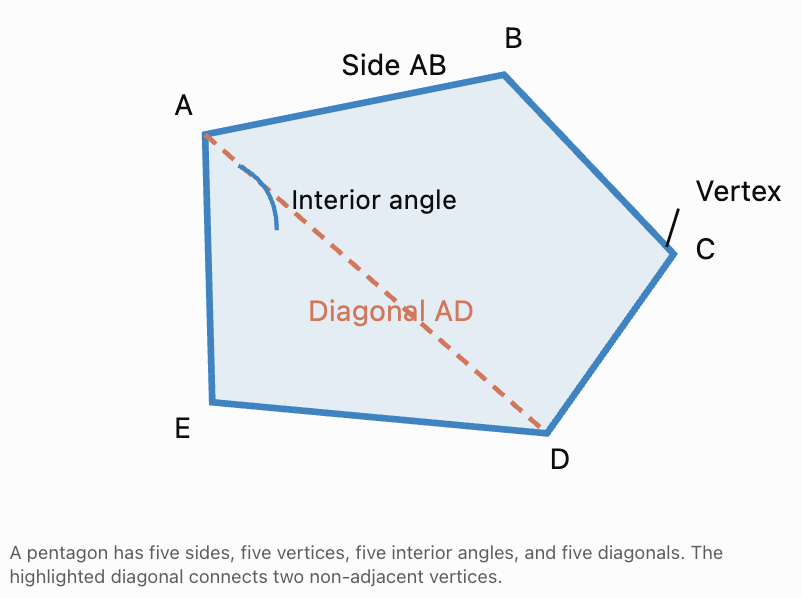
The important parts of a polygon include:
Side: A straight line segment forming part of the boundary.
Vertex: A point where two adjacent sides meet.
Interior angle: An angle formed inside the polygon by two adjacent sides.
Exterior angle: An angle formed outside the polygon when a side is extended.
Diagonal: A line segment joining two non-adjacent vertices.
Classifying Polygons by Number of Sides
Polygons are commonly named according to the number of sides they have.
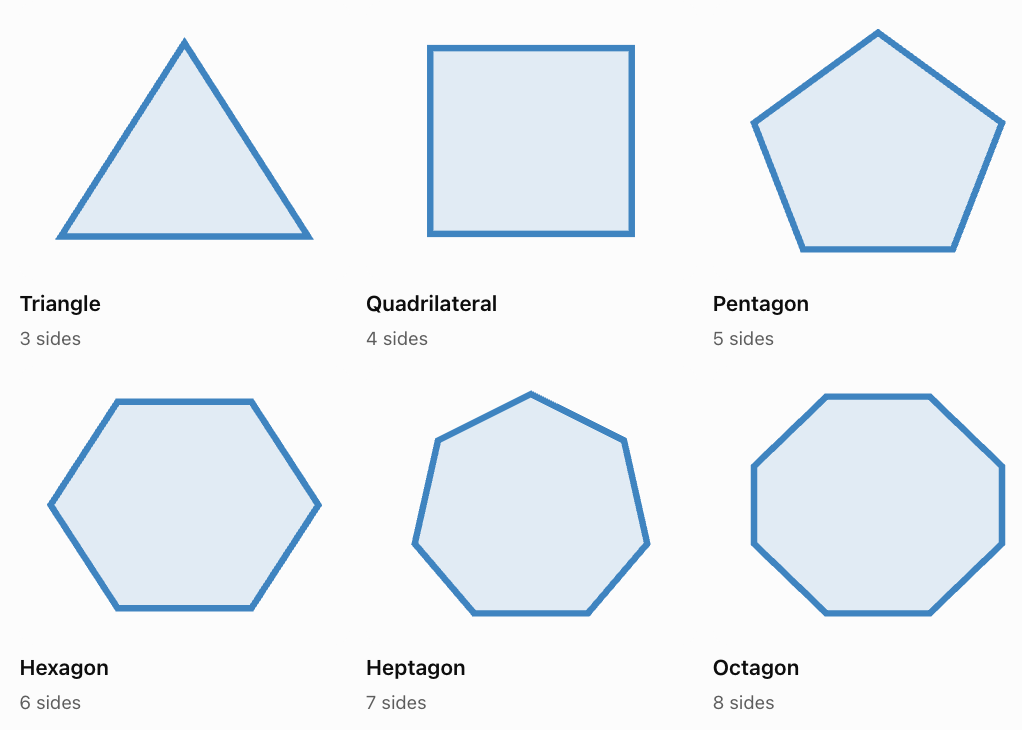
Other polygon names include:
|
Number of sides |
Polygon name |
|---|---|
|
9 |
Nonagon |
|
10 |
Decagon |
|
11 |
Hendecagon or undecagon |
|
12 |
Dodecagon |
|
15 |
Pentadecagon |
|
20 |
Icosagon |
The number of sides is usually represented by the variable n.
Classifying Polygons by Shape
Polygons can also be classified according to their angles, sides, and overall shape.
Convex Polygons
A convex polygon has every interior angle less than 180°.
A line segment joining any two points inside a convex polygon lies entirely inside the polygon.
All regular polygons are convex under the usual school-geometry definition.
Concave Polygons
A concave polygon has at least one interior angle greater than 180°.
Such an angle is called a reflex angle.
A concave polygon has an indentation, and some line segments connecting points inside it may pass outside the polygon.
Equilateral and Equiangular Polygons
An equilateral polygon has all sides equal in length.
An equiangular polygon has all interior angles equal.
A regular polygon is both equilateral and equiangular.
For example:
-
A square is regular because all four sides and all four angles are equal.
-
A rectangle that is not a square is equiangular but not equilateral.
-
A rhombus that is not a square is equilateral but not equiangular.
-
Every equilateral triangle is also equiangular and therefore regular.
Interior Angles of Polygons
The interior angle sum is the total of all angles inside a polygon.
The sum depends on the number of sides.
Why Is the Interior Angle Sum of a Triangle 180°?
In Euclidean geometry, the interior angles of every triangle add to 180°.
If a triangle has angles A, B, and C:
A + B + C = 180°
This is one of the fundamental angle properties used throughout geometry.
Dividing Polygons into Triangles
A convex polygon can be divided into triangles by drawing diagonals from one vertex to all non-adjacent vertices.
A quadrilateral can be divided into 2 triangles.
A pentagon can be divided into 3 triangles.
A hexagon can be divided into 4 triangles.
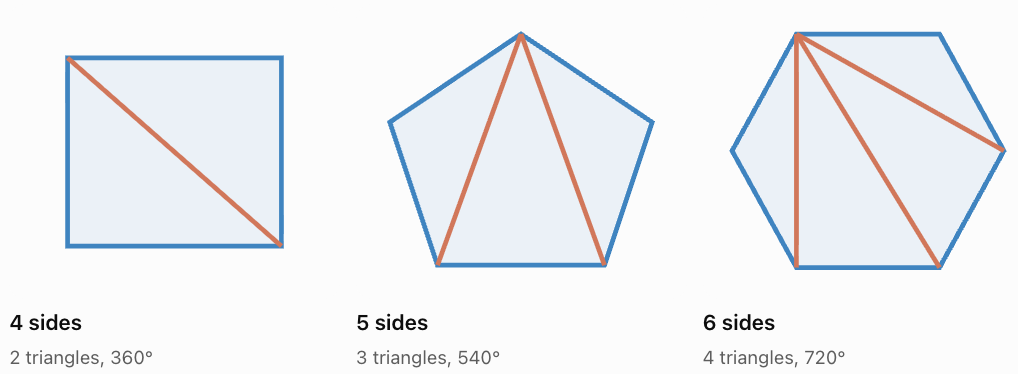
The pattern is:
Number of triangles = Number of sides − 2
Therefore, for an n-sided polygon:
Number of triangles = n − 2
Since each triangle has an angle sum of 180°:
Interior angle sum = (n − 2) × 180°
Using S to represent the interior angle sum:
This formula applies to simple polygons, whether convex or concave.
Interior Angle Sum Table
|
Polygon |
Sides |
Interior angle sum |
|
|---|---|---|---|
|
Triangle |
3 |
1 |
180° |
|
Quadrilateral |
4 |
2 |
360° |
|
Pentagon |
5 |
3 |
540° |
|
Hexagon |
6 |
4 |
720° |
|
Heptagon |
7 |
5 |
900° |
|
Octagon |
8 |
6 |
1080° |
|
Nonagon |
9 |
7 |
1260° |
|
Decagon |
10 |
8 |
1440° |
|
Dodecagon |
12 |
10 |
1800° |
Worked Example 1: Interior Angle Sum of a Nonagon
Calculate the sum of the interior angles of a nonagon.
Step 1: Identify n.
A nonagon has 9 sides.
n = 9
Step 2: Apply the formula.
S = (n − 2) × 180°
S = (9 − 2) × 180°
S = 7 × 180°
Answer: 1260°.
Worked Example 2: Finding the Number of Sides
A polygon has an interior angle sum of 1980°.
How many sides does it have?
Step 1: Use the formula.
(n − 2) × 180° = 1980°
Step 2: Divide by 180°.
n − 2 = 11
Step 3: Solve.
n = 13
Answer: The polygon has 13 sides.
Worked Example 3: Finding a Missing Interior Angle
A pentagon has interior angles:
95°, 110°, 125°, 100°, and x°.
Find x.
Step 1: Calculate the angle sum.
S = (5 − 2) × 180°
S = 540°
Step 2: Form an equation.
95 + 110 + 125 + 100 + x = 540
430 + x = 540
Step 3: Solve.
x = 110°
Answer: The missing angle is 110°.
Exterior Angles of Polygons
An exterior angle is formed when one side of a polygon is extended beyond a vertex.
For a convex polygon, the interior angle and its adjacent exterior angle form a straight line.
Therefore:
Interior angle + Exterior angle = 180°
For example, if an interior angle is 125°:
Exterior angle = 180° − 125°
Exterior angle = 55°
The Exterior Angle Sum Theorem
The sum of one exterior angle at each vertex of any convex polygon, measured consistently around the boundary, is:
This is true regardless of the number of sides.
For example:
-
Triangle: exterior angle sum = 360°.
-
Pentagon: exterior angle sum = 360°.
-
Octagon: exterior angle sum = 360°.
-
Decagon: exterior angle sum = 360°.
Why Do Exterior Angles Add to 360°?
Imagine walking around the boundary of a polygon.
At every vertex, you turn through an exterior angle.
After travelling completely around the polygon and returning to your starting direction, you have made one full turn.
One full turn is 360°.
Therefore, the exterior angles sum to 360°.
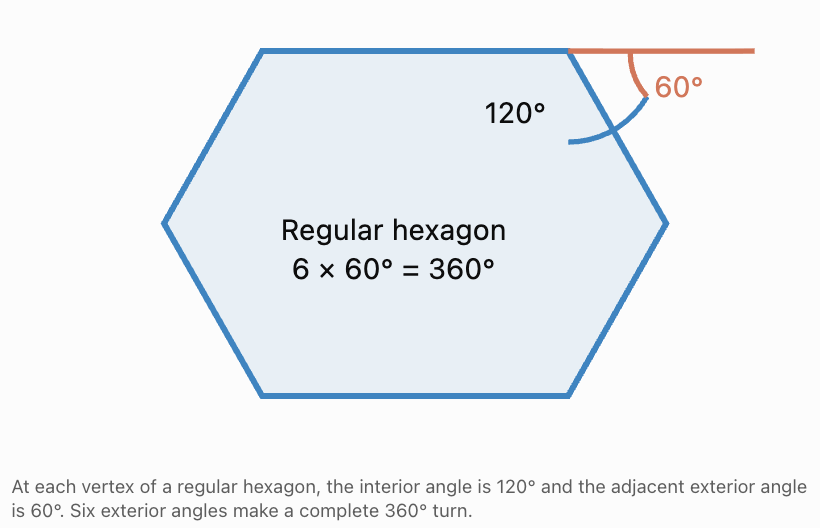
For concave polygons, the corresponding theorem uses signed exterior turning angles, allowing turns in opposite directions. Their signed sum is 360° when the boundary is traversed once counterclockwise.
For most introductory angle problems, we work with convex polygons and positive exterior angles.
Worked Example 4: Missing Exterior Angle
A convex pentagon has exterior angles:
65°, 70°, 80°, 55°, and x°.
Find x.
Step 1: Use the exterior angle sum.
65 + 70 + 80 + 55 + x = 360
Step 2: Simplify.
270 + x = 360
Step 3: Solve.
x = 90°
Answer: 90°.
Worked Example 5: Interior and Exterior Angle Relationship
An interior angle of a convex polygon is 148°.
Find its adjacent exterior angle.
Interior + Exterior = 180°
148 + e = 180
e = 32°
Answer: 32°.
Regular Polygons
A regular polygon has all sides equal in length and all interior angles equal.
Examples include:
-
Equilateral triangle.
-
Square.
-
Regular pentagon.
-
Regular hexagon.
-
Regular octagon.
An irregular polygon does not have both of these properties.
Interior Angle of a Regular Polygon
For a regular polygon, all interior angles are equal.
Therefore:
Interior angle = Interior angle sum / Number of sides
An equivalent formula is:
Both formulas give the same result.
Exterior Angle of a Regular Polygon
Since all exterior angles are equal and their sum is 360°:
The interior and exterior angles satisfy:
I + E = 180°
Regular Polygon Angle Table
|
Polygon |
Number of sides |
Each interior angle |
Each exterior angle |
|---|---|---|---|
|
Equilateral triangle |
3 |
60° |
120° |
|
Square |
4 |
90° |
90° |
|
Regular pentagon |
5 |
108° |
72° |
|
Regular hexagon |
6 |
120° |
60° |
|
Regular octagon |
8 |
135° |
45° |
|
Regular decagon |
10 |
144° |
36° |
|
Regular dodecagon |
12 |
150° |
30° |
Worked Example 6: Interior Angle of a Regular Octagon
Find each interior angle of a regular octagon.
Step 1: Identify n.
n = 8
Step 2: Use the formula.
I = [(n − 2) × 180°]/n
I = [(8 − 2) × 180°]/8
I = 1080°/8
Answer: 135°.
Worked Example 7: Finding the Number of Sides from an Exterior Angle
Each exterior angle of a regular polygon is 24°.
How many sides does it have?
Step 1: Use the exterior angle formula.
E = 360°/n
Step 2: Substitute.
24 = 360/n
Step 3: Solve.
24n = 360
n = 15
Answer: The regular polygon has 15 sides.
Worked Example 8: Finding the Number of Sides from an Interior Angle
Each interior angle of a regular polygon is 156°.
Find the number of sides.
Step 1: Find the exterior angle.
E = 180° − 156°
E = 24°
Step 2: Find n.
n = 360°/24°
n = 15
Answer: 15 sides.
This approach is often more efficient than solving the full interior-angle formula.
Central Angles of Regular Polygons
A regular polygon has a centre that is equally distant from all its vertices.
Joining the centre to every vertex divides the polygon into congruent isosceles triangles.
The angle at the centre of each triangle is called a central angle.
Because angles around a point sum to 360°:
For a regular polygon, the central angle has the same numerical measure as each exterior angle.
Worked Example 9: Central Angle of a Regular Decagon
A regular decagon has 10 sides.
Central angle:
C = 360°/10
C = 36°
Each interior angle is:
I = 180° − 36°
I = 144°
Answer: Central angle = 36°, interior angle = 144°.
Solving Algebraic Angle Problems
Some polygon problems involve angles expressed algebraically.
We use the interior or exterior angle sum to form an equation.
Worked Example 10: Algebraic Interior Angles
The interior angles of a quadrilateral are:
(2x + 10)°, (3x − 5)°, (x + 25)°, and (2x + 10)°.
Find x and all four angles.
Step 1: Use the quadrilateral angle sum.
The interior angle sum is 360°.
(2x + 10) + (3x − 5) + (x + 25) + (2x + 10) = 360
Step 2: Simplify.
8x + 40 = 360
8x = 320
x = 40
Step 3: Calculate each angle.
2x + 10 = 90°
3x − 5 = 115°
x + 25 = 65°
2x + 10 = 90°
Step 4: Verify.
90 + 115 + 65 + 90 = 360°
Answer: x = 40; the angles are 90°, 115°, 65°, and 90°.
Worked Example 11: Algebraic Exterior Angles
The exterior angles of a convex pentagon are:
x°, (x + 10)°, (2x − 5)°, (x + 25)°, and (x + 30)°.
Find x.
Step 1: Use the exterior angle sum.
x + (x + 10) + (2x − 5) + (x + 25) + (x + 30) = 360
Step 2: Simplify.
6x + 60 = 360
6x = 300
x = 50
Step 3: Calculate the angles.
50°, 60°, 95°, 75°, 80°.
Step 4: Verify.
50 + 60 + 95 + 75 + 80 = 360°
Answer: x = 50.
Worked Example 12: Finding a Polygon from an Angle Relationship
The interior angle of a regular polygon is five times its exterior angle.
Find the number of sides.
Step 1: Define the exterior angle.
Let E be the exterior angle.
Then:
I = 5E
Step 2: Use the supplementary relationship.
I + E = 180°
5E + E = 180°
6E = 180°
E = 30°
Step 3: Find the number of sides.
n = 360°/30°
n = 12
Answer: The polygon is a regular dodecagon.
Diagonals of Polygons
A diagonal is a line segment connecting two non-adjacent vertices of a polygon.
The number of diagonals increases as the number of sides increases.
Deriving the Diagonal Formula
Consider a polygon with n vertices.
From any one vertex, we can draw a segment to the other n − 1 vertices.
However, three of these connections are not diagonals:
-
The connection to the vertex itself is not counted.
-
The connections to the two adjacent vertices are sides.
Therefore, each vertex connects to:
n − 3 diagonals.
Across all n vertices, this gives:
n(n − 3)
But each diagonal has been counted twice, once from each endpoint.
Therefore, the total number of diagonals is:
Worked Example 13: Diagonals of a Decagon
Find the number of diagonals in a decagon.
n = 10
D = n(n − 3)/2
D = 10(10 − 3)/2
D = 10 × 7/2
Answer: 35 diagonals.
Worked Example 14: Finding the Number of Sides from Diagonals
A polygon has 20 diagonals. How many sides does it have?
Use:
n(n − 3)/2 = 20
Multiply by 2:
n(n − 3) = 40
Expand:
n² − 3n − 40 = 0
Factor:
(n − 8)(n + 5) = 0
n = 8 or n = −5
A polygon cannot have a negative number of sides.
Answer: The polygon is an octagon.
This problem connects geometry with quadratic equations.
Justifying Polygon Properties
In mathematics, knowing that a rule works is different from understanding why it works.
A mathematical justification uses established facts and logical reasoning to demonstrate that a statement is true.
Proof 1: Interior Angle Sum
Claim: The interior angle sum of a simple n-sided polygon is (n − 2) × 180°.
Reasoning:
-
A simple polygon with n sides can be divided into n − 2 triangles without overlapping interiors.
-
Each triangle has an interior angle sum of 180°.
-
The angles of these triangles collectively make up the polygon's interior angles.
-
Therefore, the total is (n − 2) × 180°.
Thus:
S = (n − 2) × 180°.
This establishes the interior angle sum formula for simple polygons.
Proof 2: Exterior Angle Sum
Claim: The sum of one exterior angle at each vertex of a convex polygon is 360°.
Let the interior angles be I₁, I₂, ..., Iₙ.
Let the corresponding exterior angles be E₁, E₂, ..., Eₙ.
At each vertex:
I + E = 180°
Adding this relationship for all n vertices:
Sum of interior angles + Sum of exterior angles = 180n
We already know:
Sum of interior angles = 180(n − 2)
Substitute:
180(n − 2) + Sum of exterior angles = 180n
Therefore:
Sum of exterior angles = 180n − 180(n − 2)
= 180n − 180n + 360
Sum of exterior angles = 360°.
This is an algebraic proof that works for any convex polygon.
Proof 3: Interior Angle of a Regular Polygon
Claim: Each interior angle of a regular n-sided polygon is:
I = 180° − 360°/n
Reasoning:
A regular polygon has n equal exterior angles.
Their sum is 360°.
Therefore, each exterior angle is:
E = 360°/n
Each interior angle and adjacent exterior angle add to 180°.
Hence:
I = 180° − E
Substituting:
I = 180° − 360°/n.
Proof 4: Why a Regular Polygon Has Equal Central Angles
A regular polygon has equally spaced vertices around its circumcircle.
Joining the centre to each vertex divides a full revolution into n equal central angles.
Because angles around a point sum to 360°:
Central angle = 360°/n.
This also explains why the central and exterior angles of a regular polygon are equal.
Real-World Applications
Application 1: Architecture and Structural Design
Triangles are frequently used in structural frameworks because a triangle with fixed side lengths cannot change shape without changing at least one side length.
Rectangular frameworks, by comparison, may deform into parallelograms unless they are braced.
Engineers often divide larger polygonal structures into triangles to improve rigidity.
This is called triangulation.
Application 2: Honeycomb Structures
Honeycombs contain approximately hexagonal cells.
A regular hexagon has:
-
Six equal sides.
-
Six equal interior angles of 120°.
-
Six exterior angles of 60°.
Three regular hexagons can meet around a point because:
120° + 120° + 120° = 360°.
This allows hexagons to tile a flat surface without gaps.
Application 3: Floor Tiling
A tessellation is a pattern of shapes that covers a plane without gaps or overlaps.
For regular polygons of one type to meet edge-to-edge around every vertex, their interior angles must fit exactly into 360°.
For example:
Equilateral triangles: 60° each.
360°/60° = 6 triangles.
Squares: 90° each.
360°/90° = 4 squares.
Regular hexagons: 120° each.
360°/120° = 3 hexagons.
Regular pentagons have interior angles of 108°.
360°/108° = 3⅓.
Because a whole number of regular pentagons cannot fit around a point in this way, regular pentagons alone cannot form a regular edge-to-edge tessellation.
Application 4: Road Signs
A standard stop sign is octagonal.
A regular octagon has:
Interior angle:
I = (8 − 2) × 180°/8
I = 135°
Exterior angle:
E = 360°/8
E = 45°
Its distinctive shape helps drivers recognize the sign.
Application 5: Computer Graphics and Game Design
Three-dimensional models in computer graphics are often represented using polygon meshes.
Complex surfaces are approximated using many small polygons, particularly triangles and quadrilaterals.
Understanding polygon properties helps with:
-
Constructing digital shapes.
-
Subdividing surfaces.
-
Measuring angles and dimensions.
-
Designing symmetrical patterns.
-
Building geometric models.
Common Mistakes
Mistake 1: Confusing Interior Angle Sum with One Interior Angle
For a regular hexagon:
Interior angle sum = 720°.
Each interior angle = 120°.
These are different quantities.
Mistake 2: Forgetting to Subtract 2
Incorrect:
S = n × 180°
Correct:
S = (n − 2) × 180°.
Mistake 3: Assuming All Polygons Are Regular
A polygon may have equal sides without equal angles, or equal angles without equal sides.
A regular polygon must satisfy both conditions.
Mistake 4: Thinking the Exterior Angle Sum Depends on the Number of Sides
The exterior angle sum of every convex polygon is 360°, regardless of the number of sides.
Mistake 5: Using 360°/n for Interior Angles
The formula 360°/n gives each exterior angle or central angle of a regular polygon.
Each interior angle is:
180° − 360°/n.
Mistake 6: Applying Regular Polygon Formulas to Irregular Polygons
An irregular pentagon still has an interior angle sum of 540°, but its individual angles are not necessarily 108°.
Mistake 7: Confusing Concave and Convex Polygons
A convex polygon has no reflex interior angles.
A concave polygon has at least one reflex interior angle.
Mistake 8: Counting Diagonals Twice
The formula n(n − 3) counts each diagonal from both endpoints.
Divide by 2 to obtain the correct number.
Mistake 9: Accepting Impossible Answers
A polygon cannot have 2.5 sides or a negative number of sides.
The number of sides must be a whole number of at least 3.
Mistake 10: Giving an Answer Without Justification
A complete geometry solution should state the relevant property or theorem, show the calculation, and explain the conclusion.
Key Terms
-
Polygon: A closed two-dimensional figure formed by at least three straight sides.
-
Side: A line segment forming part of a polygon's boundary.
-
Vertex: A point where two adjacent sides meet.
-
Interior Angle: An angle inside a polygon formed by adjacent sides.
-
Exterior Angle: An angle formed when a side of a polygon is extended.
-
Diagonal: A segment connecting two non-adjacent vertices.
-
Triangle: A polygon with three sides.
-
Quadrilateral: A polygon with four sides.
-
Pentagon: A polygon with five sides.
-
Hexagon: A polygon with six sides.
-
Heptagon: A polygon with seven sides.
-
Octagon: A polygon with eight sides.
-
Nonagon: A polygon with nine sides.
-
Decagon: A polygon with ten sides.
-
Regular Polygon: A polygon with all sides equal and all interior angles equal.
-
Irregular Polygon: A polygon that is not regular.
-
Equilateral Polygon: A polygon with all sides equal.
-
Equiangular Polygon: A polygon with all interior angles equal.
-
Convex Polygon: A polygon with every interior angle less than 180°.
-
Concave Polygon: A polygon with at least one reflex interior angle.
-
Reflex Angle: An angle greater than 180° and less than 360°.
-
Interior Angle Sum: The sum of all interior angles of a polygon.
-
Exterior Angle Sum: The sum of one exterior angle at each vertex, measured consistently.
-
Central Angle: An angle formed at the centre of a regular polygon by segments to adjacent vertices.
-
Supplementary Angles: Two angles whose measures add to 180°.
-
Tessellation: A pattern covering a plane without gaps or overlaps.
-
Triangulation: Dividing a polygon or geometric structure into triangles.
-
Geometric Proof: A logical explanation demonstrating why a geometric statement is true.
Key Takeaways
-
Polygons are closed, two-dimensional shapes with three or more straight sides.
-
Polygons can be classified by number of sides, angle properties, and side lengths.
-
Convex polygons have all interior angles less than 180°.
-
Concave polygons have at least one reflex interior angle.
-
Regular polygons have equal sides and equal interior angles.
-
The interior angle sum of an n-sided simple polygon is (n − 2) × 180°.
-
The exterior angle sum of a convex polygon is always 360°.
-
Each interior angle of a regular polygon is [(n − 2) × 180°]/n.
-
Each exterior angle of a regular polygon is 360°/n.
-
Each central angle of a regular polygon is 360°/n.
-
An interior angle and its adjacent exterior angle are supplementary.
-
A polygon with n sides has n(n − 3)/2 diagonals.
-
Algebra can be used to solve missing-angle problems.
-
Polygon properties can be justified through triangulation, angle relationships, and logical reasoning.
-
Polygon geometry has applications in architecture, engineering, tessellations, and computer graphics.
Check Your Understanding
Question 1: Classifying Polygons
Name the polygon with:
a) 5 sides.
b) 7 sides.
c) 10 sides.
d) 12 sides.
Explain the difference between a regular and an irregular polygon.
Question 2: Interior Angle Sums
Calculate the interior angle sum of:
a) A hexagon.
b) An octagon.
c) A decagon.
d) A 15-sided polygon.
Question 3: Finding the Number of Sides
A polygon has an interior angle sum of 2340°.
How many sides does it have?
Question 4: Missing Interior Angle
A hexagon has interior angles:
105°, 120°, 135°, 140°, 110°, and x°.
Find x.
Question 5: Exterior Angles
A convex pentagon has exterior angles:
65°, 80°, 55°, 70°, and x°.
Find x.
Question 6: Regular Polygon Angles
Calculate each interior and exterior angle of:
a) A regular pentagon.
b) A regular nonagon.
c) A regular dodecagon.
Question 7: Finding the Number of Sides
Each exterior angle of a regular polygon is 18°.
Find the number of sides.
Question 8: Algebraic Angle Problem
The interior angles of a quadrilateral are:
(x + 20)°, (2x + 10)°, (x + 40)°, and (2x − 10)°.
Find x and all four angles.
Question 9: Diagonals
a) How many diagonals does a heptagon have?
b) A polygon has 27 diagonals. How many sides does it have?
Question 10: Angle Relationships
The interior angle of a regular polygon is four times its exterior angle.
Find:
a) Each exterior angle.
b) Each interior angle.
c) The number of sides.
Question 11: Tessellations
Explain why regular hexagons can tessellate a plane by themselves, but regular pentagons cannot form a regular edge-to-edge tessellation by themselves.
Use angle calculations to justify your answer.
Question 12: Comprehensive Challenge
A convex hexagon has exterior angles:
(x + 10)°, (2x − 5)°, (x + 20)°, (x + 15)°, (2x − 10)°, and (x + 10)°.
a) Find x.
b) Calculate all six exterior angles.
c) Calculate the corresponding interior angles.
d) Verify both the exterior and interior angle sums.
Fully Worked Answers
Answer 1: Classifying Polygons
a) Pentagon.
b) Heptagon.
c) Decagon.
d) Dodecagon.
A regular polygon has all sides equal and all interior angles equal.
An irregular polygon does not satisfy both of these conditions.
Answer 2: Interior Angle Sums
Use:
S = (n − 2) × 180°.
a) Hexagon
S = (6 − 2) × 180°
S = 4 × 180°
S = 720°.
b) Octagon
S = (8 − 2) × 180°
S = 6 × 180°
S = 1080°.
c) Decagon
S = (10 − 2) × 180°
S = 8 × 180°
S = 1440°.
d) 15-sided polygon
S = (15 − 2) × 180°
S = 13 × 180°
S = 2340°.
Answer 3: Number of Sides
Given:
S = 2340°.
Use:
(n − 2) × 180° = 2340°
Divide by 180°:
n − 2 = 13
n = 15
Answer: 15 sides.
Answer 4: Missing Interior Angle
A hexagon has interior angle sum:
S = (6 − 2) × 180° = 720°.
Add the known angles:
105 + 120 + 135 + 140 + 110 = 610°
Therefore:
610 + x = 720
x = 110°
Answer: 110°.
Answer 5: Exterior Angles
The exterior angle sum is 360°.
65 + 80 + 55 + 70 + x = 360
270 + x = 360
x = 90°
Answer: 90°.
Answer 6: Regular Polygon Angles
Use:
E = 360°/n
I = 180° − E
a) Regular pentagon
E = 360°/5 = 72°
I = 180° − 72° = 108°
b) Regular nonagon
E = 360°/9 = 40°
I = 180° − 40° = 140°
c) Regular dodecagon
E = 360°/12 = 30°
I = 180° − 30° = 150°
Answer 7: Number of Sides
Given:
E = 18°.
Use:
n = 360°/E
n = 360°/18°
n = 20
Answer: 20 sides.
Answer 8: Algebraic Angles
The interior angle sum of a quadrilateral is 360°.
Form the equation:
(x + 20) + (2x + 10) + (x + 40) + (2x − 10) = 360
Collect like terms:
6x + 60 = 360
6x = 300
x = 50
Calculate each angle:
x + 20 = 70°
2x + 10 = 110°
x + 40 = 90°
2x − 10 = 90°
Check:
70 + 110 + 90 + 90 = 360°
Answer: x = 50; angles are 70°, 110°, 90°, and 90°.
Answer 9: Diagonals
Use:
D = n(n − 3)/2.
a) Heptagon
n = 7
D = 7(7 − 3)/2
D = 7 × 4/2
D = 14
Answer: 14 diagonals.
b) Polygon with 27 diagonals
n(n − 3)/2 = 27
n(n − 3) = 54
n² − 3n − 54 = 0
Factor:
(n − 9)(n + 6) = 0
n = 9 or n = −6
Reject the negative solution.
Answer: 9 sides, so the polygon is a nonagon.
Answer 10: Interior and Exterior Relationship
Given:
I = 4E
Interior and exterior angles are supplementary:
I + E = 180°
Substitute:
4E + E = 180°
5E = 180°
E = 36°
Therefore:
I = 4 × 36° = 144°
Find the number of sides:
n = 360°/36°
n = 10
Answers:
a) Exterior angle = 36°.
b) Interior angle = 144°.
c) 10 sides, a regular decagon.
Answer 11: Tessellations
A regular hexagon has interior angle:
I = [(6 − 2) × 180°]/6
I = 720°/6
I = 120°
Three regular hexagons meeting at a point produce:
3 × 120° = 360°
Therefore, they fit around a point without gaps or overlaps.
A regular pentagon has interior angle:
I = [(5 − 2) × 180°]/5
I = 540°/5
I = 108°
Three pentagons give:
3 × 10⁸° = 324°
This leaves a gap of 36°.
Four pentagons give:
4 × 10⁸° = 432°
This produces an overlap of 72°.
Therefore, regular pentagons cannot form a regular edge-to-edge tessellation using only copies of themselves.
Answer 12: Comprehensive Challenge
The exterior angles are:
(x + 10), (2x − 5), (x + 20), (x + 15), (2x − 10), (x + 10).
a) Find x.
Their sum is 360°.
(x + 10) + (2x − 5) + (x + 20) + (x + 15) + (2x − 10) + (x + 10) = 360
8x + 40 = 360
8x = 320
x = 40
b) Calculate exterior angles.
x + 10 = 50°
2x − 5 = 75°
x + 20 = 60°
x + 15 = 55°
2x − 10 = 70°
x + 10 = 50°
Exterior angles:
50°, 75°, 60°, 55°, 70°, 50°.
c) Calculate interior angles.
Each interior angle is supplementary to its exterior angle.
180 − 50 = 130°
180 − 75 = 105°
180 − 60 = 120°
180 − 55 = 125°
180 − 70 = 110°
180 − 50 = 130°
Interior angles:
130°, 105°, 120°, 125°, 110°, 130°.
d) Verify the sums.
Exterior:
50 + 75 + 60 + 55 + 70 + 50 = 360°
Interior:
130 + 105 + 120 + 125 + 110 + 130 = 720°
Using the formula for a hexagon:
S = (6 − 2) × 180° = 720°
Both results are correct.
This completes Properties of Polygons, covering classification, interior and exterior angle sums, regular polygons, algebraic angle problems, and geometric justification. The lesson also connects polygon geometry to diagonals, tessellations, architecture, and mathematical proof. For Moodle, all essential definitions, formulas, worked examples, and answers are provided as selectable text. Images and diagrams are supplementary.