Triangles
5. Triangle Proofs
Learning outcomes
- I can prove properties of triangles.
- I can justify congruence and similarity.
- I can prove angle relationships.
- I can complete formal geometric proofs.
- I can explain my reasoning clearly.
Triangle Proofs
Introduction to Triangle Proofs
Geometry is not only about calculating lengths and angles. It is also about explaining why mathematical relationships must be true.
A geometric proof is a logical argument that uses known facts, definitions, properties, and theorems to establish a conclusion.
Triangles are especially important in geometric proofs because their properties can be used to demonstrate relationships involving:
-
Equal angles and side lengths.
-
Congruent triangles.
-
Similar triangles.
-
Parallel and perpendicular lines.
-
Angle bisectors and medians.
-
Isosceles and equilateral triangles.
-
Unknown geometric measurements.
A complete triangle proof should do more than state an answer. It should explain how each conclusion follows logically from the information given.


Understanding Mathematical Proof
A mathematical proof is a sequence of logical statements that establishes the truth of a mathematical claim.
Each statement must be supported by a valid reason.
These reasons may include:
-
Information provided in the question.
-
Mathematical definitions.
-
Previously established theorems.
-
Properties of equality.
-
Geometric relationships.
Example
Suppose we are given:
AB = AC
We can conclude that triangle ABC is isosceles.
This follows from the definition of an isosceles triangle: a triangle with at least two equal sides.
We can then conclude:
∠ABC = ∠BCA
because the base angles of an isosceles triangle are equal.
The reasoning follows a logical sequence:
AB = AC
↓
△ABC is isosceles.
↓
∠ABC = ∠BCA
Each conclusion is supported by a mathematical fact.
Given Information and Required Conclusions
Most geometry proof questions contain two parts.
Given: Information known to be true.
Prove: The conclusion that must be established.
Example
Given:
AB = AC
D is the midpoint of BC.
Prove:
△ABD ≅ △ACD
To complete the proof, we must identify enough corresponding equal sides or angles to apply a valid congruence criterion.
Step 1: Use the Given Side Equality
AB = AC
Step 2: Use the Definition of Midpoint
Since D is the midpoint of BC:
BD = DC
Step 3: Identify the Shared Side
AD = AD
This follows from the reflexive property.
Step 4: Apply SSS Congruence
The three corresponding side pairs are equal.
Therefore:
△ABD ≅ △ACD by SSS.
This is a complete proof because every necessary equality has been justified.
Important Properties Used in Triangle Proofs
Before writing more advanced proofs, it is important to understand several fundamental geometric relationships.
Triangle Angle-Sum Theorem
The interior angles of every triangle add to 180°.
∠A + ∠B + ∠C = 180°
Worked Example
In triangle ABC:
∠A = 50°
∠B = 65°
Find ∠C.
Step 1: Apply the Angle-Sum Theorem
50° + 65° + ∠C = 180°
Step 2: Simplify
115° + ∠C = 180°
Step 3: Solve
∠C = 65°
Using the Theorem in Proofs
If two triangles have two pairs of equal corresponding angles, their third angles must also be equal.
For example, suppose:
∠A = ∠D
∠B = ∠E
Then:
∠C = 180° − ∠A − ∠B
∠F = 180° − ∠D − ∠E
Since the corresponding angles are equal:
∠C = ∠F
This relationship is frequently used in similarity proofs.
Exterior Angle Theorem
An exterior angle of a triangle is formed when one side is extended beyond a vertex.
The exterior angle equals the sum of the two non-adjacent interior angles.
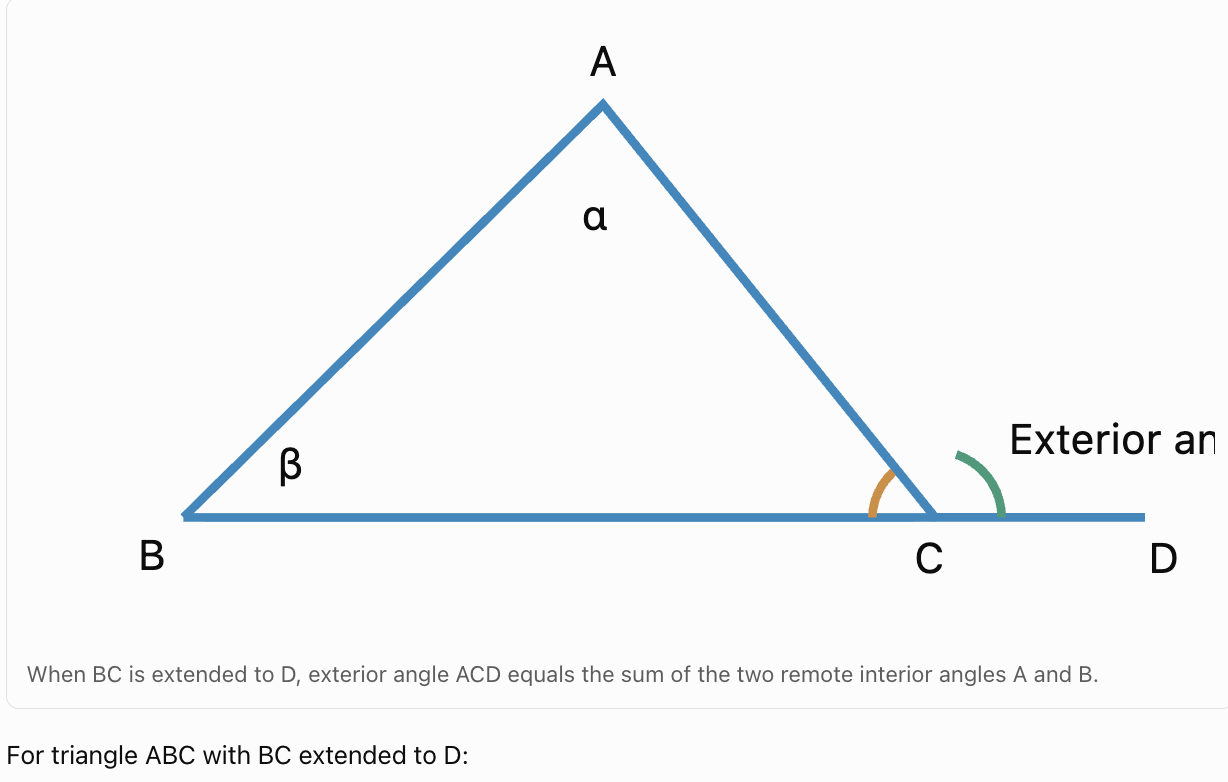
For triangle ABC with BC extended to D:
∠ACD = ∠BAC + ∠ABC
Worked Example
Suppose:
∠A = 45°
∠B = 70°
Then:
Exterior angle = 45° + 70°
Exterior angle = 115°
Why the Exterior Angle Theorem Works
The triangle angle-sum theorem gives:
∠A + ∠B + ∠C = 180°
The interior angle at C and its adjacent exterior angle form a straight line:
∠C + exterior angle = 180°
Therefore:
Exterior angle = 180° − ∠C
Since:
∠A + ∠B = 180° − ∠C
we conclude:
Exterior angle = ∠A + ∠B
This is an example of proving one theorem using another.
Angle Relationships in Geometric Proofs
Several angle relationships are especially useful when proving properties of triangles.
Vertically Opposite Angles
When two straight lines intersect, vertically opposite angles are equal.
For example:
∠AOB = ∠COD
when the two angles are vertically opposite.
Angles on a Straight Line
Adjacent angles forming a straight line add to 180°.
Corresponding Angles
When parallel lines are crossed by a transversal, corresponding angles are equal.
Alternate Interior Angles
When parallel lines are crossed by a transversal, alternate interior angles are equal.
Angle Bisectors
An angle bisector divides an angle into two equal angles.
If AD bisects ∠BAC:
∠BAD = ∠DAC
Perpendicular Lines
Perpendicular lines intersect at 90°.
If AD is perpendicular to BC:
∠ADB = ∠ADC = 90°
These relationships often provide the equal angles needed for congruence or similarity proofs.


Proving Triangle Congruence
Two triangles are congruent when they have exactly the same shape and size.
Congruent triangles have:
-
Equal corresponding side lengths.
-
Equal corresponding angles.
The congruence symbol is:
≅
For example:
△ABC ≅ △DEF
This statement indicates the correspondence:
A ↔ D
B ↔ E
C ↔ F
Triangle Congruence Criteria
|
Criterion |
Requirements |
|---|---|
|
SSS |
Three pairs of equal corresponding sides |
|
SAS |
Two pairs of equal corresponding sides and equal included angles |
|
ASA |
Two pairs of equal corresponding angles and equal included sides |
|
AAS |
Two pairs of equal corresponding angles and one equal non-included side |
|
HL |
Equal hypotenuses and one equal corresponding leg in right triangles |
A proof must identify which criterion applies and justify the required equalities.
Proving Congruence Using SSS
Worked Proof
Given:
AB = DE
BC = EF
AC = DF
Prove:
△ABC ≅ △DEF
Step 1: Identify Corresponding Sides
AB corresponds to DE.
BC corresponds to EF.
AC corresponds to DF.
Step 2: Verify the Equalities
AB = DE — given.
BC = EF — given.
AC = DF — given.
Step 3: Apply SSS
All three corresponding side pairs are equal.
Therefore:
△ABC ≅ △DEF by SSS.
Two-Column Proof
|
Statement |
Reason |
|---|---|
|
AB = DE |
Given |
|
BC = EF |
Given |
|
AC = DF |
Given |
|
△ABC ≅ △DEF |
SSS congruence |
Proving Congruence Using SAS
Worked Proof
Two straight lines AC and BD intersect at O.
Given:
AO = CO
BO = DO
Prove:
△AOB ≅ △COD
Step 1: Identify Equal Sides
AO = CO — given.
BO = DO — given.
Step 2: Identify Equal Angles
∠AOB = ∠COD
These angles are vertically opposite.
Step 3: Apply SAS
The equal angles lie between the two pairs of equal sides.
Therefore:
△AOB ≅ △COD by SAS.
Two-Column Proof
|
Statement |
Reason |
|---|---|
|
AO = CO |
Given |
|
BO = DO |
Given |
|
∠AOB = ∠COD |
Vertically opposite angles |
|
△AOB ≅ △COD |
SAS congruence |
Important Observation
The angle used in SAS must be the included angle.
Two equal sides and a non-included angle do not generally establish congruence.
Proving Congruence Using ASA
Worked Proof
Given:
∠A = ∠D
∠B = ∠E
AB = DE
Prove:
△ABC ≅ △DEF
Step 1: Compare the Angles
∠A = ∠D — given.
∠B = ∠E — given.
Step 2: Compare the Included Sides
AB = DE — given.
The equal sides lie between the two known angles.
Step 3: Apply ASA
△ABC ≅ △DEF by ASA.
Proving Congruence Using AAS
Worked Proof
Given:
∠A = ∠D
∠B = ∠E
AC = DF
Prove:
△ABC ≅ △DEF
Step 1: Identify Equal Angles
∠A = ∠D
∠B = ∠E
Step 2: Identify Equal Sides
AC = DF
These are non-included sides relative to the two known angles.
Step 3: Apply AAS
△ABC ≅ △DEF by AAS.
Proving Congruence Using HL
The HL criterion applies only to right triangles.
Worked Proof
Triangles ABC and DEF are right-angled at B and E.
Given:
AC = DF
AB = DE
Prove:
△ABC ≅ △DEF
Step 1: Identify the Right Angles
∠B = ∠E = 90°
Step 2: Identify the Hypotenuses
AC and DF are the hypotenuses.
AC = DF — given.
Step 3: Identify Equal Legs
AB = DE — given.
Step 4: Apply HL
△ABC ≅ △DEF by HL.
Corresponding Parts of Congruent Triangles
Once two triangles have been proven congruent, their corresponding sides and angles must be equal.
This principle is called:
Corresponding Parts of Congruent Triangles are Congruent (CPCTC).
For example, if:
△ABC ≅ △DEF
then:
AB = DE
BC = EF
AC = DF
∠A = ∠D
∠B = ∠E
∠C = ∠F
Important Proof Rule
CPCTC is used after proving that the triangles are congruent.
It cannot be used as an unsupported assumption to establish the congruence itself.
Worked Proof: An Isosceles Triangle
Given:
AB = AC
D is the midpoint of BC.
Prove:
∠BAD = ∠DAC
Step 1: Identify Equal Sides
AB = AC — given.
Step 2: Use the Midpoint
BD = DC — definition of midpoint.
Step 3: Identify the Shared Side
AD = AD — reflexive property.
Step 4: Prove Triangle Congruence
△ABD ≅ △ACD by SSS.
Step 5: Apply CPCTC
∠BAD = ∠DAC
Therefore:
AD bisects ∠BAC.
Two-Column Proof
|
Statement |
Reason |
|---|---|
|
AB = AC |
Given |
|
BD = DC |
Definition of midpoint |
|
AD = AD |
Reflexive property |
|
△ABD ≅ △ACD |
SSS congruence |
|
∠BAD = ∠DAC |
CPCTC |
|
AD bisects ∠BAC |
Definition of angle bisector |
This proof demonstrates how triangle congruence can establish an additional geometric property.
Proving Properties of Isosceles Triangles
An isosceles triangle has at least two equal sides.
The angles opposite those equal sides are also equal.
Isosceles Triangle Theorem
If:
AB = AC
then:
∠ABC = ∠BCA
These are called the base angles.
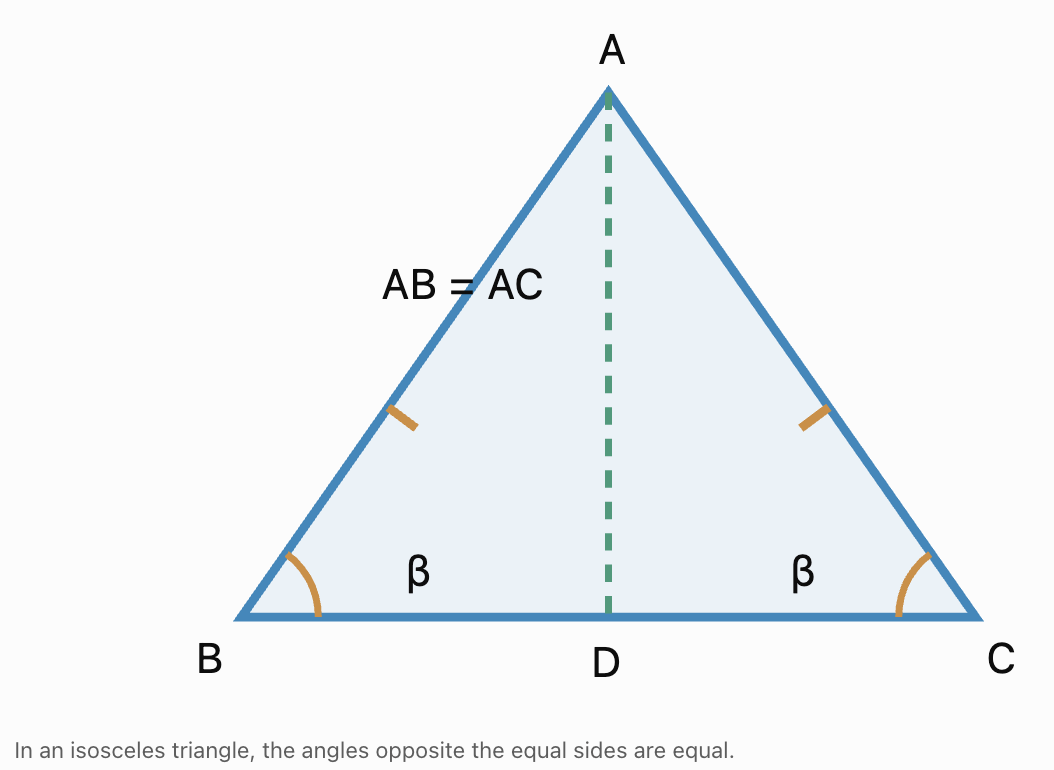
Proof of the Isosceles Triangle Theorem
Given:
AB = AC
Prove:
∠ABC = ∠BCA
Step 1: Construct an Angle Bisector
Draw AD so that it bisects ∠BAC and meets BC at D.
Therefore:
∠BAD = ∠DAC
Step 2: Identify Equal Sides
AB = AC — given.
AD = AD — reflexive property.
Step 3: Apply SAS
The equal angles lie between the corresponding equal sides.
Therefore:
△BAD ≅ △CAD by SAS.
Step 4: Apply CPCTC
∠ABD = ∠ACD
Since D lies on BC:
∠ABD = ∠ABC
∠ACD = ∠BCA
Therefore:
∠ABC = ∠BCA
The base angles of an isosceles triangle are equal.
Converse of the Isosceles Triangle Theorem
The converse states:
If two angles of a triangle are equal, then the sides opposite those angles are equal.
For example:
If ∠B = ∠C, then:
AB = AC
This theorem can be used to prove that a triangle is isosceles.
Worked Example
In triangle ABC:
∠B = 55°
∠C = 55°
Prove that AB = AC.
Since:
∠B = ∠C
the sides opposite those angles are equal.
Therefore:
AB = AC
Triangle ABC is isosceles.
Proving Properties of Equilateral Triangles
An equilateral triangle has three equal sides.
If:
AB = BC = AC
then all three interior angles are equal.
Since the angles add to 180°:
3θ = 180°
θ = 60°
Therefore:
∠A = ∠B = ∠C = 60°
Proof
Given:
AB = BC = AC
Prove:
∠A = ∠B = ∠C = 60°
Step 1: Apply the Isosceles Triangle Theorem
Since AB = AC:
∠B = ∠C
Since AB = BC:
∠A = ∠C
Therefore:
∠A = ∠B = ∠C
Step 2: Apply the Angle-Sum Theorem
∠A + ∠B + ∠C = 180°
3∠A = 180°
∠A = 60°
Therefore:
All three angles measure 60°.
Converse
If all three angles of a triangle measure 60°, the triangle is equilateral.
This follows from the converse of the isosceles triangle theorem.
Proving Triangle Similarity
Two triangles are similar when they have the same shape, although their sizes may differ.
Similar triangles have:
-
Equal corresponding angles.
-
Proportional corresponding side lengths.
The similarity symbol is:
∼
For example:
△ABC ∼ △DEF
Triangle Similarity Criteria
|
Criterion |
Requirements |
|---|---|
|
AA |
Two pairs of equal corresponding angles |
|
SSS |
Three pairs of proportional corresponding sides |
|
SAS |
Two pairs of proportional corresponding sides and equal included angles |
Similarity proofs are useful for establishing proportional relationships and finding unknown lengths.
Proving Similarity Using AA
Worked Proof
Given:
AB ∥ DE
Lines AE and BD intersect at C, with A, C, E collinear and B, C, D collinear.
Prove:
△ABC ∼ △EDC
Step 1: Identify Equal Angles
∠BAC = ∠DEC
These are alternate interior angles formed by transversal AE.
Step 2: Identify Another Pair
∠ABC = ∠EDC
These are alternate interior angles formed by transversal BD.
Step 3: Apply AA
Two pairs of corresponding angles are equal.
Therefore:
△ABC ∼ △EDC by AA similarity.
Consequence
Corresponding sides are proportional:
AB/ED = BC/DC = AC/EC
These proportions can be used to calculate unknown lengths.
Proving Similarity Using SSS
Worked Proof
Triangle ABC has sides:
AB = 4 cm
BC = 6 cm
AC = 8 cm
Triangle DEF has sides:
DE = 10 cm
EF = 15 cm
DF = 20 cm
Prove that the triangles are similar.
Step 1: Compare Corresponding Sides
AB/DE = 4/10 = 0.4
BC/EF = 6/15 = 0.4
AC/DF = 8/20 = 0.4
Step 2: Identify Equal Ratios
All three corresponding side ratios are equal.
Step 3: Apply SSS Similarity
△ABC ∼ △DEF by SSS similarity.
Proving Similarity Using SAS
Worked Proof
Given:
AB = 6 cm
AC = 9 cm
DE = 10 cm
DF = 15 cm
∠BAC = ∠EDF
Prove:
△ABC ∼ △DEF
Step 1: Compare Side Ratios
AB/DE = 6/10 = 3/5
AC/DF = 9/15 = 3/5
Step 2: Compare Included Angles
∠BAC = ∠EDF — given.
Step 3: Apply SAS Similarity
The corresponding side pairs are proportional, and the included angles are equal.
Therefore:
△ABC ∼ △DEF by SAS similarity.
Proving Similarity Using Parallel Lines
Parallel lines often create similar triangles.
Consider triangle ABC with D on AB and E on AC.
Given:
DE ∥ BC
Prove:
△ADE ∼ △ABC
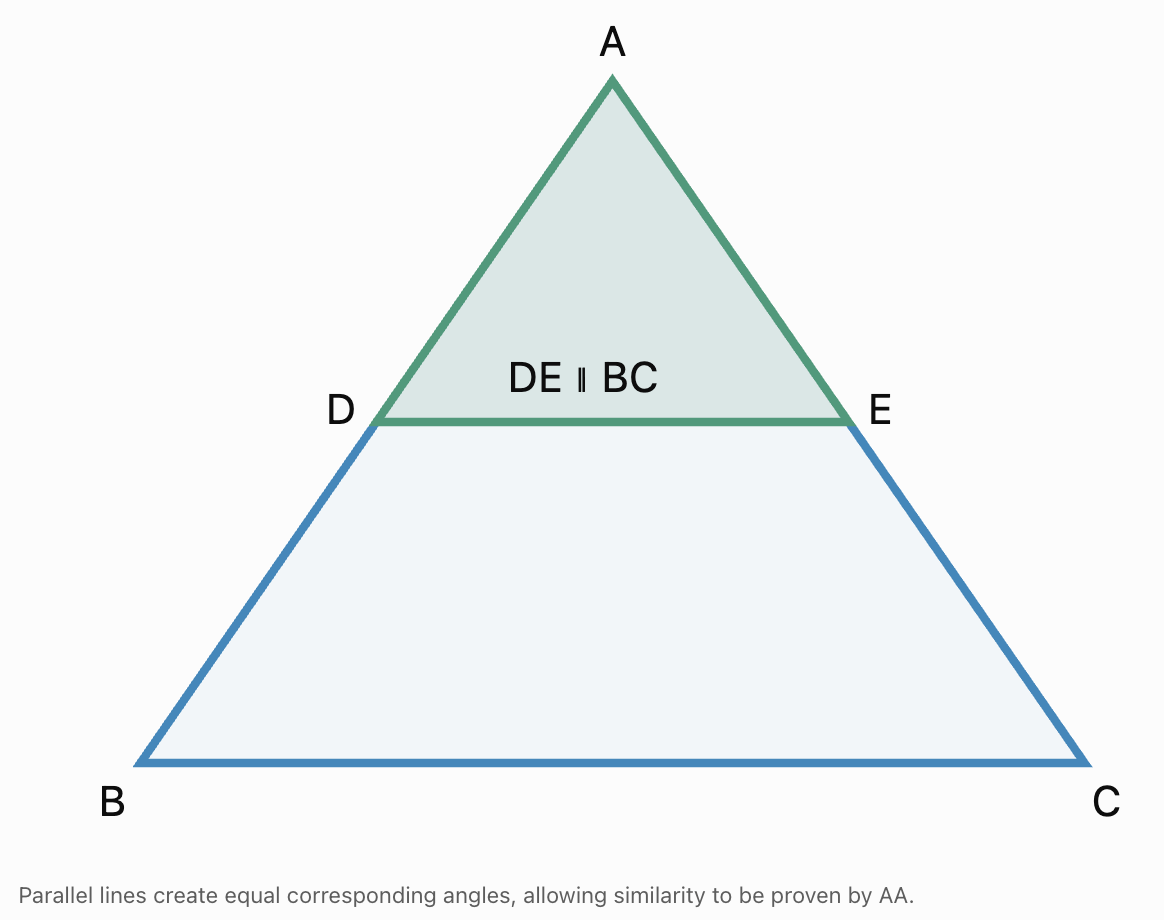
Step 1: Identify a Common Angle
∠DAE = ∠BAC
These are the same angle at vertex A.
Step 2: Use Parallel Lines
Since DE ∥ BC:
∠ADE = ∠ABC
These are corresponding angles.
Step 3: Apply AA Similarity
Two corresponding angles are equal.
Therefore:
△ADE ∼ △ABC by AA.
Step 4: Establish Proportional Sides
AD/AB = AE/AC = DE/BC
This relationship is the basis of many proportional reasoning problems.
Worked Example: Using a Similarity Proof to Find a Length
Given:
DE ∥ BC
AD = 4 cm
AB = 10 cm
AE = 6 cm
Find AC.
Step 1: Establish Similarity
△ADE ∼ △ABC by AA.
Step 2: Write a Proportion
AD/AB = AE/AC
4/10 = 6/AC
Step 3: Cross-Multiply
4AC = 60
Step 4: Solve
AC = 15 cm
Step 5: Verify
4/10 = 0.4
6/15 = 0.4
The proportions are equal.
Formal Geometric Proofs
A formal proof presents mathematical reasoning in a clear, organised sequence.
There are several common proof formats.
Two-Column Proofs
A two-column proof separates statements from reasons.
|
Statement |
Reason |
|---|---|
|
AB = AC |
Given |
|
BD = DC |
D is the midpoint of BC |
|
AD = AD |
Reflexive property |
|
△ABD ≅ △ACD |
SSS congruence |
|
∠BAD = ∠DAC |
CPCTC |
This format is especially useful for learning to justify every step.
Paragraph Proofs
A paragraph proof communicates the same reasoning using complete sentences.
Example:
AB = AC is given. Since D is the midpoint of BC, BD = DC. The triangles also share side AD, so AD = AD by the reflexive property. Therefore, △ABD ≅ △ACD by SSS congruence. Corresponding angles are equal, so ∠BAD = ∠DAC by CPCTC.
Flow Proofs
A flow proof uses a sequence of statements connected by arrows.
For example:
AB = AC
BD = DC
AD = AD
↓
△ABD ≅ △ACD by SSS
↓
∠BAD = ∠DAC by CPCTC
All three proof formats are valid when the reasoning is logically complete.
How to Plan a Geometric Proof
When beginning a proof, it is useful to work both forwards and backwards.
Forward Reasoning
Start with the given information.
Ask:
-
What can I conclude immediately?
-
Are any sides equal?
-
Are any angles equal?
-
Are there shared sides?
-
Are there parallel or perpendicular lines?
Backward Reasoning
Look at the conclusion.
Ask:
-
What would be sufficient to prove this?
-
Would congruent triangles establish the result?
-
Would similar triangles establish the result?
-
Which criterion could be used?
-
What additional facts are needed?
Connecting the Reasoning
Once a possible strategy is identified, organise the steps so that each conclusion follows from previously established facts.
Backward reasoning is useful for planning, but the final proof should present the logical justification clearly.
Proving Angle Relationships Using Congruent Triangles
Congruence can be used to establish relationships that are not immediately obvious.
Worked Proof: A Perpendicular Median in an Isosceles Triangle
Given:
AB = AC
D is the midpoint of BC.
Prove:
AD ⟂ BC
Step 1: Identify Equal Sides
AB = AC — given.
BD = DC — midpoint.
AD = AD — shared side.
Step 2: Prove Congruence
△ABD ≅ △ACD by SSS.
Step 3: Apply CPCTC
∠ADB = ∠ADC
Step 4: Use the Straight-Line Relationship
Since B, D, and C lie on a straight line:
∠ADB + ∠ADC = 180°
The two angles are equal.
Therefore:
2∠ADB = 180°
∠ADB = 90°
Similarly:
∠ADC = 90°
Conclusion
AD ⟂ BC
Interpretation
In an isosceles triangle, the segment joining the apex to the midpoint of the base is perpendicular to the base.
The same segment also bisects the apex angle.
This is an important property of isosceles triangles.
Proving Angle Relationships Using Similarity
Similarity can establish equal angles and proportional side lengths.
Worked Proof
Given:
△ABC ∼ △DEF
Prove:
∠C = ∠F
Step 1: Use the Definition of Similarity
Similar triangles have equal corresponding angles.
Step 2: Identify Corresponding Vertices
A corresponds to D.
B corresponds to E.
C corresponds to F.
Step 3: Conclude
∠C = ∠F
This is a direct consequence of similarity.
Multi-Step Proof: An Isosceles Triangle with a Parallel Line
Consider triangle ABC where:
AB = AC
D lies on AB.
E lies on AC.
DE ∥ BC
Prove that:
AD = AE
Step 1: Establish Similarity
Since DE ∥ BC:
∠ADE = ∠ABC
∠AED = ∠ACB
Therefore:
△ADE ∼ △ABC by AA.
Step 2: Use Corresponding Sides
AD/AB = AE/AC
Step 3: Use the Given Equality
AB = AC
Therefore, the two denominators are equal.
Step 4: Conclude
Since the ratios are equal and the denominators are equal:
AD = AE
Interpretation
A line parallel to the base of an isosceles triangle creates a smaller isosceles triangle.
This proof combines similarity with the properties of isosceles triangles.
Proving the Midpoint Theorem
The midpoint theorem states:
The segment joining the midpoints of two sides of a triangle is parallel to the third side and half its length.
Suppose:
D is the midpoint of AB.
E is the midpoint of AC.
We want to prove:
DE ∥ BC
and:
DE = BC/2
Proof Using Similarity
First, because D and E are midpoints:
AD = DB
AE = EC
Therefore:
AB = 2AD
AC = 2AE
So:
AD/AB = 1/2
AE/AC = 1/2
Thus:
AD/AB = AE/AC
The included angle at A is common to both triangles.
Therefore:
△ADE ∼ △ABC by SAS similarity.
Corresponding angles are equal:
∠ADE = ∠ABC
Since these are corresponding angles formed by transversal AB:
DE ∥ BC
Corresponding sides are proportional:
DE/BC = AD/AB = 1/2
Therefore:
DE = BC/2
Both parts of the midpoint theorem have been proven.
Practical Importance
The midpoint theorem is useful in:
-
Triangle constructions.
-
Coordinate geometry.
-
Structural design.
-
Geometric proofs.
-
Calculating unknown lengths.
Using Algebra in Triangle Proofs
Some proofs involve algebraic expressions rather than numerical measurements.
Worked Example
Triangle ABC is isosceles with:
AB = AC
Given:
AB = 3x + 5
AC = 5x − 7
Find x.
Step 1: Use the Isosceles Property
AB = AC
3x + 5 = 5x − 7
Step 2: Rearrange
12 = 2x
Step 3: Solve
x = 6
Step 4: Verify
AB = 3(6) + 5 = 23
AC = 5(6) − 7 = 23
The sides are equal.
Conclusion
The given triangle is consistent with the isosceles condition.
Worked Example: Angle Expressions
Triangle ABC is isosceles with:
AB = AC
Given:
∠B = 4x + 10°
∠C = 6x − 20°
Find x.
Step 1: Apply the Isosceles Triangle Theorem
∠B = ∠C
4x + 10 = 6x − 20
Step 2: Solve
30 = 2x
x = 15
Step 3: Calculate the Angles
∠B = 4(15) + 10 = 70°
∠C = 6(15) − 20 = 70°
Step 4: Find the Third Angle
∠A = 180° − 70° − 70°
∠A = 40°
Verification
40° + 70° + 70° = 180°
The result is consistent.
Real-World Applications of Triangle Proofs
Triangle proofs are useful because they allow geometric properties to be established without measuring every dimension.
Architecture and Construction
Triangular structures are commonly used in roof supports and bridges.
Congruence can establish that repeated components have identical geometric dimensions.
Similarity can be used to calculate dimensions in scale drawings and models.

Surveying
Surveyors use triangles to calculate distances that may be difficult to measure directly.
Similarity relationships can help determine unknown distances from known measurements.
Manufacturing
Congruence helps verify that manufactured components match intended geometric dimensions.
Computer Graphics
Geometric transformations and similarity relationships are used in image scaling, modelling, and graphical design.
Engineering Design
Triangle properties can help establish alignment, symmetry, and proportional relationships.
However, proving geometric congruence or similarity does not by itself establish structural safety. Forces, materials, and other engineering factors must also be considered.


Common Mistakes in Triangle Proofs
Assuming triangles are congruent because they look identical
A diagram is not sufficient evidence unless the necessary relationships are established.
Using AAA to prove congruence
AAA establishes similarity, not necessarily congruence.
Using SSA as a general congruence test
SSA does not generally guarantee triangle congruence.
Confusing SAS congruence with SAS similarity
SAS congruence requires equal corresponding sides, while SAS similarity requires proportional sides.
Using CPCTC before proving congruence
CPCTC is a consequence of congruence, not an independent congruence criterion.
Writing vertices in the wrong order
The order of vertices must correctly represent corresponding parts.
Failing to justify shared sides
A shared side is equal to itself by the reflexive property.
Assuming angles are equal without a valid reason
Equal angles must follow from given information or an established geometric theorem.
Confusing corresponding and alternate interior angles
These angle relationships must be identified correctly.
Using parallel-line angle relationships without establishing parallelism
The relevant lines must be known to be parallel.
Skipping important proof steps
A proof must contain enough reasoning to establish the conclusion.
Using the conclusion as a premise
This is circular reasoning.
Confusing a theorem with its converse
A statement and its converse require separate justification.
Failing to distinguish congruence from similarity
Congruent triangles have equal corresponding side lengths; similar triangles have proportional corresponding side lengths.
Providing calculations without explanations
A complete proof should explain why each mathematical relationship is valid.
Key Terms
-
Geometric Proof: A logical argument establishing a geometric statement.
-
Given Information: Facts known to be true at the beginning of a proof.
-
Conclusion: The statement that must be established.
-
Theorem: A mathematical statement proven using logical reasoning.
-
Definition: A precise explanation of a mathematical term.
-
Axiom or Postulate: A mathematical statement accepted without proof within a particular system.
-
Logical Reasoning: Using established facts and rules to reach valid conclusions.
-
Deductive Reasoning: Drawing conclusions that necessarily follow from given premises.
-
Congruent Triangles: Triangles with equal corresponding sides and angles.
-
Similar Triangles: Triangles with equal corresponding angles and proportional corresponding sides.
-
SSS Congruence: A criterion using three equal pairs of corresponding sides.
-
SAS Congruence: A criterion using two equal side pairs and their equal included angles.
-
ASA Congruence: A criterion using two equal angle pairs and their equal included side.
-
AAS Congruence: A criterion using two equal angle pairs and a non-included equal side.
-
HL Congruence: A criterion for right triangles using equal hypotenuses and one equal leg.
-
AA Similarity: A criterion using two pairs of equal corresponding angles.
-
SSS Similarity: A criterion using three pairs of proportional corresponding sides.
-
SAS Similarity: A criterion using two proportional side pairs and an equal included angle.
-
CPCTC: Corresponding Parts of Congruent Triangles are Congruent.
-
Corresponding Sides: Sides occupying matching positions in two triangles.
-
Corresponding Angles: Angles occupying matching positions in two triangles.
-
Reflexive Property: The property that a quantity is equal to itself.
-
Vertical Angles: Opposite angles formed by intersecting lines.
-
Alternate Interior Angles: Angles on opposite sides of a transversal between two lines.
-
Corresponding Angles Theorem: A theorem stating that corresponding angles are equal when parallel lines are crossed by a transversal.
-
Angle Bisector: A line or ray dividing an angle into two equal angles.
-
Midpoint: A point dividing a segment into two equal parts.
-
Median: A segment joining a triangle's vertex to the midpoint of the opposite side.
-
Altitude: A perpendicular segment from a vertex to the line containing the opposite side.
-
Isosceles Triangle: A triangle with at least two equal sides.
-
Equilateral Triangle: A triangle with three equal sides.
-
Base Angles: The angles opposite the equal sides of an isosceles triangle.
-
Exterior Angle: An angle formed by extending a side of a polygon.
-
Triangle Angle-Sum Theorem: The theorem stating that the interior angles of a triangle add to 180°.
-
Exterior Angle Theorem: The theorem stating that an exterior angle equals the sum of the two remote interior angles.
-
Midpoint Theorem: The theorem stating that the segment joining two side midpoints of a triangle is parallel to the third side and half its length.
-
Converse: A statement formed by reversing the hypothesis and conclusion of another statement.
-
Two-Column Proof: A proof organised into statements and reasons.
-
Paragraph Proof: A proof written using complete sentences.
-
Flow Proof: A proof organised using connected logical steps.
-
Circular Reasoning: Attempting to prove a statement by assuming that it is already true.
-
Mathematical Justification: A valid explanation supporting a mathematical statement.
Key Takeaways
-
A geometric proof establishes a conclusion through a sequence of logically justified statements.
-
Every statement in a proof should follow from given information, definitions, or established theorems.
-
Triangle proofs often involve congruence, similarity, angle relationships, and properties of special triangles.
-
SSS, SAS, ASA, AAS, and HL can be used to prove triangle congruence.
-
AA, SSS, and SAS can be used to prove triangle similarity.
-
Congruent triangles have equal corresponding sides and angles.
-
Similar triangles have equal corresponding angles and proportional corresponding sides.
-
CPCTC can be applied after proving triangle congruence.
-
Shared sides are equal by the reflexive property.
-
Vertically opposite angles are equal.
-
Parallel lines create equal corresponding and alternate interior angles.
-
The interior angles of every triangle add to 180°.
-
An exterior angle of a triangle equals the sum of the two remote interior angles.
-
Isosceles triangles have equal base angles.
-
Equilateral triangles have three equal sides and three 60° angles.
-
Congruence can be used to prove that a segment is an angle bisector, median, or altitude.
-
Similarity can be used to establish proportional relationships and calculate unknown lengths.
-
The midpoint theorem can be proven using triangle similarity.
-
Formal proofs may be written as two-column proofs, paragraph proofs, or flow proofs.
-
Forward reasoning begins with known information.
-
Backward reasoning identifies what is needed to establish the desired conclusion.
-
Mathematical diagrams help visualise relationships but do not replace logical justification.
-
The central skill in triangle proofs is selecting appropriate geometric relationships and connecting them through clear, valid mathematical reasoning.
Check Your Understanding
Recall and Understanding
-
Define a geometric proof and explain why each statement must have a valid reason.
-
List the five triangle congruence criteria and explain when each can be used.
-
State the three triangle similarity criteria.
-
Explain the meaning of CPCTC and describe when it may be used.
-
Explain the difference between a theorem and its converse.
Application
-
Given AB = AC and D is the midpoint of BC, prove that △ABD ≅ △ACD.
-
Two lines AC and BD intersect at O. Given AO = CO and BO = DO, prove that △AOB ≅ △COD.
-
In triangle ABC, AB = AC and ∠B = 55°. Calculate ∠A and justify each step.
-
Given DE ∥ BC in triangle ABC, prove that △ADE ∼ △ABC.
-
Triangle ABC has sides 4 cm, 6 cm, and 8 cm. Triangle DEF has corresponding sides 10 cm, 15 cm, and 20 cm. Prove that the triangles are similar.
Analysis and Challenge
-
In isosceles triangle ABC, AB = AC and D is the midpoint of BC. Prove that AD is perpendicular to BC.
-
Prove that the base angles of an isosceles triangle are equal.
-
Prove that every equilateral triangle has three angles measuring 60°.
-
D and E are the midpoints of AB and AC in triangle ABC. Prove that DE is parallel to BC and that DE = BC/2.
-
Triangle ABC is isosceles with AB = AC. Points D and E lie on AB and AC respectively, and DE ∥ BC. Prove that AD = AE using triangle similarity.
Final Summary
Triangle proofs provide a systematic way to establish geometric relationships using mathematical reasoning.
Congruence proofs demonstrate that two triangles have identical shapes and sizes, while similarity proofs establish that triangles have equal corresponding angles and proportional side lengths.
Angle relationships, shared sides, parallel lines, and the properties of isosceles and equilateral triangles provide essential information for constructing proofs.
Formal proofs organise this information into a logical sequence of statements supported by mathematical reasons.
By combining congruence, similarity, and established geometric theorems, we can prove properties involving angles, side lengths, midpoints, medians, altitudes, and parallel lines.
The central principle is that a geometric conclusion is not established simply because it appears true in a diagram. It must follow logically from known information and valid mathematical relationships.