Triangles
4. Right Triangle Geometry
Learning outcomes
- I can apply the Pythagorean Theorem.
- I can solve problems involving right triangles.
- I can determine unknown side lengths.
- I can recognize Pythagorean triples.
- I can solve practical problems involving right triangles.
Right Triangle Geometry
Introduction to Right Triangles
Right triangles are among the most important shapes in geometry. They appear in architecture, engineering, construction, navigation, physics, and many everyday situations involving distances and measurements.
A right triangle is a triangle containing one angle of exactly 90°. This special angle creates a mathematical relationship between the triangle's three sides.
That relationship is described by the Pythagorean Theorem, which allows us to calculate an unknown side length when the other two sides are known.
Right triangle geometry can be used to:
-
Calculate diagonal distances.
-
Determine the height of buildings and other structures.
-
Find the length of ladders and ramps.
-
Calculate distances on coordinate grids.
-
Determine whether a triangle contains a right angle.
-
Solve practical measurement problems.
The Pythagorean Theorem is especially useful because it connects geometry with algebra, square roots, and measurement.


Understanding the Parts of a Right Triangle
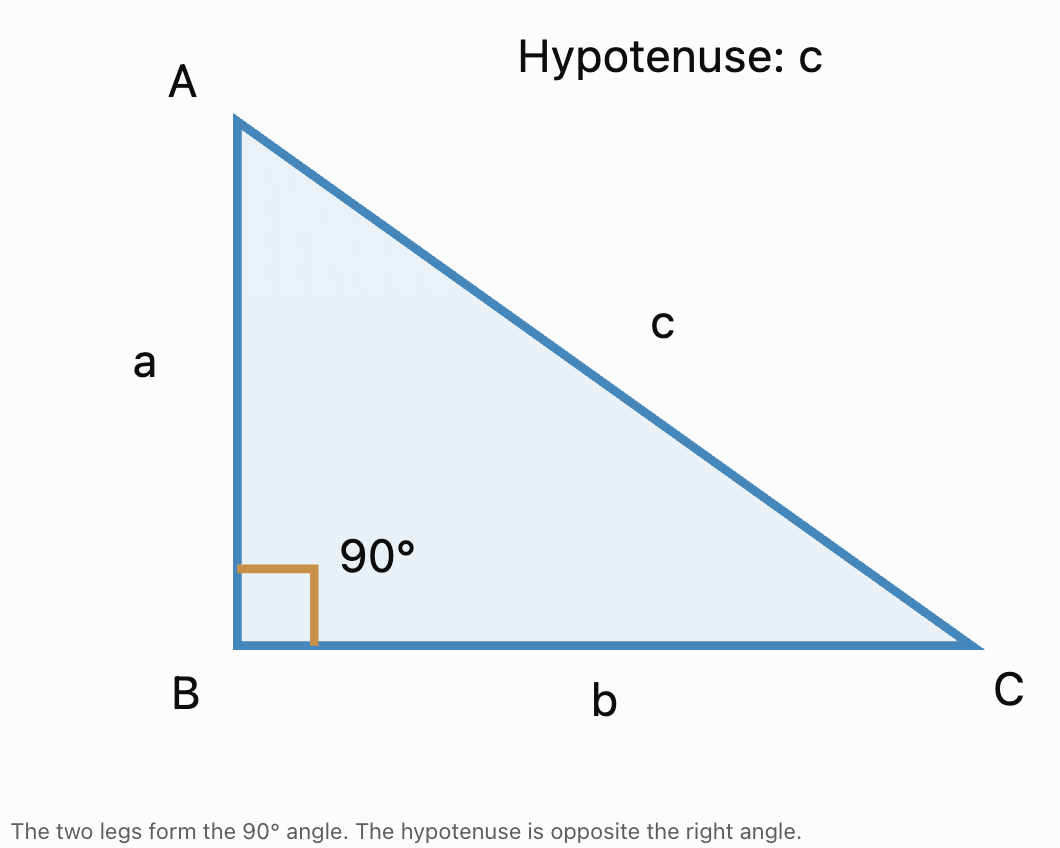
A right triangle contains three sides and three angles.
The most important features are the legs, the hypotenuse, and the right angle.
The Right Angle
The right angle measures exactly 90°.
It is usually indicated by a small square in the corner of the triangle.
The Legs
The two sides that meet to form the right angle are called the legs.
They are commonly labelled:
a and b
The Hypotenuse
The hypotenuse is the side opposite the right angle.
It is always the longest side of a right triangle.
It is commonly labelled:
c
Important Properties
-
A right triangle has exactly one right angle.
-
The other two angles are acute, meaning each is less than 90°.
-
The two acute angles add to 90°.
-
The hypotenuse is longer than either leg.
-
The Pythagorean Theorem applies to every right triangle.
The Pythagorean Theorem
The Pythagorean Theorem describes the relationship between the three sides of a right triangle.
a² + b² = c²
where:
-
a is the length of one leg.
-
b is the length of the other leg.
-
c is the length of the hypotenuse.
The theorem states that the sum of the squares of the two shorter sides equals the square of the longest side.
Understanding Squared Lengths
If a side measures 3 cm, then:
3² = 3 × 3 = 9
If another side measures 4 cm:
4² = 4 × 4 = 16
Adding:
9 + 16 = 25
Since:
5² = 25
a triangle with side lengths 3 cm, 4 cm, and 5 cm satisfies the Pythagorean Theorem.
Therefore, it is a right triangle.
Visualising the Pythagorean Theorem
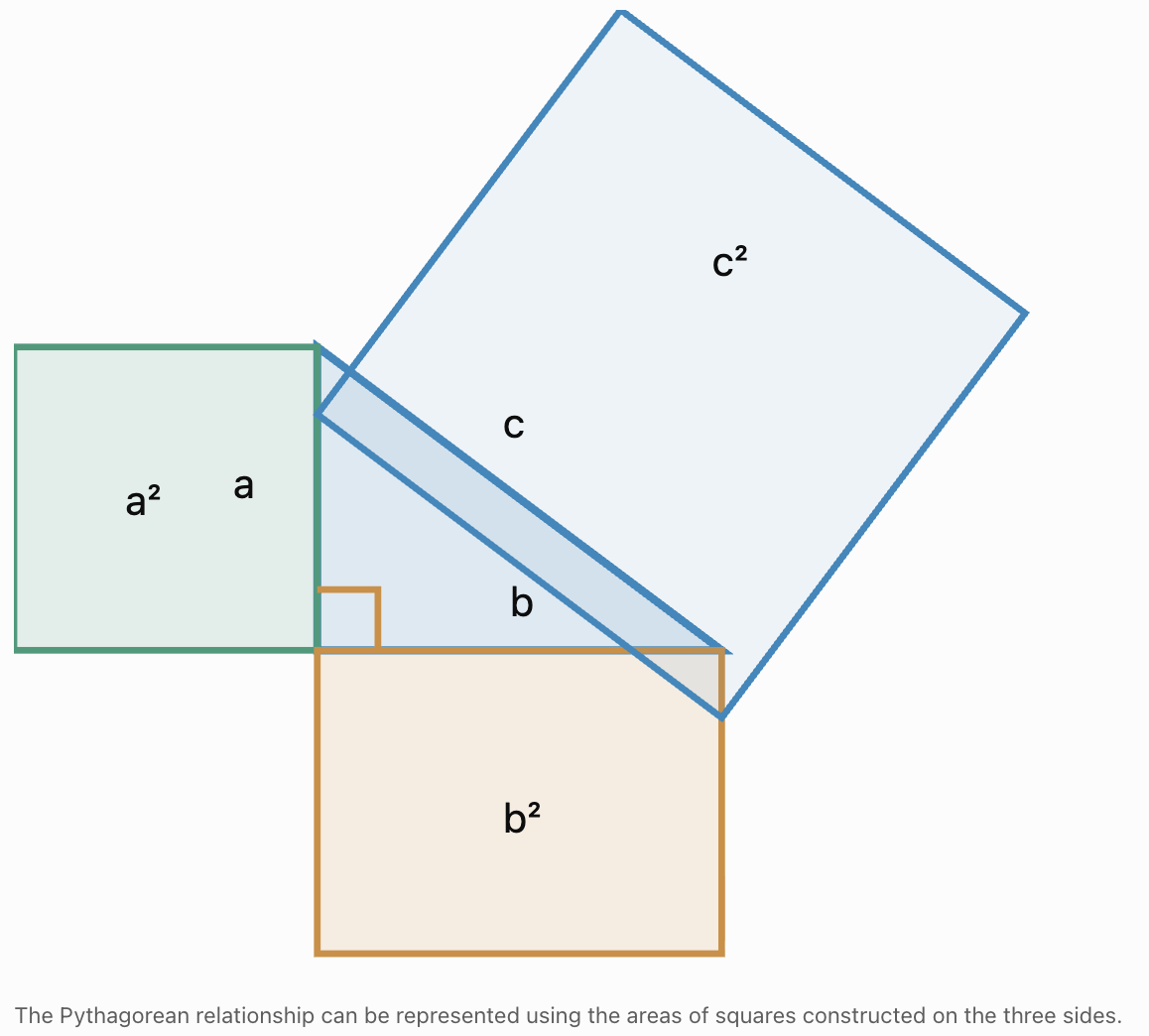
The theorem can be understood geometrically by constructing a square on each side of a right triangle.
The area of the square on the hypotenuse equals the combined areas of the squares on the two legs.
Example
For a triangle with legs of 3 cm and 4 cm:
Area of first square = 3² = 9 cm²
Area of second square = 4² = 16 cm²
Combined area = 25 cm²
The square on the hypotenuse must therefore have an area of 25 cm².
Its side length is:
√25 = 5 cm
Thus, the hypotenuse is 5 cm.
Calculating the Hypotenuse
When the lengths of both legs are known, the hypotenuse can be calculated using:
c = √(a² + b²)
Worked Example: Finding the Hypotenuse
A right triangle has legs measuring:
a = 6 cm
b = 8 cm
Find the hypotenuse.
Step 1: Write the Formula
a² + b² = c²
Step 2: Substitute
6² + 8² = c²
Step 3: Square the Values
36 + 64 = c²
Step 4: Add
100 = c²
Step 5: Take the Square Root
c = √100
c = 10 cm
Verification
6² + 8² = 10²
36 + 64 = 100
100 = 100
The answer is correct.
Reasonableness Check
The hypotenuse must be longer than either leg.
Since 10 cm is greater than both 6 cm and 8 cm, the answer is reasonable.
Worked Example: A Non-Integer Hypotenuse
A right triangle has legs measuring:
a = 5 cm
b = 7 cm
Find the hypotenuse.
Step 1: Apply the Formula
c² = 5² + 7²
Step 2: Calculate
c² = 25 + 49
c² = 74
Step 3: Take the Square Root
c = √74 cm
Step 4: Approximate
c ≈ 8.60 cm
Important Observation
Not every right triangle has whole-number side lengths.
Some hypotenuse lengths are irrational numbers.
In these cases, the exact answer may be written using a square root.
For example:
√74 cm
The decimal value is an approximation.
Calculating a Missing Leg
Sometimes the hypotenuse and one leg are known.
The Pythagorean Theorem can be rearranged to find the other leg.
Starting with:
a² + b² = c²
Subtract b²:
a² = c² − b²
Therefore:
a = √(c² − b²)
Similarly:
b = √(c² − a²)
Worked Example: Finding a Missing Leg
A right triangle has:
Hypotenuse = 13 cm
One leg = 5 cm
Find the other leg.
Step 1: Write the Formula
a² + b² = c²
Step 2: Substitute
5² + b² = 13²
Step 3: Square the Known Values
25 + b² = 169
Step 4: Rearrange
b² = 169 − 25
b² = 144
Step 5: Take the Square Root
b = √144
b = 12 cm
Verification
5² + 12² = 13²
25 + 144 = 169
169 = 169
The solution is correct.
Worked Example: Missing Leg with a Decimal Answer
A right triangle has:
Hypotenuse = 12 m
One leg = 7 m
Find the missing leg.
Step 1: Apply the Formula
b² = 12² − 7²
Step 2: Calculate
b² = 144 − 49
b² = 95
Step 3: Take the Square Root
b = √95
Step 4: Approximate
b ≈ 9.75 m
Reasonableness Check
The missing leg must be shorter than the hypotenuse.
Since 9.75 m is less than 12 m, the answer is reasonable.
Recognising Pythagorean Triples
A Pythagorean triple is a set of three positive whole numbers that satisfy the Pythagorean Theorem.
For example:
3² + 4² = 5²
9 + 16 = 25
Therefore:
3, 4, 5
is a Pythagorean triple.
Common Pythagorean Triples
|
Leg a |
Leg b |
Hypotenuse c |
|---|---|---|
|
3 |
4 |
5 |
|
5 |
12 |
13 |
|
6 |
8 |
10 |
|
7 |
24 |
25 |
|
8 |
15 |
17 |
|
9 |
12 |
15 |
|
9 |
40 |
41 |
|
12 |
16 |
20 |
|
20 |
21 |
29 |
Some triples are multiples of smaller triples.
For example:
3, 4, 5
Multiply each number by 2:
6, 8, 10
Multiply each number by 3:
9, 12, 15
These are also Pythagorean triples.
Primitive Pythagorean Triples
A primitive Pythagorean triple has no common factor greater than 1.
Examples include:
-
3, 4, 5
-
5, 12, 13
-
7, 24, 25
-
8, 15, 17
The triple 6, 8, 10 is not primitive because all three numbers are divisible by 2.
Why Pythagorean Triples Are Useful
Recognising common triples can make calculations faster.
For example, if a right triangle has legs of 9 cm and 12 cm, we can recognise that it is three times the 3–4–5 triangle.
Therefore:
Hypotenuse = 15 cm
No calculator is required.
Generating Pythagorean Triples
Some Pythagorean triples can be generated using two positive integers m and n, where m > n.
The formulas are:
a = m² − n²
b = 2mn
c = m² + n²
Worked Example
Let:
m = 3
n = 2
Then:
a = 3² − 2²
a = 9 − 4 = 5
b = 2(3)(2)
b = 12
c = 3² + 2²
c = 9 + 4 = 13
Therefore:
5, 12, 13
is a Pythagorean triple.
Verification
5² + 12² = 13²
25 + 144 = 169
169 = 169
The relationship is satisfied.
Determining Whether a Triangle Is Right-Angled
The converse of the Pythagorean Theorem states:
If the side lengths of a triangle satisfy:
a² + b² = c²
where c is the longest side, then the triangle is right-angled.
This allows us to test whether a triangle contains a 90° angle.
Worked Example
A triangle has side lengths:
9 cm, 12 cm, and 15 cm
Determine whether it is a right triangle.
Step 1: Identify the Longest Side
c = 15 cm
Step 2: Square the Shorter Sides
9² = 81
12² = 144
Step 3: Add
81 + 144 = 225
Step 4: Square the Longest Side
15² = 225
Step 5: Compare
225 = 225
Therefore:
The triangle is right-angled.
Worked Example: A Triangle That Is Not Right-Angled
A triangle has side lengths:
6 cm, 8 cm, and 11 cm
Determine whether it is right-angled.
Step 1: Identify the Longest Side
c = 11 cm
Step 2: Calculate
6² + 8² = 36 + 64
6² + 8² = 100
Step 3: Compare
11² = 121
Since:
100 ≠ 121
the triangle does not satisfy the Pythagorean Theorem.
Conclusion
The triangle is not right-angled.
Classifying Triangles Using Side Lengths
The Pythagorean relationship can also help classify triangles as acute, right, or obtuse.
Let c be the longest side.
|
Relationship |
Triangle type |
|---|---|
|
a² + b² = c² |
Right triangle |
|
a² + b² > c² |
Acute triangle |
|
a² + b² < c² |
Obtuse triangle |
These comparisons assume that the three lengths form a valid triangle.
Example: Acute Triangle
Side lengths:
6 cm, 7 cm, and 8 cm
6² + 7² = 36 + 49 = 85
8² = 64
Since:
85 > 64
the triangle is acute.
Example: Obtuse Triangle
Side lengths:
5 cm, 6 cm, and 9 cm
5² + 6² = 25 + 36 = 61
9² = 81
Since:
61 < 81
the triangle is obtuse.
Right Triangles on Coordinate Grids
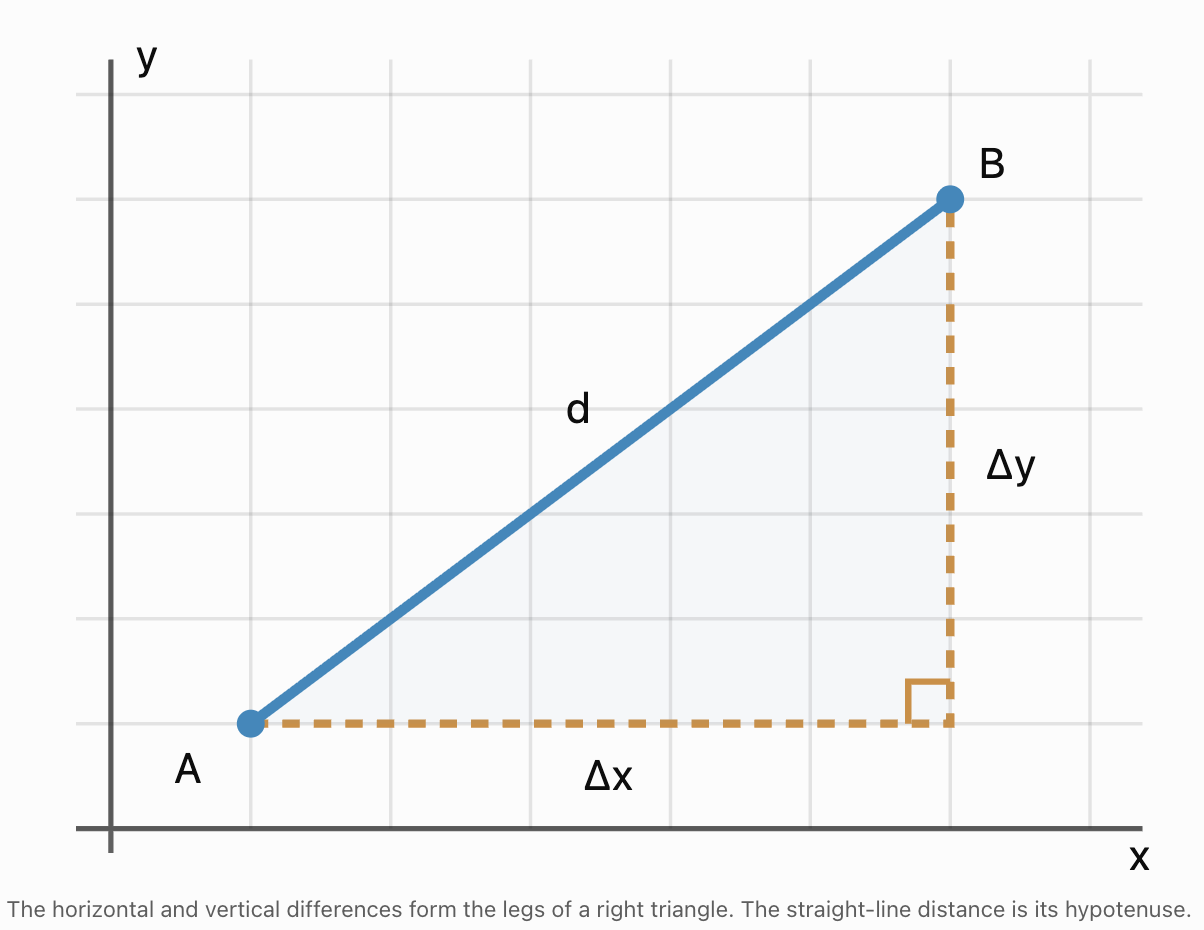
The Pythagorean Theorem can be used to calculate the distance between two points on a coordinate plane.
Suppose the points are:
A(x₁, y₁)
B(x₂, y₂)
The horizontal distance is:
Δx = x₂ − x₁
The vertical distance is:
Δy = y₂ − y₁
These distances form the legs of a right triangle.
The straight-line distance between the points is the hypotenuse.
Therefore:
d = √[(x₂ − x₁)² + (y₂ − y₁)²]
This is called the distance formula.
Worked Example: Distance Between Two Points
Find the distance between:
A(2, 3)
B(8, 11)
Step 1: Find the Horizontal Difference
Δx = 8 − 2
Δx = 6
Step 2: Find the Vertical Difference
Δy = 11 − 3
Δy = 8
Step 3: Apply the Pythagorean Theorem
d² = 6² + 8²
d² = 36 + 64
d² = 100
Step 4: Calculate the Distance
d = 10 units
Interpretation
The straight-line distance between the two points is 10 coordinate units.
Worked Example: Negative Coordinates
Find the distance between:
P(−3, 4)
Q(5, −2)
Step 1: Find the Differences
Δx = 5 − (−3) = 8
Δy = −2 − 4 = −6
Step 2: Square the Differences
8² = 64
(−6)² = 36
Step 3: Add
d² = 64 + 36
d² = 100
Step 4: Calculate
d = 10 units
Important Observation
Negative coordinate differences do not produce negative distances because the differences are squared.
Practical Application: Ladders
A ladder leaning against a vertical wall forms a right triangle with the wall and the ground, assuming the wall is vertical and the ground is level.
The ladder is the hypotenuse.
Worked Example
A ladder is 10 m long.
Its base is positioned 6 m from the wall.
How high up the wall does the ladder reach?
Step 1: Identify the Sides
Hypotenuse = 10 m
Horizontal leg = 6 m
Vertical leg = h
Step 2: Apply the Formula
h² + 6² = 10²
Step 3: Calculate
h² + 36 = 100
h² = 64
Step 4: Solve
h = 8 m
Interpretation
The ladder reaches 8 m up the wall.
Reasonableness Check
The vertical height must be shorter than the ladder.
Since 8 m is less than 10 m, the result is reasonable.
Safety Connection
In real situations, ladder placement must also follow appropriate safety guidance. The Pythagorean Theorem determines geometric distances but does not by itself establish whether the ladder is positioned safely.
Practical Application: Ramps
Ramps form right triangles when they connect two different heights across a horizontal distance.
The ramp is the hypotenuse.
Worked Example
A ramp rises 1.2 m vertically over a horizontal distance of 5 m.
Find the ramp length.
Step 1: Identify the Legs
a = 1.2 m
b = 5 m
Step 2: Apply the Formula
c² = 1.2² + 5²
Step 3: Calculate
c² = 1.44 + 25
c² = 26.44
Step 4: Take the Square Root
c ≈ 5.14 m
Interpretation
The ramp must be approximately 5.14 m long along its sloping surface.
Important Observation
The sloping length is greater than the horizontal distance because the ramp also rises vertically.

Practical Application: Television and Screen Sizes
Screen sizes are often described by their diagonal measurement.
The width and height form the legs of a right triangle.
The diagonal is the hypotenuse.
Worked Example
A rectangular screen is:
48 cm wide
36 cm high
Find its diagonal.
Step 1: Apply the Formula
d² = 48² + 36²
Step 2: Calculate
d² = 2304 + 1296
d² = 3600
Step 3: Take the Square Root
d = 60 cm
Interpretation
The screen has a diagonal measurement of 60 cm.
This illustrates why screen dimensions can be described using a single diagonal length.
Practical Application: Construction
Builders use right triangles to check whether corners are square.
A common method uses the 3–4–5 Pythagorean triple.
Worked Example
A builder measures:
3 m along one side of a rectangular foundation.
4 m along the adjacent side.
If the corner is exactly 90°, the diagonal between the endpoints should be:
c² = 3² + 4²
c² = 9 + 16
c² = 25
c = 5 m
Interpretation
If the diagonal measures 5 m, the two measured sides form a right angle, assuming the measurements are accurate.
This technique is useful when setting out rectangular foundations and other structures.


Practical Application: Navigation
The Pythagorean Theorem can calculate straight-line displacement when two movements are perpendicular.
Worked Example
A person walks:
300 m east
400 m north
Find the straight-line distance from the starting point.
Step 1: Identify the Legs
Eastward movement = 300 m
Northward movement = 400 m
Step 2: Apply the Formula
d² = 300² + 400²
Step 3: Calculate
d² = 90000 + 160000
d² = 250000
Step 4: Take the Square Root
d = 500 m
Interpretation
The person finishes 500 m from the starting point.
Distance Versus Displacement
The total distance walked is:
300 + 400 = 700 m
The magnitude of displacement is:
500 m
These values differ because distance measures the length of the path travelled, while displacement describes the straight-line change in position.
Practical Application: Engineering Cables
Support cables often form the hypotenuse of right triangles.
Worked Example
A vertical pole is 12 m tall.
A cable is attached to its top and anchored 5 m from its base.
Find the minimum straight-line cable length.
Step 1: Apply the Formula
c² = 12² + 5²
Step 2: Calculate
c² = 144 + 25
c² = 169
Step 3: Solve
c = 13 m
Interpretation
The straight-line distance from the top of the pole to the anchor point is 13 m.
Additional cable may be required for attachment and tensioning.
Multi-Step Right Triangle Problems
Some geometric problems contain more than one right triangle.
In these cases, we may need to apply the Pythagorean Theorem several times.
Worked Example: Two Connected Right Triangles
A rectangular field measures:
30 m long
40 m wide
A person walks diagonally across the field and then travels 12 m vertically upward along a separate perpendicular route.
Find the straight-line distance from the original starting point to the final point, assuming the 12 m movement is perpendicular to the plane of the field.
Step 1: Find the Field Diagonal
d² = 30² + 40²
d² = 900 + 1600
d² = 2500
d = 50 m
Step 2: Form a Second Right Triangle
The field diagonal is one leg.
The vertical movement is the other leg.
Therefore:
D² = 50² + 12²
Step 3: Calculate
D² = 2500 + 144
D² = 2644
Step 4: Solve
D = √2644 ≈ 51.42 m
Interpretation
The straight-line distance between the starting and final positions is approximately 51.42 m.
Important Observation
The first application of the theorem finds a diagonal in a horizontal plane.
The second application finds a three-dimensional distance.
Right Triangle Geometry in Three Dimensions
The Pythagorean Theorem can also be used to find the space diagonal of a rectangular prism.
For a rectangular prism with:
Length = l
Width = w
Height = h
the space diagonal is:
d = √(l² + w² + h²)
This formula comes from applying the Pythagorean Theorem twice.
Worked Example
A rectangular storage box measures:
Length = 6 cm
Width = 8 cm
Height = 24 cm
Find the distance between opposite corners of the box.
Step 1: Apply the Three-Dimensional Formula
d² = 6² + 8² + 24²
Step 2: Calculate
d² = 36 + 64 + 576
d² = 676
Step 3: Take the Square Root
d = 26 cm
Interpretation
The straight-line distance between opposite corners is 26 cm.
Algebraic Problems Involving Right Triangles
Sometimes side lengths are expressed algebraically.
The Pythagorean Theorem can be used to construct and solve equations.
Worked Example
A right triangle has legs:
x cm
(x + 7) cm
and a hypotenuse of 13 cm.
Find x.
Step 1: Write the Equation
x² + (x + 7)² = 13²
Step 2: Expand
x² + x² + 14x + 49 = 169
Step 3: Simplify
2x² + 14x + 49 = 169
2x² + 14x − 120 = 0
Step 4: Divide by 2
x² + 7x − 60 = 0
Step 5: Factorise
(x + 12)(x − 5) = 0
Therefore:
x = −12 or x = 5
Step 6: Reject the Invalid Solution
A side length cannot be negative.
Therefore:
x = 5 cm
Step 7: Find the Other Leg
x + 7 = 12 cm
Step 8: Verify
5² + 12² = 13²
25 + 144 = 169
169 = 169
The solution is correct.
Combining Right Triangles with Similarity
Right triangles can also be similar.
For example, the triangles with sides:
3, 4, 5
and:
6, 8, 10
are both right triangles.
Their corresponding sides have the same ratio:
6/3 = 2
8/4 = 2
10/5 = 2
Therefore, they are similar by SSS similarity.
This means the second triangle is an enlargement of the first by a scale factor of 2.
Important Connection
The Pythagorean Theorem remains valid when a right triangle is enlarged or reduced proportionally.
If:
a² + b² = c²
then multiplying all side lengths by k gives:
(ka)² + (kb)² = (kc)²
k²a² + k²b² = k²c²
Dividing by k² returns the original relationship.
This shows why all similar right triangles preserve the Pythagorean relationship.
Choosing the Correct Method
When solving a right triangle problem, use the following process.
Identify the Right Angle
Determine whether the triangle contains a 90° angle.
Identify the Hypotenuse
Locate the side opposite the right angle.
Label the Sides
Use a and b for the legs and c for the hypotenuse.
Determine the Unknown
Decide whether you need to find:
-
The hypotenuse.
-
One of the legs.
-
A diagonal distance.
-
A coordinate distance.
-
Whether the triangle is right-angled.
Select the Formula
For the hypotenuse:
c = √(a² + b²)
For a missing leg:
a = √(c² − b²)
For coordinate distance:
d = √[(x₂ − x₁)² + (y₂ − y₁)²]
Substitute Carefully
Use the correct side lengths and units.
Solve
Square, add or subtract, and take the square root.
Verify
Substitute the calculated value into the original equation.
Interpret
Explain what the result means in the original problem.
Common Mistakes
Using the Pythagorean Theorem on a triangle that is not right-angled
The theorem applies only to right triangles.
Misidentifying the hypotenuse
The hypotenuse is opposite the 90° angle and is always the longest side.
Adding the side lengths instead of their squares
The theorem involves squared lengths.
Forgetting to take the square root
Solving for c² is not the same as solving for c.
Adding instead of subtracting when finding a leg
To find a missing leg, subtract the square of the known leg from the square of the hypotenuse.
Subtracting in the wrong order
The square of the hypotenuse must be the larger quantity.
Accepting negative side lengths
Physical lengths must be positive.
Rounding too early
Keep exact values until the final step whenever possible.
Confusing distance with displacement
The length of a travelled path may be different from the straight-line displacement.
Using inconsistent units
Convert measurements into compatible units before calculating.
Assuming all right triangles have integer side lengths
Many right triangles have irrational side lengths.
Forgetting to check whether the answer is reasonable
The hypotenuse must always be longer than either leg.
Confusing a Pythagorean triple with any three whole numbers
The numbers must satisfy the Pythagorean relationship.
Failing to identify the longest side when testing a triangle
The longest side must be used as c.
Key Terms
-
Right Triangle: A triangle containing one angle of exactly 90°.
-
Right Angle: An angle measuring 90°.
-
Leg: One of the two sides forming the right angle.
-
Hypotenuse: The side opposite the right angle and the longest side of a right triangle.
-
Pythagorean Theorem: The relationship a² + b² = c² in a right triangle.
-
Converse of the Pythagorean Theorem: The principle that a triangle is right-angled if its side lengths satisfy the Pythagorean relationship.
-
Pythagorean Triple: Three positive whole numbers satisfying a² + b² = c².
-
Primitive Pythagorean Triple: A Pythagorean triple with no common factor greater than 1.
-
Square: The result of multiplying a number by itself.
-
Square Root: A number that produces a given value when squared.
-
Irrational Number: A number that cannot be expressed as a ratio of two integers.
-
Exact Value: A value written without rounding.
-
Approximate Value: A numerical estimate of an exact quantity.
-
Diagonal: A straight line connecting non-adjacent vertices of a polygon or opposite corners of a solid.
-
Distance Formula: A formula for calculating the straight-line distance between two coordinate points.
-
Coordinate Plane: A two-dimensional system using horizontal and vertical axes.
-
Horizontal Distance: Distance measured parallel to the horizontal axis.
-
Vertical Distance: Distance measured parallel to the vertical axis.
-
Displacement: The straight-line change in position from an initial point to a final point, including direction.
-
Distance: The total length of a path or the separation between points, depending on context.
-
Acute Triangle: A triangle in which all three angles are less than 90°.
-
Obtuse Triangle: A triangle containing one angle greater than 90°.
-
Perpendicular Lines: Lines that intersect at a right angle.
-
Rectangular Prism: A three-dimensional solid with rectangular faces.
-
Space Diagonal: A line connecting opposite vertices of a three-dimensional solid.
-
Similar Triangles: Triangles with equal corresponding angles and proportional corresponding sides.
-
Scale Factor: The ratio of corresponding lengths in similar figures.
-
Verification: Checking a calculated result against the original equation.
-
Reasonableness Check: Evaluating whether a mathematical result makes sense.
-
Geometric Model: A mathematical representation of a physical shape or situation.
Key Takeaways
-
The Pythagorean Theorem describes the relationship between the three sides of a right triangle.
-
The two sides forming the right angle are called legs.
-
The hypotenuse is opposite the right angle and is always the longest side.
-
The Pythagorean Theorem states that a² + b² = c².
-
The hypotenuse can be found using c = √(a² + b²).
-
A missing leg can be found by subtracting the square of the known leg from the square of the hypotenuse.
-
The theorem applies only to right triangles.
-
The converse of the theorem can be used to determine whether a triangle is right-angled.
-
Pythagorean triples are sets of positive whole numbers satisfying the theorem.
-
Common triples include 3–4–5, 5–12–13, and 8–15–17.
-
Multiples of Pythagorean triples are also Pythagorean triples.
-
Not all right triangles have whole-number side lengths.
-
Some side lengths must be expressed using square roots.
-
The distance formula is derived from the Pythagorean Theorem.
-
Right triangle geometry can be used to calculate distances on coordinate grids.
-
The theorem can be applied more than once to solve three-dimensional problems.
-
Similar right triangles preserve the Pythagorean relationship.
-
Right triangle geometry is useful for ladders, ramps, cables, screens, construction, and navigation.
-
Mathematical solutions should include appropriate units and verification.
-
The central skill is recognising right triangles, identifying the hypotenuse correctly, and applying the Pythagorean Theorem to calculate unknown distances and side lengths.
Check Your Understanding
Recall and Understanding
-
Define a right triangle and identify its three sides.
-
State the Pythagorean Theorem and explain what each variable represents.
-
Explain why the hypotenuse must always be the longest side.
-
Define a Pythagorean triple and give three examples.
-
Explain how the converse of the Pythagorean Theorem can be used to identify right triangles.
Application
-
A right triangle has legs measuring 9 cm and 12 cm. Calculate the hypotenuse.
-
A right triangle has a hypotenuse of 17 cm and one leg of 8 cm. Find the missing leg.
-
Determine whether a triangle with side lengths 7 cm, 24 cm, and 25 cm is right-angled.
-
Find the distance between points A(1, 2) and B(7, 10).
-
A rectangular field measures 60 m by 80 m. Calculate the diagonal distance across the field.
Analysis and Challenge
-
A 13 m ladder leans against a vertical wall. Its base is 5 m from the wall. How high does the ladder reach?
-
A ramp rises 0.9 m over a horizontal distance of 4.8 m. Calculate its sloping length.
-
A person walks 500 m east and then 1200 m north. Calculate the total distance walked and the magnitude of the displacement.
-
A right triangle has legs measuring x cm and (x + 7) cm, with a hypotenuse of 13 cm. Determine x and verify your solution.
-
A rectangular storage container measures 9 m long, 12 m wide, and 20 m high. Calculate the straight-line distance between opposite corners of the container.
Final Summary
Right triangle geometry provides an important connection between shape, measurement, and algebra.
The Pythagorean Theorem allows unknown side lengths to be calculated using the relationship between the legs and hypotenuse.
It can also be used to determine whether a triangle is right-angled, recognise Pythagorean triples, and calculate distances on coordinate grids.
More advanced applications involve similar triangles, algebraic equations, three-dimensional distances, and practical measurement problems.
The theorem is widely used in architecture, construction, navigation, engineering, and everyday situations involving perpendicular distances.
The central principle is that the square of the hypotenuse of a right triangle equals the sum of the squares of its two legs, providing a reliable method for calculating unknown lengths and solving geometric problems.