Triangles
3. Similar Triangles
Learning outcomes
- I can identify similar figures.
- I can apply similarity criteria.
- I can calculate missing side lengths using similarity.
- I can solve proportional reasoning problems.
- I can apply similarity to real-world situations.
Similar Triangles
Introduction to Similar Triangles
In geometry, two figures are similar when they have the same shape but are not necessarily the same size.
Similar figures have equal corresponding angles and proportional corresponding side lengths.
For example, two triangles may have exactly the same angles, but one triangle may be twice as large as the other. The triangles are still similar because their shapes are identical.
Similarity is an important mathematical concept because it allows us to calculate unknown lengths, compare geometric figures, and solve problems involving objects that cannot be measured directly.
Similar triangles are particularly useful in:
-
Architecture and construction.
-
Maps and scale drawings.
-
Photography and image enlargement.
-
Surveying and measuring heights.
-
Engineering and design.
-
Shadows and indirect measurement.
-
Mathematical modelling.
Understanding similarity involves recognising corresponding parts, applying similarity criteria, calculating scale factors, and using proportional reasoning.


Understanding Similar Figures
Two figures are similar if their corresponding angles are equal and their corresponding sides are proportional.
Corresponding Angles
Corresponding angles occupy matching positions in similar figures.
If triangle ABC is similar to triangle DEF, then:
∠A = ∠D
∠B = ∠E
∠C = ∠F
Corresponding Sides
Corresponding sides are sides that occupy matching positions in the two figures.
For similar triangles:
AB/DE = BC/EF = AC/DF
The ratios of corresponding side lengths are equal.
Similarity Notation
The symbol ∼ means "is similar to."
We write:
△ABC ∼ △DEF
The order of the letters is important because it identifies the corresponding vertices.
For example:
A ↔ D
B ↔ E
C ↔ F
This correspondence determines which sides should be compared.
Congruence Versus Similarity
Congruent figures have the same shape and the same size.
Similar figures have the same shape but may have different sizes.
|
Property |
Congruent figures |
Similar figures |
|---|---|---|
|
Same shape |
Yes |
Yes |
|
Same size |
Yes |
Not necessarily |
|
Corresponding angles equal |
Yes |
Yes |
|
Corresponding sides equal |
Yes |
Not necessarily |
|
Corresponding sides proportional |
Yes |
Yes |
|
Scale factor |
1 |
Any positive number |
All congruent figures are similar.
However, not all similar figures are congruent.
Example
Triangle ABC has sides:
3 cm, 4 cm, 5 cm
Triangle DEF has sides:
6 cm, 8 cm, 10 cm
The side ratios are:
6/3 = 2
8/4 = 2
10/5 = 2
All corresponding sides have been multiplied by 2.
Therefore, the triangles are similar but not congruent.
Scale Factors
A scale factor describes how much a figure has been enlarged or reduced.
For corresponding sides:
Scale factor = new length / original length
If the scale factor is:
-
Greater than 1, the figure is enlarged.
-
Between 0 and 1, the figure is reduced.
-
Equal to 1, the figure remains the same size.
Example: Enlargement
A triangle has a side measuring 5 cm.
A similar triangle has the corresponding side measuring 15 cm.
Scale factor = 15/5
Scale factor = 3
The second triangle is three times as large in its linear dimensions.
Example: Reduction
A triangle has a side measuring 20 cm.
A smaller similar triangle has the corresponding side measuring 8 cm.
Scale factor = 8/20
Scale factor = 0.4
The second triangle is a reduction of the first.
Exploring the Scale Factor
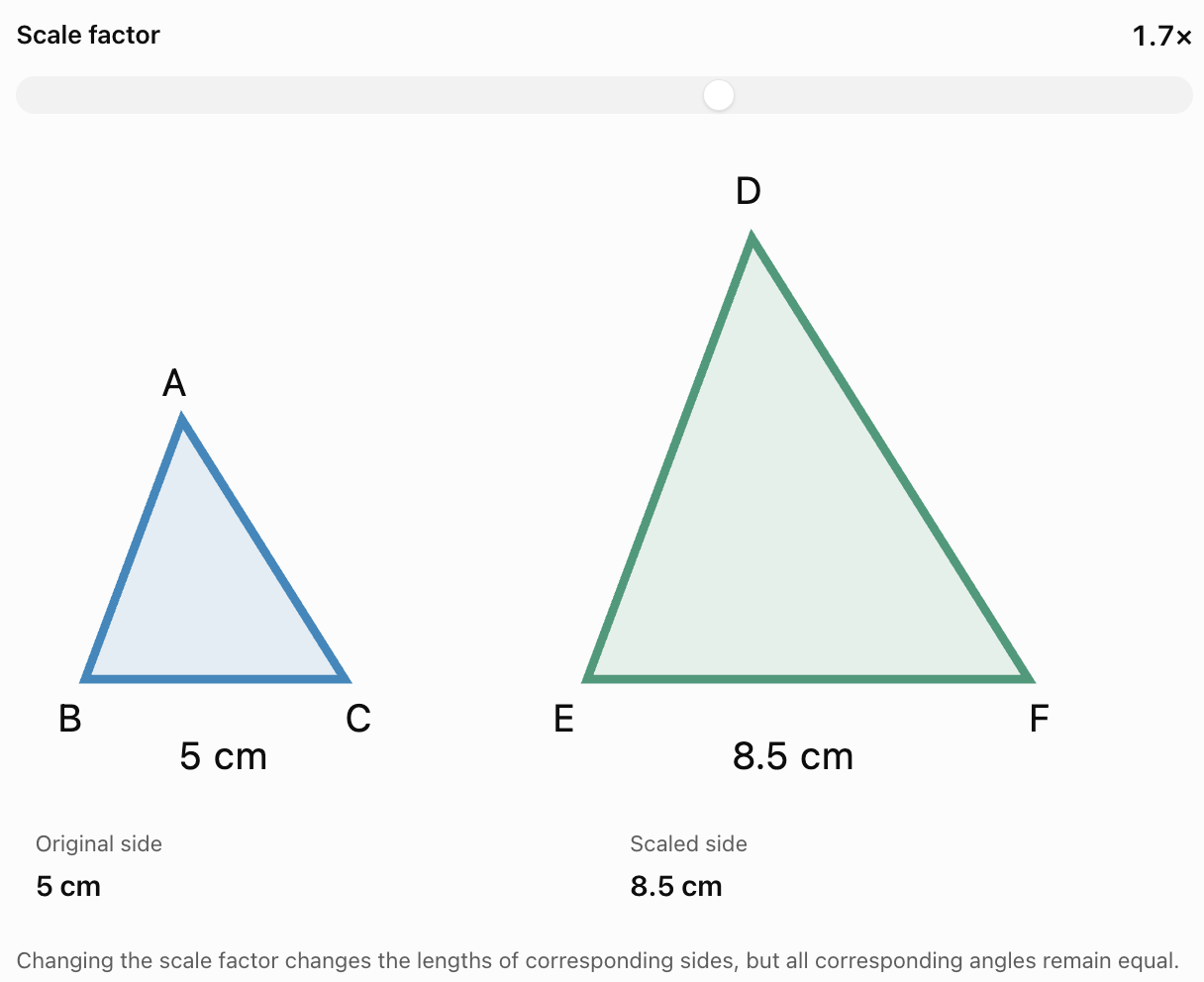
The following comparison illustrates how changing the scale factor changes the side lengths of a triangle while preserving its angles.
Important Observation
A scale factor affects all corresponding side lengths equally.
It does not change the angles.
For example, if a triangle has angles:
40°, 60°, and 80°
then every similar triangle has those same three angles, regardless of its size.
Criteria for Similar Triangles
Two triangles can be proven similar using three main criteria:
-
AA: Angle–Angle similarity.
-
SSS: Side–Side–Side similarity.
-
SAS: Side–Angle–Side similarity.
These criteria allow us to establish similarity without measuring every side and angle.
AA Similarity
AA stands for Angle–Angle.
Two triangles are similar if two angles of one triangle are equal to two corresponding angles of another triangle.
Why Two Angles Are Enough
The interior angles of every triangle add to 180°.
If two angles are equal, the third angles must also be equal.
For example:
Triangle ABC has:
∠A = 40°
∠B = 65°
Therefore:
∠C = 180° − 40° − 65°
∠C = 75°
Triangle DEF has:
∠D = 40°
∠E = 65°
Therefore:
∠F = 75°
All three pairs of corresponding angles are equal.
Thus:
△ABC ∼ △DEF by AA similarity.
Worked Example
Triangle PQR has angles:
35°, 65°, and 80°.
Triangle XYZ has angles:
35°, 65°, and 80°.
Are the triangles similar?
Step 1: Compare Angles
Both triangles contain corresponding angles of 35° and 65°.
Step 2: Apply AA
Two corresponding angles are equal.
Conclusion
The triangles are similar by AA.
No side lengths are needed to establish similarity.
SSS Similarity
SSS stands for Side–Side–Side.
Two triangles are similar if all three pairs of corresponding sides are proportional.
Unlike SSS congruence, the side lengths do not need to be equal.
They must have the same ratio.
Worked Example
Triangle ABC has sides:
4 cm, 6 cm, 8 cm
Triangle DEF has sides:
10 cm, 15 cm, 20 cm
Determine whether the triangles are similar.
Step 1: Compare Corresponding Sides
10/4 = 2.5
15/6 = 2.5
20/8 = 2.5
Step 2: Identify the Common Ratio
All three ratios are equal.
The scale factor is:
k = 2.5
Step 3: Apply SSS Similarity
△ABC ∼ △DEF by SSS similarity, with the sides matched in the order listed.
Important Difference
For SSS congruence, all three corresponding side lengths must be equal.
For SSS similarity, the corresponding side lengths must be proportional.
SAS Similarity
SAS stands for Side–Angle–Side.
Two triangles are similar if:
-
Two pairs of corresponding sides are proportional.
-
The included angles between those sides are equal.
Worked Example
Triangle ABC has:
AB = 6 cm
AC = 9 cm
∠A = 50°
Triangle DEF has:
DE = 10 cm
DF = 15 cm
∠D = 50°
Determine whether the triangles are similar.
Step 1: Compare Corresponding Side Ratios
DE/AB = 10/6 = 5/3
DF/AC = 15/9 = 5/3
The ratios are equal.
Step 2: Compare Included Angles
∠A = ∠D = 50°
Step 3: Apply SAS Similarity
The two side pairs are proportional, and the included angles are equal.
Therefore:
△ABC ∼ △DEF by SAS similarity.
Why the Included Angle Matters
If the equal angle is not between the proportional side pairs, the information may be insufficient to prove similarity.
The position of the angle is important.
Comparing Similarity Criteria
|
Criterion |
Information required |
|---|---|
|
AA |
Two pairs of equal corresponding angles |
|
SSS |
Three pairs of proportional corresponding sides |
|
SAS |
Two pairs of proportional corresponding sides and equal included angles |
Important Observation
AAA also establishes triangle similarity, but it is unnecessary to check all three angles because AA is sufficient.
There is no general SSA similarity criterion.


Finding Missing Side Lengths
One of the most important applications of similarity is calculating unknown lengths.
If two triangles are similar, their corresponding sides are proportional.
Suppose:
△ABC ∼ △DEF
Then:
AB/DE = BC/EF = AC/DF
We can use these proportions to find missing side lengths.
Worked Example: Basic Proportions
Two similar triangles have corresponding sides:
Small triangle: 4 cm and 7 cm.
Large triangle: 12 cm and x cm.
Find x.
Step 1: Identify the Scale Factor
Scale factor = 12/4
k = 3
Step 2: Apply the Scale Factor
x = 7 × 3
Final Answer
x = 21 cm
Verification
12/4 = 3
21/7 = 3
The corresponding side ratios are equal.
Worked Example: Cross-Multiplication
Suppose two similar triangles have:
AB = 5 cm
DE = 15 cm
BC = 8 cm
EF = x cm
Find x.
Step 1: Write a Proportion
AB/DE = BC/EF
5/15 = 8/x
Step 2: Cross-Multiply
5x = 15 × 8
5x = 120
Step 3: Solve
x = 24 cm
Step 4: Verify
5/15 = 1/3
8/24 = 1/3
The proportions are equal.
Worked Example: Finding a Side in the Smaller Triangle
Two similar triangles have:
Small corresponding side = x
Large corresponding side = 18 cm
Another small side = 5 cm
Corresponding large side = 15 cm
Find x.
Step 1: Write a Proportion
x/18 = 5/15
Step 2: Simplify
x/18 = 1/3
Step 3: Solve
x = 18/3
x = 6 cm
Reasonableness Check
The larger triangle has a scale factor of 3 relative to the smaller triangle.
Therefore, the missing small side must be one-third of 18 cm.
The answer is reasonable.
Solving Algebraic Problems Using Similarity
Sometimes side lengths are given as algebraic expressions.
Similarity allows us to construct equations and solve for unknown variables.
Worked Example
Two similar triangles have corresponding sides:
Small triangle: 3x + 2 and 10 cm.
Large triangle: 20 cm and 25 cm.
The first pair is 3x + 2 and 20, and the second pair is 10 and 25.
Find x.
Step 1: Write a Proportion
(3x + 2)/20 = 10/25
Step 2: Cross-Multiply
25(3x + 2) = 200
Step 3: Expand
75x + 50 = 200
Step 4: Solve
75x = 150
x = 2
Step 5: Verify
3x + 2 = 3(2) + 2 = 8
8/20 = 0.4
10/25 = 0.4
The proportions match.
Final Answer
x = 2
Worked Example: Two Unknown Sides
Two similar triangles have side lengths:
Small triangle: 6 cm, 8 cm, and 10 cm.
Large triangle: 9 cm, x cm, and y cm.
The corresponding sides are listed in the same order.
Step 1: Calculate the Scale Factor
k = 9/6
k = 1.5
Step 2: Find x
x = 8 × 1.5
x = 12 cm
Step 3: Find y
y = 10 × 1.5
y = 15 cm
Final Answer
The larger triangle has side lengths:
9 cm, 12 cm, and 15 cm
Similar Triangles Formed by Parallel Lines
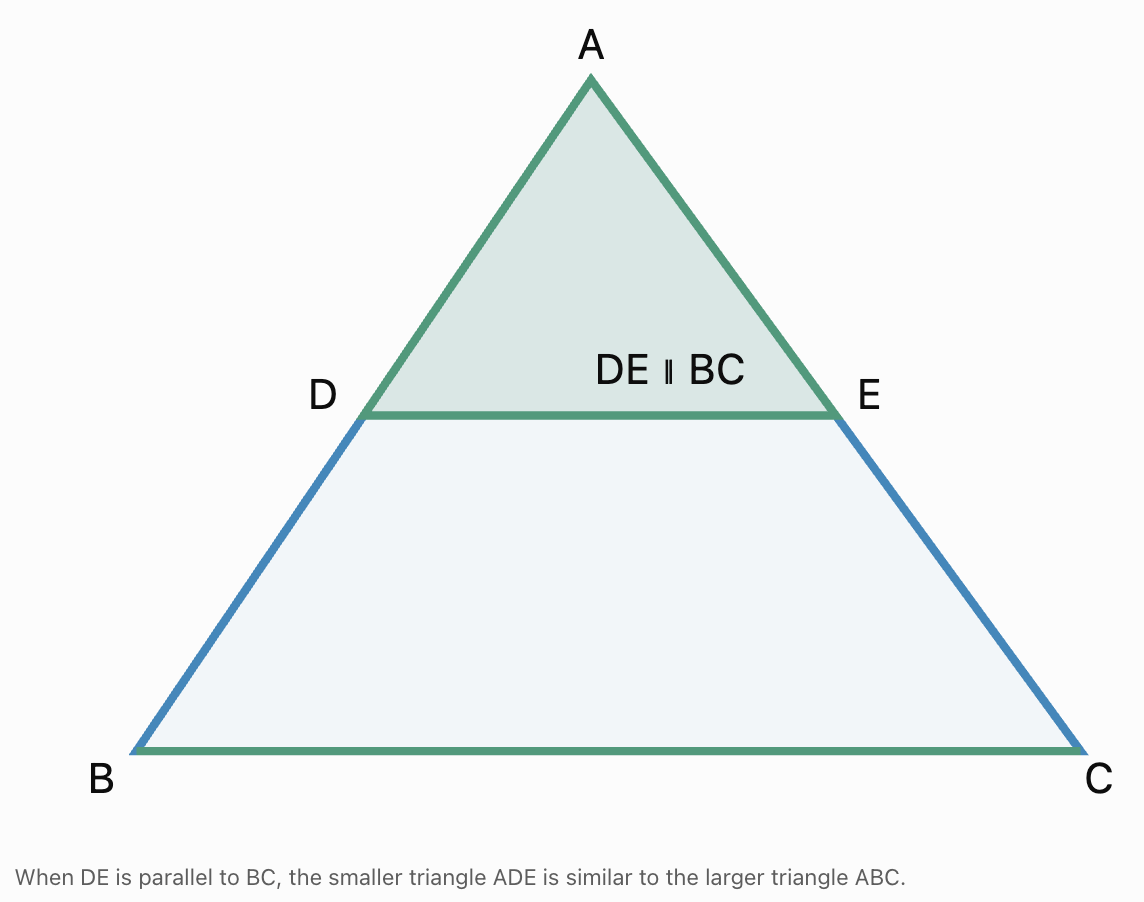
Parallel lines frequently create similar triangles.
Consider triangle ABC with points D on AB and E on AC.
If:
DE ∥ BC
then:
∠ADE = ∠ABC
and:
∠AED = ∠ACB
These are corresponding angles formed by parallel lines.
Therefore:
△ADE ∼ △ABC by AA similarity.
Proportional Relationships
Since:
△ADE ∼ △ABC
we have:
AD/AB = AE/AC = DE/BC
This relationship is extremely useful when a line parallel to one side divides the other two sides of a triangle.
Worked Example: Parallel-Line Similarity
In triangle ABC:
DE ∥ BC
AD = 4 cm
AB = 10 cm
AE = 6 cm
Find AC.
Step 1: Establish Similarity
△ADE ∼ △ABC by AA.
Step 2: Write the Proportion
AD/AB = AE/AC
4/10 = 6/AC
Step 3: Cross-Multiply
4AC = 60
Step 4: Solve
AC = 15 cm
Step 5: Verify
4/10 = 0.4
6/15 = 0.4
The ratios match.
Interpretation
The smaller triangle has a scale factor of 0.4 relative to the larger triangle.
Similar Triangles and the Pythagorean Theorem
Similarity and the Pythagorean theorem can be combined to solve right-triangle problems.
Worked Example
A right triangle has legs of 6 cm and 8 cm.
A similar right triangle has a corresponding leg of 15 cm instead of 6 cm.
Find the other two side lengths.
Step 1: Find the Original Hypotenuse
Using the Pythagorean theorem:
c² = 6² + 8²
c² = 36 + 64
c² = 100
c = 10 cm
Step 2: Calculate the Scale Factor
k = 15/6
k = 2.5
Step 3: Find the Other Leg
8 × 2.5 = 20 cm
Step 4: Find the Hypotenuse
10 × 2.5 = 25 cm
Final Answer
The larger triangle has sides:
15 cm, 20 cm, and 25 cm
Verification
15² + 20² = 225 + 400 = 625
25² = 625
The Pythagorean theorem is satisfied.
Similarity and Perimeter
When two figures are similar, their perimeters have the same ratio as their corresponding side lengths.
If the scale factor is k:
New perimeter = k × original perimeter
Worked Example
A triangle has side lengths:
5 cm, 7 cm, and 8 cm.
A similar triangle has a scale factor of 3.
Find the perimeter of the larger triangle.
Step 1: Calculate the Original Perimeter
P = 5 + 7 + 8
P = 20 cm
Step 2: Apply the Scale Factor
New perimeter = 3 × 20
Final Answer
60 cm
Important Principle
A scale factor of 3 makes the perimeter three times as large.
It does not make the perimeter nine times as large.
Similarity and Area
Area changes differently from side length.
If the scale factor is k:
New area = k² × original area
This happens because area involves two dimensions.
Worked Example
A triangle has an area of 24 cm².
A similar triangle has a scale factor of 2.5.
Find the area of the larger triangle.
Step 1: Square the Scale Factor
k² = 2.5²
k² = 6.25
Step 2: Calculate the New Area
New area = 24 × 6.25
Final Answer
150 cm²
Comparing Length, Perimeter, and Area
|
Scale factor |
Side-length factor |
Perimeter factor |
Area factor |
|---|---|---|---|
|
2 |
2 |
2 |
4 |
|
3 |
3 |
3 |
9 |
|
0.5 |
0.5 |
0.5 |
0.25 |
|
1.5 |
1.5 |
1.5 |
2.25 |
|
4 |
4 |
4 |
16 |
Why Area Changes by the Square
The area of a triangle is:
A = 1/2 × base × height
If both base and height are multiplied by k:
New area = 1/2 × (k × base) × (k × height)
New area = k² × (1/2 × base × height)
Therefore:
New area = k² × original area
This relationship applies to all similar two-dimensional figures.
Real-World Application: Measuring Heights Using Shadows
Similar triangles can be used to measure the heights of tall objects without climbing them.
When sunlight strikes objects at the same angle, their heights and shadow lengths can form similar right triangles.
Worked Example
A student who is 1.6 m tall casts a shadow measuring 2 m.
At the same time, a tree casts a shadow measuring 12 m.
Find the height of the tree.

Step 1: Establish Similarity
Both objects are vertical to level ground.
The sunlight creates the same angle with the ground.
Therefore, the height-and-shadow triangles are similar by AA.
Step 2: Write a Proportion
Tree height / tree shadow = student height / student shadow
h/12 = 1.6/2
Step 3: Cross-Multiply
2h = 12 × 1.6
2h = 19.2
Step 4: Solve
h = 9.6 m
Interpretation
The tree is approximately 9.6 m tall.
Reasonableness Check
The tree's shadow is six times longer than the student's shadow.
Therefore, its height should also be six times greater.
1.6 × 6 = 9.6 m
The answer is reasonable.
Real-World Application: Maps and Scale Drawings
Maps use similarity to represent large distances using smaller measurements.
Worked Example
A map uses the scale:
1 cm : 5 km
Two towns are 7.5 cm apart on the map.
Find their actual distance.
Step 1: Identify the Scale
1 cm represents 5 km.
Step 2: Apply Proportional Reasoning
Actual distance = 7.5 × 5
Final Answer
37.5 km
Interpretation
The towns are approximately 37.5 km apart according to the map scale.
This is a straight-line or map-measured distance, not necessarily the distance travelled along roads.

Real-World Application: Scale Models
Architects and engineers often use scale models to represent larger structures.
Worked Example
A building model is constructed at a scale of:
1 : 200
The model building is 18 cm tall.
Find the actual height of the building.
Step 1: Interpret the Scale
Every 1 cm on the model represents 200 cm in reality.
Step 2: Multiply
Actual height = 18 × 200
Actual height = 3600 cm
Step 3: Convert Units
3600 cm = 36 m
Final Answer
36 m
Interpretation
The actual building is 36 m tall.
Important Observation
When using scale ratios, all measurements must initially be expressed in compatible units.
Real-World Application: Photography
Images can be enlarged or reduced while maintaining their proportions.
If an image is enlarged uniformly, the original and enlarged shapes are similar.
Worked Example
A photograph measures:
12 cm wide
8 cm high
It is enlarged to a width of 30 cm.
Find the new height.
Step 1: Calculate the Scale Factor
k = 30/12
k = 2.5
Step 2: Calculate the New Height
New height = 8 × 2.5
Final Answer
20 cm
Interpretation
The enlarged photograph should measure:
30 cm × 20 cm
This preserves the original proportions without distortion.


Real-World Application: Indirect Measurement
Similarity can be used to determine distances that are difficult or unsafe to measure directly.
For example, a surveyor may construct two similar triangles to estimate the width of a river.
Worked Example
A surveying arrangement creates two similar triangles.
The smaller triangle has:
-
A horizontal side of 4 m.
-
A corresponding perpendicular side of 6 m.
The larger triangle has a corresponding horizontal side of 30 m.
Find the larger perpendicular side.
Step 1: Write a Proportion
6/4 = x/30
Step 2: Cross-Multiply
4x = 180
Step 3: Solve
x = 45 m
Interpretation
The unknown perpendicular distance is 45 m.
The validity of this result depends on the surveyor having established that the two triangles are similar.
Real-World Application: Engineering and Design
Engineers use similar triangles to calculate dimensions in scaled structures and mechanical systems.
Worked Example
A triangular support has:
Base = 2.4 m
Height = 1.8 m
A larger similar support must have a base of 4 m.
Find its height.
Step 1: Calculate the Scale Factor
k = 4/2.4
k = 5/3
Step 2: Calculate the New Height
New height = 1.8 × 5/3
Final Answer
3 m
Interpretation
The larger support must have a height of 3 m to preserve the original triangular shape.
Multi-Step Problems with Similar Triangles
Some problems require more than one mathematical technique.
They may involve:
-
Angle calculations.
-
Proportional relationships.
-
Algebraic equations.
-
Perimeter calculations.
-
Area ratios.
-
Pythagorean theorem.
Worked Example: Finding a Missing Side and Area
Two triangles are similar.
The smaller triangle has:
Base = 8 cm
Height = 6 cm
The larger triangle has a corresponding base of 20 cm.
Find:
-
The larger triangle's height.
-
The smaller triangle's area.
-
The larger triangle's area.
Step 1: Calculate the Scale Factor
k = 20/8
k = 2.5
Step 2: Find the Larger Height
Height = 6 × 2.5
Height = 15 cm
Step 3: Find the Smaller Area
A = 1/2 × 8 × 6
A = 24 cm²
Step 4: Find the Larger Area
Using the area scale factor:
Larger area = 24 × 2.5²
Larger area = 24 × 6.25
Larger area = 150 cm²
Step 5: Verify Directly
A = 1/2 × 20 × 15
A = 150 cm²
Both methods agree.
Worked Example: Combining Angles and Proportions
Triangle ABC is similar to triangle DEF.
Given:
∠A = 50°
∠B = 65°
AB = 8 cm
DE = 12 cm
BC = 10 cm
Find:
-
∠F.
-
EF.
Step 1: Find the Third Angle
∠C = 180° − 50° − 65°
∠C = 65°
Since C corresponds to F:
∠F = 65°
Step 2: Find the Scale Factor
k = DE/AB
k = 12/8
k = 1.5
Step 3: Find EF
EF = BC × 1.5
EF = 10 × 1.5
EF = 15 cm
Final Answers
∠F = 65°
EF = 15 cm
Writing Similarity Proofs
A similarity proof explains why two triangles must have the same shape.
The proof should identify the information given and apply a valid similarity criterion.
Example: AA Similarity Proof
Given:
∠A = ∠D
∠B = ∠E
Prove:
△ABC ∼ △DEF
|
Statement |
Reason |
|---|---|
|
∠A = ∠D |
Given |
|
∠B = ∠E |
Given |
|
△ABC ∼ △DEF |
AA similarity |
Paragraph Proof
The corresponding angles ∠A and ∠D are equal, and the corresponding angles ∠B and ∠E are equal. Therefore, the triangles have two pairs of equal corresponding angles. Hence, △ABC ∼ △DEF by AA similarity.
Why Mathematical Justification Matters
A diagram may appear to contain similar triangles, but visual appearance alone is not sufficient.
A mathematical proof must establish the required relationships.
For example, two triangles may look similar even when their side ratios differ slightly.
Accurate reasoning is more reliable than visual estimation.
A Systematic Method for Similarity Problems
Identify the Triangles
Determine which figures are being compared.
Match Corresponding Parts
Identify corresponding vertices, sides, and angles.
Establish Similarity
Use AA, SSS, or SAS similarity.
Determine the Scale Factor
Compare a known pair of corresponding sides.
Write a Correct Proportion
Keep the order of corresponding sides consistent.
Solve the Equation
Use multiplication, division, or cross-multiplication.
Check Units
Ensure that measurements use compatible units.
Verify the Result
Check that the corresponding side ratios match.
Interpret the Answer
Explain what the result means in the original geometric or practical situation.
Common Mistakes
Confusing similarity with congruence
Similar figures do not need to have equal side lengths.
Matching incorrect corresponding sides
Side ratios must compare matching sides.
Writing proportions inconsistently
All ratios must use the same triangle order.
Assuming equal angles imply congruence
Equal angles establish similarity, not necessarily congruence.
Using an invalid similarity criterion
AA, SSS, and SAS are the standard triangle similarity criteria.
Forgetting the included angle in SAS
The equal angle must lie between the proportional sides.
Calculating the scale factor backwards
Always identify which figure is the original and which is the scaled figure.
Using different measurement units without converting
For example, centimetres and metres must be converted appropriately.
Applying the scale factor incorrectly
Side lengths change by k, while areas change by k².
Assuming perimeter and area change by the same factor
They scale differently.
Failing to establish similarity before using proportions
A proportion based on similarity is justified only when the figures are known to be similar.
Ignoring the real-world context
Practical answers should include units and reasonable interpretations.
Key Terms
-
Similar Figures: Figures with the same shape and proportional corresponding side lengths.
-
Similar Triangles: Triangles with equal corresponding angles and proportional corresponding sides.
-
Similarity Symbol (∼): A symbol meaning "is similar to."
-
Corresponding Vertices: Vertices occupying matching positions in similar figures.
-
Corresponding Sides: Sides that match in position and are proportional.
-
Corresponding Angles: Angles occupying matching positions and having equal measures.
-
Proportion: An equation stating that two ratios are equal.
-
Ratio: A comparison of two quantities using division.
-
Scale Factor: The ratio of a corresponding new length to an original length.
-
Enlargement: A transformation that increases a figure's dimensions proportionally.
-
Reduction: A transformation that decreases a figure's dimensions proportionally.
-
Dilation: A transformation that changes a figure's size while preserving its shape.
-
Congruence: A relationship between figures having exactly the same shape and size.
-
AA Similarity: A criterion based on two pairs of equal corresponding angles.
-
SSS Similarity: A criterion based on three pairs of proportional corresponding sides.
-
SAS Similarity: A criterion based on two proportional side pairs and an equal included angle.
-
Included Angle: The angle formed by two specified sides.
-
Triangle Angle-Sum Theorem: The rule that the interior angles of a triangle sum to 180°.
-
Parallel Lines: Lines in a plane that never intersect.
-
Alternate Interior Angles: Angles on opposite sides of a transversal between parallel lines.
-
Corresponding Angles: Angles occupying matching positions when a transversal crosses two lines.
-
Cross-Multiplication: A method for solving proportions.
-
Perimeter: The total distance around a figure.
-
Area: The amount of two-dimensional space enclosed by a figure.
-
Area Scale Factor: The square of the linear scale factor.
-
Pythagorean Theorem: The relationship a² + b² = c² in a right triangle.
-
Indirect Measurement: Finding an unknown distance using mathematical relationships instead of direct measurement.
-
Scale Drawing: A drawing representing an object using proportional dimensions.
-
Scale Model: A physical model with dimensions proportional to the original object.
-
Geometric Proof: A logical argument establishing a mathematical relationship.
-
Proportional Reasoning: Using ratios and proportions to solve problems.
-
Mathematical Verification: Checking whether a calculated result satisfies the original conditions.
Key Takeaways
-
Similar triangles have the same shape but are not necessarily the same size.
-
Corresponding angles in similar triangles are equal.
-
Corresponding sides in similar triangles are proportional.
-
The order of vertices in similarity notation identifies the correct correspondence.
-
Congruent triangles are always similar, but similar triangles are not always congruent.
-
AA similarity requires two pairs of equal corresponding angles.
-
SSS similarity requires three pairs of proportional corresponding sides.
-
SAS similarity requires two proportional side pairs and an equal included angle.
-
Scale factors describe how corresponding lengths change between similar figures.
-
A scale factor greater than 1 represents enlargement.
-
A scale factor between 0 and 1 represents reduction.
-
Corresponding side lengths change by the scale factor k.
-
Perimeters of similar figures also change by k.
-
Areas of similar figures change by k².
-
Similarity allows missing side lengths to be calculated using proportions.
-
Cross-multiplication is a useful method for solving proportional equations.
-
Parallel lines can create similar triangles through equal corresponding or alternate interior angles.
-
Similarity can be combined with the Pythagorean theorem, angle-sum relationships, and algebra.
-
Similar triangles are useful for measuring heights, distances, and dimensions indirectly.
-
Maps, photographs, scale drawings, and architectural models rely on proportional relationships.
-
Mathematical proofs should establish similarity before using corresponding side ratios.
-
Real-world solutions should include appropriate units and reasonableness checks.
-
The central skill in similarity problems is identifying corresponding parts, establishing a valid similarity relationship, and using consistent proportions to calculate unknown quantities.
Check Your Understanding
Recall and Understanding
-
Define similar triangles and explain how they differ from congruent triangles.
-
State the three main triangle similarity criteria.
-
Explain why two equal pairs of corresponding angles are sufficient to prove triangle similarity.
-
Define scale factor and explain the difference between enlargement and reduction.
-
Explain why the areas of similar triangles change by the square of the scale factor.
Application
-
Two triangles have corresponding sides of 3 cm, 5 cm, and 7 cm, and 6 cm, 10 cm, and 14 cm. Determine whether they are similar and justify your answer.
-
A triangle has sides of 4 cm, 6 cm, and 9 cm. A similar triangle has a corresponding shortest side of 12 cm. Find its other two side lengths.
-
Two similar triangles have corresponding sides of 5 cm and 15 cm. If another side of the smaller triangle is 8 cm, find the corresponding side of the larger triangle.
-
Two triangles have corresponding angles of 45° and 70°. Explain why they are similar and calculate the third angle.
-
A triangle has an area of 18 cm². A similar triangle has a scale factor of 3. Find the larger triangle's area.
Analysis and Challenge
-
In triangle ABC, DE is parallel to BC. Given AD = 6 cm, AB = 15 cm, and AE = 8 cm, calculate AC.
-
Two similar triangles have corresponding sides measuring 2x + 3 cm and 18 cm, and another corresponding pair measuring 5 cm and 10 cm. Find x.
-
A student who is 1.5 m tall casts a shadow of 1.8 m. At the same time, a building casts a shadow of 21.6 m. Calculate the building's height and explain why similarity applies.
-
A scale model of a tower is constructed at a scale of 1 : 250. The model is 32 cm tall. Find the actual tower height in metres.
-
Two similar triangular supports have corresponding bases of 6 m and 10 m. The smaller support has a height of 4.5 m and an area of 13.5 m². Determine the larger support's height and area, showing all calculations.
Final Summary
Similar triangles have the same shape, equal corresponding angles, and proportional corresponding side lengths.
Similarity can be established using AA, SSS, or SAS criteria.
Once similarity has been proven, scale factors and proportions can be used to calculate unknown side lengths and solve geometric problems.
Similar triangles also provide important relationships between corresponding perimeters and areas.
Parallel lines, angle relationships, and the Pythagorean theorem can be combined with similarity to solve more advanced problems.
In practical situations, similarity allows heights, distances, and dimensions to be calculated using indirect measurement and scale models.
The central principle is that similar triangles preserve their shape through equal corresponding angles and proportional side lengths, allowing unknown measurements to be determined through mathematical reasoning.