Triangles
2. Congruent Triangles
Learning outcomes
- I can identify congruent figures.
- I can apply the SSS, SAS, ASA, AAS, and HL congruence tests.
- I can determine whether triangles are congruent.
- I can justify congruence using appropriate criteria.
- I can solve geometric problems using congruent triangles.
Congruent Triangles
Introduction to Congruent Triangles
In geometry, two figures are congruent when they have exactly the same shape and size.
Congruent figures may be positioned differently. One figure might be rotated, reflected, or translated, but if it can fit exactly over another without stretching or resizing, the figures are congruent.
Triangles are particularly important because their congruence can be established using specific combinations of side lengths and angles.
Rather than measuring every side and angle, mathematicians use five important congruence tests:
-
SSS: Side–Side–Side
-
SAS: Side–Angle–Side
-
ASA: Angle–Side–Angle
-
AAS: Angle–Angle–Side
-
HL: Hypotenuse–Leg, for right triangles
These tests allow us to determine whether two triangles are congruent, justify geometric relationships, and solve problems involving unknown lengths and angles.


Understanding Congruent Figures
Two figures are congruent if all their corresponding sides and angles are equal.
For triangles, this means:
-
All three pairs of corresponding sides have equal lengths.
-
All three pairs of corresponding angles have equal measures.
Example
Suppose triangle ABC has:
AB = 5 cm
BC = 7 cm
AC = 9 cm
Triangle DEF has:
DE = 5 cm
EF = 7 cm
DF = 9 cm
If the vertices correspond as A ↔ D, B ↔ E, and C ↔ F, the triangles are congruent.
We write:
△ABC ≅ △DEF
The symbol ≅ means "is congruent to."
Congruence Versus Similarity
Congruent figures have the same shape and the same size.
Similar figures have the same shape but may have different sizes.
For example, triangles with side lengths:
3 cm, 4 cm, 5 cm
and:
6 cm, 8 cm, 10 cm
are similar but not congruent.
Their corresponding sides have the same ratio, but their lengths are different.
|
Property |
Congruent triangles |
Similar triangles |
|---|---|---|
|
Same shape |
Yes |
Yes |
|
Same size |
Yes |
Not necessarily |
|
Corresponding angles equal |
Yes |
Yes |
|
Corresponding sides equal |
Yes |
Not necessarily |
|
Scale factor |
1 |
Any positive value |
Transformations and Congruence
Congruent figures can be mapped onto each other using rigid transformations.
A rigid transformation preserves distances and angle measures.
Translation
A translation slides a figure without rotating or changing its size.
Rotation
A rotation turns a figure around a fixed point.
Reflection
A reflection flips a figure across a line.
These transformations preserve congruence.
A dilation with a scale factor other than 1 does not preserve congruence because it changes the figure's size.
Corresponding Sides and Angles
Before proving that triangles are congruent, we must identify which vertices, sides, and angles correspond.
Suppose:
△ABC ≅ △DEF
The order of the letters tells us the correspondence.
|
Triangle ABC |
Triangle DEF |
|---|---|
|
Vertex A |
Vertex D |
|
Vertex B |
Vertex E |
|
Vertex C |
Vertex F |
|
Side AB |
Side DE |
|
Side BC |
Side EF |
|
Side AC |
Side DF |
|
Angle A |
Angle D |
|
Angle B |
Angle E |
|
Angle C |
Angle F |
Therefore:
AB = DE
BC = EF
AC = DF
∠A = ∠D
∠B = ∠E
∠C = ∠F
Why Letter Order Matters
The statements:
△ABC ≅ △DEF
and:
△ABC ≅ △DFE
describe different vertex correspondences.
A congruence statement must match corresponding vertices in the correct order.
Corresponding Parts of Congruent Triangles
An important geometric principle is:
Corresponding Parts of Congruent Triangles are Congruent (CPCTC).
This means that once two triangles have been proven congruent, their corresponding sides and angles must be equal.
For example, if:
△ABC ≅ △DEF
then:
AB = DE
BC = EF
AC = DF
and:
∠A = ∠D
∠B = ∠E
∠C = ∠F
This principle allows us to calculate unknown measurements after proving congruence.
The SSS Congruence Test
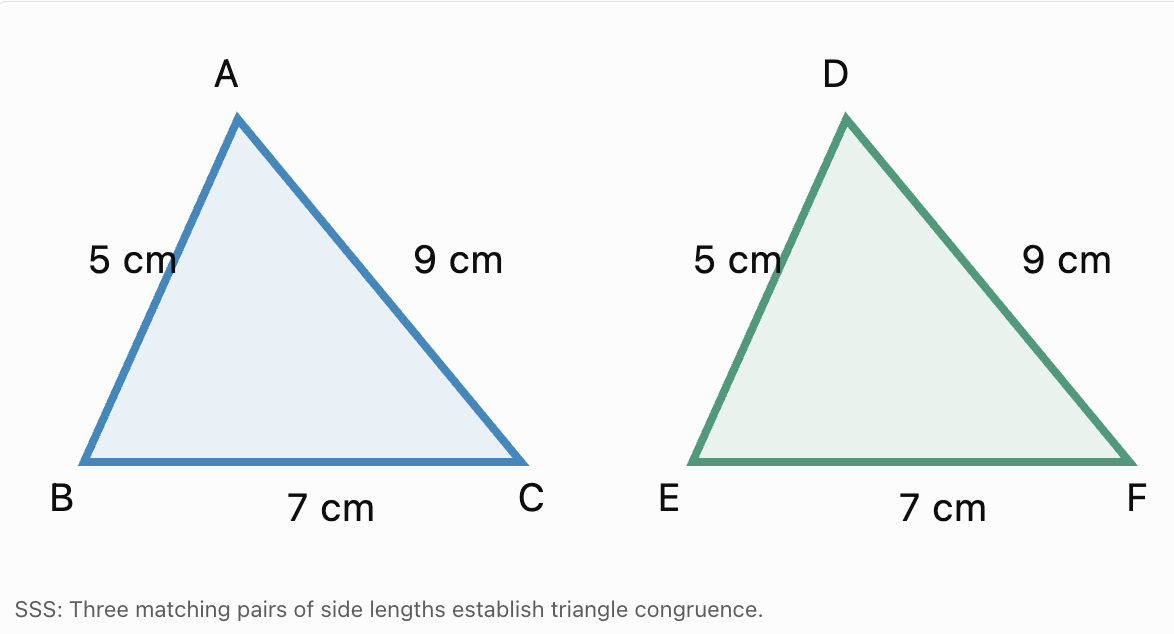
SSS stands for Side–Side–Side.
Two triangles are congruent if all three sides of one triangle are equal to the three corresponding sides of another triangle.
Conditions for SSS
We must know that:
-
One pair of corresponding sides is equal.
-
A second pair of corresponding sides is equal.
-
A third pair of corresponding sides is equal.
No angle measurements are required.
Worked Example: SSS
Triangle ABC has:
AB = 5 cm
BC = 7 cm
AC = 9 cm
Triangle DEF has:
DE = 5 cm
EF = 7 cm
DF = 9 cm
Step 1: Compare Corresponding Sides
AB = DE = 5 cm
BC = EF = 7 cm
AC = DF = 9 cm
Step 2: Apply the Congruence Test
All three pairs of corresponding sides are equal.
Therefore:
△ABC ≅ △DEF by SSS.
Why SSS Works
Three fixed side lengths determine a triangle's shape and size, provided they satisfy the triangle inequality.
Although the triangle can be rotated or reflected, the distances between its vertices remain unchanged.
The SAS Congruence Test
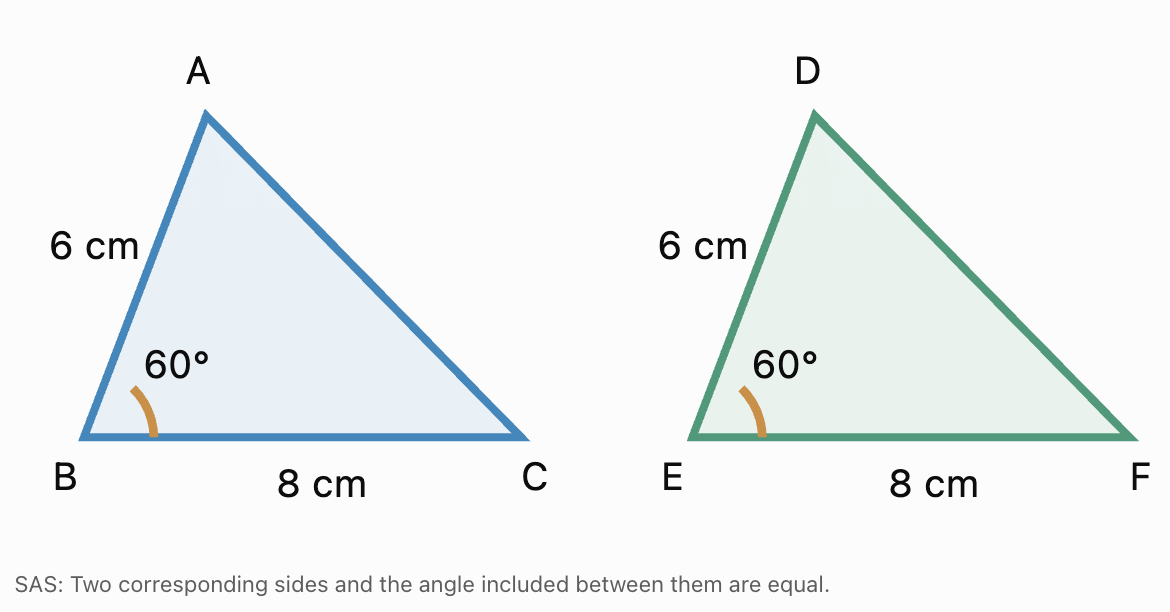
SAS stands for Side–Angle–Side.
Two triangles are congruent if:
-
Two corresponding sides are equal.
-
The included angle between those sides is equal.
The word included is extremely important.
The included angle is the angle formed by the two known sides.
Worked Example: SAS
Triangle ABC has:
AB = 6 cm
BC = 8 cm
∠ABC = 60°
Triangle DEF has:
DE = 6 cm
EF = 8 cm
∠DEF = 60°
Step 1: Compare the Sides
AB = DE
BC = EF
Step 2: Compare the Included Angles
∠ABC = ∠DEF = 60°
Both angles lie between the two known sides.
Step 3: Apply SAS
△ABC ≅ △DEF by SAS.
Why the Included Angle Matters
Two side lengths and an angle not between them do not always determine a unique triangle.
The position of the angle is essential.
The ASA Congruence Test
ASA stands for Angle–Side–Angle.
Two triangles are congruent if:
-
Two corresponding angles are equal.
-
The included side between those angles is equal.
Worked Example
Triangle ABC has:
∠A = 45°
∠B = 70°
AB = 8 cm
Triangle DEF has:
∠D = 45°
∠E = 70°
DE = 8 cm
Step 1: Compare Angles
∠A = ∠D = 45°
∠B = ∠E = 70°
Step 2: Compare Included Sides
AB = DE = 8 cm
The known side lies between the two known angles.
Step 3: Apply ASA
△ABC ≅ △DEF by ASA.
Finding the Third Angle
The angles in a triangle sum to 180°.
Therefore:
∠C = 180° − 45° − 70°
∠C = 65°
Similarly:
∠F = 65°
The third pair of angles is also equal.
The AAS Congruence Test
AAS stands for Angle–Angle–Side.
Two triangles are congruent if:
-
Two corresponding angles are equal.
-
One pair of corresponding non-included sides is equal.
The known side does not lie between the two known angles.
Worked Example
Triangle ABC has:
∠A = 40°
∠B = 75°
AC = 10 cm
Triangle DEF has:
∠D = 40°
∠E = 75°
DF = 10 cm
Step 1: Compare Angles
∠A = ∠D = 40°
∠B = ∠E = 75°
Step 2: Compare Sides
AC = DF = 10 cm
Step 3: Identify the Side Position
AC and DF are not the sides included between the two specified angles.
Step 4: Apply AAS
△ABC ≅ △DEF by AAS.
Why AAS Works
Knowing two angles determines the third angle because:
A + B + C = 180°
Therefore, AAS can be converted into ASA by calculating the missing angle.
This explains why AAS is a valid congruence test.
Comparing ASA and AAS
|
ASA |
AAS |
|---|---|
|
Two angles and a side |
Two angles and a side |
|
Known side is between the known angles |
Known side is not between the known angles |
|
Included side |
Non-included side |
|
Proves congruence |
Proves congruence |
Both are valid tests.


The HL Congruence Test
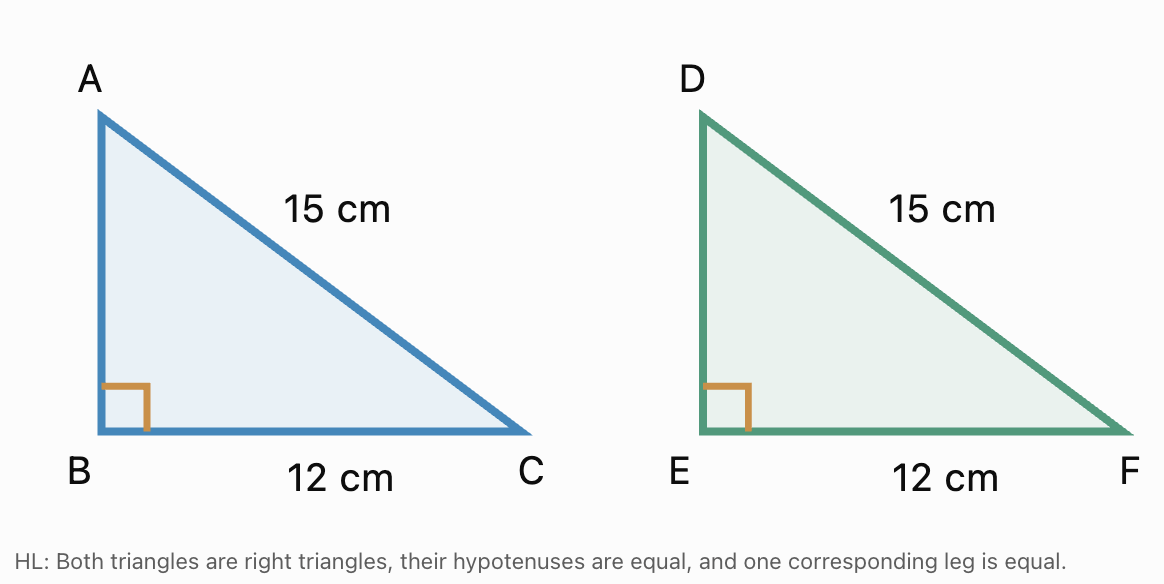
HL stands for Hypotenuse–Leg.
This test applies specifically to right triangles.
Two right triangles are congruent if:
-
Their hypotenuses are equal.
-
One pair of corresponding legs is equal.
Understanding Right Triangles
A right triangle contains one angle measuring 90°.
The hypotenuse is the side opposite the right angle.
It is always the longest side of a right triangle.
The other two sides are called legs.
Worked Example: HL
Triangle ABC is right-angled at B.
Triangle DEF is right-angled at E.
Given:
AC = DF = 15 cm
BC = EF = 12 cm
Step 1: Identify the Right Angles
∠B = ∠E = 90°
Step 2: Identify the Hypotenuses
AC and DF are opposite the right angles.
AC = DF = 15 cm
Step 3: Identify the Legs
BC = EF = 12 cm
Step 4: Apply HL
△ABC ≅ △DEF by HL.
Finding the Missing Leg
Using the Pythagorean theorem:
AB² + BC² = AC²
AB² + 12² = 15²
AB² + 144 = 225
AB² = 81
AB = 9 cm
Therefore:
DE = 9 cm
because corresponding sides of congruent triangles are equal.
Important Limitation
HL applies only to right triangles.
For non-right triangles, equal hypotenuse-like sides and another side do not establish congruence because the concept of a hypotenuse applies only to right triangles.
Comparing the Five Congruence Tests
|
Test |
Information required |
Special condition |
|---|---|---|
|
SSS |
Three corresponding sides |
All three side pairs equal |
|
SAS |
Two sides and one angle |
Angle must be included |
|
ASA |
Two angles and one side |
Side must be included |
|
AAS |
Two angles and one side |
Side is non-included |
|
HL |
Hypotenuse and one leg |
Both triangles must be right triangles |
Choosing the Correct Test
Ask:
-
What measurements or relationships are given?
-
Are three corresponding sides equal?
-
Are two sides and their included angle equal?
-
Are two angles and a corresponding side equal?
-
Are both triangles right triangles?
-
Is the known side a hypotenuse or a leg?
-
Is the available information sufficient to prove congruence?
The correct test depends on both the measurements and their positions in the triangles.
Conditions That Do Not Always Prove Congruence
Not every combination of equal measurements is sufficient.
Two common invalid tests are:
-
AAA: Angle–Angle–Angle.
-
SSA: Side–Side–Angle, in general.
Why AAA Does Not Prove Congruence
Suppose two triangles have angles:
40°, 60°, and 80°.
Both triangles have the same shape.
However, one triangle could be much larger than the other.
Equal angles establish similarity, not necessarily congruence.
Example
Triangle ABC has sides:
3 cm, 4 cm, 5 cm
Triangle DEF has sides:
6 cm, 8 cm, 10 cm
The corresponding angles are equal, but the triangles are not congruent.
AAA establishes similarity, not congruence.
Why SSA Does Not Always Prove Congruence
SSA provides:
-
Two side lengths.
-
An angle that is not included between those sides.
In some cases, this information can produce two different triangles.
This is called the ambiguous case.
Example
Suppose a triangle has:
-
An angle of 30°.
-
The side opposite that angle measuring 5 cm.
-
Another side measuring 8 cm.
Using the sine rule:
sin(B)/8 = sin(30°)/5
sin(B) = 8(0.5)/5
sin(B) = 0.8
This gives two possible angles:
B ≈ 53.13°
or:
B ≈ 126.87°
Both can produce valid triangles with different shapes.
Therefore, SSA does not generally guarantee congruence.
Exception
In right triangles, the HL test provides sufficient information because the right angle and hypotenuse relationship remove the ambiguity.
Using Congruence to Solve Unknown Side Lengths
Once two triangles are proven congruent, corresponding sides are equal.
Worked Example
Suppose:
△ABC ≅ △DEF
and:
AB = 3x + 2
DE = 17
Find x.
Step 1: Use Corresponding Sides
Since AB corresponds to DE:
3x + 2 = 17
Step 2: Solve
3x = 15
x = 5
Step 3: Verify
AB = 3(5) + 2 = 17
Therefore, AB = DE.
Solving Problems with Two Algebraic Expressions
Worked Example
Suppose:
△PQR ≅ △XYZ
and:
PQ = 4x − 3
XY = 2x + 9
Find x.
Step 1: Set Corresponding Sides Equal
4x − 3 = 2x + 9
Step 2: Solve
2x = 12
x = 6
Step 3: Calculate the Side Length
PQ = 4(6) − 3
PQ = 21
XY = 2(6) + 9
XY = 21
Both sides are equal, as expected.
Using Congruence to Solve Unknown Angles
Corresponding angles in congruent triangles are equal.
Worked Example
Suppose:
△ABC ≅ △DEF
and:
∠A = 4x + 10°
∠D = 70°
Find x.
Step 1: Use Corresponding Angles
4x + 10 = 70
Step 2: Solve
4x = 60
x = 15
Step 3: Verify
∠A = 4(15) + 10
∠A = 70°
Therefore, the corresponding angles are equal.
Combining Congruence with Angle Sums
Worked Example
Suppose:
△ABC ≅ △DEF
and triangle ABC has:
∠A = 45°
∠B = 65°
Find ∠F.
Step 1: Find the Third Angle
∠C = 180° − 45° − 65°
∠C = 70°
Step 2: Identify the Correspondence
Since:
△ABC ≅ △DEF
vertex C corresponds to vertex F.
Therefore:
∠F = 70°
This combines the triangle angle-sum rule with congruence.
Proving Congruence in Geometric Diagrams
Some problems involve triangles that share a side or contain vertical angles.
These situations require recognising geometric relationships that are not explicitly stated as measurements.
Shared Sides
If two triangles share a side, that side is equal to itself.
For example:
AC = AC
This is called the reflexive property.
Vertical Angles
When two lines intersect, vertically opposite angles are equal.
For example:
∠AOB = ∠COD
if the angles are vertically opposite.
Parallel Lines
Parallel lines can create equal:
-
Corresponding angles.
-
Alternate interior angles.
These angle relationships can help establish ASA or AAS congruence.
Worked Example: Shared Side
Suppose triangles ABC and ADC share side AC.
Given:
AB = AD
BC = DC
Prove the triangles are congruent.
Step 1: Identify Equal Sides
AB = AD — given.
BC = DC — given.
AC = AC — shared side.
Step 2: Apply SSS
All three pairs of corresponding sides are equal.
Therefore:
△ABC ≅ △ADC by SSS.
Step 3: Apply CPCTC
We can conclude:
∠BAC = ∠CAD
and:
∠BCA = ∠ACD
These angle relationships follow from congruence.
Worked Example: Vertical Angles and SAS
Two straight lines intersect at point O.
Suppose:
AO = CO
BO = DO
Prove:
△AOB ≅ △COD
Step 1: Identify Equal Sides
AO = CO — given.
BO = DO — given.
Step 2: Identify Equal Angles
∠AOB = ∠COD
because vertically opposite angles are equal.
Step 3: Apply SAS
The equal angles are included between the equal side pairs.
Therefore:
△AOB ≅ △COD by SAS.
Writing Formal Congruence Proofs
A geometric proof explains why a conclusion must be true.
A clear proof identifies:
-
The information given.
-
Relevant geometric relationships.
-
The congruence test.
-
The conclusion.
Example: Two-Column Proof
Given:
AB = DE
BC = EF
∠ABC = ∠DEF
Prove:
△ABC ≅ △DEF
|
Statement |
Reason |
|---|---|
|
AB = DE |
Given |
|
BC = EF |
Given |
|
∠ABC = ∠DEF |
Given |
|
△ABC ≅ △DEF |
SAS congruence |
Example: Paragraph Proof
AB = DE and BC = EF are given. The included angles ∠ABC and ∠DEF are also equal. Therefore, the two triangles have two pairs of equal corresponding sides and equal included angles. Hence, △ABC ≅ △DEF by SAS.
Both proof formats are acceptable when the reasoning is complete and mathematically correct.
A Proof Involving Parallel Lines
Suppose AB is parallel to CD, and diagonals AC and BD intersect at O.
Given:
AO = CO
Prove:
△AOB ≅ △COD
Step 1: Identify Equal Angles
Since AB is parallel to CD:
∠BAO = ∠DCO
These are alternate interior angles formed by transversal AC.
Step 2: Identify Another Pair of Equal Angles
∠AOB = ∠COD
These are vertically opposite angles.
Step 3: Identify Equal Sides
AO = CO — given.
Step 4: Apply ASA
The equal sides lie between the two equal angle pairs.
Therefore:
△AOB ≅ △COD by ASA.
Step 5: Draw Further Conclusions
By CPCTC:
AB = CD
and:
BO = DO
This demonstrates how triangle congruence can establish additional geometric properties.
Applications of Congruent Triangles
Congruent triangles appear in many real-world situations because triangular structures are rigid and maintain their shape when their side lengths are fixed.
Architecture and Construction
Triangular supports are used in:
-
Roof trusses.
-
Bridges.
-
Towers.
-
Structural frames.
Congruent triangular components help engineers maintain consistent dimensions.

Manufacturing
Congruent shapes are important in:
-
Precision-cutting processes.
-
Machine components.
-
Construction panels.
-
Repeated structural elements.
Components must often match exactly to fit together correctly.
Design and Art
Congruent triangles appear in:
-
Tessellations.
-
Geometric patterns.
-
Decorative tiles.
-
Symmetrical artwork.


Surveying and Measurement
Surveyors use triangles to determine distances and positions.
Known side lengths and angles can help establish geometric relationships without measuring every distance directly.
Congruence provides a way to verify that two triangular arrangements have identical dimensions.
Worked Application: Symmetrical Roof Structure
A roof structure contains two triangular supports, ABC and DEF.
The supports have corresponding side lengths:
AB = DE = 3 m
BC = EF = 4 m
AC = DF = 5 m
Step 1: Identify the Congruence Test
All three corresponding side lengths are equal.
Therefore:
△ABC ≅ △DEF by SSS.
Step 2: Interpret
The triangular supports have the same shape and size.
Their corresponding angles are also equal.
Step 3: Practical Significance
Congruent supports help ensure consistent geometry and alignment in the structure.
However, congruence alone does not prove that a structure can safely support a particular load. Material properties, joints, and forces must also be considered.
Worked Application: Measuring an Unknown Distance
Two congruent triangular frames are constructed.
In the first triangle:
AB = 2x + 4 cm
In the second triangle, the corresponding side is:
DE = 30 cm
Find x.
Step 1: Use Congruence
AB = DE
2x + 4 = 30
Step 2: Solve
2x = 26
x = 13
Step 3: Verify
AB = 2(13) + 4
AB = 30 cm
The corresponding sides are equal.
A Systematic Method for Congruence Problems
When solving a problem involving congruent triangles, use the following procedure.
Identify the Triangles
Determine which two triangles are being compared.
Match Corresponding Vertices
Identify which vertices, sides, and angles correspond.
Record the Given Information
List the equal side lengths and angle measures.
Identify Additional Relationships
Look for:
-
Shared sides.
-
Vertical angles.
-
Parallel-line angle relationships.
-
Right angles.
-
Equal radii.
-
Bisected segments or angles.
Select the Congruence Test
Choose SSS, SAS, ASA, AAS, or HL.
Justify the Congruence
Explain why the selected test applies.
Apply CPCTC
Use corresponding equal sides or angles to solve additional parts of the problem.
Verify
Check that the correspondence, calculations, and conclusion are consistent.
Common Mistakes
Confusing congruence with similarity
Congruent figures have equal corresponding side lengths, not merely proportional sides.
Using AAA as a congruence test
Equal angles establish similarity but not necessarily congruence.
Using SSA as a general congruence test
SSA can produce more than one possible triangle.
Misidentifying the included angle in SAS
The angle must lie between the two known sides.
Confusing ASA with AAS
ASA uses the included side; AAS uses a non-included side.
Applying HL to triangles that are not right triangles
HL requires both triangles to contain a right angle.
Confusing the hypotenuse with a leg
The hypotenuse is opposite the right angle.
Writing vertices in the wrong order
Congruence statements must preserve corresponding vertex order.
Assuming two triangles are congruent because they look alike
Visual appearance is not sufficient mathematical proof.
Using CPCTC before proving congruence
Corresponding parts can be concluded equal only after congruence has been established.
Failing to state the congruence criterion
A complete proof should identify the relevant test.
Ignoring shared sides or vertical angles
These relationships often provide missing information needed for a proof.
Making unsupported conclusions
Every statement in a geometric proof must follow from given information or an established theorem.
Key Terms
-
Congruent Figures: Figures with exactly the same shape and size.
-
Congruent Triangles: Triangles whose corresponding sides and angles are equal.
-
Congruence Symbol (≅): A symbol meaning "is congruent to."
-
Corresponding Vertices: Vertices that occupy matching positions in congruent figures.
-
Corresponding Sides: Sides that match in position and length.
-
Corresponding Angles: Angles that match in position and measure.
-
Rigid Transformation: A transformation that preserves distances and angle measures.
-
Translation: A transformation that slides a figure.
-
Rotation: A transformation that turns a figure around a fixed point.
-
Reflection: A transformation that flips a figure across a line.
-
Similarity: A relationship between figures having the same shape but not necessarily the same size.
-
SSS Congruence: A test using three equal pairs of corresponding sides.
-
SAS Congruence: A test using two equal side pairs and their equal included angles.
-
ASA Congruence: A test using two equal angle pairs and their equal included sides.
-
AAS Congruence: A test using two equal angle pairs and an equal non-included side pair.
-
HL Congruence: A right-triangle test using equal hypotenuses and one equal pair of legs.
-
Included Angle: The angle formed by two specified sides.
-
Included Side: The side between two specified angles.
-
Hypotenuse: The side opposite the right angle in a right triangle.
-
Leg: Either of the two sides forming the right angle in a right triangle.
-
Right Triangle: A triangle containing one 90° angle.
-
Triangle Inequality: The requirement that the sum of any two side lengths of a triangle exceeds the third side.
-
AAA: Three equal angle pairs, which establish similarity but not necessarily congruence.
-
SSA: Two side pairs and a non-included angle pair, which do not generally establish congruence.
-
Ambiguous Case: A situation in which given triangle measurements can produce more than one possible triangle.
-
CPCTC: Corresponding Parts of Congruent Triangles are Congruent.
-
Reflexive Property: The principle that a quantity is equal to itself.
-
Vertical Angles: Opposite angles formed by intersecting lines.
-
Alternate Interior Angles: Angles on opposite sides of a transversal and inside two lines.
-
Geometric Proof: A logical argument establishing a mathematical conclusion.
-
Two-Column Proof: A proof organised into statements and reasons.
-
Triangle Angle-Sum Theorem: The theorem stating that the interior angles of a triangle sum to 180°.
-
Pythagorean Theorem: The relationship a² + b² = c² in a right triangle.
-
Geometric Justification: A mathematical explanation supporting a geometric conclusion.
Key Takeaways
-
Congruent triangles have exactly the same shape and size.
-
Corresponding sides of congruent triangles have equal lengths.
-
Corresponding angles of congruent triangles have equal measures.
-
Congruent figures may be translated, rotated, or reflected without losing congruence.
-
Congruence differs from similarity because congruent figures must also have equal sizes.
-
SSS proves congruence using three pairs of equal corresponding sides.
-
SAS proves congruence using two pairs of equal sides and their included angles.
-
ASA proves congruence using two pairs of equal angles and their included sides.
-
AAS proves congruence using two pairs of equal angles and a non-included side.
-
HL proves congruence for right triangles using the hypotenuse and one leg.
-
AAA does not establish congruence because triangles can have equal angles but different sizes.
-
SSA does not generally establish congruence because it may produce two different triangles.
-
Corresponding vertices must be written in the correct order in congruence statements.
-
Shared sides, vertical angles, and parallel-line relationships can help establish congruence.
-
Once triangles are proven congruent, CPCTC allows us to conclude that their corresponding parts are equal.
-
Congruence can be used to calculate unknown side lengths and angle measures.
-
Formal proofs should contain clear statements supported by valid geometric reasons.
-
Triangle congruence is useful in construction, manufacturing, architecture, surveying, and geometric design.
-
The most important skill is selecting the correct congruence test and explaining why the available information satisfies its conditions.
Check Your Understanding
Recall and Understanding
-
Define congruent triangles and explain how they differ from similar triangles.
-
List the five triangle congruence tests and explain what each requires.
-
Explain why the included angle is important in SAS.
-
Explain why AAA does not prove triangle congruence.
-
Describe why HL can only be applied to right triangles.
Application
-
Triangle ABC has side lengths 5 cm, 8 cm, and 10 cm. Triangle DEF has corresponding side lengths 5 cm, 8 cm, and 10 cm. State whether the triangles are congruent and justify your answer.
-
Two triangles have two corresponding sides of 6 cm and 9 cm, with included angles of 50°. Identify the congruence test.
-
Two triangles have corresponding angles of 40° and 70°, and an equal side between those angles. Identify the congruence test and calculate the third angle.
-
If △ABC ≅ △DEF, AB = 3x + 4, and DE = 25, find x.
-
Two right triangles have hypotenuses of 13 cm and corresponding legs of 5 cm. Explain why they are congruent and calculate the other leg.
Analysis and Challenge
-
Two triangles share side AC. Given AB = AD and BC = DC, prove that △ABC ≅ △ADC.
-
Two lines intersect at O. Given AO = CO and BO = DO, prove that △AOB ≅ △COD.
-
Explain why SSA can produce two different triangles, using an example or labelled sketch.
-
A pair of congruent triangles has corresponding angles expressed as 3x + 10° and 5x − 20°. Determine x and the common angle.
-
A bridge design contains two triangular supports. Each has two corresponding sides measuring 4 m and 6 m, with the included angle measuring 75°. Prove that the supports are congruent and explain why this information is useful in construction.
Final Summary
Congruent triangles have identical shapes and sizes, with equal corresponding sides and angles.
Triangle congruence can be established using five important tests: SSS, SAS, ASA, AAS, and HL.
Each test requires a particular combination of side and angle information.
Not every combination is sufficient. AAA establishes similarity, while SSA does not generally guarantee congruence.
Once triangles have been proven congruent, the principle of CPCTC allows additional side lengths and angle measures to be determined.
Congruence proofs often involve shared sides, vertical angles, parallel lines, and other geometric relationships.
These ideas are important in geometric problem solving and have practical applications in architecture, construction, engineering, and design.
The central principle is that proving triangle congruence requires identifying corresponding parts, selecting a valid congruence criterion, and providing clear mathematical justification for the conclusion.